BOLD PERSONALITIES 
FROM INDIAN HISTORY 
Information Technology 
Enrollment Nos. 110110116056-110110116063 & 
10-039
Who is a Bold Personality? 
• In the context of sociability, a bold person 
may be willing to risk shame or rejection in 
social situations, and willing to bend rules of 
etiquette or politeness. 
• Outside a social context, "boldness" can also 
refer to a willingness to get things done, 
even despite risks, and is therefore broadly 
synonymous with bravery.
1. Fearless and daring; courageous. 
2. Requiring or exhibiting courage and bravery. 
3. Confident and ambitious. 
4. Ready to take risks
• A person who is not afraid to speak up for 
what he believes, even to people with more 
power than him, is an example of someone 
who is bold.
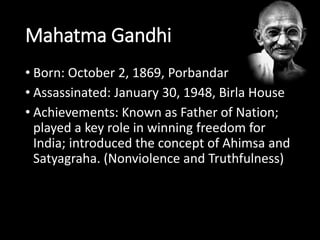
Mahatma Gandhi 
• Born: October 2, 1869, Porbandar 
• Assassinated: January 30, 1948, Birla House 
• Achievements: Known as Father of Nation; 
played a key role in winning freedom for 
India; introduced the concept of Ahimsa and 
Satyagraha. (Nonviolence and Truthfulness)
• Gandhiji organised the Indian community in 
South Africa and asked them to forget all 
distinctions of religion and caste. 
• He helped found the Natal Indian 
Congress in 1894, and through this 
organisation, he moulded the Indian 
community of South Africa into a unified 
political force.
• At a mass protest meeting held in 
Johannesburg on 11 September that year, 
Gandhi adopted his still evolving 
methodology of Satyagraha(holding fast to 
truth or firmness in a righteous cause), or 
non-violent protest, for the first time. He 
urged Indians to defy the new law and to 
suffer the punishments for doing so.
• Gandhiji's Satyagraha forced British 
government to set up a inquiry into the 
condition of tenant farmers. 
• In 1921, Gandhiji gave the call for Non-cooperation 
movement against the ills 
(Jallianwala Bagh Massacre Incident) of 
British rule. Gandhiji's call roused the 
sleeping nation.
• His Birthday October 2 is commemorated 
as Gandhi Jayanti, a national holiday, and 
world-wide as the International Day of Non- 
Violence. 
• Gandhi's date of death, 30 January, is 
commemorated as a Martyrs' Day in India. 
• In 2007, the United Nations General 
Assembly declared Gandhi's birthday 2 
October as “the International Day of Non- 
Violence”.
• "An eye for an eye only ends up making the 
whole world blind." – Mahatma Gandhi
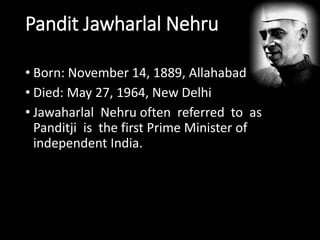
Pandit Jawharlal Nehru 
• Born: November 14, 1889, Allahabad 
• Died: May 27, 1964, New Delhi 
• Jawaharlal Nehru often referred to as 
Panditji is the first Prime Minister of 
independent India.
• His birthday, November 14, is celebrated in 
India as Baal Divas ("Children's Day") in 
recognition of his lifelong passion and work 
on behalf of children and young people. 
• Nehru family changed its family according to 
Mahatma Gandhi's teachings. Jawaharlal and 
Motilal Nehru abandoned western clothes 
and tastes for expensive possessions and 
pastimes. They now wore a Khadi Kurta and 
Gandhi cap.
• Jawaharlal Nehru took active part in the Non- 
Cooperation Movement 1920-1922 and was 
arrested for the first time during the movement. 
He was released after few months. 
• Jawaharlal Nehru was arrested in 1942 
during Quit India Movement. Released in 
1945, he took a leading part in the 
negotiations that culminated in the emergence 
of the dominions of India and Pakistan in August 
1947.
• Signed treaties with Pakistan and China 
• In 1955 Nehru was awarded Bharat Ratna, 
India's highest civilian honour.
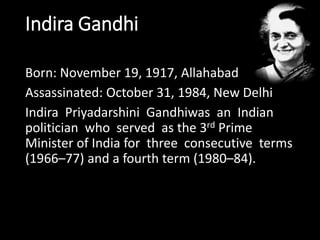
Indira Gandhi 
Born: November 19, 1917, Allahabad 
Assassinated: October 31, 1984, New Delhi 
Indira Priyadarshini Gandhiwas an Indian 
politician who served as the 3rd Prime 
Minister of India for three consecutive terms 
(1966–77) and a fourth term (1980–84).
• Gandhi was the second female head of 
government in the world after Sirimavo 
Bandaranaike of Sri Lanka and she remains 
as the world's second longest serving female 
Prime Minister as of 2012. 
• She was the first woman to become prime 
minister in India. 
• She was the first woman to Receive Bharat 
Ratna Award in 1971.
• She was also the only Indian Prime Minister 
to have declared a state of emergency in 
order to 'rule by decree' and the only Indian 
Prime Minister to have been imprisoned 
after holding that office. 
• Shortly after their marriage both Indira 
Gandhi and Feroze Gandhi were arrested 
and jailed for nationalist activities.
• In 1959, Indira Gandhi became President of 
the Indian National Congress. 
• Signed several treaties with Soviet Union. 
• Indira Gandhi campaigned fiercely on the 
slogan of "Garibi Hatao" (eliminate 
poverty)during the fifth general elections in 
March 1971 and won an unprecedented 
two-third majority.
• In 1975, Prime Minister Indira Gandhi 
declared a state of internal emergency after 
she was indicted in a corruption scandal and 
ordered to vacate her seat in the Indian 
Parliament, allowing herself to rule by 
decree until 1977 and and jailed all her 
political opponents. The Emergency lasted 
till March 1977.
• The day before her death Indira Gandhi 
visited Orissa on 30 October 1984 where 
she gave her last speech: 
• "I am alive today; I may not be there 
tomorrow. I shall continue to serve till my 
last breath and when I die every drop of my 
blood will strengthen India and keep a united 
India alive."
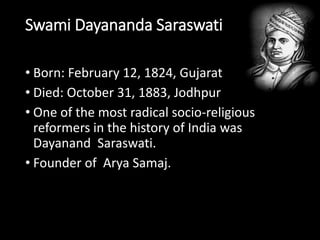
Swami Dayananda Saraswati 
• Born: February 12, 1824, Gujarat 
• Died: October 31, 1883, Jodhpur 
• One of the most radical socio-religious 
reformers in the history of India was 
Dayanand Saraswati. 
• Founder of Arya Samaj.
• Propagated egalitarian approach of the 
Vedas at a time when widespread casteism 
was prevalent in the society. 
• He has established gurukuls to impart 
Vedic education. 
• His parents decided to marry him off in his 
early teens which was very common in 19th 
century India, but he decided marriage was 
not for him and ran away from home.
• He made fiery speeches condemning the 
caste system, idolatry, and child marriages. 
• Dayanand Saraswati being the first leader in 
the field of theology who welcomed the 
advances of sciences and technology. 
• Dayanand Saraswati founded Arya Samaj 
in Mumbai in 1875 to promote social 
service.
• Swami Dayananda`s creation, the Arya 
Samaj, is a unique component in Hinduism. 
Arya Samaj, postulates in principle equal 
justice for all men and all nations, together 
with equality of the sexes. The Arya Samaj 
condemns idol-worship, animal sacrifices, 
ancestor worship, pilgrimages, priestcraft, 
offerings made in temples, the caste system, 
untouchability, and child marriages.
Netaji Subhash Chandra Bose 
• Born: January 23, 1897, Cuttack 
• Died: Unknown 
• Subhash Chandra Bose, affectionately called 
as Netaji, was one of the most prominent 
leaders of Indian freedom struggle. 
• He founded Indian National Army (Azad Hind 
Fauj)to overthrow British Empire from India 
and came to acquire legendary status among 
Indian masses.
• He came 4th in the ICS examination and 
was selected but he did not want to work 
under an alien government which would 
mean serving the British. He resigned from 
the civil service job and returned to India in 
1921. 
• In 1927, after being released from prison, 
Bose became general secretary of the 
Congress party and worked with Jawaharlal 
Nehru for independence.
• Subash Chandra Bose was soon arrested 
again under the infamous Bengal 
Regulation. After a year he was released on 
medical grounds and was banished from 
India to Europe. 
• Defying the ban on his entry to India, Subash 
Chandra Bose returned to India and was 
again arrested and jailed for a year.
• Bose most famous quote was: 
“Give me blood, and I shall give you freedom!” 
• Jai Hind, or, "Glory to India!“ was another 
slogan used by him and later adopted by the 
Government of India and the Indian Armed 
Forces. 
• The West Bengal government decided in 2011 
to observe Bose's birth anniversay (23 January) 
as Desh Prem Divas which means Day of 
Patriotism.
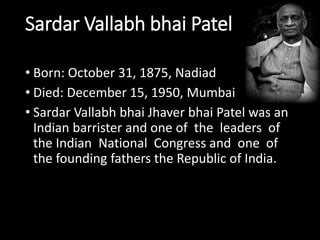
Sardar Vallabh bhai Patel 
• Born: October 31, 1875, Nadiad 
• Died: December 15, 1950, Mumbai 
• Sardar Vallabh bhai Jhaver bhai Patel was an 
Indian barrister and one of the leaders of 
the Indian National Congress and one of 
the founding fathers the Republic of India.
• He was independent India's first Deputy 
Prime Minister and first Home Minister. 
• He is also regarded as the "Bismarck of 
India" and "Iron Man of India".
• In 1928, Bardoli Talukain Gujarat suffered 
from floods and famine. 
• In this hour of distress the British 
government raised the revenue taxes by 
thirty percent. Sardar Patel took up cudgels 
on behalf of the farmers and appealed to the 
Governor to reduce the taxes. The Governor 
refused and the government even 
announced the date of the collection of 
the taxes.
• Sardar Patel organized the farmers and 
told them not to pay even a single pie 
of tax. The government tried to repress 
the revolt but ultimately bowed before 
Vallabhbhai Patel. 
• Patel was officially awarded the Bharat 
Ratna, India's highest civilian honour 
posthumously in 1991. 
• Patel's birthday, 31 October, is celebrated 
nationally in India as Sardar Jayanti.
Qualities Learned from them 
• Determination. 
• Courage. 
• Faith in yourself. 
• Resilience. 
• Fearlessness. 
• Self confidence. 
• Hard work.
QUESTIONS? 
THANK YOU

G9-pre

  • 1.
    BOLD PERSONALITIES FROMINDIAN HISTORY Information Technology Enrollment Nos. 110110116056-110110116063 & 10-039
  • 2.
    Who is aBold Personality? • In the context of sociability, a bold person may be willing to risk shame or rejection in social situations, and willing to bend rules of etiquette or politeness. • Outside a social context, "boldness" can also refer to a willingness to get things done, even despite risks, and is therefore broadly synonymous with bravery.
  • 3.
    1. Fearless anddaring; courageous. 2. Requiring or exhibiting courage and bravery. 3. Confident and ambitious. 4. Ready to take risks
  • 4.
    • A personwho is not afraid to speak up for what he believes, even to people with more power than him, is an example of someone who is bold.
  • 5.
    Mahatma Gandhi •Born: October 2, 1869, Porbandar • Assassinated: January 30, 1948, Birla House • Achievements: Known as Father of Nation; played a key role in winning freedom for India; introduced the concept of Ahimsa and Satyagraha. (Nonviolence and Truthfulness)
  • 6.
    • Gandhiji organisedthe Indian community in South Africa and asked them to forget all distinctions of religion and caste. • He helped found the Natal Indian Congress in 1894, and through this organisation, he moulded the Indian community of South Africa into a unified political force.
  • 7.
    • At amass protest meeting held in Johannesburg on 11 September that year, Gandhi adopted his still evolving methodology of Satyagraha(holding fast to truth or firmness in a righteous cause), or non-violent protest, for the first time. He urged Indians to defy the new law and to suffer the punishments for doing so.
  • 8.
    • Gandhiji's Satyagrahaforced British government to set up a inquiry into the condition of tenant farmers. • In 1921, Gandhiji gave the call for Non-cooperation movement against the ills (Jallianwala Bagh Massacre Incident) of British rule. Gandhiji's call roused the sleeping nation.
  • 9.
    • His BirthdayOctober 2 is commemorated as Gandhi Jayanti, a national holiday, and world-wide as the International Day of Non- Violence. • Gandhi's date of death, 30 January, is commemorated as a Martyrs' Day in India. • In 2007, the United Nations General Assembly declared Gandhi's birthday 2 October as “the International Day of Non- Violence”.
  • 10.
    • "An eyefor an eye only ends up making the whole world blind." – Mahatma Gandhi
  • 11.
    Pandit Jawharlal Nehru • Born: November 14, 1889, Allahabad • Died: May 27, 1964, New Delhi • Jawaharlal Nehru often referred to as Panditji is the first Prime Minister of independent India.
  • 12.
    • His birthday,November 14, is celebrated in India as Baal Divas ("Children's Day") in recognition of his lifelong passion and work on behalf of children and young people. • Nehru family changed its family according to Mahatma Gandhi's teachings. Jawaharlal and Motilal Nehru abandoned western clothes and tastes for expensive possessions and pastimes. They now wore a Khadi Kurta and Gandhi cap.
  • 13.
    • Jawaharlal Nehrutook active part in the Non- Cooperation Movement 1920-1922 and was arrested for the first time during the movement. He was released after few months. • Jawaharlal Nehru was arrested in 1942 during Quit India Movement. Released in 1945, he took a leading part in the negotiations that culminated in the emergence of the dominions of India and Pakistan in August 1947.
  • 14.
    • Signed treatieswith Pakistan and China • In 1955 Nehru was awarded Bharat Ratna, India's highest civilian honour.
  • 15.
    Indira Gandhi Born:November 19, 1917, Allahabad Assassinated: October 31, 1984, New Delhi Indira Priyadarshini Gandhiwas an Indian politician who served as the 3rd Prime Minister of India for three consecutive terms (1966–77) and a fourth term (1980–84).
  • 16.
    • Gandhi wasthe second female head of government in the world after Sirimavo Bandaranaike of Sri Lanka and she remains as the world's second longest serving female Prime Minister as of 2012. • She was the first woman to become prime minister in India. • She was the first woman to Receive Bharat Ratna Award in 1971.
  • 17.
    • She wasalso the only Indian Prime Minister to have declared a state of emergency in order to 'rule by decree' and the only Indian Prime Minister to have been imprisoned after holding that office. • Shortly after their marriage both Indira Gandhi and Feroze Gandhi were arrested and jailed for nationalist activities.
  • 18.
    • In 1959,Indira Gandhi became President of the Indian National Congress. • Signed several treaties with Soviet Union. • Indira Gandhi campaigned fiercely on the slogan of "Garibi Hatao" (eliminate poverty)during the fifth general elections in March 1971 and won an unprecedented two-third majority.
  • 19.
    • In 1975,Prime Minister Indira Gandhi declared a state of internal emergency after she was indicted in a corruption scandal and ordered to vacate her seat in the Indian Parliament, allowing herself to rule by decree until 1977 and and jailed all her political opponents. The Emergency lasted till March 1977.
  • 20.
    • The daybefore her death Indira Gandhi visited Orissa on 30 October 1984 where she gave her last speech: • "I am alive today; I may not be there tomorrow. I shall continue to serve till my last breath and when I die every drop of my blood will strengthen India and keep a united India alive."
  • 21.
    Swami Dayananda Saraswati • Born: February 12, 1824, Gujarat • Died: October 31, 1883, Jodhpur • One of the most radical socio-religious reformers in the history of India was Dayanand Saraswati. • Founder of Arya Samaj.
  • 22.
    • Propagated egalitarianapproach of the Vedas at a time when widespread casteism was prevalent in the society. • He has established gurukuls to impart Vedic education. • His parents decided to marry him off in his early teens which was very common in 19th century India, but he decided marriage was not for him and ran away from home.
  • 23.
    • He madefiery speeches condemning the caste system, idolatry, and child marriages. • Dayanand Saraswati being the first leader in the field of theology who welcomed the advances of sciences and technology. • Dayanand Saraswati founded Arya Samaj in Mumbai in 1875 to promote social service.
  • 24.
    • Swami Dayananda`screation, the Arya Samaj, is a unique component in Hinduism. Arya Samaj, postulates in principle equal justice for all men and all nations, together with equality of the sexes. The Arya Samaj condemns idol-worship, animal sacrifices, ancestor worship, pilgrimages, priestcraft, offerings made in temples, the caste system, untouchability, and child marriages.
  • 25.
    Netaji Subhash ChandraBose • Born: January 23, 1897, Cuttack • Died: Unknown • Subhash Chandra Bose, affectionately called as Netaji, was one of the most prominent leaders of Indian freedom struggle. • He founded Indian National Army (Azad Hind Fauj)to overthrow British Empire from India and came to acquire legendary status among Indian masses.
  • 26.
    • He came4th in the ICS examination and was selected but he did not want to work under an alien government which would mean serving the British. He resigned from the civil service job and returned to India in 1921. • In 1927, after being released from prison, Bose became general secretary of the Congress party and worked with Jawaharlal Nehru for independence.
  • 27.
    • Subash ChandraBose was soon arrested again under the infamous Bengal Regulation. After a year he was released on medical grounds and was banished from India to Europe. • Defying the ban on his entry to India, Subash Chandra Bose returned to India and was again arrested and jailed for a year.
  • 28.
    • Bose mostfamous quote was: “Give me blood, and I shall give you freedom!” • Jai Hind, or, "Glory to India!“ was another slogan used by him and later adopted by the Government of India and the Indian Armed Forces. • The West Bengal government decided in 2011 to observe Bose's birth anniversay (23 January) as Desh Prem Divas which means Day of Patriotism.
  • 29.
    Sardar Vallabh bhaiPatel • Born: October 31, 1875, Nadiad • Died: December 15, 1950, Mumbai • Sardar Vallabh bhai Jhaver bhai Patel was an Indian barrister and one of the leaders of the Indian National Congress and one of the founding fathers the Republic of India.
  • 30.
    • He wasindependent India's first Deputy Prime Minister and first Home Minister. • He is also regarded as the "Bismarck of India" and "Iron Man of India".
  • 31.
    • In 1928,Bardoli Talukain Gujarat suffered from floods and famine. • In this hour of distress the British government raised the revenue taxes by thirty percent. Sardar Patel took up cudgels on behalf of the farmers and appealed to the Governor to reduce the taxes. The Governor refused and the government even announced the date of the collection of the taxes.
  • 32.
    • Sardar Patelorganized the farmers and told them not to pay even a single pie of tax. The government tried to repress the revolt but ultimately bowed before Vallabhbhai Patel. • Patel was officially awarded the Bharat Ratna, India's highest civilian honour posthumously in 1991. • Patel's birthday, 31 October, is celebrated nationally in India as Sardar Jayanti.
  • 33.
    Qualities Learned fromthem • Determination. • Courage. • Faith in yourself. • Resilience. • Fearlessness. • Self confidence. • Hard work.
  • 34.