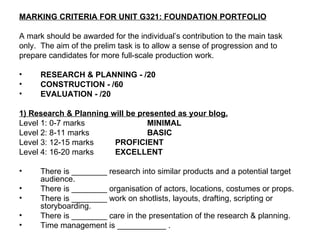
MARKING CRITERIA FOR UNIT G321: FOUNDATION PORTFOLIO A mark should be awarded for the individual’s contribution to the main task only.  The aim of the prelim task is to allow a sense of progression and to prepare candidates for more full-scale production work. RESEARCH & PLANNING - /20 CONSTRUCTION - /60 EVALUATION - /20 1) Research & Planning will be presented as your blog. Level 1: 0-7 marks MINIMAL Level 2: 8-11 marks BASIC Level 3: 12-15 marks PROFICIENT Level 4: 16-20 marks EXCELLENT There is ________ research into similar products and a potential target audience. There is ________ organisation of actors, locations, costumes or props. There is ________ work on shotlists, layouts, drafting, scripting or storyboarding. There is ________ care in the presentation of the research & planning. Time management is ___________ .
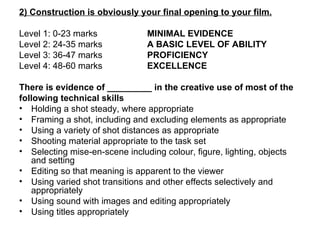
2) Construction is obviously your final opening to your film. Level 1: 0-23 marks MINIMAL EVIDENCE Level 2: 24-35 marks A   BASIC LEVEL OF ABILITY Level 3: 36-47 marks PROFICIENCY Level 4: 48-60 marks EXCELLENCE There is evidence of _________ in the creative use of most of the following technical skills Holding a shot steady, where appropriate Framing a shot, including and excluding elements as appropriate Using a variety of shot distances as appropriate Shooting material appropriate to the task set Selecting mise-en-scene including colour, figure, lighting, objects and setting Editing so that meaning is apparent to the viewer Using varied shot transitions and other effects selectively and appropriately Using sound with images and editing appropriately Using titles appropriately
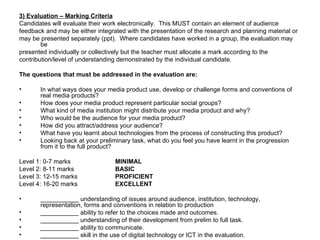
3) Evaluation – Marking Criteria Candidates will evaluate their work electronically.  This MUST contain an element of audience feedback and may be either integrated with the presentation of the research and planning material or may be presented separately (ppt).  Where candidates have worked in a group, the evaluation may be presented individually or collectively but the teacher must allocate a mark according to the contribution/level of understanding demonstrated by the individual candidate. The questions that must be addressed in the evaluation are: In what ways does your media product use, develop or challenge forms and conventions of real media products? How does your media product represent particular social groups? What kind of media institution might distribute your media product and why? Who would be the audience for your media product? How did you attract/address your audience? What have you learnt about technologies from the process of constructing this product? Looking back at your preliminary task, what do you feel you have learnt in the progression from it to the full product? Level 1: 0-7 marks MINIMAL Level 2: 8-11 marks BASIC Level 3: 12-15 marks PROFICIENT Level 4: 16-20 marks EXCELLENT ___________ understanding of issues around audience, institution, technology, representation, forms and conventions in relation to production ___________ ability to refer to the choices made and outcomes. ___________ understanding of their development from prelim to full task. ___________ ability to communicate. ___________ skill in the use of digital technology or ICT in the evaluation.

G321 Marking Criteria

  • 1.
    MARKING CRITERIA FORUNIT G321: FOUNDATION PORTFOLIO A mark should be awarded for the individual’s contribution to the main task only. The aim of the prelim task is to allow a sense of progression and to prepare candidates for more full-scale production work. RESEARCH & PLANNING - /20 CONSTRUCTION - /60 EVALUATION - /20 1) Research & Planning will be presented as your blog. Level 1: 0-7 marks MINIMAL Level 2: 8-11 marks BASIC Level 3: 12-15 marks PROFICIENT Level 4: 16-20 marks EXCELLENT There is ________ research into similar products and a potential target audience. There is ________ organisation of actors, locations, costumes or props. There is ________ work on shotlists, layouts, drafting, scripting or storyboarding. There is ________ care in the presentation of the research & planning. Time management is ___________ .
  • 2.
    2) Construction isobviously your final opening to your film. Level 1: 0-23 marks MINIMAL EVIDENCE Level 2: 24-35 marks A BASIC LEVEL OF ABILITY Level 3: 36-47 marks PROFICIENCY Level 4: 48-60 marks EXCELLENCE There is evidence of _________ in the creative use of most of the following technical skills Holding a shot steady, where appropriate Framing a shot, including and excluding elements as appropriate Using a variety of shot distances as appropriate Shooting material appropriate to the task set Selecting mise-en-scene including colour, figure, lighting, objects and setting Editing so that meaning is apparent to the viewer Using varied shot transitions and other effects selectively and appropriately Using sound with images and editing appropriately Using titles appropriately
  • 3.
    3) Evaluation –Marking Criteria Candidates will evaluate their work electronically. This MUST contain an element of audience feedback and may be either integrated with the presentation of the research and planning material or may be presented separately (ppt). Where candidates have worked in a group, the evaluation may be presented individually or collectively but the teacher must allocate a mark according to the contribution/level of understanding demonstrated by the individual candidate. The questions that must be addressed in the evaluation are: In what ways does your media product use, develop or challenge forms and conventions of real media products? How does your media product represent particular social groups? What kind of media institution might distribute your media product and why? Who would be the audience for your media product? How did you attract/address your audience? What have you learnt about technologies from the process of constructing this product? Looking back at your preliminary task, what do you feel you have learnt in the progression from it to the full product? Level 1: 0-7 marks MINIMAL Level 2: 8-11 marks BASIC Level 3: 12-15 marks PROFICIENT Level 4: 16-20 marks EXCELLENT ___________ understanding of issues around audience, institution, technology, representation, forms and conventions in relation to production ___________ ability to refer to the choices made and outcomes. ___________ understanding of their development from prelim to full task. ___________ ability to communicate. ___________ skill in the use of digital technology or ICT in the evaluation.