EXPOSURE
By Wilfred Owen
http://www.youtube.com/watch?v=3zDnzb06Kfc


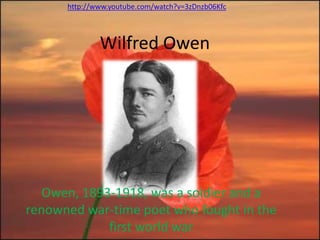
              Wilfred Owen


   Owen, 1893-1918, was a soldier and a
renowned war-time poet who fought in the
             first world war
Exposure
   Exposure is about the journey of the war, how
  there is endless waiting around for an attack in
 awful conditions; it depicts the dying emotions of
 the men, almost making them immune to what is
happening around them, it is based on Owens own
        experience on the frontline in 1917
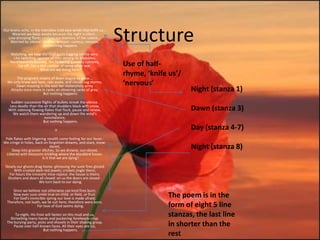
Our brains ache, in the merciless iced east winds that knife us...
     Wearied we keep awake because the night is silent...
  Low drooping flares confuse our memory of the salient...
    Worried by silence, sentries whisper, curious, nervous,
                         But nothing happens.
                                                                     Structure
    Watching, we hear the mad gusts tugging on the wire.
     Like twitching agonies of men among its brambles.
    Northward incessantly, the flickering gunnery rumbles,
        Far off, like a dull rumour of some other war.                Use of half-
                        What are we doing here?

       The poignant misery of dawn begins to grow...
                                                                      rhyme, ‘knife us’/
  We only know war lasts, rain soaks, and clouds sag stormy.
      Dawn massing in the east her melancholy army                    ‘nervous’
   Attacks once more in ranks on shivering ranks of gray,
                      But nothing happens.
                                                                                           Night (stanza 1)
    Sudden successive flights of bullets streak the silence.
   Less deadly than the air that shudders black with snow,
   With sidelong flowing flakes that flock, pause and renew,                               Dawn (stanza 3)
     We watch them wandering up and down the wind's
                        nonchalance,
                        But nothing happens.

                                 II                                                        Day (stanza 4-7)
 Pale flakes with lingering stealth come feeling for our faces -
We cringe in holes, back on forgotten dreams, and stare, snow-
                               dazed,
     Deep into grassier ditches. So we drowse, sun-dozed,
                                                                                           Night (stanza 8)
 Littered with blossoms trickling where the blackbird fusses.
                         Is it that we are dying?

 Slowly our ghosts drag home: glimpsing the sunk fires glozed
      With crusted dark-red jewels; crickets jingle there;
    For hours the innocent mice rejoice: the house is theirs;
   Shutters and doors all closed: on us the doors are closed -
                      We turn back to our dying.

     Since we believe not otherwise can kind fires burn;
     Now ever suns smile true on child, or field, or fruit.
      For God's invincible spring our love is made afraid;
                                                                                   The poem is in the
  Therefore, not loath, we lie out here; therefore were born,
                     For love of God seems dying.                                  form of eight 5 line
       To-night, His frost will fasten on this mud and us,
    Shrivelling many hands and puckering foreheads crisp.
                                                                                   stanzas, the last line
  The burying-party, picks and shovels in their shaking grasp,
      Pause over half-known faces. All their eyes are ice,                         in shorter than the
                         But nothing happens.
                                                                                   rest
Our brains ache, in the merciless iced east winds that knife us...
        Wearied we keep awake because the night is silent...
     Low drooping flares confuse our memory of the salient...
       Worried by silence, sentries whisper, curious, nervous,
                            But nothing happens.
                                                                        Language
       Watching, we hear the mad gusts tugging on the wire.
        Like twitching agonies of men among its brambles.
       Northward incessantly, the flickering gunnery rumbles,
           Far off, like a dull rumour of some other war.
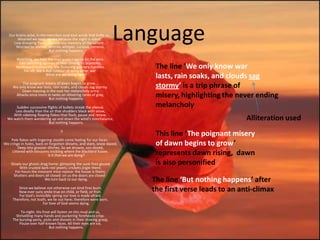
                                                                            The line ‘We only know war
                           What are we doing here?
                                                                            lasts, rain soaks, and clouds sag
          The poignant misery of dawn begins to grow...
     We only know war lasts, rain soaks, and clouds sag stormy.             stormy’ is a trip phrase of
         Dawn massing in the east her melancholy army
      Attacks once more in ranks on shivering ranks of gray,
                         But nothing happens.
                                                                            misery, highlighting the never ending
       Sudden successive flights of bullets streak the silence.             melancholy
      Less deadly than the air that shudders black with snow,
     With sidelong flowing flakes that flock, pause and renew,
  We watch them wandering up and down the wind's nonchalance,
                          But nothing happens.
                                                                                                         Alliteration used
                                    II
                                                                            This line ‘The poignant misery
    Pale flakes with lingering stealth come feeling for our faces -
We cringe in holes, back on forgotten dreams, and stare, snow-dazed,
        Deep into grassier ditches. So we drowse, sun-dozed,
                                                                            of dawn begins to grow’
    Littered with blossoms trickling where the blackbird fusses.
                            Is it that we are dying?                        represents dawn rising, dawn
    Slowly our ghosts drag home: glimpsing the sunk fires glozed            is also personified
         With crusted dark-red jewels; crickets jingle there;
       For hours the innocent mice rejoice: the house is theirs;
      Shutters and doors all closed: on us the doors are closed -
                         We turn back to our dying.                        The line ‘But nothing happens’ after
        Since we believe not otherwise can kind fires burn;
        Now ever suns smile true on child, or field, or fruit.             the first verse leads to an anti-climax
         For God's invincible spring our love is made afraid;
     Therefore, not loath, we lie out here; therefore were born,
                        For love of God seems dying.

          To-night, His frost will fasten on this mud and us,
       Shrivelling many hands and puckering foreheads crisp.
     The burying-party, picks and shovels in their shaking grasp,
         Pause over half-known faces. All their eyes are ice,
                            But nothing happens.
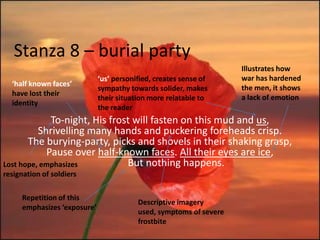
Stanza 8 – burial party
                                                                    Illustrates how
                             ‘us’ personified, creates sense of     war has hardened
  ‘half known faces’
                             sympathy towards solider, makes        the men, it shows
  have lost their
                             their situation more relatable to      a lack of emotion
  identity
                             the reader
             To-night, His frost will fasten on this mud and us,
          Shrivelling many hands and puckering foreheads crisp.
       The burying-party, picks and shovels in their shaking grasp,
            Pause over half-known faces. All their eyes are ice,
Lost hope, emphasizes          But nothing happens.
resignation of soldiers

     Repetition of this
                                         Descriptive imagery
     emphasizes ‘exposure’
                                         used, symptoms of severe
                                         frostbite
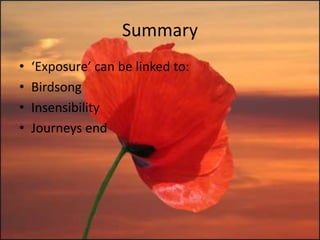
Summary
•   ‘Exposure’ can be linked to:
•   Birdsong
•   Insensibility
•   Journeys end

Exposure pp

  • 1.
  • 2.
    http://www.youtube.com/watch?v=3zDnzb06Kfc Wilfred Owen Owen, 1893-1918, was a soldier and a renowned war-time poet who fought in the first world war
  • 3.
    Exposure Exposure is about the journey of the war, how there is endless waiting around for an attack in awful conditions; it depicts the dying emotions of the men, almost making them immune to what is happening around them, it is based on Owens own experience on the frontline in 1917
  • 4.
    Our brains ache,in the merciless iced east winds that knife us... Wearied we keep awake because the night is silent... Low drooping flares confuse our memory of the salient... Worried by silence, sentries whisper, curious, nervous, But nothing happens. Structure Watching, we hear the mad gusts tugging on the wire. Like twitching agonies of men among its brambles. Northward incessantly, the flickering gunnery rumbles, Far off, like a dull rumour of some other war. Use of half- What are we doing here? The poignant misery of dawn begins to grow... rhyme, ‘knife us’/ We only know war lasts, rain soaks, and clouds sag stormy. Dawn massing in the east her melancholy army ‘nervous’ Attacks once more in ranks on shivering ranks of gray, But nothing happens. Night (stanza 1) Sudden successive flights of bullets streak the silence. Less deadly than the air that shudders black with snow, With sidelong flowing flakes that flock, pause and renew, Dawn (stanza 3) We watch them wandering up and down the wind's nonchalance, But nothing happens. II Day (stanza 4-7) Pale flakes with lingering stealth come feeling for our faces - We cringe in holes, back on forgotten dreams, and stare, snow- dazed, Deep into grassier ditches. So we drowse, sun-dozed, Night (stanza 8) Littered with blossoms trickling where the blackbird fusses. Is it that we are dying? Slowly our ghosts drag home: glimpsing the sunk fires glozed With crusted dark-red jewels; crickets jingle there; For hours the innocent mice rejoice: the house is theirs; Shutters and doors all closed: on us the doors are closed - We turn back to our dying. Since we believe not otherwise can kind fires burn; Now ever suns smile true on child, or field, or fruit. For God's invincible spring our love is made afraid; The poem is in the Therefore, not loath, we lie out here; therefore were born, For love of God seems dying. form of eight 5 line To-night, His frost will fasten on this mud and us, Shrivelling many hands and puckering foreheads crisp. stanzas, the last line The burying-party, picks and shovels in their shaking grasp, Pause over half-known faces. All their eyes are ice, in shorter than the But nothing happens. rest
  • 5.
    Our brains ache,in the merciless iced east winds that knife us... Wearied we keep awake because the night is silent... Low drooping flares confuse our memory of the salient... Worried by silence, sentries whisper, curious, nervous, But nothing happens. Language Watching, we hear the mad gusts tugging on the wire. Like twitching agonies of men among its brambles. Northward incessantly, the flickering gunnery rumbles, Far off, like a dull rumour of some other war. The line ‘We only know war What are we doing here? lasts, rain soaks, and clouds sag The poignant misery of dawn begins to grow... We only know war lasts, rain soaks, and clouds sag stormy. stormy’ is a trip phrase of Dawn massing in the east her melancholy army Attacks once more in ranks on shivering ranks of gray, But nothing happens. misery, highlighting the never ending Sudden successive flights of bullets streak the silence. melancholy Less deadly than the air that shudders black with snow, With sidelong flowing flakes that flock, pause and renew, We watch them wandering up and down the wind's nonchalance, But nothing happens. Alliteration used II This line ‘The poignant misery Pale flakes with lingering stealth come feeling for our faces - We cringe in holes, back on forgotten dreams, and stare, snow-dazed, Deep into grassier ditches. So we drowse, sun-dozed, of dawn begins to grow’ Littered with blossoms trickling where the blackbird fusses. Is it that we are dying? represents dawn rising, dawn Slowly our ghosts drag home: glimpsing the sunk fires glozed is also personified With crusted dark-red jewels; crickets jingle there; For hours the innocent mice rejoice: the house is theirs; Shutters and doors all closed: on us the doors are closed - We turn back to our dying. The line ‘But nothing happens’ after Since we believe not otherwise can kind fires burn; Now ever suns smile true on child, or field, or fruit. the first verse leads to an anti-climax For God's invincible spring our love is made afraid; Therefore, not loath, we lie out here; therefore were born, For love of God seems dying. To-night, His frost will fasten on this mud and us, Shrivelling many hands and puckering foreheads crisp. The burying-party, picks and shovels in their shaking grasp, Pause over half-known faces. All their eyes are ice, But nothing happens.
  • 6.
    Stanza 8 –burial party Illustrates how ‘us’ personified, creates sense of war has hardened ‘half known faces’ sympathy towards solider, makes the men, it shows have lost their their situation more relatable to a lack of emotion identity the reader To-night, His frost will fasten on this mud and us, Shrivelling many hands and puckering foreheads crisp. The burying-party, picks and shovels in their shaking grasp, Pause over half-known faces. All their eyes are ice, Lost hope, emphasizes But nothing happens. resignation of soldiers Repetition of this Descriptive imagery emphasizes ‘exposure’ used, symptoms of severe frostbite
  • 7.
    Summary • ‘Exposure’ can be linked to: • Birdsong • Insensibility • Journeys end

Editor's Notes

  • #3 Wilfred Owen is a recognized war poet. His poetry spoke on behalf of the men in the war as well as speaking out against the atrocities of the war itself and the struggles that the men faced. Throughout his poetry, a sense of anger is portrayed to the home front attitude, he also writes from the perspective of the soldiers much like Exposure.
  • #4 Dramatic irony is used through out as well as lots of nature-themed imagery, the immense confusion and suffering of the men is due to the weather and endless waiting rather than German attack hence the title exposure which refers the condition of being exposed by forces of nature, in particular weather. Exposure not only looks at the physical pain faces but the mental pain, similar to the works of other war time poets sucha s Siegfried Sassoon
  • #5  The short concluding line ‘But nothing happens’ is considerably shorter in length than the previous 4 stanzas, emphasising the endless wait and the pointlessness of the war. Iambic heptameter is also used as part of the structure to reflect the feelings of the soldiers and ‘exposure’ Exposure is structured in chronological order, the poem covers a whole day at the front line, starting at night (stanza 1) all the way back through to nightfall in stanza 8 ending with the burial party, the poem tells a story which allows the reader to further sympathize with the lives of the men in war
  • #6 A range of language techniques have been used to emphasize what the soldiers are going through, the line ‘We only know war lasts, rain soaks, and clouds sag stormy’ is a trip phrase of misery, highlighting the never ending melancholy, the alliteration of ‘sag stormy’ emphasises the impact of the weather which ultimately contributes to the ‘exposure’ of the soldiers. The line ‘the poignant misery of dawn begins to grow’ represents dawn rising which represents a new day/newstart, however the this does not seem to relief the soldiers at all, dawn seems to be personified as an attacking army, in fact there is a sense of anticipation as await of a German attack gets closer, however the last sentence of the stanza ‘but nothing happens’ leads to an anti climax as the awaited attack never happens
  • #7 This stanza represents the end of the poem as the day ends with night which closes the poem. It expresses the resignation of the soldiers.‘All their eyes are ice’ has a pun in it, ‘ice’ can relate to the weather/nature themes imagery throughout as well as illustrates the dehumanization of the men where they become insensible, much like the poem ‘insensibility’. The losing line ‘but nothing happens’ is repeated for the fourth final time, which emphasizes the gradual but firm lose of hope, inferring that there is no purpose of war and seems to critise those in charge of the men’s welfare as they are dying not even because of the enemy but because of the conditions they are in due to the weather hence ‘exposure’.
  • #8 Exposure contains many similar themes throughout which can be compared to other literature, Similarly to exposure, birdsong depicts the dehumanization of the soldiers, much like when Stephen questions ’how far can a man go’ The line in exposure we have looked at ‘all their eyes are ice’ is similar to the poem insensibility ‘their eyes are rid of the hurt of the colour blood forever’ which both depict that the war has almost lobotomized the minds of the men through insensibility The anticipation of the men in exposure at they wait at the frontline is similar of that faces by the men in Journeys end, Sheriff, similarly to Owen does this build a climax towards attacks.