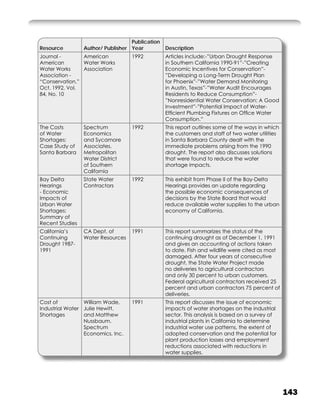
Urban Drought Guidebook
2008 Updated Edition


                                 State of California
                  Department of Water Resources
       Office of Water Use Efficiency and Transfers
Cover Photo

    Lake Mead, storing Colorado River water that supplies irrigation and domestic water to
    much of Southern California at 50 percent capacity, winter 2007.

    Photo by Andy Pernick , U.S. Bureau of Reclamation photographer.


    If you need this publication in an alternate form, contact the Equal Opportunity and
    Management Investigations Office at TDD 1-800-653-6934, or Voice 1-800-653-6952.


2
Foreword


To help local agencies and communities prepare for the possibility of another dry year
and possible water supply interruptions, the Department of Water Resources is pleased
to publish this updated version of the Urban Drought Guidebook. Drought, climate
change, natural disasters, and environmental protections can all affect water supplies.
Good planning and preparation can help agencies maintain reliable supplies and reduce
the impacts of supply interruptions. We, the U. S. Bureau of Reclamation, and the
California Urban Water Conservation Council worked together on the guidebook to
provide technical assistance to local water suppliers.

As water suppliers review and update their Water Shortage Contingency Plans, we hope
the new information and examples of exceptional efforts by water suppliers throughout
California and the United States will be useful. The wide array of approaches presented
in the guidebook reflects the variable water supply and demand scenarios from one end
of the state to the other. Accordingly, water suppliers will be able to use this guidebook
to design programs that reflect local and regional conditions.


Sincerely,


Lester A. Snow

DWR Director


                                                                                             3
State of California
                           Arnold Schwarzenegger, Governor

                                  The Resources Agency
                        Mike Chrisman, Secretary for Resources

                                Department of Water Resources
                                 Lester A. Snow, Director


    Kasey Schimke                    Susan Sims-Teixeira                  David Sandino
    Asst. Dir. Legislative Affairs Acting Chief/Deputy Director             Chief Counsel

    Mark W. Cowin                     David Gutierrez                    Timothy Haines
    Deputy Director                 Acting Deputy Director                 Deputy Director

    Reuben A. Jimenez                  Gerald E. Johns                     Ralph Torres
    Deputy Director                     Deputy Director                    Deputy Director

                                       Rick Soehren
                      Chief, Office of Water Use Efficiency and Transfers


                         This report was prepared in cooperation with:


                                  U.S. Bureau of Reclamation
                         California Urban Water Conservation Council


                    Editorial review, graphics, and report production

    Under direction of Gretchen Goettl, Supervisor of Technical Publications, research
    writers:

    Nikki Blomquist                    Patricia Cornelius                      Mike Durant

    James Joelson                        Carole Rains                        Marilee Talley


4
Acknowledgments


The Department of Water Resources is grateful for the participation and cooperation of
the U.S. Bureau of Reclamation and the California Urban Water Conservation Council
in updating the Urban Drought Guidebook. We are also thankful for the local water
suppliers who hosted the 11 Urban Drought Workshops in September and October
2007. The guidebook was updated by consultants Larry Farwell and Marsha Prillwitz
with the active participation of the “Drought Team,” representing DWR, U.S. Bureau of
Reclamation and the Council. Members of the team included:

Manucher Alemi              Department of Water Resources

Dave Todd                   Department of Water Resources

Tracy Slavin                U.S. Bureau of Reclamation, Mid-Pacific Region

Kevin Clancy                U.S. Bureau of Reclamation, Mid-Pacific Region

Dave Woolley                U.S. Bureau of Reclamation, Mid-Pacific Region

William J. Steele           U.S. Bureau of Reclamation, Lower Colorado Region

Meena Westford              U.S. Bureau of Reclamation, Lower Colorado Region

Debra Whitney               U.S. Bureau of Reclamation, Lower Colorado Region

Steve Jones                 U.S. Bureau of Reclamation, Lower Colorado Region

Chris Brown                 California Urban Water Conservation Council

Katie Shulte Joung          California Urban Water Conservation Council

Heather Woodford            California Urban Water Conservation Council

Special thanks go to the National Drought Mitigation Center staff for its review of this
guidebook.


                                                                                           5
6
Acronyms and Abbreviations


AF        Acre Feet
AFY       Acre Feet Per Year
AWE       Alliance for Water Efficiency
AWWA      American Water Works Association

BMPs      Best Management Practices

CCWD      Contra Costa Water District
CEQA      California Environmental Quality Act
CII       Commercial, Industrial, Institutional
CLCA      California Landscape Contractors Association
CPUC      California Public Utilities Commission
Council   California Urban Water Conservation Council (CUWCC)
CVPIA     Central Valley Project Improvement Act
CVP       Central Valley Project

DEP       Department of Environmental Protection
DHS       Department of Health Services (California)
DWR       Department of Water Resources

EBMUD     East Bay Municipal Utility District
ET        Evapotranspiration

GIS       Geographic Information System
GPCD      Gallons per Capita per Day
GPD       Gallons per Day
GPDD      Gallons per Day per Dwelling Unit
GPDC      Gallons per Day per Connection
GPDA      Gallons per Day per Irrigated Acre
GPDE      Gallons per Day per Employee
GPF       Gallons per Flush
GPM       Gallons per Minute

HET       High Efficiency Toilets
HCF       Hundred Cubic Feet

IA        Irrigation Association
ICI       Industrial, Commercial, Institutional
IWU       Indoor Water Use

LADWP     Los Angeles Department of Water and Power


                                                                7
Acronyms and Abbreviations (continued)

    MGD         Million Gallons Per Day
    MMWD        Marin Municipal Water District
    MWDSC       Metropolitan Water District of Southern California
    MWDOC       Municipal Water District of Orange County

    NDMC        National Drought Mitigation Center (University of Nebraska)
    NOAA        National Oceanic and Atmospheric Administration
    NWS         National Weather Service

    OES         Office of Emergency Services (California)

    PUC         Public Utilities Commission (California)

    Reclamation U.S. Bureau of Reclamation
    RO          Residential Occupancy

    SCWA        Sonoma County Water Agency
    SDCWA       San Diego County Water Authority
    SFPUC       San Francisco Public Utilities Commission
    SPU         Seattle Public Utilities
    SWP         State Water Project
    SWRCB       State Water Resources Control Board

    TWDB        Texas Water Development Board

    UAW         Unaccounted for Water
    ULF         Ultra Low Flush
    USGS        United States Geological Survey
    UWMPA       Urban Water Management Planning Agency

    WARN        Water/Wastewater Agency Response Network
    WC          Water Code
    WCI         Water Conservation Initiative
    WCM         Water Conservation Manager
    WSCP        Water Shortage Contingency Plan


8
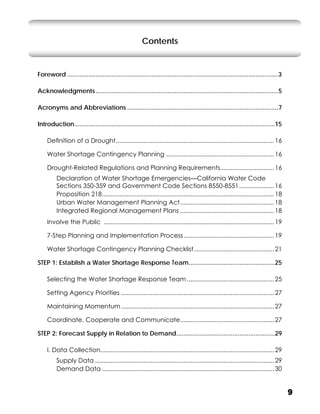
Contents


Foreword ........................................................................................................................3

Acknowledgments ........................................................................................................5

Acronyms and Abbreviations ......................................................................................7

Introduction ..................................................................................................................15

     Definition of a Drought ........................................................................................... 16

     Water Shortage Contingency Planning .............................................................. 16

     Drought-Related Regulations and Planning Requirements............................... 16
          Declaration of Water Shortage Emergencies—California Water Code
          Sections 350-359 and Government Code Sections 8550-8551 .................... 16
          Proposition 218................................................................................................... 18
          Urban Water Management Planning Act ...................................................... 18
          Integrated Regional Management Plans ...................................................... 18
     Involve the Public .................................................................................................. 19

     7-Step Planning and Implementation Process .................................................... 19

     Water Shortage Contingency Planning Checklist .............................................. 21

STEP 1: Establish a Water Shortage Response Team.................................................25

     Selecting the Water Shortage Response Team .................................................. 25

     Setting Agency Priorities ........................................................................................ 27

     Maintaining Momentum ........................................................................................ 27

     Coordinate, Cooperate and Communicate...................................................... 27

STEP 2: Forecast Supply in Relation to Demand........................................................29

     I. Data Collection.................................................................................................... 29
          Supply Data ....................................................................................................... 29
          Demand Data ................................................................................................... 30


                                                                                                                                     9
Contents (continued)

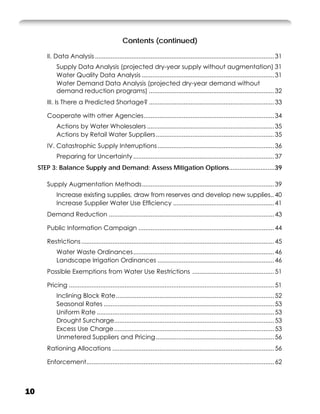
        II. Data Analysis ....................................................................................................... 31
             Supply Data Analysis (projected dry-year supply without augmentation) 31
             Water Quality Data Analysis ............................................................................ 31
             Water Demand Data Analysis (projected dry-year demand without
             demand reduction programs) ........................................................................ 32
        III. Is There a Predicted Shortage? ........................................................................ 33

        Cooperate with other Agencies ........................................................................... 34
             Actions by Water Wholesalers ......................................................................... 35
             Actions by Retail Water Suppliers .................................................................... 35
        IV. Catastrophic Supply Interruptions ................................................................... 36
             Preparing for Uncertainty ................................................................................. 37
     STEP 3: Balance Supply and Demand: Assess Mitigation Options..........................39

        Supply Augmentation Methods ............................................................................ 39
             Increase existing supplies, draw from reserves and develop new supplies.. 40
             Increase Supplier Water Use Efficiency .......................................................... 41
        Demand Reduction ............................................................................................... 43

        Public Information Campaign .............................................................................. 44

        Restrictions ............................................................................................................... 45
             Water Waste Ordinances ................................................................................. 46
             Landscape Irrigation Ordinances ................................................................... 46
        Possible Exemptions from Water Use Restrictions ............................................... 51

        Pricing ...................................................................................................................... 51
             Inclining Block Rate ........................................................................................... 52
             Seasonal Rates .................................................................................................. 53
             Uniform Rate ...................................................................................................... 53
             Drought Surcharge............................................................................................ 53
             Excess Use Charge ............................................................................................ 53
             Unmetered Suppliers and Pricing .................................................................... 56
        Rationing Allocations ............................................................................................. 56

        Enforcement............................................................................................................ 62


10
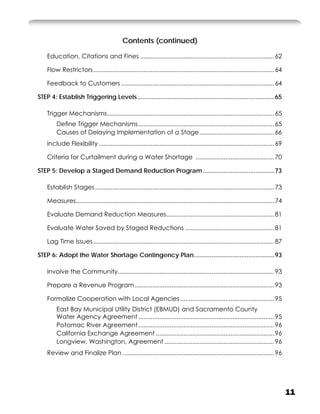
Contents (continued)

    Education, Citations and Fines ............................................................................. 62

    Flow Restrictors ........................................................................................................ 64

    Feedback to Customers ........................................................................................ 64

STEP 4: Establish Triggering Levels ..............................................................................65

    Trigger Mechanisms ................................................................................................ 65
         Define Trigger Mechanisms .............................................................................. 65
         Causes of Delaying Implementation of a Stage ........................................... 66
    Include Flexibility ..................................................................................................... 69

    Criteria for Curtailment during a Water Shortage ............................................. 70

STEP 5: Develop a Staged Demand Reduction Program .........................................73

    Establish Stages ....................................................................................................... 73

    Measures.................................................................................................................. 74

    Evaluate Demand Reduction Measures.............................................................. 81

    Evaluate Water Saved by Staged Reductions ................................................... 81

    Lag Time Issues ........................................................................................................ 87

STEP 6: Adopt the Water Shortage Contingency Plan ..............................................93

    Involve the Community.......................................................................................... 93

    Prepare a Revenue Program ................................................................................ 93

    Formalize Cooperation with Local Agencies ...................................................... 95
         East Bay Municipal Utility District (EBMUD) and Sacramento County
         Water Agency Agreement .............................................................................. 95
         Potomac River Agreement .............................................................................. 96
         California Exchange Agreement .................................................................... 96
         Longview, Washington, Agreement ............................................................... 96
    Review and Finalize Plan ....................................................................................... 96


                                                                                                                                    11
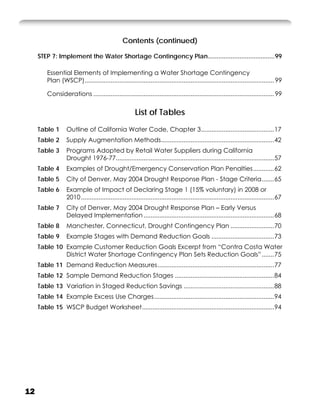
Contents (continued)

     STEP 7: Implement the Water Shortage Contingency Plan ......................................99

         Essential Elements of Implementing a Water Shortage Contingency
         Plan (WSCP)............................................................................................................. 99

         Considerations ........................................................................................................ 99


                                                        List of Tables
     Table 1       Outline of California Water Code, Chapter 3 ..........................................17
     Table 2       Supply Augmentation Methods.................................................................42
     Table 3       Programs Adopted by Retail Water Suppliers during California
                   Drought 1976-77...........................................................................................57
     Table 4       Examples of Drought/Emergency Conservation Plan Penalties ............62
     Table 5       City of Denver, May 2004 Drought Response Plan - Stage Criteria .......65
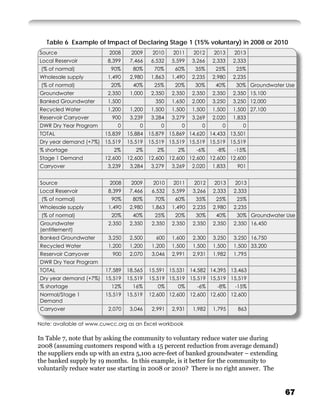
     Table 6       Example of Impact of Declaring Stage 1 (15% voluntary) in 2008 or
                   2010 ...............................................................................................................67
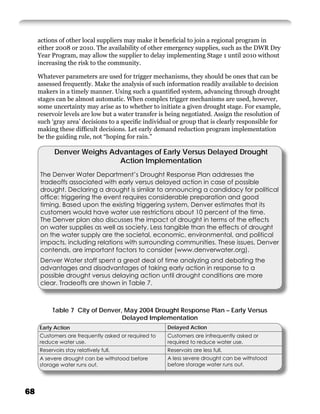
     Table 7       City of Denver, May 2004 Drought Response Plan – Early Versus
                   Delayed Implementation ...........................................................................68
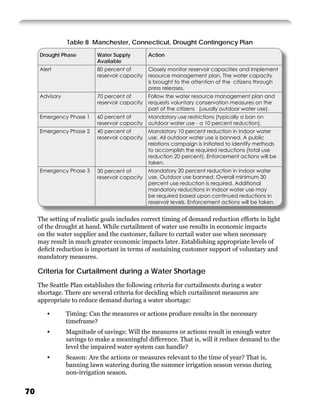
     Table 8       Manchester, Connecticut, Drought Contingency Plan .........................70
     Table 9       Example Stages with Demand Reduction Goals ....................................73
     Table 10 Example Customer Reduction Goals Excerpt from “Contra Costa Water
              District Water Shortage Contingency Plan Sets Reduction Goals” .......75
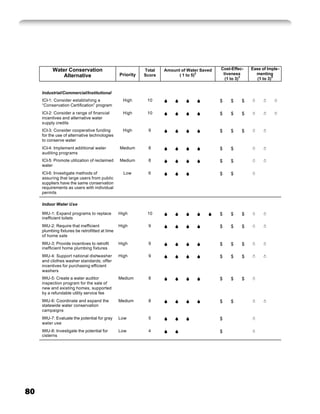
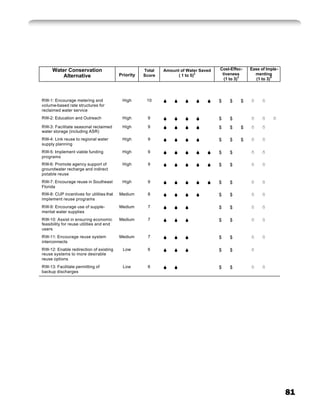
     Table 11 Demand Reduction Measures ...................................................................77
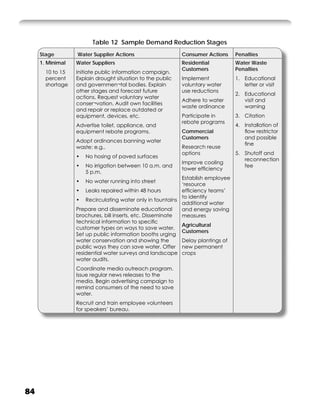
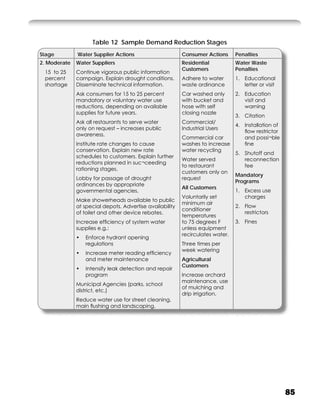
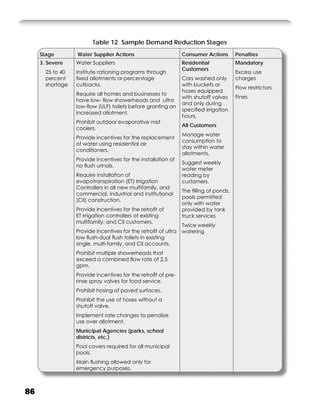
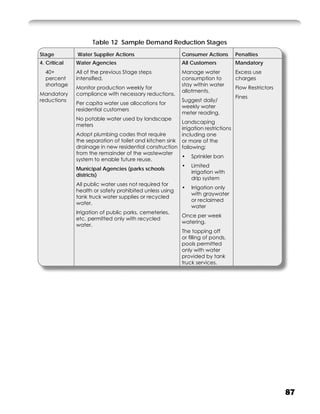
     Table 12 Sample Demand Reduction Stages .........................................................84
     Table 13 Variation in Staged Reduction Savings ....................................................88
     Table 14 Example Excess Use Charges .....................................................................94
     Table 15 WSCP Budget Worksheet............................................................................94


12
List of Appendices
Appendix A      Declaring a Water Shortage Emergency and Water Shortage
                Contingency Planning ................................................................... 109
Appendix B      PUC Water Rationing Moratoria .................................................... 115
Appendix C      Guidelines for Implementing the California Environmental
                Quality Act ....................................................................................... 121
Appendix D      Supplemental Information on Supply Augmentation
                Measures .......................................................................................... 131
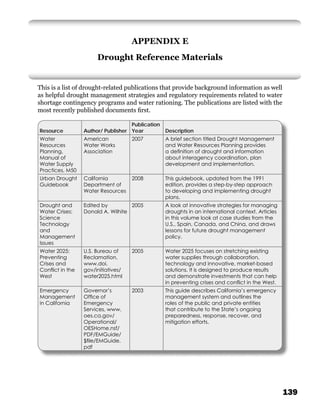
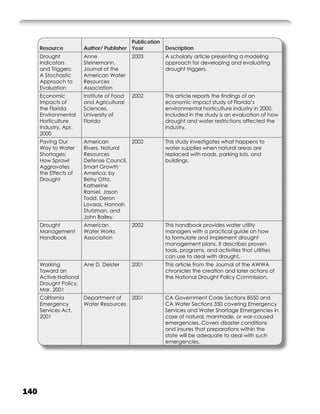
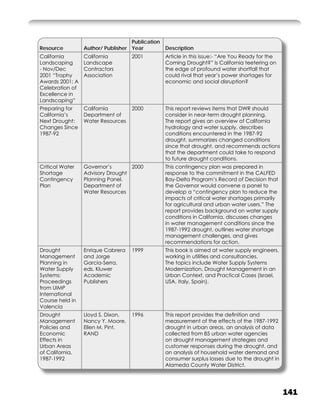
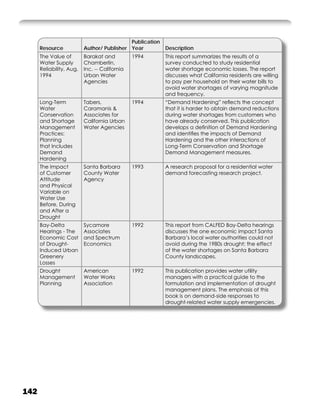
Appendix E      Drought Reference Materials ........................................................ 139
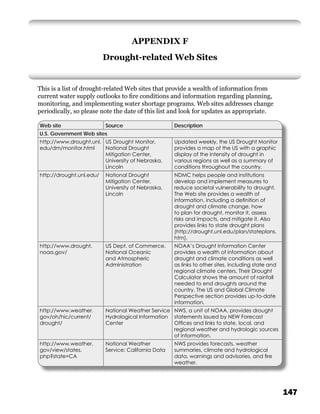
Appendix F      Drought-related Web Site .............................................................. 147
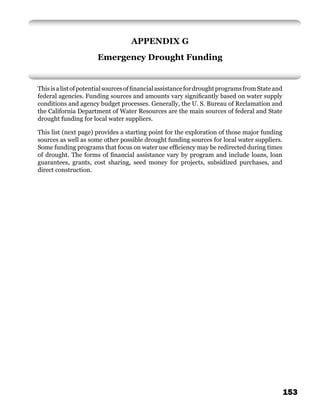
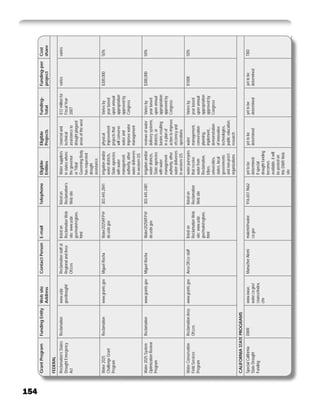
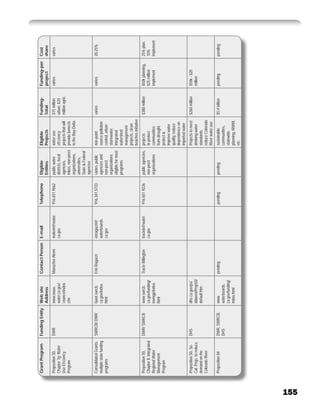
Appendix G      Emergency Drought Funding ........................................................ 153
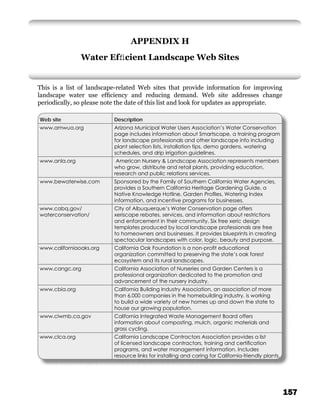
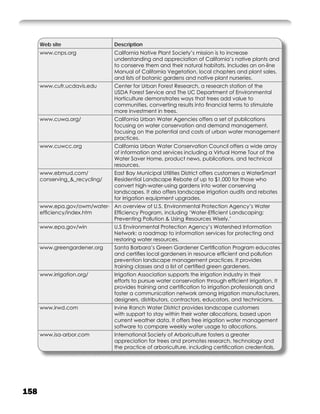
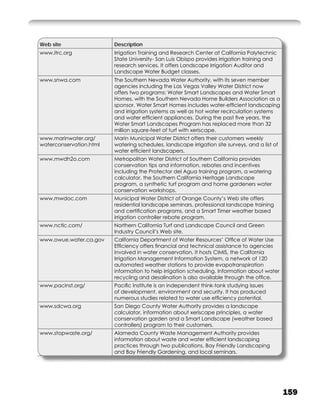
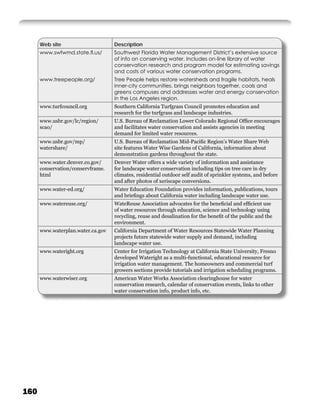
Appendix H      Water Efficient Landscape Web Sites........................................... 157
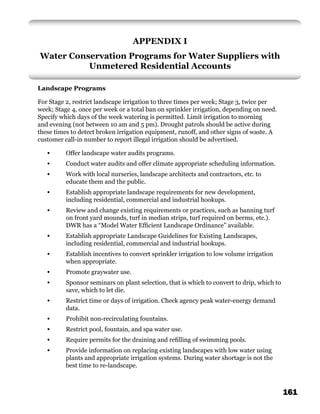
Appendix I      Water Conservation Programs for Water Suppliers with
                Unmetered Residential Accounts ................................................. 161
Appendix J      Sample Emergency Water Shortage Ordinance ........................ 165
Appendix K      Example Forms and Calculations ................................................. 185


               Quick Drought Information References
Additional drought information can be found at these Web sites:

http://www.owue.water.ca.gov

http://watersupplyconditions.water.ca.gov/

http://www.usbr.gov/drought/

http://www.usbr.gov/lc/region/scao

http:// www.usbr.gov/mp/watershare

http://www.cuwcc.org


                                                                                                                          13
14
Introduction


Much has changed in the realm of California water since DWR first published the
Urban Drought Guidebook in 1988. Some of the situations and challenges facing water
managers today include:

   •      On average, Californians use less water per person today, but the state’s
          population has grown from nearly 30 million in 1990 to more than 37 million
          in 2007.
   •      2006 was the hottest year on record in most of California and the United
          States.
   •      2006-2007 was the driest water year on record in many California counties.
   •      Water is delivered through an increasingly complex and aging network of
          distribution systems.
   •      Water treatment processes have become more sophisticated and costly.
   •      Energy-related expenses, from transportation to treatment, have increased
          significantly.
   •      The environment is taxed to a critical point in some key waterways of the
          state, including the Delta.
   •      The reliability of water deliveries has diminished as uncertainty and
          variability increases, as related to climate change, regulatory actions, system
          security and other factors.
There are also new opportunities for addressing water shortages since the 1990s.
Widespread use of the Internet allows for information sharing and communication
to a level unimagined in previous decades. New technology allows for more efficient
use of water, from commercial cooling towers to smart irrigation controllers. Regional
alliances have been established, often on a formal basis, to coordinate water supply and
demand management efforts.

This guide will help water managers facing water shortages by showing them how to use
tried and true methods of the past as well as making use of new tools and methods.

Managing water shortages involves using programs to temporarily reduce demand and
find alternate water to temporarily increase supply. The guidebook discusses water
shortage management programs that belong in water shortage contingency plans. It
was first written in 1988, and then updated in 1991 and 2008 to help water suppliers
cope with potentially severe drought and other water shortages. The focus of the guide
is to provide a step-by-step process to anticipate and respond to water shortages. The
guidebook emphasizes two areas: First, it uses examples of well-conceived and executed
plans in California and other parts of the country to illustrate recommendations


                                                                                            15
whenever possible. Second, it stresses that successful programs are commonly the result
     of a cooperative effort between water suppliers and their customers. Activities that
     foster this spirit of cooperation are highlighted.

     Definition of a Drought
     In the most general sense, drought is a deficiency of precipitation over an extended
     period of time, resulting in a water shortage for some activity, group, or environmental
     sector. Whatever the definition, it is clear that drought cannot be viewed solely as
     a physical phenomenon. A water shortage occurs when supply is reduced to a level
     that cannot support existing demands. Natural forces, system component failure or
     interruption, or regulatory actions may cause these water shortages. Such conditions
     could last two to three months or extend over many years.

     Water Shortage Contingency Planning
     A reliable water supply is essential. Its importance highlights the need to prepare for
     a drought or other water shortage. Contingency planning before a shortage allows
     selection of appropriate responses consistent with the varying severity of shortages.
     While the actions taken should be adequate to deal with the circumstances and no more,
     it is essential that water suppliers start demand-reduction programs before a severe
     shortage. Water suppliers that delay demand-reduction programs may exhaust reserve
     supplies early in an extended shortage and could cause unnecessary social and economic
     harm to the communities. A Water Shortage Contingency Plan (WSCP) should enable
     water suppliers to provide water for public health and safety and minimize impacts on
     economic activity, environmental resources and the region’s lifestyle.

     Here are sample priorities for use of available water:

     1.     Health and Safety – interior residential and fire fighting
     2.     Commercial, Industrial, and Institutional – maintain economic base, protect jobs
     3.     Permanent Crops – takes five to 10 years to replace
     4.     Annual Crops – protect jobs
     5.     Landscaping – direct water to trees and shrubs
     6.     New Demand – generally, two years of construction projects are already
            approved

     Drought-Related Regulations and Planning Requirements
     Declaration of Water Shortage Emergencies—California Water Code
     Sections 350-359 and Government Code Sections 8550-8551

     For California water suppliers, the requirements of these two acts need to be
     incorporated into any water shortage plans. The key elements of these acts are


16
summarized in Table 1. The complete text of the relevant code sections is contained
in Appendix A. These provisions provide the authority for water suppliers to declare a
water shortage emergency. Then the local water supplier is provided with broad powers
to enforce regulations and restrictions for managing the water shortage. Water needed
for domestic purposes is given priority and discrimination within a class of customers is
not allowed. Investor-owned water suppliers will find drought related information from
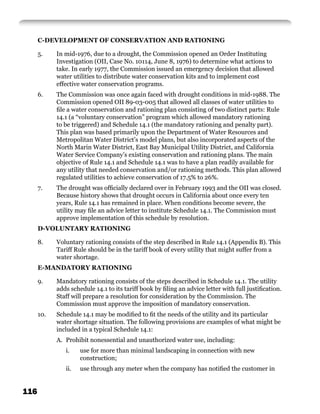
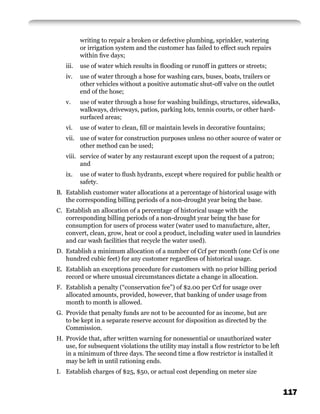
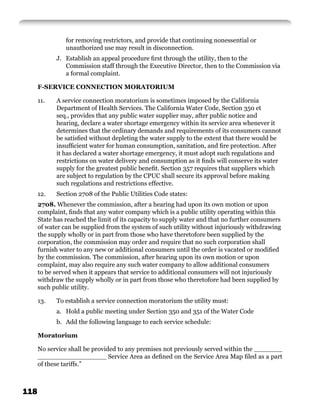
the California Public Utilities Commission in Appendix B.

               Table 1 Outline of California Water Code, Chapter 3
Section Reference     Summary of Key Points
                      Governing body of water supply distributor has authority to declare
                      water shortage emergency condition.
         350          Defines water shortage emergency condition as when there would
                      be “insufficient water for human consumption, sanitation, and fire
                      protection.”
                      A public hearing is required prior to a water shortage emergency
         351
                      condition declaration.
                      Advertisement of the public hearing must follow certain notification
         352
                      and distribution procedures.
                      Governing body of water supply distributor must adopt regulations
                      and restrictions to “conserve the water supply for the greatest public
         353          benefit.”
                      Priority uses are domestic, sanitation, and fire protection.
                      Option given to governing body of water supply distributor to establish
                      additional water allocation, distribution, and delivery priorities.
         354
                      Method of allocation cannot discriminate “between customers using
                      water for the same purpose or purposes.”
                      Regulations and restrictions are in effect until the emergency is over
         355
                      and the water supply has been replenished or augmented.
                      Regulations and restrictions allow prohibiting new or additional service
                      connections.
         356
                      Enforcement of regulations and restrictions may include discontinuing
                      service to customers willfully violating them.
                      Regulations and restrictions must prevail over allocation provisions of
                      laws pertaining to water rights of individual customers.
         357          Water distributors subject to regulation by the State Public Utilities
                      Commission (PUC) need prior approval by the PUC before adopting
                      regulations and restrictions of this type.
                      Review of an emergency declaration or adopted regulations and
         358
                      restrictions adopted by a court is not prohibited.
         359          Requirements for applying for federal drought relief program.


                                                                                                 17
Proposition 218

     Proposition 218, which was approved by the voters in 1996, added Article XIII C (taxes)
     and D (fees and assessments) to the California Constitution. Proposition 218 may apply
     to how a water supplier sets assessments and fees. Water suppliers should consult their
     attorney for modification of fees, assessments or charges. For the full text of Proposition
     218 go to http://vote96.sos.ca.gov/bp/218.htm.

     Urban Water Management Planning Act

     Since 1983, the state requires every urban water supplier that provides water to 3,000
     or more customers, or that provides more than 3,000 acre-feet of water annually to
     develop and implement an Urban Water Management Plan (UWMP) (California Water
     Code Sections 10610-10657). The California Department of Water Resources (DWR)
     provides a guidebook, conducts workshops, and serves as a repository for the plans. The
     law requires suppliers to report on the reliability of its water service and whether it is
     sufficient to meet the needs of its customers during normal, dry, and multiple dry years.
     Water suppliers update their UWMPs every five years.

     The Urban Water Management Planning Act describes the contents of UWMPs as well
     as how urban water suppliers should adopt and implement the plans. An important
     requirement is that each water supplier must prepare an urban water contingency
     analysis (California Water Code Section 10632). The analysis includes six components:

     1.    A description of the stages of action an agency will take in response to water
           shortages
     2.    An estimate of supply for three consecutive dry years
     3.    A plan for dealing with a catastrophic supply interruption
     4.    A list of the prohibitions, penalties and consumption reduction methods to be
           used
     5.    An analysis of expected revenue effects of reduced sales during shortages and
           proposed measures to overcome those effects
     6.    How it will monitor and document water cutbacks

     The full text of Section 10632 is included in Appendix A. Final versions of the 2005
     UWMPs of more than 100 water suppliers, including their WSCPs, are at: http://www.
     owue.water.ca.gov/urbanplan/index.cfm.

     Integrated Regional Management Plans

     Integrated Regional Management Plans are being developed and implemented
     throughout the state, partly in response to Proposition 50 (November 2002) and
     Proposition 84 (November 2006), statewide bonds that provides funding to encourage a
     regional approach to water management. Regions have distinct identities and hydrologic


18
and ecologic connections. Water supply reliability is a primary water management
objective to be considered in these integrated plans. Meeting dry year demands is an
important component of water supply reliability. UWMPs and the associated WSCPs
prepared by local water suppliers provide an important foundation for Integrated Water
Management Plans.

  “One Water, One Watershed” Integrates Drought Actions in Region
A noteworthy regional water management effort is the “One Water, One
Watershed” project of the Santa Ana Watershed. It brings together three
California counties, 69 cities, and 98 water suppliers, covering 2,800 square
miles, to develop regional partnerships to address the water supply and quality
challenges. It identifies the major challenges threatening water supply reliability
as climate change, continued drought in the Colorado River basin, Bay Delta
vulnerabilities, and population growth and explosive development. The goal of
“One Water, One Watershed” is to create a sustainable Santa Ana Watershed
that will be drought-proof, salt-balanced, and will support economic and
environmental health through 2030. For more information about this innovative
project, go to http://www.sawpa.org/html/OneWater.htm.


In addition to the importance of Urban Water Management Plans to regional water
management plans, the UWMPs are also important for land use planning. The approvals
of large new developments in California must be linked to assurances that there is
an adequate water supply (Senate Bills 610 and 221, 2001 - http://www.owue.water.
ca.gov). If the proposed project was not accounted for in the most recently adopted
UWMP, it requires project sponsors to discuss whether the water supplier’s total
projected water supplies available during normal, single dry, and multiple dry water
years during a 20-year projection will meet the projected water demand of the project.
Without assurances that there is a reliable source of water, even in dry years, large
development projects cannot proceed.

Involve the Public
Public involvement is clearly required for smooth implementation of all phases of a
demand reduction program. Community participation at the program development
stage is also important. Public involvement will, to a large extent, determine the
effectiveness and equity of the water supplier’s water shortage management program.

7-Step Planning and Implementation Process
The chapters of this guidebook describe step-by-step planning designed to guide water
suppliers before and during a water shortage. Water Shortage Contingency Plans have
specific mandatory requirements and penalties that become effective when certain
shortage conditions or triggers occur.


                                                                                         19
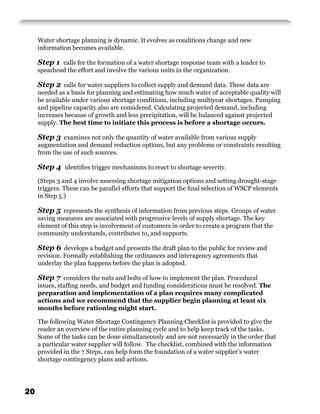
Water shortage planning is dynamic. It evolves as conditions change and new
     information becomes available.

     Step 1 calls for the formation of a water shortage response team with a leader to
     spearhead the effort and involve the various units in the organization.

     Step 2 calls for water suppliers to collect supply and demand data. These data are
     needed as a basis for planning and estimating how much water of acceptable quality will
     be available under various shortage conditions, including multiyear shortages. Pumping
     and pipeline capacity also are considered. Calculating projected demand, including
     increases because of growth and less precipitation, will be balanced against projected
     supply. The best time to initiate this process is before a shortage occurs.

     Step 3 examines not only the quantity of water available from various supply
     augmentation and demand reduction options, but any problems or constraints resulting
     from the use of such sources.

     Step 4 identifies trigger mechanisms to react to shortage severity.
     (Steps 3 and 4 involve assessing shortage mitigation options and setting drought-stage
     triggers. These can be parallel efforts that support the final selection of WSCP elements
     in Step 5.)

     Step 5 represents the synthesis of information from previous steps. Groups of water
     saving measures are associated with progressive levels of supply shortage. The key
     element of this step is involvement of customers in order to create a program that the
     community understands, contributes to, and supports.

     Step 6 develops a budget and presents the draft plan to the public for review and
     revision. Formally establishing the ordinances and interagency agreements that
     underlay the plan happens before the plan is adopted.

     Step 7 considers the nuts and bolts of how to implement the plan. Procedural
     issues, staffing needs, and budget and funding considerations must be resolved. The
     preparation and implementation of a plan requires many complicated
     actions and we recommend that the supplier begin planning at least six
     months before rationing might start.

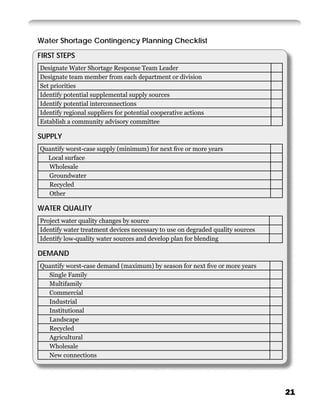
     The following Water Shortage Contingency Planning Checklist is provided to give the
     reader an overview of the entire planning cycle and to help keep track of the tasks.
     Some of the tasks can be done simultaneously and are not necessarily in the order that
     a particular water supplier will follow. The checklist, combined with the information
     provided in the 7 Steps, can help form the foundation of a water supplier’s water
     shortage contingency plans and actions.


20
Water Shortage Contingency Planning Checklist

FIRST STEPS
Designate Water Shortage Response Team Leader
Designate team member from each department or division
Set priorities
Identify potential supplemental supply sources
Identify potential interconnections
Identify regional suppliers for potential cooperative actions
Establish a community advisory committee

SUPPLY
Quantify worst-case supply (minimum) for next five or more years
  Local surface
  Wholesale
  Groundwater
  Recycled
  Other

WATER QUALITY
Project water quality changes by source
Identify water treatment devices necessary to use on degraded quality sources
Identify low-quality water sources and develop plan for blending

DEMAND
Quantify worst-case demand (maximum) by season for next five or more years
  Single Family
  Multifamily
  Commercial
  Industrial
  Institutional
  Landscape
  Recycled
  Agricultural
  Wholesale
  New connections


                                                                                21
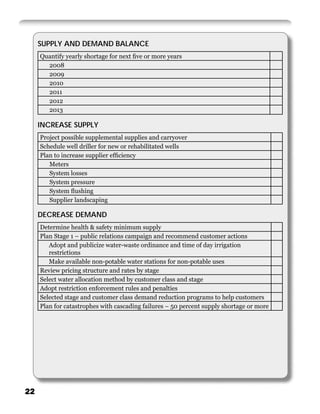
SUPPLY AND DEMAND BALANCE
     Quantify yearly shortage for next five or more years
       2008
       2009
       2010
       2011
       2012
       2013

     INCREASE SUPPLY
     Project possible supplemental supplies and carryover
     Schedule well driller for new or rehabilitated wells
     Plan to increase supplier efficiency
        Meters
        System losses
        System pressure
        System flushing
        Supplier landscaping

     DECREASE DEMAND
     Determine health & safety minimum supply
     Plan Stage 1 – public relations campaign and recommend customer actions
        Adopt and publicize water-waste ordinance and time of day irrigation
        restrictions
        Make available non-potable water stations for non-potable uses
     Review pricing structure and rates by stage
     Select water allocation method by customer class and stage
     Adopt restriction enforcement rules and penalties
     Selected stage and customer class demand reduction programs to help customers
     Plan for catastrophes with cascading failures – 50 percent supply shortage or more


22
 2
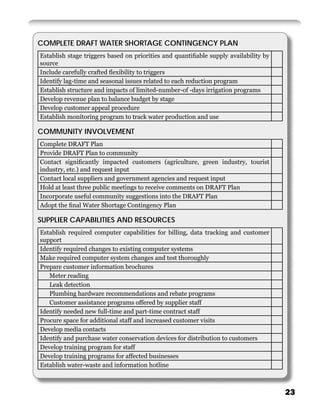
COMPLETE DRAFT WATER SHORTAGE CONTINGENCY PLAN
Establish stage triggers based on priorities and quantifiable supply availability by
source
Include carefully crafted flexibility to triggers
Identify lag-time and seasonal issues related to each reduction program
Establish structure and impacts of limited-number-of -days irrigation programs
Develop revenue plan to balance budget by stage
Develop customer appeal procedure
Establish monitoring program to track water production and use

COMMUNITY INVOLVEMENT
Complete DRAFT Plan
Provide DRAFT Plan to community
Contact significantly impacted customers (agriculture, green industry, tourist
industry, etc.) and request input
Contact local suppliers and government agencies and request input
Hold at least three public meetings to receive comments on DRAFT Plan
Incorporate useful community suggestions into the DRAFT Plan
Adopt the final Water Shortage Contingency Plan

SUPPLIER CAPABILITIES AND RESOURCES
Establish required computer capabilities for billing, data tracking and customer
support
Identify required changes to existing computer systems
Make required computer system changes and test thoroughly
Prepare customer information brochures
   Meter reading
   Leak detection
   Plumbing hardware recommendations and rebate programs
   Customer assistance programs offered by supplier staff
Identify needed new full-time and part-time contract staff
Procure space for additional staff and increased customer visits
Develop media contacts
Identify and purchase water conservation devices for distribution to customers
Develop training program for staff
Develop training programs for affected businesses
Establish water-waste and information hotline


                                                                                      23
24
STEP 1: Establish a Water Shortage Response Team


Selecting the Water Shortage Response Team
Effective water shortage planning and implementation requires a water supplier to:

   •      Designate a water shortage response team leader to lead the team.
   •      Establish a water shortage response team of senior staff representing all
          departments.
   •      Provide the water shortage response team with funding and staff.
Selecting a water shortage response team leader is the critical first step. The water
shortage response team leader is someone who the water supplier’s board of directors
and general manager trust to speak for the supplier on the nightly news, lead meetings
at which hundreds of customers attend, and organize and manage a multiyear shortage
response program. This person is someone who is able to work with and motivate all
agency staff and communicate the importance of working together to agency staff and
the community. The person should be able to handle several complex situations at
one time, deal with the public calmly and consistently, and gain the support of local
businesses and groups.

In selecting team members keep in mind that developing a specific, detailed Water
Shortage Contingency Plan (WSCP) requires collecting and analyzing water supply,
demand and use information and understanding the agency’s budget, costs and sources
of income. Most suppliers have a general WSCP but when drought conditions signal
that the WSCP may need to be implemented it is time to revise the plan to be specific
to the current drought. Every department of the water supplier will be involved in
developing the specific water shortage response plan and in implementing it. The types
of information needing review include:

   •      Supply reliability: may change from year to year.
   •      Demand: may increase due to growth or decease due to efficiency programs.
   •      Revenue: may have changed due to new rates and the shortage contingency
          fund may be depleted.
   •      Infrastructure status: areas in need of repair or subject to pipe breaks may
          aggravate shortage.
   •      Emergency supplies: usually may not be available until needed.

Every department of the water supplier will be involved in developing the specific water
shortage response plan and in implementing the plan.


                                                                                          25
For instance, the billing department will have to change the billing format so that
     customers can compare their monthly water use with the targeted reduction. And
     meter readers may have to read meters monthly instead of bi-monthly and computer
     programmers will have to develop new account databases to track customer’s
     penalty charges and rebate program participation. Human resources may need to
     hire temporary staff; and engineering may be deepening wells, installing new water
     treatment devices and designing system interconnections. Operations may need to
     accelerate capital improvements or add leakage repair crews as drying soils create more
     stress on pipes. The water conservation staff will be essential in many of these actions.
     The implementation of a water shortage response program will probably affect every
     staff member’s job responsibilities.

     Smaller water suppliers may have only one or two people to do all the work. In medium
     to large organizations, the water shortage team members will probably include:

        •      General Manager – Overall direction on the response.
        •      Water Shortage Response Team Leader– coordination, information gathering
               and dissemination, key support staff assignments, role clarification, and
               communication with broad array of interested parties
        •      Water Treatment Manager – Overall guidance on drinking water quality and
               operations, issues related to potential alternative supplies, and opportunities
               for use of non-potable water
        •      Finance Manager – Cost estimates for supply alternatives and demand
               reduction programs, customer data base improvements and bill format
               changes, expected lost revenue estimates, recommend rate changes, use of the
               revenue stabilization fund
        •      Conservation Manager - water use reduction measures management, cost
               estimates to achieve demand reductions, and liaison with green industry and
               large water users (residential and commercial, industrial and institutional
               (CII) customers)
        •      Planning / Engineering Manager – new connection water use projections, new
               and expanded supply infrastructure, interconnection planning, water quality
               treatment improvements
        •      Operations Manager – meter reading frequency, meter accuracy, system
               water loss audit and repair
        •      Customer Service – customer contact starts here, current information about
               the states of program is necessary
        •      Administrative Staff – hiring staff, purchasing equipment, negotiating union
               contract adjustments
        •      Legal staff – review legality of program, rate changes, interagency agreements
               and contracts


26
•       Communications Director (wholesale and large retail agencies) – Messaging,
           customer relations, media relations, press releases, and coordination with
           wholesale customers
   •       Environmental Review (wholesale and large retail agencies) – Review
           supplemental supply projects and prepare environmental documentation

Setting Agency Priorities
The water supplier’s primary demand reduction program focuses on providing
customers with programs and knowledge that help them to reduce their use while
still allowing them flexibility and choice in how water is used. Public support and
cooperation is likely to be higher if actions are equitable, that is, all water users are
experiencing a similar service level and degree of hardship.

Given clear, timely and specific information on supply conditions and the necessary
actions to forestall increase reductions, customers prefer the opportunity to meet
targeted demand reduction levels through voluntary compliance measures. The decision
to move to mandatory restrictions is more acceptable if the voluntary approach has been
tried first but has not resulted in enough demand reduction to ensure public health,
safety, and environmental protection through the projected duration of the shortage.

Maintaining Momentum
Implementing a water shortage response program will require three to six months. For
instance, if rationing is planned to take effect on May 1, the water shortage response
team would need to begin work no later than November 1 of the previous year. Step
7 contains a detailed implementation schedule. Use this schedule as a target and set
completion dates for each plan element.

Coordinate, Cooperate and Communicate
The development of a good plan is contingent upon coordination, cooperation and
communication with the community, within the agency, among local agencies, and
regionally. Here are some items for the team to consider in terms of coordination:

   •       Establish a community advisory committee.
   •       If the water supplier is a city or county, include departments such as parks,
           fire, and the office of emergency services.
   •       Organize meetings with sanitary districts, local cities, counties tribes, and
           water suppliers, regional heath and water quality boards, etc.
   •       Establish a regional public communication program.
   •       If others use the same sources, coordinate withdrawals and pumping -
           quantity and timing.


                                                                                            27
Denver Water Adopts Drought Principles
     In 2002, the Board of Water Commissioners adopted a policy stating that
     Denver Water’s goal for drought response is to preserve the quality of public
     life and economic activity to the extent possible in the face of water shortage.
     The Drought Response Plan outlines specific measures designed to maximize
     available water supplies and minimize water use. Because every drought is
     different, the Board can adjust and refine drought response measures based
     on actual conditions.
     Denver Water’s prime response to drought is to budget water use so supplies
     will be available for the most essential uses. The water use restrictions imposed
     during the 2002–2003 drought indicated that no single “silver bullet” was
     effective at encouraging all customers to reduce water use. Instead, a
     “basket of programs”—restrictions, surcharges, enforcement, incentives, and
     monitoring and evaluation—is recommended to create an overall atmosphere
     that encourages water savings.
     The Board adopted a set of principles to guide the development of drought
     restrictions:
     • Avoid irretrievable loss of natural resources.
     • Restrict less essential uses before essential uses.
     • Affect individuals or small groups before affecting large groups or the
       public as a whole, allowing as much public activity as possible to be
       unaffected.
     • Minimize adverse financial effects on the community.
     • Eliminate water waste.


28
STEP 2: Forecast Supply in Relation to Demand


Water shortage contingency planning includes a process of defining possible responses
to an array of defining to a whole array of “what-if?” scenarios. And good planning
backed by accurate data allows wise decisions when faced with specific situations.

However, what used to be considered good predictions based on historical data now has
a new level of uncertainty. The new reality is the increased variability of precipitation.
Water suppliers will want to build in increased uncertainty when implementing the
following procedure. Be sure to not limit planning to the drought of record. Consider
the possibility of back-to-back drought periods that do not allow time to replenish
regular and emergency supplies.

Both historical information and information on current conditions are necessary.
Historical data can be used to generate a reasonably precise definition of “normal”
versus “drought” characteristics. Review of the present supply is used to estimate how
much water of acceptable quality will probably be available. Historical and current data
are used to create water shortage scenarios. These scenarios should account for shortage
periods exceeding the drought of record by one or more years. This chapter reviews the
data needed to assess possible water shortage scenarios and calculations necessary for
interpreting the data.

And today, more suppliers consider the potential effect of climate change when
determining the reliability of their water supply.

I. Data Collection
Data concerning the water supply, treatment flexibility, distribution system, and
customer characteristics are compiled and used for building a shortage-planning
database. General categories of information include:

Supply Data

   •      Facilities data – maximum sustained pumping rates, pipeline capacities, etc.
   •      Local supply status, (also provide to water wholesalers)
   •      Supply allocation and forecast from water wholesalers
   •      Stream flow
   •      Reservoir levels
   •      Groundwater table elevations and quality by elevation
   •      Precipitation records and forecasts (rainfall and snowpack)
   •      Water quality by source and reservoir level
   •      Production records (minimum of five years) and forecasts

                                                                                             29
The National Drought Mitigation Center (NDMC) at the University of Nebraska,
     Lincoln, in collaboration with other federal agencies, hosts the U.S. Drought Monitor, a
     map of the U.S. with a graphic display of the intensity of drought in various regions and
     a summary of drought conditions. The NDMC also provides useful information about
     drought planning and climate change. Its Web site address is http://www.drought.unl.
     edu/. The Desert Research Institute and Western Regional Climate Center is another
     good climatology resource with their California Climate Tracker; it can be found at
     http://www.wrcc.dri.edu/monitor/cal-mon/index.html.

     Two of the most comprehensive sources of historical information for California are
     California Climatological Data available at the U.S. Department of Commerce National
     Oceanic and Atmospheric Administration National Weather Service Web site at: http://
     www.weather.gov/view/states.php?state=CA and Water Resources Data – California
     which is in Water Resources Data for the United States, Water Year 2006, that is
     available at the U.S. Geological Survey (USGS) Web site at: http://ca.water.usgs.gov/.
     The Water Supply Outlook DWR California Data Exchange Center at http://cdec.water.
     ca.gov/ complements the USGS publication in that it presents DWR data.

     Water Conditions in California provides current information and runoff forecasts for
     the water year and is available at http://watersupplyconditions.water.ca.gov/. Another
     DWR publication, California Water Supply Outlook provides current information on
     hydrologic conditions such as snowpack, runoff, and reservoir storage and is published
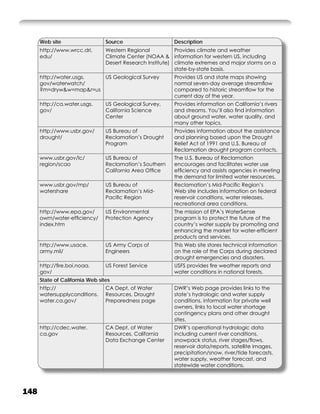
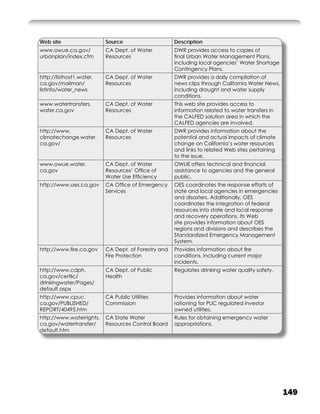
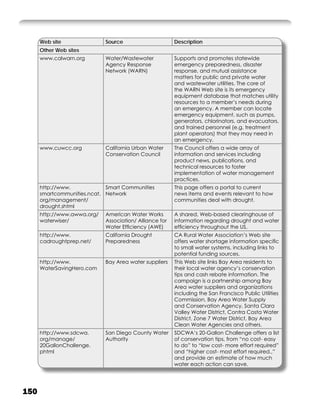
     twice each month. Appendix F summarizes State and federal agency Web sites that may
     be useful in supplying data during water shortage emergencies.

     The body of historical information summarized in the various DWR publications
     previously discussed is continually updated and available at: http://www.publicaffairs.
     water.ca.gov/information/pubs.cfm.

     Demand Data

        •      Water use records (minimum of five years) and forecasts
        •      Service area population and growth projections
        •      Customer class characteristics

     Water use data is needed by month (or as often as is available) for each customer for
     at least the last five years. This data is used to determine, for individual customer and
     customer class, the average use by month, by season and by year. Collect the following
     data:

        •      The average number of residents per single-family residence and per
               multifamily unit.
        •      The number of units per multifamily connection.
        •      The number of businesses served by each commercial meter and the number
               of employees at each business. Identify industrial customers with the North


30
American Industry Classification System (http://www.census.gov/epcd/
          www/naics.html) - the business licensing entity may have this information
          available.
   •      The number of acres irrigated by each landscape irrigation meter and
          each agricultural meter. The county agricultural commissioner, university
          extension, and resource conservation district may have this information or
          help you find it.
   •      The annual quantity of unaccounted-for water by subtracting sales + flushing
          + measured fire/leaks/breaks from production.
   •      If there is time, the accuracy of the various sizes and ages of meters. Calibrate
          all 4-inch and larger meters.

II. Data Analysis
Much of the information discussed previously is routinely collected and analyzed as part
of periodic planning for water master plans, wastewater master plans, UWMPs, and
general plan updates. Coordinate the development of a drought-planning database with
ongoing data collection and analysis programs. If not previously determined in other
studies, analysis of the raw data may be required to illuminate certain drought period
trends, such as the relation of landscape irrigation to precipitation.

Supply Data Analysis (projected dry-year supply without augmentation)

First, determine the reliable yield for each source for the next five or more years.
Assume a repeat of the worst historical drought and include an adjustment for increased
uncertainty and variability – longer, dryer periods or back-to-back droughts with short
wet intervals. For purchased water sources, do not use the contracted allocation but ask
the water wholesaler to provide estimates of how much water is likely to be available
during each of the next five or more years. Work with the wholesaler to develop the
allocation method for short supplies.

Water Quality Data Analysis

Establish treated water quality by source for constituents regulated by the Safe Drinking
Water Act (PL 93 523) and Title 22 of the California Administrative Code. Comparison
of this information with raw water data gives insights into the seasonal variability of
the supply and the ability of the treatment system to respond to changes in raw water
quality. Develop data on how the water quality of each source may vary with the 2008-
2012 use projections. The ability to treat water of degraded quality adequately during
drought will be critical if the agency plans to use all possible supplies. Identify process
or chemical changes needed to respond to reduced raw water quality and new supply
sources.


                                                                                              31
Suppliers that blend water from various sources will have to examine the ability of the
     treatment system to meet water quality standards when lesser quality water is delivered
     from one or more sources. Also, certain commercial or industrial customers may need
     advanced notification if the water quality characteristics will be significantly different
     during drought periods.

     To stay informed of drought-induced water quality issues, a water supplier may decide
     to temporarily expand its routine water quality-monitoring program. This information
     may also be useful in alleviating customer concerns if aesthetic differences in water
     quality, such as chlorides, hardness, and odor occur during a drought. Increased testing
     will also provide data on possible impacts of varying water quality on the agency and
     customer distribution systems.

     Water Demand Data Analysis (projected dry-year demand without demand
     reduction programs)

     The more information that is known about how customers use water, the better the
     demand projections and selection of appropriate demand reduction measures will be.
     At a minimum, identify customer type and their seasonal demands. Standard water
     supplier customer types include: single family residential, multifamily residential,
     commercial, industrial, institutional, landscape, recycled, agricultural and wholesale.

     From a review of water use records, specific water use factors can be determined
     for each user type on an average monthly, seasonal and annual basis. Knowledge of
     user characteristics will be helpful when assessing the demand reduction impacts
     of restrictions and rationing allocation methods and estimating revenue generation
     from pricing changes and water shortage surcharges. Common units of water use
     measurement, in order of usefulness, are:

        •      Gallons per capita per day (gpcd)
        •      Gallons per day per dwelling unit (gpdd)
        •      Gallons per day per connection (gpdc)
        •      Gallons per day per irrigated acre (gpda) by crop, irrigation and soil type
        •      Gallons per day per employee (gpde)
     Further analysis of a given category, such as determining individual subarea factors or
     correlating customer classes with land use designations, may be useful. This is especially
     important if a large proportion of the overall demand is generated by one or two
     customer-class types.

     Analyze water use records on a seasonal basis. Again, conducting this analysis by
     customer type is essential. Winter residential use compared with summer residential
     use gives a good indication of indoor versus outdoor usage. The same analysis of
     seasonal water use among industrial customers may be indicative of process changes or
     landscape irrigation. Overall indoor-use may be best determined by the local sanitary


32
district based on inflows, with winter data based on non-precipitation periods (to avoid
storm water inflow impacts).

Demand for water usually increases in a dry year over normal demand. This is because
more water is needed for landscape irrigation because of less than normal precipitation
during the spring and fall. Drought year demand will increase the most in areas such
as inland valleys and desert areas that ordinarily use a high percentage of water for
landscape irrigation. Some agencies have reported unexpected demand from previously
un-served people requesting water service because of failing private wells.

Shortages will vary by year, but will tend to increase over time as supplemental supplies
are exhausted, as demonstrated in the table below from a water supplier with an annual
water delivery of 10,000 acre-feet (AF) per year:

                           Year               Shortage
                           2008        15%          1,500 AF
                           2009        25%          2,500 AF
                           2010        20%          2,000 AF
                           2011        40%          4,000 AF
                           2012        45%          4,500 AF

To forecast drought year demand, it may be helpful to plot normal year consumption
in the service area. That is, the average of 2002-2006 demand might approximate
normal rainfall year demand, and overlay this with data on demand in previous drought
years; for example, 1999 or 2007 may have been a low rainfall year. Comparing average
demand with dry-year demand may provide a multiplier (i.e., 107 percent) to use for
predicting the dry-year demand of increased future demand due to growth or other
factors. Agencies may be able to plot full supply periods against data from the drought
period 1987-1990, California’s last major statewide drought. At a regional level, parts of
Southern California experienced a series of consecutive dry years in the late 1990s/early
2000s. Other significant droughts occurred during 1928-34 and 1976-77. However, if
the water supplier implemented demand reduction programs or the media publicized
the need to reduce use, the dry year demand information will not reflect unmitigated
demand. Keep in mind that demand will have increased due to growth in the service
area. Project the dry year increase for each customer type.

III. Is there a Predicted Shortage?
A supplier’s projected supply for the next five or more years, when compared with
projected demand for the next five or more years, provides data on the yearly (or
monthly) supply/demand balance. In some cases these projections may show that the
supplies will be adequate. It is more likely that during significant dry periods suppliers
will find the supply deficit will vary year to year but gradually increase as reserve
supplies dwindle. The predicted unmitigated annual supply deficit is then met with


                                                                                             33
supplemental supplies and demand reduction programs. A combination of supplemental
     supplies and reduced demand is used to balance supply and demand.

     A “mitigated supply” is the normal dry year supplies plus emergency supplies.
     “Mitigated customer demand” is the projected dry year demand minus reductions
     resulting from demand reduction programs. The combination of emergency supplies
     and reduced demand is planned to balance supply and demand.

     A closely coordinated effort between water wholesalers and retailers is essential. Where
     they exist, water wholesalers may take the lead and ask their retail customers to share in
     developing regional and supplier specific water shortage response plans. However, since
     most retail agencies have multiple sources of supply (wholesale, groundwater, and local
     surface) they can prepare for water shortage without waiting for their wholesaler to take
     the lead. This section discusses how various water suppliers utilize supply and demand
     data to guide their response to a supply shortage. In the case where water suppliers have
     control over their supply systems, they assume the role of both water wholesaler and
     water retailer.

     Cooperate with other Agencies

     Suppliers are entering into regional, county and local agreements to improve water
     supply management, share the cost of emergency supplies, and improve demand
     reduction media messages and program cost.


           Bay Area Water Suppliers Partner to Create New Drought
                             Media Campaign
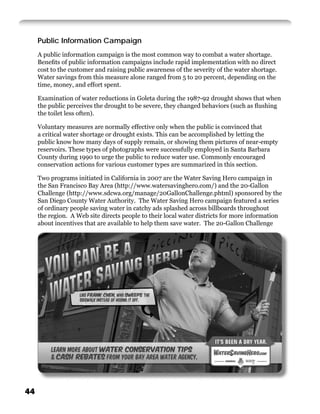
     In July of 2007, Bay Area water suppliers unveiled a regional public education
     campaign aimed at reminding residents and businesses to curb water use.
     The new “Water Saving Hero” campaign features ordinary people adopting
     simple water conservation practices in their everyday lives. The messages
     appear on billboards, transit stations, buses, trains, newspapers and are on the
     radio. A new Web site, www.WaterSavingHero.com, links Bay Area residents to
     their local water supplier’s conservation tips and cash rebate information. The
     million dollar campaign is a partnership among Bay Area water suppliers and
     organizations including the San Francisco Public Utilities Commission, Bay Area
     Water Supply and Conservation Agency, Santa Clara Valley Water District,
     Contra Costa Water District, Zone 7 Water District, Bay Area Clean Water
     Agencies.


34
El Dorado County Agencies Collaborate in Drought Planning Process
In 2004 El Dorado County Water Agency, the El Dorado Irrigation District, Grizzly
Flats Community Service District, and Georgetown Divide Public Utility District
initiated a collaborative drought planning process that identifies actions that
can be pursued individually or jointly. They are exploring the use of a model to
anticipate real-world drought impacts through drought simulations.
The El Dorado Irrigation District is now extending its drought preparedness
analysis to include a regional climate scenario, incorporating precipitation,
temperature, and hydrology factors derived from 12 internationally recognized
climate change models.


Actions by Water Wholesalers
In California, wholesalers manage source supplies or supplies from primary water
suppliers such as the State Water Project, the Central Valley Project, and the Colorado
River system.

Water wholesalers can offer the following types of leadership before and during a water
shortage:

   •      Develop an allocation process with retailers.
   •      Provide retail agencies with regular updates to wholesale water supply
          availability.
   •      Coordinate a consistent regional message and/or media-market basis.
   •      Coordinate supplemental supply purchases and agency interconnections.
   •      Coordinate regional demand reduction strategies.
   •      Coordinate financing for joint supplemental supply and demand reduction
          projects.
   •      Coordinate regional or area wide demand reduction projects.

Actions by Retail Water Suppliers

Each water retailer will make its own determination that the possibility of a water shortage
exists and adopt a current and specific WSCP. Managing supply and demand in a drought
is difficult and the following procedure is recommended.

Consider Carryover Storage

The water supplier also decides how much of the current year supply can be carried over
as insurance against a possible subsequent drought year. At a minimum, the carryover


                                                                                               35
amount will be enough to meet essential health, safety, and firefighting needs if the
     subsequent winters are as dry as the driest years on record. By reducing demand more
     than is necessary in the first year of a shortage, (i.e., 15 percent instead of 5 percent)
     suppliers have been able to carry over enough supply to avoid increasing reduction
     targets in subsequent years.

     Climate Change

     The potential impact of climate change on California’s water resources is another
     consideration that some water suppliers are exploring. It is expected that one of the
     impacts of the more variable weather patterns associated with climate change will
     be longer, drier droughts. More information can be found at this DWR Web site:
     http://www.climatechange.water.ca.gov/.

           Bay Area Agencies Address Climate Change in Water Plans
     The San Francisco Public Utility Commission (SFPUC) has embarked on a
     project to incorporate global warming concerns into their forecasting and
     planning activities. The SFPUC has evaluated the effect of a 1.5 degree Celsius
     temperature rise between 2000 and 2025 on the Hetch Hetchy watershed at
     various elevations. It expects that with this rise in temperature, there will be less
     or no snowpack below 6,500 feet and faster melting snowpack above 6,500
     feet. As such, SFPUC estimates that about 7 percent of the runoff draining into
     Hetch Hetchy Reservoir will shift from spring and summer seasons to the fall
     and winter seasons in the Hetch Hetchy Basin. This shift is manageable within
     SFPUC’s planning models, but other water suppliers with storage at lower
     elevations could be harder hit, especially during longer, dryer drought periods.
     Similarly, the Santa Clara Valley Water District, the agency that supplies water
     to much of Silicon Valley, has begun incorporating the possible effects of
     climate change into its water management plans, much as it already does for
     earthquakes and flooding. It is partnering with Sustainable Silicon Valley’s CO2
     Initiative, a key strategy to respond to climate change by changing the way
     energy is consumed. The focus is on both energy and water efficiency.


     IV. Catastrophic Supply Interruptions
     California water suppliers are required to develop plans to cope with catastrophic supply
     interruptions. Plans are required to be adopted for shortages up of to 50 percent.


            Earthquakes                 Power Outages                      Floods
           System Failures                  Fires                   Water Contamination


36
The “cascading effect” is often experienced when a catastrophe occurs. For example,
in the previous table, if an earthquake strikes, power outages often follow with water
supply interruptions and subsequent water quality problems occurring soon thereafter.
During the Southern California wildfires of 2008, several communities were stricken
with such a problem. In the city of Ramona, a fire-related power failure shut down
the local pumping station. When the pumping station stopped sending water to the
community, there was no backup generator to take over (voters rejected a proposal
to buy one in 1989, so Ramona borrowed three from the San Diego County Water
Authority). It took several days for Ramona’s drained water supply to be refilled, re-
pressurized and de-contaminated. Meanwhile, the Ramona Municipal Water District
did not have enough employees to shut off all the meters or to restart them. After some
delay, three dozen employees from neighboring water agencies helped shut off each of
the districts 10,000 meters. It took about 100 workers to reopen the meters one by one
to avoid straining the system and rupturing pipes.

Preparing for Uncertainty

System interconnections with suppliers in the region and participation in
comprehensive regional disaster plans can help lessen the effects of catastrophic supply
interruptions. In addition to predictable catastrophes such as floods, earthquakes,
power outages and contamination, the physical destruction of facilities as a result of
terrorism has taken a higher profile in recent years.

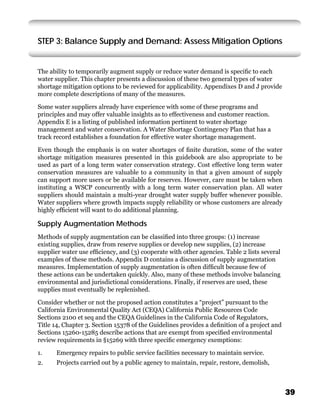
            Orange County Alerts Drivers of Water Emergency
In 2007, Orange County experienced an interruption in service because
of a weeklong shutdown of a local water treatment plant coupled with a
pronounced spike in water usage. This crisis led county water officials to
request that the transportation department activate 35 message boards
along five major freeways reading, “ORANGE COUNTY WATER EMERGENCY:
CONSERVE WATER.” The signs seem to have done the trick. In addition to the
freeway signs, which Caltrans officials said had never been used for such a
purpose, a county water official attributed the success of the conservation
effort to cities and water districts that used temporary pumps to help push
water to areas where it was needed.


WARN, the Water/Wastewater Agency Response Network, supports and promotes
statewide emergency preparedness, disaster response, and mutual assistance matters
for public and private water and wastewater utilities. California is divided into six
regions that coincide with the California Office of Emergency Services regions. Their
Web site can be found at www.calwarn.org.

Some agencies have the capacity to generate “reverse 911 calls” to alert residents
of evacuation notices or other directives, such as boil-water notices. Others have
agreements with local school districts to use their auto-dial system to parents to provide
emergency information.


                                                                                             37
38
STEP 3: Balance Supply and Demand: Assess Mitigation Options


The ability to temporarily augment supply or reduce water demand is specific to each
water supplier. This chapter presents a discussion of these two general types of water
shortage mitigation options to be reviewed for applicability. Appendixes D and J provide
more complete descriptions of many of the measures.

Some water suppliers already have experience with some of these programs and
principles and may offer valuable insights as to effectiveness and customer reaction.
Appendix E is a listing of published information pertinent to water shortage
management and water conservation. A Water Shortage Contingency Plan that has a
track record establishes a foundation for effective water shortage management.

Even though the emphasis is on water shortages of finite duration, some of the water
shortage mitigation measures presented in this guidebook are also appropriate to be
used as part of a long term water conservation strategy. Cost effective long term water
conservation measures are valuable to a community in that a given amount of supply
can support more users or be available for reserves. However, care must be taken when
instituting a WSCP concurrently with a long term water conservation plan. All water
suppliers should maintain a multi-year drought water supply buffer whenever possible.
Water suppliers where growth impacts supply reliability or whose customers are already
highly efficient will want to do additional planning.

Supply Augmentation Methods
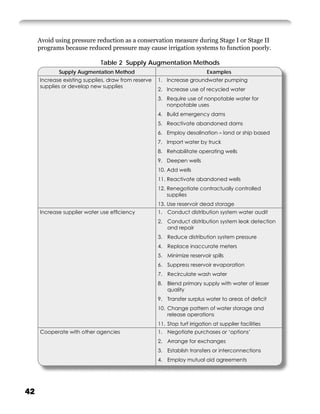
Methods of supply augmentation can be classified into three groups: (1) increase
existing supplies, draw from reserve supplies or develop new supplies, (2) increase
supplier water use efficiency, and (3) cooperate with other agencies. Table 2 lists several
examples of these methods. Appendix D contains a discussion of supply augmentation
measures. Implementation of supply augmentation is often difficult because few of
these actions can be undertaken quickly. Also, many of these methods involve balancing
environmental and jurisdictional considerations. Finally, if reserves are used, these
supplies must eventually be replenished.

Consider whether or not the proposed action constitutes a “project” pursuant to the
California Environmental Quality Act (CEQA) California Public Resources Code
Sections 2100 et seq and the CEQA Guidelines in the California Code of Regulators,
Title 14, Chapter 3. Section 15378 of the Guidelines provides a definition of a project and
Sections 15260-15285 describe actions that are exempt from specified environmental
review requirements in §15269 with three specific emergency exemptions:

1.    Emergency repairs to public service facilities necessary to maintain service.
2.    Projects carried out by a public agency to maintain, repair, restore, demolish,


                                                                                             39
or replace property damaged or destroyed in a disaster in which a state of
           emergency has been proclaimed by the Governor.
     3.    Specific actions necessary to prevent or mitigate an emergency.

     Appendix C contains pertinent language from the CEQA Guidelines, including potential
     exemptions. Certain drought response actions may not be exempt from CEQA and it
     is important to review the pertinent sections of the CEQA Guidelines for additional
     information regarding what constitutes an emergency before proceeding.

     Despite the inherent difficulties with using supply augmentation options, even minimal
     supply augmentation programs have been helpful in water shortage situations.
     Developing extra supply increases utility credibility with customers by demonstrating
     that the water supplier is maximizing its efforts to deal with the water shortage. Also,
     supply augmentation can provide a water shortage buffer in case of multi year shortages
     or can be used to minimize the amount of demand reduction needed to meet temporary
     supply deficits.

     Increase existing supplies, draw from reserves and develop new supplies

     Suppliers with surface water supplies may be able to use the amount of reservoir dead
     storage down to the legal minimum pool. Lake Cachuma, a U.S. Bureau of Reclamation
     reservoir in Santa Barbara County, was supplied with a floating pump and pipeline to
     move dead storage water almost a mile back to the reservoir outflow.

     Groundwater wells can often be deepened and the pump-rate increased for limited
     time periods. Lower quality groundwater can be blended or special treatment devices
     installed. In adjudicated basins it is sometimes possible during emergencies to
     temporarily increase the annual amount pumped. Well drillers often have waiting lists
     for their services during water shortages, so planning ahead and reserving time in their
     schedule can help insure increased groundwater production when it is needed.

     It may be possible to attract new recycled water customers during a drought. Because of
     Department of Health Services regulations on recycled water use, landscape irrigation
     with recycled water is probably already more efficient that potable water irrigation
     use. If recycled water use customers are only reduced by the amount they exceed the
     landscape demand then they will not be penalized for their efficiency and will benefit
     from their recycled water system investments.

     The best possible solution is to have emergency supplies held in reserve. These are often
     held in local groundwater basins but can also be located in distant water banks.

     During extreme shortages expensive new water supplies may be the only solution to
     meeting demands. Desalination, brackish water nano-filtration, temporary pipelines,
     and even water importation by train or truck become affordable. Nano-filtration can
     also be used to improve the quality of recycled water, expanding the number of possible
     customers. Water transfers from willing sellers using available pipeline capacity has
     become a significant source of supplemental water during shortages.

40
Increase Supplier Water Use Efficiency

To win the public’s cooperation, water suppliers and municipal agencies can
demonstrate a visible commitment to efficient water use. Actions to make a utility’s
operating system more efficient save water and set a good example for the public. A
utility company can take actions itself to conserve water before asking customers to
do the same, demonstrating a leadership role. One example is to reduce or stop turf
irrigation and install low volume irrigation systems for shrubs and trees at all agency
facilities.

System water audits can identify major water losses. Once a supplier quantifies their
system losses, it is time to conduct a leak detection and repair program and possibly a
meter replacement program. Detailed information on these procedures can be found
at the California Urban Water Conservation Council Web site at: http://www.cuwcc.
org/m_bmp3.lasso

Information about publications at:

http://www.cuwcc.com/publications/action.lasso?-Database=cuwcc_store&-
Layout=CDML&-Response=welcome2.lasso&-AnyError=error.html&Business_Serial_
ID=10185&-Search.

When appropriate, implement water theft prevention programs, generally targeting
street cleaners, water trucks, and construction sites. These programs save water and
have high visibility. Thus, they complement the public education programs.

“Water pirating” becomes more common when local private wells go dry and people in
rural, coastal and foothill regions especially become more desperate. More often, they
show up at the water supplier’s doorstep, asking for a hook-up.

A supplier can reduce water main flushing to the extent permissible by health and fire
standards, recycle water used to backwash filters, and flush existing wells to develop
the maximum flow possible. Limit landscape irrigation at water supplier facilities to
appropriate plants and be efficient and runoff free.

Water suppliers can reduce system pressure to the extent permissible by fire fighting
standards. Comparison of water use records of two similar Denver neighborhoods
indicated that homes with lower water pressure utilize an average of 6 percent less water
than those with higher pressure. They can also coordinate fire department pressure
checks with main flushing to accomplish both tasks with the same water.

The South Florida Water Management District Water Shortage Plan requires system
pressure reductions when there is even a moderate water shortage. Water authorities
are asked to reduce pressure to 45 psi at the point of use (i.e., the meter). The utility
then notifies local fire departments to make arrangements to restore pressure quickly in
case of fire.


                                                                                            41
Avoid using pressure reduction as a conservation measure during Stage I or Stage II
     programs because reduced pressure may cause irrigation systems to function poorly.

                             Table 2 Supply Augmentation Methods
            Supply Augmentation Method                                     Examples
     Increase existing supplies, draw from reserve   1. Increase groundwater pumping
     supplies or develop new supplies
                                                     2. Increase use of recycled water
                                                     3. Require use of nonpotable water for
                                                        nonpotable uses
                                                     4. Build emergency dams
                                                     5. Reactivate abandoned dams
                                                     6. Employ desalination – land or ship based
                                                     7. Import water by truck
                                                     8. Rehabilitate operating wells
                                                     9. Deepen wells
                                                     10. Add wells
                                                     11. Reactivate abandoned wells
                                                     12. Renegotiate contractually controlled
                                                         supplies
                                                     13. Use reservoir dead storage
     Increase supplier water use efficiency           1. Conduct distribution system water audit
                                                     2. Conduct distribution system leak detection
                                                        and repair
                                                     3. Reduce distribution system pressure
                                                     4. Replace inaccurate meters
                                                     5. Minimize reservoir spills
                                                     6. Suppress reservoir evaporation
                                                     7. Recirculate wash water
                                                     8. Blend primary supply with water of lesser
                                                        quality
                                                     9. Transfer surplus water to areas of deficit
                                                     10. Change pattern of water storage and
                                                         release operations
                                                     11. Stop turf irrigation at supplier facilities
     Cooperate with other agencies                   1. Negotiate purchases or ‘options’
                                                     2. Arrange for exchanges
                                                     3. Establish transfers or interconnections
                                                     4. Employ mutual aid agreements


42
Demand Reduction
Demand reduction is the most straightforward way to address water shortages.
Curtailment of water demand is directed at supplier and customer uses that are
inefficient, wasteful, or able to be temporarily reduced or suspended. Since the supplier
may mandate certain demand reduction actions, enforcement mechanisms are needed
for maximum effectiveness of those actions.

Demand reduction programs vary by Stage (severity of shortage). Stage 1 is usually
voluntary and relies on a public information campaign and enforcement of water waste
ordinances. Stage 2 can often be managed with a more intensive public information
campaign and mandatory restrictions. Stage 3 and Stage 4 most often require customer
allocations and/or severe landscape irrigation restrictions. Demand reduction measures
to assist customers reduce demand are offered in all stages but increase in scope with
the severity of the shortage.

Plumbing hardware changes can also yield considerable savings. For example, one
private college dormitory near Santa Barbara installed 350 ultra-low flush toilets
for 1,400 students and had immediate water savings of 30 percent. Providing home
water audits, free hose nozzles and buckets, rebates for efficient plumbing fixtures and
appliances, and gray water information can reduce residential use by up to 50 gallons
per capita per day without significant lifestyle changes.


                Florida Prioritizes Demand Reduction Actions
Florida has established a process to prioritize demand reduction actions. On
April 17, 2007, Florida released the Florida Drought Action Plan. Each of the five
water management districts in Florida approves plans and rules for addressing
water shortages. Concern in Florida has risen, as November 2005 to March
2007 ranks as the third driest period in the state’s recorded history. The goal
of Florida is to monitor and assess data from the five water management
districts, coordinate drought management activities, communicate with
decision makers and others and take actions to reduce adverse effects. An
interesting and useful component of the Florida Drought Action Plan is the
Recommended Water Conservation Alternatives table (http://www.dep.state.
fl.us/drought/news/2007/files/ florida_drought_action_plan.pdf). It presents the
various agricultural and urban water conservation alternatives and ascribes a
priority rating based upon the potential amount of water to be saved, the cost
effectiveness of the measure, and the ease of implementation. Conservation
rate structures, incentives, statewide irrigation design and installation
standards, and metering of reclaimed water services are some of the high
priority measures.


                                                                                           43
Public Information Campaign
     A public information campaign is the most common way to combat a water shortage.
     Benefits of public information campaigns include rapid implementation with no direct
     cost to the customer and raising public awareness of the severity of the water shortage.
     Water savings from this measure alone ranged from 5 to 20 percent, depending on the
     time, money, and effort spent.

     Examination of water reductions in Goleta during the 1987-92 drought shows that when
     the public perceives the drought to be severe, they changed behaviors (such as flushing
     the toilet less often).

     Voluntary measures are normally effective only when the public is convinced that
     a critical water shortage or drought exists. This can be accomplished by letting the
     public know how many days of supply remain, or showing them pictures of near-empty
     reservoirs. These types of photographs were successfully employed in Santa Barbara
     County during 1990 to urge the public to reduce water use. Commonly encouraged
     conservation actions for various customer types are summarized in this section.

     Two programs initiated in California in 2007 are the Water Saving Hero campaign in
     the San Francisco Bay Area (http://www.watersavinghero.com/) and the 20-Gallon
     Challenge (http://www.sdcwa.org/manage/20GallonChallenge.phtml) sponsored by the
     San Diego County Water Authority. The Water Saving Hero campaign featured a series
     of ordinary people saving water in catchy ads splashed across billboards throughout
     the region. A Web site directs people to their local water districts for more information
     about incentives that are available to help them save water. The 20-Gallon Challenge


44
provides people specific ways they can reduce their water use by 20 gallons per day,
from clothes washing to lawn watering. Since few people realize how much water they
use, this can be informative and motivational.

                                    Landscape Irrigation

Tip                                                        Estimated Savings
Water only before 6 a.m. and after 8 p.m. to reduce        20-25 gallons per day
evaporation and interference from wind.
Don’t overwater!                                           15-25 gallons for each minute; up to 250
                                                           gallons per cycle
1. Reduce each irrigation cycle by 1-3 minutes,
   or eliminate one irrigation cycle per week. Use
   the landscape calculator and watering index.
   Also check out www.sandiego.gov/water/
   conservational to learn how much to water.
2. Water only after the top inch of soil is dry.
3. Reset irrigation controllers and replace batteries
   in the spring and fall.
Adjust sprinklers to prevent overspray and run-off         15-25 gallons per day
Repair leaks and broken sprinkler heads.                   20 gallons per day per leak
Add 2” to 3” of mulch around trees and plants to           20-30 gallons per day per 1,000 sq. ft.
reduce evaporation.
Install water-efficient drip irrigation system for trees,   20-25 gallons per day
shrubs, and flowers to get water to the plant’s roots
more efficiently.
Upgrade to a “smart irrigation controlloer” that           40 gallons per day
automatically adjusts watering times for hotter
weather, and shuts down the system when it rains.
Replace a portion of lawn with beautiful native and        33-60 gallons per day per 1,000 sq. ft.
California-friendly plants. Note: These plants do best     depending on climate
when planted after winter rains begin. For great
examples, check out: landscapecontenst.com.


Restrictions
Ordinances banning specific uses of water are forms of mandatory measures. Examples
of types of demand reduction ordinances are listed on the next page.


                                                                                                      45
Water Waste Ordinances

     Ordinances making water waste illegal vary but often read:

     Waste of Water Prohibited. No water shall be wasted. All water shall be put to
     reasonable beneficial use. Prohibited water uses include, but are not limited to, the
     following:

          •      Use of any ornamental fountain using potable or makeup water for operation.
          •      Car washing except at commercial car washes that recycle water.
          •      Use of potable water from hydrants for non-potable uses.
          •      Washing of sidewalks, streets, decks or driveways (except for public health
                 and safety).
          •      Pressure washing of buildings (possible exemption for building rehabilitation
                 projects- painting).
          •      Untended hoses without shutoff nozzles.
          •      Gutter flooding.
          •      Sprinkler irrigation whose spray pattern hits paved areas.

     Landscape Irrigation Ordinances

     1.       Watering only between certain hours or on specific days: In 1988, the city of
              San Luis Obispo limited landscape irrigation to every other day and water
              use increased. Odd-even or thrice weekly watering limitations often result in
              increased water use because they encourage customers to irrigate when they
              otherwise might not. If irrigation is allowed less frequently, water use has been
              shown to decrease. Restricting irrigation to twice weekly is recommended during
              the initial stages of drought. During advanced stages sprinkler irrigation can be
              restricted to once weekly, or eventually banned. Micro irrigation of shrubs and
              trees can be encouraged as this will be a permanent efficient change. The Water
              Shortage Plan for the city of Santa Barbara demonstrates how outdoor residential
              watering restrictions can be made more severe as a drought progresses. During
              Phase 1 and 2 (minimum water shortage), existing residential landscaping could
              only be irrigated before 8 a.m. and after 5 p.m. During Phase III (severe water
              shortage) the city banned the use of sprinklers and regulations allowed only drip
              irrigation.
     2.       Watering only with hand held hose or container: In March 1990, the city of
              Santa Barbara banned sprinklers and residential customers could only use drip
              irrigation. Sprinkler bans can create considerable public resentment because
              of the great inconveniences they cause. Fixed allocations, allowing customers
              to responsibly use the water they are allocated as they see fit, allow the water
              purveyor to avoid unpopular water use bans until Phase 4. For example, the


46
North Marin County Water District exceeded its rationing goal of 30 percent with
         its sprinkler ban. It subsequently changed the plan to a voluntary percentage
         reduction program. A rationing level of 30 percent was achieved through that
         change, eliminating most of the turf damage that would have occurred if the
         sprinkler ban had been continued.
3.       Watering only with recycled water: Lawn watering was prohibited in Corpus
         Christi, Texas, on Aug. 25, 1984, during a serious drought. The city implemented
         a program to use reclaimed water for landscape irrigation and construction uses.
         Licensed, private tank truck companies delivered reclaimed water to business
         and residential customers. Before implementing this program, the public
         health aspects were addressed by the local public health agency. Regulations
         set a minimum 1 part per million chlorine residual be maintained to all applied
         reclaimed water. This reclamation program was very successful both for reducing
         landscape losses and for maintaining jobs and income of severely affected
         nursery and landscape businesses. This program provided an estimated 7 million
         gallons of reclaimed water for residential and business landscaping throughout
         the city from August through October 1984.
4.       Watering only with graywater: In 1989, Santa Barbara County amended its
         Building Code Ordinance to allow the use of graywater and in 1990 San Luis
         Obispo County adopted similar regulations. Most single-family residences
         produce 20 to 40 gallons of gray water per person each day. The per capita
         graywater produced at a residence is enough to provide all the water needs of
         four mature fruit trees or a dozen shrubs. The gray water is distributed through
         irrigation hose to subsurface irrigation points.
Each supplier will estimate the monthly amount of irrigation use by customer class
as a check on the possible amount of demand reduction of limiting irrigation. Some
suppliers have found that multiple-residential accounts use 15 percent or less of their
total yearly demand for irrigation. The nature of the restrictions used will depend on the
severity and timing of the situation. Possible water restrictions are noted below.

     •      Prohibit irrigation during the warmest hours of the day, for example between
            10 a.m. and 7 p.m. Consider allowing irrigation only during early morning
            and evening when customers can observe the efficiency of the irrigation
            system. Allowing irrigation between 9 p.m. and 5 a.m. often results in
            sprinklers running all night or systems with leaks operating for days or weeks
            before being noticed and repaired.
     •      Limit all sprinkler irrigation to a specific number of days per week. The
            number of days will depend on target consumption goals, the time of year and
            the extent to which irrigation is occurring, and how much demand has already
            decreased. For example, if demand has already been reduced by 15 percent
            through other measures, limiting sprinkler irrigation during July and August
            to two days a week could further reduce average daily demand by as much
            as 5 percent. Limiting lawn or turf watering to one day a week could reduce
            average daily demand by as much 10 percent.


                                                                                             47
Denver Prioritizes Landscape Drought Measures
     The Denver, Colorado, Drought Response Plan has a thoughtful approach to
     the use and timing of water use restrictions. Denver Water’s goal for drought
     response is to preserve the quality of public life and economic activity to the
     extent possible in the face of water shortage. In 2002, Denver Board of Water
     Commissioners adopted policy guidelines for developing a drought restriction
     program. Denver Water will follow these principles in restricting landscape
     water use during a drought.
     • Avoid irretrievable loss of natural resources.
     • Allow watering of irreplaceable trees.
     • Avoid killing perennial landscaping if possible.
     • Tailor water restrictions as much as possible to known landscape needs.
     • Restrict less essential uses before essential uses.
     • Restrict water use for misters, fountains and other aesthetic water features
       first.
     • Avoid using water as a substitute for something else (for example, cleaning
       impervious surfaces or washing personal vehicles).
     • Curtail outdoor water use (except for watering trees and shrubs), along with
       restrictions on commercial use, before restricting domestic indoor use.
     • Affect individuals or small groups before affecting large groups or the
       public as a whole, allowing as much public activity as possible to be
       unaffected.
     • Preserve community pools rather than residential pools.
     • Restrict golf courses before public parks.
     • Restrict water use on less heavily used areas of parks where grass can go
       dormant before restricting use on formal and informal playing fields, where
       recreational activity would either kill the grass or have to be prohibited.


48
Minimize adverse financial effects.
• Try not to put people out of business, although businesses that depend on
  purely discretionary water use will be affected.
• Restrict seasonal commercial use, which is likely to be outdoors.
• Restrict nonessential uses of water in businesses before affecting
  fundamental business functions.
• Work with large-volume water users to reduce use in the least disruptive
  manner.
• Engage in ongoing dialogue with the green industry to obtain input and
  allow these businesses to plan for future months.
Eliminate waste.
• Enforce restrictions and permit limitations in an effective manner.
• Adopt restrictive criteria for exemptions from restrictions.
• Discourage or prohibit irrigation of medians.
• Prohibit installation of new landscaping if its survival next season is in doubt.
• Develop incentive programs to promote savings.
• Perform audits to identify water waste and recommend solutions.
• Adopt extensive public information and media relations programs.
• Inform customers about the problems caused by drought and what they
  can do to help.
• Hold and attend public meetings as necessary to receive input.
The basic response to a Stage 1 Drought is voluntary measures; to a Stage 2
Drought, mandatory restrictions; to a Stage 3 Drought, a general prohibition
on lawn watering; and to a Stage 4 Drought, rationing of water supplies for
essential uses. Because Stage 2, Stage 3 and Stage 4 Drought restrictions are
mandatory, they must be incorporated into Denver Water’s Operating Rules,
where they become enforceable pursuant to the Denver Charter, the Denver
Revised Municipal Code and provisions in Denver Water’s water service
agreements and water leases.


                                                                                      49
Sample schedules:

             ▪   Twice weekly (avoid allowing irrigation on weekend days to maximize
                 reduction)
                 ▫   For residential addresses ending in odd numbers: Monday and
                     Thursday;
                 ▫   For residential addresses ending in even numbers: Tuesday and Friday;
                 ▫   For commercial accounts: Monday and Friday;
                 ▫   Wednesday, Saturday and Sunday: no outdoor irrigation with
                     sprinklers.
             ▪   Once Weekly by address, addresses ending with:
                 ▫   0 or 1: Monday;
                 ▫   2 or 3: Tuesday;
                 ▫   4 or 5: Wednesday;
                 ▫   6 or 7: Thursday;
                 ▫   8 or 9: Friday;
                 ▫   Saturday and Sunday: No irrigation with sprinklers.
             ▪   Ban sprinkler irrigation, with low-volume irrigation prohibited during the
                 warmest hours of the day, for example, between 10 a.m. and 6 p.m.


        Savings from Mandatory Measures Far Exceed Voluntary Water
                         Restrictions in Colorado
     An analysis of the different approaches used by eight water suppliers in
     Colorado during a 2002 drought demonstrated that mandatory restrictions
     were an effective tool in their communities (Use and Effectiveness of
     Municipal Water Restrictions During Drought in Colorado, Douglas S. Kenney
     and others, 2004). The researchers found that during periods of mandatory
     restrictions, savings measured in expected use-per-capita ranged from 18 to 56
     percent, compared to just 4 to 12 percent savings during periods of voluntary
     restrictions. The key provisions of each program were the rules restricting lawn
     watering. Four water suppliers that restricted watering to every third day
     resulted in 22 percent reductions in water use; three water suppliers that limited
     watering to twice weekly had 33 percent reductions; and the one city that
     restricted watering to once a week saved 56 percent.


50
As demonstrated below, restricted days, with NO weekend days, reduced weekend
peaks.


Possible Exemptions from Water Use Restrictions
   •      Categories of possible exemptions include: new landscapes with low-volume
          irrigation, sports fields and golf course greens.
   •      The efficient use of non-potable water for street cleaning, dust control at
          construction sites and other non-potable uses are unlikely to be restricted.
Pricing
California law requires that water suppliers provide an analysis of the expected revenue
effects of reduced sales during shortages. Well-designed rate structures can reduce the
potential financial effects of water shortages.

Water suppliers can implement new water pricing structures during water shortages.
In metered areas raising rates on the quantity used will result in water use reductions.
A water supplier can expect rapid and significant water use reductions to result from


                                                                                           51
large per billing unit price increases. Combining a large billing unit price increase with
     significant excess use charges can guarantee that the targeted reduction is achieved.
     Devise water rates to enable the supplier to recover its purchase, treatment, and delivery
     costs as well as the additional costs related to the water shortage response program and
     replenishing the drought emergency fund.

     Make pricing changes a part of a water shortage contingency plan and adopt them as
     part of the plan. This can reduce the rate change approval from months to weeks.

     Proposition 218, approved by the voters in 1996, added Article XIII C (taxes) and D
     (fees and assessments) to the California Constitution. Proposition 218 may apply to how
     a water supplier sets rates. Water suppliers should consult with their attorney for its
     agency’s situation for rate modification actions. For the full text of Proposition 218
     go to http://vote96.sos.ca.gov/bp/218.htm.

     These sections limit the authority of local government to impose, extend or increase
     taxes and property-related assessments, fees and charges. Among other requirements,
     assessments are limited to the special benefit conferred, and fees and charges are limited
     to the cost of providing the property-related service. Voter approval is required for taxes
     and certain fees or charges.

     Proposition 218 changed procedures used by local government agencies for increasing
     fees, charges, and benefit assessments. Assessments, fees, and charges imposed as an
     “incident of property ownership” are now subject to a majority public vote. Water-
     related charges potentially affected by Proposition 218 include some meter charges,
     acreage-based irrigation charges, and standby charges. Not all post-Proposition 218
     proposed assessments to fund water agency charges have succeeded in receiving voter
     approval. Most water agencies use a combination of fees for water service and other
     charges or property assessments to cover operating costs. Depending on an individual
     agency’s fee structure, it could experience financial problems during a drought, when
     water sales revenues are down and the need for voter approval would limit ability to
     increase assessments.

     Inclining Block Rate

     The billing rate increases as water use increases under an inclining block rate structure.
     This encourages customers to save water and frugal water users will benefit from
     lowered rates.

     During water shortages make the steps between blocks very steep to strongly discourage
     excess use. In 1987, the Goleta Water District replaced its two-tier block rate structure
     with a four-tier inclining block rate structure. Tier four was $2.25 per hundred cubic feet
     (HCF). During rationing this rate structure was accompanied by an excess use charge
     of four times the highest tier ($9 per HCF) for customers who exceeded their allotment
     (see the section on excess use charges below).


52
Include a lifeline rate in the pricing system that is as low as possible for basic health and
safety uses.

Seasonal Rates

For seasonal rates, low water charges cover the water production costs in winter; in
summer, or other peak periods, the rates increase to meet the capital costs associated
with the expanded facilities necessary to produce peak demand capacity. These
increased summer rates influence customers to reduce water use to lower their costly
summer water bills. The Los Angeles Department of Water and Power has a seasonal
rate structure.

Uniform Rate

The same rate is charged for each billing unit consumed. While this method provides
some incentive to reduce consumption it represents a passive rate structure that is not
likely to reduce water sufficiently during a drought.

Drought Surcharge

During extreme water shortages, water utilities often institute surcharges to alleviate
falling revenues because of decreased water sales. Make it clear that these surcharges
are separate from normal billing, and will be eliminated when the declared shortage
ends.

Excess Use Charge

This water fee is assessed during rationing periods to those customers exceeding their
allotments. During a serious 1984 Texas drought, Corpus Christi officials implemented
stiff excess use charges: $3 for the first 1,000 gallons over the allotment; $5 for the next
1,000 gallons; $10 for the next 1,000 gallons; and, finally, $25 for each additional 1,000
gallons.

Some water suppliers have programs to audit specific water uses. Recommendations are
made on how much water is needed for the uses after reasonable conservation measures
are implemented. The use of landscape water budgets, where a certain amount of water
is allowed per square foot of landscape, is a good example. When rationing is required,
these conservation-based amounts can provide volume of water for the first tier. Water
used beyond that can be priced more expensively to encourage conservation.

Whenever price structure changes are contemplated for use as part of a water shortage
management plan, a realistic assessment of how long it will take to get it approved.
Often, the utility rate setting takes several months. However, declaring a water shortage
emergency allows agencies to make immediate rate adjustments.

Also, it may be unrealistic to expect the conservation benefits of price changes to
make an immediate impact, especially if billing cycles are staggered or are bimonthly.


                                                                                                53
Denver Establishes Drought Pricing Principles
     There is a relationship between price and demand. In theory, customers
     respond to an increase in price by reducing demand. The question is at what
     price level will the customer respond? The answer varies based on a number of
     factors.
     Surcharges will be incorporated into an overall program to increase customer
     awareness of the drought’s severity and the importance of saving water.
     Customers respond to the “basket of programs” concept, which includes
     surcharges. Drought pricing plays a role in creating an environment in which
     customers recognize the importance of reducing water use.
     Surcharges may apply to current water demands, new taps, or other demands
     on the water supply. There is concern about issuing new taps when existing
     customers are subject to surcharges. Applying various forms of surcharges to
     different types of demands on the water supply provides an equitable method
     allowing all customers to share the burden of the reduced supply.
     Surcharges are less effective by themselves. Industry studies and Denver
     Water’s own customer surveys indicate that surcharges are more effective
     at reducing water use when combined with other restrictions to create an
     atmosphere that promotes water savings. Customer response to price signals
     varies depending on several factors such as affluence, billing frequency, and
     the normal cost of water. Empirical data show that customers respond to
     temporary water pricing strategies as part of a water savings environment.
     Surcharges are separate from rates. Rates are based on cost. They are
     established to recover particular kinds of costs specified by the Denver City
     Charter. The purpose of drought surcharges, on the other hand, is to raise
     awareness of the value of water, to reduce water use, and to penalize
     those who don’t comply with drought restrictions. These goals are better
     accomplished when surcharges are implemented as a temporary measure
     outside the cost-of-service rate structure.
     Surcharges should match the severity of the drought. Because every drought is
     different, each one may require a different set of responses. Surcharges must
     be structured to help create an atmosphere of appropriate water savings.
     Surcharges must be feasible for computer systems to handle. Denver Water
     must be able to respond to drought conditions quickly and efficiently. Any
     change in water use charges must be manageable with only moderate
     modifications to existing computer systems. Substantial changes increase
     response times and contribute to errors. Because internal coordination
     is critical, staff members from Customer Care, Information Technology,
     Accounting, and other relevant sections will be included in discussions of
     surcharge options.


54
Surcharges should be tailored for different customer groups and monitored
for effect. A one-size surcharge does not fit all. Commercial and industrial
customers use water differently from residential customers. Large-volume
public use customers may need some accommodation. The surcharge
structure must be flexible enough to promote water savings while still
addressing diverse customer needs.
Surcharges should reflect overall drought response philosophies. Because all
surcharge structures divide customers into groups, no surcharge structure is
100 percent “fair.” Some customers may pay a surcharge even if they comply
with the other restrictions. In addition to raising awareness of the value of water
and encouraging temporary reductions in use, surcharges can supplement
revenues if necessary.
Surcharges may need to be seasonally adjusted. In Colorado’s semi-arid
climate, water use is greater in summer than in winter. Outdoor use is more
discretionary than indoor use, and surcharges should be adjusted to assist
in maintaining a water savings environment. Because restrictions to reduce
indoor use are difficult to design, adjusting surcharge thresholds can be more
effective at monitoring and reducing indoor water demand in winter.
Public input and information are key to customer understanding of
surcharges. When surcharges are designed and implemented, the public
must have adequate opportunities for input, the surcharge must help create
an atmosphere of water savings, and the public must receive adequate
information to fully understand the surcharge program.
Surcharges are temporary measures. The criteria that determine when
surcharges will be lifted should be specified before the surcharges are
imposed. This will reinforce the temporary nature of the surcharge in the minds
of customers.
Equity issues related to removing the surcharge should be addressed in
advance. The specified conditions leading to termination of surcharges do
not always occur at the end of a billing period. Criteria for lifting the surcharge
once the specified conditions occur should be considered ahead of time.


However significant
However, significant excess use charges, even where billing cycles were staggered or on
                               charges
a bimonthly basis, had an immediate and significant impact on demand during 1990 in
San Luis Obispo, Santa Barbara and Ventura counties.

It is standard practice for water suppliers to maintain a dry-year contingency reserve
fund to protect revenue through two or more consecutive years of supply reductions
below normal demand levels. Rate hikes, surcharges, or borrowing strategies are
expected in agencies without an established reserve or when the reserve has become
depleted.


                                                                                         55
EBMUD Maintains Revenue Recovery Plan for Dry Times
     The East Bay Municipal Utility District (EBMUD) assesses its water availability
     and integrates the data into its financial planning and annual rate review
     for budget purposes. In the past, when mandatory use reductions were
     implemented based on this assessment, an inclining block rate structure was
     adopted as part of the water shortage management program, designed to
     encourage consumers to conserve water and to fully mitigate the revenue
     and expenditure impacts. In addition to offsetting the decrease in water sales,
     revenue recovery covers the extraordinary expenses of the water shortage
     management program. During the drought year of 1988, EBMUD budgeted
     $1.8 million for this program.

     Unmetered Suppliers and Pricing

     Unmetered areas face special challenges implementing drought conservation programs
     because they cannot impose per customer reductions or per capita allotments.
     Conservation programs consist of informational programs, restrictions, voluntary
     measures using rebates and incentives, technical assistance. Appendix K presents
     suggested programs for agencies with unmetered residential accounts.

     Rationing Allocations
     Rationing programs often reflect two general approaches – supplier-oriented or
     customer-oriented.

        •      Supplier-oriented approaches require little or no additional staff or computer
               programming to develop customer based data. It also may result in a program
               that may be perceived as inequitable and the demand reduction may be small
               and not sustained.
        •      Customer-oriented approaches require additional staff and computer
               programming to develop individualized allocations and more customer
               service. These programs usually produce significant and sustained demand
               reductions.
     Consumer response to rationing allocation programs is more predictable than to other
     approaches, and these are generally the most effective programs to achieve significant
     demand reduction. As an example, Table 3 shows the broad range of conservation
     policies adopted by selected California water suppliers during the 1976 1977 drought
     and their results. In nearly every instance where mandatory rationing was implemented,
     consumers responded by reducing water use more than was requested.

     A strict rationing program combined with a prohibition of landscape sprinkler irrigation
     can bring per capita water use down to low levels. The Marin Municipal Water District
     achieved a per capita use rate of 35 gallons per day in 1977.


56
In California, the California Public Utilities Commission regulates private water
suppliers, also known as Investor Owned Utilities. They have established rules
and procedures for regulated agencies regarding rationing and service connection
moratorium. Its Instructions for Water Conservation, Rationing, and Service
Connection Moratoria can be found in Appendix B.

                 Table 3 Programs Adopted by Retail Water Suppliers
                          during California Drought 1976-77
                                                                           Achievement
               Supplier                  Residential Rationing Program
                                                                             Percent
Marin Municipal Water District        Mandatory 57 percent per capita          65
East Bay Municipal Utility District   Mandatory 35 percent per household       40
Contra Costa County Water District Mandatory 30 percent                        25
San Francisco Water Department        Mandatory 25 percent                     30
Los Angeles DWP                       Mandatory 10 percent                     16
Sunnyvale Water Department            Voluntary 25 percent                     26
Santa Clara Valley Water District     Voluntary 25 percent                     30
City of Pleasanton                    No program                               19


One of the inherent problems with a rationing system is in accurately designing the
program to achieve the desired demand reduction level without greatly exceeding this
amount. Although midcourse corrections can be made to lessen the impact of a program
proving to be too severe, such adjustments are risky and most managers are reluctant
to make them. Water officials feel that changing programs too often sends a message
to customers that the supplier’s planning was faulty. Therefore, it is necessary that
rationing program corrections be presented carefully to customers.

Key elements of a successful rationing program are that the available water is shared
as equitably as possible, and that customers are kept informed about the status of the
shortage. The California Water Code, Section 354 of Chapter 3, Appendix A, provides
for the establishment of priorities and allocations for purposes beyond basic domestic,
sanitation, and fire protection uses. Allocation disagreements, however, are to be
expected and procedures to handle exceptions and variances need to be part of a
rationing program.

A good public information program helps in administering and enforcing a rationing
plan. Publish information regarding water use and supply at least weekly to keep
customers committed. Also, providing fixture replacement rebates, customer water
on-site assistance and useful information to help customers reduce water consumption
stimulates relatively painless short-term and long-term water demand reductions.


                                                                                          57
Rationing programs are generally patterned after one of five basic allocation schemes:
     (1) Percent Reduction, (2) Financial Rationing, (3) Per Connection Allotment, (4) Per
     Capita Allotment, (5) Hybrid Per Capita - Percentage. Percent reductions and financial
     rationing can be applied to all customers. The other schemes are only for residential
     customers.

     Percent Reduction Allotment: all account types
      +    useful for non-residential vary based on efficiency
      +    easy to determine and administer
      +    establish minimum/maximum amounts to limit extremes
      –    penalizes conservers
      –    rewards “above average” users
      –    promotes water use during non-shortage periods


     A percentage reduction assigns each customer a consumption reduction goal as a
     percentage of the consumption level used in a previous year or a five-year average.
     Required percent reductions can be constant, stepped, or variable. Fixed percentage
     reductions were used widely during the 1977 California drought. The cities of Concord,
     Palo Alto, San Mateo, Napa, and Vallejo all used allotment programs that depended on a
     customer’s previous year water use. In Southern California, people were given a baseline
     allotment of 90 percent of their previous year’s consumption with excess use charges for
     water consumption above that level. The fixed percentage system was easy to coordinate
     because water allocations were quickly determined from the previous year’s water
     bills. The percentage reduction method, however, was widely perceived as inequitable
     because it had the effect of penalizing former water conservers while rewarding those
     who had previously used large water quantities. Neighbors living in identical houses
     could therefore receive vastly different water allotments. Also, this plan does not
     distinguish between indoor and outdoor water use.

     During severe shortages a rationing plan based on percentage reductions may cause
     huge disparities in allotments among similar customers. This will create serious
     management problems for the water supplier because many requests for exemptions
     will be filed and many people will perceive the system to be unfair. In 1991, the city of
     San Francisco called for reductions of 90 and 33 percent in exterior and interior water
     use respectively. Inequity was minimized by limiting deliveries to 300 gallons per single
     family home per day, and 150 gallons per multifamily dwelling per day.

     The percentage seasonal allotment is similar to percentage reduction except that
     the consumption reduction goal varies depending on the time of year. Both of these
     methods inadvertently reward past wasteful behavior and penalize past conservation by
     using previous demand levels in the computation of rationed allotments.


58
Financial Rationing: all account types
  +     market determines water uses, avoids allotments
  –     relates water use to income
  –     residential tiers are based on average number of occupants
  –     large number of appeal
  –     difficult to set non-residential tiers


Financial rationing sets tiers based on past use for non-residential customers and the
number of residents for residential customers. The advantage of this system is that the
market determines how water is used and, because it avoids per-customer allotments,
it is easy for the supplier to implement. The community is unlikely to support this
scheme because it relates water use to income and there is no sense of equity. Since non-
residential tiers are based on historical use it rewards high-water users and penalizes
efficient customers. The supplier sets residential tiers based on the average number of
occupants, resulting in a large number of appeals. Generally, the negatives outweigh the
positives.

Per Connection Allotment: residential
   +     easy to establish allotments
   –     no relationship between customer characteristics and water use
   –     not equitable
   –     doesn’t recognize historical use


Per Connection allotment (residential only) establishes a customer’s water consumption
goal on a unit basis (such as the number of bedrooms per single family home or multi-
family unit) calculated from an estimate of essential uses. A per connection basis is easier
to determine than a per capita basis, but may introduce unfair allocations because there
is no relationship between historical use, customer characteristics, or how many people
live at the residence.

Per Capita Allotment: residential
   +     suitable for extreme shortages
   +     equitable base allotment, sewer charges on number of residents
   –     must determine and update per account occupancy
   –     water for essential inside use only
   –     doesn’t recognize historical use


Per Capita allotment (residential only) provides a fixed amount of water per person.
San Francisco area residents in an attitude survey conducted after the 1976-77 drought
preferred this rationing method. Marin County’s plan with per capita allotments was
considered fairest, however it banned irrigation completely. This program achieved a 63.1
percent reduction compared to 1975 (pre-drought) consumption. Apartment dwellers cut
their water use by an average 45 percent and single family homes reduced water use 75


                                                                                               59
percent. This method results in significant work for agency staff, both in determining the
     number of residents per home and in changing allotments as the number of residents
     per home changes. It is difficult to equitably provide allocations for other than essential
     inside use.

     Hybrid Per Capita / Percentage: residential
       +     equitable recognizes variety of uses
       +     flexibility suitable to all stages
       +     provides customers greatest control
       +     recognizes factors like lot size, historic use and economics
        –    additional staff / computer work to determine allotments
        –    requires more public education

     Hybrid per capita / percentage allotment programs have allowed limited outside
     irrigation, distinguished between single family and multifamily dwellings with different
     water use requirements and still produced 35 to 45 percent reductions. Customers prefer
     a fixed allocation within which they can determine their own water use priorities. The
     hybrid provides water for inside use and a percentage of the five-year average outside use.
     GISs (geographic information system) now allow the outside use portion of the hybrid
     system to be based on the landscaped area served by each meter. A maximum per customer
     allocation is necessary, however, in order to limit the amount of water allocated to large
     parcels. Otherwise the community may not see the allocation method as equitable.

     The type of rationing selected depends on three factors: (1) the amount of water available
     for health, safety and sanitary purposes, commercial-industrial uses, agriculture and
     landscape irrigation; (2) the seasonal variation in water consumption (usually a function
     of irrigation demand): and (3) the degree of homogeneity among consumer types. Where
     water is in extremely short supply and no water is available for irrigation, the fixed
     allotment approach usually works best. Where some water is available for landscape
     irrigation, a plan that permits the customer more water in the dry season, a hybrid per
     capita basis is preferable.

     The information below is summarized from the Tampa (Florida) Water Department
     Residential Water Conservation Study: The Impacts of High Efficiency Plumbing Fixture
     Retrofits in Single-Family Homes, January 8, 2004.

     Note that no leakage is included in this summary. While a small percentage of residences
     do have significant water leaks (especially in toilets) suppliers generally do not allocate
     water for wasteful water uses. Customers unable to meet the health and safety targets
     should receive information or a home water audit that helps them to find and repair
     leaks.


60
Health & Safety Inside Residential Use (gallons per capita per day)
                             Non-conserving fixtures                   Conserving fixtures
Toilets                 5 flushes x 3.6 gpf =          18.0    5 flushes x 1.6 gpf =          8.0
Shower / bath           12.7 shower/ 2.6 bath         15.3    9.2 shower & 2.6 bath        11.8
Clothes washer          1/3 load                      14.7    1/3 load                      7.8
Kitchen / bathroom      Faucets & dishwasher          10.0    Faucets & dishwasher          6.7
Inside Total (gallons per capita per day)             58.0                                 34.3


Health & Safety Inside Residential Use with Habit Changes (gpcd)
                             Non-conserving fixtures                   Conserving fixtures
Toilets                 4 flushes x 3.6 gpf =          14.4    4 flushes x 1.6 gpf =          6.4
Shower / bath           9.2 shower/ 2.4 bath          11.6    9.2 shower/ 2.4 bath         11.6
Clothes washer          1/4 load                      11.0    1/4 load                      6.0
Kitchen / bathroom      Faucets & dishwasher           8.0    Faucets & dishwasher          6.0
Inside TOTAL (gallons per capita per day)             45.0                                 30.0


           Goleta Combines Hybrid Per Capita and Percentage
                       Reduction Approaches
The Goleta Water District’s rationing plan established a hybrid per capita
and percentage reduction for residential accounts. Each residential account
received a health and safety allocation (11 HCF/month single family [68
gallons per capita per day (gpcd), four people], 7 HCF/month multi-residential
unit [58 gpcd, three people]) and a percentage of its average use. Reductions
ranged from 0 percent for the most conservative users (28 percent of
residential customers) to 45 percent for the largest users. If the water shortage
increases, the percentage add on can be reduced or eliminated.
Residential allocations were increased for additional residents at the service,
for health related problems and fruit trees, but only if the account had efficient
toilets and showerheads and drip irrigation. Commercial accounts were
reduced by a percentage from their five-year average. Agricultural accounts
were provided enough water to keep permanent crops (orchards) alive but
not enough to produce full yields.
This program was implemented in May 1989 with a goal of 15 percent
conservation and achieved a 30 percent reduction. When the drought
intensified during the winter of 1990, even with allocations staying the same,
residential accounts reduced use by 50 percent with a district reduction of 36
percent below the 1984-88 average.


                                                                                                  61
In general, restrictions prohibiting specific consumer actions (such as a total ban on
     sprinkler usage or car washing) are less popular and harder to enforce than those providing
     customers with an allocated amount. Reserve absolute restrictions for cases of extreme
     shortage.

     When rationing is in effect water suppliers may want to make special efforts to help
     customers save trees in their landscapes. Mature trees take longer to establish than
     smaller landscape plants, and their value is greater. Trees also provide shading, cooling,
     and help to keep the air cleaner. If the water supplier permits some landscape irrigation,
     it may advise customers to irrigate trees because they are the most valuable component
     of the landscape. Even if no landscape irrigation is permitted, customers might be
     advised to use graywater to keep trees alive.

     Enforcement
     During significant shortages, a call for voluntary conservation may not bring sufficient
     reduction of water use, especially when water consumption is to be reduced by 15
     percent or more. In such cases it may be necessary to use mandatory conservation
     measures (such as restrictions or rationing), enforceable under the authority of special
     ordinances or revised rate schedules. Table 4 summarizes penalties that can be used
     to enforce such programs. The most severe violations may call for shutting off service.
     Less extreme infractions may be handled with a rate schedule that imposes financial
     penalties for excess use.

             Table 4 Examples of Drought/Emergency Conservation Plan Penalties
                                                                 Penalty
        Violation Occurrence              Prohibited use                          Excess use
     First                     Written warning by regular mail.        Written warning by regular mail.
                               Written warning delivered by            Surcharge if allotment is
                               utility representative who will offer   exceeded.
     Second
                               conservation tips and approved
                               retrofit devices.
                               Flow restrictor (1 gallon per           Surcharge if allotment is
                               minute) installed for 48 hours,         exceeded.
     Third
                               installation and removal charges
                               assessed.
                               Shutoff, plus reconnection charge       Surcharge if allotment is
     Additional
                               of $25.                                 exceeded.

     Education, Citations and Fines
     Many water suppliers have noted that the availability of enforcement mechanisms
     is the most important feature, and that application of enforcement procedures is
     rare. Nevertheless, it is important that customers know that those who choose not to
     cooperate will be dealt with firmly. This way, the consumer is assured that the program


62
is uniformly applied and fair to all. Communicate the supplier’s resolve to enforce the
regulations at the start of the program.

A common enforcement program is to use water waste patrols, frequently referred to
as “water cops” or “waste busters.” They usually issue warnings for the first violation.
Subsequent violations are subject to fines and, if still uncorrected, installation of a
water flow restrictor at the customer service connection. Water cops enforce the water
shortage restrictions and water waste rules. The goal of water cops is to use education to
help customers save water, not merely to penalize violators.

Restrictions on the days when landscape irrigation are allowed have not always been
successful. Some residents water on the designated days regardless of whether the
landscape needs it. Others over irrigate their landscapes in the hope the irrigation will
last longer. This overuse cannot be controlled by patrols.

Landscape irrigation runoff is easily detected by the water patrols when it occurs on
front lawns and public and business landscapes. The value of these patrols is to help
customers understand and operate their irrigation systems. The patrols are also a visible
reminder to the community of the seriousness of the situation.

Patrols are particularly necessary when there are restrictions on the time-of-day when
landscape irrigation is allowed. Schedule the patrols to do most of their patrolling in
the evenings and early mornings. Restrictions on middle-of-the-day watering mean
that many residents with automatic sprinklers will schedule watering for when they
are asleep and sprinkler malfunctions may go unnoticed. Photos or video made during
evening or early morning patrols have been a useful tool to demonstrate to property
managers and non-residential property owners that their irrigation systems need repair
or adjustment.

Monitoring customers for compliance with mandatory measures that are not strictly
consumption related is complex. Most water suppliers rely heavily on peer pressure and
observations by the public and by water supplier field employees during their regular
work schedule. Also, city or county employees, whose daily routine work requires them
to be moving about the community, can be empowered to issue citations, although
these employees are often reluctant to fulfill this role. These types of employees
include supervisors of street and wastewater departments and inspectors for building,
plumbing, electrical, construction and health services. This is an effective method
of covering the service area at minimum expense and with little interruption of the
employee’s regular duties. Police are not widely used unless there is a problem with a
specific customer.

Most jurisdictions provide an appeal process for customers. And some offer alternatives
to fines, including water conservation classes, interior and exterior water use efficiency
retrofits, the application of fees to a professional landscape evaluation and water audit.

Customer hotlines have also been useful in identifying repeat violators. These hotline
reports can be Web-based as well. And they can be integrated with the agency’s work


                                                                                             63
order system to send a monitoring official to visit the reported address to issue a
     warning, or citation as necessary. Hotlines greatly assist the agency’s credibility in
     enforcement, if reported violations are quickly followed up by enforcement. One
     drawback reported is that some neighborly feuds cause repeated calls to hotlines.
     The agency staff will have to identify such patterns, and eliminate responding to calls
     where no violations are observed. Despite this perceived drawback, the reduced time to
     address violations because of public reporting helps enforcement.

                        Texas Cities Enforce Drought Ordinances
     Citations issued by the city of Corpus Christi, Texas, (www.cctexas.com/
     ?fuseaction=main.view&page=612) for violations of the water conservation
     ordinance represent a misdemeanor charge, punishable by a fine not to
     exceed $200. The San Antonio, Texas (www.saws.org/conservation/), water
     conservation plan provides for a special team of civilian field investigators
     to enforce the drought response ordinance when the highest-level drought
     stage is reached. These field investigators will be drawn from the fire, building,
     health, wastewater, public works, and planning departments. Investigators
     will be empowered to issue both warning and regular citations to violators.
     Enforcement powers needed by a water supplier should be clearly described
     in drought ordinances.


     Flow Restrictors
     Some customers will continue to exceed their allotment regardless of the amount of
     their water bill. Even one customer that refuses to support the community’s efforts
     to reduce water use can undermine the essential community belief in equity. At
     some point the media will contact water suppliers with a request for information on
     customers with the greatest water use or largest bills. Suppliers have the legal authority
     to enforce drought regulations by terminating service. Most suppliers have instead
     chosen to install flow restrictors on non-cooperative customers. Flow restrictors can
     be manufactured by the supplier to provide, for instance, a one gallon-per-minute
     flow—allowing only enough water for health and safety needs. Flow restrictors may not
     be allowed in jurisdictions where required fire suppression sprinklers are on the same
     supply line as the rest of the home or business.

     Feedback to Customers
     In order for customers to know how they are doing in meeting their conservation
     requirements, provide customers with simple instructions on how to read their meters
     and to convert billing units to gallons.

     Print a comparison of actual water use with allocation on the bills. Also, print the
     customer’s allocation for the next billing period on the bill. If the customer has a yearly
     allocation, provide information on the year-to-date use on the bill.

64
STEP 4: Establish Triggering Levels


Identify the specific supply shortage that will “trigger” each of the water shortage plan
stages. Then, in Step 5, with deficit reduction targets quantified, the appropriate water
saving measures can be selected for the demand reduction program. Triggers can
include such indicators as water quality changes, supply interruptions, environmental
changes and regional agreements.

Trigger Mechanisms
Define Trigger Mechanisms

Comparison of forecast supply and demand provides the basis for implementing
or intensifying a water shortage emergency. The number of supply sources and the
degree of uncertainty affecting the reliability of each source determines the complexity
of the water shortage triggers. A relatively simple scheme, which the city of Denver
has adopted, is illustrated in Table 6. In this case, measurement of the water level of
the reservoirs (expressed as a percent of normal seasonal capacity) gives sufficient
indication of drought status in a community primarily dependent on surface water.

    Table 5 City of Denver, May 2004 Drought Response Plan - Stage Criteria
  Reservoir Storage Less Than          Drought Stage          Water Use Reduction Goal
             80%                          Stage 1                       10-15%
             65%                          Stage 2                       15-25%
             40%                          Stage 3                       25-40%
             25%                          Stage 4                       40%+

The threshold for declaring a drought - reservoir storage at 80 percent - was chosen
for two reasons. First, 80 percent is the amount of water that, with increasingly
cautious use, is projected to see Denver Water’s existing customers through a drought
more severe than they experienced in the 1950s. Second, is to avoid inconveniencing
customers more often than necessary. As growth occurs or firm yield estimates change,
this threshold may need to be changed.

A sliding scale for trigger values is often represented graphically. In the drought
contingency plan for the Delaware River Basin, several stages of diversions, reservoir
releases, emergency reservoir operations, and conservation measures are keyed to four
drought stage conditions. These conditions are determined from a set of operation
curves based on the total remaining available storage in three reservoirs.


                                                                                           65
Delaware River Basin Storage Levels
                                                                                                                                           New York City Delaware River Basin Storage
                            300
                                                                                                                                                                                                February 25, 2008
                            280
                                                                                                                                                                                                   271.912 bg
                                                                              Observed
                            260


                            240


                            220


                            200                                               Long-term                                                                         Normal
                                                                              Median
     Billion Gallons (BG)


                                                                                                                                                            * Drought
                            180                                                                                                                               Watch
                                                                                                                                                            * Drought
                            160                                                                                                                              Warning

                                                                                                                                                              Drought
                            140


                            120


                            100


                            80


                            60
                                                                                                    Storage is 116.349 bg above Drought Watch.
                            40                                                     Storage is 132.349 bg above Drought Warning and 156.349 bg above Drought.
                                                                     Storage is 52.012 bg above the long-term median (23.65%) and 33.546 bg above the level of one year ago.
                            20            Storage data is provisional and provided by the New York City Department of Environmental Protection, Bureau of Water Supply. The period of record represented by the long-
                                          term median values is June 1967 to November 1998.
                                          *Based on the New York State Experimental Fisheries Program, Docket D-77-20 (Rev. 4)
                             0
                                  1-Jan
                                          11-Jan
                                                   21-Jan
                                                            31-Jan
                                                                     10-Feb
                                                                              20-Feb
                                                                                       2-Mar
                                                                                               12-Mar
                                                                                                        22-Mar
                                                                                                                 1-Apr
                                                                                                                         11-Apr
                                                                                                                                  21-Apr
                                                                                                                                           1-May
                                                                                                                                                   11-May
                                                                                                                                                            21-May
                                                                                                                                                                     31-May
                                                                                                                                                                              10-Jun
                                                                                                                                                                                       20-Jun
                                                                                                                                                                                                30-Jun
                                                                                                                                                                                                         10-Jul
                                                                                                                                                                                                                  20-Jul
                                                                                                                                                                                                                           30-Jul
                                                                                                                                                                                                                                    9-Aug
                                                                                                                                                                                                                                            19-Aug
                                                                                                                                                                                                                                                     29-Aug
                                                                                                                                                                                                                                                              8-Sep
                                                                                                                                                                                                                                                                      18-Sep
                                                                                                                                                                                                                                                                               28-Sep
                                                                                                                                                                                                                                                                                        8-Oct
                                                                                                                                                                                                                                                                                                18-Oct
                                                                                                                                                                                                                                                                                                         28-Oct
                                                                                                                                                                                                                                                                                                                  7-Nov
                                                                                                                                                                                                                                                                                                                          17-Nov
                                                                                                                                                                                                                                                                                                                                   27-Nov
                                                                                                                                                                                                                                                                                                                                            7-Dec
                                                                                                                                                                                                                                                                                                                                                    17-Dec
                                                                                                                                                                                                                                                                                                                                                             27-Dec
                                                                                                                                                                                                                                                                                                                                                                      6-Jan
                                                                                                                                                                                                                                                                                                                                                                              16-Jan
                                                                                                                                                                                                                                                                                                                                                                                       26-Jan
                                                                                                                                                                                                                                                                                                                                                                                                5-Feb
                                                                                                                                                                                                                                                                                                                                                                                                        15-Feb
                                                                                                                                                                                                                                                                                                                                                                                                                 25-Feb
                                                                                                                                                                                                                  2007-2008


     Causes of Delaying Implementation of a Stage

     There will be enormous pressure to NOT declare a water shortage. It is important that
     triggers be clearly defined and documented as part of the adopted water shortage plan.
     Imposing restrictions, significant water rate increases or rationing on a community
     results in upset customers that foresee damage to their businesses, homes and lifestyles.
     Political leaders need clearly defined triggers to make decisions when there is a water
     supply problem. 1n 1992, Seville, Spain, hosted a world exposition. That same year
     the city had a drought. The community used all of its reserve water supplies to avoid
     announcing a water shortage. When the exposition ended, the community had so little
     water left that it risked severe damage to the city’s future.


66
Table 6 Example of Impact of Declaring Stage 1 (15% voluntary) in 2008 or 2010
Source                    2008    2009     2010    2011    2012    2013    2013
Local Reservoir          8,399    7,466    6,532   5,599   3,266   2,333   2,333
 (% of normal)            90%      80%      70%     60%     35%     25%     25%
Wholesale supply         1,490    2,980    1,863   1,490   2,235   2,980   2,235
 (% of normal)            20%      40%      25%     20%     30%     40%     30% Groundwater Use
Groundwater              2,350    1,000    2,350   2,350   2,350   2,350   2,350 15,100
Banked Groundwater       1,500              350    1,650   2,000   3,250   3,250 12,000
Recycled Water           1,200    1,200    1,500   1,500   1,500   1,500   1,500 27,100
Reservoir Carryover        900    3,239    3,284   3,279   3,269   2,020   1,833
DWR Dry Year Program         0       0        0       0       0       0       0
TOTAL                   15,839   15,884   15,879 15,869 14,620 14,433 13,501
Dry year demand (+7%) 15,519     15,519   15,519 15,519 15,519 15,519 15,519
% shortage                 2%       2%       2%      2%     -6%     -8%    -15%
Stage 1 Demand          12,600   12,600   12,600 12,600 12,600 12,600 12,600
Carryover                3,239    3,284    3,279   3,269   2,020   1,833    901


Source                    2008    2009     2010    2011    2012    2013    2013
Local Reservoir          8,399    7,466    6,532   5,599   3,266   2,333   2,333
 (% of normal)            90%      80%      70%     60%     35%     25%     25%
Wholesale supply         1,490    2,980    1,863   1,490   2,235   2,980   2,235
 (% of normal)            20%      40%      25%     20%     30%     40%     30% Groundwater Use
Groundwater              2,350    2,350    2,350   2,350   2,350   2,350   2,350 16,450
(entitlement)
Banked Groundwater       3,250    2,500     600    1,600   2,300   3,250   3,250 16,750
Recycled Water           1,200    1,200    1,200   1,500   1,500   1,500   1,500 33,200
Reservoir Carryover        900    2,070    3,046   2,991   2,931   1,982   1,795
DWR Dry Year Program
TOTAL                   17,589   18,565   15,591 15,531 14,582 14,395 13,463
Dry year demand (+7%) 15,519     15,519   15,519 15,519 15,519 15,519 15,519
% shortage                12%      16%       0%      0%     -6%     -8%    -15%
Normal/Stage 1          15,519   15,519   12,600 12,600 12,600 12,600 12,600
Demand
Carryover                2,070    3,046    2,991   2,931   1,982   1,795    863

Note: available at www.cuwcc.org as an Excel workbook

In Table 7, note that by asking the community to voluntary reduce water use during
2008 (assuming customers respond with a 15 percent reduction from average demand)
the suppliers ends up with an extra 5,100 acre-feet of banked groundwater – extending
the banked supply by 19 months. In this example, is it better for the community to
voluntarily reduce water use starting in 2008 or 2010? There is no right answer. The


                                                                                           67
actions of other local suppliers may make it beneficial to join a regional program in
     either 2008 or 2010. The availability of other emergency supplies, such as the DWR Dry
     Year Program, may allow the supplier to delay implementing Stage 1 until 2010 without
     increasing the risk to the community.

     Whatever parameters are used for trigger mechanisms, they should be ones that can be
     assessed frequently. Make the analysis of such information readily available to decision
     makers in a timely manner. Using such a quantified system, advancing through drought
     stages can be almost automatic. When complex trigger mechanisms are used, however,
     some uncertainty may arise as to whether to initiate a given drought stage. For example,
     reservoir levels are low but a water transfer is being negotiated. Assign the resolution of
     such ‘gray area’ decisions to a specific individual or group that is clearly responsible for
     making these difficult decisions. Let early demand reduction program implementation
     be the guiding rule, not “hoping for rain.”

           Denver Weighs Advantages of Early Versus Delayed Drought
                           Action Implementation
     The Denver Water Department’s Drought Response Plan addresses the
     tradeoffs associated with early versus delayed action in case of possible
     drought. Declaring a drought is similar to announcing a candidacy for political
     office: triggering the event requires considerable preparation and good
     timing. Based upon the existing triggering system, Denver estimates that its
     customers would have water use restrictions about 10 percent of the time.
     The Denver plan also discusses the impact of drought in terms of the effects
     on water supplies as well as society. Less tangible than the effects of drought
     on the water supply are the societal, economic, environmental, and political
     impacts, including relations with surrounding communities. These issues, Denver
     contends, are important factors to consider (www.denverwater.org).
     Denver Water staff spent a great deal of time analyzing and debating the
     advantages and disadvantages of taking early action in response to a
     possible drought versus delaying action until drought conditions are more
     clear. Tradeoffs are shown in Table 7.


          Table 7 City of Denver, May 2004 Drought Response Plan – Early Versus
                                 Delayed Implementation
     Early Action                                    Delayed Action
     Customers are frequently asked or required to   Customers are infrequently asked or
     reduce water use.                               required to reduce water use.
     Reservoirs stay relatively full.                Reservoirs are less full.
     A severe drought can be withstood before        A less severe drought can be withstood
     storage water runs out.                         before storage water runs out.


68
A primary focus in the debate over early action versus delayed action is the potential
hardship caused by reducing water use versus drawing down reservoir storage.
Reducing water use could affect businesses and damage water-thirsty landscapes.
Low reservoirs reduce or prevent recreation, stress the environment, create aesthetic
problems and put the community at risk. Denver Water staff proposed storage levels
and drought responses on the basis of three questions:

   •      How severe a drought could Denver Water withstand with a range of potential
          storage levels?
   •      With these storage levels, how often and how much would customers be asked
          to reduce water use?
   •      How low would storage levels get?
Alternatively, a weighted indicator may be derived from the combination of all relevant
factors. The latter method is used in the drought contingency plan for the Delaware
River Basin which relies on five drought indicators: precipitation, groundwater levels,
reservoir storage stream flow, and the Palmer Drought Severity Index, a standard
meteorological classification of moisture conditions, from extremely wet (4.00) to
extreme drought (-0.400). Ranges of values for each of these parameters are assigned
to one of four drought stages (normal, drought watch, drought warning, and drought
emergency). In order for a given drought stage to start, three of the five drought
parameters must indicate a given stage. During winter months, if the Palmer Index
and stream flow indicators are judged unreliable, then any two of the three remaining
drought indicators will trigger a given drought stage.

Include Flexibility
Correlate the number of successive levels of drought stages with a series of realistic
deficit reduction goals. Most communities have used between three and five stages.
Fewer than three stages require dramatic changes between the first and second
stages. Greater than five stages may incur frequent transitions that could reduce the
effectiveness of deficit reduction measures as they are introduced. Recent experience
indicates, however, that water suppliers often delay imposing more restrictive stages
and thus stage five is often implemented within a few weeks or months of stage three
– indicating a failure to achieve earlier staged demand reductions.

Deficit reduction objectives for each drought stage are commonly expressed as a
percentage of average demand levels or as a quantity of water saved. Tables 8 show goals
established for Manchester, Connecticut.


                                                                                           69
Table 8 Manchester, Connecticut, Drought Contingency Plan
     Drought Phase         Water Supply         Action
                           Available
     Alert                 80 percent of        Closely monitor reservoir capacities and implement
                           reservoir capacity   resource management plan. The water capacity
                                                is brought to the attention of the citizens through
                                                press releases.
     Advisory              70 percent of        Follow the water resource management plan and
                           reservoir capacity   requests voluntary conservation measures on the
                                                part of the citizens (usually outdoor water use).
     Emergency Phase 1     60 percent of        Mandatory use restrictions (typically a ban on
                           reservoir capacity   outdoor water use - a 10 percent reduction).
     Emergency Phase 2     40 percent of        Mandatory 10 percent reduction in indoor water
                           reservoir capacity   use. All outdoor water use is banned. A public
                                                relations campaign is initiated to identify methods
                                                to accomplish the required reductions (total use
                                                reduction 20 percent). Enforcement actions will be
                                                taken.
     Emergency Phase 3     30 percent of        Mandatory 20 percent reduction in indoor water
                           reservoir capacity   use. Outdoor use banned. Overall minimum 30
                                                percent use reduction is required. Additional
                                                mandatory reductions in indoor water use may
                                                be required based upon continued reductions in
                                                reservoir levels. Enforcement actions will be taken.


     The setting of realistic goals includes correct timing of demand reduction efforts in light
     of the drought at hand. While curtailment of water use results in economic impacts
     on the water supplier and the customer, failure to curtail water use when necessary
     may result in much greater economic impacts later. Establishing appropriate levels of
     deficit reduction is important in terms of sustaining customer support of voluntary and
     mandatory measures.

     Criteria for Curtailment during a Water Shortage
     The Seattle Plan establishes the following criteria for curtailments during a water
     shortage. There are several criteria for deciding which curtailment measures are
     appropriate to reduce demand during a water shortage:

        •       Timing: Can the measures or actions produce results in the necessary
                timeframe?
        •       Magnitude of savings: Will the measures or actions result in enough water
                savings to make a meaningful difference. That is, will it reduce demand to the
                level the impaired water system can handle?
        •       Season: Are the actions or measures relevant to the time of year? That is,
                banning lawn watering during the summer irrigation season versus during
                non-irrigation season.


70
•      Costs: How severe are the cost implications of the measure to the customer,
         including local business and industry, relative to the need for action? Note:
         While there could be costs to certain customers, particular actions still may be
         necessary for public health and safety.

  Seattle Establishes Exit Strategy for Water Shortage Contingency
                               Plan Stages
As soon as actual and forecast supply conditions substantially improve, Seattle
Public Utilities will either inform the public of the return to normal use of water,
or inform them that the utility is moving from one stage to a lesser stage of
this plan. This latter process would occur until there was a return to normal
operations. Stages could be skipped in this process as conditions and forecasts
warrant.


                                                                                            71
72
STEP 5: Develop a Staged Demand Reduction Program


Identify the demand management actions that will be used in each stage to produce the
necessary water savings. Supply augmentation is not considered in this step. Supply was
considered in Step 4 when the water shortage stage triggers were developed. In this step,
demand management actions are correlated with customer water-use characteristics
and the projected savings are quantified. Program design is evaluated for effectiveness,
timeliness, and cost.

Establish Stages
The best approach to managing water demand during a water shortage is to use a staged
approach, with increasing levels of savings in each successive stage. A typical staged
reduction is shown in the Table 9:

              Table 9 Example Stages with Demand Reduction Goals
            Stage        Water Shortage          Demand reduction goal - %
               1            Minimum                       10 to 15
               2           Moderate                       15 to 25
               3             Severe                       25 to 40
               4             Critical                       40+


Prepare a description of the specific measures in each stage as is shown in Table 9.
This list is a general guide. The actual plan developed by a water supplier may differ
depending on local circumstances.
Stage 1 relies primarily on voluntary action by customers. These actions are taken in
anticipation of the drought continuing and the community benefiting from increased
carryover. Subsequent stages are in response to increasing supply shortages. Stage 2
uses some mandatory measures and Stages 3 and 4 involve water rationing. Stage 4
includes extensive restrictions on water use and would be initiated only in extreme
circumstances. Efforts made during the first three stages to avert reaching Stage 4 will
save the customers and the water suppliers from the potential hardships of extreme
shortages.
The estimated percent water use reduction in the model plan for each drought stage
was derived from savings achieved in previous drought situations by comparable
water shortage management plans. The typical demand reduction goals for staged
plans normally range from 5 to 10 percent in the first stage to as much as 50 percent
in the last stage. Stage 4 in the model program could achieve more than 50 percent
savings by further reducing the per capita water allotment contained in the model
plan. Community hardship, however, increases above 35 percent. For example, most
communities facing a 50 percent cutback could save, by using graywater, valuable


                                                                                            73
Contra Costa Water District Water Shortage Contingency Plan
                             Sets Reduction Goals
     Sample customer class reduction goals under the various supply shortage
     stages are shown in Table 10. These allotments are provided as an example
     of how to achieve the overall desired reduction goal while acknowledging
     the constraints various customer classes may have in effecting short-term
     demand reduction. Alternative allocations may be considered at the time
     a given stage is implemented. The Board of Directors has recognized in the
     past that industrial customers cannot sustain the same percentage cutback
     as municipal customers without severe economic hardship. Therefore, it is
     proposed to keep reductions to industrial customers to less than 10 percent,
     and in most cases to have a goal of no more than 5 percent. It was also
     recognized that multifamily residential water users have primarily indoor
     water use and cannot reduce their water use as much as the single-family
     residences, which typically use nearly half of their water outdoors. The use of
     increments of five in choosing the reduction goals helps Contra Costa Water
     District in communicating its reduction goals to its customers.

     trees and shrubs, but most turf would go dormant and some may die. Lawns are less
     expensive and easier to replace than mature trees and shrubs.
     Review of customer-use data from the Goleta Water District reveal that deciding on
     reduction targets for each customer class must be determined by analyzing actual use
     records. Single-family accounts are estimated to use about 31 percent of the annual
     total for outside use (comparing January-March with June-August consumption).
     Multifamily accounts are estimated to use about 12 percent of the annual total for outside
     use (comparing January-March with June-August consumption). Reducing single-family
     to a health and safety allocation of 35 gallons per capita per day (gpcd) would result in
     a maximum reduction from the five-year average of 60 percent. Reducing multifamily
     to a health and safety allocation of 35 gpcd would result in a maximum reduction from
     the five-year average of 44 percent. Thus it is not possible for this supplier to target
     multifamily for a 50 percent reduction.

     Select Demand Management Measures
     Consider the short-term versus long-term water-use reduction impacts of the measures
     you select. Short-term measures may be cheaper and faster to implement, but long-
     term measures may provide permanent increased water-supply reliability. For instance,
     providing toilet displacement bags (short-term) versus replacing inefficient toilets with
     efficient ones (long-term).
     Demand reduction measures seek to reduce water use through plumbing fixture
     replacement, fixture leak detection and repair, water audits to reveal alternative ways
     of using water, improved landscape irrigation practices, and use restrictions specific to


74
Table 10 Example Customer Reduction Goals Excerpt from “Contra Costa Water
        District Water Shortage Contingency Plan Sets Reduction Goals” (previous page)
                                       Stage I           Stage II         Stage III(b)      Stage IV(b)       Maximum(b)
                                      0-10%(a)          10-20%(a)          20-35%(a)        35-50%(a)            50%
                 2004      % of
 Water Use       Sales     Total   Goal     Sales      Goal   Sales       Goal   Sales     Goal   Sales       Goal   Sales
  Sectors         (AF)     Sales   (%)       (AF)      (%)     (AF)       (%)     (AF)     (%)     (AF)       (%)     (AF)
Raw Water Service Area
Municipal        47,434     39%      5%     45,062      15%   40,319       25% 35,576       40%   28,460       50% 23,717
Industrial       33,255     27%      0%     33,255       5%   31,592        5% 31,592       10%   29,930       40% 19,953
Irrigation        1,612       1%    10%      1,451      30%     1,128      75%     403      90% 161,110       100%         0
Agriculture         184       0%     5%          175    15%         156    25%     138      40%   58,661       50%         92
Subtotal         82,485     68%             79,943            73,195             67,709                              43,762
Treated Water Service Area
SF               22,054     18%      5%     20,951      20%   17,643       30% 15,438       45%   12,130       50% 11,027
Residential
MF                6,325       5%     5%      6,009      15%     5,376      25%    4,744     40%    3,795       50%     3,163
Residential
Irrigation        4,443       4%    10%      3,999      30%     3,110      75%    1,111     90%      444      100%          0
Commercial        4,287       4%     5%      4,073      10%     3,858      20%    3,430     30%    3,001       50%     2,144
Industrial          247     0.2%     0%          247     5%         235     5%     235      10%      222       40%        148
Public              985       1%     5%          936    10%         887    20%     788      30%      690       50%        493
Authority
Private Fire        137     0.1%     0%          137     0%         137     0%     137      0%       137        0%        137
Protection
Temporary             76    0.1%     0%           76     0%          76   100%           0 100%           0   100%          0
Service
Municipal             62    0.1%     5%           59    15%          53    25%       47     40%        37      50%         31
Subtotal         38,616     32%             36,487            31,375             25,930           20,456             17,143
Total           121,101    100%      4% 116,430         14% 104,570        23% 93,639       35%   79,117       50% 60,905

(a) Range in overall reduction goal to be achieved for a given supply reduction stage. A stage’s overall reduction goal
  equals the water supply shortage remaining after supplemental supplies are obtained.
(b) The Urban Water Management Planning Act requires the Plan to consider the reductions necessary to achieve a
  maximum reduction of 50percent. Stages III and IV are not expected to be experienced as a result of drought, but
  rather in response to an emergency situation and exceeds CCWD’s estimate of the minimum public health and safety
  requirement.

     the customer class. There are many sources of information regarding water conservation
     measures. The California Urban Water Council’s Web site (www.cuwcc.org) is a key
     source of information about urban water management practices. State and federal
     agencies listed in Appendix F are also good sources of water conservation information.
     Establish or expand existing toilet and clothes washer rebate programs. While
     replacement is normally part of a long term conservation program, it can be
     implemented quickly if enough financial and human resources are allocated.


                                                                                                                     75
Homes without efficient devices have an average of 24 gallons per capita per day (gpcd)
     indoor use more than water-efficient homes, that is, 58 gpcd vs. 34 gpcd, respectively. A
     replacement campaign reduces consumption in these less efficient homes by providing
     efficient showerheads, dye tablets to identify leaky toilets and offering toilet, clothes
     washer, low-volume irrigation equipment and other rebates.

     Some water suppliers offer incentives to replace turf as part of their ongoing
     conservation programs. This can be expanded and focused on the installation of
     appropriate landscaping or artificial turf when the shortage ends.

     During moderate supply shortages, demand reduction methods can be incorporated as
     part of the requirements for new connections to the water system. Alternatively, new
     customers can be actively encouraged to voluntarily adopt demand reduction measures
     with a connection fee discount. During severe and critical supply shortages, deferment
     of new development or at least deferment of landscape installations in new development
     is justifiable and important to ensure customer support for the program.

     A ban on new connections during critical shortages is something water suppliers will
     be asked to consider by its existing customers. Because already permitted construction
     projects will continue for many months, the short-term economic impacts on the
     construction trades could be minimal. If the shortage persists, the additional demand
     resulting from new connections approved during the shortage could result in severe
     economic harm to existing customers.

     If a supplier does not stop issuing new meters during rationing, a way to reduce the
     impact of new connections is to enact a demand-offset program. Under this program,
     developers wanting approval for new construction are required to demonstrate that they
     will conserve, in the community, two to three times the quantity of water the new project
     will use.

     Developers have the option to carry out the conservation themselves or they can
     contribute a specified amount into the water supplier’s conservation fund. These funds
     can then be used to finance conservation improvements in public facilities, low-income
     housing or expand customer rebate programs. This has the double benefit of conserving
     water and providing assistance to low-income residents or the whole community.

     A one-to-one offset puts the existing community at a disadvantage. Although the
     developer has offset the new demand, this has been accomplished by using up some of
     the slack in the community’s existing water use practices. When the next drought comes
     there is less slack and the new development, which is already water efficient, will result
     in increased demand.

     This hardening of demand is compensated for by having a greater than one-to-one
     offset. The developer would fund conservation of more water than the amount the new
     project would use. This would mean that the new project would make the community
     better able to resist a water shortage. Santa Monica has required a two-to-one offset.


76
Mandatory compliance measures are more severe than voluntary measures and
produce greater water savings. The principal drawback to mandatory measures is
customer resentment if the measures are not seen as equitable. Therefore, design the
mandatory measures well and accompany them with a good public relations campaign.
Demonstrate to customers that their sacrifices are warranted. Show them that the water
supplier is achieving a balance between demand and available supply.
Three methods of demand reduction exist which are generally imposed to affect
all customer classes – Restrictions on water-use practices, price restructuring, and
rationing (limits on customer water-use).

                       Table 11 Demand Reduction Measures
Customer Category                 Examples
Existing Residential              1. Interior
                                     a. Public Information
                                     b. Residential water audit
                                     c. Fixture leak detection and repair
                                     d. Plumbing fixture replacement
                                     e. Appliance replacement
                                  2. Exterior
                                     a. Public Information
                                     b. Landscape water audit
                                     c. Turf irrigation guidelines / Irrigation timer settings
                                     d. Pool covers & refill restrictions, hose nozzles
                                     e. Landscape irrigation improvements & repair
                                     f. Use restrictions (day or time of use)
                                     g. Graywater use guidelines
Existing Commercial and           1. Employee information programs
Institutional                     2. Interior water use audits
                                  3. Landscape irrigation audits
                                  4. Plumbing fixture repair and replacement
                                  5. Irrigation system repair and improvement
                                  6. Specific use restrictions
Existing Industrial               1. Employee information programs
                                  2. Interior water use audits
                                  3. Landscape irrigation audits
                                  4. Plumbing fixture repair and replacement
                                  5. Irrigation system repair and improvement
                                  6, Process water audits
                                  7. Process system repair and improvement
                                  8. Specific use restrictions
New Connections                   1. Information program
                                  2. Plumbing code changes
                                  3. Restrictions on new landscaping
                                  4. Pool filling restrictions
                                  5. No new landscaping
                                  6. Connection moratorium


                                                                                                 77
Summary of Recommendations By Work Group Area
       The six Work Groups provided extremely valuable input. The ranking and scoring below was based largely
       on the informed professional judgment of the Work Group participants, rather than on empirical data, which
       was often unavailable. DEP staff adjusted some of the Work Group rankings and scores to provide greater
       consistency among the groups, and to incorporate input received during public review of the draft report.
       The body of this report describes each of the recommendations. Readers are also encouraged to review
       the Work Group reports which are available on the Department’s website.

       The reader will note that there is some overlap among the recommendations in this report. For example,
       several Work Groups endorsed similar alternatives involving public education, outreach, or technical
       assistance. Other related recommendations address topics like improved measurement of water use,
       implementation of conservation rate structures, and reuse of reclaimed water. In most cases the
       Department combined similar alternatives into a single recommendation and simply noted that another
       Work Group had a comparable recommendation.

                           Recommended Water Conservation Alternatives1

             Water Conservation                                 Total       Amount of Water Saved   Cost-Effec-   Ease of Imple-
                                                  Priority      Score             ( 1 to 5)
                                                                                            2        tiveness       menting
                 Alternative                                                                          (1 to 3)3      (1 to 3)4
     Agricultural Irrigation                                                                                       
     AI-1: Cost share and other incentives           High         10                                $   $     $        
     AI-2: More mobile irrigation labs to            High         10                                $   $     $        
     achieve water conservation BMPs
     AI-3: Increase rainfall harvesting and          High          9                                $   $     $   
     recycling of irrigation water
     AI-4: Increase the reuse of reclaimed           High          9                                $   $     $   
     water
     AI-5: Improve methods for measuring           Medium          8                                $   $              
     water use and estimating agricultural
     water needs
     AI-6: Conduct additional research to          Medium          8                                $   $              
     improve agricultural water use
     efficiency
     AI-7: Increase education and                  Medium          8                                $   $                  
     information dissemination
     AI-8: Amend WMD rules to create               Medium          8                                $   $              
     incentives for water conservation


       1
        The “scores” assigned to each alternative have been made by the Department of Environmental Protection, with the
       benefit of the recommendations of participants in the Water Conservation Initiative.
       2
           A score of 1 indicates the least water saved, 5 the most.
       3
           A score of 1 indicates the least cost-effective, 3 the most cost-effective.
       4
           A score of 1 indicates relatively difficult to implement, 3 relatively easy.


78
Water Conservation                               Total   Amount of Water Saved   Cost-Effec-   Ease of Imple-
         Alternative                       Priority   Score         ( 1 to 5)2         tiveness       menting
                                                                                        (1 to 3)3      (1 to 3)4
Landscape Irrigation                                                                                 
LI-1: Develop and adopt state              High        10                             $   $     $       
irrigation design & installation
standards and require inspection.
LI-2: Expand and coordinate                High        9                              $   $     $       
educational/outreach programs on
water-efficient landscaping.
LI-3: Establish a statewide training       High        9                              $   $     $       
and certification program for irrigation
design and installation professionals.
LI-4: Develop environmentally sound        Medium      8                              $   $     $   
guidelines for the review of site plans
LI-5: Conduct applied research to          Medium      8                              $   $             
improve turf and landscape water
conservation
LI-6: Establish a training and             Medium      7                              $   $         
certification program for landscape
maintenance workers.
LI-7: Evaluate the use of water            Low         6                              $             
budgeting as an effective water
conservation practice
LI-8: Evaluate the need to establish       Low         6                              $   $         
consistent statewide watering
restrictions for landscape irrigation
Water Pricing                                                                                        
WP-1: Phase in conservation rate           High        10                             $   $     $        
structures
WP-2: Require drought rates as part        Medium      8                              $   $     $        
of utility conservation rate structures
WP-3: Consider using market                Medium      7                              $   $     $   
principles in the allocation of water,
while still protecting the fundamental
principles of Florida water law
WP-4: Improve cost-effectiveness in        Medium      7                              $   $     $        
the next cycle of regional water
supply plans
WP-5: Phase in informative billing         Medium      7                              $   $     $        
WP-6: Require more measurement of
water use, including metering and
sub-metering
 a) Sub-metering of new multi -family      Medium      7                              $   $              
residences
b) Sub-metering retrofit of existing       Low         6                              $             
    multi-family residences
WP-7: Adopt additional state               Low         6                              $   $              
guidance on water supply develop-
ment subsidies


                                                                                                                     79
Water Conservation                               Total   Amount of Water Saved   Cost-Effec-   Ease of Imple-
                                                Priority                 ( 1 to 5)2         tiveness       menting
              Alternative                                  Score
                                                                                             (1 to 3)3      (1 to 3)4
                                                                                                          
     Industrial/Commercial/Institutional
     ICI-1: Consider establishing a               High      10                             $   $     $           
     “Conservation Certification” program
     ICI-2: Consider a range of financial         High      10                             $   $     $           
     incentives and alternative water
     supply credits
     ICI-3: Consider cooperative funding          High      9                              $   $     $       
     for the use of alternative technologies
     to conserve water
     ICI-4: Implement additional water          Medium      8                              $   $             
     auditing programs
     ICI-5: Promote utilization of reclaimed    Medium      8                              $   $             
     water
     ICI-6: Investigate methods of                Low       6                              $   $         
     assuring that large users from public
     suppliers have the same conservation
     requirements as users with individual
     permits

                                                                                                          
     Indoor Water Use

     IWU-1: Expand programs to replace          High        10                             $   $     $       
     inefficient toilets
     IWU-2: Require that inefficient            High        9                              $   $     $       
     plumbing fixtures be retrofitted at time
     of home sale
     IWU-3: Provide incentives to retrofit      High        9                              $   $     $       
     inefficient home plumbing fixtures
     IWU-4: Support national dishwasher         High        9                              $   $     $       
     and clothes washer standards; offer
     incentives for purchasing efficient
     washers
     IWU-5: Create a water auditor              Medium      8                              $   $     $             
     inspection program for the sale of
     new and existing homes, supported
     by a refundable utility service fee
     IWU-6: Coordinate and expand the           Medium      8                              $   $                  
     statewide water conservation
     campaigns
     IWU-7: Evaluate the potential for gray     Low         5                              $             
     water use
     IWU-8: Investigate the potential for       Low         4                              $                 
     cisterns


80
Water Conservation                              Total   Amount of Water Saved   Cost-Effec-   Ease of Imple-
         Alternative                      Priority   Score         ( 1 to 5)2         tiveness       menting
                                                                                       (1 to 3)3      (1 to 3)4
                                                                                                    


RW-1: Encourage metering and               High       10                             $   $     $       
volume-based rate structures for
reclaimed water service
RW-2: Education and Outreach               High       9                              $   $                 
RW-3: Facilitate seasonal reclaimed        High       9                              $   $     $       
water storage (including ASR)
RW-4: Link reuse to regional water         High       9                              $   $     $       
supply planning
RW-5: Implement viable funding             High       9                              $   $             
programs
RW-6: Promote agency support of            High       9                              $   $             
groundwater recharge and indirect
potable reuse
RW-7: Encourage reuse in Southeast         High       9                              $   $             
Florida
RW-8: CUP incentives for utilities that   Medium      8                              $   $             
implement reuse programs
RW-9: Encourage use of supple-            Medium      7                              $   $             
mental water supplies
RW-10: Assist in ensuring economic        Medium      7                              $   $             
feasibility for reuse utilities and end
users
RW-11: Encourage reuse system             Medium      7                              $   $             
interconnects
RW-12: Enable redirection of existing      Low        6                              $   $         
reuse systems to more desirable
reuse options
RW-13: Facilitate permitting of            Low        6                              $   $             
backup discharges

                                                                                                        


                                                                                                                    81
Evaluate Demand Reduction Measures
     Once water shortage demand reduction measures are identified, generate certain
     information to provide decision makers with a basis to review and select measures that
     will be used in the plan. Basic considerations include:

        •      Water savings
        •      Lead time required to activate measure
        •      Direct and indirect costs
        •      Legal or procedural requirements for implementation

     The Florida Drought Action Plan, April 2007, used a matrix to evaluate demand
     reduction programs according to several important factors. Alternative practices
     are rated by amount of water saved, cost effectiveness, ease of implementation, and
     then prioritized by total score. This graphic representation is easy to understand and
     represents the consensus of the stakeholders in terms of establishing what actions
     should be taken first.

     Step 5 is finalized by eliminating measures that are infeasible and arranging the
     remaining feasible measures in logical groups. Identify the specific application of a
     water shortage management measure, such as mandatory versus voluntary, residential
     versus nonresidential, etc.

     Evaluate Water Saved by Staged Reductions
     The water saved by one of the four stages listed in Table 10 will vary by month. Many
     measures included in the various stages emphasize reducing outside water use.
     Therefore, their effectiveness will be higher in the warmer months. The percentage
     savings during 1989 and 1990 in San Luis Obispo and Goleta, however, were as high
     during the winter as the summer. The public seems to respond with greater efforts
     to reduce use when winter rains fail to materialize. Some water suppliers find that a
     rationing plan expected to save 25 percent of the total demand on an annual average
     basis actually saves as much as 35 percent in the summer; a correspondingly lower rate
     of savings, perhaps 15 percent, during the winter. Other water suppliers may achieve a
     more uniform savings throughout the year.

     Exactly how much water savings can be achieved in any given month is difficult to
     predict. A service area where most of the water use is residential with a large proportion
     used for landscape irrigation may have high summer savings relative to the annual
     average. Whereas, a service area with low summer irrigation demands may experience
     much less variation from the predicted annual average savings.

     One way to account for the variation in percent savings is to assume that the savings
     can be scaled to the normal year demand curve. The predicted percent savings for a
     given stage in the month of interest is based on the ratio of monthly water use to annual


82
average water use. For example, in Table 12, the percent savings from Stage 1, expected
to average 10 percent, may vary from 7.7 percent in December to 13.3 percent in July.
In eight out of 12 months the savings may be below the target but the water savings
in June, July, and August may result in achieving the annual reduction target. While
people over-irrigate more in the spring and fall, their overall water use is higher in the
summer, thus the opportunity for greater water savings. Seasonal differences are not
as marked in coastal areas as they are inland. This example can be used as a general
guideline but will not be accurate in every service area. Implementation of demand
reduction programs in unmetered service areas presents special problems and some
implementation ideas are provided in Appendix K.

An important way to reduce landscape water use is to limit the time of irrigation to early
morning and evening. Twice weekly irrigation of lawns is generally adequate but only
the customer can determine when and how much their landscape needs. Having all
irrigation occur, for instance, on weekdays will make enforcement easier. If irrigation
is limited to odd-even days of the week or every other day the water supplier may
actually experience an increase in landscape water use. One way to temper the potential
impact on peak water demand is to assign watering days based on odd-even numbered
addresses. Customers with odd-numbered addresses water on Mondays and Thursdays,
even-numbered addresses water on Tuesdays and Fridays. Customers with multiple
addresses on the same property, such as commercial properties, are assigned watering
days. This is similar to the city of Fresno summer watering schedule that includes
restricted watering hours and has also reduced energy use for groundwater pumping.


                                                                                             83
Table 12 Sample Demand Reduction Stages
     Stage        Water Supplier Actions                    Consumer Actions     Penalties
     1. Minimal   Water Suppliers                           Residential          Water Waste
                                                            Customers            Penalties
       10 to 15   Initiate public information campaign.
       percent    Explain drought situation to the public   Implement            1. Educational
       shortage   and governmen¬tal bodies. Explain         voluntary water         letter or visit
                  other stages and forecast future          use reductions
                                                                                 2. Educational
                  actions. Request voluntary water
                                                            Adhere to water         visit and
                  conser¬vation. Audit own facilities
                                                            waste ordinance         warning
                  and repair or replace outdated or
                  equipment, devices, etc.                  Participate in       3. Citation
                                                            rebate programs
                  Advertise toilet, appliance, and                               4. Installation of
                  equipment rebate programs.                Commercial              flow restrictor
                                                            Customers               and possible
                  Adopt ordinances banning water
                                                                                    fine
                  waste: e.g.,                              Research reuse
                                                            options              5. Shutoff and
                  •   No hosing of paved surfaces
                                                                                    reconnection
                                                            Improve cooling
                  •   No irrigation between 10 a.m. and                             fee
                                                            tower efficiency
                      5 p.m.
                                                            Establish employee
                  •   No water running into street
                                                            ‘resource
                  • Leaks repaired within 48 hours          efficiency teams’
                                                            to identify
                  • Recirculating water only in fountains
                                                            additional water
                  Prepare and disseminate educational       and energy saving
                  brochures, bill inserts, etc. Disseminate measures
                  technical information to specific
                                                            Agricultural
                  customer types on ways to save water.
                                                            Customers
                  Set up public information booths urging
                  water conservation and showing the        Delay plantings of
                  public ways they can save water. Offer new permanent
                  residential water surveys and landscape crops
                  water audits.
                  Coordinate media outreach program.
                  Issue regular news releases to the
                  media. Begin advertising campaign to
                  remind consumers of the need to save
                  water.
                  Recruit and train employee volunteers
                  for speakers’ bureau.


84
Table 12 Sample Demand Reduction Stages
Stage         Water Supplier Actions                      Consumer Actions    Penalties
2. Moderate   Water Suppliers                             Residential         Water Waste
                                                          Customers           Penalties
 15 to 25     Continue vigorous public information
 percent      campaign. Explain drought conditions.       Adhere to water     1. Educational
 shortage     Disseminate technical information.          waste ordinance        letter or visit
              Ask consumers for 15 to 25 percent          Car washed only     2. Education
              mandatory or voluntary water use            with bucket and        visit and
              reductions, depending on available          hose with self         warning
              supplies for future years.                  closing nozzle
                                                                              3. Citation
              Ask all restaurants to serve water          Commercial/
                                                                              4. Installation of
              only on request – increases public          Industrial Users
                                                                                 flow restrictor
              awareness.
                                                          Commercial car         and possi¬ble
              Institute rate changes to cause             washes to increase     fine
              conservation. Explain new rate              water recycling
                                                                              5. Shutoff and
              schedules to customers. Explain further
                                                          Water served           reconnection
              reductions planned in suc¬ceeding
                                                          to restaurant          fee
              rationing stages.
                                                          customers only on
                                                                              Mandatory
              Lobby for passage of drought                request
                                                                              Programs
              ordinances by appropriate
                                                          All Customers
              governmental agencies.                                          1. Excess use
                                                          Voluntarily set        charges
              Make showerheads available to public
                                                          minimum air
              at special depots. Advertise availability                       2. Flow
                                                          conditioner
              of toilet and other device rebates.                                restrictors
                                                          temperatures
              Increase efficiency of system water          to 75 degrees F     3. Fines
              supplies e.g.:                              unless equipment
                                                          recirculates water.
              •   Enforce hydrant opening
                  regulations                             Three times per
                                                          week watering
              •   Increase meter reading efficiency
                  and meter maintenance                   Agricultural
                                                          Customers
              •   Intensify leak detection and repair
                  program                                 Increase orchard
                                                          maintenance, use
              Municipal Agencies (parks, school
                                                          of mulching and
              district, etc.)
                                                          drip irrigation.
              Reduce water use for street cleaning,
              main flushing and landscaping.


                                                                                                   85
Table 12 Sample Demand Reduction Stages
     Stage        Water Supplier Actions                        Consumer Actions       Penalties
     3. Severe    Water Suppliers                               Residential            Mandatory
                                                                Customers
       25 to 40   Institute rationing programs through                                 Excess use
       percent    fixed allotments or percentage                 Cars washed only       charges
       shortage   cutbacks.                                     with buckets or
                                                                                       Flow restrictors
                                                                hoses equipped
                  Require all homes and businesses to
                                                                with shutoff valves    Fines
                  have low- flow showerheads and ultra
                                                                and only during
                  low-flow (ULF) toilets before granting an
                                                                specified irrigation
                  increased allotment.
                                                                hours.
                  Prohibit outdoor evaporative mist
                                                                All Customers
                  coolers.
                                                                Manage water
                  Provide incentives for the replacement
                                                                consumption to
                  of water using residential air
                                                                stay within water
                  conditioners.
                                                                allotments.
                  Provide incentives for the installation of
                                                                Suggest weekly
                  no flush urinals.
                                                                water meter
                  Require installation of                       reading by
                  evapotranspiration (ET) Irrigation            customers.
                  Controllers in all new multifamily, and
                                                                The filling of ponds,
                  commercial, industrial and institutional
                                                                pools permitted
                  (CII) construction.
                                                                only with water
                  Provide incentives for the retrofit of         provided by tank
                  ET irrigation controllers at existing         truck services
                  multifamily, and CII customers.
                                                                Twice weekly
                  Provide incentives for the retrofit of ultra   watering
                  low flush-dual flush toilets in existing
                  single, multi-family, and CII accounts.
                  Prohibit multiple showerheads that
                  exceed a combined flow rate of 2.5
                  gpm.
                  Provide incentives for the retrofit of pre-
                  rinse spray valves for food service.
                  Prohibit hosing of paved surfaces.
                  Prohibit the use of hoses without a
                  shutoff valve.
                  Implement rate changes to penalize
                  use over allotment.
                  Municipal Agencies (parks, school
                  districts, etc.)
                  Pool covers required for all municipal
                  pools.
                  Main flushing allowed only for
                  emergency purposes.


86
Table 12 Sample Demand Reduction Stages
Stage         Water Supplier Actions                      Consumer Actions        Penalties
4. Critical   Water Agencies                              All Customers           Mandatory
  40+         All of the previous Stage steps             Manage water            Excess use
  percent     intensified.                                 consumption to          charges
  shortage                                                stay within water
              Monitor production weekly for                                       Flow Restrictors
                                                          allotments.
Mandatory     compliance with necessary reductions.
                                                                                  Fines
reductions                                                Suggest daily/
              Per capita water use allocations for
                                                          weekly water
              residential customers
                                                          meter reading.
              No potable water used by landscape
                                                        Landscaping
              meters
                                                        irrigation restrictions
              Adopt plumbing codes that require         including one
              the separation of toilet and kitchen sink or more of the
              drainage in new residential construction following:
              from the remainder of the wastewater
                                                        • Sprinkler ban
              system to enable future reuse.
                                                        • Limited
              Municipal Agencies (parks schools
                                                             irrigation with
              districts)
                                                             drip system
              All public water uses not required for
                                                        • Irrigation only
              health or safety prohibited unless using
                                                             with graywater
              tank truck water supplies or recycled
                                                             or reclaimed
              water.
                                                             water
              Irrigation of public parks, cemeteries,
                                                        Once per week
              etc. permitted only with recycled
                                                        watering.
              water.
                                                        The topping off
                                                        or filling of ponds,
                                                        pools permitted
                                                        only with water
                                                        provided by tank
                                                        truck services.


                                                                                                     87
Table 13 Variation in Staged Reduction Savings
                    Projected drought       Ratio of monthly
                      year demand,        demand to average
        Month            acre feet         monthly demand             Savings by stage, percent
                                                                      1            2           4
     January              11,570                  0.88               8.83        22.06       44.13
     February             11,980                  0.91               9.14        22.85       45.69
     March                12,680                  0.97               9.67        24.18       48.36
     April                12,930                  0.99               9.86        24.66       49.31
     May                  13,420                  1.02              10.24        25.59       51.18
     June                 16,310                  1.24              12.44        31.10       62.20
     July                 17,370                  1.32              13.25        33.12       66.25
     August               15,950                  1.22              12.17        30.42       60.83
     September            12,120                  0.92               9.24        23.11       46.22
     October              11,980                  0.91               9.14        22.85       45.69
     November             10,920                  0.83               8.33        20.82       41.65
     December             10,090                  0.77               7.70        19.24       38.48
     Annual savings goal                                            10.00        25.00       50.00


     Lag Time Issues
     Water suppliers may assume that they will immediately achieve the reduced levels
     of water use requested. In areas that have not experienced rationing before, this is
     unlikely. This is because other local water suppliers in the region may have differing
     messages that may make it difficult to achieve significant water use reductions. For this
     reason cooperation with other local and regional water suppliers in the development of
     a consistent drought related message can be very beneficial. Customer response can also
     be delayed because many customers find out their water use only in their bills. With the
     unseasonably dry hot weather usually associated with droughts, water use can be higher.

     By the time water suppliers find out that response is lagging, less water is available for
     the rest of the year. The likely result of this lag time effect is that water suppliers will have
     to leapfrog over more moderate rationing levels all the way to severe levels in the spring
     and summer. Instead of progressing from a Stage 1 rationing level to a Stage 2 level, they
     will have to immediately go from Stage 1 to Stage 3. This was the experience of many San
     Francisco area suppliers in 1977 and the experience of even more suppliers in the first
     years of the 1986-1991 drought.

     Another effect of the lag time is that water suppliers may have to draw down emergency
     storage and overdraft groundwater to make it through later months of the year. That
     reduces the supply of water targeted to help meet the next year’s needs.

     This lag time effect is likely to lead to unnecessary economic losses unless it is accounted
     for by the early setting of significant rationing levels. It is better to have communities


88
ration early at levels that are uncomfortable but manageable than to wait and later have
to live with extreme rationing.

It is important that the customers hear consistent messages from water suppliers in
the region, particularly when they are in the same media markets. There are frequently
significant differences in the supplies available to adjacent water suppliers. If customers
served by one water supplier are asked to reduce their water use as much as

30 percent while their neighbors served by another water supplier are only asked to
conserve 10 or 15 percent, they will question the equity of the program. This can lead
some of them to not meet the reduction needs. In the following example, the Sonoma
County Water Agency in 2007 demonstrates the challenges faced by water suppliers in
such a situation.


                                                                                             89
Sonoma County Water Agency Reports Achievement of Water
       Restriction Goals, Citizen Response from April 2007- October 2007
     The Sonoma County Water Agency (SCWA) serves 750,000 users in Sonoma, Marin
     and Mendocino counties, including the cities of Santa Rosa, Windsor, Rohnert
     Park, Cotati, Petaluma, Valley of the Moon, North Marin and Marin Municipal
     water districts.
     The State told the water agency in mid-June to cut its diversions by 15 percent
     from July 1 to October 28 from the same period in 2004, saving the water in Lake
     Mendocino for the Russian River’s fall salmon run. If water had been drawn out at
     the normal rate, Lake Mendocino would have been virtually dry in October when
     water would be needed to support the fall run of Chinook salmon, which are
     listed as threatened on the federal Endangered Species Act list. While the other
     major reservoir in the system, Lake Sonoma, was nearly full, getting more of that
     water into the Russian River was a problem. The National Marine Fisheries Service
     limited the amount the Water Agency could discharge from Lake Sonoma’s Warm
     Springs Dam into Dry Creek. Too much water could damage the fishery.
     Thus, the Sonoma County Water Agency embarked on an aggressive
     water conservation campaign to rein in water use. Each of the contracting
     municipalities and retail water suppliers implemented their own programs to meet
     the cuts established by SCWA, the water wholesaler. SCWA provided information
     and daily updates on their Web site at www.scwa.ca.gov and worked closely with
     its local newspaper to keep the public informed. Following are excerpts from the
     Santa Rosa Press Democrat between April 2007 and October 2007, illustrating how
     quickly conditions can change, affecting the triggering mechanisms of a water
     shortage contingency plan, as well as some typical responses from the public.
     April 13, 2007: Water conservation urged; Reservoir could drop to record-low level.
     County officials are asking everyone to make a (voluntary) effort to conserve
     between 10 and 15 percent beginning immediately.
     April 25, 2007: County seeks river flow cut; Plan could affect farmers, recreation
     along Russian River during summer.
     May 7, 2007: Water woes return; A combination of low spring rainfall levels and
     new regulations could cause drought conditions in Sonoma, Mendocino and
     Marin counties by fall.
     June 27, 2007: City (Rohnert Park) water savings exceed State order.
     July 1, 2007: Mandatory 15 percent water conservation ordered.
     July 6, 2007: WATER SAVINGS FALLING SHORT; hot spell blamed for high use, but
     Water Agency indicates it may take tougher steps. The Sonoma County Water
     Agency said its customers used 853 acre feet of water between July 1 and July 4
     -- 61 acre-feet more than the target of 792 acre-feet.
     July 12, 2007: State takes tough line on water savings; Official says while unlikely,
     county supply could be cut off if conservation falls short.


90
July 16, 2007: Asking a few questions about conservation. (Columnist asks for a 15
percent reduction in building permits to go with 15 percent cuts in water use.)
July 17, 2007: County steps up water efforts; Next: Officials want State to help limit
usage, feds to free more water from Lake Sonoma.
July 17, 2007: ‘Water cops’ tag homes, threatening $500 fines. After the first 15
days, the Water Agency is well behind its goal. Use has dropped just 9.9 percent
below the 2004 level. If the Santa Rosa doesn’t meet its goal or if the Water
Agency calls for an even higher conservation level, the city has an emergency
program prepared. The program has several levels that include rationing, no
water for irrigation, pools and fountains and rules that water for new construction
must be offset by savings elsewhere.
July 18, 2007: SCWA TOUGHENS RULES ON WATER USE: Officials next week to
reveal allocation figures for each city, water district. Similarly, the Water Resources
Control Board warned last week it would consider prohibiting Sonoma County
from drawing any water from the river if the conservation order isn’t fulfilled. On
Monday, the agency plans to tell each contractor what its allocation will be. The
allocations will be based on a 15 percent reduction in the 2004 level and will take
into account population and per capita water use, so cities will not be penalized
for already having strong conservation programs, Water Agency officials said.
July 18, 2007: Petaluma may link escrow, water use; proposed ordinance would
require efficiency inspections before property sales. Future homes sales in
Petaluma could hinge on water efficiency inspections to determine if plumbing
and appliances meet conservation standards. An ordinance being drafted by
the city would require the inspections before transfer of ownership of residential
or commercial property. The point-of-sale provision is the first of its kind in Sonoma
County.
July 18, 2007: Water wasters EDITORIAL; Tougher measures are needed to meet
state-mandated goals. Santa Rosa, the largest consumer of water, has already
started down this path by sending out “water cops” to look for water wasters.
Neighbors may also report water waste by calling a hot line. If problems aren’t
corrected within 30 days, residents will face fines of $500 a day. Windsor is also
stepping up efforts. At 6 p.m. today a public hearing will be held in the Town
Council Chambers on an emergency water ordinance that includes mandatory
rationing and a moratorium on new development. It’s likely that other cities will
need to adopt tough measures -- or expect State regulators to do the dirty work
for them by ordering the water agency to turn off its pumps in order to meet the
15 percent cutback requirement.
July 19, 2007: Tipsters key in cutting water waste; as part of conservation effort,
cities, districts follow up on anonymous reports of overuse. “It is one of our top
10 conservation tips, to report water waste,” Brad Sherwood, a Water Agency
spokesman, said Wednesday. The Water Agency, the cities and water districts
have set up hot lines for anonymous tips, and the Water Agency also is planning
to put a tip form on its Web site, Sherwood said.
July 23, 2007: Water uncertainty; Consumers, region’s water districts scramble


                                                                                         91
to find ways to meet requirement to cut usage of flow from Russian River by
     15 percent. The cities and water districts also have provisions to fine or even
     disconnect their customers who waste water. Those penalties kick in when water
     conservation measures are made mandatory.
     July 23, 2007: Water conservation improves dramatically; Sonoma County Water
     Agency’s latest reading shows 13.1 percent reduction in use, close to 15 percent
     required by state.
     July 24, 2007: Voluntary water conservation urged; Officials see situation as
     ‘generally manageable’ as long as everyone is pitching in…. the Water Agency
     said the cumulative savings since the order took effect July 1 is now 14.2 percent.
     That’s a significant increase from the first four days of July when an 8.5 percent
     conservation rate was attributed to a hot spell.
     The Water Agency wanted to set allocations for its major contractors. The
     allocations formula put forth by the Water Agency would take into account water
     conservation programs already in place and are not 15 percent across-the-board
     decreases.
     July 26, 2007: WATER MANDATE LEVEL REACHED; 15 percent reduction achieved in
     Sonoma, Marin counties; still a ‘long way to go’ toward conservation, authorities
     warn. Water officials say it is important to keep up conservation efforts now,
     because it becomes harder to cut back by 15 percent in September and
     October. “Now is the highest demand period of the year. It’s easier to get
     conservation,” said Chris Murray, principal engineer for the Water Agency. “When
     you get into the fall . . . it’s more difficult to get conservation.” But officials were still
     relieved to have reached their target for now.
     August 1, 2007: Efforts to save water paying off; County reports 16.6 percent
     reduction in diversions from Russian River, urges continued conservation.
     August 14, 2007: Wells fill gap in conservation. The 19 percent reduction in Russian
     River water use has been achieved by cities’ and the county’s increasing reliance
     on their own well water as much as by homeowners getting stingy with their tap
     water. Water officials in Santa Rosa, Rohnert Park, Petaluma and North Marin
     reported their total water usage dropped about 10 or 11 percent.
     August 28, 2007: Water usage down 18.4% , beating state mandate. Nearing the
     midway point in a mandatory conservation program, Sonoma County continues
     to run ahead of the state target for water savings from the Russian River, officials
     said Monday.
     September 24, 2007: Sonoma on track to meet water conservation target. The
     Sonoma County Water Agency has drawn about 20 percent less water from the
     river since July 1 than it did in the same period in years past, state water officials
     said.
     October 28, 2007: Sonoma County Water Agency reports that its total water
     diversion from the Russian River was 21.6 percent, meeting the 15 percent
     reduction from July 1 to October 28 that was required by the State Water
     Resources Control Board.


92
STEP 6: Adopt the Water Shortage Contingency Plan


Update the Water Shortage Contingency Plan (WSCP) developed for the last Urban
Water Management Plan for the current water shortage situation. Each drought or other
shortage situation has enough unique characteristics that a general plan cannot define
all the scenarios and specific supply and demand management actions. The usefulness
of a WSCP lies in planning the range of supply and demand management actions in
advance of the situation and in defining the communication mechanisms by which
decisions will be made during the event.

Move quickly to formally adopt the updated WSCP once it is completed – catastrophes
can happen at any time. With public input and noticing requirements, adopting a plan
can take one to two months. The implementation process, running concurrently with the
adoption process, can usually be completed within five months. If drought conditions
are imminent, the water supplier will need to treat the situation as an emergency,
mobilizing the necessary people to develop and implement the procedures to carry out
the needed drought phase.

Involve the Community
When the draft is completed, present it at several community forums. If the plan is
available for download from the supplier’s Web site it will increase the quality of the
public suggestions. The community will be more likely to reduce water use if the draft plan
incorporates ideas presented at the public forums. Include the sectors of the community
that could be most affected, such as tourism, agriculture, the landscape industry, hospitals
and nursing homes, and disadvantaged communities in the service area.

Prepare a Revenue Program
A reduction in water use will mean a revenue shortfall for most water suppliers.
This is especially true with the additional costs of purchasing emergency supply and
implementing demand reduction programs. There are two common ways of balancing
the costs and revenues: (1) raising water rates and (2) imposing a water shortage
surcharge. If a Stage 3 or Stage 4 program is initiated, rates may have to be doubled to
cover fixed costs and extraordinary rationing and supplemental supply expenses. Two
additional funding sources that may be available are the financial reserves in the general
or water revenue fund and a designated water shortage emergency account.

Raising water rates can include an excess charge for each unit of water over the
customer’s allotment when rationing is in effect. This helps to reinforce adherence to the
allotted amounts. Forecasting the amount of revenue that will be generated, however, is
more complicated when using this method. Some water suppliers have refunded excess
use charges if the customer was able to repay the excess water during the rationing year.
While the refunds are added work for the supplier they build community support and
trust.

                                                                                               93
Table 14 Example Excess Use Charges
                      Units in Excess of Allotment              Excess Use Charge per Unit
                First bill, excess units                  Four times normal rate
                Second bill, excess units                 Four times normal rate
                Third consecutive bill, excess units      Ten times normal rate


     Table 13 shows an example budget worksheet projecting the financial effects of the
     four stages of a WSCP. As water demand is reduced from normal to half of normal,
     it requires rate increases of 6 to 57 percent to keep the budget balanced. The cost of
     supply is dropping but the cost of treatment increases as lower-quality sources are used.
     Capital projects are suspended, but the cost of the conservation program (customer
     assistance and rebates) and other operating expenses steadily increase.

                                    Table 15 WSCP Budget Worksheet
              Sales                 Normal        Stage 1         Stage 2         Stage 3       Stage 4
                                                85% normal      75% normal    65% normal      50% normal
                                                  6% rate         12% rate        26% rate     57% rate
                                                 increase         increase        increase     increase
     Fixed charge                  $7,409,676    $7,409,676      $7,409,676    $7,409,676      $7,409,676
     Quantity charge             $10,401,091    $10,643,938     $10,129,399    $9,923,566      $9,825,051
     Total Income                $17,810,767    $18,053,614     $17,539,075   $17,333,242     $17,234,727


     Operating Expenses             Normal        Stage 1         Stage 2         Stage 3       Stage 4
     overhead expense                $525,500        $550,000      $575,000        $600,000     $600,000
     source of supply              $3,903,000    $3,505,170      $3,099,800    $2,647,800      $2,695,750
     product. & purification        $2,000,000    $2,556,136      $2,249,840    $1,858,240      $1,716,600
     trans. & distribution         $2,500,000    $2,500,000      $2,500,000    $2,500,000      $2,500,000
     customer accounts               $850,000        $900,000      $950,000    $1,000,000      $1,000,000
     general & admin.              $3,000,000    $3,300,000      $3,600,000    $3,900,000      $3,900,000
     Conservation                    $175,000        $300,000      $900,000    $1,200,000      $1,200,000
     depreciation                  $3,600,000    $3,600,000      $3,600,000    $3,600,000      $3,600,000
     capital projects              $1,000,000        $750,000            $0              $0           $0
     Total Operating             $17,553,500    $17,961,306     $17,474,640   $17,306,040     $17,212,350
     expense


     Budget Balance                  $257,267         $92,308       $64,435         $27,202      $22,377

     Note: available at www.cuwcc.org as an Excel workbook

     If the water supplier simply wants to recover all of its extraordinary water shortage
     related expenses and lost revenues necessary to meet fixed costs, a water shortage
     surcharge can be applied for the duration of the crisis. The water shortage surcharge
     method is easier to administer and may enable a more accurate prediction of the


94
additional revenue that will be generated. This method is also easier for the customers to
understand as a water shortage related charge and not a disguise for a rate increase that
may not end when the water shortage is over. As part of the water shortage surcharge
ordinance, describe the termination of the surcharge once the crisis is past.

Consider the financial feasibility of funding part of the revenue shortfall from emergency
reserves. It may be practical to cover as much as 50 percent of the first year extraordinary
expenses and lost revenue from such funds if they are available.

Regardless of the method selected, include the following actions as part of the revenue
program:

1.     Estimate the amount of water use reduction that will be achieved and the
       associated lost revenue.
2.     Estimate revenue needs include funds for expensive new water supplies,
       increased water quality monitoring and an extended multiyear rationing
       program.
3.     Design a rate adjustment or water shortage surcharge that will cover the expected
       revenue deficit.
4.     Monitor actual revenue and compare with forecast revenue; adjust water
       shortage surcharges as needed, but not too often.
State and federal agencies offer some financial assistance to communities affected
by drought. Programs available in 2007 are summarized in Appendix G. Use of such
external sources of financial assistance may reduce a water supplier’s revenue shortfall.
However, most of these are programs of last resort, so be prepared to go it alone.

Formalize Cooperation with Local Agencies
Draft ordinances and interagency agreements that will be available for adoption for
different levels of water shortage. They may contain various levels of mandatory
restrictions and provisions that will go into effect when a state of emergency is declared
by the governing body.

Regional or cooperative water supplier water shortage contingency planning
can provide a common approach to drought management among adjacent water
suppliers, identification of emergency supplies, and possibly provide for emergency
interconnections or other joint activities. Interagency agreements confirmed in advance
will speed response to an emergency and help avoid hurried decisions on matters such
as price and equity. Here are some examples of interagency agreements.

East Bay Municipal Utility District (EBMUD) and Sacramento County
Water Agency Agreement

Looking long-term, EBMUD and Sacramento County Water Agency ended a 35-year
legal and political negotiation in 2007, reaching agreement on the Freeport Regional


                                                                                              95
Water Project. When finished in 2010, it will provide 85 million gallons of water a
     day to Sacramento County Water Agency. During drought years, 100 million gallons a
     day will be delivered to EBMUD. Sacramento County Water Agency will benefit with
     the additional protection of the Lower American River and the promotion of water
     conservation and recycling the project will provide.

     Potomac River Agreement

     The Potomac River Low Flow Allocation Agreement provides that in cases of drought,
     each of the participating agencies would adjust withdrawals to maintain a specific
     amount of flow in the lower reaches of the Potomac River near Washington, D.C.

     California Exchange Agreement

     During the 1976 1977 California drought, The Metropolitan Water District of
     Southern California (MWDSC), in cooperation with the California Department of
     Water Resources, made water available to Marin Municipal Water District (MMWD)
     through EBMUD. This State/regional/local water exchange agreement resulted in the
     construction of an emergency pipeline connecting Richmond and San Rafael. This
     pipeline enabled EBMUD to wheel water from MWDSC through its distribution system
     to MMWD. The additional water was obtained by EBMUD from a pumping station
     in the Delta that pumped water that would otherwise be pumped south to MWDSC.
     MWDSC obtained replacement water from its Colorado River Supply that was not
     experiencing a drought.

     Longview, Washington, Agreement

     The emergency resulting from the Mount Saint Helens eruption rendered the city of
     Longview’s water supply untreatable and resulted in an agreement among Longview,
     the city of Kelso, Washington state, the Weyerhaeuser Paper Co., and the International
     Paper Co. to supply water to Longview. As this situation illustrates, not all emergencies
     can be anticipated.

     Review and Finalize Plan
     Subject the WSCP to a formal public review process. This will help minimize future
     objections when mandatory provisions are needed. Describe the WSCP elements and the
     need for them in clear, concise presentations by staff to the board of directors, the public
     and the media.

     Hold several public hearings on the plan following sufficient notice by the news media.
     Expect opposition and allow for and welcome ideas for beneficial changes to the plan.
     The green industry, i.e., landscape contractors, nurseries, etc., can mitigate economic
     harm during a water shortage if they are involved and are informed of potential
     availability of efficient irrigation systems, graywater distribution systems and other
     efficient technologies.


96
Contacting industry representatives ahead of time and discussing with them the
opportunities and difficulties that rationing will entail may help them understand the
reasons for plan requirements and gain their support. There is a good chance that they
may have innovative ideas that can be incorporated into the program. The California
Landscape Contractors Association and the Irrigation Association, for example, train
and certify their members as certified water managers. They can provide a list of
qualified professionals that the water supplier can refer customers to when they need
to improve the efficiency of their landscape water use. This is good for business for the
landscape industry and good for the water supplier in terms of having confidence in the
services being provided.


                                                                                           97
98
STEP 7: Implement the Water Shortage Contingency Plan


Essential Elements of Implementing a Water Shortage Contingency
Plan (WSCP)
Implementation of a WSCP requires:

1.      Adequate staff levels
2.      Staff training and support
3.      Office space
4.      Equipment
5.      Budget
6.      Connecting the silos: intra-office communication
7.      Coordination with other agencies
8.      Computer and billing format capabilities
9.      Customer assistance
10.     Customer appeals
11.     Special need customers
12.     Dealing with the media
13.     Monitoring of actual use

Considerations
Examples of specific drought implementation program needs:

1.      Staff levels – first year (community of 75,000 people)
           a.    Two full-time staff (can use reassignments), three six-month contracts,
                 four interns.
           b.    A tremendous amount of customer contact will occur when rationing
                 or restrictions are announced, when customers receive large penalty
                 bills and when appeals are filed. Educate district employees about the
                 rationing program so that they are informed. The workload begins to
                 drop off after six months.
2.      Training and support
           a.    Integrate new staff into agency.
           b.    Provide training and recognize good performance.


                                                                                           99
c.   Interns from local universities can be trained to perform water audits
                    for those customers who exceed their allocations or ask for help.
                    The water audit is free, and the auditors carry showerheads, faucet
                    aerators, washers, plumbing tape and other materials that allow them
                    to teach customers how to make simple repairs. Water auditors also do
                    landscape water audits, show customers how to set irrigation clocks and
                    demonstrate the use of soil probes.
               d.   Train customer service personnel about drought restrictions, so they may
                    easily respond to customer questions.


                                  Seattle Trains Water Cops
       A drought monitor’s (water cop’s) only responsibility is to enforce the drought
       response measures. Temporary employees are recruited for this function, and
       those hired must be able to interact with the public and communicate the
       drought restrictions. Thorough background checks are required.
       Training. Drought monitors undergo an intensive training program to prepare
       them to patrol the service area. Dispatchers and data entry staff participate in
       the training program, which will address:
       • Dealing with irate customers.
       • Reading meters.
       • Understanding the drought restrictions.
       • Operating irrigation systems.
       • Passing driving tests.
       • Knowing the boundaries of their patrol area.
       • Understanding the data entry equipment.
       Documentation. Water cops use hand-held data entry devices that allow
       them to issue tickets in the field. This system keeps track of the number of
       violations for each customer and enables the drought monitor to ascertain
       the appropriate-level violation. Drought monitors will also keep track of stops
       that did not result in a ticket or written warning but were merely educational in
       nature.


      3.    Office Space
               a.   Expanded office space is essential for new staff. Consider space adequate
                    for high-volume customer traffic - a portable building, store front, etc.
                    Separate it from normal functions.


100
4.    Equipment
         a.   Telephones - multiple lines, cell phones, new hot line number.
         b.   Computers - one per person, staff will need current information to
              provide correct answers to customers’ questions.
         c.   Cars - for appeals, inspections, audits, and water waste patrols
         d.   Audit kits, educational materials, water waste report forms
5.    Budget (75,000 people - $150,000 + money for rebates)
         a.   The cost of staff, cars, phones and computers
         b.   The cost of publicity, rebates, and free showerheads, nozzles, soil probes,
              buckets, etc.
6.    Connecting the silos
         a.   Keeping everyone informed with regular e-mail updates
         b.   Create a Shortage Management Team involving billing, programming,
              customer service, public relations, operations/engineers, water
              conservation, and senior management, etc.
         c.   Schedule team meetings at least monthly before declaring Stage 1, and
              weekly afterward.
         d.   Present board or policy reports summarizing each department’s activities
              regularly during a drought.
         e.   Consider tying enforcement and compliance calls directly into utility
              work-order system to track and process complaints more rapidly.
7.    Coordination with other agencies
         a.   Monthly meetings with other suppliers, city and county building and
              health, emergency services, county agricultural commissioner, etc.
         b.   Develop phone and e-mail group contacts for emergencies
         8. Computer and billing formal capabilities (See Appendix K)
         a.   Establish flexible billing and water use history database capabilities.
         b.   Adopt a flexible and informative billing format.
9.    Customer Assistance
         a.   Establish evening and weekend hours, hot-line and Web site
              information.
         b.   Provide house calls, efficient landscape irrigation training and meter
              reading brochure.
10.   Customer Appeals
         a.   Rationing manager and appeals committee make decisions.


                                                                                            101
b.   Staff can either be used for processing appeals or helping customers
                    make permanent efficiency changes. Design appeal process to ask for
                    water efficiency changes from customers.
      11.   Special needs customers – hospitals, coin laundries, etc.
               a.   Recognize special needs but require efficiency upgrades.
               b.   Audits are always necessary.
      12.   Dealing with the media - publicity, customer privacy, consistency
               a.   Free news coverage - the most effective tool
               b.   Keep the message consistent.
            Activate a Public Information/Media Program
            Getting the public involved will require an expansion of an existing water
            conservation public information program. A vigorous public education program
            during a water shortage emergency is crucial for achieving substantial water use
            reductions. The water supplier assumes a central role in publicizing the extent
            of the water shortage problem as well as in helping consumers conserve. Even
            voluntary programs have achieved significant reductions in water use where the
            public was well informed and understood the need to conserve.
            Aim a public education program at five basic groups:
               1.   Provide information to local decision-makers regarding why
                    certain actions are needed, why special arrangements for communication
                    and coordination will be called for, and the possible need for both
                    emergency funds and emergency powers.
               2.   Encourage governmental bodies (park and fire departments,
                    universities, recreational facilities and other water-dependent
                    agencies) to provide leadership by taking timely actions to reduce
                    demand and provide examples to the public. Government actions
                    can go beyond the efforts being asked of the public and occur quickly
                    and at the initiation of the agencies themselves. The water supplier
                    takes the lead and works with local elected officials and the media to
                    promote cooperation and commitment from governments in its service
                    area. Governments are willing to respond, especially if given technical
                    guidance.
               3.   Provide detailed information to industry, schools, retailing,
                    and other groups that are asked to comply with specific use
                    restrictions. Also, call upon these groups to suggest alternatives to the
                    proposed rationing program that might achieve an equivalent level of
                    demand reduction with potentially less economic harm. Innovative
                    ideas have been generated by the private sector in past droughts. As
                    a minimum, this approach will help ensure willing participation by
                    demonstrating a genuine interest in their perspective.


102
4.   Provide frequent briefings to the news media to ensure timely
        and accurate communication. Be especially watchful for human-interest
        stories. Telling the media of specific instances of an individual or group
        making sacrifices for the common good is a way the water supplier can
        show appreciation for conservation efforts.
   5.   Provide information to the public on a regular basis about
        the water supply situation, what actions are being proposed or being
        taken, how those actions will mitigate supply shortages, and how well
        customers are meeting program goals.
When appealing to customers for water use reductions, act equitably, credibly
and consistently. Demonstrate to the public that the water supplier is doing
everything possible to minimize the shortage. Pursue supply options vigorously;
if new supplies are too costly or not achievable in a short time, communicate
that fact. Publicity about changes in water supplier operation and maintenance
practices that conserve water is helpful. Also, provide accurate information
concerning supply status (reservoir and ground water levels), water use
reductions, and other pertinent information to all company personnel, especially
those briefing the media or involved with public education, as well as meter
readers and billing department employees.
Developing the public information campaign takes time. The Denver Drought
Plan includes the following media implementation plan.
In dealing with the media, have one person speak for the water supplier
preferably the water shortage response team leader. Make immediate response
to media inquiries to maintain communication links and to avoid media
representatives seeking alternative information sources that are probably less
informed. Good communication provides opportunities for a water supplier to
tell its story and ensures that knowledgeable people will be called upon to speak
on the issues.
Before developing water shortage related public information strategies, there are
several important issues to keep in mind about program focus and content. First,
emphasize that the water supply situation is unpredictable and may change from
month to month. No one can be certain when the situation will improve. Even
if precipitation increases, the effect on the water supply may not be immediate.
The water supplier needs to proceed cautiously by starting demand reduction
programs early and avoid relaxing any measures too soon. Also, customers need
to realize that the drought impact is not uniform across a state or region and that
the problem will be more severe in some areas and less severe in others.
Some classes of customers may carry the burden of coping with the water
shortage more than others. Some groups with high potential for reduction may
be asked to reduce water use more than others, but avoid discrimination within
a class of customers. Landscape irrigation may have to be curtailed. Conversely,
it may be decided to minimize water reductions to commercial-industrial


                                                                                      103
Communications Plan Key in Denver Drought Plan
      Once the Board has identified a specific drought stage, Denver Water’s
      Community Relations staff will develop an appropriate communications plan
      based on the elements specified in the Outline for a Drought Communication
      Plan.
      February
      • Select advertising agency to assist staff with mass media advertising
        campaign.
      • Announce “Spring Watch” (voluntary ban on lawn watering), subject to
        Board decision.
      • Promote relevant news story topics to media and respond to media inquiries.
      March
      • Begin developing message-of-the-week program.
      • Reinforce voluntary ban on lawn watering.
      • Board contracts with ad agency.
      • Community Relations staff and agency begin work on campaign.
      • Hold public meeting about surcharges.
      • Promote relevant news story topics to media and respond to media inquiries.
      April
      • Begin disseminating message of the week.
      • Reinforce voluntary ban on lawn watering.
      • Promote relevant news story topics to media and respond to media inquiries.
      • Board determines drought stage and corresponding drought response
        measures.
      • Post drought stage and response measures on Web site.
      • Intensify media relations.
      • Community Relations staff prepares and mails notices to all customers.
      • Board approves ad campaign.
      May
      • Disseminate message of the week.
      • Ad campaign begins.
      • Mail notices of drought response measures to all customers.
      • Promote relevant news story topics to media and respond to media inquiries.


104
customers in order to preserve as many jobs as possible. Carefully communicate
      the reasoning behind these or any mandatory curtailment of supplies.
      Make the public aware of the impact of the water shortage on water system costs
      as early as possible. Reduced water sales will obviously reduce revenue. Most
      water suppliers have fixed costs on the order of 75 to 80 percent of their total
      budget and the public needs to know this. There may be significant additional
      costs incurred for purchasing water, conservation programs, emergency pumps,
      pipes, other equipment, increased water quality testing, and other water shortage
      related activities. These costs will be borne by the system users.
      Finally, avoid being placed in an adversarial position. Focus on the emergency
      at hand without blame implied toward the water supplier’s management or a
      customer class.
      It is important to tailor the public information program to the type of community
      served. For large decentralized areas, methods that allow the water supplier to
      reach many customers relatively inexpensively such as Web sites, e-mail, direct
      mail, bill inserts and media advertisements are appropriate. Smaller, close knit
      communities with central business districts may also be well served by a central
      information center.
      Public information programs provide long term benefits by increasing the
      customers’ understanding of their water use and of the water supplier’s
      operations. Such an understanding will be useful in generating public support for
      future efforts regarding rate increases or new efficiency and supply projects.
      When undertaking any public information effort, it is crucial that the information
      be accurate and consistent and that requested use reductions be commensurate
      with the seriousness of the situation. In other words, the customer must
      understand what the trigger conditions are, what the consequences of the
      different stages of drought are, and how the emergency measures will help relieve
      or minimize the problem.
13.   Monitoring of actual use
         a.   Chart actual water supply and demand on a graph. A seven day average
              can be used to smooth out daily fluctuations. Update this graph weekly.
         b.   Compare actual demand and supply with projected demand and supply
              to determine if stage adjustments may be needed. Before altering the
              demand reduction stage, consider program adjustments such as raising
              the level of expenditure on public information, increasing enforcement
              efforts, or both. If this does not achieve the required stabilization, adjust
              the stage.


                                                                                              105
Monitoring Targeted versus Actual Water Production

      Continually monitor the effectiveness of the individual conservation measures, supply
      availability, and actual water use. Here’s how Seattle handled it:


            Seattle Incorporates Seasonal Differences into Drought Plan
      The Seattle plan recognizes that the impacts of drought during different
      seasons have different effects. It found that it is essential to closely monitor
      water quality during droughts and particularly during warm weather. This
      applies to water quality in rivers as well as to the drinking water provided to
      customers. Water quality issues must be considered for drinking water and
      instream uses when supply management decisions are made. The Seattle
      water distribution system is designed to carry a large capacity of water during
      summer peak months. If demand is significantly lowered, water will not move
      through the system at the “design” rate. The slower moving water, coupled
      with higher summer temperatures will increase the likelihood that drinking
      water quality problems will arise.


106
Example Planning Timeline
26 Nov         Staff member begins to research and draft an updated plan.
10 Dec         Draft plan is ready for staff review. GM and team review plan and suggest
               changes. The plan is modified and expanded to include implementation
               procedures.
17 Dec         Essential staff review the draft plan and comment on how it affects their
               functions, ensure that it is ‘workable.’
3 Jan          Board subcommittee reviews the draft plan, suggests changes, and sends the
               plan to the Board for review and action.
January        Full Board reviews the draft plan and schedules public hearings.
mid-Feb        Public hearings announced. Plan released for public review.
Feb-Mar        Public hearings result in public pressure to revise specific elements of the plan
31 Mar         The Board declares a Water Shortage Warning, requests 10 percent reduction
               (rainy season is almost over) and adopts Plan
April          Customers are notified by direct mail that mandatory rationing has been
               adopted and how the plan will affect them
mid-Apr        Customers receive individual letter with their allotment, description of rationing
               plan and appeal procedure, general rationing/information brochure, and
               conservation information on how to reduce use (efficient toilets, showerheads,
               landscaping, meter reading, leak repair, etc.)
1 May          Board declares a Water Shortage Emergency, Stage 1 (rainy season is over)


Modify your general drought plan to meet the specific conditions of the drought possible
in the next year or two. Begin six months before you know for sure that you will have to
implement rationing. Most water suppliers are able to forecast the likelihood of drought-
related supply shortages a year before they occur. Six to eight months is a reasonable
time to develop an effective, equitable rationing plan that your staff can implement
smoothly.

Why does good water shortage contingency planning take at least six months and
significantly longer if regional plans are being developed and implemented? Let’s
assume that the restrictions will take effect on May 1 - that means planning would begin
on November 1.

   •      On Nov. 1, ask a staff member to research and draft an updated rationing
          plan. This individual will become very familiar with the plan and perhaps will
          be the rationing manager.
   •      Two weeks later the draft plan is ready for staff review. The general manager
          and department heads review the plan and the underlying assumptions
          and suggest changes. The plan is changed and expanded to include
          implementation procedures.
   •      A week later, affected staff are asked to review the effect of the plan on
          their functions - customer service, billing, computer programming, budget,
          operations, etc. - to ensure that the plan as written is workable.


                                                                                                    107
•      It is now mid-December and a subcommittee of the elected board reviews the
                plan, suggests changes, and sends the plan to the board for review and action.
         •      During early January the Board reviews the final draft of rationing plan and
                schedules public hearings
         •      Staff finds a large meeting room, prepares presentation materials, designs
                the news releases and advertisements and by mid-February sends out the
                public hearing announcements (direct mail, paid ads, news stories). This
                information includes rationing plan specifics and invites public input at a
                series of hearings.
         •      The first public hearing, late February, with hundreds of customers attending,
                results in public pressure to revise specific elements of the plan.
         •      At the second public hearing, in early March, usually with only half as many
                customers attending, suggested changes to the plan are reviewed and public
                input continues. The board declares a Water Shortage Emergency (the rainy
                season is almost over).
         •      At the last public hearing, in mid-March, with hundreds of customers still
                in attendance, the staff reviews public suggestions, presents a variety of
                rationing plans for board consideration, and the board selects a plan.
         •      By the end of March all customers are notified by direct mail that mandatory
                rationing has been adopted and how the plan will affect them.
         •      By mid-April customers receive an individual letter with an allotment for
                that account, description of rationing plan and appeal procedure, general
                rationing/information brochure, and conservation information on how to
                reduce use with such things as efficient toilets, showerheads, landscaping,
                meter reading, leak repair, etc.
         •      On May 1 rationing begins.
      This is a tight time line and requires that one staff member be responsible for keeping
      the momentum going. As each winter storm arrives, the motivation to maintain the rapid
      pace will decrease. It is important that someone be responsible for this process and, in
      most cases, the water conservation Manager becomes the rationing manger. This makes
      sense in that the conservation staff is aware of how customers can reduce use, has public
      education and assistance experience, and conservation programs will become essential to
      the success of the rationing plan.

      While the rationing manager is orchestrating the rationing plan approval process, the
      agency can also start preparing for implementation. Support from the general manager is
      essential, since the rationing manager will need to hire staff, spend money, act as media
      spokesperson, call staff meetings, etc.


108
APPENDIX A
     Declaring a Water Shortage Emergency and Water
              Shortage Contingency Planning


Water Code Section 350-359

350. The governing body of a distributor of a public water supply, whether publicly or
privately owned and including a mutual water company, may declare a water shortage
emergency condition to prevail within the area served by such distributor whenever it
finds and determines that the ordinary demands and requirements of water consumers
cannot be satisfied without depleting the water supply of the distributor to the extent
that there would be insufficient water for human consumption, sanitation, and fire
protection.

351. Excepting in event of a breakage or failure of a dam, pump, pipe line or conduit
causing an immediate emergency, the declaration shall be made only after a public
hearing at which consumers of such water supply shall have an opportunity to be heard
to protest against the declaration and to present their respective needs to said governing
board.

352. Notice of the time and place of hearing shall be published pursuant to Section
6061 of the Government Code at least seven days prior to the date of hearing in a
newspaper printed, published, and circulated within the area in which the water supply
is distributed, or if there is no such newspaper, in any newspaper printed, published,
and circulated in the county in which the area is located.

353. When the governing body has so determined and declared the existence of
an emergency condition of water shortage within its service area, it shall thereupon
adopt such regulations and restrictions on the delivery of water and the consumption
within said area of water supplied for public use as will in the sound discretion of such
governing body conserve the water supply for the greatest public benefit with particular
regard to domestic use, sanitation, and fire protection.

354. After allocating and setting aside the amount of water which in the opinion of the
governing body will be necessary to supply water needed for domestic use, sanitation,
and fire protection, the regulations may establish priorities in the use of water for other
purposes and provide for the allocation, distribution, and delivery of water for such
other purposes, without discrimination between consumers using water for the same
purpose or purposes.

355. The regulations and restrictions shall thereafter be and remain in full force and
effect during the period of the emergency and until the supply of water available for
distribution within such area has been replenished or augmented.


                                                                                             109
356. The regulations and restrictions may include the right to deny applications
      for new or additional service connections, and provision for their enforcement by
      discontinuing service to consumers willfully violating the regulations and restrictions.

      357. If the regulations and restrictions on delivery and consumption of water adopted
      pursuant to this chapter conflict with any law establishing the rights of individual
      consumers to receive either specific or proportionate amounts of the water supply
      available for distribution within such service area, the regulations and restrictions
      adopted pursuant to this chapter shall prevail over the provisions of such laws relating
      to water rights for the duration of the period of emergency; provided, however, that
      any distributor of water which is subject to regulation by the State Public Utilities
      Commission shall before making such regulations and restrictions effective secure the
      approval thereof by the Public Utilities Commission.

      358. Nothing in this chapter shall be construed to prohibit or prevent review by any
      court of competent jurisdiction of any finding or determination by a governing board of
      the existence of an emergency or of regulations or restrictions adopted by such board,
      pursuant to this chapter, on the ground that any such action is fraudulent, arbitrary, or
      capricious.

      359.

      (a)    Notwithstanding any other provision of law that requires an election for the
             purpose of authorizing a contract with the United States, or for incurring the
             obligation to repay loans from the United States, and except as otherwise
             limited or prohibited by the California Constitution, a public water agency, as an
             alternative procedure to submitting the proposal to an election, upon affirmative
             vote of four-fifths of the members of the governing body thereof, may apply
             for, accept, provide for the repayment together with interest thereon, and use
             funds made available by the federal government pursuant to Public Law 95-
             18, pursuant to any other federal act subsequently enacted during 1977 that
             specifically provides emergency drought relief financing, or pursuant to existing
             federal relief programs receiving budget augmentations in 1977 for drought
             assistance, and may enter into contracts that are required to obtain those federal
             funds pursuant to the provisions of those federal acts if the following conditions
             exist:
             (1) The project is undertaken by a state, regional, or local governmental agency.
             (2) As a result of the severe drought now existing in many parts of the state, the
                 agency has insufficient water supply needed to meet necessary agricultural,
                 domestic, industrial, recreational, and fish and wildlife needs within the
                 service area or area of jurisdiction of the agency.
             (3) The project will develop or conserve water before October 31, 1978, and will
                 assist in mitigating the impacts of the drought.


110
(4) The agency affirms that it will comply, if applicable, with Sections 1602, 1603,
          and 1605 of the Fish and Game Code.
      (5)    The project will be completed on or before the completion date, if any,
             required under the federal act providing the funding, but not later than
             March 1, 1978.
(b)   Any obligation to repay loans shall be expressly limited to revenues of the system
      improved by the proceeds of the contract.
(c)   No application for federal funds pursuant to this section shall be made on or after
      March 1, 1978.
(d)   Notwithstanding the provisions of this section, a public agency shall not be
      exempt from any provision of law that requires the submission of a proposal to
      an election if a petition requesting such an election signed by 10 percent of the
      registered voters within the public agency is presented to the governing board
      within 30 days following the submission of an application for federal funds.
(e)   Notwithstanding the provisions of this section, a public water agency that applied
      for federal funds for a project before January 1, 1978, may make application to
      the Director of the Drought Emergency Task Force for extension of the required
      completion date specified in paragraph (5) of subdivision (b). Following receipt
      of an application for extension, the Director of the Drought Emergency Task
      Force may extend the required completion date specified in paragraph (5) of
      subdivision (b) to a date not later than September 30, 1978, if the director finds
      that the project has been delayed by factors not controllable by the public water
      agency. If the Drought Emergency Task Force is dissolved, the Director of Water
      Resources shall exercise the authority vested in the Director of the Drought
      Emergency Task Force pursuant to this section.
(f)   For the purposes of this section, “public water agency” means a city, district,
      agency, authority, or any other political subdivision of the state, except the state,
      that distributes water to the inhabitants thereof, is otherwise authorized by law
      to enter into contracts or agreements with the federal government for a water
      supply or for financing facilities for a water supply, and is otherwise required by
      law to submit those agreements or contracts or any other project involving long-
      term debt to an election within that public water agency.
Water Code Section 10632

10632.The plan shall provide an urban water shortage contingency analysis which
includes each of the following elements which are within the authority of the urban
water supplier:

(a)   Stages of action to be undertaken by the urban water supplier in response to
      water supply shortages, including up to a 50 percent reduction in water supply,
      and an outline of specific water supply conditions which are applicable to each
      stage.


                                                                                              111
(b)   An estimate of the minimum water supply available during each of the next three
            water years based on the driest three-year historic sequence for the agency’s
            water supply.
      (c)   Actions to be undertaken by the urban water supplier to prepare for, and
            implement during, a catastrophic interruption of water supplies including, but
            not limited to, a regional power outage, an earthquake, or other disaster.
      (d)   Additional, mandatory prohibitions against specific water use practices during
            water shortages, including, but not limited to, prohibiting the use of potable
            water for street cleaning.
      (e)   Consumption reduction methods in the most restrictive stages. Each urban
            water supplier may use any type of consumption reduction methods in its water
            shortage contingency analysis that would reduce water use, are appropriate for its
            area, and have the ability to achieve a water use reduction consistent with up to a
            50 percent reduction in water supply.
      (f)   Penalties or charges for excessive use, where applicable.
      (g)   An analysis of the impacts of each of the actions and conditions described in
            subdivisions (a) to (f), inclusive, on the revenues and expenditures of the urban
            water supplier, and proposed measures to overcome those impacts, such as the
            development of reserves and rate adjustments.
      (h)   A draft water shortage contingency resolution or ordinance.
      (i)   A mechanism for determining actual reductions in water use pursuant to the
            urban water Shortage Contingency Analysis.
      Government Code Section 8550-8551

      8550. The state has long recognized its responsibility to mitigate the effects of natural,
      manmade, or war-caused emergencies which result in conditions of disaster or in
      extreme peril to life, property, and the resources of the state, and generally to protect
      the health and safety and preserve the lives and property of the people of the state. To
      insure that preparations within the state will be adequate to deal with such emergencies,
      it is hereby found and declared to be necessary:

      (a)   To confer upon the Governor and upon the chief executives and governing bodies
            of political subdivisions of this state the emergency powers provided herein;
            and to provide for state assistance in the organization and maintenance of the
            emergency programs of such political subdivisions;
      (b)   To provide for a state agency to be known and referred to as the Office of
            Emergency Services, within the Governor’s office; and to prescribe the powers
            and duties of the director of that office;
      (c)   To provide for the assignment of functions to state agencies to be performed
            during an emergency and for the coordination and direction of the emergency
            actions of such agencies;


112
(d)   To provide for the rendering of mutual aid by the state government and all
      its departments and agencies and by the political subdivisions of this state in
      carrying out the purposes of this chapter;
(e)   To authorize the establishment of such organizations and the taking of such
      actions as are necessary and proper to carry out the provisions of this chapter.
It is further declared to be the purpose of this chapter and the policy of this state that
all emergency services functions of this state be coordinated as far as possible with the
comparable functions of its political subdivisions, of the federal government including
its various departments and agencies, of other states, and of private agencies of every
type, to the end that the most effective use may be made of all manpower, resources, and
facilities for dealing with any emergency that may occur.

8551. This chapter may be cited as the “California Emergency Services Act.”


                                                                                             113
114
APPENDIX B
                  PUC Water Rationing Moratoria


               CALIFORNIA PUBLIC UTILITIES COMMISSION

                                     Water Division

                  INSTRUCTIONS FOR WATER CONSERVATION,

             RATIONING AND SERVICE CONNECTION MORATORIA

                            Standard Practice U-40-W

                         SAN FRANCISCO, CALIFORNIA

                                        July 2004

                  INSTRUCTIONS FOR WATER CONSERVATION,

             RATIONING AND SERVICE CONNECTION MORATORIA


A-PURPOSE AND SCOPE

1.   The purpose of this standard practice is to provide guidance to Water Division
     staff, to the public and to utilities as to steps to be taken when the utility suffers
     from a water shortage. The three levels of action are voluntary rationing,
     mandatory rationing and a service connection moratorium.
B-BACKGROUND

2.   General Order 103, Chart 1, and Standard Practice U-22-W, Determination
     of Water Supply Requirements of Water Systems, address water supply
     requirements, but supply can be affected temporarily due to drought or decreased
     production of a utility’s wells. When this happens, utilities may have to resort
     to mandatory conservation or may have to institute a service connection
     moratorium.
3.   Parties may also protest service area extensions (see Standard Practice U-14-
     W) over concern that the available supplies may be inadequate to serve the new
     customers, which would be the equivalent of a service connection moratorium
     (see Section F)1.
4.   The position of the Commission in overall water supply planning was set forth in
     Decision 99-04-061, April 22, 1999 (see Appendix A to this Standard Practice).


                                                                                              115
C-DEVELOPMENT OF CONSERVATION AND RATIONING

      5.    In mid-1976, due to a drought, the Commission opened an Order Instituting
            Investigation (OII, Case No. 10114, June 8, 1976) to determine what actions to
            take. In early 1977, the Commission issued an emergency decision that allowed
            water utilities to distribute water conservation kits and to implement cost
            effective water conservation programs.
      6.    The Commission was once again faced with drought conditions in mid-1988. The
            Commission opened OII 89-03-005 that allowed all classes of water utilities to
            file a water conservation and rationing plan consisting of two distinct parts: Rule
            14.1 (a “voluntary conservation” program which allowed mandatory rationing
            to be triggered) and Schedule 14.1 (the mandatory rationing and penalty part).
            This plan was based primarily upon the Department of Water Resources and
            Metropolitan Water District’s model plans, but also incorporated aspects of the
            North Marin Water District, East Bay Municipal Utility District, and California
            Water Service Company’s existing conservation and rationing plans. The main
            objective of Rule 14.1 and Schedule 14.1 was to have a plan readily available for
            any utility that needed conservation and/or rationing methods. This plan allowed
            regulated utilities to achieve conservation of 17.5% to 26%.
      7.    The drought was officially declared over in February 1993 and the OII was closed.
            Because history shows that drought occurs in California about once every ten
            years, Rule 14.1 has remained in place. When conditions become severe, the
            utility may file an advice letter to institute Schedule 14.1. The Commission must
            approve implementation of this schedule by resolution.
      D-VOLUNTARY RATIONING

      8.    Voluntary rationing consists of the step described in Rule 14.1 (Appendix B). This
            Tariff Rule should be in the tariff book of every utility that might suffer from a
            water shortage.
      E-MANDATORY RATIONING

      9.    Mandatory rationing consists of the steps described in Schedule 14.1. The utility
            adds schedule 14.1 to its tariff book by filing an advice letter with full justification.
            Staff will prepare a resolution for consideration by the Commission. The
            Commission must approve the imposition of mandatory conservation.
      10.   Schedule 14.1 may be modified to fit the needs of the utility and its particular
            water shortage situation. The following provisions are examples of what might be
            included in a typical Schedule 14.1:
            A. Prohibit nonessential and unauthorized water use, including:
               i.    use for more than minimal landscaping in connection with new
                     construction;
               ii.   use through any meter when the company has notified the customer in


116
writing to repair a broken or defective plumbing, sprinkler, watering
          or irrigation system and the customer has failed to effect such repairs
          within five days;
   iii.   use of water which results in flooding or runoff in gutters or streets;
   iv.    use of water through a hose for washing cars, buses, boats, trailers or
          other vehicles without a positive automatic shut-off valve on the outlet
          end of the hose;
   v.     use of water through a hose for washing buildings, structures, sidewalks,
          walkways, driveways, patios, parking lots, tennis courts, or other hard-
          surfaced areas;
   vi.    use of water to clean, fill or maintain levels in decorative fountains;
   vii. use of water for construction purposes unless no other source of water or
        other method can be used;
   viii. service of water by any restaurant except upon the request of a patron;
         and
   ix.    use of water to flush hydrants, except where required for public health or
          safety.
B. Establish customer water allocations at a percentage of historical usage with
   the corresponding billing periods of a non-drought year being the base.
C. Establish an allocation of a percentage of historical usage with the
   corresponding billing periods of a non-drought year being the base for
   consumption for users of process water (water used to manufacture, alter,
   convert, clean, grow, heat or cool a product, including water used in laundries
   and car wash facilities that recycle the water used).
D. Establish a minimum allocation of a number of Ccf per month (one Ccf is one
   hundred cubic feet) for any customer regardless of historical usage.
E. Establish an exceptions procedure for customers with no prior billing period
   record or where unusual circumstances dictate a change in allocation.
F. Establish a penalty (“conservation fee”) of $2.00 per Ccf for usage over
   allocated amounts, provided, however, that banking of under usage from
   month to month is allowed.
G. Provide that penalty funds are not to be accounted for as income, but are
   to be kept in a separate reserve account for disposition as directed by the
   Commission.
H. Provide that, after written warning for nonessential or unauthorized water
   use, for subsequent violations the utility may install a flow restrictor to be left
   in a minimum of three days. The second time a flow restrictor is installed it
   may be left in until rationing ends.
I. Establish charges of $25, $50, or actual cost depending on meter size


                                                                                        117
for removing restrictors, and provide that continuing nonessential or
                unauthorized use may result in disconnection.
            J. Establish an appeal procedure first through the utility, then to the
               Commission staff through the Executive Director, then to the Commission via
               a formal complaint.

      F-SERVICE CONNECTION MORATORIUM

      11.   A service connection moratorium is sometimes imposed by the California
            Department of Health Services. The California Water Code, Section 350 et
            seq., provides that any public water supplier may, after public notice and
            hearing, declare a water shortage emergency within its service area whenever it
            determines that the ordinary demands and requirements of its consumers cannot
            be satisfied without depleting the water supply to the extent that there would be
            insufficient water for human consumption, sanitation, and fire protection. After
            it has declared a water shortage emergency, it must adopt such regulations and
            restrictions on water delivery and consumption as it finds will conserve its water
            supply for the greatest public benefit. Section 357 requires that suppliers which
            are subject to regulation by the CPUC shall secure its approval before making
            such regulations and restrictions effective.
      12.   Section 2708 of the Public Utilities Code states:
      2708. Whenever the commission, after a hearing had upon its own motion or upon
      complaint, finds that any water company which is a public utility operating within this
      State has reached the limit of its capacity to supply water and that no further consumers
      of water can be supplied from the system of such utility without injuriously withdrawing
      the supply wholly or in part from those who have theretofore been supplied by the
      corporation, the commission may order and require that no such corporation shall
      furnish water to any new or additional consumers until the order is vacated or modified
      by the commission. The commission, after hearing upon its own motion or upon
      complaint, may also require any such water company to allow additional consumers
      to be served when it appears that service to additional consumers will not injuriously
      withdraw the supply wholly or in part from those who theretofore had been supplied by
      such public utility.

      13.   To establish a service connection moratorium the utility must:
            a. Hold a public meeting under Section 350 and 351 of the Water Code
            b. Add the following language to each service schedule:

      Moratorium

      No service shall be provided to any premises not previously served within the _______
      _________________ Service Area as defined on the Service Area Map filed as a part
      of these tariffs.”


118
G-Exemptions

14.    Some decisions to impose a moratorium contain exceptions. For example in
       Citizen’s Utilities (CUCC) Montara District:
       “The moratorium shall not apply to owners of real property who are customers
       of CUCC on or before the date of this order, or their successors in interest, if
       any change in the use of their property will not increase their demand upon the
       system.” (D.86-05-078, Ordering Paragraph 3.)
15.    D.86-05-078 also provided that prospective customers could seek an exemption
       from the moratorium by filing an application with the Commission showing that
       extraordinary circumstances required an exemption.
16.    In D.00-06-020, June 8, 2000 the Commission granted an application and
       authorized Citizens Utilities to install a water service connection to applicant’s
       property at APN 037-278-090 following cessation of service at applicant’s
       property at 888 Ocean Boulevard in Montara. Costs were to be borne by
       applicant. The order made it clear that water service could not be reinstated
       at 888 Ocean Boulevard absent a lifting or easing of the moratorium. Such
       determinations were also delegated to staff2.

The Commission’s Role in Water Planning

The two state agencies primarily responsible for overseeing water planning are the
California Department of Water Resources, which manages the State Water Project and
produces the California Water Plan, and the State Water Quality Control Board and
Regional Water Quality Control Boards that have authority over water allocation and
water quality protection.

In addition to the state agencies that have broad planning and management powers,
local government also has a part in water use decisions. For example, county boards
of supervisors, county water agencies, land use planning agencies, city governments,
municipal water districts and many special districts all have a role in the use of water in
California.

In this context, the Commission has recognized the futility of one party taking unilateral
action to protect a groundwater basin:

Rehabilitation of the Santa Maria Groundwater Basin is not the responsibility of, and
is beyond the physical and financial resources of any single individual, company, or
agency. Even if [Southern California Water Company] were to stop drawing from the
basin entirely and injected into the basin the entire 7,900 AFY it desires to obtain from
the [Central Coast Water Authority], the basin’s fundamental problems of declining
quantity and water quality would not be solved. Most simply put, the basin’s salvation as
a water resource requires the immediate, undivided, sincere and selfless attention of all
its users.


                                                                                              119
(Re Southern California Water Company, 48 CPUC2d 511, 519 (D.93-03-066) (emphasis
      in original).)

      The Commission’s role is limited to ensuring that each jurisdictional water utility
      provides its customers with “just and reasonable service . . . and facilities as are
      necessary to promote the safety, health, comfort and convenience of its patrons,
      employees, and the public.” (§ 451.) The Commission has further delineated the service
      standard in its General Order 103 where it proscribes Standards of Service including
      water quality, water supply, and water pressure, as well as many other details of service.

      The Commission has not, however, dictated to investor-owned utilities what method of
      obtaining water must be used to meet its present and future responsibility of providing
      safe and adequate supply of water at reasonable rates. (Southern California Water, 48
      CPUC2d at 517.)

      Which is not to suggest that the Commission ignores issues of water availability in its
      regulation of water utilities. The Commission requires that all water utilities prepare,
      file, and update a water management plan, which includes identification of water
      sources as well as consumption projections over 15 years. These plans are updated by
      the utility as part of its general rate case.

      Rule N0. 14.1 Water Conservation and Rationing Plan

      General Information

      If water supplies are projected to be insufficient to meet normal customer demand,
      and are beyond the control of the utility, the utility may elect to implement voluntary
      conservation using the portion of this plan set forth in Section A of this rule after
      notifying the Commission’s Water Division of its intent. If, in the opinion of the utility,
      more stringent water measures are required, the utility shall request Commission
      authorization to implement the mandatory conservation and rationing measures set
      forth in Section B.

      The Commission shall authorize mandatory conservation and rationing by approving
      Schedule No. 14.1, Mandatory Water Conservation and Rationing. When Schedule No.
      14.1 has expired, or is not in effect, mandatory conservation and rationing measures
      will not be in force. Schedule No. 14.1 will set forth water use violation fines, charges for
      removal of flow restrictors, and the period during which mandatory conservation and
      rationing measures will be in effect.

      When Schedule No. 14.1 is in effect and the utility determines that water supplies are
      again sufficient to meet normal demands, and mandatory conservation and rationing
      measures are no longer necessary, the utility shall seek Commission approval to rescind
      Schedule No. 14.1 to discontinue rationing.

      In the event of a water supply shortage requiring a voluntary or mandatory program, the
      utility shall make available to its customers water conservation kits as required by Rule
      20. The utility shall notify all customers of the availability of conservation kits.

120
APPENDIX C
          Guidelines for Implementing the California
                  Environmental Quality Act

Excerpts from:

http://ceres.ca.gov/topic/env_law/ceqa/guidelines/art18.html Page 1 of 15

Title 14. California Code of Regulations

Chapter 3. Guidelines for Implementation of the California Environmental Quality Act

Article 18. Statutory Exemptions

Sections 15260 to 15285

15260. General

This article describes the exemptions from CEQA granted by the Legislature. The
exemptions take several forms. Some exemptions are complete exemptions from CEQA.
Other exemptions apply to only part of the requirements of CEQA, and still other
exemptions apply only to the timing of CEQA compliance.

Note: Authority cited: Section 21083, Public Resources Code; Reference: Section
21080(b), Public Resources Code.

Discussion: This section serves as an introduction to this article on statutory
exemptions. The section notes that the exemptions take basically three forms, being
either complete exemptions, partial exemptions, or special timing requirements. The
court in Western Municipal Water District of Riverside County v. Superior Court of
San Bernardino County (1986) 187 Cal. App. 3d 1104, pointed out that “the self-evident
purpose of a [statutory] exemption is to provide an escape from the EIR requirement
despite a project’s clear, significant impact.” This is in contrast to categorical exemptions
which are disallowed if the project would otherwise have an environmental impact.

By way of example, the Supreme Court held in Napa Valley Wine Train, Inc. v. Public
Utilities

Commission (1990) 50 Cal 3d 370, that CEQA is a legislative act subject to legislative
limitations and legislative amendment. Through that premise, the court held that
statutory exemptions were enacted to avoid the environmental review process for an
entire class of projects. In the specific case, an excursion train proposed for operation
within an existing railroad right-of-way fell within the exemption language in Public
Resources Code Section 21080(b)(11), even though the use might have potential
environmental consequences. Subsequent legislation enacted Public Resources Code
Section 21080.04 making the wine train project subject to CEQA.


                                                                                               121
15261. Ongoing Project

      (a)   If a project being carried out by a public agency was approved prior to November
            23, 1970, the project shall be exempt from CEQA unless either of the following
            conditions exist:
            (1) A substantial portion of public funds allocated for the project have not been
                spent, and it is still feasible to modify the project to mitigate potentially
                adverse environmental effects, or to choose feasible alternatives to the project,
                including the alternative of “no project” or halting the project; provided that
                a project subject to the National Environmental Policy Act (NEPA) shall be
                exempt from CEQA as an ongoing project if, under regulations promulgated
                under NEPA, the project would be too far advanced as of January 1, 1970, to
                require preparation of an EIS.
            (2) A public agency proposes to modify the project in such a way that the project
                might have a new significant effect on the environment.
      (b)   A private project shall be exempt from CEQA if the project received approval
            of a lease, license, certificate, permit, or other entitlement for use from a public
            agency prior to April 5, 1973, subject to the following provisions:
            (1) CEQA does not prohibit a public agency from considering environmental
                factors in connection with the approval or disapproval of a project, or from
                imposing reasonable fees on the appropriate private person or entity for
                preparing an environmental report under authority other than CEQA. Local
                agencies may require environmental reports for projects covered by this
                paragraph pursuant to local ordinances during this interim period.
            (2) Where a project was approved prior to December 5, 1972, and prior to that
                date the project was legally challenged for noncompliance with CEQA, the
                project shall be bound by special rules set forth in Section 21170 of CEQA.
            (3) Where a private project has been granted a discretionary governmental
                approval for part of the project before April 5, 1973, and another or additional
                discretionary governmental approvals after April 5, 1973, the project shall be
                subject to CEQA only if the approval or approvals after April 5, 1973, involve a
                greater degree of responsibility or control over the project as a whole than did
                the approval or approvals prior to that date.

      Note: Authority cited: Section 21083, Public Resources Code; Reference: Sections 21169,
      21170, and 21171, Public Resources Code; County of Inyo v. Yorty, 32 Cal. App. 3d 795.

      Discussion: While not specifically mentioned among the statutory exemptions contained
      in CEQA, the ongoing project exemption is a result of the prospective application of
      statutes when they are enacted. Accordingly, CEQA clearly applies to governmental
      projects approved after November 23, 1970, the effective date of CEQA. This section
      seeks to codify case law interpreting the application of CEQA to projects which were in
      process at the time of CEQA’s effective date but not yet finally approved or still capable


122
of being changed to avoid environmental damage. This section is also complicated by
the special rules that apply to private projects approved after the Friends of Mammoth
decision in 1972 and before April 5, 1973, the end of the statutory moratorium on the
application of CEQA to private projects. The special rules are included here with some
administrative interpretation in the interest of completeness of the ongoing project
exception.

15262. Feasibility and Planning Studies

A project involving only feasibility or planning studies for possible future actions which
the agency, board, or commission has not approved, adopted, or funded does not require
the preparation of an EIR or Negative Declaration but does require consideration of
environmental factors. This section does not apply to the adoption of a plan that will
have a legally binding effect on later activities.

Note: Authority cited: Section 21083, Public Resources Code; Reference: Sections 21102
and 21150, Public Resources Code.

Discussion: This section provides an interpretation of the exception in CEQA for
feasibility and planning studies. This section provides an interpretation holding clearly
that feasibility and planning studies are exempt from the requirements to prepare
EIRs or Negative Declarations. These studies must still include consideration of
environmental factors. This interpretation is consistent with the intent of the Legislature
as reflected in Sections 21102 and 21150. The section also adds a necessary limitation
on this exemption to show that if the adoption of a plan will have a legally binding effect
on later activities, the adoption will be subject to CEQA. This clarification is necessary
to avoid a conflict with Section 15378(a)(1) that the adoption of a local general plan is a
project subject to CEQA.

15268. Ministerial Projects

(a)    Ministerial projects are exempt from the requirements of CEQA. The
       determination of what is “ministerial” can most appropriately be made by
       the particular public agency involved based upon its analysis of its own laws,
       and each public agency should make such determination either as a part of its
       implementing regulations or on a case-by-case basis.
(b)   In the absence of any discretionary provision contained in the local ordinance
      or other law establishing the requirements for the permit, license, or other
      entitlement for use, the following actions establishing the requirements for
      the permit, license, or other entitlement for use, the following actions shall be
      presumed to be ministerial:
       (1) Issuance of building permits.
       (2) Issuance of business licenses.
       (3) Approval of final subdivision maps.


                                                                                              123
(4) Approval of individual utility service connections and disconnections.
      (c)   Each public agency should, in its implementing regulations or ordinances,
            provide an identification or itemization of its projects and actions which are
            deemed ministerial under the applicable laws and ordinances.
      (d)   Where a project involves an approval that contains elements of both a ministerial
            action and a discretionary action, the project will be deemed to be discretionary
            and will be subject to the requirements of CEQA.
      Note: Authority cited: Section 21083, Public Resources Code; Reference: Section
      21080(b)(1), Public Resources Code; Day v. City of Glendale, 51 Cal. App. 3d 817.

      Discussion: This section provides an interpretation of the exemption for ministerial
      projects. The term “ministerial” is defined in Section 15369. This section provides
      additional explanation. The key point is that the determination of whether a particular
      project is ministerial must be based on an examination of the law or ordinance
      authorizing the particular permit. The problem is that ordinances vary. Ordinances in
      adjacent counties requiring permits for the same kind of activity may provide different
      kinds of controls over the activity. In one county, the ordinance may be ministerial, and
      in the other the permit may be discretionary and therefore subject to CEQA. The section
      identifies four types of permits or licenses which are normally ministerial in most
      jurisdictions. The section creates a presumption that these activities are ministerial
      unless evidence is presented showing that there are discretionary provisions in the
      relevant local ordinance. The section encourages public agencies to identify their
      ministerial permits in their implementing procedures. This approach will simplify the
      administration of the process in the individual agency. This section also codifies the
      ruling in Day v. City of Glendale cited in the note and other court decisions which have
      held that where a project approval involves elements of both ministerial action and
      discretionary action, the project will be deemed to be discretionary and therefore subject
      to CEQA. The court in Friends of Westwood, Inc. v. Los Angeles (1986) 191 Cal. App. 3d
      259, provided guidance, and held that the legislative history of CEQA indicates that the
      term ‘Ministerial’ is limited to those approvals which can be legally compelled without
      substantial modification or change. “It is enough that the [agency] possesses discretion
      to require changes which would mitigate in whole or part one or more of the [significant
      or potentially significant] environmental consequences an EIR might conceivably
      uncover.”

      15269. Emergency Projects

      The following emergency projects are exempt from the requirements of CEQA.

      (a)   Projects to maintain, repair, restore, demolish, or replace property or facilities
            damaged or destroyed as a result of a disaster in a disaster stricken area in
            which a state of emergency has been proclaimed by the Governor pursuant
            to the California Emergency Services Act, commencing with Section 8550 of
            the Government Code. This includes projects that will remove, destroy, or


124
significantly alter an historical resource when that resource represents an
      imminent threat to the public of bodily harm or of damage to adjacent property
      or when the project has received a determination by the State Office of Historic
      adjacent property or when the project has received a determination by the State
      Office of Historic Preservation pursuant to Section 5028(b) of Public Resources
      Code.
(b)   Emergency repairs to publicly or privately owned service facilities necessary to
      maintain service essential to the public health, safety or welfare.
(c)   Specific actions necessary to prevent or mitigate an emergency. This does
      not include long-term projects undertaken for the purpose of preventing or
      mitigating a situation that has a low probability of occurrence in the short-term.
(d)   Projects undertaken, carried out, or approved by a public agency to maintain,
      repair, or restore an existing highway damaged by fire, flood, storm, earthquake,
      land subsidence, gradual earth movement, or landslide, provided that the project
      is within the existing right of way of that highway and is initiated within one year
      of the damage occurring. This exemption does not apply to highways designated
      as official state scenic highways, nor any project undertaken, carried out, or
      approved by a public agency to expand or widen a highway damaged by fire,
      flood, storm, earthquake, land subsidence, gradual earth movement, or landslide.
(e)   Seismic work on highways and bridges pursuant to Section 180.2 of the Streets
      and Highways Code, Section 180 et seq.

Note: Authority: Section 21083, Public Resources Code. Reference: Sections
21080(b)(2), (3), and (4), 21080.33 and 21172, Public Resources Code; Castaic
Lake Water Agency v. City of Santa Clarita (1995) 41 Cal.App.4th 1257; and Western
Municipal Water District of Riverside County v. Superior Court of San Bernardino
County (1987) 187 Cal.App.3d 1104.

Discussion: This section identifies the emergency exemptions from CEQA. The
exemptions for emergency repairs to existing highways and for emergency projects
involving historical resources that are an imminent threat to the public reflect statutory
provisions. Highway repairs are limited to those which do not expand or widen the
highway.

In Western Municipal Water District of Riverside County v. Superior Court of San
Bernardino County (1987) 187 Cal. App. 3d 1104, the court held that an emergency
is an occurrence, not a condition, and that the occurrence must involve a clear and
imminent danger, demanding immediate attention. In this case, the water district
proposed to dewater areas that could potentially be subject to liquefaction in the event
of an earthquake. The excess water was to be pumped out to reduce the hazard as an
emergency project. The court, however, ruled that this was not the proper use of this
exemption. The imminence of an earthquake is not a condition but a potential event and
no real change had yet occurred or could be incontestably foreseen as being mitigated
by the proposed actions. The standard of review is there must be substantial evidence in


                                                                                             125
the record to support the agency findings of an emergency, in this case, the Court found
      inadequate evidence of imminent danger and the subsequent need for immediate action.
      This holding is now codified in subsection (c).

      15273. Rates, Tolls, Fares, and Charges

      (a)   CEQA does not apply to the establishment, modification, structuring,
            restructuring, or approval of rates, tolls, fares, or other charges by public agencies
            which the public agency finds are for the purpose of:
            (1) Meeting operating expenses, including employee wage rates and fringe
                benefits,
            (2) Purchasing or leasing supplies, equipment, or materials,
            (3) Meeting financial reserve needs and requirements,
            (4) Obtaining funds for capital projects, necessary to maintain service within
                existing service areas, or
            (5) Obtaining funds necessary to maintain such intra-city transfers as are
                authorized by city charter.
      (b)   Rate increases to fund capital projects for the expansion of a system remain
            subject to CEQA. The agency granting the rate increase shall act either as the
            Lead Agency if no other agency has prepared environmental documents for the
            capital project or as a Responsible Agency if another agency has already complied
            with CEQA as the Lead Agency.
      (c)   The public agency shall incorporate written findings in the record of any
            proceeding in which an exemption under this section is claimed setting forth with
            specificity the basis for the claim of exemption.
      Note: Authority cited: Section 21083, Public Resources Code; Reference: Section
      21080(b)(8), Public Resources Code.

      Discussion: This section identifies and interprets the exemption that applies to the
      adoption of rates, tolls, fares, and other charges. The section spells out the provisions
      of the statutory exemption for these charges and in summary form provides an
      interpretation of the kinds of rate increases that still remain subject to CEQA. The
      section also identifies the requirement to make written findings to support the claim
      that the rate change falls within the specific exemptions provided in this section. These
      findings are an unusual requirement with an exemption and need to be highlighted.
      Granted by the Legislature, they were also subject to constraints enacted by the
      Legislature.

      15282. Other Statutory Exemptions

      The following is a list of existing statutory exemptions. Each subdivision summarizes
      statutory exemptions found in the California Code. Lead agencies are not to rely on
      the language contained in the summaries below but must rely on the actual statutory


126
language that creates the exemption. This list is intended to assist lead agencies in
finding them, but not as a substitute for them. This section is merely a reference tool.

15284. Pipelines.

(a)   CEQA does not apply to any project consisting of the inspection, maintenance,
      repair, restoration, reconditioning, relocation, replacement, or removal of an
      existing hazardous or volatile liquid pipeline or any valve, flange, meter, or other
      piece of equipment that is directly attached to the pipeline.
(b)   To qualify for this exemption, the diameter of the affected pipeline must not
      be increased and the project must be located outside the boundaries of an oil
      refinery. The project must also meet all of the following criteria:
      (1) The affected section of pipeline is less than eight miles in length and actual
          construction and excavation activities are not undertaken over a length of
          more than one-half mile at a time.
      (2) The affected section of pipeline is not less than eight miles distance from any
          section of pipeline that had been subject to this exemption in the previous 12
          months.
      (3) The project is not solely for the purpose of excavating soil that is
          contaminated by hazardous materials.
      (4) To the extent not otherwise required by law, the person undertaking the
          project has, in advance of undertaking the project, prepared a plan that
          will result in notification of the appropriate agencies so that they may take
          action, if necessary, to provide for the emergency evacuation of members of
          the public who may be located in close proximity to the project, and those
          agencies, including but not limited to the local fire department, police, sheriff,
          and California Highway Patrol as appropriate, have reviewed and agreed to
          that plan.
      (5) Project activities take place within an existing right-of-way and that right-
          of-way will be restored to its pre-project condition upon completion of the
          project.
      (6) The project applicant will comply with all conditions otherwise authorized by
          law, imposed by the city or county as part of any local agency permit process,
          and to comply with the Keene-Nejedly California Wetlands Preservation Act
          (Public Resources Code Section 5810, et seq.), the California Endangered
          Species Act (Fish and Game Code Section 2050, et seq.), other applicable state
          laws, and all applicable federal laws.
(c)   When the lead agency determines that a project meets all of the criteria of
      subdivisions (a) and (b),the party undertaking the project shall do all of the
      following:
      (1) Notify in writing all responsible and trustee agencies, as well as any public
          agency with environmental, public health protection, or emergency response


                                                                                              127
authority, of the lead agency’s invocation of this exemption.
            (2) Mail notice of the project to the last known name and address of all
                organizations and individuals who have previously requested such notice
                and notify the public in the affected area by at least one of the following
                procedures:
                (A) Publication at least one time in a newspaper of general circulation in the
                    area affected by the proposed project. If more than one area is affected,
                    the notice shall be published in the newspaper of largest circulation from
                    among the newspapers of general circulation in those areas.
                (B) Posting of notice on and off site in the area where the project is to be
                    located.
                (C) Direct mailing to the owners and occupants of contiguous property
                    shown on the latest equalized assessment roll.
                The notice shall include a brief description of the proposed project and its
                location, and the date, time, and place of any public meetings or hearings
                on the proposed project. This notice may be combined with the public
                notice required under other law, as applicable, but shall meet the preceding
                minimum requirements.
            (3) In the case of private rights-of-way over private property, receive from the
                underlying property owner permission for access to the property.
            (4) Immediately inform the lead agency if any soil contaminated with hazardous
                materials is discovered.
            (5) Comply with all conditions otherwise authorized by law, imposed by the city
                or county as part of any local agency permit process, and to comply with the
                Keene-Nejedly California Wetlands Preservation Act (Public Resources Code
                Section 5810, et seq.), the California Endangered Species Act (Fish and Game
                Code Section 2050, et seq.), other applicable state laws, and all applicable
                federal laws.
      (d)   For purposes of this section, “pipeline” is used as defined in subdivision (a) of
            Government Code Section 51010.5. This definition includes every intrastate
            pipeline used for the transportation of hazardous liquid substances or highly
            volatile liquid substances, including a common carrier pipeline, and all piping
            containing those substances located within a refined products bulk loading
            facility which is owned by a common carrier and is served by a pipeline of that
            common carrier, and the common carrier owns and serves by pipeline at least five
            such facilities in California.
      Note: Authority cited: Section 21083, Public Resources Code. Reference: Section 21080.23,
      Public Resources Code.

      Discussion: This section describes the statutory exemption for the inspection,
      maintenance, repair, restoration, reconditioning, relocation, replacement, or removal


128
of existing hazardous or volatile liquid pipelines. The Legislature’s purpose in creating
this exemption was to encourage the upkeep of existing pipelines by limiting the review
required of particular activities.

Subsection (b) establishes the criteria under which a pipeline project qualifies for this
exemption. These include a prohibition on increasing the diameter of the existing
pipeline, limitations on the length of pipeline which may be worked on at any one time,
provision of an emergency notification plan to local safety agencies and the California
Highway Patrol for their review and agreement, site restoration, and compliance with
local, state, and federal environmental laws. Subsection (c) clarifies that the lead agency
is responsible for determining that the criteria described in subsection (b) have been
met. This exemption is to be invoked by the lead agency, not the project applicant.
The project applicant is responsible for providing public notice, obtaining property
owner‘s permission where the pipeline crosses private property, and complying with all
regulatory requirements.


                                                                                             129
130
APPENDIX D
                Supplemental Information on Supply
                      Augmentation Measures

A brief overview of supply augmentation techniques is provided to explain how such
measures fit into the overall picture of required water shortage response actions. After
a basic understanding of the supply situation is agreed upon, selection of appropriate
supply augmentation methods can be made.

Reliable Supply

When a water year (or years) turns out to be very dry, a water supplier needs to make
decisions on how much of the available supply to use and how much to carry over into
the next year as insurance against possible subsequent dry years. Water demand is
often greater during dry years because of the lack of rainfall, higher temperatures, and
consequent increased irrigation use.

Urban water suppliers generally can achieve 35 percent reductions with only moderate
economic impact and may base carryover levels on the ability to provide 65 percent
of normal demand for several years. At a minimum, urban systems should always
keep enough reserves to handle residential health and safety needs and potential fire
suppression requirements.

In assessing reliable supplies, a water supplier starts with current usable water storage
and adds the amount of additional supply expected in the worst year(s) of record (for
some watersheds this was 1977 but in much of Southern California is it now 2006-07).
This provides a total supply with 95 percent reliability. The amount to be carried over
into the next year(s) would then be deducted from the total to yield the reliable supply
for the current year. Allowance for evaporation and other losses should be deducted.
This quantity would then be the amount available without special action. Because the
risk of the next year being the driest on record is small (at least until the season is well
underway), most water suppliers choose to define a reliable yield as that which can
be obtained in about 90 percent of the years. However, it is useful to be able to make
a simple assessment of the water supply situation periodically throughout the rainy
season. A so-called “rule curve” is a good tool for this purpose.

A simple graph that a water manager can use to estimate system water delivery
capability as a function of runoff (or, in some cases, accumulated reservoir storage
levels). There are many potential kinds of such graphs but the simplest relates water
year runoff (or projected remaining water year runoff) with project deliveries.

A simple single stream-single reservoir graph would be constructed by adding expected
storable and divertible inflow to current starting storage, then subtracting the storage
reserve needed at the end of the water year to yield the total amount deliverable.


                                                                                               131
The storable inflow for more complicated systems may need to be determined from
      operation studies that simulate monthly operation over a long period of historical
      record. The resulting annual supply available is plotted on a chart with runoff. Runoff
      forecasts are updated as the season progresses and the manager has an immediate
      estimate of water supply from the graph.

      More sophisticated forecasting models are now including the potential effect of global
      climate change in their calculations and estimates.

      For large complicated systems, the initial estimate may need refinement or confirmation
      by more detailed water system operation studies. But larger agencies with more complex
      supply systems generally have the technical staff to update estimates periodically.

      One of the virtues of a graph is that it can show water customers at a glance where their
      supply system stands as a function of runoff. Water users can readily see how their supply
      of water relates to the wetness or dryness of the year and it drives home the point that
      water availability depends on the weather or other often uncontrollable factors, and it is
      not an assured quantity.

      If it is necessary to augment available supplies, many possibilities can be considered.
      Several supply augmentation measures are described below.

      Prepare to Switch to Groundwater Where Possible

      Groundwater represents a reserve supply source. Water suppliers can increase groundwater
      extraction by:

            1. Withdrawing previously banked groundwater
            2. Drilling new wells
            3. Reactivating abandoned wells
            4. Deepening existing wells
            5. Leasing private wells

      For example, by the end of the severe 1984 Texas drought, the city of Corpus Christi
      developed an additional 25 million gallons per day (MGD) from groundwater wells.
      Three new city wells produced 2.7 MGD. Another 18.4 MGD came from reactivated wells
      that had been drilled for a drought during the 1950s. They also made provisions to lease
      private wells.

      The first step is to gather all the data available on groundwater resources in one’s
      district. Review of local experience during the last several drought years can be
      revealing. Are water tables higher or lower than those periods? How much did they
      fall in comparison to the amount pumped and natural recharge? To what extent did
      groundwater substitute for surface supply deficiencies? How much new demand has
      been added? Has any groundwater overdraft or contamination occurred? Are there


132
unused wells of marginal water quality that can be used temporarily or by blending with
better quality supplies? What kind of problems, if any, developed in previous droughts
and what was done to alleviate the problems? For example, added extractions from
deeper wells may cause some shallower wells to go dry.

The second step is to ensure that all potentially usable wells are in good working order.
Where it can be determined from the data review that groundwater levels will decline so
that the well would run dry, consider deepening prior to the months of high demand.

For wells that have not been in use, inspect and prepare them for use. Such preparation
might include surging and cleaning the wells as well as pumping to ensure the well is
capable of producing water. Rehabilitation of large capacity wells may cost $25,000
each, so purveyors may wish to check what is needed and where services can be obtained
but hold back until the water supply is needed. However, be aware that during droughts
the demand for new wells and rebuilding old wells exceeds the capacity of well drillers.

The third step is to arrange for power hookups. If many abandoned wells are put back
into service, the number of pumps, pump motors, and electrical transformers available
for use might be insufficient. In 1977, the lack of transformers was a limiting factor.
This may limit the amount of groundwater available for use. An early assessment of
the need for groundwater pumping equipment improves the chance of adequate water
supply. Also, consider the power needs of the pump motor, including the time needed to
provide power hookups. Power could be limited because of reduced hydroelectric power
generation. In some cases, diesel or natural gas power may be used to power the pumps.

Another early action that may be available is the relaxation of limits on groundwater
pumping in adjudicated basins. There are inherent problems to such action as
adjudicated basins are the result of judicial decisions. The procedure for modifying
such a decision has to be worked out by the court and the involved parties. Relaxation
of controls requiring court approval may not be practicable during dry years. Some
decrees, however, include useful mechanisms for responding to dry years. Examples
include use of temporary surplus water and the transfer of right to use decreed water.

Water masters usually manage adjudicated basins. The manager of the basin will
determine what options are available for responding to dry year conditions. Finally, the
accelerated use of imported water stored in an adjudicated basin may be possible. The
use of such water will probably be subject to regulation by a water district.

Decrees determine the relative rights to the use of the “safe yield” of an adjudicated
basin. Some basins add “temporary surplus” to the amount that may be pumped. “Safe
yield” means the average amount of water that may be taken from a basin without
damaging that basin.

In most areas of the state, additional groundwater use during a drought is only a
temporary source of water supply. Eventually the underground supply must be
replenished or the basin may be damaged. Water levels in some basins will recover as


                                                                                            133
surface supplies replace pumping, but others will require recharge programs to restore
      water levels.

      Interconnections and Transfers

      The California Water Code governs the transfer of water from one water user to another.
      Below are listed the most significant sections of the Water Code a potential water transfer
      participant should know.

            1. Conditional Temporary Urgency Changes (WC 1435)
            2. Conventional “Changes in Place of Use” (WC 1700)
            3. Notice of Temporary Change (WC 1725)
            4. Trial Transfers of Water (WC 1735)
            5. Long Term Transfer of Water (WC 1737)
            6. Use of State Facilities (WC 1810)

      A water transfer, in this context, is an agreement between a supplier that has excess
      water and makes water available to a water short entity (a willing seller and willing
      buyer). Normally the infrastructure to move water directly from the seller to the buyer is
      not available. Usually the infrastructure of the State Water Project (SWP) or the Central
      Valley Project (CVP) is needed to wheel or move the water. Various circumstances can
      exist that require an intermediary to be involved in the water transfer. In this case the
      seller’s water is delivered to the intermediary and the intermediary provides water to the
      buyer. This situation usually exists when the water sold is moving to an area that does
      not have a “place of use” permit, from the State Water Resources Control Board, or both
      SWP and CVP facilities are required to move the water.

      Specific requirements of any water transfer are dependent on the water rights the water
      is under. Approvals may be required from the State Water Resources Control Board
      (SWRCB), California Department of Water Resources (DWR), and United States Bureau
      of Reclamation; or all of the above agencies. In addition to requirements in the Water
      Code CVP contractors are subject to provisions of the Central Valley Improvement Act.

      Agencies or individuals interested in water transfer should check the following for
      additional information:

      Department of Water Resources: www.watertransfers.water.ca.gov

      Dean Reynolds, Water Transfer DWR, 916-651-7055

      State Water Resources Control Board: www.waterrights.ca.gov/watertransfer/default.htm

      United States Bureau of Reclamation: www.usbr.gov/mp/cvpia/3405a/index.html


134
Interested parties are encouraged to contact the above agencies for more information.
Although the water transfer concept is simple, the details can become quite complex.

Fallow Croplands Temporarily for Added Water Supply

In some areas, farmers are willing to sell water normally used for crops. This would only
provide transferable supply in surface water delivery areas where the reduction in use
would add to surface water supply. Generally, the amount made available would be the
evapotranspiration of the crop (the difference between diversion and return flow and
deep percolation).

In 1977, under the Federal Emergency Drought Act, the U.S. Bureau of Reclamation
purchased 46,440 acre-feet (AF) of water at prices ranging from $15 to $87 per AF.
The average was about $53 per AF. Some 3,900 AF was deducted as an allowance for
lost reuse of return flow and wheeling losses. Thus about 42,500 AF was sold to 26
different contractors at an average price of $61 per AF. About 25,500 AF was used to
maintain high-value perennial crops and the remaining 21,000 AF was used to support
foundation dairy and beef cattle herds, breeding stock and other approved uses.

Most of the supply for the federal programs was from Sacramento Valley irrigators
who left rice acreage unplanted; although about 8,000 AF came from the State Water
Project out of the water relinquished by SWP Southern California Contractors as part of
State system exchanges. Most of the water sold was for use on the west side of the San
Joaquin Valley by federal contractors.

The program was entirely voluntary. The U.S. Bureau of Reclamation, as a water
broker, bought water from growers and districts that did not need it and sold it to other
consumers who faced severe economic losses due to the drought. Little adverse public
reaction was noted. The act allowed the Bureau of Reclamation to negotiate water prices
but required that there be no undue benefit or profit to the seller. In addition to paying a
price sufficient to compensate growers for not growing a crop, (or reducing acreage), an
additional sum was paid to compensate other landowners in the service area for added
costs incurred because their customary supply from return flow was cut off.

Financial assistance was available for purchase of water through interest-free loans with
up to five years to repay. Eighteen of the 26 California Central Valley Project contractors
who purchased water under the program opted for the interest-free emergency loans.
The loans totaled approximately $2 million out of $2.6 million total sales.

In 1991, the Department of Water Resources established a water bank to provide water
to meet critical needs, such as health and safety, fire fighting, maintaining baseline
populations of fish, or carry over storage for next year. Water was purchased from
willing sellers.


                                                                                             135
Reduce Nonessential Uses

      Using water in ways it is most needed represents an effective form of supply
      augmentation. The following lists possible sources of diverted water.

      Reduce Power Generation

      During the 1987 dry year, the San Francisco Water Department maximized reservoir
      levels by cutting back on hydroelectric power production. Although it cost $30 million
      in lost power revenues, this action saved the department 360,000 acre-feet of water (at
      $83.33 per acre-foot).

      Limit Aquifer Recharge Programs

      During dry periods, aquifer recharge programs (or “groundwater banking”) should be
      suspended and previously “banked” groundwater withdrawn to augment the system’s
      supplies.

      Eliminate Recreational Boating

      Reservoirs used for recreational boating can be emptied to water levels below boat
      ramps. Boating should be curtailed until the reservoir refills to an adequate level.

      Exploit Unused Surface Water Supplies

      These supplies are generally used only in more extreme drought stages because of
      aesthetic or economic criteria. Sources to consider include large recreational and golf
      course ponds. Also, dead reservoir storage (water below the out-take) level can be used.
      This water can be obtained by installing alternate piping and pumping facilities.

      Increase Use of Recycled Water

      Recycled water is used to irrigate farms, golf courses and other large turf areas; to
      recharge groundwater; for industrial cooling and processing, toilet flushing, and a
      variety of environmental purposes. With the uncertainties of drought, examination of
      opportunities for new recycled water projects and the extension of existing projects is an
      appropriate part of drought contingency planning.
      In order to facilitate future use of recycled water, agencies may consider requiring new
      construction to be double plumbed to use recycled water.

      For more information about recycled water, go to these Web sites: Department of
      Health Services’ Regulations and Guidance for Recycled http://www.dhs.ca.gov/ps/
      ddwem/waterrecycling/default.htm

      http://www.owue.water.ca.gov/


136
Use of Graywater

In a severe water shortage graywater use allows residential customers to save millions
of dollars worth of mature trees and shrubs. The California Department of Water
Resources has a Graywater Guidebook available on-line at www.owue.water.ca.gov.

During 1989 Santa Barbara County amended the Building Code Ordinance to allow the
use of graywater and the Uniform Plumbing Code has allowed graywater use since 1992.
For graywater systems that require modifications to the drain pipe a Building Permit is
required.

Graywater can be used for landscape irrigation and includes drainwater from residential
showers, bathtubs, bathroom sinks and clothes washers. Plumbed graywater systems
use a small surge tank and piping to provide subsurface irrigation water to trees and
shrubs. There are no restrictions on the use of graywater for irrigation if it is carried in
a bucket. Graywater does not include water that has come in contact with toilet waste,
water from kitchen sinks and dishwashers, and laundry water from soiled diapers.

Investigate Blending Poor Quality Water with Good Quality to Stretch
Supplies

In some cases blending in marginal quality groundwater can stretch municipal supply.

Weather Modification

Weather modification is widely practiced in California’s mountain watersheds, especially
in the southern Sierra. Many of the best prospects are in the Sacramento River basin,
in watersheds that are not seeded now. The Lahontan regions are already well covered
by cloud seeding projects, except for the Susan River. With the exception of the upper
Trinity River watershed, and perhaps the Russian River, there is little new potential in
the North Coast region because not much extra rainfall could be captured due to limited
storage capacity. There is also potential to increase water production by more effective
seeding operations in existing projects. Precipitation enhancement should not be viewed
as a remedy for drought. Cloud seeding opportunities are generally fewer in dry years.
It works better in combination with surface or groundwater storage to increase average
supplies. In the very wet years, when sponsors already have enough water, cloud seeding
operations are usually suspended.

Some benefits could be achieved from a crash program of cloud seeding in unseeded
watersheds. However, amounts would likely be considerably less than from a well
designed program of aerial and ground seeding. Water managers who have storage
facilities on mountain watersheds probably should seriously consider weather
modification and carry out some advance planning for future years. Where potential
cloud seeding projects have had considerable past study or have operated in the past,
a properly directed aerial cloud seeding program may be able to quickly augment
precipitation and runoff to some extent. However, the number of commercial cloud


                                                                                               137
seeding firms is small and the resources might not be available if there are high
      demands for new projects in a drought year.

      Desalination

      Seawater desalting creates a new water supply by tapping the significant supply from
      the Pacific Ocean. There is additional new water supply possible from desalting oil
      field production water in the San Joaquin and Salinas valleys and brackish agricultural
      drainage water in the San Joaquin and Imperial valleys. Desalting wastewater increases
      the range of beneficial uses for which recycled municipal wastewater can be used.
      Desalting groundwater allows groundwater of impaired quality to be adequately treated
      for potable use.

      For more information about recycled water, go to this Web site:

      www.owue.water.ca.gov

      Emergency Supplies

      For those communities that are very short of water, emergency supplies may be needed.
      Although inconvenient, hauling water is a simple expedient for individual residences
      or small communities. Hauling costs are nominal if distances are short, but can be high
      if long distances and large quantities of water are involved. It can be hauled with small
      containers in the family car or to large tank trucks or railroad tank cars. Public health
      considerations require care in selecting hauling vessels. Tank trucks or containers that
      have been used for toxic materials must not be used, since it is almost impossible to
      remove all traces of these materials from containers.

      It is interesting to note that, during 1977, several communities with severe water
      rationing were able to get by with 35 to 50 gallons per capita per day of average
      residential supply. Goleta’s 1989-90 water use averaged 67 gpcd at single family
      accounts and 49 gpcd at multi-family accounts.

      Larger communities may find temporary pipelines practical. Even irrigation sprinkler
      pipe may work if a suitable source can be found. The State Office of Emergency Services
      (OES) can provide some assistance. Go to their Web site at http://www.oes.ca.gov for
      information about their services and regional offices.


138
APPENDIX E
                      Drought Reference Materials


This is a list of drought-related publications that provide background information as well
as helpful drought management strategies and regulatory requirements related to water
shortage contingency programs and water rationing. The publications are listed with the
most recently published documents first.

                                   Publication
Resource         Author/ Publisher Year          Description
Water            American           2007         A brief section titled Drought Management
Resources        Water Works                     and Water Resources Planning provides
Planning,        Association                     a definition of drought and information
Manual of                                        about interagency coordination, plan
Water Supply                                     development and implementation.
Practices, M50
Urban Drought    California         2008         This guidebook, updated from the 1991
Guidebook        Department of                   edition, provides a step-by-step approach
                 Water Resources                 to developing and implementing drought
                                                 plans.
Drought and      Edited by         2005          A look at innovative strategies for managing
Water Crises:    Donald A. Wilhite               droughts in an international context. Articles
Science                                          in this volume look at case studies from the
Technology                                       U.S., Spain, Canada, and China, and draws
and                                              lessons for future drought management
Management                                       policy.
Issues
Water 2025:      U.S. Bureau of     2005         Water 2025 focuses on stretching existing
Preventing       Reclamation,                    water supplies through collaboration,
Crises and       www.doi.                        technology and innovative, market-based
Conflict in the   gov/initiatives/                solutions. It is designed to produce results
West             water2025.html                  and demonstrate investments that can help
                                                 in preventing crises and conflict in the West.
Emergency        Governor’s         2003         This guide describes California’s emergency
Management       Office of                        management system and outlines the
in California    Emergency                       roles of the public and private entities
                 Services, www.                  that contribute to the State’s ongoing
                 oes.ca.gov/                     preparedness, response, recover, and
                 Operational/                    mitigation efforts.
                 OESHome.nsf/
                 PDF/EMGuide/
                 $file/EMGuide.
                 pdf


                                                                                                  139
Publication
      Resource         Author/ Publisher Year          Description
      Drought          Anne                2003        A scholarly article presenting a modeling
      Indicators       Steinemann,                     approach for developing and evaluating
      and Triggers:    Journal of the                  drought triggers.
      A Stochastic     American Water
      Approach to      Resources
      Evaluation       Association
      Economic         Institute of Food   2002        This article reports the findings of an
      Impacts of       and Agricultural                economic impact study of Florida’s
      the Florida      Sciences,                       environmental horticulture industry in 2000.
      Environmental    University of                   Included in the study is an evaluation of how
      Horticulture     Florida                         drought and water restrictions affected the
      Industry, Apr.                                   industry.
      2000
      Paving Our       American         2002           This study investigates what happens to
      Way to Water     Rivers, Natural                 water supplies when natural areas are
      Shortages:       Resources                       replaced with roads, parking lots, and
      How Sprawl       Defense Council,                buildings.
      Aggravates       Smart Growth
      the Effects of   America; by
      Drought          Betsy Otto,
                       Katherine
                       Ransel, Jason
                       Todd, Deron
                       Lovaas, Hannah
                       Stutzman, and
                       John Bailey.
      Drought          American            2002        This handbook provides water utility
      Management       Water Works                     managers with a practical guide on how
      Handbook         Association                     to formulate and implement drought
                                                       management plans. It describes proven
                                                       tools, programs, and activities that utilities
                                                       can use to deal with drought.
      Working         Ane D. Deister       2001        This article from the Journal of the AWWA
      Toward an                                        chronicles the creation and later actions of
      Active National                                  the National Drought Policy Commission.
      Drought Policy,
      Mar. 2001
      California       Department of       2001        CA Government Code Sections 8550 and
      Emergency        Water Resources                 CA Water Sections 350 covering Emergency
      Services Act,                                    Services and Water Shortage Emergencies in
      2001                                             case of natural, manmade, or war-caused
                                                       emergencies. Covers disaster conditions
                                                       and insures that preparations within the
                                                       state will be adequate to deal with such
                                                       emergencies.


140
Publication
Resource         Author/ Publisher Year          Description
California       California        2001          Article in this issue:- “Are You Ready for the
Landscaping      Landscape                       Coming Drought?” Is California teetering on
- Nov/Dec        Contractors                     the edge of profound water shortfall that
2001 “Trophy     Association                     could rival that year’s power shortages for
Awards 2001: A                                   economic and social disruption?
Celebration of
Excellence in
Landscaping”
Preparing for    California        2000          This report reviews items that DWR should
California’s     Department of                   consider in near-term drought planning.
Next Drought:    Water Resources                 The report gives an overview of California
Changes Since                                    hydrology and water supply, describes
1987-92                                          conditions encountered in the 1987-92
                                                 drought, summarizes changed conditions
                                                 since that drought, and recommends actions
                                                 that the department could take to respond
                                                 to future drought conditions.
Critical Water   Governor’s       2000           This contingency plan was prepared in
Shortage         Advisory Drought                response to the commitment in the CALFED
Contingency      Planning Panel.                 Bay-Delta Program’s Record of Decision that
Plan             Department of                   the Governor would convene a panel to
                 Water Resources                 develop a “contingency plan to reduce the
                                                 impacts of critical water shortages primarily
                                                 for agricultural and urban water users.” The
                                                 report provides background on water supply
                                                 conditions in California, discusses changes
                                                 in water management conditions since the
                                                 1987-1992 drought, outlines water shortage
                                                 management challenges, and gives
                                                 recommendations for action.
Drought          Enrique Cabrera   1999          This book is aimed at water supply engineers,
Management       and Jorge                       working in utilities and consultancies.
Planning in      Garcia-Serra,                   The topics include Water Supply Systems
Water Supply     eds. Kluwer                     Modernization, Drought Management in an
Systems:         Academic                        Urban Context, and Practical Cases (Israel,
Proceedings      Publishers                      USA, Italy, Spain).
from UIMP
International
Course held in
Valencia
Drought          Lloyd S. Dixon,   1996          This report provides the definition and
Management       Nancy Y. Moore,                 measurement of the effects of the 1987-1992
Policies and     Ellen M. Pint.                  drought in urban areas, an analysis of data
Economic         RAND                            collected from 85 urban water agencies
Effects in                                       on drought management strategies and
Urban Areas                                      customer responses during the drought, and
of California,                                   an analysis of household water demand and
1987-1992                                        consumer surplus losses due to the drought in
                                                 Alameda County Water District.


                                                                                                  141
Publication
      Resource            Author/ Publisher Year          Description
      The Value of        Barakat and          1994       This report summarizes the results of a
      Water Supply        Chamberlin,                     survey conducted to study residential
      Reliability, Aug.   Inc. -- California              water shortage economic losses. The report
      1994                Urban Water                     discusses what California residents are willing
                          Agencies                        to pay per household on their water bills to
                                                          avoid water shortages of varying magnitude
                                                          and frequency.
      Long-Term           Tabers,              1994       “Demand Hardening” reflects the concept
      Water               Caramanis &                     that it is harder to obtain demand reductions
      Conservation        Associates for                  during water shortages from customers who
      and Shortage        California Urban                have already conserved. This publication
      Management          Water Agencies                  develops a definition of Demand Hardening
      Practices:                                          and identifies the impacts of Demand
      Planning                                            Hardening and the other interactions of
      that Includes                                       Long-Term Conservation and Shortage
      Demand                                              Demand Management measures.
      Hardening
      The Impact          Santa Barbara        1993       A research proposal for a residential water
      of Customer         County Water                    demand forecasting research project.
      Attitude            Agency
      and Physical
      Variable on
      Water Use
      Before, During
      and After a
      Drought
      Bay-Delta           Sycamore             1992       This report from CALFED Bay-Delta hearings
      Hearings - The      Associates                      discusses the one economic impact Santa
      Economic Cost       and Spectrum                    Barbara’s local water authorities could not
      of Drought-         Economics                       avoid during the 1980s drought: the effect
      Induced Urban                                       of the water shortages on Santa Barbara
      Greenery                                            County landscapes.
      Losses
      Drought             American             1992       This publication provides water utility
      Management          Water Works                     managers with a practical guide to the
      Planning            Association                     formulation and implementation of drought
                                                          management plans. The emphasis of this
                                                          book is on demand-side responses to
                                                          drought-related water supply emergencies.


142
Publication
Resource         Author/ Publisher Year          Description
Journal -       American           1992          Articles include:-”Urban Drought Response
American        Water Works                      in Southern California 1990-91”-”Creating
Water Works     Association                      Economic Incentives for Conservation”-
Association -                                    ”Developing a Long-Term Drought Plan
“Conservation,”                                  for Phoenix”-”Water Demand Monitoring
Oct. 1992, Vol.                                  in Austin, Texas”-”Water Audit Encourages
84, No. 10                                       Residents to Reduce Consumption”-
                                                 ”Nonresidential Water Conservation: A Good
                                                 Investment”-”Potential Impact of Water-
                                                 Efficient Plumbing Fixtures on Office Water
                                                 Consumption.”
The Costs        Spectrum          1992          This report outlines some of the ways in which
of Water         Economics                       the customers and staff of two water utilities
Shortages:       and Sycamore                    in Santa Barbara County dealt with the
Case Study of    Associates.                     immediate problems arising from the 1990
Santa Barbara    Metropolitan                    drought. The report also discusses solutions
                 Water District                  that were found to reduce the water
                 of Southern                     shortage impacts.
                 California
Bay Delta        State Water       1992          This exhibit from Phase II of the Bay-Delta
Hearings         Contractors                     Hearings provides an update regarding
- Economic                                       the possible economic consequences of
Impacts of                                       decisions by the State Board that would
Urban Water                                      reduce available water supplies to the urban
Shortages:                                       economy of California.
Summary of
Recent Studies
California’s     CA Dept. of       1991          This report summarizes the status of the
Continuing       Water Resources                 continuing drought as of December 1, 1991
Drought 1987-                                    and gives an accounting of actions taken
1991                                             to date. Fish and wildlife were cited as most
                                                 damaged. After four years of consecutive
                                                 drought, the State Water Project made
                                                 no deliveries to agricultural contractors
                                                 and only 30 percent to urban customers.
                                                 Federal agricultural contractors received 25
                                                 percent and urban contractors 75 percent of
                                                 deliveries.
Cost of          William Wade,     1991          This report discusses the issue of economic
Industrial Water Julie Hewitt,                   impacts of water shortages on the industrial
Shortages        and Matthew                     sector. This analysis is based on a survey of
                 Nussbaum.                       industrial plants in California to determine
                 Spectrum                        industrial water use patterns, the extent of
                 Economics, Inc.                 adopted conservation and the potential for
                                                 plant production losses and employment
                                                 reductions associated with reductions in
                                                 water supplies.


                                                                                                  143
Publication
      Resource          Author/ Publisher Year          Description
      Industrial/       California          1991        This guide will assist water utility conservation
      Commercial        Department of                   coordinators help their industrial and
      Drought           Water Resources                 commercial customers initiate immediate
      Guidebook for                                     responses to a drought. The guide outlines
      Water Utilities                                   effective programs to improve water use
                                                        efficiency by large nonresidential water
                                                        users.
      Journal -         American            1990        Articles include:-”Reducing Water Demand
      American          Water Works                     During Drought Years” and -”Operating
      Water Works       Association                     the Seattle Water System During the 1987
      Association                                       Drought.”
      - 1990 May
      Conservation,”
      Vol. 82, No. 5

      Managing          California          1989        Booklet to accompany the 1989 Conference
      Limited Urban     Dept. of Water                  for California Water Agencies. Topics
      Water Supplies:   Resources                       covered include: Landscape Water Audits,
      Conference                                        Residentail Water Surveys, Public Information
      for California                                    & Water Education, Commercial & Industrial
      Water                                             Conservation, Water Rates & Pricing and
      Agencies                                          Preparing for Drought.
      Consumer          Planning and        1989        This report describes the results of two
      Response to       Management                      telephone surveys of residential water users
      the Drought       Consultants, Ltd.               in Southern California that were designed to
      Media                                             measure the impact of Metropolitan Water
      Campaign                                          District’s 1988 drought media campaign.
      in Southern                                       The results of a pre-campaign survey can
      California                                        be found in the report “Drought Media
                                                        Campaign: Analysis of the Pre-Campaign
                                                        Survey” (PMCL 1988).
      Compendium        Janice A.           1989        A comprehensive and interdisciplinary
      on Water          Beecher, Ann                    approach to the consideration of water
      Supply,           P. Laubach.                     resource issues and policies.
      Drought, and      The National
      Conservation      Regulatory
                        Research
                        Institute
      Consumer          Planning and        1988        This report summarizes the findings of a
      Response to       Management                      study of factors which govern the consumer
      Drought           Consultants, Ltd.               adoption of water conservation during
                        Metropolitan                    drought. The report identifies practical
                        Water District                  approaches to encourage conservation
                        of Southern                     behavior, evaluates written materials used by
                        California                      water agencies in promoting conservation,
                                                        reviews drought response plans of U.S. water
                                                        agencies and recommends specific Drought
                                                        Plan actions.


144
Publication
Resource          Author/ Publisher Year          Description
Drought Media     Planning and        1988        This report describes the results of a survey of
Campaign:         Management                      residential water users that was conducted
Analysis of the   Consultants, Ltd.               prior to the implementation of Metropolitan
Pre-Campaign                                      Water District’s 1988 drought media
Survey                                            campaign. The results of this survey are used
                                                  as “baseline” conditions against which the
                                                  post-campaign survey results are gauged
                                                  against. These post-campaign survey results
                                                  can be found in the report “Consumer
                                                  Response to the Drought Media Campaign
                                                  in Southern California” (PMCL 1989).
Economic          Richard Carson      1987        This paper reports economic values for
Value of          and Robert                      changes in the reliability of water supply.
Reliable Water    Mitchell.                       From the perspective of the residential
Supplies for      Metropolitan                    water user, these values reflect the cost of
Residential       Water District                  damages expected from a period of water
Water Users in    of Southern                     shortage.
the State Water   California
Project Service
Area, Jun. 9,
1987
Before the        American            1984        This handbook describes a five-step process
Well Runs Dry     Water Works                     designed to provide water suppliers and
Volume II: A      Association                     local government officials from small- and
Handbook                                          medium-sized communities with guidelines
on Drought                                        on how to develop a contingency plan for
Management                                        coping with drought.
The 1976-1977     CA Dept. of         1978        This fifth and final report on the 1976-1977
California        Water Resources                 California drought. Urges Californians not to
Drought: A                                        let up on water conservation efforts, even
Review                                            though the rains have returned.
The Continuing    CA Dept. of         1977        This is the third in a series of reports on the
California        Water Resources                 worst California drought in history.
Drought


                                                                                                     145
146
APPENDIX F
                          Drought-related Web Sites


This is a list of drought-related Web sites that provide a wealth of information from
current water supply outlooks to fire conditions and information regarding planning,
monitoring, and implementing water shortage programs. Web sites addresses change
periodically, so please note the date of this list and look for updates as appropriate.

Web site                  Source                     Description
U.S. Government Web sites
http://www.drought.unl. US Drought Monitor,          Updated weekly, the US Drought Monitor
edu/dm/monitor.html     National Drought             provides a map of the US with a graphic
                        Mitigation Center,           display of the intensity of drought in
                        University of Nebraska,      various regions as well as a summary of
                        Lincoln                      conditions throughout the country.
http://drought.unl.edu/   National Drought           NDMC helps people and institutions
                          Mitigation Center,         develop and implement measures to
                          University of Nebraska,    reduce societal vulnerability to drought.
                          Lincoln                    The Web site provides a wealth of
                                                     information, including a definition of
                                                     drought and climate change, how
                                                     to plan for drought, monitor it, assess
                                                     risks and impacts, and mitigate it. Also
                                                     provides links to state drought plans
                                                     (http://drought.unl.edu/plan/stateplans.
                                                     htm).
http://www.drought.       US Dept. of Commerce,      NOAA’s Drought Information Center
noaa.gov/                 National Oceanic           provides a wealth of information about
                          and Atmospheric            drought and climate conditions as well
                          Administration             as links to other sites, including state and
                                                     regional climate centers. Their Drought
                                                     Calculator shows the amount of rainfall
                                                     needed to end droughts around the
                                                     country. The US and Global Climate
                                                     Perspective section provides up-to-date
                                                     information.
http://www.weather.       National Weather Service NWS, a unit of NOAA, provides drought
gov/oh/hic/current/       Hydrological Information statements issued by NEW Forecast
drought/                  Center                   Offices and links to state, local, and
                                                   regional weather and hydrologic sources
                                                   of information.
http://www.weather.       National Weather           NWS provides forecasts, weather
gov/view/states.          Service: California Data   summaries, climate and hydrological
php?state=CA                                         data, warnings and advisories, and fire
                                                     weather.


                                                                                                    147
Web site                   Source                    Description
      http://www.wrcc.dri.       Western Regional           Provides climate and weather
      edu/                       Climate Center (NOAA & information for western US, including
                                 Desert Research Institute) climate extremes and major storms on a
                                                            state-by-state basis.
      http://water.usgs. US Geological Survey              Provides US and state maps showing
      gov/waterwatch/                                      normal seven-day average streamflow
      ?m=dryw&w=map&r=us                                   compared to historic streamflow for the
                                                           current day of the year.
      http://ca.water.usgs.      US Geological Survey,     Provides information on California’s rivers
      gov/                       California Science        and streams. You’ll also find information
                                 Center                    about ground water, water quality, and
                                                           many other topics.
      http://www.usbr.gov/       US Bureau of              Provides information about the assistance
      drought/                   Reclamation’s Drought     and planning based upon the Drought
                                 Program                   Relief Act of 1991 and U.S. Bureau of
                                                           Reclamation drought program contacts.
      www.usbr.gov/lc/           US Bureau of              The U.S. Bureau of Reclamation
      region/scao                Reclamation’s Southern    encourages and facilitates water use
                                 California Area Office     efficiency and assists agencies in meeting
                                                           the demand for limited water resources.
      www.usbr.gov/mp/           US Bureau of              Reclamation’s Mid-Pacific Region’s
      watershare                 Reclamation’s Mid-        Web site includes information on federal
                                 Pacific Region             reservoir conditions, water releases,
                                                           recreational area conditions.
      http://www.epa.gov/        US Environmental          The mission of EPA’s WaterSense
      owm/water-efficiency/       Protection Agency         program is to protect the future of the
      index.htm                                            country’s water supply by promoting and
                                                           enhancing the market for water-efficient
                                                           products and services.
      http://www.usace.          US Army Corps of          This Web site stores technical information
      army.mil/                  Engineers                 on the role of the Corps during declared
                                                           drought emergencies and disasters.
      http://fire.boi.noaa.       US Forest Service         USFS provides fire weather reports and
      gov/                                                 water conditions in national forests.
      State of California Web sites
      http://                    CA Dept. of Water         DWR’s Web page provides links to the
      watersupplyconditions.     Resources, Drought        state’s hydrologic and water supply
      water.ca.gov/              Preparedness page         conditions, information for private well
                                                           owners, links to local water shortage
                                                           contingency plans and other drought
                                                           sites.
      http://cdec.water.         CA Dept. of Water         DWR’s operational hydrologic data
      ca.gov                     Resources, California     including current river conditions,
                                 Data Exchange Center      snowpack status, river stages/flows,
                                                           reservoir data/reports, satellite images,
                                                           precipitation/snow, river/tide forecasts,
                                                           water supply, weather forecast, and
                                                           statewide water conditions.


148
Web site                  Source                     Description
www.owue.ca.gov/          CA Dept. of Water          DWR provides access to copies of
urbanplan/index.cfm       Resources                  final Urban Water Management Plans,
                                                     including local agencies’ Water Shortage
                                                     Contingency Plans.
http://listhost1.water.   CA Dept. of Water          DWR provides a daily compilation of
ca.gov/mailman/           Resources                  news clips through California Water News,
listinfo/water_news                                  including drought and water supply
                                                     conditions.
www.watertransfers.       CA Dept. of Water          This web site provides access to
water.ca.gov              Resources                  information related to water transfers in
                                                     the CALFED solution area in which the
                                                     CALFED agencies are involved.
http://www.               CA Dept. of Water          DWR provides information about the
climatechange.water.      Resources                  potential and actual impacts of climate
ca.gov/                                              change on California’s water resources
                                                     and links to related Web sites pertaining
                                                     to the issue.
www.owue.water.           CA Dept. of Water          OWUE offers technical and financial
ca.gov                    Resources’ Office of        assistance to agencies and the general
                          Water Use Efficiency        public.
http://www.oes.ca.gov     CA Office of Emergency      OES coordinates the response efforts of
                          Services                   state and local agencies in emergencies
                                                     and disasters. Additionally, OES
                                                     coordinates the integration of federal
                                                     resources into state and local response
                                                     and recovery operations. Its Web
                                                     site provides information about OES
                                                     regions and divisions and describes the
                                                     Standardized Emergency Management
                                                     System.
http://www.fire.ca.gov     CA Dept. of Forestry and   Provides information about fire
                          Fire Protection            conditions, including current major
                                                     incidents.
http://www.cdph.          CA Dept. of Public         Regulates drinking water quality safety.
ca.gov/certlic/           Health
drinkingwater/Pages/
default.aspx
http://www.cpuc.          CA Public Utilities        Provides information about water
ca.gov/PUBLISHED/         Commission                 rationing for PUC regulated investor
REPORT/40495.htm                                     owned utilities.
http://www.waterrights.   CA State Water             Rules for obtaining emergency water
ca.gov/watertransfer/     Resources Control Board    appropriations.
default.htm


                                                                                                 149
Web site               Source                      Description
      Other Web sites
      www.calwarn.org        Water/Wastewater            Supports and promotes statewide
                             Agency Response             emergency preparedness, disaster
                             Network (WARN)              response, and mutual assistance
                                                         matters for public and private water
                                                         and wastewater utilities. The core of
                                                         the WARN Web site is its emergency
                                                         equipment database that matches utility
                                                         resources to a member’s needs during
                                                         an emergency. A member can locate
                                                         emergency equipment, such as pumps,
                                                         generators, chlorinators, and evacuators.
                                                         and trained personnel (e.g. treatment
                                                         plant operators) that they may need in
                                                         an emergency.
      www.cuwcc.org          California Urban Water      The Council offers a wide array of
                             Conservation Council        information and services including
                                                         product news, publications, and
                                                         technical resources to foster
                                                         implementation of water management
                                                         practices.
      http://www.            Smart Communities           This page offers a portal to current
      smartcommunities.ncat. Network                     news items and events relevant to how
      org/management/                                    communities deal with drought.
      drought.shtml
      http://www.awwa.org/   American Water Works        A shared, Web-based clearinghouse of
      waterwiser/            Association/ Alliance for   information regarding drought and water
                             Water Efficiency (AWE)       efficiency throughout the US.
      http://www.            California Drought          CA Rural Water Association’s Web site
      cadroughtprep.net/     Preparedness                offers water shortage information specific
                                                         to small water systems, including links to
                                                         potential funding sources.
      http://www.            Bay Area water suppliers    This Web site links Bay Area residents to
      WaterSavingHero.com                                their local water agency’s conservation
                                                         tips and cash rebate information. The
                                                         campaign is a partnership among Bay
                                                         Area water suppliers and organizations
                                                         including the San Francisco Public Utilities
                                                         Commission, Bay Area Water Supply
                                                         and Conservation Agency, Santa Clara
                                                         Valley Water District, Contra Costa Water
                                                         District, Zone 7 Water District, Bay Area
                                                         Clean Water Agencies and others.
      http://www.sdcwa.      San Diego County Water      SDCWA’s 20-Gallon Challenge offers a list
      org/manage/            Authority                   of conservation tips, from “no cost- easy
      20GallonChallenge.                                 to do” to “low cost- more effort required”
      phtml                                              and “higher cost- most effort required.,”
                                                         and provide an estimate of how much
                                                         water each action can save.


150
Web site                Source                       Description
http://www.scwa.        Sonoma County Water          In cooperation with Marin and
ca.gov/water_           Agency                       Mendocino county water suppliers,
conservation/tips.php                                Sonoma County Water Agency
                                                     offers customers the “Top 10 Water
                                                     Conservation Tips.”
http://www.wmwd.        Corona Dept. of Water        This program is similar to the city of
com/enough              & Power, Eastern             Denver’s “Use Only What You Need”
                        Municipal Water District,    friendly pledge and “FRE Bs” program
                        Elsinore Valley Municipal    that offers their customers free “stuff”,
                        Water District, Rancho       like a rubber duckie, t-shirt, shower head,
                        California Water District,   and even a skate board to promote the
                        Riverside Public Utilities   program: http://useonlywhatyouneed.
                        and Western Municipal        org/
                        Water District


                                                                                                   151
152
APPENDIX G
                       Emergency Drought Funding


This is a list of potential sources of financial assistance for drought programs from State and
federal agencies. Funding sources and amounts vary significantly based on water supply
conditions and agency budget processes. Generally, the U. S. Bureau of Reclamation and
the California Department of Water Resources are the main sources of federal and State
drought funding for local water suppliers.

This list (next page) provides a starting point for the exploration of those major funding
sources as well as some other possible drought funding sources for local water suppliers.
Some funding programs that focus on water use efficiency may be redirected during times
of drought. The forms of financial assistance vary by program and include loans, loan
guarantees, grants, cost sharing, seed money for projects, subsidized purchases, and
direct construction.


                                                                                                 153
154
      Grant Program          Funding Entity     Web site         Contact Person         E-mail              Telephone       Eligible             Eligible            Funding-          Funding-per   Cost
                                                Address                                                                     Entities             Projects            Total             project       share
      FEDERAL
      Reclamation’s States   Reclamation        www.usbr.        Reclamation staff at   listed on           listed on       Water suppliers      financial and        $12 million for   varies        varies
      Drought Emergency                         gov/drought/     Regional and Area      Reclamation Web     Reclamation’s   in states where      technical           Fiscal Year
      Act                                                        Offices                 site: www.usbr.     Web site        the governor         assistance to       2007
                                                                                        gov/main/regions.                   or Tribal            drought plagued
                                                                                        html                                Governing Body       areas of the west
                                                                                                                            has requested
                                                                                                                            drought
                                                                                                                            assistance.
      Water 2025             Reclamation        www.grants.gov   Miguel Rocha           Water2025RFP@       303.445.2841    irrigation and/or    physical            Varies by         $300,000      50%
      Challenge Grant                                                                   do.usbr.gov                         water districts,     improvement         year based
      Program                                                                                                               State agencies       projects that       upon annual
                                                                                                                            with water           will conserve       appropriation
                                                                                                                            management           water and           approved by
                                                                                                                            authority, other     improve water       Congress
                                                                                                                            water deliverers     management
                                                                                                                            in western US
      Water 2025 System      Reclamation        www.grants.gov   Miguel Rocha           Water2025RFP@       303.445.2481    irrigation and/or    reviews of water    Varies by         $300,000      50%
      Optimization Review                                                               do.usbr.gov                         water districts,     delivery systems,   year based
      Program                                                                                                               State agencies       districts, or       upon annual
                                                                                                                            with water           basins resulting    appropriation
                                                                                                                            management           in a plan of        approved by
                                                                                                                            authority, other     action to improve   Congress
                                                                                                                            water deliverers     efficiency and
                                                                                                                            in western US        operations
      Water Conservation     Reclamation Area   www.grants.gov   Area Office staff       listed on           listed on       water purveyors      water               Varies by         $100K         50%
      Field Services         Offices                                                     Reclamation Web     Reclamation     that receive         management,         year based
      Program                                                                           site: www.usbr.     Web site        water from           conservation        upon annual
                                                                                        gov/main/regions.                   Reclamation,         planning,           appropriation
                                                                                        html                                tribes,              implement.,         approved by
                                                                                                                            universities,        demonstration       Congress
                                                                                                                            states, local        of innovative
                                                                                                                            governments          technologies,
                                                                                                                            and non-profit        public education,
                                                                                                                            organizations        research
      CALIFORNIA STATE PROGRAMS
      Special California     DWR                www.owue.        Manucher Alemi         malemi@water.       916.651.9662    yet to be            yet to be           yet to be         yet to be     TBD
      State Drought                             water.ca.gov/                           ca.gov                              determined:          determined          determined        determined
      Funding                                   finance/index.                                                               if special
                                                cfm                                                                         drought funding
                                                                                                                            becomes
                                                                                                                            available, it will
                                                                                                                            be posted on
                                                                                                                            this DWR Web
                                                                                                                            site
Grant Program            Funding Entity   Web site          Contact Person      E-mail           Telephone      Eligible            Eligible             Funding-         Funding-per      Cost
                                                Address                                                               Entities            Projects             Total            project          share
      Proposition 50,          DWR              www.owue.         Manucher Alemi      malemi@water.    916.651.9662   public water        water use            $15 million      varies           varies
      Chapter 7g: Water                         water.ca.gov/                         ca.gov                          districts, local    efficiency            urban, $20
      Use Efficiency                             finance/index.                                                         agencies,           projects that will   million agric.
      Program                                   cfm                                                                   tribes, non-profit   provide benefits
                                                                                                                      organizations,      to the Bay-Delta
                                                                                                                      universities,
                                                                                                                      State & Federal
                                                                                                                      agencies
      Consolidated Grants:     SWRCB/ DWR       faast.swrcb.      Erin Ragazzi        enragazzi@       916.341.5733   varies, public      non-point            varies           varies           20-25%
      multiple state funding                    ca.gov/index.                         waterboards.                    agencies and        source pollution
      programs                                  html                                  ca.gov                          non-profit           control, urban
                                                                                                                      organizations       stormwater,
                                                                                                                      eligible for most   integrated
                                                                                                                      programs            watershed
                                                                                                                                          management
                                                                                                                                          projects, clean
                                                                                                                                          beaches initiative
      Proposition 50,          DWR/ SWRCB       www.swrcb.        Tracie Billington   tracieb@water.   916.651.9226   public agencies,    projects             $380 million     $50k planning,   25% plan,
      Chapter 8: Integrated                     ca.gov/funding/                       ca.gov                          non-profit           to protect                            $25 million      10%
      Regional Water                            irwmgp/index.                                                         organizations       communities                           implement        implement
      Management                                html                                                                                      from drought,
      Program                                                                                                                             protect &
                                                                                                                                          improve water
                                                                                                                                          quality, reduce
                                                                                                                                          dependence on
                                                                                                                                          imported water
      Proposition 50, So.      DHS              dhs.ca.gov/ps/                                                                            Projects to meet     $260 million     $50k - $20
      Cal. Projs. to reduce                     ddwem/Prop50/                                                                             drinking water                        million
      demand on the                             default.htm                                                                               standards,
      Colorado River                                                                                                                      reduce Colorado
                                                                                                                                          River water use
      Proposition 84           DWR, SWRCB,      www.              pending                              pending        pending             sustainable          $5.4 billion     pending          pending
                               DHS              waterboards.                                                                              communities,
                                                ca.gov/funding/                                                                           statewide
                                                index.html                                                                                planning, IRWM,
                                                                                                                                          etc.


155
156
APPENDIX H
               Water Efficient Landscape Web Sites


This is a list of landscape-related Web sites that provide information for improving
landscape water use efficiency and reducing demand. Web site addresses change
periodically, so please note the date of this list and look for updates as appropriate.

Web site                   Description
www.amwua.org              Arizona Municipal Water Users Association’s Water Conservation
                           page includes information about Smartscape, a training program
                           for landscape professionals and other landscape info including
                           plant selection lists, installation tips, demo gardens, watering
                           schedules, and drip irrigation guidelines.
www.anla.org                American Nursery & Landscape Association represents members
                           who grow, distribute and retail plants, providing education,
                           research and public relations services.
www.bewaterwise.com        Sponsored by the Family of Southern California Water Agencies,
                           provides a Southern California Heritage Gardening Guide, a
                           Native Knowledge Hotline, Garden Profiles, Watering Index
                           information, and incentive programs for businesses.
www.cabq.gov/              City of Albuquerque’s Water Conservation page offers
waterconservation/         xeriscape rebates, services, and information about restrictions
                           and enforcement in their community. Six free xeric design
                           templates produced by local landscape professionals are free
                           to homeowners and businesses. It provides blueprints in creating
                           spectacular landscapes with color, logic, beauty and purpose.
www.californiaoaks.org     California Oak Foundation is a non-profit educational
                           organization committed to preserving the state’s oak forest
                           ecosystem and its rural landscapes.
www.cangc.org              California Association of Nurseries and Garden Centers is a
                           professional organization dedicated to the promotion and
                           advancement of the nursery industry.
www.cbia.org               California Building Industry Association, an association of more
                           than 6,000 companies in the homebuilding industry, is working
                           to build a wide variety of new homes up and down the state to
                           house our growing population.
www.ciwmb.ca.gov           California Integrated Waste Management Board offers
                           information about composting, mulch, organic materials and
                           grass cycling.
www.clca.org               California Landscape Contractors Association provides a list
                           of licensed landscape contractors, training and certification
                           programs, and water management information. Includes
                           resource links for installing and caring for California-friendly plants.


                                                                                                      157
Web site                  Description
      www.cnps.org              California Native Plant Society’s mission is to increase
                                understanding and appreciation of California’s native plants and
                                to conserve them and their natural habitats. Includes an on-line
                                Manual of California Vegetation, local chapters and plant sales,
                                and lists of botanic gardens and native plant nurseries.
      www.cufr.ucdavis.edu      Center for Urban Forest Research, a research station of the
                                USDA Forest Service and The UC Department of Environmental
                                Horticulture demonstrates ways that trees add value to
                                communities, converting results into financial terms to stimulate
                                more investment in trees.
      www.cuwa.org/             California Urban Water Agencies offers a set of publications
                                focusing on water conservation and demand management,
                                focusing on the potential and costs of urban water management
                                practices.
      www.cuwcc.org             California Urban Water Conservation Council offers a wide array
                                of information and services including a Virtual Home Tour of the
                                Water Saver Home, product news, publications, and technical
                                resources.
      www.ebmud.com/            East Bay Municipal Utilities District offers customers a WaterSmart
      conserving_&_recycling/   Residential Landscape Rebate of up to $1,000 for those who
                                convert high-water-using gardens into water conserving
                                landscapes. It also offers landscape irrigation audits and rebates
                                for irrigation equipment upgrades.
      www.epa.gov/owm/water- An overview of U.S. Environmental Protection Agency’s Water
      efficiency/index.htm    Efficiency Program, including ‘Water-Efficient Landscaping:
                             Preventing Pollution & Using Resources Wisely.’
      www.epa.gov/win           U.S Environmental Protection Agency’s Watershed Information
                                Network: a roadmap to information services for protecting and
                                restoring water resources.
      www.greengardener.org     Santa Barbara’s Green Gardener Certification Program educates
                                and certifies local gardeners in resource efficient and pollution
                                prevention landscape management practices. It provides
                                training classes and a list of certified green gardeners.
      www.irrigation.org/       Irrigation Association supports the irrigation industry in their
                                efforts to pursue water conservation through efficient irrigation. It
                                provides training and certification to irrigation professionals and
                                foster a communication network among irrigation manufacturers,
                                designers, distributors, contractors, educators, and technicians.
      www.irwd.com              Irvine Ranch Water District provides landscape customers
                                with support to stay within their water allocations, based upon
                                current weather data. It offers free irrigation water management
                                software to compare weekly water usage to allocations.
      www.isa-arbor.com         International Society of Arboriculture fosters a greater
                                appreciation for trees and promotes research, technology and
                                the practice of arboriculture, including certification credentials.


158
Web site                 Description
www.itrc.org             Irrigation Training and Research Center at California Polytechnic
                         State University- San Luis Obispo provides irrigation training and
                         research services. It offers Landscape Irrigation Auditor and
                         Landscape Water Budget classes.
www.snwa.com             The Southern Nevada Water Authority, with its seven member
                         agencies including the Las Vegas Valley Water District now
                         offers two programs: Water Smart Landscapes and Water Smart
                         Homes, with the Southern Nevada Home Builders Association as a
                         sponsor. Water Smart Homes includes water-efficient landscaping
                         and irrigation systems as well as hot water recirculation systems
                         and water efficient appliances. During the past five years, the
                         Water Smart Landscapes Program has replaced more than 32
                         million square-feet of turf with xeriscape.
www.marinwater.org/      Marin Municipal Water District offers their customers weekly
waterconservation.html   watering schedules, landscape irrigation site surveys, and a list of
                         water efficient landscapers.
www.mwdh2o.com           Metropolitan Water District of Southern California provides
                         conservation tips and information, rebates and incentives
                         including the Protector del Agua training program, a watering
                         calculator, the Southern California Heritage Landscape
                         program, a synthetic turf program and home gardeners water
                         conservation workshops.
www.mwdoc.com            Municipal Water District of Orange County’s Web site offers
                         residential landscape seminars, professional landscape training
                         and certification programs, and a Smart Timer weather based
                         irrigation controller rebate program.
www.nctlc.com/           Northern California Turf and Landscape Council and Green
                         Industry Council’s Web site.
www.owue.water.ca.gov    California Department of Water Resources’ Office of Water Use
                         Efficiency offers financial and technical assistance to agencies
                         involved in water conservation. It hosts CIMIS, the California
                         Irrigation Management Information System, a network of 120
                         automated weather stations to provide evapotranspiration
                         information to help irrigation scheduling. Information about water
                         recycling and desalination is also available through the office.
www.pacinst.org/         Pacific Institute is an independent think-tank studying issues
                         of development, environment and security. It has produced
                         numerous studies related to water use efficiency potential.
www.sdcwa.org            San Diego County Water Authority provides a landscape
                         calculator, information about xeriscape principles, a water
                         conservation garden and a Smart Landscape (weather based
                         controllers) program to their customers.
www.stopwaste.org/       Alameda County Waste Management Authority provides
                         information about waste and water efficient landscaping
                         practices through two publications, Bay Friendly Landscaping
                         and Bay Friendly Gardening, and local seminars.


                                                                                                159
Web site                     Description
      www.swfwmd.state.fl.us/       Southwest Florida Water Management District’s extensive source
                                   of info on conserving water. Includes on-line library of water
                                   conservation research and program model for estimating savings
                                   and costs of various water conservation programs.
      www.treepeople.org/          Tree People helps restore watersheds and fragile habitats, heals
                                   inner-city communities, brings neighbors together, cools and
                                   greens campuses and addresses water and energy conservation
                                   in the Los Angeles region.
      www.turfcouncil.org          Southern California Turfgrass Council promotes education and
                                   research for the turfgrass and landscape industries.
      www.usbr.gov/lc/region/      U.S. Bureau of Reclamation Lower Colorado Regional Office encourages
      scao/                        and facilitates water conservation and assists agencies in meeting
                                   demand for limited water resources.
      www.usbr.gov/mp/             U.S. Bureau of Reclamation Mid-Pacific Region’s Water Share Web
      watershare/                  site features Water Wise Gardens of California, information about
                                   demonstration gardens throughout the state.
      www.water.denver.co.gov/     Denver Water offers a wide variety of information and assistance
      conservation/conservframe.   for landscape water conservation including tips on tree care in dry
      html                         climates, residential outdoor self audit of sprinkler systems, and before
                                   and after photos of xeriscape conversions.
      www.water-ed.org/            Water Education Foundation provides information, publications, tours
                                   and briefings about California water including landscape water use.
      www.watereuse.org/           WateReuse Association advocates for the beneficial and efficient use
                                   of water resources through education, science and technology using
                                   recycling, reuse and desalination for the benefit of the public and the
                                   environment.
      www.waterplan.water.ca.gov   California Department of Water Resources Statewide Water Planning
                                   projects future statewide water supply and demand, including
                                   landscape water use.
      www.wateright.org            Center for Irrigation Technology at California State University, Fresno
                                   developed Wateright as a multi-functional, educational resource for
                                   irrigation water management. The homeowners and commercial turf
                                   growers sections provide tutorials and irrigation scheduling programs.
      www.waterwiser.org           American Water Works Association clearinghouse for water
                                   conservation research, calendar of conservation events, links to other
                                   water conservation info, product info, etc.


160
APPENDIX I
Water Conservation Programs for Water Suppliers with
          Unmetered Residential Accounts

Landscape Programs

For Stage 2, restrict landscape irrigation to three times per week; Stage 3, twice per
week; Stage 4, once per week or a total ban on sprinkler irrigation, depending on need.
Specify which days of the week watering is permitted. Limit irrigation to morning
and evening (not between 10 am and 5 pm). Drought patrols should be active during
these times to detect broken irrigation equipment, runoff, and other signs of waste. A
customer call-in number to report illegal irrigation should be advertised.

   •      Offer landscape water audits programs.
   •      Conduct water audits and offer climate appropriate scheduling information.
   •      Work with local nurseries, landscape architects and contractors, etc. to
          educate them and the public.
   •      Establish appropriate landscape requirements for new development,
          including residential, commercial and industrial hookups.
   •      Review and change existing requirements or practices, such as banning turf
          on front yard mounds, turf in median strips, turf required on berms, etc.).
          DWR has a “Model Water Efficient Landscape Ordinance” available.
   •      Establish appropriate Landscape Guidelines for Existing Landscapes,
          including residential, commercial and industrial hookups.
   •      Establish incentives to convert sprinkler irrigation to low volume irrigation
          when appropriate.
   •      Promote graywater use.
   •      Sponsor seminars on plant selection, that is which to convert to drip, which to
          save, which to let die.
   •      Restrict time or days of irrigation. Check agency peak water-energy demand
          data.
   •      Prohibit non-recirculating fountains.
   •      Restrict pool, fountain, and spa water use.
   •      Require permits for the draining and refilling of swimming pools.
   •      Provide information on replacing existing landscapes with low water using
          plants and appropriate irrigation systems. During water shortage is not the
          best time to re-landscape.


                                                                                            161
System Measures

        •     Reduce system pressures.
        •     Calibrate all production, commercial, industrial, and zone meters.
        •     Conduct a water audit and leak detection program. This is possible to do
              without accurate customer usage records by using zone measurements.
        •     Install meters at key distribution points. This allows subarea flow
              measurements to be made, and aids in isolating areas of overuse and probable
              leakage.
        •     Reduce agency water use. Establish agency policy on water conservation.
              Demonstrate landscape conservation with water efficient gardens. Reduce
              employee water use by installing efficient toilets and showerheads, self-closing
              faucets, on-demand water heaters, etc.
        •     Loan or install acoustical meters to help customers understand how they use
              water.

      Commercial/Industrial

        •     Establish percent reduction goals for all commercial and industrial accounts.
        •     Restrict landscape water use.
        •     Provide technical assistance for conversion of cooling towers and other
              industrial water using processes.
        •     Establish an industrial and commercial audit program.

      Information and Public Relations Programs

        •     Conduct active public information campaigns - 10 to 20 percent reductions
              can be achieved due to consistent and continuous public information
              campaigns.
        •     Conduct active school education programs.
        •     Conduct active employee water conservation campaign. Ask for suggestions,
              and offer at-home incentives.
        •     Conduct high visibility toilet replacement programs, such as board members’
              homes, schools, visitor and other public toilet facilities.

      Interior Residential Programs

        •     Install flow restrictors on water wasting homes.
        •     Establish an active toilet replacement program.
        •     Establish a showerhead replacement program. Coordinate activities with local
              energy utility and/or wastewater treatment plant.


162
•    Provide information on average water use and establish guidelines to reduce
       water use.
  •    Conduct a residential water survey program. Include interior leak detection
       using acoustical devices, showerhead replacement, leak detection dye tablets
       and exterior water audit.

Review Building Code Requirements

  •    Require efficient toilets, low flow showerheads, faucet aerators on house
       resale or remodeling.
  •    Design homes for water as well as energy efficiency.
  •    Consider requiring all new construction to be pre-plumbed for future hook-
       ups to solar water heating or gray water.
  •    Require new construction to be double plumbed. Use recycled water wherever
       it is available or where it will be available.
  •    Establish recycled and graywater guidelines.

Economics and Rates

  •    Review agency operational costs, and economic value of new water supply.
       Also evaluate secondary costs and impacts of energy and sewer.
  •    Evaluate current rate structure, and change rate structure to higher rates
       for water shortage response. This may also be an appropriate method to
       encourage water use reductions if initial agency efforts do not succeed.
  •    Allow customers to change to metered rate for actual usage.
  •    Base water rates on lot size.
  •    Charge extra for pools, spas, or fountains.


                                                                                      163
164
APPENDIX J
       Sample Emergency Water Shortage Ordinance


ORDINANCE NO. XXX

AN ORDINANCE ENACTED AS AN EMERGENCY MEASURE ESTABLISHING RULES
AND REGULATIONS FOR RATIONING WATER DURING A WATER SHORTAGE
EMERGENCY AND ESTABLISHING PENALTIES FOR VIOLATIONS THEREOF

THE CITY COUNCIL OF THE CITY OF HAYWARD DOES ORDAIN AS FOLLOWS:

SECTION 1. FINDINGS AND DETERMINATIONS

(a)   A water shortage emergency condition prevails within the area served by the
      Hayward Water System.
(b)   The San Francisco Water Department, at the direction of the San Francisco
      Public Utilities Commission, has requested that all resale customers, including
      the Hayward Water System, immediately institute a water conservation program
      designed to effect a [TBD] percent reduction in water usage.
(c)   The rules, regulations and restrictions set forth in this ordinance are intended to
      conserve the water supply of the Hayward Water System for the greatest public
      benefit with particular regard to domestic use, sanitation and fire protection.
(d)   The specific uses prohibited or restricted by this ordinance are nonessential, if
      allowed, would constitute wastage of Hayward Water System water, and should
      be prohibited pursuant to the City of Hayward’s general authority under its
      charter as well as the authority granted by State Water Code Section 350 et seq.
      and the common law.
(e)   The actions taken hereinafter are exempt from the provisions of Sections 21000
      et seq. of the Public Resources Code as a project undertaken as immediate action
      necessary to prevent or mitigate an emergency pursuant to Title 14, California
      Code of Regulations Section 15269 (State CEQA Guidelines).
(f)   The following measures are therefore found to be necessary as an emergency
      measure for preserving the public peace, health or safety.

SECTION 2. DEFINITIONS

(a)   The “Hayward Water System” is the Hayward Municipal Water System operated
      under Divisions of the City of Hayward Public Works Department.
(b)   “Director” is Director of Public Works of the City of Hayward.
(c)   “Person” means any person, firm, partnership association, corporation, company,
      organization or governmental entity.


                                                                                            165
(d)   “Customer” means any person, whether within or without the geographic
            boundaries of the City of Hayward, who uses water supplied by the Hayward
            Water System.
      (e)   “Process Water” means water used to manufacture, alter, convert, clean, heat or
            cool a product, including water used in laundries and recycled car wash facilities.
      (f)   “Unit of Water” is 100 cubic feet of water.
      (g)   “Water” is water from the Hayward Water System.

      SECTION 3. PROHIBITION OF NONESSENTIAL WATER USE

      It shall be unlawful for any person to use water obtained from the Hayward Water
      System for nonessential uses as hereinafter defined.

      SECTION 4. NONESSENTIAL USES DEFINED

      The following uses of water are hereby determined to be nonessential, except as further
      provided herein:

      (a)   Use of water in excess of those certain allotments set forth in Schedule A entitled
            “Allotment System For Water Use During Water Shortage Emergency” attached
            hereto and hereby made a part hereof. Allotments as established herein shall be
            based on [Year TBD] use with adjustments for unusual conditions. New services
            or services without [Year TBD] history shall be allotted on comparable customer
            usage. The City Council is hereby authorized from time to time to establish by
            resolution allotments different from the allotments set forth in said Schedule A
            due to changes in circumstances.
      (b)   Use of water through any meter when the customer has been given 10 days
            written notice to repair broken or defective plumbing, sprinkler, watering or
            irrigation systems and has failed to effect such repairs.
      (c)   Use of water that results in flooding or runoff in gutters or streets.
      (d)   Use of water through a hand-held hose for washing cars, buses, boats, trailers or
            other vehicles, unless the hose is equipped with a positive shutoff nozzle.
      (e)   Use of water through a hand-held hose for washing buildings, structures,
            sidewalks, walkways, driveways, patios, parking lots, tennis courts, or other hard-
            surfaced areas.
      (f)   Use of water for filling any existing or new swimming pool or hot tub.
      (g)   Use of water to clean, fill or maintain levels in decorative fountains.
      (h)   Use of water for construction purposes such as consolidation of backfill unless no
            other source of water or other method can be used.
      (i)   Service of water by restaurants except upon the request of a customer.


166
SECTION 5. EXCEPTIONS

Written application for an exception or adjustment may be made to:

Hayward Water System
777 B Street
Hayward, California 94541-5007

The Director may

(a)   Grant permits for the uses of water otherwise prohibited or
(b)   Adjust the established allotments if it is found that:
      (1) To fail to do so would cause an emergency condition adversely affecting the
          health, sanitation, fire protection, or safety of the customer or the public, or
          adverse impacts such as loss of production or jobs; or
      (2) The customer has demonstrated to the Director’s satisfaction that
          circumstances have changed warranting a change in the customer’s allotment.
No permit shall be granted or allotment adjusted unless the customer has adopted
all practicable water conservation measures and has demonstrated to the Director’s
satisfaction that there are no alternatives to the use of water from the Hayward Water
System and that Hayward’s water will be used efficiently and without waste. The Director’s
denial of application for an exception or adjustments is final.

SECTION 6. EXCESS WATER USE CHARGE

(a)   In addition to regular metered service charges under Section 11-2.38 of the
      Hayward Municipal Code, every consumer shall pay for each billing period an
      excess use charge for water delivered in excess of established allotments. This
      excess use charge shall be based upon a rate schedule as specified from time to
      time by resolution of the City Council.
(b)   The excess use charge shall not apply to any residential customer whose
      consumption is 1000 cubic feet or less per bi-monthly billing period.
SECTION 7. ENFORCEMENT

(a)   Installation of Flow-Restricting Devices: In lieu of or in addition to the penalties
      provided for in Section 356 of the Water Code, the Hayward Water System may,
      after one written warning, install a flow-restricting device on the service line of
      any customer violating any of the provisions of this ordinance, including use of
      water in excess of the established allotments.
(b)   Charges for Installation and Removal of Flow-Restricting Devices: Charges for
      installation and removal of flow-restricting devices shall be based upon a rate
      schedule as specified from time to time by resolution of the City Council.


                                                                                             167
(c)   Discontinuance of Water Service: Continued water consumption in violation
            of the provisions of this ordinance may result in the discontinuance of water
            service by the Hayward Water System. A charge shall be paid prior to reactivating
            a service that has been discontinued as provided herein. The charge shall be
            specified from time to time by resolution of the City Council.

      SECTION 8. EFFECTIVE DATE

      The findings and determinations set forth in Section 1. hereof constitute the statement
      of reasons for adopting this ordinance as an emergency measure in the manner provided
      by Section 617 of the Charger. This ordinance shall be effective immediately.

      SECTION 9. OPERATIVE DATE

      The requirements of this ordinance shall be operative as of [Date TBD].

      INTRODUCED at a regular meeting of the City Council of the City of Hayward, held the
      [Date TBD], by Councilmember


168
Sample Escalated Water Rationing Ordinance

ORDINANCE NO. XXX

AN ORDINANCE ENACTED TO ESTABLISH RULES AND REGULATIONS FOR
INCREASED WATER RATIONING DURING A WATER SHORTAGE EMERGENCY
AND ESTABLISHING PENALTIES FOR VIOLATIONS THEREOF

THE CITY COUNCIL OF THE CITY OF HAYWARD DOES ORDAIN AS FOLLOWS:

SECTION 1. FINDINGS AND DETERMINATIONS

(a)   A water shortage emergency condition prevails within the area served by the
      Hayward Water System.
(b)   On [Date TBD), the San Francisco Water Department, at the direction of the
      San Francisco Public Utilities Commission, requested that all resale customers,
      including the Hayward Water System, immediately institute a water conservation
      program designed to effect a [TBD] percent reduction in water usage.
(c)   Such action was taken by the City of Hayward’s adoption of Ordinance No. [TBD]
(d)   On [Date TBD], the San Francisco Water Department, at the direction of the San
      Francisco Public Utilities Commission, recommended that all resale customers,
      including the Hayward Water System adopt additional water use restrictions to
      enhance their water conservation programs.
(e)   The rules, regulations and restrictions set forth in this ordinance are intended to
      conserve the water supply of the Hayward Water System for the greatest public
      benefit with particular regard to domestic use, sanitation, and fire protection.
(f)   The specific uses prohibited or restricted by this ordinance are nonessential, if
      allowed, would constitute wastage of Hayward Water System water, and should
      be prohibited pursuant to the City of Hayward’s general authority under its
      Charter as well as the authority granted by State Water Code sections 350 et seq.
      and the common law.
(g)   The actions taken hereinafter are exempt from the provisions of sections 21000
      et seq. of the Public Resources Code as a project undertaken as immediate action
      necessary to prevent or mitigate an emergency pursuant to Title 14, California
      Administrative Code section 15071 (State of California Environmental Impact
      Report Guidelines).
(h)   The following measures are therefore found to be necessary as an emergency
      measure for preserving the public peace, health, and safety.

SECTION 1.5 AMENDED PROGRAM

This ordinance supersedes Ordinance No. [TBD]


                                                                                            169
SECTION 2. DEFINITIONS

      (a)   The “Hayward Water System” as operated under divisions of the City of Hayward
            Public Works Department.
      (b)   “Director” is Director of Public Works of the City of Hayward.
      (c)   “Person” means any person, firm, partnership, association, corporation,
            company, organization, or governmental entity.
      (d)   “Customer” means any person, whether within or without the geographic
            boundaries of the City of Hayward, who uses water supplied by the Hayward
            Water System.
      (e)   “Process Water” means water used to manufacture, alter, convert, clean, heat, or
            cool a product, including water used in laundries and recycled car wash facilities.
      (f)   “Unit of water” is 100 cubic feet of water.
      (g)   “Water” is water from the Hayward Water System.

      SECTION 3. PROHIBITION OF NONESSENTIAL WATER USE

      It shall be unlawful for any person to use water obtained from the Hayward Water
      System for nonessential uses as hereinafter defined.

      SECTION 4. NONESSENTIAL USES DEFINED

      The following uses of water are hereby determined to be nonessential, except as further
      provided herein:

      (a)   Use of water in excess of those certain allotments set forth in Schedule A entitled
            “Allotment System For Water Use During Water Shortage Emergency” attached
            hereto and hereby made a part hereof. Allotments as established herein shall be
            based on [Year TBD] use with adjustments for unusual conditions. New services
            or services without [Year TBD] history shall be allotted on comparable customer
            usage. The City Council is hereby authorized from time to time to establish by
            resolution allotments different from the allotments set forth in said Schedule A
            due to changes in circumstances.
      (b)   Use of water through any meter when the person billed for the water service
            has been given 10 days written notice to repair broken or defective plumbing,
            sprinkler, watering, or irrigation systems and has failed to affect such repairs.
      (c)   Use of water that results in flooding or runoff in gutter or streets.
      (d)   Use of water through a hand-held hose for washing buildings, structures, mobile
            homes, sidewalks, walkways, driveways, patios, parking lots, tennis courts, or
            other hard-surfaced areas.
      (e)   Use of water for filling or refilling after draining of any existing or new swimming
            pool, spa, or hot tub; topping off will be allowed to the extent the designated


170
allocation is not exceeded. Because it is necessary to fill a swimming pool as part
      of its construction process, building permits for new pools will not be issued
      during the current water shortage emergency.
(f)   Use of water to clean, fill, or maintain levels in decorative fountains.
(g)   Use of water for construction purposes such as consolidation of backfill unless no
      other source of water or other method can be used.
(h)   Service of water by restaurants except upon the request of a customer.
(i)   The washing of all vehicles, including but not limited to automobiles,
      motorcycles, RV’s, trucks, transit vehicles, trailers, boats, trains, and airplanes, is
      prohibited outside of a commercial washing facility. Use of water through a hand-
      held hose in connection with the exceptions to this use restriction is prohibited
      unless the hose is equipped with a positive shut-off nozzle.
(j)   Verified water waste as determined by the Director will serve as prima facie
      evidence that the allocation assigned to the water account is excessive; therefore
      the allocation will be subject to review and possible reduction, including
      termination of service.
(k)   The use of recycled water and for all commercial car washes is strongly
      recommended.
(l)   The use of groundwater and/or reclaimed water for the irrigation of golf courses
      and similar turf areas is encouraged when approved by the Department of Public
      Health.
(m)   The enforcement of any contractual provision that requires the installation of
      landscaping requiring irrigation. Nothing in this Section 4 restricts the use of
      groundwater and/or reclaimed water when otherwise lawful.

SECTION 5. EXCEPTIONS

(a)   Written application for an exception or adjustment may be made to:
      Hayward Water System
      777 B Street
      Hayward, California 94541-5007

(b)   After written application, the Director may grant permits for the uses of water
      otherwise prohibited or adjust the established allotments if the Director finds
      that:
      (1) The person billed for the water service has demonstrated that to do otherwise
          would cause an emergency condition adversely affecting the health,
          sanitation, fire protection, or safety of the person served or the public, or
          would result in loss of production or jobs; or
      (2) The person billed for the water service has demonstrated to the Director’s
          satisfaction that circumstances have changed, warranting a change in the


                                                                                                171
allotment. No permit shall be granted or allotment adjusted unless the
               person billed for the service has adopted all practicable water conservation
               measures and has demonstrated to the Director’s satisfaction that there are
               no alternatives to the use of water from the Hayward Water System and that
               Hayward’s water will be used efficiently and without waste.
      (c)   Upon the filing of a written request for an exception, the owner of a multiple
            residential development or a single-family household shall include a certification
            that the following water conservation efforts, at a minimum, have been
            implemented in every toilet and shower in the multiple residential development
            or single-family household:
            (1) All toilet tanks have been tested for leaks with leak detection dye tablets;
            (2) A two-quart plastic bag filled with water has been installed in all toilet tanks;
                and
            (3) An approved flow restrictor has been installed in every shower head.
            In multiple residential unit developments served by a master meter where the
            owner does not own the units within the development, the owner shall provide
            certification under penalty of perjury that a kit containing the equipment for the
            above described water conservation efforts was delivered to every unit and each
            unit owner or occupant was urged to install the kits.
      (d)   The Director’s denial of an application for an exception or adjustments is final.
      (e)   The following service charges or other charges approved from time to time by
            City Council resolution shall be applied to allotment changes:
            (1) Temporary residents – a fee of [Fee TBD] for changing existing allotments;
            (2) Adjustments to prior billings – a minimum fee of [Fee TBD] to adjust prior
                billings.

      SECTION 6. EXCESS WATER USE CHARGE

      (a)   In addition to regular metered service charges under Section 11-2.38 of the
            Hayward Municipal Code, every person billed for water service shall pay for each
            billing period an excess use charge for water delivered in excess of established
            allotments. This excess use charge shall be based upon a rate schedule as
            specified from time to time by resolution of the City Council.
      (b)   The excess use charge shall not apply to any residential customer whose
            consumption is 1000 cubic feet or less per bi-monthly billing period.
      (c)   In addition to the exception set forth in subsection
      (d)   and notwithstanding any other provision of law, the Director of Public Works
            is authorized to adopt rules and regulations providing for waiver of excess use
            or other charges where their imposition would give rise to a civil right of action
            against the City by the person billed or would constitute a manifest and gross
            miscarriage of fairness and equity.

172
SECTION 7. BANKING OF WATER ALLOCATION

An unused portion of a customer’s water allocation during a given billing period may be
used in the next billing period to offset excess water usage in that period as provided in
rules and regulations promulgated by the Director of Public Works in compliance with
direction from the City Council.

SECTION 8. ENFORCEMENT AND PENALTIES

(a)    Installation of Flow-Restricting Devices: In lieu of or in addition to the penalties
       provided for in Section 356 of the Water Code, the Hayward Water System may,
       after one written warning, install a flow-restricting device on the service line of
       any customer violating any of the provisions of this ordinance, including use of
       water in excess of the established allotments.
(b)    Charges for Installation and Removal of Flow-Restricting Devices: Charges for
       installation and removal of flow-restricting devices shall be based upon a rate
       schedule as specified from time to time by resolution of the City Council.
(c)    Reduction or Discontinuance of Water Service: Verified water waste consisting
       of continued water consumption in violation of the provisions of this ordinance
       will serve as prima facie evidence that the allotment to the water account is
       excessive and may result in the reduction or discontinuance of water service by
       the Hayward Water System. A charge shall be paid prior to reactivating a service
       which has been discontinued as provided herein. The charge shall be specified
       from time to time by resolution of the City Council.
(d)    Any person or customer violating or failing to comply with the provisions of
       this ordinance or any code or regulation adopted by reference shall constitute
       an infraction. Upon conviction of an infraction, a violator shall be subject to
       payment of a fine, not to exceed the limits set forth in California Government
       Code section 36900. After a third conviction for a violation of the same provision,
       subsequent violations within a twelvemonth period may be charges as a
       misdemeanor. Upon conviction of a misdemeanor, a violator shall be subject to
       payment of a fine or imprisonment, or both, not to exceed the limits set forth in
       California Government Code section 36901.
(e)    Each violator shall be guilty of a separate offense for each and every day during
       any portion of which any violation of any provision of this ordinance or of any
       code or regulation adopted by reference is committed, continued, or permitted by
       such person, and such person shall be punished accordingly.
(f)    Whenever this ordinance or any code or regulation adopted by reference makes
       any act or omission unlawful, it shall include causing, permitted, aiding, abetting,
       suffering, or concealing the fact of such act or omission.


                                                                                              173
(g)   Any violation of this ordinance or of any code or regulation adopted by reference
            shall constitute a public nuisance. In addition to any other remedies provided in
            this ordinance, the City may summarily abate such nuisance and may bring a civil
            suit to enjoin or abate the violation.
      (h)   The remedies provided for herein shall be cumulative and not exclusive.
      (i)   In addition to the punishment provided by law, a violator convicted of a
            misdemeanor or an infraction shall be liable for such costs, expenses, or
            disbursements paid or incurred by the City or any of its contractors in connection
            with the abatement or prosecution of the violation.
      SECTION 9. SEVERABILITY

      If any provision of this ordinance is held by any court or by any federal, state, or local
      agency of competent jurisdiction to be invalid, then said provision shall be considered
      a separate, distinct, and independent part of this ordinance, and such holding shall not
      affect the validity and enforceability of all other provisions hereof.

      SECTION 10. OPERATIVE DATE

      The requirements of this ordinance shall be operative as of xxx, 2005.


174
INTRODUCED at a regular meeting of the City Council of the City of Hayward, held the
[Date TBD], by Councilmember

Sample 50 Percent Water Rationing Ordinance

ORDINANCE NO. XXX

AN ORDINANCE ENACTED AS AN EMERGENCY MEASURE TO ESTABLISH RULES
AND REGULATIONS FOR INCREASED WATER RATIONING DURING A WATER
SHORTAGE EMERGENCY AND ESTABLISHING PENALTIES FOR VIOLATIONS
THEREOF

THE CITY COUNCIL OF THE CITY OF HAYWARD DOES ORDAIN AS FOLLOWS:

SECTION 1. FINDINGS AND DETERMINATIONS

(a)   A water shortage emergency condition prevails within the area served by the
      Hayward Water System.
(b)   On [Date TBD], the San Francisco Water Department, at the direction of the
      San Francisco Public Utilities Commission, requested that all resale customers,
      including the Hayward Water System, immediately institute a water conservation
      program designed to effect a [TBD] percent reduction in water usage.
(c)   Such action was taken by the City of Hayward’s adoption of Ordinance No. [TBD]
(d)   The severity of the water shortage has prompted the Governor of the State of
      California to call upon all communities to adopt water rationing plans to effect a
      50 percent reduction in water usage.
(e)   On [Date TBD], the San Francisco Water Department, at the direction of the
      San Francisco Public Utilities Commission, requested that all resale customers,
      including the Hayward Water System, immediately increase water conservation
      programs to effect a 50 percent reduction in water usage.
(f)   The rules, regulations and restrictions set forth in this ordinance are intended to
      conserve the water supply of the Hayward Water System for the greatest public
      benefit with particular regard to domestic use, sanitation, and fire protection.
(g)   The specific uses prohibited or restricted by this ordinance are nonessential, if
      allowed, would constitute wastage of Hayward Water system water, and should
      be prohibited pursuant to the City of Hayward’s general authority under its
      Charter as well as the authority granted by State Water Code sections 350 et seq.
      and the common law.
(h)   The actions taken hereinafter are exempt from the provisions of sections 21000
      et seq. of the Public Resources Code as a project undertaken as immediate action
      necessary to prevent or mitigate an emergency pursuant to Title 14, California
      Administrative Code section 15071 (State of California Environmental Impact
      Report Guidelines).


                                                                                            175
(i)   The following measures are therefore found to be necessary as an emergency
            measure for preserving the public peace, health, and safety.
      SECTION 1.5 AMENDED PROGRAM

      This ordinance supersedes Ordinance No. [TBD]

      SECTION 2. DEFINITIONS.

      (a)   The “Hayward Water System” as operated under divisions of the City of Hayward
            Public Works Department.
      (b)   “Director” is Director of Public Works of the City of Hayward.
      (c)   “Person” means any person, firm, partnership, association, corporation,
            company, organization, or governmental entity.
      (d)   “Customer” means any person, whether within or without the geographic
            boundaries of the City of Hayward, who uses water supplied by the Hayward
            Water System.
      (e)   “Process Water” means water used to manufacture, alter, convert, clean, heat, or
            cool a product, including water used in laundries and recycled car wash facilities.
      (f)   “Unit of Water” is 100 cubic feet of water.
      (g)   “Water” is water from the Hayward Water System.

      SECTION 3. PROHIBITION OF NONESSENTIAL WATER USE

      It shall be unlawful for any person to use water obtained from the Hayward Water
      System for nonessential uses as hereinafter defined.

      SECTION 4. NONESSENTIAL USES DEFINED

      The following uses of water are hereby determined to be nonessential, except as further
      provided herein:

      (a)   Use of water in excess of those certain allotments set forth in Schedule A entitled
            “Allotment System for Water Use During Water Shortage Emergency” attached
            hereto and hereby made a part hereof. 3 Allotments as established herein shall be
            based on [Year TBD] use with adjustments for unusual conditions. New services
            or services without [Year TBD] history shall be allotted on comparable customer
            usage. The City Council is hereby authorized from time to time to establish by
            resolution allotments different from the allotments set forth in said Schedule A
            due to changes in circumstances.
      (b)   Use of water through any meter when the person billed for the water service
            has been given 10 days written notice to repair broken or defective plumbing,
            sprinkler, watering, or irrigation systems and has failed to affect such repairs.
      (c)   Use of water that results in flooding or runoff in gutters or streets.
      (d)   Use of water through a hand-held hose for washing buildings, structures,

176
sidewalks, walkways, driveways, patios, parking lots, tennis courts, or other hard-
      surfaced areas.
(e)   Use of water for filling or refilling after draining or any existing or new swimming
      pool, spa, or hot tub; topping off will be allowed to the extent the designated
      allocation is not exceeded. Because it is necessary to fill a swimming pool as part
      of its construction process, building permits for new pools will not be issued
      during the current water shortage emergency.
(f)   Use of water to clean, fill, or maintain levels in decorative fountains.
(g)   Use of water for construction purposes such as consolidation of backfill unless no
      other source of water or other method can be used.
(h)   Service of water by restaurants except upon the request of a customer.
(i)   The washing of all vehicles, including but not limited to automobiles,
      motorcycles, RV’s, trucks, transit vehicles, trailers, boats, trains, and airplanes,
      is prohibited outside of a commercial washing facility. Notwithstanding the
      foregoing, the following exceptions apply to this use restriction: washing windows
      on all vehicles and the use of water to clean commercial or safety vehicles
      requiring cleaning for health or safety reasons (e.g. garbage trucks, food delivery
      vehicles, ambulances, etc.). Use of water through a hand-held hose in connection
      with the exceptions to this use restriction is prohibited unless the hose is
      equipped with a positive shut-off nozzle.
(j)   Water used for all cooling purposes and for commercial car washes unless it is
      recycled.
(k)   The use of potable water on golf courses except for the irrigation of putting
      greens.
(l)   The use of potable water for street sweepers/washers is prohibited.
(m)   Notwithstanding contractual or statutory language to the contrary, the use of
      potable water to irrigate any landscaped areas in developments approved after
      the effective date of this ordinance. Water meters serving landscaped areas
      requiring irrigation will not be installed during the current water shortage.
(n)   The enforcement of any contractual or statutory provision that requires the
      installation of landscaping requiring irrigation. Nothing in this Section 4 restricts
      the use of groundwater and/or reclaimed water when otherwise lawful.

SECTION 5. EXCEPTIONS

Written application for an exception or adjustment may be made to:

Hayward Water System
777 B Street
Hayward, California 94541-5007

After written application, the Director may grant permits for the uses of water otherwise


                                                                                              177
prohibited or adjust the established allotments if the Director finds that:

      (a)   The person billed for the water service has demonstrated that to do otherwise
            would cause an emergency condition adversely affecting the health, sanitation,
            fire protection or safety of the person served or the public, or would result in loss
            of production or jobs; or
      (b)   The person billed for the water service has demonstrated to the Director’s
            satisfaction that circumstances have changed, warranting a change in the
            allotment; or
      (c)   The person billed for the water service has demonstrated to the Director’s
            satisfaction that an adjustment in the allotment based upon 60 gallons per day
            per person in a single-family household or 150 gallons per day in a multifamily
            living unit is warranted. No permit shall be granted or allotment adjusted unless
            the person billed for the service has adopted all practicable water conservation
            measures and has demonstrated to the Director’s satisfaction that there are
            no alternatives to the use of water from the Hayward Water System and that
            Hayward’s water will be used efficiently and without waste.
            Upon the filing of a written request for an exception, the owner of a multiple
            residential development or a single-family household shall include a certification
            that the following water conservation efforts, at a minimum, have been
            implemented in every toilet and shower in the multiple residential development
            or single-family household:
            1) All toilet tanks have been tested for leaks with leak detection dye tablets;
            2) A two-quart plastic bag filled with water has been installed in all toilet tanks;
               and
            3) An approved flow restrictor has been installed in every showerhead.
            In multiple residential unit developments served by a master meter where the
            owner does not own the units within the development, the owner shall provide
            certification under penalty of perjury that a kit containing the equipment for the
            above described water conservation efforts was delivered to every unit and each
            unit owner or occupant was urged to install the kits. The Director’s denial of an
            application for an exception or adjustments is final. The following service charges
            or other charges approved from time to time by City Council resolution shall be
            applied to allotment changes:
            1) Temporary residents – a fee of [Fee TBD] for changing existing allotments;
            2) Adjustments to prior billings – a minimum fee of [Fee TBD] to adjust prior
               billings.

      SECTION 6. EXCESS WATER USE CHARGE

      (a)   In addition to regular metered service charges under Section 11-2.38 of the


178
Hayward Municipal Code, every person billed for water service shall pay for each
      billing period an excess use charge for water delivered in excess of established
      allotments. This excess use charge shall be based upon a rate schedule as
      specified from time to time by resolution of the City Council.
(b)   The excess use charge shall not apply to any residential customer whose
      consumption is 1000 cubic feet or less per bi-monthly billing period.
SECTION 7. ENFORCEMENT

(a)   Installation of Flow-Restricting Devices: In lieu of or in addition to the penalties
      provided for in Section 356 of the Water Code, the Hayward Water System may,
      after one written warning, install a flow-restricting device on the service line of
      any customer violating any of the provisions of this ordinance, including use of
      water in excess of the established allotments.
(b)   Charges for Installation and Removal of Flow-Restricting Devices: Charges for
      installation and removal of flow-restricting devices shall be based upon a rate
      schedule as specified from time to time by resolution of the City Council.
(c)   Reduction or Discontinuance of Water Service: Verified water waste consisting
      of continued water consumption in violation of the provisions of this ordinance
      will serve as prima facie evidence that the allotment to the water account is
      excessive and may result in the reduction or discontinuance of water service by
      the Hayward Water System. A charge shall be paid prior to reactivating a service
      that has been discontinued as provided herein. The charge shall be specified from
      time to time by resolution of the City Council.

SECTION 8. EFFECTIVE DATE

The findings and determinations set forth in Section 1 hereof constitute the statement of
reasons for adopting this ordinance as an emergency measure in the manner provided
by section 617 of the Charter. This ordinance shall be effective immediately.

SECTION 9. OPERATIVE DATE

The requirements of this ordinance shall be operative as of [Date TBD].

INTRODUCED at a regular meeting of the City Council of the City of Hayward, held the
[Date TBD], by Councilmember


                                                                                             179
Sample Excess Water Use Charges Resolution

      HAYWARD CITY COUNCIL

      RESOLUTION NO. __________

      Introduced by Councilmember

      RESOLUTION ESTABLISHING EXCESS WATER USE CHARGES AND
      ENFORCEMENT CHARGES FOR RATIONING WATER DURING A WATER
      SHORTAGE EMERGENCY

      WHEREAS, by Ordinance No. [TBD] the City Council adopted an emergency ordinance
      establishing rules and regulations operative [Date TBD], for water rationing during the
      current water emergency; and

      WHEREAS, excess water use charges and enforcement charges shall be based upon rate
      schedules specified from time to time by resolution of the City Council.

      NOW, THEREFORE, be it resolved by the City Council of the City of Hayward that said
      Council does hereby adopt the following charges:

      SECTION 1

      In addition to regular meter service charges, charges based upon the amount of water
      supplied and surcharges under Section 11-2.38 of the Hayward Municipal Code,
      the following amounts will be charged for water delivered in excess of established
      allotments.

         Excess Use Charges In Addition to All Other Water Charges for All Hayward
                                     Water Customers

            Excess Use Range          Percent of Water Used In      Excess Use Charge per 100
                                        Excess of Allotment        Cubic Feet for all Water Used
                                                                      in Excess of Allotment
                    A               0% to 10% over allotment               Charges TBD
                    B               10.01% to 20% over allotment           Charges TBD
                   C                Over 20.01% over allotment             Charges TBD


180
SECTION 2.

In accordance with Section 7 of Ordinance No. [TBD] the following charges shall be
established for enforcement purposes:

(a)   Charges for installation and removal of flow-restricting devices shall be as
      follows:
      Meter Size          Installation Charge         Removal Charge
      5/8” to 1”          Charges TBD
      1-1/2” and 2”       Charges TBD

(b)   A charge of [Charge TBD] shall be paid prior to reactivating a service which has
      been discontinued as provided in Ordinance No. [TBD]
IN COUNCIL HAYWARD, CALIF. ,

ADOPTED BY THE FOLLOWING VOTE:


                                                                                         181
SCHEDULE A

                         ALLOTMENT SYSTEM FOR WATER USE DURING
                              WATER SHORTAGE EMERGENCY

      SINGLE FAMILY RESIDENTIAL UNITS:

      Allotments to provide for a minimum overall decrease of 50% of [Year TBD] use

      (Table 1.)

      BI-MONTHLY BILLING-in HCF                                  % REDUCTION

         0 to 10                                                          None

         11 to 40                                   Sliding scale from 5% to 50%

         All use over 40                                         90% all over 40

      MULTIPLE RESIDENTIAL UNITS:

         DESCRIPTION                                              REDUCTION

         Domestic with irrigation water                                    50%

         Domestic without irrigation water                                 20%

         Irrigation Only Services                                          90%

      COMMERCIAL AND INDUSTRIAL:

         Process Water                                                     20%

         Domestic Water                                                    50%

         Irrigation Only Services                                          90%

      GOVERNMENTAL:

         Domestic Water                                                    50%

         Irrigation Services                                               90%

      CONSTRUCTION SERVICES:

         Allowed by permit only                                              ---

         Water from other sources will be used where available


182
TABLE 1

                                WATER RATIONING ORDINANCE
                                 RESIDENTIAL SLIDING SCALE

             Use in Base Year                                   Allotment
 Billing                          GPD        Billing                    GPD
(cubic ft)       Gallons        (60 days)   (cubic ft)   Gallons      (60 days)   % reduction
   100             748             12          100        748               12        0%
   200            1496             25          200        1496              25        0%
   300            2244             37          300        2244              37        0%
   400            2992             50          400        2992              50        0%
   500            3740             62          500        3740              62        0%
   600            4488             75          600        4488              75        0%
   700            5236             87          700        5236              87        0%
   800            5984            100          800        5984              100       0%
   900            6732            112          900        6732              112       0%
  1000            7480            125         1000        7480              125       0%
  1100            8228            137         1033        7727              129       6%
  1200            8976            150         1066        7974              133      11%
  1300            9724            162         1099        8221              137      15%
  1400            10472           175         1132        8467              141      19%
  1500            11220           187         1165        8714              145      22%
  1600            11968           199         1198        8961              149      25%
  1700            12716           212         1231        9208              153      28%
  1800            13464           224         1264        9455              158      30%
  1900            14212           237         1297        9702              162      32%
  2000            14960           249         1330        9948              166      34%
  2100            15708           262         1363       10195              170       5%
  2200            16456           274         1396       10442              174      37%
  2300            17204           287         1429       10689              178      38%
  2400            17952           299         1462       10936              182      39%
  2500            18700           312         1495       11183              186      40%
  2600            19448           324         1528       11429              190      41%
  2700            20196           337         1561       11676              195      42%
  2800            20944           349         1594       11923              199      43%
  2900            21692           362         1627       12170              203      44%
  3000            22440           374         1660       12417              207      45%
  3100            23188           386         1693       12664              211      45%
  3200            23936           399         1726       12910              215      46%
  3300            24684           411         1759       13157              219      47%
  3400            25432           424         1792       13404              223      47%


                                                                                                183
Use in Base Year                                  Allotment
          Billing                         GPD        Billing                   GPD
        (cubic ft)       Gallons        (60 days)   (cubic ft)    Gallons    (60 days)   % reduction
          3500            26180           436         1825        13651            228      48%
          3600            26928           449         1858        13898            232      48%
          3700            27676           461         1891        14145            236      49%
          3800            28424           474         1924        14392            240      49%
          3900            29172           486         1957        14638            244      50%
          4000            29920           499         1990        14885            248      50%

      All water use over 40 units will be reduced by 90 percent
      1 cubic foot + 7.48 gallons
      100 cubic foot (HCF) = 748 gallons


184
APPENDIX K
                  Example Forms and Calculations


This appendix provides a collection of example forms and calculations that a water
supplier can use as ideas when developing their own drought program. Each supplier
has a distinct set of conditions to consider when facing dry conditions. These forms and
calculations are intended only as examples that can be tailored to the particular needs
of the water supplier. Any numbers or quantities contained in these forms reflect only
sample data.

Appendix K includes:

1.    Software Capabilities for Billing, Rates and Rationing
2.    Sample Supply Projections
3.    Essential Health and Safety Calculations
4.    Sample Reductions by Customer Type and Priority
5.    Water Rationing Stages and Triggering Mechanisms
6.    Allotment Methods
7.    Example - Calculating Hybrid Allotment for Stage 2
8.    Example - Calculating Hybrid Allotment for Stage 3
9.    Example – Calculating Hybrid Allotment for Stage 4
10.   Hybrid Allotment Calculation Method
11.   Calculations for Determining Seasonal Adjustments
12.   Effects of hybrid allotments on conserving and non-conserving households
13.   Effects of hybrid allotments on households with varying number of residents
14.   Effects of seasonal distribution of allotments on conserving and non-conserving
      households
15.   Effects of seasonal distribution of allotments on households with varying
      numbers of residents
16.   Sample Bill Calculations – uniform rates and tiered rates
17.   Sample Customer Assistance Computer Screen - Commercial
18.   Sample Customer Assistance Computer Screen – Residential
19.   Residential Water Use Efficiency Audit
20.   Residential Water Use Efficiency Audit Recommendations
21.   Appeal Process


                                                                                           185
Software Capabilities for Billing, Rates and Rationing
      Many water suppliers do not have utility billing system software that provides the
      necessary capabilities to store and manipulate data and revise rates structures and bill
      formats. Many utility billing systems do not the capability to provide the customer with
      information about their current or past water use, or to print messages on the bill.

      A supplier’s ability to manage a water shortage depends upon good historic and current
      data and an ability to communicate rate changes, allocations and excess use charges
      with customers. If a supplier’s billing and data management software does not provide
      the following capabilities the software may need to be replaced as soon as possible.

      On the next page is a list of minimum software capabilities necessary for professional
      water management.


186
Quickly/Easily    Supplier
                           Capability                              Modified        Controlled
Can the software manage a tiered billing system?
Can rate tiers be modified?
Can tiers be added or removed?
Can the system estimate revenue changes due to rate
changes?
Can the tiered rate structure integrate meter size? (i.e.,
different tiered rate block sizes by meter size)
Can the system integrate conservation elements and
estimated revenue impacts? The system can be set to
give discounts to customers who use less and also add a
surcharge to customers who over use. To find out the effects
of this change could be done the same as question 4
Can the customer classifications be modified?
Can the supplier define prior period usage to generate
specified date ranges (i.e., prior quarter, previous year,
previous 5-year average) and show on bill?
Can the supplier define future period targeted use or
allocations to generate specified date ranges (i.e., next
month, next quarter, next year) and show on bill? This would
be used for landscape water budgets, water shortages, etc.
Can the system generate excess-use charges during
rationing
Can the system integrate customer details:
Parcel size? (i.e., acreage, acres irrigated, etc.) Can the
supplier establish fields that can be tied to the parcel, use,
soil type, customer, etc.
Landscape size, plant type, irrigation type, etc.
Participation in conservation program(s)
Participation in one or more rebate programs
Irrigation water budget by month and year
Rationing allocation by month and year
Maintain minimum 5-year water use history
Special need/ rate/ or class customer
Can the software link multiple dwelling units per meter? This
could be used to link individually metered multi-family units
with common-area landscape meters, etc
Can the system link costs of water to different water sources?
Can costs be coded as variable or fixed?
Can meters be identified as indoor, outdoor, restricted, etc.?
Can the system provide the customer with information about
their current or past water use, or to print messages on the
bill?


                                                                                               187
Sample Supply Projections

      PROJECTED SUPPLY INFORMATION - without supplemental water (AF)
              Source           Normal      2008        2009         2010     2011
      Local Surface            10,000      8,000       6,000        4,000    2,000
      Groundwater               2,200      2,600       2,600        2,200    2,000
      Imported                  2,100       630        420           420     420
      Recycled Water                                   500          1,000    1,500
      Total                    14,300      11,230      9,520        7,620    5,920
      % shortage                            21%        33%           47%     59%
      Average Demand           14,000


                           Needed Additional Supply    1,500        3,000    4,000
                                          New Total   11,020        10,620   9,920
                                  % Supply Shortage    23%           26%     31%


      PROJECTED SUPPLY INFORMATION - with supplemental water (AF)
              Source           Normal      2008        2009         2010     2011
      Local Surface            10,000      8,000       6,000        4,000    2,000
      Groundwater               2,200      2,600       2,600        2,200    2,000
      Imported                  2,100       630        420           420     420
      Recycled Water                                   500          1,000    1,500
      Water Transfer                                   1900         3800     5500
      Total                     14300      11230      11420         11420    11420
      % Shortage                            21%        20%           20%      20%


188
Essential Health and Safety Calculations with Graywater Contribution to
                   Landscape Irrigation Water Availability

Allocated water use is 50 gallons per capita per day
                         Non-conserving fixtures                Conserving fixtures
Toilets               4 flushes x 3.5 gpf=    14.0      5 flushes x 1.6 gpf =         8.0
Shower/bath           5 min x 3.0 gpm =      15.0      5 min x 2.5 gpm =        12.5
Clothes washer             1/3 load          11.0           1/3 load                6.0
Kitchen/dishwasher          5 gpcd           5.0             4 gpcd                 4.0
bathroon sinks              4 gpcd           4.0             4 gpcd                 4.0
Inside TOTAL (gpcd)                          49.0                               34.5
Landscape use                                1.0                                15.5
Total purchased
(gpcd)                                       50.0                               50.0
Available graywater (bath, clothes
washer, sinks)                               30.0                               22.5
Total landscape water from each
resident (gpcd)                              31.0                               38.0
Total landscape water from four
residents (gpd)                              124                                152


Allocated water use is 40 gallons per capita per day
                         Non-conserving fixtures                Conserving fixtures
Toilets               3 flushes x 3.5 gpf =   10.5      5 flushes x 1.6 gpf =         8.0
Shower / bath         5 min x 2.5 gpm =      12.5      5 min x 2.5 gpm =        12.5
Clothes washer             1/4 load          8.0            1/3 load                6.0
Kitchen /
dishwasher                  5 gpcd           5.0             4 gpcd                 4.0
bathroon sinks              4 gpcd           4.0             4 gpcd                 4.0
Inside Total (gpcd)                          40.0                               34.5
Landscape use                                 -                                     5.5
Total purchased
(gpcd)                                       40.0                               40.0
Available graywater
(bath, clothes washer, sinks)                24.5                               22.5
Total landscape water from each
resident (gpcd)                              24.5
Total landscape water from four
residents (gpd)                              98                                 112


                                                                                          189
Sample Reductions by Customer Type and Priority

                                  Customer type - AF
                                        Comm/         Ag -                   Ag -
            Priority      Residential    Indust       Perm       Recreation Annuals Total
      “Average use”             9,000      1,800       2,600            600     600 14,600
      Health & Safety
      (50 gpcd)                 5,600        100             0            0       0 5,700
      Commercial                    0      1,250             0            0       0 1,250
      Ag - Perm                     0             0    2,100              0       0 2,100
      Landscape/Ag                900        100             0          400     400 1,800    STAGE II
      New Connections               0             0          0            0       0     0 Available Supply
      TOTAL (AF)                6,500      1,450       2,100            400     400 10,850    10,950
      % reduction                28%        19%         19%            33%      33%   26% 25% reduction


                                        Comm/         Ag -                   Ag -
            Priority      Residential    Indust       Perm       Recreation Annuals Total
      “Average use”             9,000      1,800       2,600            600     600 14,600
      Health & Safety
      (50 gpcd)                 5,600        100             0            0       0 5,700
      Commercial                    0      1,220             0            0       0 1,220
      Agric - Perm                  0             0    1,900              0       0 1,900
      Landscape/Ag                200             0          0          200     200   600    STAGE III
      New Connections               0             0          0            0       0     0 Available Supply
      TOTAL (AF)                5,800      1,320       1,900            200     200 9,420      9,490
      % reduction                36%        27%         27%            67%      67%   35% 35% reduction


                                        Comm/         Ag -                   Ag -
            Priority      Residential    Indust       Perm       Recreation Annuals Total
      “Average use”             9,000      1,800       2,600            600     600 14,600
      Health & Safety
      (40 gpcd)                 4,500         80             0            0       0 4,580
      Commercial                    0      1,180             0            0       0 1,180
      Agric - Perm                  0             0    1,810              0       0 1,810
      Landscape/Ag                  0             0          0            0       0     0    STAGE IV
      New Connections               0             0          0            0       0     0 Available Supply
      TOTAL (AF)                4,200      1,260       1,810              0       0 7,270      7,300
      % reduction                53%        30%         30%           100%     100%   50% 50% reduction


190
Sample Water Rationing Stages and Triggering Mechanisms Including Surface,
                   Groundwater and Imported Supplies

Supply Shortage   Demand Reduction Goal      Triggering Mechanisms
                  Stage I - 10% reduction    •   Dry year (based on local, regional or state
                                                 standard)
10%
                  Can be achieved through •      Supply is 90-99% of “normal”
                  a voluntary program     •      Ground water overdraft exists
                                             •   Dry or critically dry year
                                             •   Supply is 80-90% of “normal”
                  Stage II – 10% - 20%
                                             •   1 year change in ground water storage
                  reduction
10% - 20%                                        exceeds 5 year average annual decline by
                  Usually achieved through       more than 20%
                  a mandatory program
                                             •   Contamination of 10% of ground water
                                                 supply (exceeds primary drinking water
                                                 standards)
                                             •   Second dry or critically dry year
                                             •   Supply is 65-80% of “normal”

                  Stage III - 20% - 35%      •   1 year change in ground water storage
                  reduction                      exceeds 5 year average annual decline by
20% - 35%                                        more than 40%
                  Always a mandatory
                  program                    •   Contamination of 20% of ground water
                                                 supply (exceeds primary drinking water
                                                 standards)
                                             •   Disaster loss of 20-35% of supply


                                                                                               191
Allotment Methods
                                      (all can be seasonal)


      1.   Percent Reduction Allotment (all account types)
           Positives
                   Useful for non-residential - vary reductions based on efficiency
                   Easy to determine allotment and administer program
                   Good to establish minimum/maximum amounts to limit extremes
           Negatives
                   Penalizes conservers
                   Rewards “above average” users
                   Promotes water use during non-shortage periods
      2.   Financial Rationing (all account types)
           Positives
                   Market determines water uses, avoids allotments
           Negatives
                   Relates water use to income
                   Residential tiers are based on average number of occupants
                   Large number of appeals
                   Difficult to set non-residential tiers
      3.   Per Connection Allotment (residential only)
           Positives
                   Easy to establish allotments
           Negatives
                   No relationship between customer characteristics and water use
                   Not equitable
                   Doesn’t recognize historic use
      4.   Per Capita Allotment (residential only)
           Positives
                   Suitable for extreme shortages
                   Equitable, can base allotment and sewer charges on number of residents
           Negatives
                   Doesn’t recognize historic use
                   Must determine and update per account occupancy
                   Water for essential inside use only
      5.   Hybrid Per Capita/Percentage Allotment (residential only)
           Positives
                   Equitable - recognizes variety of uses
                   Flexibility - suitable to all stages
                   Provides customers greatest control
                   Recognizes water use factors like climate, lot size and economics
           Negatives
                   Additional staff / computer work to determine allotments
                   Requires more public education
      6.   Specific Use Restrictions - unmetered areas (Guidebook - Appendix I)


192
EXAMPLE
                         Calculating Hybrid Allotment for Stage 2

Sample Priority Allotment for Residential – Stage 2
The water supplier has 80% of average supply available and is in a Stage 2 shortage.

       Average year residential account water demand       = 8,400 AF
       Water available for residential accounts in Stage II = 7,100 AF


1.     Residential accounts “health & safety” allotment
       (68 gpcd)*(75,000 people)*(365 days)=(1,861,500,000 gallons/325,851 gallons)≈ 5,700 AFY
       Health & safety” allotment per single family account (assumes four residents)
       (68 gpcd)*(4 people)=(272 gpd)*(365 days)=(99,280/748)≈ 132 HCF per year
       Health & safety” allotment per multi-family account (assumes three residents)
       (68 gpcd)*(3 people)=(204 gpd)*(365 days)=(74,460/748)≈ 102 HCF per year


2.     Additional water available for residential add-on
       Available res. water – “health & safety” res. allotment = non-essential add-on
       7,100 AF – 5,700 AF = 1400 AF
       Normal use – “health & safety” = normal non-essential water use
       8,400 AF – 5,700 AF = 2,700 AF
       (Residential add-on/normal non-essential use)= percentage non-essential add-on
       (1,400 AF/2,700 AF)≈ 50% of normal non-essential use available


                                                                                                 193
EXAMPLE
                               Calculating Hybrid Allotment for Stage 4


      Sample Priority Allotment for Residential – STAGE 4


      The water supplier has 50% of average supply available and is in a Stage 4 shortage.
             Average year residential account water demand       = 8,400 AF
             Water available for residential accounts in Stage IV = 4,500 AF


      1.     Residential accounts “health & safety” allotment
             (50 gpcd*75,000 people)*(365 days)=(1,368,750,000 gallons/325,851 gallons) ≈ 4,200 AFY
             “Health & safety” allotment per single family account (assumes four residents)
             (50 gpcd)*(4 people)=(200 gpd)*(365 days)=(73,000/748) ≈ 98 HCF per year
             “Health & safety” allotment per multi-family account (assumes three residents)
             (50 gpcd)*(3 people)=(150 gpd)*(365 days)=(54750/748) ≈ 72 HCF per year


      2.     Additional water available for residential add-on
             Available res. water – “health & safety” res. allotment = non-essential add-on
             4,200 AF – 4,200 AF = 0 AF
             Normal use – “health & safety” = normal non-essential water use
             8,400 AF – 4,200 AF = 4,200 AF
             Residential add-onnormal non-essential water use = percentage non-essential add-on
             (0 AF/4,200 AF) = 0% of normal non-essential use available


194
Calculations for Determining Seasonal Admustments


                      Conserving household - Single family with 4 residents
                           2006-07 average yearly water use = 182 HCF

                                             State 2         Stage 3          Stage 4       (50%)
 Basic Single Family allot. (68 gpcd)         132              132                 108    (54 gpcd)
 Available Add-on                           +25 (50%)        +10 (20%)             +0
 Yearly Allotment                           157 HCF            142                 108
 Reduction                                    14%              22%                40%


                            Specific Example – conserving household

  Bill Every
 Two Months         2003          2004           2005         2006            2007         Average
Nov-Dec              22            25             26           24                 23          24
Jan-Feb              19            20             22           21                 18          20
Mar-Apr              22            28             32            30                23          27
May-Jun              34            36             40           36                 34          36
Jul-Aug              36            40             42            38                34          38
Sep-Oct              34            37             40           38                 36          37
Annual use          167           186            202           187                168      182 HCF


1.      Winter billing period average use

     Nov-Dec     Jan-Feb        Mar-Apr       Winter Avg    Winter Avg      Min. Allot    Difference
       24           +20        +27=(71/3)      ≈ 24 HCF         24            -22 =         2 HCF

2.      Summer billing period average use

                                              Summer       Summer        Minimum
 May-Jun       Jul-Aug         Sep-Oct          Avg          Avg         Allotment       Difference
       36       +38        +37=(111/3)       = 37 HCF        37             -22           = 15HCF

3.      Seasonal Adjustment factor
        (Winter difference/Summer difference) = percentage of winter use versus summer use
                (2/15) ≈ 11%             Summer = 90%         Winter = 10%


Non-essential add-on is divided 90% to summer billing periods and 10% to winter periods.


                                                                                                       195
Effect of Hybrid Allotments on Conserving and Non-conserving Households


                     NON-CONSERVING HOUSEHOLD - Single family with 4 residents
                               2006-07 average yearly water use = 332 HCF

                                      Stage 2               Stage 3              Stage 4 (50%)
      Basic Single Family
      allot. (68 gpcd)                 132                    132                108 (54 gpcd)
      Available Add-on               100 (50%)               40 (20%)                  0
      Yearly Allotment (HCF)           232                    172                    108
      Reduction                        30%                    48%                    67%


                   MEDIUM-CONSERVING HOUSEHOLD - Single Family with 4 residents
                               2006-07 average yearly water use = 232 HCF

                                     Stage 2                Stage 3              Stage 4 (50%)
      Basic Single Family
      allot. (68 gpcd)                 132                    132                108 (54 gpcd)
      Available Add-on               50 (50%)               20 (20%)                  0
      Yearly Allotment (HCF)           182                    152                    108
      Reduction                        22%                    34%                    53%


                         CONSERVING HOUSEHOLD - Single Family with 4 residents
                               2006-07 average yearly water use = 182 HCF

                                      Stage 2               Stage 3              Stage 4 (50%)
      Basic Single Family
      allot. (68 gpcd)                 132                    132                108 (54 gpcd)
      Available Add-on               25 (50%)               10 (20%)                   0
      Yearly Allotment (HCF)           157                    142                     108
      Reduction                        14%                    22%                    40%


196
Effect of Hybrid Allotments on Conserving and Non-conserving Households


               NON-CONSERVING HOUSEHOLD - Single family with 4 residents
                         2006-07 average yearly water use = 332 HCF

                               Stage 2                Stage 3              Stage 4 (50%)
Basic Single Family
allot. (68 gpcd)                 132                    132                108 (54 gpcd)
Available Add-on              100 (50%)               40 (20%)                   0
Yearly Allotment (HCF)           232                    172                    108
Reduction                        30%                    48%                    67%


              MEDIUM-CONSERVING HOUSEHOLD - Single Family with 4 residents
                         2006-07 average yearly water use = 232 HCF

                               Stage 2                Stage 3              Stage 4 (50%)
Basic Single Family
allot. (68 gpcd)                 132                    132                108 (54 gpcd)
Available Add-on               50 (50%)               20 (20%)                  0
Yearly Allotment (HCF)           182                    152                    108
Reduction                        22%                    34%                    53%


                   CONSERVING HOUSEHOLD - Single Family with 4 residents
                         2006-07 average yearly water use = 182 HCF

                               Stage 2                Stage 3              Stage 4 (50%)
Basic Single Family
allot. (68 gpcd)                 132                    132                108 (54 gpcd)
Available Add-on               25 (50%)               10 (20%)                   0
Yearly Allotment (HCF)           157                    142                    108
Reduction                        14%                    22%                    40%


                                                                                           197
Effect of Hybrid Allotments on Households with Varying Number of Residents


                                          Single family with 4 residents

                             Stage 2                         Stage 3                    Stage 4
                         (50% Available)                 (20% available)            (no additional)
        2006-07
      average use      Allot.       % reduced         Allot.        % reduced    Allot.       % reduced
        182 HCF      157 HCF              14%        142 HCF              22%   108 HCF             40%
        232 HCF      182 HCF              22%        152 HCF              34%   108 HCF             53%
        332 HCF      232 HCF              30%        172 HCF              48%   108 HCF             67%


                                          Single family with 8 residents

                                Stage 2                         Stage 3                   Stage 4
        2006-07
      average use      Allot.       % reduced          Allot.       % reduced    Allot.       % reduced
        182 HCF      228 HCF              0%         228 HCF              0%    204 HCF             0%
        232 HCF      230 HCF              1%         229 HCF              1%    204 HCF             12%
        332 HCF      280 HCF              16%        249 HCF              25%   204 HCF             39%


            Multiple residential - 10 units assuming 3 residents in each unit (master meter)

                                Stage 2                         Stage 3                   Stage 4
        2006-07
      average use      Allot.       % reduced         Allot.        % reduced    Allot.        % reduced
       820 HCF       840 HCF              0%         840 HCF              0%    720 HCF             12%
       1020 HCF      930 HCF              9%         876 HCF              14%   720 HCF             29%
       1220 HCF      1030 HCF             16%        916 HCF              25%   720 HCF             41%


198
Effects of Seasonal Distribution of Allotments on Conserving
                         and Non-conserving Households


               NON-CONSERVING HOUSEHOLD - Single family with 4 residents
                         2006-07 average yearly water use = 332 HCF

                                  Stage 2              Stage 3             Stage 4 (50%)
Yearly Allotment                  232 HCF                172                    108
Adjusted Summer Months              25                    17                     9
Adjusted Winter Months              14                    12                     9
Monthly Minimum (HCF)               11                    11                     9


             MEDIUM-CONSERVING HOUSEHOLD - Single family with 4 residents
                         2006-07 average yearly water use = 232 HCF

                                  Stage 2              Stage 3             Stage 4 (50%)
Yearly Allotment                 182 HCF                 152                   108
Adjusted Summer Months              18                    14                     9
Adjusted Winter Months              12                    11                     9
Monthly Minimum (HCF)               11                    11                    9


                   CONSERVING HOUSEHOLD - Single family with 4 residents
                         2006-07 average yearly water use = 182 HCF

                                  Stage 2              Stage 3             Stage 4 (50%)
Yearly Allotment                  157 HCF                142                    108
Adjusted Summer Months              15                    13                     9
Adjusted Winter Months              11                    11                     9
Monthly Minimum (HCF)               11                    11                     9


                                                                                           199
Effects of Seasonal Distribution of Allotments on Households
                              with Varying Numbers of Residents


                                       Single family with 4 residents

                                     Stage 2                    Stage 3                  Stage 4
      2006-07 average use      Sum             Winter     Sum             Winter   Sum         Winter
      182 HCF                   15              11         13              11       9              9
      232 HCF                   18              12         14              11       9              9
      332 HCF                   25              14         17              12       9              9


                                       Single family with 8 residents

                                     Stage 2                    Stage 3                  Stage 4
      2006-07 average use      Sum         Winter        Sum            Winter     Sum         Winter
      182 HCF                   19              19        19               19      17              17
      232 HCF                   19              19        19               19      17              17
      332 HCF                   28              19        22               19      17              17


                    Multiple Residential - Ten units assuming 3 residents in each unit

                                     Stage 2                    Stage 3                  Stage 4
      2006-07 average use      Sum         Winter        Sum            Winter     Sum         Winter
      820 HCF                   70              70        70               70      60              60
      1020 HCF                 100              70        82               70      60              60
      1220 HCF                 133              70        95               70      60              60


200
Sample Bill Calculations
                Showing Excess Water Use Charges


                  Agency with a uniform rate structure
Customer's allotment is 22 HCF for this bi-monthly billing period

         Tier               Rate           HCF        Amount Billed
 Normal                     $1.39           22             $30.58
 Excess 1                   $8.00            2             $16.00
 Excess 2                  $20.00            0              $0.00
                           Water use        24             $48.58
Excess Tier 1 (101-140%) applies to water use from 23 to 31 HCF
Excess Tier 2 (141% +) applies to all water use from 32 HCF on up
Excess Tiers 1 and 2 apply to excess use during rationing periods.


                  Agency with a four tier rate structure
Customer's allotment is 22 HCF for this bi-monthly billing period

         Tier                Rate           HCF        Amount Billed
Essential                    $0.90            9              $8.10
Tier 2                       $1.35            9             $12.15
Tier 3                       $1.80            4              $7.20
Tier 4                       $2.25            0              $0.00
Excess 1                     $9.00            2             $18.00
Excess 2                    $22.50            0                     0
                        Water use            24             $45.45
Essential tier applies only to residential accounts
 Single family account receives nine HCF per tier per bi-monthly bill
 Multi-residential unit receives seven HCF per tier per bi-monthly bill
 Excess 1 tier applies to excess use during rationing.
 Excess 2 tier applies to third consecutive excess use during rationing


                                                                          201
Providing Customer Allotment and Billing Information
                                    Sample Commercial Computer Screen


      Rationing Inquiry
      Active
      172-058-0                  Commercial
      (office building)           5000 Rhoads Ave.

                                                             5-Year           Amount            Amount
          Periods              HCF used        ALLOT        Average            Billed           Normal
        Apr-May                    43                40            49          $96.75               $76.50
        Jun-Jul                    40                48            58          $69.75               $69.75
        Aug-Sep                    37                48            57          $63.00               $63.00
        Oct-Nov                    39                48            54          $67.50               $67.50
        Dec-Jan                    28                40            48          $42.75               $42.75
        Feb-Mar                    26                40            45          $38.70               $38.70
        Totals                    213               264           311         $378.45          $358.20


      Inspection Date
      Potential Flow Restrictor?               NO
      Exceeded Allotment                       1 Time(s)               Command 3 = 2006-2007


      Calculations for April/May Bill as shown above
                   Agency has a four tier rate structure
          Essential tier applies only to residential accounts
          Excess 1 tier applies to excess use during rationing periods.
          Excess 2 tier applies to third consecutive excess use period during rationing.


                                                           Amount
                                    Rate         HCF        Billed            Amount Normal
                 Essential         $0.90              -
                 Tier 2            $1.35             18    $24.30              18       $24.30
                 Tier 3            $1.80              9    $16.20               9       $16.20
                 Tier 4            $2.25             13    $29.25              16       $36.00
                 Excess 1          $9.00              3    $27.00               0          $0.00
                 Excess 2         $22.50              0         ----            0            ----
                                                     43    $96.75              43       $76.50


202
Providing Customer Allotment and Billing Information
                            Sample Residential Computer Screen


Rationing Inquiry
Active
172-712-6      Single Family
Susan Smith    264 Puente Ave.

                                                       5-Year          Amount         Amount
    Periods           HCF used          ALLOT         Average           Billed        Normal
  Apr-May                    24               22            23          $45.45         $31.05
  Jun-Jul                    32               30            36          $61.20         $47.70
  Aug-Sep                    34               30            38         $133.20         $52.50
  Oct-Nov                    24               30            35          $31.05         $31.05
  Dec-Jan                    20               22            27          $23.85         $23.85
  Feb-Mar                    18               22            21          $20.25         $20.25
  TOTALS                 152               156             180         $315.00        $206.40


Inspection Date
Potential Flow Restrictor?              Yes
Exceeded Allotment                      3 Time(s)               Command 3 = 1989-90
Actual yearly use was less than yearly allotment so excess charges were refunded.
Agency sent customer refund check for $108.60 at the end of rationing year.


Calculations for April/May Bill as shown above
Agency has a four tier rate structure
Essential tier applies only to residential accounts
Excess 1 tier applies to excess use during rationing periods.
Excess 2 tier applies to third consecutive excess use period during rationing.


                                                                                                203
Sample
                                           Residential Water Use Efficiency Audit


      Date                                 Account #                                            Meter #
      Name                                            Address                                                      Zip Code
      Daytime Phone #                                                       Evening Phone #


                                                         BILLING INFORMATION
                                           Reasonable
       Bill Date             HCF              Use                                                    HCF
                                                                   Current Meter Reading                            Date
                                                                         Last Meter Reading                         Date
                                                                               Amount Used                         Days
                                                                          Average Daily Use


                                      ESSENTIAL DOMESTIC WATER USE INFORMATION
      Inside Water Pressure                                      psi               Outside Water Pressure               psi
      Number of full-time residents                                           Fruit Trees                               Horses

                             Number                                                                                           Leaks Detected
               Toilets                1.6 gpf                            3.5 gpf                    5-7 gpf
               Showerheads           2.5 gpm                       > 2.5 gpm
               Faucets                Aerated                   Non-aerated


                                    NON-ESSENTIAL DOMESTIC WATER USE INFORMATION
      Water Softener            o    Yes          o     No              o   Exchange
               Cycles per week                    Brand                                   Model No.
      RO Unit            o    Yes      o    No                 Automatic shut-off         o   Yes      o      No    o   Not working
      Pool/Spa           o    Yes      o    No                       Pool Cover           o   Yes      o      No    o   Not used
      How often is water added to the pool?


                                                       Irrigation Water Use Information
      Automatic               No. of Stations                      Cycles per week                            Length of cycle
      Manual                 Times per week                            Length of Cycle                        Shut-off reminder
      Turf                   Area                        ft2           Condition                              Soil Moisture


      Comments & Recommendations


                    Minimal changes are required to convert this form to Commercial and Institutional


204
Sample
                Providing Customer Allotment and Billing Information
                       Sample Commercial Computer Screen

                 Residential Water Use Efficiency Audit Recommendations
                                    For questions or help, call (hotline)

                                INDOOR WATER USE INFORMATION
Install:              Efficient Toilets               Efficient Showerheads                     Faucet Aerators
Repair Leaks:         Toilets                         Showerheads                               Faucets
Change:               R.O. Unit                                                                 Water Softener
                      Call Dealer to install automatic shut-off valve                    Call Dealer to reset timer

                               OUTDOOR WATER USE INFORMATION

Irrigation:         Repair system                     Reset timer                             Allow lawn to brown
Fruit Trees:        Mulch                             Install drip irrigation                 Contact Farm Advisor
Pool/Spa:           Cover pool                        Repair

Comments


Inspector                                                                         Date

                                        Water Meter Information
Read water meter(s) at the same time each day. Numbers to the right of the decimal point on the dial of
the water meter(s) are in Hundred Cubic Feet (HCF). 1 HCF = 748 gallons.

Determine Water use Goal: (reasonable use may be a rationing allotment or individual goal)

   Current Water Meter Reading                            1075.23 HCF
   Reasonable Use for 61 days                     +         24.00 HCF
   Target Water Meter Reading                     =       1099.23 HCF

                                   24 HCF                         748 gallons
       Water Use per Day =         61 days       = .39 HCF          1 HCF         = 292 gallons per day (gpd)

Determination of Actual Use: (make these calculations as often as necessary)
   Your Present Water Meter Reading                          1075.23 HCF                 Date         7/13/07
   Your Last Water Meter Reading                      –      1058.59 HCF                 Date         6/11/07
   Amount of Water Used                               =        16.64 HCF                 Days         32 days
                                              16.64 HCF                         748 gallons
       Current Water Use per Day:              32 days          = .52 HCF         1 HCF          = 387 gpd

       Current Water Use per Week: 7 days X 387 gpd = 2,709 gallon per week

       Projected Water Use in 61 days at Present Rate:             31.72 HCF
       Excessive Water use Per Day 387 gpd (actual use) – 292 gpd (target use) = 95 gpd

        Minimal changes are required to convert this form to Commercial and Institutional


                                                                                                                      205
Appeal Process
 Customer action
 Customer action        Letters to customer                 District action
                                                            District action
    File appeal                                    Rationing manager
                                                                              Approved
                                                                              Approved
                                                   reviews appeal
                                                   reviews appeal
                                                        Denied
                            Denial letter           Committee
                                                                              Approved
                                                    reviews appeal
                                                    reviews appeal
Request review by
Request review by                                  General manager
general manager                                    reviews appeal
                                                   reviews appeal             Approved
                                                                              Approved
 No more appeals
 No more appeals            Denial letter
                                                                        Rationing staff
Schedule inspection
Schedule inspection     Tentative-approval                          Required audit or
                        letter                                      efficient plumbing
                                                                    efficient plumbing
                                                      Inspector checks
                                                      Inspector checks
                                                      efficient plumbing
                                                      fixtures
                                                      fixtures
                      Pass inspection; send         Fail inspection; send letter
                                                    Fail inspection; send letter
                      letter verifying increased    identifying problem and
                      allotment                     need for further inspection
                                                    need for further inspection


                                                                                          206
207
California Urban Drought Guidebook

California Urban Drought Guidebook

  • 1.
    Urban Drought Guidebook 2008Updated Edition State of California Department of Water Resources Office of Water Use Efficiency and Transfers
  • 2.
    Cover Photo Lake Mead, storing Colorado River water that supplies irrigation and domestic water to much of Southern California at 50 percent capacity, winter 2007. Photo by Andy Pernick , U.S. Bureau of Reclamation photographer. If you need this publication in an alternate form, contact the Equal Opportunity and Management Investigations Office at TDD 1-800-653-6934, or Voice 1-800-653-6952. 2
  • 3.
    Foreword To help localagencies and communities prepare for the possibility of another dry year and possible water supply interruptions, the Department of Water Resources is pleased to publish this updated version of the Urban Drought Guidebook. Drought, climate change, natural disasters, and environmental protections can all affect water supplies. Good planning and preparation can help agencies maintain reliable supplies and reduce the impacts of supply interruptions. We, the U. S. Bureau of Reclamation, and the California Urban Water Conservation Council worked together on the guidebook to provide technical assistance to local water suppliers. As water suppliers review and update their Water Shortage Contingency Plans, we hope the new information and examples of exceptional efforts by water suppliers throughout California and the United States will be useful. The wide array of approaches presented in the guidebook reflects the variable water supply and demand scenarios from one end of the state to the other. Accordingly, water suppliers will be able to use this guidebook to design programs that reflect local and regional conditions. Sincerely, Lester A. Snow DWR Director 3
  • 4.
    State of California Arnold Schwarzenegger, Governor The Resources Agency Mike Chrisman, Secretary for Resources Department of Water Resources Lester A. Snow, Director Kasey Schimke Susan Sims-Teixeira David Sandino Asst. Dir. Legislative Affairs Acting Chief/Deputy Director Chief Counsel Mark W. Cowin David Gutierrez Timothy Haines Deputy Director Acting Deputy Director Deputy Director Reuben A. Jimenez Gerald E. Johns Ralph Torres Deputy Director Deputy Director Deputy Director Rick Soehren Chief, Office of Water Use Efficiency and Transfers This report was prepared in cooperation with: U.S. Bureau of Reclamation California Urban Water Conservation Council Editorial review, graphics, and report production Under direction of Gretchen Goettl, Supervisor of Technical Publications, research writers: Nikki Blomquist Patricia Cornelius Mike Durant James Joelson Carole Rains Marilee Talley 4
  • 5.
    Acknowledgments The Department ofWater Resources is grateful for the participation and cooperation of the U.S. Bureau of Reclamation and the California Urban Water Conservation Council in updating the Urban Drought Guidebook. We are also thankful for the local water suppliers who hosted the 11 Urban Drought Workshops in September and October 2007. The guidebook was updated by consultants Larry Farwell and Marsha Prillwitz with the active participation of the “Drought Team,” representing DWR, U.S. Bureau of Reclamation and the Council. Members of the team included: Manucher Alemi Department of Water Resources Dave Todd Department of Water Resources Tracy Slavin U.S. Bureau of Reclamation, Mid-Pacific Region Kevin Clancy U.S. Bureau of Reclamation, Mid-Pacific Region Dave Woolley U.S. Bureau of Reclamation, Mid-Pacific Region William J. Steele U.S. Bureau of Reclamation, Lower Colorado Region Meena Westford U.S. Bureau of Reclamation, Lower Colorado Region Debra Whitney U.S. Bureau of Reclamation, Lower Colorado Region Steve Jones U.S. Bureau of Reclamation, Lower Colorado Region Chris Brown California Urban Water Conservation Council Katie Shulte Joung California Urban Water Conservation Council Heather Woodford California Urban Water Conservation Council Special thanks go to the National Drought Mitigation Center staff for its review of this guidebook. 5
  • 6.
  • 7.
    Acronyms and Abbreviations AF Acre Feet AFY Acre Feet Per Year AWE Alliance for Water Efficiency AWWA American Water Works Association BMPs Best Management Practices CCWD Contra Costa Water District CEQA California Environmental Quality Act CII Commercial, Industrial, Institutional CLCA California Landscape Contractors Association CPUC California Public Utilities Commission Council California Urban Water Conservation Council (CUWCC) CVPIA Central Valley Project Improvement Act CVP Central Valley Project DEP Department of Environmental Protection DHS Department of Health Services (California) DWR Department of Water Resources EBMUD East Bay Municipal Utility District ET Evapotranspiration GIS Geographic Information System GPCD Gallons per Capita per Day GPD Gallons per Day GPDD Gallons per Day per Dwelling Unit GPDC Gallons per Day per Connection GPDA Gallons per Day per Irrigated Acre GPDE Gallons per Day per Employee GPF Gallons per Flush GPM Gallons per Minute HET High Efficiency Toilets HCF Hundred Cubic Feet IA Irrigation Association ICI Industrial, Commercial, Institutional IWU Indoor Water Use LADWP Los Angeles Department of Water and Power 7
  • 8.
    Acronyms and Abbreviations(continued) MGD Million Gallons Per Day MMWD Marin Municipal Water District MWDSC Metropolitan Water District of Southern California MWDOC Municipal Water District of Orange County NDMC National Drought Mitigation Center (University of Nebraska) NOAA National Oceanic and Atmospheric Administration NWS National Weather Service OES Office of Emergency Services (California) PUC Public Utilities Commission (California) Reclamation U.S. Bureau of Reclamation RO Residential Occupancy SCWA Sonoma County Water Agency SDCWA San Diego County Water Authority SFPUC San Francisco Public Utilities Commission SPU Seattle Public Utilities SWP State Water Project SWRCB State Water Resources Control Board TWDB Texas Water Development Board UAW Unaccounted for Water ULF Ultra Low Flush USGS United States Geological Survey UWMPA Urban Water Management Planning Agency WARN Water/Wastewater Agency Response Network WC Water Code WCI Water Conservation Initiative WCM Water Conservation Manager WSCP Water Shortage Contingency Plan 8
  • 9.
    Contents Foreword ........................................................................................................................3 Acknowledgments ........................................................................................................5 Acronymsand Abbreviations ......................................................................................7 Introduction ..................................................................................................................15 Definition of a Drought ........................................................................................... 16 Water Shortage Contingency Planning .............................................................. 16 Drought-Related Regulations and Planning Requirements............................... 16 Declaration of Water Shortage Emergencies—California Water Code Sections 350-359 and Government Code Sections 8550-8551 .................... 16 Proposition 218................................................................................................... 18 Urban Water Management Planning Act ...................................................... 18 Integrated Regional Management Plans ...................................................... 18 Involve the Public .................................................................................................. 19 7-Step Planning and Implementation Process .................................................... 19 Water Shortage Contingency Planning Checklist .............................................. 21 STEP 1: Establish a Water Shortage Response Team.................................................25 Selecting the Water Shortage Response Team .................................................. 25 Setting Agency Priorities ........................................................................................ 27 Maintaining Momentum ........................................................................................ 27 Coordinate, Cooperate and Communicate...................................................... 27 STEP 2: Forecast Supply in Relation to Demand........................................................29 I. Data Collection.................................................................................................... 29 Supply Data ....................................................................................................... 29 Demand Data ................................................................................................... 30 9
  • 10.
    Contents (continued) II. Data Analysis ....................................................................................................... 31 Supply Data Analysis (projected dry-year supply without augmentation) 31 Water Quality Data Analysis ............................................................................ 31 Water Demand Data Analysis (projected dry-year demand without demand reduction programs) ........................................................................ 32 III. Is There a Predicted Shortage? ........................................................................ 33 Cooperate with other Agencies ........................................................................... 34 Actions by Water Wholesalers ......................................................................... 35 Actions by Retail Water Suppliers .................................................................... 35 IV. Catastrophic Supply Interruptions ................................................................... 36 Preparing for Uncertainty ................................................................................. 37 STEP 3: Balance Supply and Demand: Assess Mitigation Options..........................39 Supply Augmentation Methods ............................................................................ 39 Increase existing supplies, draw from reserves and develop new supplies.. 40 Increase Supplier Water Use Efficiency .......................................................... 41 Demand Reduction ............................................................................................... 43 Public Information Campaign .............................................................................. 44 Restrictions ............................................................................................................... 45 Water Waste Ordinances ................................................................................. 46 Landscape Irrigation Ordinances ................................................................... 46 Possible Exemptions from Water Use Restrictions ............................................... 51 Pricing ...................................................................................................................... 51 Inclining Block Rate ........................................................................................... 52 Seasonal Rates .................................................................................................. 53 Uniform Rate ...................................................................................................... 53 Drought Surcharge............................................................................................ 53 Excess Use Charge ............................................................................................ 53 Unmetered Suppliers and Pricing .................................................................... 56 Rationing Allocations ............................................................................................. 56 Enforcement............................................................................................................ 62 10
  • 11.
    Contents (continued) Education, Citations and Fines ............................................................................. 62 Flow Restrictors ........................................................................................................ 64 Feedback to Customers ........................................................................................ 64 STEP 4: Establish Triggering Levels ..............................................................................65 Trigger Mechanisms ................................................................................................ 65 Define Trigger Mechanisms .............................................................................. 65 Causes of Delaying Implementation of a Stage ........................................... 66 Include Flexibility ..................................................................................................... 69 Criteria for Curtailment during a Water Shortage ............................................. 70 STEP 5: Develop a Staged Demand Reduction Program .........................................73 Establish Stages ....................................................................................................... 73 Measures.................................................................................................................. 74 Evaluate Demand Reduction Measures.............................................................. 81 Evaluate Water Saved by Staged Reductions ................................................... 81 Lag Time Issues ........................................................................................................ 87 STEP 6: Adopt the Water Shortage Contingency Plan ..............................................93 Involve the Community.......................................................................................... 93 Prepare a Revenue Program ................................................................................ 93 Formalize Cooperation with Local Agencies ...................................................... 95 East Bay Municipal Utility District (EBMUD) and Sacramento County Water Agency Agreement .............................................................................. 95 Potomac River Agreement .............................................................................. 96 California Exchange Agreement .................................................................... 96 Longview, Washington, Agreement ............................................................... 96 Review and Finalize Plan ....................................................................................... 96 11
  • 12.
    Contents (continued) STEP 7: Implement the Water Shortage Contingency Plan ......................................99 Essential Elements of Implementing a Water Shortage Contingency Plan (WSCP)............................................................................................................. 99 Considerations ........................................................................................................ 99 List of Tables Table 1 Outline of California Water Code, Chapter 3 ..........................................17 Table 2 Supply Augmentation Methods.................................................................42 Table 3 Programs Adopted by Retail Water Suppliers during California Drought 1976-77...........................................................................................57 Table 4 Examples of Drought/Emergency Conservation Plan Penalties ............62 Table 5 City of Denver, May 2004 Drought Response Plan - Stage Criteria .......65 Table 6 Example of Impact of Declaring Stage 1 (15% voluntary) in 2008 or 2010 ...............................................................................................................67 Table 7 City of Denver, May 2004 Drought Response Plan – Early Versus Delayed Implementation ...........................................................................68 Table 8 Manchester, Connecticut, Drought Contingency Plan .........................70 Table 9 Example Stages with Demand Reduction Goals ....................................73 Table 10 Example Customer Reduction Goals Excerpt from “Contra Costa Water District Water Shortage Contingency Plan Sets Reduction Goals” .......75 Table 11 Demand Reduction Measures ...................................................................77 Table 12 Sample Demand Reduction Stages .........................................................84 Table 13 Variation in Staged Reduction Savings ....................................................88 Table 14 Example Excess Use Charges .....................................................................94 Table 15 WSCP Budget Worksheet............................................................................94 12
  • 13.
    List of Appendices AppendixA Declaring a Water Shortage Emergency and Water Shortage Contingency Planning ................................................................... 109 Appendix B PUC Water Rationing Moratoria .................................................... 115 Appendix C Guidelines for Implementing the California Environmental Quality Act ....................................................................................... 121 Appendix D Supplemental Information on Supply Augmentation Measures .......................................................................................... 131 Appendix E Drought Reference Materials ........................................................ 139 Appendix F Drought-related Web Site .............................................................. 147 Appendix G Emergency Drought Funding ........................................................ 153 Appendix H Water Efficient Landscape Web Sites........................................... 157 Appendix I Water Conservation Programs for Water Suppliers with Unmetered Residential Accounts ................................................. 161 Appendix J Sample Emergency Water Shortage Ordinance ........................ 165 Appendix K Example Forms and Calculations ................................................. 185 Quick Drought Information References Additional drought information can be found at these Web sites: http://www.owue.water.ca.gov http://watersupplyconditions.water.ca.gov/ http://www.usbr.gov/drought/ http://www.usbr.gov/lc/region/scao http:// www.usbr.gov/mp/watershare http://www.cuwcc.org 13
  • 14.
  • 15.
    Introduction Much has changedin the realm of California water since DWR first published the Urban Drought Guidebook in 1988. Some of the situations and challenges facing water managers today include: • On average, Californians use less water per person today, but the state’s population has grown from nearly 30 million in 1990 to more than 37 million in 2007. • 2006 was the hottest year on record in most of California and the United States. • 2006-2007 was the driest water year on record in many California counties. • Water is delivered through an increasingly complex and aging network of distribution systems. • Water treatment processes have become more sophisticated and costly. • Energy-related expenses, from transportation to treatment, have increased significantly. • The environment is taxed to a critical point in some key waterways of the state, including the Delta. • The reliability of water deliveries has diminished as uncertainty and variability increases, as related to climate change, regulatory actions, system security and other factors. There are also new opportunities for addressing water shortages since the 1990s. Widespread use of the Internet allows for information sharing and communication to a level unimagined in previous decades. New technology allows for more efficient use of water, from commercial cooling towers to smart irrigation controllers. Regional alliances have been established, often on a formal basis, to coordinate water supply and demand management efforts. This guide will help water managers facing water shortages by showing them how to use tried and true methods of the past as well as making use of new tools and methods. Managing water shortages involves using programs to temporarily reduce demand and find alternate water to temporarily increase supply. The guidebook discusses water shortage management programs that belong in water shortage contingency plans. It was first written in 1988, and then updated in 1991 and 2008 to help water suppliers cope with potentially severe drought and other water shortages. The focus of the guide is to provide a step-by-step process to anticipate and respond to water shortages. The guidebook emphasizes two areas: First, it uses examples of well-conceived and executed plans in California and other parts of the country to illustrate recommendations 15
  • 16.
    whenever possible. Second,it stresses that successful programs are commonly the result of a cooperative effort between water suppliers and their customers. Activities that foster this spirit of cooperation are highlighted. Definition of a Drought In the most general sense, drought is a deficiency of precipitation over an extended period of time, resulting in a water shortage for some activity, group, or environmental sector. Whatever the definition, it is clear that drought cannot be viewed solely as a physical phenomenon. A water shortage occurs when supply is reduced to a level that cannot support existing demands. Natural forces, system component failure or interruption, or regulatory actions may cause these water shortages. Such conditions could last two to three months or extend over many years. Water Shortage Contingency Planning A reliable water supply is essential. Its importance highlights the need to prepare for a drought or other water shortage. Contingency planning before a shortage allows selection of appropriate responses consistent with the varying severity of shortages. While the actions taken should be adequate to deal with the circumstances and no more, it is essential that water suppliers start demand-reduction programs before a severe shortage. Water suppliers that delay demand-reduction programs may exhaust reserve supplies early in an extended shortage and could cause unnecessary social and economic harm to the communities. A Water Shortage Contingency Plan (WSCP) should enable water suppliers to provide water for public health and safety and minimize impacts on economic activity, environmental resources and the region’s lifestyle. Here are sample priorities for use of available water: 1. Health and Safety – interior residential and fire fighting 2. Commercial, Industrial, and Institutional – maintain economic base, protect jobs 3. Permanent Crops – takes five to 10 years to replace 4. Annual Crops – protect jobs 5. Landscaping – direct water to trees and shrubs 6. New Demand – generally, two years of construction projects are already approved Drought-Related Regulations and Planning Requirements Declaration of Water Shortage Emergencies—California Water Code Sections 350-359 and Government Code Sections 8550-8551 For California water suppliers, the requirements of these two acts need to be incorporated into any water shortage plans. The key elements of these acts are 16
  • 17.
    summarized in Table1. The complete text of the relevant code sections is contained in Appendix A. These provisions provide the authority for water suppliers to declare a water shortage emergency. Then the local water supplier is provided with broad powers to enforce regulations and restrictions for managing the water shortage. Water needed for domestic purposes is given priority and discrimination within a class of customers is not allowed. Investor-owned water suppliers will find drought related information from the California Public Utilities Commission in Appendix B. Table 1 Outline of California Water Code, Chapter 3 Section Reference Summary of Key Points Governing body of water supply distributor has authority to declare water shortage emergency condition. 350 Defines water shortage emergency condition as when there would be “insufficient water for human consumption, sanitation, and fire protection.” A public hearing is required prior to a water shortage emergency 351 condition declaration. Advertisement of the public hearing must follow certain notification 352 and distribution procedures. Governing body of water supply distributor must adopt regulations and restrictions to “conserve the water supply for the greatest public 353 benefit.” Priority uses are domestic, sanitation, and fire protection. Option given to governing body of water supply distributor to establish additional water allocation, distribution, and delivery priorities. 354 Method of allocation cannot discriminate “between customers using water for the same purpose or purposes.” Regulations and restrictions are in effect until the emergency is over 355 and the water supply has been replenished or augmented. Regulations and restrictions allow prohibiting new or additional service connections. 356 Enforcement of regulations and restrictions may include discontinuing service to customers willfully violating them. Regulations and restrictions must prevail over allocation provisions of laws pertaining to water rights of individual customers. 357 Water distributors subject to regulation by the State Public Utilities Commission (PUC) need prior approval by the PUC before adopting regulations and restrictions of this type. Review of an emergency declaration or adopted regulations and 358 restrictions adopted by a court is not prohibited. 359 Requirements for applying for federal drought relief program. 17
  • 18.
    Proposition 218 Proposition 218, which was approved by the voters in 1996, added Article XIII C (taxes) and D (fees and assessments) to the California Constitution. Proposition 218 may apply to how a water supplier sets assessments and fees. Water suppliers should consult their attorney for modification of fees, assessments or charges. For the full text of Proposition 218 go to http://vote96.sos.ca.gov/bp/218.htm. Urban Water Management Planning Act Since 1983, the state requires every urban water supplier that provides water to 3,000 or more customers, or that provides more than 3,000 acre-feet of water annually to develop and implement an Urban Water Management Plan (UWMP) (California Water Code Sections 10610-10657). The California Department of Water Resources (DWR) provides a guidebook, conducts workshops, and serves as a repository for the plans. The law requires suppliers to report on the reliability of its water service and whether it is sufficient to meet the needs of its customers during normal, dry, and multiple dry years. Water suppliers update their UWMPs every five years. The Urban Water Management Planning Act describes the contents of UWMPs as well as how urban water suppliers should adopt and implement the plans. An important requirement is that each water supplier must prepare an urban water contingency analysis (California Water Code Section 10632). The analysis includes six components: 1. A description of the stages of action an agency will take in response to water shortages 2. An estimate of supply for three consecutive dry years 3. A plan for dealing with a catastrophic supply interruption 4. A list of the prohibitions, penalties and consumption reduction methods to be used 5. An analysis of expected revenue effects of reduced sales during shortages and proposed measures to overcome those effects 6. How it will monitor and document water cutbacks The full text of Section 10632 is included in Appendix A. Final versions of the 2005 UWMPs of more than 100 water suppliers, including their WSCPs, are at: http://www. owue.water.ca.gov/urbanplan/index.cfm. Integrated Regional Management Plans Integrated Regional Management Plans are being developed and implemented throughout the state, partly in response to Proposition 50 (November 2002) and Proposition 84 (November 2006), statewide bonds that provides funding to encourage a regional approach to water management. Regions have distinct identities and hydrologic 18
  • 19.
    and ecologic connections.Water supply reliability is a primary water management objective to be considered in these integrated plans. Meeting dry year demands is an important component of water supply reliability. UWMPs and the associated WSCPs prepared by local water suppliers provide an important foundation for Integrated Water Management Plans. “One Water, One Watershed” Integrates Drought Actions in Region A noteworthy regional water management effort is the “One Water, One Watershed” project of the Santa Ana Watershed. It brings together three California counties, 69 cities, and 98 water suppliers, covering 2,800 square miles, to develop regional partnerships to address the water supply and quality challenges. It identifies the major challenges threatening water supply reliability as climate change, continued drought in the Colorado River basin, Bay Delta vulnerabilities, and population growth and explosive development. The goal of “One Water, One Watershed” is to create a sustainable Santa Ana Watershed that will be drought-proof, salt-balanced, and will support economic and environmental health through 2030. For more information about this innovative project, go to http://www.sawpa.org/html/OneWater.htm. In addition to the importance of Urban Water Management Plans to regional water management plans, the UWMPs are also important for land use planning. The approvals of large new developments in California must be linked to assurances that there is an adequate water supply (Senate Bills 610 and 221, 2001 - http://www.owue.water. ca.gov). If the proposed project was not accounted for in the most recently adopted UWMP, it requires project sponsors to discuss whether the water supplier’s total projected water supplies available during normal, single dry, and multiple dry water years during a 20-year projection will meet the projected water demand of the project. Without assurances that there is a reliable source of water, even in dry years, large development projects cannot proceed. Involve the Public Public involvement is clearly required for smooth implementation of all phases of a demand reduction program. Community participation at the program development stage is also important. Public involvement will, to a large extent, determine the effectiveness and equity of the water supplier’s water shortage management program. 7-Step Planning and Implementation Process The chapters of this guidebook describe step-by-step planning designed to guide water suppliers before and during a water shortage. Water Shortage Contingency Plans have specific mandatory requirements and penalties that become effective when certain shortage conditions or triggers occur. 19
  • 20.
    Water shortage planningis dynamic. It evolves as conditions change and new information becomes available. Step 1 calls for the formation of a water shortage response team with a leader to spearhead the effort and involve the various units in the organization. Step 2 calls for water suppliers to collect supply and demand data. These data are needed as a basis for planning and estimating how much water of acceptable quality will be available under various shortage conditions, including multiyear shortages. Pumping and pipeline capacity also are considered. Calculating projected demand, including increases because of growth and less precipitation, will be balanced against projected supply. The best time to initiate this process is before a shortage occurs. Step 3 examines not only the quantity of water available from various supply augmentation and demand reduction options, but any problems or constraints resulting from the use of such sources. Step 4 identifies trigger mechanisms to react to shortage severity. (Steps 3 and 4 involve assessing shortage mitigation options and setting drought-stage triggers. These can be parallel efforts that support the final selection of WSCP elements in Step 5.) Step 5 represents the synthesis of information from previous steps. Groups of water saving measures are associated with progressive levels of supply shortage. The key element of this step is involvement of customers in order to create a program that the community understands, contributes to, and supports. Step 6 develops a budget and presents the draft plan to the public for review and revision. Formally establishing the ordinances and interagency agreements that underlay the plan happens before the plan is adopted. Step 7 considers the nuts and bolts of how to implement the plan. Procedural issues, staffing needs, and budget and funding considerations must be resolved. The preparation and implementation of a plan requires many complicated actions and we recommend that the supplier begin planning at least six months before rationing might start. The following Water Shortage Contingency Planning Checklist is provided to give the reader an overview of the entire planning cycle and to help keep track of the tasks. Some of the tasks can be done simultaneously and are not necessarily in the order that a particular water supplier will follow. The checklist, combined with the information provided in the 7 Steps, can help form the foundation of a water supplier’s water shortage contingency plans and actions. 20
  • 21.
    Water Shortage ContingencyPlanning Checklist FIRST STEPS Designate Water Shortage Response Team Leader Designate team member from each department or division Set priorities Identify potential supplemental supply sources Identify potential interconnections Identify regional suppliers for potential cooperative actions Establish a community advisory committee SUPPLY Quantify worst-case supply (minimum) for next five or more years Local surface Wholesale Groundwater Recycled Other WATER QUALITY Project water quality changes by source Identify water treatment devices necessary to use on degraded quality sources Identify low-quality water sources and develop plan for blending DEMAND Quantify worst-case demand (maximum) by season for next five or more years Single Family Multifamily Commercial Industrial Institutional Landscape Recycled Agricultural Wholesale New connections 21
  • 22.
    SUPPLY AND DEMANDBALANCE Quantify yearly shortage for next five or more years 2008 2009 2010 2011 2012 2013 INCREASE SUPPLY Project possible supplemental supplies and carryover Schedule well driller for new or rehabilitated wells Plan to increase supplier efficiency Meters System losses System pressure System flushing Supplier landscaping DECREASE DEMAND Determine health & safety minimum supply Plan Stage 1 – public relations campaign and recommend customer actions Adopt and publicize water-waste ordinance and time of day irrigation restrictions Make available non-potable water stations for non-potable uses Review pricing structure and rates by stage Select water allocation method by customer class and stage Adopt restriction enforcement rules and penalties Selected stage and customer class demand reduction programs to help customers Plan for catastrophes with cascading failures – 50 percent supply shortage or more 22 2
  • 23.
    COMPLETE DRAFT WATERSHORTAGE CONTINGENCY PLAN Establish stage triggers based on priorities and quantifiable supply availability by source Include carefully crafted flexibility to triggers Identify lag-time and seasonal issues related to each reduction program Establish structure and impacts of limited-number-of -days irrigation programs Develop revenue plan to balance budget by stage Develop customer appeal procedure Establish monitoring program to track water production and use COMMUNITY INVOLVEMENT Complete DRAFT Plan Provide DRAFT Plan to community Contact significantly impacted customers (agriculture, green industry, tourist industry, etc.) and request input Contact local suppliers and government agencies and request input Hold at least three public meetings to receive comments on DRAFT Plan Incorporate useful community suggestions into the DRAFT Plan Adopt the final Water Shortage Contingency Plan SUPPLIER CAPABILITIES AND RESOURCES Establish required computer capabilities for billing, data tracking and customer support Identify required changes to existing computer systems Make required computer system changes and test thoroughly Prepare customer information brochures Meter reading Leak detection Plumbing hardware recommendations and rebate programs Customer assistance programs offered by supplier staff Identify needed new full-time and part-time contract staff Procure space for additional staff and increased customer visits Develop media contacts Identify and purchase water conservation devices for distribution to customers Develop training program for staff Develop training programs for affected businesses Establish water-waste and information hotline 23
  • 24.
  • 25.
    STEP 1: Establisha Water Shortage Response Team Selecting the Water Shortage Response Team Effective water shortage planning and implementation requires a water supplier to: • Designate a water shortage response team leader to lead the team. • Establish a water shortage response team of senior staff representing all departments. • Provide the water shortage response team with funding and staff. Selecting a water shortage response team leader is the critical first step. The water shortage response team leader is someone who the water supplier’s board of directors and general manager trust to speak for the supplier on the nightly news, lead meetings at which hundreds of customers attend, and organize and manage a multiyear shortage response program. This person is someone who is able to work with and motivate all agency staff and communicate the importance of working together to agency staff and the community. The person should be able to handle several complex situations at one time, deal with the public calmly and consistently, and gain the support of local businesses and groups. In selecting team members keep in mind that developing a specific, detailed Water Shortage Contingency Plan (WSCP) requires collecting and analyzing water supply, demand and use information and understanding the agency’s budget, costs and sources of income. Most suppliers have a general WSCP but when drought conditions signal that the WSCP may need to be implemented it is time to revise the plan to be specific to the current drought. Every department of the water supplier will be involved in developing the specific water shortage response plan and in implementing it. The types of information needing review include: • Supply reliability: may change from year to year. • Demand: may increase due to growth or decease due to efficiency programs. • Revenue: may have changed due to new rates and the shortage contingency fund may be depleted. • Infrastructure status: areas in need of repair or subject to pipe breaks may aggravate shortage. • Emergency supplies: usually may not be available until needed. Every department of the water supplier will be involved in developing the specific water shortage response plan and in implementing the plan. 25
  • 26.
    For instance, thebilling department will have to change the billing format so that customers can compare their monthly water use with the targeted reduction. And meter readers may have to read meters monthly instead of bi-monthly and computer programmers will have to develop new account databases to track customer’s penalty charges and rebate program participation. Human resources may need to hire temporary staff; and engineering may be deepening wells, installing new water treatment devices and designing system interconnections. Operations may need to accelerate capital improvements or add leakage repair crews as drying soils create more stress on pipes. The water conservation staff will be essential in many of these actions. The implementation of a water shortage response program will probably affect every staff member’s job responsibilities. Smaller water suppliers may have only one or two people to do all the work. In medium to large organizations, the water shortage team members will probably include: • General Manager – Overall direction on the response. • Water Shortage Response Team Leader– coordination, information gathering and dissemination, key support staff assignments, role clarification, and communication with broad array of interested parties • Water Treatment Manager – Overall guidance on drinking water quality and operations, issues related to potential alternative supplies, and opportunities for use of non-potable water • Finance Manager – Cost estimates for supply alternatives and demand reduction programs, customer data base improvements and bill format changes, expected lost revenue estimates, recommend rate changes, use of the revenue stabilization fund • Conservation Manager - water use reduction measures management, cost estimates to achieve demand reductions, and liaison with green industry and large water users (residential and commercial, industrial and institutional (CII) customers) • Planning / Engineering Manager – new connection water use projections, new and expanded supply infrastructure, interconnection planning, water quality treatment improvements • Operations Manager – meter reading frequency, meter accuracy, system water loss audit and repair • Customer Service – customer contact starts here, current information about the states of program is necessary • Administrative Staff – hiring staff, purchasing equipment, negotiating union contract adjustments • Legal staff – review legality of program, rate changes, interagency agreements and contracts 26
  • 27.
    Communications Director (wholesale and large retail agencies) – Messaging, customer relations, media relations, press releases, and coordination with wholesale customers • Environmental Review (wholesale and large retail agencies) – Review supplemental supply projects and prepare environmental documentation Setting Agency Priorities The water supplier’s primary demand reduction program focuses on providing customers with programs and knowledge that help them to reduce their use while still allowing them flexibility and choice in how water is used. Public support and cooperation is likely to be higher if actions are equitable, that is, all water users are experiencing a similar service level and degree of hardship. Given clear, timely and specific information on supply conditions and the necessary actions to forestall increase reductions, customers prefer the opportunity to meet targeted demand reduction levels through voluntary compliance measures. The decision to move to mandatory restrictions is more acceptable if the voluntary approach has been tried first but has not resulted in enough demand reduction to ensure public health, safety, and environmental protection through the projected duration of the shortage. Maintaining Momentum Implementing a water shortage response program will require three to six months. For instance, if rationing is planned to take effect on May 1, the water shortage response team would need to begin work no later than November 1 of the previous year. Step 7 contains a detailed implementation schedule. Use this schedule as a target and set completion dates for each plan element. Coordinate, Cooperate and Communicate The development of a good plan is contingent upon coordination, cooperation and communication with the community, within the agency, among local agencies, and regionally. Here are some items for the team to consider in terms of coordination: • Establish a community advisory committee. • If the water supplier is a city or county, include departments such as parks, fire, and the office of emergency services. • Organize meetings with sanitary districts, local cities, counties tribes, and water suppliers, regional heath and water quality boards, etc. • Establish a regional public communication program. • If others use the same sources, coordinate withdrawals and pumping - quantity and timing. 27
  • 28.
    Denver Water AdoptsDrought Principles In 2002, the Board of Water Commissioners adopted a policy stating that Denver Water’s goal for drought response is to preserve the quality of public life and economic activity to the extent possible in the face of water shortage. The Drought Response Plan outlines specific measures designed to maximize available water supplies and minimize water use. Because every drought is different, the Board can adjust and refine drought response measures based on actual conditions. Denver Water’s prime response to drought is to budget water use so supplies will be available for the most essential uses. The water use restrictions imposed during the 2002–2003 drought indicated that no single “silver bullet” was effective at encouraging all customers to reduce water use. Instead, a “basket of programs”—restrictions, surcharges, enforcement, incentives, and monitoring and evaluation—is recommended to create an overall atmosphere that encourages water savings. The Board adopted a set of principles to guide the development of drought restrictions: • Avoid irretrievable loss of natural resources. • Restrict less essential uses before essential uses. • Affect individuals or small groups before affecting large groups or the public as a whole, allowing as much public activity as possible to be unaffected. • Minimize adverse financial effects on the community. • Eliminate water waste. 28
  • 29.
    STEP 2: ForecastSupply in Relation to Demand Water shortage contingency planning includes a process of defining possible responses to an array of defining to a whole array of “what-if?” scenarios. And good planning backed by accurate data allows wise decisions when faced with specific situations. However, what used to be considered good predictions based on historical data now has a new level of uncertainty. The new reality is the increased variability of precipitation. Water suppliers will want to build in increased uncertainty when implementing the following procedure. Be sure to not limit planning to the drought of record. Consider the possibility of back-to-back drought periods that do not allow time to replenish regular and emergency supplies. Both historical information and information on current conditions are necessary. Historical data can be used to generate a reasonably precise definition of “normal” versus “drought” characteristics. Review of the present supply is used to estimate how much water of acceptable quality will probably be available. Historical and current data are used to create water shortage scenarios. These scenarios should account for shortage periods exceeding the drought of record by one or more years. This chapter reviews the data needed to assess possible water shortage scenarios and calculations necessary for interpreting the data. And today, more suppliers consider the potential effect of climate change when determining the reliability of their water supply. I. Data Collection Data concerning the water supply, treatment flexibility, distribution system, and customer characteristics are compiled and used for building a shortage-planning database. General categories of information include: Supply Data • Facilities data – maximum sustained pumping rates, pipeline capacities, etc. • Local supply status, (also provide to water wholesalers) • Supply allocation and forecast from water wholesalers • Stream flow • Reservoir levels • Groundwater table elevations and quality by elevation • Precipitation records and forecasts (rainfall and snowpack) • Water quality by source and reservoir level • Production records (minimum of five years) and forecasts 29
  • 30.
    The National DroughtMitigation Center (NDMC) at the University of Nebraska, Lincoln, in collaboration with other federal agencies, hosts the U.S. Drought Monitor, a map of the U.S. with a graphic display of the intensity of drought in various regions and a summary of drought conditions. The NDMC also provides useful information about drought planning and climate change. Its Web site address is http://www.drought.unl. edu/. The Desert Research Institute and Western Regional Climate Center is another good climatology resource with their California Climate Tracker; it can be found at http://www.wrcc.dri.edu/monitor/cal-mon/index.html. Two of the most comprehensive sources of historical information for California are California Climatological Data available at the U.S. Department of Commerce National Oceanic and Atmospheric Administration National Weather Service Web site at: http:// www.weather.gov/view/states.php?state=CA and Water Resources Data – California which is in Water Resources Data for the United States, Water Year 2006, that is available at the U.S. Geological Survey (USGS) Web site at: http://ca.water.usgs.gov/. The Water Supply Outlook DWR California Data Exchange Center at http://cdec.water. ca.gov/ complements the USGS publication in that it presents DWR data. Water Conditions in California provides current information and runoff forecasts for the water year and is available at http://watersupplyconditions.water.ca.gov/. Another DWR publication, California Water Supply Outlook provides current information on hydrologic conditions such as snowpack, runoff, and reservoir storage and is published twice each month. Appendix F summarizes State and federal agency Web sites that may be useful in supplying data during water shortage emergencies. The body of historical information summarized in the various DWR publications previously discussed is continually updated and available at: http://www.publicaffairs. water.ca.gov/information/pubs.cfm. Demand Data • Water use records (minimum of five years) and forecasts • Service area population and growth projections • Customer class characteristics Water use data is needed by month (or as often as is available) for each customer for at least the last five years. This data is used to determine, for individual customer and customer class, the average use by month, by season and by year. Collect the following data: • The average number of residents per single-family residence and per multifamily unit. • The number of units per multifamily connection. • The number of businesses served by each commercial meter and the number of employees at each business. Identify industrial customers with the North 30
  • 31.
    American Industry ClassificationSystem (http://www.census.gov/epcd/ www/naics.html) - the business licensing entity may have this information available. • The number of acres irrigated by each landscape irrigation meter and each agricultural meter. The county agricultural commissioner, university extension, and resource conservation district may have this information or help you find it. • The annual quantity of unaccounted-for water by subtracting sales + flushing + measured fire/leaks/breaks from production. • If there is time, the accuracy of the various sizes and ages of meters. Calibrate all 4-inch and larger meters. II. Data Analysis Much of the information discussed previously is routinely collected and analyzed as part of periodic planning for water master plans, wastewater master plans, UWMPs, and general plan updates. Coordinate the development of a drought-planning database with ongoing data collection and analysis programs. If not previously determined in other studies, analysis of the raw data may be required to illuminate certain drought period trends, such as the relation of landscape irrigation to precipitation. Supply Data Analysis (projected dry-year supply without augmentation) First, determine the reliable yield for each source for the next five or more years. Assume a repeat of the worst historical drought and include an adjustment for increased uncertainty and variability – longer, dryer periods or back-to-back droughts with short wet intervals. For purchased water sources, do not use the contracted allocation but ask the water wholesaler to provide estimates of how much water is likely to be available during each of the next five or more years. Work with the wholesaler to develop the allocation method for short supplies. Water Quality Data Analysis Establish treated water quality by source for constituents regulated by the Safe Drinking Water Act (PL 93 523) and Title 22 of the California Administrative Code. Comparison of this information with raw water data gives insights into the seasonal variability of the supply and the ability of the treatment system to respond to changes in raw water quality. Develop data on how the water quality of each source may vary with the 2008- 2012 use projections. The ability to treat water of degraded quality adequately during drought will be critical if the agency plans to use all possible supplies. Identify process or chemical changes needed to respond to reduced raw water quality and new supply sources. 31
  • 32.
    Suppliers that blendwater from various sources will have to examine the ability of the treatment system to meet water quality standards when lesser quality water is delivered from one or more sources. Also, certain commercial or industrial customers may need advanced notification if the water quality characteristics will be significantly different during drought periods. To stay informed of drought-induced water quality issues, a water supplier may decide to temporarily expand its routine water quality-monitoring program. This information may also be useful in alleviating customer concerns if aesthetic differences in water quality, such as chlorides, hardness, and odor occur during a drought. Increased testing will also provide data on possible impacts of varying water quality on the agency and customer distribution systems. Water Demand Data Analysis (projected dry-year demand without demand reduction programs) The more information that is known about how customers use water, the better the demand projections and selection of appropriate demand reduction measures will be. At a minimum, identify customer type and their seasonal demands. Standard water supplier customer types include: single family residential, multifamily residential, commercial, industrial, institutional, landscape, recycled, agricultural and wholesale. From a review of water use records, specific water use factors can be determined for each user type on an average monthly, seasonal and annual basis. Knowledge of user characteristics will be helpful when assessing the demand reduction impacts of restrictions and rationing allocation methods and estimating revenue generation from pricing changes and water shortage surcharges. Common units of water use measurement, in order of usefulness, are: • Gallons per capita per day (gpcd) • Gallons per day per dwelling unit (gpdd) • Gallons per day per connection (gpdc) • Gallons per day per irrigated acre (gpda) by crop, irrigation and soil type • Gallons per day per employee (gpde) Further analysis of a given category, such as determining individual subarea factors or correlating customer classes with land use designations, may be useful. This is especially important if a large proportion of the overall demand is generated by one or two customer-class types. Analyze water use records on a seasonal basis. Again, conducting this analysis by customer type is essential. Winter residential use compared with summer residential use gives a good indication of indoor versus outdoor usage. The same analysis of seasonal water use among industrial customers may be indicative of process changes or landscape irrigation. Overall indoor-use may be best determined by the local sanitary 32
  • 33.
    district based oninflows, with winter data based on non-precipitation periods (to avoid storm water inflow impacts). Demand for water usually increases in a dry year over normal demand. This is because more water is needed for landscape irrigation because of less than normal precipitation during the spring and fall. Drought year demand will increase the most in areas such as inland valleys and desert areas that ordinarily use a high percentage of water for landscape irrigation. Some agencies have reported unexpected demand from previously un-served people requesting water service because of failing private wells. Shortages will vary by year, but will tend to increase over time as supplemental supplies are exhausted, as demonstrated in the table below from a water supplier with an annual water delivery of 10,000 acre-feet (AF) per year: Year Shortage 2008 15% 1,500 AF 2009 25% 2,500 AF 2010 20% 2,000 AF 2011 40% 4,000 AF 2012 45% 4,500 AF To forecast drought year demand, it may be helpful to plot normal year consumption in the service area. That is, the average of 2002-2006 demand might approximate normal rainfall year demand, and overlay this with data on demand in previous drought years; for example, 1999 or 2007 may have been a low rainfall year. Comparing average demand with dry-year demand may provide a multiplier (i.e., 107 percent) to use for predicting the dry-year demand of increased future demand due to growth or other factors. Agencies may be able to plot full supply periods against data from the drought period 1987-1990, California’s last major statewide drought. At a regional level, parts of Southern California experienced a series of consecutive dry years in the late 1990s/early 2000s. Other significant droughts occurred during 1928-34 and 1976-77. However, if the water supplier implemented demand reduction programs or the media publicized the need to reduce use, the dry year demand information will not reflect unmitigated demand. Keep in mind that demand will have increased due to growth in the service area. Project the dry year increase for each customer type. III. Is there a Predicted Shortage? A supplier’s projected supply for the next five or more years, when compared with projected demand for the next five or more years, provides data on the yearly (or monthly) supply/demand balance. In some cases these projections may show that the supplies will be adequate. It is more likely that during significant dry periods suppliers will find the supply deficit will vary year to year but gradually increase as reserve supplies dwindle. The predicted unmitigated annual supply deficit is then met with 33
  • 34.
    supplemental supplies anddemand reduction programs. A combination of supplemental supplies and reduced demand is used to balance supply and demand. A “mitigated supply” is the normal dry year supplies plus emergency supplies. “Mitigated customer demand” is the projected dry year demand minus reductions resulting from demand reduction programs. The combination of emergency supplies and reduced demand is planned to balance supply and demand. A closely coordinated effort between water wholesalers and retailers is essential. Where they exist, water wholesalers may take the lead and ask their retail customers to share in developing regional and supplier specific water shortage response plans. However, since most retail agencies have multiple sources of supply (wholesale, groundwater, and local surface) they can prepare for water shortage without waiting for their wholesaler to take the lead. This section discusses how various water suppliers utilize supply and demand data to guide their response to a supply shortage. In the case where water suppliers have control over their supply systems, they assume the role of both water wholesaler and water retailer. Cooperate with other Agencies Suppliers are entering into regional, county and local agreements to improve water supply management, share the cost of emergency supplies, and improve demand reduction media messages and program cost. Bay Area Water Suppliers Partner to Create New Drought Media Campaign In July of 2007, Bay Area water suppliers unveiled a regional public education campaign aimed at reminding residents and businesses to curb water use. The new “Water Saving Hero” campaign features ordinary people adopting simple water conservation practices in their everyday lives. The messages appear on billboards, transit stations, buses, trains, newspapers and are on the radio. A new Web site, www.WaterSavingHero.com, links Bay Area residents to their local water supplier’s conservation tips and cash rebate information. The million dollar campaign is a partnership among Bay Area water suppliers and organizations including the San Francisco Public Utilities Commission, Bay Area Water Supply and Conservation Agency, Santa Clara Valley Water District, Contra Costa Water District, Zone 7 Water District, Bay Area Clean Water Agencies. 34
  • 35.
    El Dorado CountyAgencies Collaborate in Drought Planning Process In 2004 El Dorado County Water Agency, the El Dorado Irrigation District, Grizzly Flats Community Service District, and Georgetown Divide Public Utility District initiated a collaborative drought planning process that identifies actions that can be pursued individually or jointly. They are exploring the use of a model to anticipate real-world drought impacts through drought simulations. The El Dorado Irrigation District is now extending its drought preparedness analysis to include a regional climate scenario, incorporating precipitation, temperature, and hydrology factors derived from 12 internationally recognized climate change models. Actions by Water Wholesalers In California, wholesalers manage source supplies or supplies from primary water suppliers such as the State Water Project, the Central Valley Project, and the Colorado River system. Water wholesalers can offer the following types of leadership before and during a water shortage: • Develop an allocation process with retailers. • Provide retail agencies with regular updates to wholesale water supply availability. • Coordinate a consistent regional message and/or media-market basis. • Coordinate supplemental supply purchases and agency interconnections. • Coordinate regional demand reduction strategies. • Coordinate financing for joint supplemental supply and demand reduction projects. • Coordinate regional or area wide demand reduction projects. Actions by Retail Water Suppliers Each water retailer will make its own determination that the possibility of a water shortage exists and adopt a current and specific WSCP. Managing supply and demand in a drought is difficult and the following procedure is recommended. Consider Carryover Storage The water supplier also decides how much of the current year supply can be carried over as insurance against a possible subsequent drought year. At a minimum, the carryover 35
  • 36.
    amount will beenough to meet essential health, safety, and firefighting needs if the subsequent winters are as dry as the driest years on record. By reducing demand more than is necessary in the first year of a shortage, (i.e., 15 percent instead of 5 percent) suppliers have been able to carry over enough supply to avoid increasing reduction targets in subsequent years. Climate Change The potential impact of climate change on California’s water resources is another consideration that some water suppliers are exploring. It is expected that one of the impacts of the more variable weather patterns associated with climate change will be longer, drier droughts. More information can be found at this DWR Web site: http://www.climatechange.water.ca.gov/. Bay Area Agencies Address Climate Change in Water Plans The San Francisco Public Utility Commission (SFPUC) has embarked on a project to incorporate global warming concerns into their forecasting and planning activities. The SFPUC has evaluated the effect of a 1.5 degree Celsius temperature rise between 2000 and 2025 on the Hetch Hetchy watershed at various elevations. It expects that with this rise in temperature, there will be less or no snowpack below 6,500 feet and faster melting snowpack above 6,500 feet. As such, SFPUC estimates that about 7 percent of the runoff draining into Hetch Hetchy Reservoir will shift from spring and summer seasons to the fall and winter seasons in the Hetch Hetchy Basin. This shift is manageable within SFPUC’s planning models, but other water suppliers with storage at lower elevations could be harder hit, especially during longer, dryer drought periods. Similarly, the Santa Clara Valley Water District, the agency that supplies water to much of Silicon Valley, has begun incorporating the possible effects of climate change into its water management plans, much as it already does for earthquakes and flooding. It is partnering with Sustainable Silicon Valley’s CO2 Initiative, a key strategy to respond to climate change by changing the way energy is consumed. The focus is on both energy and water efficiency. IV. Catastrophic Supply Interruptions California water suppliers are required to develop plans to cope with catastrophic supply interruptions. Plans are required to be adopted for shortages up of to 50 percent. Earthquakes Power Outages Floods System Failures Fires Water Contamination 36
  • 37.
    The “cascading effect”is often experienced when a catastrophe occurs. For example, in the previous table, if an earthquake strikes, power outages often follow with water supply interruptions and subsequent water quality problems occurring soon thereafter. During the Southern California wildfires of 2008, several communities were stricken with such a problem. In the city of Ramona, a fire-related power failure shut down the local pumping station. When the pumping station stopped sending water to the community, there was no backup generator to take over (voters rejected a proposal to buy one in 1989, so Ramona borrowed three from the San Diego County Water Authority). It took several days for Ramona’s drained water supply to be refilled, re- pressurized and de-contaminated. Meanwhile, the Ramona Municipal Water District did not have enough employees to shut off all the meters or to restart them. After some delay, three dozen employees from neighboring water agencies helped shut off each of the districts 10,000 meters. It took about 100 workers to reopen the meters one by one to avoid straining the system and rupturing pipes. Preparing for Uncertainty System interconnections with suppliers in the region and participation in comprehensive regional disaster plans can help lessen the effects of catastrophic supply interruptions. In addition to predictable catastrophes such as floods, earthquakes, power outages and contamination, the physical destruction of facilities as a result of terrorism has taken a higher profile in recent years. Orange County Alerts Drivers of Water Emergency In 2007, Orange County experienced an interruption in service because of a weeklong shutdown of a local water treatment plant coupled with a pronounced spike in water usage. This crisis led county water officials to request that the transportation department activate 35 message boards along five major freeways reading, “ORANGE COUNTY WATER EMERGENCY: CONSERVE WATER.” The signs seem to have done the trick. In addition to the freeway signs, which Caltrans officials said had never been used for such a purpose, a county water official attributed the success of the conservation effort to cities and water districts that used temporary pumps to help push water to areas where it was needed. WARN, the Water/Wastewater Agency Response Network, supports and promotes statewide emergency preparedness, disaster response, and mutual assistance matters for public and private water and wastewater utilities. California is divided into six regions that coincide with the California Office of Emergency Services regions. Their Web site can be found at www.calwarn.org. Some agencies have the capacity to generate “reverse 911 calls” to alert residents of evacuation notices or other directives, such as boil-water notices. Others have agreements with local school districts to use their auto-dial system to parents to provide emergency information. 37
  • 38.
  • 39.
    STEP 3: BalanceSupply and Demand: Assess Mitigation Options The ability to temporarily augment supply or reduce water demand is specific to each water supplier. This chapter presents a discussion of these two general types of water shortage mitigation options to be reviewed for applicability. Appendixes D and J provide more complete descriptions of many of the measures. Some water suppliers already have experience with some of these programs and principles and may offer valuable insights as to effectiveness and customer reaction. Appendix E is a listing of published information pertinent to water shortage management and water conservation. A Water Shortage Contingency Plan that has a track record establishes a foundation for effective water shortage management. Even though the emphasis is on water shortages of finite duration, some of the water shortage mitigation measures presented in this guidebook are also appropriate to be used as part of a long term water conservation strategy. Cost effective long term water conservation measures are valuable to a community in that a given amount of supply can support more users or be available for reserves. However, care must be taken when instituting a WSCP concurrently with a long term water conservation plan. All water suppliers should maintain a multi-year drought water supply buffer whenever possible. Water suppliers where growth impacts supply reliability or whose customers are already highly efficient will want to do additional planning. Supply Augmentation Methods Methods of supply augmentation can be classified into three groups: (1) increase existing supplies, draw from reserve supplies or develop new supplies, (2) increase supplier water use efficiency, and (3) cooperate with other agencies. Table 2 lists several examples of these methods. Appendix D contains a discussion of supply augmentation measures. Implementation of supply augmentation is often difficult because few of these actions can be undertaken quickly. Also, many of these methods involve balancing environmental and jurisdictional considerations. Finally, if reserves are used, these supplies must eventually be replenished. Consider whether or not the proposed action constitutes a “project” pursuant to the California Environmental Quality Act (CEQA) California Public Resources Code Sections 2100 et seq and the CEQA Guidelines in the California Code of Regulators, Title 14, Chapter 3. Section 15378 of the Guidelines provides a definition of a project and Sections 15260-15285 describe actions that are exempt from specified environmental review requirements in §15269 with three specific emergency exemptions: 1. Emergency repairs to public service facilities necessary to maintain service. 2. Projects carried out by a public agency to maintain, repair, restore, demolish, 39
  • 40.
    or replace propertydamaged or destroyed in a disaster in which a state of emergency has been proclaimed by the Governor. 3. Specific actions necessary to prevent or mitigate an emergency. Appendix C contains pertinent language from the CEQA Guidelines, including potential exemptions. Certain drought response actions may not be exempt from CEQA and it is important to review the pertinent sections of the CEQA Guidelines for additional information regarding what constitutes an emergency before proceeding. Despite the inherent difficulties with using supply augmentation options, even minimal supply augmentation programs have been helpful in water shortage situations. Developing extra supply increases utility credibility with customers by demonstrating that the water supplier is maximizing its efforts to deal with the water shortage. Also, supply augmentation can provide a water shortage buffer in case of multi year shortages or can be used to minimize the amount of demand reduction needed to meet temporary supply deficits. Increase existing supplies, draw from reserves and develop new supplies Suppliers with surface water supplies may be able to use the amount of reservoir dead storage down to the legal minimum pool. Lake Cachuma, a U.S. Bureau of Reclamation reservoir in Santa Barbara County, was supplied with a floating pump and pipeline to move dead storage water almost a mile back to the reservoir outflow. Groundwater wells can often be deepened and the pump-rate increased for limited time periods. Lower quality groundwater can be blended or special treatment devices installed. In adjudicated basins it is sometimes possible during emergencies to temporarily increase the annual amount pumped. Well drillers often have waiting lists for their services during water shortages, so planning ahead and reserving time in their schedule can help insure increased groundwater production when it is needed. It may be possible to attract new recycled water customers during a drought. Because of Department of Health Services regulations on recycled water use, landscape irrigation with recycled water is probably already more efficient that potable water irrigation use. If recycled water use customers are only reduced by the amount they exceed the landscape demand then they will not be penalized for their efficiency and will benefit from their recycled water system investments. The best possible solution is to have emergency supplies held in reserve. These are often held in local groundwater basins but can also be located in distant water banks. During extreme shortages expensive new water supplies may be the only solution to meeting demands. Desalination, brackish water nano-filtration, temporary pipelines, and even water importation by train or truck become affordable. Nano-filtration can also be used to improve the quality of recycled water, expanding the number of possible customers. Water transfers from willing sellers using available pipeline capacity has become a significant source of supplemental water during shortages. 40
  • 41.
    Increase Supplier WaterUse Efficiency To win the public’s cooperation, water suppliers and municipal agencies can demonstrate a visible commitment to efficient water use. Actions to make a utility’s operating system more efficient save water and set a good example for the public. A utility company can take actions itself to conserve water before asking customers to do the same, demonstrating a leadership role. One example is to reduce or stop turf irrigation and install low volume irrigation systems for shrubs and trees at all agency facilities. System water audits can identify major water losses. Once a supplier quantifies their system losses, it is time to conduct a leak detection and repair program and possibly a meter replacement program. Detailed information on these procedures can be found at the California Urban Water Conservation Council Web site at: http://www.cuwcc. org/m_bmp3.lasso Information about publications at: http://www.cuwcc.com/publications/action.lasso?-Database=cuwcc_store&- Layout=CDML&-Response=welcome2.lasso&-AnyError=error.html&Business_Serial_ ID=10185&-Search. When appropriate, implement water theft prevention programs, generally targeting street cleaners, water trucks, and construction sites. These programs save water and have high visibility. Thus, they complement the public education programs. “Water pirating” becomes more common when local private wells go dry and people in rural, coastal and foothill regions especially become more desperate. More often, they show up at the water supplier’s doorstep, asking for a hook-up. A supplier can reduce water main flushing to the extent permissible by health and fire standards, recycle water used to backwash filters, and flush existing wells to develop the maximum flow possible. Limit landscape irrigation at water supplier facilities to appropriate plants and be efficient and runoff free. Water suppliers can reduce system pressure to the extent permissible by fire fighting standards. Comparison of water use records of two similar Denver neighborhoods indicated that homes with lower water pressure utilize an average of 6 percent less water than those with higher pressure. They can also coordinate fire department pressure checks with main flushing to accomplish both tasks with the same water. The South Florida Water Management District Water Shortage Plan requires system pressure reductions when there is even a moderate water shortage. Water authorities are asked to reduce pressure to 45 psi at the point of use (i.e., the meter). The utility then notifies local fire departments to make arrangements to restore pressure quickly in case of fire. 41
  • 42.
    Avoid using pressurereduction as a conservation measure during Stage I or Stage II programs because reduced pressure may cause irrigation systems to function poorly. Table 2 Supply Augmentation Methods Supply Augmentation Method Examples Increase existing supplies, draw from reserve 1. Increase groundwater pumping supplies or develop new supplies 2. Increase use of recycled water 3. Require use of nonpotable water for nonpotable uses 4. Build emergency dams 5. Reactivate abandoned dams 6. Employ desalination – land or ship based 7. Import water by truck 8. Rehabilitate operating wells 9. Deepen wells 10. Add wells 11. Reactivate abandoned wells 12. Renegotiate contractually controlled supplies 13. Use reservoir dead storage Increase supplier water use efficiency 1. Conduct distribution system water audit 2. Conduct distribution system leak detection and repair 3. Reduce distribution system pressure 4. Replace inaccurate meters 5. Minimize reservoir spills 6. Suppress reservoir evaporation 7. Recirculate wash water 8. Blend primary supply with water of lesser quality 9. Transfer surplus water to areas of deficit 10. Change pattern of water storage and release operations 11. Stop turf irrigation at supplier facilities Cooperate with other agencies 1. Negotiate purchases or ‘options’ 2. Arrange for exchanges 3. Establish transfers or interconnections 4. Employ mutual aid agreements 42
  • 43.
    Demand Reduction Demand reductionis the most straightforward way to address water shortages. Curtailment of water demand is directed at supplier and customer uses that are inefficient, wasteful, or able to be temporarily reduced or suspended. Since the supplier may mandate certain demand reduction actions, enforcement mechanisms are needed for maximum effectiveness of those actions. Demand reduction programs vary by Stage (severity of shortage). Stage 1 is usually voluntary and relies on a public information campaign and enforcement of water waste ordinances. Stage 2 can often be managed with a more intensive public information campaign and mandatory restrictions. Stage 3 and Stage 4 most often require customer allocations and/or severe landscape irrigation restrictions. Demand reduction measures to assist customers reduce demand are offered in all stages but increase in scope with the severity of the shortage. Plumbing hardware changes can also yield considerable savings. For example, one private college dormitory near Santa Barbara installed 350 ultra-low flush toilets for 1,400 students and had immediate water savings of 30 percent. Providing home water audits, free hose nozzles and buckets, rebates for efficient plumbing fixtures and appliances, and gray water information can reduce residential use by up to 50 gallons per capita per day without significant lifestyle changes. Florida Prioritizes Demand Reduction Actions Florida has established a process to prioritize demand reduction actions. On April 17, 2007, Florida released the Florida Drought Action Plan. Each of the five water management districts in Florida approves plans and rules for addressing water shortages. Concern in Florida has risen, as November 2005 to March 2007 ranks as the third driest period in the state’s recorded history. The goal of Florida is to monitor and assess data from the five water management districts, coordinate drought management activities, communicate with decision makers and others and take actions to reduce adverse effects. An interesting and useful component of the Florida Drought Action Plan is the Recommended Water Conservation Alternatives table (http://www.dep.state. fl.us/drought/news/2007/files/ florida_drought_action_plan.pdf). It presents the various agricultural and urban water conservation alternatives and ascribes a priority rating based upon the potential amount of water to be saved, the cost effectiveness of the measure, and the ease of implementation. Conservation rate structures, incentives, statewide irrigation design and installation standards, and metering of reclaimed water services are some of the high priority measures. 43
  • 44.
    Public Information Campaign A public information campaign is the most common way to combat a water shortage. Benefits of public information campaigns include rapid implementation with no direct cost to the customer and raising public awareness of the severity of the water shortage. Water savings from this measure alone ranged from 5 to 20 percent, depending on the time, money, and effort spent. Examination of water reductions in Goleta during the 1987-92 drought shows that when the public perceives the drought to be severe, they changed behaviors (such as flushing the toilet less often). Voluntary measures are normally effective only when the public is convinced that a critical water shortage or drought exists. This can be accomplished by letting the public know how many days of supply remain, or showing them pictures of near-empty reservoirs. These types of photographs were successfully employed in Santa Barbara County during 1990 to urge the public to reduce water use. Commonly encouraged conservation actions for various customer types are summarized in this section. Two programs initiated in California in 2007 are the Water Saving Hero campaign in the San Francisco Bay Area (http://www.watersavinghero.com/) and the 20-Gallon Challenge (http://www.sdcwa.org/manage/20GallonChallenge.phtml) sponsored by the San Diego County Water Authority. The Water Saving Hero campaign featured a series of ordinary people saving water in catchy ads splashed across billboards throughout the region. A Web site directs people to their local water districts for more information about incentives that are available to help them save water. The 20-Gallon Challenge 44
  • 45.
    provides people specificways they can reduce their water use by 20 gallons per day, from clothes washing to lawn watering. Since few people realize how much water they use, this can be informative and motivational. Landscape Irrigation Tip Estimated Savings Water only before 6 a.m. and after 8 p.m. to reduce 20-25 gallons per day evaporation and interference from wind. Don’t overwater! 15-25 gallons for each minute; up to 250 gallons per cycle 1. Reduce each irrigation cycle by 1-3 minutes, or eliminate one irrigation cycle per week. Use the landscape calculator and watering index. Also check out www.sandiego.gov/water/ conservational to learn how much to water. 2. Water only after the top inch of soil is dry. 3. Reset irrigation controllers and replace batteries in the spring and fall. Adjust sprinklers to prevent overspray and run-off 15-25 gallons per day Repair leaks and broken sprinkler heads. 20 gallons per day per leak Add 2” to 3” of mulch around trees and plants to 20-30 gallons per day per 1,000 sq. ft. reduce evaporation. Install water-efficient drip irrigation system for trees, 20-25 gallons per day shrubs, and flowers to get water to the plant’s roots more efficiently. Upgrade to a “smart irrigation controlloer” that 40 gallons per day automatically adjusts watering times for hotter weather, and shuts down the system when it rains. Replace a portion of lawn with beautiful native and 33-60 gallons per day per 1,000 sq. ft. California-friendly plants. Note: These plants do best depending on climate when planted after winter rains begin. For great examples, check out: landscapecontenst.com. Restrictions Ordinances banning specific uses of water are forms of mandatory measures. Examples of types of demand reduction ordinances are listed on the next page. 45
  • 46.
    Water Waste Ordinances Ordinances making water waste illegal vary but often read: Waste of Water Prohibited. No water shall be wasted. All water shall be put to reasonable beneficial use. Prohibited water uses include, but are not limited to, the following: • Use of any ornamental fountain using potable or makeup water for operation. • Car washing except at commercial car washes that recycle water. • Use of potable water from hydrants for non-potable uses. • Washing of sidewalks, streets, decks or driveways (except for public health and safety). • Pressure washing of buildings (possible exemption for building rehabilitation projects- painting). • Untended hoses without shutoff nozzles. • Gutter flooding. • Sprinkler irrigation whose spray pattern hits paved areas. Landscape Irrigation Ordinances 1. Watering only between certain hours or on specific days: In 1988, the city of San Luis Obispo limited landscape irrigation to every other day and water use increased. Odd-even or thrice weekly watering limitations often result in increased water use because they encourage customers to irrigate when they otherwise might not. If irrigation is allowed less frequently, water use has been shown to decrease. Restricting irrigation to twice weekly is recommended during the initial stages of drought. During advanced stages sprinkler irrigation can be restricted to once weekly, or eventually banned. Micro irrigation of shrubs and trees can be encouraged as this will be a permanent efficient change. The Water Shortage Plan for the city of Santa Barbara demonstrates how outdoor residential watering restrictions can be made more severe as a drought progresses. During Phase 1 and 2 (minimum water shortage), existing residential landscaping could only be irrigated before 8 a.m. and after 5 p.m. During Phase III (severe water shortage) the city banned the use of sprinklers and regulations allowed only drip irrigation. 2. Watering only with hand held hose or container: In March 1990, the city of Santa Barbara banned sprinklers and residential customers could only use drip irrigation. Sprinkler bans can create considerable public resentment because of the great inconveniences they cause. Fixed allocations, allowing customers to responsibly use the water they are allocated as they see fit, allow the water purveyor to avoid unpopular water use bans until Phase 4. For example, the 46
  • 47.
    North Marin CountyWater District exceeded its rationing goal of 30 percent with its sprinkler ban. It subsequently changed the plan to a voluntary percentage reduction program. A rationing level of 30 percent was achieved through that change, eliminating most of the turf damage that would have occurred if the sprinkler ban had been continued. 3. Watering only with recycled water: Lawn watering was prohibited in Corpus Christi, Texas, on Aug. 25, 1984, during a serious drought. The city implemented a program to use reclaimed water for landscape irrigation and construction uses. Licensed, private tank truck companies delivered reclaimed water to business and residential customers. Before implementing this program, the public health aspects were addressed by the local public health agency. Regulations set a minimum 1 part per million chlorine residual be maintained to all applied reclaimed water. This reclamation program was very successful both for reducing landscape losses and for maintaining jobs and income of severely affected nursery and landscape businesses. This program provided an estimated 7 million gallons of reclaimed water for residential and business landscaping throughout the city from August through October 1984. 4. Watering only with graywater: In 1989, Santa Barbara County amended its Building Code Ordinance to allow the use of graywater and in 1990 San Luis Obispo County adopted similar regulations. Most single-family residences produce 20 to 40 gallons of gray water per person each day. The per capita graywater produced at a residence is enough to provide all the water needs of four mature fruit trees or a dozen shrubs. The gray water is distributed through irrigation hose to subsurface irrigation points. Each supplier will estimate the monthly amount of irrigation use by customer class as a check on the possible amount of demand reduction of limiting irrigation. Some suppliers have found that multiple-residential accounts use 15 percent or less of their total yearly demand for irrigation. The nature of the restrictions used will depend on the severity and timing of the situation. Possible water restrictions are noted below. • Prohibit irrigation during the warmest hours of the day, for example between 10 a.m. and 7 p.m. Consider allowing irrigation only during early morning and evening when customers can observe the efficiency of the irrigation system. Allowing irrigation between 9 p.m. and 5 a.m. often results in sprinklers running all night or systems with leaks operating for days or weeks before being noticed and repaired. • Limit all sprinkler irrigation to a specific number of days per week. The number of days will depend on target consumption goals, the time of year and the extent to which irrigation is occurring, and how much demand has already decreased. For example, if demand has already been reduced by 15 percent through other measures, limiting sprinkler irrigation during July and August to two days a week could further reduce average daily demand by as much as 5 percent. Limiting lawn or turf watering to one day a week could reduce average daily demand by as much 10 percent. 47
  • 48.
    Denver Prioritizes LandscapeDrought Measures The Denver, Colorado, Drought Response Plan has a thoughtful approach to the use and timing of water use restrictions. Denver Water’s goal for drought response is to preserve the quality of public life and economic activity to the extent possible in the face of water shortage. In 2002, Denver Board of Water Commissioners adopted policy guidelines for developing a drought restriction program. Denver Water will follow these principles in restricting landscape water use during a drought. • Avoid irretrievable loss of natural resources. • Allow watering of irreplaceable trees. • Avoid killing perennial landscaping if possible. • Tailor water restrictions as much as possible to known landscape needs. • Restrict less essential uses before essential uses. • Restrict water use for misters, fountains and other aesthetic water features first. • Avoid using water as a substitute for something else (for example, cleaning impervious surfaces or washing personal vehicles). • Curtail outdoor water use (except for watering trees and shrubs), along with restrictions on commercial use, before restricting domestic indoor use. • Affect individuals or small groups before affecting large groups or the public as a whole, allowing as much public activity as possible to be unaffected. • Preserve community pools rather than residential pools. • Restrict golf courses before public parks. • Restrict water use on less heavily used areas of parks where grass can go dormant before restricting use on formal and informal playing fields, where recreational activity would either kill the grass or have to be prohibited. 48
  • 49.
    Minimize adverse financialeffects. • Try not to put people out of business, although businesses that depend on purely discretionary water use will be affected. • Restrict seasonal commercial use, which is likely to be outdoors. • Restrict nonessential uses of water in businesses before affecting fundamental business functions. • Work with large-volume water users to reduce use in the least disruptive manner. • Engage in ongoing dialogue with the green industry to obtain input and allow these businesses to plan for future months. Eliminate waste. • Enforce restrictions and permit limitations in an effective manner. • Adopt restrictive criteria for exemptions from restrictions. • Discourage or prohibit irrigation of medians. • Prohibit installation of new landscaping if its survival next season is in doubt. • Develop incentive programs to promote savings. • Perform audits to identify water waste and recommend solutions. • Adopt extensive public information and media relations programs. • Inform customers about the problems caused by drought and what they can do to help. • Hold and attend public meetings as necessary to receive input. The basic response to a Stage 1 Drought is voluntary measures; to a Stage 2 Drought, mandatory restrictions; to a Stage 3 Drought, a general prohibition on lawn watering; and to a Stage 4 Drought, rationing of water supplies for essential uses. Because Stage 2, Stage 3 and Stage 4 Drought restrictions are mandatory, they must be incorporated into Denver Water’s Operating Rules, where they become enforceable pursuant to the Denver Charter, the Denver Revised Municipal Code and provisions in Denver Water’s water service agreements and water leases. 49
  • 50.
    Sample schedules: ▪ Twice weekly (avoid allowing irrigation on weekend days to maximize reduction) ▫ For residential addresses ending in odd numbers: Monday and Thursday; ▫ For residential addresses ending in even numbers: Tuesday and Friday; ▫ For commercial accounts: Monday and Friday; ▫ Wednesday, Saturday and Sunday: no outdoor irrigation with sprinklers. ▪ Once Weekly by address, addresses ending with: ▫ 0 or 1: Monday; ▫ 2 or 3: Tuesday; ▫ 4 or 5: Wednesday; ▫ 6 or 7: Thursday; ▫ 8 or 9: Friday; ▫ Saturday and Sunday: No irrigation with sprinklers. ▪ Ban sprinkler irrigation, with low-volume irrigation prohibited during the warmest hours of the day, for example, between 10 a.m. and 6 p.m. Savings from Mandatory Measures Far Exceed Voluntary Water Restrictions in Colorado An analysis of the different approaches used by eight water suppliers in Colorado during a 2002 drought demonstrated that mandatory restrictions were an effective tool in their communities (Use and Effectiveness of Municipal Water Restrictions During Drought in Colorado, Douglas S. Kenney and others, 2004). The researchers found that during periods of mandatory restrictions, savings measured in expected use-per-capita ranged from 18 to 56 percent, compared to just 4 to 12 percent savings during periods of voluntary restrictions. The key provisions of each program were the rules restricting lawn watering. Four water suppliers that restricted watering to every third day resulted in 22 percent reductions in water use; three water suppliers that limited watering to twice weekly had 33 percent reductions; and the one city that restricted watering to once a week saved 56 percent. 50
  • 51.
    As demonstrated below,restricted days, with NO weekend days, reduced weekend peaks. Possible Exemptions from Water Use Restrictions • Categories of possible exemptions include: new landscapes with low-volume irrigation, sports fields and golf course greens. • The efficient use of non-potable water for street cleaning, dust control at construction sites and other non-potable uses are unlikely to be restricted. Pricing California law requires that water suppliers provide an analysis of the expected revenue effects of reduced sales during shortages. Well-designed rate structures can reduce the potential financial effects of water shortages. Water suppliers can implement new water pricing structures during water shortages. In metered areas raising rates on the quantity used will result in water use reductions. A water supplier can expect rapid and significant water use reductions to result from 51
  • 52.
    large per billingunit price increases. Combining a large billing unit price increase with significant excess use charges can guarantee that the targeted reduction is achieved. Devise water rates to enable the supplier to recover its purchase, treatment, and delivery costs as well as the additional costs related to the water shortage response program and replenishing the drought emergency fund. Make pricing changes a part of a water shortage contingency plan and adopt them as part of the plan. This can reduce the rate change approval from months to weeks. Proposition 218, approved by the voters in 1996, added Article XIII C (taxes) and D (fees and assessments) to the California Constitution. Proposition 218 may apply to how a water supplier sets rates. Water suppliers should consult with their attorney for its agency’s situation for rate modification actions. For the full text of Proposition 218 go to http://vote96.sos.ca.gov/bp/218.htm. These sections limit the authority of local government to impose, extend or increase taxes and property-related assessments, fees and charges. Among other requirements, assessments are limited to the special benefit conferred, and fees and charges are limited to the cost of providing the property-related service. Voter approval is required for taxes and certain fees or charges. Proposition 218 changed procedures used by local government agencies for increasing fees, charges, and benefit assessments. Assessments, fees, and charges imposed as an “incident of property ownership” are now subject to a majority public vote. Water- related charges potentially affected by Proposition 218 include some meter charges, acreage-based irrigation charges, and standby charges. Not all post-Proposition 218 proposed assessments to fund water agency charges have succeeded in receiving voter approval. Most water agencies use a combination of fees for water service and other charges or property assessments to cover operating costs. Depending on an individual agency’s fee structure, it could experience financial problems during a drought, when water sales revenues are down and the need for voter approval would limit ability to increase assessments. Inclining Block Rate The billing rate increases as water use increases under an inclining block rate structure. This encourages customers to save water and frugal water users will benefit from lowered rates. During water shortages make the steps between blocks very steep to strongly discourage excess use. In 1987, the Goleta Water District replaced its two-tier block rate structure with a four-tier inclining block rate structure. Tier four was $2.25 per hundred cubic feet (HCF). During rationing this rate structure was accompanied by an excess use charge of four times the highest tier ($9 per HCF) for customers who exceeded their allotment (see the section on excess use charges below). 52
  • 53.
    Include a lifelinerate in the pricing system that is as low as possible for basic health and safety uses. Seasonal Rates For seasonal rates, low water charges cover the water production costs in winter; in summer, or other peak periods, the rates increase to meet the capital costs associated with the expanded facilities necessary to produce peak demand capacity. These increased summer rates influence customers to reduce water use to lower their costly summer water bills. The Los Angeles Department of Water and Power has a seasonal rate structure. Uniform Rate The same rate is charged for each billing unit consumed. While this method provides some incentive to reduce consumption it represents a passive rate structure that is not likely to reduce water sufficiently during a drought. Drought Surcharge During extreme water shortages, water utilities often institute surcharges to alleviate falling revenues because of decreased water sales. Make it clear that these surcharges are separate from normal billing, and will be eliminated when the declared shortage ends. Excess Use Charge This water fee is assessed during rationing periods to those customers exceeding their allotments. During a serious 1984 Texas drought, Corpus Christi officials implemented stiff excess use charges: $3 for the first 1,000 gallons over the allotment; $5 for the next 1,000 gallons; $10 for the next 1,000 gallons; and, finally, $25 for each additional 1,000 gallons. Some water suppliers have programs to audit specific water uses. Recommendations are made on how much water is needed for the uses after reasonable conservation measures are implemented. The use of landscape water budgets, where a certain amount of water is allowed per square foot of landscape, is a good example. When rationing is required, these conservation-based amounts can provide volume of water for the first tier. Water used beyond that can be priced more expensively to encourage conservation. Whenever price structure changes are contemplated for use as part of a water shortage management plan, a realistic assessment of how long it will take to get it approved. Often, the utility rate setting takes several months. However, declaring a water shortage emergency allows agencies to make immediate rate adjustments. Also, it may be unrealistic to expect the conservation benefits of price changes to make an immediate impact, especially if billing cycles are staggered or are bimonthly. 53
  • 54.
    Denver Establishes DroughtPricing Principles There is a relationship between price and demand. In theory, customers respond to an increase in price by reducing demand. The question is at what price level will the customer respond? The answer varies based on a number of factors. Surcharges will be incorporated into an overall program to increase customer awareness of the drought’s severity and the importance of saving water. Customers respond to the “basket of programs” concept, which includes surcharges. Drought pricing plays a role in creating an environment in which customers recognize the importance of reducing water use. Surcharges may apply to current water demands, new taps, or other demands on the water supply. There is concern about issuing new taps when existing customers are subject to surcharges. Applying various forms of surcharges to different types of demands on the water supply provides an equitable method allowing all customers to share the burden of the reduced supply. Surcharges are less effective by themselves. Industry studies and Denver Water’s own customer surveys indicate that surcharges are more effective at reducing water use when combined with other restrictions to create an atmosphere that promotes water savings. Customer response to price signals varies depending on several factors such as affluence, billing frequency, and the normal cost of water. Empirical data show that customers respond to temporary water pricing strategies as part of a water savings environment. Surcharges are separate from rates. Rates are based on cost. They are established to recover particular kinds of costs specified by the Denver City Charter. The purpose of drought surcharges, on the other hand, is to raise awareness of the value of water, to reduce water use, and to penalize those who don’t comply with drought restrictions. These goals are better accomplished when surcharges are implemented as a temporary measure outside the cost-of-service rate structure. Surcharges should match the severity of the drought. Because every drought is different, each one may require a different set of responses. Surcharges must be structured to help create an atmosphere of appropriate water savings. Surcharges must be feasible for computer systems to handle. Denver Water must be able to respond to drought conditions quickly and efficiently. Any change in water use charges must be manageable with only moderate modifications to existing computer systems. Substantial changes increase response times and contribute to errors. Because internal coordination is critical, staff members from Customer Care, Information Technology, Accounting, and other relevant sections will be included in discussions of surcharge options. 54
  • 55.
    Surcharges should betailored for different customer groups and monitored for effect. A one-size surcharge does not fit all. Commercial and industrial customers use water differently from residential customers. Large-volume public use customers may need some accommodation. The surcharge structure must be flexible enough to promote water savings while still addressing diverse customer needs. Surcharges should reflect overall drought response philosophies. Because all surcharge structures divide customers into groups, no surcharge structure is 100 percent “fair.” Some customers may pay a surcharge even if they comply with the other restrictions. In addition to raising awareness of the value of water and encouraging temporary reductions in use, surcharges can supplement revenues if necessary. Surcharges may need to be seasonally adjusted. In Colorado’s semi-arid climate, water use is greater in summer than in winter. Outdoor use is more discretionary than indoor use, and surcharges should be adjusted to assist in maintaining a water savings environment. Because restrictions to reduce indoor use are difficult to design, adjusting surcharge thresholds can be more effective at monitoring and reducing indoor water demand in winter. Public input and information are key to customer understanding of surcharges. When surcharges are designed and implemented, the public must have adequate opportunities for input, the surcharge must help create an atmosphere of water savings, and the public must receive adequate information to fully understand the surcharge program. Surcharges are temporary measures. The criteria that determine when surcharges will be lifted should be specified before the surcharges are imposed. This will reinforce the temporary nature of the surcharge in the minds of customers. Equity issues related to removing the surcharge should be addressed in advance. The specified conditions leading to termination of surcharges do not always occur at the end of a billing period. Criteria for lifting the surcharge once the specified conditions occur should be considered ahead of time. However significant However, significant excess use charges, even where billing cycles were staggered or on charges a bimonthly basis, had an immediate and significant impact on demand during 1990 in San Luis Obispo, Santa Barbara and Ventura counties. It is standard practice for water suppliers to maintain a dry-year contingency reserve fund to protect revenue through two or more consecutive years of supply reductions below normal demand levels. Rate hikes, surcharges, or borrowing strategies are expected in agencies without an established reserve or when the reserve has become depleted. 55
  • 56.
    EBMUD Maintains RevenueRecovery Plan for Dry Times The East Bay Municipal Utility District (EBMUD) assesses its water availability and integrates the data into its financial planning and annual rate review for budget purposes. In the past, when mandatory use reductions were implemented based on this assessment, an inclining block rate structure was adopted as part of the water shortage management program, designed to encourage consumers to conserve water and to fully mitigate the revenue and expenditure impacts. In addition to offsetting the decrease in water sales, revenue recovery covers the extraordinary expenses of the water shortage management program. During the drought year of 1988, EBMUD budgeted $1.8 million for this program. Unmetered Suppliers and Pricing Unmetered areas face special challenges implementing drought conservation programs because they cannot impose per customer reductions or per capita allotments. Conservation programs consist of informational programs, restrictions, voluntary measures using rebates and incentives, technical assistance. Appendix K presents suggested programs for agencies with unmetered residential accounts. Rationing Allocations Rationing programs often reflect two general approaches – supplier-oriented or customer-oriented. • Supplier-oriented approaches require little or no additional staff or computer programming to develop customer based data. It also may result in a program that may be perceived as inequitable and the demand reduction may be small and not sustained. • Customer-oriented approaches require additional staff and computer programming to develop individualized allocations and more customer service. These programs usually produce significant and sustained demand reductions. Consumer response to rationing allocation programs is more predictable than to other approaches, and these are generally the most effective programs to achieve significant demand reduction. As an example, Table 3 shows the broad range of conservation policies adopted by selected California water suppliers during the 1976 1977 drought and their results. In nearly every instance where mandatory rationing was implemented, consumers responded by reducing water use more than was requested. A strict rationing program combined with a prohibition of landscape sprinkler irrigation can bring per capita water use down to low levels. The Marin Municipal Water District achieved a per capita use rate of 35 gallons per day in 1977. 56
  • 57.
    In California, theCalifornia Public Utilities Commission regulates private water suppliers, also known as Investor Owned Utilities. They have established rules and procedures for regulated agencies regarding rationing and service connection moratorium. Its Instructions for Water Conservation, Rationing, and Service Connection Moratoria can be found in Appendix B. Table 3 Programs Adopted by Retail Water Suppliers during California Drought 1976-77 Achievement Supplier Residential Rationing Program Percent Marin Municipal Water District Mandatory 57 percent per capita 65 East Bay Municipal Utility District Mandatory 35 percent per household 40 Contra Costa County Water District Mandatory 30 percent 25 San Francisco Water Department Mandatory 25 percent 30 Los Angeles DWP Mandatory 10 percent 16 Sunnyvale Water Department Voluntary 25 percent 26 Santa Clara Valley Water District Voluntary 25 percent 30 City of Pleasanton No program 19 One of the inherent problems with a rationing system is in accurately designing the program to achieve the desired demand reduction level without greatly exceeding this amount. Although midcourse corrections can be made to lessen the impact of a program proving to be too severe, such adjustments are risky and most managers are reluctant to make them. Water officials feel that changing programs too often sends a message to customers that the supplier’s planning was faulty. Therefore, it is necessary that rationing program corrections be presented carefully to customers. Key elements of a successful rationing program are that the available water is shared as equitably as possible, and that customers are kept informed about the status of the shortage. The California Water Code, Section 354 of Chapter 3, Appendix A, provides for the establishment of priorities and allocations for purposes beyond basic domestic, sanitation, and fire protection uses. Allocation disagreements, however, are to be expected and procedures to handle exceptions and variances need to be part of a rationing program. A good public information program helps in administering and enforcing a rationing plan. Publish information regarding water use and supply at least weekly to keep customers committed. Also, providing fixture replacement rebates, customer water on-site assistance and useful information to help customers reduce water consumption stimulates relatively painless short-term and long-term water demand reductions. 57
  • 58.
    Rationing programs aregenerally patterned after one of five basic allocation schemes: (1) Percent Reduction, (2) Financial Rationing, (3) Per Connection Allotment, (4) Per Capita Allotment, (5) Hybrid Per Capita - Percentage. Percent reductions and financial rationing can be applied to all customers. The other schemes are only for residential customers. Percent Reduction Allotment: all account types + useful for non-residential vary based on efficiency + easy to determine and administer + establish minimum/maximum amounts to limit extremes – penalizes conservers – rewards “above average” users – promotes water use during non-shortage periods A percentage reduction assigns each customer a consumption reduction goal as a percentage of the consumption level used in a previous year or a five-year average. Required percent reductions can be constant, stepped, or variable. Fixed percentage reductions were used widely during the 1977 California drought. The cities of Concord, Palo Alto, San Mateo, Napa, and Vallejo all used allotment programs that depended on a customer’s previous year water use. In Southern California, people were given a baseline allotment of 90 percent of their previous year’s consumption with excess use charges for water consumption above that level. The fixed percentage system was easy to coordinate because water allocations were quickly determined from the previous year’s water bills. The percentage reduction method, however, was widely perceived as inequitable because it had the effect of penalizing former water conservers while rewarding those who had previously used large water quantities. Neighbors living in identical houses could therefore receive vastly different water allotments. Also, this plan does not distinguish between indoor and outdoor water use. During severe shortages a rationing plan based on percentage reductions may cause huge disparities in allotments among similar customers. This will create serious management problems for the water supplier because many requests for exemptions will be filed and many people will perceive the system to be unfair. In 1991, the city of San Francisco called for reductions of 90 and 33 percent in exterior and interior water use respectively. Inequity was minimized by limiting deliveries to 300 gallons per single family home per day, and 150 gallons per multifamily dwelling per day. The percentage seasonal allotment is similar to percentage reduction except that the consumption reduction goal varies depending on the time of year. Both of these methods inadvertently reward past wasteful behavior and penalize past conservation by using previous demand levels in the computation of rationed allotments. 58
  • 59.
    Financial Rationing: allaccount types + market determines water uses, avoids allotments – relates water use to income – residential tiers are based on average number of occupants – large number of appeal – difficult to set non-residential tiers Financial rationing sets tiers based on past use for non-residential customers and the number of residents for residential customers. The advantage of this system is that the market determines how water is used and, because it avoids per-customer allotments, it is easy for the supplier to implement. The community is unlikely to support this scheme because it relates water use to income and there is no sense of equity. Since non- residential tiers are based on historical use it rewards high-water users and penalizes efficient customers. The supplier sets residential tiers based on the average number of occupants, resulting in a large number of appeals. Generally, the negatives outweigh the positives. Per Connection Allotment: residential + easy to establish allotments – no relationship between customer characteristics and water use – not equitable – doesn’t recognize historical use Per Connection allotment (residential only) establishes a customer’s water consumption goal on a unit basis (such as the number of bedrooms per single family home or multi- family unit) calculated from an estimate of essential uses. A per connection basis is easier to determine than a per capita basis, but may introduce unfair allocations because there is no relationship between historical use, customer characteristics, or how many people live at the residence. Per Capita Allotment: residential + suitable for extreme shortages + equitable base allotment, sewer charges on number of residents – must determine and update per account occupancy – water for essential inside use only – doesn’t recognize historical use Per Capita allotment (residential only) provides a fixed amount of water per person. San Francisco area residents in an attitude survey conducted after the 1976-77 drought preferred this rationing method. Marin County’s plan with per capita allotments was considered fairest, however it banned irrigation completely. This program achieved a 63.1 percent reduction compared to 1975 (pre-drought) consumption. Apartment dwellers cut their water use by an average 45 percent and single family homes reduced water use 75 59
  • 60.
    percent. This methodresults in significant work for agency staff, both in determining the number of residents per home and in changing allotments as the number of residents per home changes. It is difficult to equitably provide allocations for other than essential inside use. Hybrid Per Capita / Percentage: residential + equitable recognizes variety of uses + flexibility suitable to all stages + provides customers greatest control + recognizes factors like lot size, historic use and economics – additional staff / computer work to determine allotments – requires more public education Hybrid per capita / percentage allotment programs have allowed limited outside irrigation, distinguished between single family and multifamily dwellings with different water use requirements and still produced 35 to 45 percent reductions. Customers prefer a fixed allocation within which they can determine their own water use priorities. The hybrid provides water for inside use and a percentage of the five-year average outside use. GISs (geographic information system) now allow the outside use portion of the hybrid system to be based on the landscaped area served by each meter. A maximum per customer allocation is necessary, however, in order to limit the amount of water allocated to large parcels. Otherwise the community may not see the allocation method as equitable. The type of rationing selected depends on three factors: (1) the amount of water available for health, safety and sanitary purposes, commercial-industrial uses, agriculture and landscape irrigation; (2) the seasonal variation in water consumption (usually a function of irrigation demand): and (3) the degree of homogeneity among consumer types. Where water is in extremely short supply and no water is available for irrigation, the fixed allotment approach usually works best. Where some water is available for landscape irrigation, a plan that permits the customer more water in the dry season, a hybrid per capita basis is preferable. The information below is summarized from the Tampa (Florida) Water Department Residential Water Conservation Study: The Impacts of High Efficiency Plumbing Fixture Retrofits in Single-Family Homes, January 8, 2004. Note that no leakage is included in this summary. While a small percentage of residences do have significant water leaks (especially in toilets) suppliers generally do not allocate water for wasteful water uses. Customers unable to meet the health and safety targets should receive information or a home water audit that helps them to find and repair leaks. 60
  • 61.
    Health & SafetyInside Residential Use (gallons per capita per day) Non-conserving fixtures Conserving fixtures Toilets 5 flushes x 3.6 gpf = 18.0 5 flushes x 1.6 gpf = 8.0 Shower / bath 12.7 shower/ 2.6 bath 15.3 9.2 shower & 2.6 bath 11.8 Clothes washer 1/3 load 14.7 1/3 load 7.8 Kitchen / bathroom Faucets & dishwasher 10.0 Faucets & dishwasher 6.7 Inside Total (gallons per capita per day) 58.0 34.3 Health & Safety Inside Residential Use with Habit Changes (gpcd) Non-conserving fixtures Conserving fixtures Toilets 4 flushes x 3.6 gpf = 14.4 4 flushes x 1.6 gpf = 6.4 Shower / bath 9.2 shower/ 2.4 bath 11.6 9.2 shower/ 2.4 bath 11.6 Clothes washer 1/4 load 11.0 1/4 load 6.0 Kitchen / bathroom Faucets & dishwasher 8.0 Faucets & dishwasher 6.0 Inside TOTAL (gallons per capita per day) 45.0 30.0 Goleta Combines Hybrid Per Capita and Percentage Reduction Approaches The Goleta Water District’s rationing plan established a hybrid per capita and percentage reduction for residential accounts. Each residential account received a health and safety allocation (11 HCF/month single family [68 gallons per capita per day (gpcd), four people], 7 HCF/month multi-residential unit [58 gpcd, three people]) and a percentage of its average use. Reductions ranged from 0 percent for the most conservative users (28 percent of residential customers) to 45 percent for the largest users. If the water shortage increases, the percentage add on can be reduced or eliminated. Residential allocations were increased for additional residents at the service, for health related problems and fruit trees, but only if the account had efficient toilets and showerheads and drip irrigation. Commercial accounts were reduced by a percentage from their five-year average. Agricultural accounts were provided enough water to keep permanent crops (orchards) alive but not enough to produce full yields. This program was implemented in May 1989 with a goal of 15 percent conservation and achieved a 30 percent reduction. When the drought intensified during the winter of 1990, even with allocations staying the same, residential accounts reduced use by 50 percent with a district reduction of 36 percent below the 1984-88 average. 61
  • 62.
    In general, restrictionsprohibiting specific consumer actions (such as a total ban on sprinkler usage or car washing) are less popular and harder to enforce than those providing customers with an allocated amount. Reserve absolute restrictions for cases of extreme shortage. When rationing is in effect water suppliers may want to make special efforts to help customers save trees in their landscapes. Mature trees take longer to establish than smaller landscape plants, and their value is greater. Trees also provide shading, cooling, and help to keep the air cleaner. If the water supplier permits some landscape irrigation, it may advise customers to irrigate trees because they are the most valuable component of the landscape. Even if no landscape irrigation is permitted, customers might be advised to use graywater to keep trees alive. Enforcement During significant shortages, a call for voluntary conservation may not bring sufficient reduction of water use, especially when water consumption is to be reduced by 15 percent or more. In such cases it may be necessary to use mandatory conservation measures (such as restrictions or rationing), enforceable under the authority of special ordinances or revised rate schedules. Table 4 summarizes penalties that can be used to enforce such programs. The most severe violations may call for shutting off service. Less extreme infractions may be handled with a rate schedule that imposes financial penalties for excess use. Table 4 Examples of Drought/Emergency Conservation Plan Penalties Penalty Violation Occurrence Prohibited use Excess use First Written warning by regular mail. Written warning by regular mail. Written warning delivered by Surcharge if allotment is utility representative who will offer exceeded. Second conservation tips and approved retrofit devices. Flow restrictor (1 gallon per Surcharge if allotment is minute) installed for 48 hours, exceeded. Third installation and removal charges assessed. Shutoff, plus reconnection charge Surcharge if allotment is Additional of $25. exceeded. Education, Citations and Fines Many water suppliers have noted that the availability of enforcement mechanisms is the most important feature, and that application of enforcement procedures is rare. Nevertheless, it is important that customers know that those who choose not to cooperate will be dealt with firmly. This way, the consumer is assured that the program 62
  • 63.
    is uniformly appliedand fair to all. Communicate the supplier’s resolve to enforce the regulations at the start of the program. A common enforcement program is to use water waste patrols, frequently referred to as “water cops” or “waste busters.” They usually issue warnings for the first violation. Subsequent violations are subject to fines and, if still uncorrected, installation of a water flow restrictor at the customer service connection. Water cops enforce the water shortage restrictions and water waste rules. The goal of water cops is to use education to help customers save water, not merely to penalize violators. Restrictions on the days when landscape irrigation are allowed have not always been successful. Some residents water on the designated days regardless of whether the landscape needs it. Others over irrigate their landscapes in the hope the irrigation will last longer. This overuse cannot be controlled by patrols. Landscape irrigation runoff is easily detected by the water patrols when it occurs on front lawns and public and business landscapes. The value of these patrols is to help customers understand and operate their irrigation systems. The patrols are also a visible reminder to the community of the seriousness of the situation. Patrols are particularly necessary when there are restrictions on the time-of-day when landscape irrigation is allowed. Schedule the patrols to do most of their patrolling in the evenings and early mornings. Restrictions on middle-of-the-day watering mean that many residents with automatic sprinklers will schedule watering for when they are asleep and sprinkler malfunctions may go unnoticed. Photos or video made during evening or early morning patrols have been a useful tool to demonstrate to property managers and non-residential property owners that their irrigation systems need repair or adjustment. Monitoring customers for compliance with mandatory measures that are not strictly consumption related is complex. Most water suppliers rely heavily on peer pressure and observations by the public and by water supplier field employees during their regular work schedule. Also, city or county employees, whose daily routine work requires them to be moving about the community, can be empowered to issue citations, although these employees are often reluctant to fulfill this role. These types of employees include supervisors of street and wastewater departments and inspectors for building, plumbing, electrical, construction and health services. This is an effective method of covering the service area at minimum expense and with little interruption of the employee’s regular duties. Police are not widely used unless there is a problem with a specific customer. Most jurisdictions provide an appeal process for customers. And some offer alternatives to fines, including water conservation classes, interior and exterior water use efficiency retrofits, the application of fees to a professional landscape evaluation and water audit. Customer hotlines have also been useful in identifying repeat violators. These hotline reports can be Web-based as well. And they can be integrated with the agency’s work 63
  • 64.
    order system tosend a monitoring official to visit the reported address to issue a warning, or citation as necessary. Hotlines greatly assist the agency’s credibility in enforcement, if reported violations are quickly followed up by enforcement. One drawback reported is that some neighborly feuds cause repeated calls to hotlines. The agency staff will have to identify such patterns, and eliminate responding to calls where no violations are observed. Despite this perceived drawback, the reduced time to address violations because of public reporting helps enforcement. Texas Cities Enforce Drought Ordinances Citations issued by the city of Corpus Christi, Texas, (www.cctexas.com/ ?fuseaction=main.view&page=612) for violations of the water conservation ordinance represent a misdemeanor charge, punishable by a fine not to exceed $200. The San Antonio, Texas (www.saws.org/conservation/), water conservation plan provides for a special team of civilian field investigators to enforce the drought response ordinance when the highest-level drought stage is reached. These field investigators will be drawn from the fire, building, health, wastewater, public works, and planning departments. Investigators will be empowered to issue both warning and regular citations to violators. Enforcement powers needed by a water supplier should be clearly described in drought ordinances. Flow Restrictors Some customers will continue to exceed their allotment regardless of the amount of their water bill. Even one customer that refuses to support the community’s efforts to reduce water use can undermine the essential community belief in equity. At some point the media will contact water suppliers with a request for information on customers with the greatest water use or largest bills. Suppliers have the legal authority to enforce drought regulations by terminating service. Most suppliers have instead chosen to install flow restrictors on non-cooperative customers. Flow restrictors can be manufactured by the supplier to provide, for instance, a one gallon-per-minute flow—allowing only enough water for health and safety needs. Flow restrictors may not be allowed in jurisdictions where required fire suppression sprinklers are on the same supply line as the rest of the home or business. Feedback to Customers In order for customers to know how they are doing in meeting their conservation requirements, provide customers with simple instructions on how to read their meters and to convert billing units to gallons. Print a comparison of actual water use with allocation on the bills. Also, print the customer’s allocation for the next billing period on the bill. If the customer has a yearly allocation, provide information on the year-to-date use on the bill. 64
  • 65.
    STEP 4: EstablishTriggering Levels Identify the specific supply shortage that will “trigger” each of the water shortage plan stages. Then, in Step 5, with deficit reduction targets quantified, the appropriate water saving measures can be selected for the demand reduction program. Triggers can include such indicators as water quality changes, supply interruptions, environmental changes and regional agreements. Trigger Mechanisms Define Trigger Mechanisms Comparison of forecast supply and demand provides the basis for implementing or intensifying a water shortage emergency. The number of supply sources and the degree of uncertainty affecting the reliability of each source determines the complexity of the water shortage triggers. A relatively simple scheme, which the city of Denver has adopted, is illustrated in Table 6. In this case, measurement of the water level of the reservoirs (expressed as a percent of normal seasonal capacity) gives sufficient indication of drought status in a community primarily dependent on surface water. Table 5 City of Denver, May 2004 Drought Response Plan - Stage Criteria Reservoir Storage Less Than Drought Stage Water Use Reduction Goal 80% Stage 1 10-15% 65% Stage 2 15-25% 40% Stage 3 25-40% 25% Stage 4 40%+ The threshold for declaring a drought - reservoir storage at 80 percent - was chosen for two reasons. First, 80 percent is the amount of water that, with increasingly cautious use, is projected to see Denver Water’s existing customers through a drought more severe than they experienced in the 1950s. Second, is to avoid inconveniencing customers more often than necessary. As growth occurs or firm yield estimates change, this threshold may need to be changed. A sliding scale for trigger values is often represented graphically. In the drought contingency plan for the Delaware River Basin, several stages of diversions, reservoir releases, emergency reservoir operations, and conservation measures are keyed to four drought stage conditions. These conditions are determined from a set of operation curves based on the total remaining available storage in three reservoirs. 65
  • 66.
    Delaware River BasinStorage Levels New York City Delaware River Basin Storage 300 February 25, 2008 280 271.912 bg Observed 260 240 220 200 Long-term Normal Median Billion Gallons (BG) * Drought 180 Watch * Drought 160 Warning Drought 140 120 100 80 60 Storage is 116.349 bg above Drought Watch. 40 Storage is 132.349 bg above Drought Warning and 156.349 bg above Drought. Storage is 52.012 bg above the long-term median (23.65%) and 33.546 bg above the level of one year ago. 20 Storage data is provisional and provided by the New York City Department of Environmental Protection, Bureau of Water Supply. The period of record represented by the long- term median values is June 1967 to November 1998. *Based on the New York State Experimental Fisheries Program, Docket D-77-20 (Rev. 4) 0 1-Jan 11-Jan 21-Jan 31-Jan 10-Feb 20-Feb 2-Mar 12-Mar 22-Mar 1-Apr 11-Apr 21-Apr 1-May 11-May 21-May 31-May 10-Jun 20-Jun 30-Jun 10-Jul 20-Jul 30-Jul 9-Aug 19-Aug 29-Aug 8-Sep 18-Sep 28-Sep 8-Oct 18-Oct 28-Oct 7-Nov 17-Nov 27-Nov 7-Dec 17-Dec 27-Dec 6-Jan 16-Jan 26-Jan 5-Feb 15-Feb 25-Feb 2007-2008 Causes of Delaying Implementation of a Stage There will be enormous pressure to NOT declare a water shortage. It is important that triggers be clearly defined and documented as part of the adopted water shortage plan. Imposing restrictions, significant water rate increases or rationing on a community results in upset customers that foresee damage to their businesses, homes and lifestyles. Political leaders need clearly defined triggers to make decisions when there is a water supply problem. 1n 1992, Seville, Spain, hosted a world exposition. That same year the city had a drought. The community used all of its reserve water supplies to avoid announcing a water shortage. When the exposition ended, the community had so little water left that it risked severe damage to the city’s future. 66
  • 67.
    Table 6 Exampleof Impact of Declaring Stage 1 (15% voluntary) in 2008 or 2010 Source 2008 2009 2010 2011 2012 2013 2013 Local Reservoir 8,399 7,466 6,532 5,599 3,266 2,333 2,333 (% of normal) 90% 80% 70% 60% 35% 25% 25% Wholesale supply 1,490 2,980 1,863 1,490 2,235 2,980 2,235 (% of normal) 20% 40% 25% 20% 30% 40% 30% Groundwater Use Groundwater 2,350 1,000 2,350 2,350 2,350 2,350 2,350 15,100 Banked Groundwater 1,500 350 1,650 2,000 3,250 3,250 12,000 Recycled Water 1,200 1,200 1,500 1,500 1,500 1,500 1,500 27,100 Reservoir Carryover 900 3,239 3,284 3,279 3,269 2,020 1,833 DWR Dry Year Program 0 0 0 0 0 0 0 TOTAL 15,839 15,884 15,879 15,869 14,620 14,433 13,501 Dry year demand (+7%) 15,519 15,519 15,519 15,519 15,519 15,519 15,519 % shortage 2% 2% 2% 2% -6% -8% -15% Stage 1 Demand 12,600 12,600 12,600 12,600 12,600 12,600 12,600 Carryover 3,239 3,284 3,279 3,269 2,020 1,833 901 Source 2008 2009 2010 2011 2012 2013 2013 Local Reservoir 8,399 7,466 6,532 5,599 3,266 2,333 2,333 (% of normal) 90% 80% 70% 60% 35% 25% 25% Wholesale supply 1,490 2,980 1,863 1,490 2,235 2,980 2,235 (% of normal) 20% 40% 25% 20% 30% 40% 30% Groundwater Use Groundwater 2,350 2,350 2,350 2,350 2,350 2,350 2,350 16,450 (entitlement) Banked Groundwater 3,250 2,500 600 1,600 2,300 3,250 3,250 16,750 Recycled Water 1,200 1,200 1,200 1,500 1,500 1,500 1,500 33,200 Reservoir Carryover 900 2,070 3,046 2,991 2,931 1,982 1,795 DWR Dry Year Program TOTAL 17,589 18,565 15,591 15,531 14,582 14,395 13,463 Dry year demand (+7%) 15,519 15,519 15,519 15,519 15,519 15,519 15,519 % shortage 12% 16% 0% 0% -6% -8% -15% Normal/Stage 1 15,519 15,519 12,600 12,600 12,600 12,600 12,600 Demand Carryover 2,070 3,046 2,991 2,931 1,982 1,795 863 Note: available at www.cuwcc.org as an Excel workbook In Table 7, note that by asking the community to voluntary reduce water use during 2008 (assuming customers respond with a 15 percent reduction from average demand) the suppliers ends up with an extra 5,100 acre-feet of banked groundwater – extending the banked supply by 19 months. In this example, is it better for the community to voluntarily reduce water use starting in 2008 or 2010? There is no right answer. The 67
  • 68.
    actions of otherlocal suppliers may make it beneficial to join a regional program in either 2008 or 2010. The availability of other emergency supplies, such as the DWR Dry Year Program, may allow the supplier to delay implementing Stage 1 until 2010 without increasing the risk to the community. Whatever parameters are used for trigger mechanisms, they should be ones that can be assessed frequently. Make the analysis of such information readily available to decision makers in a timely manner. Using such a quantified system, advancing through drought stages can be almost automatic. When complex trigger mechanisms are used, however, some uncertainty may arise as to whether to initiate a given drought stage. For example, reservoir levels are low but a water transfer is being negotiated. Assign the resolution of such ‘gray area’ decisions to a specific individual or group that is clearly responsible for making these difficult decisions. Let early demand reduction program implementation be the guiding rule, not “hoping for rain.” Denver Weighs Advantages of Early Versus Delayed Drought Action Implementation The Denver Water Department’s Drought Response Plan addresses the tradeoffs associated with early versus delayed action in case of possible drought. Declaring a drought is similar to announcing a candidacy for political office: triggering the event requires considerable preparation and good timing. Based upon the existing triggering system, Denver estimates that its customers would have water use restrictions about 10 percent of the time. The Denver plan also discusses the impact of drought in terms of the effects on water supplies as well as society. Less tangible than the effects of drought on the water supply are the societal, economic, environmental, and political impacts, including relations with surrounding communities. These issues, Denver contends, are important factors to consider (www.denverwater.org). Denver Water staff spent a great deal of time analyzing and debating the advantages and disadvantages of taking early action in response to a possible drought versus delaying action until drought conditions are more clear. Tradeoffs are shown in Table 7. Table 7 City of Denver, May 2004 Drought Response Plan – Early Versus Delayed Implementation Early Action Delayed Action Customers are frequently asked or required to Customers are infrequently asked or reduce water use. required to reduce water use. Reservoirs stay relatively full. Reservoirs are less full. A severe drought can be withstood before A less severe drought can be withstood storage water runs out. before storage water runs out. 68
  • 69.
    A primary focusin the debate over early action versus delayed action is the potential hardship caused by reducing water use versus drawing down reservoir storage. Reducing water use could affect businesses and damage water-thirsty landscapes. Low reservoirs reduce or prevent recreation, stress the environment, create aesthetic problems and put the community at risk. Denver Water staff proposed storage levels and drought responses on the basis of three questions: • How severe a drought could Denver Water withstand with a range of potential storage levels? • With these storage levels, how often and how much would customers be asked to reduce water use? • How low would storage levels get? Alternatively, a weighted indicator may be derived from the combination of all relevant factors. The latter method is used in the drought contingency plan for the Delaware River Basin which relies on five drought indicators: precipitation, groundwater levels, reservoir storage stream flow, and the Palmer Drought Severity Index, a standard meteorological classification of moisture conditions, from extremely wet (4.00) to extreme drought (-0.400). Ranges of values for each of these parameters are assigned to one of four drought stages (normal, drought watch, drought warning, and drought emergency). In order for a given drought stage to start, three of the five drought parameters must indicate a given stage. During winter months, if the Palmer Index and stream flow indicators are judged unreliable, then any two of the three remaining drought indicators will trigger a given drought stage. Include Flexibility Correlate the number of successive levels of drought stages with a series of realistic deficit reduction goals. Most communities have used between three and five stages. Fewer than three stages require dramatic changes between the first and second stages. Greater than five stages may incur frequent transitions that could reduce the effectiveness of deficit reduction measures as they are introduced. Recent experience indicates, however, that water suppliers often delay imposing more restrictive stages and thus stage five is often implemented within a few weeks or months of stage three – indicating a failure to achieve earlier staged demand reductions. Deficit reduction objectives for each drought stage are commonly expressed as a percentage of average demand levels or as a quantity of water saved. Tables 8 show goals established for Manchester, Connecticut. 69
  • 70.
    Table 8 Manchester,Connecticut, Drought Contingency Plan Drought Phase Water Supply Action Available Alert 80 percent of Closely monitor reservoir capacities and implement reservoir capacity resource management plan. The water capacity is brought to the attention of the citizens through press releases. Advisory 70 percent of Follow the water resource management plan and reservoir capacity requests voluntary conservation measures on the part of the citizens (usually outdoor water use). Emergency Phase 1 60 percent of Mandatory use restrictions (typically a ban on reservoir capacity outdoor water use - a 10 percent reduction). Emergency Phase 2 40 percent of Mandatory 10 percent reduction in indoor water reservoir capacity use. All outdoor water use is banned. A public relations campaign is initiated to identify methods to accomplish the required reductions (total use reduction 20 percent). Enforcement actions will be taken. Emergency Phase 3 30 percent of Mandatory 20 percent reduction in indoor water reservoir capacity use. Outdoor use banned. Overall minimum 30 percent use reduction is required. Additional mandatory reductions in indoor water use may be required based upon continued reductions in reservoir levels. Enforcement actions will be taken. The setting of realistic goals includes correct timing of demand reduction efforts in light of the drought at hand. While curtailment of water use results in economic impacts on the water supplier and the customer, failure to curtail water use when necessary may result in much greater economic impacts later. Establishing appropriate levels of deficit reduction is important in terms of sustaining customer support of voluntary and mandatory measures. Criteria for Curtailment during a Water Shortage The Seattle Plan establishes the following criteria for curtailments during a water shortage. There are several criteria for deciding which curtailment measures are appropriate to reduce demand during a water shortage: • Timing: Can the measures or actions produce results in the necessary timeframe? • Magnitude of savings: Will the measures or actions result in enough water savings to make a meaningful difference. That is, will it reduce demand to the level the impaired water system can handle? • Season: Are the actions or measures relevant to the time of year? That is, banning lawn watering during the summer irrigation season versus during non-irrigation season. 70
  • 71.
    Costs: How severe are the cost implications of the measure to the customer, including local business and industry, relative to the need for action? Note: While there could be costs to certain customers, particular actions still may be necessary for public health and safety. Seattle Establishes Exit Strategy for Water Shortage Contingency Plan Stages As soon as actual and forecast supply conditions substantially improve, Seattle Public Utilities will either inform the public of the return to normal use of water, or inform them that the utility is moving from one stage to a lesser stage of this plan. This latter process would occur until there was a return to normal operations. Stages could be skipped in this process as conditions and forecasts warrant. 71
  • 72.
  • 73.
    STEP 5: Developa Staged Demand Reduction Program Identify the demand management actions that will be used in each stage to produce the necessary water savings. Supply augmentation is not considered in this step. Supply was considered in Step 4 when the water shortage stage triggers were developed. In this step, demand management actions are correlated with customer water-use characteristics and the projected savings are quantified. Program design is evaluated for effectiveness, timeliness, and cost. Establish Stages The best approach to managing water demand during a water shortage is to use a staged approach, with increasing levels of savings in each successive stage. A typical staged reduction is shown in the Table 9: Table 9 Example Stages with Demand Reduction Goals Stage Water Shortage Demand reduction goal - % 1 Minimum 10 to 15 2 Moderate 15 to 25 3 Severe 25 to 40 4 Critical 40+ Prepare a description of the specific measures in each stage as is shown in Table 9. This list is a general guide. The actual plan developed by a water supplier may differ depending on local circumstances. Stage 1 relies primarily on voluntary action by customers. These actions are taken in anticipation of the drought continuing and the community benefiting from increased carryover. Subsequent stages are in response to increasing supply shortages. Stage 2 uses some mandatory measures and Stages 3 and 4 involve water rationing. Stage 4 includes extensive restrictions on water use and would be initiated only in extreme circumstances. Efforts made during the first three stages to avert reaching Stage 4 will save the customers and the water suppliers from the potential hardships of extreme shortages. The estimated percent water use reduction in the model plan for each drought stage was derived from savings achieved in previous drought situations by comparable water shortage management plans. The typical demand reduction goals for staged plans normally range from 5 to 10 percent in the first stage to as much as 50 percent in the last stage. Stage 4 in the model program could achieve more than 50 percent savings by further reducing the per capita water allotment contained in the model plan. Community hardship, however, increases above 35 percent. For example, most communities facing a 50 percent cutback could save, by using graywater, valuable 73
  • 74.
    Contra Costa WaterDistrict Water Shortage Contingency Plan Sets Reduction Goals Sample customer class reduction goals under the various supply shortage stages are shown in Table 10. These allotments are provided as an example of how to achieve the overall desired reduction goal while acknowledging the constraints various customer classes may have in effecting short-term demand reduction. Alternative allocations may be considered at the time a given stage is implemented. The Board of Directors has recognized in the past that industrial customers cannot sustain the same percentage cutback as municipal customers without severe economic hardship. Therefore, it is proposed to keep reductions to industrial customers to less than 10 percent, and in most cases to have a goal of no more than 5 percent. It was also recognized that multifamily residential water users have primarily indoor water use and cannot reduce their water use as much as the single-family residences, which typically use nearly half of their water outdoors. The use of increments of five in choosing the reduction goals helps Contra Costa Water District in communicating its reduction goals to its customers. trees and shrubs, but most turf would go dormant and some may die. Lawns are less expensive and easier to replace than mature trees and shrubs. Review of customer-use data from the Goleta Water District reveal that deciding on reduction targets for each customer class must be determined by analyzing actual use records. Single-family accounts are estimated to use about 31 percent of the annual total for outside use (comparing January-March with June-August consumption). Multifamily accounts are estimated to use about 12 percent of the annual total for outside use (comparing January-March with June-August consumption). Reducing single-family to a health and safety allocation of 35 gallons per capita per day (gpcd) would result in a maximum reduction from the five-year average of 60 percent. Reducing multifamily to a health and safety allocation of 35 gpcd would result in a maximum reduction from the five-year average of 44 percent. Thus it is not possible for this supplier to target multifamily for a 50 percent reduction. Select Demand Management Measures Consider the short-term versus long-term water-use reduction impacts of the measures you select. Short-term measures may be cheaper and faster to implement, but long- term measures may provide permanent increased water-supply reliability. For instance, providing toilet displacement bags (short-term) versus replacing inefficient toilets with efficient ones (long-term). Demand reduction measures seek to reduce water use through plumbing fixture replacement, fixture leak detection and repair, water audits to reveal alternative ways of using water, improved landscape irrigation practices, and use restrictions specific to 74
  • 75.
    Table 10 ExampleCustomer Reduction Goals Excerpt from “Contra Costa Water District Water Shortage Contingency Plan Sets Reduction Goals” (previous page) Stage I Stage II Stage III(b) Stage IV(b) Maximum(b) 0-10%(a) 10-20%(a) 20-35%(a) 35-50%(a) 50% 2004 % of Water Use Sales Total Goal Sales Goal Sales Goal Sales Goal Sales Goal Sales Sectors (AF) Sales (%) (AF) (%) (AF) (%) (AF) (%) (AF) (%) (AF) Raw Water Service Area Municipal 47,434 39% 5% 45,062 15% 40,319 25% 35,576 40% 28,460 50% 23,717 Industrial 33,255 27% 0% 33,255 5% 31,592 5% 31,592 10% 29,930 40% 19,953 Irrigation 1,612 1% 10% 1,451 30% 1,128 75% 403 90% 161,110 100% 0 Agriculture 184 0% 5% 175 15% 156 25% 138 40% 58,661 50% 92 Subtotal 82,485 68% 79,943 73,195 67,709 43,762 Treated Water Service Area SF 22,054 18% 5% 20,951 20% 17,643 30% 15,438 45% 12,130 50% 11,027 Residential MF 6,325 5% 5% 6,009 15% 5,376 25% 4,744 40% 3,795 50% 3,163 Residential Irrigation 4,443 4% 10% 3,999 30% 3,110 75% 1,111 90% 444 100% 0 Commercial 4,287 4% 5% 4,073 10% 3,858 20% 3,430 30% 3,001 50% 2,144 Industrial 247 0.2% 0% 247 5% 235 5% 235 10% 222 40% 148 Public 985 1% 5% 936 10% 887 20% 788 30% 690 50% 493 Authority Private Fire 137 0.1% 0% 137 0% 137 0% 137 0% 137 0% 137 Protection Temporary 76 0.1% 0% 76 0% 76 100% 0 100% 0 100% 0 Service Municipal 62 0.1% 5% 59 15% 53 25% 47 40% 37 50% 31 Subtotal 38,616 32% 36,487 31,375 25,930 20,456 17,143 Total 121,101 100% 4% 116,430 14% 104,570 23% 93,639 35% 79,117 50% 60,905 (a) Range in overall reduction goal to be achieved for a given supply reduction stage. A stage’s overall reduction goal equals the water supply shortage remaining after supplemental supplies are obtained. (b) The Urban Water Management Planning Act requires the Plan to consider the reductions necessary to achieve a maximum reduction of 50percent. Stages III and IV are not expected to be experienced as a result of drought, but rather in response to an emergency situation and exceeds CCWD’s estimate of the minimum public health and safety requirement. the customer class. There are many sources of information regarding water conservation measures. The California Urban Water Council’s Web site (www.cuwcc.org) is a key source of information about urban water management practices. State and federal agencies listed in Appendix F are also good sources of water conservation information. Establish or expand existing toilet and clothes washer rebate programs. While replacement is normally part of a long term conservation program, it can be implemented quickly if enough financial and human resources are allocated. 75
  • 76.
    Homes without efficientdevices have an average of 24 gallons per capita per day (gpcd) indoor use more than water-efficient homes, that is, 58 gpcd vs. 34 gpcd, respectively. A replacement campaign reduces consumption in these less efficient homes by providing efficient showerheads, dye tablets to identify leaky toilets and offering toilet, clothes washer, low-volume irrigation equipment and other rebates. Some water suppliers offer incentives to replace turf as part of their ongoing conservation programs. This can be expanded and focused on the installation of appropriate landscaping or artificial turf when the shortage ends. During moderate supply shortages, demand reduction methods can be incorporated as part of the requirements for new connections to the water system. Alternatively, new customers can be actively encouraged to voluntarily adopt demand reduction measures with a connection fee discount. During severe and critical supply shortages, deferment of new development or at least deferment of landscape installations in new development is justifiable and important to ensure customer support for the program. A ban on new connections during critical shortages is something water suppliers will be asked to consider by its existing customers. Because already permitted construction projects will continue for many months, the short-term economic impacts on the construction trades could be minimal. If the shortage persists, the additional demand resulting from new connections approved during the shortage could result in severe economic harm to existing customers. If a supplier does not stop issuing new meters during rationing, a way to reduce the impact of new connections is to enact a demand-offset program. Under this program, developers wanting approval for new construction are required to demonstrate that they will conserve, in the community, two to three times the quantity of water the new project will use. Developers have the option to carry out the conservation themselves or they can contribute a specified amount into the water supplier’s conservation fund. These funds can then be used to finance conservation improvements in public facilities, low-income housing or expand customer rebate programs. This has the double benefit of conserving water and providing assistance to low-income residents or the whole community. A one-to-one offset puts the existing community at a disadvantage. Although the developer has offset the new demand, this has been accomplished by using up some of the slack in the community’s existing water use practices. When the next drought comes there is less slack and the new development, which is already water efficient, will result in increased demand. This hardening of demand is compensated for by having a greater than one-to-one offset. The developer would fund conservation of more water than the amount the new project would use. This would mean that the new project would make the community better able to resist a water shortage. Santa Monica has required a two-to-one offset. 76
  • 77.
    Mandatory compliance measuresare more severe than voluntary measures and produce greater water savings. The principal drawback to mandatory measures is customer resentment if the measures are not seen as equitable. Therefore, design the mandatory measures well and accompany them with a good public relations campaign. Demonstrate to customers that their sacrifices are warranted. Show them that the water supplier is achieving a balance between demand and available supply. Three methods of demand reduction exist which are generally imposed to affect all customer classes – Restrictions on water-use practices, price restructuring, and rationing (limits on customer water-use). Table 11 Demand Reduction Measures Customer Category Examples Existing Residential 1. Interior a. Public Information b. Residential water audit c. Fixture leak detection and repair d. Plumbing fixture replacement e. Appliance replacement 2. Exterior a. Public Information b. Landscape water audit c. Turf irrigation guidelines / Irrigation timer settings d. Pool covers & refill restrictions, hose nozzles e. Landscape irrigation improvements & repair f. Use restrictions (day or time of use) g. Graywater use guidelines Existing Commercial and 1. Employee information programs Institutional 2. Interior water use audits 3. Landscape irrigation audits 4. Plumbing fixture repair and replacement 5. Irrigation system repair and improvement 6. Specific use restrictions Existing Industrial 1. Employee information programs 2. Interior water use audits 3. Landscape irrigation audits 4. Plumbing fixture repair and replacement 5. Irrigation system repair and improvement 6, Process water audits 7. Process system repair and improvement 8. Specific use restrictions New Connections 1. Information program 2. Plumbing code changes 3. Restrictions on new landscaping 4. Pool filling restrictions 5. No new landscaping 6. Connection moratorium 77
  • 78.
    Summary of RecommendationsBy Work Group Area The six Work Groups provided extremely valuable input. The ranking and scoring below was based largely on the informed professional judgment of the Work Group participants, rather than on empirical data, which was often unavailable. DEP staff adjusted some of the Work Group rankings and scores to provide greater consistency among the groups, and to incorporate input received during public review of the draft report. The body of this report describes each of the recommendations. Readers are also encouraged to review the Work Group reports which are available on the Department’s website. The reader will note that there is some overlap among the recommendations in this report. For example, several Work Groups endorsed similar alternatives involving public education, outreach, or technical assistance. Other related recommendations address topics like improved measurement of water use, implementation of conservation rate structures, and reuse of reclaimed water. In most cases the Department combined similar alternatives into a single recommendation and simply noted that another Work Group had a comparable recommendation. Recommended Water Conservation Alternatives1 Water Conservation Total Amount of Water Saved Cost-Effec- Ease of Imple- Priority Score ( 1 to 5) 2 tiveness menting Alternative (1 to 3)3 (1 to 3)4 Agricultural Irrigation  AI-1: Cost share and other incentives High 10 $ $ $   AI-2: More mobile irrigation labs to High 10 $ $ $   achieve water conservation BMPs AI-3: Increase rainfall harvesting and High 9 $ $ $  recycling of irrigation water AI-4: Increase the reuse of reclaimed High 9 $ $ $  water AI-5: Improve methods for measuring Medium 8 $ $   water use and estimating agricultural water needs AI-6: Conduct additional research to Medium 8 $ $   improve agricultural water use efficiency AI-7: Increase education and Medium 8 $ $    information dissemination AI-8: Amend WMD rules to create Medium 8 $ $   incentives for water conservation 1 The “scores” assigned to each alternative have been made by the Department of Environmental Protection, with the benefit of the recommendations of participants in the Water Conservation Initiative. 2 A score of 1 indicates the least water saved, 5 the most. 3 A score of 1 indicates the least cost-effective, 3 the most cost-effective. 4 A score of 1 indicates relatively difficult to implement, 3 relatively easy. 78
  • 79.
    Water Conservation Total Amount of Water Saved Cost-Effec- Ease of Imple- Alternative Priority Score ( 1 to 5)2 tiveness menting (1 to 3)3 (1 to 3)4 Landscape Irrigation  LI-1: Develop and adopt state High 10 $ $ $   irrigation design & installation standards and require inspection. LI-2: Expand and coordinate High 9 $ $ $   educational/outreach programs on water-efficient landscaping. LI-3: Establish a statewide training High 9 $ $ $   and certification program for irrigation design and installation professionals. LI-4: Develop environmentally sound Medium 8 $ $ $  guidelines for the review of site plans LI-5: Conduct applied research to Medium 8 $ $   improve turf and landscape water conservation LI-6: Establish a training and Medium 7 $ $  certification program for landscape maintenance workers. LI-7: Evaluate the use of water Low 6 $  budgeting as an effective water conservation practice LI-8: Evaluate the need to establish Low 6 $ $  consistent statewide watering restrictions for landscape irrigation Water Pricing  WP-1: Phase in conservation rate High 10 $ $ $   structures WP-2: Require drought rates as part Medium 8 $ $ $   of utility conservation rate structures WP-3: Consider using market Medium 7 $ $ $  principles in the allocation of water, while still protecting the fundamental principles of Florida water law WP-4: Improve cost-effectiveness in Medium 7 $ $ $   the next cycle of regional water supply plans WP-5: Phase in informative billing Medium 7 $ $ $   WP-6: Require more measurement of water use, including metering and sub-metering a) Sub-metering of new multi -family Medium 7 $ $   residences b) Sub-metering retrofit of existing Low 6 $  multi-family residences WP-7: Adopt additional state Low 6 $ $   guidance on water supply develop- ment subsidies 79
  • 80.
    Water Conservation Total Amount of Water Saved Cost-Effec- Ease of Imple- Priority ( 1 to 5)2 tiveness menting Alternative Score (1 to 3)3 (1 to 3)4  Industrial/Commercial/Institutional ICI-1: Consider establishing a High 10 $ $ $    “Conservation Certification” program ICI-2: Consider a range of financial High 10 $ $ $    incentives and alternative water supply credits ICI-3: Consider cooperative funding High 9 $ $ $   for the use of alternative technologies to conserve water ICI-4: Implement additional water Medium 8 $ $   auditing programs ICI-5: Promote utilization of reclaimed Medium 8 $ $   water ICI-6: Investigate methods of Low 6 $ $  assuring that large users from public suppliers have the same conservation requirements as users with individual permits  Indoor Water Use IWU-1: Expand programs to replace High 10 $ $ $   inefficient toilets IWU-2: Require that inefficient High 9 $ $ $   plumbing fixtures be retrofitted at time of home sale IWU-3: Provide incentives to retrofit High 9 $ $ $   inefficient home plumbing fixtures IWU-4: Support national dishwasher High 9 $ $ $   and clothes washer standards; offer incentives for purchasing efficient washers IWU-5: Create a water auditor Medium 8 $ $ $   inspection program for the sale of new and existing homes, supported by a refundable utility service fee IWU-6: Coordinate and expand the Medium 8 $ $    statewide water conservation campaigns IWU-7: Evaluate the potential for gray Low 5 $  water use IWU-8: Investigate the potential for Low 4 $   cisterns 80
  • 81.
    Water Conservation Total Amount of Water Saved Cost-Effec- Ease of Imple- Alternative Priority Score ( 1 to 5)2 tiveness menting (1 to 3)3 (1 to 3)4  RW-1: Encourage metering and High 10 $ $ $   volume-based rate structures for reclaimed water service RW-2: Education and Outreach High 9 $ $    RW-3: Facilitate seasonal reclaimed High 9 $ $ $   water storage (including ASR) RW-4: Link reuse to regional water High 9 $ $ $   supply planning RW-5: Implement viable funding High 9 $ $   programs RW-6: Promote agency support of High 9 $ $   groundwater recharge and indirect potable reuse RW-7: Encourage reuse in Southeast High 9 $ $   Florida RW-8: CUP incentives for utilities that Medium 8 $ $   implement reuse programs RW-9: Encourage use of supple- Medium 7 $ $   mental water supplies RW-10: Assist in ensuring economic Medium 7 $ $   feasibility for reuse utilities and end users RW-11: Encourage reuse system Medium 7 $ $   interconnects RW-12: Enable redirection of existing Low 6 $ $  reuse systems to more desirable reuse options RW-13: Facilitate permitting of Low 6 $ $   backup discharges   81
  • 82.
    Evaluate Demand ReductionMeasures Once water shortage demand reduction measures are identified, generate certain information to provide decision makers with a basis to review and select measures that will be used in the plan. Basic considerations include: • Water savings • Lead time required to activate measure • Direct and indirect costs • Legal or procedural requirements for implementation The Florida Drought Action Plan, April 2007, used a matrix to evaluate demand reduction programs according to several important factors. Alternative practices are rated by amount of water saved, cost effectiveness, ease of implementation, and then prioritized by total score. This graphic representation is easy to understand and represents the consensus of the stakeholders in terms of establishing what actions should be taken first. Step 5 is finalized by eliminating measures that are infeasible and arranging the remaining feasible measures in logical groups. Identify the specific application of a water shortage management measure, such as mandatory versus voluntary, residential versus nonresidential, etc. Evaluate Water Saved by Staged Reductions The water saved by one of the four stages listed in Table 10 will vary by month. Many measures included in the various stages emphasize reducing outside water use. Therefore, their effectiveness will be higher in the warmer months. The percentage savings during 1989 and 1990 in San Luis Obispo and Goleta, however, were as high during the winter as the summer. The public seems to respond with greater efforts to reduce use when winter rains fail to materialize. Some water suppliers find that a rationing plan expected to save 25 percent of the total demand on an annual average basis actually saves as much as 35 percent in the summer; a correspondingly lower rate of savings, perhaps 15 percent, during the winter. Other water suppliers may achieve a more uniform savings throughout the year. Exactly how much water savings can be achieved in any given month is difficult to predict. A service area where most of the water use is residential with a large proportion used for landscape irrigation may have high summer savings relative to the annual average. Whereas, a service area with low summer irrigation demands may experience much less variation from the predicted annual average savings. One way to account for the variation in percent savings is to assume that the savings can be scaled to the normal year demand curve. The predicted percent savings for a given stage in the month of interest is based on the ratio of monthly water use to annual 82
  • 83.
    average water use.For example, in Table 12, the percent savings from Stage 1, expected to average 10 percent, may vary from 7.7 percent in December to 13.3 percent in July. In eight out of 12 months the savings may be below the target but the water savings in June, July, and August may result in achieving the annual reduction target. While people over-irrigate more in the spring and fall, their overall water use is higher in the summer, thus the opportunity for greater water savings. Seasonal differences are not as marked in coastal areas as they are inland. This example can be used as a general guideline but will not be accurate in every service area. Implementation of demand reduction programs in unmetered service areas presents special problems and some implementation ideas are provided in Appendix K. An important way to reduce landscape water use is to limit the time of irrigation to early morning and evening. Twice weekly irrigation of lawns is generally adequate but only the customer can determine when and how much their landscape needs. Having all irrigation occur, for instance, on weekdays will make enforcement easier. If irrigation is limited to odd-even days of the week or every other day the water supplier may actually experience an increase in landscape water use. One way to temper the potential impact on peak water demand is to assign watering days based on odd-even numbered addresses. Customers with odd-numbered addresses water on Mondays and Thursdays, even-numbered addresses water on Tuesdays and Fridays. Customers with multiple addresses on the same property, such as commercial properties, are assigned watering days. This is similar to the city of Fresno summer watering schedule that includes restricted watering hours and has also reduced energy use for groundwater pumping. 83
  • 84.
    Table 12 SampleDemand Reduction Stages Stage Water Supplier Actions Consumer Actions Penalties 1. Minimal Water Suppliers Residential Water Waste Customers Penalties 10 to 15 Initiate public information campaign. percent Explain drought situation to the public Implement 1. Educational shortage and governmen¬tal bodies. Explain voluntary water letter or visit other stages and forecast future use reductions 2. Educational actions. Request voluntary water Adhere to water visit and conser¬vation. Audit own facilities waste ordinance warning and repair or replace outdated or equipment, devices, etc. Participate in 3. Citation rebate programs Advertise toilet, appliance, and 4. Installation of equipment rebate programs. Commercial flow restrictor Customers and possible Adopt ordinances banning water fine waste: e.g., Research reuse options 5. Shutoff and • No hosing of paved surfaces reconnection Improve cooling • No irrigation between 10 a.m. and fee tower efficiency 5 p.m. Establish employee • No water running into street ‘resource • Leaks repaired within 48 hours efficiency teams’ to identify • Recirculating water only in fountains additional water Prepare and disseminate educational and energy saving brochures, bill inserts, etc. Disseminate measures technical information to specific Agricultural customer types on ways to save water. Customers Set up public information booths urging water conservation and showing the Delay plantings of public ways they can save water. Offer new permanent residential water surveys and landscape crops water audits. Coordinate media outreach program. Issue regular news releases to the media. Begin advertising campaign to remind consumers of the need to save water. Recruit and train employee volunteers for speakers’ bureau. 84
  • 85.
    Table 12 SampleDemand Reduction Stages Stage Water Supplier Actions Consumer Actions Penalties 2. Moderate Water Suppliers Residential Water Waste Customers Penalties 15 to 25 Continue vigorous public information percent campaign. Explain drought conditions. Adhere to water 1. Educational shortage Disseminate technical information. waste ordinance letter or visit Ask consumers for 15 to 25 percent Car washed only 2. Education mandatory or voluntary water use with bucket and visit and reductions, depending on available hose with self warning supplies for future years. closing nozzle 3. Citation Ask all restaurants to serve water Commercial/ 4. Installation of only on request – increases public Industrial Users flow restrictor awareness. Commercial car and possi¬ble Institute rate changes to cause washes to increase fine conservation. Explain new rate water recycling 5. Shutoff and schedules to customers. Explain further Water served reconnection reductions planned in suc¬ceeding to restaurant fee rationing stages. customers only on Mandatory Lobby for passage of drought request Programs ordinances by appropriate All Customers governmental agencies. 1. Excess use Voluntarily set charges Make showerheads available to public minimum air at special depots. Advertise availability 2. Flow conditioner of toilet and other device rebates. restrictors temperatures Increase efficiency of system water to 75 degrees F 3. Fines supplies e.g.: unless equipment recirculates water. • Enforce hydrant opening regulations Three times per week watering • Increase meter reading efficiency and meter maintenance Agricultural Customers • Intensify leak detection and repair program Increase orchard maintenance, use Municipal Agencies (parks, school of mulching and district, etc.) drip irrigation. Reduce water use for street cleaning, main flushing and landscaping. 85
  • 86.
    Table 12 SampleDemand Reduction Stages Stage Water Supplier Actions Consumer Actions Penalties 3. Severe Water Suppliers Residential Mandatory Customers 25 to 40 Institute rationing programs through Excess use percent fixed allotments or percentage Cars washed only charges shortage cutbacks. with buckets or Flow restrictors hoses equipped Require all homes and businesses to with shutoff valves Fines have low- flow showerheads and ultra and only during low-flow (ULF) toilets before granting an specified irrigation increased allotment. hours. Prohibit outdoor evaporative mist All Customers coolers. Manage water Provide incentives for the replacement consumption to of water using residential air stay within water conditioners. allotments. Provide incentives for the installation of Suggest weekly no flush urinals. water meter Require installation of reading by evapotranspiration (ET) Irrigation customers. Controllers in all new multifamily, and The filling of ponds, commercial, industrial and institutional pools permitted (CII) construction. only with water Provide incentives for the retrofit of provided by tank ET irrigation controllers at existing truck services multifamily, and CII customers. Twice weekly Provide incentives for the retrofit of ultra watering low flush-dual flush toilets in existing single, multi-family, and CII accounts. Prohibit multiple showerheads that exceed a combined flow rate of 2.5 gpm. Provide incentives for the retrofit of pre- rinse spray valves for food service. Prohibit hosing of paved surfaces. Prohibit the use of hoses without a shutoff valve. Implement rate changes to penalize use over allotment. Municipal Agencies (parks, school districts, etc.) Pool covers required for all municipal pools. Main flushing allowed only for emergency purposes. 86
  • 87.
    Table 12 SampleDemand Reduction Stages Stage Water Supplier Actions Consumer Actions Penalties 4. Critical Water Agencies All Customers Mandatory 40+ All of the previous Stage steps Manage water Excess use percent intensified. consumption to charges shortage stay within water Monitor production weekly for Flow Restrictors allotments. Mandatory compliance with necessary reductions. Fines reductions Suggest daily/ Per capita water use allocations for weekly water residential customers meter reading. No potable water used by landscape Landscaping meters irrigation restrictions Adopt plumbing codes that require including one the separation of toilet and kitchen sink or more of the drainage in new residential construction following: from the remainder of the wastewater • Sprinkler ban system to enable future reuse. • Limited Municipal Agencies (parks schools irrigation with districts) drip system All public water uses not required for • Irrigation only health or safety prohibited unless using with graywater tank truck water supplies or recycled or reclaimed water. water Irrigation of public parks, cemeteries, Once per week etc. permitted only with recycled watering. water. The topping off or filling of ponds, pools permitted only with water provided by tank truck services. 87
  • 88.
    Table 13 Variationin Staged Reduction Savings Projected drought Ratio of monthly year demand, demand to average Month acre feet monthly demand Savings by stage, percent 1 2 4 January 11,570 0.88 8.83 22.06 44.13 February 11,980 0.91 9.14 22.85 45.69 March 12,680 0.97 9.67 24.18 48.36 April 12,930 0.99 9.86 24.66 49.31 May 13,420 1.02 10.24 25.59 51.18 June 16,310 1.24 12.44 31.10 62.20 July 17,370 1.32 13.25 33.12 66.25 August 15,950 1.22 12.17 30.42 60.83 September 12,120 0.92 9.24 23.11 46.22 October 11,980 0.91 9.14 22.85 45.69 November 10,920 0.83 8.33 20.82 41.65 December 10,090 0.77 7.70 19.24 38.48 Annual savings goal 10.00 25.00 50.00 Lag Time Issues Water suppliers may assume that they will immediately achieve the reduced levels of water use requested. In areas that have not experienced rationing before, this is unlikely. This is because other local water suppliers in the region may have differing messages that may make it difficult to achieve significant water use reductions. For this reason cooperation with other local and regional water suppliers in the development of a consistent drought related message can be very beneficial. Customer response can also be delayed because many customers find out their water use only in their bills. With the unseasonably dry hot weather usually associated with droughts, water use can be higher. By the time water suppliers find out that response is lagging, less water is available for the rest of the year. The likely result of this lag time effect is that water suppliers will have to leapfrog over more moderate rationing levels all the way to severe levels in the spring and summer. Instead of progressing from a Stage 1 rationing level to a Stage 2 level, they will have to immediately go from Stage 1 to Stage 3. This was the experience of many San Francisco area suppliers in 1977 and the experience of even more suppliers in the first years of the 1986-1991 drought. Another effect of the lag time is that water suppliers may have to draw down emergency storage and overdraft groundwater to make it through later months of the year. That reduces the supply of water targeted to help meet the next year’s needs. This lag time effect is likely to lead to unnecessary economic losses unless it is accounted for by the early setting of significant rationing levels. It is better to have communities 88
  • 89.
    ration early atlevels that are uncomfortable but manageable than to wait and later have to live with extreme rationing. It is important that the customers hear consistent messages from water suppliers in the region, particularly when they are in the same media markets. There are frequently significant differences in the supplies available to adjacent water suppliers. If customers served by one water supplier are asked to reduce their water use as much as 30 percent while their neighbors served by another water supplier are only asked to conserve 10 or 15 percent, they will question the equity of the program. This can lead some of them to not meet the reduction needs. In the following example, the Sonoma County Water Agency in 2007 demonstrates the challenges faced by water suppliers in such a situation. 89
  • 90.
    Sonoma County WaterAgency Reports Achievement of Water Restriction Goals, Citizen Response from April 2007- October 2007 The Sonoma County Water Agency (SCWA) serves 750,000 users in Sonoma, Marin and Mendocino counties, including the cities of Santa Rosa, Windsor, Rohnert Park, Cotati, Petaluma, Valley of the Moon, North Marin and Marin Municipal water districts. The State told the water agency in mid-June to cut its diversions by 15 percent from July 1 to October 28 from the same period in 2004, saving the water in Lake Mendocino for the Russian River’s fall salmon run. If water had been drawn out at the normal rate, Lake Mendocino would have been virtually dry in October when water would be needed to support the fall run of Chinook salmon, which are listed as threatened on the federal Endangered Species Act list. While the other major reservoir in the system, Lake Sonoma, was nearly full, getting more of that water into the Russian River was a problem. The National Marine Fisheries Service limited the amount the Water Agency could discharge from Lake Sonoma’s Warm Springs Dam into Dry Creek. Too much water could damage the fishery. Thus, the Sonoma County Water Agency embarked on an aggressive water conservation campaign to rein in water use. Each of the contracting municipalities and retail water suppliers implemented their own programs to meet the cuts established by SCWA, the water wholesaler. SCWA provided information and daily updates on their Web site at www.scwa.ca.gov and worked closely with its local newspaper to keep the public informed. Following are excerpts from the Santa Rosa Press Democrat between April 2007 and October 2007, illustrating how quickly conditions can change, affecting the triggering mechanisms of a water shortage contingency plan, as well as some typical responses from the public. April 13, 2007: Water conservation urged; Reservoir could drop to record-low level. County officials are asking everyone to make a (voluntary) effort to conserve between 10 and 15 percent beginning immediately. April 25, 2007: County seeks river flow cut; Plan could affect farmers, recreation along Russian River during summer. May 7, 2007: Water woes return; A combination of low spring rainfall levels and new regulations could cause drought conditions in Sonoma, Mendocino and Marin counties by fall. June 27, 2007: City (Rohnert Park) water savings exceed State order. July 1, 2007: Mandatory 15 percent water conservation ordered. July 6, 2007: WATER SAVINGS FALLING SHORT; hot spell blamed for high use, but Water Agency indicates it may take tougher steps. The Sonoma County Water Agency said its customers used 853 acre feet of water between July 1 and July 4 -- 61 acre-feet more than the target of 792 acre-feet. July 12, 2007: State takes tough line on water savings; Official says while unlikely, county supply could be cut off if conservation falls short. 90
  • 91.
    July 16, 2007:Asking a few questions about conservation. (Columnist asks for a 15 percent reduction in building permits to go with 15 percent cuts in water use.) July 17, 2007: County steps up water efforts; Next: Officials want State to help limit usage, feds to free more water from Lake Sonoma. July 17, 2007: ‘Water cops’ tag homes, threatening $500 fines. After the first 15 days, the Water Agency is well behind its goal. Use has dropped just 9.9 percent below the 2004 level. If the Santa Rosa doesn’t meet its goal or if the Water Agency calls for an even higher conservation level, the city has an emergency program prepared. The program has several levels that include rationing, no water for irrigation, pools and fountains and rules that water for new construction must be offset by savings elsewhere. July 18, 2007: SCWA TOUGHENS RULES ON WATER USE: Officials next week to reveal allocation figures for each city, water district. Similarly, the Water Resources Control Board warned last week it would consider prohibiting Sonoma County from drawing any water from the river if the conservation order isn’t fulfilled. On Monday, the agency plans to tell each contractor what its allocation will be. The allocations will be based on a 15 percent reduction in the 2004 level and will take into account population and per capita water use, so cities will not be penalized for already having strong conservation programs, Water Agency officials said. July 18, 2007: Petaluma may link escrow, water use; proposed ordinance would require efficiency inspections before property sales. Future homes sales in Petaluma could hinge on water efficiency inspections to determine if plumbing and appliances meet conservation standards. An ordinance being drafted by the city would require the inspections before transfer of ownership of residential or commercial property. The point-of-sale provision is the first of its kind in Sonoma County. July 18, 2007: Water wasters EDITORIAL; Tougher measures are needed to meet state-mandated goals. Santa Rosa, the largest consumer of water, has already started down this path by sending out “water cops” to look for water wasters. Neighbors may also report water waste by calling a hot line. If problems aren’t corrected within 30 days, residents will face fines of $500 a day. Windsor is also stepping up efforts. At 6 p.m. today a public hearing will be held in the Town Council Chambers on an emergency water ordinance that includes mandatory rationing and a moratorium on new development. It’s likely that other cities will need to adopt tough measures -- or expect State regulators to do the dirty work for them by ordering the water agency to turn off its pumps in order to meet the 15 percent cutback requirement. July 19, 2007: Tipsters key in cutting water waste; as part of conservation effort, cities, districts follow up on anonymous reports of overuse. “It is one of our top 10 conservation tips, to report water waste,” Brad Sherwood, a Water Agency spokesman, said Wednesday. The Water Agency, the cities and water districts have set up hot lines for anonymous tips, and the Water Agency also is planning to put a tip form on its Web site, Sherwood said. July 23, 2007: Water uncertainty; Consumers, region’s water districts scramble 91
  • 92.
    to find waysto meet requirement to cut usage of flow from Russian River by 15 percent. The cities and water districts also have provisions to fine or even disconnect their customers who waste water. Those penalties kick in when water conservation measures are made mandatory. July 23, 2007: Water conservation improves dramatically; Sonoma County Water Agency’s latest reading shows 13.1 percent reduction in use, close to 15 percent required by state. July 24, 2007: Voluntary water conservation urged; Officials see situation as ‘generally manageable’ as long as everyone is pitching in…. the Water Agency said the cumulative savings since the order took effect July 1 is now 14.2 percent. That’s a significant increase from the first four days of July when an 8.5 percent conservation rate was attributed to a hot spell. The Water Agency wanted to set allocations for its major contractors. The allocations formula put forth by the Water Agency would take into account water conservation programs already in place and are not 15 percent across-the-board decreases. July 26, 2007: WATER MANDATE LEVEL REACHED; 15 percent reduction achieved in Sonoma, Marin counties; still a ‘long way to go’ toward conservation, authorities warn. Water officials say it is important to keep up conservation efforts now, because it becomes harder to cut back by 15 percent in September and October. “Now is the highest demand period of the year. It’s easier to get conservation,” said Chris Murray, principal engineer for the Water Agency. “When you get into the fall . . . it’s more difficult to get conservation.” But officials were still relieved to have reached their target for now. August 1, 2007: Efforts to save water paying off; County reports 16.6 percent reduction in diversions from Russian River, urges continued conservation. August 14, 2007: Wells fill gap in conservation. The 19 percent reduction in Russian River water use has been achieved by cities’ and the county’s increasing reliance on their own well water as much as by homeowners getting stingy with their tap water. Water officials in Santa Rosa, Rohnert Park, Petaluma and North Marin reported their total water usage dropped about 10 or 11 percent. August 28, 2007: Water usage down 18.4% , beating state mandate. Nearing the midway point in a mandatory conservation program, Sonoma County continues to run ahead of the state target for water savings from the Russian River, officials said Monday. September 24, 2007: Sonoma on track to meet water conservation target. The Sonoma County Water Agency has drawn about 20 percent less water from the river since July 1 than it did in the same period in years past, state water officials said. October 28, 2007: Sonoma County Water Agency reports that its total water diversion from the Russian River was 21.6 percent, meeting the 15 percent reduction from July 1 to October 28 that was required by the State Water Resources Control Board. 92
  • 93.
    STEP 6: Adoptthe Water Shortage Contingency Plan Update the Water Shortage Contingency Plan (WSCP) developed for the last Urban Water Management Plan for the current water shortage situation. Each drought or other shortage situation has enough unique characteristics that a general plan cannot define all the scenarios and specific supply and demand management actions. The usefulness of a WSCP lies in planning the range of supply and demand management actions in advance of the situation and in defining the communication mechanisms by which decisions will be made during the event. Move quickly to formally adopt the updated WSCP once it is completed – catastrophes can happen at any time. With public input and noticing requirements, adopting a plan can take one to two months. The implementation process, running concurrently with the adoption process, can usually be completed within five months. If drought conditions are imminent, the water supplier will need to treat the situation as an emergency, mobilizing the necessary people to develop and implement the procedures to carry out the needed drought phase. Involve the Community When the draft is completed, present it at several community forums. If the plan is available for download from the supplier’s Web site it will increase the quality of the public suggestions. The community will be more likely to reduce water use if the draft plan incorporates ideas presented at the public forums. Include the sectors of the community that could be most affected, such as tourism, agriculture, the landscape industry, hospitals and nursing homes, and disadvantaged communities in the service area. Prepare a Revenue Program A reduction in water use will mean a revenue shortfall for most water suppliers. This is especially true with the additional costs of purchasing emergency supply and implementing demand reduction programs. There are two common ways of balancing the costs and revenues: (1) raising water rates and (2) imposing a water shortage surcharge. If a Stage 3 or Stage 4 program is initiated, rates may have to be doubled to cover fixed costs and extraordinary rationing and supplemental supply expenses. Two additional funding sources that may be available are the financial reserves in the general or water revenue fund and a designated water shortage emergency account. Raising water rates can include an excess charge for each unit of water over the customer’s allotment when rationing is in effect. This helps to reinforce adherence to the allotted amounts. Forecasting the amount of revenue that will be generated, however, is more complicated when using this method. Some water suppliers have refunded excess use charges if the customer was able to repay the excess water during the rationing year. While the refunds are added work for the supplier they build community support and trust. 93
  • 94.
    Table 14 ExampleExcess Use Charges Units in Excess of Allotment Excess Use Charge per Unit First bill, excess units Four times normal rate Second bill, excess units Four times normal rate Third consecutive bill, excess units Ten times normal rate Table 13 shows an example budget worksheet projecting the financial effects of the four stages of a WSCP. As water demand is reduced from normal to half of normal, it requires rate increases of 6 to 57 percent to keep the budget balanced. The cost of supply is dropping but the cost of treatment increases as lower-quality sources are used. Capital projects are suspended, but the cost of the conservation program (customer assistance and rebates) and other operating expenses steadily increase. Table 15 WSCP Budget Worksheet Sales Normal Stage 1 Stage 2 Stage 3 Stage 4 85% normal 75% normal 65% normal 50% normal 6% rate 12% rate 26% rate 57% rate increase increase increase increase Fixed charge $7,409,676 $7,409,676 $7,409,676 $7,409,676 $7,409,676 Quantity charge $10,401,091 $10,643,938 $10,129,399 $9,923,566 $9,825,051 Total Income $17,810,767 $18,053,614 $17,539,075 $17,333,242 $17,234,727 Operating Expenses Normal Stage 1 Stage 2 Stage 3 Stage 4 overhead expense $525,500 $550,000 $575,000 $600,000 $600,000 source of supply $3,903,000 $3,505,170 $3,099,800 $2,647,800 $2,695,750 product. & purification $2,000,000 $2,556,136 $2,249,840 $1,858,240 $1,716,600 trans. & distribution $2,500,000 $2,500,000 $2,500,000 $2,500,000 $2,500,000 customer accounts $850,000 $900,000 $950,000 $1,000,000 $1,000,000 general & admin. $3,000,000 $3,300,000 $3,600,000 $3,900,000 $3,900,000 Conservation $175,000 $300,000 $900,000 $1,200,000 $1,200,000 depreciation $3,600,000 $3,600,000 $3,600,000 $3,600,000 $3,600,000 capital projects $1,000,000 $750,000 $0 $0 $0 Total Operating $17,553,500 $17,961,306 $17,474,640 $17,306,040 $17,212,350 expense Budget Balance $257,267 $92,308 $64,435 $27,202 $22,377 Note: available at www.cuwcc.org as an Excel workbook If the water supplier simply wants to recover all of its extraordinary water shortage related expenses and lost revenues necessary to meet fixed costs, a water shortage surcharge can be applied for the duration of the crisis. The water shortage surcharge method is easier to administer and may enable a more accurate prediction of the 94
  • 95.
    additional revenue thatwill be generated. This method is also easier for the customers to understand as a water shortage related charge and not a disguise for a rate increase that may not end when the water shortage is over. As part of the water shortage surcharge ordinance, describe the termination of the surcharge once the crisis is past. Consider the financial feasibility of funding part of the revenue shortfall from emergency reserves. It may be practical to cover as much as 50 percent of the first year extraordinary expenses and lost revenue from such funds if they are available. Regardless of the method selected, include the following actions as part of the revenue program: 1. Estimate the amount of water use reduction that will be achieved and the associated lost revenue. 2. Estimate revenue needs include funds for expensive new water supplies, increased water quality monitoring and an extended multiyear rationing program. 3. Design a rate adjustment or water shortage surcharge that will cover the expected revenue deficit. 4. Monitor actual revenue and compare with forecast revenue; adjust water shortage surcharges as needed, but not too often. State and federal agencies offer some financial assistance to communities affected by drought. Programs available in 2007 are summarized in Appendix G. Use of such external sources of financial assistance may reduce a water supplier’s revenue shortfall. However, most of these are programs of last resort, so be prepared to go it alone. Formalize Cooperation with Local Agencies Draft ordinances and interagency agreements that will be available for adoption for different levels of water shortage. They may contain various levels of mandatory restrictions and provisions that will go into effect when a state of emergency is declared by the governing body. Regional or cooperative water supplier water shortage contingency planning can provide a common approach to drought management among adjacent water suppliers, identification of emergency supplies, and possibly provide for emergency interconnections or other joint activities. Interagency agreements confirmed in advance will speed response to an emergency and help avoid hurried decisions on matters such as price and equity. Here are some examples of interagency agreements. East Bay Municipal Utility District (EBMUD) and Sacramento County Water Agency Agreement Looking long-term, EBMUD and Sacramento County Water Agency ended a 35-year legal and political negotiation in 2007, reaching agreement on the Freeport Regional 95
  • 96.
    Water Project. Whenfinished in 2010, it will provide 85 million gallons of water a day to Sacramento County Water Agency. During drought years, 100 million gallons a day will be delivered to EBMUD. Sacramento County Water Agency will benefit with the additional protection of the Lower American River and the promotion of water conservation and recycling the project will provide. Potomac River Agreement The Potomac River Low Flow Allocation Agreement provides that in cases of drought, each of the participating agencies would adjust withdrawals to maintain a specific amount of flow in the lower reaches of the Potomac River near Washington, D.C. California Exchange Agreement During the 1976 1977 California drought, The Metropolitan Water District of Southern California (MWDSC), in cooperation with the California Department of Water Resources, made water available to Marin Municipal Water District (MMWD) through EBMUD. This State/regional/local water exchange agreement resulted in the construction of an emergency pipeline connecting Richmond and San Rafael. This pipeline enabled EBMUD to wheel water from MWDSC through its distribution system to MMWD. The additional water was obtained by EBMUD from a pumping station in the Delta that pumped water that would otherwise be pumped south to MWDSC. MWDSC obtained replacement water from its Colorado River Supply that was not experiencing a drought. Longview, Washington, Agreement The emergency resulting from the Mount Saint Helens eruption rendered the city of Longview’s water supply untreatable and resulted in an agreement among Longview, the city of Kelso, Washington state, the Weyerhaeuser Paper Co., and the International Paper Co. to supply water to Longview. As this situation illustrates, not all emergencies can be anticipated. Review and Finalize Plan Subject the WSCP to a formal public review process. This will help minimize future objections when mandatory provisions are needed. Describe the WSCP elements and the need for them in clear, concise presentations by staff to the board of directors, the public and the media. Hold several public hearings on the plan following sufficient notice by the news media. Expect opposition and allow for and welcome ideas for beneficial changes to the plan. The green industry, i.e., landscape contractors, nurseries, etc., can mitigate economic harm during a water shortage if they are involved and are informed of potential availability of efficient irrigation systems, graywater distribution systems and other efficient technologies. 96
  • 97.
    Contacting industry representativesahead of time and discussing with them the opportunities and difficulties that rationing will entail may help them understand the reasons for plan requirements and gain their support. There is a good chance that they may have innovative ideas that can be incorporated into the program. The California Landscape Contractors Association and the Irrigation Association, for example, train and certify their members as certified water managers. They can provide a list of qualified professionals that the water supplier can refer customers to when they need to improve the efficiency of their landscape water use. This is good for business for the landscape industry and good for the water supplier in terms of having confidence in the services being provided. 97
  • 98.
  • 99.
    STEP 7: Implementthe Water Shortage Contingency Plan Essential Elements of Implementing a Water Shortage Contingency Plan (WSCP) Implementation of a WSCP requires: 1. Adequate staff levels 2. Staff training and support 3. Office space 4. Equipment 5. Budget 6. Connecting the silos: intra-office communication 7. Coordination with other agencies 8. Computer and billing format capabilities 9. Customer assistance 10. Customer appeals 11. Special need customers 12. Dealing with the media 13. Monitoring of actual use Considerations Examples of specific drought implementation program needs: 1. Staff levels – first year (community of 75,000 people) a. Two full-time staff (can use reassignments), three six-month contracts, four interns. b. A tremendous amount of customer contact will occur when rationing or restrictions are announced, when customers receive large penalty bills and when appeals are filed. Educate district employees about the rationing program so that they are informed. The workload begins to drop off after six months. 2. Training and support a. Integrate new staff into agency. b. Provide training and recognize good performance. 99
  • 100.
    c. Interns from local universities can be trained to perform water audits for those customers who exceed their allocations or ask for help. The water audit is free, and the auditors carry showerheads, faucet aerators, washers, plumbing tape and other materials that allow them to teach customers how to make simple repairs. Water auditors also do landscape water audits, show customers how to set irrigation clocks and demonstrate the use of soil probes. d. Train customer service personnel about drought restrictions, so they may easily respond to customer questions. Seattle Trains Water Cops A drought monitor’s (water cop’s) only responsibility is to enforce the drought response measures. Temporary employees are recruited for this function, and those hired must be able to interact with the public and communicate the drought restrictions. Thorough background checks are required. Training. Drought monitors undergo an intensive training program to prepare them to patrol the service area. Dispatchers and data entry staff participate in the training program, which will address: • Dealing with irate customers. • Reading meters. • Understanding the drought restrictions. • Operating irrigation systems. • Passing driving tests. • Knowing the boundaries of their patrol area. • Understanding the data entry equipment. Documentation. Water cops use hand-held data entry devices that allow them to issue tickets in the field. This system keeps track of the number of violations for each customer and enables the drought monitor to ascertain the appropriate-level violation. Drought monitors will also keep track of stops that did not result in a ticket or written warning but were merely educational in nature. 3. Office Space a. Expanded office space is essential for new staff. Consider space adequate for high-volume customer traffic - a portable building, store front, etc. Separate it from normal functions. 100
  • 101.
    4. Equipment a. Telephones - multiple lines, cell phones, new hot line number. b. Computers - one per person, staff will need current information to provide correct answers to customers’ questions. c. Cars - for appeals, inspections, audits, and water waste patrols d. Audit kits, educational materials, water waste report forms 5. Budget (75,000 people - $150,000 + money for rebates) a. The cost of staff, cars, phones and computers b. The cost of publicity, rebates, and free showerheads, nozzles, soil probes, buckets, etc. 6. Connecting the silos a. Keeping everyone informed with regular e-mail updates b. Create a Shortage Management Team involving billing, programming, customer service, public relations, operations/engineers, water conservation, and senior management, etc. c. Schedule team meetings at least monthly before declaring Stage 1, and weekly afterward. d. Present board or policy reports summarizing each department’s activities regularly during a drought. e. Consider tying enforcement and compliance calls directly into utility work-order system to track and process complaints more rapidly. 7. Coordination with other agencies a. Monthly meetings with other suppliers, city and county building and health, emergency services, county agricultural commissioner, etc. b. Develop phone and e-mail group contacts for emergencies 8. Computer and billing formal capabilities (See Appendix K) a. Establish flexible billing and water use history database capabilities. b. Adopt a flexible and informative billing format. 9. Customer Assistance a. Establish evening and weekend hours, hot-line and Web site information. b. Provide house calls, efficient landscape irrigation training and meter reading brochure. 10. Customer Appeals a. Rationing manager and appeals committee make decisions. 101
  • 102.
    b. Staff can either be used for processing appeals or helping customers make permanent efficiency changes. Design appeal process to ask for water efficiency changes from customers. 11. Special needs customers – hospitals, coin laundries, etc. a. Recognize special needs but require efficiency upgrades. b. Audits are always necessary. 12. Dealing with the media - publicity, customer privacy, consistency a. Free news coverage - the most effective tool b. Keep the message consistent. Activate a Public Information/Media Program Getting the public involved will require an expansion of an existing water conservation public information program. A vigorous public education program during a water shortage emergency is crucial for achieving substantial water use reductions. The water supplier assumes a central role in publicizing the extent of the water shortage problem as well as in helping consumers conserve. Even voluntary programs have achieved significant reductions in water use where the public was well informed and understood the need to conserve. Aim a public education program at five basic groups: 1. Provide information to local decision-makers regarding why certain actions are needed, why special arrangements for communication and coordination will be called for, and the possible need for both emergency funds and emergency powers. 2. Encourage governmental bodies (park and fire departments, universities, recreational facilities and other water-dependent agencies) to provide leadership by taking timely actions to reduce demand and provide examples to the public. Government actions can go beyond the efforts being asked of the public and occur quickly and at the initiation of the agencies themselves. The water supplier takes the lead and works with local elected officials and the media to promote cooperation and commitment from governments in its service area. Governments are willing to respond, especially if given technical guidance. 3. Provide detailed information to industry, schools, retailing, and other groups that are asked to comply with specific use restrictions. Also, call upon these groups to suggest alternatives to the proposed rationing program that might achieve an equivalent level of demand reduction with potentially less economic harm. Innovative ideas have been generated by the private sector in past droughts. As a minimum, this approach will help ensure willing participation by demonstrating a genuine interest in their perspective. 102
  • 103.
    4. Provide frequent briefings to the news media to ensure timely and accurate communication. Be especially watchful for human-interest stories. Telling the media of specific instances of an individual or group making sacrifices for the common good is a way the water supplier can show appreciation for conservation efforts. 5. Provide information to the public on a regular basis about the water supply situation, what actions are being proposed or being taken, how those actions will mitigate supply shortages, and how well customers are meeting program goals. When appealing to customers for water use reductions, act equitably, credibly and consistently. Demonstrate to the public that the water supplier is doing everything possible to minimize the shortage. Pursue supply options vigorously; if new supplies are too costly or not achievable in a short time, communicate that fact. Publicity about changes in water supplier operation and maintenance practices that conserve water is helpful. Also, provide accurate information concerning supply status (reservoir and ground water levels), water use reductions, and other pertinent information to all company personnel, especially those briefing the media or involved with public education, as well as meter readers and billing department employees. Developing the public information campaign takes time. The Denver Drought Plan includes the following media implementation plan. In dealing with the media, have one person speak for the water supplier preferably the water shortage response team leader. Make immediate response to media inquiries to maintain communication links and to avoid media representatives seeking alternative information sources that are probably less informed. Good communication provides opportunities for a water supplier to tell its story and ensures that knowledgeable people will be called upon to speak on the issues. Before developing water shortage related public information strategies, there are several important issues to keep in mind about program focus and content. First, emphasize that the water supply situation is unpredictable and may change from month to month. No one can be certain when the situation will improve. Even if precipitation increases, the effect on the water supply may not be immediate. The water supplier needs to proceed cautiously by starting demand reduction programs early and avoid relaxing any measures too soon. Also, customers need to realize that the drought impact is not uniform across a state or region and that the problem will be more severe in some areas and less severe in others. Some classes of customers may carry the burden of coping with the water shortage more than others. Some groups with high potential for reduction may be asked to reduce water use more than others, but avoid discrimination within a class of customers. Landscape irrigation may have to be curtailed. Conversely, it may be decided to minimize water reductions to commercial-industrial 103
  • 104.
    Communications Plan Keyin Denver Drought Plan Once the Board has identified a specific drought stage, Denver Water’s Community Relations staff will develop an appropriate communications plan based on the elements specified in the Outline for a Drought Communication Plan. February • Select advertising agency to assist staff with mass media advertising campaign. • Announce “Spring Watch” (voluntary ban on lawn watering), subject to Board decision. • Promote relevant news story topics to media and respond to media inquiries. March • Begin developing message-of-the-week program. • Reinforce voluntary ban on lawn watering. • Board contracts with ad agency. • Community Relations staff and agency begin work on campaign. • Hold public meeting about surcharges. • Promote relevant news story topics to media and respond to media inquiries. April • Begin disseminating message of the week. • Reinforce voluntary ban on lawn watering. • Promote relevant news story topics to media and respond to media inquiries. • Board determines drought stage and corresponding drought response measures. • Post drought stage and response measures on Web site. • Intensify media relations. • Community Relations staff prepares and mails notices to all customers. • Board approves ad campaign. May • Disseminate message of the week. • Ad campaign begins. • Mail notices of drought response measures to all customers. • Promote relevant news story topics to media and respond to media inquiries. 104
  • 105.
    customers in orderto preserve as many jobs as possible. Carefully communicate the reasoning behind these or any mandatory curtailment of supplies. Make the public aware of the impact of the water shortage on water system costs as early as possible. Reduced water sales will obviously reduce revenue. Most water suppliers have fixed costs on the order of 75 to 80 percent of their total budget and the public needs to know this. There may be significant additional costs incurred for purchasing water, conservation programs, emergency pumps, pipes, other equipment, increased water quality testing, and other water shortage related activities. These costs will be borne by the system users. Finally, avoid being placed in an adversarial position. Focus on the emergency at hand without blame implied toward the water supplier’s management or a customer class. It is important to tailor the public information program to the type of community served. For large decentralized areas, methods that allow the water supplier to reach many customers relatively inexpensively such as Web sites, e-mail, direct mail, bill inserts and media advertisements are appropriate. Smaller, close knit communities with central business districts may also be well served by a central information center. Public information programs provide long term benefits by increasing the customers’ understanding of their water use and of the water supplier’s operations. Such an understanding will be useful in generating public support for future efforts regarding rate increases or new efficiency and supply projects. When undertaking any public information effort, it is crucial that the information be accurate and consistent and that requested use reductions be commensurate with the seriousness of the situation. In other words, the customer must understand what the trigger conditions are, what the consequences of the different stages of drought are, and how the emergency measures will help relieve or minimize the problem. 13. Monitoring of actual use a. Chart actual water supply and demand on a graph. A seven day average can be used to smooth out daily fluctuations. Update this graph weekly. b. Compare actual demand and supply with projected demand and supply to determine if stage adjustments may be needed. Before altering the demand reduction stage, consider program adjustments such as raising the level of expenditure on public information, increasing enforcement efforts, or both. If this does not achieve the required stabilization, adjust the stage. 105
  • 106.
    Monitoring Targeted versusActual Water Production Continually monitor the effectiveness of the individual conservation measures, supply availability, and actual water use. Here’s how Seattle handled it: Seattle Incorporates Seasonal Differences into Drought Plan The Seattle plan recognizes that the impacts of drought during different seasons have different effects. It found that it is essential to closely monitor water quality during droughts and particularly during warm weather. This applies to water quality in rivers as well as to the drinking water provided to customers. Water quality issues must be considered for drinking water and instream uses when supply management decisions are made. The Seattle water distribution system is designed to carry a large capacity of water during summer peak months. If demand is significantly lowered, water will not move through the system at the “design” rate. The slower moving water, coupled with higher summer temperatures will increase the likelihood that drinking water quality problems will arise. 106
  • 107.
    Example Planning Timeline 26Nov Staff member begins to research and draft an updated plan. 10 Dec Draft plan is ready for staff review. GM and team review plan and suggest changes. The plan is modified and expanded to include implementation procedures. 17 Dec Essential staff review the draft plan and comment on how it affects their functions, ensure that it is ‘workable.’ 3 Jan Board subcommittee reviews the draft plan, suggests changes, and sends the plan to the Board for review and action. January Full Board reviews the draft plan and schedules public hearings. mid-Feb Public hearings announced. Plan released for public review. Feb-Mar Public hearings result in public pressure to revise specific elements of the plan 31 Mar The Board declares a Water Shortage Warning, requests 10 percent reduction (rainy season is almost over) and adopts Plan April Customers are notified by direct mail that mandatory rationing has been adopted and how the plan will affect them mid-Apr Customers receive individual letter with their allotment, description of rationing plan and appeal procedure, general rationing/information brochure, and conservation information on how to reduce use (efficient toilets, showerheads, landscaping, meter reading, leak repair, etc.) 1 May Board declares a Water Shortage Emergency, Stage 1 (rainy season is over) Modify your general drought plan to meet the specific conditions of the drought possible in the next year or two. Begin six months before you know for sure that you will have to implement rationing. Most water suppliers are able to forecast the likelihood of drought- related supply shortages a year before they occur. Six to eight months is a reasonable time to develop an effective, equitable rationing plan that your staff can implement smoothly. Why does good water shortage contingency planning take at least six months and significantly longer if regional plans are being developed and implemented? Let’s assume that the restrictions will take effect on May 1 - that means planning would begin on November 1. • On Nov. 1, ask a staff member to research and draft an updated rationing plan. This individual will become very familiar with the plan and perhaps will be the rationing manager. • Two weeks later the draft plan is ready for staff review. The general manager and department heads review the plan and the underlying assumptions and suggest changes. The plan is changed and expanded to include implementation procedures. • A week later, affected staff are asked to review the effect of the plan on their functions - customer service, billing, computer programming, budget, operations, etc. - to ensure that the plan as written is workable. 107
  • 108.
    It is now mid-December and a subcommittee of the elected board reviews the plan, suggests changes, and sends the plan to the board for review and action. • During early January the Board reviews the final draft of rationing plan and schedules public hearings • Staff finds a large meeting room, prepares presentation materials, designs the news releases and advertisements and by mid-February sends out the public hearing announcements (direct mail, paid ads, news stories). This information includes rationing plan specifics and invites public input at a series of hearings. • The first public hearing, late February, with hundreds of customers attending, results in public pressure to revise specific elements of the plan. • At the second public hearing, in early March, usually with only half as many customers attending, suggested changes to the plan are reviewed and public input continues. The board declares a Water Shortage Emergency (the rainy season is almost over). • At the last public hearing, in mid-March, with hundreds of customers still in attendance, the staff reviews public suggestions, presents a variety of rationing plans for board consideration, and the board selects a plan. • By the end of March all customers are notified by direct mail that mandatory rationing has been adopted and how the plan will affect them. • By mid-April customers receive an individual letter with an allotment for that account, description of rationing plan and appeal procedure, general rationing/information brochure, and conservation information on how to reduce use with such things as efficient toilets, showerheads, landscaping, meter reading, leak repair, etc. • On May 1 rationing begins. This is a tight time line and requires that one staff member be responsible for keeping the momentum going. As each winter storm arrives, the motivation to maintain the rapid pace will decrease. It is important that someone be responsible for this process and, in most cases, the water conservation Manager becomes the rationing manger. This makes sense in that the conservation staff is aware of how customers can reduce use, has public education and assistance experience, and conservation programs will become essential to the success of the rationing plan. While the rationing manager is orchestrating the rationing plan approval process, the agency can also start preparing for implementation. Support from the general manager is essential, since the rationing manager will need to hire staff, spend money, act as media spokesperson, call staff meetings, etc. 108
  • 109.
    APPENDIX A Declaring a Water Shortage Emergency and Water Shortage Contingency Planning Water Code Section 350-359 350. The governing body of a distributor of a public water supply, whether publicly or privately owned and including a mutual water company, may declare a water shortage emergency condition to prevail within the area served by such distributor whenever it finds and determines that the ordinary demands and requirements of water consumers cannot be satisfied without depleting the water supply of the distributor to the extent that there would be insufficient water for human consumption, sanitation, and fire protection. 351. Excepting in event of a breakage or failure of a dam, pump, pipe line or conduit causing an immediate emergency, the declaration shall be made only after a public hearing at which consumers of such water supply shall have an opportunity to be heard to protest against the declaration and to present their respective needs to said governing board. 352. Notice of the time and place of hearing shall be published pursuant to Section 6061 of the Government Code at least seven days prior to the date of hearing in a newspaper printed, published, and circulated within the area in which the water supply is distributed, or if there is no such newspaper, in any newspaper printed, published, and circulated in the county in which the area is located. 353. When the governing body has so determined and declared the existence of an emergency condition of water shortage within its service area, it shall thereupon adopt such regulations and restrictions on the delivery of water and the consumption within said area of water supplied for public use as will in the sound discretion of such governing body conserve the water supply for the greatest public benefit with particular regard to domestic use, sanitation, and fire protection. 354. After allocating and setting aside the amount of water which in the opinion of the governing body will be necessary to supply water needed for domestic use, sanitation, and fire protection, the regulations may establish priorities in the use of water for other purposes and provide for the allocation, distribution, and delivery of water for such other purposes, without discrimination between consumers using water for the same purpose or purposes. 355. The regulations and restrictions shall thereafter be and remain in full force and effect during the period of the emergency and until the supply of water available for distribution within such area has been replenished or augmented. 109
  • 110.
    356. The regulationsand restrictions may include the right to deny applications for new or additional service connections, and provision for their enforcement by discontinuing service to consumers willfully violating the regulations and restrictions. 357. If the regulations and restrictions on delivery and consumption of water adopted pursuant to this chapter conflict with any law establishing the rights of individual consumers to receive either specific or proportionate amounts of the water supply available for distribution within such service area, the regulations and restrictions adopted pursuant to this chapter shall prevail over the provisions of such laws relating to water rights for the duration of the period of emergency; provided, however, that any distributor of water which is subject to regulation by the State Public Utilities Commission shall before making such regulations and restrictions effective secure the approval thereof by the Public Utilities Commission. 358. Nothing in this chapter shall be construed to prohibit or prevent review by any court of competent jurisdiction of any finding or determination by a governing board of the existence of an emergency or of regulations or restrictions adopted by such board, pursuant to this chapter, on the ground that any such action is fraudulent, arbitrary, or capricious. 359. (a) Notwithstanding any other provision of law that requires an election for the purpose of authorizing a contract with the United States, or for incurring the obligation to repay loans from the United States, and except as otherwise limited or prohibited by the California Constitution, a public water agency, as an alternative procedure to submitting the proposal to an election, upon affirmative vote of four-fifths of the members of the governing body thereof, may apply for, accept, provide for the repayment together with interest thereon, and use funds made available by the federal government pursuant to Public Law 95- 18, pursuant to any other federal act subsequently enacted during 1977 that specifically provides emergency drought relief financing, or pursuant to existing federal relief programs receiving budget augmentations in 1977 for drought assistance, and may enter into contracts that are required to obtain those federal funds pursuant to the provisions of those federal acts if the following conditions exist: (1) The project is undertaken by a state, regional, or local governmental agency. (2) As a result of the severe drought now existing in many parts of the state, the agency has insufficient water supply needed to meet necessary agricultural, domestic, industrial, recreational, and fish and wildlife needs within the service area or area of jurisdiction of the agency. (3) The project will develop or conserve water before October 31, 1978, and will assist in mitigating the impacts of the drought. 110
  • 111.
    (4) The agencyaffirms that it will comply, if applicable, with Sections 1602, 1603, and 1605 of the Fish and Game Code. (5) The project will be completed on or before the completion date, if any, required under the federal act providing the funding, but not later than March 1, 1978. (b) Any obligation to repay loans shall be expressly limited to revenues of the system improved by the proceeds of the contract. (c) No application for federal funds pursuant to this section shall be made on or after March 1, 1978. (d) Notwithstanding the provisions of this section, a public agency shall not be exempt from any provision of law that requires the submission of a proposal to an election if a petition requesting such an election signed by 10 percent of the registered voters within the public agency is presented to the governing board within 30 days following the submission of an application for federal funds. (e) Notwithstanding the provisions of this section, a public water agency that applied for federal funds for a project before January 1, 1978, may make application to the Director of the Drought Emergency Task Force for extension of the required completion date specified in paragraph (5) of subdivision (b). Following receipt of an application for extension, the Director of the Drought Emergency Task Force may extend the required completion date specified in paragraph (5) of subdivision (b) to a date not later than September 30, 1978, if the director finds that the project has been delayed by factors not controllable by the public water agency. If the Drought Emergency Task Force is dissolved, the Director of Water Resources shall exercise the authority vested in the Director of the Drought Emergency Task Force pursuant to this section. (f) For the purposes of this section, “public water agency” means a city, district, agency, authority, or any other political subdivision of the state, except the state, that distributes water to the inhabitants thereof, is otherwise authorized by law to enter into contracts or agreements with the federal government for a water supply or for financing facilities for a water supply, and is otherwise required by law to submit those agreements or contracts or any other project involving long- term debt to an election within that public water agency. Water Code Section 10632 10632.The plan shall provide an urban water shortage contingency analysis which includes each of the following elements which are within the authority of the urban water supplier: (a) Stages of action to be undertaken by the urban water supplier in response to water supply shortages, including up to a 50 percent reduction in water supply, and an outline of specific water supply conditions which are applicable to each stage. 111
  • 112.
    (b) An estimate of the minimum water supply available during each of the next three water years based on the driest three-year historic sequence for the agency’s water supply. (c) Actions to be undertaken by the urban water supplier to prepare for, and implement during, a catastrophic interruption of water supplies including, but not limited to, a regional power outage, an earthquake, or other disaster. (d) Additional, mandatory prohibitions against specific water use practices during water shortages, including, but not limited to, prohibiting the use of potable water for street cleaning. (e) Consumption reduction methods in the most restrictive stages. Each urban water supplier may use any type of consumption reduction methods in its water shortage contingency analysis that would reduce water use, are appropriate for its area, and have the ability to achieve a water use reduction consistent with up to a 50 percent reduction in water supply. (f) Penalties or charges for excessive use, where applicable. (g) An analysis of the impacts of each of the actions and conditions described in subdivisions (a) to (f), inclusive, on the revenues and expenditures of the urban water supplier, and proposed measures to overcome those impacts, such as the development of reserves and rate adjustments. (h) A draft water shortage contingency resolution or ordinance. (i) A mechanism for determining actual reductions in water use pursuant to the urban water Shortage Contingency Analysis. Government Code Section 8550-8551 8550. The state has long recognized its responsibility to mitigate the effects of natural, manmade, or war-caused emergencies which result in conditions of disaster or in extreme peril to life, property, and the resources of the state, and generally to protect the health and safety and preserve the lives and property of the people of the state. To insure that preparations within the state will be adequate to deal with such emergencies, it is hereby found and declared to be necessary: (a) To confer upon the Governor and upon the chief executives and governing bodies of political subdivisions of this state the emergency powers provided herein; and to provide for state assistance in the organization and maintenance of the emergency programs of such political subdivisions; (b) To provide for a state agency to be known and referred to as the Office of Emergency Services, within the Governor’s office; and to prescribe the powers and duties of the director of that office; (c) To provide for the assignment of functions to state agencies to be performed during an emergency and for the coordination and direction of the emergency actions of such agencies; 112
  • 113.
    (d) To provide for the rendering of mutual aid by the state government and all its departments and agencies and by the political subdivisions of this state in carrying out the purposes of this chapter; (e) To authorize the establishment of such organizations and the taking of such actions as are necessary and proper to carry out the provisions of this chapter. It is further declared to be the purpose of this chapter and the policy of this state that all emergency services functions of this state be coordinated as far as possible with the comparable functions of its political subdivisions, of the federal government including its various departments and agencies, of other states, and of private agencies of every type, to the end that the most effective use may be made of all manpower, resources, and facilities for dealing with any emergency that may occur. 8551. This chapter may be cited as the “California Emergency Services Act.” 113
  • 114.
  • 115.
    APPENDIX B PUC Water Rationing Moratoria CALIFORNIA PUBLIC UTILITIES COMMISSION Water Division INSTRUCTIONS FOR WATER CONSERVATION, RATIONING AND SERVICE CONNECTION MORATORIA Standard Practice U-40-W SAN FRANCISCO, CALIFORNIA July 2004 INSTRUCTIONS FOR WATER CONSERVATION, RATIONING AND SERVICE CONNECTION MORATORIA A-PURPOSE AND SCOPE 1. The purpose of this standard practice is to provide guidance to Water Division staff, to the public and to utilities as to steps to be taken when the utility suffers from a water shortage. The three levels of action are voluntary rationing, mandatory rationing and a service connection moratorium. B-BACKGROUND 2. General Order 103, Chart 1, and Standard Practice U-22-W, Determination of Water Supply Requirements of Water Systems, address water supply requirements, but supply can be affected temporarily due to drought or decreased production of a utility’s wells. When this happens, utilities may have to resort to mandatory conservation or may have to institute a service connection moratorium. 3. Parties may also protest service area extensions (see Standard Practice U-14- W) over concern that the available supplies may be inadequate to serve the new customers, which would be the equivalent of a service connection moratorium (see Section F)1. 4. The position of the Commission in overall water supply planning was set forth in Decision 99-04-061, April 22, 1999 (see Appendix A to this Standard Practice). 115
  • 116.
    C-DEVELOPMENT OF CONSERVATIONAND RATIONING 5. In mid-1976, due to a drought, the Commission opened an Order Instituting Investigation (OII, Case No. 10114, June 8, 1976) to determine what actions to take. In early 1977, the Commission issued an emergency decision that allowed water utilities to distribute water conservation kits and to implement cost effective water conservation programs. 6. The Commission was once again faced with drought conditions in mid-1988. The Commission opened OII 89-03-005 that allowed all classes of water utilities to file a water conservation and rationing plan consisting of two distinct parts: Rule 14.1 (a “voluntary conservation” program which allowed mandatory rationing to be triggered) and Schedule 14.1 (the mandatory rationing and penalty part). This plan was based primarily upon the Department of Water Resources and Metropolitan Water District’s model plans, but also incorporated aspects of the North Marin Water District, East Bay Municipal Utility District, and California Water Service Company’s existing conservation and rationing plans. The main objective of Rule 14.1 and Schedule 14.1 was to have a plan readily available for any utility that needed conservation and/or rationing methods. This plan allowed regulated utilities to achieve conservation of 17.5% to 26%. 7. The drought was officially declared over in February 1993 and the OII was closed. Because history shows that drought occurs in California about once every ten years, Rule 14.1 has remained in place. When conditions become severe, the utility may file an advice letter to institute Schedule 14.1. The Commission must approve implementation of this schedule by resolution. D-VOLUNTARY RATIONING 8. Voluntary rationing consists of the step described in Rule 14.1 (Appendix B). This Tariff Rule should be in the tariff book of every utility that might suffer from a water shortage. E-MANDATORY RATIONING 9. Mandatory rationing consists of the steps described in Schedule 14.1. The utility adds schedule 14.1 to its tariff book by filing an advice letter with full justification. Staff will prepare a resolution for consideration by the Commission. The Commission must approve the imposition of mandatory conservation. 10. Schedule 14.1 may be modified to fit the needs of the utility and its particular water shortage situation. The following provisions are examples of what might be included in a typical Schedule 14.1: A. Prohibit nonessential and unauthorized water use, including: i. use for more than minimal landscaping in connection with new construction; ii. use through any meter when the company has notified the customer in 116
  • 117.
    writing to repaira broken or defective plumbing, sprinkler, watering or irrigation system and the customer has failed to effect such repairs within five days; iii. use of water which results in flooding or runoff in gutters or streets; iv. use of water through a hose for washing cars, buses, boats, trailers or other vehicles without a positive automatic shut-off valve on the outlet end of the hose; v. use of water through a hose for washing buildings, structures, sidewalks, walkways, driveways, patios, parking lots, tennis courts, or other hard- surfaced areas; vi. use of water to clean, fill or maintain levels in decorative fountains; vii. use of water for construction purposes unless no other source of water or other method can be used; viii. service of water by any restaurant except upon the request of a patron; and ix. use of water to flush hydrants, except where required for public health or safety. B. Establish customer water allocations at a percentage of historical usage with the corresponding billing periods of a non-drought year being the base. C. Establish an allocation of a percentage of historical usage with the corresponding billing periods of a non-drought year being the base for consumption for users of process water (water used to manufacture, alter, convert, clean, grow, heat or cool a product, including water used in laundries and car wash facilities that recycle the water used). D. Establish a minimum allocation of a number of Ccf per month (one Ccf is one hundred cubic feet) for any customer regardless of historical usage. E. Establish an exceptions procedure for customers with no prior billing period record or where unusual circumstances dictate a change in allocation. F. Establish a penalty (“conservation fee”) of $2.00 per Ccf for usage over allocated amounts, provided, however, that banking of under usage from month to month is allowed. G. Provide that penalty funds are not to be accounted for as income, but are to be kept in a separate reserve account for disposition as directed by the Commission. H. Provide that, after written warning for nonessential or unauthorized water use, for subsequent violations the utility may install a flow restrictor to be left in a minimum of three days. The second time a flow restrictor is installed it may be left in until rationing ends. I. Establish charges of $25, $50, or actual cost depending on meter size 117
  • 118.
    for removing restrictors,and provide that continuing nonessential or unauthorized use may result in disconnection. J. Establish an appeal procedure first through the utility, then to the Commission staff through the Executive Director, then to the Commission via a formal complaint. F-SERVICE CONNECTION MORATORIUM 11. A service connection moratorium is sometimes imposed by the California Department of Health Services. The California Water Code, Section 350 et seq., provides that any public water supplier may, after public notice and hearing, declare a water shortage emergency within its service area whenever it determines that the ordinary demands and requirements of its consumers cannot be satisfied without depleting the water supply to the extent that there would be insufficient water for human consumption, sanitation, and fire protection. After it has declared a water shortage emergency, it must adopt such regulations and restrictions on water delivery and consumption as it finds will conserve its water supply for the greatest public benefit. Section 357 requires that suppliers which are subject to regulation by the CPUC shall secure its approval before making such regulations and restrictions effective. 12. Section 2708 of the Public Utilities Code states: 2708. Whenever the commission, after a hearing had upon its own motion or upon complaint, finds that any water company which is a public utility operating within this State has reached the limit of its capacity to supply water and that no further consumers of water can be supplied from the system of such utility without injuriously withdrawing the supply wholly or in part from those who have theretofore been supplied by the corporation, the commission may order and require that no such corporation shall furnish water to any new or additional consumers until the order is vacated or modified by the commission. The commission, after hearing upon its own motion or upon complaint, may also require any such water company to allow additional consumers to be served when it appears that service to additional consumers will not injuriously withdraw the supply wholly or in part from those who theretofore had been supplied by such public utility. 13. To establish a service connection moratorium the utility must: a. Hold a public meeting under Section 350 and 351 of the Water Code b. Add the following language to each service schedule: Moratorium No service shall be provided to any premises not previously served within the _______ _________________ Service Area as defined on the Service Area Map filed as a part of these tariffs.” 118
  • 119.
    G-Exemptions 14. Some decisions to impose a moratorium contain exceptions. For example in Citizen’s Utilities (CUCC) Montara District: “The moratorium shall not apply to owners of real property who are customers of CUCC on or before the date of this order, or their successors in interest, if any change in the use of their property will not increase their demand upon the system.” (D.86-05-078, Ordering Paragraph 3.) 15. D.86-05-078 also provided that prospective customers could seek an exemption from the moratorium by filing an application with the Commission showing that extraordinary circumstances required an exemption. 16. In D.00-06-020, June 8, 2000 the Commission granted an application and authorized Citizens Utilities to install a water service connection to applicant’s property at APN 037-278-090 following cessation of service at applicant’s property at 888 Ocean Boulevard in Montara. Costs were to be borne by applicant. The order made it clear that water service could not be reinstated at 888 Ocean Boulevard absent a lifting or easing of the moratorium. Such determinations were also delegated to staff2. The Commission’s Role in Water Planning The two state agencies primarily responsible for overseeing water planning are the California Department of Water Resources, which manages the State Water Project and produces the California Water Plan, and the State Water Quality Control Board and Regional Water Quality Control Boards that have authority over water allocation and water quality protection. In addition to the state agencies that have broad planning and management powers, local government also has a part in water use decisions. For example, county boards of supervisors, county water agencies, land use planning agencies, city governments, municipal water districts and many special districts all have a role in the use of water in California. In this context, the Commission has recognized the futility of one party taking unilateral action to protect a groundwater basin: Rehabilitation of the Santa Maria Groundwater Basin is not the responsibility of, and is beyond the physical and financial resources of any single individual, company, or agency. Even if [Southern California Water Company] were to stop drawing from the basin entirely and injected into the basin the entire 7,900 AFY it desires to obtain from the [Central Coast Water Authority], the basin’s fundamental problems of declining quantity and water quality would not be solved. Most simply put, the basin’s salvation as a water resource requires the immediate, undivided, sincere and selfless attention of all its users. 119
  • 120.
    (Re Southern CaliforniaWater Company, 48 CPUC2d 511, 519 (D.93-03-066) (emphasis in original).) The Commission’s role is limited to ensuring that each jurisdictional water utility provides its customers with “just and reasonable service . . . and facilities as are necessary to promote the safety, health, comfort and convenience of its patrons, employees, and the public.” (§ 451.) The Commission has further delineated the service standard in its General Order 103 where it proscribes Standards of Service including water quality, water supply, and water pressure, as well as many other details of service. The Commission has not, however, dictated to investor-owned utilities what method of obtaining water must be used to meet its present and future responsibility of providing safe and adequate supply of water at reasonable rates. (Southern California Water, 48 CPUC2d at 517.) Which is not to suggest that the Commission ignores issues of water availability in its regulation of water utilities. The Commission requires that all water utilities prepare, file, and update a water management plan, which includes identification of water sources as well as consumption projections over 15 years. These plans are updated by the utility as part of its general rate case. Rule N0. 14.1 Water Conservation and Rationing Plan General Information If water supplies are projected to be insufficient to meet normal customer demand, and are beyond the control of the utility, the utility may elect to implement voluntary conservation using the portion of this plan set forth in Section A of this rule after notifying the Commission’s Water Division of its intent. If, in the opinion of the utility, more stringent water measures are required, the utility shall request Commission authorization to implement the mandatory conservation and rationing measures set forth in Section B. The Commission shall authorize mandatory conservation and rationing by approving Schedule No. 14.1, Mandatory Water Conservation and Rationing. When Schedule No. 14.1 has expired, or is not in effect, mandatory conservation and rationing measures will not be in force. Schedule No. 14.1 will set forth water use violation fines, charges for removal of flow restrictors, and the period during which mandatory conservation and rationing measures will be in effect. When Schedule No. 14.1 is in effect and the utility determines that water supplies are again sufficient to meet normal demands, and mandatory conservation and rationing measures are no longer necessary, the utility shall seek Commission approval to rescind Schedule No. 14.1 to discontinue rationing. In the event of a water supply shortage requiring a voluntary or mandatory program, the utility shall make available to its customers water conservation kits as required by Rule 20. The utility shall notify all customers of the availability of conservation kits. 120
  • 121.
    APPENDIX C Guidelines for Implementing the California Environmental Quality Act Excerpts from: http://ceres.ca.gov/topic/env_law/ceqa/guidelines/art18.html Page 1 of 15 Title 14. California Code of Regulations Chapter 3. Guidelines for Implementation of the California Environmental Quality Act Article 18. Statutory Exemptions Sections 15260 to 15285 15260. General This article describes the exemptions from CEQA granted by the Legislature. The exemptions take several forms. Some exemptions are complete exemptions from CEQA. Other exemptions apply to only part of the requirements of CEQA, and still other exemptions apply only to the timing of CEQA compliance. Note: Authority cited: Section 21083, Public Resources Code; Reference: Section 21080(b), Public Resources Code. Discussion: This section serves as an introduction to this article on statutory exemptions. The section notes that the exemptions take basically three forms, being either complete exemptions, partial exemptions, or special timing requirements. The court in Western Municipal Water District of Riverside County v. Superior Court of San Bernardino County (1986) 187 Cal. App. 3d 1104, pointed out that “the self-evident purpose of a [statutory] exemption is to provide an escape from the EIR requirement despite a project’s clear, significant impact.” This is in contrast to categorical exemptions which are disallowed if the project would otherwise have an environmental impact. By way of example, the Supreme Court held in Napa Valley Wine Train, Inc. v. Public Utilities Commission (1990) 50 Cal 3d 370, that CEQA is a legislative act subject to legislative limitations and legislative amendment. Through that premise, the court held that statutory exemptions were enacted to avoid the environmental review process for an entire class of projects. In the specific case, an excursion train proposed for operation within an existing railroad right-of-way fell within the exemption language in Public Resources Code Section 21080(b)(11), even though the use might have potential environmental consequences. Subsequent legislation enacted Public Resources Code Section 21080.04 making the wine train project subject to CEQA. 121
  • 122.
    15261. Ongoing Project (a) If a project being carried out by a public agency was approved prior to November 23, 1970, the project shall be exempt from CEQA unless either of the following conditions exist: (1) A substantial portion of public funds allocated for the project have not been spent, and it is still feasible to modify the project to mitigate potentially adverse environmental effects, or to choose feasible alternatives to the project, including the alternative of “no project” or halting the project; provided that a project subject to the National Environmental Policy Act (NEPA) shall be exempt from CEQA as an ongoing project if, under regulations promulgated under NEPA, the project would be too far advanced as of January 1, 1970, to require preparation of an EIS. (2) A public agency proposes to modify the project in such a way that the project might have a new significant effect on the environment. (b) A private project shall be exempt from CEQA if the project received approval of a lease, license, certificate, permit, or other entitlement for use from a public agency prior to April 5, 1973, subject to the following provisions: (1) CEQA does not prohibit a public agency from considering environmental factors in connection with the approval or disapproval of a project, or from imposing reasonable fees on the appropriate private person or entity for preparing an environmental report under authority other than CEQA. Local agencies may require environmental reports for projects covered by this paragraph pursuant to local ordinances during this interim period. (2) Where a project was approved prior to December 5, 1972, and prior to that date the project was legally challenged for noncompliance with CEQA, the project shall be bound by special rules set forth in Section 21170 of CEQA. (3) Where a private project has been granted a discretionary governmental approval for part of the project before April 5, 1973, and another or additional discretionary governmental approvals after April 5, 1973, the project shall be subject to CEQA only if the approval or approvals after April 5, 1973, involve a greater degree of responsibility or control over the project as a whole than did the approval or approvals prior to that date. Note: Authority cited: Section 21083, Public Resources Code; Reference: Sections 21169, 21170, and 21171, Public Resources Code; County of Inyo v. Yorty, 32 Cal. App. 3d 795. Discussion: While not specifically mentioned among the statutory exemptions contained in CEQA, the ongoing project exemption is a result of the prospective application of statutes when they are enacted. Accordingly, CEQA clearly applies to governmental projects approved after November 23, 1970, the effective date of CEQA. This section seeks to codify case law interpreting the application of CEQA to projects which were in process at the time of CEQA’s effective date but not yet finally approved or still capable 122
  • 123.
    of being changedto avoid environmental damage. This section is also complicated by the special rules that apply to private projects approved after the Friends of Mammoth decision in 1972 and before April 5, 1973, the end of the statutory moratorium on the application of CEQA to private projects. The special rules are included here with some administrative interpretation in the interest of completeness of the ongoing project exception. 15262. Feasibility and Planning Studies A project involving only feasibility or planning studies for possible future actions which the agency, board, or commission has not approved, adopted, or funded does not require the preparation of an EIR or Negative Declaration but does require consideration of environmental factors. This section does not apply to the adoption of a plan that will have a legally binding effect on later activities. Note: Authority cited: Section 21083, Public Resources Code; Reference: Sections 21102 and 21150, Public Resources Code. Discussion: This section provides an interpretation of the exception in CEQA for feasibility and planning studies. This section provides an interpretation holding clearly that feasibility and planning studies are exempt from the requirements to prepare EIRs or Negative Declarations. These studies must still include consideration of environmental factors. This interpretation is consistent with the intent of the Legislature as reflected in Sections 21102 and 21150. The section also adds a necessary limitation on this exemption to show that if the adoption of a plan will have a legally binding effect on later activities, the adoption will be subject to CEQA. This clarification is necessary to avoid a conflict with Section 15378(a)(1) that the adoption of a local general plan is a project subject to CEQA. 15268. Ministerial Projects (a) Ministerial projects are exempt from the requirements of CEQA. The determination of what is “ministerial” can most appropriately be made by the particular public agency involved based upon its analysis of its own laws, and each public agency should make such determination either as a part of its implementing regulations or on a case-by-case basis. (b) In the absence of any discretionary provision contained in the local ordinance or other law establishing the requirements for the permit, license, or other entitlement for use, the following actions establishing the requirements for the permit, license, or other entitlement for use, the following actions shall be presumed to be ministerial: (1) Issuance of building permits. (2) Issuance of business licenses. (3) Approval of final subdivision maps. 123
  • 124.
    (4) Approval ofindividual utility service connections and disconnections. (c) Each public agency should, in its implementing regulations or ordinances, provide an identification or itemization of its projects and actions which are deemed ministerial under the applicable laws and ordinances. (d) Where a project involves an approval that contains elements of both a ministerial action and a discretionary action, the project will be deemed to be discretionary and will be subject to the requirements of CEQA. Note: Authority cited: Section 21083, Public Resources Code; Reference: Section 21080(b)(1), Public Resources Code; Day v. City of Glendale, 51 Cal. App. 3d 817. Discussion: This section provides an interpretation of the exemption for ministerial projects. The term “ministerial” is defined in Section 15369. This section provides additional explanation. The key point is that the determination of whether a particular project is ministerial must be based on an examination of the law or ordinance authorizing the particular permit. The problem is that ordinances vary. Ordinances in adjacent counties requiring permits for the same kind of activity may provide different kinds of controls over the activity. In one county, the ordinance may be ministerial, and in the other the permit may be discretionary and therefore subject to CEQA. The section identifies four types of permits or licenses which are normally ministerial in most jurisdictions. The section creates a presumption that these activities are ministerial unless evidence is presented showing that there are discretionary provisions in the relevant local ordinance. The section encourages public agencies to identify their ministerial permits in their implementing procedures. This approach will simplify the administration of the process in the individual agency. This section also codifies the ruling in Day v. City of Glendale cited in the note and other court decisions which have held that where a project approval involves elements of both ministerial action and discretionary action, the project will be deemed to be discretionary and therefore subject to CEQA. The court in Friends of Westwood, Inc. v. Los Angeles (1986) 191 Cal. App. 3d 259, provided guidance, and held that the legislative history of CEQA indicates that the term ‘Ministerial’ is limited to those approvals which can be legally compelled without substantial modification or change. “It is enough that the [agency] possesses discretion to require changes which would mitigate in whole or part one or more of the [significant or potentially significant] environmental consequences an EIR might conceivably uncover.” 15269. Emergency Projects The following emergency projects are exempt from the requirements of CEQA. (a) Projects to maintain, repair, restore, demolish, or replace property or facilities damaged or destroyed as a result of a disaster in a disaster stricken area in which a state of emergency has been proclaimed by the Governor pursuant to the California Emergency Services Act, commencing with Section 8550 of the Government Code. This includes projects that will remove, destroy, or 124
  • 125.
    significantly alter anhistorical resource when that resource represents an imminent threat to the public of bodily harm or of damage to adjacent property or when the project has received a determination by the State Office of Historic adjacent property or when the project has received a determination by the State Office of Historic Preservation pursuant to Section 5028(b) of Public Resources Code. (b) Emergency repairs to publicly or privately owned service facilities necessary to maintain service essential to the public health, safety or welfare. (c) Specific actions necessary to prevent or mitigate an emergency. This does not include long-term projects undertaken for the purpose of preventing or mitigating a situation that has a low probability of occurrence in the short-term. (d) Projects undertaken, carried out, or approved by a public agency to maintain, repair, or restore an existing highway damaged by fire, flood, storm, earthquake, land subsidence, gradual earth movement, or landslide, provided that the project is within the existing right of way of that highway and is initiated within one year of the damage occurring. This exemption does not apply to highways designated as official state scenic highways, nor any project undertaken, carried out, or approved by a public agency to expand or widen a highway damaged by fire, flood, storm, earthquake, land subsidence, gradual earth movement, or landslide. (e) Seismic work on highways and bridges pursuant to Section 180.2 of the Streets and Highways Code, Section 180 et seq. Note: Authority: Section 21083, Public Resources Code. Reference: Sections 21080(b)(2), (3), and (4), 21080.33 and 21172, Public Resources Code; Castaic Lake Water Agency v. City of Santa Clarita (1995) 41 Cal.App.4th 1257; and Western Municipal Water District of Riverside County v. Superior Court of San Bernardino County (1987) 187 Cal.App.3d 1104. Discussion: This section identifies the emergency exemptions from CEQA. The exemptions for emergency repairs to existing highways and for emergency projects involving historical resources that are an imminent threat to the public reflect statutory provisions. Highway repairs are limited to those which do not expand or widen the highway. In Western Municipal Water District of Riverside County v. Superior Court of San Bernardino County (1987) 187 Cal. App. 3d 1104, the court held that an emergency is an occurrence, not a condition, and that the occurrence must involve a clear and imminent danger, demanding immediate attention. In this case, the water district proposed to dewater areas that could potentially be subject to liquefaction in the event of an earthquake. The excess water was to be pumped out to reduce the hazard as an emergency project. The court, however, ruled that this was not the proper use of this exemption. The imminence of an earthquake is not a condition but a potential event and no real change had yet occurred or could be incontestably foreseen as being mitigated by the proposed actions. The standard of review is there must be substantial evidence in 125
  • 126.
    the record tosupport the agency findings of an emergency, in this case, the Court found inadequate evidence of imminent danger and the subsequent need for immediate action. This holding is now codified in subsection (c). 15273. Rates, Tolls, Fares, and Charges (a) CEQA does not apply to the establishment, modification, structuring, restructuring, or approval of rates, tolls, fares, or other charges by public agencies which the public agency finds are for the purpose of: (1) Meeting operating expenses, including employee wage rates and fringe benefits, (2) Purchasing or leasing supplies, equipment, or materials, (3) Meeting financial reserve needs and requirements, (4) Obtaining funds for capital projects, necessary to maintain service within existing service areas, or (5) Obtaining funds necessary to maintain such intra-city transfers as are authorized by city charter. (b) Rate increases to fund capital projects for the expansion of a system remain subject to CEQA. The agency granting the rate increase shall act either as the Lead Agency if no other agency has prepared environmental documents for the capital project or as a Responsible Agency if another agency has already complied with CEQA as the Lead Agency. (c) The public agency shall incorporate written findings in the record of any proceeding in which an exemption under this section is claimed setting forth with specificity the basis for the claim of exemption. Note: Authority cited: Section 21083, Public Resources Code; Reference: Section 21080(b)(8), Public Resources Code. Discussion: This section identifies and interprets the exemption that applies to the adoption of rates, tolls, fares, and other charges. The section spells out the provisions of the statutory exemption for these charges and in summary form provides an interpretation of the kinds of rate increases that still remain subject to CEQA. The section also identifies the requirement to make written findings to support the claim that the rate change falls within the specific exemptions provided in this section. These findings are an unusual requirement with an exemption and need to be highlighted. Granted by the Legislature, they were also subject to constraints enacted by the Legislature. 15282. Other Statutory Exemptions The following is a list of existing statutory exemptions. Each subdivision summarizes statutory exemptions found in the California Code. Lead agencies are not to rely on the language contained in the summaries below but must rely on the actual statutory 126
  • 127.
    language that createsthe exemption. This list is intended to assist lead agencies in finding them, but not as a substitute for them. This section is merely a reference tool. 15284. Pipelines. (a) CEQA does not apply to any project consisting of the inspection, maintenance, repair, restoration, reconditioning, relocation, replacement, or removal of an existing hazardous or volatile liquid pipeline or any valve, flange, meter, or other piece of equipment that is directly attached to the pipeline. (b) To qualify for this exemption, the diameter of the affected pipeline must not be increased and the project must be located outside the boundaries of an oil refinery. The project must also meet all of the following criteria: (1) The affected section of pipeline is less than eight miles in length and actual construction and excavation activities are not undertaken over a length of more than one-half mile at a time. (2) The affected section of pipeline is not less than eight miles distance from any section of pipeline that had been subject to this exemption in the previous 12 months. (3) The project is not solely for the purpose of excavating soil that is contaminated by hazardous materials. (4) To the extent not otherwise required by law, the person undertaking the project has, in advance of undertaking the project, prepared a plan that will result in notification of the appropriate agencies so that they may take action, if necessary, to provide for the emergency evacuation of members of the public who may be located in close proximity to the project, and those agencies, including but not limited to the local fire department, police, sheriff, and California Highway Patrol as appropriate, have reviewed and agreed to that plan. (5) Project activities take place within an existing right-of-way and that right- of-way will be restored to its pre-project condition upon completion of the project. (6) The project applicant will comply with all conditions otherwise authorized by law, imposed by the city or county as part of any local agency permit process, and to comply with the Keene-Nejedly California Wetlands Preservation Act (Public Resources Code Section 5810, et seq.), the California Endangered Species Act (Fish and Game Code Section 2050, et seq.), other applicable state laws, and all applicable federal laws. (c) When the lead agency determines that a project meets all of the criteria of subdivisions (a) and (b),the party undertaking the project shall do all of the following: (1) Notify in writing all responsible and trustee agencies, as well as any public agency with environmental, public health protection, or emergency response 127
  • 128.
    authority, of thelead agency’s invocation of this exemption. (2) Mail notice of the project to the last known name and address of all organizations and individuals who have previously requested such notice and notify the public in the affected area by at least one of the following procedures: (A) Publication at least one time in a newspaper of general circulation in the area affected by the proposed project. If more than one area is affected, the notice shall be published in the newspaper of largest circulation from among the newspapers of general circulation in those areas. (B) Posting of notice on and off site in the area where the project is to be located. (C) Direct mailing to the owners and occupants of contiguous property shown on the latest equalized assessment roll. The notice shall include a brief description of the proposed project and its location, and the date, time, and place of any public meetings or hearings on the proposed project. This notice may be combined with the public notice required under other law, as applicable, but shall meet the preceding minimum requirements. (3) In the case of private rights-of-way over private property, receive from the underlying property owner permission for access to the property. (4) Immediately inform the lead agency if any soil contaminated with hazardous materials is discovered. (5) Comply with all conditions otherwise authorized by law, imposed by the city or county as part of any local agency permit process, and to comply with the Keene-Nejedly California Wetlands Preservation Act (Public Resources Code Section 5810, et seq.), the California Endangered Species Act (Fish and Game Code Section 2050, et seq.), other applicable state laws, and all applicable federal laws. (d) For purposes of this section, “pipeline” is used as defined in subdivision (a) of Government Code Section 51010.5. This definition includes every intrastate pipeline used for the transportation of hazardous liquid substances or highly volatile liquid substances, including a common carrier pipeline, and all piping containing those substances located within a refined products bulk loading facility which is owned by a common carrier and is served by a pipeline of that common carrier, and the common carrier owns and serves by pipeline at least five such facilities in California. Note: Authority cited: Section 21083, Public Resources Code. Reference: Section 21080.23, Public Resources Code. Discussion: This section describes the statutory exemption for the inspection, maintenance, repair, restoration, reconditioning, relocation, replacement, or removal 128
  • 129.
    of existing hazardousor volatile liquid pipelines. The Legislature’s purpose in creating this exemption was to encourage the upkeep of existing pipelines by limiting the review required of particular activities. Subsection (b) establishes the criteria under which a pipeline project qualifies for this exemption. These include a prohibition on increasing the diameter of the existing pipeline, limitations on the length of pipeline which may be worked on at any one time, provision of an emergency notification plan to local safety agencies and the California Highway Patrol for their review and agreement, site restoration, and compliance with local, state, and federal environmental laws. Subsection (c) clarifies that the lead agency is responsible for determining that the criteria described in subsection (b) have been met. This exemption is to be invoked by the lead agency, not the project applicant. The project applicant is responsible for providing public notice, obtaining property owner‘s permission where the pipeline crosses private property, and complying with all regulatory requirements. 129
  • 130.
  • 131.
    APPENDIX D Supplemental Information on Supply Augmentation Measures A brief overview of supply augmentation techniques is provided to explain how such measures fit into the overall picture of required water shortage response actions. After a basic understanding of the supply situation is agreed upon, selection of appropriate supply augmentation methods can be made. Reliable Supply When a water year (or years) turns out to be very dry, a water supplier needs to make decisions on how much of the available supply to use and how much to carry over into the next year as insurance against possible subsequent dry years. Water demand is often greater during dry years because of the lack of rainfall, higher temperatures, and consequent increased irrigation use. Urban water suppliers generally can achieve 35 percent reductions with only moderate economic impact and may base carryover levels on the ability to provide 65 percent of normal demand for several years. At a minimum, urban systems should always keep enough reserves to handle residential health and safety needs and potential fire suppression requirements. In assessing reliable supplies, a water supplier starts with current usable water storage and adds the amount of additional supply expected in the worst year(s) of record (for some watersheds this was 1977 but in much of Southern California is it now 2006-07). This provides a total supply with 95 percent reliability. The amount to be carried over into the next year(s) would then be deducted from the total to yield the reliable supply for the current year. Allowance for evaporation and other losses should be deducted. This quantity would then be the amount available without special action. Because the risk of the next year being the driest on record is small (at least until the season is well underway), most water suppliers choose to define a reliable yield as that which can be obtained in about 90 percent of the years. However, it is useful to be able to make a simple assessment of the water supply situation periodically throughout the rainy season. A so-called “rule curve” is a good tool for this purpose. A simple graph that a water manager can use to estimate system water delivery capability as a function of runoff (or, in some cases, accumulated reservoir storage levels). There are many potential kinds of such graphs but the simplest relates water year runoff (or projected remaining water year runoff) with project deliveries. A simple single stream-single reservoir graph would be constructed by adding expected storable and divertible inflow to current starting storage, then subtracting the storage reserve needed at the end of the water year to yield the total amount deliverable. 131
  • 132.
    The storable inflowfor more complicated systems may need to be determined from operation studies that simulate monthly operation over a long period of historical record. The resulting annual supply available is plotted on a chart with runoff. Runoff forecasts are updated as the season progresses and the manager has an immediate estimate of water supply from the graph. More sophisticated forecasting models are now including the potential effect of global climate change in their calculations and estimates. For large complicated systems, the initial estimate may need refinement or confirmation by more detailed water system operation studies. But larger agencies with more complex supply systems generally have the technical staff to update estimates periodically. One of the virtues of a graph is that it can show water customers at a glance where their supply system stands as a function of runoff. Water users can readily see how their supply of water relates to the wetness or dryness of the year and it drives home the point that water availability depends on the weather or other often uncontrollable factors, and it is not an assured quantity. If it is necessary to augment available supplies, many possibilities can be considered. Several supply augmentation measures are described below. Prepare to Switch to Groundwater Where Possible Groundwater represents a reserve supply source. Water suppliers can increase groundwater extraction by: 1. Withdrawing previously banked groundwater 2. Drilling new wells 3. Reactivating abandoned wells 4. Deepening existing wells 5. Leasing private wells For example, by the end of the severe 1984 Texas drought, the city of Corpus Christi developed an additional 25 million gallons per day (MGD) from groundwater wells. Three new city wells produced 2.7 MGD. Another 18.4 MGD came from reactivated wells that had been drilled for a drought during the 1950s. They also made provisions to lease private wells. The first step is to gather all the data available on groundwater resources in one’s district. Review of local experience during the last several drought years can be revealing. Are water tables higher or lower than those periods? How much did they fall in comparison to the amount pumped and natural recharge? To what extent did groundwater substitute for surface supply deficiencies? How much new demand has been added? Has any groundwater overdraft or contamination occurred? Are there 132
  • 133.
    unused wells ofmarginal water quality that can be used temporarily or by blending with better quality supplies? What kind of problems, if any, developed in previous droughts and what was done to alleviate the problems? For example, added extractions from deeper wells may cause some shallower wells to go dry. The second step is to ensure that all potentially usable wells are in good working order. Where it can be determined from the data review that groundwater levels will decline so that the well would run dry, consider deepening prior to the months of high demand. For wells that have not been in use, inspect and prepare them for use. Such preparation might include surging and cleaning the wells as well as pumping to ensure the well is capable of producing water. Rehabilitation of large capacity wells may cost $25,000 each, so purveyors may wish to check what is needed and where services can be obtained but hold back until the water supply is needed. However, be aware that during droughts the demand for new wells and rebuilding old wells exceeds the capacity of well drillers. The third step is to arrange for power hookups. If many abandoned wells are put back into service, the number of pumps, pump motors, and electrical transformers available for use might be insufficient. In 1977, the lack of transformers was a limiting factor. This may limit the amount of groundwater available for use. An early assessment of the need for groundwater pumping equipment improves the chance of adequate water supply. Also, consider the power needs of the pump motor, including the time needed to provide power hookups. Power could be limited because of reduced hydroelectric power generation. In some cases, diesel or natural gas power may be used to power the pumps. Another early action that may be available is the relaxation of limits on groundwater pumping in adjudicated basins. There are inherent problems to such action as adjudicated basins are the result of judicial decisions. The procedure for modifying such a decision has to be worked out by the court and the involved parties. Relaxation of controls requiring court approval may not be practicable during dry years. Some decrees, however, include useful mechanisms for responding to dry years. Examples include use of temporary surplus water and the transfer of right to use decreed water. Water masters usually manage adjudicated basins. The manager of the basin will determine what options are available for responding to dry year conditions. Finally, the accelerated use of imported water stored in an adjudicated basin may be possible. The use of such water will probably be subject to regulation by a water district. Decrees determine the relative rights to the use of the “safe yield” of an adjudicated basin. Some basins add “temporary surplus” to the amount that may be pumped. “Safe yield” means the average amount of water that may be taken from a basin without damaging that basin. In most areas of the state, additional groundwater use during a drought is only a temporary source of water supply. Eventually the underground supply must be replenished or the basin may be damaged. Water levels in some basins will recover as 133
  • 134.
    surface supplies replacepumping, but others will require recharge programs to restore water levels. Interconnections and Transfers The California Water Code governs the transfer of water from one water user to another. Below are listed the most significant sections of the Water Code a potential water transfer participant should know. 1. Conditional Temporary Urgency Changes (WC 1435) 2. Conventional “Changes in Place of Use” (WC 1700) 3. Notice of Temporary Change (WC 1725) 4. Trial Transfers of Water (WC 1735) 5. Long Term Transfer of Water (WC 1737) 6. Use of State Facilities (WC 1810) A water transfer, in this context, is an agreement between a supplier that has excess water and makes water available to a water short entity (a willing seller and willing buyer). Normally the infrastructure to move water directly from the seller to the buyer is not available. Usually the infrastructure of the State Water Project (SWP) or the Central Valley Project (CVP) is needed to wheel or move the water. Various circumstances can exist that require an intermediary to be involved in the water transfer. In this case the seller’s water is delivered to the intermediary and the intermediary provides water to the buyer. This situation usually exists when the water sold is moving to an area that does not have a “place of use” permit, from the State Water Resources Control Board, or both SWP and CVP facilities are required to move the water. Specific requirements of any water transfer are dependent on the water rights the water is under. Approvals may be required from the State Water Resources Control Board (SWRCB), California Department of Water Resources (DWR), and United States Bureau of Reclamation; or all of the above agencies. In addition to requirements in the Water Code CVP contractors are subject to provisions of the Central Valley Improvement Act. Agencies or individuals interested in water transfer should check the following for additional information: Department of Water Resources: www.watertransfers.water.ca.gov Dean Reynolds, Water Transfer DWR, 916-651-7055 State Water Resources Control Board: www.waterrights.ca.gov/watertransfer/default.htm United States Bureau of Reclamation: www.usbr.gov/mp/cvpia/3405a/index.html 134
  • 135.
    Interested parties areencouraged to contact the above agencies for more information. Although the water transfer concept is simple, the details can become quite complex. Fallow Croplands Temporarily for Added Water Supply In some areas, farmers are willing to sell water normally used for crops. This would only provide transferable supply in surface water delivery areas where the reduction in use would add to surface water supply. Generally, the amount made available would be the evapotranspiration of the crop (the difference between diversion and return flow and deep percolation). In 1977, under the Federal Emergency Drought Act, the U.S. Bureau of Reclamation purchased 46,440 acre-feet (AF) of water at prices ranging from $15 to $87 per AF. The average was about $53 per AF. Some 3,900 AF was deducted as an allowance for lost reuse of return flow and wheeling losses. Thus about 42,500 AF was sold to 26 different contractors at an average price of $61 per AF. About 25,500 AF was used to maintain high-value perennial crops and the remaining 21,000 AF was used to support foundation dairy and beef cattle herds, breeding stock and other approved uses. Most of the supply for the federal programs was from Sacramento Valley irrigators who left rice acreage unplanted; although about 8,000 AF came from the State Water Project out of the water relinquished by SWP Southern California Contractors as part of State system exchanges. Most of the water sold was for use on the west side of the San Joaquin Valley by federal contractors. The program was entirely voluntary. The U.S. Bureau of Reclamation, as a water broker, bought water from growers and districts that did not need it and sold it to other consumers who faced severe economic losses due to the drought. Little adverse public reaction was noted. The act allowed the Bureau of Reclamation to negotiate water prices but required that there be no undue benefit or profit to the seller. In addition to paying a price sufficient to compensate growers for not growing a crop, (or reducing acreage), an additional sum was paid to compensate other landowners in the service area for added costs incurred because their customary supply from return flow was cut off. Financial assistance was available for purchase of water through interest-free loans with up to five years to repay. Eighteen of the 26 California Central Valley Project contractors who purchased water under the program opted for the interest-free emergency loans. The loans totaled approximately $2 million out of $2.6 million total sales. In 1991, the Department of Water Resources established a water bank to provide water to meet critical needs, such as health and safety, fire fighting, maintaining baseline populations of fish, or carry over storage for next year. Water was purchased from willing sellers. 135
  • 136.
    Reduce Nonessential Uses Using water in ways it is most needed represents an effective form of supply augmentation. The following lists possible sources of diverted water. Reduce Power Generation During the 1987 dry year, the San Francisco Water Department maximized reservoir levels by cutting back on hydroelectric power production. Although it cost $30 million in lost power revenues, this action saved the department 360,000 acre-feet of water (at $83.33 per acre-foot). Limit Aquifer Recharge Programs During dry periods, aquifer recharge programs (or “groundwater banking”) should be suspended and previously “banked” groundwater withdrawn to augment the system’s supplies. Eliminate Recreational Boating Reservoirs used for recreational boating can be emptied to water levels below boat ramps. Boating should be curtailed until the reservoir refills to an adequate level. Exploit Unused Surface Water Supplies These supplies are generally used only in more extreme drought stages because of aesthetic or economic criteria. Sources to consider include large recreational and golf course ponds. Also, dead reservoir storage (water below the out-take) level can be used. This water can be obtained by installing alternate piping and pumping facilities. Increase Use of Recycled Water Recycled water is used to irrigate farms, golf courses and other large turf areas; to recharge groundwater; for industrial cooling and processing, toilet flushing, and a variety of environmental purposes. With the uncertainties of drought, examination of opportunities for new recycled water projects and the extension of existing projects is an appropriate part of drought contingency planning. In order to facilitate future use of recycled water, agencies may consider requiring new construction to be double plumbed to use recycled water. For more information about recycled water, go to these Web sites: Department of Health Services’ Regulations and Guidance for Recycled http://www.dhs.ca.gov/ps/ ddwem/waterrecycling/default.htm http://www.owue.water.ca.gov/ 136
  • 137.
    Use of Graywater Ina severe water shortage graywater use allows residential customers to save millions of dollars worth of mature trees and shrubs. The California Department of Water Resources has a Graywater Guidebook available on-line at www.owue.water.ca.gov. During 1989 Santa Barbara County amended the Building Code Ordinance to allow the use of graywater and the Uniform Plumbing Code has allowed graywater use since 1992. For graywater systems that require modifications to the drain pipe a Building Permit is required. Graywater can be used for landscape irrigation and includes drainwater from residential showers, bathtubs, bathroom sinks and clothes washers. Plumbed graywater systems use a small surge tank and piping to provide subsurface irrigation water to trees and shrubs. There are no restrictions on the use of graywater for irrigation if it is carried in a bucket. Graywater does not include water that has come in contact with toilet waste, water from kitchen sinks and dishwashers, and laundry water from soiled diapers. Investigate Blending Poor Quality Water with Good Quality to Stretch Supplies In some cases blending in marginal quality groundwater can stretch municipal supply. Weather Modification Weather modification is widely practiced in California’s mountain watersheds, especially in the southern Sierra. Many of the best prospects are in the Sacramento River basin, in watersheds that are not seeded now. The Lahontan regions are already well covered by cloud seeding projects, except for the Susan River. With the exception of the upper Trinity River watershed, and perhaps the Russian River, there is little new potential in the North Coast region because not much extra rainfall could be captured due to limited storage capacity. There is also potential to increase water production by more effective seeding operations in existing projects. Precipitation enhancement should not be viewed as a remedy for drought. Cloud seeding opportunities are generally fewer in dry years. It works better in combination with surface or groundwater storage to increase average supplies. In the very wet years, when sponsors already have enough water, cloud seeding operations are usually suspended. Some benefits could be achieved from a crash program of cloud seeding in unseeded watersheds. However, amounts would likely be considerably less than from a well designed program of aerial and ground seeding. Water managers who have storage facilities on mountain watersheds probably should seriously consider weather modification and carry out some advance planning for future years. Where potential cloud seeding projects have had considerable past study or have operated in the past, a properly directed aerial cloud seeding program may be able to quickly augment precipitation and runoff to some extent. However, the number of commercial cloud 137
  • 138.
    seeding firms issmall and the resources might not be available if there are high demands for new projects in a drought year. Desalination Seawater desalting creates a new water supply by tapping the significant supply from the Pacific Ocean. There is additional new water supply possible from desalting oil field production water in the San Joaquin and Salinas valleys and brackish agricultural drainage water in the San Joaquin and Imperial valleys. Desalting wastewater increases the range of beneficial uses for which recycled municipal wastewater can be used. Desalting groundwater allows groundwater of impaired quality to be adequately treated for potable use. For more information about recycled water, go to this Web site: www.owue.water.ca.gov Emergency Supplies For those communities that are very short of water, emergency supplies may be needed. Although inconvenient, hauling water is a simple expedient for individual residences or small communities. Hauling costs are nominal if distances are short, but can be high if long distances and large quantities of water are involved. It can be hauled with small containers in the family car or to large tank trucks or railroad tank cars. Public health considerations require care in selecting hauling vessels. Tank trucks or containers that have been used for toxic materials must not be used, since it is almost impossible to remove all traces of these materials from containers. It is interesting to note that, during 1977, several communities with severe water rationing were able to get by with 35 to 50 gallons per capita per day of average residential supply. Goleta’s 1989-90 water use averaged 67 gpcd at single family accounts and 49 gpcd at multi-family accounts. Larger communities may find temporary pipelines practical. Even irrigation sprinkler pipe may work if a suitable source can be found. The State Office of Emergency Services (OES) can provide some assistance. Go to their Web site at http://www.oes.ca.gov for information about their services and regional offices. 138
  • 139.
    APPENDIX E Drought Reference Materials This is a list of drought-related publications that provide background information as well as helpful drought management strategies and regulatory requirements related to water shortage contingency programs and water rationing. The publications are listed with the most recently published documents first. Publication Resource Author/ Publisher Year Description Water American 2007 A brief section titled Drought Management Resources Water Works and Water Resources Planning provides Planning, Association a definition of drought and information Manual of about interagency coordination, plan Water Supply development and implementation. Practices, M50 Urban Drought California 2008 This guidebook, updated from the 1991 Guidebook Department of edition, provides a step-by-step approach Water Resources to developing and implementing drought plans. Drought and Edited by 2005 A look at innovative strategies for managing Water Crises: Donald A. Wilhite droughts in an international context. Articles Science in this volume look at case studies from the Technology U.S., Spain, Canada, and China, and draws and lessons for future drought management Management policy. Issues Water 2025: U.S. Bureau of 2005 Water 2025 focuses on stretching existing Preventing Reclamation, water supplies through collaboration, Crises and www.doi. technology and innovative, market-based Conflict in the gov/initiatives/ solutions. It is designed to produce results West water2025.html and demonstrate investments that can help in preventing crises and conflict in the West. Emergency Governor’s 2003 This guide describes California’s emergency Management Office of management system and outlines the in California Emergency roles of the public and private entities Services, www. that contribute to the State’s ongoing oes.ca.gov/ preparedness, response, recover, and Operational/ mitigation efforts. OESHome.nsf/ PDF/EMGuide/ $file/EMGuide. pdf 139
  • 140.
    Publication Resource Author/ Publisher Year Description Drought Anne 2003 A scholarly article presenting a modeling Indicators Steinemann, approach for developing and evaluating and Triggers: Journal of the drought triggers. A Stochastic American Water Approach to Resources Evaluation Association Economic Institute of Food 2002 This article reports the findings of an Impacts of and Agricultural economic impact study of Florida’s the Florida Sciences, environmental horticulture industry in 2000. Environmental University of Included in the study is an evaluation of how Horticulture Florida drought and water restrictions affected the Industry, Apr. industry. 2000 Paving Our American 2002 This study investigates what happens to Way to Water Rivers, Natural water supplies when natural areas are Shortages: Resources replaced with roads, parking lots, and How Sprawl Defense Council, buildings. Aggravates Smart Growth the Effects of America; by Drought Betsy Otto, Katherine Ransel, Jason Todd, Deron Lovaas, Hannah Stutzman, and John Bailey. Drought American 2002 This handbook provides water utility Management Water Works managers with a practical guide on how Handbook Association to formulate and implement drought management plans. It describes proven tools, programs, and activities that utilities can use to deal with drought. Working Ane D. Deister 2001 This article from the Journal of the AWWA Toward an chronicles the creation and later actions of Active National the National Drought Policy Commission. Drought Policy, Mar. 2001 California Department of 2001 CA Government Code Sections 8550 and Emergency Water Resources CA Water Sections 350 covering Emergency Services Act, Services and Water Shortage Emergencies in 2001 case of natural, manmade, or war-caused emergencies. Covers disaster conditions and insures that preparations within the state will be adequate to deal with such emergencies. 140
  • 141.
    Publication Resource Author/ Publisher Year Description California California 2001 Article in this issue:- “Are You Ready for the Landscaping Landscape Coming Drought?” Is California teetering on - Nov/Dec Contractors the edge of profound water shortfall that 2001 “Trophy Association could rival that year’s power shortages for Awards 2001: A economic and social disruption? Celebration of Excellence in Landscaping” Preparing for California 2000 This report reviews items that DWR should California’s Department of consider in near-term drought planning. Next Drought: Water Resources The report gives an overview of California Changes Since hydrology and water supply, describes 1987-92 conditions encountered in the 1987-92 drought, summarizes changed conditions since that drought, and recommends actions that the department could take to respond to future drought conditions. Critical Water Governor’s 2000 This contingency plan was prepared in Shortage Advisory Drought response to the commitment in the CALFED Contingency Planning Panel. Bay-Delta Program’s Record of Decision that Plan Department of the Governor would convene a panel to Water Resources develop a “contingency plan to reduce the impacts of critical water shortages primarily for agricultural and urban water users.” The report provides background on water supply conditions in California, discusses changes in water management conditions since the 1987-1992 drought, outlines water shortage management challenges, and gives recommendations for action. Drought Enrique Cabrera 1999 This book is aimed at water supply engineers, Management and Jorge working in utilities and consultancies. Planning in Garcia-Serra, The topics include Water Supply Systems Water Supply eds. Kluwer Modernization, Drought Management in an Systems: Academic Urban Context, and Practical Cases (Israel, Proceedings Publishers USA, Italy, Spain). from UIMP International Course held in Valencia Drought Lloyd S. Dixon, 1996 This report provides the definition and Management Nancy Y. Moore, measurement of the effects of the 1987-1992 Policies and Ellen M. Pint. drought in urban areas, an analysis of data Economic RAND collected from 85 urban water agencies Effects in on drought management strategies and Urban Areas customer responses during the drought, and of California, an analysis of household water demand and 1987-1992 consumer surplus losses due to the drought in Alameda County Water District. 141
  • 142.
    Publication Resource Author/ Publisher Year Description The Value of Barakat and 1994 This report summarizes the results of a Water Supply Chamberlin, survey conducted to study residential Reliability, Aug. Inc. -- California water shortage economic losses. The report 1994 Urban Water discusses what California residents are willing Agencies to pay per household on their water bills to avoid water shortages of varying magnitude and frequency. Long-Term Tabers, 1994 “Demand Hardening” reflects the concept Water Caramanis & that it is harder to obtain demand reductions Conservation Associates for during water shortages from customers who and Shortage California Urban have already conserved. This publication Management Water Agencies develops a definition of Demand Hardening Practices: and identifies the impacts of Demand Planning Hardening and the other interactions of that Includes Long-Term Conservation and Shortage Demand Demand Management measures. Hardening The Impact Santa Barbara 1993 A research proposal for a residential water of Customer County Water demand forecasting research project. Attitude Agency and Physical Variable on Water Use Before, During and After a Drought Bay-Delta Sycamore 1992 This report from CALFED Bay-Delta hearings Hearings - The Associates discusses the one economic impact Santa Economic Cost and Spectrum Barbara’s local water authorities could not of Drought- Economics avoid during the 1980s drought: the effect Induced Urban of the water shortages on Santa Barbara Greenery County landscapes. Losses Drought American 1992 This publication provides water utility Management Water Works managers with a practical guide to the Planning Association formulation and implementation of drought management plans. The emphasis of this book is on demand-side responses to drought-related water supply emergencies. 142
  • 143.
    Publication Resource Author/ Publisher Year Description Journal - American 1992 Articles include:-”Urban Drought Response American Water Works in Southern California 1990-91”-”Creating Water Works Association Economic Incentives for Conservation”- Association - ”Developing a Long-Term Drought Plan “Conservation,” for Phoenix”-”Water Demand Monitoring Oct. 1992, Vol. in Austin, Texas”-”Water Audit Encourages 84, No. 10 Residents to Reduce Consumption”- ”Nonresidential Water Conservation: A Good Investment”-”Potential Impact of Water- Efficient Plumbing Fixtures on Office Water Consumption.” The Costs Spectrum 1992 This report outlines some of the ways in which of Water Economics the customers and staff of two water utilities Shortages: and Sycamore in Santa Barbara County dealt with the Case Study of Associates. immediate problems arising from the 1990 Santa Barbara Metropolitan drought. The report also discusses solutions Water District that were found to reduce the water of Southern shortage impacts. California Bay Delta State Water 1992 This exhibit from Phase II of the Bay-Delta Hearings Contractors Hearings provides an update regarding - Economic the possible economic consequences of Impacts of decisions by the State Board that would Urban Water reduce available water supplies to the urban Shortages: economy of California. Summary of Recent Studies California’s CA Dept. of 1991 This report summarizes the status of the Continuing Water Resources continuing drought as of December 1, 1991 Drought 1987- and gives an accounting of actions taken 1991 to date. Fish and wildlife were cited as most damaged. After four years of consecutive drought, the State Water Project made no deliveries to agricultural contractors and only 30 percent to urban customers. Federal agricultural contractors received 25 percent and urban contractors 75 percent of deliveries. Cost of William Wade, 1991 This report discusses the issue of economic Industrial Water Julie Hewitt, impacts of water shortages on the industrial Shortages and Matthew sector. This analysis is based on a survey of Nussbaum. industrial plants in California to determine Spectrum industrial water use patterns, the extent of Economics, Inc. adopted conservation and the potential for plant production losses and employment reductions associated with reductions in water supplies. 143
  • 144.
    Publication Resource Author/ Publisher Year Description Industrial/ California 1991 This guide will assist water utility conservation Commercial Department of coordinators help their industrial and Drought Water Resources commercial customers initiate immediate Guidebook for responses to a drought. The guide outlines Water Utilities effective programs to improve water use efficiency by large nonresidential water users. Journal - American 1990 Articles include:-”Reducing Water Demand American Water Works During Drought Years” and -”Operating Water Works Association the Seattle Water System During the 1987 Association Drought.” - 1990 May Conservation,” Vol. 82, No. 5 Managing California 1989 Booklet to accompany the 1989 Conference Limited Urban Dept. of Water for California Water Agencies. Topics Water Supplies: Resources covered include: Landscape Water Audits, Conference Residentail Water Surveys, Public Information for California & Water Education, Commercial & Industrial Water Conservation, Water Rates & Pricing and Agencies Preparing for Drought. Consumer Planning and 1989 This report describes the results of two Response to Management telephone surveys of residential water users the Drought Consultants, Ltd. in Southern California that were designed to Media measure the impact of Metropolitan Water Campaign District’s 1988 drought media campaign. in Southern The results of a pre-campaign survey can California be found in the report “Drought Media Campaign: Analysis of the Pre-Campaign Survey” (PMCL 1988). Compendium Janice A. 1989 A comprehensive and interdisciplinary on Water Beecher, Ann approach to the consideration of water Supply, P. Laubach. resource issues and policies. Drought, and The National Conservation Regulatory Research Institute Consumer Planning and 1988 This report summarizes the findings of a Response to Management study of factors which govern the consumer Drought Consultants, Ltd. adoption of water conservation during Metropolitan drought. The report identifies practical Water District approaches to encourage conservation of Southern behavior, evaluates written materials used by California water agencies in promoting conservation, reviews drought response plans of U.S. water agencies and recommends specific Drought Plan actions. 144
  • 145.
    Publication Resource Author/ Publisher Year Description Drought Media Planning and 1988 This report describes the results of a survey of Campaign: Management residential water users that was conducted Analysis of the Consultants, Ltd. prior to the implementation of Metropolitan Pre-Campaign Water District’s 1988 drought media Survey campaign. The results of this survey are used as “baseline” conditions against which the post-campaign survey results are gauged against. These post-campaign survey results can be found in the report “Consumer Response to the Drought Media Campaign in Southern California” (PMCL 1989). Economic Richard Carson 1987 This paper reports economic values for Value of and Robert changes in the reliability of water supply. Reliable Water Mitchell. From the perspective of the residential Supplies for Metropolitan water user, these values reflect the cost of Residential Water District damages expected from a period of water Water Users in of Southern shortage. the State Water California Project Service Area, Jun. 9, 1987 Before the American 1984 This handbook describes a five-step process Well Runs Dry Water Works designed to provide water suppliers and Volume II: A Association local government officials from small- and Handbook medium-sized communities with guidelines on Drought on how to develop a contingency plan for Management coping with drought. The 1976-1977 CA Dept. of 1978 This fifth and final report on the 1976-1977 California Water Resources California drought. Urges Californians not to Drought: A let up on water conservation efforts, even Review though the rains have returned. The Continuing CA Dept. of 1977 This is the third in a series of reports on the California Water Resources worst California drought in history. Drought 145
  • 146.
  • 147.
    APPENDIX F Drought-related Web Sites This is a list of drought-related Web sites that provide a wealth of information from current water supply outlooks to fire conditions and information regarding planning, monitoring, and implementing water shortage programs. Web sites addresses change periodically, so please note the date of this list and look for updates as appropriate. Web site Source Description U.S. Government Web sites http://www.drought.unl. US Drought Monitor, Updated weekly, the US Drought Monitor edu/dm/monitor.html National Drought provides a map of the US with a graphic Mitigation Center, display of the intensity of drought in University of Nebraska, various regions as well as a summary of Lincoln conditions throughout the country. http://drought.unl.edu/ National Drought NDMC helps people and institutions Mitigation Center, develop and implement measures to University of Nebraska, reduce societal vulnerability to drought. Lincoln The Web site provides a wealth of information, including a definition of drought and climate change, how to plan for drought, monitor it, assess risks and impacts, and mitigate it. Also provides links to state drought plans (http://drought.unl.edu/plan/stateplans. htm). http://www.drought. US Dept. of Commerce, NOAA’s Drought Information Center noaa.gov/ National Oceanic provides a wealth of information about and Atmospheric drought and climate conditions as well Administration as links to other sites, including state and regional climate centers. Their Drought Calculator shows the amount of rainfall needed to end droughts around the country. The US and Global Climate Perspective section provides up-to-date information. http://www.weather. National Weather Service NWS, a unit of NOAA, provides drought gov/oh/hic/current/ Hydrological Information statements issued by NEW Forecast drought/ Center Offices and links to state, local, and regional weather and hydrologic sources of information. http://www.weather. National Weather NWS provides forecasts, weather gov/view/states. Service: California Data summaries, climate and hydrological php?state=CA data, warnings and advisories, and fire weather. 147
  • 148.
    Web site Source Description http://www.wrcc.dri. Western Regional Provides climate and weather edu/ Climate Center (NOAA & information for western US, including Desert Research Institute) climate extremes and major storms on a state-by-state basis. http://water.usgs. US Geological Survey Provides US and state maps showing gov/waterwatch/ normal seven-day average streamflow ?m=dryw&w=map&r=us compared to historic streamflow for the current day of the year. http://ca.water.usgs. US Geological Survey, Provides information on California’s rivers gov/ California Science and streams. You’ll also find information Center about ground water, water quality, and many other topics. http://www.usbr.gov/ US Bureau of Provides information about the assistance drought/ Reclamation’s Drought and planning based upon the Drought Program Relief Act of 1991 and U.S. Bureau of Reclamation drought program contacts. www.usbr.gov/lc/ US Bureau of The U.S. Bureau of Reclamation region/scao Reclamation’s Southern encourages and facilitates water use California Area Office efficiency and assists agencies in meeting the demand for limited water resources. www.usbr.gov/mp/ US Bureau of Reclamation’s Mid-Pacific Region’s watershare Reclamation’s Mid- Web site includes information on federal Pacific Region reservoir conditions, water releases, recreational area conditions. http://www.epa.gov/ US Environmental The mission of EPA’s WaterSense owm/water-efficiency/ Protection Agency program is to protect the future of the index.htm country’s water supply by promoting and enhancing the market for water-efficient products and services. http://www.usace. US Army Corps of This Web site stores technical information army.mil/ Engineers on the role of the Corps during declared drought emergencies and disasters. http://fire.boi.noaa. US Forest Service USFS provides fire weather reports and gov/ water conditions in national forests. State of California Web sites http:// CA Dept. of Water DWR’s Web page provides links to the watersupplyconditions. Resources, Drought state’s hydrologic and water supply water.ca.gov/ Preparedness page conditions, information for private well owners, links to local water shortage contingency plans and other drought sites. http://cdec.water. CA Dept. of Water DWR’s operational hydrologic data ca.gov Resources, California including current river conditions, Data Exchange Center snowpack status, river stages/flows, reservoir data/reports, satellite images, precipitation/snow, river/tide forecasts, water supply, weather forecast, and statewide water conditions. 148
  • 149.
    Web site Source Description www.owue.ca.gov/ CA Dept. of Water DWR provides access to copies of urbanplan/index.cfm Resources final Urban Water Management Plans, including local agencies’ Water Shortage Contingency Plans. http://listhost1.water. CA Dept. of Water DWR provides a daily compilation of ca.gov/mailman/ Resources news clips through California Water News, listinfo/water_news including drought and water supply conditions. www.watertransfers. CA Dept. of Water This web site provides access to water.ca.gov Resources information related to water transfers in the CALFED solution area in which the CALFED agencies are involved. http://www. CA Dept. of Water DWR provides information about the climatechange.water. Resources potential and actual impacts of climate ca.gov/ change on California’s water resources and links to related Web sites pertaining to the issue. www.owue.water. CA Dept. of Water OWUE offers technical and financial ca.gov Resources’ Office of assistance to agencies and the general Water Use Efficiency public. http://www.oes.ca.gov CA Office of Emergency OES coordinates the response efforts of Services state and local agencies in emergencies and disasters. Additionally, OES coordinates the integration of federal resources into state and local response and recovery operations. Its Web site provides information about OES regions and divisions and describes the Standardized Emergency Management System. http://www.fire.ca.gov CA Dept. of Forestry and Provides information about fire Fire Protection conditions, including current major incidents. http://www.cdph. CA Dept. of Public Regulates drinking water quality safety. ca.gov/certlic/ Health drinkingwater/Pages/ default.aspx http://www.cpuc. CA Public Utilities Provides information about water ca.gov/PUBLISHED/ Commission rationing for PUC regulated investor REPORT/40495.htm owned utilities. http://www.waterrights. CA State Water Rules for obtaining emergency water ca.gov/watertransfer/ Resources Control Board appropriations. default.htm 149
  • 150.
    Web site Source Description Other Web sites www.calwarn.org Water/Wastewater Supports and promotes statewide Agency Response emergency preparedness, disaster Network (WARN) response, and mutual assistance matters for public and private water and wastewater utilities. The core of the WARN Web site is its emergency equipment database that matches utility resources to a member’s needs during an emergency. A member can locate emergency equipment, such as pumps, generators, chlorinators, and evacuators. and trained personnel (e.g. treatment plant operators) that they may need in an emergency. www.cuwcc.org California Urban Water The Council offers a wide array of Conservation Council information and services including product news, publications, and technical resources to foster implementation of water management practices. http://www. Smart Communities This page offers a portal to current smartcommunities.ncat. Network news items and events relevant to how org/management/ communities deal with drought. drought.shtml http://www.awwa.org/ American Water Works A shared, Web-based clearinghouse of waterwiser/ Association/ Alliance for information regarding drought and water Water Efficiency (AWE) efficiency throughout the US. http://www. California Drought CA Rural Water Association’s Web site cadroughtprep.net/ Preparedness offers water shortage information specific to small water systems, including links to potential funding sources. http://www. Bay Area water suppliers This Web site links Bay Area residents to WaterSavingHero.com their local water agency’s conservation tips and cash rebate information. The campaign is a partnership among Bay Area water suppliers and organizations including the San Francisco Public Utilities Commission, Bay Area Water Supply and Conservation Agency, Santa Clara Valley Water District, Contra Costa Water District, Zone 7 Water District, Bay Area Clean Water Agencies and others. http://www.sdcwa. San Diego County Water SDCWA’s 20-Gallon Challenge offers a list org/manage/ Authority of conservation tips, from “no cost- easy 20GallonChallenge. to do” to “low cost- more effort required” phtml and “higher cost- most effort required.,” and provide an estimate of how much water each action can save. 150
  • 151.
    Web site Source Description http://www.scwa. Sonoma County Water In cooperation with Marin and ca.gov/water_ Agency Mendocino county water suppliers, conservation/tips.php Sonoma County Water Agency offers customers the “Top 10 Water Conservation Tips.” http://www.wmwd. Corona Dept. of Water This program is similar to the city of com/enough & Power, Eastern Denver’s “Use Only What You Need” Municipal Water District, friendly pledge and “FRE Bs” program Elsinore Valley Municipal that offers their customers free “stuff”, Water District, Rancho like a rubber duckie, t-shirt, shower head, California Water District, and even a skate board to promote the Riverside Public Utilities program: http://useonlywhatyouneed. and Western Municipal org/ Water District 151
  • 152.
  • 153.
    APPENDIX G Emergency Drought Funding This is a list of potential sources of financial assistance for drought programs from State and federal agencies. Funding sources and amounts vary significantly based on water supply conditions and agency budget processes. Generally, the U. S. Bureau of Reclamation and the California Department of Water Resources are the main sources of federal and State drought funding for local water suppliers. This list (next page) provides a starting point for the exploration of those major funding sources as well as some other possible drought funding sources for local water suppliers. Some funding programs that focus on water use efficiency may be redirected during times of drought. The forms of financial assistance vary by program and include loans, loan guarantees, grants, cost sharing, seed money for projects, subsidized purchases, and direct construction. 153
  • 154.
    154 Grant Program Funding Entity Web site Contact Person E-mail Telephone Eligible Eligible Funding- Funding-per Cost Address Entities Projects Total project share FEDERAL Reclamation’s States Reclamation www.usbr. Reclamation staff at listed on listed on Water suppliers financial and $12 million for varies varies Drought Emergency gov/drought/ Regional and Area Reclamation Web Reclamation’s in states where technical Fiscal Year Act Offices site: www.usbr. Web site the governor assistance to 2007 gov/main/regions. or Tribal drought plagued html Governing Body areas of the west has requested drought assistance. Water 2025 Reclamation www.grants.gov Miguel Rocha Water2025RFP@ 303.445.2841 irrigation and/or physical Varies by $300,000 50% Challenge Grant do.usbr.gov water districts, improvement year based Program State agencies projects that upon annual with water will conserve appropriation management water and approved by authority, other improve water Congress water deliverers management in western US Water 2025 System Reclamation www.grants.gov Miguel Rocha Water2025RFP@ 303.445.2481 irrigation and/or reviews of water Varies by $300,000 50% Optimization Review do.usbr.gov water districts, delivery systems, year based Program State agencies districts, or upon annual with water basins resulting appropriation management in a plan of approved by authority, other action to improve Congress water deliverers efficiency and in western US operations Water Conservation Reclamation Area www.grants.gov Area Office staff listed on listed on water purveyors water Varies by $100K 50% Field Services Offices Reclamation Web Reclamation that receive management, year based Program site: www.usbr. Web site water from conservation upon annual gov/main/regions. Reclamation, planning, appropriation html tribes, implement., approved by universities, demonstration Congress states, local of innovative governments technologies, and non-profit public education, organizations research CALIFORNIA STATE PROGRAMS Special California DWR www.owue. Manucher Alemi malemi@water. 916.651.9662 yet to be yet to be yet to be yet to be TBD State Drought water.ca.gov/ ca.gov determined: determined determined determined Funding finance/index. if special cfm drought funding becomes available, it will be posted on this DWR Web site
  • 155.
    Grant Program Funding Entity Web site Contact Person E-mail Telephone Eligible Eligible Funding- Funding-per Cost Address Entities Projects Total project share Proposition 50, DWR www.owue. Manucher Alemi malemi@water. 916.651.9662 public water water use $15 million varies varies Chapter 7g: Water water.ca.gov/ ca.gov districts, local efficiency urban, $20 Use Efficiency finance/index. agencies, projects that will million agric. Program cfm tribes, non-profit provide benefits organizations, to the Bay-Delta universities, State & Federal agencies Consolidated Grants: SWRCB/ DWR faast.swrcb. Erin Ragazzi enragazzi@ 916.341.5733 varies, public non-point varies varies 20-25% multiple state funding ca.gov/index. waterboards. agencies and source pollution programs html ca.gov non-profit control, urban organizations stormwater, eligible for most integrated programs watershed management projects, clean beaches initiative Proposition 50, DWR/ SWRCB www.swrcb. Tracie Billington tracieb@water. 916.651.9226 public agencies, projects $380 million $50k planning, 25% plan, Chapter 8: Integrated ca.gov/funding/ ca.gov non-profit to protect $25 million 10% Regional Water irwmgp/index. organizations communities implement implement Management html from drought, Program protect & improve water quality, reduce dependence on imported water Proposition 50, So. DHS dhs.ca.gov/ps/ Projects to meet $260 million $50k - $20 Cal. Projs. to reduce ddwem/Prop50/ drinking water million demand on the default.htm standards, Colorado River reduce Colorado River water use Proposition 84 DWR, SWRCB, www. pending pending pending sustainable $5.4 billion pending pending DHS waterboards. communities, ca.gov/funding/ statewide index.html planning, IRWM, etc. 155
  • 156.
  • 157.
    APPENDIX H Water Efficient Landscape Web Sites This is a list of landscape-related Web sites that provide information for improving landscape water use efficiency and reducing demand. Web site addresses change periodically, so please note the date of this list and look for updates as appropriate. Web site Description www.amwua.org Arizona Municipal Water Users Association’s Water Conservation page includes information about Smartscape, a training program for landscape professionals and other landscape info including plant selection lists, installation tips, demo gardens, watering schedules, and drip irrigation guidelines. www.anla.org American Nursery & Landscape Association represents members who grow, distribute and retail plants, providing education, research and public relations services. www.bewaterwise.com Sponsored by the Family of Southern California Water Agencies, provides a Southern California Heritage Gardening Guide, a Native Knowledge Hotline, Garden Profiles, Watering Index information, and incentive programs for businesses. www.cabq.gov/ City of Albuquerque’s Water Conservation page offers waterconservation/ xeriscape rebates, services, and information about restrictions and enforcement in their community. Six free xeric design templates produced by local landscape professionals are free to homeowners and businesses. It provides blueprints in creating spectacular landscapes with color, logic, beauty and purpose. www.californiaoaks.org California Oak Foundation is a non-profit educational organization committed to preserving the state’s oak forest ecosystem and its rural landscapes. www.cangc.org California Association of Nurseries and Garden Centers is a professional organization dedicated to the promotion and advancement of the nursery industry. www.cbia.org California Building Industry Association, an association of more than 6,000 companies in the homebuilding industry, is working to build a wide variety of new homes up and down the state to house our growing population. www.ciwmb.ca.gov California Integrated Waste Management Board offers information about composting, mulch, organic materials and grass cycling. www.clca.org California Landscape Contractors Association provides a list of licensed landscape contractors, training and certification programs, and water management information. Includes resource links for installing and caring for California-friendly plants. 157
  • 158.
    Web site Description www.cnps.org California Native Plant Society’s mission is to increase understanding and appreciation of California’s native plants and to conserve them and their natural habitats. Includes an on-line Manual of California Vegetation, local chapters and plant sales, and lists of botanic gardens and native plant nurseries. www.cufr.ucdavis.edu Center for Urban Forest Research, a research station of the USDA Forest Service and The UC Department of Environmental Horticulture demonstrates ways that trees add value to communities, converting results into financial terms to stimulate more investment in trees. www.cuwa.org/ California Urban Water Agencies offers a set of publications focusing on water conservation and demand management, focusing on the potential and costs of urban water management practices. www.cuwcc.org California Urban Water Conservation Council offers a wide array of information and services including a Virtual Home Tour of the Water Saver Home, product news, publications, and technical resources. www.ebmud.com/ East Bay Municipal Utilities District offers customers a WaterSmart conserving_&_recycling/ Residential Landscape Rebate of up to $1,000 for those who convert high-water-using gardens into water conserving landscapes. It also offers landscape irrigation audits and rebates for irrigation equipment upgrades. www.epa.gov/owm/water- An overview of U.S. Environmental Protection Agency’s Water efficiency/index.htm Efficiency Program, including ‘Water-Efficient Landscaping: Preventing Pollution & Using Resources Wisely.’ www.epa.gov/win U.S Environmental Protection Agency’s Watershed Information Network: a roadmap to information services for protecting and restoring water resources. www.greengardener.org Santa Barbara’s Green Gardener Certification Program educates and certifies local gardeners in resource efficient and pollution prevention landscape management practices. It provides training classes and a list of certified green gardeners. www.irrigation.org/ Irrigation Association supports the irrigation industry in their efforts to pursue water conservation through efficient irrigation. It provides training and certification to irrigation professionals and foster a communication network among irrigation manufacturers, designers, distributors, contractors, educators, and technicians. www.irwd.com Irvine Ranch Water District provides landscape customers with support to stay within their water allocations, based upon current weather data. It offers free irrigation water management software to compare weekly water usage to allocations. www.isa-arbor.com International Society of Arboriculture fosters a greater appreciation for trees and promotes research, technology and the practice of arboriculture, including certification credentials. 158
  • 159.
    Web site Description www.itrc.org Irrigation Training and Research Center at California Polytechnic State University- San Luis Obispo provides irrigation training and research services. It offers Landscape Irrigation Auditor and Landscape Water Budget classes. www.snwa.com The Southern Nevada Water Authority, with its seven member agencies including the Las Vegas Valley Water District now offers two programs: Water Smart Landscapes and Water Smart Homes, with the Southern Nevada Home Builders Association as a sponsor. Water Smart Homes includes water-efficient landscaping and irrigation systems as well as hot water recirculation systems and water efficient appliances. During the past five years, the Water Smart Landscapes Program has replaced more than 32 million square-feet of turf with xeriscape. www.marinwater.org/ Marin Municipal Water District offers their customers weekly waterconservation.html watering schedules, landscape irrigation site surveys, and a list of water efficient landscapers. www.mwdh2o.com Metropolitan Water District of Southern California provides conservation tips and information, rebates and incentives including the Protector del Agua training program, a watering calculator, the Southern California Heritage Landscape program, a synthetic turf program and home gardeners water conservation workshops. www.mwdoc.com Municipal Water District of Orange County’s Web site offers residential landscape seminars, professional landscape training and certification programs, and a Smart Timer weather based irrigation controller rebate program. www.nctlc.com/ Northern California Turf and Landscape Council and Green Industry Council’s Web site. www.owue.water.ca.gov California Department of Water Resources’ Office of Water Use Efficiency offers financial and technical assistance to agencies involved in water conservation. It hosts CIMIS, the California Irrigation Management Information System, a network of 120 automated weather stations to provide evapotranspiration information to help irrigation scheduling. Information about water recycling and desalination is also available through the office. www.pacinst.org/ Pacific Institute is an independent think-tank studying issues of development, environment and security. It has produced numerous studies related to water use efficiency potential. www.sdcwa.org San Diego County Water Authority provides a landscape calculator, information about xeriscape principles, a water conservation garden and a Smart Landscape (weather based controllers) program to their customers. www.stopwaste.org/ Alameda County Waste Management Authority provides information about waste and water efficient landscaping practices through two publications, Bay Friendly Landscaping and Bay Friendly Gardening, and local seminars. 159
  • 160.
    Web site Description www.swfwmd.state.fl.us/ Southwest Florida Water Management District’s extensive source of info on conserving water. Includes on-line library of water conservation research and program model for estimating savings and costs of various water conservation programs. www.treepeople.org/ Tree People helps restore watersheds and fragile habitats, heals inner-city communities, brings neighbors together, cools and greens campuses and addresses water and energy conservation in the Los Angeles region. www.turfcouncil.org Southern California Turfgrass Council promotes education and research for the turfgrass and landscape industries. www.usbr.gov/lc/region/ U.S. Bureau of Reclamation Lower Colorado Regional Office encourages scao/ and facilitates water conservation and assists agencies in meeting demand for limited water resources. www.usbr.gov/mp/ U.S. Bureau of Reclamation Mid-Pacific Region’s Water Share Web watershare/ site features Water Wise Gardens of California, information about demonstration gardens throughout the state. www.water.denver.co.gov/ Denver Water offers a wide variety of information and assistance conservation/conservframe. for landscape water conservation including tips on tree care in dry html climates, residential outdoor self audit of sprinkler systems, and before and after photos of xeriscape conversions. www.water-ed.org/ Water Education Foundation provides information, publications, tours and briefings about California water including landscape water use. www.watereuse.org/ WateReuse Association advocates for the beneficial and efficient use of water resources through education, science and technology using recycling, reuse and desalination for the benefit of the public and the environment. www.waterplan.water.ca.gov California Department of Water Resources Statewide Water Planning projects future statewide water supply and demand, including landscape water use. www.wateright.org Center for Irrigation Technology at California State University, Fresno developed Wateright as a multi-functional, educational resource for irrigation water management. The homeowners and commercial turf growers sections provide tutorials and irrigation scheduling programs. www.waterwiser.org American Water Works Association clearinghouse for water conservation research, calendar of conservation events, links to other water conservation info, product info, etc. 160
  • 161.
    APPENDIX I Water ConservationPrograms for Water Suppliers with Unmetered Residential Accounts Landscape Programs For Stage 2, restrict landscape irrigation to three times per week; Stage 3, twice per week; Stage 4, once per week or a total ban on sprinkler irrigation, depending on need. Specify which days of the week watering is permitted. Limit irrigation to morning and evening (not between 10 am and 5 pm). Drought patrols should be active during these times to detect broken irrigation equipment, runoff, and other signs of waste. A customer call-in number to report illegal irrigation should be advertised. • Offer landscape water audits programs. • Conduct water audits and offer climate appropriate scheduling information. • Work with local nurseries, landscape architects and contractors, etc. to educate them and the public. • Establish appropriate landscape requirements for new development, including residential, commercial and industrial hookups. • Review and change existing requirements or practices, such as banning turf on front yard mounds, turf in median strips, turf required on berms, etc.). DWR has a “Model Water Efficient Landscape Ordinance” available. • Establish appropriate Landscape Guidelines for Existing Landscapes, including residential, commercial and industrial hookups. • Establish incentives to convert sprinkler irrigation to low volume irrigation when appropriate. • Promote graywater use. • Sponsor seminars on plant selection, that is which to convert to drip, which to save, which to let die. • Restrict time or days of irrigation. Check agency peak water-energy demand data. • Prohibit non-recirculating fountains. • Restrict pool, fountain, and spa water use. • Require permits for the draining and refilling of swimming pools. • Provide information on replacing existing landscapes with low water using plants and appropriate irrigation systems. During water shortage is not the best time to re-landscape. 161
  • 162.
    System Measures • Reduce system pressures. • Calibrate all production, commercial, industrial, and zone meters. • Conduct a water audit and leak detection program. This is possible to do without accurate customer usage records by using zone measurements. • Install meters at key distribution points. This allows subarea flow measurements to be made, and aids in isolating areas of overuse and probable leakage. • Reduce agency water use. Establish agency policy on water conservation. Demonstrate landscape conservation with water efficient gardens. Reduce employee water use by installing efficient toilets and showerheads, self-closing faucets, on-demand water heaters, etc. • Loan or install acoustical meters to help customers understand how they use water. Commercial/Industrial • Establish percent reduction goals for all commercial and industrial accounts. • Restrict landscape water use. • Provide technical assistance for conversion of cooling towers and other industrial water using processes. • Establish an industrial and commercial audit program. Information and Public Relations Programs • Conduct active public information campaigns - 10 to 20 percent reductions can be achieved due to consistent and continuous public information campaigns. • Conduct active school education programs. • Conduct active employee water conservation campaign. Ask for suggestions, and offer at-home incentives. • Conduct high visibility toilet replacement programs, such as board members’ homes, schools, visitor and other public toilet facilities. Interior Residential Programs • Install flow restrictors on water wasting homes. • Establish an active toilet replacement program. • Establish a showerhead replacement program. Coordinate activities with local energy utility and/or wastewater treatment plant. 162
  • 163.
    Provide information on average water use and establish guidelines to reduce water use. • Conduct a residential water survey program. Include interior leak detection using acoustical devices, showerhead replacement, leak detection dye tablets and exterior water audit. Review Building Code Requirements • Require efficient toilets, low flow showerheads, faucet aerators on house resale or remodeling. • Design homes for water as well as energy efficiency. • Consider requiring all new construction to be pre-plumbed for future hook- ups to solar water heating or gray water. • Require new construction to be double plumbed. Use recycled water wherever it is available or where it will be available. • Establish recycled and graywater guidelines. Economics and Rates • Review agency operational costs, and economic value of new water supply. Also evaluate secondary costs and impacts of energy and sewer. • Evaluate current rate structure, and change rate structure to higher rates for water shortage response. This may also be an appropriate method to encourage water use reductions if initial agency efforts do not succeed. • Allow customers to change to metered rate for actual usage. • Base water rates on lot size. • Charge extra for pools, spas, or fountains. 163
  • 164.
  • 165.
    APPENDIX J Sample Emergency Water Shortage Ordinance ORDINANCE NO. XXX AN ORDINANCE ENACTED AS AN EMERGENCY MEASURE ESTABLISHING RULES AND REGULATIONS FOR RATIONING WATER DURING A WATER SHORTAGE EMERGENCY AND ESTABLISHING PENALTIES FOR VIOLATIONS THEREOF THE CITY COUNCIL OF THE CITY OF HAYWARD DOES ORDAIN AS FOLLOWS: SECTION 1. FINDINGS AND DETERMINATIONS (a) A water shortage emergency condition prevails within the area served by the Hayward Water System. (b) The San Francisco Water Department, at the direction of the San Francisco Public Utilities Commission, has requested that all resale customers, including the Hayward Water System, immediately institute a water conservation program designed to effect a [TBD] percent reduction in water usage. (c) The rules, regulations and restrictions set forth in this ordinance are intended to conserve the water supply of the Hayward Water System for the greatest public benefit with particular regard to domestic use, sanitation and fire protection. (d) The specific uses prohibited or restricted by this ordinance are nonessential, if allowed, would constitute wastage of Hayward Water System water, and should be prohibited pursuant to the City of Hayward’s general authority under its charter as well as the authority granted by State Water Code Section 350 et seq. and the common law. (e) The actions taken hereinafter are exempt from the provisions of Sections 21000 et seq. of the Public Resources Code as a project undertaken as immediate action necessary to prevent or mitigate an emergency pursuant to Title 14, California Code of Regulations Section 15269 (State CEQA Guidelines). (f) The following measures are therefore found to be necessary as an emergency measure for preserving the public peace, health or safety. SECTION 2. DEFINITIONS (a) The “Hayward Water System” is the Hayward Municipal Water System operated under Divisions of the City of Hayward Public Works Department. (b) “Director” is Director of Public Works of the City of Hayward. (c) “Person” means any person, firm, partnership association, corporation, company, organization or governmental entity. 165
  • 166.
    (d) “Customer” means any person, whether within or without the geographic boundaries of the City of Hayward, who uses water supplied by the Hayward Water System. (e) “Process Water” means water used to manufacture, alter, convert, clean, heat or cool a product, including water used in laundries and recycled car wash facilities. (f) “Unit of Water” is 100 cubic feet of water. (g) “Water” is water from the Hayward Water System. SECTION 3. PROHIBITION OF NONESSENTIAL WATER USE It shall be unlawful for any person to use water obtained from the Hayward Water System for nonessential uses as hereinafter defined. SECTION 4. NONESSENTIAL USES DEFINED The following uses of water are hereby determined to be nonessential, except as further provided herein: (a) Use of water in excess of those certain allotments set forth in Schedule A entitled “Allotment System For Water Use During Water Shortage Emergency” attached hereto and hereby made a part hereof. Allotments as established herein shall be based on [Year TBD] use with adjustments for unusual conditions. New services or services without [Year TBD] history shall be allotted on comparable customer usage. The City Council is hereby authorized from time to time to establish by resolution allotments different from the allotments set forth in said Schedule A due to changes in circumstances. (b) Use of water through any meter when the customer has been given 10 days written notice to repair broken or defective plumbing, sprinkler, watering or irrigation systems and has failed to effect such repairs. (c) Use of water that results in flooding or runoff in gutters or streets. (d) Use of water through a hand-held hose for washing cars, buses, boats, trailers or other vehicles, unless the hose is equipped with a positive shutoff nozzle. (e) Use of water through a hand-held hose for washing buildings, structures, sidewalks, walkways, driveways, patios, parking lots, tennis courts, or other hard- surfaced areas. (f) Use of water for filling any existing or new swimming pool or hot tub. (g) Use of water to clean, fill or maintain levels in decorative fountains. (h) Use of water for construction purposes such as consolidation of backfill unless no other source of water or other method can be used. (i) Service of water by restaurants except upon the request of a customer. 166
  • 167.
    SECTION 5. EXCEPTIONS Writtenapplication for an exception or adjustment may be made to: Hayward Water System 777 B Street Hayward, California 94541-5007 The Director may (a) Grant permits for the uses of water otherwise prohibited or (b) Adjust the established allotments if it is found that: (1) To fail to do so would cause an emergency condition adversely affecting the health, sanitation, fire protection, or safety of the customer or the public, or adverse impacts such as loss of production or jobs; or (2) The customer has demonstrated to the Director’s satisfaction that circumstances have changed warranting a change in the customer’s allotment. No permit shall be granted or allotment adjusted unless the customer has adopted all practicable water conservation measures and has demonstrated to the Director’s satisfaction that there are no alternatives to the use of water from the Hayward Water System and that Hayward’s water will be used efficiently and without waste. The Director’s denial of application for an exception or adjustments is final. SECTION 6. EXCESS WATER USE CHARGE (a) In addition to regular metered service charges under Section 11-2.38 of the Hayward Municipal Code, every consumer shall pay for each billing period an excess use charge for water delivered in excess of established allotments. This excess use charge shall be based upon a rate schedule as specified from time to time by resolution of the City Council. (b) The excess use charge shall not apply to any residential customer whose consumption is 1000 cubic feet or less per bi-monthly billing period. SECTION 7. ENFORCEMENT (a) Installation of Flow-Restricting Devices: In lieu of or in addition to the penalties provided for in Section 356 of the Water Code, the Hayward Water System may, after one written warning, install a flow-restricting device on the service line of any customer violating any of the provisions of this ordinance, including use of water in excess of the established allotments. (b) Charges for Installation and Removal of Flow-Restricting Devices: Charges for installation and removal of flow-restricting devices shall be based upon a rate schedule as specified from time to time by resolution of the City Council. 167
  • 168.
    (c) Discontinuance of Water Service: Continued water consumption in violation of the provisions of this ordinance may result in the discontinuance of water service by the Hayward Water System. A charge shall be paid prior to reactivating a service that has been discontinued as provided herein. The charge shall be specified from time to time by resolution of the City Council. SECTION 8. EFFECTIVE DATE The findings and determinations set forth in Section 1. hereof constitute the statement of reasons for adopting this ordinance as an emergency measure in the manner provided by Section 617 of the Charger. This ordinance shall be effective immediately. SECTION 9. OPERATIVE DATE The requirements of this ordinance shall be operative as of [Date TBD]. INTRODUCED at a regular meeting of the City Council of the City of Hayward, held the [Date TBD], by Councilmember 168
  • 169.
    Sample Escalated WaterRationing Ordinance ORDINANCE NO. XXX AN ORDINANCE ENACTED TO ESTABLISH RULES AND REGULATIONS FOR INCREASED WATER RATIONING DURING A WATER SHORTAGE EMERGENCY AND ESTABLISHING PENALTIES FOR VIOLATIONS THEREOF THE CITY COUNCIL OF THE CITY OF HAYWARD DOES ORDAIN AS FOLLOWS: SECTION 1. FINDINGS AND DETERMINATIONS (a) A water shortage emergency condition prevails within the area served by the Hayward Water System. (b) On [Date TBD), the San Francisco Water Department, at the direction of the San Francisco Public Utilities Commission, requested that all resale customers, including the Hayward Water System, immediately institute a water conservation program designed to effect a [TBD] percent reduction in water usage. (c) Such action was taken by the City of Hayward’s adoption of Ordinance No. [TBD] (d) On [Date TBD], the San Francisco Water Department, at the direction of the San Francisco Public Utilities Commission, recommended that all resale customers, including the Hayward Water System adopt additional water use restrictions to enhance their water conservation programs. (e) The rules, regulations and restrictions set forth in this ordinance are intended to conserve the water supply of the Hayward Water System for the greatest public benefit with particular regard to domestic use, sanitation, and fire protection. (f) The specific uses prohibited or restricted by this ordinance are nonessential, if allowed, would constitute wastage of Hayward Water System water, and should be prohibited pursuant to the City of Hayward’s general authority under its Charter as well as the authority granted by State Water Code sections 350 et seq. and the common law. (g) The actions taken hereinafter are exempt from the provisions of sections 21000 et seq. of the Public Resources Code as a project undertaken as immediate action necessary to prevent or mitigate an emergency pursuant to Title 14, California Administrative Code section 15071 (State of California Environmental Impact Report Guidelines). (h) The following measures are therefore found to be necessary as an emergency measure for preserving the public peace, health, and safety. SECTION 1.5 AMENDED PROGRAM This ordinance supersedes Ordinance No. [TBD] 169
  • 170.
    SECTION 2. DEFINITIONS (a) The “Hayward Water System” as operated under divisions of the City of Hayward Public Works Department. (b) “Director” is Director of Public Works of the City of Hayward. (c) “Person” means any person, firm, partnership, association, corporation, company, organization, or governmental entity. (d) “Customer” means any person, whether within or without the geographic boundaries of the City of Hayward, who uses water supplied by the Hayward Water System. (e) “Process Water” means water used to manufacture, alter, convert, clean, heat, or cool a product, including water used in laundries and recycled car wash facilities. (f) “Unit of water” is 100 cubic feet of water. (g) “Water” is water from the Hayward Water System. SECTION 3. PROHIBITION OF NONESSENTIAL WATER USE It shall be unlawful for any person to use water obtained from the Hayward Water System for nonessential uses as hereinafter defined. SECTION 4. NONESSENTIAL USES DEFINED The following uses of water are hereby determined to be nonessential, except as further provided herein: (a) Use of water in excess of those certain allotments set forth in Schedule A entitled “Allotment System For Water Use During Water Shortage Emergency” attached hereto and hereby made a part hereof. Allotments as established herein shall be based on [Year TBD] use with adjustments for unusual conditions. New services or services without [Year TBD] history shall be allotted on comparable customer usage. The City Council is hereby authorized from time to time to establish by resolution allotments different from the allotments set forth in said Schedule A due to changes in circumstances. (b) Use of water through any meter when the person billed for the water service has been given 10 days written notice to repair broken or defective plumbing, sprinkler, watering, or irrigation systems and has failed to affect such repairs. (c) Use of water that results in flooding or runoff in gutter or streets. (d) Use of water through a hand-held hose for washing buildings, structures, mobile homes, sidewalks, walkways, driveways, patios, parking lots, tennis courts, or other hard-surfaced areas. (e) Use of water for filling or refilling after draining of any existing or new swimming pool, spa, or hot tub; topping off will be allowed to the extent the designated 170
  • 171.
    allocation is notexceeded. Because it is necessary to fill a swimming pool as part of its construction process, building permits for new pools will not be issued during the current water shortage emergency. (f) Use of water to clean, fill, or maintain levels in decorative fountains. (g) Use of water for construction purposes such as consolidation of backfill unless no other source of water or other method can be used. (h) Service of water by restaurants except upon the request of a customer. (i) The washing of all vehicles, including but not limited to automobiles, motorcycles, RV’s, trucks, transit vehicles, trailers, boats, trains, and airplanes, is prohibited outside of a commercial washing facility. Use of water through a hand- held hose in connection with the exceptions to this use restriction is prohibited unless the hose is equipped with a positive shut-off nozzle. (j) Verified water waste as determined by the Director will serve as prima facie evidence that the allocation assigned to the water account is excessive; therefore the allocation will be subject to review and possible reduction, including termination of service. (k) The use of recycled water and for all commercial car washes is strongly recommended. (l) The use of groundwater and/or reclaimed water for the irrigation of golf courses and similar turf areas is encouraged when approved by the Department of Public Health. (m) The enforcement of any contractual provision that requires the installation of landscaping requiring irrigation. Nothing in this Section 4 restricts the use of groundwater and/or reclaimed water when otherwise lawful. SECTION 5. EXCEPTIONS (a) Written application for an exception or adjustment may be made to: Hayward Water System 777 B Street Hayward, California 94541-5007 (b) After written application, the Director may grant permits for the uses of water otherwise prohibited or adjust the established allotments if the Director finds that: (1) The person billed for the water service has demonstrated that to do otherwise would cause an emergency condition adversely affecting the health, sanitation, fire protection, or safety of the person served or the public, or would result in loss of production or jobs; or (2) The person billed for the water service has demonstrated to the Director’s satisfaction that circumstances have changed, warranting a change in the 171
  • 172.
    allotment. No permitshall be granted or allotment adjusted unless the person billed for the service has adopted all practicable water conservation measures and has demonstrated to the Director’s satisfaction that there are no alternatives to the use of water from the Hayward Water System and that Hayward’s water will be used efficiently and without waste. (c) Upon the filing of a written request for an exception, the owner of a multiple residential development or a single-family household shall include a certification that the following water conservation efforts, at a minimum, have been implemented in every toilet and shower in the multiple residential development or single-family household: (1) All toilet tanks have been tested for leaks with leak detection dye tablets; (2) A two-quart plastic bag filled with water has been installed in all toilet tanks; and (3) An approved flow restrictor has been installed in every shower head. In multiple residential unit developments served by a master meter where the owner does not own the units within the development, the owner shall provide certification under penalty of perjury that a kit containing the equipment for the above described water conservation efforts was delivered to every unit and each unit owner or occupant was urged to install the kits. (d) The Director’s denial of an application for an exception or adjustments is final. (e) The following service charges or other charges approved from time to time by City Council resolution shall be applied to allotment changes: (1) Temporary residents – a fee of [Fee TBD] for changing existing allotments; (2) Adjustments to prior billings – a minimum fee of [Fee TBD] to adjust prior billings. SECTION 6. EXCESS WATER USE CHARGE (a) In addition to regular metered service charges under Section 11-2.38 of the Hayward Municipal Code, every person billed for water service shall pay for each billing period an excess use charge for water delivered in excess of established allotments. This excess use charge shall be based upon a rate schedule as specified from time to time by resolution of the City Council. (b) The excess use charge shall not apply to any residential customer whose consumption is 1000 cubic feet or less per bi-monthly billing period. (c) In addition to the exception set forth in subsection (d) and notwithstanding any other provision of law, the Director of Public Works is authorized to adopt rules and regulations providing for waiver of excess use or other charges where their imposition would give rise to a civil right of action against the City by the person billed or would constitute a manifest and gross miscarriage of fairness and equity. 172
  • 173.
    SECTION 7. BANKINGOF WATER ALLOCATION An unused portion of a customer’s water allocation during a given billing period may be used in the next billing period to offset excess water usage in that period as provided in rules and regulations promulgated by the Director of Public Works in compliance with direction from the City Council. SECTION 8. ENFORCEMENT AND PENALTIES (a) Installation of Flow-Restricting Devices: In lieu of or in addition to the penalties provided for in Section 356 of the Water Code, the Hayward Water System may, after one written warning, install a flow-restricting device on the service line of any customer violating any of the provisions of this ordinance, including use of water in excess of the established allotments. (b) Charges for Installation and Removal of Flow-Restricting Devices: Charges for installation and removal of flow-restricting devices shall be based upon a rate schedule as specified from time to time by resolution of the City Council. (c) Reduction or Discontinuance of Water Service: Verified water waste consisting of continued water consumption in violation of the provisions of this ordinance will serve as prima facie evidence that the allotment to the water account is excessive and may result in the reduction or discontinuance of water service by the Hayward Water System. A charge shall be paid prior to reactivating a service which has been discontinued as provided herein. The charge shall be specified from time to time by resolution of the City Council. (d) Any person or customer violating or failing to comply with the provisions of this ordinance or any code or regulation adopted by reference shall constitute an infraction. Upon conviction of an infraction, a violator shall be subject to payment of a fine, not to exceed the limits set forth in California Government Code section 36900. After a third conviction for a violation of the same provision, subsequent violations within a twelvemonth period may be charges as a misdemeanor. Upon conviction of a misdemeanor, a violator shall be subject to payment of a fine or imprisonment, or both, not to exceed the limits set forth in California Government Code section 36901. (e) Each violator shall be guilty of a separate offense for each and every day during any portion of which any violation of any provision of this ordinance or of any code or regulation adopted by reference is committed, continued, or permitted by such person, and such person shall be punished accordingly. (f) Whenever this ordinance or any code or regulation adopted by reference makes any act or omission unlawful, it shall include causing, permitted, aiding, abetting, suffering, or concealing the fact of such act or omission. 173
  • 174.
    (g) Any violation of this ordinance or of any code or regulation adopted by reference shall constitute a public nuisance. In addition to any other remedies provided in this ordinance, the City may summarily abate such nuisance and may bring a civil suit to enjoin or abate the violation. (h) The remedies provided for herein shall be cumulative and not exclusive. (i) In addition to the punishment provided by law, a violator convicted of a misdemeanor or an infraction shall be liable for such costs, expenses, or disbursements paid or incurred by the City or any of its contractors in connection with the abatement or prosecution of the violation. SECTION 9. SEVERABILITY If any provision of this ordinance is held by any court or by any federal, state, or local agency of competent jurisdiction to be invalid, then said provision shall be considered a separate, distinct, and independent part of this ordinance, and such holding shall not affect the validity and enforceability of all other provisions hereof. SECTION 10. OPERATIVE DATE The requirements of this ordinance shall be operative as of xxx, 2005. 174
  • 175.
    INTRODUCED at aregular meeting of the City Council of the City of Hayward, held the [Date TBD], by Councilmember Sample 50 Percent Water Rationing Ordinance ORDINANCE NO. XXX AN ORDINANCE ENACTED AS AN EMERGENCY MEASURE TO ESTABLISH RULES AND REGULATIONS FOR INCREASED WATER RATIONING DURING A WATER SHORTAGE EMERGENCY AND ESTABLISHING PENALTIES FOR VIOLATIONS THEREOF THE CITY COUNCIL OF THE CITY OF HAYWARD DOES ORDAIN AS FOLLOWS: SECTION 1. FINDINGS AND DETERMINATIONS (a) A water shortage emergency condition prevails within the area served by the Hayward Water System. (b) On [Date TBD], the San Francisco Water Department, at the direction of the San Francisco Public Utilities Commission, requested that all resale customers, including the Hayward Water System, immediately institute a water conservation program designed to effect a [TBD] percent reduction in water usage. (c) Such action was taken by the City of Hayward’s adoption of Ordinance No. [TBD] (d) The severity of the water shortage has prompted the Governor of the State of California to call upon all communities to adopt water rationing plans to effect a 50 percent reduction in water usage. (e) On [Date TBD], the San Francisco Water Department, at the direction of the San Francisco Public Utilities Commission, requested that all resale customers, including the Hayward Water System, immediately increase water conservation programs to effect a 50 percent reduction in water usage. (f) The rules, regulations and restrictions set forth in this ordinance are intended to conserve the water supply of the Hayward Water System for the greatest public benefit with particular regard to domestic use, sanitation, and fire protection. (g) The specific uses prohibited or restricted by this ordinance are nonessential, if allowed, would constitute wastage of Hayward Water system water, and should be prohibited pursuant to the City of Hayward’s general authority under its Charter as well as the authority granted by State Water Code sections 350 et seq. and the common law. (h) The actions taken hereinafter are exempt from the provisions of sections 21000 et seq. of the Public Resources Code as a project undertaken as immediate action necessary to prevent or mitigate an emergency pursuant to Title 14, California Administrative Code section 15071 (State of California Environmental Impact Report Guidelines). 175
  • 176.
    (i) The following measures are therefore found to be necessary as an emergency measure for preserving the public peace, health, and safety. SECTION 1.5 AMENDED PROGRAM This ordinance supersedes Ordinance No. [TBD] SECTION 2. DEFINITIONS. (a) The “Hayward Water System” as operated under divisions of the City of Hayward Public Works Department. (b) “Director” is Director of Public Works of the City of Hayward. (c) “Person” means any person, firm, partnership, association, corporation, company, organization, or governmental entity. (d) “Customer” means any person, whether within or without the geographic boundaries of the City of Hayward, who uses water supplied by the Hayward Water System. (e) “Process Water” means water used to manufacture, alter, convert, clean, heat, or cool a product, including water used in laundries and recycled car wash facilities. (f) “Unit of Water” is 100 cubic feet of water. (g) “Water” is water from the Hayward Water System. SECTION 3. PROHIBITION OF NONESSENTIAL WATER USE It shall be unlawful for any person to use water obtained from the Hayward Water System for nonessential uses as hereinafter defined. SECTION 4. NONESSENTIAL USES DEFINED The following uses of water are hereby determined to be nonessential, except as further provided herein: (a) Use of water in excess of those certain allotments set forth in Schedule A entitled “Allotment System for Water Use During Water Shortage Emergency” attached hereto and hereby made a part hereof. 3 Allotments as established herein shall be based on [Year TBD] use with adjustments for unusual conditions. New services or services without [Year TBD] history shall be allotted on comparable customer usage. The City Council is hereby authorized from time to time to establish by resolution allotments different from the allotments set forth in said Schedule A due to changes in circumstances. (b) Use of water through any meter when the person billed for the water service has been given 10 days written notice to repair broken or defective plumbing, sprinkler, watering, or irrigation systems and has failed to affect such repairs. (c) Use of water that results in flooding or runoff in gutters or streets. (d) Use of water through a hand-held hose for washing buildings, structures, 176
  • 177.
    sidewalks, walkways, driveways,patios, parking lots, tennis courts, or other hard- surfaced areas. (e) Use of water for filling or refilling after draining or any existing or new swimming pool, spa, or hot tub; topping off will be allowed to the extent the designated allocation is not exceeded. Because it is necessary to fill a swimming pool as part of its construction process, building permits for new pools will not be issued during the current water shortage emergency. (f) Use of water to clean, fill, or maintain levels in decorative fountains. (g) Use of water for construction purposes such as consolidation of backfill unless no other source of water or other method can be used. (h) Service of water by restaurants except upon the request of a customer. (i) The washing of all vehicles, including but not limited to automobiles, motorcycles, RV’s, trucks, transit vehicles, trailers, boats, trains, and airplanes, is prohibited outside of a commercial washing facility. Notwithstanding the foregoing, the following exceptions apply to this use restriction: washing windows on all vehicles and the use of water to clean commercial or safety vehicles requiring cleaning for health or safety reasons (e.g. garbage trucks, food delivery vehicles, ambulances, etc.). Use of water through a hand-held hose in connection with the exceptions to this use restriction is prohibited unless the hose is equipped with a positive shut-off nozzle. (j) Water used for all cooling purposes and for commercial car washes unless it is recycled. (k) The use of potable water on golf courses except for the irrigation of putting greens. (l) The use of potable water for street sweepers/washers is prohibited. (m) Notwithstanding contractual or statutory language to the contrary, the use of potable water to irrigate any landscaped areas in developments approved after the effective date of this ordinance. Water meters serving landscaped areas requiring irrigation will not be installed during the current water shortage. (n) The enforcement of any contractual or statutory provision that requires the installation of landscaping requiring irrigation. Nothing in this Section 4 restricts the use of groundwater and/or reclaimed water when otherwise lawful. SECTION 5. EXCEPTIONS Written application for an exception or adjustment may be made to: Hayward Water System 777 B Street Hayward, California 94541-5007 After written application, the Director may grant permits for the uses of water otherwise 177
  • 178.
    prohibited or adjustthe established allotments if the Director finds that: (a) The person billed for the water service has demonstrated that to do otherwise would cause an emergency condition adversely affecting the health, sanitation, fire protection or safety of the person served or the public, or would result in loss of production or jobs; or (b) The person billed for the water service has demonstrated to the Director’s satisfaction that circumstances have changed, warranting a change in the allotment; or (c) The person billed for the water service has demonstrated to the Director’s satisfaction that an adjustment in the allotment based upon 60 gallons per day per person in a single-family household or 150 gallons per day in a multifamily living unit is warranted. No permit shall be granted or allotment adjusted unless the person billed for the service has adopted all practicable water conservation measures and has demonstrated to the Director’s satisfaction that there are no alternatives to the use of water from the Hayward Water System and that Hayward’s water will be used efficiently and without waste. Upon the filing of a written request for an exception, the owner of a multiple residential development or a single-family household shall include a certification that the following water conservation efforts, at a minimum, have been implemented in every toilet and shower in the multiple residential development or single-family household: 1) All toilet tanks have been tested for leaks with leak detection dye tablets; 2) A two-quart plastic bag filled with water has been installed in all toilet tanks; and 3) An approved flow restrictor has been installed in every showerhead. In multiple residential unit developments served by a master meter where the owner does not own the units within the development, the owner shall provide certification under penalty of perjury that a kit containing the equipment for the above described water conservation efforts was delivered to every unit and each unit owner or occupant was urged to install the kits. The Director’s denial of an application for an exception or adjustments is final. The following service charges or other charges approved from time to time by City Council resolution shall be applied to allotment changes: 1) Temporary residents – a fee of [Fee TBD] for changing existing allotments; 2) Adjustments to prior billings – a minimum fee of [Fee TBD] to adjust prior billings. SECTION 6. EXCESS WATER USE CHARGE (a) In addition to regular metered service charges under Section 11-2.38 of the 178
  • 179.
    Hayward Municipal Code,every person billed for water service shall pay for each billing period an excess use charge for water delivered in excess of established allotments. This excess use charge shall be based upon a rate schedule as specified from time to time by resolution of the City Council. (b) The excess use charge shall not apply to any residential customer whose consumption is 1000 cubic feet or less per bi-monthly billing period. SECTION 7. ENFORCEMENT (a) Installation of Flow-Restricting Devices: In lieu of or in addition to the penalties provided for in Section 356 of the Water Code, the Hayward Water System may, after one written warning, install a flow-restricting device on the service line of any customer violating any of the provisions of this ordinance, including use of water in excess of the established allotments. (b) Charges for Installation and Removal of Flow-Restricting Devices: Charges for installation and removal of flow-restricting devices shall be based upon a rate schedule as specified from time to time by resolution of the City Council. (c) Reduction or Discontinuance of Water Service: Verified water waste consisting of continued water consumption in violation of the provisions of this ordinance will serve as prima facie evidence that the allotment to the water account is excessive and may result in the reduction or discontinuance of water service by the Hayward Water System. A charge shall be paid prior to reactivating a service that has been discontinued as provided herein. The charge shall be specified from time to time by resolution of the City Council. SECTION 8. EFFECTIVE DATE The findings and determinations set forth in Section 1 hereof constitute the statement of reasons for adopting this ordinance as an emergency measure in the manner provided by section 617 of the Charter. This ordinance shall be effective immediately. SECTION 9. OPERATIVE DATE The requirements of this ordinance shall be operative as of [Date TBD]. INTRODUCED at a regular meeting of the City Council of the City of Hayward, held the [Date TBD], by Councilmember 179
  • 180.
    Sample Excess WaterUse Charges Resolution HAYWARD CITY COUNCIL RESOLUTION NO. __________ Introduced by Councilmember RESOLUTION ESTABLISHING EXCESS WATER USE CHARGES AND ENFORCEMENT CHARGES FOR RATIONING WATER DURING A WATER SHORTAGE EMERGENCY WHEREAS, by Ordinance No. [TBD] the City Council adopted an emergency ordinance establishing rules and regulations operative [Date TBD], for water rationing during the current water emergency; and WHEREAS, excess water use charges and enforcement charges shall be based upon rate schedules specified from time to time by resolution of the City Council. NOW, THEREFORE, be it resolved by the City Council of the City of Hayward that said Council does hereby adopt the following charges: SECTION 1 In addition to regular meter service charges, charges based upon the amount of water supplied and surcharges under Section 11-2.38 of the Hayward Municipal Code, the following amounts will be charged for water delivered in excess of established allotments. Excess Use Charges In Addition to All Other Water Charges for All Hayward Water Customers Excess Use Range Percent of Water Used In Excess Use Charge per 100 Excess of Allotment Cubic Feet for all Water Used in Excess of Allotment A 0% to 10% over allotment Charges TBD B 10.01% to 20% over allotment Charges TBD C Over 20.01% over allotment Charges TBD 180
  • 181.
    SECTION 2. In accordancewith Section 7 of Ordinance No. [TBD] the following charges shall be established for enforcement purposes: (a) Charges for installation and removal of flow-restricting devices shall be as follows: Meter Size Installation Charge Removal Charge 5/8” to 1” Charges TBD 1-1/2” and 2” Charges TBD (b) A charge of [Charge TBD] shall be paid prior to reactivating a service which has been discontinued as provided in Ordinance No. [TBD] IN COUNCIL HAYWARD, CALIF. , ADOPTED BY THE FOLLOWING VOTE: 181
  • 182.
    SCHEDULE A ALLOTMENT SYSTEM FOR WATER USE DURING WATER SHORTAGE EMERGENCY SINGLE FAMILY RESIDENTIAL UNITS: Allotments to provide for a minimum overall decrease of 50% of [Year TBD] use (Table 1.) BI-MONTHLY BILLING-in HCF % REDUCTION 0 to 10 None 11 to 40 Sliding scale from 5% to 50% All use over 40 90% all over 40 MULTIPLE RESIDENTIAL UNITS: DESCRIPTION REDUCTION Domestic with irrigation water 50% Domestic without irrigation water 20% Irrigation Only Services 90% COMMERCIAL AND INDUSTRIAL: Process Water 20% Domestic Water 50% Irrigation Only Services 90% GOVERNMENTAL: Domestic Water 50% Irrigation Services 90% CONSTRUCTION SERVICES: Allowed by permit only --- Water from other sources will be used where available 182
  • 183.
    TABLE 1 WATER RATIONING ORDINANCE RESIDENTIAL SLIDING SCALE Use in Base Year Allotment Billing GPD Billing GPD (cubic ft) Gallons (60 days) (cubic ft) Gallons (60 days) % reduction 100 748 12 100 748 12 0% 200 1496 25 200 1496 25 0% 300 2244 37 300 2244 37 0% 400 2992 50 400 2992 50 0% 500 3740 62 500 3740 62 0% 600 4488 75 600 4488 75 0% 700 5236 87 700 5236 87 0% 800 5984 100 800 5984 100 0% 900 6732 112 900 6732 112 0% 1000 7480 125 1000 7480 125 0% 1100 8228 137 1033 7727 129 6% 1200 8976 150 1066 7974 133 11% 1300 9724 162 1099 8221 137 15% 1400 10472 175 1132 8467 141 19% 1500 11220 187 1165 8714 145 22% 1600 11968 199 1198 8961 149 25% 1700 12716 212 1231 9208 153 28% 1800 13464 224 1264 9455 158 30% 1900 14212 237 1297 9702 162 32% 2000 14960 249 1330 9948 166 34% 2100 15708 262 1363 10195 170 5% 2200 16456 274 1396 10442 174 37% 2300 17204 287 1429 10689 178 38% 2400 17952 299 1462 10936 182 39% 2500 18700 312 1495 11183 186 40% 2600 19448 324 1528 11429 190 41% 2700 20196 337 1561 11676 195 42% 2800 20944 349 1594 11923 199 43% 2900 21692 362 1627 12170 203 44% 3000 22440 374 1660 12417 207 45% 3100 23188 386 1693 12664 211 45% 3200 23936 399 1726 12910 215 46% 3300 24684 411 1759 13157 219 47% 3400 25432 424 1792 13404 223 47% 183
  • 184.
    Use in BaseYear Allotment Billing GPD Billing GPD (cubic ft) Gallons (60 days) (cubic ft) Gallons (60 days) % reduction 3500 26180 436 1825 13651 228 48% 3600 26928 449 1858 13898 232 48% 3700 27676 461 1891 14145 236 49% 3800 28424 474 1924 14392 240 49% 3900 29172 486 1957 14638 244 50% 4000 29920 499 1990 14885 248 50% All water use over 40 units will be reduced by 90 percent 1 cubic foot + 7.48 gallons 100 cubic foot (HCF) = 748 gallons 184
  • 185.
    APPENDIX K Example Forms and Calculations This appendix provides a collection of example forms and calculations that a water supplier can use as ideas when developing their own drought program. Each supplier has a distinct set of conditions to consider when facing dry conditions. These forms and calculations are intended only as examples that can be tailored to the particular needs of the water supplier. Any numbers or quantities contained in these forms reflect only sample data. Appendix K includes: 1. Software Capabilities for Billing, Rates and Rationing 2. Sample Supply Projections 3. Essential Health and Safety Calculations 4. Sample Reductions by Customer Type and Priority 5. Water Rationing Stages and Triggering Mechanisms 6. Allotment Methods 7. Example - Calculating Hybrid Allotment for Stage 2 8. Example - Calculating Hybrid Allotment for Stage 3 9. Example – Calculating Hybrid Allotment for Stage 4 10. Hybrid Allotment Calculation Method 11. Calculations for Determining Seasonal Adjustments 12. Effects of hybrid allotments on conserving and non-conserving households 13. Effects of hybrid allotments on households with varying number of residents 14. Effects of seasonal distribution of allotments on conserving and non-conserving households 15. Effects of seasonal distribution of allotments on households with varying numbers of residents 16. Sample Bill Calculations – uniform rates and tiered rates 17. Sample Customer Assistance Computer Screen - Commercial 18. Sample Customer Assistance Computer Screen – Residential 19. Residential Water Use Efficiency Audit 20. Residential Water Use Efficiency Audit Recommendations 21. Appeal Process 185
  • 186.
    Software Capabilities forBilling, Rates and Rationing Many water suppliers do not have utility billing system software that provides the necessary capabilities to store and manipulate data and revise rates structures and bill formats. Many utility billing systems do not the capability to provide the customer with information about their current or past water use, or to print messages on the bill. A supplier’s ability to manage a water shortage depends upon good historic and current data and an ability to communicate rate changes, allocations and excess use charges with customers. If a supplier’s billing and data management software does not provide the following capabilities the software may need to be replaced as soon as possible. On the next page is a list of minimum software capabilities necessary for professional water management. 186
  • 187.
    Quickly/Easily Supplier Capability Modified Controlled Can the software manage a tiered billing system? Can rate tiers be modified? Can tiers be added or removed? Can the system estimate revenue changes due to rate changes? Can the tiered rate structure integrate meter size? (i.e., different tiered rate block sizes by meter size) Can the system integrate conservation elements and estimated revenue impacts? The system can be set to give discounts to customers who use less and also add a surcharge to customers who over use. To find out the effects of this change could be done the same as question 4 Can the customer classifications be modified? Can the supplier define prior period usage to generate specified date ranges (i.e., prior quarter, previous year, previous 5-year average) and show on bill? Can the supplier define future period targeted use or allocations to generate specified date ranges (i.e., next month, next quarter, next year) and show on bill? This would be used for landscape water budgets, water shortages, etc. Can the system generate excess-use charges during rationing Can the system integrate customer details: Parcel size? (i.e., acreage, acres irrigated, etc.) Can the supplier establish fields that can be tied to the parcel, use, soil type, customer, etc. Landscape size, plant type, irrigation type, etc. Participation in conservation program(s) Participation in one or more rebate programs Irrigation water budget by month and year Rationing allocation by month and year Maintain minimum 5-year water use history Special need/ rate/ or class customer Can the software link multiple dwelling units per meter? This could be used to link individually metered multi-family units with common-area landscape meters, etc Can the system link costs of water to different water sources? Can costs be coded as variable or fixed? Can meters be identified as indoor, outdoor, restricted, etc.? Can the system provide the customer with information about their current or past water use, or to print messages on the bill? 187
  • 188.
    Sample Supply Projections PROJECTED SUPPLY INFORMATION - without supplemental water (AF) Source Normal 2008 2009 2010 2011 Local Surface 10,000 8,000 6,000 4,000 2,000 Groundwater 2,200 2,600 2,600 2,200 2,000 Imported 2,100 630 420 420 420 Recycled Water 500 1,000 1,500 Total 14,300 11,230 9,520 7,620 5,920 % shortage 21% 33% 47% 59% Average Demand 14,000 Needed Additional Supply 1,500 3,000 4,000 New Total 11,020 10,620 9,920 % Supply Shortage 23% 26% 31% PROJECTED SUPPLY INFORMATION - with supplemental water (AF) Source Normal 2008 2009 2010 2011 Local Surface 10,000 8,000 6,000 4,000 2,000 Groundwater 2,200 2,600 2,600 2,200 2,000 Imported 2,100 630 420 420 420 Recycled Water 500 1,000 1,500 Water Transfer 1900 3800 5500 Total 14300 11230 11420 11420 11420 % Shortage 21% 20% 20% 20% 188
  • 189.
    Essential Health andSafety Calculations with Graywater Contribution to Landscape Irrigation Water Availability Allocated water use is 50 gallons per capita per day Non-conserving fixtures Conserving fixtures Toilets 4 flushes x 3.5 gpf= 14.0 5 flushes x 1.6 gpf = 8.0 Shower/bath 5 min x 3.0 gpm = 15.0 5 min x 2.5 gpm = 12.5 Clothes washer 1/3 load 11.0 1/3 load 6.0 Kitchen/dishwasher 5 gpcd 5.0 4 gpcd 4.0 bathroon sinks 4 gpcd 4.0 4 gpcd 4.0 Inside TOTAL (gpcd) 49.0 34.5 Landscape use 1.0 15.5 Total purchased (gpcd) 50.0 50.0 Available graywater (bath, clothes washer, sinks) 30.0 22.5 Total landscape water from each resident (gpcd) 31.0 38.0 Total landscape water from four residents (gpd) 124 152 Allocated water use is 40 gallons per capita per day Non-conserving fixtures Conserving fixtures Toilets 3 flushes x 3.5 gpf = 10.5 5 flushes x 1.6 gpf = 8.0 Shower / bath 5 min x 2.5 gpm = 12.5 5 min x 2.5 gpm = 12.5 Clothes washer 1/4 load 8.0 1/3 load 6.0 Kitchen / dishwasher 5 gpcd 5.0 4 gpcd 4.0 bathroon sinks 4 gpcd 4.0 4 gpcd 4.0 Inside Total (gpcd) 40.0 34.5 Landscape use - 5.5 Total purchased (gpcd) 40.0 40.0 Available graywater (bath, clothes washer, sinks) 24.5 22.5 Total landscape water from each resident (gpcd) 24.5 Total landscape water from four residents (gpd) 98 112 189
  • 190.
    Sample Reductions byCustomer Type and Priority Customer type - AF Comm/ Ag - Ag - Priority Residential Indust Perm Recreation Annuals Total “Average use” 9,000 1,800 2,600 600 600 14,600 Health & Safety (50 gpcd) 5,600 100 0 0 0 5,700 Commercial 0 1,250 0 0 0 1,250 Ag - Perm 0 0 2,100 0 0 2,100 Landscape/Ag 900 100 0 400 400 1,800 STAGE II New Connections 0 0 0 0 0 0 Available Supply TOTAL (AF) 6,500 1,450 2,100 400 400 10,850 10,950 % reduction 28% 19% 19% 33% 33% 26% 25% reduction Comm/ Ag - Ag - Priority Residential Indust Perm Recreation Annuals Total “Average use” 9,000 1,800 2,600 600 600 14,600 Health & Safety (50 gpcd) 5,600 100 0 0 0 5,700 Commercial 0 1,220 0 0 0 1,220 Agric - Perm 0 0 1,900 0 0 1,900 Landscape/Ag 200 0 0 200 200 600 STAGE III New Connections 0 0 0 0 0 0 Available Supply TOTAL (AF) 5,800 1,320 1,900 200 200 9,420 9,490 % reduction 36% 27% 27% 67% 67% 35% 35% reduction Comm/ Ag - Ag - Priority Residential Indust Perm Recreation Annuals Total “Average use” 9,000 1,800 2,600 600 600 14,600 Health & Safety (40 gpcd) 4,500 80 0 0 0 4,580 Commercial 0 1,180 0 0 0 1,180 Agric - Perm 0 0 1,810 0 0 1,810 Landscape/Ag 0 0 0 0 0 0 STAGE IV New Connections 0 0 0 0 0 0 Available Supply TOTAL (AF) 4,200 1,260 1,810 0 0 7,270 7,300 % reduction 53% 30% 30% 100% 100% 50% 50% reduction 190
  • 191.
    Sample Water RationingStages and Triggering Mechanisms Including Surface, Groundwater and Imported Supplies Supply Shortage Demand Reduction Goal Triggering Mechanisms Stage I - 10% reduction • Dry year (based on local, regional or state standard) 10% Can be achieved through • Supply is 90-99% of “normal” a voluntary program • Ground water overdraft exists • Dry or critically dry year • Supply is 80-90% of “normal” Stage II – 10% - 20% • 1 year change in ground water storage reduction 10% - 20% exceeds 5 year average annual decline by Usually achieved through more than 20% a mandatory program • Contamination of 10% of ground water supply (exceeds primary drinking water standards) • Second dry or critically dry year • Supply is 65-80% of “normal” Stage III - 20% - 35% • 1 year change in ground water storage reduction exceeds 5 year average annual decline by 20% - 35% more than 40% Always a mandatory program • Contamination of 20% of ground water supply (exceeds primary drinking water standards) • Disaster loss of 20-35% of supply 191
  • 192.
    Allotment Methods (all can be seasonal) 1. Percent Reduction Allotment (all account types) Positives Useful for non-residential - vary reductions based on efficiency Easy to determine allotment and administer program Good to establish minimum/maximum amounts to limit extremes Negatives Penalizes conservers Rewards “above average” users Promotes water use during non-shortage periods 2. Financial Rationing (all account types) Positives Market determines water uses, avoids allotments Negatives Relates water use to income Residential tiers are based on average number of occupants Large number of appeals Difficult to set non-residential tiers 3. Per Connection Allotment (residential only) Positives Easy to establish allotments Negatives No relationship between customer characteristics and water use Not equitable Doesn’t recognize historic use 4. Per Capita Allotment (residential only) Positives Suitable for extreme shortages Equitable, can base allotment and sewer charges on number of residents Negatives Doesn’t recognize historic use Must determine and update per account occupancy Water for essential inside use only 5. Hybrid Per Capita/Percentage Allotment (residential only) Positives Equitable - recognizes variety of uses Flexibility - suitable to all stages Provides customers greatest control Recognizes water use factors like climate, lot size and economics Negatives Additional staff / computer work to determine allotments Requires more public education 6. Specific Use Restrictions - unmetered areas (Guidebook - Appendix I) 192
  • 193.
    EXAMPLE Calculating Hybrid Allotment for Stage 2 Sample Priority Allotment for Residential – Stage 2 The water supplier has 80% of average supply available and is in a Stage 2 shortage. Average year residential account water demand = 8,400 AF Water available for residential accounts in Stage II = 7,100 AF 1. Residential accounts “health & safety” allotment (68 gpcd)*(75,000 people)*(365 days)=(1,861,500,000 gallons/325,851 gallons)≈ 5,700 AFY Health & safety” allotment per single family account (assumes four residents) (68 gpcd)*(4 people)=(272 gpd)*(365 days)=(99,280/748)≈ 132 HCF per year Health & safety” allotment per multi-family account (assumes three residents) (68 gpcd)*(3 people)=(204 gpd)*(365 days)=(74,460/748)≈ 102 HCF per year 2. Additional water available for residential add-on Available res. water – “health & safety” res. allotment = non-essential add-on 7,100 AF – 5,700 AF = 1400 AF Normal use – “health & safety” = normal non-essential water use 8,400 AF – 5,700 AF = 2,700 AF (Residential add-on/normal non-essential use)= percentage non-essential add-on (1,400 AF/2,700 AF)≈ 50% of normal non-essential use available 193
  • 194.
    EXAMPLE Calculating Hybrid Allotment for Stage 4 Sample Priority Allotment for Residential – STAGE 4 The water supplier has 50% of average supply available and is in a Stage 4 shortage. Average year residential account water demand = 8,400 AF Water available for residential accounts in Stage IV = 4,500 AF 1. Residential accounts “health & safety” allotment (50 gpcd*75,000 people)*(365 days)=(1,368,750,000 gallons/325,851 gallons) ≈ 4,200 AFY “Health & safety” allotment per single family account (assumes four residents) (50 gpcd)*(4 people)=(200 gpd)*(365 days)=(73,000/748) ≈ 98 HCF per year “Health & safety” allotment per multi-family account (assumes three residents) (50 gpcd)*(3 people)=(150 gpd)*(365 days)=(54750/748) ≈ 72 HCF per year 2. Additional water available for residential add-on Available res. water – “health & safety” res. allotment = non-essential add-on 4,200 AF – 4,200 AF = 0 AF Normal use – “health & safety” = normal non-essential water use 8,400 AF – 4,200 AF = 4,200 AF Residential add-onnormal non-essential water use = percentage non-essential add-on (0 AF/4,200 AF) = 0% of normal non-essential use available 194
  • 195.
    Calculations for DeterminingSeasonal Admustments Conserving household - Single family with 4 residents 2006-07 average yearly water use = 182 HCF State 2 Stage 3 Stage 4 (50%) Basic Single Family allot. (68 gpcd) 132 132 108 (54 gpcd) Available Add-on +25 (50%) +10 (20%) +0 Yearly Allotment 157 HCF 142 108 Reduction 14% 22% 40% Specific Example – conserving household Bill Every Two Months 2003 2004 2005 2006 2007 Average Nov-Dec 22 25 26 24 23 24 Jan-Feb 19 20 22 21 18 20 Mar-Apr 22 28 32 30 23 27 May-Jun 34 36 40 36 34 36 Jul-Aug 36 40 42 38 34 38 Sep-Oct 34 37 40 38 36 37 Annual use 167 186 202 187 168 182 HCF 1. Winter billing period average use Nov-Dec Jan-Feb Mar-Apr Winter Avg Winter Avg Min. Allot Difference 24 +20 +27=(71/3) ≈ 24 HCF 24 -22 = 2 HCF 2. Summer billing period average use Summer Summer Minimum May-Jun Jul-Aug Sep-Oct Avg Avg Allotment Difference 36 +38 +37=(111/3) = 37 HCF 37 -22 = 15HCF 3. Seasonal Adjustment factor (Winter difference/Summer difference) = percentage of winter use versus summer use (2/15) ≈ 11% Summer = 90% Winter = 10% Non-essential add-on is divided 90% to summer billing periods and 10% to winter periods. 195
  • 196.
    Effect of HybridAllotments on Conserving and Non-conserving Households NON-CONSERVING HOUSEHOLD - Single family with 4 residents 2006-07 average yearly water use = 332 HCF Stage 2 Stage 3 Stage 4 (50%) Basic Single Family allot. (68 gpcd) 132 132 108 (54 gpcd) Available Add-on 100 (50%) 40 (20%) 0 Yearly Allotment (HCF) 232 172 108 Reduction 30% 48% 67% MEDIUM-CONSERVING HOUSEHOLD - Single Family with 4 residents 2006-07 average yearly water use = 232 HCF Stage 2 Stage 3 Stage 4 (50%) Basic Single Family allot. (68 gpcd) 132 132 108 (54 gpcd) Available Add-on 50 (50%) 20 (20%) 0 Yearly Allotment (HCF) 182 152 108 Reduction 22% 34% 53% CONSERVING HOUSEHOLD - Single Family with 4 residents 2006-07 average yearly water use = 182 HCF Stage 2 Stage 3 Stage 4 (50%) Basic Single Family allot. (68 gpcd) 132 132 108 (54 gpcd) Available Add-on 25 (50%) 10 (20%) 0 Yearly Allotment (HCF) 157 142 108 Reduction 14% 22% 40% 196
  • 197.
    Effect of HybridAllotments on Conserving and Non-conserving Households NON-CONSERVING HOUSEHOLD - Single family with 4 residents 2006-07 average yearly water use = 332 HCF Stage 2 Stage 3 Stage 4 (50%) Basic Single Family allot. (68 gpcd) 132 132 108 (54 gpcd) Available Add-on 100 (50%) 40 (20%) 0 Yearly Allotment (HCF) 232 172 108 Reduction 30% 48% 67% MEDIUM-CONSERVING HOUSEHOLD - Single Family with 4 residents 2006-07 average yearly water use = 232 HCF Stage 2 Stage 3 Stage 4 (50%) Basic Single Family allot. (68 gpcd) 132 132 108 (54 gpcd) Available Add-on 50 (50%) 20 (20%) 0 Yearly Allotment (HCF) 182 152 108 Reduction 22% 34% 53% CONSERVING HOUSEHOLD - Single Family with 4 residents 2006-07 average yearly water use = 182 HCF Stage 2 Stage 3 Stage 4 (50%) Basic Single Family allot. (68 gpcd) 132 132 108 (54 gpcd) Available Add-on 25 (50%) 10 (20%) 0 Yearly Allotment (HCF) 157 142 108 Reduction 14% 22% 40% 197
  • 198.
    Effect of HybridAllotments on Households with Varying Number of Residents Single family with 4 residents Stage 2 Stage 3 Stage 4 (50% Available) (20% available) (no additional) 2006-07 average use Allot. % reduced Allot. % reduced Allot. % reduced 182 HCF 157 HCF 14% 142 HCF 22% 108 HCF 40% 232 HCF 182 HCF 22% 152 HCF 34% 108 HCF 53% 332 HCF 232 HCF 30% 172 HCF 48% 108 HCF 67% Single family with 8 residents Stage 2 Stage 3 Stage 4 2006-07 average use Allot. % reduced Allot. % reduced Allot. % reduced 182 HCF 228 HCF 0% 228 HCF 0% 204 HCF 0% 232 HCF 230 HCF 1% 229 HCF 1% 204 HCF 12% 332 HCF 280 HCF 16% 249 HCF 25% 204 HCF 39% Multiple residential - 10 units assuming 3 residents in each unit (master meter) Stage 2 Stage 3 Stage 4 2006-07 average use Allot. % reduced Allot. % reduced Allot. % reduced 820 HCF 840 HCF 0% 840 HCF 0% 720 HCF 12% 1020 HCF 930 HCF 9% 876 HCF 14% 720 HCF 29% 1220 HCF 1030 HCF 16% 916 HCF 25% 720 HCF 41% 198
  • 199.
    Effects of SeasonalDistribution of Allotments on Conserving and Non-conserving Households NON-CONSERVING HOUSEHOLD - Single family with 4 residents 2006-07 average yearly water use = 332 HCF Stage 2 Stage 3 Stage 4 (50%) Yearly Allotment 232 HCF 172 108 Adjusted Summer Months 25 17 9 Adjusted Winter Months 14 12 9 Monthly Minimum (HCF) 11 11 9 MEDIUM-CONSERVING HOUSEHOLD - Single family with 4 residents 2006-07 average yearly water use = 232 HCF Stage 2 Stage 3 Stage 4 (50%) Yearly Allotment 182 HCF 152 108 Adjusted Summer Months 18 14 9 Adjusted Winter Months 12 11 9 Monthly Minimum (HCF) 11 11 9 CONSERVING HOUSEHOLD - Single family with 4 residents 2006-07 average yearly water use = 182 HCF Stage 2 Stage 3 Stage 4 (50%) Yearly Allotment 157 HCF 142 108 Adjusted Summer Months 15 13 9 Adjusted Winter Months 11 11 9 Monthly Minimum (HCF) 11 11 9 199
  • 200.
    Effects of SeasonalDistribution of Allotments on Households with Varying Numbers of Residents Single family with 4 residents Stage 2 Stage 3 Stage 4 2006-07 average use Sum Winter Sum Winter Sum Winter 182 HCF 15 11 13 11 9 9 232 HCF 18 12 14 11 9 9 332 HCF 25 14 17 12 9 9 Single family with 8 residents Stage 2 Stage 3 Stage 4 2006-07 average use Sum Winter Sum Winter Sum Winter 182 HCF 19 19 19 19 17 17 232 HCF 19 19 19 19 17 17 332 HCF 28 19 22 19 17 17 Multiple Residential - Ten units assuming 3 residents in each unit Stage 2 Stage 3 Stage 4 2006-07 average use Sum Winter Sum Winter Sum Winter 820 HCF 70 70 70 70 60 60 1020 HCF 100 70 82 70 60 60 1220 HCF 133 70 95 70 60 60 200
  • 201.
    Sample Bill Calculations Showing Excess Water Use Charges Agency with a uniform rate structure Customer's allotment is 22 HCF for this bi-monthly billing period Tier Rate HCF Amount Billed Normal $1.39 22 $30.58 Excess 1 $8.00 2 $16.00 Excess 2 $20.00 0 $0.00 Water use 24 $48.58 Excess Tier 1 (101-140%) applies to water use from 23 to 31 HCF Excess Tier 2 (141% +) applies to all water use from 32 HCF on up Excess Tiers 1 and 2 apply to excess use during rationing periods. Agency with a four tier rate structure Customer's allotment is 22 HCF for this bi-monthly billing period Tier Rate HCF Amount Billed Essential $0.90 9 $8.10 Tier 2 $1.35 9 $12.15 Tier 3 $1.80 4 $7.20 Tier 4 $2.25 0 $0.00 Excess 1 $9.00 2 $18.00 Excess 2 $22.50 0 0 Water use 24 $45.45 Essential tier applies only to residential accounts Single family account receives nine HCF per tier per bi-monthly bill Multi-residential unit receives seven HCF per tier per bi-monthly bill Excess 1 tier applies to excess use during rationing. Excess 2 tier applies to third consecutive excess use during rationing 201
  • 202.
    Providing Customer Allotmentand Billing Information Sample Commercial Computer Screen Rationing Inquiry Active 172-058-0 Commercial (office building) 5000 Rhoads Ave. 5-Year Amount Amount Periods HCF used ALLOT Average Billed Normal Apr-May 43 40 49 $96.75 $76.50 Jun-Jul 40 48 58 $69.75 $69.75 Aug-Sep 37 48 57 $63.00 $63.00 Oct-Nov 39 48 54 $67.50 $67.50 Dec-Jan 28 40 48 $42.75 $42.75 Feb-Mar 26 40 45 $38.70 $38.70 Totals 213 264 311 $378.45 $358.20 Inspection Date Potential Flow Restrictor? NO Exceeded Allotment 1 Time(s) Command 3 = 2006-2007 Calculations for April/May Bill as shown above Agency has a four tier rate structure Essential tier applies only to residential accounts Excess 1 tier applies to excess use during rationing periods. Excess 2 tier applies to third consecutive excess use period during rationing. Amount Rate HCF Billed Amount Normal Essential $0.90 - Tier 2 $1.35 18 $24.30 18 $24.30 Tier 3 $1.80 9 $16.20 9 $16.20 Tier 4 $2.25 13 $29.25 16 $36.00 Excess 1 $9.00 3 $27.00 0 $0.00 Excess 2 $22.50 0 ---- 0 ---- 43 $96.75 43 $76.50 202
  • 203.
    Providing Customer Allotmentand Billing Information Sample Residential Computer Screen Rationing Inquiry Active 172-712-6 Single Family Susan Smith 264 Puente Ave. 5-Year Amount Amount Periods HCF used ALLOT Average Billed Normal Apr-May 24 22 23 $45.45 $31.05 Jun-Jul 32 30 36 $61.20 $47.70 Aug-Sep 34 30 38 $133.20 $52.50 Oct-Nov 24 30 35 $31.05 $31.05 Dec-Jan 20 22 27 $23.85 $23.85 Feb-Mar 18 22 21 $20.25 $20.25 TOTALS 152 156 180 $315.00 $206.40 Inspection Date Potential Flow Restrictor? Yes Exceeded Allotment 3 Time(s) Command 3 = 1989-90 Actual yearly use was less than yearly allotment so excess charges were refunded. Agency sent customer refund check for $108.60 at the end of rationing year. Calculations for April/May Bill as shown above Agency has a four tier rate structure Essential tier applies only to residential accounts Excess 1 tier applies to excess use during rationing periods. Excess 2 tier applies to third consecutive excess use period during rationing. 203
  • 204.

    Sample Residential Water Use Efficiency Audit Date Account # Meter # Name Address Zip Code Daytime Phone # Evening Phone # BILLING INFORMATION Reasonable Bill Date HCF Use HCF Current Meter Reading Date Last Meter Reading Date Amount Used Days Average Daily Use ESSENTIAL DOMESTIC WATER USE INFORMATION Inside Water Pressure psi Outside Water Pressure psi Number of full-time residents Fruit Trees Horses Number Leaks Detected Toilets 1.6 gpf 3.5 gpf 5-7 gpf Showerheads 2.5 gpm > 2.5 gpm Faucets Aerated Non-aerated NON-ESSENTIAL DOMESTIC WATER USE INFORMATION Water Softener o Yes o No o Exchange Cycles per week Brand Model No. RO Unit o Yes o No Automatic shut-off o Yes o No o Not working Pool/Spa o Yes o No Pool Cover o Yes o No o Not used How often is water added to the pool? Irrigation Water Use Information Automatic No. of Stations Cycles per week Length of cycle Manual Times per week Length of Cycle Shut-off reminder Turf Area ft2 Condition Soil Moisture Comments & Recommendations Minimal changes are required to convert this form to Commercial and Institutional 204
  • 205.
    Sample Providing Customer Allotment and Billing Information Sample Commercial Computer Screen Residential Water Use Efficiency Audit Recommendations For questions or help, call (hotline) INDOOR WATER USE INFORMATION Install: Efficient Toilets Efficient Showerheads Faucet Aerators Repair Leaks: Toilets Showerheads Faucets Change: R.O. Unit Water Softener Call Dealer to install automatic shut-off valve Call Dealer to reset timer OUTDOOR WATER USE INFORMATION Irrigation: Repair system Reset timer Allow lawn to brown Fruit Trees: Mulch Install drip irrigation Contact Farm Advisor Pool/Spa: Cover pool Repair Comments Inspector Date Water Meter Information Read water meter(s) at the same time each day. Numbers to the right of the decimal point on the dial of the water meter(s) are in Hundred Cubic Feet (HCF). 1 HCF = 748 gallons. Determine Water use Goal: (reasonable use may be a rationing allotment or individual goal) Current Water Meter Reading 1075.23 HCF Reasonable Use for 61 days + 24.00 HCF Target Water Meter Reading = 1099.23 HCF 24 HCF 748 gallons Water Use per Day = 61 days = .39 HCF 1 HCF = 292 gallons per day (gpd) Determination of Actual Use: (make these calculations as often as necessary) Your Present Water Meter Reading 1075.23 HCF Date 7/13/07 Your Last Water Meter Reading – 1058.59 HCF Date 6/11/07 Amount of Water Used = 16.64 HCF Days 32 days 16.64 HCF 748 gallons Current Water Use per Day: 32 days = .52 HCF 1 HCF = 387 gpd Current Water Use per Week: 7 days X 387 gpd = 2,709 gallon per week Projected Water Use in 61 days at Present Rate: 31.72 HCF Excessive Water use Per Day 387 gpd (actual use) – 292 gpd (target use) = 95 gpd Minimal changes are required to convert this form to Commercial and Institutional 205
  • 206.
    Appeal Process Customeraction Customer action Letters to customer District action District action File appeal Rationing manager Approved Approved reviews appeal reviews appeal Denied Denial letter Committee Approved reviews appeal reviews appeal Request review by Request review by General manager general manager reviews appeal reviews appeal Approved Approved No more appeals No more appeals Denial letter Rationing staff Schedule inspection Schedule inspection Tentative-approval Required audit or letter efficient plumbing efficient plumbing Inspector checks Inspector checks efficient plumbing fixtures fixtures Pass inspection; send Fail inspection; send letter Fail inspection; send letter letter verifying increased identifying problem and allotment need for further inspection need for further inspection 206
  • 207.