a guide to
watering your garden
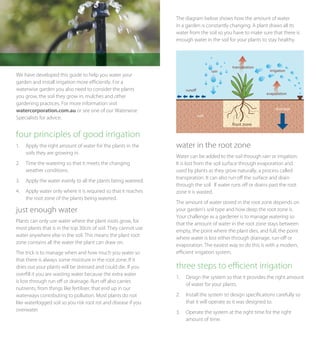
The diagram below shows how the amount of water
                                                                in a garden is constantly changing. A plant draws all its
                                                                water from the soil so you have to make sure that there is
                                                                enough water in the soil for your plants to stay healthy.


We have developed this guide to help you water your
garden and install irrigation more efficiently. For a
waterwise garden you also need to consider the plants
you grow, the soil they grow in, mulches and other
gardening practices. For more information visit
watercorporation.com.au or see one of our Waterwise
Specialists for advice.


four principles of good irrigation
1.   Apply the right amount of water for the plants in the      water in the root zone
     soils they are growing in.
                                                                Water can be added to the soil through rain or irrigation.
2.   Time the watering so that it meets the changing            It is lost from the soil surface through evaporation and
     weather conditions.                                        used by plants as they grow naturally, a process called
                                                                transpiration. It can also run off the surface and drain
3.   Apply the water evenly to all the plants being watered.
                                                                through the soil. If water runs off or drains past the root
4.   Apply water only where it is required so that it reaches   zone it is wasted.
     the root zone of the plants being watered.
                                                                The amount of water stored in the root zone depends on
just enough water                                               your garden’s soil type and how deep the root zone is.
                                                                Your challenge as a gardener is to manage watering so
Plants can only use water where the plant roots grow, for
                                                                that the amount of water in the root zone stays between
most plants that is in the top 30cm of soil. They cannot use
                                                                empty, the point where the plant dies, and full, the point
water anywhere else in the soil. This means the plant root
                                                                where water is lost either through drainage, run-off or
zone contains all the water the plant can draw on.
                                                                evaporation. The easiest way to do this is with a modern,
The trick is to manage when and how much you water so           efficient irrigation system.
that there is always some moisture in the root zone. If it
dries out your plants will be stressed and could die. If you    three steps to efficient irrigation
overfill it you are wasting water because the extra water
                                                                1.   Design the system so that it provides the right amount
is lost through run off or drainage. Run off also carries
                                                                     of water for your plants.
nutrients, from things like fertiliser, that end up in our
waterways contributing to pollution. Most plants do not         2.   Install the system to design specifications carefully so
like waterlogged soil so you risk root rot and disease if you        that it will operate as it was designed to.
overwater.                                                      3.   Operate the system at the right time for the right
                                                                     amount of time.
connecting to mains supply
                                                                  The highest available water flow on your property is likely
                                                                  to be close to the water meter. Commonly the most
                                                                  cost-effective garden watering system would involve a
                                                                  plumber’s connection close to this point. Whilst your home
                                                                  may have taps for both front and back to which a system
                                                                  can be connected, the lower water flow rates at these
                                                                  points means that a system often has to be split up into
                                                                  more stations. A connection to your mains must be carried
designing your system                                             out by a licensed plumber, who must also install a double-
Prepare a plan of your garden so you can see where you            check backflow prevention device at the connection point.
need to water. Designing an irrigation system can be
a difficult job, contact a Waterwise Garden Irrigator for         choosing an irrigation system
professional help.
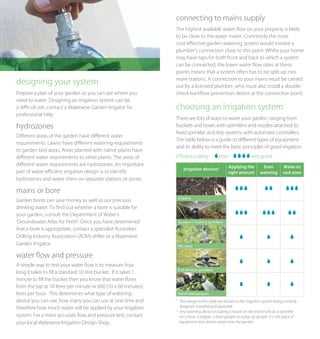
                                                                  There are lots of ways to water your garden, ranging from
hydrozones                                                        buckets and hoses with sprinklers and nozzles attached to
                                                                  fixed sprinkler and drip systems with automatic controllers.
Different areas of the garden have different water
                                                                  The table below is a guide to different types of equipment
requirements. Lawns have different watering requirements
                                                                  and its ability to meet the basic principles of good irrigation.
to garden bed areas. Areas planted with native plants have
different water requirements to other plants. The areas of        Efficiency rating1             poor                very good
different water requirements are hydrozones. An important                                              Applying the         Even          Water to
                                                                         Irrigation devices2
part of water efficient irrigation design is to identify                                               right amount        watering      root zone
hydrozones and water them on separate stations or zones.

mains or bore
                                                                      Dripline
Garden bores can save money as well as our precious
drinking water. To find out whether a bore is suitable for
your garden, consult the Department of Water’s
‘Groundwater Atlas for Perth’. Once you have determined               Sprayers / rotating sprinklers
that a bore is appropriate, contact a specialist Australian
Drilling Industry Association (ADIA) driller or a Waterwise
Garden Irrigator.                                                     Microjets

water flow and pressure
A simple way to test your water flow is to measure how
                                                                      End-of-hose sprinklers
long it takes to fill a standard 10 litre bucket. If it takes 1
minute to fill the bucket then you know that water flows
from the tap at 10 litres per minute or 600 (10 x 60 minutes)
litres per hour. This determines what type of watering                Hand-held sprayers
device you can use, how many you can use at one time and          1
                                                                       The ratings in this table are based on the irrigation system being correctly
therefore how much water will be applied by your irrigation            designed, installed and operated.
                                                                  2
                                                                       Any watering device including a nozzle on the end of a hose, a sprinkler
system. For a more accurate flow and pressure test, contact            on a hose, a dripper, a fixed sprayer or a pop up sprayer. It is the piece of
your local Waterwise Irrigation Design Shop.                           equipment that directs water onto the garden.
garden watering tips
l	   Install a rain sensor if you have an automatic irrigation
     system. It will prevent your automatic irrigation system
     from watering unnecessarily either during or soon
     after rain.
l	   Space your sprinklers so that your garden is watered
     evenly.
l	   Use a tap timer, it will help you to control the amount
     of water applied to your lawn or garden.                    installing your system
l	   Design your irrigation system so that you can water         1.	 Before you begin, get your finished design and all the
     the hydrozones in your garden on different stations.            parts. Ensure you have everything you need and you
     This way your plants will get the water they need               know where each piece should go.
     without wasting it.
                                                                 2.	 Mark out and dig your trenches.
l	   Do not mix different types of sprinklers on one
                                                                 3.	 Start at the water source, connect your master
     watering station, they emit different volumes of water
                                                                     solenoid valve (if installing automatic system) and
     and have different run times. By making sure every
                                                                     then install the mainline. Flush the mainline before
     sprinkler in a station is the same you will optimise the
                                                                     installing any solenoid valves so that you don’t have
     amount of water penetrating the root zone, without
                                                                     dirt and rubbish in the pipes.
     wasting water.
                                                                 4.	 Remember to install any wiring with the mainline
l	   A drip irrigation system is water efficient and works
                                                                     placing it in conduit or burying it under the mainline
     well for native and other waterwise plants. Install a
                                                                     to protect it.
     pressure regulator if you experience low flow rates
     and a filter to prevent drippers from clogging.             5.	 Install lateral lines and, finally, the sprinklers
                                                                     themselves. Don’t install any nozzles until you have
l	   Make sure you install the right number of sprinklers on
                                                                     thoroughly flushed each station. Solenoid valves may
     one line. Too many may result in not enough water
                                                                     have to be operated manually until you have made
     pressure and too few may lead to high water pressure
                                                                     final connections to the controller.
     and water being wasted.
                                                                 6.	 Fit nozzles and make sure each station waters evenly.
l	   Do not choose sprinklers that will apply more water
     than your soil can absorb. Different soils hold different   For professional assistance please contact your local
     amounts of water and may require different watering         Waterwise Irrigation Design Shop or a Waterwise
     rates. It is important to know the type of soil and         Garden Irrigator.
     the type of plants you are watering, so that you can
     choose the right sprinkler.
l	   Position sprinklers so that they only water your
     garden. Overspray on to the road or nearby buildings        did you know?
     is a waste.                                                 A waterwise irrigation system is the most
                                                                 effective way to water your garden and will
                                                                 help you save water and money.
operating your system                                         how long should you water?
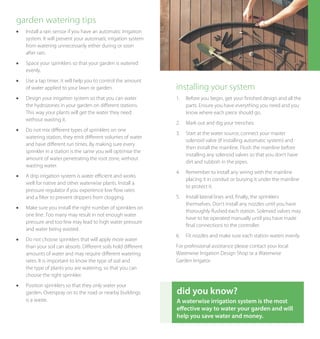
Water is wasted in three ways:                                Water just enough to penetrate the root zone, most plant
                                                              roots are found in the top 30cm of soil.
1.   Through evaporation and wind drift.
                                                              10mm is the standard drink for your garden to penetrate
2.   Putting water where it is not needed, such as onto
                                                              the root zone and is the recommended maximum
     paths or buildings.
                                                              application per watering day. Different types of sprinklers
3.   Watering for too long.                                   have different watering rates. The table on the next page
                                                              shows the recommended watering times to apply 10mm
check your system regularly                                   of water to your garden for a range of sprinklers. Watering
Make sure sprinklers and sprayers are pointing in the right   for longer will just waste water.
direction, drippers are working and that the system is        Remember to program your irrigation system to suit
working at the right pressure (no misting from sprinklers,    current climate and seasonal conditions. The aim of a
pressure too high, or streams of water, pressure too low).    water efficient irrigation system is to deliver the right
                                                              amount of water at the right time.
reduce evaporation
                                                              Different soils can hold different amounts of water and
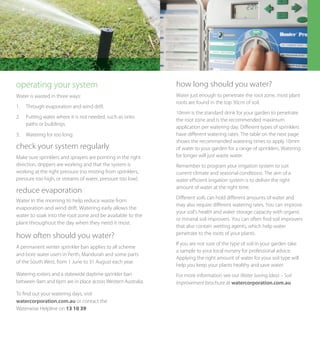
Water in the morning to help reduce waste from
                                                              may also require different watering rates. You can improve
evaporation and wind drift. Watering early allows the
                                                              your soil’s health and water storage capacity with organic
water to soak into the root zone and be available to the
                                                              or mineral soil improvers. You can often find soil improvers
plant throughout the day when they need it most.
                                                              that also contain wetting agents, which help water
                                                              penetrate to the roots of your plants.
how often should you water?
                                                              If you are not sure of the type of soil in your garden take
A permanent winter sprinkler ban applies to all scheme
                                                              a sample to your local nursery for professional advice.
and bore water users in Perth, Mandurah and some parts
                                                              Applying the right amount of water for your soil type will
of the South West, from 1 June to 31 August each year.
                                                              help you keep your plants healthy and save water.
Watering rosters and a statewide daytime sprinkler ban        For more information see our Water Saving Ideas – Soil
between 9am and 6pm are in place across Western Australia.    Improvement brochure at watercorporation.com.au

To find out your watering days, visit
watercorporation.com.au or contact the
Waterwise Helpline on 13 10 39.
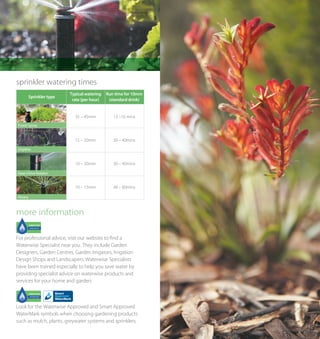
sprinkler watering times
                         Typical watering                 Run time for 10mm
      Sprinkler type
                          rate (per hour)                  (standard drink)


                           35 – 45mm                         13 –16 mins
Fixed Spray


                           15 – 20mm                         30 – 40mins
Dripline


                           10 – 20mm                         30 – 40mins

Gear-Drive Rotator


                           10 – 15mm                         40 – 60mins

Rotary


more information

For professional advice, visit our website to find a
Waterwise Specialist near you. They include Garden
Designers, Garden Centres, Garden Irrigators, Irrigation
Design Shops and Landscapers. Waterwise Specialists
have been trained especially to help you save water by
providing specialist advice on waterwise products and
services for your home and garden.


Look for the Waterwise Approved and Smart Approved
                               Smart Approved WaterMark
                               CMYK Logo


WaterMark symbols when choosing gardening products
                                 CMYK         CMYK
                               100/50/0/30   56/0/0/0


such as mulch, plants, greywater systems and sprinklers.
13 10 39	 Waterwise Helpline
13 13 85	 Customer Centre
(8am - 5pm weekdays)
13 36 77	 National Relay Service
ISBN 1 74043 740 3 October 2011
This information is available in
alternative formats on request.
customer@watercorporation.com.au

watercorporation.com.au

A Guide to Watering Your Garden - Australia Water Corporation

  • 1.
  • 2.
    The diagram belowshows how the amount of water in a garden is constantly changing. A plant draws all its water from the soil so you have to make sure that there is enough water in the soil for your plants to stay healthy. We have developed this guide to help you water your garden and install irrigation more efficiently. For a waterwise garden you also need to consider the plants you grow, the soil they grow in, mulches and other gardening practices. For more information visit watercorporation.com.au or see one of our Waterwise Specialists for advice. four principles of good irrigation 1. Apply the right amount of water for the plants in the water in the root zone soils they are growing in. Water can be added to the soil through rain or irrigation. 2. Time the watering so that it meets the changing It is lost from the soil surface through evaporation and weather conditions. used by plants as they grow naturally, a process called transpiration. It can also run off the surface and drain 3. Apply the water evenly to all the plants being watered. through the soil. If water runs off or drains past the root 4. Apply water only where it is required so that it reaches zone it is wasted. the root zone of the plants being watered. The amount of water stored in the root zone depends on just enough water your garden’s soil type and how deep the root zone is. Your challenge as a gardener is to manage watering so Plants can only use water where the plant roots grow, for that the amount of water in the root zone stays between most plants that is in the top 30cm of soil. They cannot use empty, the point where the plant dies, and full, the point water anywhere else in the soil. This means the plant root where water is lost either through drainage, run-off or zone contains all the water the plant can draw on. evaporation. The easiest way to do this is with a modern, The trick is to manage when and how much you water so efficient irrigation system. that there is always some moisture in the root zone. If it dries out your plants will be stressed and could die. If you three steps to efficient irrigation overfill it you are wasting water because the extra water 1. Design the system so that it provides the right amount is lost through run off or drainage. Run off also carries of water for your plants. nutrients, from things like fertiliser, that end up in our waterways contributing to pollution. Most plants do not 2. Install the system to design specifications carefully so like waterlogged soil so you risk root rot and disease if you that it will operate as it was designed to. overwater. 3. Operate the system at the right time for the right amount of time.
  • 3.
    connecting to mainssupply The highest available water flow on your property is likely to be close to the water meter. Commonly the most cost-effective garden watering system would involve a plumber’s connection close to this point. Whilst your home may have taps for both front and back to which a system can be connected, the lower water flow rates at these points means that a system often has to be split up into more stations. A connection to your mains must be carried designing your system out by a licensed plumber, who must also install a double- Prepare a plan of your garden so you can see where you check backflow prevention device at the connection point. need to water. Designing an irrigation system can be a difficult job, contact a Waterwise Garden Irrigator for choosing an irrigation system professional help. There are lots of ways to water your garden, ranging from hydrozones buckets and hoses with sprinklers and nozzles attached to fixed sprinkler and drip systems with automatic controllers. Different areas of the garden have different water The table below is a guide to different types of equipment requirements. Lawns have different watering requirements and its ability to meet the basic principles of good irrigation. to garden bed areas. Areas planted with native plants have different water requirements to other plants. The areas of Efficiency rating1 poor very good different water requirements are hydrozones. An important Applying the Even Water to Irrigation devices2 part of water efficient irrigation design is to identify right amount watering root zone hydrozones and water them on separate stations or zones. mains or bore Dripline Garden bores can save money as well as our precious drinking water. To find out whether a bore is suitable for your garden, consult the Department of Water’s ‘Groundwater Atlas for Perth’. Once you have determined Sprayers / rotating sprinklers that a bore is appropriate, contact a specialist Australian Drilling Industry Association (ADIA) driller or a Waterwise Garden Irrigator. Microjets water flow and pressure A simple way to test your water flow is to measure how End-of-hose sprinklers long it takes to fill a standard 10 litre bucket. If it takes 1 minute to fill the bucket then you know that water flows from the tap at 10 litres per minute or 600 (10 x 60 minutes) litres per hour. This determines what type of watering Hand-held sprayers device you can use, how many you can use at one time and 1 The ratings in this table are based on the irrigation system being correctly therefore how much water will be applied by your irrigation designed, installed and operated. 2 Any watering device including a nozzle on the end of a hose, a sprinkler system. For a more accurate flow and pressure test, contact on a hose, a dripper, a fixed sprayer or a pop up sprayer. It is the piece of your local Waterwise Irrigation Design Shop. equipment that directs water onto the garden.
  • 4.
    garden watering tips l Install a rain sensor if you have an automatic irrigation system. It will prevent your automatic irrigation system from watering unnecessarily either during or soon after rain. l Space your sprinklers so that your garden is watered evenly. l Use a tap timer, it will help you to control the amount of water applied to your lawn or garden. installing your system l Design your irrigation system so that you can water 1. Before you begin, get your finished design and all the the hydrozones in your garden on different stations. parts. Ensure you have everything you need and you This way your plants will get the water they need know where each piece should go. without wasting it. 2. Mark out and dig your trenches. l Do not mix different types of sprinklers on one 3. Start at the water source, connect your master watering station, they emit different volumes of water solenoid valve (if installing automatic system) and and have different run times. By making sure every then install the mainline. Flush the mainline before sprinkler in a station is the same you will optimise the installing any solenoid valves so that you don’t have amount of water penetrating the root zone, without dirt and rubbish in the pipes. wasting water. 4. Remember to install any wiring with the mainline l A drip irrigation system is water efficient and works placing it in conduit or burying it under the mainline well for native and other waterwise plants. Install a to protect it. pressure regulator if you experience low flow rates and a filter to prevent drippers from clogging. 5. Install lateral lines and, finally, the sprinklers themselves. Don’t install any nozzles until you have l Make sure you install the right number of sprinklers on thoroughly flushed each station. Solenoid valves may one line. Too many may result in not enough water have to be operated manually until you have made pressure and too few may lead to high water pressure final connections to the controller. and water being wasted. 6. Fit nozzles and make sure each station waters evenly. l Do not choose sprinklers that will apply more water than your soil can absorb. Different soils hold different For professional assistance please contact your local amounts of water and may require different watering Waterwise Irrigation Design Shop or a Waterwise rates. It is important to know the type of soil and Garden Irrigator. the type of plants you are watering, so that you can choose the right sprinkler. l Position sprinklers so that they only water your garden. Overspray on to the road or nearby buildings did you know? is a waste. A waterwise irrigation system is the most effective way to water your garden and will help you save water and money.
  • 5.
    operating your system how long should you water? Water is wasted in three ways: Water just enough to penetrate the root zone, most plant roots are found in the top 30cm of soil. 1. Through evaporation and wind drift. 10mm is the standard drink for your garden to penetrate 2. Putting water where it is not needed, such as onto the root zone and is the recommended maximum paths or buildings. application per watering day. Different types of sprinklers 3. Watering for too long. have different watering rates. The table on the next page shows the recommended watering times to apply 10mm check your system regularly of water to your garden for a range of sprinklers. Watering Make sure sprinklers and sprayers are pointing in the right for longer will just waste water. direction, drippers are working and that the system is Remember to program your irrigation system to suit working at the right pressure (no misting from sprinklers, current climate and seasonal conditions. The aim of a pressure too high, or streams of water, pressure too low). water efficient irrigation system is to deliver the right amount of water at the right time. reduce evaporation Different soils can hold different amounts of water and Water in the morning to help reduce waste from may also require different watering rates. You can improve evaporation and wind drift. Watering early allows the your soil’s health and water storage capacity with organic water to soak into the root zone and be available to the or mineral soil improvers. You can often find soil improvers plant throughout the day when they need it most. that also contain wetting agents, which help water penetrate to the roots of your plants. how often should you water? If you are not sure of the type of soil in your garden take A permanent winter sprinkler ban applies to all scheme a sample to your local nursery for professional advice. and bore water users in Perth, Mandurah and some parts Applying the right amount of water for your soil type will of the South West, from 1 June to 31 August each year. help you keep your plants healthy and save water. Watering rosters and a statewide daytime sprinkler ban For more information see our Water Saving Ideas – Soil between 9am and 6pm are in place across Western Australia. Improvement brochure at watercorporation.com.au To find out your watering days, visit watercorporation.com.au or contact the Waterwise Helpline on 13 10 39.
  • 6.
    sprinkler watering times Typical watering Run time for 10mm Sprinkler type rate (per hour) (standard drink) 35 – 45mm 13 –16 mins Fixed Spray 15 – 20mm 30 – 40mins Dripline 10 – 20mm 30 – 40mins Gear-Drive Rotator 10 – 15mm 40 – 60mins Rotary more information For professional advice, visit our website to find a Waterwise Specialist near you. They include Garden Designers, Garden Centres, Garden Irrigators, Irrigation Design Shops and Landscapers. Waterwise Specialists have been trained especially to help you save water by providing specialist advice on waterwise products and services for your home and garden. Look for the Waterwise Approved and Smart Approved Smart Approved WaterMark CMYK Logo WaterMark symbols when choosing gardening products CMYK CMYK 100/50/0/30 56/0/0/0 such as mulch, plants, greywater systems and sprinklers.
  • 7.
    13 10 39 Waterwise Helpline 13 13 85 Customer Centre (8am - 5pm weekdays) 13 36 77 National Relay Service ISBN 1 74043 740 3 October 2011 This information is available in alternative formats on request. customer@watercorporation.com.au watercorporation.com.au