SAW14060 NGIA Waterwise Book   8/10/04   11:19 AM   Page 1


      A   W A T E R      C O N S E R V A T I O N             I N I T I A T I V E   F R O M   S A   W A T E R


                                                                                Have the
                     cottage
                                                                                beautiful
                       formal
                                                                             garden you
                                                                                    want
          mediterranean
                                                                               ... and be
      australian native
                                                                             waterwise!
SAW14060 NGIA Waterwise Book         8/10/04      11:19 AM        Page 2


              A message                                                                      Permanent
                                                                                             water
              from the                                                                       conservation
              Premier                                                                        measures
                              Adelaide has long had a reputation as a garden city,           Permanent water conservation measures cover a
                              renowned for its beautiful parklands, landscaping              range of outdoor water uses. The following apply
                              and surrounds.                                                 specifically to gardens.

                              Gardening is an important part of the quality of life in our   Public or private gardens, recreational areas,
                              communities. It is also essential to tourism, recreation       sports grounds or nurseries can be watered:
                              and leisure, which enrich South Australia's lifestyle.         • By hand (through a hand-held hose, from a bucket
                                                                                               or watering can); or
              Permanent water conservation measures were introduced in late 2003
                                                                                             • Through a drip-feed irrigation system; or
              highlighting the State Government's commitment to protecting our
              precious water resources. These measures reflect a common sense                • Where the watering takes place through a
              approach to water efficiency. They are simple, sensible and responsible          sprinkler - after 5pm and before 10am on any day
              steps we can all take.                                                           (or, when daylight saving is in force, after 6pm
                                                                                               and before 10am).
              Outdoor water use makes up more than 40% of residential water
              consumption, and research indicates great savings can be made if               No hosing down of external paved areas with
              waterwise gardening techniques are applied.                                    water at any time unless it is absolutely
                                                                                             necessary to do so:
              Waterwise gardening means thinking about things like watering                  • To protect public health; or
              techniques, plant selection and design.
                                                                                             • To ensure the safety of people using the area; or
              This booklet, produced by the Government of South Australia and the            • To ensure the health and welfare of animals using
              Nursery and Garden Industry SA, is designed to help you have the                 the area; or
              beautiful garden you want, and be waterwise.                                   • To deal with fire, accident or other emergency.

              Enjoy your garden!                                                             The Eyre Peninsula - which sources most of is supply
                                                                                             from groundwater - remains subject to the water
              Mike Rann
                                                                                             restrictions introduced in December 2002.
              Premier of South Australia
                                                                                             For more information about Permanent Water
                                                                                             Conservation Measures or Eyre Peninsula Water
                                                                                             Restrictions please visit www.sawater.com.au or
                                                                                             phone 1800 130 952.

                                                                                             Please visit www.sawater.com.au for up to date
                                                                                             information.


  2>
SAW14060 NGIA Waterwise Book   8/10/04   11:19 AM   Page 3


                                                             An easy
                                                             guide to
                                                             planning,
                                                             planting &
                                                             maintaining
                                                             beautiful
                                                             waterwise
                                                             gardens
                                                             Whether creating a new garden or working
                                                             with your existing garden, this booklet
                                                             contains tips and techniques to help reduce
                                                             water consumption.

                                                             By following some simple steps and making
                                                             small changes around the garden, such as
                                                             careful plant selection and smart watering
                                                             techniques, you can save water while
                                                             watching your garden thrive!

                                                             Don't forget – If you need any gardening
                                                             advice, visit your local nursery or garden
                                                             centre.


                                                                                                           <3
SAW14060 NGIA Waterwise Book               8/10/04      11:19 AM   Page 4


       Planning a
       waterwise garden
       • Group plants which require similar amounts
         of water - creating watering zones.

       • Choose low water use plants which are
         appropriate for the soil conditions and are
         suited to your local area.

       • When designing your garden consider using
         natural water capture - where will water go
         during high rainfall?

       • Understand the site - where and when
         is shade created? Where is there exposure
         to wind? This will help you select and
         position plants to promote water efficiency.


       Creating ideal
       conditions for a
       waterwise garden
       • Improve soil conditions to retain more
         moisture in the soil by adding organic
         material such as composts and soil
         conditioners. Ask your local nursery or
         garden centre how to improve your soil.

       • Use mulch around the base of plants to                               Did you know
         minimise evaporation, maximise water
                                                                                You can take a soil sample to
         retention and inhibit weed growth while
                                                                                  your local nursery or garden
         protecting your plants from frost and heat.
                                                                            centre for testing – understanding
       • Keep your garden free of weeds. Weeds                                        the makeup of your soil
         harbour pests and diseases, and use up                                 is important for improving its
         valuable water!                                                     conditions, and also for selecting
                                                                                            appropriate plants.


  4>
SAW14060 NGIA Waterwise Book   8/10/04   11:19 AM        Page 5


             Originally            Rambling and informal in layout, the cottage
                                   garden focuses on colour and foliage forms,

          designed for             with brightly flowering annuals, perennials,
                                   bulbs and herbs. A delight for beginners and       Michael Keelan
                 cool to           garden enthusiasts alike, the cottage garden
                                   contains a kaleidoscope of plant types often       suggests planting:
            temperate              reflecting individual personalities. The cottage
                                                                                      Trees & Shrubs
                                   garden can be characterised by timber fences,
              climates,            stone, mellow brickwork and wrought iron                      • Roses
                                   accessories.
              different            Making the cottage garden waterwise:
                                                                                                  • Crabapple
                                                                                                 • Elderberry Tree
         plants can be             • Select trees which provide shade for
                                                                                                 • Crepe Myrtle
                                     other plants and reduce water
           used to suit              evaporation.                                                 • Callistemon
            hotter and             • Consider structures which provide                              (Bottle Brush)
                                     additional shade and reduce wind                 • Verbena
         drier climates              exposure such as pergolas, arbours or lattice.
                                                                                      • Hakea
                                   • Choose creeping plants which form a
                                     canopy reducing water evaporation and
                                     weed growth.                                     Medium Sized Plants

                                   • Select waterwise plants - for example some              • Rosemary
                                     roses are very resilient to hot climates.               • Banksia Rose
                                   • Many native and Mediterranean plants are               • Grevillea
                                     excellent for cottage gardens.
                                                                                         • Westringia
                                                                                         (Native Rosemary)
                                                                                       • Lavender
                                                                                      • Wallflowers
                                                                                      • Daisies
                                                                                      • Asters
                                                                                      • Agapanthus
                                                                                      • Nerines
                                                                                      • Salvias


                                                                                                                     <5
SAW14060 NGIA Waterwise Book   8/10/04   11:20 AM     Page 6


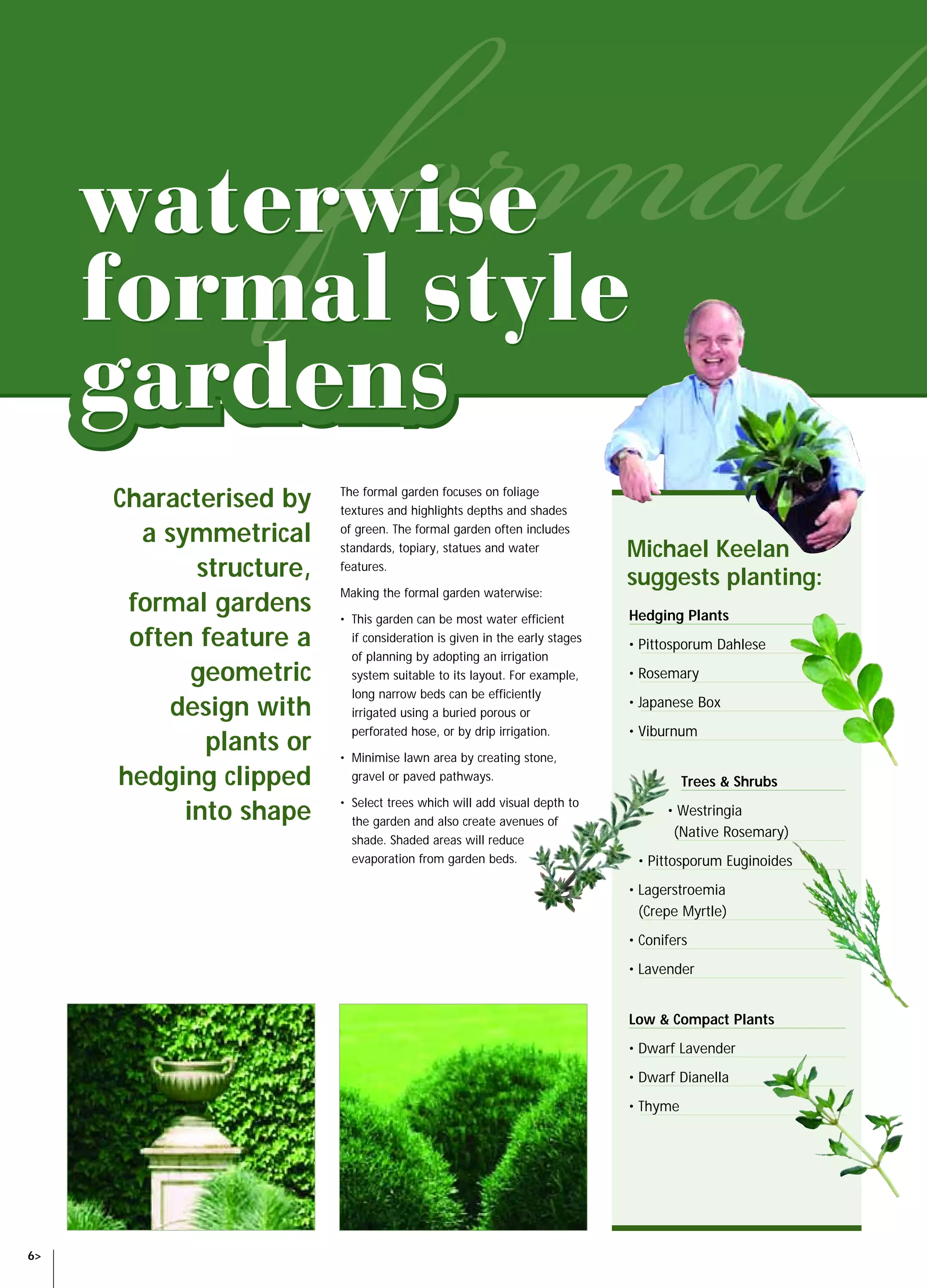
             Characterised by              The formal garden focuses on foliage
                                           textures and highlights depths and shades

               a symmetrical               of green. The formal garden often includes
                                           standards, topiary, statues and water             Michael Keelan
                    structure,             features.
                                                                                             suggests planting:
                                           Making the formal garden waterwise:
              formal gardens               • This garden can be most water efficient         Hedging Plants
              often feature a                if consideration is given in the early stages
                                                                                             • Pittosporum Dahlese
                                             of planning by adopting an irrigation
                    geometric                system suitable to its layout. For example,     • Rosemary
                                             long narrow beds can be efficiently
                 design with                 irrigated using a buried porous or
                                                                                             • Japanese Box
                                             perforated hose, or by drip irrigation.         • Viburnum
                     plants or             • Minimise lawn area by creating stone,
             hedging clipped                 gravel or paved pathways.                                 Trees & Shrubs

                   into shape              • Select trees which will add visual depth to
                                             the garden and also create avenues of
                                                                                                   • Westringia
                                                                                                    (Native Rosemary)
                                             shade. Shaded areas will reduce
                                             evaporation from garden beds.                    • Pittosporum Euginoides
                                                                                             • Lagerstroemia
                                                                                               (Crepe Myrtle)
                                                                                             • Conifers
                                                                                             • Lavender


                                                                                             Low & Compact Plants
                                                                                             • Dwarf Lavender
                                                                                             • Dwarf Dianella
                                                                                             • Thyme


  6>
SAW14060 NGIA Waterwise Book         8/10/04   11:20 AM   Page 7


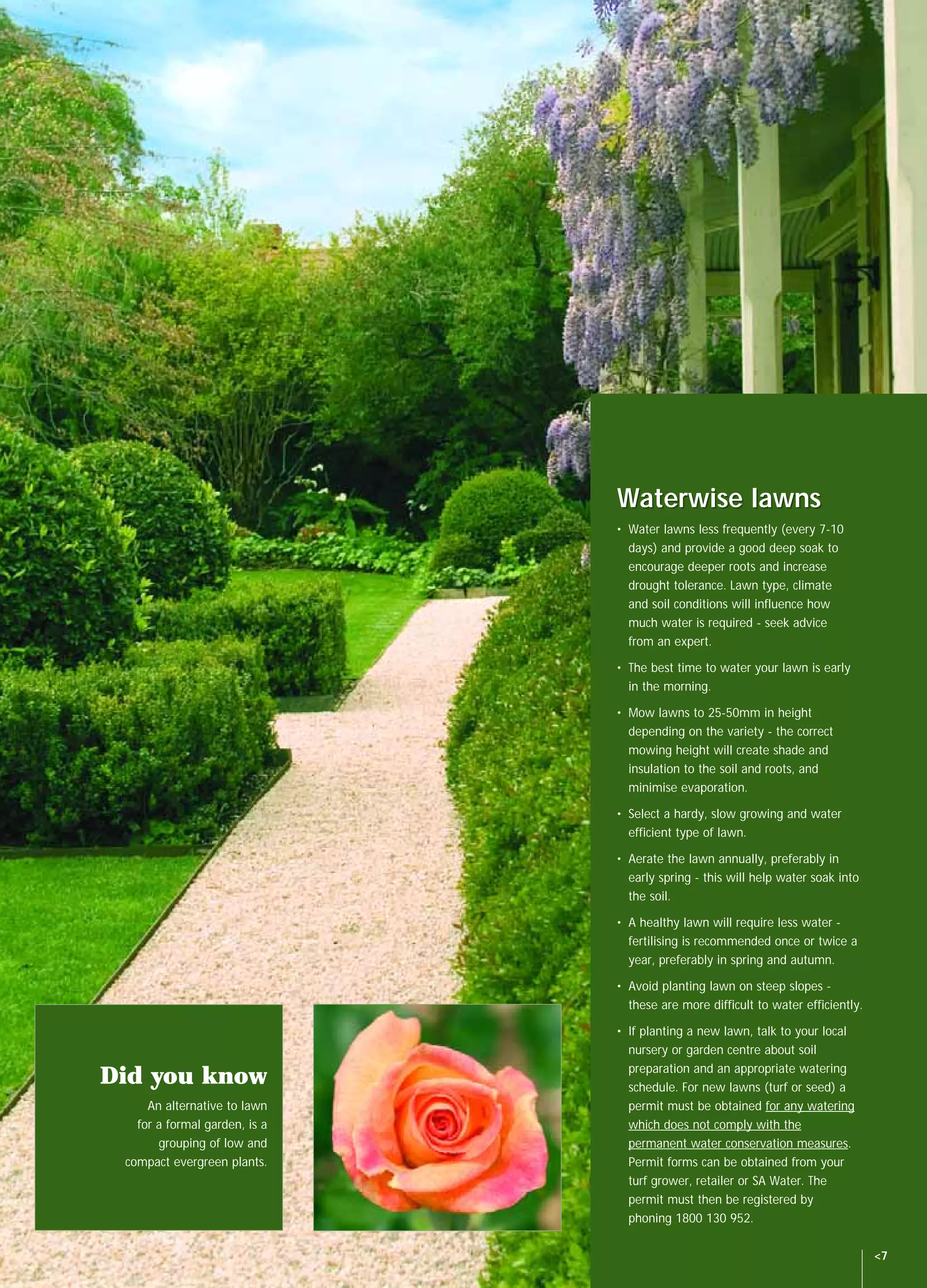
                                                                   Waterwise lawns
                                                                   • Water lawns less frequently (every 7-10
                                                                     days) and provide a good deep soak to
                                                                     encourage deeper roots and increase
                                                                     drought tolerance. Lawn type, climate
                                                                     and soil conditions will influence how
                                                                     much water is required - seek advice
                                                                     from an expert.

                                                                   • The best time to water your lawn is early
                                                                     in the morning.

                                                                   • Mow lawns to 25-50mm in height
                                                                     depending on the variety - the correct
                                                                     mowing height will create shade and
                                                                     insulation to the soil and roots, and
                                                                     minimise evaporation.

                                                                   • Select a hardy, slow growing and water
                                                                     efficient type of lawn.

                                                                   • Aerate the lawn annually, preferably in
                                                                     early spring - this will help water soak into
                                                                     the soil.

                                                                   • A healthy lawn will require less water -
                                                                     fertilising is recommended once or twice a
                                                                     year, preferably in spring and autumn.

                                                                   • Avoid planting lawn on steep slopes -
                                                                     these are more difficult to water efficiently.

                                                                   • If planting a new lawn, talk to your local
                                                                     nursery or garden centre about soil
                                                                     preparation and an appropriate watering
           Did you know                                              schedule. For new lawns (turf or seed) a
                   An alternative to lawn                            permit must be obtained for any watering
                 for a formal garden, is a                           which does not comply with the
                     grouping of low and                             permanent water conservation measures.
               compact evergreen plants.                             Permit forms can be obtained from your
                                                                     turf grower, retailer or SA Water. The
                                                                     permit must then be registered by
                                                                     phoning 1800 130 952.

                                                                                                                      <7
SAW14060 NGIA Waterwise Book                  8/10/04        11:20 AM   Page 8


       All about mulch
       Mulching performs an important function in
       the garden – most importantly it conserves
       moisture in the soil, reducing the amount of
       water we need to apply to our gardens & pots.

       • Mulch is also useful for inhibiting weed
         growth and making any weeds that do grow
         far easier to remove.

       • Prior to mulching install any irrigation systems,
         water garden beds and pots thoroughly and
         apply fertilizer. Mulch needs to be applied in a
         layer thick enough to reduce evaporation and
         weed growth. Be careful to leave a clear area
         around the stems of your plants to prevent rot.

       • Garden beds and pots can be mulched with a
         wide variety of products, from pebbles to organic
         materials such as pine bark, wood chips, lucerne,
         pea straw, composts, composted manures,
         shredded paper and straw. The most effective
         mulches are those that contain a variety of
         particle sizes from fine to coarse. The added
         advantage of using organic mulches is that they
         break down and enrich the soil, creating a
         moist & healthy environment for plants to grow!

       • Mulches need to be topped up from time to
         time to maintain their effectiveness. Generally
         spring mulching every year will be sufficient.
                                                                                    Did you know
                                                                                         Potting a plant increases its
       Planting in pots                                                           maintenance requirements. Make
       • Use a premium potting mix – it has a higher                              sure your choice of pot plants suit
         water holding capacity and means you won’t                              your lifestyle and time availability.
         need to water as often.                                                       Plus, a wetting agent can be
       • Select larger and deeper pots – shallow pots                                     used to help keep the soil
         will be prone to greater loss of water from                                       moist for longer periods.
         evaporation.


  8>
SAW14060 NGIA Waterwise Book   8/10/04   11:20 AM        Page 9


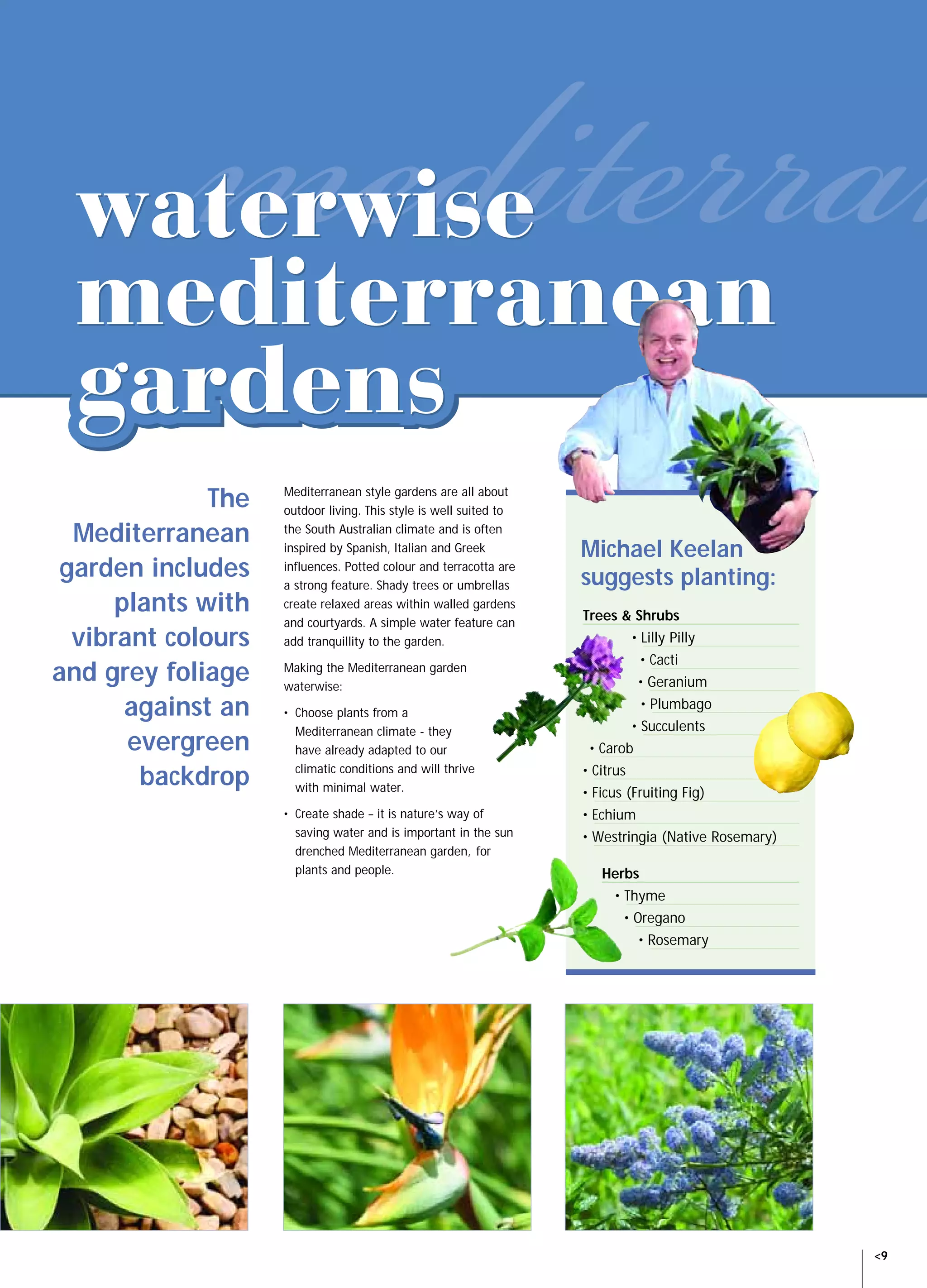
                   The             Mediterranean style gardens are all about
                                   outdoor living. This style is well suited to

       Mediterranean               the South Australian climate and is often
                                   inspired by Spanish, Italian and Greek         Michael Keelan
      garden includes              influences. Potted colour and terracotta are
                                   a strong feature. Shady trees or umbrellas     suggests planting:
           plants with             create relaxed areas within walled gardens
                                                                                  Trees & Shrubs
                                   and courtyards. A simple water feature can
       vibrant colours             add tranquillity to the garden.                           • Lilly Pilly
                                                                                              • Cacti
     and grey foliage              Making the Mediterranean garden
                                   waterwise:                                                 • Geranium
            against an             • Choose plants from a
                                                                                              • Plumbago
                                     Mediterranean climate - they                            • Succulents
            evergreen                have already adapted to our                   • Carob

             backdrop                climatic conditions and will thrive
                                     with minimal water.
                                                                                  • Citrus
                                                                                  • Ficus (Fruiting Fig)
                                   • Create shade – it is nature’s way of         • Echium
                                     saving water and is important in the sun     • Westringia (Native Rosemary)
                                     drenched Mediterranean garden, for
                                     plants and people.                              Herbs
                                                                                        • Thyme
                                                                                         • Oregano
                                                                                              • Rosemary


                                                                                                                   <9
SAW14060 NGIA Waterwise Book   8/10/04   11:20 AM     Page 10


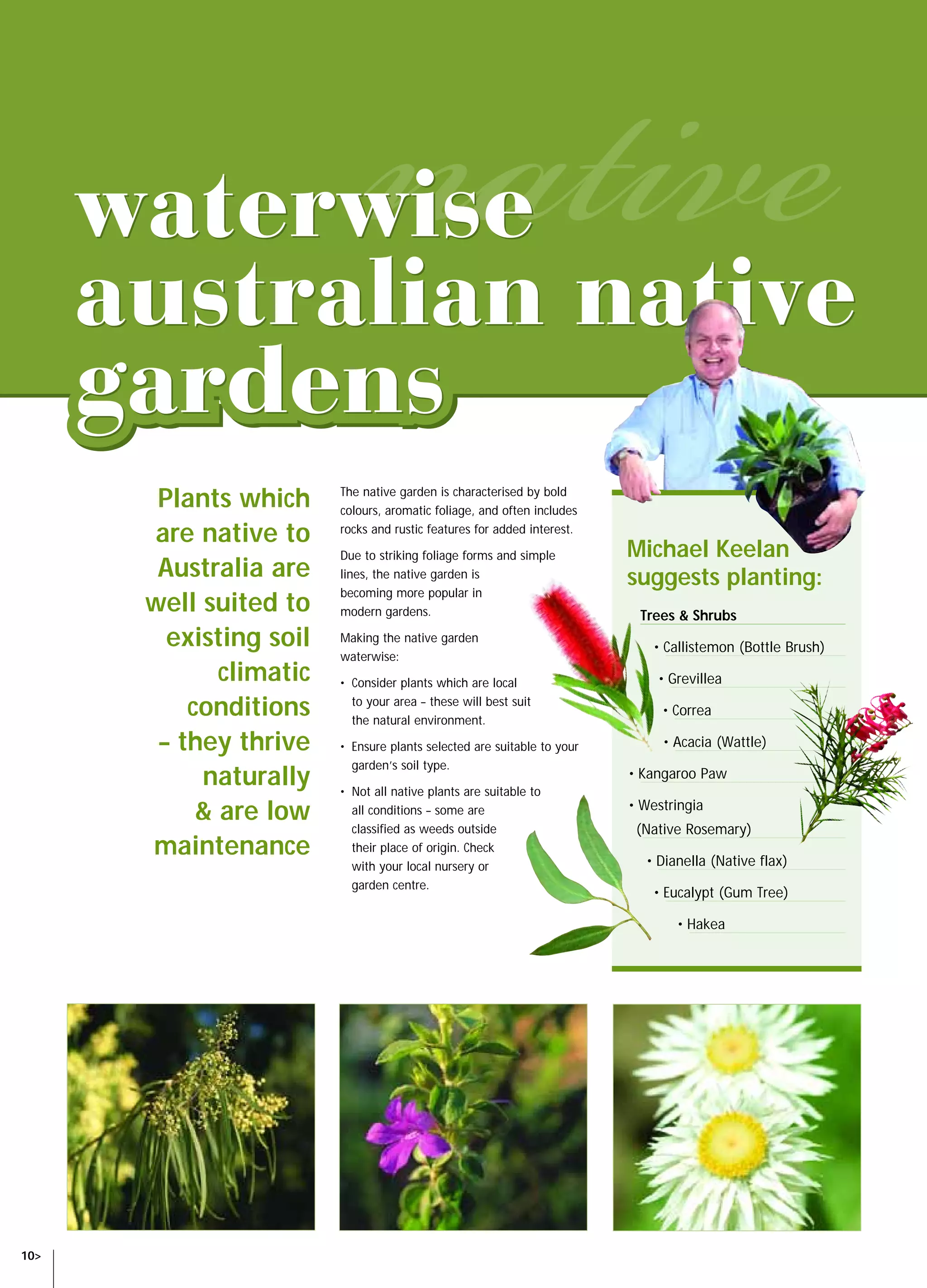
                  Plants which             The native garden is characterised by bold
                                           colours, aromatic foliage, and often includes

                 are native to             rocks and rustic features for added interest.

                                           Due to striking foliage forms and simple        Michael Keelan
                  Australia are            lines, the native garden is
                                                                                           suggests planting:
                                           becoming more popular in
                 well suited to            modern gardens.                                  Trees & Shrubs
                   existing soil           Making the native garden
                                                                                               • Callistemon (Bottle Brush)
                                           waterwise:
                        climatic           • Consider plants which are local                   • Grevillea

                     conditions              to your area – these will best suit
                                             the natural environment.
                                                                                                • Correa

                  – they thrive            • Ensure plants selected are suitable to your        • Acacia (Wattle)
                                             garden’s soil type.
                      naturally            • Not all native plants are suitable to
                                                                                           • Kangaroo Paw

                      & are low              all conditions – some are                     • Westringia
                                             classified as weeds outside                    (Native Rosemary)
                 maintenance                 their place of origin. Check
                                                                                             • Dianella (Native flax)
                                             with your local nursery or
                                             garden centre.
                                                                                               • Eucalypt (Gum Tree)

                                                                                                  • Hakea


  10>
SAW14060 NGIA Waterwise Book         8/10/04   11:20 AM   Page 11


                                                                    Irrigating techniques
                                                                    • The amount of water used in your garden can
                                                                      be reduced by up to 75% by choosing an
                                                                      efficient irrigation system.
                                                                    • Consult with your local nursery or garden centre
                                                                      about choosing a watering technique which
                                                                      best suits your garden. For a more detailed
                                                                      system, consult with an irrigation specialist.
                                                                    • Tap timers can be useful if used correctly –
                                                                      set an appropriate time limit for watering
                                                                      and turn off during rain.
                                                                    • Use irrigation components that apply water as
                                                                      close as possible to the roots of the plant, &
                                                                      with the largest droplet size as practicable.
                                                                    • Dripper irrigation systems will efficiently supply
                                                                      water to your plants, delivering single droplets
                                                                      which will soak into the soil & reduce evaporation.
                                                                    • Wider or longer garden beds can be cost
                                                                      effectively watered using perforated and
                                                                      porous hoses (leaky hose). These can be buried
                                                                      under mulch or soil to deliver an even amount
                                                                      of water to the entire garden bed (or lawns).
                                                                    • If watering by hose, use a trigger nozzle to save
                                                                      water as you move around the garden – follow
                                                                      permanent water conservation measures!


                                                                    When to water
                                                                    • A simple test is to press your finger into the
                                                                      soil past your first knuckle - if the soil is damp
                                                                      it does not need watering.
                                                                    • Train your plants to be waterwise – water
           Did you know                                               for a little longer but less frequently to
                                                                      encourage deeper roots and increase the
                    Most native plants can                            drought tolerance of your plants.
                be pruned after flowering.
                                                                    • Watch your plants – looking for signs on how the
                   Pruning promotes new
                                                                      plant is responding to your watering methods.
          healthy growth, water efficiency
                                                                      Ensure they receive adequate water, but
                       and more flowers!                              remember people waste water - not plants.
                                                                    • Water in the coolest part of the morning or
                                                                      evening – avoid watering when windy or hot.
                                                                      Follow permanent water conservation measures.
                                                                                                                            <11
SAW14060 NGIA Waterwise Book      8/10/04       11:20 AM        Page 12


                      About the Nursery
                      & Garden Industry (SA)
                      Nursery & Garden Industry (SA) is the peak industry body providing leadership in technical, industrial and
                      commercial services and advice to its members.

                      NGI (SA) represents all sectors of the industry including producers, wholesalers. retailers, allied traders and
                      consultants. Along with the national NGI body, its goal is to ‘Build Better Businesses’ by helping and
                      supporting members to improve their profit, performance and professionalism.

                      To find out more about NGIA (SA) visit www.ngia.com.au and click on “Your Associations” or phone
                      (08) 8372 6822.


                     For more information on creating your ideal waterwise garden visit
                                           www.sawater.com.au
SAW14060/einstein

Beautiful Waterwise Gardens - Southern Australia

  • 1.
    SAW14060 NGIA WaterwiseBook 8/10/04 11:19 AM Page 1 A W A T E R C O N S E R V A T I O N I N I T I A T I V E F R O M S A W A T E R Have the cottage beautiful formal garden you want mediterranean ... and be australian native waterwise!
  • 2.
    SAW14060 NGIA WaterwiseBook 8/10/04 11:19 AM Page 2 A message Permanent water from the conservation Premier measures Adelaide has long had a reputation as a garden city, Permanent water conservation measures cover a renowned for its beautiful parklands, landscaping range of outdoor water uses. The following apply and surrounds. specifically to gardens. Gardening is an important part of the quality of life in our Public or private gardens, recreational areas, communities. It is also essential to tourism, recreation sports grounds or nurseries can be watered: and leisure, which enrich South Australia's lifestyle. • By hand (through a hand-held hose, from a bucket or watering can); or Permanent water conservation measures were introduced in late 2003 • Through a drip-feed irrigation system; or highlighting the State Government's commitment to protecting our precious water resources. These measures reflect a common sense • Where the watering takes place through a approach to water efficiency. They are simple, sensible and responsible sprinkler - after 5pm and before 10am on any day steps we can all take. (or, when daylight saving is in force, after 6pm and before 10am). Outdoor water use makes up more than 40% of residential water consumption, and research indicates great savings can be made if No hosing down of external paved areas with waterwise gardening techniques are applied. water at any time unless it is absolutely necessary to do so: Waterwise gardening means thinking about things like watering • To protect public health; or techniques, plant selection and design. • To ensure the safety of people using the area; or This booklet, produced by the Government of South Australia and the • To ensure the health and welfare of animals using Nursery and Garden Industry SA, is designed to help you have the the area; or beautiful garden you want, and be waterwise. • To deal with fire, accident or other emergency. Enjoy your garden! The Eyre Peninsula - which sources most of is supply from groundwater - remains subject to the water Mike Rann restrictions introduced in December 2002. Premier of South Australia For more information about Permanent Water Conservation Measures or Eyre Peninsula Water Restrictions please visit www.sawater.com.au or phone 1800 130 952. Please visit www.sawater.com.au for up to date information. 2>
  • 3.
    SAW14060 NGIA WaterwiseBook 8/10/04 11:19 AM Page 3 An easy guide to planning, planting & maintaining beautiful waterwise gardens Whether creating a new garden or working with your existing garden, this booklet contains tips and techniques to help reduce water consumption. By following some simple steps and making small changes around the garden, such as careful plant selection and smart watering techniques, you can save water while watching your garden thrive! Don't forget – If you need any gardening advice, visit your local nursery or garden centre. <3
  • 4.
    SAW14060 NGIA WaterwiseBook 8/10/04 11:19 AM Page 4 Planning a waterwise garden • Group plants which require similar amounts of water - creating watering zones. • Choose low water use plants which are appropriate for the soil conditions and are suited to your local area. • When designing your garden consider using natural water capture - where will water go during high rainfall? • Understand the site - where and when is shade created? Where is there exposure to wind? This will help you select and position plants to promote water efficiency. Creating ideal conditions for a waterwise garden • Improve soil conditions to retain more moisture in the soil by adding organic material such as composts and soil conditioners. Ask your local nursery or garden centre how to improve your soil. • Use mulch around the base of plants to Did you know minimise evaporation, maximise water You can take a soil sample to retention and inhibit weed growth while your local nursery or garden protecting your plants from frost and heat. centre for testing – understanding • Keep your garden free of weeds. Weeds the makeup of your soil harbour pests and diseases, and use up is important for improving its valuable water! conditions, and also for selecting appropriate plants. 4>
  • 5.
    SAW14060 NGIA WaterwiseBook 8/10/04 11:19 AM Page 5 Originally Rambling and informal in layout, the cottage garden focuses on colour and foliage forms, designed for with brightly flowering annuals, perennials, bulbs and herbs. A delight for beginners and Michael Keelan cool to garden enthusiasts alike, the cottage garden contains a kaleidoscope of plant types often suggests planting: temperate reflecting individual personalities. The cottage Trees & Shrubs garden can be characterised by timber fences, climates, stone, mellow brickwork and wrought iron • Roses accessories. different Making the cottage garden waterwise: • Crabapple • Elderberry Tree plants can be • Select trees which provide shade for • Crepe Myrtle other plants and reduce water used to suit evaporation. • Callistemon hotter and • Consider structures which provide (Bottle Brush) additional shade and reduce wind • Verbena drier climates exposure such as pergolas, arbours or lattice. • Hakea • Choose creeping plants which form a canopy reducing water evaporation and weed growth. Medium Sized Plants • Select waterwise plants - for example some • Rosemary roses are very resilient to hot climates. • Banksia Rose • Many native and Mediterranean plants are • Grevillea excellent for cottage gardens. • Westringia (Native Rosemary) • Lavender • Wallflowers • Daisies • Asters • Agapanthus • Nerines • Salvias <5
  • 6.
    SAW14060 NGIA WaterwiseBook 8/10/04 11:20 AM Page 6 Characterised by The formal garden focuses on foliage textures and highlights depths and shades a symmetrical of green. The formal garden often includes standards, topiary, statues and water Michael Keelan structure, features. suggests planting: Making the formal garden waterwise: formal gardens • This garden can be most water efficient Hedging Plants often feature a if consideration is given in the early stages • Pittosporum Dahlese of planning by adopting an irrigation geometric system suitable to its layout. For example, • Rosemary long narrow beds can be efficiently design with irrigated using a buried porous or • Japanese Box perforated hose, or by drip irrigation. • Viburnum plants or • Minimise lawn area by creating stone, hedging clipped gravel or paved pathways. Trees & Shrubs into shape • Select trees which will add visual depth to the garden and also create avenues of • Westringia (Native Rosemary) shade. Shaded areas will reduce evaporation from garden beds. • Pittosporum Euginoides • Lagerstroemia (Crepe Myrtle) • Conifers • Lavender Low & Compact Plants • Dwarf Lavender • Dwarf Dianella • Thyme 6>
  • 7.
    SAW14060 NGIA WaterwiseBook 8/10/04 11:20 AM Page 7 Waterwise lawns • Water lawns less frequently (every 7-10 days) and provide a good deep soak to encourage deeper roots and increase drought tolerance. Lawn type, climate and soil conditions will influence how much water is required - seek advice from an expert. • The best time to water your lawn is early in the morning. • Mow lawns to 25-50mm in height depending on the variety - the correct mowing height will create shade and insulation to the soil and roots, and minimise evaporation. • Select a hardy, slow growing and water efficient type of lawn. • Aerate the lawn annually, preferably in early spring - this will help water soak into the soil. • A healthy lawn will require less water - fertilising is recommended once or twice a year, preferably in spring and autumn. • Avoid planting lawn on steep slopes - these are more difficult to water efficiently. • If planting a new lawn, talk to your local nursery or garden centre about soil preparation and an appropriate watering Did you know schedule. For new lawns (turf or seed) a An alternative to lawn permit must be obtained for any watering for a formal garden, is a which does not comply with the grouping of low and permanent water conservation measures. compact evergreen plants. Permit forms can be obtained from your turf grower, retailer or SA Water. The permit must then be registered by phoning 1800 130 952. <7
  • 8.
    SAW14060 NGIA WaterwiseBook 8/10/04 11:20 AM Page 8 All about mulch Mulching performs an important function in the garden – most importantly it conserves moisture in the soil, reducing the amount of water we need to apply to our gardens & pots. • Mulch is also useful for inhibiting weed growth and making any weeds that do grow far easier to remove. • Prior to mulching install any irrigation systems, water garden beds and pots thoroughly and apply fertilizer. Mulch needs to be applied in a layer thick enough to reduce evaporation and weed growth. Be careful to leave a clear area around the stems of your plants to prevent rot. • Garden beds and pots can be mulched with a wide variety of products, from pebbles to organic materials such as pine bark, wood chips, lucerne, pea straw, composts, composted manures, shredded paper and straw. The most effective mulches are those that contain a variety of particle sizes from fine to coarse. The added advantage of using organic mulches is that they break down and enrich the soil, creating a moist & healthy environment for plants to grow! • Mulches need to be topped up from time to time to maintain their effectiveness. Generally spring mulching every year will be sufficient. Did you know Potting a plant increases its Planting in pots maintenance requirements. Make • Use a premium potting mix – it has a higher sure your choice of pot plants suit water holding capacity and means you won’t your lifestyle and time availability. need to water as often. Plus, a wetting agent can be • Select larger and deeper pots – shallow pots used to help keep the soil will be prone to greater loss of water from moist for longer periods. evaporation. 8>
  • 9.
    SAW14060 NGIA WaterwiseBook 8/10/04 11:20 AM Page 9 The Mediterranean style gardens are all about outdoor living. This style is well suited to Mediterranean the South Australian climate and is often inspired by Spanish, Italian and Greek Michael Keelan garden includes influences. Potted colour and terracotta are a strong feature. Shady trees or umbrellas suggests planting: plants with create relaxed areas within walled gardens Trees & Shrubs and courtyards. A simple water feature can vibrant colours add tranquillity to the garden. • Lilly Pilly • Cacti and grey foliage Making the Mediterranean garden waterwise: • Geranium against an • Choose plants from a • Plumbago Mediterranean climate - they • Succulents evergreen have already adapted to our • Carob backdrop climatic conditions and will thrive with minimal water. • Citrus • Ficus (Fruiting Fig) • Create shade – it is nature’s way of • Echium saving water and is important in the sun • Westringia (Native Rosemary) drenched Mediterranean garden, for plants and people. Herbs • Thyme • Oregano • Rosemary <9
  • 10.
    SAW14060 NGIA WaterwiseBook 8/10/04 11:20 AM Page 10 Plants which The native garden is characterised by bold colours, aromatic foliage, and often includes are native to rocks and rustic features for added interest. Due to striking foliage forms and simple Michael Keelan Australia are lines, the native garden is suggests planting: becoming more popular in well suited to modern gardens. Trees & Shrubs existing soil Making the native garden • Callistemon (Bottle Brush) waterwise: climatic • Consider plants which are local • Grevillea conditions to your area – these will best suit the natural environment. • Correa – they thrive • Ensure plants selected are suitable to your • Acacia (Wattle) garden’s soil type. naturally • Not all native plants are suitable to • Kangaroo Paw & are low all conditions – some are • Westringia classified as weeds outside (Native Rosemary) maintenance their place of origin. Check • Dianella (Native flax) with your local nursery or garden centre. • Eucalypt (Gum Tree) • Hakea 10>
  • 11.
    SAW14060 NGIA WaterwiseBook 8/10/04 11:20 AM Page 11 Irrigating techniques • The amount of water used in your garden can be reduced by up to 75% by choosing an efficient irrigation system. • Consult with your local nursery or garden centre about choosing a watering technique which best suits your garden. For a more detailed system, consult with an irrigation specialist. • Tap timers can be useful if used correctly – set an appropriate time limit for watering and turn off during rain. • Use irrigation components that apply water as close as possible to the roots of the plant, & with the largest droplet size as practicable. • Dripper irrigation systems will efficiently supply water to your plants, delivering single droplets which will soak into the soil & reduce evaporation. • Wider or longer garden beds can be cost effectively watered using perforated and porous hoses (leaky hose). These can be buried under mulch or soil to deliver an even amount of water to the entire garden bed (or lawns). • If watering by hose, use a trigger nozzle to save water as you move around the garden – follow permanent water conservation measures! When to water • A simple test is to press your finger into the soil past your first knuckle - if the soil is damp it does not need watering. • Train your plants to be waterwise – water Did you know for a little longer but less frequently to encourage deeper roots and increase the Most native plants can drought tolerance of your plants. be pruned after flowering. • Watch your plants – looking for signs on how the Pruning promotes new plant is responding to your watering methods. healthy growth, water efficiency Ensure they receive adequate water, but and more flowers! remember people waste water - not plants. • Water in the coolest part of the morning or evening – avoid watering when windy or hot. Follow permanent water conservation measures. <11
  • 12.
    SAW14060 NGIA WaterwiseBook 8/10/04 11:20 AM Page 12 About the Nursery & Garden Industry (SA) Nursery & Garden Industry (SA) is the peak industry body providing leadership in technical, industrial and commercial services and advice to its members. NGI (SA) represents all sectors of the industry including producers, wholesalers. retailers, allied traders and consultants. Along with the national NGI body, its goal is to ‘Build Better Businesses’ by helping and supporting members to improve their profit, performance and professionalism. To find out more about NGIA (SA) visit www.ngia.com.au and click on “Your Associations” or phone (08) 8372 6822. For more information on creating your ideal waterwise garden visit www.sawater.com.au SAW14060/einstein