Eagle County Town Hall
Public Meeting
March 27, 2014
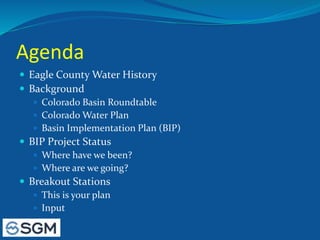
Agenda
 Eagle County Water History
 Background
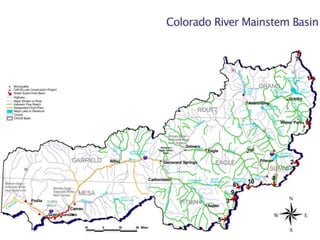
 Colorado Basin Roundtable
 Colorado Water Plan
 Basin Implementation Plan (BIP)
 BIP Project Status
 Where have we been?
 Where are we going?
 Breakout Stations
 This is your plan
 Input
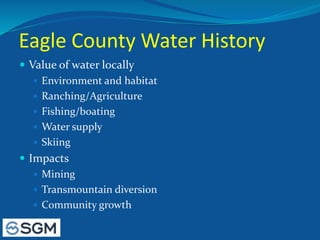
Eagle County Water History
 Value of water locally
 Environment and habitat
 Ranching/Agriculture
 Fishing/boating
 Water supply
 Skiing
 Impacts
 Mining
 Transmountain diversion
 Community growth
Eagle County Water History
 Early development
 Municipal use – small towns
 Agriculture, ranching
 Mining
 Later development
 Recreation
 Resort Economy
 Growing Towns
Eagle County Developed Water
 LEDE Reservoir (1931)
 Homestake Project (1967)
 Black Lakes
 Snowmaking
 Eagle River Memorandum of Understanding (1998)
 Eagle Park Reservoir
 Vail & Avon Whitewater Parks (RICDs)
 Denver Settlement (2007)
 Colorado River Cooperative Agreement (CRCA)
Background
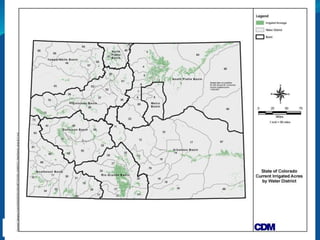
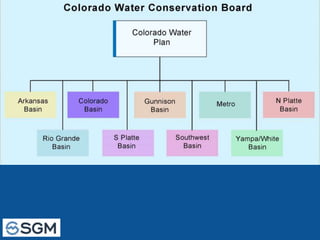
 Basin Roundtables
 HB 1177 (2005)
 9 Roundtables in Colorado (8 watersheds plus 1 additional for
the Metro)
 Colorado Water Plan
 Executive Order May 2013
 Plan has to show how we meet the Gap
 Planning horizon is 2050
 Basin Implementation Plan
 Grassroots document
 Projects, policies and processes on how to meet the Gap
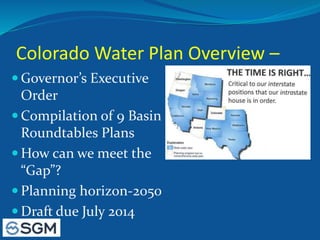
Colorado Water Plan Overview –
 Governor’s Executive
Order
 Compilation of 9 Basin
Roundtables Plans
 How can we meet the
“Gap”?
 Planning horizon-2050
 Draft due July 2014
Governor’s Executive Order-Why?
 The “Gap” between future demand and future
projects is real….500,000 acre-feet per year
 Population
 Drought
 Transfer of water rights from agriculture is
unacceptable
 Water quality
 Interstate issues pressing
 Front Range new supply project
Your Opportunity
 CWP is an opportunity to transition from an
individual perspective to a regional perspective.
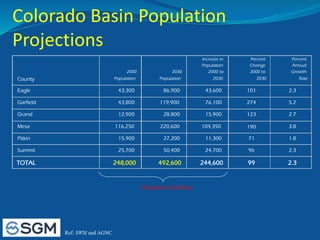
Colorado Basin Population
Projections
County
2000
Population
2030
Population
Increase in
Population
2000 to
2030
Percent
Change
2000 to
2030
Percent
Annual
Growth
Rate
Eagle 43,300 86,900 43,600 101 2.3
Garfield 43,800 119,900 76,100 274 5.2
Grand 12,900 28,800 15,900 123 2.7
Mesa 116,250 220,600 104,350 190 3.8
Pitkin 15,900 27,200 11,300 71 1.8
Summit 25,700 50,400 24,700 96 2.3
TOTAL 248,000 492,600 244,600 99 2.3
Population doubling
Ref: SWSI and AGNC
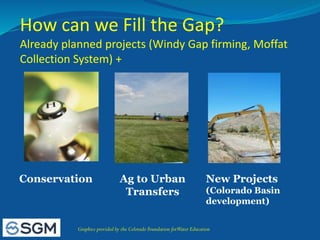
Conservation Ag to Urban
Transfers
New Projects
(Colorado Basin
development)
How can we Fill the Gap?
Already planned projects (Windy Gap firming, Moffat
Collection System) +
Graphics provided by the Colorado Foundation forWater Education
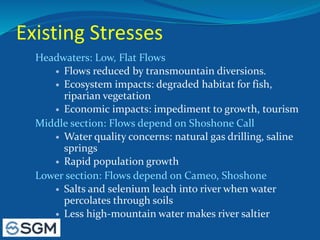
Existing Stresses
Headwaters: Low, Flat Flows
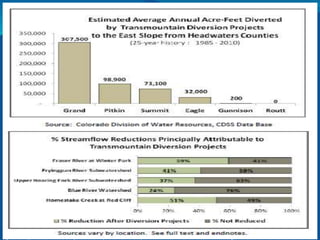
 Flows reduced by transmountain diversions.
 Ecosystem impacts: degraded habitat for fish,
riparian vegetation
 Economic impacts: impediment to growth, tourism
Middle section: Flows depend on Shoshone Call
 Water quality concerns: natural gas drilling, saline
springs
 Rapid population growth
Lower section: Flows depend on Cameo, Shoshone
 Salts and selenium leach into river when water
percolates through soils
 Less high-mountain water makes river saltier
Threats, Challenges, Issues
 Compact Calls
 Transbasin diversions
 Endangered Species
 Growth separation of land use and water planning
 Energy
 Shoshone Call
 Loss of agriculture
 Climate change
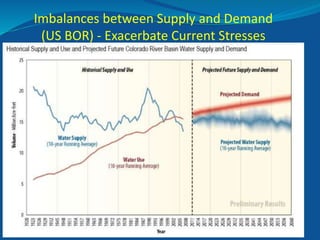
Imbalances between Supply and Demand
(US BOR) - Exacerbate Current Stresses
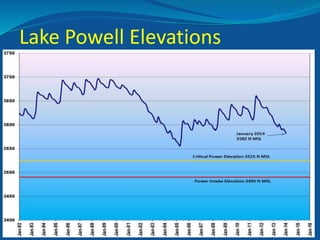
Lake Powell Elevations
Figures from report “Water and its Relationship to the Economies of the Headwaters Counties,” commissioned by the Northwest Colorado Council of governments.
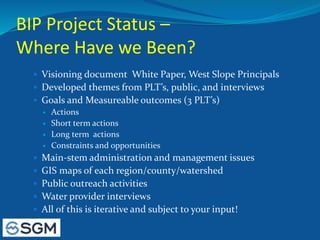
BIP Project Status –
Where Have we Been?
 Visioning document White Paper, West Slope Principals
 Developed themes from PLT’s, public, and interviews
 Goals and Measureable outcomes (3 PLT’s)
 Actions
 Short term actions
 Long term actions
 Constraints and opportunities
 Main-stem administration and management issues
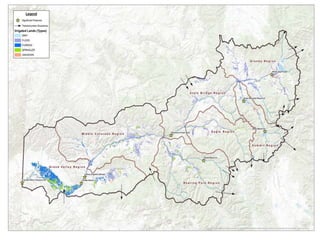
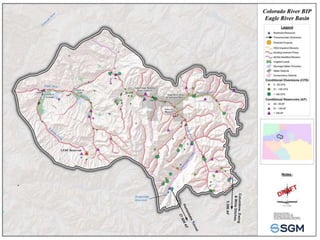
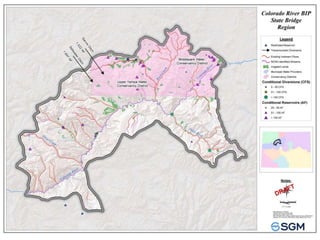
 GIS maps of each region/county/watershed
 Public outreach activities
 Water provider interviews
 All of this is iterative and subject to your input!
Project Status –
Where are we Going?
 Continuation of Public Outreach
 April Implementation Strategies
 May and June finalize report, feedback, reviews,
resolutions?
 July 15 Draft BIP due to CWCB (July 16..go fishing)
 December 2014 Draft to Governor
 Building off existing SWSI information and other
sources
 Nonconsumptive Needs Assessment (NCNA)
Roundtable Themes
 Local control
 Land use - connection with water use
 Healthy rivers
 Not just flat, but supporting healthy biology
 Multi-purpose projects
 Existing reservoirs, restricted, better cooperation of review
 Why reliance upon stream – vulnerable no redundancy
 Save agriculture
 No water to support other basins
 Protect Mainstem water rights operations
 Regional cooperation
 Themes change and evolve
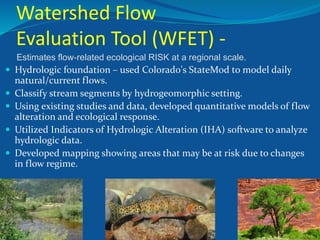
Estimates flow-related ecological RISK at a regional scale.
 Hydrologic foundation – used Colorado's StateMod to model daily
natural/current flows.
 Classify stream segments by hydrogeomorphic setting.
 Using existing studies and data, developed quantitative models of flow
alteration and ecological response.
 Utilized Indicators of Hydrologic Alteration (IHA) software to analyze
hydrologic data.
 Developed mapping showing areas that may be at risk due to changes
in flow regime.
Watershed Flow
Evaluation Tool (WFET) -
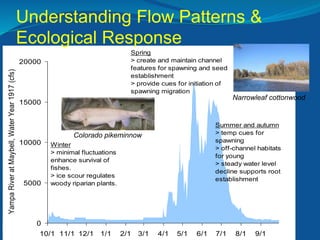
0
5000
10000
15000
20000
10/1 11/1 12/1 1/1 2/1 3/1 4/1 5/1 6/1 7/1 8/1 9/1
Spring
> create and maintain channel
features for spawning and seed
establishment
> provide cues for initiation of
spawning migration
Summer and autumn
> temp cues for
spawning
> off-channel habitats
for young
> steady water level
decline supports root
establishment
Winter
> minimal fluctuations
enhance survival of
fishes.
> ice scour regulates
woody riparian plants.
YampaRiveratMaybell,WaterYear1917(cfs)
Colorado pikeminnow
Narrowleaf cottonwood
Understanding Flow Patterns &
Ecological Response
Nonconsumptive Needs
Assessment (NCNA)
 Part of the Statewide Water Supply Initiative (SWSI)
2010
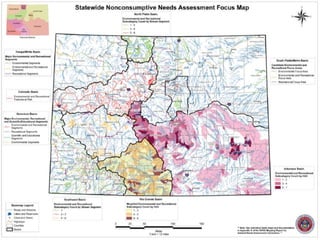
 Environmental and recreational mapping – focus areas
and projects and methods
 Habitat restoration (bank stabilization or instream
habitat restoration)
 Flow protection [voluntary flow agreements, instream
flow (ISF) donations, voluntary re-operation of
reservoirs for environmental and recreational benefit]
Nonconsumptive Needs
Assessment (NCNA)
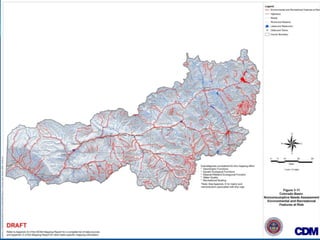
 Attributes at risk
 Water quality
 Geomorphic function
 Riparian/wetlands ecological function
 Aquatic ecological function
 Recreational boating
 #1 Factor affecting attributes - FLOW
 Quantification of “at-risk” reaches = 64+
 5 reaches within Blue River
Public Outreach Nonconsumptive
 Recovery Program, Conservation Rep. for the Recovery Program Implementation Team
 Bureau of Reclamation
 Colorado Parks and Wildlife
 Denver Water
 Bureau of Land Management
 United States Forest Service
 Nonconsumptive Roundtable Representatives
 Trout Unlimited
 Consumptive
 Water provider interviews
 Agricultural
 NRCS Ag Days (January 29)
 Rancher/Farmer individual meetings
 Colorado River District-Colorado River Water Supply and Demand Study
 Misc
 AGNC NWCOG
 Rotary and Kiwanis Clubs
 Colleges
 County Commissioners
Upcoming Meetings
 Town Hall Meetings
 Thursday, April 3, 6-8 p.m., Grand Junction (Grand
Junction City Hall)
 Thursday, April 10, 6-8 p.m., Aspen (Rio Grande
Building/Conference Room)
 Colorado Basin Roundtable Meeting
April 14, 2014, Glenwood Springs Community Center,
noon – 4 p.m.
Have you Checked Out the
Website?
 http://coloradobip.sgm-inc.com/
Thank You
 This is your plan and project….we want to
hear from You! You are driving this plan!
 Breakout stations
 Consumptive
 Non Consumptive
 Agriculture
 Policy

Eagle County Town Hall Meeting

  • 1.
    Eagle County TownHall Public Meeting March 27, 2014
  • 2.
    Agenda  Eagle CountyWater History  Background  Colorado Basin Roundtable  Colorado Water Plan  Basin Implementation Plan (BIP)  BIP Project Status  Where have we been?  Where are we going?  Breakout Stations  This is your plan  Input
  • 3.
    Eagle County WaterHistory  Value of water locally  Environment and habitat  Ranching/Agriculture  Fishing/boating  Water supply  Skiing  Impacts  Mining  Transmountain diversion  Community growth
  • 4.
    Eagle County WaterHistory  Early development  Municipal use – small towns  Agriculture, ranching  Mining  Later development  Recreation  Resort Economy  Growing Towns
  • 5.
    Eagle County DevelopedWater  LEDE Reservoir (1931)  Homestake Project (1967)  Black Lakes  Snowmaking  Eagle River Memorandum of Understanding (1998)  Eagle Park Reservoir  Vail & Avon Whitewater Parks (RICDs)  Denver Settlement (2007)  Colorado River Cooperative Agreement (CRCA)
  • 6.
    Background  Basin Roundtables HB 1177 (2005)  9 Roundtables in Colorado (8 watersheds plus 1 additional for the Metro)  Colorado Water Plan  Executive Order May 2013  Plan has to show how we meet the Gap  Planning horizon is 2050  Basin Implementation Plan  Grassroots document  Projects, policies and processes on how to meet the Gap
  • 7.
    Colorado Water PlanOverview –  Governor’s Executive Order  Compilation of 9 Basin Roundtables Plans  How can we meet the “Gap”?  Planning horizon-2050  Draft due July 2014
  • 10.
    Governor’s Executive Order-Why? The “Gap” between future demand and future projects is real….500,000 acre-feet per year  Population  Drought  Transfer of water rights from agriculture is unacceptable  Water quality  Interstate issues pressing  Front Range new supply project
  • 11.
    Your Opportunity  CWPis an opportunity to transition from an individual perspective to a regional perspective.
  • 14.
    Colorado Basin Population Projections County 2000 Population 2030 Population Increasein Population 2000 to 2030 Percent Change 2000 to 2030 Percent Annual Growth Rate Eagle 43,300 86,900 43,600 101 2.3 Garfield 43,800 119,900 76,100 274 5.2 Grand 12,900 28,800 15,900 123 2.7 Mesa 116,250 220,600 104,350 190 3.8 Pitkin 15,900 27,200 11,300 71 1.8 Summit 25,700 50,400 24,700 96 2.3 TOTAL 248,000 492,600 244,600 99 2.3 Population doubling Ref: SWSI and AGNC
  • 15.
    Conservation Ag toUrban Transfers New Projects (Colorado Basin development) How can we Fill the Gap? Already planned projects (Windy Gap firming, Moffat Collection System) + Graphics provided by the Colorado Foundation forWater Education
  • 16.
    Existing Stresses Headwaters: Low,Flat Flows  Flows reduced by transmountain diversions.  Ecosystem impacts: degraded habitat for fish, riparian vegetation  Economic impacts: impediment to growth, tourism Middle section: Flows depend on Shoshone Call  Water quality concerns: natural gas drilling, saline springs  Rapid population growth Lower section: Flows depend on Cameo, Shoshone  Salts and selenium leach into river when water percolates through soils  Less high-mountain water makes river saltier
  • 17.
    Threats, Challenges, Issues Compact Calls  Transbasin diversions  Endangered Species  Growth separation of land use and water planning  Energy  Shoshone Call  Loss of agriculture  Climate change
  • 18.
    Imbalances between Supplyand Demand (US BOR) - Exacerbate Current Stresses
  • 19.
  • 22.
    Figures from report“Water and its Relationship to the Economies of the Headwaters Counties,” commissioned by the Northwest Colorado Council of governments.
  • 23.
    BIP Project Status– Where Have we Been?  Visioning document White Paper, West Slope Principals  Developed themes from PLT’s, public, and interviews  Goals and Measureable outcomes (3 PLT’s)  Actions  Short term actions  Long term actions  Constraints and opportunities  Main-stem administration and management issues  GIS maps of each region/county/watershed  Public outreach activities  Water provider interviews  All of this is iterative and subject to your input!
  • 24.
    Project Status – Whereare we Going?  Continuation of Public Outreach  April Implementation Strategies  May and June finalize report, feedback, reviews, resolutions?  July 15 Draft BIP due to CWCB (July 16..go fishing)  December 2014 Draft to Governor  Building off existing SWSI information and other sources  Nonconsumptive Needs Assessment (NCNA)
  • 25.
    Roundtable Themes  Localcontrol  Land use - connection with water use  Healthy rivers  Not just flat, but supporting healthy biology  Multi-purpose projects  Existing reservoirs, restricted, better cooperation of review  Why reliance upon stream – vulnerable no redundancy  Save agriculture  No water to support other basins  Protect Mainstem water rights operations  Regional cooperation  Themes change and evolve
  • 28.
    Estimates flow-related ecologicalRISK at a regional scale.  Hydrologic foundation – used Colorado's StateMod to model daily natural/current flows.  Classify stream segments by hydrogeomorphic setting.  Using existing studies and data, developed quantitative models of flow alteration and ecological response.  Utilized Indicators of Hydrologic Alteration (IHA) software to analyze hydrologic data.  Developed mapping showing areas that may be at risk due to changes in flow regime. Watershed Flow Evaluation Tool (WFET) -
  • 29.
    0 5000 10000 15000 20000 10/1 11/1 12/11/1 2/1 3/1 4/1 5/1 6/1 7/1 8/1 9/1 Spring > create and maintain channel features for spawning and seed establishment > provide cues for initiation of spawning migration Summer and autumn > temp cues for spawning > off-channel habitats for young > steady water level decline supports root establishment Winter > minimal fluctuations enhance survival of fishes. > ice scour regulates woody riparian plants. YampaRiveratMaybell,WaterYear1917(cfs) Colorado pikeminnow Narrowleaf cottonwood Understanding Flow Patterns & Ecological Response
  • 30.
    Nonconsumptive Needs Assessment (NCNA) Part of the Statewide Water Supply Initiative (SWSI) 2010  Environmental and recreational mapping – focus areas and projects and methods  Habitat restoration (bank stabilization or instream habitat restoration)  Flow protection [voluntary flow agreements, instream flow (ISF) donations, voluntary re-operation of reservoirs for environmental and recreational benefit]
  • 31.
    Nonconsumptive Needs Assessment (NCNA) Attributes at risk  Water quality  Geomorphic function  Riparian/wetlands ecological function  Aquatic ecological function  Recreational boating  #1 Factor affecting attributes - FLOW  Quantification of “at-risk” reaches = 64+  5 reaches within Blue River
  • 32.
    Public Outreach Nonconsumptive Recovery Program, Conservation Rep. for the Recovery Program Implementation Team  Bureau of Reclamation  Colorado Parks and Wildlife  Denver Water  Bureau of Land Management  United States Forest Service  Nonconsumptive Roundtable Representatives  Trout Unlimited  Consumptive  Water provider interviews  Agricultural  NRCS Ag Days (January 29)  Rancher/Farmer individual meetings  Colorado River District-Colorado River Water Supply and Demand Study  Misc  AGNC NWCOG  Rotary and Kiwanis Clubs  Colleges  County Commissioners
  • 33.
    Upcoming Meetings  TownHall Meetings  Thursday, April 3, 6-8 p.m., Grand Junction (Grand Junction City Hall)  Thursday, April 10, 6-8 p.m., Aspen (Rio Grande Building/Conference Room)  Colorado Basin Roundtable Meeting April 14, 2014, Glenwood Springs Community Center, noon – 4 p.m.
  • 34.
    Have you CheckedOut the Website?  http://coloradobip.sgm-inc.com/
  • 37.
    Thank You  Thisis your plan and project….we want to hear from You! You are driving this plan!  Breakout stations  Consumptive  Non Consumptive  Agriculture  Policy