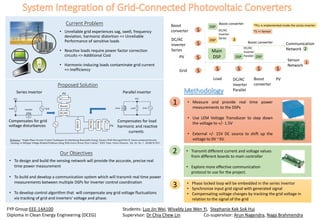
• Unreliable grid experiences sag, swell, frequency
deviation, harmonic distortion => Unreliable
Performance of sensitive loads
• Reactive loads require power factor correction
circuits => Additional Cost
• Harmonic-inducing loads contaminate grid current
=> Inefficiency
S
Main
DSP
DSP
Communication
Network
Sensor
Network
Boost converter
Boost converter
DC/AC
Inverter
Series
DC/AC
Inverter
Parallel
Boost
converter
Boost
converter
DC/AC
Inverter
Series
PV
PV
Grid
DC/AC
Inverter
Parallel
Load
DSP
DSP DSP
• Phase locked loop will be embedded in the series invertor
• Synchronize input grid signal with generated signal
• Compensating voltage changes by tracking the grid voltage in
relation to the signal of the grid
• Measure and provide real time power
measurements to the DSPs
• Use LEM Voltage Transducer to step down
the voltage to +/- 1.5V
• External +/- 15V DC source to shift up the
voltage to 0V ~3V.
1
3
2 • Transmit different current and voltage values
from different boards to main controller
• Explore more effective communication
protocol to use for the project.
Compensates for grid
voltage disturbances
Series invertor Parallel invertor
Compensates for load
harmonic and reactive
currents
Current Problem
Proposed Solution
FYP Group:EEE-14A100 Students: Luo Jin Wei, Wivaldy Lee Wen Yi, Stephanie Kek Sok Hui
Diploma in Clean Energy Engineering (DCEG) Supervisor: Dr Chia Chew Lin Co-supervisor: Arun Nagendra, Naga Brahmendra
*PLL is implemented inside the series inverter
Our Objectives
• To design and build the sensing network will provide the accurate, precise real
time power measurement
• To build and develop a communication system which will transmit real time power
measurements between multiple DSPs for Inverter control coordination
• To develop control algorithm that will compensate any grid voltage fluctuations
via tracking of grid and inverters' voltage and phase.
S
S
S S S S S
*S => Sensor
1
2
3
Reference: “Single-Phase Inverter-Control Techniques for Interfacing Renewable Energy Sources With Microgrid-Part II: Series-connected Inverter
Topology to Mitigate Voltage-Related Problems Along With Active Power Flow Control,” IEEE Trans. Power Electron., Vol. 26, No. 3 , MARCH 2011

FYP poster (Final)

  • 1.
    • Unreliable gridexperiences sag, swell, frequency deviation, harmonic distortion => Unreliable Performance of sensitive loads • Reactive loads require power factor correction circuits => Additional Cost • Harmonic-inducing loads contaminate grid current => Inefficiency S Main DSP DSP Communication Network Sensor Network Boost converter Boost converter DC/AC Inverter Series DC/AC Inverter Parallel Boost converter Boost converter DC/AC Inverter Series PV PV Grid DC/AC Inverter Parallel Load DSP DSP DSP • Phase locked loop will be embedded in the series invertor • Synchronize input grid signal with generated signal • Compensating voltage changes by tracking the grid voltage in relation to the signal of the grid • Measure and provide real time power measurements to the DSPs • Use LEM Voltage Transducer to step down the voltage to +/- 1.5V • External +/- 15V DC source to shift up the voltage to 0V ~3V. 1 3 2 • Transmit different current and voltage values from different boards to main controller • Explore more effective communication protocol to use for the project. Compensates for grid voltage disturbances Series invertor Parallel invertor Compensates for load harmonic and reactive currents Current Problem Proposed Solution FYP Group:EEE-14A100 Students: Luo Jin Wei, Wivaldy Lee Wen Yi, Stephanie Kek Sok Hui Diploma in Clean Energy Engineering (DCEG) Supervisor: Dr Chia Chew Lin Co-supervisor: Arun Nagendra, Naga Brahmendra *PLL is implemented inside the series inverter Our Objectives • To design and build the sensing network will provide the accurate, precise real time power measurement • To build and develop a communication system which will transmit real time power measurements between multiple DSPs for Inverter control coordination • To develop control algorithm that will compensate any grid voltage fluctuations via tracking of grid and inverters' voltage and phase. S S S S S S S *S => Sensor 1 2 3 Reference: “Single-Phase Inverter-Control Techniques for Interfacing Renewable Energy Sources With Microgrid-Part II: Series-connected Inverter Topology to Mitigate Voltage-Related Problems Along With Active Power Flow Control,” IEEE Trans. Power Electron., Vol. 26, No. 3 , MARCH 2011