🦸🦹
Fuzzing Workshop @ NDSS'22 • April 24, 2022
Fuzzing: A Tale of Cultures
Andreas Zeller
Fuzzing
Random Testing at the System Level
[;x1-GPZ+wcckc];,N9J+?#6^6e?]9lu2_%'4GX"0VUB[E/r
~fApu6b8<{%siq8Zh.6{V,hr?;{Ti.r3PIxMMMv6{xS^+'Hq!AxB"YXRS@!
Kd6;wtAMefFWM(`|J_<1~o}z3K(CCzRH JIIvHz>_*.>JrlU32~eGP?
lR=bF3+;y$3lodQ<B89!5"W2fK*vE7v{')KC-i,c{<[~m!]o;{.'}Gj(X}
EtYetrpbY@aGZ1{P!AZU7x#4(Rtn!q4nCwqol^y6}0|
Ko=*JK~;zMKV=9Nai:wxu{J&UV#HaU)*BiC<),`+t*gka<W=Z.
%T5WGHZpI30D<Pq>&]BS6R&j?#tP7iaV}-}`?[_[Z^LBMPG-
FKj'xwuZ1=Q`^`5,$N$Q@[!CuRzJ2D|vBy!^zkhdf3C5PAkR?V hn|
3='i2Qx]D$qs4O`1@fevnG'211Vf3piU37@55apzIyl"'f,
$ee,J4Gw:cgNKLie3nx9(`efSlg6#[K"@WjhZ}r[Scun&sBCS,T[/
vY'pduwgzDlVNy7'rnzxNwI)(ynBa>%|b`;`9fG]P_0hdG~$@6
3]KAeEnQ7lU)3Pn,0)G/6N-wyzj/MTd#A;r
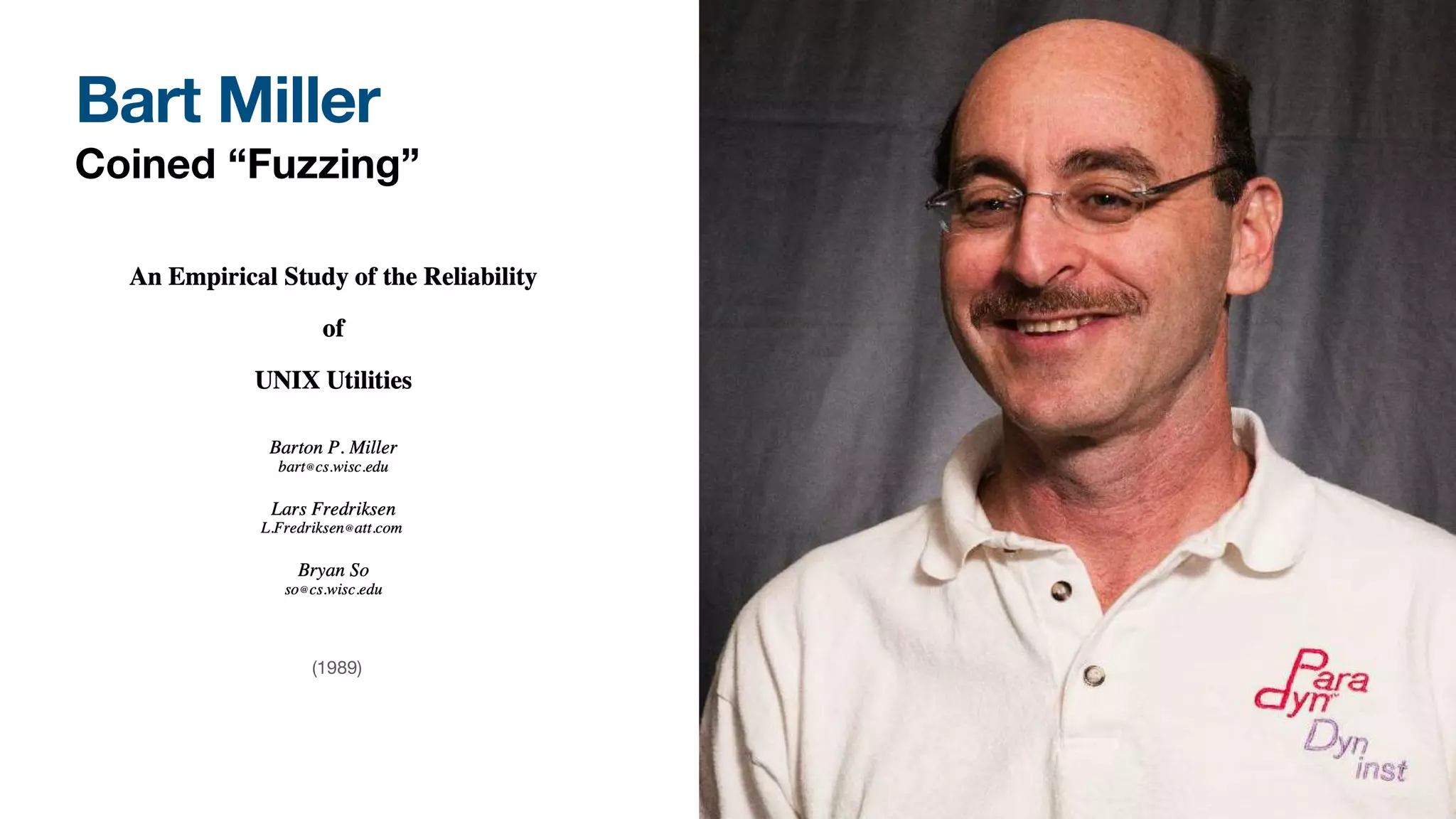
Bart Miller
Coined “Fuzzing”
(1989)
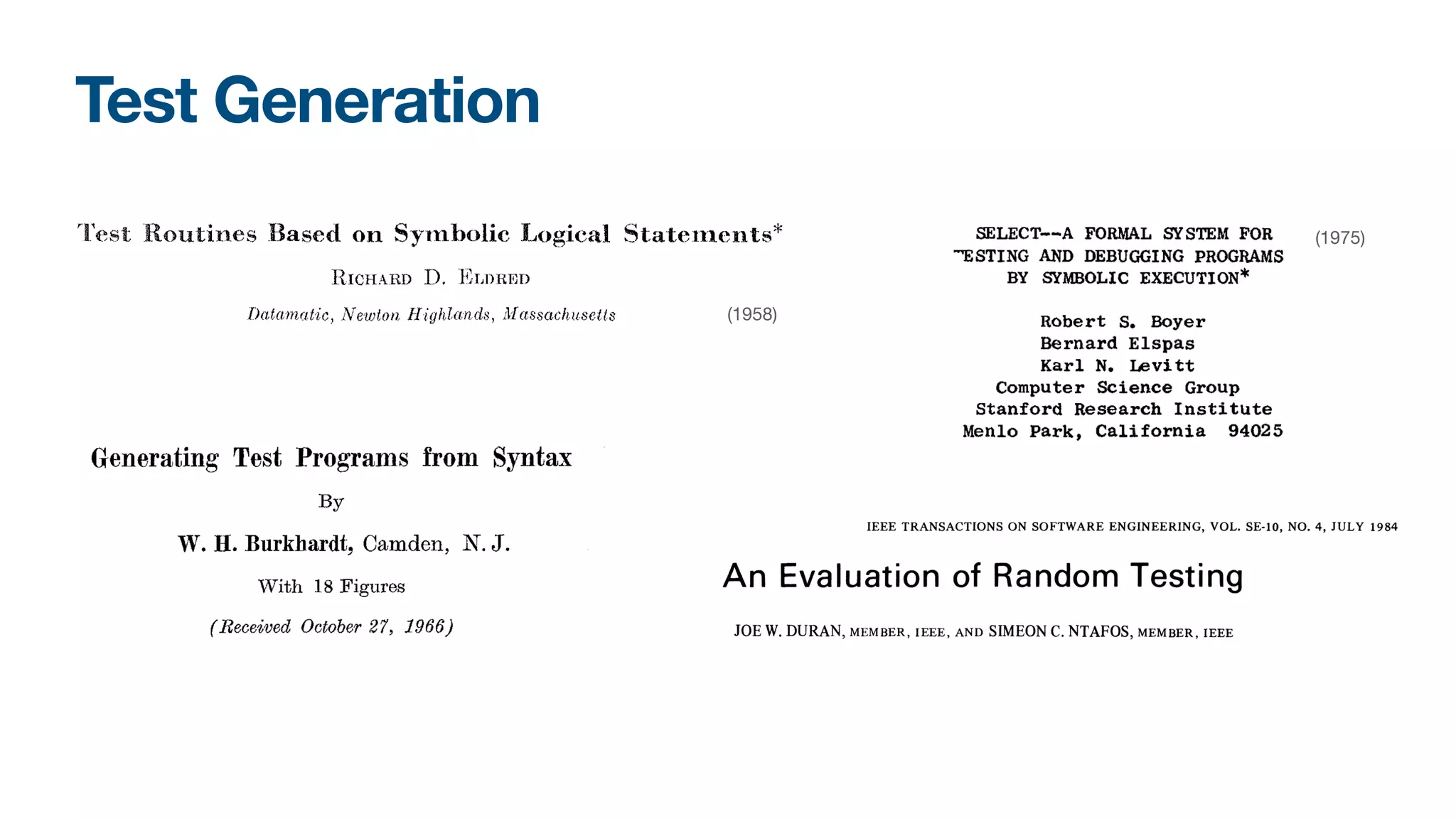
(1975)
Test Generation
(1958)
(1975)
Fuzzing
(1989)
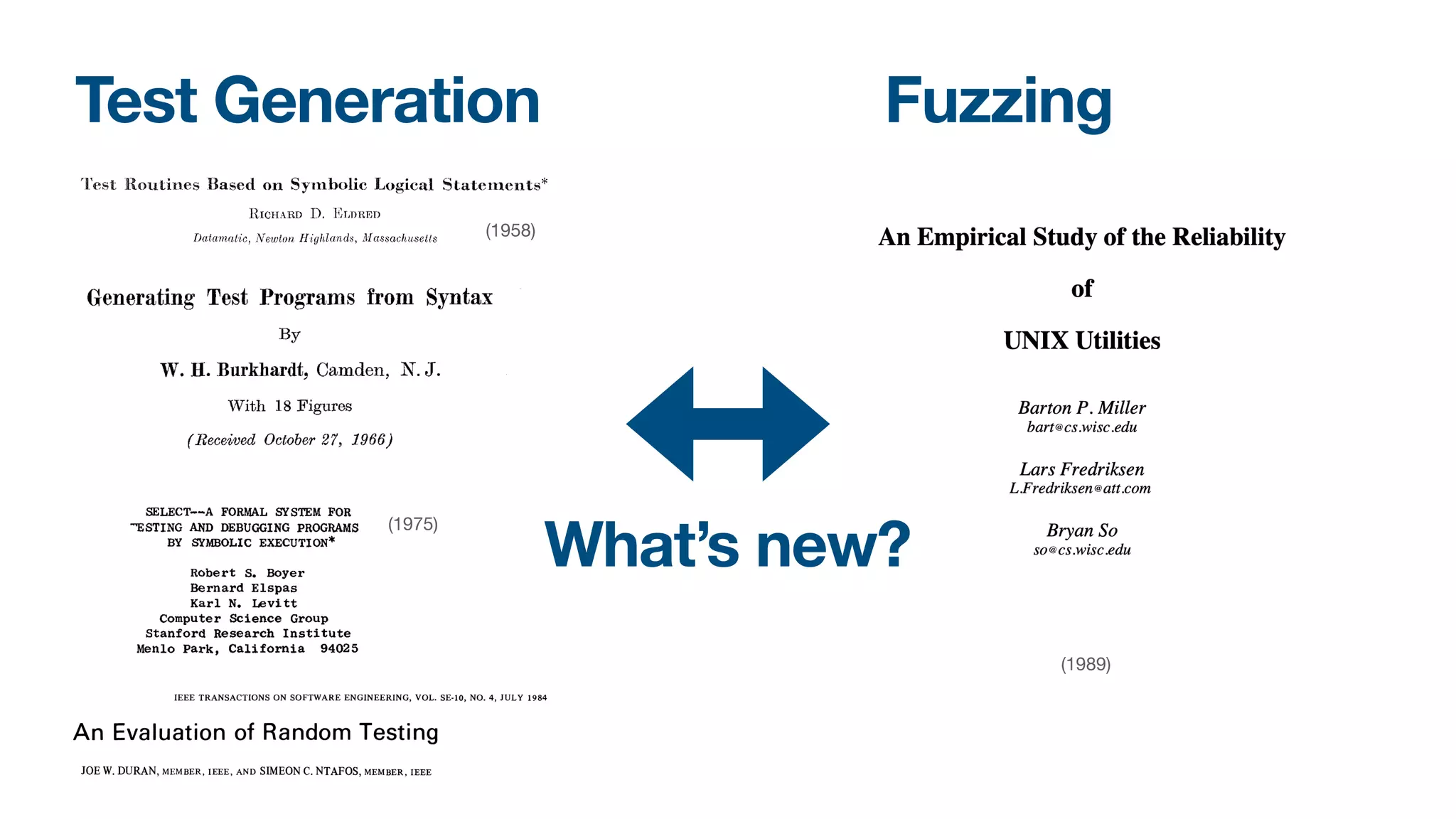
What’s new?
Test Generation
(1958)
Fuzzing
Test Generation
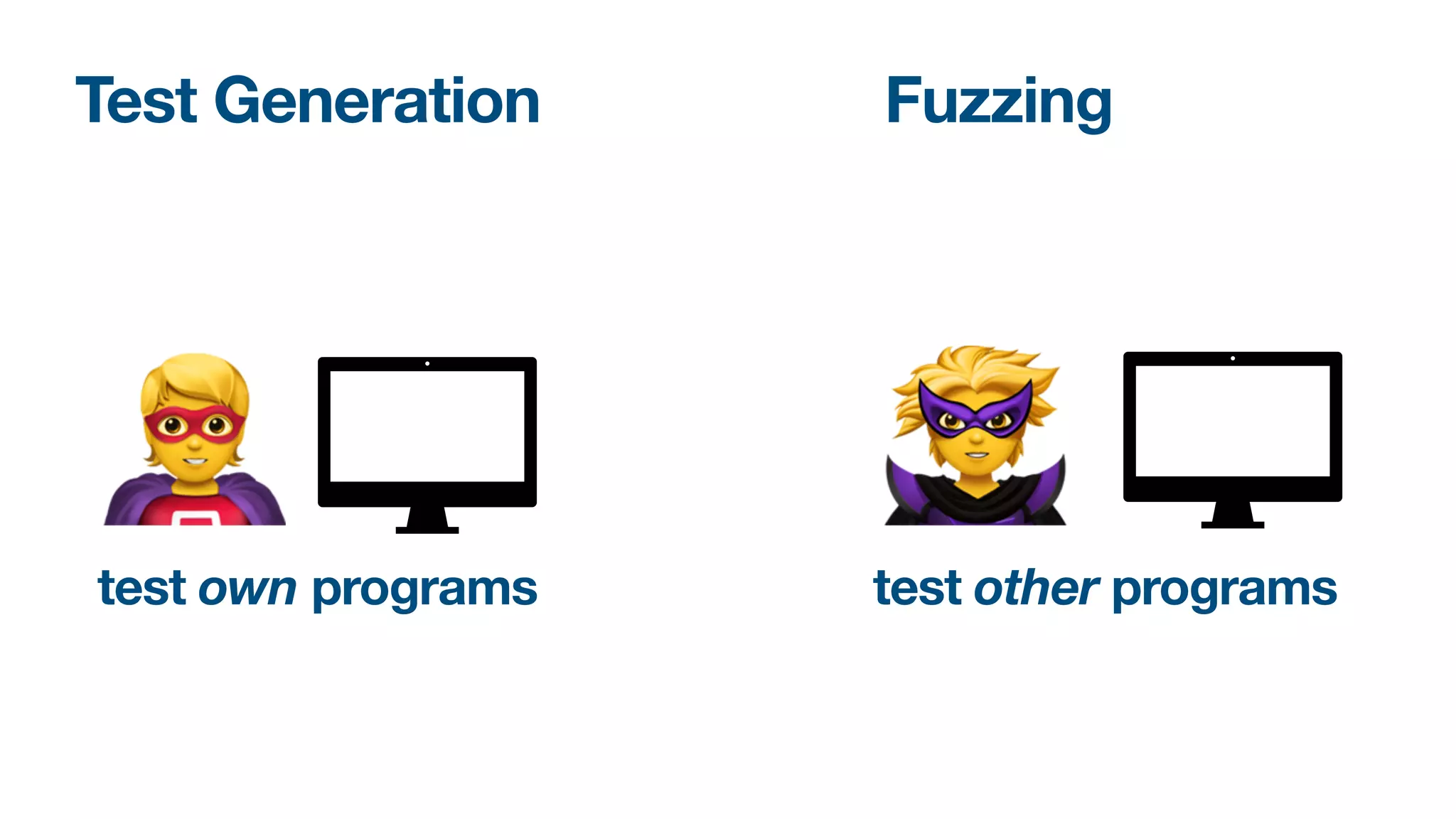
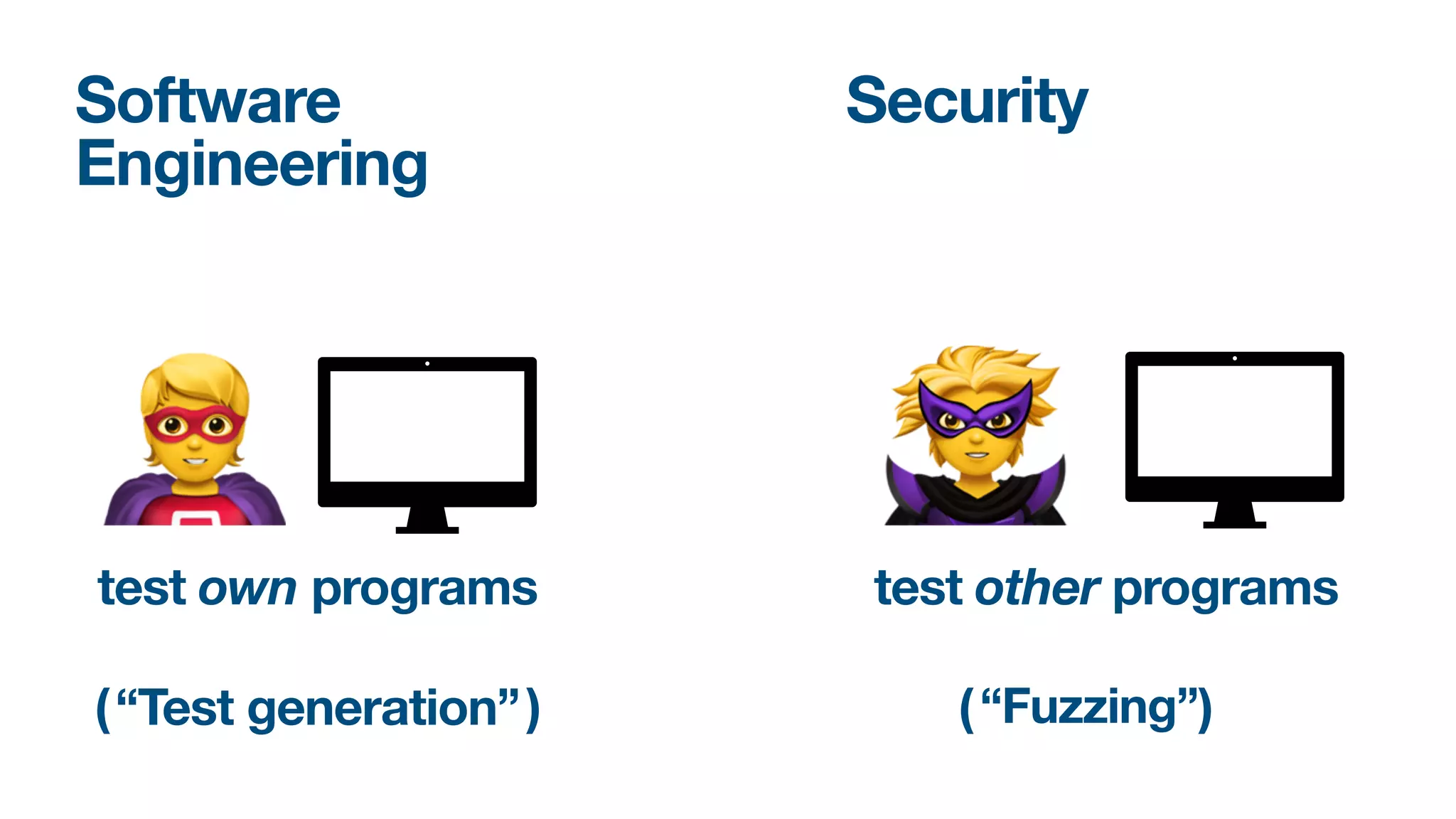
test own programs
🦸
test other programs
🦹
Security
Software

Engineering
test own programs test other programs
🦸 🦹
“Test generation” “Fuzzing”
( (
) )
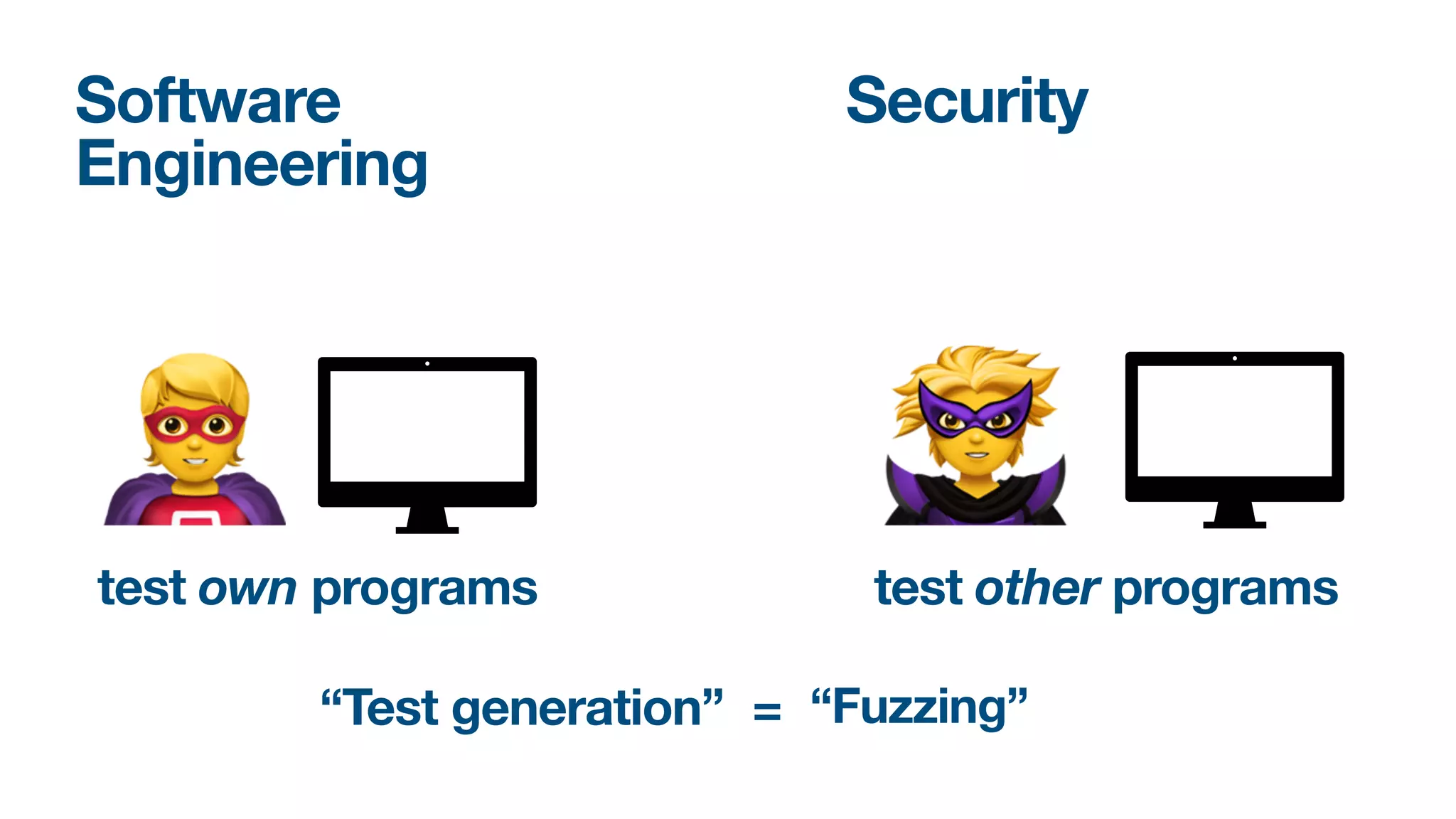
Security
Software

Engineering
test own programs test other programs
🦸 🦹
“Test generation” “Fuzzing”
=
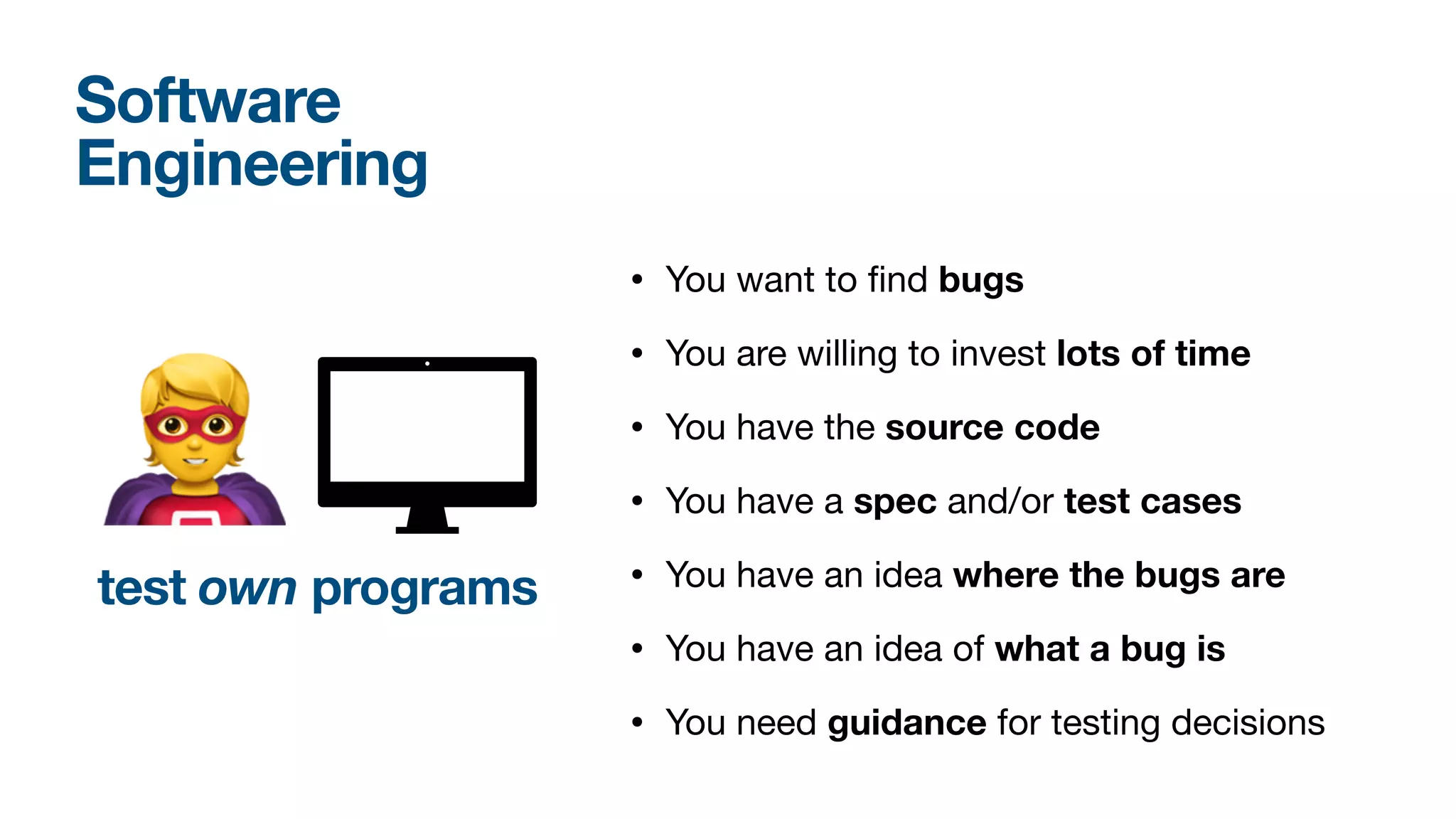
• You want to
fi
nd bugs 

• You are willing to invest lots of time

• You have the source code

• You have a spec and/or test cases

• You have an idea where the bugs are
• You have an idea of what a bug is

• You need guidance for testing decisions
Software

Engineering
test own programs
🦸
• You want to
fi
nd bugs 

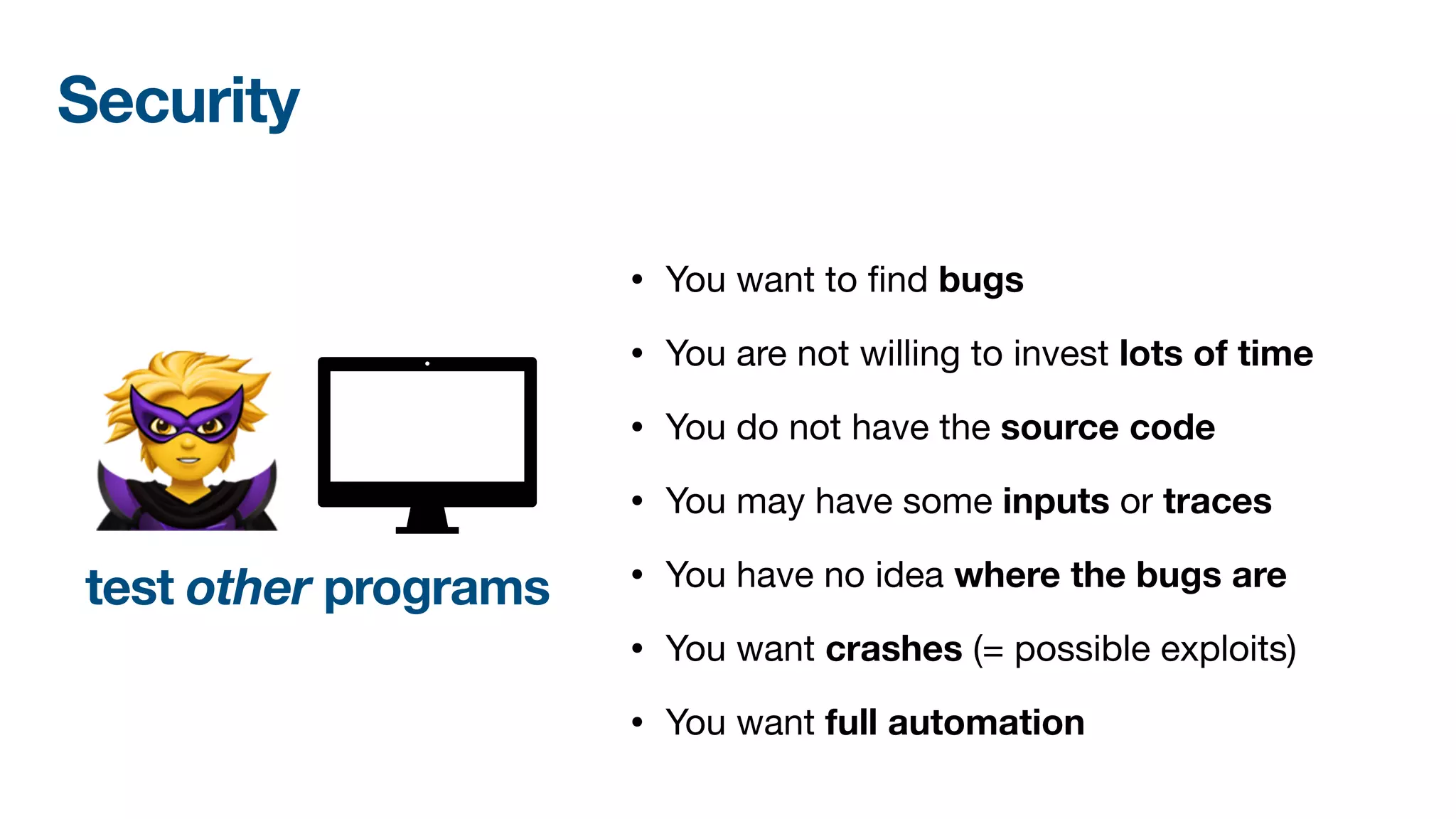
• You are not willing to invest lots of time

• You do not have the source code

• You may have some inputs or traces

• You have no idea where the bugs are
• You want crashes (= possible exploits)

• You want full automation
Security
test other programs
🦹
• You want to
fi
nd bugs 

• You are not willing to invest lots of time

• You do not have the source code

• You may have some inputs or traces

• You have no idea where the bugs are
• You want crashes (= possible exploits)

• You want full automation
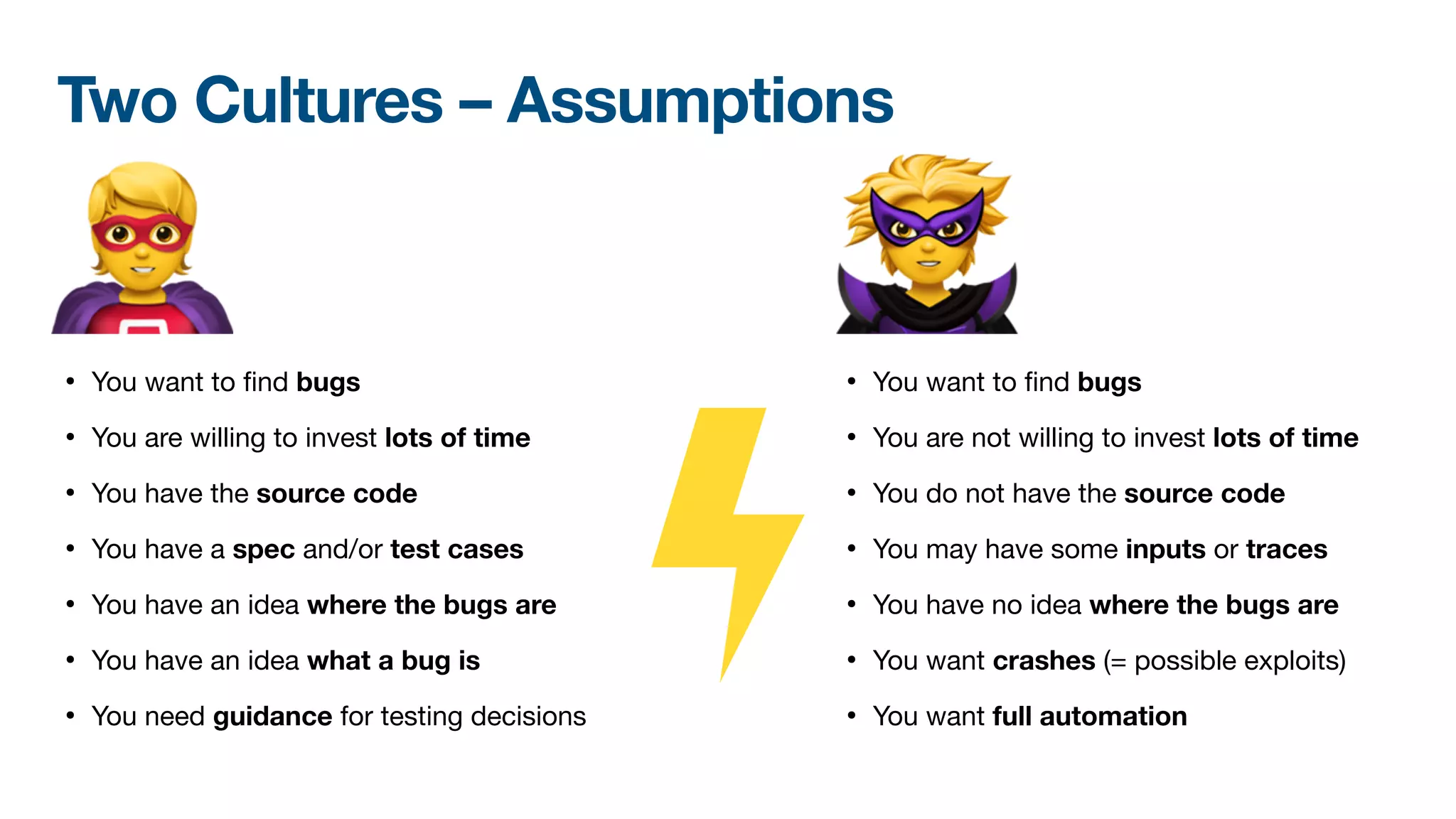
Two Cultures – Assumptions
• You want to
fi
nd bugs 

• You are willing to invest lots of time

• You have the source code

• You have a spec and/or test cases

• You have an idea where the bugs are
• You have an idea what a bug is

• You need guidance for testing decisions
🦸 🦹
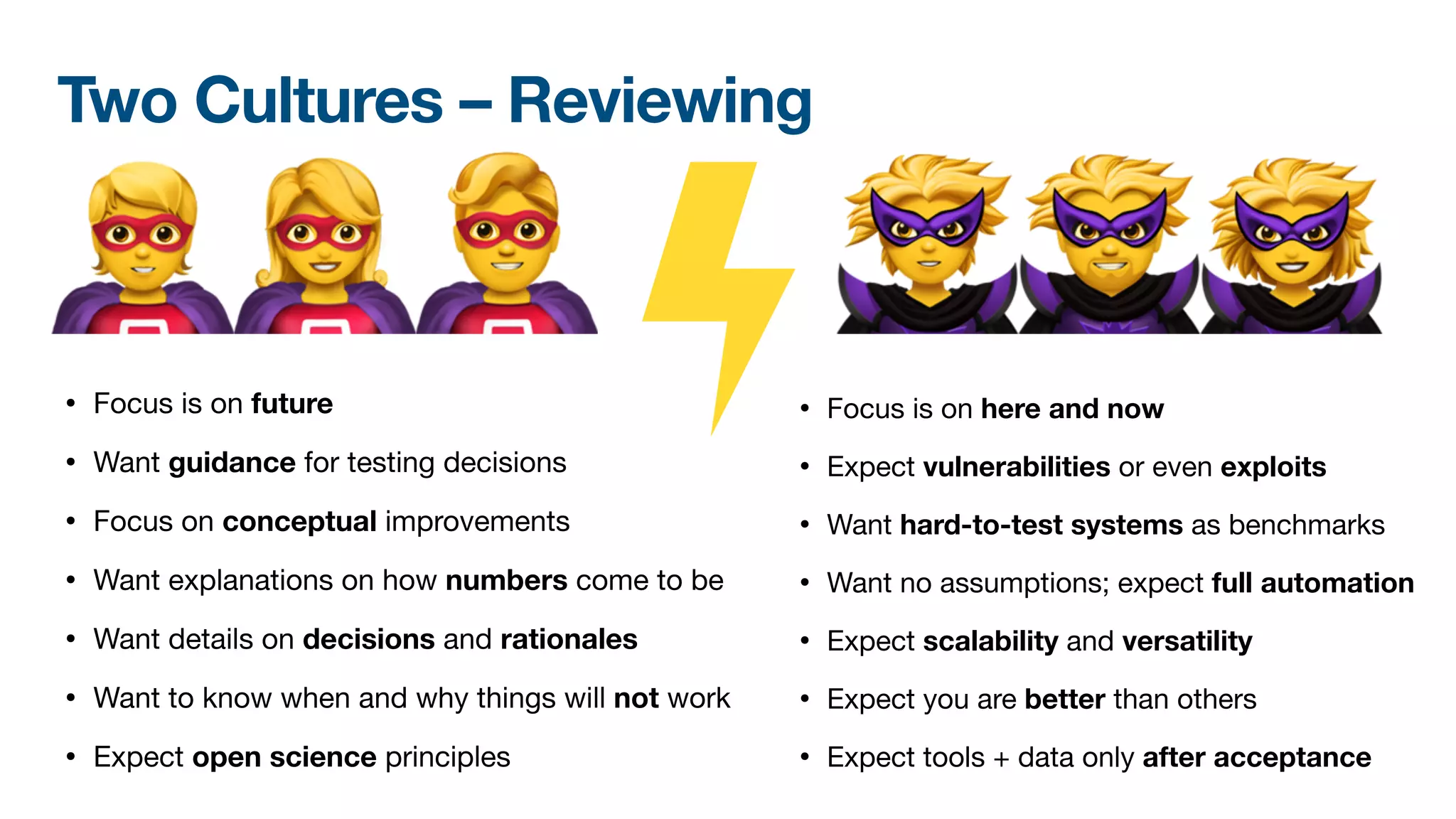
Two Cultures – Reviewing
🦸🦸🦸 🦹🦹🦹
• Focus is on future

• Want guidance for testing decisions

• Focus on conceptual improvements

• Want explanations on how numbers come to be

• Want details on decisions and rationales

• Want to know when and why things will not work

• Expect open science principles
• Focus is on here and now
• Expect vulnerabilities or even exploits

• Want hard-to-test systems as benchmarks

• Want no assumptions; expect full automation

• Expect scalability and versatility
• Expect you are better than others

• Expect tools + data only after acceptance
🦹🦹🦹
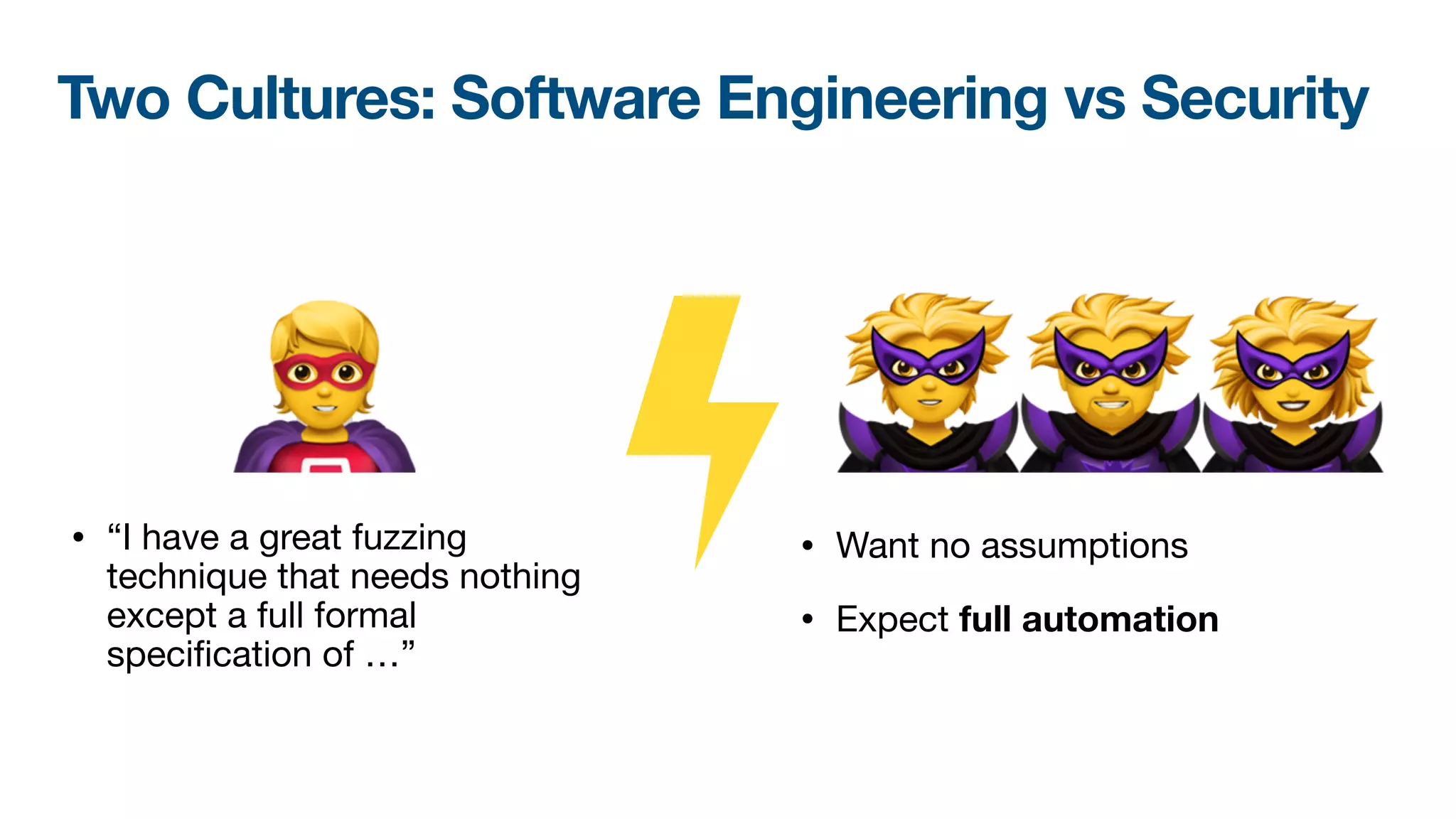
Two Cultures: Software Engineering vs Security
• “I have a great fuzzing
technique that needs nothing
except a full formal
speci
fi
cation of …”
• Want no assumptions

• Expect full automation
🦸
🦹🦹🦹
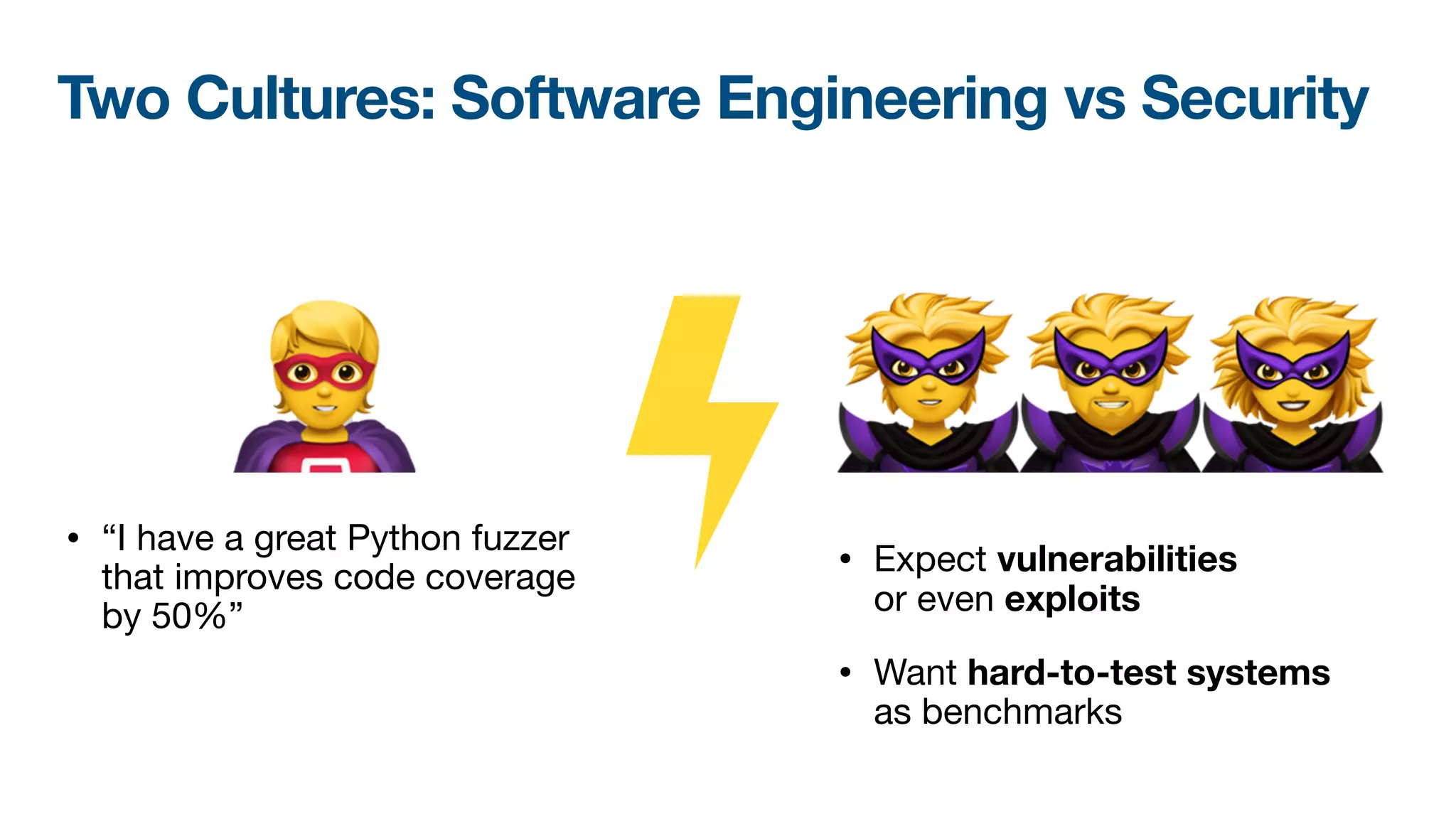
• Expect vulnerabilities

or even exploits

• Want hard-to-test systems

as benchmarks
🦸
• “I have a great Python fuzzer
that improves code coverage
by 50%”
Two Cultures: Software Engineering vs Security
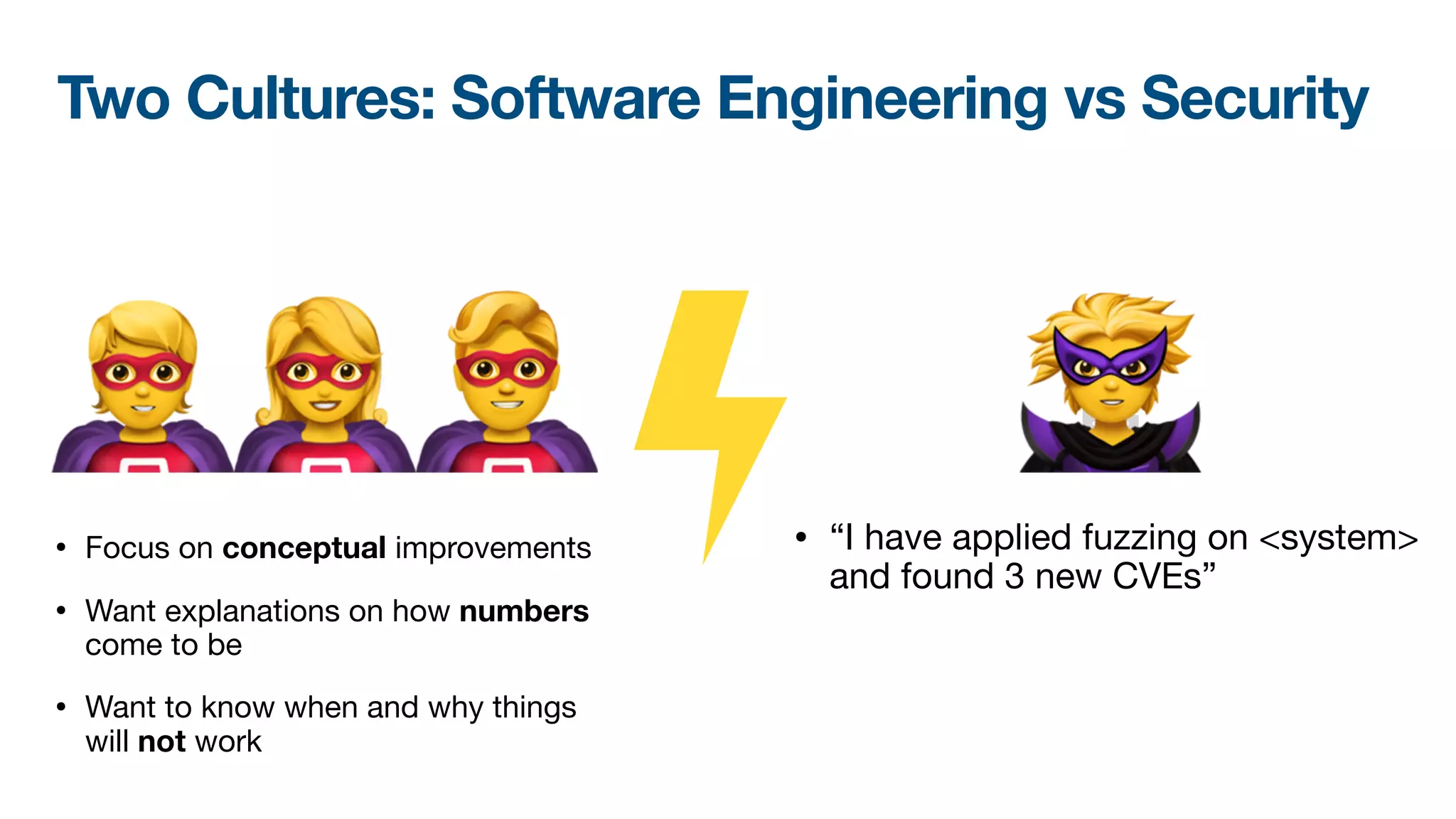
🦸🦸🦸 🦹
• “I have applied fuzzing on <system>
and found 3 new CVEs”
• Focus on conceptual improvements

• Want explanations on how numbers
come to be

• Want to know when and why things
will not work
Two Cultures: Software Engineering vs Security
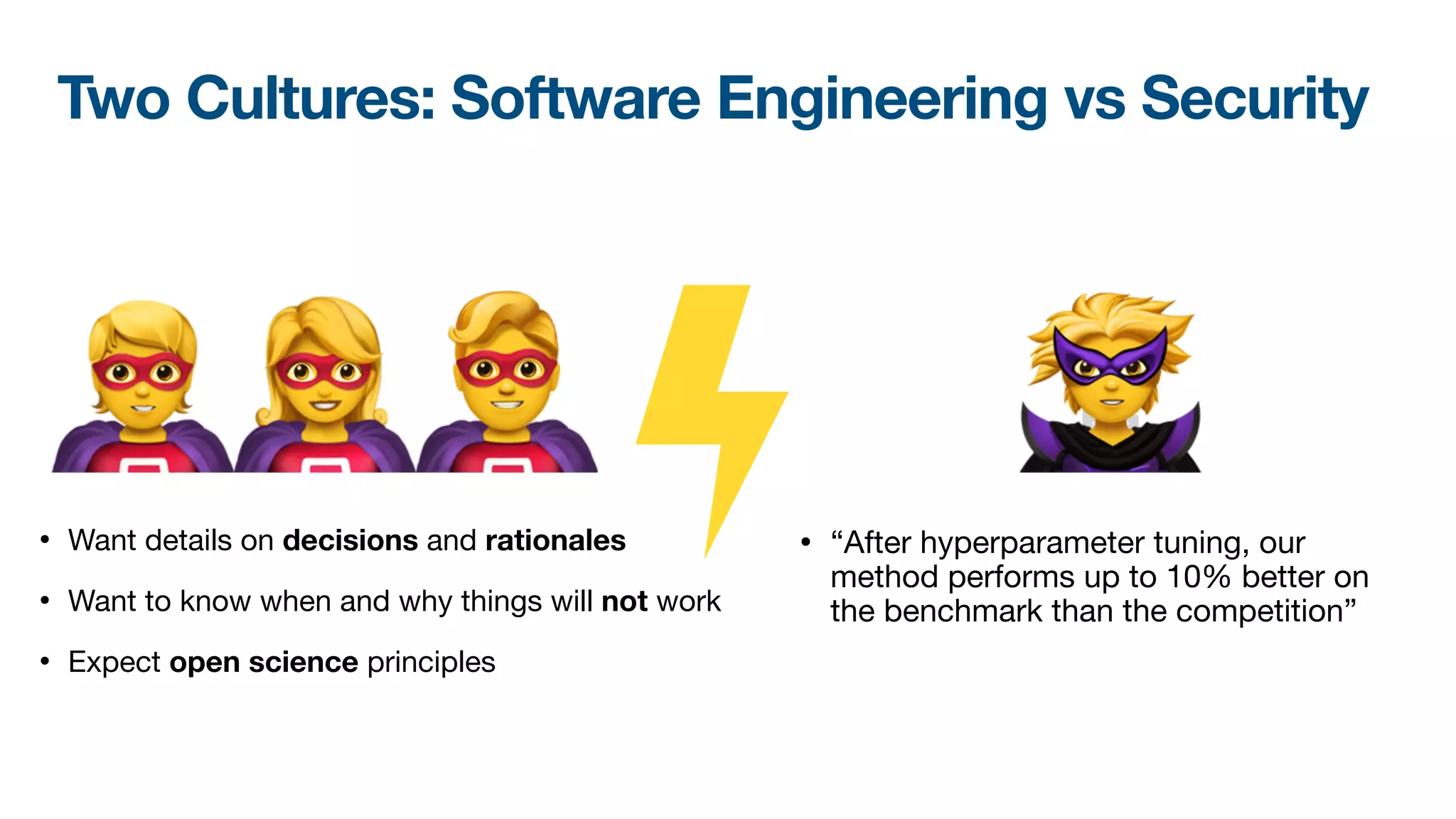
🦸🦸🦸
• “After hyperparameter tuning, our
method performs up to 10% better on
the benchmark than the competition”
🦹
• Want details on decisions and rationales
• Want to know when and why things will not work

• Expect open science principles
Two Cultures: Software Engineering vs Security
test own programs test other programs
🦸🦸🦸 🦹🦹🦹
test any program
🦸🦹🦸🦹🦸🦹
🦸🦹🦸🦹🦸🦹
test any program
🧑 👩
🧒 👨
🧔 👩🎓
test any program
🦸🦹🦸🦹🦸🦹
test any program
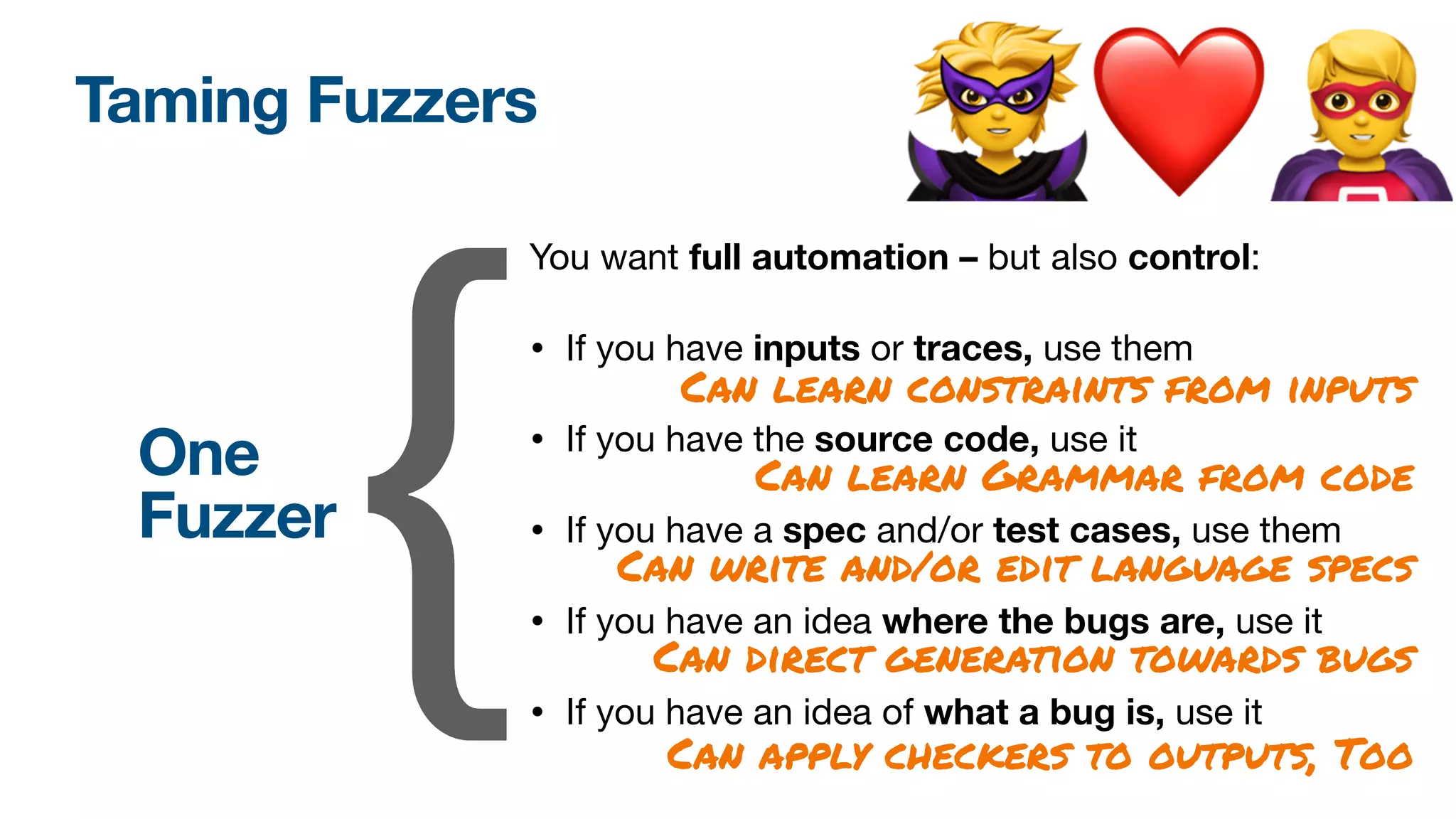
You want full automation – but also control:

• If you have inputs or traces, use them

• If you have the source code, use it

• If you have a spec and/or test cases, use them

• If you have an idea where the bugs are, use it
• If you have an idea of what a bug is, use it
🦸🦹
Taming Fuzzers
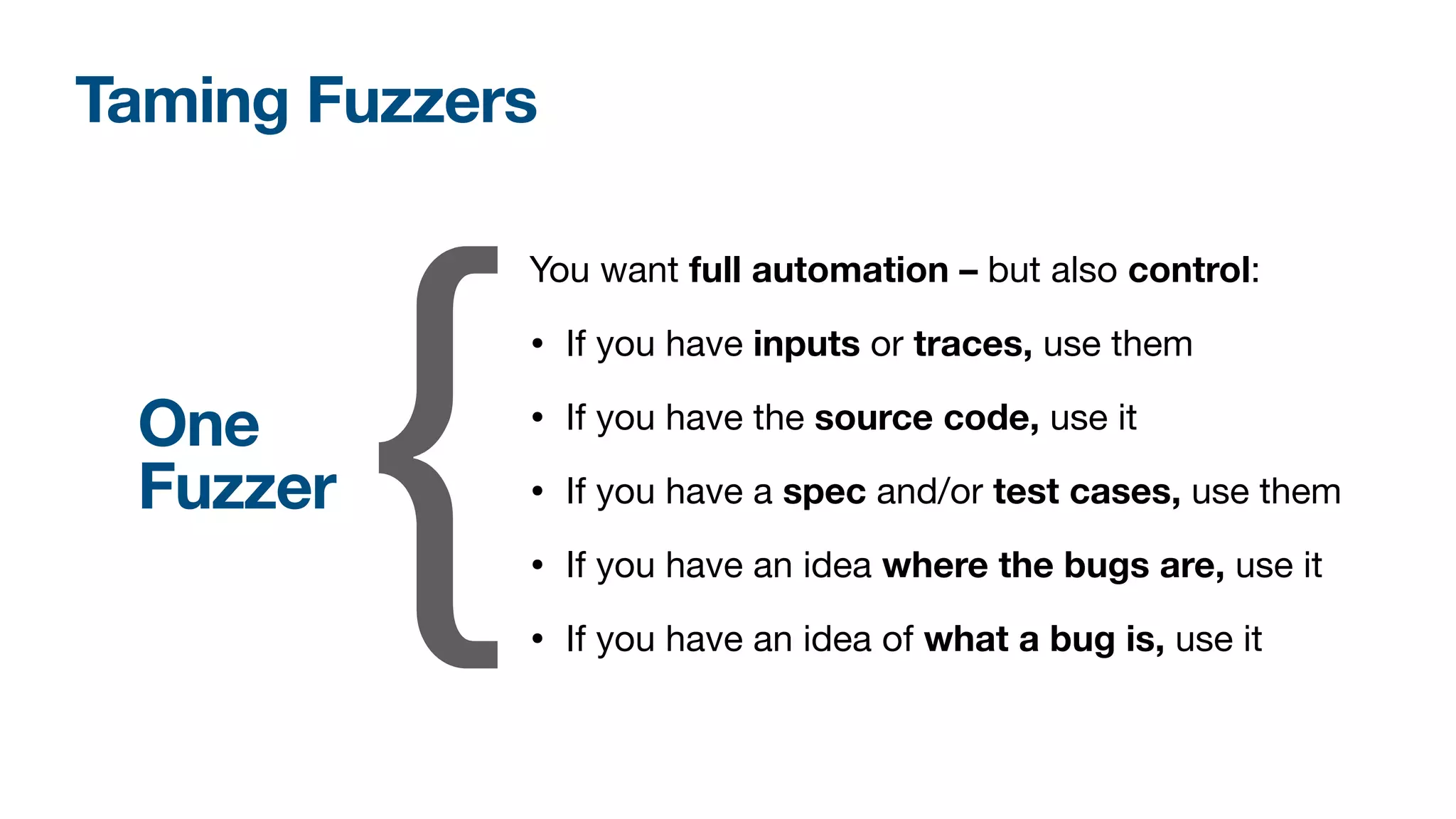
You want full automation – but also control:

• If you have inputs or traces, use them

• If you have the source code, use it

• If you have a spec and/or test cases, use them

• If you have an idea where the bugs are, use it
• If you have an idea of what a bug is, use it
{
One
Fuzzer
Sneak Peek
🦸🦹🦸🦹🦸🦹
Specifying Inputs
Context-Free Grammars
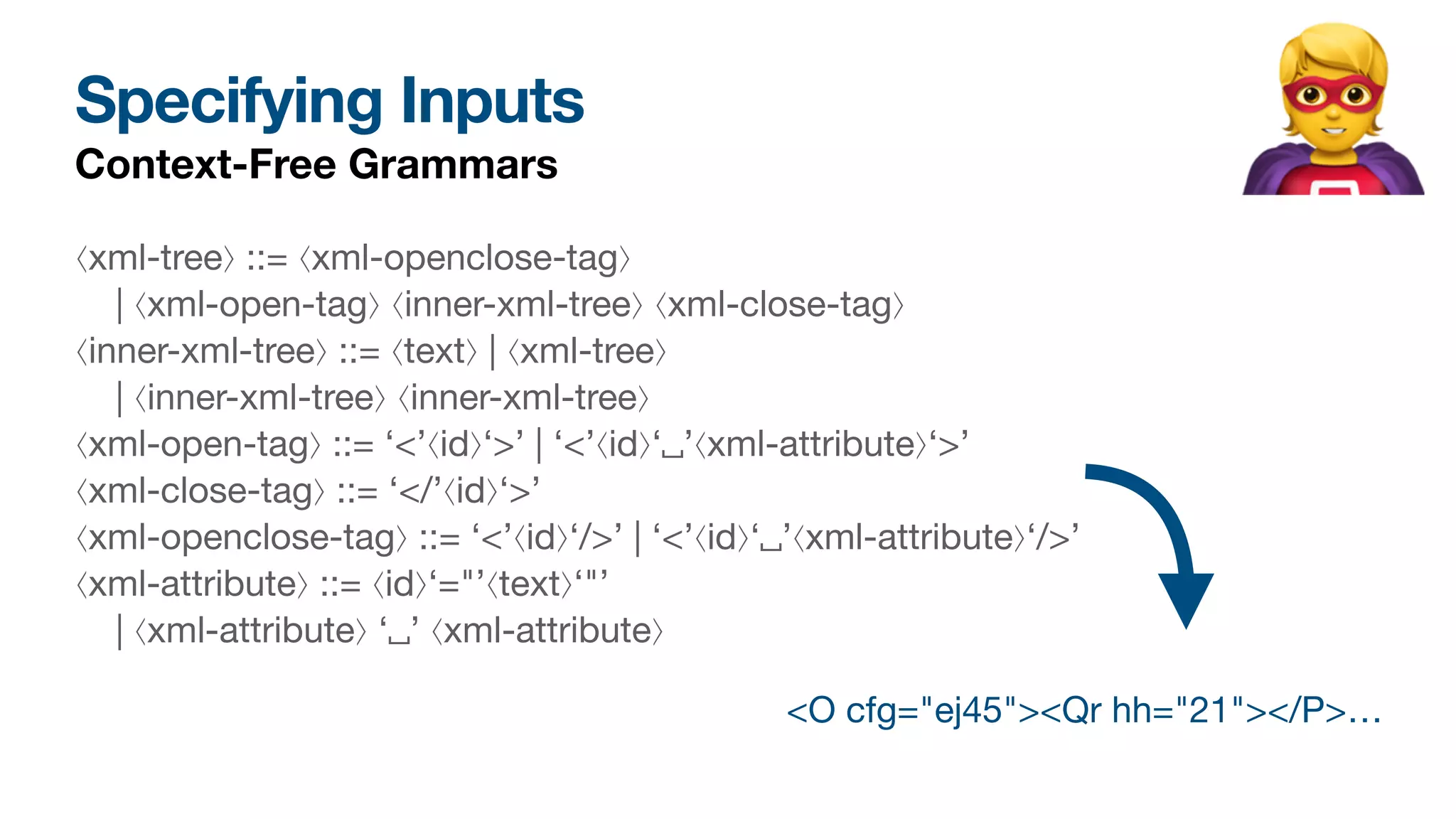
⟨xml-tree⟩ ::= ⟨xml-openclose-tag⟩

| ⟨xml-open-tag⟩ ⟨inner-xml-tree⟩ ⟨xml-close-tag⟩ 

⟨inner-xml-tree⟩ ::= ⟨text⟩ | ⟨xml-tree⟩

| ⟨inner-xml-tree⟩ ⟨inner-xml-tree⟩ 

⟨xml-open-tag⟩ ::= ‘<’⟨id⟩‘>’ | ‘<’⟨id⟩‘␣’⟨xml-attribute⟩‘>’ 

⟨xml-close-tag⟩ ::= ‘</’⟨id⟩‘>’

⟨xml-openclose-tag⟩ ::= ‘<’⟨id⟩‘/>’ | ‘<’⟨id⟩‘␣’⟨xml-attribute⟩‘/>’

⟨xml-attribute⟩ ::= ⟨id⟩‘="’⟨text⟩‘"’ 

| ⟨xml-attribute⟩ ‘␣’ ⟨xml-attribute⟩
🦸
<O cfg="ej45"><Qr hh="21"></P>…
Specifying Inputs
Context-Free Grammars
⟨xml-tree⟩ ::= ⟨xml-openclose-tag⟩

| ⟨xml-open-tag⟩ ⟨inner-xml-tree⟩ ⟨xml-close-tag⟩ 

⟨inner-xml-tree⟩ ::= ⟨text⟩ | ⟨xml-tree⟩

| ⟨inner-xml-tree⟩ ⟨inner-xml-tree⟩ 

⟨xml-open-tag⟩ ::= ‘<’⟨id⟩‘>’ | ‘<’⟨id⟩‘␣’⟨xml-attribute⟩‘>’ 

⟨xml-close-tag⟩ ::= ‘</’⟨id⟩‘>’

⟨xml-openclose-tag⟩ ::= ‘<’⟨id⟩‘/>’ | ‘<’⟨id⟩‘␣’⟨xml-attribute⟩‘/>’

⟨xml-attribute⟩ ::= ⟨id⟩ ‘="’ ⟨text⟩ ‘"’ 

| ⟨xml-attribute⟩ ‘␣’ ⟨xml-attribute⟩
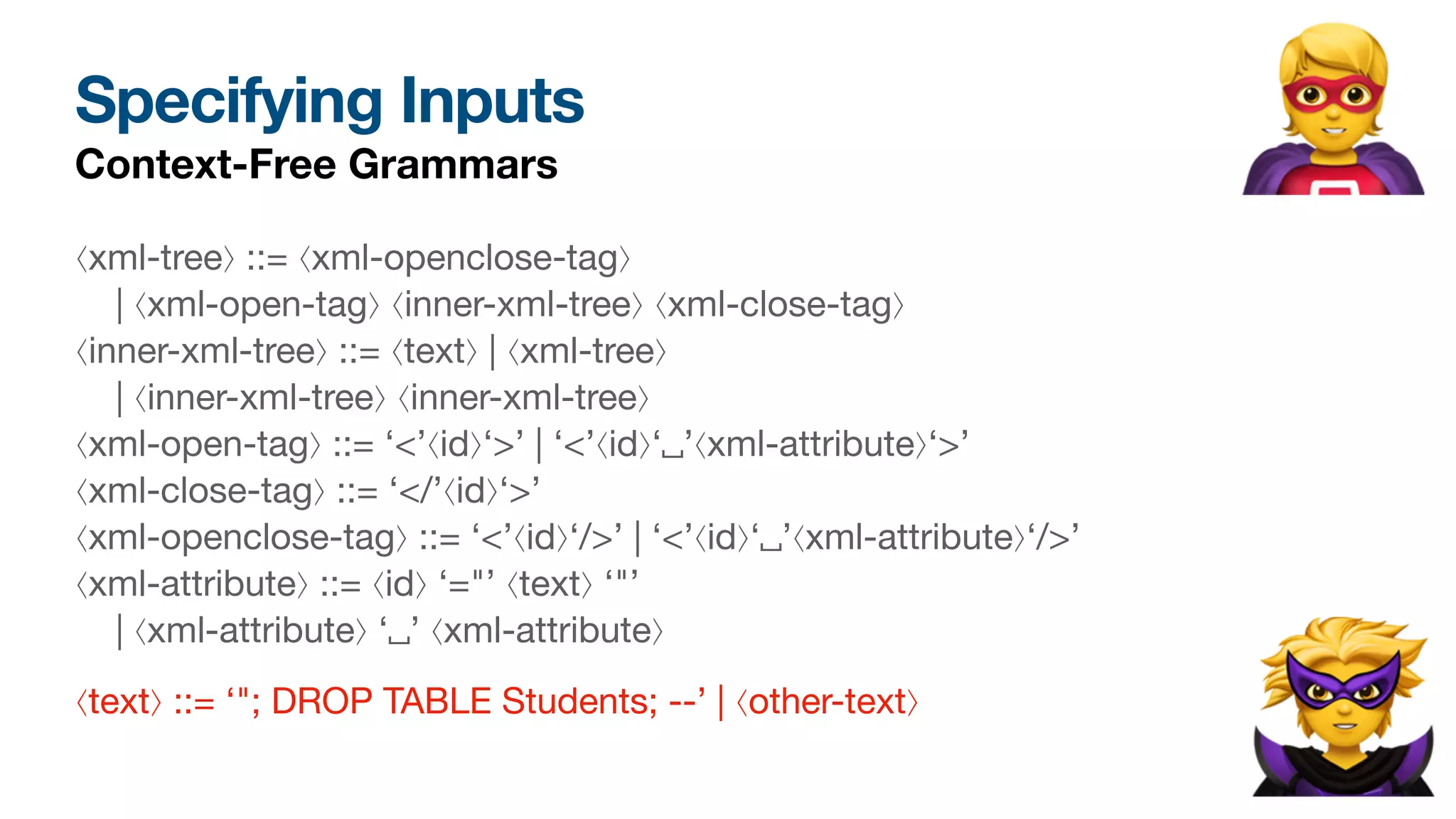
🦹
⟨text⟩ ::= ‘"; DROP TABLE Students; --’ | ⟨other-text⟩
🦸
Specifying Inputs
Context-Free Grammars
⟨xml-tree⟩ ::= ⟨xml-openclose-tag⟩

| ⟨xml-open-tag⟩ ⟨inner-xml-tree⟩ ⟨xml-close-tag⟩ 

⟨inner-xml-tree⟩ ::= ⟨text⟩ | ⟨xml-tree⟩

| ⟨inner-xml-tree⟩ ⟨inner-xml-tree⟩ 

⟨xml-open-tag⟩ ::= ‘<’⟨id⟩‘>’ | ‘<’⟨id⟩‘␣’⟨xml-attribute⟩‘>’ 

⟨xml-close-tag⟩ ::= ‘</’⟨id⟩‘>’

⟨xml-openclose-tag⟩ ::= ‘<’⟨id⟩‘/>’ | ‘<’⟨id⟩‘␣’⟨xml-attribute⟩‘/>’

⟨xml-attribute⟩ ::= ⟨id⟩‘="’⟨text⟩‘"’ 

| ⟨xml-attribute⟩ ‘␣’ ⟨xml-attribute⟩
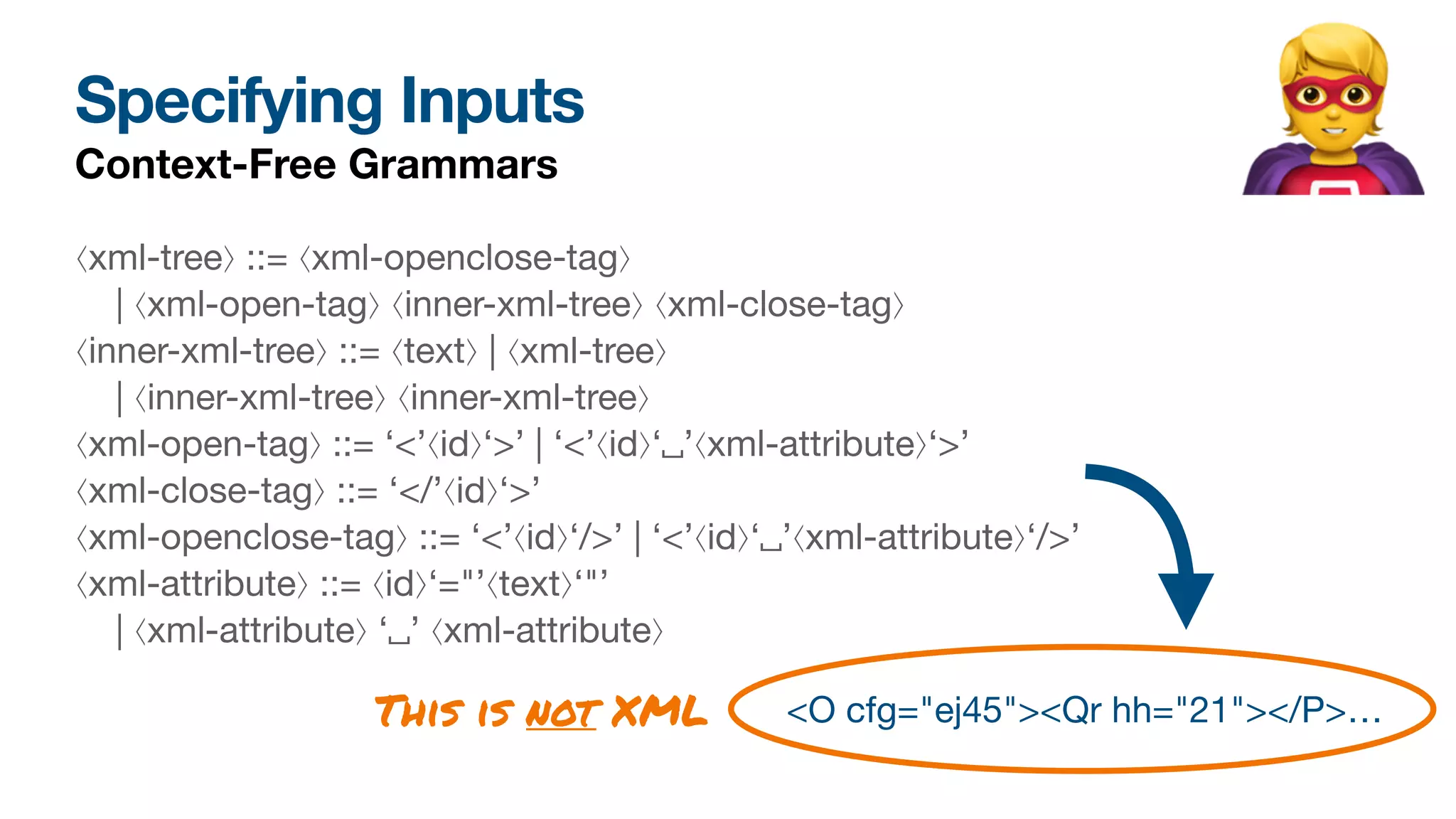
🦸
<O cfg="ej45"><Qr hh="21"></P>…
This is not XML
Specifying Inputs
The ISLa Speci
fi
cation Language
⟨xml-tree⟩ ::= ⟨xml-openclose-tag⟩

| ⟨xml-open-tag⟩ ⟨inner-xml-tree⟩ ⟨xml-close-tag⟩ 

⟨inner-xml-tree⟩ ::= ⟨text⟩ | ⟨xml-tree⟩

| ⟨inner-xml-tree⟩ ⟨inner-xml-tree⟩ 

⟨xml-open-tag⟩ ::= ‘<’⟨id⟩‘>’ | ‘<’⟨id⟩‘␣’⟨xml-attribute⟩‘>’ 

⟨xml-close-tag⟩ ::= ‘</’⟨id⟩‘>’

⟨xml-openclose-tag⟩ ::= ‘<’⟨id⟩‘/>’ | ‘<’⟨id⟩‘␣’⟨xml-attribute⟩‘/>’

⟨xml-attribute⟩ ::= ⟨id⟩‘="’⟨text⟩‘"’ 

| ⟨xml-attribute⟩ ‘␣’ ⟨xml-attribute⟩
🦸
<O cfg="ej45"><Qr hh="21"></Qr>…
forall <xml-tree> tree="<{⟨id⟩ opid}[⟨xml-attribute⟩]>
⟨inner-xml-tree⟩
</{⟨id⟩ clid}>" in start:
(= opid clid)
Grammar
Constraints
+
This is XML
Input Constraints
The ISLa Speci
fi
cation Language 🦸
<O cfg="ej45"><Qr hh="21"></Qr>…
forall <xml-tree> tree="<{⟨id⟩ opid}[⟨xml-attribute⟩]>
⟨inner-xml-tree⟩
</{⟨id⟩ clid}>" in start:
(= opid clid)
This is XML
Satisfying Constraints
🦸
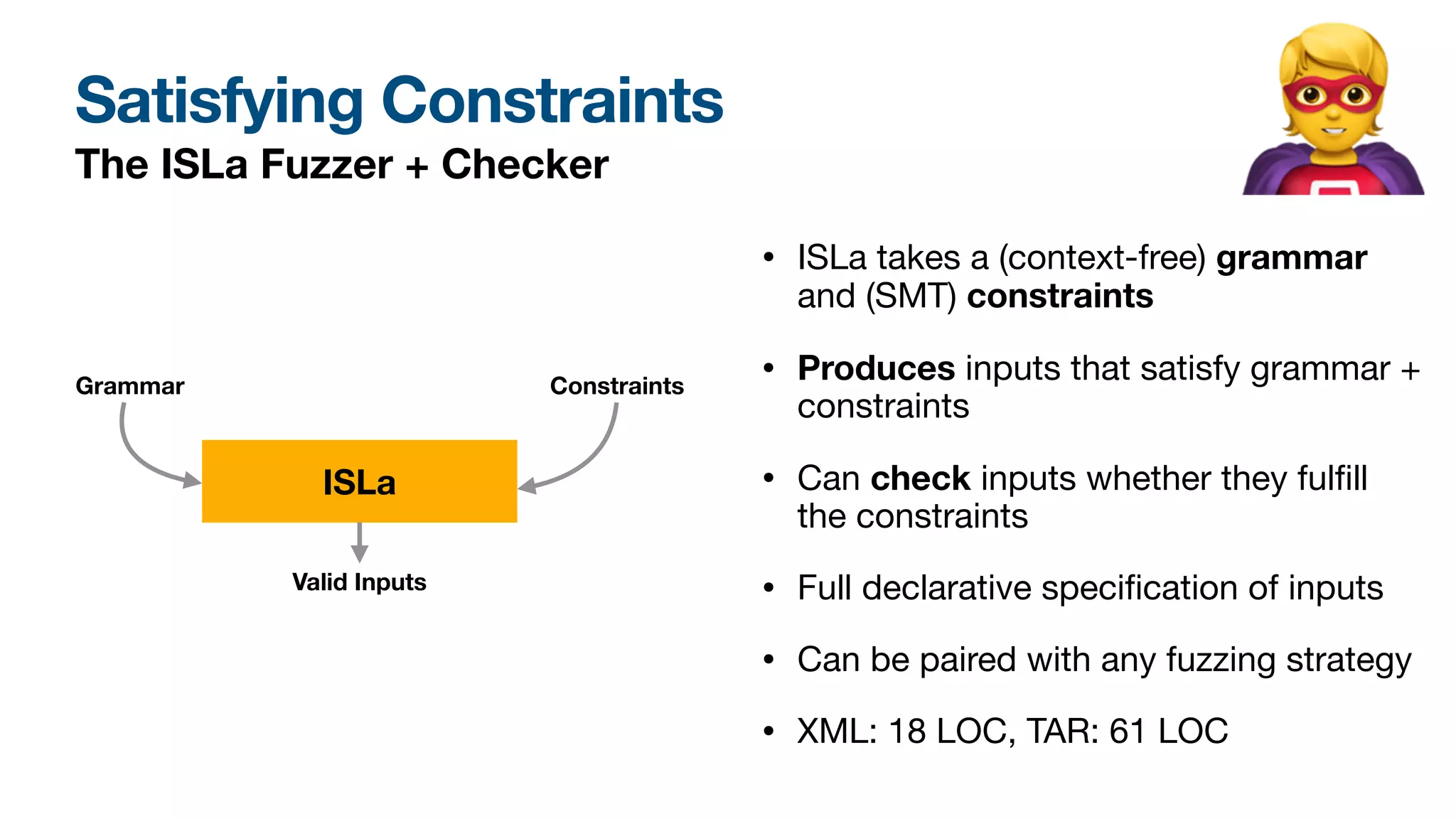
• ISLa takes a (context-free) grammar
and (SMT) constraints

• Produces inputs that satisfy grammar +
constraints
• Can check inputs whether they ful
fi
ll
the constraints

• Full declarative speci
fi
cation of inputs

• Can be paired with any fuzzing strategy

• XML: 18 LOC, TAR: 61 LOC
The ISLa Fuzzer + Checker
ISLa
Grammar Constraints
Valid Inputs
Learning Input Languages
The ISLearn Invariant Miner 🦹
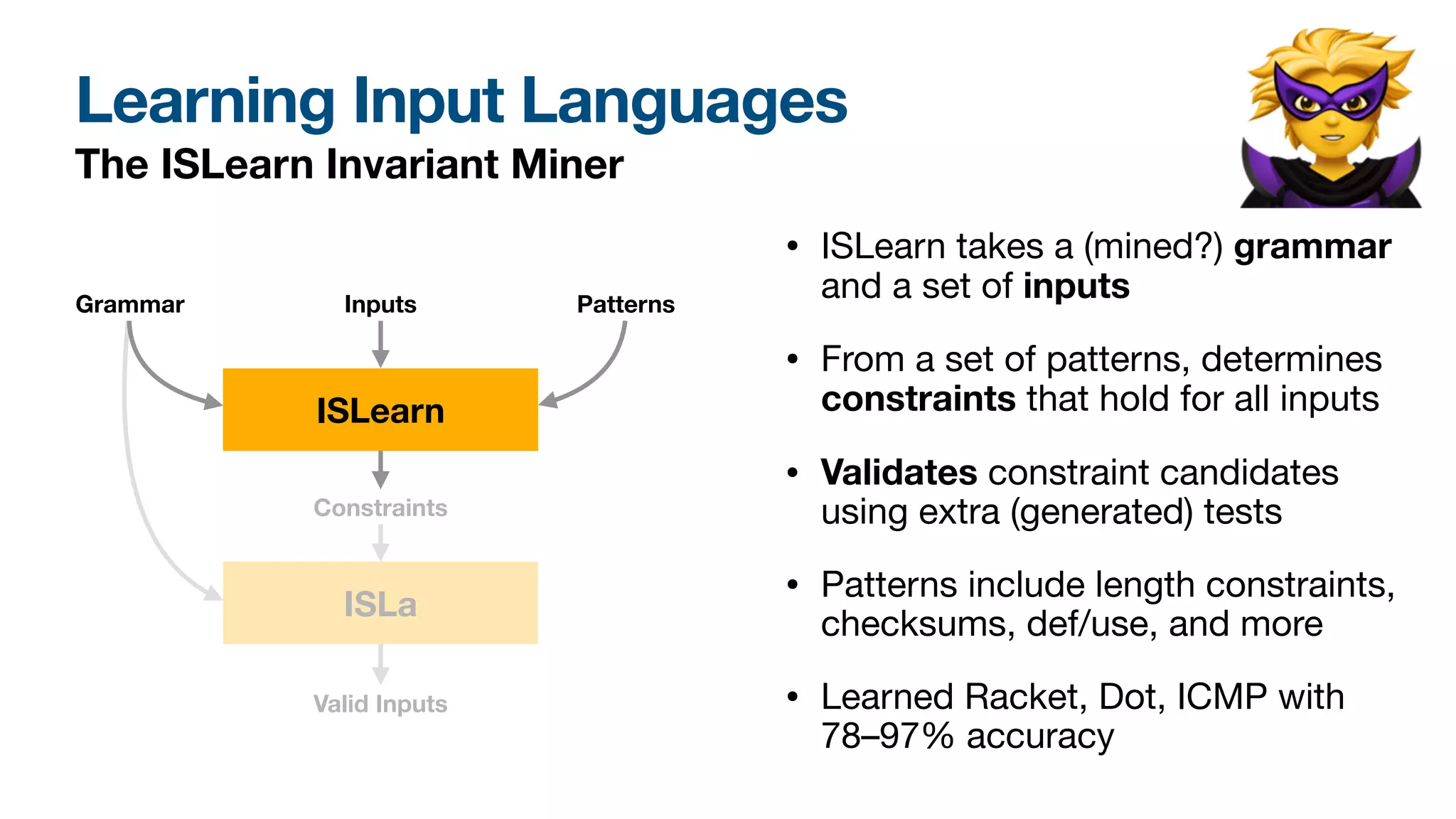
• ISLearn takes a (mined?) grammar
and a set of inputs

• From a set of patterns, determines
constraints that hold for all inputs

• Validates constraint candidates
using extra (generated) tests
• Patterns include length constraints,
checksums, def/use, and more

• Learned Racket, Dot, ICMP with
78–97% accuracy
ISLa
ISLearn
Grammar Inputs Patterns
Constraints
Valid Inputs
Demo
Taming Fuzzers
You want full automation – but also control:

• If you have inputs or traces, use them

• If you have the source code, use it

• If you have a spec and/or test cases, use them

• If you have an idea where the bugs are, use it
• If you have an idea of what a bug is, use it
{
One
Fuzzer
Can learn constraints from inputs
Can learn Grammar from code
Can write and/or edit language specs
Can direct generation towards bugs
Can apply checkers to outputs, Too
🦹❤🦸
Learn More about ISLa
Dominic Steinhöfel https://publications.cispa.saarland/3596/1/main.pdf
Input Invariants
Dominic Steinhöfel
CISPA Helmholtz Center for Information Security
Saarbrücken, Germany
dominic.steinhoefel@cispa.de
Andreas Zeller
CISPA Helmholtz Center for Information Security
Saarbrücken, Germany
zeller@cispa.de
ABSTRACT
Grammar-based fuzzers are highly e�cient in producing syntac-
tically valid system inputs. However, as context-free grammars
cannot capture semantic input features, generated inputs will often
be rejected as semantically invalid by a target program. We pro-
pose ISLa, a declarative speci�cation language for context-sensitive
properties of structured system inputs based on context-free gram-
mars. With ISLa, it is possible to specify input constraints like “a
variable has to be de�ned before it is used,” “the length of the ‘�le
name’ block in a TAR �le has to equal 100 bytes,” or “the number
of columns in all CSV rows must be identical.”
ISLa constraints can be used for parsing or validation (“Does an
input meet the expected constraint?”) as well as for fuzzing, since
we provide both an evaluation and input generation component. ISLa
embeds SMT formulas as an island language, leveraging the power
of modern solvers like Z3 to solve atomic semantic constraints.
On top, it adds universal and existential quanti�ers over the struc-
ture of derivation trees from a grammar, and structural (“X occurs
before Y”) and semantic (“X is the checksum of Y”) predicates.
ISLa constraints can be speci�ed manually, but also mined from
existing input samples. For this, our ISLearn prototype uses a cat-
alog of common patterns (such as the ones above), instantiates
these over input elements, and retains those candidates that hold
for the inputs observed and whose instantiations are fully accepted
by input-processing programs. The resulting constraints can then
again be used for fuzzing and parsing.
In our evaluation, we show that a few ISLa constraints su�ce to
produce inputs that are 100% semantically valid while still maintain-
ing input diversity. Furthermore, we con�rm that ISLearn mines use-
ful constraints about de�nition-use relationships and (implications
between) the existence of “magic constants”, e.g., for programming
languages and network packets.
1 INTRODUCTION
Automated software testing with random inputs (fuzzing) [19] is
an e�ective technique for �nding bugs in programs. Pure random
inputs can quickly discover errors in input processing. Yet, if a
program expects complex structured inputs (e.g., C programs, JSON
expressions, or binary formats), the chances of randomly produc-
ing valid inputs that are accepted by the parser and reach deeper
functionality are low.
Language-based fuzzers [8, 12, 13] overcome this limitation by
generating inputs from a speci�cation of a program’s expected
input language, frequently expressed as a Context-Free Grammar
(CFG). This considerably increases the chance of producing an input
passing the program’s parsing stage and reaching its core logic. Yet,
while being great for parsing, CFGs are often too coarse for producing
inputs. Consider, e.g., the language of XML documents (without
document type). This language is not context free.1 Still, it can be
approximated by a CFG. Fig. 1 shows an excerpt of a CFG for XML.
When we used a coverage-based fuzzer to produce 10,000 strings
from this grammar, exactly one produced document (<O L= cmV >
õ! B7</O>) contained a matching tag pair. This result is typical for
language-based fuzzers used with a language speci�cation designed
for parsing which therefore is more permissive than a language
speci�cation for producing would have to be. This is unfortunate,
as hundreds of language speci�cations for parsing exist.
To allow for precise production, we need to enrich the grammar
with more information, or switch to a di�erent formalism. However,
existing solutions all have their drawbacks. Using general purpose
code to produce inputs, or enriching grammars with such code is
closely tied to an implementation language, and does not allow
for parsing and recombining inputs, which is a common feature of
modern fuzzers. Unrestricted grammars can in principle specify any
computable input property, but we see them as “Turing tar-pits,” in
🦸🦹
Fuzzing Workshop @ NDSS'22 • April 24, 2022
Fuzzing: A Tale of Cultures
Andreas Zeller
Security
Software

Engineering
test own programs test other programs
! "
("Test generation") ("Fuzzing")
Input Invariants
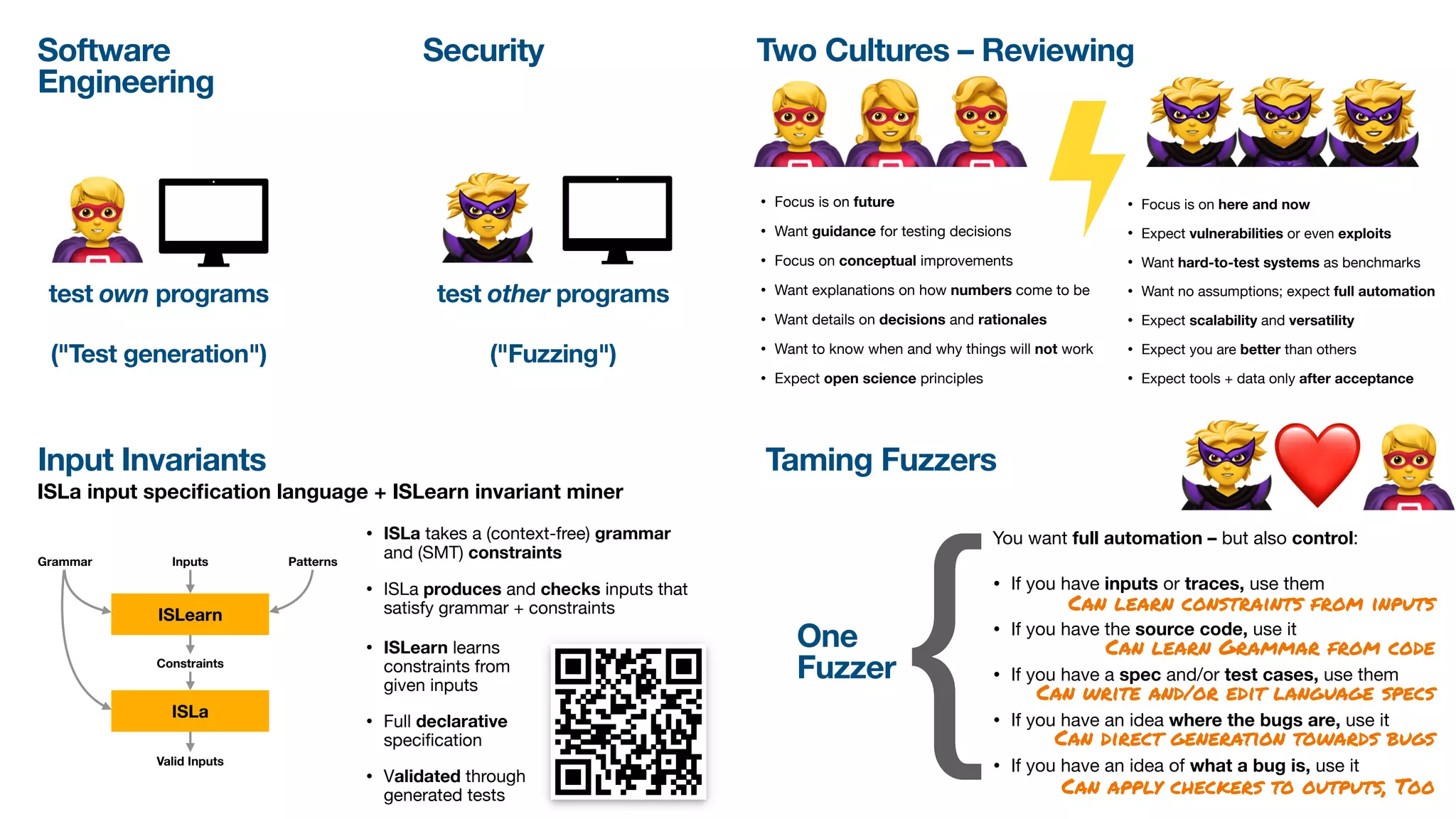
ISLa input specification language + ISLearn invariant miner
• ISLearn learns
constraints from
given inputs
• Full declarative
specification 

• Validated through
generated tests
ISLa
ISLearn
Grammar Inputs Patterns
Constraints
Valid Inputs
• ISLa takes a (context-free) grammar
and (SMT) constraints

• ISLa produces and checks inputs that
satisfy grammar + constraints
Taming Fuzzers
You want full automation – but also control:

• If you have inputs or traces, use them

• If you have the source code, use it

• If you have a spec and/or test cases, use them

• If you have an idea where the bugs are, use it
• If you have an idea of what a bug is, use it
{
One
Fuzzer
Can learn constraints from inputs
Can learn Grammar from code
Can write and/or edit language specs
Can direct generation towards bugs
Can apply checkers to outputs, Too
!❤#
Two Cultures – Reviewing
!"# $%&
• Focus is on future

• Want guidance for testing decisions

• Focus on conceptual improvements

• Want explanations on how numbers come to be

• Want details on decisions and rationales

• Want to know when and why things will not work

• Expect open science principles
• Focus is on here and now
• Expect vulnerabilities or even exploits

• Want hard-to-test systems as benchmarks

• Want no assumptions; expect full automation

• Expect scalability and versatility
• Expect you are better than others

• Expect tools + data only after acceptance
🦸🦹
Fuzzing Workshop @ NDSS'22 • April 24, 2022
Fuzzing: A Tale of Cultures
Andreas Zeller
Security
Software

Engineering
test own programs test other programs
! "
("Test generation") ("Fuzzing")
Input Invariants
ISLa input specification language + ISLearn invariant miner
• ISLearn learns
constraints from
given inputs
• Full declarative
specification 

• Validated through
generated tests
ISLa
ISLearn
Grammar Inputs Patterns
Constraints
Valid Inputs
• ISLa takes a (context-free) grammar
and (SMT) constraints

• ISLa produces and checks inputs that
satisfy grammar + constraints
Taming Fuzzers
You want full automation – but also control:

• If you have inputs or traces, use them

• If you have the source code, use it

• If you have a spec and/or test cases, use them

• If you have an idea where the bugs are, use it
• If you have an idea of what a bug is, use it
{
One
Fuzzer
Can learn constraints from inputs
Can learn Grammar from code
Can write and/or edit language specs
Can direct generation towards bugs
Can apply checkers to outputs, Too
!❤#
Two Cultures – Reviewing
!"# $%&
• Focus is on future

• Want guidance for testing decisions

• Focus on conceptual improvements

• Want explanations on how numbers come to be

• Want details on decisions and rationales

• Want to know when and why things will not work

• Expect open science principles
• Focus is on here and now
• Expect vulnerabilities or even exploits

• Want hard-to-test systems as benchmarks

• Want no assumptions; expect full automation

• Expect scalability and versatility
• Expect you are better than others

• Expect tools + data only after acceptance
We're hiring!
!"#$
%&

Fuzzing - A Tale of Two Cultures

  • 1.
    🦸🦹 Fuzzing Workshop @NDSS'22 • April 24, 2022 Fuzzing: A Tale of Cultures Andreas Zeller
  • 2.
    Fuzzing Random Testing atthe System Level [;x1-GPZ+wcckc];,N9J+?#6^6e?]9lu2_%'4GX"0VUB[E/r ~fApu6b8<{%siq8Zh.6{V,hr?;{Ti.r3PIxMMMv6{xS^+'Hq!AxB"YXRS@! Kd6;wtAMefFWM(`|J_<1~o}z3K(CCzRH JIIvHz>_*.>JrlU32~eGP? lR=bF3+;y$3lodQ<B89!5"W2fK*vE7v{')KC-i,c{<[~m!]o;{.'}Gj(X} EtYetrpbY@aGZ1{P!AZU7x#4(Rtn!q4nCwqol^y6}0| Ko=*JK~;zMKV=9Nai:wxu{J&UV#HaU)*BiC<),`+t*gka<W=Z. %T5WGHZpI30D<Pq>&]BS6R&j?#tP7iaV}-}`?[_[Z^LBMPG- FKj'xwuZ1=Q`^`5,$N$Q@[!CuRzJ2D|vBy!^zkhdf3C5PAkR?V hn| 3='i2Qx]D$qs4O`1@fevnG'211Vf3piU37@55apzIyl"'f, $ee,J4Gw:cgNKLie3nx9(`efSlg6#[K"@WjhZ}r[Scun&sBCS,T[/ vY'pduwgzDlVNy7'rnzxNwI)(ynBa>%|b`;`9fG]P_0hdG~$@6 3]KAeEnQ7lU)3Pn,0)G/6N-wyzj/MTd#A;r
  • 3.
  • 4.
  • 5.
  • 6.
    Fuzzing Test Generation test ownprograms 🦸 test other programs 🦹
  • 7.
    Security Software
 Engineering test own programstest other programs 🦸 🦹 “Test generation” “Fuzzing” ( ( ) )
  • 8.
    Security Software
 Engineering test own programstest other programs 🦸 🦹 “Test generation” “Fuzzing” =
  • 9.
    • You wantto fi nd bugs • You are willing to invest lots of time • You have the source code • You have a spec and/or test cases • You have an idea where the bugs are • You have an idea of what a bug is • You need guidance for testing decisions Software
 Engineering test own programs 🦸
  • 10.
    • You wantto fi nd bugs • You are not willing to invest lots of time • You do not have the source code • You may have some inputs or traces • You have no idea where the bugs are • You want crashes (= possible exploits) • You want full automation Security test other programs 🦹
  • 11.
    • You wantto fi nd bugs • You are not willing to invest lots of time • You do not have the source code • You may have some inputs or traces • You have no idea where the bugs are • You want crashes (= possible exploits) • You want full automation Two Cultures – Assumptions • You want to fi nd bugs • You are willing to invest lots of time • You have the source code • You have a spec and/or test cases • You have an idea where the bugs are • You have an idea what a bug is • You need guidance for testing decisions 🦸 🦹
  • 12.
    Two Cultures – Reviewing 🦸🦸🦸🦹🦹🦹 • Focus is on future • Want guidance for testing decisions • Focus on conceptual improvements • Want explanations on how numbers come to be • Want details on decisions and rationales • Want to know when and why things will not work • Expect open science principles • Focus is on here and now • Expect vulnerabilities or even exploits • Want hard-to-test systems as benchmarks • Want no assumptions; expect full automation • Expect scalability and versatility • Expect you are better than others • Expect tools + data only after acceptance
  • 13.
    🦹🦹🦹 Two Cultures: SoftwareEngineering vs Security • “I have a great fuzzing technique that needs nothing except a full formal speci fi cation of …” • Want no assumptions • Expect full automation 🦸
  • 14.
    🦹🦹🦹 • Expect vulnerabilities
 oreven exploits • Want hard-to-test systems
 as benchmarks 🦸 • “I have a great Python fuzzer that improves code coverage by 50%” Two Cultures: Software Engineering vs Security
  • 15.
    🦸🦸🦸 🦹 • “Ihave applied fuzzing on <system> and found 3 new CVEs” • Focus on conceptual improvements • Want explanations on how numbers come to be • Want to know when and why things will not work Two Cultures: Software Engineering vs Security
  • 16.
    🦸🦸🦸 • “After hyperparametertuning, our method performs up to 10% better on the benchmark than the competition” 🦹 • Want details on decisions and rationales • Want to know when and why things will not work • Expect open science principles Two Cultures: Software Engineering vs Security
  • 17.
    test own programstest other programs 🦸🦸🦸 🦹🦹🦹
  • 18.
  • 19.
  • 20.
  • 21.
    test any program Youwant full automation – but also control: • If you have inputs or traces, use them • If you have the source code, use it • If you have a spec and/or test cases, use them • If you have an idea where the bugs are, use it • If you have an idea of what a bug is, use it 🦸🦹
  • 22.
    Taming Fuzzers You wantfull automation – but also control: • If you have inputs or traces, use them • If you have the source code, use it • If you have a spec and/or test cases, use them • If you have an idea where the bugs are, use it • If you have an idea of what a bug is, use it { One Fuzzer
  • 23.
  • 24.
    Specifying Inputs Context-Free Grammars ⟨xml-tree⟩::= ⟨xml-openclose-tag⟩
 | ⟨xml-open-tag⟩ ⟨inner-xml-tree⟩ ⟨xml-close-tag⟩ ⟨inner-xml-tree⟩ ::= ⟨text⟩ | ⟨xml-tree⟩ | ⟨inner-xml-tree⟩ ⟨inner-xml-tree⟩ ⟨xml-open-tag⟩ ::= ‘<’⟨id⟩‘>’ | ‘<’⟨id⟩‘␣’⟨xml-attribute⟩‘>’ 
 ⟨xml-close-tag⟩ ::= ‘</’⟨id⟩‘>’
 ⟨xml-openclose-tag⟩ ::= ‘<’⟨id⟩‘/>’ | ‘<’⟨id⟩‘␣’⟨xml-attribute⟩‘/>’
 ⟨xml-attribute⟩ ::= ⟨id⟩‘="’⟨text⟩‘"’ | ⟨xml-attribute⟩ ‘␣’ ⟨xml-attribute⟩ 🦸 <O cfg="ej45"><Qr hh="21"></P>…
  • 25.
    Specifying Inputs Context-Free Grammars ⟨xml-tree⟩::= ⟨xml-openclose-tag⟩
 | ⟨xml-open-tag⟩ ⟨inner-xml-tree⟩ ⟨xml-close-tag⟩ ⟨inner-xml-tree⟩ ::= ⟨text⟩ | ⟨xml-tree⟩ | ⟨inner-xml-tree⟩ ⟨inner-xml-tree⟩ ⟨xml-open-tag⟩ ::= ‘<’⟨id⟩‘>’ | ‘<’⟨id⟩‘␣’⟨xml-attribute⟩‘>’ 
 ⟨xml-close-tag⟩ ::= ‘</’⟨id⟩‘>’
 ⟨xml-openclose-tag⟩ ::= ‘<’⟨id⟩‘/>’ | ‘<’⟨id⟩‘␣’⟨xml-attribute⟩‘/>’
 ⟨xml-attribute⟩ ::= ⟨id⟩ ‘="’ ⟨text⟩ ‘"’ | ⟨xml-attribute⟩ ‘␣’ ⟨xml-attribute⟩ 🦹 ⟨text⟩ ::= ‘"; DROP TABLE Students; --’ | ⟨other-text⟩ 🦸
  • 26.
    Specifying Inputs Context-Free Grammars ⟨xml-tree⟩::= ⟨xml-openclose-tag⟩
 | ⟨xml-open-tag⟩ ⟨inner-xml-tree⟩ ⟨xml-close-tag⟩ ⟨inner-xml-tree⟩ ::= ⟨text⟩ | ⟨xml-tree⟩ | ⟨inner-xml-tree⟩ ⟨inner-xml-tree⟩ ⟨xml-open-tag⟩ ::= ‘<’⟨id⟩‘>’ | ‘<’⟨id⟩‘␣’⟨xml-attribute⟩‘>’ 
 ⟨xml-close-tag⟩ ::= ‘</’⟨id⟩‘>’
 ⟨xml-openclose-tag⟩ ::= ‘<’⟨id⟩‘/>’ | ‘<’⟨id⟩‘␣’⟨xml-attribute⟩‘/>’
 ⟨xml-attribute⟩ ::= ⟨id⟩‘="’⟨text⟩‘"’ | ⟨xml-attribute⟩ ‘␣’ ⟨xml-attribute⟩ 🦸 <O cfg="ej45"><Qr hh="21"></P>… This is not XML
  • 27.
    Specifying Inputs The ISLaSpeci fi cation Language ⟨xml-tree⟩ ::= ⟨xml-openclose-tag⟩
 | ⟨xml-open-tag⟩ ⟨inner-xml-tree⟩ ⟨xml-close-tag⟩ ⟨inner-xml-tree⟩ ::= ⟨text⟩ | ⟨xml-tree⟩ | ⟨inner-xml-tree⟩ ⟨inner-xml-tree⟩ ⟨xml-open-tag⟩ ::= ‘<’⟨id⟩‘>’ | ‘<’⟨id⟩‘␣’⟨xml-attribute⟩‘>’ 
 ⟨xml-close-tag⟩ ::= ‘</’⟨id⟩‘>’
 ⟨xml-openclose-tag⟩ ::= ‘<’⟨id⟩‘/>’ | ‘<’⟨id⟩‘␣’⟨xml-attribute⟩‘/>’
 ⟨xml-attribute⟩ ::= ⟨id⟩‘="’⟨text⟩‘"’ | ⟨xml-attribute⟩ ‘␣’ ⟨xml-attribute⟩ 🦸 <O cfg="ej45"><Qr hh="21"></Qr>… forall <xml-tree> tree="<{⟨id⟩ opid}[⟨xml-attribute⟩]> ⟨inner-xml-tree⟩ </{⟨id⟩ clid}>" in start: (= opid clid) Grammar Constraints + This is XML
  • 28.
    Input Constraints The ISLaSpeci fi cation Language 🦸 <O cfg="ej45"><Qr hh="21"></Qr>… forall <xml-tree> tree="<{⟨id⟩ opid}[⟨xml-attribute⟩]> ⟨inner-xml-tree⟩ </{⟨id⟩ clid}>" in start: (= opid clid) This is XML
  • 29.
    Satisfying Constraints 🦸 • ISLatakes a (context-free) grammar and (SMT) constraints • Produces inputs that satisfy grammar + constraints • Can check inputs whether they ful fi ll the constraints • Full declarative speci fi cation of inputs • Can be paired with any fuzzing strategy • XML: 18 LOC, TAR: 61 LOC The ISLa Fuzzer + Checker ISLa Grammar Constraints Valid Inputs
  • 30.
    Learning Input Languages TheISLearn Invariant Miner 🦹 • ISLearn takes a (mined?) grammar and a set of inputs • From a set of patterns, determines constraints that hold for all inputs • Validates constraint candidates using extra (generated) tests • Patterns include length constraints, checksums, def/use, and more • Learned Racket, Dot, ICMP with 78–97% accuracy ISLa ISLearn Grammar Inputs Patterns Constraints Valid Inputs
  • 31.
  • 32.
    Taming Fuzzers You wantfull automation – but also control: • If you have inputs or traces, use them • If you have the source code, use it • If you have a spec and/or test cases, use them • If you have an idea where the bugs are, use it • If you have an idea of what a bug is, use it { One Fuzzer Can learn constraints from inputs Can learn Grammar from code Can write and/or edit language specs Can direct generation towards bugs Can apply checkers to outputs, Too 🦹❤🦸
  • 33.
    Learn More aboutISLa Dominic Steinhöfel https://publications.cispa.saarland/3596/1/main.pdf Input Invariants Dominic Steinhöfel CISPA Helmholtz Center for Information Security Saarbrücken, Germany dominic.steinhoefel@cispa.de Andreas Zeller CISPA Helmholtz Center for Information Security Saarbrücken, Germany zeller@cispa.de ABSTRACT Grammar-based fuzzers are highly e�cient in producing syntac- tically valid system inputs. However, as context-free grammars cannot capture semantic input features, generated inputs will often be rejected as semantically invalid by a target program. We pro- pose ISLa, a declarative speci�cation language for context-sensitive properties of structured system inputs based on context-free gram- mars. With ISLa, it is possible to specify input constraints like “a variable has to be de�ned before it is used,” “the length of the ‘�le name’ block in a TAR �le has to equal 100 bytes,” or “the number of columns in all CSV rows must be identical.” ISLa constraints can be used for parsing or validation (“Does an input meet the expected constraint?”) as well as for fuzzing, since we provide both an evaluation and input generation component. ISLa embeds SMT formulas as an island language, leveraging the power of modern solvers like Z3 to solve atomic semantic constraints. On top, it adds universal and existential quanti�ers over the struc- ture of derivation trees from a grammar, and structural (“X occurs before Y”) and semantic (“X is the checksum of Y”) predicates. ISLa constraints can be speci�ed manually, but also mined from existing input samples. For this, our ISLearn prototype uses a cat- alog of common patterns (such as the ones above), instantiates these over input elements, and retains those candidates that hold for the inputs observed and whose instantiations are fully accepted by input-processing programs. The resulting constraints can then again be used for fuzzing and parsing. In our evaluation, we show that a few ISLa constraints su�ce to produce inputs that are 100% semantically valid while still maintain- ing input diversity. Furthermore, we con�rm that ISLearn mines use- ful constraints about de�nition-use relationships and (implications between) the existence of “magic constants”, e.g., for programming languages and network packets. 1 INTRODUCTION Automated software testing with random inputs (fuzzing) [19] is an e�ective technique for �nding bugs in programs. Pure random inputs can quickly discover errors in input processing. Yet, if a program expects complex structured inputs (e.g., C programs, JSON expressions, or binary formats), the chances of randomly produc- ing valid inputs that are accepted by the parser and reach deeper functionality are low. Language-based fuzzers [8, 12, 13] overcome this limitation by generating inputs from a speci�cation of a program’s expected input language, frequently expressed as a Context-Free Grammar (CFG). This considerably increases the chance of producing an input passing the program’s parsing stage and reaching its core logic. Yet, while being great for parsing, CFGs are often too coarse for producing inputs. Consider, e.g., the language of XML documents (without document type). This language is not context free.1 Still, it can be approximated by a CFG. Fig. 1 shows an excerpt of a CFG for XML. When we used a coverage-based fuzzer to produce 10,000 strings from this grammar, exactly one produced document (<O L= cmV > õ! B7</O>) contained a matching tag pair. This result is typical for language-based fuzzers used with a language speci�cation designed for parsing which therefore is more permissive than a language speci�cation for producing would have to be. This is unfortunate, as hundreds of language speci�cations for parsing exist. To allow for precise production, we need to enrich the grammar with more information, or switch to a di�erent formalism. However, existing solutions all have their drawbacks. Using general purpose code to produce inputs, or enriching grammars with such code is closely tied to an implementation language, and does not allow for parsing and recombining inputs, which is a common feature of modern fuzzers. Unrestricted grammars can in principle specify any computable input property, but we see them as “Turing tar-pits,” in
  • 34.
    🦸🦹 Fuzzing Workshop @NDSS'22 • April 24, 2022 Fuzzing: A Tale of Cultures Andreas Zeller Security Software
 Engineering test own programs test other programs ! " ("Test generation") ("Fuzzing") Input Invariants ISLa input specification language + ISLearn invariant miner • ISLearn learns constraints from given inputs • Full declarative specification • Validated through generated tests ISLa ISLearn Grammar Inputs Patterns Constraints Valid Inputs • ISLa takes a (context-free) grammar and (SMT) constraints • ISLa produces and checks inputs that satisfy grammar + constraints Taming Fuzzers You want full automation – but also control: • If you have inputs or traces, use them • If you have the source code, use it • If you have a spec and/or test cases, use them • If you have an idea where the bugs are, use it • If you have an idea of what a bug is, use it { One Fuzzer Can learn constraints from inputs Can learn Grammar from code Can write and/or edit language specs Can direct generation towards bugs Can apply checkers to outputs, Too !❤# Two Cultures – Reviewing !"# $%& • Focus is on future • Want guidance for testing decisions • Focus on conceptual improvements • Want explanations on how numbers come to be • Want details on decisions and rationales • Want to know when and why things will not work • Expect open science principles • Focus is on here and now • Expect vulnerabilities or even exploits • Want hard-to-test systems as benchmarks • Want no assumptions; expect full automation • Expect scalability and versatility • Expect you are better than others • Expect tools + data only after acceptance
  • 35.
    🦸🦹 Fuzzing Workshop @NDSS'22 • April 24, 2022 Fuzzing: A Tale of Cultures Andreas Zeller Security Software
 Engineering test own programs test other programs ! " ("Test generation") ("Fuzzing") Input Invariants ISLa input specification language + ISLearn invariant miner • ISLearn learns constraints from given inputs • Full declarative specification • Validated through generated tests ISLa ISLearn Grammar Inputs Patterns Constraints Valid Inputs • ISLa takes a (context-free) grammar and (SMT) constraints • ISLa produces and checks inputs that satisfy grammar + constraints Taming Fuzzers You want full automation – but also control: • If you have inputs or traces, use them • If you have the source code, use it • If you have a spec and/or test cases, use them • If you have an idea where the bugs are, use it • If you have an idea of what a bug is, use it { One Fuzzer Can learn constraints from inputs Can learn Grammar from code Can write and/or edit language specs Can direct generation towards bugs Can apply checkers to outputs, Too !❤# Two Cultures – Reviewing !"# $%& • Focus is on future • Want guidance for testing decisions • Focus on conceptual improvements • Want explanations on how numbers come to be • Want details on decisions and rationales • Want to know when and why things will not work • Expect open science principles • Focus is on here and now • Expect vulnerabilities or even exploits • Want hard-to-test systems as benchmarks • Want no assumptions; expect full automation • Expect scalability and versatility • Expect you are better than others • Expect tools + data only after acceptance We're hiring! !"#$ %&