@AndreasZeller
ON IMPACT IN SOFTWARE ENGINEERING RESEARCH
ANDREAS ZELLER, CISPA HELMHOLTZ CENTER FOR INFORMATION SECURITY
HU BERLIN WORKSHOP "SE FORSCHUNGSMETHODENTRAINING"


MARCH 22, 2021
@AndreasZeller
ANDREAS ZELLER: KEY FACTS
• PhD in 1997 on Con
fi
guration Management with Feature Logic


• Since 2001, Professor at Saarland University, Saarbrücken, Germany


• Since 2019, Faculty at CISPA Helmholtz Center for Information Security


• ACM Fellow in 2010


• ERC Advanced Grant in 2011


• SIGSOFT Outstanding Research Award in 2018


• Last week, got my sixth 10-year impact award
@AndreasZeller
WHAT IS IMPACT?
@AndreasZeller
WHAT IS IMPACT?
• How do your actions change the world?


• We want to make the world a better place


• Gives meaning and purpose to our (professional) life
@AndreasZeller
WHAT MAKES IMPACTFUL RESEARCH?
• Intellectual challenge – was it hard, or could anyone have done this?


• Elegance – is your research speci
fi
c to a context, or can it be reused
again and again?


• Usefulness – can someone make money with it?


• Innovation is the delta in any of these metrics
@AndreasZeller
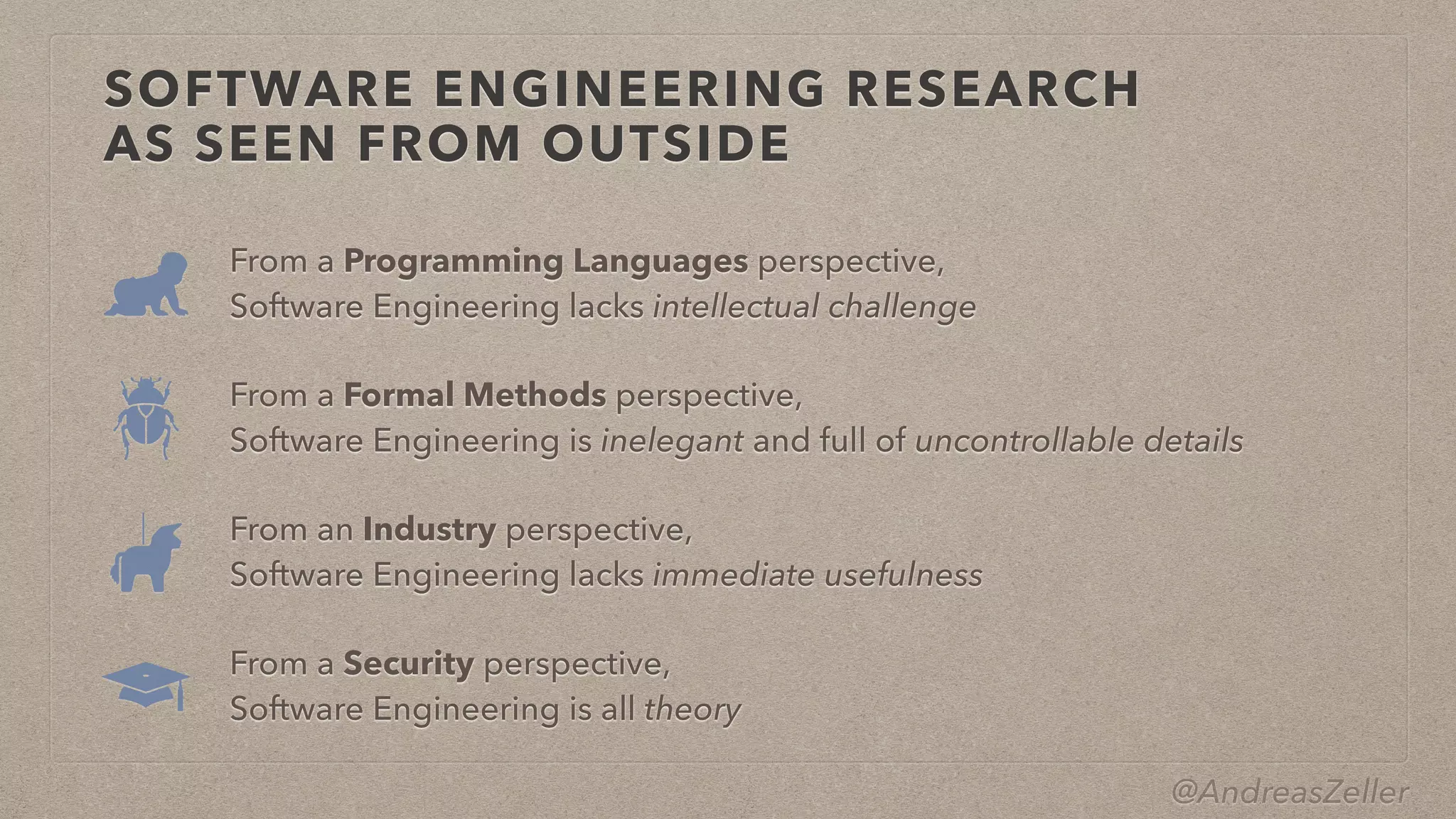
SOFTWARE ENGINEERING RESEARCH


AS SEEN FROM OUTSIDE
From a Programming Languages perspective,


Software Engineering lacks intellectual challenge
From a Security perspective,


Software Engineering is all theory
From an Industry perspective,


Software Engineering lacks immediate usefulness
From a Formal Methods perspective,


Software Engineering is inelegant and full of uncontrollable details
@AndreasZeller
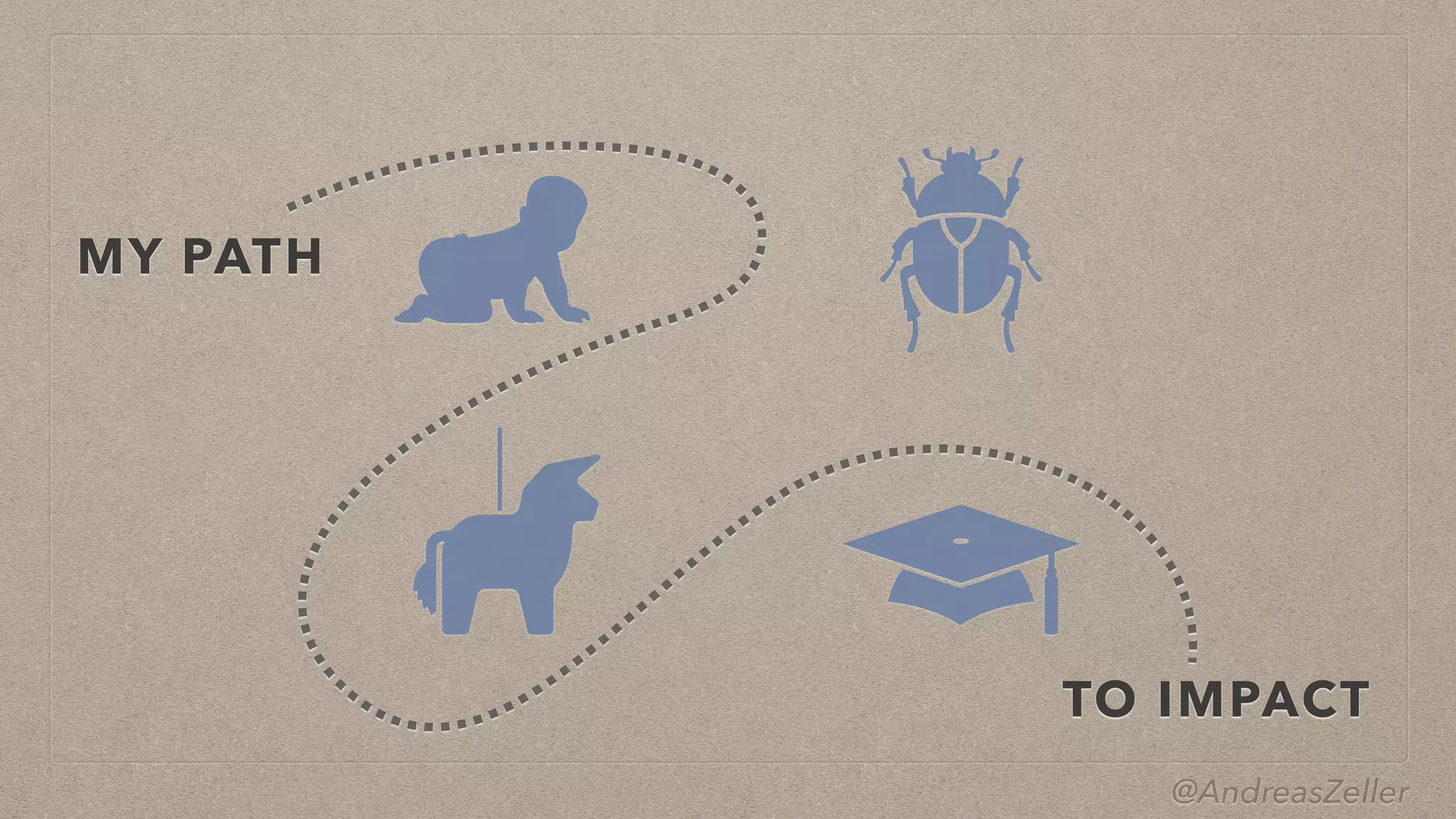
MY PATH
TO IMPACT
@AndreasZeller
MY PATH TO IMPACT
• Life can only be understood backwards; but it must be lived forwards


(Søren Kierkegaard)
@AndreasZeller
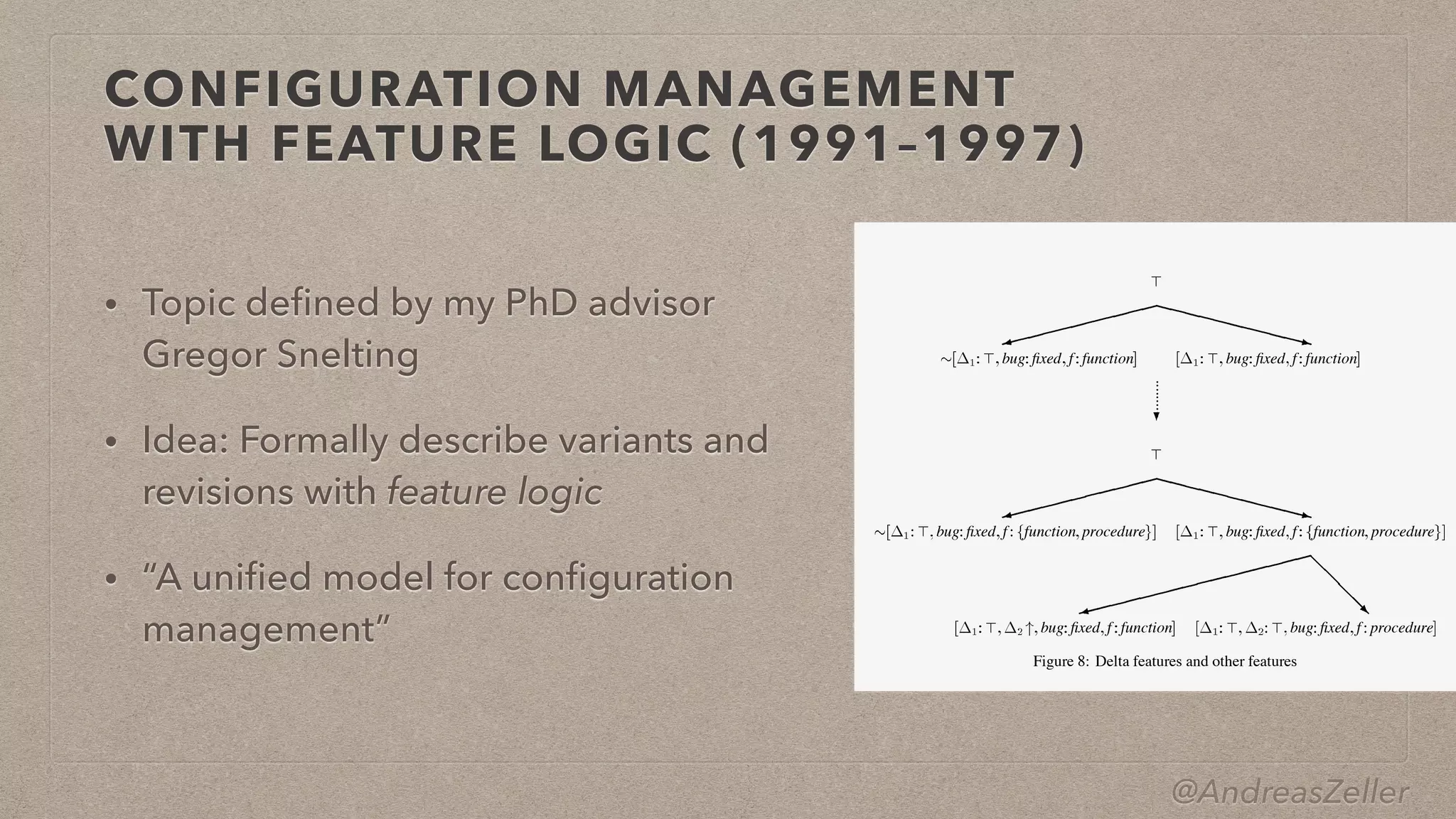
CONFIGURATION MANAGEMENT


WITH FEATURE LOGIC (1991–1997)
• Topic de
fi
ned by my PhD advisor
Gregor Snelting


• Idea: Formally describe variants and
revisions with feature logic


• “A uni
fi
ed model for con
fi
guration
management”
3.3 Combining Delta Features and other Features
.
.
.
.
.
.
.
.
.
.
bug fixed f function
bug fixed f function procedure
bug fixed f function bug fixed f procedure
Figure 8: Delta features and other features
. This is only natural, since the change relies on the presence of the
change. Adding a new revision under implies that the revision is now tagged w
, so that the generalization property is not violated. Indeed,
.
@AndreasZeller
FEATURE LOGIC: LESSONS LEARNED
• ∅ –  did everything wrong
@AndreasZeller
FEATURE LOGIC: LESSONS LEARNED
• You can get plenty of papers accepted


• even if you miss the problem


• even if you neither prove nor evaluate


• “Modeling for the sake of modeling”


• Enabled much of my later work, though
@AndreasZeller
WHAT TO DO AFTER PHD
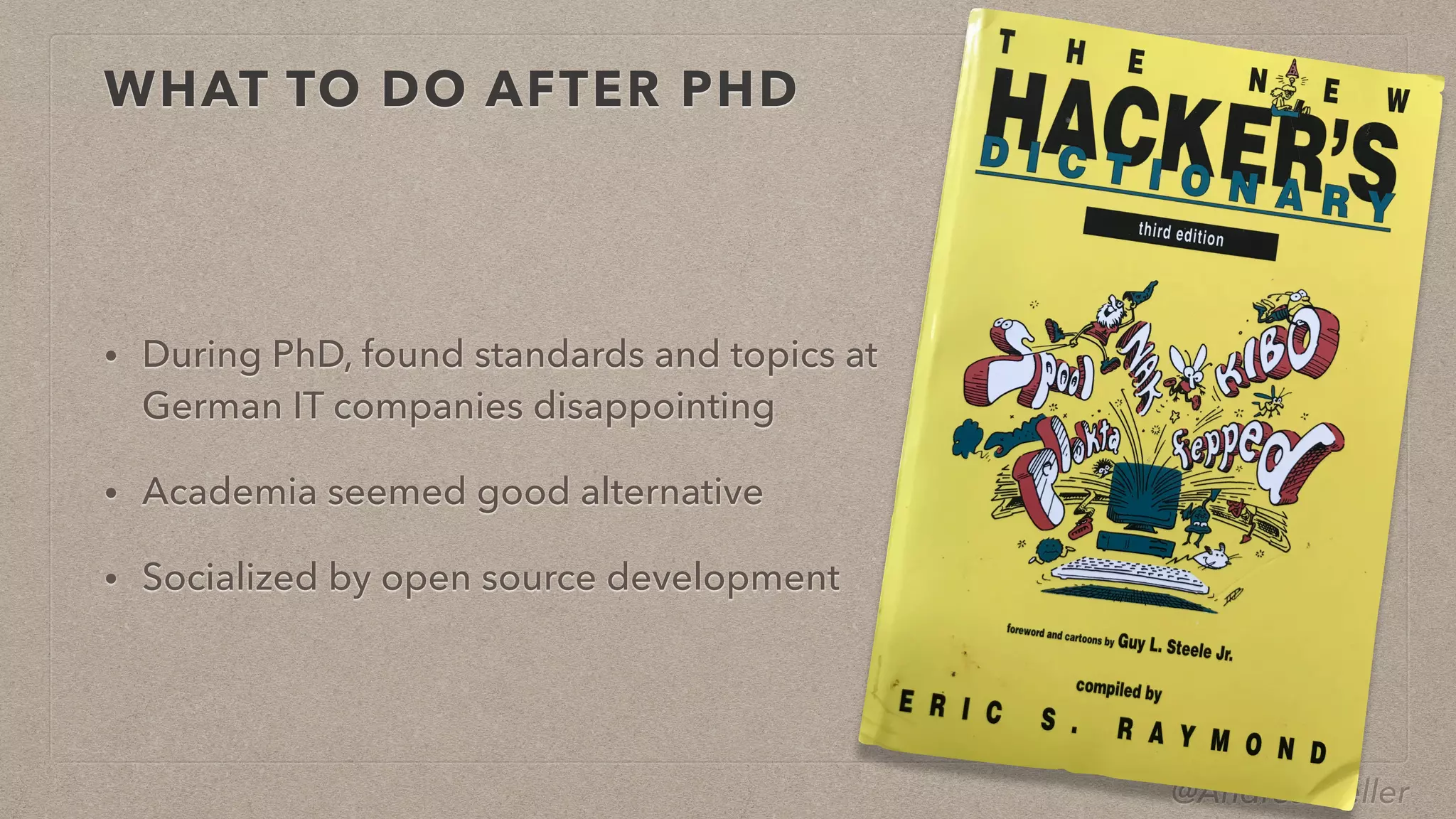
• During PhD, found standards and topics at
German IT companies disappointing


• Academia seemed good alternative


• Socialized by open source development
@AndreasZeller
DDD (1994–1999)
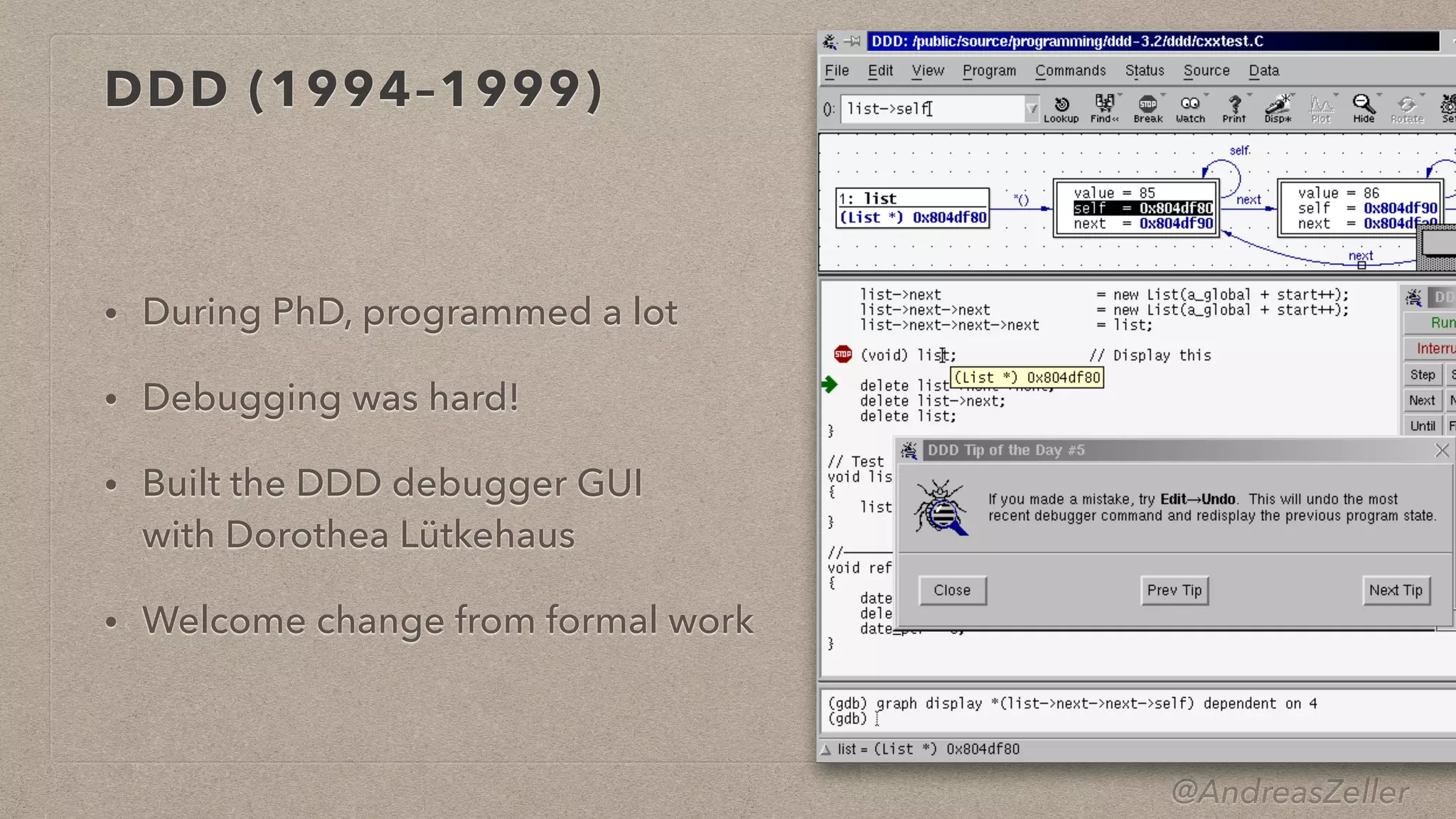
• During PhD, programmed a lot


• Debugging was hard!


• Built the DDD debugger GUI


with Dorothea Lütkehaus


• Welcome change from formal work
@AndreasZeller
DDD (1994–1999)
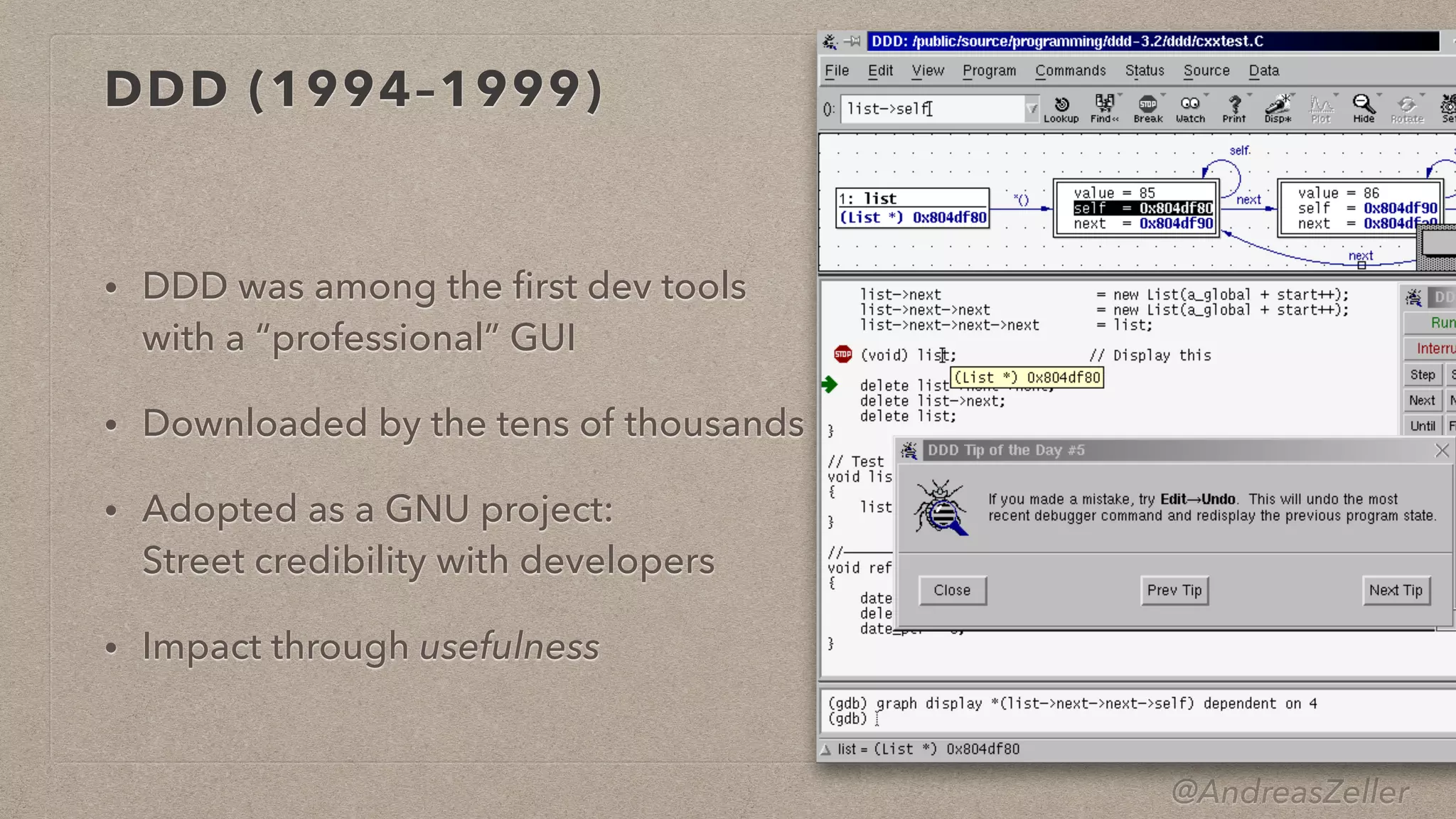
• DDD was among the
fi
rst dev tools


with a “professional” GUI


• Downloaded by the tens of thousands


• Adopted as a GNU project:


Street credibility with developers


• Impact through usefulness
@AndreasZeller
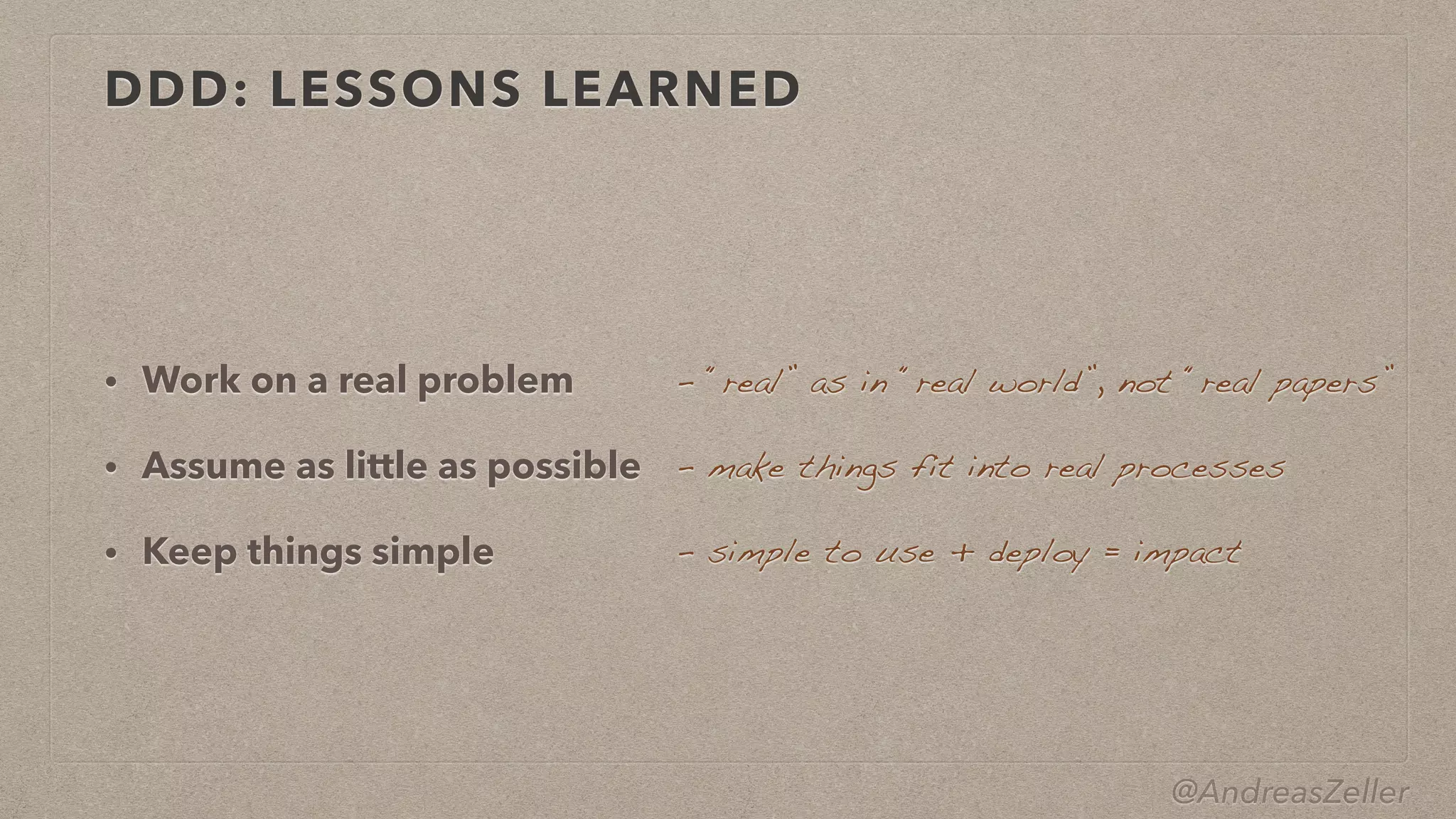
DDD: LESSONS LEARNED
• Work on a real problem


• Assume as little as possible


• Keep things simple
–  “real” as in “real world”, not “real papers”
–  make things fit into real processes
–  simple to use + deploy = impact
@AndreasZeller
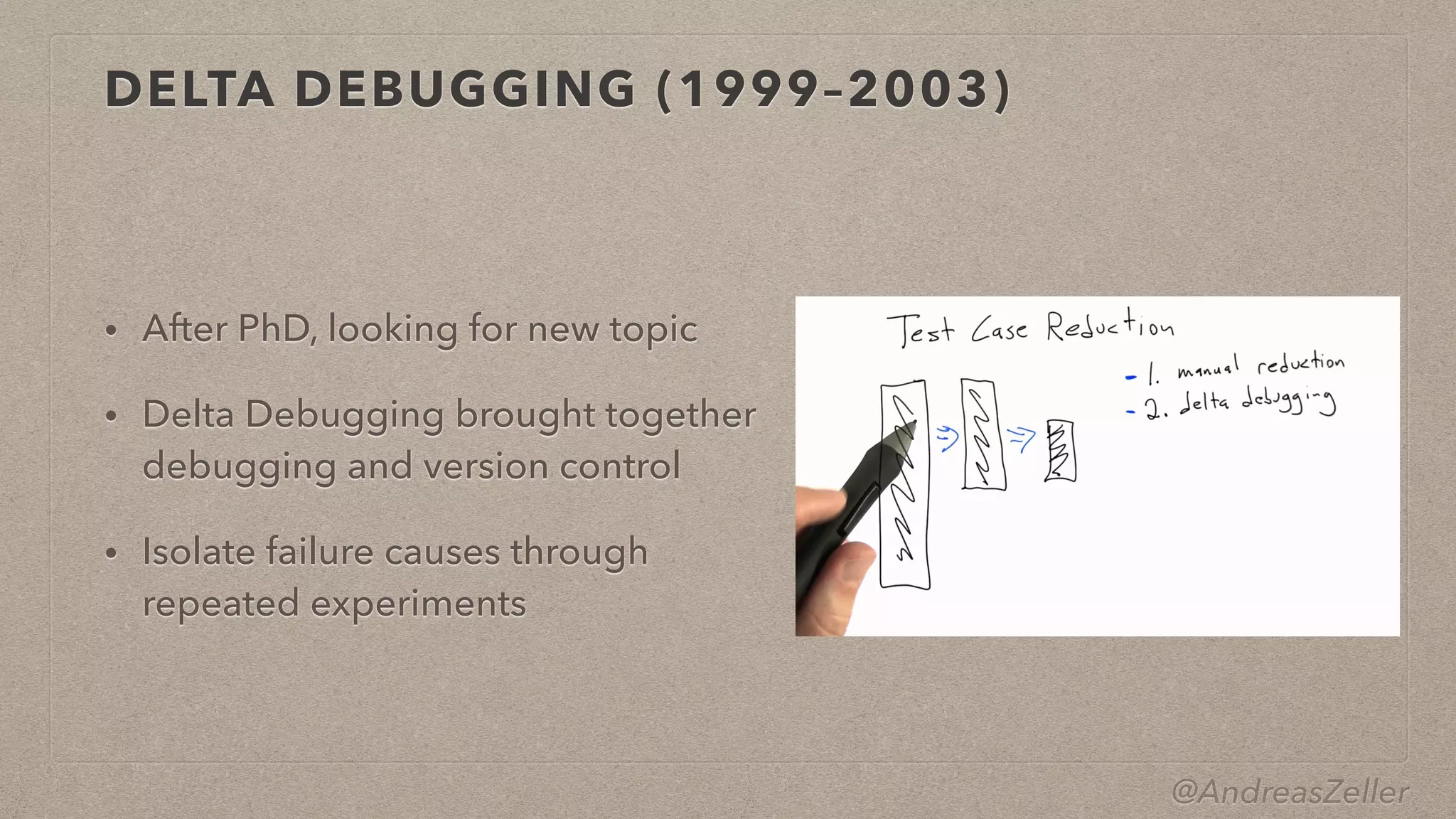
DELTA DEBUGGING (1999–2003)
• After PhD, looking for new topic


• Delta Debugging brought together
debugging and version control


• Isolate failure causes through
repeated experiments
@AndreasZeller
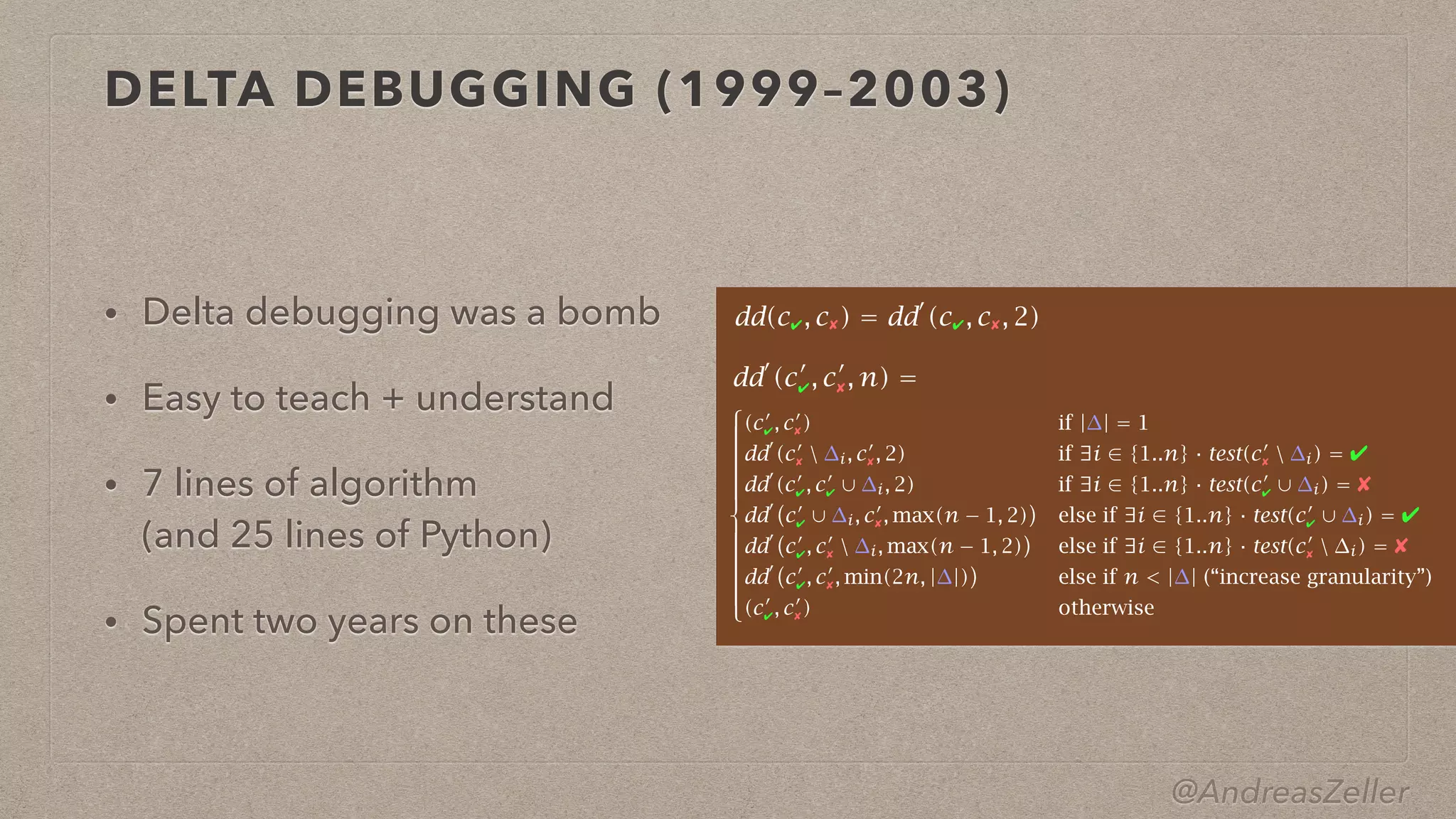
DELTA DEBUGGING (1999–2003)
• Delta debugging was a bomb


• Easy to teach + understand


• 7 lines of algorithm


(and 25 lines of Python)


• Spent two years on these





























(c!
✔, c!
✘) if |∆| = 1
dd!
(c!
✘  ∆i, c!
✘, 2) if ∃i ∈ {1..n} · test(c!
✘  ∆i) = ✔
dd!
(c!
✔, c!
✔ ∪ ∆i, 2) if ∃i ∈ {1..n} · test(c!
✔ ∪ ∆i) = ✘
dd!%
c!
✔ ∪ ∆i, c!
✘, max(n − 1, 2)
&
else if ∃i ∈ {1..n} · test(c!
✔ ∪ ∆i) = ✔
dd!%
c!
✔, c!
✘  ∆i, max(n − 1, 2)
&
else if ∃i ∈ {1..n} · test(c!
✘  ∆i) = ✘
dd!%
c!
✔, c!
✘, min(2n, |∆|)
&
else if n < |∆| (“increase granularity”)
(c!
✔, c!
✘) otherwise
dd(c✔, c✘) = dd!
(c✔, c✘, 2)
dd!
(c!
✔, c!
✘, n) =
@AndreasZeller
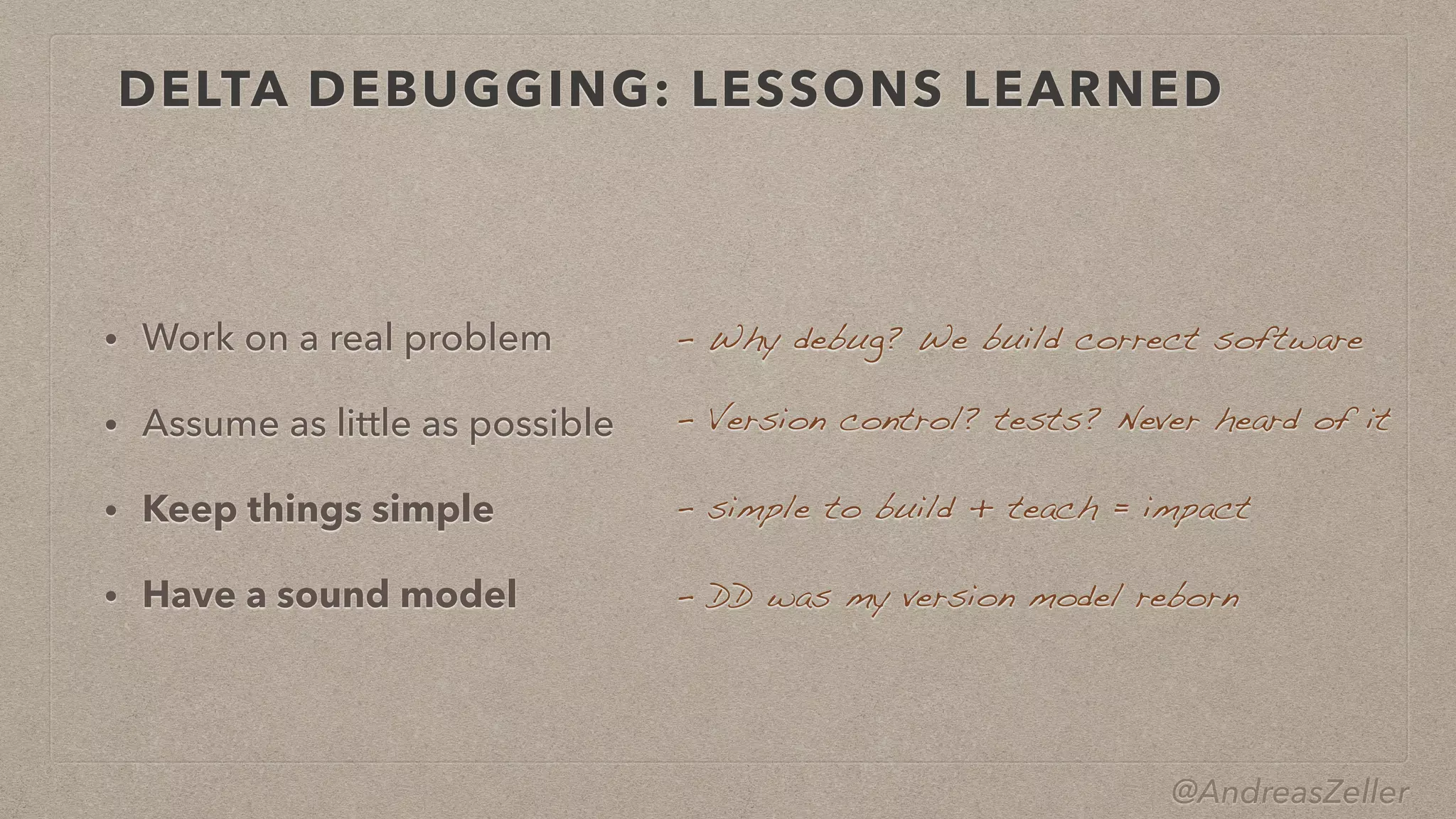
DELTA DEBUGGING: LESSONS LEARNED
• Work on a real problem


• Assume as little as possible


• Keep things simple


• Have a sound model
–  Version control? tests? Never heard of it
– simple to build + teach = impact
–  DD was my version model reborn
–  Why debug? We build correct software
@AndreasZeller
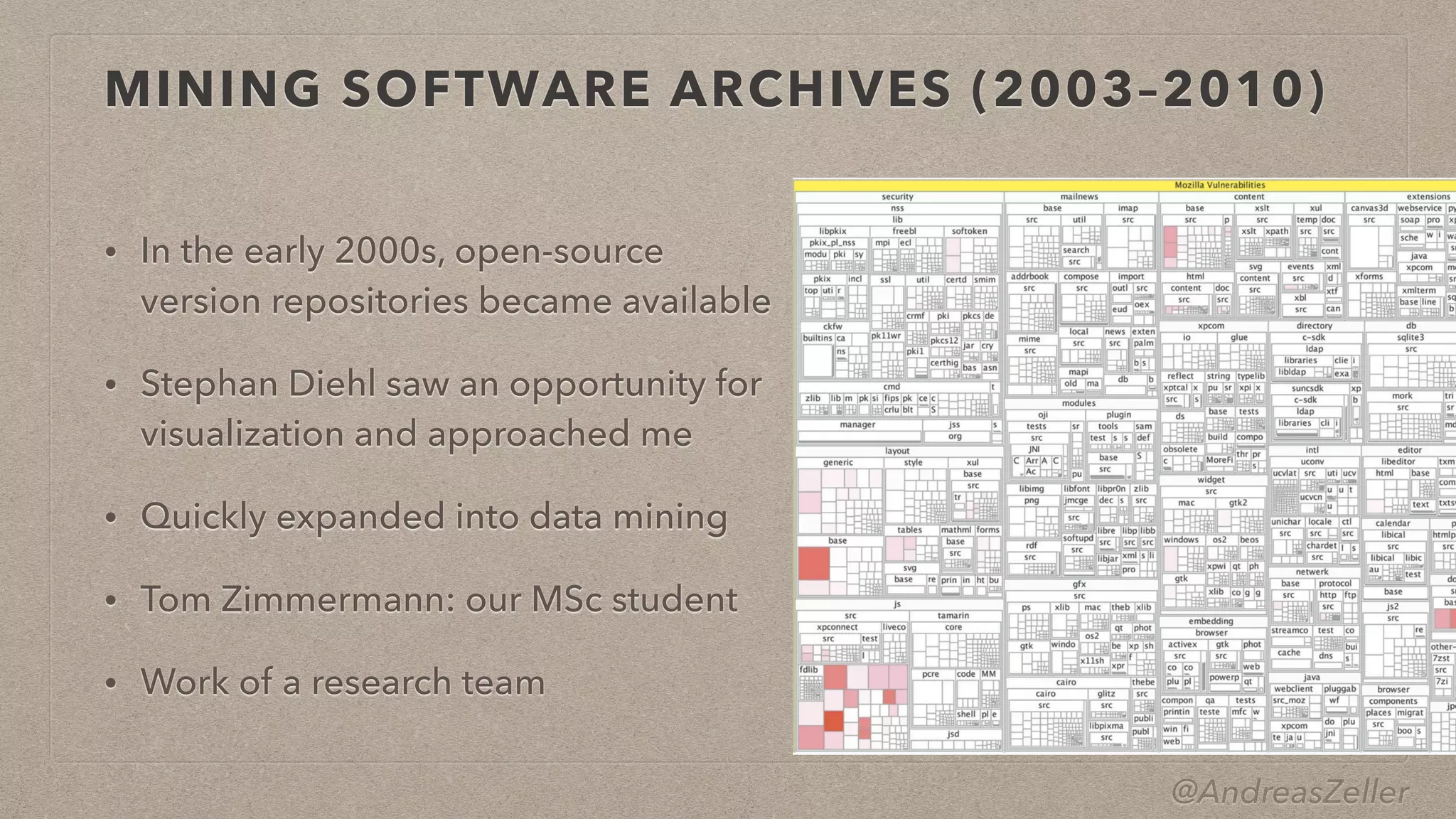
MINING SOFTWARE ARCHIVES (2003–2010)
• In the early 2000s, open-source
version repositories became available


• Stephan Diehl saw an opportunity for
visualization and approached me


• Quickly expanded into data mining


• Tom Zimmermann: our MSc student


• Work of a research team
@AndreasZeller
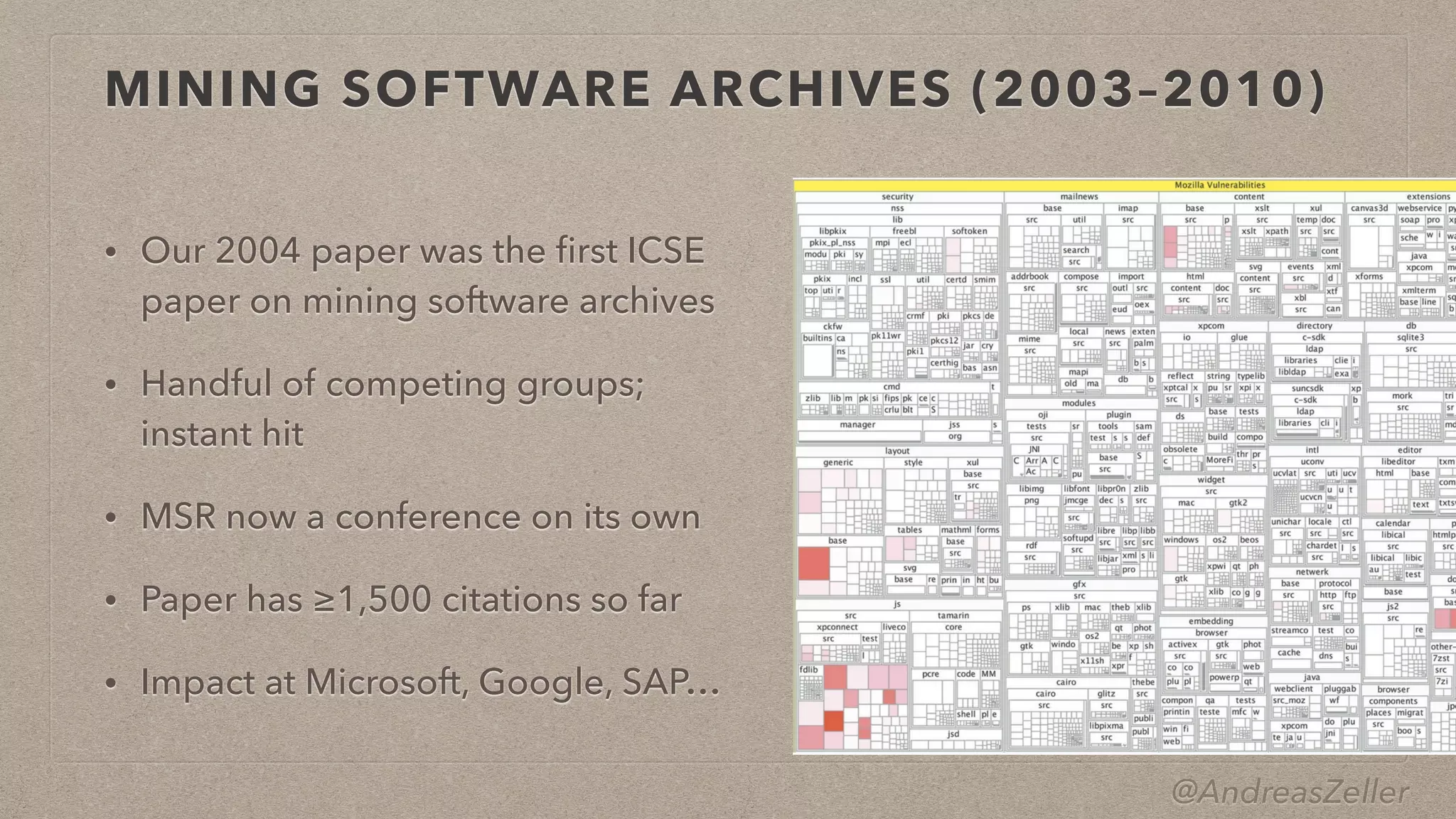
MINING SOFTWARE ARCHIVES (2003–2010)
• Our 2004 paper was the
fi
rst ICSE
paper on mining software archives


• Handful of competing groups;


instant hit


• MSR now a conference on its own


• Paper has ≥1,500 citations so far


• Impact at Microsoft, Google, SAP…
@AndreasZeller
MINING SOFTWARE REPOSITORIES:
LESSONS LEARNED
• Work on a real problem


• Assume as little as possible


• Keep things simple


• Have a sound model


• Keep on learning
–  Empirical research is core field of SE
–  simple parsers for multiple languages
–  essence of 2004 paper is one line of SQL
–  retrieval, precision, recall, etc, etc
–  NLP, data mining, machine learning
@AndreasZeller
MINING SOFTWARE ARCHIVES (2003–2010)
• We are now after the gold rush


• Data still exciting (if you have some)


• Few new insights on old data


• Get out of a
fi
eld when too crowded
3.5 Programmer Actions and Defects
Now that we know how to predict defects, can we actually prevent
them? Of course, we could focus quality assurance on those files
predicted as most defect-prone. But are there also constructive
ways to avoid these defects? Is there a general rule to learn?
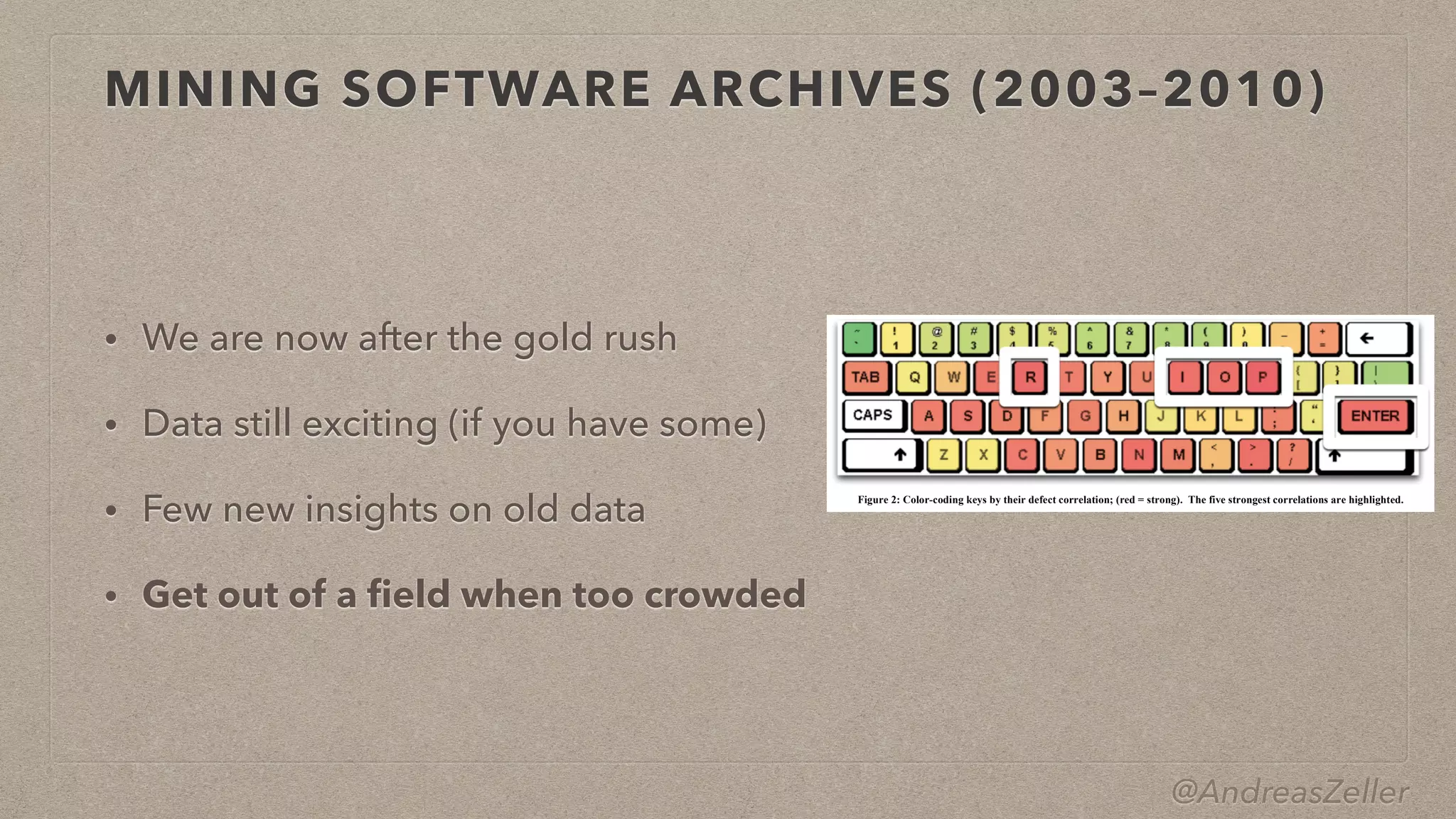
For this purpose, let us now focus on H2: Is there a correlation
between individual actions (= keystrokes) and defects? For this
purpose, we would search for correlations between the count of
the 256 characters and the overall post-defect count per file; our
null hypothesis would be:
H0. There is no correlation between character distribution and
defect-proneness.
After a number of preliminary experiments, we focused on the
Eclipse 3.0 dataset. It is well known that most metrics of software
do not follow a normal distribution and our measures of key-
strokes are no exception. The distributions of characters appear to
have an exponential rather than a power-law character. Nonethe-
less, due to the heavily skewed distribution, we used a standard
non-parametric approach with the Spearman rank correlation. Of
course, with so many metrics (one for each character), we run the
risk of identifying spurious correlations, and we thus employed p- 3.6 Preventing Defects
Our results show a strong correlation between specific pro-
grammer actions (keystrokes I, R, O, and P) and defects.
Figure 2: Color-coding keys by their defect correlation; (red = strong). The five strongest correlations are highlighted.
Figure 3: Defect correlation for the 26 lower-case letters.
@AndreasZeller
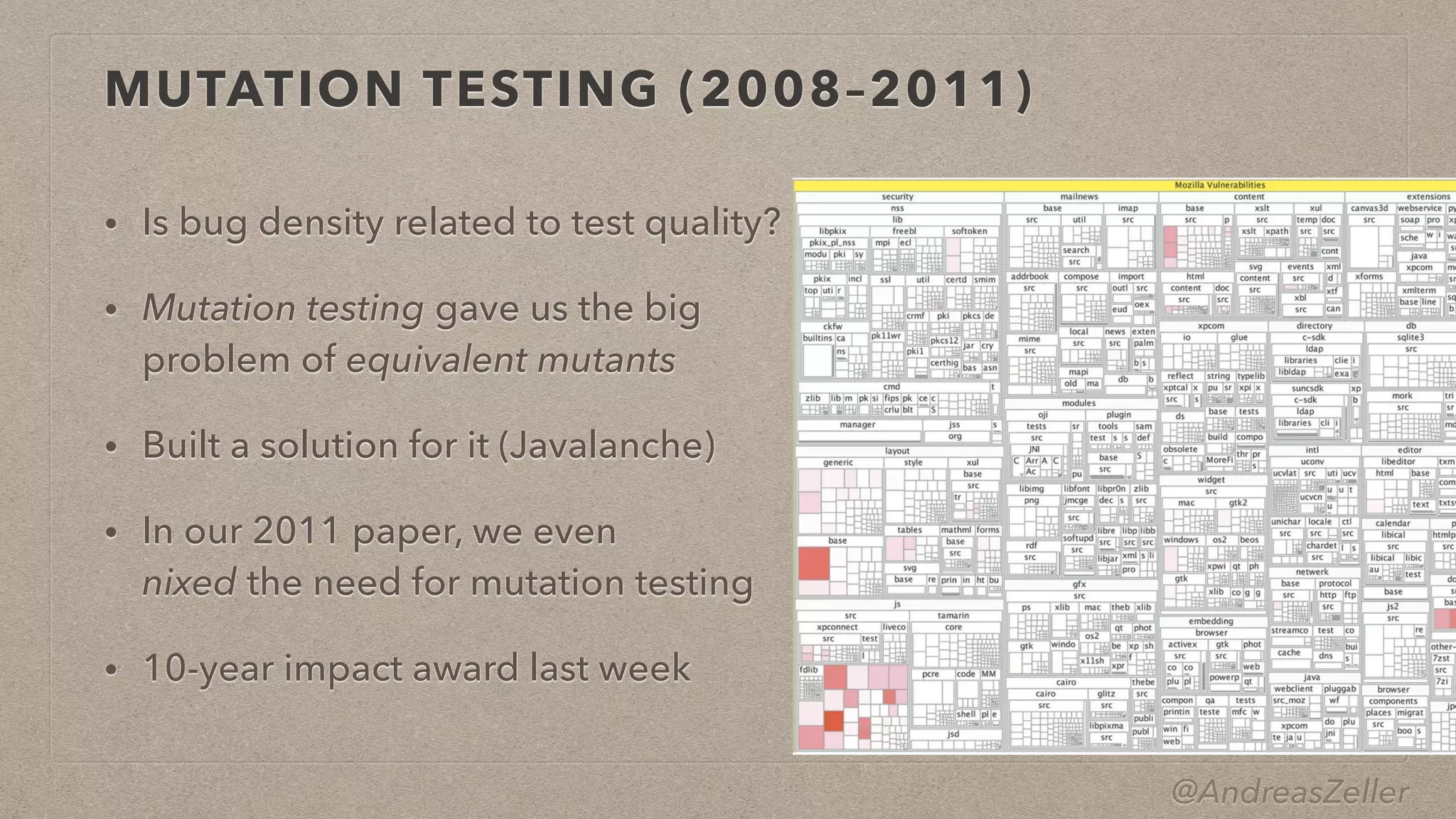
MUTATION TESTING (2008–2011)
• Is bug density related to test quality?


• Mutation testing gave us the big
problem of equivalent mutants


• Built a solution for it (Javalanche)


• In our 2011 paper, we even


nixed the need for mutation testing


• 10-year impact award last week
@AndreasZeller
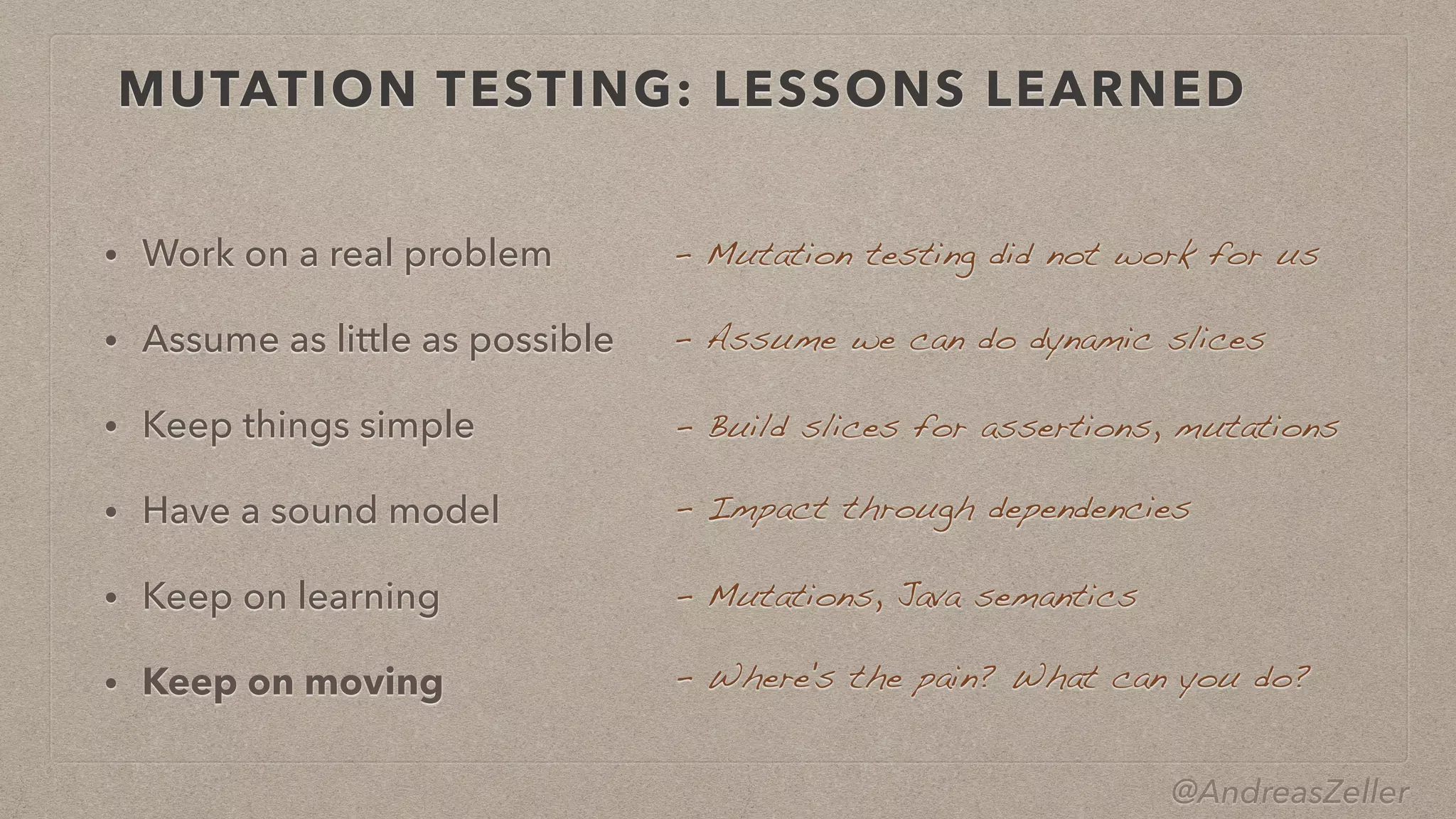
MUTATION TESTING: LESSONS LEARNED
• Work on a real problem


• Assume as little as possible


• Keep things simple


• Have a sound model


• Keep on learning


• Keep on moving
–  Mutation testing did not work for us
–  Assume we can do dynamic slices
–  Build slices for assertions, mutations
–  Impact through dependencies
–  Mutations, Java semantics
–  Where's the pain? What can you do?
@AndreasZeller
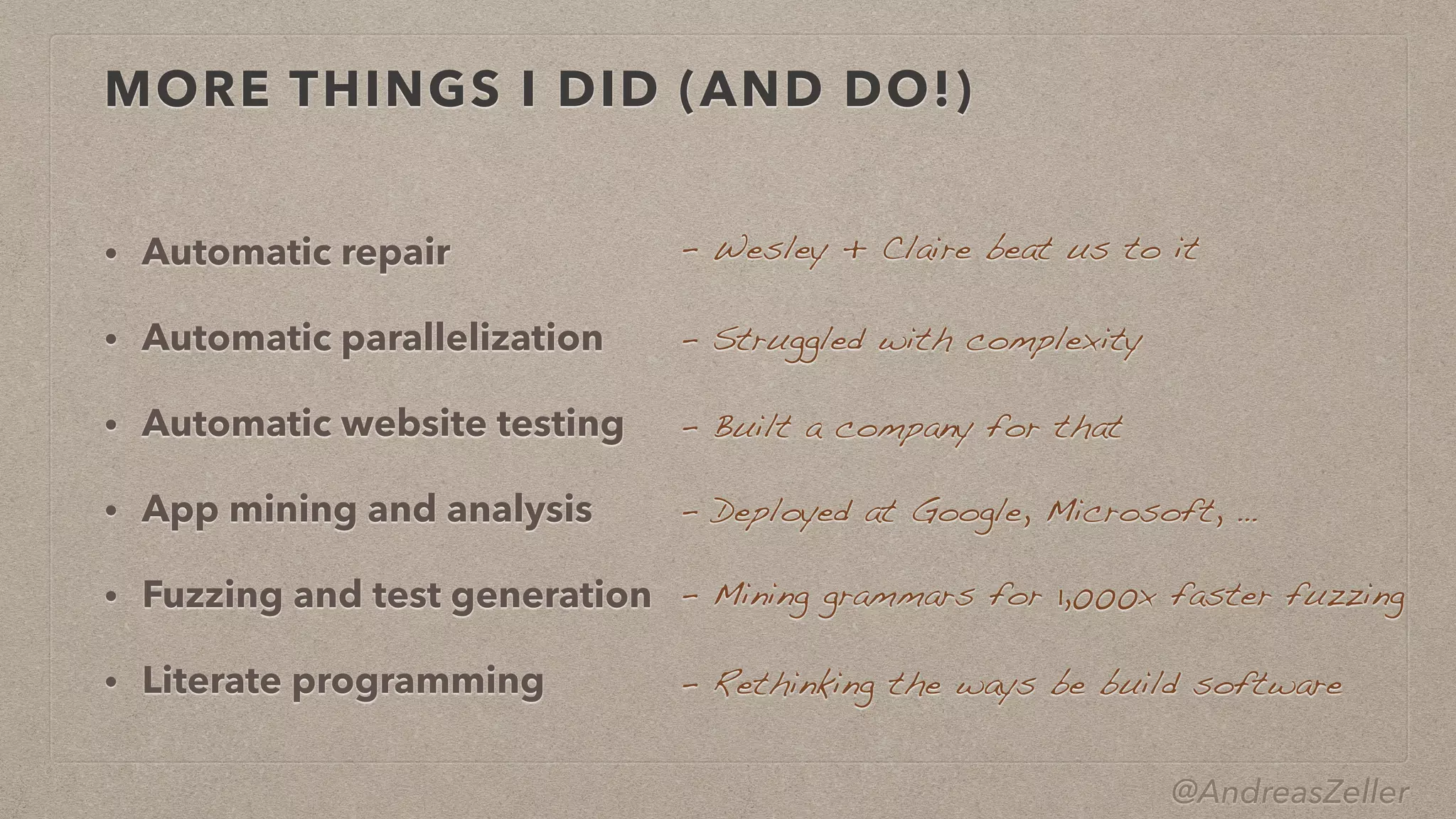
MORE THINGS I DID (AND DO!)
• Automatic repair


• Automatic parallelization


• Automatic website testing


• App mining and analysis


• Fuzzing and test generation


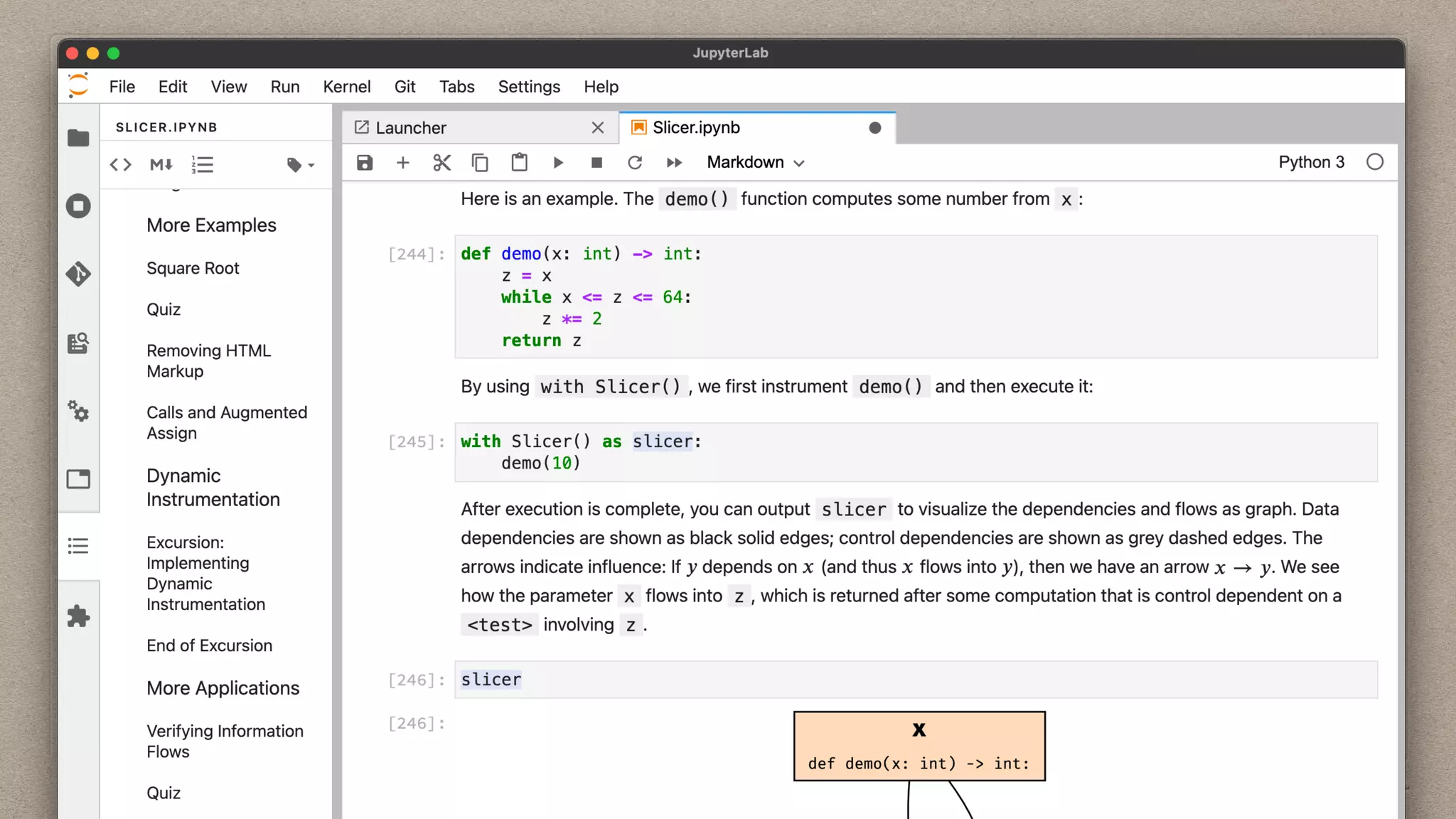
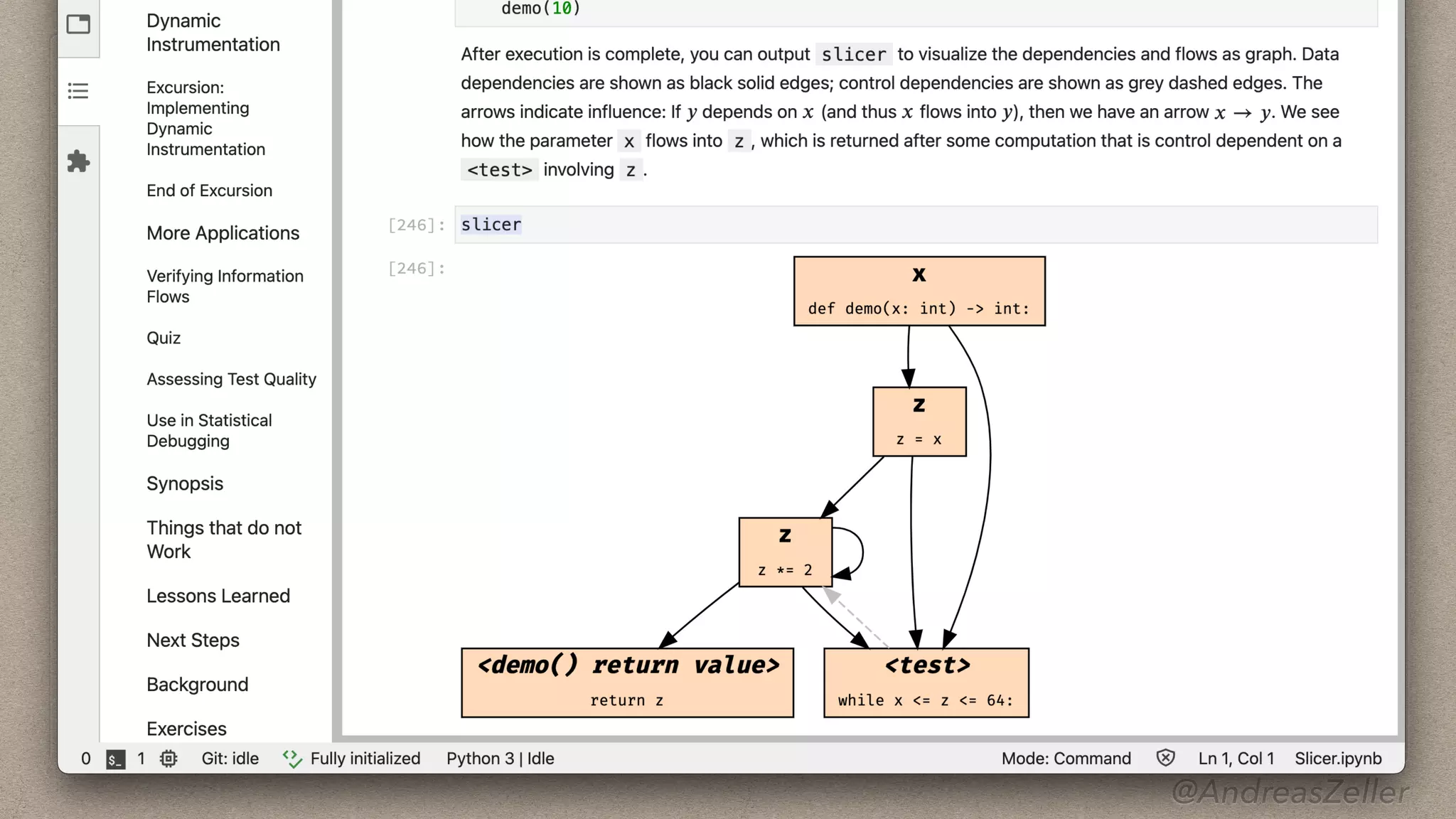
• Literate programming
–  Wesley + Claire beat us to it
–  Struggled with complexity
–  Built a company for that
–  Mining grammars for 1,000x faster fuzzing
–  Rethinking the ways be build software
–  Deployed at Google, Microsoft, …
@AndreasZeller
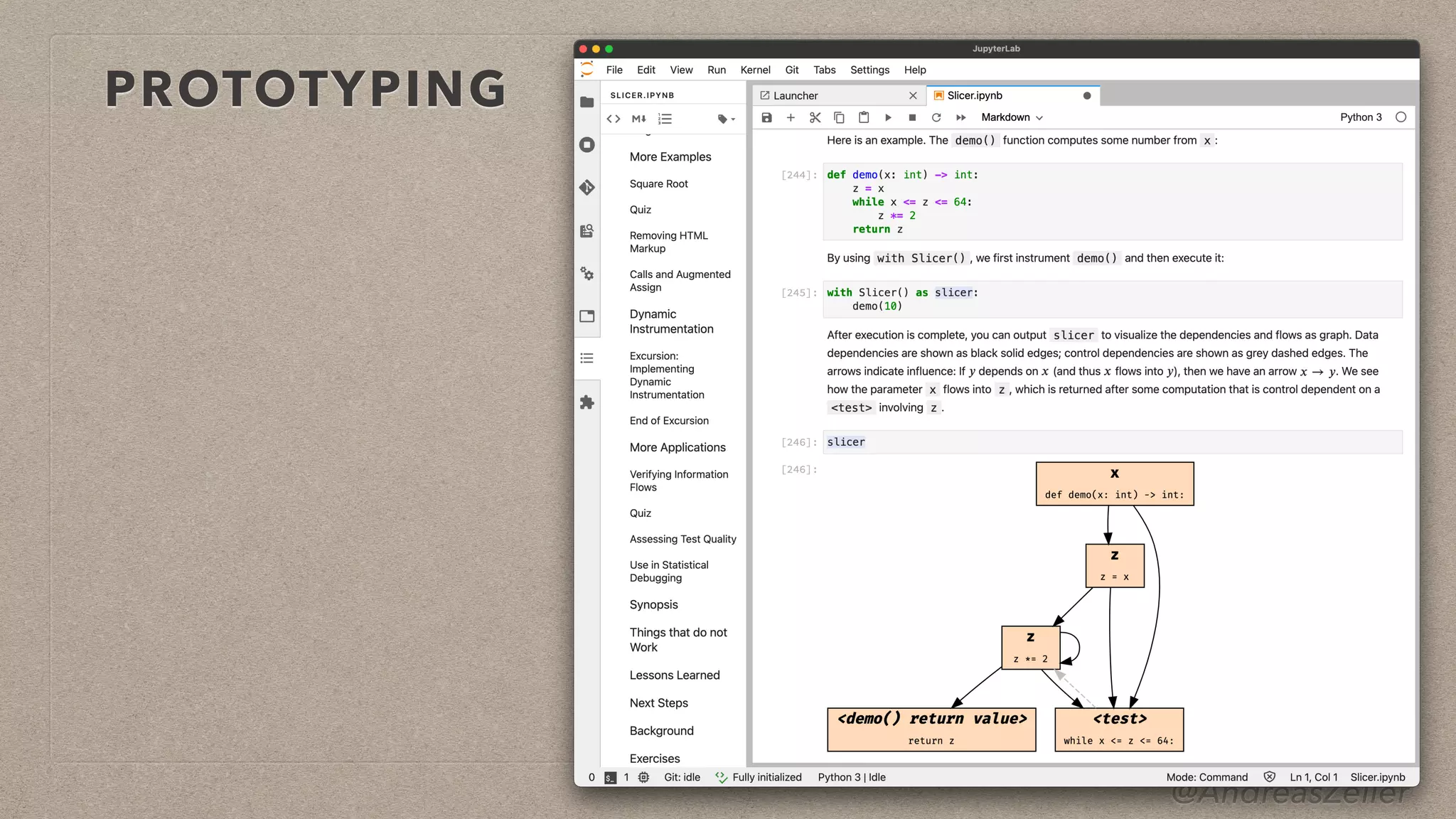
PROTOTYPING
@AndreasZeller
PROTOTYPING
@AndreasZeller
PROTOTYPING
@AndreasZeller
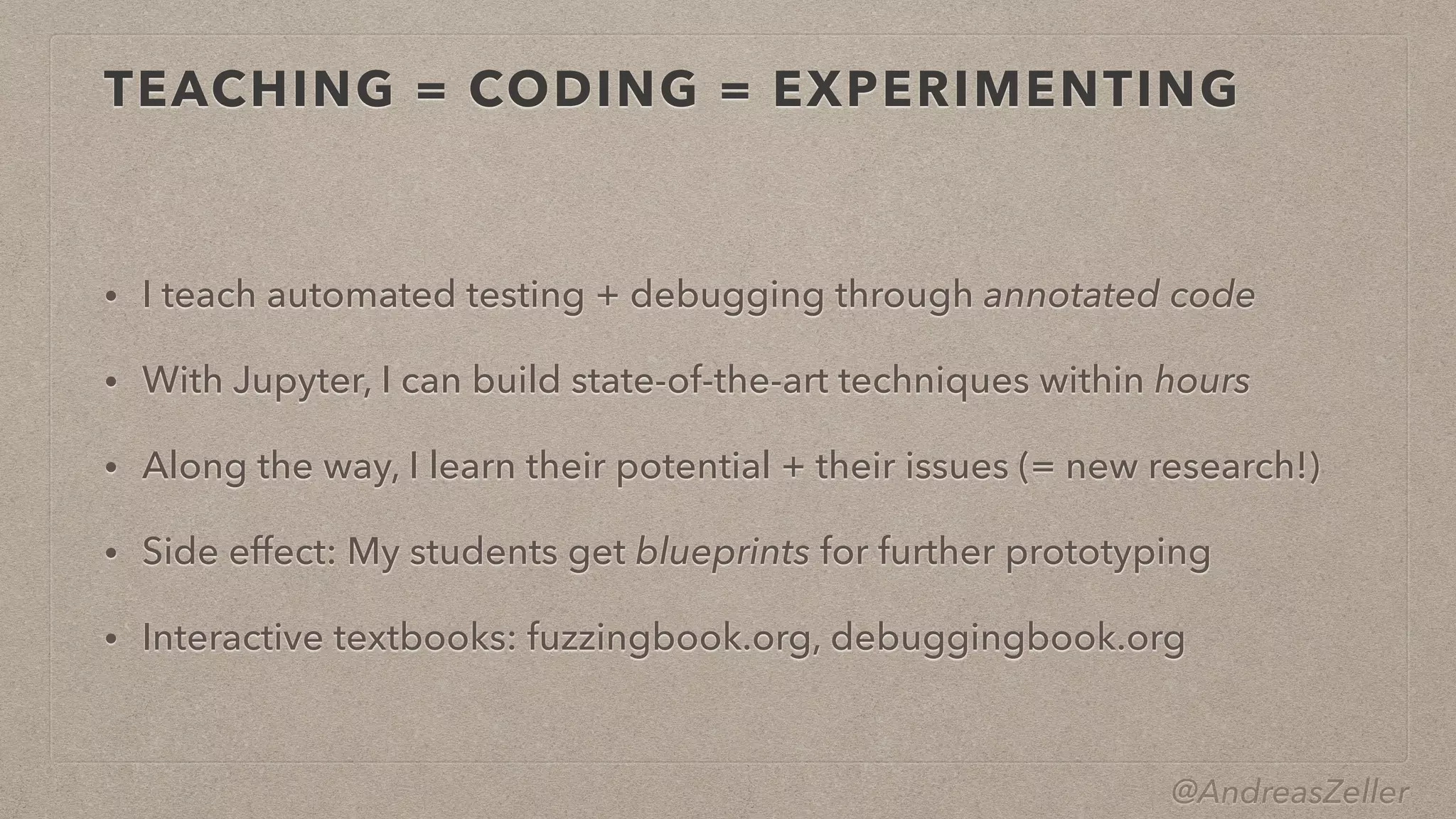
TEACHING = CODING = EXPERIMENTING
• I teach automated testing + debugging through annotated code


• With Jupyter, I can build state-of-the-art techniques within hours


• Along the way, I learn their potential + their issues (= new research!)


• Side effect: My students get blueprints for further prototyping


• Interactive textbooks: fuzzingbook.org, debuggingbook.org
@AndreasZeller
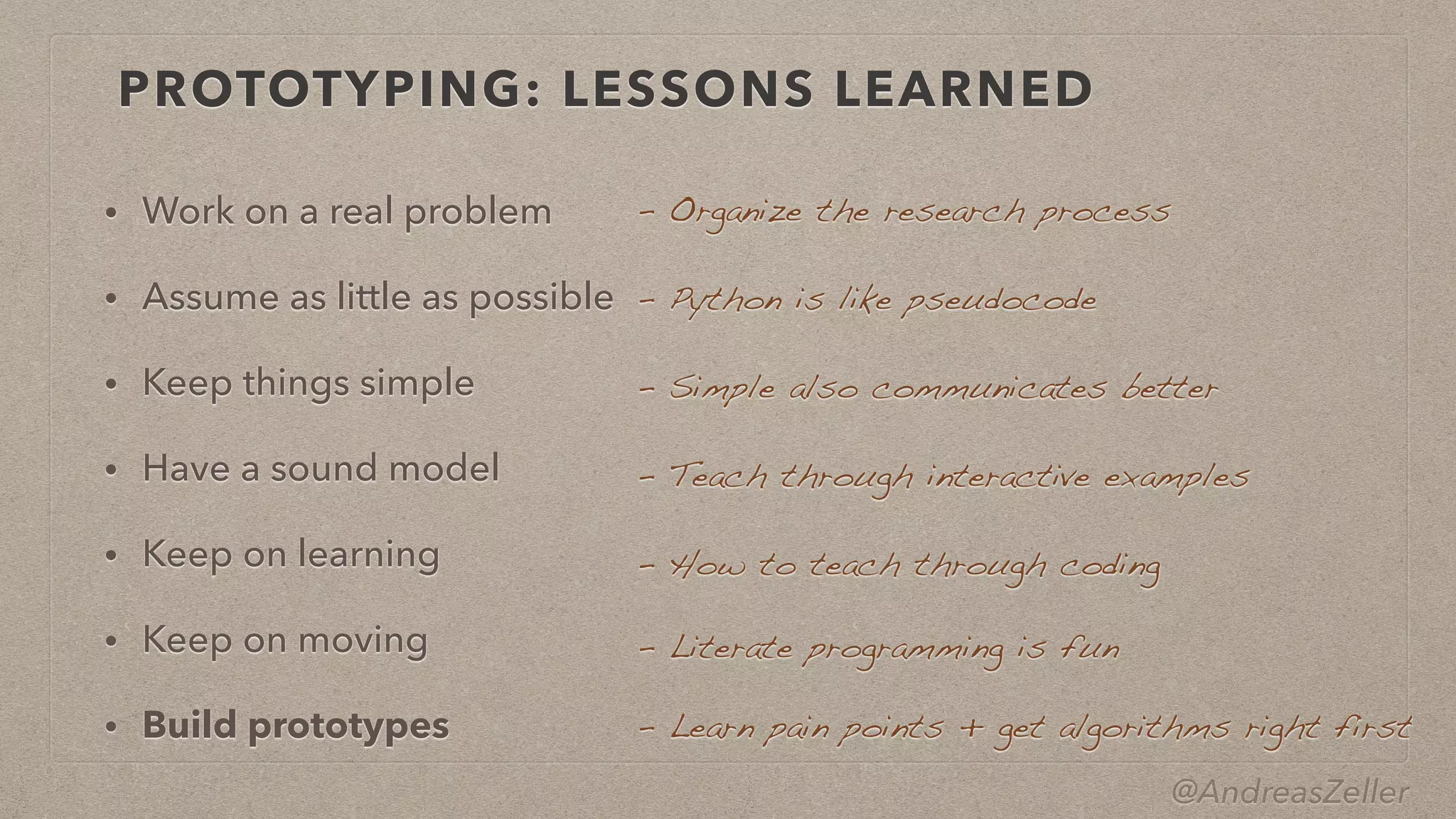
PROTOTYPING: LESSONS LEARNED
• Work on a real problem


• Assume as little as possible


• Keep things simple


• Have a sound model


• Keep on learning


• Keep on moving


• Build prototypes
–  Organize the research process
–  Python is like pseudocode
–  Simple also communicates better
–  Teach through interactive examples
–  How to teach through coding
–  Literate programming is fun
–  Learn pain points + get algorithms right first
@AndreasZeller
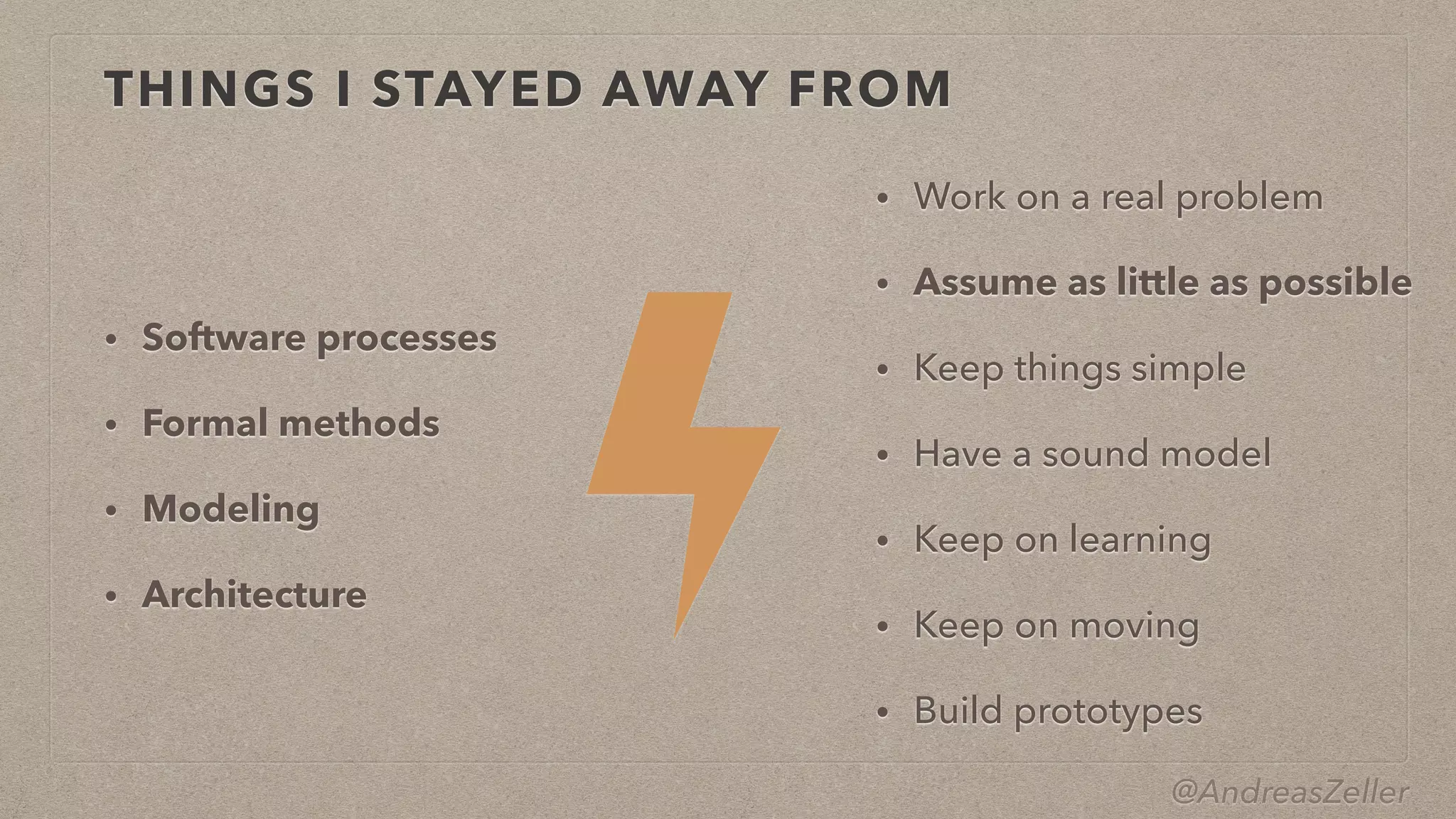
THINGS I STAYED AWAY FROM
• Software processes


• Formal methods


• Modeling


• Architecture
• Work on a real problem


• Assume as little as possible


• Keep things simple


• Have a sound model


• Keep on learning


• Keep on moving


• Build prototypes
@AndreasZeller
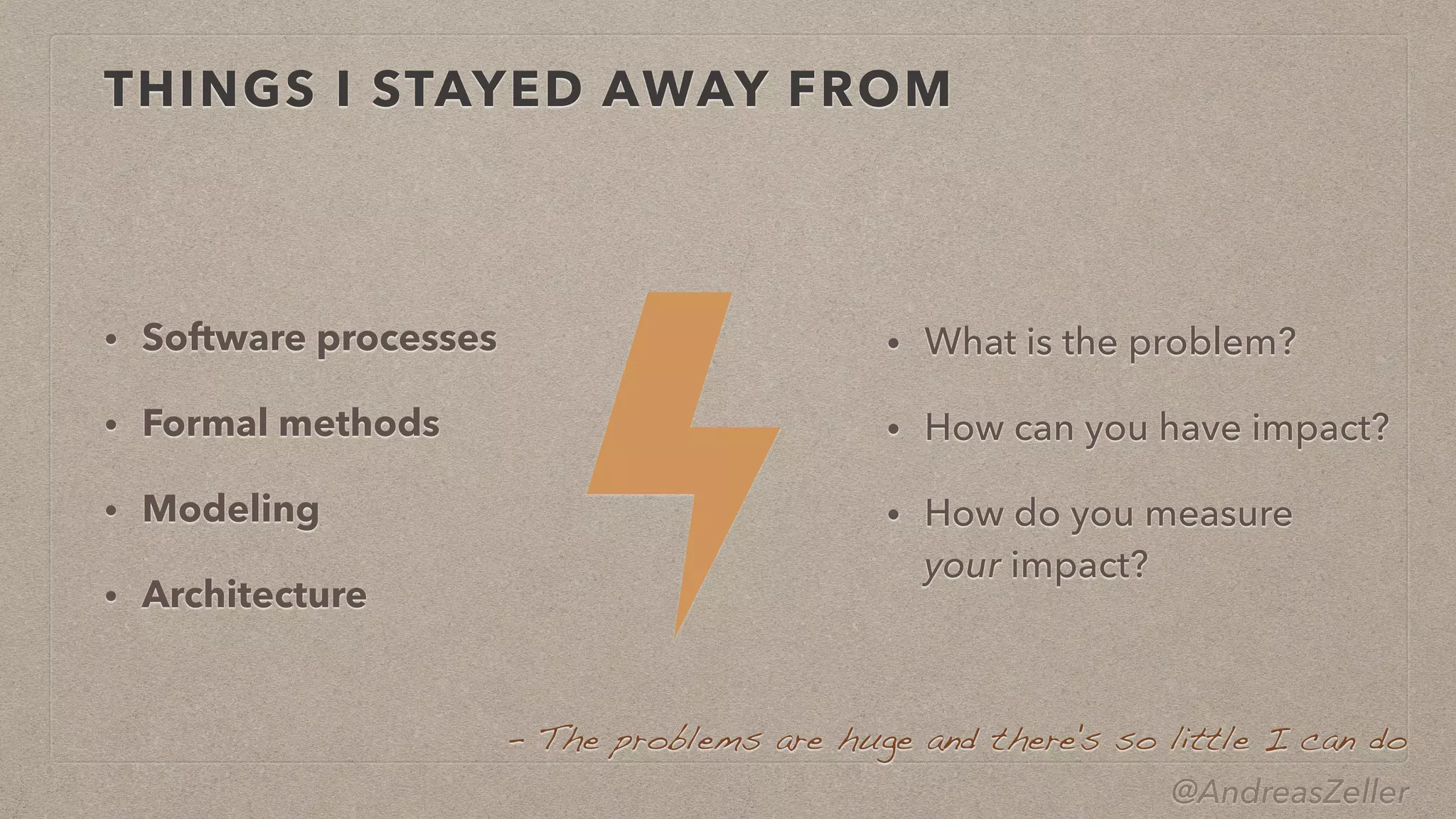
THINGS I STAYED AWAY FROM
• Software processes


• Formal methods


• Modeling


• Architecture
• What is the problem?


• How can you have impact?


• How do you measure


your impact?
–  The problems are huge and there's so little I can do
@AndreasZeller
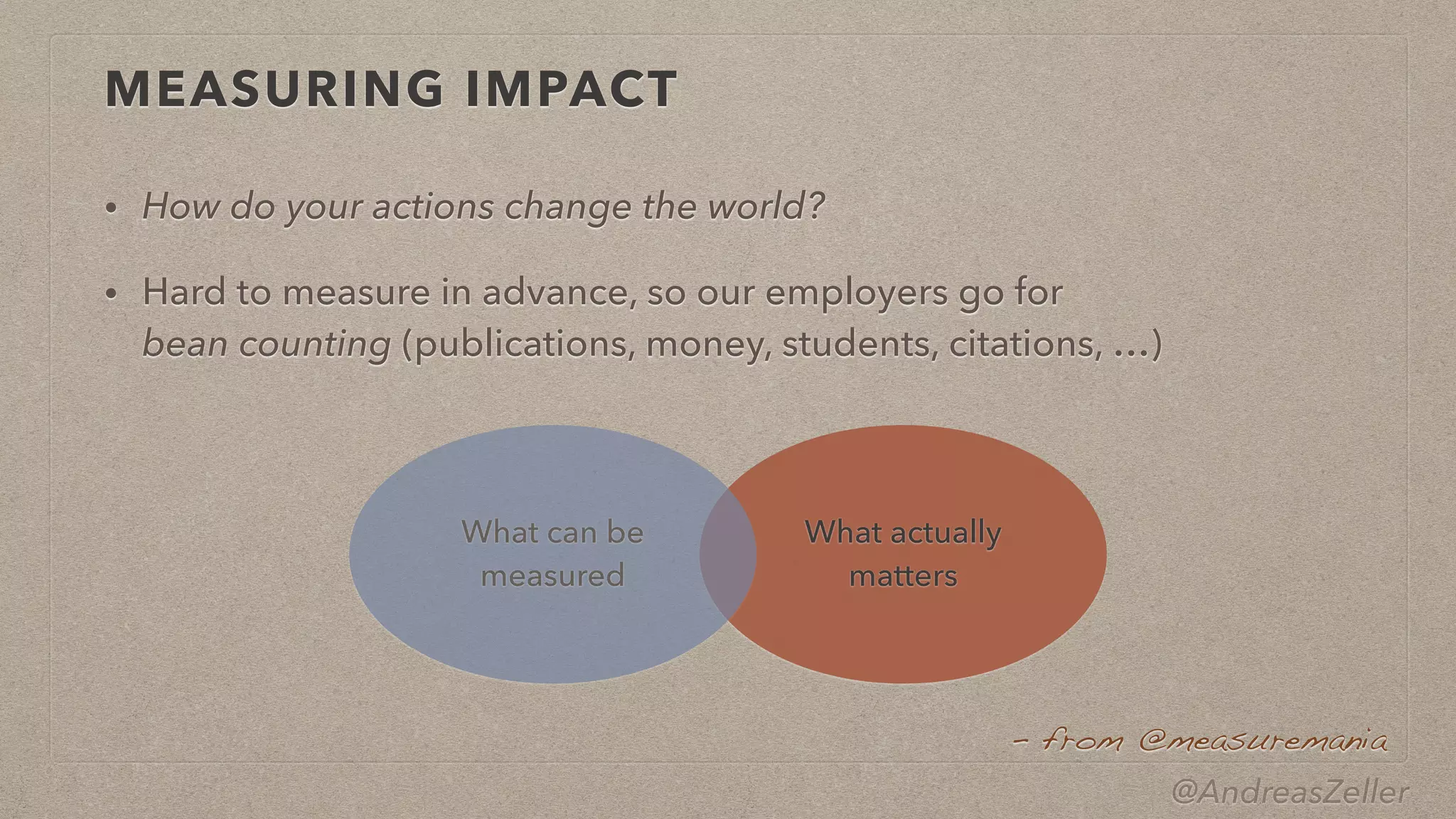
MEASURING IMPACT
• How do your actions change the world?


• Hard to measure in advance, so our employers go for


bean counting (publications, money, students, citations, …)
–  from @measuremania
What actually


matters
What can be
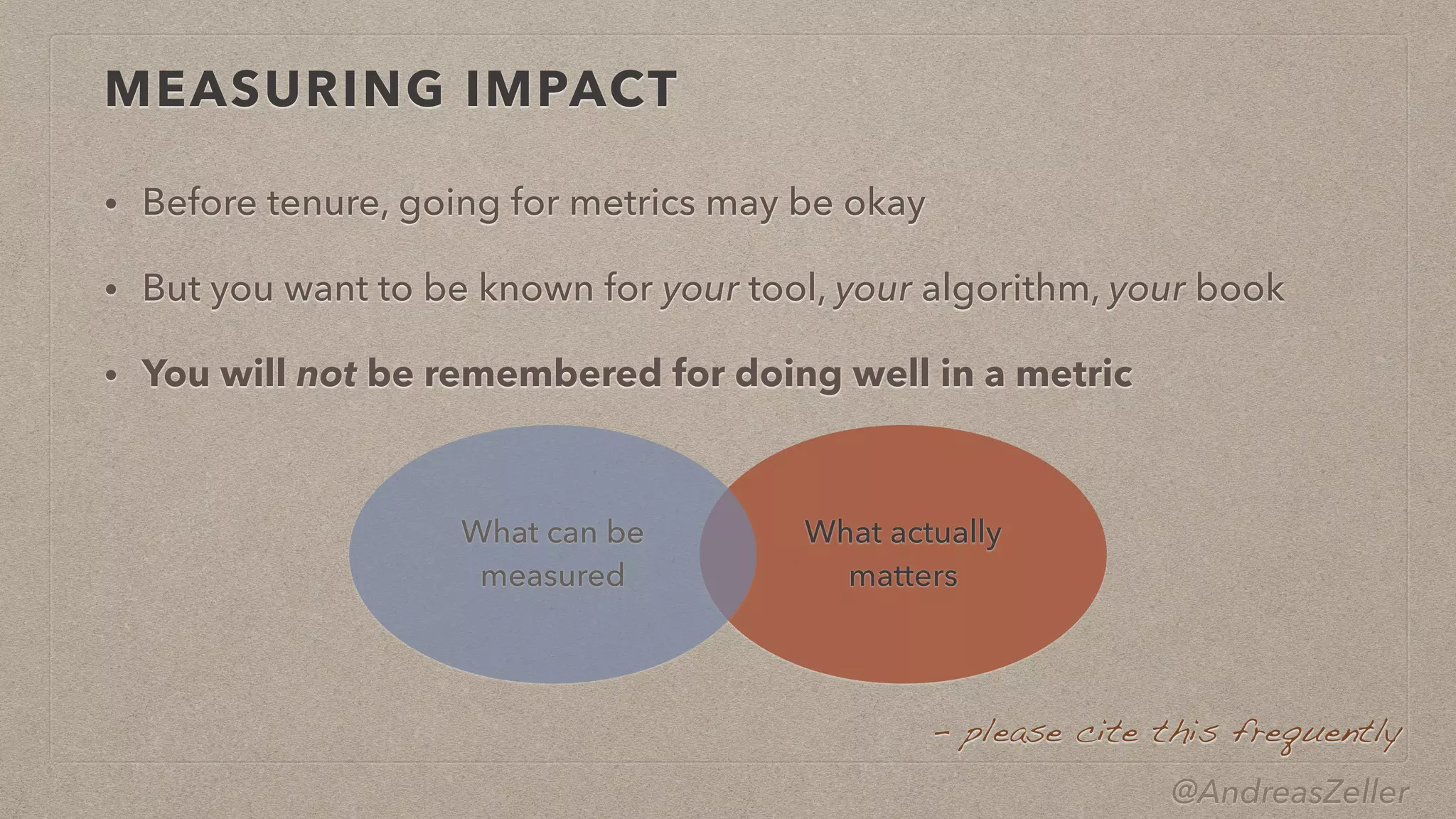
• But you want to be known for your tool, your algorithm, your book


• You will not be remembered for doing well in a metric
–  please cite this frequently
What actually


matters
What can be
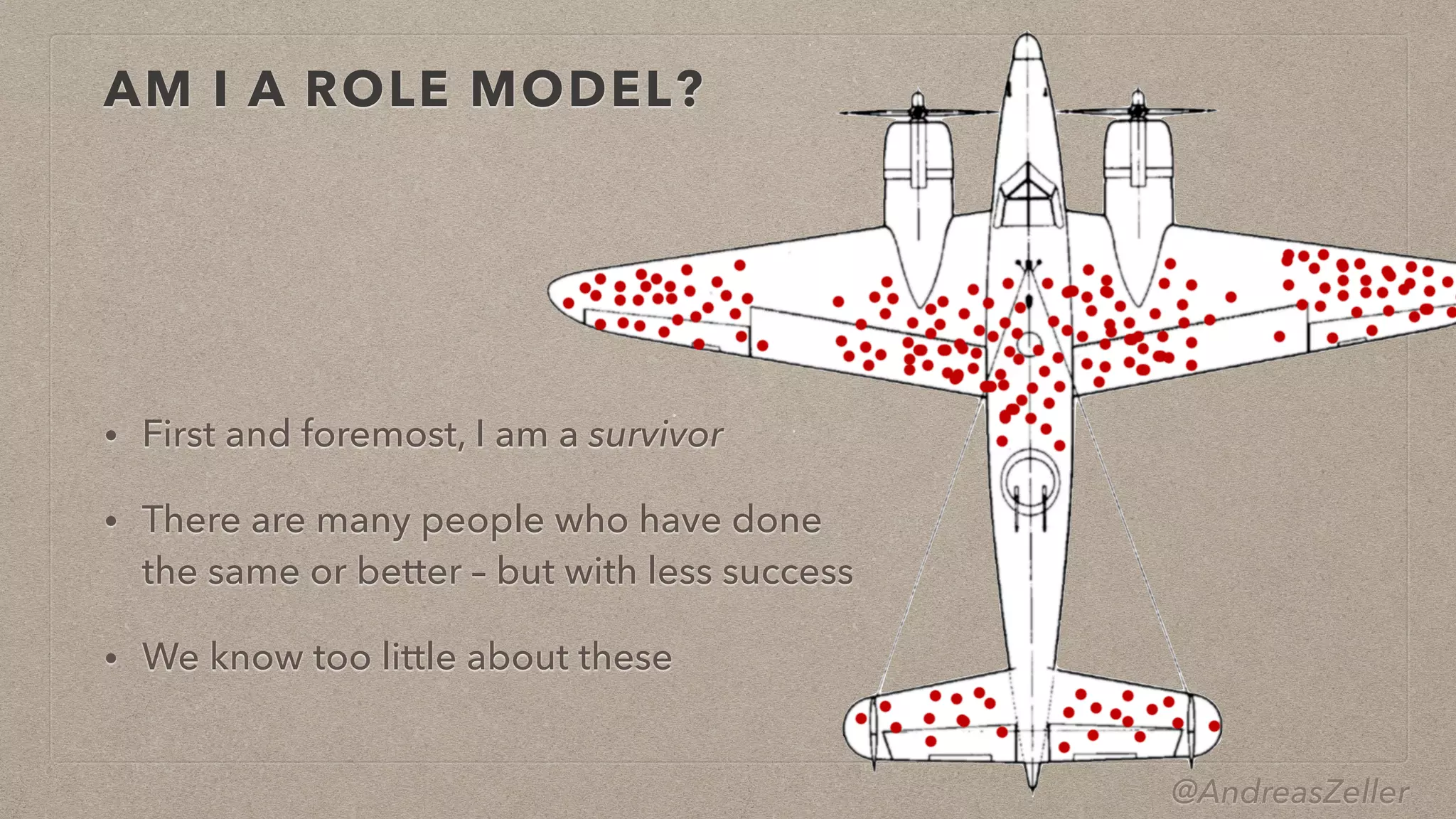
• There are many people who have done


the same or better – but with less success


• We know too little about these
@AndreasZeller
YOUR WAYS TO HAVE IMPACT
@AndreasZeller
IMPACT AS A RESEARCHER
• Society funds research to take risks that no one else does


• Research is risky by construction –


you should expect to fail, and fail again


• Tenure is meant to allow you to take arbitrarily grand challenges –


so work on the grand stuff


• Build things! Try out things! Find the pain points! What can you do?


• If you lack resources: abstract + prototype things
@AndreasZeller
IMPACT AS A TEACHER
• Teaching can be a great way to multiply your message


• Not only focus on teaching the standards, but also your research


• Teaching your research helps to propagate it and make it accessible


• Turn your research into well-annotated code you can use in teaching


• Engage students on topics dear to you
@AndreasZeller
IMPACT WITH INDUSTRY
• Do work with industry to
fi
nd problems and frame your work


• Do not work with industry to solve (their) concrete problems


• Your role as researcher is more than a cheap consulting tool


• Many “research” funding schemes are there to subsidize industry
@AndreasZeller
IMPACT THROUGH TOOLS
• Getting your technique out as a tool is a great way to have impact!


• Also allows to check what actual users need (and if they exist)


• A tool can have far more impact than a paper


• Funding agencies and hiring committees begin to realize this
@AndreasZeller
IMPACT AS FOUNDER
• Creating a company out of your research can be great fun!


• Allows you to push your research and ideas into practice


• Again, shows you what the market wants (and what not)


• Plenty of monetary and consultancy support available
@AndreasZeller
IMPACT AS MENTOR
• Working with advanced students (MSc, PhD, PostDoc) can be the
most satisfying part of your job


• The variety of SE research needs universal problem solving skills


• Find such skills besides good grades
@AndreasZeller
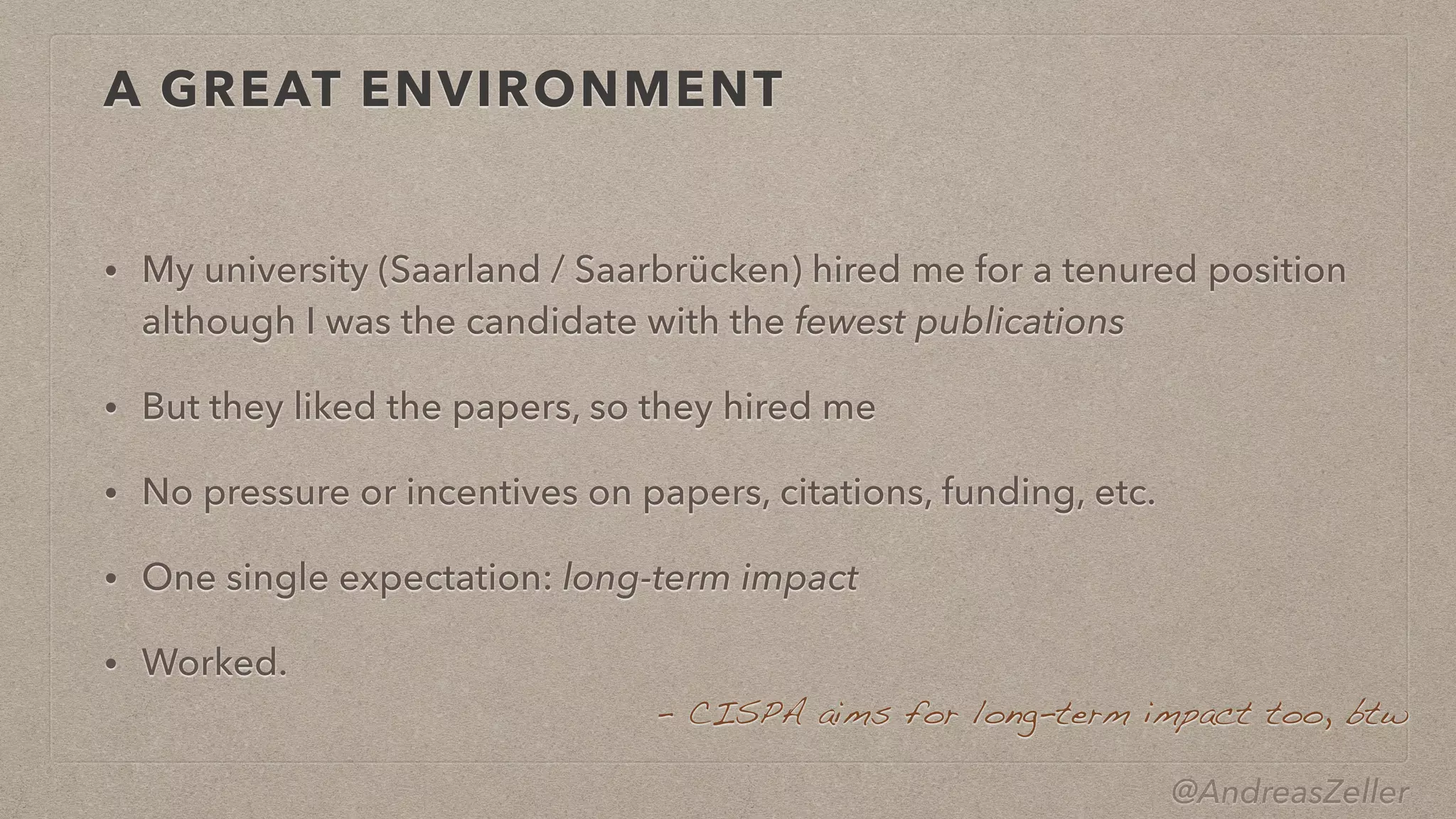
A GREAT ENVIRONMENT
• My university (Saarland / Saarbrücken) hired me for a tenured position


although I was the candidate with the fewest publications


• But they liked the papers, so they hired me


• No pressure or incentives on papers, citations, funding, etc.


• One single expectation: long-term impact


• Worked.
–  CISPA aims for long-term impact too, btw
@AndreasZeller
ON IMPACT IN SOFTWARE ENGINEERING RESEARCH
ANDREAS ZELLER, CISPA HELMHOLTZ CENTER FOR INFORMATION SECURITY
@AndreasZeller
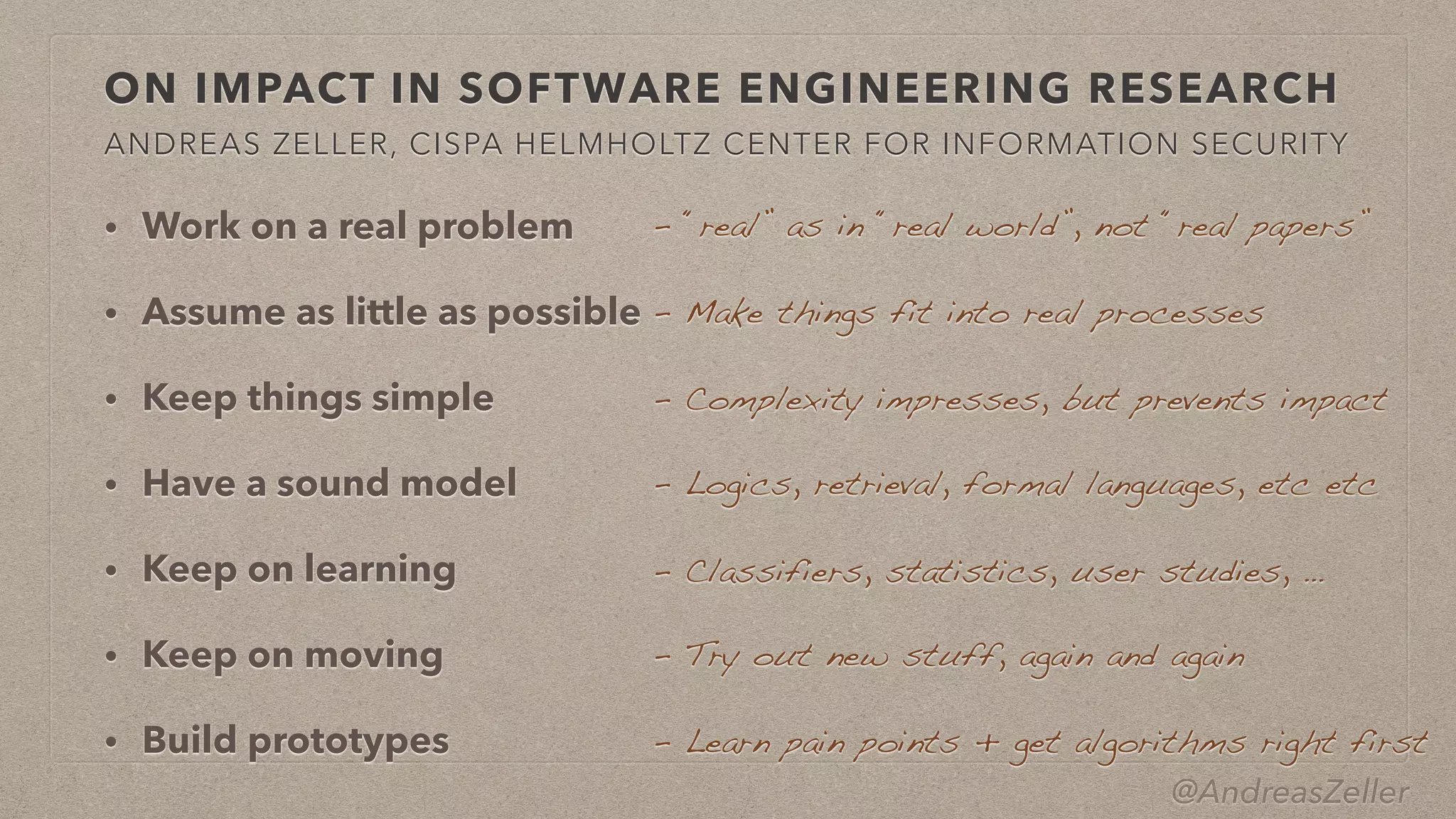
• Work on a real problem


• Assume as little as possible


• Keep things simple


• Have a sound model


• Keep on learning


• Keep on moving


• Build prototypes
ON IMPACT IN SOFTWARE ENGINEERING RESEARCH
ANDREAS ZELLER, CISPA HELMHOLTZ CENTER FOR INFORMATION SECURITY
–  Try out new stuff, again and again
–  Learn pain points + get algorithms right first
–  “real” as in “real world”, not “real papers”
–  Make things fit into real processes
–  Complexity impresses, but prevents impact
–  Logics, retrieval, formal languages, etc etc
–  Classifiers, statistics, user studies, …

On Impact in Software Engineering Research (HU Berlin 2021)

  • 1.
    @AndreasZeller ON IMPACT INSOFTWARE ENGINEERING RESEARCH ANDREAS ZELLER, CISPA HELMHOLTZ CENTER FOR INFORMATION SECURITY HU BERLIN WORKSHOP "SE FORSCHUNGSMETHODENTRAINING" MARCH 22, 2021
  • 2.
    @AndreasZeller ANDREAS ZELLER: KEYFACTS • PhD in 1997 on Con fi guration Management with Feature Logic • Since 2001, Professor at Saarland University, Saarbrücken, Germany • Since 2019, Faculty at CISPA Helmholtz Center for Information Security • ACM Fellow in 2010 • ERC Advanced Grant in 2011 • SIGSOFT Outstanding Research Award in 2018 • Last week, got my sixth 10-year impact award
  • 3.
  • 4.
    @AndreasZeller WHAT IS IMPACT? •How do your actions change the world? • We want to make the world a better place • Gives meaning and purpose to our (professional) life
  • 5.
    @AndreasZeller WHAT MAKES IMPACTFULRESEARCH? • Intellectual challenge – was it hard, or could anyone have done this? • Elegance – is your research speci fi c to a context, or can it be reused again and again? • Usefulness – can someone make money with it? • Innovation is the delta in any of these metrics
  • 6.
    @AndreasZeller SOFTWARE ENGINEERING RESEARCH 
 ASSEEN FROM OUTSIDE From a Programming Languages perspective, Software Engineering lacks intellectual challenge From a Security perspective, Software Engineering is all theory From an Industry perspective, Software Engineering lacks immediate usefulness From a Formal Methods perspective, Software Engineering is inelegant and full of uncontrollable details
  • 7.
  • 8.
    @AndreasZeller MY PATH TOIMPACT • Life can only be understood backwards; but it must be lived forwards 
 (Søren Kierkegaard)
  • 9.
    @AndreasZeller CONFIGURATION MANAGEMENT 
 WITH FEATURELOGIC (1991–1997) • Topic de fi ned by my PhD advisor Gregor Snelting • Idea: Formally describe variants and revisions with feature logic • “A uni fi ed model for con fi guration management” 3.3 Combining Delta Features and other Features . . . . . . . . . . bug fixed f function bug fixed f function bug fixed f function procedure bug fixed f function procedure bug fixed f function bug fixed f procedure Figure 8: Delta features and other features . This is only natural, since the change relies on the presence of the change. Adding a new revision under implies that the revision is now tagged w , so that the generalization property is not violated. Indeed, .
  • 10.
    @AndreasZeller FEATURE LOGIC: LESSONSLEARNED • ∅ –  did everything wrong
  • 11.
    @AndreasZeller FEATURE LOGIC: LESSONSLEARNED • You can get plenty of papers accepted • even if you miss the problem • even if you neither prove nor evaluate • “Modeling for the sake of modeling” • Enabled much of my later work, though
  • 12.
    @AndreasZeller WHAT TO DOAFTER PHD • During PhD, found standards and topics at German IT companies disappointing • Academia seemed good alternative • Socialized by open source development
  • 13.
    @AndreasZeller DDD (1994–1999) • DuringPhD, programmed a lot • Debugging was hard! • Built the DDD debugger GUI 
 with Dorothea Lütkehaus • Welcome change from formal work
  • 14.
    @AndreasZeller DDD (1994–1999) • DDDwas among the fi rst dev tools 
 with a “professional” GUI • Downloaded by the tens of thousands • Adopted as a GNU project: 
 Street credibility with developers • Impact through usefulness
  • 15.
    @AndreasZeller DDD: LESSONS LEARNED •Work on a real problem • Assume as little as possible • Keep things simple –  “real” as in “real world”, not “real papers” –  make things fit into real processes –  simple to use + deploy = impact
  • 16.
    @AndreasZeller DELTA DEBUGGING (1999–2003) •After PhD, looking for new topic • Delta Debugging brought together debugging and version control • Isolate failure causes through repeated experiments
  • 17.
    @AndreasZeller DELTA DEBUGGING (1999–2003) •Delta debugging was a bomb • Easy to teach + understand • 7 lines of algorithm 
 (and 25 lines of Python) • Spent two years on these                              (c! ✔, c! ✘) if |∆| = 1 dd! (c! ✘ ∆i, c! ✘, 2) if ∃i ∈ {1..n} · test(c! ✘ ∆i) = ✔ dd! (c! ✔, c! ✔ ∪ ∆i, 2) if ∃i ∈ {1..n} · test(c! ✔ ∪ ∆i) = ✘ dd!% c! ✔ ∪ ∆i, c! ✘, max(n − 1, 2) & else if ∃i ∈ {1..n} · test(c! ✔ ∪ ∆i) = ✔ dd!% c! ✔, c! ✘ ∆i, max(n − 1, 2) & else if ∃i ∈ {1..n} · test(c! ✘ ∆i) = ✘ dd!% c! ✔, c! ✘, min(2n, |∆|) & else if n < |∆| (“increase granularity”) (c! ✔, c! ✘) otherwise dd(c✔, c✘) = dd! (c✔, c✘, 2) dd! (c! ✔, c! ✘, n) =
  • 18.
    @AndreasZeller DELTA DEBUGGING: LESSONSLEARNED • Work on a real problem • Assume as little as possible • Keep things simple • Have a sound model –  Version control? tests? Never heard of it – simple to build + teach = impact –  DD was my version model reborn –  Why debug? We build correct software
  • 19.
    @AndreasZeller MINING SOFTWARE ARCHIVES(2003–2010) • In the early 2000s, open-source version repositories became available • Stephan Diehl saw an opportunity for visualization and approached me • Quickly expanded into data mining • Tom Zimmermann: our MSc student • Work of a research team
  • 20.
    @AndreasZeller MINING SOFTWARE ARCHIVES(2003–2010) • Our 2004 paper was the fi rst ICSE paper on mining software archives • Handful of competing groups; 
 instant hit • MSR now a conference on its own • Paper has ≥1,500 citations so far • Impact at Microsoft, Google, SAP…
  • 21.
    @AndreasZeller MINING SOFTWARE REPOSITORIES: LESSONSLEARNED • Work on a real problem • Assume as little as possible • Keep things simple • Have a sound model • Keep on learning –  Empirical research is core field of SE –  simple parsers for multiple languages –  essence of 2004 paper is one line of SQL –  retrieval, precision, recall, etc, etc –  NLP, data mining, machine learning
  • 22.
    @AndreasZeller MINING SOFTWARE ARCHIVES(2003–2010) • We are now after the gold rush • Data still exciting (if you have some) • Few new insights on old data • Get out of a fi eld when too crowded 3.5 Programmer Actions and Defects Now that we know how to predict defects, can we actually prevent them? Of course, we could focus quality assurance on those files predicted as most defect-prone. But are there also constructive ways to avoid these defects? Is there a general rule to learn? For this purpose, let us now focus on H2: Is there a correlation between individual actions (= keystrokes) and defects? For this purpose, we would search for correlations between the count of the 256 characters and the overall post-defect count per file; our null hypothesis would be: H0. There is no correlation between character distribution and defect-proneness. After a number of preliminary experiments, we focused on the Eclipse 3.0 dataset. It is well known that most metrics of software do not follow a normal distribution and our measures of key- strokes are no exception. The distributions of characters appear to have an exponential rather than a power-law character. Nonethe- less, due to the heavily skewed distribution, we used a standard non-parametric approach with the Spearman rank correlation. Of course, with so many metrics (one for each character), we run the risk of identifying spurious correlations, and we thus employed p- 3.6 Preventing Defects Our results show a strong correlation between specific pro- grammer actions (keystrokes I, R, O, and P) and defects. Figure 2: Color-coding keys by their defect correlation; (red = strong). The five strongest correlations are highlighted. Figure 3: Defect correlation for the 26 lower-case letters.
  • 23.
    @AndreasZeller MUTATION TESTING (2008–2011) •Is bug density related to test quality? • Mutation testing gave us the big problem of equivalent mutants • Built a solution for it (Javalanche) • In our 2011 paper, we even 
 nixed the need for mutation testing • 10-year impact award last week
  • 24.
    @AndreasZeller MUTATION TESTING: LESSONSLEARNED • Work on a real problem • Assume as little as possible • Keep things simple • Have a sound model • Keep on learning • Keep on moving –  Mutation testing did not work for us –  Assume we can do dynamic slices –  Build slices for assertions, mutations –  Impact through dependencies –  Mutations, Java semantics –  Where's the pain? What can you do?
  • 25.
    @AndreasZeller MORE THINGS IDID (AND DO!) • Automatic repair • Automatic parallelization • Automatic website testing • App mining and analysis • Fuzzing and test generation • Literate programming –  Wesley + Claire beat us to it –  Struggled with complexity –  Built a company for that –  Mining grammars for 1,000x faster fuzzing –  Rethinking the ways be build software –  Deployed at Google, Microsoft, …
  • 26.
  • 27.
  • 28.
  • 29.
    @AndreasZeller TEACHING = CODING= EXPERIMENTING • I teach automated testing + debugging through annotated code • With Jupyter, I can build state-of-the-art techniques within hours • Along the way, I learn their potential + their issues (= new research!) • Side effect: My students get blueprints for further prototyping • Interactive textbooks: fuzzingbook.org, debuggingbook.org
  • 30.
    @AndreasZeller PROTOTYPING: LESSONS LEARNED •Work on a real problem • Assume as little as possible • Keep things simple • Have a sound model • Keep on learning • Keep on moving • Build prototypes –  Organize the research process –  Python is like pseudocode –  Simple also communicates better –  Teach through interactive examples –  How to teach through coding –  Literate programming is fun –  Learn pain points + get algorithms right first
  • 31.
    @AndreasZeller THINGS I STAYEDAWAY FROM • Software processes • Formal methods • Modeling • Architecture • Work on a real problem • Assume as little as possible • Keep things simple • Have a sound model • Keep on learning • Keep on moving • Build prototypes
  • 32.
    @AndreasZeller THINGS I STAYEDAWAY FROM • Software processes • Formal methods • Modeling • Architecture • What is the problem? • How can you have impact? • How do you measure 
 your impact? –  The problems are huge and there's so little I can do
  • 33.
    @AndreasZeller MEASURING IMPACT • Howdo your actions change the world? • Hard to measure in advance, so our employers go for 
 bean counting (publications, money, students, citations, …) –  from @measuremania What actually 
 matters What can be
  • 34.
    • But youwant to be known for your tool, your algorithm, your book • You will not be remembered for doing well in a metric –  please cite this frequently What actually 
 matters What can be
  • 35.
    • There aremany people who have done 
 the same or better – but with less success • We know too little about these
  • 36.
  • 37.
    @AndreasZeller IMPACT AS ARESEARCHER • Society funds research to take risks that no one else does • Research is risky by construction – 
 you should expect to fail, and fail again • Tenure is meant to allow you to take arbitrarily grand challenges – 
 so work on the grand stuff • Build things! Try out things! Find the pain points! What can you do? • If you lack resources: abstract + prototype things
  • 38.
    @AndreasZeller IMPACT AS ATEACHER • Teaching can be a great way to multiply your message • Not only focus on teaching the standards, but also your research • Teaching your research helps to propagate it and make it accessible • Turn your research into well-annotated code you can use in teaching • Engage students on topics dear to you
  • 39.
    @AndreasZeller IMPACT WITH INDUSTRY •Do work with industry to fi nd problems and frame your work • Do not work with industry to solve (their) concrete problems • Your role as researcher is more than a cheap consulting tool • Many “research” funding schemes are there to subsidize industry
  • 40.
    @AndreasZeller IMPACT THROUGH TOOLS •Getting your technique out as a tool is a great way to have impact! • Also allows to check what actual users need (and if they exist) • A tool can have far more impact than a paper • Funding agencies and hiring committees begin to realize this
  • 41.
    @AndreasZeller IMPACT AS FOUNDER •Creating a company out of your research can be great fun! • Allows you to push your research and ideas into practice • Again, shows you what the market wants (and what not) • Plenty of monetary and consultancy support available
  • 42.
    @AndreasZeller IMPACT AS MENTOR •Working with advanced students (MSc, PhD, PostDoc) can be the most satisfying part of your job • The variety of SE research needs universal problem solving skills • Find such skills besides good grades
  • 43.
    @AndreasZeller A GREAT ENVIRONMENT •My university (Saarland / Saarbrücken) hired me for a tenured position 
 although I was the candidate with the fewest publications • But they liked the papers, so they hired me • No pressure or incentives on papers, citations, funding, etc. • One single expectation: long-term impact • Worked. –  CISPA aims for long-term impact too, btw
  • 44.
    @AndreasZeller ON IMPACT INSOFTWARE ENGINEERING RESEARCH ANDREAS ZELLER, CISPA HELMHOLTZ CENTER FOR INFORMATION SECURITY
  • 45.
    @AndreasZeller • Work ona real problem • Assume as little as possible • Keep things simple • Have a sound model • Keep on learning • Keep on moving • Build prototypes ON IMPACT IN SOFTWARE ENGINEERING RESEARCH ANDREAS ZELLER, CISPA HELMHOLTZ CENTER FOR INFORMATION SECURITY –  Try out new stuff, again and again –  Learn pain points + get algorithms right first –  “real” as in “real world”, not “real papers” –  Make things fit into real processes –  Complexity impresses, but prevents impact –  Logics, retrieval, formal languages, etc etc –  Classifiers, statistics, user studies, …