Andreas Zeller • 36th IEEE/ACM International Conference on Automated Software Engineering (ASE 2021) • November 17, 2021
Illustrated Code
Building Software in a Literate Way
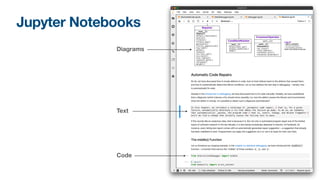
Jupyter Notebooks
Diagrams
Text
Code
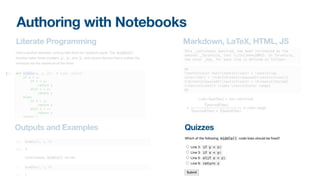
Authoring with Notebooks
Literate Programming
Outputs and Examples Quizzes
Markdown, LaTeX, HTML, JS
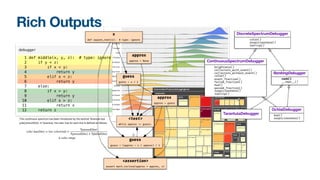
Rich Outputs
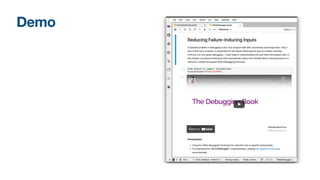
Demo
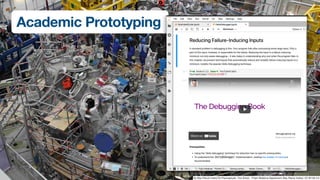
Academic Prototyping
By Max-Planck-Institut für Plasmaphysik, Tino Schulz - Public Relations Department, Max-Planck-Institut, CC BY-SA 3.0
Is this a general model for coding?
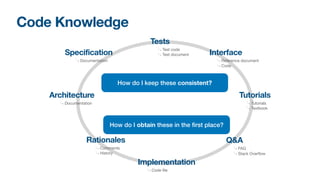
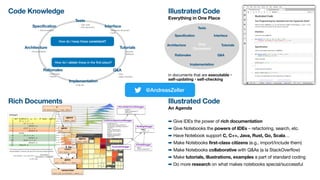
Code Knowledge
Implementation
Code
fi
le
Rationales
Comments
History
Architecture
Documentation
Tests
Test code
Test document Interface
Reference document
Code
Tutorials
Tutorials
Textbook
Specification
Documentation
How do I keep these consistent?
How do I obtain these in the
fi
rst place?
Q&A
Stack Over
fl
ow
FAQ
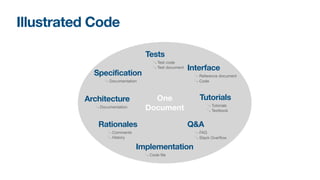
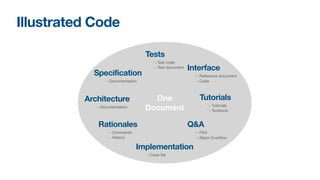
One

Document
Illustrated Code
Rationales
Comments
History
Architecture
Documentation
Tests
Test code
Test document Interface
Reference document
Code
Q&A
Stack Over
fl
ow
FAQ
Tutorials
Tutorials
Textbook
Specification
Documentation
Implementation
Code
fi
le
One

Document
Illustrated Code
Architecture
Documentation
Interface
Reference document
Code
Tutorials
Tutorials
Textbook
Specification
Documentation
Rationales
Comments
History
Q&A
Stack Over
fl
ow
FAQ
Implementation
Code
fi
le
Tests
Test code
Test document
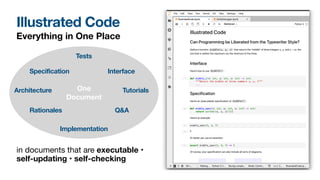
Illustrated Code
Everything in One Place
in documents that are executable •

self-updating • self-checking
One

Document
Rationales
Architecture
Tests
Interface
Q&A
Tutorials
Specification
Implementation
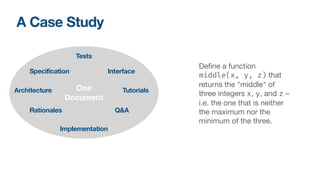
A Case Study
De
fi
ne a function
middle(x, y, z) that
returns the "middle" of
three integers x, y, and z – 

i.e. the one that is neither
the maximum nor the
minimum of the three.
One

Document
Architecture
Tests
Interface
Tutorials
Specification
Rationales Q&A
Implementation
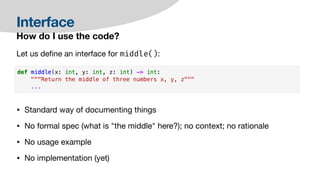
Interface
How do I use the code?
• Standard way of documenting things

• No formal spec (what is "the middle" here?); no context; no rationale

• No usage example

• No implementation (yet)
Let us de
fi
ne an interface for middle():
Specification
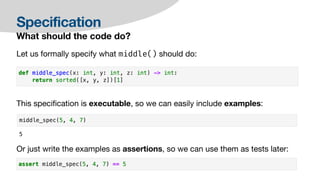
What should the code do?
Let us formally specify what middle() should do:
This speci
fi
cation is executable, so we can easily include examples:
Or just write the examples as assertions, so we can use them as tests later:
Specification
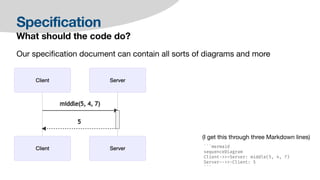
What should the code do?
Our speci
fi
cation document can contain all sorts of diagrams and more
```mermaid


sequenceDiagram


Client->>+Server: middle(5, 4, 7)


Server-->>-Client: 5


```
(I get this through three Markdown lines)
Implementation
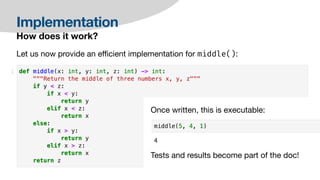
How does it work?
Let us now provide an e
ffi
cient implementation for middle():
Once written, this is executable:
Tests and results become part of the doc!
Rationales
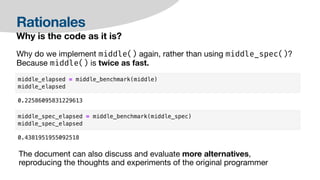
Why is the code as it is?
Why do we implement middle() again, rather than using middle_spec()?

Because middle() is twice as fast.
The document can also discuss and evaluate more alternatives,

reproducing the thoughts and experiments of the original programmer
Rationales
Why is the code as it is?
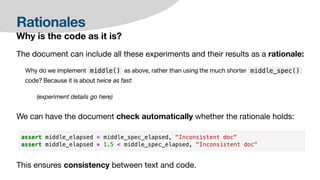
The document can include all these experiments and their results as a rationale:
(experiment details go here)
We can have the document check automatically whether the rationale holds:
This ensures consistency between text and code.
Tests
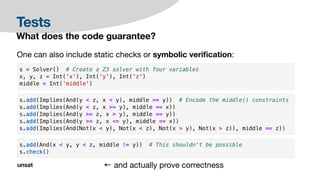
What does the code guarantee?
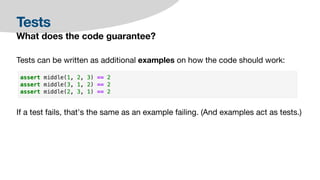
Tests can be written as additional examples on how the code should work:
If a test fails, that's the same as an example failing. (And examples act as tests.)
Tests
What does the code guarantee?
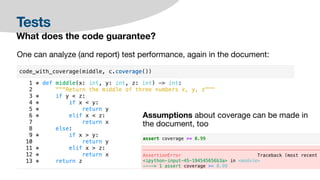
One can analyze (and report) test performance, again in the document:
Assumptions about coverage can be made in
the document, too
Tests
What does the code guarantee?
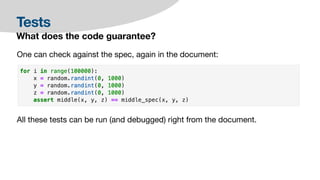
One can check against the spec, again in the document:
All these tests can be run (and debugged) right from the document.
Tests
What does the code guarantee?
One can also include static checks or symbolic veri
fi
cation:
← and actually prove correctness
Architecture
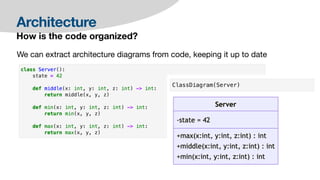
How is the code organized?
We can extract architecture diagrams from code, keeping it up to date
Architecture
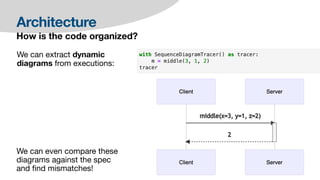
How is the code organized?
We can extract dynamic
diagrams from executions:
We can even compare these
diagrams against the spec
and
fi
nd mismatches!
Tutorials
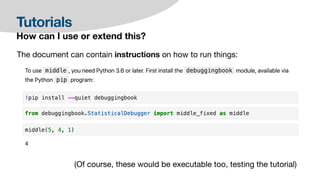
How can I use or extend this?
The document can contain instructions on how to run things:
(Of course, these would be executable too, testing the tutorial)
Q&A
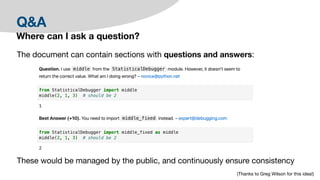
Where can I ask a question?
The document can contain sections with questions and answers:
These would be managed by the public, and continuously ensure consistency
(Thanks to Greg Wilson for this idea!)
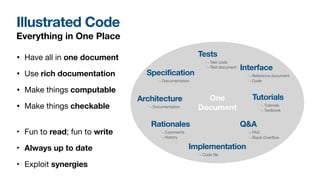
Illustrated Code
• Have all in one document

• Use rich documentation

• Make things computable
• Make things checkable
‣ Fun to read; fun to write
‣ Always up to date
‣ Exploit synergies
Everything in One Place
One

Document
Rationales
Comments
History
Architecture
Documentation
Tests
Test code
Test document Interface
Reference document
Code
Q&A
Stack Over
fl
ow
FAQ
Tutorials
Tutorials
Textbook
Specification
Documentation
Implementation
Code
fi
le
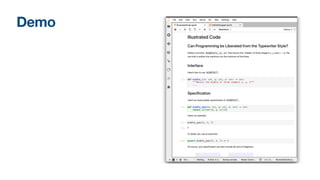
Demo
Alternatives
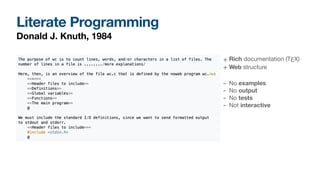
Literate Programming
Donald J. Knuth, 1984
+ Rich documentation (TEX)

+ Web structure
- No examples

- No output

- No tests

- Not interactive
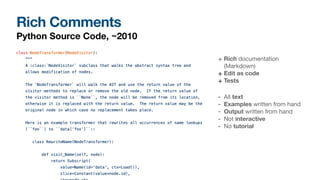
Rich Comments
Python Source Code, ~2010
+ Rich documentation

(Markdown)

+ Edit as code
+ Tests
- All text

- Examples written from hand

- Output written from hand

- Not interactive

- No tutorial
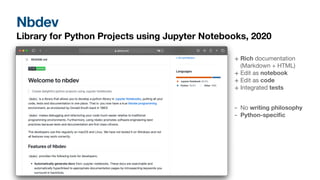
Nbdev
Library for Python Projects using Jupyter Notebooks, 2020
+ Rich documentation

(Markdown + HTML)

+ Edit as notebook

+ Edit as code

+ Integrated tests
- No writing philosophy

- Python-speci
fi
c
Agenda
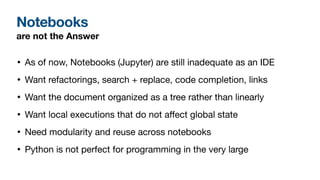
Notebooks
• As of now, Notebooks (Jupyter) are still inadequate as an IDE

• Want refactorings, search + replace, code completion, links

• Want the document organized as a tree rather than linearly

• Want local executions that do not a
ff
ect global state

• Need modularity and reuse across notebooks

• Python is not perfect for programming in the very large
are not the Answer
Integrated Development Environments
• Today's development environments are all typewriter-centric

• Want rich documentation, interactivity, examples, tutorials…

• Want documents that capture all code aspects consistently,
rather than a dozen fragments
are not the Answer
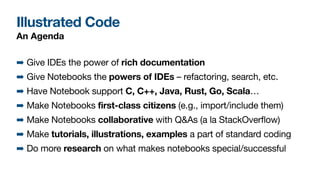
Illustrated Code
An Agenda
➡ Give IDEs the power of rich documentation

➡ Give Notebooks the powers of IDEs – refactoring, search, etc.

➡ Have Notebook support C, C++, Java, Rust, Go, Scala…

➡ Make Notebooks first-class citizens (e.g., import/include them)

➡ Make Notebooks collaborative with Q&As (a la StackOverflow)

➡ Make tutorials, illustrations, examples a part of standard coding

➡ Do more research on what makes notebooks special/successful
Illustrated Code
An Agenda
➡ Give IDEs the power of rich documentation

➡ Give Notebooks the powers of IDEs – refactoring, search, etc.

➡ Have Notebook support C, C++, Java, Rust, Go, Scala…

➡ Make Notebooks first-class citizens (e.g., import/include them)

➡ Make Notebooks collaborative with Q&As (a la StackOverflow)

➡ Make tutorials, illustrations, examples a part of standard coding

➡ Do more research on what makes notebooks special/successful
Andreas Zeller
Illustrated Code
Building Software that Lasts
Rich Documents
Code Knowledge
Implementation
Code file
Rationales
Comments
History
Architecture
Documentation
Tests
Test code
Test document Interface
Reference document
Code
Tutorials
Tutorials
Textbook
Specification
Documentation
How do I keep these consistent?
How do I obtain these in the first place?
Q&A
Stack Overflow
FAQ
Illustrated Code
Everything in One Place
in documents that are executable •

self-updating • self-checking
One

Document
Rationales
Architecture
Tests
Interface
Q&A
Tutorials
Specification
Implementation
@AndreasZeller

Illustrated Code (ASE 2021)

  • 1.
    Andreas Zeller •36th IEEE/ACM International Conference on Automated Software Engineering (ASE 2021) • November 17, 2021 Illustrated Code Building Software in a Literate Way
  • 5.
  • 6.
    Authoring with Notebooks LiterateProgramming Outputs and Examples Quizzes Markdown, LaTeX, HTML, JS
  • 7.
  • 8.
  • 9.
    Academic Prototyping By Max-Planck-Institutfür Plasmaphysik, Tino Schulz - Public Relations Department, Max-Planck-Institut, CC BY-SA 3.0
  • 10.
    Is this ageneral model for coding?
  • 11.
    Code Knowledge Implementation Code fi le Rationales Comments History Architecture Documentation Tests Test code Testdocument Interface Reference document Code Tutorials Tutorials Textbook Specification Documentation How do I keep these consistent? How do I obtain these in the fi rst place? Q&A Stack Over fl ow FAQ
  • 12.
    One
 Document Illustrated Code Rationales Comments History Architecture Documentation Tests Test code Testdocument Interface Reference document Code Q&A Stack Over fl ow FAQ Tutorials Tutorials Textbook Specification Documentation Implementation Code fi le
  • 13.
  • 14.
    Illustrated Code Everything inOne Place in documents that are executable •
 self-updating • self-checking One
 Document Rationales Architecture Tests Interface Q&A Tutorials Specification Implementation
  • 15.
    A Case Study De fi nea function middle(x, y, z) that returns the "middle" of three integers x, y, and z – 
 i.e. the one that is neither the maximum nor the minimum of the three. One
 Document Architecture Tests Interface Tutorials Specification Rationales Q&A Implementation
  • 16.
    Interface How do Iuse the code? • Standard way of documenting things • No formal spec (what is "the middle" here?); no context; no rationale • No usage example • No implementation (yet) Let us de fi ne an interface for middle():
  • 17.
    Specification What should thecode do? Let us formally specify what middle() should do: This speci fi cation is executable, so we can easily include examples: Or just write the examples as assertions, so we can use them as tests later:
  • 18.
    Specification What should thecode do? Our speci fi cation document can contain all sorts of diagrams and more ```mermaid sequenceDiagram Client->>+Server: middle(5, 4, 7) Server-->>-Client: 5 ``` (I get this through three Markdown lines)
  • 19.
    Implementation How does itwork? Let us now provide an e ffi cient implementation for middle(): Once written, this is executable: Tests and results become part of the doc!
  • 20.
    Rationales Why is thecode as it is? Why do we implement middle() again, rather than using middle_spec()?
 Because middle() is twice as fast. The document can also discuss and evaluate more alternatives,
 reproducing the thoughts and experiments of the original programmer
  • 21.
    Rationales Why is thecode as it is? The document can include all these experiments and their results as a rationale: (experiment details go here) We can have the document check automatically whether the rationale holds: This ensures consistency between text and code.
  • 22.
    Tests What does thecode guarantee? Tests can be written as additional examples on how the code should work: If a test fails, that's the same as an example failing. (And examples act as tests.)
  • 23.
    Tests What does thecode guarantee? One can analyze (and report) test performance, again in the document: Assumptions about coverage can be made in the document, too
  • 24.
    Tests What does thecode guarantee? One can check against the spec, again in the document: All these tests can be run (and debugged) right from the document.
  • 25.
    Tests What does thecode guarantee? One can also include static checks or symbolic veri fi cation: ← and actually prove correctness
  • 26.
    Architecture How is thecode organized? We can extract architecture diagrams from code, keeping it up to date
  • 27.
    Architecture How is thecode organized? We can extract dynamic diagrams from executions: We can even compare these diagrams against the spec and fi nd mismatches!
  • 28.
    Tutorials How can Iuse or extend this? The document can contain instructions on how to run things: (Of course, these would be executable too, testing the tutorial)
  • 29.
    Q&A Where can Iask a question? The document can contain sections with questions and answers: These would be managed by the public, and continuously ensure consistency (Thanks to Greg Wilson for this idea!)
  • 30.
    Illustrated Code • Haveall in one document • Use rich documentation • Make things computable • Make things checkable ‣ Fun to read; fun to write ‣ Always up to date ‣ Exploit synergies Everything in One Place One
 Document Rationales Comments History Architecture Documentation Tests Test code Test document Interface Reference document Code Q&A Stack Over fl ow FAQ Tutorials Tutorials Textbook Specification Documentation Implementation Code fi le
  • 31.
  • 32.
  • 33.
    Literate Programming Donald J.Knuth, 1984 + Rich documentation (TEX) + Web structure - No examples - No output - No tests - Not interactive
  • 34.
    Rich Comments Python SourceCode, ~2010 + Rich documentation
 (Markdown) + Edit as code + Tests - All text - Examples written from hand - Output written from hand - Not interactive - No tutorial
  • 35.
    Nbdev Library for PythonProjects using Jupyter Notebooks, 2020 + Rich documentation
 (Markdown + HTML) + Edit as notebook + Edit as code + Integrated tests - No writing philosophy - Python-speci fi c
  • 36.
  • 37.
    Notebooks • As ofnow, Notebooks (Jupyter) are still inadequate as an IDE • Want refactorings, search + replace, code completion, links • Want the document organized as a tree rather than linearly • Want local executions that do not a ff ect global state • Need modularity and reuse across notebooks • Python is not perfect for programming in the very large are not the Answer
  • 38.
    Integrated Development Environments •Today's development environments are all typewriter-centric • Want rich documentation, interactivity, examples, tutorials… • Want documents that capture all code aspects consistently, rather than a dozen fragments are not the Answer
  • 39.
    Illustrated Code An Agenda ➡Give IDEs the power of rich documentation ➡ Give Notebooks the powers of IDEs – refactoring, search, etc. ➡ Have Notebook support C, C++, Java, Rust, Go, Scala… ➡ Make Notebooks first-class citizens (e.g., import/include them) ➡ Make Notebooks collaborative with Q&As (a la StackOverflow) ➡ Make tutorials, illustrations, examples a part of standard coding ➡ Do more research on what makes notebooks special/successful
  • 40.
    Illustrated Code An Agenda ➡Give IDEs the power of rich documentation ➡ Give Notebooks the powers of IDEs – refactoring, search, etc. ➡ Have Notebook support C, C++, Java, Rust, Go, Scala… ➡ Make Notebooks first-class citizens (e.g., import/include them) ➡ Make Notebooks collaborative with Q&As (a la StackOverflow) ➡ Make tutorials, illustrations, examples a part of standard coding ➡ Do more research on what makes notebooks special/successful Andreas Zeller Illustrated Code Building Software that Lasts Rich Documents Code Knowledge Implementation Code file Rationales Comments History Architecture Documentation Tests Test code Test document Interface Reference document Code Tutorials Tutorials Textbook Specification Documentation How do I keep these consistent? How do I obtain these in the first place? Q&A Stack Overflow FAQ Illustrated Code Everything in One Place in documents that are executable •
 self-updating • self-checking One
 Document Rationales Architecture Tests Interface Q&A Tutorials Specification Implementation @AndreasZeller