Future-Ready:
responding to a
fast-changing world
ECF – 13 April 2016
David Bent - @davidbent
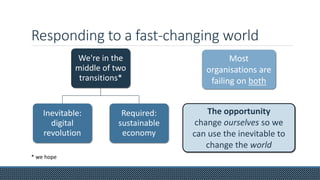
Responding to a fast-changing world
We're in the
middle of two
transitions*
Inevitable:
digital
revolution
Required:
sustainable
economy
Most
organisations are
failing on both
The opportunity
change ourselves so we
can use the inevitable to
change the world
* we hope
1. What’s going on in corporate
sustainability and beyond?
A few leaders, lots of incremental effort.
But not is enough.
Approach to sustainability efforts are
changing
Last 30 years
Dominated by incumbents
Incremental efforts
Product and service innovation
For-profit maximisation
Emerging order
New entrants (for good and bad)
Whole system efforts
Business model innovation
For-purpose and for- long-term –profit
No guarantee of success
It’s annoying we’re going in the wrong direction.
There are plenty of people to blame.
But ultimately we only control ourselves.
We need to change ourselves
so we can foster the transition to a sustainable future.
The inevitable transition
– a new socio-technological basis.
from Stern (2012) and Perez (2002).
Digital revolution is changing information
flows, and therefore how to be organised
What we’re used to
Centralised / controlled
Organised as siloes
What’s coming
Diffuse
Organised as networks
“Computers and other digital advances are
doing for mental power— the ability to use our
brains to understand and shape our
environments— what the steam engine and its
descendants did for muscle power.”
Erik Brynjolfsson and Andrew McAfee, Andrew in
The Second Machine Age: Work, Progress, and Prosperity in a Time of Brilliant Technologies
No organisation or society is ready for this.
“Computers and other digital advances are
doing for mental power— the ability to use our
brains to understand and shape our
environments— what the steam engine and its
descendants did for muscle power.”
Erik Brynjolfsson and Andrew McAfee, Andrew in
The Second Machine Age: Work, Progress, and Prosperity in a Time of Brilliant Technologies
No organisation or society is ready for this.
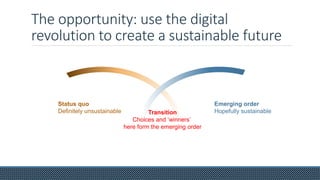
The opportunity: use the digital
revolution to create a sustainable future
Status quo
Definitely unsustainable
Emerging order
Hopefully sustainableTransition
Choices and ‘winners’
here form the emerging order
2. How has Forum for the Future
responded?
We realised that our approach to change
was going out-of-date
• Our long-held beliefs were no longer true:
◦ Working one-on-one can help incumbents to be prime movers in
change.
◦ We can be relevant, and have a global impact, from the UK.
• If we had kept going then we would have been increasingly
ineffectual, and would have deserved to die.
We asked ourselves some tough
questions
Diagnosis Direction
Design for
delivery
• How do we believe change
happens?
• What change do we believe is
needed?
• What skills and assets do we
have, or could grow over time?
• What have we learnt so far?
• Where have we failed, honestly?
• What is the best match for
what we can do (and get
funded for) with what is
needed in the world?
• Where and how should we
‘play’?
• How should we be organised to
deliver that?
• How can we have access to the
skills and assets do we need?
• How can we generate the income
to cover the costs we have?
• How can we get better as we go?
• How can we evaluate our impact?
We’re definitely not ‘there’ yet
Partner
responsive
Systems-led +
Partner-
directive
“Catalyst”
2016-2010-20152006-2010
Catalyse the shift to a sustainable future
Spot the areas of high-
change potential
Match with the pioneers
who want to act
Use our change
processes
Create proof-points that
others can use
By 2018 we aim for:
Specific sustainability issues
shifted, like protein and Indian
energy
People and organisations
inspired and equipped to act
themselves
Created enabling conditions
Some hard-won lessons
• It is difficult to see alternatives when you’re very used to the status
quo
• The commitment to ‘cutting-edge’ forces Forum forward
• Experimentation helps make the case for the new
“In times of change,
learners inherit the earth.
The learned find themselves beautifully
equipped to deal with a world
that no longer exists.”
Eric Hoffer
3. What can you do to respond
to a fast-changing world?
Some questions
What long-held beliefs
are no longer going to
be true?
What is the best match
for what your
organisation can do
with what is needed in
the world?
How can you start to
experiment in roughly
the right direction?
What long-held beliefs are no longer
going to be true?
Candidates:
“It is OK for campaigning,
media, volunteering,
fundraising to act
separately, even having
very different messages"
"It is better to act alone
and specifically on one
issue than act coherently
with others on the big
picture."
What is the best match for what you
organisation can do with what is needed?
Our skills and
assets
Way to create
change 1
Way to create
change 2
The impact
we want
Way to create
change 3
?
?
?
How can you start to experiment in
roughly the right direction?
Set up
• Long-term intent:
in 5 year's time, what will
you be glad you learnt
now?
• Set your inquiry question:
‘how can we...?’
• Design for learning:
budget time to learn; be
ready to put insights into
practice
• Limit the risk:
Show how the downside is
controlled
During
• Be agile:
Respond to changes
• Be reflective
Make time to learn as you
go (and record it!)
After
• Evaluation:
- How could we do things
better?
- How could we do better
things?
• Reward ‘good’ failure
If you learn (and do things
differently), it’s a success
• Implement
Put insights into practice
• Progress:
What's the next
experiment?
Some questions
What long-held beliefs
are no longer going to
be true?
What is the best match
for what your
organisation can do
with what is needed in
the world?
How can you start to
experiment in roughly
the right direction?
Responding to a fast-changing world
We're in the
middle of two
transitions*
Inevitable:
digital
revolution
Required:
sustainable
economy
Most
organisations are
failing on both
The opportunity
change ourselves so we
can use the inevitable to
change the world
* we hope
And finally…
Putting the world on a
sustainable footing is the
task of our generation.
Are you going to be the one
to change how things are
done?
We need you to be amazing
Thank you
David Bent
david.bent.hazelwood@gmail.com
@davidbent
Behind each problem is
the mindset which drives
‘unsustainability’
Our diagnosis:
Starting point
Many areas need change
Many efforts underway
Our diagnosis
What will make a difference now
Help specific challenges
that are ready
Help individuals and
organsiations to create
change where they are
Our diagnosis
What will make a difference over time
Help specific challenges
that are ready.
Help individuals and
organsiations to create
change where they are.
Design each to shift the
wider context too
Our diagnosis
Shift to a sustainable future
Help specific challenges
that are ready.
Help individuals and
organsiations to create
change where they are.
Design each to shift the
wider context too
Our diagnosis
Shift to a sustainable future
Help specific challenges
that are ready.
Help individuals and
organsiations to create
change where they are.
Design each to shift the
wider context too
Will make changing easier
Catalyse the shift to a sustainable future
• Spot the areas of high-change potential
• Match with the pioneers who want to act
• Use our change processes
• Create proof-points that others can use
By 2018 we’ll have impacts:
1. Specific sustainability issues like protein and Indian energy
2. People and organisations inspired and equipped to act
themselves
3. Created enabling conditions

Future-ready: responding to a fast-changing world

  • 1.
    Future-Ready: responding to a fast-changingworld ECF – 13 April 2016 David Bent - @davidbent
  • 4.
    Responding to afast-changing world We're in the middle of two transitions* Inevitable: digital revolution Required: sustainable economy Most organisations are failing on both The opportunity change ourselves so we can use the inevitable to change the world * we hope
  • 5.
    1. What’s goingon in corporate sustainability and beyond?
  • 6.
    A few leaders,lots of incremental effort. But not is enough.
  • 7.
    Approach to sustainabilityefforts are changing Last 30 years Dominated by incumbents Incremental efforts Product and service innovation For-profit maximisation Emerging order New entrants (for good and bad) Whole system efforts Business model innovation For-purpose and for- long-term –profit No guarantee of success
  • 8.
    It’s annoying we’regoing in the wrong direction. There are plenty of people to blame. But ultimately we only control ourselves. We need to change ourselves so we can foster the transition to a sustainable future.
  • 9.
    The inevitable transition –a new socio-technological basis. from Stern (2012) and Perez (2002).
  • 10.
    Digital revolution ischanging information flows, and therefore how to be organised What we’re used to Centralised / controlled Organised as siloes What’s coming Diffuse Organised as networks
  • 12.
    “Computers and otherdigital advances are doing for mental power— the ability to use our brains to understand and shape our environments— what the steam engine and its descendants did for muscle power.” Erik Brynjolfsson and Andrew McAfee, Andrew in The Second Machine Age: Work, Progress, and Prosperity in a Time of Brilliant Technologies No organisation or society is ready for this.
  • 13.
    “Computers and otherdigital advances are doing for mental power— the ability to use our brains to understand and shape our environments— what the steam engine and its descendants did for muscle power.” Erik Brynjolfsson and Andrew McAfee, Andrew in The Second Machine Age: Work, Progress, and Prosperity in a Time of Brilliant Technologies No organisation or society is ready for this.
  • 14.
    The opportunity: usethe digital revolution to create a sustainable future Status quo Definitely unsustainable Emerging order Hopefully sustainableTransition Choices and ‘winners’ here form the emerging order
  • 15.
    2. How hasForum for the Future responded?
  • 16.
    We realised thatour approach to change was going out-of-date • Our long-held beliefs were no longer true: ◦ Working one-on-one can help incumbents to be prime movers in change. ◦ We can be relevant, and have a global impact, from the UK. • If we had kept going then we would have been increasingly ineffectual, and would have deserved to die.
  • 17.
    We asked ourselvessome tough questions Diagnosis Direction Design for delivery • How do we believe change happens? • What change do we believe is needed? • What skills and assets do we have, or could grow over time? • What have we learnt so far? • Where have we failed, honestly? • What is the best match for what we can do (and get funded for) with what is needed in the world? • Where and how should we ‘play’? • How should we be organised to deliver that? • How can we have access to the skills and assets do we need? • How can we generate the income to cover the costs we have? • How can we get better as we go? • How can we evaluate our impact?
  • 18.
    We’re definitely not‘there’ yet Partner responsive Systems-led + Partner- directive “Catalyst” 2016-2010-20152006-2010
  • 19.
    Catalyse the shiftto a sustainable future Spot the areas of high- change potential Match with the pioneers who want to act Use our change processes Create proof-points that others can use By 2018 we aim for: Specific sustainability issues shifted, like protein and Indian energy People and organisations inspired and equipped to act themselves Created enabling conditions
  • 20.
    Some hard-won lessons •It is difficult to see alternatives when you’re very used to the status quo • The commitment to ‘cutting-edge’ forces Forum forward • Experimentation helps make the case for the new
  • 21.
    “In times ofchange, learners inherit the earth. The learned find themselves beautifully equipped to deal with a world that no longer exists.” Eric Hoffer
  • 22.
    3. What canyou do to respond to a fast-changing world?
  • 23.
    Some questions What long-heldbeliefs are no longer going to be true? What is the best match for what your organisation can do with what is needed in the world? How can you start to experiment in roughly the right direction?
  • 24.
    What long-held beliefsare no longer going to be true? Candidates: “It is OK for campaigning, media, volunteering, fundraising to act separately, even having very different messages" "It is better to act alone and specifically on one issue than act coherently with others on the big picture."
  • 25.
    What is thebest match for what you organisation can do with what is needed? Our skills and assets Way to create change 1 Way to create change 2 The impact we want Way to create change 3 ? ? ?
  • 26.
    How can youstart to experiment in roughly the right direction? Set up • Long-term intent: in 5 year's time, what will you be glad you learnt now? • Set your inquiry question: ‘how can we...?’ • Design for learning: budget time to learn; be ready to put insights into practice • Limit the risk: Show how the downside is controlled During • Be agile: Respond to changes • Be reflective Make time to learn as you go (and record it!) After • Evaluation: - How could we do things better? - How could we do better things? • Reward ‘good’ failure If you learn (and do things differently), it’s a success • Implement Put insights into practice • Progress: What's the next experiment?
  • 27.
    Some questions What long-heldbeliefs are no longer going to be true? What is the best match for what your organisation can do with what is needed in the world? How can you start to experiment in roughly the right direction?
  • 28.
    Responding to afast-changing world We're in the middle of two transitions* Inevitable: digital revolution Required: sustainable economy Most organisations are failing on both The opportunity change ourselves so we can use the inevitable to change the world * we hope
  • 29.
  • 32.
    Putting the worldon a sustainable footing is the task of our generation.
  • 33.
    Are you goingto be the one to change how things are done?
  • 34.
    We need youto be amazing
  • 35.
  • 36.
    Behind each problemis the mindset which drives ‘unsustainability’ Our diagnosis: Starting point Many areas need change Many efforts underway
  • 37.
    Our diagnosis What willmake a difference now Help specific challenges that are ready Help individuals and organsiations to create change where they are
  • 38.
    Our diagnosis What willmake a difference over time Help specific challenges that are ready. Help individuals and organsiations to create change where they are. Design each to shift the wider context too
  • 39.
    Our diagnosis Shift toa sustainable future Help specific challenges that are ready. Help individuals and organsiations to create change where they are. Design each to shift the wider context too
  • 40.
    Our diagnosis Shift toa sustainable future Help specific challenges that are ready. Help individuals and organsiations to create change where they are. Design each to shift the wider context too Will make changing easier
  • 41.
    Catalyse the shiftto a sustainable future • Spot the areas of high-change potential • Match with the pioneers who want to act • Use our change processes • Create proof-points that others can use By 2018 we’ll have impacts: 1. Specific sustainability issues like protein and Indian energy 2. People and organisations inspired and equipped to act themselves 3. Created enabling conditions

Editor's Notes

  • #5 The opportunity:
  • #21  By 2018 we’ll have impacts: Specific sustainability issues like protein and Indian energy People and organisations inspired and equipped to act themselves Created enabling conditions
  • #26 Others?
  • #30 The opportunity: