TASK FORCE:
for the future of social product development


                         PRODUCT
                         EVALUATION
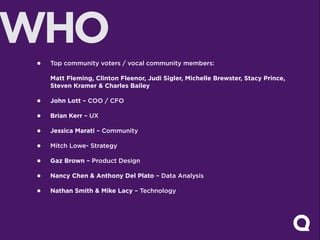
WHO
 •   Top community voters / vocal community members:

     Matt Fleming, Clinton Fleenor, Judi Sigler, Michelle Brewster, Stacy Prince,
     Steven Kramer & Charles Bailey

 •   John Lott – COO / CFO

 •   Brian Kerr – UX

 •   Jessica Marati – Community

 •   Mitch Lowe- Strategy

 •   Gaz Brown – Product Design

 •   Nancy Chen & Anthony Del Plato – Data Analysis

 •   Nathan Smith & Mike Lacy – Technology
WHAT A
SUCCESSFUL
PRODUCT
EVALUATION
PROCESS
LOOKS LIKE:
1. Surfaces the ‘best ideas’ every week.


WHAT A SUCCESSFUL PRODUCT EVALUATION PROCESS DOES:
2. Curation is a fun and engaging
              experience for voters and community
              members.


WHAT A SUCCESSFUL PRODUCT EVALUATION PROCESS DOES:
3. Data collected is useful in product
              design, research, and marketing process.


WHAT A SUCCESSFUL PRODUCT EVALUATION PROCESS DOES:
4. Inventors who do not win walk away
              educated, with a ton of insight about
              where they fell short.


WHAT A SUCCESSFUL PRODUCT EVALUATION PROCESS DOES:
5. Requires a sustainable amount of
              Quirky staff interaction.


WHAT A SUCCESSFUL PRODUCT EVALUATION PROCESS DOES:
6. Rewards all who are involved without
              encouraging gaming.


WHAT A SUCCESSFUL PRODUCT EVALUATION PROCESS DOES:
7. Ends in winning ideas that both the
              community and Quirky are excited about.


WHAT A SUCCESSFUL PRODUCT EVALUATION PROCESS DOES:
8. Winning ideas enter the design process
              with a ton of research, knowledge,
              and demand behind them.


WHAT A SUCCESSFUL PRODUCT EVALUATION PROCESS DOES:
WHAT
ARE THE
‘BEST IDEAS’?
1. The best ideas solve big problems
               (relating to usability, comfort,
               and convenience) in a new way.


WHAT ARE THE BEST IDEAS
2. The best ideas represent the
               biggest commercial opportunity
               for our community & brand.


WHAT ARE THE BEST IDEAS
3. The best ideas are manufacturable.


WHAT ARE THE BEST IDEAS
4. The best ideas don’t go out of
               fashion / relevance quickly – they are
               around for years (ideally 3+ year lifespan).


WHAT ARE THE BEST IDEAS
5. The best ideas are protectable.


WHAT ARE THE BEST IDEAS
6. The best ideas are often the ones
               people ignore or reject.


WHAT ARE THE BEST IDEAS
KNOWN
ISSUES:
1. Number of ideas grows each week,
               making the curation process more
               fatiguing for community members.


KNOWN ISSUES
2. We are, by design, saying ‘get lost’ to all
       but two of hundreds of inventors every
       week – how do we turn ‘get lost’ into
       something constructive and helpful, and
       how do we inspire losing inventors to
       stick around so they can learn, grow,
       and become successful inventors?


KNOWN ISSUES
3. Evaluating an ‘idea’ this early in the
           process is risky, because no one (not
           even the inventor) fully understands ‘it’ –
           because ‘it’ doesn’t exist yet.

           “Don’t worry about people stealing your ideas. If they are any good,
           you’ll have to ram them down people’s throats”. - Howard Aiken


KNOWN ISSUES
4. Due to relatively low number (about 2000)
               active voters and high weight of votes in
               defining the top ideas in a given week, the
               weight of each inventor’s social graph is
               higher then the actual ‘quality’ of an idea.


KNOWN ISSUES
5. People are voting for what they
               believe Quirky will like, versus what
               they actually like and will buy.


KNOWN ISSUES
6. Seasonality and changes in culture make
               things that were ‘no’s’ a short time ago, big
               ‘yes’s’ shortly thereafter... do we lose
               that opportunity, and how do we make
               a mineable database of ideas?


KNOWN ISSUES
QUESTIONS/
THOUGHT
STARTERS:
1. How do we create a mineable database
               of ideas that can somehow come back into
               relevance as times change / relevance
               changes / lines need expansion, etc?


KNOWN ISSUES
2. How do we avoid a culture (both staff
               and community) that gravitates toward
               easy wins, but rather encourage a
               culture that is drawn toward risk?


KNOWN ISSUES
3. Is a weekly ‘class’ of ideas the best
               way to approach evaluation?

               other thoughts have included:


                • rolling list in each category (ideas must hit a certain threshold
                  in order to get pushed into staff eval)


                • volume-per-category-driven (collect 50 ideas in each
                  category, then choose one)


                • sudden death / elimination round (slowly kill off ideas
                  throughout the curation process that way we are all focusing
                  on going deeper into ideas we like)


KNOWN ISSUES
4. How can the community do more
               research earlier in the process to make
               staff evaluation easier?


KNOWN ISSUES
THE
TASKFORCE
PROCESS
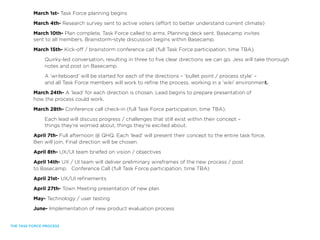
March 1st- Task Force planning begins

          March 4th- Research survey sent to active voters (effort to better understand current climate)

          March 10th- Plan complete, Task Force called to arms. Planning deck sent. Basecamp invites
          sent to all members. Brainstorm-style discussion begins within Basecamp.

          March 15th- Kick-off / brainstorm conference call (full Task Force participation, time TBA).

               Quirky-led conversation, resulting in three to five clear directions we can go. Jess will take thorough
               notes and post on Basecamp.

               A ‘writeboard’ will be started for each of the directions – ‘bullet point / process style’ –
               and all Task Force members will work to refine the process, working in a ‘wiki’ environment.

          March 24th- A ‘lead’ for each direction is chosen. Lead begins to prepare presentation of
          how the process could work.

          March 28th- Conference call check-in (full Task Force participation, time TBA).

               Each lead will discuss progress / challenges that still exist within their concept –
               things they’re worried about, things they’re excited about.

          April 7th- Full afternoon @ QHQ. Each ‘lead’ will present their concept to the entire task force,
          Ben will join. Final direction will be chosen.

          April 8th- UX/UI team briefed on vision / objectives

          April 14th- UX / UI team will deliver preliminary wireframes of the new process / post
          to Basecamp. Conference Call (full Task Force participation, time TBA)

          April 21st- UX/UI refinements

          April 27th- Town Meeting presentation of new plan

          May- Technology / user testing

          June- Implementation of new product evaluation process


THE TASK FORCE PROCESS

Quirky Future Taskforce: Product Evaluation

  • 1.
    TASK FORCE: for thefuture of social product development PRODUCT EVALUATION
  • 2.
    WHO • Top community voters / vocal community members: Matt Fleming, Clinton Fleenor, Judi Sigler, Michelle Brewster, Stacy Prince, Steven Kramer & Charles Bailey • John Lott – COO / CFO • Brian Kerr – UX • Jessica Marati – Community • Mitch Lowe- Strategy • Gaz Brown – Product Design • Nancy Chen & Anthony Del Plato – Data Analysis • Nathan Smith & Mike Lacy – Technology
  • 3.
  • 4.
    1. Surfaces the‘best ideas’ every week. WHAT A SUCCESSFUL PRODUCT EVALUATION PROCESS DOES:
  • 5.
    2. Curation isa fun and engaging experience for voters and community members. WHAT A SUCCESSFUL PRODUCT EVALUATION PROCESS DOES:
  • 6.
    3. Data collectedis useful in product design, research, and marketing process. WHAT A SUCCESSFUL PRODUCT EVALUATION PROCESS DOES:
  • 7.
    4. Inventors whodo not win walk away educated, with a ton of insight about where they fell short. WHAT A SUCCESSFUL PRODUCT EVALUATION PROCESS DOES:
  • 8.
    5. Requires asustainable amount of Quirky staff interaction. WHAT A SUCCESSFUL PRODUCT EVALUATION PROCESS DOES:
  • 9.
    6. Rewards allwho are involved without encouraging gaming. WHAT A SUCCESSFUL PRODUCT EVALUATION PROCESS DOES:
  • 10.
    7. Ends inwinning ideas that both the community and Quirky are excited about. WHAT A SUCCESSFUL PRODUCT EVALUATION PROCESS DOES:
  • 11.
    8. Winning ideasenter the design process with a ton of research, knowledge, and demand behind them. WHAT A SUCCESSFUL PRODUCT EVALUATION PROCESS DOES:
  • 12.
  • 13.
    1. The bestideas solve big problems (relating to usability, comfort, and convenience) in a new way. WHAT ARE THE BEST IDEAS
  • 14.
    2. The bestideas represent the biggest commercial opportunity for our community & brand. WHAT ARE THE BEST IDEAS
  • 15.
    3. The bestideas are manufacturable. WHAT ARE THE BEST IDEAS
  • 16.
    4. The bestideas don’t go out of fashion / relevance quickly – they are around for years (ideally 3+ year lifespan). WHAT ARE THE BEST IDEAS
  • 17.
    5. The bestideas are protectable. WHAT ARE THE BEST IDEAS
  • 18.
    6. The bestideas are often the ones people ignore or reject. WHAT ARE THE BEST IDEAS
  • 19.
  • 20.
    1. Number ofideas grows each week, making the curation process more fatiguing for community members. KNOWN ISSUES
  • 21.
    2. We are,by design, saying ‘get lost’ to all but two of hundreds of inventors every week – how do we turn ‘get lost’ into something constructive and helpful, and how do we inspire losing inventors to stick around so they can learn, grow, and become successful inventors? KNOWN ISSUES
  • 22.
    3. Evaluating an‘idea’ this early in the process is risky, because no one (not even the inventor) fully understands ‘it’ – because ‘it’ doesn’t exist yet. “Don’t worry about people stealing your ideas. If they are any good, you’ll have to ram them down people’s throats”. - Howard Aiken KNOWN ISSUES
  • 23.
    4. Due torelatively low number (about 2000) active voters and high weight of votes in defining the top ideas in a given week, the weight of each inventor’s social graph is higher then the actual ‘quality’ of an idea. KNOWN ISSUES
  • 24.
    5. People arevoting for what they believe Quirky will like, versus what they actually like and will buy. KNOWN ISSUES
  • 25.
    6. Seasonality andchanges in culture make things that were ‘no’s’ a short time ago, big ‘yes’s’ shortly thereafter... do we lose that opportunity, and how do we make a mineable database of ideas? KNOWN ISSUES
  • 26.
  • 27.
    1. How dowe create a mineable database of ideas that can somehow come back into relevance as times change / relevance changes / lines need expansion, etc? KNOWN ISSUES
  • 28.
    2. How dowe avoid a culture (both staff and community) that gravitates toward easy wins, but rather encourage a culture that is drawn toward risk? KNOWN ISSUES
  • 29.
    3. Is aweekly ‘class’ of ideas the best way to approach evaluation? other thoughts have included: • rolling list in each category (ideas must hit a certain threshold in order to get pushed into staff eval) • volume-per-category-driven (collect 50 ideas in each category, then choose one) • sudden death / elimination round (slowly kill off ideas throughout the curation process that way we are all focusing on going deeper into ideas we like) KNOWN ISSUES
  • 30.
    4. How canthe community do more research earlier in the process to make staff evaluation easier? KNOWN ISSUES
  • 31.
  • 32.
    March 1st- TaskForce planning begins March 4th- Research survey sent to active voters (effort to better understand current climate) March 10th- Plan complete, Task Force called to arms. Planning deck sent. Basecamp invites sent to all members. Brainstorm-style discussion begins within Basecamp. March 15th- Kick-off / brainstorm conference call (full Task Force participation, time TBA). Quirky-led conversation, resulting in three to five clear directions we can go. Jess will take thorough notes and post on Basecamp. A ‘writeboard’ will be started for each of the directions – ‘bullet point / process style’ – and all Task Force members will work to refine the process, working in a ‘wiki’ environment. March 24th- A ‘lead’ for each direction is chosen. Lead begins to prepare presentation of how the process could work. March 28th- Conference call check-in (full Task Force participation, time TBA). Each lead will discuss progress / challenges that still exist within their concept – things they’re worried about, things they’re excited about. April 7th- Full afternoon @ QHQ. Each ‘lead’ will present their concept to the entire task force, Ben will join. Final direction will be chosen. April 8th- UX/UI team briefed on vision / objectives April 14th- UX / UI team will deliver preliminary wireframes of the new process / post to Basecamp. Conference Call (full Task Force participation, time TBA) April 21st- UX/UI refinements April 27th- Town Meeting presentation of new plan May- Technology / user testing June- Implementation of new product evaluation process THE TASK FORCE PROCESS