Future Computers By: Elvia Gutierrez
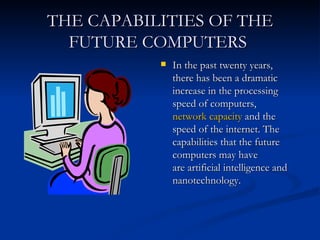
THE CAPABILITIES OF THE FUTURE COMPUTERS   In the past twenty years, there has been a dramatic increase in the processing speed of computers,  network capacity  and the speed of the internet. The capabilities that the future computers may have are artificial intelligence and nanotechnology.
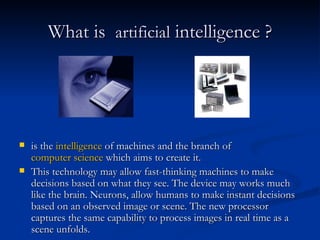
What is   artificial  intelligence ? is the  intelligence  of machines and the branch of  computer science  which aims to create it.  This technology may allow fast-thinking machines to make decisions based on what they see. The device may works much like the brain. Neurons, allow humans to make instant decisions based on an observed image or scene. The new processor captures the same capability to process images in real time as a scene unfolds.
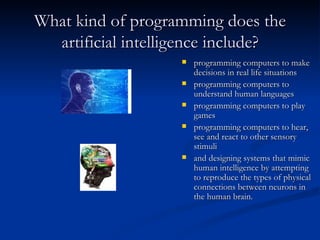
What kind of programming does the artificial intelligence include? programming computers to make decisions in real life situations programming computers to understand human languages programming computers to play games programming computers to hear, see and react to other sensory stimuli  and designing systems that mimic human intelligence by attempting to reproduce the types of physical connections between neurons in the human brain.
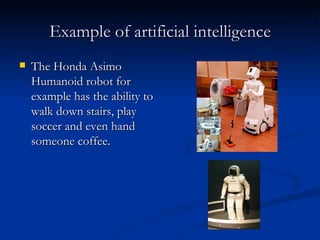
Example of artificial intelligence The Honda Asimo Humanoid robot for example has the ability to walk down stairs, play soccer and even hand someone coffee.
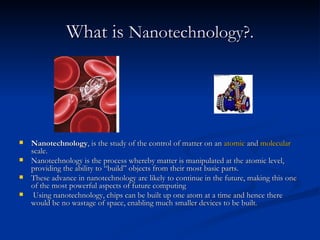
What is  Nanotechnology?.   Nanotechnology , is the study of the control of matter on an  atomic  and  molecular  scale. Nanotechnology is the process whereby matter is manipulated at the atomic level, providing the ability to “build” objects from their most basic parts.  These advance in nanotechnology are likely to continue in the future, making this one of the most powerful aspects of future computing  Using nanotechnology, chips can be built up one atom at a time and hence there would be no wastage of space, enabling much smaller devices to be built .
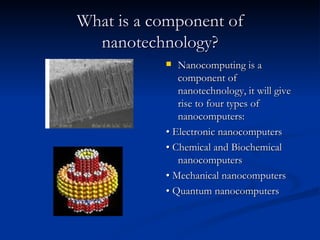
What is a component of nanotechnology? Nanocomputing is a component of nanotechnology, it will give rise to four types of nanocomputers: •  Electronic nanocomputers •  Chemical and Biochemical nanocomputers •  Mechanical nanocomputers •  Quantum nanocomputers
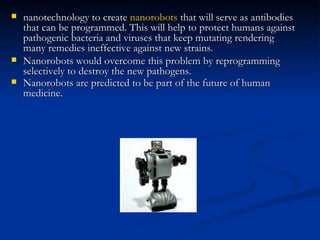
nanotechnology to create  nanorobots  that will serve as antibodies that can be programmed. This will help to protect humans against pathogenic bacteria and viruses that keep mutating rendering many remedies ineffective against new strains.  Nanorobots would overcome this problem by reprogramming selectively to destroy the new pathogens.  Nanorobots are predicted to be part of the future of human medicine.
Works Citation Herzog, Chris The Future of Computer Technology   Nov.26,2006 < http://www.geeks.com/techtips/2006/techtips-26nov06.htm > Innovation  A Computer Like Your Brain Article Image from  Jet Propulsion  <http :// www.futureforall.org/computers/computers.htm >

Future Computers

  • 1.
    Future Computers By:Elvia Gutierrez
  • 2.
    THE CAPABILITIES OFTHE FUTURE COMPUTERS In the past twenty years, there has been a dramatic increase in the processing speed of computers, network capacity and the speed of the internet. The capabilities that the future computers may have are artificial intelligence and nanotechnology.
  • 3.
    What is  artificial intelligence ? is the intelligence of machines and the branch of computer science which aims to create it. This technology may allow fast-thinking machines to make decisions based on what they see. The device may works much like the brain. Neurons, allow humans to make instant decisions based on an observed image or scene. The new processor captures the same capability to process images in real time as a scene unfolds.
  • 4.
    What kind ofprogramming does the artificial intelligence include? programming computers to make decisions in real life situations programming computers to understand human languages programming computers to play games programming computers to hear, see and react to other sensory stimuli and designing systems that mimic human intelligence by attempting to reproduce the types of physical connections between neurons in the human brain.
  • 5.
    Example of artificialintelligence The Honda Asimo Humanoid robot for example has the ability to walk down stairs, play soccer and even hand someone coffee.
  • 6.
    What is Nanotechnology?. Nanotechnology , is the study of the control of matter on an atomic and molecular scale. Nanotechnology is the process whereby matter is manipulated at the atomic level, providing the ability to “build” objects from their most basic parts. These advance in nanotechnology are likely to continue in the future, making this one of the most powerful aspects of future computing Using nanotechnology, chips can be built up one atom at a time and hence there would be no wastage of space, enabling much smaller devices to be built .
  • 7.
    What is acomponent of nanotechnology? Nanocomputing is a component of nanotechnology, it will give rise to four types of nanocomputers: • Electronic nanocomputers • Chemical and Biochemical nanocomputers • Mechanical nanocomputers • Quantum nanocomputers
  • 8.
    nanotechnology to create nanorobots that will serve as antibodies that can be programmed. This will help to protect humans against pathogenic bacteria and viruses that keep mutating rendering many remedies ineffective against new strains. Nanorobots would overcome this problem by reprogramming selectively to destroy the new pathogens. Nanorobots are predicted to be part of the future of human medicine.
  • 9.
    Works Citation Herzog,Chris The Future of Computer Technology Nov.26,2006 < http://www.geeks.com/techtips/2006/techtips-26nov06.htm > Innovation A Computer Like Your Brain Article Image from Jet Propulsion <http :// www.futureforall.org/computers/computers.htm >