Future Agricultures Consortium
A Learning Alliance on African Agricultural Policy

                   An Overview of the Consortium’s
                    Research, Communications and
                     Policy Engagement Activities

                          September 2011

                     www.future-agricultures.org
Future Agricultures Consortium

 Established in 2005….
   “to encourage dialogue and the sharing
   of good practice by policy makers and
   opinion formers in Africa on the role of
   agriculture in broad based growth”
Future Agricultures Consortium
Focus on…
• Producing cutting-edge, policy relevant research
  linking national debates to wider regional
  discussions on the new agricultural agenda in Africa
• Building on solid long-term partnerships adding
  value through synergies and collaboration
• Fostering critical debate on agricultural policy in
  Africa  serving as a communications and
  networking ‘hub’
• Why now? Lack of focus on the political economy
  of agricultural policy processes
X-cutting policy questions
Assuming that effectiveness of policy is a major
determinant of agricultural performance…
• Which agricultural policies get implemented
  (in a particular country ) – and why?
• Why might implementation of a similar policy
  prescription lead to very different outcomes
  across and within countries?
• How does the political economy of agricultural
  policy affect processes and outcomes?
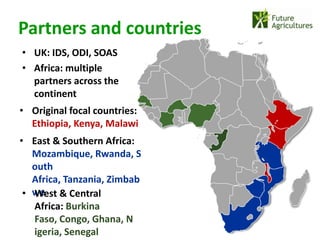
Partners and countries
• UK: IDS, ODI, SOAS
• Africa: multiple
  partners across the
  continent
• Original focal countries:
  Ethiopia, Kenya, Malawi
• East & Southern Africa:
   Mozambique, Rwanda, S
   outh
   Africa, Tanzania, Zimbab
 • we & Central
   West
   Africa: Burkina
   Faso, Congo, Ghana, N
   igeria, Senegal
New phase – 2010-2013
• DFID grant – 3 years to April 2013 – £1.5 mil/yr
• Extending research activities into West Africa
•   Expanding communications and networking activities
•   Convening high-profile, policy-relevant events
•   Strengthening the capacity of young researchers
•   Transferring FAC’s Secretariat to Africa
•   Deepening and broadening core thematic research:
    (1) Policy Processes; (2) Growth & Social Protection;
    (3) Commercialisations; (4) Science, Technology & Innovation
     (5) Climate Change & Agriculture; (6) Land; (7) Pastoralism;
     (8) Young People and Agri-Food Systems
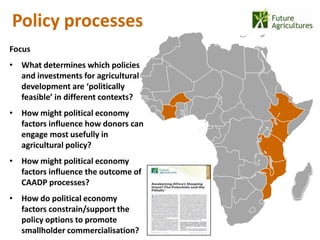
Policy processes
                                     22% 42%
Focus
• What determines which policies
  and investments for agricultural
                                               12%   17%
  development are ‘politically
  feasible’ in different contexts?
• How might political economy
  factors influence how donors can
  engage most usefully in
  agricultural policy?
• How might political economy
  factors influence the outcome of
  CAADP processes?
• How do political economy
  factors constrain/support the
  policy options to promote
  smallholder commercialisation?
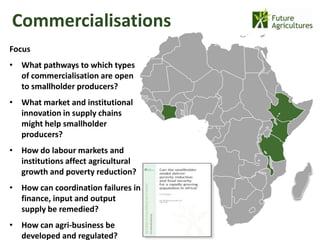
Commercialisations
                                     22% 42%
Focus
• What pathways to which types
  of commercialisation are open
                                               12%   17%
  to smallholder producers?
• What market and institutional
  innovation in supply chains
  might help smallholder
  producers?
• How do labour markets and
  institutions affect agricultural
  growth and poverty reduction?
• How can coordination failures in
  finance, input and output
  supply be remedied?
• How can agri-business be
  developed and regulated?
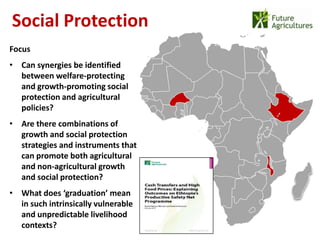
Social Protection
                                     22% 42%
Focus
• Can synergies be identified
  between welfare-protecting
                                               12%   17%
  and growth-promoting social
  protection and agricultural
  policies?
• Are there combinations of
  growth and social protection
  strategies and instruments that
  can promote both agricultural
  and non-agricultural growth
  and social protection?
• What does ‘graduation’ mean
  in such intrinsically vulnerable
  and unpredictable livelihood
  contexts?
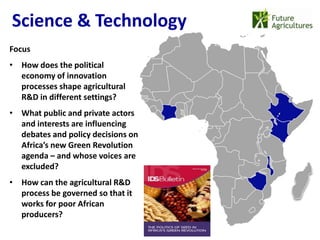
Science & Technology
                                    22% 42%
Focus
• How does the political
  economy of innovation
                                              12%   17%
  processes shape agricultural
  R&D in different settings?
• What public and private actors
  and interests are influencing
  debates and policy decisions on
  Africa’s new Green Revolution
  agenda – and whose voices are
  excluded?
• How can the agricultural R&D
  process be governed so that it
  works for poor African
  producers?
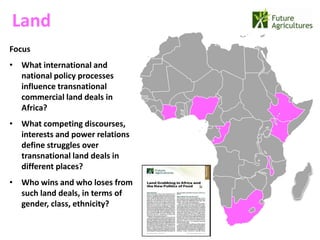
Land
                                  22% 42%
Focus
• What international and
  national policy processes
                                            12%   17%
  influence transnational
  commercial land deals in
  Africa?
• What competing discourses,
  interests and power relations
  define struggles over
  transnational land deals in
  different places?
• Who wins and who loses from
  such land deals, in terms of
  gender, class, ethnicity?
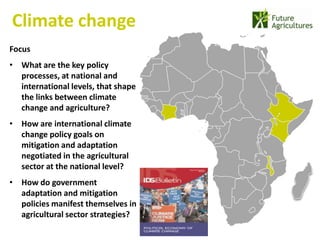
Climate change
                                     22% 42%
Focus
• What are the key policy
  processes, at national and
                                               12%   17%
  international levels, that shape
  the links between climate
  change and agriculture?
• How are international climate
  change policy goals on
  mitigation and adaptation
  negotiated in the agricultural
  sector at the national level?
• How do government
  adaptation and mitigation
  policies manifest themselves in
  agricultural sector strategies?
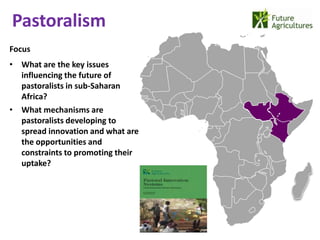
Pastoralism
                                   22% 42%
Focus
• What are the key issues
  influencing the future of
                                             12%   17%
  pastoralists in sub-Saharan
  Africa?
• What mechanisms are
  pastoralists developing to
  spread innovation and what are
  the opportunities and
  constraints to promoting their
  uptake?
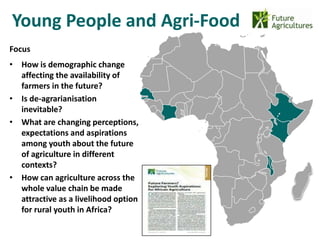
Young People and Agri-Food
                                      22% 42%
Focus
• How is demographic change
  affecting the availability of
                                                12%   17%
  farmers in the future?
• Is de-agrarianisation
  inevitable?
• What are changing perceptions,
  expectations and aspirations
  among youth about the future
  of agriculture in different
  contexts?
• How can agriculture across the
  whole value chain be made
  attractive as a livelihood option
  for rural youth in Africa?
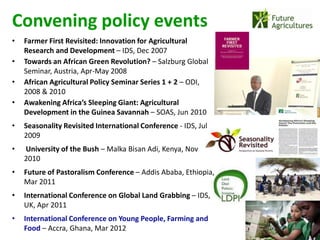
Convening policy events
•   Farmer First Revisited: Innovation for Agricultural
    Research and Development – IDS, Dec 2007
•   Towards an African Green Revolution? – Salzburg Global
    Seminar, Austria, Apr-May 2008
•   African Agricultural Policy Seminar Series 1 + 2 – ODI,
    2008 & 2010
•   Awakening Africa’s Sleeping Giant: Agricultural
    Development in the Guinea Savannah – SOAS, Jun 2010
•   Seasonality Revisited International Conference - IDS, Jul
    2009
•   University of the Bush – Malka Bisan Adi, Kenya, Nov
    2010
•   Future of Pastoralism Conference – Addis Ababa, Ethiopia,
    Mar 2011
•   International Conference on Global Land Grabbing – IDS,
    UK, Apr 2011
•   International Conference on Young People, Farming and
    Food – Accra, Ghana, Mar 2012
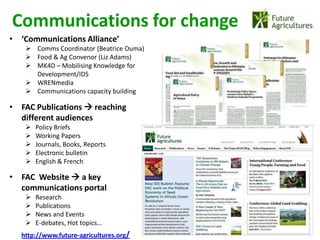
Communications for change
• ‘Communications Alliance’
    Comms Coordinator (Beatrice Ouma)
    Food & Ag Convenor (Liz Adams)
    MK4D – Mobilising Knowledge for
     Development/IDS
    WRENmedia
    Communications capacity building

• FAC Publications  reaching
  different audiences
      Policy Briefs
      Working Papers
      Journals, Books, Reports
      Electronic bulletin
      English & French

• FAC Website  a key
  communications portal
      Research
      Publications
      News and Events
      E-debates, Hot topics…
  http://www.future-agricultures.org/
Coordination & governance
• Secretariat – IDS  Joint Coordinators (John Thompson and Ian
  Scoones); W Africa (Jim Sumberg); admin and budgets (Oliver Burch)
• Research Coordination - decentralised Theme Convenors oversee all
  8 research themes - each follows a detailed annual workplan
• Country Coordination  selected focal countries
• Annual General Meeting  the key decision-making forum
• Regular reporting to DFID  meetings; formal reports against
  logframe
• CAADP Engagement  CAADP Coordinator (Sam Asuming Brempong)
  + Consultant (Kate Wellard Dyer)
• Gender and Social Analysis  x-cutting focus (Christine Okali)
• Development of FAC Africa Plan  Institutionalisation Commission (6
  person team; Ephraim Chirwa, Chair)
Why FAC Africa?
• In April 2013, Future Agricultures is aiming to transfer
  its Secretariat to an African base
• A detailed review of possible locations, governance
  arrangements and partnership options is under way
• Our vision is to create…
     a vibrant, African-led research consortium capable of
     providing high-quality, independent advice and
     information based on solid evidence and cutting-
     edge, comparative analysis to inform and influence
     the design and implementation of national and
     regional policy processes which will enhance growth,
     reduce poverty and regenerate agriculture
Thank you
         Further information:

             Beatrice Ouma
    B.Ouma@future-agricultures.org
Communications and Networking Coordinator,
     Future Agricultures Consortium


http://www.future-agricultures.org/

Future Agricultures Consortium overview Sept 2011

  • 1.
    Future Agricultures Consortium ALearning Alliance on African Agricultural Policy An Overview of the Consortium’s Research, Communications and Policy Engagement Activities September 2011 www.future-agricultures.org
  • 2.
    Future Agricultures Consortium Established in 2005…. “to encourage dialogue and the sharing of good practice by policy makers and opinion formers in Africa on the role of agriculture in broad based growth”
  • 3.
    Future Agricultures Consortium Focuson… • Producing cutting-edge, policy relevant research linking national debates to wider regional discussions on the new agricultural agenda in Africa • Building on solid long-term partnerships adding value through synergies and collaboration • Fostering critical debate on agricultural policy in Africa  serving as a communications and networking ‘hub’ • Why now? Lack of focus on the political economy of agricultural policy processes
  • 4.
    X-cutting policy questions Assumingthat effectiveness of policy is a major determinant of agricultural performance… • Which agricultural policies get implemented (in a particular country ) – and why? • Why might implementation of a similar policy prescription lead to very different outcomes across and within countries? • How does the political economy of agricultural policy affect processes and outcomes?
  • 5.
    Partners and countries •UK: IDS, ODI, SOAS • Africa: multiple partners across the continent • Original focal countries: Ethiopia, Kenya, Malawi • East & Southern Africa: Mozambique, Rwanda, S outh Africa, Tanzania, Zimbab • we & Central West Africa: Burkina Faso, Congo, Ghana, N igeria, Senegal
  • 6.
    New phase –2010-2013 • DFID grant – 3 years to April 2013 – £1.5 mil/yr • Extending research activities into West Africa • Expanding communications and networking activities • Convening high-profile, policy-relevant events • Strengthening the capacity of young researchers • Transferring FAC’s Secretariat to Africa • Deepening and broadening core thematic research: (1) Policy Processes; (2) Growth & Social Protection; (3) Commercialisations; (4) Science, Technology & Innovation (5) Climate Change & Agriculture; (6) Land; (7) Pastoralism; (8) Young People and Agri-Food Systems
  • 7.
    Policy processes 22% 42% Focus • What determines which policies and investments for agricultural 12% 17% development are ‘politically feasible’ in different contexts? • How might political economy factors influence how donors can engage most usefully in agricultural policy? • How might political economy factors influence the outcome of CAADP processes? • How do political economy factors constrain/support the policy options to promote smallholder commercialisation?
  • 8.
    Commercialisations 22% 42% Focus • What pathways to which types of commercialisation are open 12% 17% to smallholder producers? • What market and institutional innovation in supply chains might help smallholder producers? • How do labour markets and institutions affect agricultural growth and poverty reduction? • How can coordination failures in finance, input and output supply be remedied? • How can agri-business be developed and regulated?
  • 9.
    Social Protection 22% 42% Focus • Can synergies be identified between welfare-protecting 12% 17% and growth-promoting social protection and agricultural policies? • Are there combinations of growth and social protection strategies and instruments that can promote both agricultural and non-agricultural growth and social protection? • What does ‘graduation’ mean in such intrinsically vulnerable and unpredictable livelihood contexts?
  • 10.
    Science & Technology 22% 42% Focus • How does the political economy of innovation 12% 17% processes shape agricultural R&D in different settings? • What public and private actors and interests are influencing debates and policy decisions on Africa’s new Green Revolution agenda – and whose voices are excluded? • How can the agricultural R&D process be governed so that it works for poor African producers?
  • 11.
    Land 22% 42% Focus • What international and national policy processes 12% 17% influence transnational commercial land deals in Africa? • What competing discourses, interests and power relations define struggles over transnational land deals in different places? • Who wins and who loses from such land deals, in terms of gender, class, ethnicity?
  • 12.
    Climate change 22% 42% Focus • What are the key policy processes, at national and 12% 17% international levels, that shape the links between climate change and agriculture? • How are international climate change policy goals on mitigation and adaptation negotiated in the agricultural sector at the national level? • How do government adaptation and mitigation policies manifest themselves in agricultural sector strategies?
  • 13.
    Pastoralism 22% 42% Focus • What are the key issues influencing the future of 12% 17% pastoralists in sub-Saharan Africa? • What mechanisms are pastoralists developing to spread innovation and what are the opportunities and constraints to promoting their uptake?
  • 14.
    Young People andAgri-Food 22% 42% Focus • How is demographic change affecting the availability of 12% 17% farmers in the future? • Is de-agrarianisation inevitable? • What are changing perceptions, expectations and aspirations among youth about the future of agriculture in different contexts? • How can agriculture across the whole value chain be made attractive as a livelihood option for rural youth in Africa?
  • 15.
    Convening policy events • Farmer First Revisited: Innovation for Agricultural Research and Development – IDS, Dec 2007 • Towards an African Green Revolution? – Salzburg Global Seminar, Austria, Apr-May 2008 • African Agricultural Policy Seminar Series 1 + 2 – ODI, 2008 & 2010 • Awakening Africa’s Sleeping Giant: Agricultural Development in the Guinea Savannah – SOAS, Jun 2010 • Seasonality Revisited International Conference - IDS, Jul 2009 • University of the Bush – Malka Bisan Adi, Kenya, Nov 2010 • Future of Pastoralism Conference – Addis Ababa, Ethiopia, Mar 2011 • International Conference on Global Land Grabbing – IDS, UK, Apr 2011 • International Conference on Young People, Farming and Food – Accra, Ghana, Mar 2012
  • 16.
    Communications for change •‘Communications Alliance’  Comms Coordinator (Beatrice Ouma)  Food & Ag Convenor (Liz Adams)  MK4D – Mobilising Knowledge for Development/IDS  WRENmedia  Communications capacity building • FAC Publications  reaching different audiences  Policy Briefs  Working Papers  Journals, Books, Reports  Electronic bulletin  English & French • FAC Website  a key communications portal  Research  Publications  News and Events  E-debates, Hot topics… http://www.future-agricultures.org/
  • 17.
    Coordination & governance •Secretariat – IDS  Joint Coordinators (John Thompson and Ian Scoones); W Africa (Jim Sumberg); admin and budgets (Oliver Burch) • Research Coordination - decentralised Theme Convenors oversee all 8 research themes - each follows a detailed annual workplan • Country Coordination  selected focal countries • Annual General Meeting  the key decision-making forum • Regular reporting to DFID  meetings; formal reports against logframe • CAADP Engagement  CAADP Coordinator (Sam Asuming Brempong) + Consultant (Kate Wellard Dyer) • Gender and Social Analysis  x-cutting focus (Christine Okali) • Development of FAC Africa Plan  Institutionalisation Commission (6 person team; Ephraim Chirwa, Chair)
  • 18.
    Why FAC Africa? •In April 2013, Future Agricultures is aiming to transfer its Secretariat to an African base • A detailed review of possible locations, governance arrangements and partnership options is under way • Our vision is to create… a vibrant, African-led research consortium capable of providing high-quality, independent advice and information based on solid evidence and cutting- edge, comparative analysis to inform and influence the design and implementation of national and regional policy processes which will enhance growth, reduce poverty and regenerate agriculture
  • 19.
    Thank you Further information: Beatrice Ouma B.Ouma@future-agricultures.org Communications and Networking Coordinator, Future Agricultures Consortium http://www.future-agricultures.org/