2020 Discussion Paper 38 
Development Strategies 
and Food and Nutrition 
Security in Africa 
An Assessment 
Franz Heidhues 
Achi Atsain 
Hezron Nyangito 
Martine Padilla 
Gérard Ghersi 
Jean-Charles Le Vallée 
International Food Policy Research Institute 
2033 K Street, NW 
Washington, DC 20006–1002 USA 
December 2004
Copyright © 2004 International Food Policy Research Institute. All rights reserved. 
Sections of this report may be reproduced without the express permission of but 
with acknowledgment to the International Food Policy Research Institute. Contact 
ifpri-copyright@cgiar.org for permission to reprint. 
ISBN 0-89629-651-2
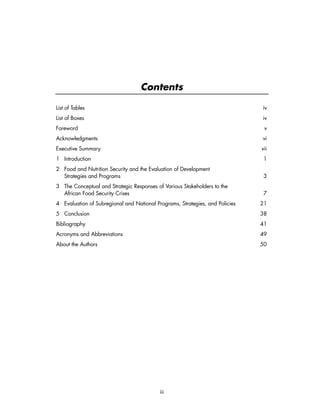
Contents 
List of Tables iv 
List of Boxes iv 
Foreword v 
Acknowledgments vi 
Executive Summary vii 
1 Introduction 1 
2 Food and Nutrition Security and the Evaluation of Development 
Strategies and Programs 3 
3 The Conceptual and Strategic Responses of Various Stakeholders to the 
African Food Security Crises 7 
4 Evaluation of Subregional and National Programs, Strategies, and Policies 21 
5 Conclusion 38 
Bibliography 41 
Acronyms and Abbreviations 49 
About the Authors 50 
iii
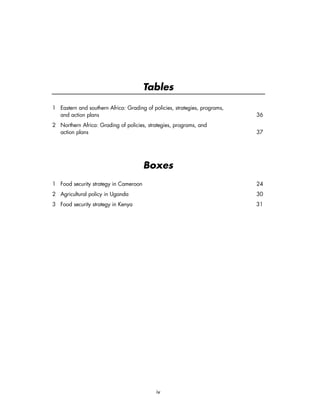
Tables 
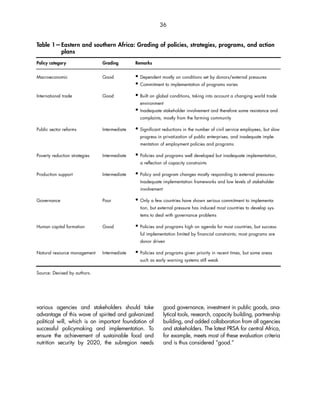
1 Eastern and southern Africa: Grading of policies, strategies, programs, 
and action plans 36 
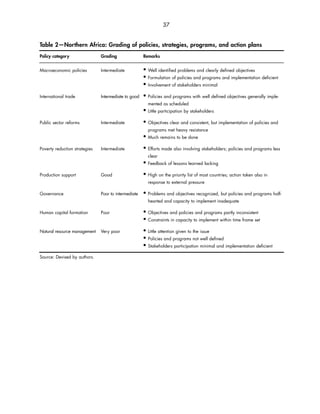
2 Northern Africa: Grading of policies, strategies, programs, and 
action plans 37 
Boxes 
1 Food security strategy in Cameroon 24 
2 Agricultural policy in Uganda 30 
3 Food security strategy in Kenya 31 
iv
Momentum is building in and around Africa today for policy action to decisively confront 
hunger and malnutrition. If we are to succeed, it is vital that food and nutrition security strate-gies 
be both sound and able to be implemented. Ultimately, strategies deficient in either of 
these two areas will be ineffectual. Lessons from past strategies provide a valuable resource 
in the design of future strategies, yet there is a dearth of programmatic information and rig-orous 
evaluations of the approaches used in the past. 
With this in mind, the authors of this 2020 discussion paper—Franz Heidhues, Achi 
Atsain, Hezron Nyangito, Martine Padilla, Gérard Ghersi, and Jean-Charles Le Vallée— 
review the multitude of approaches and strategies for achieving food and nutrition security in 
Africa within the context of development over the past four decades. They assess the extent 
to which these plans have been implemented and identify the key constraints and limitations, 
along with the priority investments needed for more effective design and implementation in 
the future. 
This paper was commissioned for the IFPRI 2020 Africa Conference, “Assuring Food and 
Nutrition Security in Africa by 2020: Prioritizing Actions, Strengthening Actors, and 
Facilitating Partnerships,” which was held in Kampala, Uganda, from April 1 to April 3, 
2004. There, the lessons learned from decades of successes and failures in designing and 
implementing strategies in and for Africa contributed to an informed and informative discus-sion 
of how to improve the implementation of action to end hunger and malnutrition. We 
thank the authors for setting the stage for the systematic examination of these extremely impor-tant 
issues and hope that this paper is only the beginning of such endeavors. 
v 
Joachim von Braun 
Director General, IFPRI 
Foreword
Acknowledgments 
The authors gratefully acknowledge the research support provided by Helene Heyd of the 
University of Hohenheim, Germany. They also thank three anonymous reviewers for valuable 
comments, as well as the editors for their input. Rajul Pandya-Lorch provided overall guidance 
as the head of IFPRI’s 2020 Vision Initiative and the organizer of the 2020 Africa Conference. 
vi
Executive Summary 
Numerous strategies, policies, and programs intended to assist Africa’s development have 
been conceived and implemented by international bodies, regional and subregional groups, 
and national institutions. On average, a typical developing country in Africa is assisted by 
about 30 aid institutions to implement these strategies, yet Africa is still far from achieving 
food and nutrition security. This paper examines whether those strategies and policies fit the 
goal of achieving food and nutrition security, how they were implemented, and why the results 
have been so variable and often lacking. Further, this paper considers the lessons of these 
projects in terms of strategy formulation and implementation, and how they can be used to 
effectively and sustainably reduce hunger and malnutrition. 
The implementation of a strategy requires its clear formulation, a conducive policy and 
institutional environment, a widely shared consensus about the strategy and its measures, the 
human capacity for implementation, and sufficient financial resources. In order to evaluate a 
strategy in detail, it is necessary to address the following issues: 
 Have key issues been clearly identified, properly analyzed, and located within their polit-ical, 
economic, and sociocultural contexts? 
 Are objectives clearly defined, internally consistent, and formulated realistically, and have 
possible conflicts between the objectives been identified and trade-offs between them 
been addressed? 
 Are policies and programs for achieving these objectives appropriate to, congruent with, 
and supportive of, the strategy? 
 Is the capacity to implement the strategy available—that is, are there sufficient financial 
resources, the necessary human capacity, the requisite institutional framework, and ade-quate 
vii 
infrastructure? 
 Has the time required for implementation been estimated realistically, taking into account 
the demands of institution building, education, and training? 
 Have all stakeholders been included in the process of strategy development, and, in par-ticular, 
have they been involved in identifying priorities, defining objectives, and in plan-ning 
and implementing the strategy? 
 Have the lessons of past experiences of development strategy implementation been taken 
into account? 
In the two decades after most African countries became independent in the early 1960s 
there were high hopes for rapid development, and much was achieved. The overall economic 
growth in Sub-Saharan Africa averaged 3.4 percent per year between 1961 and 1980. 
Agricultural development contributed enormously to overall growth and was crucial to the 
gains achieved in food and nutrition security. But by the end of the 1970s, the major social 
and economic indicators for African countries began to decline. Agricultural production 
dropped, resulting in massive food imports. The output of both industry and manufacturing
viii 
also declined. Adverse terms of trade, the oil crisis, and the slump in the world economy exac-erbated 
these negative trends in African economies. At the same time, domestic problems 
threatened the stability of many African state institutions and even the existence of some states. 
There were widespread coups d’état, civil strife, and ethnic violence. 
Two early responses to these African socioeconomic development crises were the Lagos 
Plan of Action (LPA) and the Regional Food Plan for Africa (AFPLAN). These started from the 
premise that, given the limited size and capacity of the private sector, the states had to take 
on the dominant role in development. Thus governments drew up comprehensive five-year 
plans, invested in large state-run basic industries and market structures, and enacted perva-sive 
regulations to control prices, restrict trade, and allocate credit and foreign exchange, all 
generally carried out with full donor support. Publicly funded programs in support of agricul-tural 
research and extension, fertilizer supply, export production and marketing, and food dis-tribution 
were the essential components of this approach. 
When by 1980 it had become apparent that Africa’s crisis was deepening, the World 
Bank and IMF argued that a fundamental shift in approach was needed to stabilize African 
economies, increase efficiency of investment, and reinvigorate growth. Their new concept of 
structural adjustment programs (SAPs) implied a move away from state-dominated develop-ment 
to reliance on the private sector. . Food and nutrition security were addressed only indi-rectly 
in these programs through the aims of improved economic stability and higher eco-nomic 
growth. 
In response to concerns about the deleterious impact of SAPs on health services, educa-tion, 
infrastructure, rural support institutions, and employment, all of which had particularly 
affected Africa’s poor, the approach of the World Bank and donor community shifted, return-ing 
to a more balanced treatment of state and private sector functions in development, while 
at the same time maintaining the emphasis on efficiency in resource allocation. The 
Comprehensive Development Framework (CDF) and the Poverty Reduction Strategy Paper 
(PRSP) both emphasized the need to integrate cultural, social, political, and environmental 
considerations into development strategies, and to apply these considerations to reducing 
poverty and creating a framework for pro-poor growth. Each process was intended to be led 
by the countries concerned, and to be based on the partnership and participation of all stake-holders 
at the national, regional, and local levels. The emphasis on poverty in the CDF/PRSP 
concept implies that agricultural and rural development were envisioned as playing vitally 
important roles. 
Building on the CDF/PRSP process, African leaders at the turn of the century developed 
the New Partnership for Africa’s Development (NEPAD). This approach intended to combine 
African initiatives and ownership of the development process with neoliberal concepts. 
NEPAD supports liberalization and globalization but emphasizes that these processes need 
to be fair and accompanied by a leveling of the playing field for international trade. By 
accepting NEPAD’s policy framework, African leaders jointly took responsibility for eradicat-ing 
poverty and placing their countries, both individually and collectively, on the path of sus-tainable 
development and growth. Furthermore, they committed their countries to people-cen-tered 
participatory development processes. The NEPAD strategy seeks to produce agriculture-led 
development that eliminates hunger and reduces poverty as well as food insecurity. 
SAPs and PRSPs have shaped regional approaches and country policies and their imple-mentation 
throughout Africa. A significant number of African countries have carried out suc-cessful 
programs of macroeconomic stabilization and structural reform. Reforms and retrench-ment 
of the public sector have been carried out in numerous countries, although often at the
ix 
costs of increasing unemployment—and thus vulnerability to food and nutrition insecurity— 
and a decline in public services, even in essential areas such as health, education, and 
research and extension. International trade has been liberalized in many countries, and 
parastatal marketing boards no longer enjoy market monopolies. A major issue in most 
African countries remains the failure of the weak private sector in taking up the functions once 
performed by government marketing monopolies. A further key problem is the unevenness of 
the playing field in international trade, with the EU, Japan, and United States continuing to 
protect their markets against imports from developing countries, including those in Africa. 
Many countries have formulated poverty reduction policies, with an increased emphasis 
on agricultural development. More progress is needed in key areas, however, such as in 
reducing social and economic discrimination against women, particularly in improving 
their access to land, credit, and input and output markets, and in fostering the education of 
girls. Similarly, in areas such as employment creation, natural resource protection, and gov-ernance 
reform, some countries have initiated encouraging measures, but much more 
progress is needed. The most successful reformers have been countries without war or civil 
unrest, and with reform processes characterized by strong political leadership and a com-mitment 
to reforms with wide domestic participation and ownership. This review makes it clear 
that peace and security are prerequisites for development and thus for poverty reduction. In 
countries that have been plagued by conflict and war, development has been pushed back 
by years, if not decades. 
Political will and the commitment to reform within a framework of good governance are 
crucial features of successful reform and development. Experience has also shown that reform 
processes are most successful with the wide involvement and participation of people at all 
levels of society and across different organizations and social groups. For poverty reduction 
in particular, civil society and private sector groups representing the poor need to be included 
in the consultation, decisionmaking, and implementation process. 
Capacity building must be a high priority. The very recent and still patchy experience 
of African countries with PRSP implementation demonstrates that capacity building requires 
more attention and more resources. Capacity and competence are required at all levels of 
African administration. 
Agriculture should be returned to the top of the development agenda. The priority given 
to agriculture and water in NEPAD and the Maputo 2003 Declaration of the Heads of States 
of the African Union is encouraging in this respect. It is essential for the World Bank and bilat-eral 
donors to follow the lead of African states and support agricultural development. 
Prioritizing agriculture cannot be achieved without making additional resources available to 
these programs. Countries must act on the Maputo Declaration’s target of allocating 10 per-cent 
of each country’s budget to agriculture. 
Governments and donors face a joint challenge to achieve greater cohesion in their 
approaches to the various strategies promoted by, and the requirements of, the international 
community. For example, monitoring poverty reduction in a given country is important within 
the PRSP process, but care needs to be taken not to overburden that country’s capacity and 
institutions. Too often, donors have instituted reporting and monitoring requirements that place 
their internal institutional needs ahead of the needs of the recipient country. Donors need to 
agree on a coordinated and unified monitoring and evaluation system that serves primarily 
to improve policy implementation in recipient countries. 
Adequate attention must be devoted to micro-level activities. The project approach domi-nated 
the development scene in Africa until the 1980s, but its limitations in nonconducive
x 
policy environments soon became obvious. Deficiencies in project environments resulted in a 
180-degree shift in approach toward lending for policy programs, as opposed to extending 
loans for projects. This forced the private sectors of the targeted countries to take up micro-level 
activities. Correcting policy environments and strengthening institutional frameworks 
were necessary aims and remain a high priority, but development only occurs if investment, 
innovation, and action are carried out on farms, in households, and in villages. This means 
that development strategists must reaffirm the value of the project approach. 
Finally, the design and implementation of good policies, as emphasized repeatedly in this 
review, are dependent on clear, relevant, and consistent policy objectives, financial resource 
availability, and human and institutional capacity. Even under these ideal circumstances, these 
processes often involve risks to the political and social stability of targeted countries. The 
speed of reform and the implementation of policies and programs must be appropriate to 
each country’s political and social absorptive capacity.
1. Introduction 
Most African countries became independent in the 
1960s. The relatively positive socioeconomic per-formances 
of African countries during the “post-independence 
boom” years were followed by 
downturns, which continue in some countries to the 
present date. The downturns in 1973 and 1974 
were principally due to the overall deterioration of 
international economic conditions as a result of the 
first oil crisis. Two fundamentally different approach-es 
to furthering Africa’s development emerged in 
the late 1970s and the early 1980s and were pur-sued 
simultaneously; all subsequent initiatives 
emerged from these two positions. 
The first position was that held by the 
Organization of African Unity (OAU) and was used 
to formulate the strategies that made up the Lagos 
Plan of Action (LPA) and the Regional Food Plan for 
Africa (AFPLAN). This position perceived Africa’s 
colonial heritage and continued dependence on 
western donors as the main problems besetting 
future development. Thus the LPA emphasized dis-association 
from western donors and concentration 
on self-centered development, with each country 
orienting production toward its own markets. 
Development aid was seen as rightful compensation 
for colonial injustices. Programs formulated subse-quently, 
such as the African Priority Program for 
Economic Recovery (APPER, 1986–90), followed a 
similar line, while also recognizing internal institu-tional 
and policy deficiencies. 
The second position was based on the neolib-eral 
understanding of economic development and 
was typically held by donors and international insti-tutions 
(such as the World Bank and the 
International Monetary Fund [IMF]). This position 
took concrete form in the structural adjustment pro-grams 
(SAPs), with their emphasis on macroeco-nomic 
stability, elimination of market distortions, 
subsidies, and price controls, liberalization of trade 
and exchange transactions, reduction of govern-ment 
and elimination of parastatal activities, and 
encouragement of the private sector. 
When the weaknesses of the SAP approach— 
such as the resulting social disruption, worsening 
income distribution, unemployment, and anti-poor 
biases inherent in public sector retrenchment, and 
its short-term orientation—became increasingly 
apparent in the 1990s, the World Bank extended 
the SAP framework to include a “social dimension.” 
This led to the World Bank conceptualizing a more 
holistic approach, the Comprehensive Development 
Framework (CDF), which tries to involve all stake-holders 
in the development process and to integrate 
economic, social, political, cultural, and environ-mental 
needs. This new approach focuses on pover-ty 
reduction and emphasizes each country’s owner-ship 
of its national, regional, and local government, 
civil society, and private sector. Transparency, 
accountability, and the monitoring and evaluation 
of performance of societal institutions are also 
emphasized. This strategy was integrated into the 
poverty reduction strategy paper (PRSP) process for 
each individual country—a participatory process 
whereby countries outline a strategy, including spe-cific 
policies for reducing poverty, restoring macro-economic 
equilibrium, and establishing a frame-work 
conducive to pro-poor growth. PRSPs also link 
the CDF to the Highly Indebted Poor Countries 
(HIPC) initiative. 
An initiative known as the New Partnership for 
Africa’s Development (NEPAD) was started by 
African leaders in 1999, and builds on the CDF by 
combining African initiatives and program owner-ship 
with neoliberal concepts. NEPAD supports lib-eralization 
and globalization but emphasizes that 
these processes need to be fair and simultaneous 
1
with the leveling of the international trade playing 
field. It calls on African leaders and governments to 
improve governance, eliminate corruption, facilitate 
the creation of democratic structures and processes, 
encourage a free press, and establish an inde-pendent, 
fair, and reliable judicial system. It also re-emphasizes 
that agriculture and rural development 
are crucial to poverty reduction and food and nutri-tion 
security. NEPAD enjoys strong support from the 
international donor community. 
These positions on development have informed 
all African socioeconomic development programs 
and have had different impacts. This paper focuses 
on food and nutrition security developments in 
Africa with an emphasis on a review of the strate-gies 
and programs that have been used and their 
implementation statuses, with the aim of drawing 
lessons from them in order to deal with the present-day 
food and nutrition crisis in Africa. We examine 
the following questions, among others: What strate-gies, 
policies, and programs have addressed or 
were intended to address the crisis? To what extent 
have individual countries in the region adopted 
them? And, to what extent were they implemented? 
Given the multitude of strategies, policies, and 
approaches; the large number of countries in Africa, 
each with its own cultural heritage; and the diversi-ty 
of ecological, economic, sociocultural, and polit-ical 
conditions and traditions, this paper does not 
aim to be comprehensive. We have instead chosen 
to focus on those countries and strategies that best 
illustrate what has been learned about strategy for-mulation 
and implementation, with a view to pro-viding 
policymakers and development agencies 
2 
with input that may help them to avoid repeating 
the ineffective policies of the past and to improve 
policy design and implementation in the future. 
The paper is organized as follows: Chapter 1 
outlines how the different paradigms have influ-enced 
the formulation of strategies for overall 
socioeconomic development. Chapter 2 reviews the 
evolution of the concept of food security from its 
food production focus in the 1970s to the current 
broader concept of food and nutrition security with-in 
the overall livelihood context. It also outlines a 
framework for evaluating development strategies. 
Development strategies emerge from particular his-torical 
contexts, so to understand today’s strategies 
we need to review their evolution within their par-ticular 
ecological, political, and socioeconomic 
contexts and to elucidate how and why attitudes to 
development have changed over time. Chapter 3 
applies this approach to food and nutrition strate-gies, 
and reviews from a continental perspective the 
strategies, policies, and programs formulated by 
international institutions and regional organiza-tions. 
A summary of the adoption and implementa-tion 
in Africa of these strategies and programs, with 
a particular focus on their food and nutrition securi-ty 
implications, is presented in Chapter 4. Finally, 
Chapter 5 presents the conclusions of our review, 
which draw on both the successes and failures of 
development strategies and their implementation.
2. Food and Nutrition Security and 
the Evaluation of Development 
Strategies and Programs 
3 
Background 
Food security is now defined as the situation “when 
all people, at all times, have physical and econom-ical 
access to sufficient, safe and nutritious food for 
a healthy and active life” (FAO 1996). However, 
this term has gone through stages of definition and 
redefinition; approaches to its definition have 
ranged from an emphasis on self-sufficiency to an 
emphasis on coping with vulnerability and risk in 
food and nutrition access. In the 1970s, food secu-rity 
was equated to adequate food production. In 
the 1980s, food security was considered to refer to 
the security of food access and availability. In the 
1990s, the importance of nutrition was recognized, 
and hence the concept of food security was com-bined 
with that of nutrition security. In the 2000s, 
the concepts of food and nutrition security were inte-grated 
with vulnerability, risk coping, and risk man-agement 
considerations. 
Much of the recent discussion of food security 
has revolved around the following major topics 
(ODI 2002): 
 What are the links between food availability, 
access, and nutrition, given that food availabil-ity 
does not ensure nutritional well-being? 
 What implications do the new challenges to 
Africa—notably globalization, rapid urbaniza-tion, 
market liberalization, health and HIV/ 
AIDS, and biotechnology—have for the food-security 
agenda? 
 Does food security remain a useful concept for 
the discussion of development assistance and 
national policies, given the new approaches 
coming to the fore (for example, livelihoods 
analysis) and the current focus of donors on 
poverty reduction? 
 Does food aid still have an important role in 
supporting food security, and how can it be 
shaped to support long-term food security? 
Recognizing the distinction between food and 
nutrition security as well as the links between the two 
concepts is imperative for the success of na-tional 
development strategies (Benson 2004). The 
secure access to food that is necessary for food secu-rity 
must be complemented with access to health 
services, education, sanitary environments, and safe 
water sources, among other resources, to achieve 
nutrition security. A much more comprehensive 
developmental approach is thus required to ensure 
that all groups in a population achieve both food 
and nutrition security. The following research find-ings 
on the links between food availability, food ac-cess, 
and nutritional well-being are relevant to Africa: 
 Women’s education has accounted for over 
40 percent of the reduction in malnutrition over 
the past 25 years because of its strong influ-ence 
on child nutrition. Other major factors are 
improvements in per capita food availability 
(25 percent), health, environment, and women’s 
status (Smith and Haddad 2000). About 26 per-cent 
of the hungry have caloric intakes so low 
that they are unable to work or care for them-selves 
(Millennium Project 2003). 
 How food is made available is just as important 
as the overall supply. Strategies to boost nation-al 
food production only improve food access 
if they raise the incomes of large numbers of 
rural farm and nonfarm households and re-duce 
the consumer prices of food, particularly 
for net buyers. 
 Agricultural market reform may improve the 
food security of poor consumers by improving
the private production, distribution, and pro-cessing 
of the types of foods consumed by them. 
 A higher household income does not always 
translate into more and better food for all fam-ily 
members. If women control the household in-come, 
otherwise undernourished children are 
likely to benefit. 
Food security is increasingly though not univer-sally 
treated as a basic human right. The inter-twined 
relationships between food security, poverty, 
and development have moved to the forefront on 
current thinking about food security, as has the 
recognition that long-term food security is a function 
of current policies and actions, such as develop-ment 
strategies, macroeconomic policies, trade and 
exchange rate policies, research and innovation 
policies, and modifications to institutions and infra-structure. 
More specifically, it remains vitally impor-tant 
to raise food production, create employment, 
and improve the institutional and policy framework 
for agriculture, as well as to rehabilitate and ex-pand 
physical and social infrastructure in rural 
areas, all of which require increased and sustained 
investment and support for agriculture. 
Typology of Food-Insecure 
Households and Measurement 
Issues 
To develop a strategy for reducing hunger and 
undernutrition, the Millennium Development Goals 
(MDG) Hunger Task Force has broadly distin-guished 
four major groups of food-insecure house-holds 
and thus of highly vulnerable individuals by 
their principal means of securing food. While many 
households have multiple means of obtaining food, 
the typology focuses on their principal strategies, 
identifying the following four groups (with a rough 
approximation of their relative size): 
1. Farming households (50 percent of the food-insecure) 
2. Rural landless and nonfarm households (22 per-cent 
of the food-insecure) 
3. Urban households (20 percent of the food-insecure) 
4. Herding, fishing, and forest-dependent house-holds 
(8 percent of the food-insecure) 
Measuring food and nutrition insecurity is a 
4 
multidimensional problem that requires accounting 
for both short- and long-term food and nutrition inse-curity, 
as well as considering chronic, transitory, 
and periodic food and nutrition insecurity. 
Measures of household food and nutrition security, 
such as those based on surveys of dietary intake, 
must be compared with adequacy norms. Finally, 
the use of potential substitute indicators such as real 
wage rates, employment, price ratios, migration 
flows, changes in consumption structure, incidence 
of illness, and so forth may be appropriate at times. 
Policy Challenges 
Guaranteeing food and nutrition security at the 
micro level requires policymakers to go beyond the 
question of physical access at the national level, 
that is, whether there is sufficient food at the nation-al 
level to feed all people. A number of considera-tions 
are required, including the following: 
 Physical access at the local level—making sure 
food is available in local markets and in local 
fields; 
 Economic access—addressing the question of 
whether households can afford to purchase the 
food items they need for food and nutrition 
security; 
 Social access—promoting adequate access to 
food for all household members; 
 Food quality and safety—ensuring food of suf-ficient 
diversity and safety to promote good 
health; 
 Proper physiological access—providing high-quality 
care and good health and sanitation 
environments so that ingested nutritious food 
results in healthy growth and development; 
 Low risk of loss of access—providing institu-tional 
set-ups that enable households to absorb 
and manage shocks, cycles, and seasonality, 
and reduce their vulnerability; and 
 Access to food as a human right—promoting 
the capacity of the food system to deliver 
needed food and to enhance the capacity of 
individuals to press their claims to food. 
To summarize, the main determinants of food 
and nutrition security in Africa are the adequacy of
the food supply produced by or accessible to house-holds; 
access to income and markets to purchase 
food, as well as to land and inputs for food pro-duction; 
and the adequacy of sanitation, health, 
and feeding practices, and of the support of social 
claims to food. National policies must be adopted 
that sustain these key priorities in political process-es 
so that they are not moved aside in times of cri-sis 
or even of strong growth. Governments have 
fluctuating concerns and tend to take a short-term 
view; for example, during a good production year, 
less attention is often given to food security. The 
evaluation of how governments have developed 
strategies, programs, and policies to address the 
above policy challenges is central to this paper. 
However, measuring the extent to which food secu-rity 
and nutrition have been achieved by the conti-nent’s 
regions and countries is not a focus of this 
paper (for such a discussion, see Benson 2004). 
Evaluating Strategies, Policies, 
and Programs 
Development strategy must be seen as inextricably 
linked with the identification of needs, priorities, 
and constraints; with the creation of action plans; 
and finally with the implementation of those plans. 
This paper focuses on the implementation of devel-opment 
strategies, policies, and programs in Africa. 
Strategies, policies, and programs have been for-mulated 
and implemented in Africa by international 
institutions, individual donors at the regional and 
subregional levels, and by institutions within African 
countries; all of these levels of contribution are 
included in this review. 
The implementation of a development strategy 
requires its clear formulation, a conducive policy 
and institutional environment, a widely shared con-sensus 
about the strategy and its measures, the 
human capacity for implementation (including the 
required management capability and technical 
knowledge), and sufficient financial resources for 
agencies to carry out the strategy. Finally, agencies 
and stakeholders need to have adequate incentives 
to take the planned action. Implementation is thus 
inextricably linked with strategy. A strategy that fails 
to take these requirements into account is deficient. 
How should strategies be evaluated? Imple-mentation 
criteria, such as the resource and time 
requirements for implementation and the conditions 
that enable strategies and policies to be translated 
into action, are intended as yardsticks for evaluat-ing 
and rating strategies. Our evaluations also 
assess whether strategies are relevant, clear, con-sistent, 
realistic, and able to be implemented; hence 
they involve the following considerations: 
 Problem definition. Are the key issues identi-fied, 
properly analyzed, linked to the historical 
context (in economic terms, path dependency), 
and located within their political, economic, 
sociocultural, and ecological contexts? 
 Objectives. Are the objectives clearly defined, 
internally consistent, and formulated realistical-ly? 
Are possible conflicts between the objectives 
identified and the required trade-offs addressed? 
 Policies and programs. Are the proposed instru-ments 
for the strategy’s objectives appropriate, 
and are these policies and programs congruent 
with and supportive of the strategy? 
 Capacity to implement. Are the strategies 
backed by sufficient financial means for imple-mentation? 
Are the human capacity (that is, the 
availability of capable and experienced per-sonnel), 
the institutional set-up, and the infra-structure 
adequate? 
 Time frame. Has the time required for imple-mentation 
been estimated realistically, taking 
into account the requirements of institution 
building, education, and training? 
 Stakeholder participation. With which method 
and to what extent were different stakeholders 
involved in identifying the priorities, defining 
the objectives, and implementing the programs 
of the strategy? The different types of participa-tion 
include asking questions and extracting 
information (extractive), discussing issues, 
objectives, and program measures (consulta-tive), 
sharing in decisionmaking about objec-tives 
and program measures, and taking on 
responsibilities in implementation (active). 
 Integrating lessons from the past. Have past 
experiences been taken into account, and have 
measures designed to avoid earlier mistakes 
been implemented? 
5
Based on our assessment of the relevant poli-cies 
and strategies according to these criteria, an 
attempt has been made to grade them as “good,” 
“intermediate,” or “poor.” This approach is not 
6 
clear-cut in all cases given the information base 
available, and was found to be feasible only for 
some regions and countries.
3. The Conceptual and Strategic Responses of 
Various Stakeholders to the African 
Food Security Crises 
7 
There are numerous strategies and programs and 
even more aid agencies assisting individual coun-tries 
in Africa; for instance, a typical developing 
country is assisted by 30 aid institutions (Eicher 
2003). Most agencies emphasize the same priori-ties, 
pursue similar objectives, and address related 
issues; however, a number of agencies have specif-ic 
features that deserve highlighting. In this chapter, 
we discuss the key features of the important strate-gies 
and programs, beginning with the response to 
Africa’s crisis in the 1970s, then moving on to the 
recent strategies of international institutions and 
NEPAD. 
Historical Perspectives: 
1960–80 
After independence was gained, citizens in most 
African countries had high hopes for rapid devel-opment. 
New energies were released by the end 
of colonialism, and African leaders were deter-mined 
that their countries would catch up with the 
developed world. “Africans must run while the 
others walk” captures the spirit of those early days; 
no time was to be lost in overcoming ignorance, 
poverty, and disease. Africans were encouraged 
to be bold by the many who argued that Africa 
could find shortcuts to development. The donor com-munity 
shared this optimism and contributed sub-stantial 
resources. 
Indeed, the first generation of African leaders, 
influenced by the prominent economists of the United 
Nations Economic Commission for Latin America, 
adopted strategies focused on industrialization as 
the engine of economic growth and the key to trans-forming 
traditional economies. It was believed that 
the prospects for commodity exports were poor, and 
the desire to reduce dependence on manufactured 
imports was widespread in the continent. Agriculture 
was relegated to the secondary role of supplying 
raw materials and providing tax revenues that could 
finance other development. 
Given the limited size of the private sector, 
African leaders believed that government had to 
play the dominant role. This view translated into the 
concept of the provider-state in which the govern-ment 
thinks and acts for individuals and is the best 
protector of their rights and economic welfare. As a 
result, and generally with full donor support, gov-ernments 
drew up comprehensive five-year plans, 
invested in large state-run core industries, and enact-ed 
pervasive regulations to control prices, restrict 
trade, and allocate credit and foreign exchange. 
Much was initially achieved with this framework 
of policies. There was enormous growth in the num-ber 
of trained people, major investments were made 
in Africa’s infrastructure—roads, ports, telecommuni-cations, 
and power generation and supply—and 
there were significant improvements in health and 
education. The overall economic growth in Sub- 
Saharan Africa averaged 3.4 percent per year 
between 1961 and 1980 while agricultural growth, 
which is closely linked to food and nutrition security, 
averaged about 3 percent per year. As the 1970s 
advanced, however, African countries began to 
stumble; by the mid-1970s, their performance had 
fallen below that of other parts of the develop-ing 
world. By 1980, output was actually declining. 
By the end of the 1980s, Sub-Saharan African coun-tries 
were facing surprisingly widespread problems: 
high rates of population growth, low levels of invest-ment 
and saving, inefficient resource use, weak 
institutional and human capacity, and a general 
decline in income and living standards. Africa’s 
generally poor performance between 1970 and 
1980 was reflected in the weak growth of the
productive sectors, poor export performance, mount-ing 
debt, deteriorating social conditions, environ-mental 
degradation, and the increasing decay of 
institutional capacity. This poor performance further 
resulted in a crisis of confidence. The crisis was 
also visible in the high deficits of both public budg-ets 
and balances of payments, which led to signifi-cant 
public debt. These factors started to seriously 
undermine the very basis for growth and for Africa 
taking control of its own destiny. 
This crisis prompted responses from internation-al 
agencies, including the United Nations Economic 
Commission for Africa (ECA) and the World Bank, 
and a vivid debate among African leaders at OAU 
meetings and summits over the causes of Africa’s 
socioeconomic decline. Some laid the blame far 
beyond Africa’s control: bad weather, weak world 
commodity prices, fluctuating international interest 
rates, and too little aid. Others blamed policies, 
especially poor management of public resources 
and inappropriate incentives. The international 
financial institutions such as the World Bank and the 
IMF held the view that African leaders were partly 
responsible for the poor economic performance of 
the region. These institutions stressed the importance 
of structural factors in the decline, especially that of 
high population growth. 
In short, African leaders and the major interna-tional 
financial institutions offered contrasting analy-ses 
of the crisis. These different ideological positions 
led to a number of concurrent initiatives to reverse 
the negative trends observed toward the end of the 
1970s. The first initiatives were the policies home-grown 
under the auspices of the OAU and formu-lated 
as strategy in the Lagos Plan of Action (LPA) 
and the Regional Food Plan for Africa (AFPLAN). 
The second set of initiatives were policies based on 
the neoliberal understanding of economic develop-ment 
held by donors and international institutions 
(such as the World Bank and IMF) and were com-monly 
referred to as structural adjustment programs 
(SAPs). These initiatives formed the frameworks with-in 
which food and nutrition security programs and 
strategies were developed in Africa during the past 
three decades. Most of the programs of bilateral 
donors and other agencies are in one way or anoth-er 
built on these frameworks. The focus of this paper 
8 
is the OAU and ECA and World Bank and IMF pro-grams 
and the subsequent initiatives. 
The Lagos Plan of Action (LPA), 
1980–85, and the Regional 
Food Plan for Africa (AFPLAN), 
1978–90 
AFPLAN and LPA both gave highest priority to the 
development of the agricultural and food sectors. 
Their goal was to substantially increase food self-suf-ficiency 
by the end of the 20th century and, since 
this sector was at the root of the social and economic 
development of most African countries, to provide 
the impetus for their development. 
AFPLAN and LPA were based on a critical 
assessment of the African food situation in the 1960s 
and 1970s, which showed that Africa was the only 
continent in the world where per capita food pro-duction 
had declined over those two decades. This 
analysis also showed that the most important char-acteristic 
of the food situation was the gap between 
the increase in food production and the growth in 
population. Food production increased at 2.3 per-cent 
per year in the 1960s, yet increased at only 1.5 
percent per year in the 1970s. At the same time, 
population growth accelerated from 2.5 percent per 
year in the 1960s to 2.8 percent per year in the fol-lowing 
decade. 
As a consequence, food production per capita 
declined by 7 percent in the 1960s, and fell by 15 
percent in the 1970s. A decline in incomes, which 
is the major factor determining food demand, exac-erbated 
the drop in food production, leading to an 
increased global deficit during this period. To close 
this food deficit, the region had to double its food 
imports between 1975 and 1980; the average ratio 
of food self-sufficiency of the continent, which had 
been estimated at 98 percent in the 1960s, 
dropped to 86 percent in 1980. This meant that the 
region was importing 14 percent of the food it was 
consuming in 1980, as compared with 2 percent in 
the 1960s. Furthermore, fluctuations in food produc-tion 
were large and frequent in many regions of the 
continent. Chronic malnutrition and famine persisted 
among marginal groups, including the urban poor, 
nomads, peasants in marginal areas, and farmers
without land who, for various reasons, were not able 
to obtain food in sufficient quantities. 
This assessment also established that Africa’s 
food problem was both a short-term problem creat-ed 
by weather changes and other factors, and a 
long-term problem resulting mainly from the degra-dation 
of the ecosystem. Some of these causes were 
internal and others had their origin in the economies 
of non-African countries. Among the internal causes, 
weaknesses in African systems and organization of 
agricultural production, as well as in the distribution 
of food, inputs, and services, constrained both pro-duction 
and access to food for a large proportion of 
the population. These weaknesses included distor-tions 
in government development policies, the struc-ture 
and organization of production, inadequate 
technologies, natural resource and environmental 
constraints, changes in consumer tastes, social and 
institutional bottlenecks, inadequate investment, fail-ures 
of the distribution system, and failure to account 
for demographic trends and their effects. The exter-nal 
causes were identified mainly as distortions of 
the terms of trade, changing trends in food aid, and 
declining international aid for development. 
AFPLAN provided a framework for understand-ing 
the food situation in Africa until 1990, and pro-posed 
long-term (1978–90) policies and programs 
for food development at national as well as inter-governmental 
levels. The plan particularly targeted 
food self-sufficiency—that is, to reduce the region’s 
dependence on food imports—as well as to fight 
hunger and reduce malnutrition. African govern-ments 
were encouraged to design and implement 
policies and projects that aimed at ensuring food 
self-sufficiency. At the intergovernmental level, 
African countries were pressed to work in common 
enterprises to increase food production and intra-regional 
and regional trade. 
The LPA formed the strategy for implementing 
AFPLAN and was adopted in April 1980 in Lagos 
by the heads of state and governments at their 
extraordinary session. The plan defined long- and 
medium-term (1980–85) development strategies 
and focused on measures that gave priority to 
achieving an immediate improvement of the food sit-uation, 
while at the same time working toward the 
long-term goal of food self-sufficiency spelled out in 
AFPLAN. It also outlined a political direction for 
African governments and provided a precise frame-work 
for restructuring and transforming African agri-cultural 
and food sectors, with particular emphasis 
on measures that would result in reducing food loss-es, 
increasing food security, and stimulating the 
diversification of agricultural production (that is, into 
areas such as the production of tropical cereals, live-stock, 
and fish), as well as other basic measures to 
improve agricultural life in rural areas. 
Evaluation of LPA and AFPLAN 
As African governments became more and more 
aware of the food crisis, they made greater efforts to 
implement AFPLAN and LPA with the assistance of 
African development organizations and internation-al 
donors. Some countries reoriented their policies 
toward stimulating economic growth and poverty 
reduction and at the same time improving the incen-tives 
for agricultural and rural development. Others 
made substantial efforts to remedy disequilibria in 
the allocation of resources and other economic poli-cy 
weaknesses, and to put into place research struc-tures 
to support the development of techniques and 
innovations that would improve the efficiency of their 
overall system of agricultural production, with spe-cial 
emphasis on food production. 
At the subregional and regional levels, about 50 
intergovernmental organizations were involved 
entirely or partially in the development of African 
agricultural and food sectors. Some of their activities 
dealt with exploiting lakes and river basins (for 
example, the Commission of the Basin of Chad 
Lake). Some were programs for collective food se-curity 
and food self-sufficiency, such as in the Sahel 
(the Comité Permanent Inter Etats de Lutte contre 
la Sécheresse au Sahel [Permanent Interstate 
Committee for Drought Control in the Sahel, or 
CILSS]), in Northern Africa (Fund of Egypt-Sudanese 
integration), and in Eastern and Southern Africa 
(Common Market for Eastern and Southern Africa 
[COMESA] and Southern African Development 
Co-ordination Conference, or SADCC). Other pro-grams 
fought plant and animal diseases. Other ini-tiatives 
aimed at harmonizing agricultural price poli-cies 
or attempted to improve intra-African trade, 
9
such as the creation of the Economic Community of 
Central Africa (CEAC). 
The OAU General Secretariat was coordinator 
and supervisor of the implementation of the LPA, and 
hence organized seminars and produced publica-tions 
focused on increasing agricultural growth. It 
also attempted to monitor implementation of the LPA 
throughout the region. For its part, UNECA insisted 
that assistance be provided to member countries and 
NGOs in order to increase their agricultural devel-opment 
planning and programming capacity (par-ticularly 
in the areas of forest and livestock manage-ment) 
and to improve their food self-sufficiency and 
food security. The African Development Bank (ADB) 
approved loans to agriculture for a total amount of 
US$1.379 billion, representing 28.7 percent of its 
cumulative loans over the period 1980–90. From 
the mid-1970s, and especially after 1982, the ADB’s 
loans clearly emphasized the agricultural sector, par-ticularly 
the food subsector. During the course of the 
implementation of the LPA, the ADB’s commitments to 
the sector rose from 27.8 percent before 1981 to 
30.4 percent during the years 1982 and 1983. It is 
worth noting that these figures are for agriculture in 
general, not for the food subsector alone. The ADB 
also provided political and institutional support to its 
regional members and to subregional institutions. 
It is not clear, however, to what extent the inter-national 
community helped African countries to fi-nance 
responses to the food crisis during 1976–86. 
There are indications that the World Food Council 
made an indirect contribution by implementing the 
recommendations of the World Food Conference. 
Similarly, FAO made indirect contributions by col-laborating 
with African institutions such as the ADB 
and the Africa Rice Center (WARDA). Furthermore, 
many other international organizations realized that 
the African food crisis would wipe out all their devel-opment 
assistance to African countries and provided 
diverse indirect contributions. What is not clear is 
the extent to which the OAU General Secretariat 
was able to mobilize international support in terms 
of human and financial resources to address food 
and nutrition security. 
In conclusion, AFPLAN and LPA were excellent 
strategies and programs for agricultural develop-ment 
in Africa and, by extension, for food and nutri-tion 
security. However, it is questionable whether the 
implementation of the programs at the level of indi-vidual 
countries has been successful, given the per-formance 
of the agricultural sector during this peri-od. 
A review by the World Bank of Africa’s rural 
strategy in 2002 blamed faulty policies for the limit-ed 
impact of the implementation of the initiatives 
(World Bank 2002). It argued that the past neglect 
of food production, the slowness with which some 
countries implemented plans and resolutions, or their 
incapacity to do so, contributed to the poor results of 
the various initiatives. 
OAU also observed that inadequate monitoring 
of these efforts aggravated the overall slowness 
with which the objectives of AFPLAN and LPA were 
pursued. Member countries did not realize that 
they had to report periodically to OAU, ECA, and 
FAO. At the same time, missions to examine the 
strategies and monitor progress were never under-taken 
as expected, because of organizational and 
financial difficulties and because the member coun-tries 
failed to request that these missions be sent. 
Further, no national-level updates on the food and 
agriculture activities of African countries were avail-able, 
although many disparate indicators of the 
success of implementation were available for the 
subregional level. 
The World Bank View of the 
African Crisis: Structural 
Adjustment Programs (SAPs) 
and the Washington Consensus 
(1980–99) 
The approach of the World Bank and IMF, con-sisting 
of SAPs and stabilization policies, is one 
of the most important policy frameworks and has 
greatly influenced both strategies and programs for 
food and nutrition security in Africa and the frame-work 
for overall economic development. The SAP 
approach was the response of the World Bank and 
IMF to the African economic crisis of the 1970s. 
SAPs began to sweep across Africa in the 1980s 
and continued to operate throughout the 1990s. 
During this period, the World Bank and IMF worked 
closely together, with the IMF heavily involved in set-ting 
the macroeconomic development and policy 
10
agenda, while the World Bank provided structural 
adjustment lending. 
According to World Bank (1981), the deepen-ing 
of the African crisis in the 1970s was character-ized 
by weak agricultural growth, a decline in indus-trial 
output, poor export performance, climbing 
debt, and deteriorating social indicators, institutions, 
and environment. The World Bank argued that 
although many African countries saw their develop-ment 
disrupted by sharp falls in the international 
prices of key commodities, the long-term fall in per 
capita incomes since the late 1970s could be 
explained largely by the declining level and effi-ciency 
of investment and the compounding of the 
resulting problems by accelerating population 
growth. External factors were not seen as the pri-mary 
reasons for the crisis, although the World Bank 
did recognize that many countries, especially the 
poorer ones, suffered severe external shocks. 
The World Bank and IMF also argued that the 
problem of low returns from investments was the 
main reason for Africa’s decline in the 1980s. 
Africa’s investment and operating costs were typi-cally 
50 to 100 percent above those in South Asia 
during this period. Weak public sector management 
resulted in loss-making by public enterprises, poor 
investment choices, and costly and unreliable infra-structure. 
Price distortions, especially overvalued 
exchange rates, government-determined prices, and 
subsidized credit resulted in inefficient resource allo-cation. 
Furthermore, wage costs were high relative 
to productivity (particularly in the franc currency 
zone [CFA]), even though real wages fell by 25 per-cent 
on average across Africa in the 1980s. All of 
these factors added heavily to the cost of doing busi-ness 
and discouraged investors. 
The World Bank diagnosis concluded that the 
post-independence development efforts failed be-cause 
the strategy they attempted to implement was 
misconceived. Governments had made a dash for 
modernization by copying, but not adapting, west-ern 
models. The results were poorly designed invest-ments 
in industry; too little attention to peasant agri-culture; 
too much intervention in areas in which the 
state lacked managerial, technical, and entrepre-neurial 
skills; and too little effort to foster grassroots 
development. This top-down approach had demoti-vated 
ordinary people, precisely those whose ener-gies 
were most needed in the development effort. 
Given the World Bank’s diagnosis and the need 
11 
for money and advice on development strategies 
from the World Bank and IMF, most African govern-ments 
recognized the necessity of adopting SAPs 
and stabilization policies to solve the crises their 
countries faced. The new strategy under these poli-cies 
stated clearly that if Africa was to avert hunger 
and provide its growing population with productive 
jobs and increasing incomes, its economies needed 
to grow by at least 4 to 5 percent per year. The pri-mary 
source of this growth would, in this strategy, be 
agricultural production, which was itself targeted to 
expand annually by 4 percent. With this growth, 
African countries could then not only meet their own 
food requirements but also generate the foreign 
exchange needed for development. 
The main elements of SAPs were their classical/ 
neoliberal features, which emphasized instituting 
macroeconomic policies for reducing inflation and 
re-establishing economic stability, controlling budget 
deficits (mainly by containing government deficits/ 
public expenditure), privatizing public sector com-panies 
and services, dissolving parastatals, eliminat-ing 
subsidies, and cutting public support for social 
services. A typical SAP called for devaluation and 
trade liberalization to improve the country’s balance 
of payments and control its foreign indebtedness; 
debt rescheduling and stricter debt management 
were usually requirements. Food and nutrition securi-ty 
were addressed only indirectly by this framework. 
This long-term strategy envisaged a move away 
from earlier practices. It aimed at releasing the ener-gies 
of ordinary people to enable them to take 
charge of their lives. For the private sector, profits 
would now be seen as the mark of an efficient busi-ness. 
Agricultural extension services would be seen 
as responding to farmers, not commanding them. 
Foreign investors would be welcomed as partners, 
not discouraged. The state would no longer be an 
entrepreneur but a promoter of private producers. 
The informal sector would be valued as a seedbed 
for entrepreneurs, not dismissed as a hotbed of rack-eteers. 
The key concept of the World Bank strategy 
was that successful development depends on getting 
most policies reasonably right and none of them
hopelessly wrong, rather than on getting just a few 
policies perfectly right. 
Evaluation of SAPs 
SAPs and neoliberal policies, often called the 
“Washington Consensus,” provoked considerable 
debate within development circles. Supporters 
argued that the reforms they put forward were essen-tial 
and that reforms should be implemented sooner 
rather than later. Critics charged that the 
Washington Consensus paid insufficient attention to 
the social aspects of development and to the institu-tional 
weaknesses of developing countries. Further, 
the adjustment policies also often failed to take 
into account the political implications of reform 
and the risks these policies posed for the stability 
of developing countries. Development under the 
Washington Consensus was seen as overly eco-nomic 
and characterized by excessive conditionali-ty 
as well as the absence of genuine ownership by 
the countries concerned. Since countries that failed 
to abide by SAP conditions were denied financial 
support until all conditions were met, it has often 
been argued that this development framework was 
forced on the developing world. 
The impact of SAPs on Africa remains a matter 
of intense debate. Many empirical studies have con-cluded 
that with some exceptions (Ghana and 
Uganda), SAPs have typically had a negligible 
effect in Africa (Klasen 2003; Easterly 2000, and 
the literature cited therein; Mosley, Harrington, and 
Toye 1995). Some studies (such as Christiaensen, 
Demery, and Paternostro 2001) have argued that 
SAPs induced growth and reduced poverty in those 
African countries where they were successfully imple-mented. 
However, as Klasen (2003) has pointed 
out, these results have not been clearly linked to SAP-related 
macroeconomic policies. 
The issue of whether the overall disappointing 
performance of SAPs in Africa is due to incomplete 
and half-hearted implementation, adverse external 
factors, or inappropriate policy components of the 
SAPs lies at the heart of the debate. A review of the 
available studies suggests that in most cases a com-bination 
of these three factors is at work. It is cer-tainly 
true that the markets for primary producers 
12 
deteriorated (Mkandawire and Soludo 1999); that 
there was partial, half-hearted, and “stop and go” 
implementation (World Bank 2001); and that there 
were deficiencies in sequencing, lack of coordina-tion 
of policies, and inappropriate policy design 
(Cornia and Helleiner 1995; World Bank 2000c). 
SAPs implemented in African countries were 
predicted to have an impact on poverty by fostering 
economic growth and shifting relative prices in favor 
of agricultural and rural areas, where most of the 
poor live (World Bank 1981). Given that SAPs failed 
to promote growth, no improvement in poverty could 
be expected. The impact on poverty and food secu-rity 
achieved through the shifting of relative agricul-tural 
prices has been mixed. The winners have been 
net surplus producers of agricultural products among 
rural households, particularly those with export 
crops, while the losers have been net consuming 
poor households and the urban poor (Christiaensen, 
Demery, and Paternostro 2001). 
Of particular concern for poverty and food secu-rity 
are the fiscal measures implemented as part of 
SAPs. While there is wide consensus that low budg-et 
deficits are essential for achieving macroeconom-ic 
stability, there is intense debate regarding how to 
achieve them—that is, on the proper mix between 
tax increases and expenditure reduction. In many 
SAPs, particularly the early ones, the expenditure 
side of the budget had to carry the main burden. 
There was little room for raising tax revenues, for 
example through import duties, without producing 
conflict with the trade liberalization objective. 
Because of this emphasis on expenditure cuts, pub-lic 
support for infrastructure, education, social serv-ices, 
as well as for research and extension suffered, 
and rural areas, with their high proportion of the 
poor, were particularly hard hit. 
In conclusion, although SAPs and stabilization 
policies were widely adopted in Africa, their im-pact 
on both economic development and food and 
nutrition security is debatable. The implementation 
of the policies was poor—only stop-go and half-hearted 
in most countries—and there has been a 
lack of political will to implement the policies, 
despite the financial support and conditions placed
on that support by the promoters, mainly the World 
Bank and IMF. 
The Comprehensive 
Development Framework (CDF) 
and the HIPC/PRSP Approach 
(1999 to the present day) 
In the later phases of SAP implementation, the views 
of strategists began to shift toward a more flexible 
and gradual approach to budget cutting, largely in 
response to criticism from African leaders, OAU, 
ECA, many NGOs, and scholars (Owusu 2003), 
with greater tolerance of short-term deficits during 
stabilization (Klasen 2003; Cornia and Helleiner 
1995; Bevan and Adam 2001). At the same time, 
there was increasing recognition of the role govern-ments 
play in providing the necessary support for 
education, health, and research and extension, most 
notably in agriculture, rural credit, and institutional 
development. It was realized that scarce public 
funds need to be focused more on the needs of the 
poor so as to increase their access to these vital serv-ices 
(Bevan and Adam 2001). Thus, as the 1990s 
approached, there were increasing calls for “adjust-ment 
with a human face,” which meant renewed 
attention to the social dimension of development and 
widening the role played by the state in societal 
development. This broader view of development 
was strengthened by a series of UN conferences 
throughout the 1990s that dealt with such issues as 
gender equality, human rights, population, social 
development, and the environment. 
In response to worldwide criticism, and as a 
result of a change in its top management, the World 
Bank started to rethink its approach in 1999. The 
then-new President, James Wolfensohn, a critic of 
SAPs, initiated a process for establishing a new 
development framework that would move beyond 
pure macroeconomic stabilization and structural 
transformation, and integrate a society’s social, polit-ical, 
environmental, and cultural aspects into devel-opment. 
This framework would also be based on the 
assumption that all development agencies (govern-ments, 
multilaterals, bilaterals), civil society, and the 
private sector must play a part in poverty reduction 
and equitable, sustainable development (World 
13 
Bank 2003). The World Bank’s CDF is based on the 
following four principles: 
1. Development strategies should be holistic, take a 
long-term perspective, and be comprehensive in 
accounting for the economic, social, political, 
environmental, and cultural aspects of the socie-ty 
concerned. 
2. Development should be results oriented. 
Performance should be measured not in terms of 
inputs such as disbursement of loans but in terms 
of outcomes, impacts, and results on the ground. 
3. Development should be “owned” by the recipi-ent 
country; development goals and strategies 
must be based on broad citizen participation 
and commitment, that is, they should not only 
involve national and local governments but also 
civil society, the private sector, and local infor-mal 
groups. 
4. Development should be based on country-led 
partnerships. Recipient countries should be in 
charge of managing and coordinating aid, act-ing 
through consultation and partnerships with 
multilaterals and donors. This approach aims to 
reduce donor dominance, inefficiencies, and 
asymmetrical power relationships, and thus 
donor–recipient tensions. 
As the CDF took hold, the World Bank and IMF 
launched a new program in 1999 aimed at debt 
relief for 60–70 highly indebted poor countries 
(HIPCs), on the condition they followed poverty-oriented 
development programs. Following the CDF 
principles, governments were expected to formulate 
their own development strategies, articulate their pri-orities 
and policies, and integrate them into their 
expenditure plans using the guidance of what were 
known as PRSPs. Resources released through debt 
reduction were to be directed toward poverty reduc-tion. 
PRSPs require countries to outline a strategy 
backed by specific policies for reducing poverty, 
restore macroeconomic equilibrium taking into 
account poverty issues in particular, and establish a 
framework conducive to pro-poor growth. 
The PRSP process has two steps. Each country 
prepares an interim PRSP as a key condition for 
reaching the decision point (step 1). The preparation 
of a full PRSP, involving all stakeholders, is then a
condition for reaching the completion point (step 2), 
which triggers debt relief and resource flow. 
A key feature of the PRSP process is the empha-sis 
on country ownership. The process moves from 
initial consultation with each recipient country to the 
countries setting their own development priorities 
and making and implementing the necessary deci-sions 
involved. To ensure ownership and a focus on 
poverty within recipient countries, the process calls 
for wide ranging participation of all levels of public 
decisionmaking and of civil society, local groups 
representing the poor, minorities, and the private 
sector. It was intended that recipient countries take 
the lead in managing their aid processes and coor-dinate 
donors within joint PRSP processes. 
The CDF and PRSP models recognize that there 
is no single path to development, that its many ele-ments 
need to be considered in turn, and that their 
relative weight and importance will vary from one 
situation to another. Another important aspect of the 
CDF and PRSP approaches is the role of gender in 
poverty. It specifically considers the differences 
between how women and men experience poverty, 
as well as the kinds of discriminatory practices that 
make women more vulnerable to poverty than men. 
Because the development strategies are 
designed by the governments and people of devel-oping 
countries and thus reflect their priorities rather 
than the priorities of donors, the PRSP approach 
requires a strong focus on strengthening the capaci-ty 
of developing countries to plan and manage their 
own development. Local partnership is seen as a 
way to ensure that donor efforts respond to local pri-orities, 
and that programs or initiatives supported by 
development programs are sustainable, particularly 
once donor investments are wound down. 
This approach also calls for improved donor 
coordination. Recipient countries bear the main 
responsibility for coordinating their development 
actions, although external partners must also ensure 
that their aid programs complement each other. In 
cases where planning and management capacity is 
weak, bilateral and multilateral donors must encour-age 
the use of regular forums for coordination and 
the promotion of local participation. Further, the 
model calls for a results-based approach with 
improved monitoring and evaluation of development 
14 
programs. Finally, the approach seeks greater cohe-sion 
among the non-aid policies of industrialized 
countries that can have profound effects on the 
developing world—for example, policies on trade, 
investment, and technology transfer. 
In summary, the CDF and PRSP models enjoy 
wide acceptance among international organiza-tions— 
international financial institutions and the 
UN—and bilateral donors, as well as in the devel-oping 
world. Bilateral donors, UN agencies, and 
international financial institutions (IFIs) are now mak-ing 
efforts to put these models into practice within 
their project portfolios, as well as in a number of 
new program approaches, such as the World Bank’s 
Africa Region Rural Strategy (ARRS), the UN’s 
Development Assistance Framework, and instru-ments 
such as sectorwide approaches (SWAPs). The 
CDF informs all these efforts, draws together the prin-ciples 
of effective development programming, and is 
based on a holistic approach to development. 
Evaluation of the CDF and PRSPs 
Implementation of the CDF only began in 1999; 
hence it is perhaps too early to evaluate its out-comes. 
The World Bank’s Operation Evaluation 
Department (OED) has instead evaluated the extent 
to which CDF principles have been implemented in 
six countries chosen as case studies, three of which 
are in Africa: Burkina Faso, Ghana, and Uganda. 
The following discussion draws on this evaluation 
(World Bank 2003). 
The CDF’s long-term holistic development frame-work 
was intended to become operational by iden-tifying 
clear and affordable priorities and linking 
them to the central budget process. Of all the coun-tries 
studied, “only Uganda follows such a process 
of costing and setting priorities and linking them to a 
medium expenditure framework” (World Bank 
2003, xix). Such a process requires the availability 
of sufficient know-how, competence, and institution-al 
capacity. The evaluation thus calls on donors to 
provide sustained, long-term support for capacity 
building, public sector reforms, and institutional 
strengthening. 
Most donor agencies and recipient governments 
do not have the internal structures and processes
that are conducive for the cross-sectoral dialogue 
and multisector programs required by a holistic ap-proach. 
Such an approach is often further hampered 
by prevailing departmental thinking and intersector 
competition in donor agencies. 
The CDF’s results-based orientation is intended 
to shift attention to results on the ground; however, 
the evaluation found that the weak capacity of pub-lic 
service providers and institutions significantly con-strained 
the implementation of this principle. 
Inadequate incentives and fragile accountability 
structures further hampered efforts to install a “results 
culture” in the daily operations of governments. In 
addition, the complex reporting and monitoring 
requirements of donors placed undue burdens on 
recipient governments. Donors continued to pursue 
“complex, special-purpose approaches with 
unwieldy indicators that conform more to donors’ 
reporting requirements than to what is needed to 
manage national service delivery” (World Bank 
2003, xx). The demand in the CDF for country own-ership 
of the development process is not novel. 
However, the evaluation found that country owner-ship 
was too narrowly based when consultations 
were confined to the ministerial level. Parliaments, 
local governments, civil society, and the private sec-tor 
have regularly been bypassed, and those who 
lack an organized voice, such as women, the land-less, 
and minorities, have been left out entirely. To the 
extent that CDF principles are applied to PRSP 
processes, their approval by the boards of the World 
Bank and IMF (if funded by a Poverty Reduction 
Support Credit [PRSC] or Poverty Reduction and 
Growth Facility [PRGF]) have tended to limit the 
options of countries and to inhibit their full ownership 
of their development processes. 
The PRSP process has, despite its short history, 
assumed a significance far beyond the need for 
countries to fulfill the HIPC-1 (decision point) and 
HIPC-2 (completion point) conditions. First, it has 
become a key frame of reference for both multilater-al 
and bilateral donors. Second, the PRSP process 
has led the World Bank and IMF to introduce new 
lending facilities in the form of the PRSC and PRGF 
programs, respectively. Third, PRSPs address three 
critical problems: 
15 
1. fragmentation of and inconsistencies in donors’ 
development assistance behavior; 
2. governance and institution deficiencies in recip-ient 
countries; and 
3. weaknesses in the legitimacy and institutional-ization 
of participatory decision processes with-in 
countries. 
On the basis of an evaluation of the PRSPs of 
eight African countries in 2000/01, Booth (2003, 
135) concluded that “there is also a distinct possi-bility 
that PRSPs will make a real difference.” He also 
emphasized that the PRSP process requires support, 
strengthening of its weaknesses, and expansion if 
that optimistic view is to become a long-term reality. 
First and foremost, PRSPs need to emphasize 
and allocate more resources to capacity building at 
all levels, including resources for budgeting process-es 
and financial accountability monitoring, for sector 
level priority setting and policy formulation, and at 
the local and micro level administration, project eval-uation, 
and management. 
Second, many PRSP processes are still heavily 
focused on the “capital city” and fail to involve 
regional authorities and local institutions and 
groups. Within government, responsibilities are dif-fuse, 
and line ministries are not involved—or even 
fighting for influence—in the PRSP process. 
Parliaments are often even less involved, which is 
also true of civil society, private sector stakeholders, 
and local representatives (Eberle 2001). If owner-ship 
of PRSP processes is to be broadly based, par-ticipation 
needs to be institutionalized more effec-tively. 
Parliaments, regional and local representa-tives, 
as well as private sector and civil society 
groups, all need to be made part of the consultation, 
decisionmaking, and implementation process. 
Moreover, the role of the World Bank and IMF 
approval process in releasing PRSC and PRGF funds 
needs to be clarified; at present it is seen as dis-couraging 
participation and limiting true recipient 
country ownership. 
Third, increasing the openness of agreements 
with PRGF or PRSC would encourage participation. 
These agreements tend to be treated as secret, often 
without justification; they are thus not widely 
disseminated, which creates the image of exclusion, 
secrecy, distrust, and the evasion of accountability.
Fourth, it was found that the monitoring of many 
PRSP processes remains weak and progress in mon-itoring 
patchy. One reason may be that stakeholders 
are not convinced that the monitoring system is 
feeding evidence back into policy decisionmaking. 
It follows that monitoring processes are seen merely 
as technical matters that are best handled by na-tional 
statistical services. Monitoring PRSP processes 
should be seen as a strategic task with a short time 
horizon that can provide information to poverty 
reduction programs. Monitoring should focus on 
tracking the delivery of financial and other inputs 
to poverty reduction programs and in particular to 
food- and nutrition-related programs (Booth 2003). 
In conclusion, the commitment to reduce poverty 
expressed by governments at the World Food 
Summit and in the Millennium Development Goals 
and PRSPs has shifted attention to rural people and 
to agriculture. Most of Africa’s poor are engaged in 
farming, and without a development push in agri-culture, 
poverty reduction efforts are futile. After a 
period of declining support for agricultural and rural 
development, African governments now place 
increasing attention on enlarged public and private 
investment programs to foster agricultural and rural 
growth (World Bank 2002). Thus, the PRSPs can 
improve food and nutrition security in Africa if the 
identified needs and programs are implemented by 
governments and stakeholders. 
Recent African Agricultural and 
Rural Development Initiatives 
Two high-profile agricultural production/food securi-ty 
initiatives are currently underway in Africa: FAO’s 
Special Program for Food Security (SPFS); and the 
World Bank’s Africa Region Rural Strategy (ARRS). 
Another noteworthy initiative, the Sasakawa–Global 
2000 Food Production Initiative, has been helping 
16 
farmers to raise food production since 1986.1 These 
initiatives are discussed below. 
FAO’s Special Program for 
Food Security (SPFS) 
FAO developed a program of special support for 
agriculture, known as the Special Program for Food 
Security (SPFS), in 1996. The program is now oper-ational 
in 62 countries. Its objectives are to help low-income 
food-deficit countries to increase food pro-duction 
and productivity on a sustainable basis, 
reduce annual fluctuations in food supply, and 
improve access to food (FAO/DFID 2001). It seeks 
to generate rural income and employment, reduce 
poverty, and enhance social and gender equality. 
SPFS has four key components: (1) water/mois-ture 
management and irrigation; (2) crop intensifi-cation 
and productivity increases through the devel-opment 
of a technology package providing 
improved seeds, fertilizers, and plant protection, 
combined with extension and farm management 
advice; (3) diversification of the range of products to 
reduce ecological, market, food supply, and nutri-tion 
risks; and (4) policy and institution creation to 
improve incentives for and access to agricultural 
services, infrastructure, and knowledge. The pro-gram 
focuses initially on high-potential areas and 
employs the farmer field school extension model, 
with outreach demonstrating the effect of innovations 
to interested farmers through farmers’ groups. 
A recent evaluation of the program (FAO 2002) 
concluded that SPFS has helped to raise national 
consciousness about food and nutrition security in 
the targeted countries. SPFS has moved attention 
back to agriculture and its role in enhancing food 
and nutrition security, as well as to poverty reduction 
in rural areas. Its participatory approach recognizes 
the importance of demand orientation in technology 
1 The Sasakawa–Global 2000 program combined the financial backing of Mr. Sasakawa with agricultural know-how in the form 
of technical packages comprising manual fertilizer and improved seeds, and then supported their transfer to farmers. It gradually 
expanded from its original base in Ghana, Sudan, and Zambia to about 12 countries, and is continuing its efforts to develop a 
technology package that is sufficiently attractive to farmers to achieve a wide impact in Africa.
design, and of linking national concerns with local-level 
actions. It also recognizes that solving the food 
security problem requires a multifaceted and inte-grated 
strategy involving water management, crop 
intensification and diversification, and institutional 
development. 
This evaluation also produced important lessons 
for future agricultural support programs. First, the 
focus on high-potential areas renders upscaling and 
replication difficult, given Africa’s ecological diversi-ty 
and the predominance of ecologically and eco-nomically 
marginal areas. The high-potential focus 
also highlights national, as opposed to household, 
food security, and thus tends to weaken the poverty 
reduction orientation of the program. Second, SPFS 
makes extensive use of subsidies to encourage tech-nology 
adoption, which raises concerns about the 
sustainability of the program and its replicability on 
a wider scale. Therefore, the innovation package 
approach must be handled flexibly, as farmers often 
prefer partial adoption, and the guidelines and infor-mation 
the approach produces must be use oriented, 
easily accessible, and adapted to the local commu-nication 
tradition. 
Spread over 62 countries, SPFS has had only 
a weak impact at the individual country level in 
improving household food and nutrition security and 
a practically unnoticeable impact on national poli-cies. 
Further, donors do not seem to have modified 
their aid strategies as a result of SPFS (FAO 2002). 
The World Bank’s Africa Region 
Rural Strategy (ARRS) 
The World Bank’s development efforts in the 1980s 
and 1990s were guided by the SAP approach, and 
hence focused largely on stabilizing the macroeco-nomic 
environment, reforming macroeconomic poli-cies 
and institutional frameworks within countries, 
and investing in health and education. Support for 
agriculture became partly neglected as a result. In 
nominal terms, World Bank lending to agricultural 
and rural development dropped by 75 percent 
between 1990 and 2000, and the number of new 
projects fell from 23 to just 8. As a proportion of 
total lending to Africa, the rural sector’s share 
17 
declined from 28 percent in 1990 to 10 percent 
in 2000. Recognizing that Africa’s population 
remains predominantly rural and that measures to 
reduce poverty are most needed in rural areas, 
ARRS aims to correct the neglect of agriculture in pre-vious 
SAPs. ARRS is building on a growing consen-sus 
that macroeconomic stability and institutional 
reforms are necessary but not sufficient to generate 
the widely shared growth required for effective 
poverty reduction. 
This approach emphasizes the essential role of 
the private sector in production and trade, liberal-ization 
of markets, enhancement of the activity of 
local governments and private firms in public service 
provision, participation of community and producer 
organizations, and transparency and accountability 
in the use of public funds. It places a high priority on 
the following considerations: 
 raising agricultural productivity and increasing 
investment in all factors contributing to agricul-ture, 
particularly research and education; 
 reversing the degradation of natural resources, 
improving soil fertility and water management, 
and protecting forests, wetlands, and range-lands; 
 rehabilitating and expanding rural infrastruc-ture 
services (transportation, water supply and 
sanitation, energy, and communication) and 
improving access to them for the rural poor; 
 meeting the Millennium Development Goals for 
education by building schools, training teach-ers, 
and providing textbooks for 80 million chil-dren 
during the next 15 years; and 
 increasing health services to achieve the goals 
of reducing infant and child mortality by two-thirds 
and maternal mortality by three-quarters 
by 2015 (this component is closely integrated 
with the World Bank’s special program for cop-ing 
with and preventing HIV/AIDS in Africa). 
In designing specific programs, ARRS particu-larly 
emphasizes land rights for women, the inclu-sion 
of women in community development pro-grams, 
and improving women’s access to 
agricultural services, farming inputs, and markets 
(World Bank 2002).
ARRS is too new for its performance to be 
assessed. Therefore this review is limited to examin-ing 
whether the preconditions for successful imple-mentation 
have been established. ARRS is imple-mented 
mainly through the PRSP process, which 
emphasizes productivity growth in agriculture, natu-ral 
resource conservation, rural infrastructure and 
institution building, and improving health and edu-cation 
in rural areas. The strategy’s objectives are 
relevant to and consistent with poverty reduction and 
food and nutrition security improvement. Many of 
these components require specialized expertise in 
agricultural production and rural institution building. 
If bank and bilateral donors focus their staffing and 
recruitment policies on this requirement, agricultural 
development may regain its potential for improving 
food and nutrition security. 
NEPAD’s Response to the 
Present Crisis in Africa 
The present crisis in Africa is a major challenge for 
the international community as well as for Africa’s 
leadership. In response, African leaders assembled 
in Sirte, Libya, in September 1999 to search for a 
paradigm shift in the way Africa conducts its affairs. 
A consensus emerged that what was needed was a 
holistic, integrated, and coordinated agenda for the 
regeneration of the African continent. Given the evi-dence 
that the continent was failing on every front, 
ranging from economic management to social sta-bility 
to adoption of new technologies to capacity 
building, African leaders agreed on a new devel-opment 
agenda for African renewal. What finally 
emerged from their deliberations was NEPAD’s 
strategic framework document. 
The African leaders formally adopted the vision, 
principles, objectives, goals, and priorities outlined 
in the NEPAD document at the OAU Summit in 
Lusaka, Zambia, in July 2001. This new initiative 
aimed to build on the CDF–PRSP process, and amal-gamates 
African initiative and ownership of the 
development process with neoliberal concepts. 
NEPAD supports liberalization and globalization if 
the process is fair and the playing field of interna-tional 
trade is level. By endorsing NEPAD’s policy 
framework, African leaders jointly accepted respon-sibility 
for eradicating poverty and placing their 
18 
countries, both individually and collectively, on the 
path of sustainable development and growth. At the 
same time, they committed themselves to principles, 
values, priorities, and standards of governance 
that are in line with international best practice. 
Furthermore, they committed themselves to people-centered, 
participative development processes. 
Within NEPAD’s overall vision, its vision for agri-culture 
seeks to maximize the contribution of Africa’s 
largest economic sector to achieving a self-reliant 
and productive Africa that can participate fully in 
the world economy. The NEPAD strategy aims for 
agriculture-led development that eliminates hunger 
and reduces food insecurity and poverty, thereby 
opening the way for an expansion of exports, and 
that puts the continent on an improved economic 
growth path within an overall strategy of sustain-able 
development and the preservation of the natu-ral 
resource base. NEPAD’s strategy consists of the 
following aims: 
 improving the productivity of agriculture, with 
particular attention to small-scale and women 
farmers; 
 ensuring food security for all people, and in-creasing 
the access of the poor to adequate 
food and nutrition; 
 promoting measures against natural resource 
degradation, and encouraging production 
methods that are environmentally sustainable; 
 integrating the rural poor into the market econ-omy 
and providing them with better access to 
national and export markets; 
 transforming Africa into a net exporter of agri-cultural 
products; and 
 making Africa a strategic player in agricultural 
science and technology development. 
None of these goals for African agriculture are 
new. These goals have been proclaimed in every 
strategy that African leaders have designed or 
adopted with the aims of resolving the food crisis 
and reversing the effects of poverty. What does 
appear to be new is the high recognition of these 
goals by the African leaders who currently drive the 
implementation of NEPAD’s strategy. The new 
emphasis and priority given to agriculture and water 
within NEPAD and in the 2003 Maputo Declaration
19 
of the Heads of States of the African Union is also 
encouraging in this respect. The Lagos Plan of Action 
and initiatives of the past did not have the benefit of 
such strong political leadership in their implementa-tion 
phase. To ensure its full success, NEPAD must 
integrate lessons from OAU’s past involvements in 
initiatives conceived or adopted by African leaders. 
The International Trade Context 
The WTO Agreements 
Africa’s food and nutrition status has also been 
affected by international developments in trade, in 
particular by the World Trade Organization (WTO) 
agreements. The WTO agreements, which were one 
outcome of the Uruguay Round (UR) of multilateral 
trade completed in 1993, resulted in particular in 
radical changes in the global environment for agri-cultural 
development and trade. These agreements 
provide the institutional setting and rules that govern 
broad agricultural production policies and agricul-tural 
trade relations among countries. These reforms 
are important for most African countries because 
agriculture remains their dominant economic sector. 
The main thrust of the Uruguay Round 
Agreement on Agriculture (AoA) is to remove pro-duction- 
and trade-distorting practices and thus facil-itate 
a fair and market-oriented agricultural trading 
system. The Uruguay Round addressed market dis-tortions 
by banning some previous protectionist 
practices, and developed new rules described by 
the AoA for other practices. The main goals of the 
AoA are to improve market access and to reduce 
domestic support measures and export subsidies. 
Market Access: Under these agreements, all member 
countries of the WTO are required to substitute 
quantitative trade restrictions by tariffs, bind their tar-iffs 
against further increases, and reduce them over 
time (by 24 percent over an eight-year period for 
developing countries). The agreements also require 
that all duties and charges applying a bound tariff 
be included in the schedule of commitments. This 
requirement ensures that a bound tariff concession is 
not nullified by the imposition of other duties or 
charges. Countries are required to provide informa-tion 
on the products subject to tariffication and about 
their current minimum access conditions, where min-imum 
access is defined as 3 percent of domestic 
consumption in the base years, rising to 5 percent 
by 2004. When current access is already above 
the required minimum, no further import provision 
is required. 
Most countries in Africa have done away with 
nontariff barriers as required by the AoA, but at the 
same time developed countries have adopted sani-tary 
and phytosanitary standards as well as techni-cal 
barriers to trade. While developed countries are 
using the Sanitary and Phytosanitary Standards 
Agreement to limit access to commodities from devel-oping 
countries, most developing countries find it dif-ficult 
to meet the standards of this agreement 
because of numerous problems with implementation 
and their lack of technical capacity. The emerging 
use of standards related to labor, environment, com-petition, 
and investment by developed countries can 
be seen as a way to create barriers to trade for com-modities 
from developing countries. 
Domestic Support: The provisions of the AoA divide 
support measures into three groups: green, blue, 
and amber box measures. Green box measures are 
agricultural production measures with minimum 
trade distortion, such as agricultural extension and 
research services, which are permitted by the 
Agreement. Blue box measures include indirect sub-sidies 
related to production quotas, such as pay-ments 
to farmers to reduce production, which lead to 
trade distortion. These measures are to be reduced 
gradually with the aim of their total elimination in the 
future. Amber box measures are direct subsidies of 
agricultural production such as input subsidies. 
These measures are not permitted by the Agreement 
and are to be gradually reduced and eventually 
eliminated. Finally, the special differential treatment 
clause allows developing countries to use production 
subsidies under special circumstances, such as in 
poverty programs for disadvantaged regions. The 
least-developed countries are exempt from the AoA 
requirements of the domestic support provisions. 
The emerging consensus is that most developed 
countries have managed to package their substan-tial 
support commitments into the blue and green
20 
box categories, enabling them to provide support to 
farmers of as much as 80 percent of the value of 
agricultural production. Developing countries and, 
in particular, African countries have been less adept 
at using such opportunities for exemptions from 
requirements to reduce aggregate measures of sup-port. 
They have also underestimated the importance 
of aggregate measures of support, thus excluding 
measures that should have been included either in 
green box submissions or as part of the de minimis 
exemption—that is, the minimum level of allowable 
domestic support, in value terms, that is not subject 
to reduction. Worse still, programs such as SAPs led 
many developing countries to reduce levels of agri-cultural 
support, and this has affected agricultural 
production. The combination of these factors has 
had adverse effects on African agriculture and on 
Africa’s food and nutrition security. 
Export Subsidies: The AoA permits export subsidies 
on agricultural products but imposes constraints on 
using them liberally, and member countries have 
made commitments to reduce these subsidies. The 
base period for computing export subsidies was 
1986–90. Subsidies must be reduced from the base 
by 24 percent (for developing countries) over an 
eight-year period, during which time the subsidies 
cannot be increased. Subsidies that reduce costs 
relating to export marketing and internal transporta-tion 
are exempt from these considerations for devel-oping 
countries, although no new subsidies can be 
introduced. Export subsidies can, however, be coun-tervailed 
by importing countries if they cause serious 
injury to their domestic industries. 
For many African countries, the key issue in ex-port 
subsidies is under use since few African coun-tries 
provided export subsidies at the time of signing 
the AoA. The indirect effects of the heavy use of 
export subsidies by developed countries can be sub-stantial. 
These subsidies encourage surpluses of agri-cultural 
products in the world market, which depress 
prices and therefore make products from Africa less 
competitive. However, net food exporters benefit 
from the low prices that result from export subsidies. 
Countries can face higher import bills once subsidies 
are withdrawn, which is likely to negatively affect 
food and nutrition security. 
Other Issues: The AoA has three other elements that 
are important to African countries. First, it contains 
new rules on sanitary and phytosanitary measures. 
Although intended only to protect food safety as 
well as animal and plant health, applications of the 
rules can constitute unfair technical barriers to trade 
when used indiscriminately. Provision is also made 
for technical assistance for developing countries to 
help them comply with standards imposed by 
importing countries, which could lead to increased 
exports and therefore to improvements in food and 
nutrition security. 
Second, the agreement includes special and 
differential treatment for developing countries and 
least-developed countries, granting them 10 years 
to implement their reduction commitments. Further, 
least-developed countries are not required to make 
reduction commitments in any of the following 
three areas: market access, domestic support, and 
export subsidies. 
Third, the Marrakech Declaration, which ad-dresses 
the special difficulties of least-developed 
countries and net-food-importing developing coun-tries, 
proposed that support be provided to these 
countries if they suffer sharply increased food im-port 
bills following reductions in food export subsi-dies 
by developed countries. However, there were 
no operational mechanisms developed for imple-menting 
this decision. 
In conclusion, while African countries have 
moved toward liberalization and the opening of 
markets, industrialized countries are still protecting 
important sectors and markets, notably those in agri-culture. 
African countries are increasing the pressure 
on industrialized countries—particularly the EU, 
Japan, and the United States—to lower the protec-tion 
levels in these markets. The uneven playing field 
of international trade constrains the export and 
production potential of African producers, reduces 
employment and income, especially in rural areas, 
and thus negatively affects Africa’s food and nu-trition 
security.
4. Evaluation of Subregional and National 
Programs, Strategies, and Policies 
Africa remains in crisis today. Hunger and poverty 
are a major threat to many people there, particular-ly 
in Sub-Saharan Africa. Over 300 million Africans 
live on less than US$1 a day. More than a quarter 
of the population of Africa, about 200 million peo-ple, 
are chronically hungry, 30 million require emer-gency 
food and agricultural assistance in any one 
year, and in 2003 about 14 million people were on 
the brink of starvation in the Southern Africa 
Development Community (SADC) alone. It is expect-ed 
that the number of undernourished people in Sub- 
Saharan Africa will increase from 180 million in 
1995–97 to 184 million in 2015. This stands in 
sharp contrast to the Millennium Development Goal 
of halving hunger and poverty by 2015. 
These negative trends are associated with the 
elusiveness of economic growth, especially in agri-culture, 
persistent conflicts, and the rampant HIV/ 
AIDS epidemic. However, a closer look at the region 
reveals some variability among countries and sub-regions. 
For example, in northern Africa, both the 
prevalence and the absolute number of people who 
are malnourished have been decreasing, and sever-al 
countries in Sub-Saharan Africa (Angola, Ghana, 
Madagascar, Malawi, Niger, Nigeria, and Tanza-nia) 
have introduced policies that have successfully 
combated either hunger or malnutrition, or both. 
There are especially difficult situations in central, 
southern, and eastern Africa, where violent conflicts 
and HIV/AIDS epidemics thwart all efforts to estab-lish 
food and nutrition security. In northern Africa, the 
south–north migratory streams, coupled with rapid 
urbanization in the south of the Mediterranean 
region, are likely to intensify in coming years. The 
disparities between north and south show up in sub-stantial 
differences in human development indicators 
such as illiteracy rates, sanitation, child mortality, 
and life expectancy. The average GDP per capita 
today is five times higher in the northern Mediter-ranean 
countries than in the south. Similarly, agri-cultural 
labor productivity is currently five times less 
in the south. 
Further, with only a few exceptions, all the coun-tries 
in eastern and southern Africa have per capita 
incomes lower than the average for low-income 
countries, estimated at US$430, as well as poverty 
rates that are over 40 percent. With regard to 
the prevalence of undernutrition in this region, only 
Namibia, Swaziland, and Uganda had prevalences 
lower than 25 percent, which is the average for 
least-developed countries. In central Africa, the num-ber 
of undernourished went up from 22 million 
people in 1992 to 45 million in 2000, which is 
a 100 percent growth rate in malnutrition. The re-gional 
hunger and malnutrition rate in central Africa 
is 57 percent. 
At the same time, most African economies are 
heavily dependent on agriculture as their main 
source of livelihood and many have the natural 
resources to support these activities. In eastern and 
southern Africa, for example, more then 90 percent 
of potentially arable land is unexploited. Central 
Africa contains the second-largest forested area in 
the world and agriculture is the principal economic 
activity, accounting for 67 percent of all employ-ment, 
28 percent of GDP, and 5 percent of all 
exports. However, agricultural exports fell from 
US$1.4 billion in 1980 to US$0.72 billion in 2002, 
while agricultural imports grew from US$0.95 bil-lion 
in 1998 to US$1.6 billion in 2002. Seven of the 
11 countries in central Africa have experienced 
conflict, which is contributing to the poor perform-ances 
of their agricultural sectors. 
In addition to the strategies discussed in earlier 
chapters, a number of food security programs have 
been designed and implemented in Africa through 
21
regional economic organizations. In eastern and 
southern Africa, for instance, SADC and the coun-tries 
belonging to the Common Market for Eastern 
and Southern Africa (COMESA) have undertaken 
regional efforts in food and nutrition security. In cen-tral 
Africa, food and nutrition security programs 
have centered around the efforts by the Economic 
Community of Central African States (ECCAS) and 
its Regional Programme of Food Security (PRSA). 
The Economic Community of West African States 
(ECOWAS) has also taken steps to address the food 
security situation in its member countries. The follow-ing 
sections provide more detailed descriptions of 
some of these initiatives. 
Subregional Initiatives 
Southern African Development 
Community (SADC) 
SADC was established in Lusaka, Zambia, on 
April 1, 1980, following the adoption of the Lusaka 
Declaration. Its main objective is to promote region-al 
cooperation in economic development among 
member states. 
SADC’s Food Security Program is the implemen-tation 
of a food security strategy that addresses both 
the supply and demand sides of the food security 
issue by focusing on household economies and vul-nerable 
groups. The program comprises a number 
of national and regional projects that help member 
states improve regional, national, and household 
food security. It encourages activities that increase 
the ability of all people to acquire an adequate diet 
through improved productivity and increased 
incomes, especially for the rural population, and is 
based on wise use and long-term conservation of the 
region’s natural resource base. The Food Security 
Program has several regional projects that include 
an early warning system, remote sensing, food secu-rity 
training, small-scale seed production, a food 
security database, vulnerability assessment, and a 
food and nutritional information system. These proj-ects 
are implemented by member states with funding 
and technical assistance from various donors. 
Much has been achieved in SADC in terms of 
food security since its inception in April 1980. In 
22 
particular, the small-scale seed production project 
has been successful and led to the development of a 
number of seed varieties catering to the different cli-matic 
conditions in SADC. Other achievements have 
been in training, disaster management, information 
management, and emergency operations. However, 
the financing of projects remains problematic and 
weaknesses in the individual countries’ implementa-tion 
of the programs may be responsible for the 
problems in food security and nutrition in the region. 
Common Market of Eastern and 
Southern Africa (COMESA) 
The treaty establishing COMESA was signed on 
November 5, 1993, in Kampala, Uganda, and was 
ratified a year later in Lilongwe, Malawi. COMESA 
was formed to replace the former Preferential Trade 
Area (PTA), which had existed since 1981. Food 
and nutrition security are coordinated by the agri-culture, 
trade, and customs unit of COMESA. A 
new program for regional agricultural trade pro-motion 
and food security was proposed in 2003 
and is technically coordinated by the committee 
on agriculture. 
COMESA and its predecessor, PTA, have pro-duced 
significant achievements in the areas of trade, 
customs, transport, development finance, and tech-nical 
cooperation. Impressive progress has also 
been made in the productive sectors of industry and 
agriculture. However, COMESA member countries 
face frequent food insecurity as a result of the con-fluence 
over a long period of time of several factors. 
Droughts, floods, and related natural disasters have 
been some of the major causes of food insecurity, 
exacerbated by other factors such as conflict, pov-erty, 
and HIV/AIDS. The region has been unable to 
adequately respond to the continued recurrence of 
climate-induced disasters, despite the existence of a 
well-assembled body of knowledge and early warn-ing 
systems. For example, the Horn of Africa is 
prone to food famine almost every four years. 
The region has developed a food security pro-gram 
that builds on the 1992 FAO-approved 
Technical Cooperation Programme (TCP), which 
was created to assist COMESA in formulating a 
regional food security program. This project identi-
fied a number of priority intervention areas for 
enhancing food security in member states, but these 
interventions have not proceeded because of a lack 
of financial resources. 
COMESA has a draft regional agricultural strat-egy 
that was presented and discussed during the 
meeting of the COMESA committee on agriculture in 
June 2000. The committee recommended that this 
document be revised to focus on those areas that are 
better addressed at the regional rather than at the 
national level. There is a provision in the above-mentioned 
TCP to improve this strategy, but it will 
nevertheless require further refinement and periodic 
updating in the future. Furthermore, once the strate-gy 
is finalized, an action plan and program will still 
need to be formulated for its implementation. 
The Economic Community of Central 
African States (ECCAS) and the 
Regional Programme of Food 
Security (PRSA) 
ECCAS was established on October 18, 1983, by 
the members of the Central African Customs and 
Economic Union (UDEAC) and the members of the 
Economic Community of the Great Lakes States 
(Burundi, Rwanda, and Zaire), as well as by Sao 
Tome and Principe. ECCAS began operation in 
1985 with the goals of promoting regional eco-nomic 
cooperation and establishing a Central 
African Common Market. Since 1992, however, the 
activities of ECCAS have been limited due to the 
nonpayment of fees by its member states. 
Among the major challenges to the establish-ment 
of food and nutrition security in central Africa 
are the dependence of its member countries on 
imported food, primarily due to the urban demand 
associated largely with a rural exodus to urban 
areas, and inadequate domestic production due to 
the low productivity of their agriculture sectors. With 
the assistance of international donors, ECCAS 
intends to mobilize an amount estimated at about 
US$20.1 billion to finance the Regional Programme 
of Food Security (PRSA). 
The ECCAS ministers of agriculture argue that a 
PRSA must be implemented to increase agricultural 
productivity and to contribute to the creation of a 
food reserve. The program should also stabilize 
internal and external markets, which in turn would 
help strengthen trade and promote various export 
crops. The important elements of this regional inte-gration 
are macroeconomic liberalization and the 
provision of incentives for commerce and private 
enterprise through a supportive legislative, fiscal, 
financial, and institutional framework that is favor-able 
to private agents. 
The latest PRSA has a mid-term time frame 
(2003–07) and includes components that address 
implementation capacity, such as partnering in tech-nological 
support, coordination, and implementa-tion. 
It also emphasizes stakeholder participation 
and commitments in accordance with NEPAD. Our 
recommendations for the implementation of this 
PRSA are summarized as follows: 
1. Advocacy, participation, and research should 
be the favored implementation strategies for all 
implementers, and increased incentives lead to 
improved implementation. Better collaboration 
between government, the private sector, civil 
society, and farmer organizations in the imple-mentation 
of food security programs is strongly 
encouraged. Nongovernmental and civil society 
organizations work best when they are treated 
as partners by governments. These organiza-tions 
can provide essential assistance to govern-ments 
willing to invest in public goods and mo-bilize 
local participation in both the planning 
and construction phases. Local participation is 
crucial to ensuring affordable maintenance and 
successful management of public goods through 
a greater sense of local ownership. 
2. Governments need to address policy imbal-ances 
by shifting their reform priorities toward 
agriculture: agriculture and nutrition need a 
much more focused, sustained, and long-term 
approach. 
3. The experience of Cameroon (see Box 1) shows 
that the interconnectedness of food policy and 
other sectors makes it necessary for countries to 
put a policy-coordinating mechanism in place to 
reduce nonimplementation of programs and 
inefficiency. Consequently, research must be pur-sued 
not only within sectors such as population, 
agriculture, and the environment but also into the 
23
24 
Box 1—Food security strategy in Cameroon 
Cameroon’s sustainable development is threatened by its agricultural practices, high birth rates, 
and forest exploitation. The country has recognized the linkages between food insecurity, demo-graphic 
pressure, and environmental degradation. Thanks to the recognition of these linkages and 
of the sources of pressure on sustainable development, policymakers have developed cross-sectoral 
population, agricultural, and environmental policies and programs. These policies address (1) 
human development, particularly family planning through education and societal change, accom-panied 
by measures for poverty reduction and for achieving gender equality; (2) agricultural and 
rural development, through investment in productivity and intensification, advocating market-orient-ed 
production and access to credit, and reforming pricing policy; and (3) environmental manage-ment, 
through improving natural resource management, protecting biodiversity, forests, and land 
cover, and encouraging stakeholder participation and adoption of new technologies.Support from 
international partners is critical to the successful implementation of these policies, as are good gov-ernance 
and strong administrative frameworks. The country’s poor human capital and institutional 
framework has led, however, to the lack of implementation of demographic policies. Another bot-tleneck 
has been the lack of infrastructure for coordinating policies and actions in each of the pop-ulation, 
agriculture, and environment sectors. Further, the nutritional dimension of food security has 
not been addressed. Nonetheless, the country’s increased awareness of the interconnectedness of 
these sectors has enabled the state to adopt a multisectoral approach to food security. 
interactions between sectors. Greater investment 
in human capacity building is also required, 
given the interdisciplinary aspects of food and 
nutrition security recognized by the Regional 
Programme of Food Security (PRSA) and demon-strated 
by the United Nations Population Fund’s 
(UNFPA’s) experiences in Cameroon. 
4. There is a lack of statistically supported evidence 
that could be used to inform policy- and deci-sionmakers 
about progress in implementation, 
especially for nutrition. Implementation actions 
must be monitored and evaluated through a 
common database for the countries of the re-gion, 
which would allow comparisons between 
its departments and countries. 
National Programs, Strategies, 
and Policies 
As has been discussed, food insecurity and malnu-trition 
remain major challenges for most countries in 
the region. At the policy level, issues of nutrition con-tinue 
to be crowded out by the emphasis on pover-ty 
reduction and food security; however, more agri-cultural 
production does not necessarily produce bet-ter 
nutrition. When agricultural produce is sold and 
the income is used for nonhunger-related expendi-ture, 
the malnourished continue to suffer. Further, 
increased food consumption does not translate into 
better nutrition because the consumed food may lack 
essential nutrients. 
The following subsections briefly examine the 
recent policies that have both directly and indirectly 
improved food and nutrition security in Africa. For 
the most part, this analysis is based on the experi-ences 
of countries in southern and eastern Africa as 
well as those of a number of northern African coun-tries. 
Although we at first analyze these regions indi-vidually, 
the concluding section of this chapter ties 
our findings together. 
Macroeconomic Policies 
Many African governments have been implementing 
macroeconomic adjustment programs in association 
with the World Bank and IMF for as long as two 
decades, but the success of SAPs in Africa has been 
mixed. Most of these reforms were adopted under
25 
World Bank/IMF-funded programs, such as eco-nomic 
recovery programs in Tanzania and Uganda; 
SAPs and the enhanced structural facility programs 
in Kenya, Malawi, Tanzania, and Uganda; and fis-cal 
restructuring and deregulation programs in 
Malawi. More recently, most countries in eastern 
and southern Africa have adopted the medium-term 
expenditure framework to further consolidate their 
macroeconomic reforms. The overall objective of 
these reforms has been to achieve macroeconomic 
stability by ensuring low inflation rates and high eco-nomic 
growth rates. Attaining these objectives would 
open up further income-generating opportunities for 
the population and fortify their purchasing power, 
and thus promote food and nutrition security. 
Some countries, such as Botswana, Mozam-bique, 
and Uganda, have carried out successful pro-grams 
of macroeconomic adjustment and structural 
reform, and have achieved high and sustained eco-nomic 
growth and low inflation. However, the high 
levels of economic growth at the national level hide 
the huge segments of the economy that have not 
enjoyed any benefits. Other countries like Kenya, 
Malawi, Tanzania, and Zambia have not achieved 
high levels of economic growth, although their infla-tionary 
levels have been stabilized. 
Reforms in the financial sector have led to an 
increase in the number of financial institutions in 
numerous African countries, including Kenya, 
Uganda, and Zambia. In many of these countries, 
however, these increases have not been accompa-nied 
by increases in savings and domestic invest-ment. 
Access to credit is generally poor because 
of high interest rates and tight lending conditions. 
The costs of doing business remain high in many 
countries because of poor communication, high elec-tricity 
charges, and poor security services. Revenue 
performance is still poor in most countries, because 
of a narrow tax base, noncompliance, and cor-ruption. 
The fiscal situations of most African coun-tries 
are characterized by high deficits and heavy 
aid dependency. 
The countries of northern Africa have been in 
transition toward market economies for more than 
10 years in association with the World Bank and 
IMF. In addition to the restoration of macroeconom-ic 
stability and balance of payments equilibrium, 
SAPs have aimed at a reorganization of the 
economies of these countries through the liberaliza-tion 
of production and market systems, including the 
liberalization of prices, abolition of subsidies, dis-mantling 
of state intervention and marketing, and the 
privatization of land. 
In northern Africa, the stabilization policies 
implemented to control government expenditure 
were appropriate. However, the priorities of gov-ernment 
expenditure should also have been rede-fined; 
education, training, health prevention and 
care—that is, the bases of human development— 
should not be left behind. The liberalization of for-eign 
trade has led to internal competition between 
imported and home products, and exports are con-fronted 
with nontariff barriers established by import-ing 
countries. After a period of improvement, trade 
and budget deficits still prevail. 
The food and nutrition security strategies of all 
African countries were defined by the macroeco-nomic 
policies implicit in agricultural programs. The 
disparities in implementation of macroeconomic pol-icy 
may be responsible for the differences in food 
and nutrition status between the countries of the 
region. However, in many countries, food deficits 
are visible not at the national level but at the house-hold 
level. Thus, good performance at the macro 
level may mask weaknesses in food and nutrition at 
the household level. 
International Trade 
Like the macroeconomic policy reforms, trade liber-alization 
efforts were initiated under World Bank 
and IMF programs. Further, membership of various 
regional trade blocs such as SADC, the East African 
Community (EAC), COMESA, and international 
trade organizations such as the World Trade 
Organization (WTO) has led African countries to 
adopt multilateral trade liberalization policies. 
Several countries enjoy the EU preferential arrange-ment 
for Sub-Saharan Africa under the Lomé 
Agreement between African, Caribbean, and 
Pacific countries and the EU, as well as general pref-erential 
trade arrangements with many developed 
countries. In northern Africa, Algeria reached agree-ments 
with the EU for freer trade, ensuring that its
exports to the EU benefit from a complete elimination 
of customs duties, and that imports from the EU will 
be progressively liberalized. Egypt participates in 
the U.S.-Egyptian Partnership Agreement, the 
Greater Arab Free Trade Area (GAFTA), COMESA, 
and the Euro-Egyptian Partnership. 
International trade has been liberalized in most 
African countries, price controls have been removed, 
and the once monopolistic marketing boards no 
longer enjoy market monopoly. Some countries have 
carried out aggressive export promotion and encour-aged 
foreign investment (Botswana, Kenya, Uganda, 
and Zambia). Most countries have also removed 
quantitative restrictions and lowered tariff barriers. In 
general, trade liberalization ensures free importing 
of food from the rest of the world during food def-icits, 
as well as higher incomes for local exporters. 
Freer trade was thought likely to enhance food secu-rity 
and has indeed made it possible to import food-stuffs 
from other countries whenever a country has a 
deficit. It has also benefited those consumers who 
can now access foodstuffs more cheaply, but it has 
hurt producers, who now face stiff competition from 
cheap imports, which lowers their incomes and is 
thus detrimental to food and nutrition security. 
In most countries the private sector has failed to 
adequately take up the role once played by govern-ment 
marketing monopolies, which has created bot-tlenecks 
in the marketing of food products, although 
there has been an increase in the number of private 
business players in some countries (such as Kenya, 
Malawi, and Uganda). In northern Africa, the num-ber 
of private agencies is increasing, but their 
actions are also strongly influenced by regulations 
and limits on market access and by support meas-ures 
benefiting national producers. 
Since the second half of the 1990s, the 
Mediterranean basin has attracted a great deal of 
attention from multinational agro-industrial groups. 
Foreign investors now control nearly one-third of 
national market shares. The multinational groups 
bring not only their technology but also their man-agement 
methods and international distribution net-works. 
The presence of multinational groups is an 
advantage for the companies of host countries faced 
with the nontariff barriers of international trade and 
with barriers to entering the world food oligopoly. 
The liberalization of international trade and the 
26 
commitment to globalization in northern Africa were 
made without careful analysis of the possible conse-quences; 
these strategies were mainly seen from the 
perspective of intensifying trade exchanges with 
Europe. To promote trade with European countries 
substantial European funds have been made avail-able 
to help upgrade companies so they can meet 
European safety and quality standards, but such up-grading 
is unaffordable for many companies (espe-cially 
in Algeria and Egypt), given the enormous 
changes needed in financial management and hu-man 
resources, the investment required, and the im-portance 
of training both executives and employees. 
As a result, northern African countries are disillu-sioned 
about the promised expansion of exports to 
Europe and increasingly use devices that enable the 
circumvention of the difficulties of gaining market 
access in Europe. 
On the other hand, the potential for internal and 
regional trade has not yet been fully exploited. 
Neighboring countries are far less demanding in 
quality standards and product sophistication, and 
could thus be important trading partners. 
Public Sector Reforms 
Broad reforms were carried out in the civil services 
of most African countries under the World Bank and 
IMF programs. The overall objective of these public 
sector reforms was to improve the efficiency and pro-ductivity 
of civil service. The reforms included cutting 
the size of civil service, and thus lowering the wage 
bill, which would enable governments to devote 
more resources to areas that would directly improve 
the welfare of the people, such as education, health, 
and infrastructure improvement. Other public sector 
reforms included the introduction of cost sharing in 
the provision of some essential services to bring 
down government expenditure, and the privatiza-tion 
of government parastatals with the aim of 
enhancing their efficiency by placing them in private 
hands and thus reducing the burden on the state 
treasury. The improved delivery of essential human 
capital investment in health and education, along 
with strengthening of the private sector, would, it
27 
was hoped, in turn facilitate the achievement of over-all 
food and nutrition security in the region. 
However, in many countries the public sector 
reforms have been slow and incomplete, and have 
often exacerbated, rather than improved, food secu-rity. 
In some countries, the large-scale retrenchment 
of civil service employees left many families without 
a source of income and hence vulnerable to food 
insecurity. In others, the reluctance of the state to be 
sidelined or its inability to create a sufficient number 
of alternative jobs produced hesitancy in public sec-tor 
retrenchment. In Egypt, for instance, retrenchment 
has been reversed, and the public sector has even 
expanded in an effort to reduce the unemployment 
rate. In many cases, the public sector constitutes an 
impediment to the ongoing liberalization and priva-tization 
reforms because these reforms threaten civil 
servants’ job security (Ayad 2002). 
In many instances, the private sector did not 
come onstream until after the dissolution of the 
parastatal companies, so unemployment grew. Lack-ing 
the financial means and the capacity to organ-ize 
such a complex restructuring process, northern 
African countries have generally been unable to set 
up structures in the private sector that could replace 
the dismantled public structures. Further, in the ab-sence 
of civil society groups, northern African states 
have not had a public dismission of the role of the 
state in their development process. Redefinition of 
the role of the state remains to be carried out in these 
countries, and the mentalities of civil servants must 
evolve accordingly. 
Public sector retrenchments have also nega-tively 
affected the delivery of services by govern-ments, 
such as medical and extension services. The 
resources freed up by retrenchment have rarely 
been translated into increases in public sector invest-ment. 
In fact, public expenditures have mainly 
decreased in the sectors of major importance for 
human development—namely research, education, 
and health. The figures for social welfare expen-diture 
show that priorities vary from country to 
country, especially with regard to health care and 
housing. Algeria is one of the countries that has 
opted for a very strong social policy, but most 
others are yet to shift their focus toward the poor 
and disadvantaged. 
In particular, food and nutrition security have 
not generally benefited significantly from public 
reforms. However, the constraints on social expen-diture 
in the SAP framework have recently led to 
a re-examination of this problem and the encour-agement 
of private sector participation in the 
area of education and health services. Thus, private 
schools have proliferated, as have private clinics 
and even universities (all formerly forbidden in 
Egypt, for example). Continued engagement by 
the private sector may translate into job creation, 
lower prices, expanding markets, better provision 
of basic services, and subsequent improvements in 
food security in Africa. 
Poverty Reduction Policies 
The links between poverty and hunger are unam-biguous, 
which means that poverty alleviation efforts 
must play a major role in securing access to food 
and proper nutrition for all. For almost all African 
countries, local initiatives to fight poverty have been 
outlined in PRSPs, as well as in other national pro-grams 
and action plans. African countries have com-mitted 
to eradicating poverty, as stated in the 
Millennium Development Goals. Most countries in 
the region have also signed the Rome Declaration 
on World Food Security, which committed them to 
halving the number of undernourished people by no 
later than 2015, mainly by fighting poverty, which 
was identified in the declaration as a major cause of 
food insecurity. Very broad measures to achieve 
these goals were outlined in this declaration, includ-ing 
restoring and maintaining high levels of eco-nomic 
growth, improving governance, increasing 
income opportunities for the poor, improving quality 
of life, and improving equity. 
The countries in eastern and southern Africa 
have very high levels of poverty and have adopted 
the goals of accelerated economic growth and 
greater equity in the distribution of national wealth. 
Except for a small number of countries (Botswana, 
Mozambique, and Uganda), however, these coun-tries 
have not achieved high and sustained 
economic growth, and all these countries have 
shown poor equity performance. In northern Africa, 
on the other hand, extreme poverty has been suc-
cessfully limited; only about 2.5 percent of the 
population lives on less than US$1 per day. 
Algeria’s efforts to reduce poverty during the 
past decade demonstrate that targeted anti-poverty 
policies can be successful. Social policy reforms 
were introduced that aimed to solidify the finan-cial 
situation of the social security system, gradually 
eliminate food subsidies, establish a system of unem-ployment 
insurance and a compensation system 
for workers dismissed from state-owned companies, 
and identify the underprivileged members of the 
population and provide them assistance within 
the framework of the social development fund. 
However, inadequate targeting, the absence of 
follow-up, the policy of setting quotas per muni-cipality, 
and the large proportion of unwarranted 
beneficiaries have limited the extent to which the 
ultimate objectives of this program—that is, to help 
the most vulnerable members of the population— 
have been achieved. 
Morocco has also adopted various anti-poverty 
measures, with programs aiming to open up poor 
rural areas by improving their infrastructure. Such 
measures can be effective if poverty-oriented devel-opment 
projects are matched by microcredit and are 
efficient. However, even in northern African coun-tries, 
poverty has been increasing since the mid- 
1980s, especially in Algeria and Morocco, because 
of a decline in real wages, increasing income dis-parities, 
and growing underemployment (Economic 
Research Forum 2002). Moreover, recent economic 
policies have reduced some of the practices of mutu-al 
aid and led to increased disparities. 
The main focus of the poverty reduction strate-gies 
of most countries has been employment cre-ation. 
Policy reforms have aimed at increasing 
employment opportunities, as well as developing the 
rural areas where the majority of the poor live, in 
various ways, including facilitating growth in agri-culture 
through improvement of extension services, 
promoting nonfarm employment opportunities, and 
improving rural infrastructure. These reforms have 
had mixed direct and indirect effects on employ-ment. 
Institutional reforms have had serious direct 
negative effects, while the associated competition-enhancing 
policies have had mixed effects, with 
some causing contraction of employment and others 
28 
having expansionary effects. Further, real wages 
have declined during the adjustment period in most 
countries; this decline has had negative effects on 
food security. In some countries, such as Egypt and 
Morocco, job creation was expected to improve as 
a result of the microcredit programs supported by 
the Social Fund of Development. The results of these 
programs remain disappointing, however, principal-ly 
because of the lack of the management skills nec-essary 
for their implementation. 
Unemployment is becoming a major problem in 
Africa, in part because of the negative impact of 
public sector policies. The hope placed in measures 
to boost employment creation through liberalization 
and privatization remains unrewarded. Employment 
enhancement schemes have so far proved inade-quate. 
In Algeria, the main emphasis has been on 
temporary employment; in Egypt, the number of 
poorly paid civil servants has increased; and in 
Tunisia, these schemes have promoted vocational 
training, but graduates are released into unemploy-ment. 
Moreover, given the very low salaries, indi-viduals 
have been compelled to take on several jobs 
simultaneously. 
As long as private companies cannot offer suf-ficient 
jobs to absorb those released by public com-panies 
or utilities, there can only ever be faint hope 
of a solution. The task of creating a satisfactory 
employment environment is considerable and can 
only be undertaken as a long-term project. The 
risks of civil uprisings and the growth of religious 
extremism will increase if liberalization does not 
improve living conditions, and particularly levels 
of employment. 
Other poverty reduction efforts have included 
the empowerment of women, assisting the most vul-nerable 
groups of the population with food and 
income subsidies, and investing in core infrastruc-ture. 
Women are discriminated against in many 
countries. Although women form the bulk of the farm-ing 
population in these countries, they have less 
access to productive resources and opportunities, as 
well as to the benefits of their work. To combat dis-crimination 
against women, women’s rights activist 
groups have been created in some countries, such 
as in Kenya and Uganda. Some governments have 
established legislation to integrate women’s empow-
erment into the overall framework for national devel-opment; 
in Kenya, for example, legislation has been 
passed at the national level to address issues of gen-der 
equality. Northern Africa is one of the least-favored 
areas in terms of gender disparity: on aver-age 
only 31 percent of women are employed. Ma-jor 
reforms are needed in this region to improve the 
status of women and achieve the goals of poverty 
reduction and improved nutrition and food security. 
Production Support Policies 
Production support policies were part of the World 
Bank and IMF programs for various countries and 
addressed broad areas such as research and ex-tension, 
investment, infrastructure, finance and mar-ket 
institutions, land markets, input subsidies, and 
output pricing and marketing. The overall focus of 
these liberalization policies was aimed at increas-ing 
competition so as to bring down the cost of 
inputs, create incentives for producers through freer 
market access, and increase incentives for local and 
foreign investors. This approach aimed to address 
food insecurity directly by providing cheaper access 
to production inputs, bringing down the prices of 
foodstuffs, and creating more income-generating 
opportunities. 
In eastern and southern Africa, input subsidies 
and price controls have progressively been phased 
out in most countries (Kenya, Mozambique, 
Tanzania, Uganda, Zambia, and Zimbabwe). Price 
decontrols were approached with hesitation, espe-cially 
for staple foods (for example, maize in 
Kenya), and there were some policy reversals, but 
by now these decontrols have largely been complet-ed. 
As a result of these reforms, most countries have 
developed policy frameworks focusing on agricul-ture, 
such as in Uganda (see Box 2). In other coun-tries, 
specific food security policies have been devel-oped, 
such as in Kenya (see Box 3). Most of these 
policies include reforms that aim to support the agri-cultural 
sector and thus to implicitly ensure food and 
nutrition security. 
In northern Africa, the increasing support for 
agricultural and food production during the past 
two decades is a result of radical changes in the 
role of the state. Liberalization has affected both gov-ernment 
enterprises (parastatals, administrations, 
29 
and marketing institutions) and the private or semi-private 
sector. 
Egyptian agricultural policy reform began with 
the SAP established in 1987 and continued into the 
1990s (Siam 2003; DAI 2002). The delivery of all 
crops to governmental bodies was obligatory until 
1987. In 1987, the marketing of crops (except cot-ton, 
rice, and sugarcane) was liberalized. At the 
beginning of the 1990s, reforms liberalized the mar-keting 
of rice, eliminated subsidies for agricultural 
inputs (chemical fertilizers, pesticides, and seeds), 
liberalized the markets for agricultural inputs, elimi-nated 
subsidies on the interest rate of agricultural 
credits, and abolished compulsory crop rotation. 
During the second half of the 1990s, further reforms 
liberalized the marketing of cotton and the prices of 
land and farm rents. Thus, from 1987 to 1997, state 
intervention in agriculture fell drastically, mainly via 
the privatization of governmental bodies and the 
progressive closing down of “offices” (state market-ing 
organizations). Today, only two crops are still 
under state control—sugar and rice. The liberaliza-tion 
of agricultural policies was accomplished while 
under protection from foreign trade. 
In post-independence Morocco, agricultural 
strategies continued the policies established during 
the colonial period (Doukkali 2003; Arndt and Tyner 
2003). Of these policies, the goal of reaching 1 mil-lion 
irrigated hectares by the year 2000 had the 
most significant effect on Moroccan agriculture. The 
increase during the 1970s in the price of phos-phates, 
of which Morocco was the world’s leading 
exporter, allowed for substantial state intervention in 
the agricultural and food industries. In 1986, Tunisia 
embarked on its first SAP, which consisted of a series 
of reforms, including increases in the prices of key 
farm products and the elimination of subsidies for 
agricultural inputs. Production prices for grains 
increased up to levels surpassing international 
prices, and subsidies for fertilizers, herbicides, 
seeds, and cattle feed were gradually eliminated. At 
the same time, large public investments in the 
agricultural sector continued to occur; the most 
important investment was in irrigation infrastructure 
and the installation of public irrigation systems 
(35 percent of the total volume of financing).
30 
Box 2—Agricultural policy in Uganda 
Uganda’s current agricultural policy is enshrined in the Programme for Modernization of 
Agriculture (PMA), a holistic strategic framework for increasing agricultural productivity, eradicat-ing 
poverty, and improving food security through multisectoral interventions. PMA’s objectives are 
to increase the incomes and improve the quality of life of poor rural smallholder subsistence farm-ers, 
improve household food security, provide gainful employment, and promote sustainable use 
and management of natural resources. PMA hinges on eradicating poverty and food insecurity by 
transforming rural smallholder subsistence agriculture into commercial agriculture. The broad strate-gies 
In northern Africa, SAP commitments specify 
three objectives: (1) agriculture should be liberal-ized, 
(2) agricultural productivity should be raised, 
and (3) agriculture should be export oriented. The 
resulting programs and policies must be consistent 
with these objectives. Heavy public investment in 
water resources and the end of state monopolies 
together with the liberalization of prices have led 
to significant progress. However, agricultural devel-opment 
policy needs to take into account the im-pact 
on the sustainability of renewable resources 
(lands, water) and also the constraints of the ex-ternal 
markets, such as nontariff barriers and strict 
product standards. 
The privatization of formerly state or parastatal 
companies has significantly transformed agricultural 
activities in northern African countries. Autonomous 
decisionmaking has allowed farmers to reorient their 
production (Egypt) and exporters to develop more 
active export strategies (Morocco). Liberalizing 
external trade has improved the agricultural balance 
of the countries studied. Farmers in this region have 
demonstrated a good capacity to adapt, in spite of 
their poverty. 
Food Policies 
Some northern African countries have subsidized 
basic products as part of their food policy, hoping 
that these measures could improve food security 
without the need for significant social reform or for 
questioning the foundations of the economy. Al-though 
the SAPs required the progressive elimination 
of these subsidies, some basic products still benefit 
from state support or regulation: bread and grain in 
Algeria; soft wheat, hard wheat, olive oil, and milk 
in Tunisia; and soft wheat, vegetable oil, and sugar 
in Morocco. These products have been judged too 
for achieving the objectives of PMA include: 
 making poverty eradication the overriding objective of agricultural development; 
 decentralizing service delivery to lower levels of local government; 
 removing direct government involvement in the commercial aspects of agriculture and establish-ing 
incentives to attract private sector participation; 
 supporting the dissemination and adoption of productivity-enhancing technologies through agri-cultural 
extension services; 
 guaranteeing food security by increasing production for the market and improving incomes; 
 ensuring that all intervention programs are gender-focused and gender-responsive; 
 promoting a two-way planning and budgeting process by empowering local governments; and 
 ensuring the coordination of the multisectoral interventions that aim to remove constraints on agri-cultural 
modernization. 
A National Agricultural Advisory Service has been created to coordinate the provision of serv-ices 
to subsistence farmers. 
Source: Opolot, Wandera, and Abdala (2003).
31 
Box 3—Food security strategy in Kenya 
Food security is of paramount importance to Kenyan development policy, as is reflected by its cen-tral 
position in several recent policy documents and plans. The objective of Kenyan food policy is 
to maintain a position of broad food self-sufficiency so that scarce foreign exchange resources are 
not used on food imports. This objective was the rationale behind the government’s long-term 
reliance in the 1960s and 1970s on agricultural policies such as the application of input subsidies 
and the controlled marketing of food commodities. 
Kenya’s policy reforms aimed to develop the agricultural sector, and were broad enough to 
include trade and production support. Trade policy reforms and SAPs were used in the 1980s to 
liberalize markets that had previously been dominated by government controls. As far as agricul-ture 
was concerned, the aim of the SAPs was to dismantle the government monopoly on the mar-keting 
of agricultural commodities; remove the associated price controls; and end government con-trol 
over the importing, pricing, and distribution of farm inputs such as fertilizers, improved seeds, 
pesticides, vaccines, and machinery. As a result, the input markets have been liberalized and the 
country has developed a network of agricultural input markets. The monopoly on output marketing 
previously held by parastatals such as the National Cereals Produce Board has been dismantled, 
and private sector and farmer organizations are now taking the lead in organizing the marketing 
of these products.The implementation of these reforms met with significant covert and overt resist-ance 
in the 1980s but proceeded with greater commitment from 1993 onwards. Although the 
reforms have helped to bring about macroeconomic changes, they have been less successful in 
stimulating agricultural growth. The appropriate complementary policy components and sequenc-ing 
of the reform measures were often missing. For example, no institutional framework was estab-lished 
for the efficient operation of markets, and no system of rights and obligations was created to 
knit society together and respond to citizen needs. The Kenyan government seems to have equated 
liberalization and privatization with an abdication of its responsibility for economic development. 
After the many years of government monopolies in production and marketing had ended, private 
entrepreneurs lacked the managerial skills, financial capacity, and physical infrastructure to take 
over. These factors may have played an important role in compromising the response of the agri-cultural 
sector to policy reforms.The food insecurity and poverty situation in Kenya may also be 
due to the poor performance of agriculture in recent years, because this sector dominates the 
Kenyan economy. The full potential of the agricultural sector is yet to be realized, although in 
recent years the development of nontraditional exports such as horticultural products have con-tributed 
significantly to agricultural growth and therefore to food security. The major challenges to 
the agricultural sector include low farm-level productivity, poor marketing, lack of infrastructure, lim-ited 
access to credit, and the high costs of farm inputs. The sector is also affected by lags in the 
reform of policy and legal frameworks, which are not yet in line with those associated with a liber-alized 
strategic for the liberalization of their prices. Egypt 
also continues to subsidize a number of products 
heavily within its green card system: bread (56 per-cent), 
wheat flour (50 percent), sugar (55 percent), 
and oil (56 percent). Red card beneficiaries can buy 
sugar subsidized at 32 percent and oil at 38 per-cent. 
These food subsidies represented 4.5 percent 
of government expenditure in 2000. 
In Algeria, the objectives of food policy were to 
reduce food dependence and to provide the popu- 
economy. 
Source: Nyangito et al. (2003).
32 
lation with a well-balanced diet. The products bene-fiting 
from food aid, such as flour, legumes, milk, oil, 
semolina, and sugar make up the bulk of the daily 
diet of the population. Financing the gap between 
the equilibrium price (import price) and the con-sumer 
price has for a long time been accomplished 
through general foodstuffs support, chargeable to 
the state budget. 
Maintaining generalized food subsidies is not 
justified, because high-income groups benefit more 
from them than low-income groups. For example, 
the red card system in Egypt should be abolished. 
Targeting the needy should be a required pro-cedure, 
provided the costs of this targeting can be 
contained. Since subsidies are generally not applied 
to the most nutritional products, it appears that polit-ical 
economy plays a key role in subsidy targeting. 
Thus food policy, including subsidization, is often 
geared not toward food security but toward achiev-ing 
internal stability, and to removing some of the 
burden from social policies. In the trade-off between 
the rural sector, which benefits from high pro-ducer 
prices, and the urban sector, which benefits 
from low prices, governments have so far favored 
the urban sector. Food subsidies have thus not 
promoted stronger local demand for local prod-ucts 
but have caused countries to become more 
dependent on foreign trade, while at the same time 
also burdening their budgets. 
Governance 
Governance plays a critical role in the achievement 
of food and nutrition security. Countries that have 
well-developed governance structures have 
achieved better levels of food and nutrition security 
because such structures facilitate the overseeing of 
the development process, and thus make it less sus-ceptible 
to corruption. Insecurity and corruption are 
high on the list of factors constraining private partic-ipation 
in economic activities in the region. Good 
governance is particularly important for the poor. If 
the poor have opportunities to exercise their political 
and civil rights, governments are more attuned to 
their needs and demands, and, among other effects, 
are more likely to focus on better allocation and use 
of resources for food and security programs. Finally, 
the absence of armed conflict is a fundamental com-ponent 
of good governance and a prerequisite of 
sound food and nutrition policy. The focus of African 
governance initiatives has varied, depending on 
which aspect of governance required the most atten-tion 
at the time. 
Measures aimed at improving governance were 
adopted under World Bank/IMF initiatives, interna-tional 
initiatives (such as the UN conventions on 
international corruption), and domestic programs 
such as PRSPs and anticorruption strategies. 
Although most African countries have fared poorly in 
combating corruption, some hope remains. 
Botswana has over the years been ranked among 
the least corrupt nations in the world and the best in 
Africa, but other countries rank very poorly. 
Nonetheless, Kenya, Malawi, Tanzania, and 
Uganda have also attempted to implement reforms 
aiming to rid the judiciary, police, and civil service 
of corruption and inefficiency. Their overall objec-tives 
were to improve security, lower the cost of 
doing business, speed up the process of dispensing 
justice, and establish a relatively predictable and sta-ble 
environment for investment. 
Successful policy reform has usually only been 
made possible by strong political leadership, such 
as in Uganda after the 1986 change of government, 
the sustained democratic leadership of Botswana, 
and the democratic governance in Mozambique 
that has persisted since 1992 when war ended. 
Reform is also only successful where there is gov-ernment 
commitment to the reforms, and where there 
is a wider domestic ownership of the reforms (for 
example, in Uganda). Some of the less successful 
reformers experienced stiff internal resistance to 
reforms or external hostility due to overall national 
policies, such as the socialism of Tanzania. Other 
countries, like Kenya, have expressed reluctance 
to reform but have also only achieved poor 
management of their economies. 
In northern Africa, policy reforms aimed to mod-ernize 
the public sector and encourage a civil soci-ety 
to emerge on the basis of privatization. 
However, their policies and programs do not go far 
enough in clarifying and adapting the rules for the
33 
legal and banking sectors. Thus while this process 
has been steadily progressing in Algeria and in 
Tunisia, it is still lagging behind in Egypt and 
Morocco. The capacity to implement these changes 
is constrained by cultural attitudes and the difficulty 
of modifying long-lasting management practices. 
The time span allowed for these changes is general-ly 
too short. Moreover the level and type of training 
available for civil servants and entrepreneurs are not 
suited to the management methods of a private 
enterprise in a liberal market context. The state 
apparatus, laws and regulations (at different levels, 
such as trading, business start-up, and credits), and 
the modes of governance were geared in these 
countries to centralized decisionmaking and have 
turned out to be significant barriers to liberalization. 
Many countries in Africa have instituted signifi-cant 
measures to ensure democratic governance, 
such as creating multiparty democracy and encour-aging 
greater political tolerance. But in some 
regions such as northern Africa, the peoples’ partic-ipation 
in decisionmaking is close to zero. Indeed, 
according to usual practices, the new rules and pro-grams 
are decided at the highest levels of gov-ernment. 
This is not surprising, given that there 
are no independent professional organizations, 
and the organizations that do exist are subject 
to heavy state control, partly because of fear of 
political opposition. It is only very recently in Algeria 
and Morocco that it has become possible to express 
any opposition. 
Lastly, many countries in Africa are experiencing 
violent conflicts in their territories. Central Africa is 
especially plagued by conflict, which renders eco-nomic 
and social development activities impossible 
and endangers the food and nutrition security of 
large parts of the population. In November 2003, 
the UN introduced a report on the conflict-plagued 
ECCAS (United Nations Security Council 2003) and 
called on the Security Council to assist the area in its 
efforts to stabilize itself and build peace and democ-racy. 
In this report, submitted to the UN Secretary 
General and later forwarded to the Security Council, 
the mission concluded that the root causes of the cur-rent 
situation in the central African subregion can be 
traced to at least two main internal sources—the cri-sis 
in governance and the widespread poverty, 
which have, in several cases, been compounded by 
external factors. 
Conflicts are often triggered or exacerbated by 
poor governance practices, such as lack of account-ability 
and transparency, impunity, exclusion, socioe-conomic 
marginalization, and the absence of the 
rule of law and respect for human rights. Yet encour-aging 
examples do exist. Some countries, such as 
Mozambique and Uganda, came out of long peri-ods 
of civil war and are on the path to full recovery. 
Other countries, like Zimbabwe, however, are slip-ping 
back into political turmoil with a risk of exclu-sion 
by the international community. 
Human Capital Formation 
Most governments recognize that human capital 
development is the key to poverty reduction and 
have therefore implemented programs in the central 
areas of education, health, nutrition, and family 
planning. These reforms have typically been carried 
out under country development programs, World 
Bank/IMF-initiated programs, and UN international 
conventions. The overall objective of these reforms in 
human capital has been to enable citizens to have 
better access to services and to promote better use 
of productive resources, and thus improve the food 
and nutritional status of the population. 
Most African countries have increased their 
budgetary allocations to social services; however 
most indicators of human capital for these countries 
rank poorly compared with those of other develop-ing 
countries. Illiteracy levels remain high, access to 
health services is poor, sanitation is poor, and access 
to modern family planning methods has shown only 
marginal improvement. With regard to health, the 
national health plans of various countries have set 
clear goals for improving the health status of their 
citizens. Measures that emphasize preventive or pro-motive 
rural health services with community-level 
management have been outlined, for example in 
Kenya and Uganda. The government of Botswana 
has set up a national health scheme that gives all 
citizens access to basic medical care. With regards 
to education, some countries have initiated free or
universal primary education programs (such as 
Kenya, South Africa, and Uganda), but in most of 
Africa basic education is inadequate and not avail-able 
to all. In spite of serious efforts in the field of 
schooling, the level of illiteracy remains significant. 
The approach to human capital formation has 
been biased in two directions. First governments 
have addressed the training of executives, but large-ly 
neglected the education and basic training of the 
population. The policies and programs of northern 
African countries favor better schooling, particularly 
for the rural population, but they also favor expen-sive 
private education that is inaccessible to a large 
number of poor people. Second, the serious prob-lems 
of gender discrimination mentioned above are 
widely ignored. The capacity to implement needed 
reforms to reduce the biases is weak because access 
to good-quality training is limited. 
Most countries have invested in research and 
extension services with the aim of improving the 
human capacity to increase agricultural production. 
These efforts contribute to increased food and nutri-tion 
security only if well tailored to the issues. For 
example, the Kenya Agricultural Research Institute, a 
parastatal established by Parliament in 1979, dom-inates 
research and extension in Kenya. Yet, 
although Kenya’s agricultural research system is 
strong, the lack of progress in increasing total factor 
productivity in agriculture suggests there are weak-nesses 
in subsequent technology development and 
transfer, which have been attributed in particular to 
weaknesses in priority setting, financing, manage-ment, 
and interagency linkages. 
Natural Resource Management Policies 
The combination of increasing population and stag-nating 
yields often forces farmers onto new lands, 
either forests or other lands poorly suited for agricul-ture, 
causing deforestation and land degradation. 
Poor people are the most adversely affected by lack 
or loss of access to critical natural resources, unsus-tainable 
use practices, and environmental degrada-tion. 
Therefore, national environmental concerns 
must be addressed to prevent such developments 
and promote sustainable agricultural practices. In 
addition, securing access to land for farmers facili-tates 
such practices, and enhances their food and 
34 
nutrition security. 
Long-term economic and ecological issues 
should be of major concern in African development, 
but sustainable development is not among the main 
concerns of those in charge of resource manage-ment. 
There is a conflict between agricultural policies 
aimed at intensification and environmental policies. 
Subsidies for water use, price supports for water-consuming 
products, and promotion of tourism are 
factors liable to affect sustainable water manage-ment. 
In northern Africa, so far only Algeria’s Plan of 
Development includes natural resource management 
policies. Unmonitored liberalization risks are also 
intensifying the pressure on scarce natural resources. 
This problem is likely to undermine efforts to increase 
local production and reduce food dependence. 
Public sector research needs to give higher priority 
to natural resource management, which is particu-larly 
important for marginal areas and fragile envi-ronments. 
The lessons of the past have hardly been 
considered; some lands are already unusable 
because of excessive intensification, agrochemical 
treatment, or grazing, and some cities face increas-ing 
water shortages. 
However, many countries have adopted meas-ures 
aimed at protecting the environment and 
attempted to establish early warning systems as well 
as disaster and emergency coordination units, real-izing 
that the livelihoods of most rural people in 
Africa are dependent on natural resources. 
Furthermore, some countries have established 
national environmental authorities to oversee envi-ronmental 
conservation (for example, Kenya and 
Uganda). In Malawi, the national environmental 
policy emphasizes a community-based natural 
resource management approach. Under this 
approach, communities control their own natural 
resources, which discourages individual overuse 
and reduces damage due to external factors. 
Similarly, the environmental support program in 
Zambia aims at supporting community-based pro-grams. 
Environmental protection in Zambia has 
been hindered, however, by weak law enforcement 
capacity and corruption. 
Several countries in eastern and southern Africa 
have also attempted land reforms to improve access
35 
and enhance security by instituting stable land 
tenure, but these reforms have often met with resist-ance. 
In Zambia, a land bill intended to convert cus-tomary 
ownership to private ownership was rejected 
by parliament. In Zimbabwe, land reforms (through 
eviction of white settlers from their land with the 
intent to redistribute it to the natives) have been high-ly 
controversial and met with stiff opposition, espe-cially 
internationally. In Kenya, a presidential com-mission 
was set up to look into the problem of land 
access, but its recommendations are yet to be imple-mented. 
In some countries such as Mozambique, 
land markets are poorly developed, with most land 
being vested in the government. In 2002, the gov-ernment 
of Botswana engaged consultants to review 
the country’s land policy. The aim of the new land 
policy was to integrate and consolidate all existing 
policies, procedures, and programs used in admin-istration, 
management, development, acquisition, 
and disposal of land in the country. The report has 
yet to be considered by the government. In general, 
land policy is crucial for food and nutrition security 
and needs to be given serious attention. 
The progress toward sustainable development 
is slow in northern Africa. In Algeria, the conserva-tion 
of natural resources became a political priority 
only with the National Plan for Agricultural 
Development, established in 2001, and, more 
specifically, with the report on “Environment and 
Sustainable Development (PNAE-DD).” This report 
focuses on inefficient water use, land degradation, 
deforestation, desertification, and erosion (Bedrani 
2003). In Egypt and Morocco although environ-mental 
concerns have been widely acknowledged, 
specific and relevant programs to address these 
concerns do not exist. Companies in favor of the 
conservation of natural resources are still hesitant to 
take resource protection measures. In Tunisia, water 
management is the main area of concern. The coun-try’s 
10-year plan, which started in 1990, aimed 
essentially to transport water for irrigated agri-culture 
and to provide drinking water for the popu-lation, 
rather than to save water or increase effi-ciency. 
The Tunisian Ministry of Agriculture fosters 
water-saving techniques and pays a subsidy 
for drip irrigation equipment, amounting to 40 to 
60 percent of its total cost. 
Summary 
Our closer look at individual African countries and 
subregions has shown that the progress toward food 
and nutrition security has not been consistent 
throughout Africa. Since the root causes of poverty 
and hunger vary from country to country, highly con-text- 
specific policies and strategies are required. 
Recommendations for African governments and 
other agencies with respect to hunger alleviation 
should therefore be based on the particular features 
of the subregion or country in question. 
A more systematic grading of countries’ poli-cies, 
strategies, programs, and action plans based 
on the criteria outlined in the conceptual framework 
in Chapter 2 and the review in this chapter has been 
attempted for eastern and southern Africa, as sum-marized 
in Table 1, and for northern Africa as 
shown in Table 2. For central Africa, which has suf-fered 
most severely from conflict and devastating 
destruction in recent decades, and where the inter-national 
community has shown little interest, only a 
general assessment has been possible. 
It is apparent that the overall performance of 
these programs and strategies for eastern and south-ern 
African countries is intermediate to good, and 
for northern Africa, intermediate. In northern Africa, 
although the main macroeconomic balances have 
been restored, economic development has been 
sluggish and accompanied by high unemploy-ment, 
a decline in real wages, and gender dis-crimination. 
The liberalization of the economy and 
the retrenchment of the state, particularly in social 
sectors, has resulted in the appearance of a new 
type of poverty and its accompanying social prob-lems. 
While extreme poverty has disappeared, a 
wider and more diffuse type of poverty has 
emerged with adverse effects on food and nutrition 
security in the region. This assessment indicates 
that there have been remarkable achievements, but 
also that there is room for improvement in their 
implementation, which is essential if food and nutri-tion 
security are to be achieved in these regions. 
Attention to food and nutrition has improved, 
and political will has been mobilized. The central 
African countries are now making a renewed effort 
to ensure greater food and nutrition security, and are 
showing increasing willingness to collaborate. The
36 
Table 1—Eastern and southern Africa: Grading of policies, strategies, programs, and action 
various agencies and stakeholders should take 
advantage of this wave of spirited and galvanized 
political will, which is an important foundation of 
successful policymaking and implementation. To 
ensure the achievement of sustainable food and 
nutrition security by 2020, the subregion needs 
good governance, investment in public goods, ana-lytical 
tools, research, capacity building, partnership 
building, and added collaboration from all agencies 
and stakeholders. The latest PRSA for central Africa, 
for example, meets most of these evaluation criteria 
and is thus considered “good.” 
plans 
Policy category Grading Remarks 
Macroeconomic Good  Dependent mostly on conditions set by donors/external pressures 
 Commitment to implementation of programs varies 
International trade Good  Built on global conditions, taking into account a changing world trade 
environment 
 Inadequate stakeholder involvement and therefore some resistance and 
complaints, mostly from the farming community 
Public sector reforms Intermediate  Significant reductions in the number of civil service employees, but slow 
progress in privatization of public enterprises, and inadequate imple-mentation 
of employment policies and programs 
Poverty reduction strategies Intermediate  Policies and programs well developed but inadequate implementation, 
a reflection of capacity constraints 
Production support Intermediate  Policy and program changes mostly responding to external pressures· 
Inadequate implementation frameworks and low levels of stakeholder 
involvement 
Governance Poor  Only a few countries have shown serious commitment to implementa-tion, 
but external pressure has induced most countries to develop sys-tems 
to deal with governance problems 
Human capital formation Good  Policies and programs high on agenda for most countries, but success-ful 
implementation limited by financial constraints; most programs are 
donor driven 
Natural resource management Intermediate  Policies and programs given priority in recent times, but some areas 
such as early warning systems still weak 
Source: Devised by authors.
37 
Table 2—Northern Africa: Grading of policies, strategies, programs, and action plans 
Policy category Grading Remarks 
Macroeconomic policies Intermediate  Well identified problems and clearly defined objectives 
 Formulation of policies and programs and implementation deficient 
 Involvement of stakeholders minimal 
International trade Intermediate to good  Policies and programs with well defined objectives generally imple-mented 
as scheduled 
 Little participation by stakeholders 
Public sector reforms Intermediate  Objectives clear and consistent, but implementation of policies and 
programs met heavy resistance 
 Much remains to be done 
Poverty reduction strategies Intermediate  Efforts made also involving stakeholders; policies and programs less 
clear 
 Feedback of lessons learned lacking 
Production support Good  High on the priority list of most countries; action taken also in 
response to external pressure 
Governance Poor to intermediate  Problems and objectives recognized, but policies and programs half-hearted 
and capacity to implement inadequate 
Human capital formation Poor  Objectives and policies and programs partly inconsistent 
 Constraints in capacity to implement within time frame set 
Natural resource management Very poor  Little attention given to the issue 
 Policies and programs not well defined 
 Stakeholders participation minimal and implementation deficient 
Source: Devised by authors.
5. Conclusion 
38 
After decades of sluggish growth and economic 
decline in many African countries, there are signs 
that some of these countries have succeeded in re-versing 
the trend. There have been remarkable suc-cesses, 
particularly in establishing macroeconomic 
stability, liberalizing trade, moving exchange rates 
to more realistic levels, and removing price controls 
and marketing board monopolies. There have also 
been improvements in social services and efforts in 
human capital formation, although financial con-straints 
have prevented fully satisfactory progress. 
Peace and security are a conditio sine qua non 
for any progress in development. Where wars, civil 
unrest, insecurity, large numbers of refugees, and 
warlords dominate the scene, as has been the case 
in central Africa, no development can be expected. 
In these situations, restoring peace, resolving con-flicts, 
and establishing the rule of law should have 
the highest priority for the countries concerned and 
for the international community. For the many coun-tries 
plagued by conflict, these measures need to be 
accompanied by postconflict support. For example, 
where large numbers of people have fled and 
assembled in refugee camps, it is critical to pursue 
resettlement under safe conditions and provide infra-structure 
and start-up resources for re-establishing a 
basis for their lives. 
Successes in socioeconomic development and 
by extension in food and nutrition security have been 
achieved in countries with strong leadership and the 
political will to address the key problems. Where 
political will has been lacking and where no serious 
attempts have been made to address food crises, 
such as in the early response strategies the Lagos 
Plan of Action and the Regional Food Plan for 
Africa, the crises deepened and often reached des-perate 
proportions. Stiff internal resistance to reforms 
has also hampered implementation, however, par-ticularly 
where public sector retrenchment resulted in 
job and income losses, making many families vul-nerable 
to food insecurity. 
Good governance, the rule of law, and a reli-able 
and independent judicial system are precondi-tions 
for decentralization, community empowerment, 
and privatization. Private sector initiatives, entrepre-neurial 
activity, and ownership by local people can-not 
be expected in an environment of arbitrariness, 
corruption, lawlessness, and insecurity. Some coun-tries 
have formed anticorruption bodies and have 
initiated serious programs to fight corruption. Where 
corruption of public administration, arbitrariness, 
and extortion by state powers are prevalent, enforc-ing 
accountability and strengthening law enforce-ment 
is of prime importance. Where the political sys-tem 
excludes large numbers of people, particularly 
the poor, women, and landless, from participating in 
political decisionmaking, it is essential to strengthen 
democratic processes. 
Related to good governance is broadly based 
country ownership of development. Although coun-try 
ownership is not a novel issue, it has been neg-lected 
in many policies. Even in the more recent 
PRSP process, where country ownership was specif-ically 
advocated, it was too narrowly based. 
Consultations have too often been confined to the 
ministerial level; parliaments, local governments, 
civil society, and private sector organizations have 
regularly been bypassed and those who lack an 
organized voice, such as women, the landless, and 
minorities have been left out entirely. If ownership 
(such as of PRSPs) is to be broadly based, partici-pation 
needs to be institutionalized more effectively. 
Parliaments, regional and local representatives, and 
civil society and private sector groups need to be 
included in the consultation, decision, and imple-mentation 
processes. This approach also requires
changes in the practices of donors. Donors’ govern-mental 
or board approval procedures, their condi-tions 
and processes for releasing funds, and their 
tendency to micromanage aid programs have dis-couraged 
participation and local ownership. 
Capacity building is also a high priority. The 
very recent and still patchy experience with PRSP 
implementation demonstrates that there is a need for 
greater emphasis on capacity building at all levels: 
in budgeting processes, in linking budgets to long-term 
national strategies, and in financial accounta-bility 
monitoring at the macroeconomic level; in pri-ority 
setting and policy formulation at the sector 
level; and in local administration and in project eval-uation 
and management at the local and micro lev-els. 
Capacity building needs to include all levels of 
education; primary education should be made uni-versal, 
and the neglect of secondary and tertiary 
education by many African countries should be 
addressed. Lack of finance has played a decisive 
role. Apart from rebuilding the university capacity, 
there is a need to provide adequate working condi-tions 
for graduates and postgraduates to avoid their 
migration to countries with more attractive working 
environments. For example, nowadays scientists 
without computers and access to the Internet are iso-lated 
and will be unable to link up with the science 
community and new scientific developments. 
Agriculture needs to be returned to the top of the 
development agenda. The priority given to agricul-ture 
and water under NEPAD and in the 2003 
Maputo Declaration of the Heads of States of the 
African Union is encouraging in this respect. The 
World Bank and bilateral donors must follow the 
lead of African states and support their agricultural 
development initiatives. The World Bank’s Africa 
Region Rural Strategy is showing the way in empha-sizing 
productivity growth in agriculture, natural 
resource conservation, rural infrastructure and insti-tution 
building, and health and education in rural 
areas. The strategy’s objectives are relevant for and 
consistent with poverty reduction and food and nutri-tion 
security improvement. Many of these compo-nents 
require specialized expertise in agricultural 
production and rural institution building. If the World 
Bank and bilateral donors move their staffing and 
recruitment policies in this direction, agricultural de-velopment 
will have a good chance to regain the im-petus 
it needs to enhance food and nutrition security. 
The specific support needs of agriculture are 
manifold. Agricultural research and extension are 
crucial to Africa’s agricultural development, which 
needs a steady stream of research to support agri-cultural 
innovation. Research must focus on produc-tivity- 
increasing technologies, including biotechnolo-gies, 
and the development of drought-tolerant and 
pest-resistant varieties, and at the same time be 
directed at natural resource conservation. Moreover, 
in many countries agriculture suffers from additional 
constraints: insecure property rights, poor infrastruc-ture 
that constrains domestic markets, unreliable 
food chains, and lack of rural development activities 
to increase the purchasing power of rural people 
and thus strengthen regional markets. 
Strengthening agricultural research and exten-sion 
requires reform of research policies and support 
for extension institutions that involve private sector 
and farmer organizations. Soil fertility, water man-agement, 
and water use efficiency are in general 
crucial to raising agricultural productivity in a sus-tainable 
manner. Involving farmers in the innovation 
process through participatory technology develop-ment 
is essential to ensure that the innovations are 
suitable for their needs. This requires strengthened 
institutions and the involvement of civil society and 
farmers groups at the local level; building farmer 
organizations and coordinating the civil society 
groups in support of innovative adoption processes 
remains a challenge for the future. 
Raising agricultural productivity needs to be 
closely linked with support programs for rural health, 
particularly for fighting HIV/AIDS, and with efforts to 
enhance the empowerment of women and to 
improve their access to education, land and water, 
production factors, and markets. 
Prioritizing agriculture cannot be carried out 
without additional resources. The Maputo Decla-ration’s 
target of allocating 10 percent of the budget 
to agriculture needs to be translated into reality. 
Governments and donors must achieve greater 
cohesion in their approaches to the various stra-tegies 
that governments have been urged to 
implement by the international community. Mon-itoring 
poverty reduction within the PRSP process is 
39
40 
important. In many countries, assistance has been 
provided for flexible and decentralized monitoring 
of poverty. At the same time, care needs to be taken 
not to overburden a targeted country’s capacity and 
institutions. Donors have too often instituted reporting 
and monitoring requirements that serve their internal 
institutional needs ahead of the needs of the re-cipient 
country. Donors need to agree on a coordi-nated 
and unified monitoring and evaluation system 
that serves to improve policy implementation in 
recipient countries. 
Micro-level activities require more attention. 
While the project approach dominated the develop-ment 
scene in Africa until the 1980s, from industri-alization 
via import substitution to agricultural and 
rural development projects, its limitations in a non-conducive 
policy environment have become increas-ingly 
obvious. Deficiency in project environments led 
to an about-face regarding policy lending, leaving 
the private sector to pick up the micro-level activities. 
SAPs, the CDF, PRSPs, and other strategies share an 
emphasis on policy- and institution-strengthening 
activities, but few of the strategies discuss projects. 
Correcting the policy environment and strengthen-ing 
institutional frameworks remains a high priority; 
however, development takes place only if there are 
investments, innovations, and actions carried out on 
farms, in households, and in villages. This means 
that the development approach must again recog-nize 
the value of the project concept. 
Many African countries have made substantial 
progress toward liberalizing trade, and their call 
to Japan, the EU, and the United States to level 
the international trade playing field and reduce 
protection of their agricultural and other sectors 
is more than justified. Still, the pressure to further 
open up African markets continues. The European– 
Mediterranean Free Trade Zone is a case well worth 
studying; it provides valuable lessons for a model of 
development among unequal partners. The northern 
African countries’ experience after seven years 
shows that opening up to international trade ex-poses 
agricultural producers and processors of poor 
countries to stiff international competition, pushing 
many of them to lower-quality and less remunerative 
segments of markets. Based on the northern African 
experience, there is increasing skepticism about the 
positive effects of a too-rapid opening up of poor 
countries’ markets to full international competition. 
A study by the German Ministry of Economic 
Cooperation and Development has found that the 
rural sectors of the less-developed Mediterranean 
countries, if exposed rapidly and without adequate 
preparation to European competition, are likely to 
decline (BMZ 2001). Under existing technological 
institutional and infrastructure conditions, local rural 
producers will be pushed out of their own markets, 
and, lacking other opportunities, rural people will 
suffer unemployment and there will be an increase 
in rural–urban migration. Food and nutrition security 
will also suffer. 
The experience of Asia’s emerging economies 
seems to confirm this conclusion. The lesson is that 
opening up the markets of poor African countries to 
international trade and competition with advanced 
countries requires a carefully synchronized policy of 
raising the competitiveness of producers, improving 
rural infrastructure, and strengthening rural and 
trade-promoting institutions. Increasing exposure to 
world market competition and building the competi-tiveness 
of local producers need to go hand in hand. 
Finally, the design of good policies and their 
implementation is, of course, a matter of clarity, rel-evance, 
and consistency in policy objectives, of 
financial resource availability, and of human and 
institutional capacity. Yet there are often associated 
risks of such programs to a targeted country’s politi-cal 
and social stability. Thus the speed of reforms 
and the implementation of policies and programs 
need to be adapted to each country’s political and 
social absorptive capacity.
Bibliography 
Abalu, G., F. Mucavle, D. N’gon’gola, J. van 
Rooyen, J. F. Kirsten, J. van Zyl, O. S. Saasa, 
T. Simbi, G. Sithole, and N. Vink.1996. 
Comparative analysis of structural adjustment 
programs in southern Africa with emphasis on 
agriculture and trade. Technical Paper No. 23. 
Nairobi, Kenya: USAID Bureau for Africa, 
Office of Sustainable Development. 
Abrahart, A. I. Kaur, and Z. Tzannatos. 2000. 
Government employment and active labour 
market policies in MENA in a comparative 
international context. Paper presented at the 
third meeting of the Mediterranean Devel-opment 
Forum (MDF3) held in Cairo, Egypt, 
March 5–8. 
Adams, R. H., Jr., and J. Page. 2001. Holding the 
line: Poverty reduction in the Middle East and 
North Africa, 1970–2000. Paper presented at 
the annual Economic Research Forum confer-ence, 
October 25–27, 2001. 
ADB (African Development Bank). 2002. Achieving 
the millennium development goals in Africa: 
Progress, prospects, and policy implications. 
http://www.afdb.org/knowledge/publica-tions/ 
pdf/global_poverty_report_jun2002.pdf 
 (accessed August 12, 2003). 
Ait el-Mekki, A., G. Ghersi, R. Hamimaz, and J. L. 
Rastoin. 2002. Prospective agroalimentaire 
Maroc, 2010. Casablanca: ONA Foundation. 
Arfa, L. 1998. Les échanges agro-alimentaires entre 
la Tunisie et l’Union européenne. In Delande 
Guy. Montpellier, France: University of Faculty 
of Science and Economics. 
Arndt, C., and W. Tyner. 2003. Policy and prog-ress 
in Moroccan agriculture: A retrospective 
and perspective. In Food, agriculture, and eco-nomic 
policy in the Middle East and North 
Africa, H. Lofgren, ed. Research in Middle 
East economics, vol. 5. Elsevier (USA). 
http://books.elsevier.com/elsevier/?isbn=0 
76230992X. 
Asche, H., C. Breustedt, and M. Kampmann. 
2000. Poverty reduction strategies in develop-ing 
countries: The new approach of the HIPC II 
Initiative. Preliminary assessment and potential 
roles for German Technical Co-operation. 
Eschborn, Germany: German Agency for 
Technical Co-operation (GTZ). 
Ayad, C. 2002. Géopolitique de l’Egypte. Géo-politique 
des Etats du monde. Brussels: 
Complexe. 
Ayadi, N. 2003. Les entreprises algériennes au 
coeur des réformes économiques. Agroligne 
4–5 (28): 10–16. 
Baba-Khelil, A. 2001. Organisation des entreprises 
publiques face aux politiques de restructuration 
dans une économie de transition: Le cas de 
l’ERIAD. (Entreprise Régionale des Industries 
Alimentaires et Dérivés). MSc Thesis. Mont-pellier, 
France: Centre International de Hautes 
Etudes Agronomiques Méditerranéennes– 
Institut Agronomique Méditerranéen de Mont-pellier 
(CIHEAM/IAMM). 
Bachta, S., and G. Ghersi, eds. 2004. Agriculture 
et alimentation en Méditerranée: Les défis de 
la mondialisation. Paris: Centre International 
41
42 
de Hautes Etudes Agronomiques Méditerrané-ennes; 
Tunisian Ministry of Agriculture (IRESA); 
and Karthala. 
Bedrani, S. 2003. Développement et politiques 
agro-alimentaires dans la région méditer-ranéenne: 
Algérie 2002. Paris: Centre Inter-national 
de Hautes Etudes Agronomiques 
Méditerranéennes and Observatoire Méditer-ranéen. 
Belshaw, D. 2002. Strategizing poverty reduction 
in Sub-Saharan Africa: The role of small-scale 
agriculture. Presidential Address. Journal of 
Agricultural Economics. 53 (2): 161–193. 
Benabdallah, Y. 1999. La réforme économique en 
Algérie: Entre rente et production Monde 
Arabe: Maghreb-Machrek. 10–12 (166): 
16–31. 
Benson, T. 2004. Africa’s food security situation: 
Where are we and how did we get here. 2020 
Discussion Paper No. 37. Washington, D.C.: 
International Food Policy Research Institute. 
Bessaoud, O. 2002. L’agriculture algérienne: Des 
révolutions agraires aux réformes libérales 
(1963–2002). In L’agriculture des pays du Sud 
et de l’Est de la Méditerranée. Paris: 
L’Harmattan. 
Bevan, D., and C. Adam. 2001. Poverty reduction 
strategies and the macroeconomic policy 
framework. Oxford, U.K.: Oxford University 
Department of Economics. 
Birdsall, N., and L. O’Connell. 1999. Putting edu-cation 
to work in Egypt. Carnegie Endowment 
for International Peace Working Paper No. 5. 
Washington, D.C. 
Blanc, P., ed. 2002. Du Maghreb au Proche-Orient: 
Les défis de l’agriculture. Paris: L’Harmattan. 
BMZ (German Federal Ministry for Economic 
Cooperation). 2001. Erfolgsbedingungen der 
Euro-Mediterranen Asoziierungspolitik. BMZ 
Special Report No. 30, July. Bonn. 
_____. 2003. Referat 120. Querschnittsauswertung 
der Evaluierung. Deutsche bilaterale Beteilig-ung 
an PRS-Prozessen. Bonn: BMZ. 
Booth, D. 2003. Are PRSPs making a difference? 
The African experience. Development Policy 
Review. 21 (2): 131–159. 
Camau, M., and V. Geisser. 1997. Tunisie: Dix 
ans déjà. Monde Arabe: Maghreb-Machrek 
07–09 (157): 3–114. 
Chamki, F. 2000. Tunisie: La politique de privat-isation. 
Confluence méditerranée 12 (35): 
103–109. 
Chemingui, M. A. 2000. Impact de la libéralisation 
des échanges sur l’économie tunisienne: Une 
évaluation quantitative. PhD Thesis, University 
of Montpellier 1, Faculty of Economic Sciences, 
Montpellier, France. 
Chioccioli, E., M. Allaya, S. Bedrani, R. Capone, 
G. Alvarez-Coque, G. Malorgio, G. Miclet, P. 
Oliver, and A. Simantov. 2002. Development 
and agri-food policies in the Mediterranean 
region: Annual report 2002. Paris: Centre 
International de Hautes Etudes Agronomiques 
Méditerranéennes. 
Chirwa, E. W., and C. Zakeyo. 2003. Impact of 
economic and trade policy reforms on food 
security in Malawi. Unpublished report pre-pared 
for Food and Agriculture Organization 
of the United Nations, Rome. 
Christiaensen, L. J., L. Demery, and S. Paternostro. 
2001. Growth, distribution, and poverty in 
Africa: Messages from the 1990s. Washing-ton, 
D.C.: World Bank. 
CIHEAM (Centre International de Hautes Etudes 
Agronomiques Méditerranéennes). 2002. 
Prospects for the Mediterranean agri-food sys-
43 
tems in an international context. Paris: 
CIHEAM. 
Cleaver, K. 2003a. Donor role in agriculture and 
rural development, and in hunger reduction. 
Paper prepared for the 2003 World Food 
Prize Symposium, October 16–17, Des 
Moines, Iowa, U.S.A. 
_____. 2003b. Key factors in stimulating rural 
development. Entwicklung und Ländlicher Raum 
37 (6): 7–9. 
Cornia, G., and G. Helleiner. 1995. From Adjust-ment 
to Development in Africa. New York: 
Oxford University Press. 
Crase, L., B. Dollery, and A. Worthington. 1999. 
Structural reform of the South African economy. 
Economics and Economic History Working 
Papers No. 99–1. Armidale, Australia: 
University of New England. 
DAI Assess-ment 
(Development Alternatives Inc.). 2002. competitive-ness. 
of Egypt’s agricultural sector Vol II: Analysis, principal findings and 
recommendations, June 2002. Bethesda, Md., 
USA: DAI. 
Derrac, M., ed., and R. Delpech, coordinator. 
2002. S’implanter au Maroc. Paris: Ubifrance. 
Devarajan, S., D. R. Dollar, and T. Holmgren, eds. 
2001. Aid and reforms in Africa: Lessons from 
ten case studies. Washington D.C.: World 
Bank. 
Dhehibi, B., and J. M. Gil. 2003. Forecasting food 
demand in Tunisia under alternative pricing 
policies. Food Policy 28 (2): 167–186. 
Doukkali, R. 2003. Modélisation du secteur agri-cole 
marocain. In Rapport PAR-PAA. Rabat: IAV 
Hassan II. 
Easterly, W. 2000. The effect of IMF and World 
Bank programs on Poverty. Washington, D.C.: 
World Bank. 
Eberle, W. 2001. Institutionalisierte Partizipation in 
PRS-Folgeprozessen. Studie im Auftrag der 
Gesellschaft Fuer Technische Zusammenarbeit 
(GTZ). Duisburg, Germany: University of 
Duisburg. 
Economic Research Forum. 2002. Economic trends 
in the MENA region, 2002. Cairo: American 
University in Cairo Press. http://www.erf. 
org.eg/html/trends02.asp (accessed Decem-ber 
1, 2003). 
Economist, The. 2004. How to make Africa smile. 
January 17–23: 3–16. 
Eicher, C. K. 2003. Flashback: Fifty years of donor 
aid to African agriculture. Paper presented at 
the international policy conference “Successes 
in African Agriculture: Building the Future,” 
held in Pretoria, South Africa, December 1–3, 
2003. 
Eid, U., and H. Asche. 2003. Deutsche Interessen 
und Pflichten in Afrika. Thesen zu einer erweit-erten 
Friedens und Sicherheitspolitik der 
Bundesrepublik Deutschland in Afrika. Evangel-ischer 
Pressedienst 22 (3): 36–40. 
El-Erian, M. A. 1995. Macroeconomy of the 
Middle East and North Africa: Exploiting 
potential for growth and financial stability. 
Washington, D.C.: International Monetary 
Fund. 
EU (European Union). 2003a. Sectoral develop-ment 
policies. Food security: Food-aid policy 
and food-aid management. http:// 
europa.eu.int/scadplus/leg/en/lvb/r12504. 
htm (accessed December 17, 2003). 
_____. 2003b: Staaten in Afrika, im karibischen 
Raum und im Pazifischen Ozean (AKP).
44 
http://europa.eu.int/scadplus/leg/de/lvb/r 
12100.htm (accessed December 17, 2003). 
_____. 2003c. EU–Africa partnership. http:// 
europa.eu.int/scadplus/leg/en/lvb/r12106. 
htm (accessed December 19, 2003). 
FAO (Food and Agriculture Organization of the 
United Nations). 1986. A programme of 
action for African agriculture proposed by the 
Director-General. Rome 1986. 
_____. 1996. Rome declaration on world food 
security. World Food Summit, November 
13–17, 1996, Rome. 
_____. 2001. La situation mondiale de l’alimenta-tion 
et de l’agriculture. Rome. 
_____. 2002. Independent external evaluation of 
the special programme for food security. 
Eighty-seventh session of the Programme 
Committee, held in Rome, May 6–10, 2002. 
http://www.fao.org/DOREP/MEET-ING/ 
004/Y6172e/Y6172e00.htm 
(accessed December 2003). 
_____. 2003a. The special program for food secu-rity. 
http://www.fao.org/spfs/ (accessed 
December 8, 2003). 
_____. 2003b. FAO—what it is—what it does. 
http://www.fao.org/UNFAO/e/wmain-e. 
htm (accessed December 15, 2003). 
_____. 2003c. Basic texts of the Food and 
Agriculture Organization of the United 
Nations: Constitution. http://www.fao.org/ 
DOCREP/003/X8700E/x8700e01.htm#P8_ 
10 (accessed December 15, 2003). 
FAO/DFID (Food and Agriculture Organization of 
the United Nations and Department for 
International Development). 2001. Draft joint 
analytical study of the application of sustain-able 
livelihood approaches in the FAO Special 
Programme for Food Security (final report May 
2001), FAO, Rome. 
Ferguene, A. 1996. Etat et développement au 
Maghreb: Analyse comparée des expériences 
algérienne et marocaine. Revue Algérienne 
des Sciences Juridiques, Economiques et 
Politiques 34 (2): 249–263. 
Foreign Investment Promotion Agency (FIPA).1998. 
Tunisie: Une économie compétitive. Tunis, 
Tunisia: FIPA. 
Galal, A. 2002: The paradox of education and 
unemployment in Egypt. The Egyptian Center 
for Economic Studies Working Paper No. 67 
(March). http://www.worldbank.org/mdf/ 
mdf4/papers/galal.pdf. 
Gallina, A. 2003. Markets integration and innova-tion 
in the Mediterranean Region. New 
Mediterranean 2 (3): 14–21. 
GTZ (Gesellschaft fuer Technische Zusammen-arbeit). 
2003. Leitfaden zur Orientierung der 
GTZ–Arbeit an Poverty Reduction Strategy 
Papers, MDGs und dem Aktionsprogramm 
2015. Working Paper. Eschborn: GTZ. 
Government of Kenya. 2000. Interim poverty reduc-tion 
strategy paper 2000–2003. Nairobi: 
Government Printer. 
Guerraoui, D., and X. Richet, eds. 1995. Stratégies 
de privatisation: Comparaison Maghreb- 
Europe. Casablanca: Toubkal/L’Harmattan. 
Hachachena, Z. 1999. Evolution du concept de 
politique alimentaire et ses effets sur la con-sommation: 
L’exemple de l’Algérie. MSc Thesis. 
Montpellier, France: Centre International de 
Hautes Etudes Agronomiques Méditerrané-ennes– 
Institut Agronomique Méditerranéen de 
Montpellier (CIHEAM/ IAMM). 
Handoussa, H., and J. L. Reiffers, coordinators. 
2003. Femise network report on the Euro–
45 
Mediterranean partnership: Analysis and pro-posals 
of the Euro–Mediterranean Forum of 
Economic institutes. Marseille, France: Institut 
de la Méditerranée. http://www.femise.org/ 
PDF/Femise_A2003gb.pdf (accessed Janu-ary 
27, 2004). 
Husain I., and R. Faruquee, eds. 1994. Adjustment 
in Africa: Lessons from country case studies. 
World Bank Regional and Sectoral studies. 
Washington D.C.: World Bank. 
ICRW (International Center for Research on 
Women). 2002. A new initiative promotes gen-der- 
sensitive agriculture and nutrition strategies. 
ICRW Information Bulletin. Washington D.C.: 
ICWR. 
IFAD (International Fund for Agricultural Devel-opment). 
2003a. IFAD strategy for rural pov-erty 
reduction in western and central Africa. 
http://www.ifad.org/operations/regional/ 
2002/pa/pa.htm (accessed November 5, 
2003). 
_____. 2003b. IFAD strategy for rural poverty 
reduction in eastern and southern Africa. 
http://www.ifad.org/operations/regional/ 
2002/pf/pf.htm (accessed November 5, 
2003). 
_____. 2003c. Malawi: Dowa West Rural 
Development Project. http://www.ifad.org/ 
evaluation/public_html/eksyst/doc/prj/r070 
mwbe.html (accessed December 15, 2003). 
_____. 2003d. Lesotho: Soil and Water Conserva-tion 
and Agroforestry Programme (SWaCAP) 
(SRS-013-LE). http://www.ifad.org/evalua-tion/ 
public_html/eksyst/doc/prj/region/pf/le 
sotho/s013leae.htm (access December 15, 
2003). 
_____. 2003e. Annual report on evaluation. 
http://www.ifad.org/gbdocs/eb/75/e/EB- 
2002-75-R-13.pdf (accessed December 15, 
2003). 
IFPRI (International Food Policy Research Institute). 
2002. Reaching sustainable food security for 
all by 2020. Getting the priorities and respon-sibilities 
right. Washington, D.C.: IFPRI. 
IMF and IDA (International Monetary Fund 
and International Development Association). 
2003. Poverty reduction strategy papers: 
Progress in implementation. http://poverty. 
worldbank.org/ files/091203.pdf (accessed 
December 13, 2003). 
Jacquet, F., and F. Lerin, eds., and C. Costesec, col-laborator. 
2003. Free trade, agriculture and 
environment: The Euro–Mediterranean context 
and sustainable rural development, situation 
and prospects. Options Méditerranéennes. 
Série A: Séminaires Méditerranéens. Mont-pellier, 
France: Centre International de Hautes 
Etudes Agronomiques Méditerranéennes-Institut 
Agronomique Méditerranéen de Montpellier 
(CIHEAM/IAMM). 
Kadmirim, A. 1999. La gestion des finances 
publiques au Maroc face aux impératifs de 
régulation économique par le marché et/ou 
l’Etat. Revue Juridique, Politique et Economiques 
du Maroc 31–32: 193–209. 
Khader, B. 1999. La privatisation dans le monde 
arabe. Euro–Mediterranean Partnership: Pri-vatisation 
and social coast. Cahiers du Monde 
arabe. Louvain la Neuve, Belgium: Centre 
d’Etudes et de Recherches sur le Monde Arabe 
Contemporain (CERMAC). 
Kherallah, M., and K. Govidan.1997. The sequenc-ing 
of agricultural market reforms in Malawi. 
Markets and Structural Studies Discussion 
Discussion Paper No. 13. Washington D.C.: 
International Food Policy Research Institute. 
Kiggundu, M. 1997. Retrenchment programs in 
Sub-Saharan Africa: Lessons for demobiliza-tion. 
Bonn: Bonn International Center for 
Conversion.
46 
Kinabo, J. 2001. Nutrition in Africa in the global 
economy: Perspectives, challenges, and oppor-tunities. 
African Study Monographs 22 (3). 
Klasen, S. 2003. In search of the holy grail: How 
to achieve pro-poor growth? In M. Krakowski, 
ed. Attacking poverty: What makes growth pro-poor? 
Baden-Baden, Germany: Nomos 
Verlagsgesellschaft. 
Konate, A. 2003. La trajectoire économique des 
pays du Maghreb. Problèmes Economiques 
2796: 28–32. 
Kurwijila, R. 2004. Meeting the challenges of 
implementing integrated and sustainable devel-opment 
in Africa: Agriculture and water. 
Address to the African ministers of agriculture 
and water in preparation for the Extraordinary 
Summit of the Assembly of the Heads of State 
and Government of the African Union on 
Agriculture and Water, held in Tripoli, Libya, 
on February 11, 2004. 
Laajime, A., B. Dhehibi, and J. M. Gil. 2003. The 
structure of food demand in Tunisia: A differ-ential 
system approach. Cahiers d’Economie et 
Sociologie Rurales 66: 56–77. 
Labaronne, D. 2001: Libéralisation économique et 
privatisation. Economie Internationale 86: 
7–98. 
Legrand, E. 2003. Algérie: Relance et ouvertures 
de l’économie. Spécial 36ème foire interna-tionale 
d’Alger. Moniteur du Commerce 
International 1600: 1–242. 
Maipose, G. S. 2003. Economic development and 
the role of state in Botswana. Development 
Policy Management Network Bulletin 10 (2) 
April. 
Marjorie, M., B. Koda, C. Mung’ong’o, and T. 
Nyoni. 1999. Rural food security in Tanzania: 
The challenges for human rights, democracy 
and development. Excerpts from report pre-sented 
at the launching workshop on Rural 
Food Security Policy and Development, held in 
Dar es Salaam, Tanzania, on July 23, 1999. 
Marref, R. 2000. Les techniques de privatisation 
des entreprises publiques en Algérie. Revue 
Algérienne des Sciences Juridiques, Econ-omiques 
et Politiques 3: 107–119. 
Mathuba, B. M. 2003. Botswana land policy. 
Paper presented at an international workshop 
on land policies in southern Africa, held in 
Berlin, May 26–27, 2003. 
McClafferty, B. 2000. Ensuring food security in 
Egypt: Food subsidy, income generation and 
market reform. Food Policy 25 (2): 219–224. 
Millennium Project. 2003. Background paper of 
Task Force 2 on Hunger: Halving global 
hunger. http://www.unmillenniumproject.org/ 
documents/tf02apr18.pdf. 
Millstone, E., and T. Lang. 2003. The atlas of food: 
Who eats what, where and why. London: 
Earthscan. 
Mkandawire, T., and C. Soludo, eds. 1999. Our 
continent, our future: African perspectives on 
structural adjustment. Asmara, Eritrea: Africa 
World Press. 
Moleboge, N. S. 2003. Public sector reforms. 
Challenges and opportunities: The case of Bots-wana 
police service. Paper presented at the 
Commonwealth Advanced Seminar, held in 
Wellington, New Zealand, February 24– 
March 8, 2003. 
Mosley, P., J. Harringten, J. Toye. 1995. Aid and 
power. The World Bank and policy-based lend-ing: 
Analysis and Policy Proposals. 2nd Ed. 
London: Routledge. 
Muir-Leresche, K. 1998. Agriculture and macro-economic 
reforms in Zimbabwe: A political-economy 
perspective. Trade and Macroeco-
nomics Division Discussion Paper No. 29. 
Washington D.C.: International Food Policy 
Research Institute. 
NEPAD (New Partnership for Africa’s Develop-ment). 
2001. The NEPAD frame document: 
The new partnership for Africa’s development. 
http://www.nepad.org/documents/nepad_ 
english_version.pdf (accessed November 24, 
2003). 
Nyangito, H. O., J. Nzuma, H. Ommeh, and M. 
Mbithi. 2003. Impact of agricultural trade and 
related policy reforms on food security in 
Kenya. Unpublished report prepared for Food 
and Agriculture Organization of the United 
Nations, Rome. 
Odhiambo, M. O. 2002. Advocating for land pol-icy 
reforms in Kenya, Uganda, and Tanzania: 
NGO lessons and prospects. Paper prepared 
for the second workshop of the Pan-African 
Programme on Land and Resource Rights, held 
in Lagos, Nigeria, July 15–16, 2002. 
ODI (Ocerseas Development Institute). 2002. 
Keysheets for sustainable livelihoods: Policy 
planning and implementation. Keysheet No. 8, 
Food security. London: ODI. 
Opolot, J., A. Wandera, and Y. A. Abdala. 2003. 
Impact of agricultural trade and related policy 
reforms on domestic food security in Uganda. 
Unpublished report prepared for Food and 
Agriculture Organization of the United 
Nations, Rome. 
Owusu, F. 2003. Pragmatism and the gradual shift 
from dependency to neoliberalism: The World 
Bank, African leaders and development policy 
in Africa. World Development 31 (10): 
1655–1672. 
Padilla, M. 1998. Situation alimentaire en 
Méditerranée: Changements et enjeux avec 
la mondialisation. Montpellier, France: Centre 
International de Hautes Etudes Agronomiques 
Méditerranéennes–Institut Agronomique Médi-terranéen 
de Montpellier (CIHEAM/IAMM). 
Republic of Malawi. 2002. Malawi poverty re-duction 
strategy paper. Lilongwe, Malawi: 
Government Printer. 
Republic of Mozambique. 2000. Interim poverty 
reduction strategy paper incorporating the 
action plan for the reduction of absolute pover-ty. 
Maputo, Mozambique: Government Printer. 
Republic of Uganda. 2000. Poverty reduction strat-egy 
paper: Uganda’s poverty eradication 
action plan summary and main objectives. 
Kampala: Ministry of Finance and Economic 
Development. 
Republic of Zambia. 2000. Interim poverty reduc-tion 
strategy paper. Lusaka: Ministry of Finance 
and Economic Development. 
Ross-Larson, B., M. de Coqueraumont, J. Costello, 
E. McCroklin, M. Molanphy, C. Trott, and 
E. Wilson. 2003. Economic report on Africa 
2003: Accelerating the pace of development. 
Addis Ababa, Ethiopia: Economic Commission 
for Africa. 
Siam, G. 2003. Agricultural sector model of Egypt. 
In Report of the PAR-PAA project. Cairo: 
University of Cairo. 
Smith, L., and L. Haddad. 2000. Overcoming child 
nutrition in developing countries: Past achieve-ments 
and future choices. 2020 Discussion 
Paper No. 30. Washington, D.C.: Internation-al 
Food Policy Research Institute. 
Tozanli, S., M. Padilla, and G. Ghersi. 2003. 
Impact de l’application des normes interna-tionales 
sur la sécurité alimentaire des popula-tions 
dans les pays du Sud et de l’Est de la 
Méditerranée. In Fanfani, R., and C. Brasili, 
eds. Perspective of the agri-food system in the 
new millenium. Bologne, Italy: Cooperativa 
Libraria Universitaria Editrice Bologna. 
47
48 
Tsikata, M. Y. 2001. Owning reforms: A compara-tive 
study of Ghana and Tanzania. Discussion 
Paper No. 53. Helsinki: United Nations 
University, World Institute for Development 
Economics Research. 
UNECA (United Nations Economic Commission 
for Africa). 2003. Overview: Accelerating the 
pace of development. http://www.uneca.org/ 
era2003/ (accessed November 10, 2003). 
United Nations Security Council. 2003. Interim 
report of the Multidisciplinary Assessment mis-sion 
to the Central Africa Subregion. 
S/2003/1077, November 11. Geneva. 
United Republic of Tanzania. 2000. Poverty 
Reduction Strategy Paper. Dar es Salaam: 
Government Printer. 
Vanzetti, D., and R. Peters. 2003. Making sense of 
agricultural trade policy reform. Paper present-ed 
at the 25th international conference of the 
International Association of Agricultural 
Economists, held in Durban, South Africa, 
August 16–22, 2003. 
Vermeren, P. 2001. Le Maroc en transition. Cahiers 
Libres. Paris: La Découverte. 
World Bank. 1981. Accelerated development in 
Sub-Saharan Africa: An agenda for action. 
Washington D.C. 
_____. 1995. Kingdom of Morocco. Country eco-nomic 
memorandum: Towards higher growth 
and employment. Vols. l and 2. Washington, 
D.C. 
_____. 2000a. World development report 2000. 
New York: Oxford University Press. 
_____. 2000b. The quality of growth. New York: 
Oxford University Press. 
_____. 2000c. Can Africa claim the 21st century? 
New York: Oxford University Press. 
_____. 2001. Aid and growth in Africa. New York: 
Oxford University Press. 
_____. 2002. From action to impact: The Africa’s 
region’s rural strategy. http://lnweb18. 
worldbank.org/ESSD/ardext.nsf/11ByDocNa 
me/StrategyRegionalStrategiesAfrica/$FILE/A 
frica_strategy.pdf  (accessed December 11, 
2003). 
_____. 2003. Toward country-led development: 
A multi-partner evaluation of the CDF. Precís 
No. 233 (Summer). World Bank Operations 
Evaluation Department. http://lnweb18. 
worldbank.org/OED/OEDDocLib.nsf/ 
DocPgNmViewForJavaSearch/precis233cdf/ 
$file/Precis233_CDF.pdf (accessed Decem-ber 
15, 2003). 
_____. 2004. World development report 2004. 
Making services work for poor people. 
Washington, D.C. 
Zaibet, L., and H. Ben Salem. 2003. International-ization 
process and competitive performance 
of agri-food firms: The case of Tunisia. New 
Mediterranean 2 (2): 14–19.
Acronyms and Abbreviations 
AFPLAN Regional Food Plan for Africa 
ARRS Africa Region Rural Strategy 
AoA Agreement on Agriculture 
CDF Comprehensive Development Framework 
CEMAC Communauté Économique et Monétaire de l’Afrique Centrale [Central African 
Economic and Monetary Community] 
CFA Franc Currency Zone 
CILSS Comité Permanent Inter Etats de Lutte contre la Sécheresse au Sahel [Permanent 
Interstate Committee for Drought Control in the Sahel] 
COMESA Common Market for Eastern and Southern Africa 
EAC East African Community 
ECCAS Economic Community of Central African States 
ECOWAS Economic Community of West African States 
EMPRES Emergency Prevention System for Transboundary Animal and Plant Pests and Diseases 
ESAF Enhanced Structural Adjustment Fund 
ESP Environmental Support Program 
EU European Union 
FAO Food and Agriculture Organization of the United Nations 
HIPC Heavily Indebted Poor Countries 
IDA International Development Agency 
IFIs international financial institutions 
IMF International Monetary Fund 
LPA Lagos Plan of Action 
MDG Millennium Development Goals 
NEPAD New Partnership for Africa’s Development 
OAU Organization of African Unity 
OECD Organisation for Economic Co-operation and Development 
PMA Programme for Modernization of Agriculture 
PRGF Poverty Reduction and Growth Facility 
PRSA Regional Programme of Food Security 
PRSC Poverty Reduction Support Credit 
PRSP Poverty Reduction Strategy Papers 
PTA Preferential Trade Area 
SADC Southern African Development Community 
SADCC Southern African Development Co-ordination Conference 
SAP Structural Adjustment Program 
SPFS Special Program for Food Security 
SWAPS sectorwide approaches 
TCP Technical Cooperation Programme 
UNECA United Nations Economic Commission for Africa 
UNFPA United Nations Population Fund 
UNICEF United Nations Children’s Fund 
WARDA The Africa Rice Center 
WTO World Trade Organization 
49
About the Authors 
Franz Heidhues is professor at the University of Hohenheim, Center for Tropical Agriculture in Stuttgart, 
Germany. He conducts research on poverty, rural development, and natural resource management; food 
and nutrition security; and rural finance, primarily in Sub-Saharan Africa and Southeast Asia. Before 
joining the University of Hohenheim Heidhues worked at the World Bank. He holds a Ph.D. in economics 
from the University of Muenster, Germany. 
Achi Atsain is professor of economics and econometrics at the University of Abidjan, Côte d’Ivoire, sen-ior 
research fellow at the Ivorian Center for Economic and Social Research, and president of the West 
African Economic Association. An IFPRI Board member, Atsain was a member of Parliament for 10 years. 
His research has focused on macroeconomics, regional integration, and sustainable development in West 
Africa, though more recently he has focused on the issue of good governance. Atsain holds a Ph.D. in eco-nomics 
from the State University of New York, Albany, USA. 
Hezron Nyangito is a principal policy analyst and head of the Productive Sector Division at the Kenya 
Institute for Public Policy Research and Analysis (KIPPRA) in Nairobi. He has wide experience in policy 
research and analysis focusing on development economics with particular emphasis on agricultural and 
rural development and international trade. Hezron is also a senior lecturer in the Department of Agricultural 
Economics at the University of Nairobi and the coordinator of IFPRI’s 2020 Vision Network in Kenya. He 
holds a Ph.D. in agricultural economics from the University of Tennessee, Knoxville, USA. 
Martine Padilla is a development economist and policy analyst at the Mediterranean Agronomic Institute 
in Montpellier, France. As a senior researcher, she manages the Agro-food Department in addition to 
teaching and managing M.Sc. training on public choice in agriculture and food. Padilla holds a Ph.D. in 
economics and is accredited to supervise researchers from the University of Montpellier I. 
Gérard Ghersi is director of the International Center for Advanced Mediterranean Agronomic Studies at 
the Institute of Montpellier, where he conducts research on the analysis of the agri-food system and on food 
policies. He is also a professor at Laval University in Québec, Canada, where he is head of the Department 
of Rural Economy and director of the International Cooperation Centre. Ghersi holds a Ph.D. in economics 
from the University of Montpellier I , France. 
Jean-Charles Le Vallée is an agricultural economist, agronomist, ecologist, and nutritionist. He has 
worked as a food security specialist with several universities, consulting firms, the Canadian government, 
FAO, IFPRI, and the World Bank. He has taught at Cornell University, coordinated Canada’s Food Security 
Bureau, and has been the food security guide for the Development Gateway Foundation since its inception. 
Le Vallée is currently pursuing a Ph.D. in food security at Carleton University. 
50

2020dp38

  • 1.
    2020 Discussion Paper38 Development Strategies and Food and Nutrition Security in Africa An Assessment Franz Heidhues Achi Atsain Hezron Nyangito Martine Padilla Gérard Ghersi Jean-Charles Le Vallée International Food Policy Research Institute 2033 K Street, NW Washington, DC 20006–1002 USA December 2004
  • 2.
    Copyright © 2004International Food Policy Research Institute. All rights reserved. Sections of this report may be reproduced without the express permission of but with acknowledgment to the International Food Policy Research Institute. Contact ifpri-copyright@cgiar.org for permission to reprint. ISBN 0-89629-651-2
  • 3.
    Contents List ofTables iv List of Boxes iv Foreword v Acknowledgments vi Executive Summary vii 1 Introduction 1 2 Food and Nutrition Security and the Evaluation of Development Strategies and Programs 3 3 The Conceptual and Strategic Responses of Various Stakeholders to the African Food Security Crises 7 4 Evaluation of Subregional and National Programs, Strategies, and Policies 21 5 Conclusion 38 Bibliography 41 Acronyms and Abbreviations 49 About the Authors 50 iii
  • 4.
    Tables 1 Easternand southern Africa: Grading of policies, strategies, programs, and action plans 36 2 Northern Africa: Grading of policies, strategies, programs, and action plans 37 Boxes 1 Food security strategy in Cameroon 24 2 Agricultural policy in Uganda 30 3 Food security strategy in Kenya 31 iv
  • 5.
    Momentum is buildingin and around Africa today for policy action to decisively confront hunger and malnutrition. If we are to succeed, it is vital that food and nutrition security strate-gies be both sound and able to be implemented. Ultimately, strategies deficient in either of these two areas will be ineffectual. Lessons from past strategies provide a valuable resource in the design of future strategies, yet there is a dearth of programmatic information and rig-orous evaluations of the approaches used in the past. With this in mind, the authors of this 2020 discussion paper—Franz Heidhues, Achi Atsain, Hezron Nyangito, Martine Padilla, Gérard Ghersi, and Jean-Charles Le Vallée— review the multitude of approaches and strategies for achieving food and nutrition security in Africa within the context of development over the past four decades. They assess the extent to which these plans have been implemented and identify the key constraints and limitations, along with the priority investments needed for more effective design and implementation in the future. This paper was commissioned for the IFPRI 2020 Africa Conference, “Assuring Food and Nutrition Security in Africa by 2020: Prioritizing Actions, Strengthening Actors, and Facilitating Partnerships,” which was held in Kampala, Uganda, from April 1 to April 3, 2004. There, the lessons learned from decades of successes and failures in designing and implementing strategies in and for Africa contributed to an informed and informative discus-sion of how to improve the implementation of action to end hunger and malnutrition. We thank the authors for setting the stage for the systematic examination of these extremely impor-tant issues and hope that this paper is only the beginning of such endeavors. v Joachim von Braun Director General, IFPRI Foreword
  • 6.
    Acknowledgments The authorsgratefully acknowledge the research support provided by Helene Heyd of the University of Hohenheim, Germany. They also thank three anonymous reviewers for valuable comments, as well as the editors for their input. Rajul Pandya-Lorch provided overall guidance as the head of IFPRI’s 2020 Vision Initiative and the organizer of the 2020 Africa Conference. vi
  • 7.
    Executive Summary Numerousstrategies, policies, and programs intended to assist Africa’s development have been conceived and implemented by international bodies, regional and subregional groups, and national institutions. On average, a typical developing country in Africa is assisted by about 30 aid institutions to implement these strategies, yet Africa is still far from achieving food and nutrition security. This paper examines whether those strategies and policies fit the goal of achieving food and nutrition security, how they were implemented, and why the results have been so variable and often lacking. Further, this paper considers the lessons of these projects in terms of strategy formulation and implementation, and how they can be used to effectively and sustainably reduce hunger and malnutrition. The implementation of a strategy requires its clear formulation, a conducive policy and institutional environment, a widely shared consensus about the strategy and its measures, the human capacity for implementation, and sufficient financial resources. In order to evaluate a strategy in detail, it is necessary to address the following issues: Have key issues been clearly identified, properly analyzed, and located within their polit-ical, economic, and sociocultural contexts? Are objectives clearly defined, internally consistent, and formulated realistically, and have possible conflicts between the objectives been identified and trade-offs between them been addressed? Are policies and programs for achieving these objectives appropriate to, congruent with, and supportive of, the strategy? Is the capacity to implement the strategy available—that is, are there sufficient financial resources, the necessary human capacity, the requisite institutional framework, and ade-quate vii infrastructure? Has the time required for implementation been estimated realistically, taking into account the demands of institution building, education, and training? Have all stakeholders been included in the process of strategy development, and, in par-ticular, have they been involved in identifying priorities, defining objectives, and in plan-ning and implementing the strategy? Have the lessons of past experiences of development strategy implementation been taken into account? In the two decades after most African countries became independent in the early 1960s there were high hopes for rapid development, and much was achieved. The overall economic growth in Sub-Saharan Africa averaged 3.4 percent per year between 1961 and 1980. Agricultural development contributed enormously to overall growth and was crucial to the gains achieved in food and nutrition security. But by the end of the 1970s, the major social and economic indicators for African countries began to decline. Agricultural production dropped, resulting in massive food imports. The output of both industry and manufacturing
  • 8.
    viii also declined.Adverse terms of trade, the oil crisis, and the slump in the world economy exac-erbated these negative trends in African economies. At the same time, domestic problems threatened the stability of many African state institutions and even the existence of some states. There were widespread coups d’état, civil strife, and ethnic violence. Two early responses to these African socioeconomic development crises were the Lagos Plan of Action (LPA) and the Regional Food Plan for Africa (AFPLAN). These started from the premise that, given the limited size and capacity of the private sector, the states had to take on the dominant role in development. Thus governments drew up comprehensive five-year plans, invested in large state-run basic industries and market structures, and enacted perva-sive regulations to control prices, restrict trade, and allocate credit and foreign exchange, all generally carried out with full donor support. Publicly funded programs in support of agricul-tural research and extension, fertilizer supply, export production and marketing, and food dis-tribution were the essential components of this approach. When by 1980 it had become apparent that Africa’s crisis was deepening, the World Bank and IMF argued that a fundamental shift in approach was needed to stabilize African economies, increase efficiency of investment, and reinvigorate growth. Their new concept of structural adjustment programs (SAPs) implied a move away from state-dominated develop-ment to reliance on the private sector. . Food and nutrition security were addressed only indi-rectly in these programs through the aims of improved economic stability and higher eco-nomic growth. In response to concerns about the deleterious impact of SAPs on health services, educa-tion, infrastructure, rural support institutions, and employment, all of which had particularly affected Africa’s poor, the approach of the World Bank and donor community shifted, return-ing to a more balanced treatment of state and private sector functions in development, while at the same time maintaining the emphasis on efficiency in resource allocation. The Comprehensive Development Framework (CDF) and the Poverty Reduction Strategy Paper (PRSP) both emphasized the need to integrate cultural, social, political, and environmental considerations into development strategies, and to apply these considerations to reducing poverty and creating a framework for pro-poor growth. Each process was intended to be led by the countries concerned, and to be based on the partnership and participation of all stake-holders at the national, regional, and local levels. The emphasis on poverty in the CDF/PRSP concept implies that agricultural and rural development were envisioned as playing vitally important roles. Building on the CDF/PRSP process, African leaders at the turn of the century developed the New Partnership for Africa’s Development (NEPAD). This approach intended to combine African initiatives and ownership of the development process with neoliberal concepts. NEPAD supports liberalization and globalization but emphasizes that these processes need to be fair and accompanied by a leveling of the playing field for international trade. By accepting NEPAD’s policy framework, African leaders jointly took responsibility for eradicat-ing poverty and placing their countries, both individually and collectively, on the path of sus-tainable development and growth. Furthermore, they committed their countries to people-cen-tered participatory development processes. The NEPAD strategy seeks to produce agriculture-led development that eliminates hunger and reduces poverty as well as food insecurity. SAPs and PRSPs have shaped regional approaches and country policies and their imple-mentation throughout Africa. A significant number of African countries have carried out suc-cessful programs of macroeconomic stabilization and structural reform. Reforms and retrench-ment of the public sector have been carried out in numerous countries, although often at the
  • 9.
    ix costs ofincreasing unemployment—and thus vulnerability to food and nutrition insecurity— and a decline in public services, even in essential areas such as health, education, and research and extension. International trade has been liberalized in many countries, and parastatal marketing boards no longer enjoy market monopolies. A major issue in most African countries remains the failure of the weak private sector in taking up the functions once performed by government marketing monopolies. A further key problem is the unevenness of the playing field in international trade, with the EU, Japan, and United States continuing to protect their markets against imports from developing countries, including those in Africa. Many countries have formulated poverty reduction policies, with an increased emphasis on agricultural development. More progress is needed in key areas, however, such as in reducing social and economic discrimination against women, particularly in improving their access to land, credit, and input and output markets, and in fostering the education of girls. Similarly, in areas such as employment creation, natural resource protection, and gov-ernance reform, some countries have initiated encouraging measures, but much more progress is needed. The most successful reformers have been countries without war or civil unrest, and with reform processes characterized by strong political leadership and a com-mitment to reforms with wide domestic participation and ownership. This review makes it clear that peace and security are prerequisites for development and thus for poverty reduction. In countries that have been plagued by conflict and war, development has been pushed back by years, if not decades. Political will and the commitment to reform within a framework of good governance are crucial features of successful reform and development. Experience has also shown that reform processes are most successful with the wide involvement and participation of people at all levels of society and across different organizations and social groups. For poverty reduction in particular, civil society and private sector groups representing the poor need to be included in the consultation, decisionmaking, and implementation process. Capacity building must be a high priority. The very recent and still patchy experience of African countries with PRSP implementation demonstrates that capacity building requires more attention and more resources. Capacity and competence are required at all levels of African administration. Agriculture should be returned to the top of the development agenda. The priority given to agriculture and water in NEPAD and the Maputo 2003 Declaration of the Heads of States of the African Union is encouraging in this respect. It is essential for the World Bank and bilat-eral donors to follow the lead of African states and support agricultural development. Prioritizing agriculture cannot be achieved without making additional resources available to these programs. Countries must act on the Maputo Declaration’s target of allocating 10 per-cent of each country’s budget to agriculture. Governments and donors face a joint challenge to achieve greater cohesion in their approaches to the various strategies promoted by, and the requirements of, the international community. For example, monitoring poverty reduction in a given country is important within the PRSP process, but care needs to be taken not to overburden that country’s capacity and institutions. Too often, donors have instituted reporting and monitoring requirements that place their internal institutional needs ahead of the needs of the recipient country. Donors need to agree on a coordinated and unified monitoring and evaluation system that serves primarily to improve policy implementation in recipient countries. Adequate attention must be devoted to micro-level activities. The project approach domi-nated the development scene in Africa until the 1980s, but its limitations in nonconducive
  • 10.
    x policy environmentssoon became obvious. Deficiencies in project environments resulted in a 180-degree shift in approach toward lending for policy programs, as opposed to extending loans for projects. This forced the private sectors of the targeted countries to take up micro-level activities. Correcting policy environments and strengthening institutional frameworks were necessary aims and remain a high priority, but development only occurs if investment, innovation, and action are carried out on farms, in households, and in villages. This means that development strategists must reaffirm the value of the project approach. Finally, the design and implementation of good policies, as emphasized repeatedly in this review, are dependent on clear, relevant, and consistent policy objectives, financial resource availability, and human and institutional capacity. Even under these ideal circumstances, these processes often involve risks to the political and social stability of targeted countries. The speed of reform and the implementation of policies and programs must be appropriate to each country’s political and social absorptive capacity.
  • 11.
    1. Introduction MostAfrican countries became independent in the 1960s. The relatively positive socioeconomic per-formances of African countries during the “post-independence boom” years were followed by downturns, which continue in some countries to the present date. The downturns in 1973 and 1974 were principally due to the overall deterioration of international economic conditions as a result of the first oil crisis. Two fundamentally different approach-es to furthering Africa’s development emerged in the late 1970s and the early 1980s and were pur-sued simultaneously; all subsequent initiatives emerged from these two positions. The first position was that held by the Organization of African Unity (OAU) and was used to formulate the strategies that made up the Lagos Plan of Action (LPA) and the Regional Food Plan for Africa (AFPLAN). This position perceived Africa’s colonial heritage and continued dependence on western donors as the main problems besetting future development. Thus the LPA emphasized dis-association from western donors and concentration on self-centered development, with each country orienting production toward its own markets. Development aid was seen as rightful compensation for colonial injustices. Programs formulated subse-quently, such as the African Priority Program for Economic Recovery (APPER, 1986–90), followed a similar line, while also recognizing internal institu-tional and policy deficiencies. The second position was based on the neolib-eral understanding of economic development and was typically held by donors and international insti-tutions (such as the World Bank and the International Monetary Fund [IMF]). This position took concrete form in the structural adjustment pro-grams (SAPs), with their emphasis on macroeco-nomic stability, elimination of market distortions, subsidies, and price controls, liberalization of trade and exchange transactions, reduction of govern-ment and elimination of parastatal activities, and encouragement of the private sector. When the weaknesses of the SAP approach— such as the resulting social disruption, worsening income distribution, unemployment, and anti-poor biases inherent in public sector retrenchment, and its short-term orientation—became increasingly apparent in the 1990s, the World Bank extended the SAP framework to include a “social dimension.” This led to the World Bank conceptualizing a more holistic approach, the Comprehensive Development Framework (CDF), which tries to involve all stake-holders in the development process and to integrate economic, social, political, cultural, and environ-mental needs. This new approach focuses on pover-ty reduction and emphasizes each country’s owner-ship of its national, regional, and local government, civil society, and private sector. Transparency, accountability, and the monitoring and evaluation of performance of societal institutions are also emphasized. This strategy was integrated into the poverty reduction strategy paper (PRSP) process for each individual country—a participatory process whereby countries outline a strategy, including spe-cific policies for reducing poverty, restoring macro-economic equilibrium, and establishing a frame-work conducive to pro-poor growth. PRSPs also link the CDF to the Highly Indebted Poor Countries (HIPC) initiative. An initiative known as the New Partnership for Africa’s Development (NEPAD) was started by African leaders in 1999, and builds on the CDF by combining African initiatives and program owner-ship with neoliberal concepts. NEPAD supports lib-eralization and globalization but emphasizes that these processes need to be fair and simultaneous 1
  • 12.
    with the levelingof the international trade playing field. It calls on African leaders and governments to improve governance, eliminate corruption, facilitate the creation of democratic structures and processes, encourage a free press, and establish an inde-pendent, fair, and reliable judicial system. It also re-emphasizes that agriculture and rural development are crucial to poverty reduction and food and nutri-tion security. NEPAD enjoys strong support from the international donor community. These positions on development have informed all African socioeconomic development programs and have had different impacts. This paper focuses on food and nutrition security developments in Africa with an emphasis on a review of the strate-gies and programs that have been used and their implementation statuses, with the aim of drawing lessons from them in order to deal with the present-day food and nutrition crisis in Africa. We examine the following questions, among others: What strate-gies, policies, and programs have addressed or were intended to address the crisis? To what extent have individual countries in the region adopted them? And, to what extent were they implemented? Given the multitude of strategies, policies, and approaches; the large number of countries in Africa, each with its own cultural heritage; and the diversi-ty of ecological, economic, sociocultural, and polit-ical conditions and traditions, this paper does not aim to be comprehensive. We have instead chosen to focus on those countries and strategies that best illustrate what has been learned about strategy for-mulation and implementation, with a view to pro-viding policymakers and development agencies 2 with input that may help them to avoid repeating the ineffective policies of the past and to improve policy design and implementation in the future. The paper is organized as follows: Chapter 1 outlines how the different paradigms have influ-enced the formulation of strategies for overall socioeconomic development. Chapter 2 reviews the evolution of the concept of food security from its food production focus in the 1970s to the current broader concept of food and nutrition security with-in the overall livelihood context. It also outlines a framework for evaluating development strategies. Development strategies emerge from particular his-torical contexts, so to understand today’s strategies we need to review their evolution within their par-ticular ecological, political, and socioeconomic contexts and to elucidate how and why attitudes to development have changed over time. Chapter 3 applies this approach to food and nutrition strate-gies, and reviews from a continental perspective the strategies, policies, and programs formulated by international institutions and regional organiza-tions. A summary of the adoption and implementa-tion in Africa of these strategies and programs, with a particular focus on their food and nutrition securi-ty implications, is presented in Chapter 4. Finally, Chapter 5 presents the conclusions of our review, which draw on both the successes and failures of development strategies and their implementation.
  • 13.
    2. Food andNutrition Security and the Evaluation of Development Strategies and Programs 3 Background Food security is now defined as the situation “when all people, at all times, have physical and econom-ical access to sufficient, safe and nutritious food for a healthy and active life” (FAO 1996). However, this term has gone through stages of definition and redefinition; approaches to its definition have ranged from an emphasis on self-sufficiency to an emphasis on coping with vulnerability and risk in food and nutrition access. In the 1970s, food secu-rity was equated to adequate food production. In the 1980s, food security was considered to refer to the security of food access and availability. In the 1990s, the importance of nutrition was recognized, and hence the concept of food security was com-bined with that of nutrition security. In the 2000s, the concepts of food and nutrition security were inte-grated with vulnerability, risk coping, and risk man-agement considerations. Much of the recent discussion of food security has revolved around the following major topics (ODI 2002): What are the links between food availability, access, and nutrition, given that food availabil-ity does not ensure nutritional well-being? What implications do the new challenges to Africa—notably globalization, rapid urbaniza-tion, market liberalization, health and HIV/ AIDS, and biotechnology—have for the food-security agenda? Does food security remain a useful concept for the discussion of development assistance and national policies, given the new approaches coming to the fore (for example, livelihoods analysis) and the current focus of donors on poverty reduction? Does food aid still have an important role in supporting food security, and how can it be shaped to support long-term food security? Recognizing the distinction between food and nutrition security as well as the links between the two concepts is imperative for the success of na-tional development strategies (Benson 2004). The secure access to food that is necessary for food secu-rity must be complemented with access to health services, education, sanitary environments, and safe water sources, among other resources, to achieve nutrition security. A much more comprehensive developmental approach is thus required to ensure that all groups in a population achieve both food and nutrition security. The following research find-ings on the links between food availability, food ac-cess, and nutritional well-being are relevant to Africa: Women’s education has accounted for over 40 percent of the reduction in malnutrition over the past 25 years because of its strong influ-ence on child nutrition. Other major factors are improvements in per capita food availability (25 percent), health, environment, and women’s status (Smith and Haddad 2000). About 26 per-cent of the hungry have caloric intakes so low that they are unable to work or care for them-selves (Millennium Project 2003). How food is made available is just as important as the overall supply. Strategies to boost nation-al food production only improve food access if they raise the incomes of large numbers of rural farm and nonfarm households and re-duce the consumer prices of food, particularly for net buyers. Agricultural market reform may improve the food security of poor consumers by improving
  • 14.
    the private production,distribution, and pro-cessing of the types of foods consumed by them. A higher household income does not always translate into more and better food for all fam-ily members. If women control the household in-come, otherwise undernourished children are likely to benefit. Food security is increasingly though not univer-sally treated as a basic human right. The inter-twined relationships between food security, poverty, and development have moved to the forefront on current thinking about food security, as has the recognition that long-term food security is a function of current policies and actions, such as develop-ment strategies, macroeconomic policies, trade and exchange rate policies, research and innovation policies, and modifications to institutions and infra-structure. More specifically, it remains vitally impor-tant to raise food production, create employment, and improve the institutional and policy framework for agriculture, as well as to rehabilitate and ex-pand physical and social infrastructure in rural areas, all of which require increased and sustained investment and support for agriculture. Typology of Food-Insecure Households and Measurement Issues To develop a strategy for reducing hunger and undernutrition, the Millennium Development Goals (MDG) Hunger Task Force has broadly distin-guished four major groups of food-insecure house-holds and thus of highly vulnerable individuals by their principal means of securing food. While many households have multiple means of obtaining food, the typology focuses on their principal strategies, identifying the following four groups (with a rough approximation of their relative size): 1. Farming households (50 percent of the food-insecure) 2. Rural landless and nonfarm households (22 per-cent of the food-insecure) 3. Urban households (20 percent of the food-insecure) 4. Herding, fishing, and forest-dependent house-holds (8 percent of the food-insecure) Measuring food and nutrition insecurity is a 4 multidimensional problem that requires accounting for both short- and long-term food and nutrition inse-curity, as well as considering chronic, transitory, and periodic food and nutrition insecurity. Measures of household food and nutrition security, such as those based on surveys of dietary intake, must be compared with adequacy norms. Finally, the use of potential substitute indicators such as real wage rates, employment, price ratios, migration flows, changes in consumption structure, incidence of illness, and so forth may be appropriate at times. Policy Challenges Guaranteeing food and nutrition security at the micro level requires policymakers to go beyond the question of physical access at the national level, that is, whether there is sufficient food at the nation-al level to feed all people. A number of considera-tions are required, including the following: Physical access at the local level—making sure food is available in local markets and in local fields; Economic access—addressing the question of whether households can afford to purchase the food items they need for food and nutrition security; Social access—promoting adequate access to food for all household members; Food quality and safety—ensuring food of suf-ficient diversity and safety to promote good health; Proper physiological access—providing high-quality care and good health and sanitation environments so that ingested nutritious food results in healthy growth and development; Low risk of loss of access—providing institu-tional set-ups that enable households to absorb and manage shocks, cycles, and seasonality, and reduce their vulnerability; and Access to food as a human right—promoting the capacity of the food system to deliver needed food and to enhance the capacity of individuals to press their claims to food. To summarize, the main determinants of food and nutrition security in Africa are the adequacy of
  • 15.
    the food supplyproduced by or accessible to house-holds; access to income and markets to purchase food, as well as to land and inputs for food pro-duction; and the adequacy of sanitation, health, and feeding practices, and of the support of social claims to food. National policies must be adopted that sustain these key priorities in political process-es so that they are not moved aside in times of cri-sis or even of strong growth. Governments have fluctuating concerns and tend to take a short-term view; for example, during a good production year, less attention is often given to food security. The evaluation of how governments have developed strategies, programs, and policies to address the above policy challenges is central to this paper. However, measuring the extent to which food secu-rity and nutrition have been achieved by the conti-nent’s regions and countries is not a focus of this paper (for such a discussion, see Benson 2004). Evaluating Strategies, Policies, and Programs Development strategy must be seen as inextricably linked with the identification of needs, priorities, and constraints; with the creation of action plans; and finally with the implementation of those plans. This paper focuses on the implementation of devel-opment strategies, policies, and programs in Africa. Strategies, policies, and programs have been for-mulated and implemented in Africa by international institutions, individual donors at the regional and subregional levels, and by institutions within African countries; all of these levels of contribution are included in this review. The implementation of a development strategy requires its clear formulation, a conducive policy and institutional environment, a widely shared con-sensus about the strategy and its measures, the human capacity for implementation (including the required management capability and technical knowledge), and sufficient financial resources for agencies to carry out the strategy. Finally, agencies and stakeholders need to have adequate incentives to take the planned action. Implementation is thus inextricably linked with strategy. A strategy that fails to take these requirements into account is deficient. How should strategies be evaluated? Imple-mentation criteria, such as the resource and time requirements for implementation and the conditions that enable strategies and policies to be translated into action, are intended as yardsticks for evaluat-ing and rating strategies. Our evaluations also assess whether strategies are relevant, clear, con-sistent, realistic, and able to be implemented; hence they involve the following considerations: Problem definition. Are the key issues identi-fied, properly analyzed, linked to the historical context (in economic terms, path dependency), and located within their political, economic, sociocultural, and ecological contexts? Objectives. Are the objectives clearly defined, internally consistent, and formulated realistical-ly? Are possible conflicts between the objectives identified and the required trade-offs addressed? Policies and programs. Are the proposed instru-ments for the strategy’s objectives appropriate, and are these policies and programs congruent with and supportive of the strategy? Capacity to implement. Are the strategies backed by sufficient financial means for imple-mentation? Are the human capacity (that is, the availability of capable and experienced per-sonnel), the institutional set-up, and the infra-structure adequate? Time frame. Has the time required for imple-mentation been estimated realistically, taking into account the requirements of institution building, education, and training? Stakeholder participation. With which method and to what extent were different stakeholders involved in identifying the priorities, defining the objectives, and implementing the programs of the strategy? The different types of participa-tion include asking questions and extracting information (extractive), discussing issues, objectives, and program measures (consulta-tive), sharing in decisionmaking about objec-tives and program measures, and taking on responsibilities in implementation (active). Integrating lessons from the past. Have past experiences been taken into account, and have measures designed to avoid earlier mistakes been implemented? 5
  • 16.
    Based on ourassessment of the relevant poli-cies and strategies according to these criteria, an attempt has been made to grade them as “good,” “intermediate,” or “poor.” This approach is not 6 clear-cut in all cases given the information base available, and was found to be feasible only for some regions and countries.
  • 17.
    3. The Conceptualand Strategic Responses of Various Stakeholders to the African Food Security Crises 7 There are numerous strategies and programs and even more aid agencies assisting individual coun-tries in Africa; for instance, a typical developing country is assisted by 30 aid institutions (Eicher 2003). Most agencies emphasize the same priori-ties, pursue similar objectives, and address related issues; however, a number of agencies have specif-ic features that deserve highlighting. In this chapter, we discuss the key features of the important strate-gies and programs, beginning with the response to Africa’s crisis in the 1970s, then moving on to the recent strategies of international institutions and NEPAD. Historical Perspectives: 1960–80 After independence was gained, citizens in most African countries had high hopes for rapid devel-opment. New energies were released by the end of colonialism, and African leaders were deter-mined that their countries would catch up with the developed world. “Africans must run while the others walk” captures the spirit of those early days; no time was to be lost in overcoming ignorance, poverty, and disease. Africans were encouraged to be bold by the many who argued that Africa could find shortcuts to development. The donor com-munity shared this optimism and contributed sub-stantial resources. Indeed, the first generation of African leaders, influenced by the prominent economists of the United Nations Economic Commission for Latin America, adopted strategies focused on industrialization as the engine of economic growth and the key to trans-forming traditional economies. It was believed that the prospects for commodity exports were poor, and the desire to reduce dependence on manufactured imports was widespread in the continent. Agriculture was relegated to the secondary role of supplying raw materials and providing tax revenues that could finance other development. Given the limited size of the private sector, African leaders believed that government had to play the dominant role. This view translated into the concept of the provider-state in which the govern-ment thinks and acts for individuals and is the best protector of their rights and economic welfare. As a result, and generally with full donor support, gov-ernments drew up comprehensive five-year plans, invested in large state-run core industries, and enact-ed pervasive regulations to control prices, restrict trade, and allocate credit and foreign exchange. Much was initially achieved with this framework of policies. There was enormous growth in the num-ber of trained people, major investments were made in Africa’s infrastructure—roads, ports, telecommuni-cations, and power generation and supply—and there were significant improvements in health and education. The overall economic growth in Sub- Saharan Africa averaged 3.4 percent per year between 1961 and 1980 while agricultural growth, which is closely linked to food and nutrition security, averaged about 3 percent per year. As the 1970s advanced, however, African countries began to stumble; by the mid-1970s, their performance had fallen below that of other parts of the develop-ing world. By 1980, output was actually declining. By the end of the 1980s, Sub-Saharan African coun-tries were facing surprisingly widespread problems: high rates of population growth, low levels of invest-ment and saving, inefficient resource use, weak institutional and human capacity, and a general decline in income and living standards. Africa’s generally poor performance between 1970 and 1980 was reflected in the weak growth of the
  • 18.
    productive sectors, poorexport performance, mount-ing debt, deteriorating social conditions, environ-mental degradation, and the increasing decay of institutional capacity. This poor performance further resulted in a crisis of confidence. The crisis was also visible in the high deficits of both public budg-ets and balances of payments, which led to signifi-cant public debt. These factors started to seriously undermine the very basis for growth and for Africa taking control of its own destiny. This crisis prompted responses from internation-al agencies, including the United Nations Economic Commission for Africa (ECA) and the World Bank, and a vivid debate among African leaders at OAU meetings and summits over the causes of Africa’s socioeconomic decline. Some laid the blame far beyond Africa’s control: bad weather, weak world commodity prices, fluctuating international interest rates, and too little aid. Others blamed policies, especially poor management of public resources and inappropriate incentives. The international financial institutions such as the World Bank and the IMF held the view that African leaders were partly responsible for the poor economic performance of the region. These institutions stressed the importance of structural factors in the decline, especially that of high population growth. In short, African leaders and the major interna-tional financial institutions offered contrasting analy-ses of the crisis. These different ideological positions led to a number of concurrent initiatives to reverse the negative trends observed toward the end of the 1970s. The first initiatives were the policies home-grown under the auspices of the OAU and formu-lated as strategy in the Lagos Plan of Action (LPA) and the Regional Food Plan for Africa (AFPLAN). The second set of initiatives were policies based on the neoliberal understanding of economic develop-ment held by donors and international institutions (such as the World Bank and IMF) and were com-monly referred to as structural adjustment programs (SAPs). These initiatives formed the frameworks with-in which food and nutrition security programs and strategies were developed in Africa during the past three decades. Most of the programs of bilateral donors and other agencies are in one way or anoth-er built on these frameworks. The focus of this paper 8 is the OAU and ECA and World Bank and IMF pro-grams and the subsequent initiatives. The Lagos Plan of Action (LPA), 1980–85, and the Regional Food Plan for Africa (AFPLAN), 1978–90 AFPLAN and LPA both gave highest priority to the development of the agricultural and food sectors. Their goal was to substantially increase food self-suf-ficiency by the end of the 20th century and, since this sector was at the root of the social and economic development of most African countries, to provide the impetus for their development. AFPLAN and LPA were based on a critical assessment of the African food situation in the 1960s and 1970s, which showed that Africa was the only continent in the world where per capita food pro-duction had declined over those two decades. This analysis also showed that the most important char-acteristic of the food situation was the gap between the increase in food production and the growth in population. Food production increased at 2.3 per-cent per year in the 1960s, yet increased at only 1.5 percent per year in the 1970s. At the same time, population growth accelerated from 2.5 percent per year in the 1960s to 2.8 percent per year in the fol-lowing decade. As a consequence, food production per capita declined by 7 percent in the 1960s, and fell by 15 percent in the 1970s. A decline in incomes, which is the major factor determining food demand, exac-erbated the drop in food production, leading to an increased global deficit during this period. To close this food deficit, the region had to double its food imports between 1975 and 1980; the average ratio of food self-sufficiency of the continent, which had been estimated at 98 percent in the 1960s, dropped to 86 percent in 1980. This meant that the region was importing 14 percent of the food it was consuming in 1980, as compared with 2 percent in the 1960s. Furthermore, fluctuations in food produc-tion were large and frequent in many regions of the continent. Chronic malnutrition and famine persisted among marginal groups, including the urban poor, nomads, peasants in marginal areas, and farmers
  • 19.
    without land who,for various reasons, were not able to obtain food in sufficient quantities. This assessment also established that Africa’s food problem was both a short-term problem creat-ed by weather changes and other factors, and a long-term problem resulting mainly from the degra-dation of the ecosystem. Some of these causes were internal and others had their origin in the economies of non-African countries. Among the internal causes, weaknesses in African systems and organization of agricultural production, as well as in the distribution of food, inputs, and services, constrained both pro-duction and access to food for a large proportion of the population. These weaknesses included distor-tions in government development policies, the struc-ture and organization of production, inadequate technologies, natural resource and environmental constraints, changes in consumer tastes, social and institutional bottlenecks, inadequate investment, fail-ures of the distribution system, and failure to account for demographic trends and their effects. The exter-nal causes were identified mainly as distortions of the terms of trade, changing trends in food aid, and declining international aid for development. AFPLAN provided a framework for understand-ing the food situation in Africa until 1990, and pro-posed long-term (1978–90) policies and programs for food development at national as well as inter-governmental levels. The plan particularly targeted food self-sufficiency—that is, to reduce the region’s dependence on food imports—as well as to fight hunger and reduce malnutrition. African govern-ments were encouraged to design and implement policies and projects that aimed at ensuring food self-sufficiency. At the intergovernmental level, African countries were pressed to work in common enterprises to increase food production and intra-regional and regional trade. The LPA formed the strategy for implementing AFPLAN and was adopted in April 1980 in Lagos by the heads of state and governments at their extraordinary session. The plan defined long- and medium-term (1980–85) development strategies and focused on measures that gave priority to achieving an immediate improvement of the food sit-uation, while at the same time working toward the long-term goal of food self-sufficiency spelled out in AFPLAN. It also outlined a political direction for African governments and provided a precise frame-work for restructuring and transforming African agri-cultural and food sectors, with particular emphasis on measures that would result in reducing food loss-es, increasing food security, and stimulating the diversification of agricultural production (that is, into areas such as the production of tropical cereals, live-stock, and fish), as well as other basic measures to improve agricultural life in rural areas. Evaluation of LPA and AFPLAN As African governments became more and more aware of the food crisis, they made greater efforts to implement AFPLAN and LPA with the assistance of African development organizations and internation-al donors. Some countries reoriented their policies toward stimulating economic growth and poverty reduction and at the same time improving the incen-tives for agricultural and rural development. Others made substantial efforts to remedy disequilibria in the allocation of resources and other economic poli-cy weaknesses, and to put into place research struc-tures to support the development of techniques and innovations that would improve the efficiency of their overall system of agricultural production, with spe-cial emphasis on food production. At the subregional and regional levels, about 50 intergovernmental organizations were involved entirely or partially in the development of African agricultural and food sectors. Some of their activities dealt with exploiting lakes and river basins (for example, the Commission of the Basin of Chad Lake). Some were programs for collective food se-curity and food self-sufficiency, such as in the Sahel (the Comité Permanent Inter Etats de Lutte contre la Sécheresse au Sahel [Permanent Interstate Committee for Drought Control in the Sahel, or CILSS]), in Northern Africa (Fund of Egypt-Sudanese integration), and in Eastern and Southern Africa (Common Market for Eastern and Southern Africa [COMESA] and Southern African Development Co-ordination Conference, or SADCC). Other pro-grams fought plant and animal diseases. Other ini-tiatives aimed at harmonizing agricultural price poli-cies or attempted to improve intra-African trade, 9
  • 20.
    such as thecreation of the Economic Community of Central Africa (CEAC). The OAU General Secretariat was coordinator and supervisor of the implementation of the LPA, and hence organized seminars and produced publica-tions focused on increasing agricultural growth. It also attempted to monitor implementation of the LPA throughout the region. For its part, UNECA insisted that assistance be provided to member countries and NGOs in order to increase their agricultural devel-opment planning and programming capacity (par-ticularly in the areas of forest and livestock manage-ment) and to improve their food self-sufficiency and food security. The African Development Bank (ADB) approved loans to agriculture for a total amount of US$1.379 billion, representing 28.7 percent of its cumulative loans over the period 1980–90. From the mid-1970s, and especially after 1982, the ADB’s loans clearly emphasized the agricultural sector, par-ticularly the food subsector. During the course of the implementation of the LPA, the ADB’s commitments to the sector rose from 27.8 percent before 1981 to 30.4 percent during the years 1982 and 1983. It is worth noting that these figures are for agriculture in general, not for the food subsector alone. The ADB also provided political and institutional support to its regional members and to subregional institutions. It is not clear, however, to what extent the inter-national community helped African countries to fi-nance responses to the food crisis during 1976–86. There are indications that the World Food Council made an indirect contribution by implementing the recommendations of the World Food Conference. Similarly, FAO made indirect contributions by col-laborating with African institutions such as the ADB and the Africa Rice Center (WARDA). Furthermore, many other international organizations realized that the African food crisis would wipe out all their devel-opment assistance to African countries and provided diverse indirect contributions. What is not clear is the extent to which the OAU General Secretariat was able to mobilize international support in terms of human and financial resources to address food and nutrition security. In conclusion, AFPLAN and LPA were excellent strategies and programs for agricultural develop-ment in Africa and, by extension, for food and nutri-tion security. However, it is questionable whether the implementation of the programs at the level of indi-vidual countries has been successful, given the per-formance of the agricultural sector during this peri-od. A review by the World Bank of Africa’s rural strategy in 2002 blamed faulty policies for the limit-ed impact of the implementation of the initiatives (World Bank 2002). It argued that the past neglect of food production, the slowness with which some countries implemented plans and resolutions, or their incapacity to do so, contributed to the poor results of the various initiatives. OAU also observed that inadequate monitoring of these efforts aggravated the overall slowness with which the objectives of AFPLAN and LPA were pursued. Member countries did not realize that they had to report periodically to OAU, ECA, and FAO. At the same time, missions to examine the strategies and monitor progress were never under-taken as expected, because of organizational and financial difficulties and because the member coun-tries failed to request that these missions be sent. Further, no national-level updates on the food and agriculture activities of African countries were avail-able, although many disparate indicators of the success of implementation were available for the subregional level. The World Bank View of the African Crisis: Structural Adjustment Programs (SAPs) and the Washington Consensus (1980–99) The approach of the World Bank and IMF, con-sisting of SAPs and stabilization policies, is one of the most important policy frameworks and has greatly influenced both strategies and programs for food and nutrition security in Africa and the frame-work for overall economic development. The SAP approach was the response of the World Bank and IMF to the African economic crisis of the 1970s. SAPs began to sweep across Africa in the 1980s and continued to operate throughout the 1990s. During this period, the World Bank and IMF worked closely together, with the IMF heavily involved in set-ting the macroeconomic development and policy 10
  • 21.
    agenda, while theWorld Bank provided structural adjustment lending. According to World Bank (1981), the deepen-ing of the African crisis in the 1970s was character-ized by weak agricultural growth, a decline in indus-trial output, poor export performance, climbing debt, and deteriorating social indicators, institutions, and environment. The World Bank argued that although many African countries saw their develop-ment disrupted by sharp falls in the international prices of key commodities, the long-term fall in per capita incomes since the late 1970s could be explained largely by the declining level and effi-ciency of investment and the compounding of the resulting problems by accelerating population growth. External factors were not seen as the pri-mary reasons for the crisis, although the World Bank did recognize that many countries, especially the poorer ones, suffered severe external shocks. The World Bank and IMF also argued that the problem of low returns from investments was the main reason for Africa’s decline in the 1980s. Africa’s investment and operating costs were typi-cally 50 to 100 percent above those in South Asia during this period. Weak public sector management resulted in loss-making by public enterprises, poor investment choices, and costly and unreliable infra-structure. Price distortions, especially overvalued exchange rates, government-determined prices, and subsidized credit resulted in inefficient resource allo-cation. Furthermore, wage costs were high relative to productivity (particularly in the franc currency zone [CFA]), even though real wages fell by 25 per-cent on average across Africa in the 1980s. All of these factors added heavily to the cost of doing busi-ness and discouraged investors. The World Bank diagnosis concluded that the post-independence development efforts failed be-cause the strategy they attempted to implement was misconceived. Governments had made a dash for modernization by copying, but not adapting, west-ern models. The results were poorly designed invest-ments in industry; too little attention to peasant agri-culture; too much intervention in areas in which the state lacked managerial, technical, and entrepre-neurial skills; and too little effort to foster grassroots development. This top-down approach had demoti-vated ordinary people, precisely those whose ener-gies were most needed in the development effort. Given the World Bank’s diagnosis and the need 11 for money and advice on development strategies from the World Bank and IMF, most African govern-ments recognized the necessity of adopting SAPs and stabilization policies to solve the crises their countries faced. The new strategy under these poli-cies stated clearly that if Africa was to avert hunger and provide its growing population with productive jobs and increasing incomes, its economies needed to grow by at least 4 to 5 percent per year. The pri-mary source of this growth would, in this strategy, be agricultural production, which was itself targeted to expand annually by 4 percent. With this growth, African countries could then not only meet their own food requirements but also generate the foreign exchange needed for development. The main elements of SAPs were their classical/ neoliberal features, which emphasized instituting macroeconomic policies for reducing inflation and re-establishing economic stability, controlling budget deficits (mainly by containing government deficits/ public expenditure), privatizing public sector com-panies and services, dissolving parastatals, eliminat-ing subsidies, and cutting public support for social services. A typical SAP called for devaluation and trade liberalization to improve the country’s balance of payments and control its foreign indebtedness; debt rescheduling and stricter debt management were usually requirements. Food and nutrition securi-ty were addressed only indirectly by this framework. This long-term strategy envisaged a move away from earlier practices. It aimed at releasing the ener-gies of ordinary people to enable them to take charge of their lives. For the private sector, profits would now be seen as the mark of an efficient busi-ness. Agricultural extension services would be seen as responding to farmers, not commanding them. Foreign investors would be welcomed as partners, not discouraged. The state would no longer be an entrepreneur but a promoter of private producers. The informal sector would be valued as a seedbed for entrepreneurs, not dismissed as a hotbed of rack-eteers. The key concept of the World Bank strategy was that successful development depends on getting most policies reasonably right and none of them
  • 22.
    hopelessly wrong, ratherthan on getting just a few policies perfectly right. Evaluation of SAPs SAPs and neoliberal policies, often called the “Washington Consensus,” provoked considerable debate within development circles. Supporters argued that the reforms they put forward were essen-tial and that reforms should be implemented sooner rather than later. Critics charged that the Washington Consensus paid insufficient attention to the social aspects of development and to the institu-tional weaknesses of developing countries. Further, the adjustment policies also often failed to take into account the political implications of reform and the risks these policies posed for the stability of developing countries. Development under the Washington Consensus was seen as overly eco-nomic and characterized by excessive conditionali-ty as well as the absence of genuine ownership by the countries concerned. Since countries that failed to abide by SAP conditions were denied financial support until all conditions were met, it has often been argued that this development framework was forced on the developing world. The impact of SAPs on Africa remains a matter of intense debate. Many empirical studies have con-cluded that with some exceptions (Ghana and Uganda), SAPs have typically had a negligible effect in Africa (Klasen 2003; Easterly 2000, and the literature cited therein; Mosley, Harrington, and Toye 1995). Some studies (such as Christiaensen, Demery, and Paternostro 2001) have argued that SAPs induced growth and reduced poverty in those African countries where they were successfully imple-mented. However, as Klasen (2003) has pointed out, these results have not been clearly linked to SAP-related macroeconomic policies. The issue of whether the overall disappointing performance of SAPs in Africa is due to incomplete and half-hearted implementation, adverse external factors, or inappropriate policy components of the SAPs lies at the heart of the debate. A review of the available studies suggests that in most cases a com-bination of these three factors is at work. It is cer-tainly true that the markets for primary producers 12 deteriorated (Mkandawire and Soludo 1999); that there was partial, half-hearted, and “stop and go” implementation (World Bank 2001); and that there were deficiencies in sequencing, lack of coordina-tion of policies, and inappropriate policy design (Cornia and Helleiner 1995; World Bank 2000c). SAPs implemented in African countries were predicted to have an impact on poverty by fostering economic growth and shifting relative prices in favor of agricultural and rural areas, where most of the poor live (World Bank 1981). Given that SAPs failed to promote growth, no improvement in poverty could be expected. The impact on poverty and food secu-rity achieved through the shifting of relative agricul-tural prices has been mixed. The winners have been net surplus producers of agricultural products among rural households, particularly those with export crops, while the losers have been net consuming poor households and the urban poor (Christiaensen, Demery, and Paternostro 2001). Of particular concern for poverty and food secu-rity are the fiscal measures implemented as part of SAPs. While there is wide consensus that low budg-et deficits are essential for achieving macroeconom-ic stability, there is intense debate regarding how to achieve them—that is, on the proper mix between tax increases and expenditure reduction. In many SAPs, particularly the early ones, the expenditure side of the budget had to carry the main burden. There was little room for raising tax revenues, for example through import duties, without producing conflict with the trade liberalization objective. Because of this emphasis on expenditure cuts, pub-lic support for infrastructure, education, social serv-ices, as well as for research and extension suffered, and rural areas, with their high proportion of the poor, were particularly hard hit. In conclusion, although SAPs and stabilization policies were widely adopted in Africa, their im-pact on both economic development and food and nutrition security is debatable. The implementation of the policies was poor—only stop-go and half-hearted in most countries—and there has been a lack of political will to implement the policies, despite the financial support and conditions placed
  • 23.
    on that supportby the promoters, mainly the World Bank and IMF. The Comprehensive Development Framework (CDF) and the HIPC/PRSP Approach (1999 to the present day) In the later phases of SAP implementation, the views of strategists began to shift toward a more flexible and gradual approach to budget cutting, largely in response to criticism from African leaders, OAU, ECA, many NGOs, and scholars (Owusu 2003), with greater tolerance of short-term deficits during stabilization (Klasen 2003; Cornia and Helleiner 1995; Bevan and Adam 2001). At the same time, there was increasing recognition of the role govern-ments play in providing the necessary support for education, health, and research and extension, most notably in agriculture, rural credit, and institutional development. It was realized that scarce public funds need to be focused more on the needs of the poor so as to increase their access to these vital serv-ices (Bevan and Adam 2001). Thus, as the 1990s approached, there were increasing calls for “adjust-ment with a human face,” which meant renewed attention to the social dimension of development and widening the role played by the state in societal development. This broader view of development was strengthened by a series of UN conferences throughout the 1990s that dealt with such issues as gender equality, human rights, population, social development, and the environment. In response to worldwide criticism, and as a result of a change in its top management, the World Bank started to rethink its approach in 1999. The then-new President, James Wolfensohn, a critic of SAPs, initiated a process for establishing a new development framework that would move beyond pure macroeconomic stabilization and structural transformation, and integrate a society’s social, polit-ical, environmental, and cultural aspects into devel-opment. This framework would also be based on the assumption that all development agencies (govern-ments, multilaterals, bilaterals), civil society, and the private sector must play a part in poverty reduction and equitable, sustainable development (World 13 Bank 2003). The World Bank’s CDF is based on the following four principles: 1. Development strategies should be holistic, take a long-term perspective, and be comprehensive in accounting for the economic, social, political, environmental, and cultural aspects of the socie-ty concerned. 2. Development should be results oriented. Performance should be measured not in terms of inputs such as disbursement of loans but in terms of outcomes, impacts, and results on the ground. 3. Development should be “owned” by the recipi-ent country; development goals and strategies must be based on broad citizen participation and commitment, that is, they should not only involve national and local governments but also civil society, the private sector, and local infor-mal groups. 4. Development should be based on country-led partnerships. Recipient countries should be in charge of managing and coordinating aid, act-ing through consultation and partnerships with multilaterals and donors. This approach aims to reduce donor dominance, inefficiencies, and asymmetrical power relationships, and thus donor–recipient tensions. As the CDF took hold, the World Bank and IMF launched a new program in 1999 aimed at debt relief for 60–70 highly indebted poor countries (HIPCs), on the condition they followed poverty-oriented development programs. Following the CDF principles, governments were expected to formulate their own development strategies, articulate their pri-orities and policies, and integrate them into their expenditure plans using the guidance of what were known as PRSPs. Resources released through debt reduction were to be directed toward poverty reduc-tion. PRSPs require countries to outline a strategy backed by specific policies for reducing poverty, restore macroeconomic equilibrium taking into account poverty issues in particular, and establish a framework conducive to pro-poor growth. The PRSP process has two steps. Each country prepares an interim PRSP as a key condition for reaching the decision point (step 1). The preparation of a full PRSP, involving all stakeholders, is then a
  • 24.
    condition for reachingthe completion point (step 2), which triggers debt relief and resource flow. A key feature of the PRSP process is the empha-sis on country ownership. The process moves from initial consultation with each recipient country to the countries setting their own development priorities and making and implementing the necessary deci-sions involved. To ensure ownership and a focus on poverty within recipient countries, the process calls for wide ranging participation of all levels of public decisionmaking and of civil society, local groups representing the poor, minorities, and the private sector. It was intended that recipient countries take the lead in managing their aid processes and coor-dinate donors within joint PRSP processes. The CDF and PRSP models recognize that there is no single path to development, that its many ele-ments need to be considered in turn, and that their relative weight and importance will vary from one situation to another. Another important aspect of the CDF and PRSP approaches is the role of gender in poverty. It specifically considers the differences between how women and men experience poverty, as well as the kinds of discriminatory practices that make women more vulnerable to poverty than men. Because the development strategies are designed by the governments and people of devel-oping countries and thus reflect their priorities rather than the priorities of donors, the PRSP approach requires a strong focus on strengthening the capaci-ty of developing countries to plan and manage their own development. Local partnership is seen as a way to ensure that donor efforts respond to local pri-orities, and that programs or initiatives supported by development programs are sustainable, particularly once donor investments are wound down. This approach also calls for improved donor coordination. Recipient countries bear the main responsibility for coordinating their development actions, although external partners must also ensure that their aid programs complement each other. In cases where planning and management capacity is weak, bilateral and multilateral donors must encour-age the use of regular forums for coordination and the promotion of local participation. Further, the model calls for a results-based approach with improved monitoring and evaluation of development 14 programs. Finally, the approach seeks greater cohe-sion among the non-aid policies of industrialized countries that can have profound effects on the developing world—for example, policies on trade, investment, and technology transfer. In summary, the CDF and PRSP models enjoy wide acceptance among international organiza-tions— international financial institutions and the UN—and bilateral donors, as well as in the devel-oping world. Bilateral donors, UN agencies, and international financial institutions (IFIs) are now mak-ing efforts to put these models into practice within their project portfolios, as well as in a number of new program approaches, such as the World Bank’s Africa Region Rural Strategy (ARRS), the UN’s Development Assistance Framework, and instru-ments such as sectorwide approaches (SWAPs). The CDF informs all these efforts, draws together the prin-ciples of effective development programming, and is based on a holistic approach to development. Evaluation of the CDF and PRSPs Implementation of the CDF only began in 1999; hence it is perhaps too early to evaluate its out-comes. The World Bank’s Operation Evaluation Department (OED) has instead evaluated the extent to which CDF principles have been implemented in six countries chosen as case studies, three of which are in Africa: Burkina Faso, Ghana, and Uganda. The following discussion draws on this evaluation (World Bank 2003). The CDF’s long-term holistic development frame-work was intended to become operational by iden-tifying clear and affordable priorities and linking them to the central budget process. Of all the coun-tries studied, “only Uganda follows such a process of costing and setting priorities and linking them to a medium expenditure framework” (World Bank 2003, xix). Such a process requires the availability of sufficient know-how, competence, and institution-al capacity. The evaluation thus calls on donors to provide sustained, long-term support for capacity building, public sector reforms, and institutional strengthening. Most donor agencies and recipient governments do not have the internal structures and processes
  • 25.
    that are conducivefor the cross-sectoral dialogue and multisector programs required by a holistic ap-proach. Such an approach is often further hampered by prevailing departmental thinking and intersector competition in donor agencies. The CDF’s results-based orientation is intended to shift attention to results on the ground; however, the evaluation found that the weak capacity of pub-lic service providers and institutions significantly con-strained the implementation of this principle. Inadequate incentives and fragile accountability structures further hampered efforts to install a “results culture” in the daily operations of governments. In addition, the complex reporting and monitoring requirements of donors placed undue burdens on recipient governments. Donors continued to pursue “complex, special-purpose approaches with unwieldy indicators that conform more to donors’ reporting requirements than to what is needed to manage national service delivery” (World Bank 2003, xx). The demand in the CDF for country own-ership of the development process is not novel. However, the evaluation found that country owner-ship was too narrowly based when consultations were confined to the ministerial level. Parliaments, local governments, civil society, and the private sec-tor have regularly been bypassed, and those who lack an organized voice, such as women, the land-less, and minorities, have been left out entirely. To the extent that CDF principles are applied to PRSP processes, their approval by the boards of the World Bank and IMF (if funded by a Poverty Reduction Support Credit [PRSC] or Poverty Reduction and Growth Facility [PRGF]) have tended to limit the options of countries and to inhibit their full ownership of their development processes. The PRSP process has, despite its short history, assumed a significance far beyond the need for countries to fulfill the HIPC-1 (decision point) and HIPC-2 (completion point) conditions. First, it has become a key frame of reference for both multilater-al and bilateral donors. Second, the PRSP process has led the World Bank and IMF to introduce new lending facilities in the form of the PRSC and PRGF programs, respectively. Third, PRSPs address three critical problems: 15 1. fragmentation of and inconsistencies in donors’ development assistance behavior; 2. governance and institution deficiencies in recip-ient countries; and 3. weaknesses in the legitimacy and institutional-ization of participatory decision processes with-in countries. On the basis of an evaluation of the PRSPs of eight African countries in 2000/01, Booth (2003, 135) concluded that “there is also a distinct possi-bility that PRSPs will make a real difference.” He also emphasized that the PRSP process requires support, strengthening of its weaknesses, and expansion if that optimistic view is to become a long-term reality. First and foremost, PRSPs need to emphasize and allocate more resources to capacity building at all levels, including resources for budgeting process-es and financial accountability monitoring, for sector level priority setting and policy formulation, and at the local and micro level administration, project eval-uation, and management. Second, many PRSP processes are still heavily focused on the “capital city” and fail to involve regional authorities and local institutions and groups. Within government, responsibilities are dif-fuse, and line ministries are not involved—or even fighting for influence—in the PRSP process. Parliaments are often even less involved, which is also true of civil society, private sector stakeholders, and local representatives (Eberle 2001). If owner-ship of PRSP processes is to be broadly based, par-ticipation needs to be institutionalized more effec-tively. Parliaments, regional and local representa-tives, as well as private sector and civil society groups, all need to be made part of the consultation, decisionmaking, and implementation process. Moreover, the role of the World Bank and IMF approval process in releasing PRSC and PRGF funds needs to be clarified; at present it is seen as dis-couraging participation and limiting true recipient country ownership. Third, increasing the openness of agreements with PRGF or PRSC would encourage participation. These agreements tend to be treated as secret, often without justification; they are thus not widely disseminated, which creates the image of exclusion, secrecy, distrust, and the evasion of accountability.
  • 26.
    Fourth, it wasfound that the monitoring of many PRSP processes remains weak and progress in mon-itoring patchy. One reason may be that stakeholders are not convinced that the monitoring system is feeding evidence back into policy decisionmaking. It follows that monitoring processes are seen merely as technical matters that are best handled by na-tional statistical services. Monitoring PRSP processes should be seen as a strategic task with a short time horizon that can provide information to poverty reduction programs. Monitoring should focus on tracking the delivery of financial and other inputs to poverty reduction programs and in particular to food- and nutrition-related programs (Booth 2003). In conclusion, the commitment to reduce poverty expressed by governments at the World Food Summit and in the Millennium Development Goals and PRSPs has shifted attention to rural people and to agriculture. Most of Africa’s poor are engaged in farming, and without a development push in agri-culture, poverty reduction efforts are futile. After a period of declining support for agricultural and rural development, African governments now place increasing attention on enlarged public and private investment programs to foster agricultural and rural growth (World Bank 2002). Thus, the PRSPs can improve food and nutrition security in Africa if the identified needs and programs are implemented by governments and stakeholders. Recent African Agricultural and Rural Development Initiatives Two high-profile agricultural production/food securi-ty initiatives are currently underway in Africa: FAO’s Special Program for Food Security (SPFS); and the World Bank’s Africa Region Rural Strategy (ARRS). Another noteworthy initiative, the Sasakawa–Global 2000 Food Production Initiative, has been helping 16 farmers to raise food production since 1986.1 These initiatives are discussed below. FAO’s Special Program for Food Security (SPFS) FAO developed a program of special support for agriculture, known as the Special Program for Food Security (SPFS), in 1996. The program is now oper-ational in 62 countries. Its objectives are to help low-income food-deficit countries to increase food pro-duction and productivity on a sustainable basis, reduce annual fluctuations in food supply, and improve access to food (FAO/DFID 2001). It seeks to generate rural income and employment, reduce poverty, and enhance social and gender equality. SPFS has four key components: (1) water/mois-ture management and irrigation; (2) crop intensifi-cation and productivity increases through the devel-opment of a technology package providing improved seeds, fertilizers, and plant protection, combined with extension and farm management advice; (3) diversification of the range of products to reduce ecological, market, food supply, and nutri-tion risks; and (4) policy and institution creation to improve incentives for and access to agricultural services, infrastructure, and knowledge. The pro-gram focuses initially on high-potential areas and employs the farmer field school extension model, with outreach demonstrating the effect of innovations to interested farmers through farmers’ groups. A recent evaluation of the program (FAO 2002) concluded that SPFS has helped to raise national consciousness about food and nutrition security in the targeted countries. SPFS has moved attention back to agriculture and its role in enhancing food and nutrition security, as well as to poverty reduction in rural areas. Its participatory approach recognizes the importance of demand orientation in technology 1 The Sasakawa–Global 2000 program combined the financial backing of Mr. Sasakawa with agricultural know-how in the form of technical packages comprising manual fertilizer and improved seeds, and then supported their transfer to farmers. It gradually expanded from its original base in Ghana, Sudan, and Zambia to about 12 countries, and is continuing its efforts to develop a technology package that is sufficiently attractive to farmers to achieve a wide impact in Africa.
  • 27.
    design, and oflinking national concerns with local-level actions. It also recognizes that solving the food security problem requires a multifaceted and inte-grated strategy involving water management, crop intensification and diversification, and institutional development. This evaluation also produced important lessons for future agricultural support programs. First, the focus on high-potential areas renders upscaling and replication difficult, given Africa’s ecological diversi-ty and the predominance of ecologically and eco-nomically marginal areas. The high-potential focus also highlights national, as opposed to household, food security, and thus tends to weaken the poverty reduction orientation of the program. Second, SPFS makes extensive use of subsidies to encourage tech-nology adoption, which raises concerns about the sustainability of the program and its replicability on a wider scale. Therefore, the innovation package approach must be handled flexibly, as farmers often prefer partial adoption, and the guidelines and infor-mation the approach produces must be use oriented, easily accessible, and adapted to the local commu-nication tradition. Spread over 62 countries, SPFS has had only a weak impact at the individual country level in improving household food and nutrition security and a practically unnoticeable impact on national poli-cies. Further, donors do not seem to have modified their aid strategies as a result of SPFS (FAO 2002). The World Bank’s Africa Region Rural Strategy (ARRS) The World Bank’s development efforts in the 1980s and 1990s were guided by the SAP approach, and hence focused largely on stabilizing the macroeco-nomic environment, reforming macroeconomic poli-cies and institutional frameworks within countries, and investing in health and education. Support for agriculture became partly neglected as a result. In nominal terms, World Bank lending to agricultural and rural development dropped by 75 percent between 1990 and 2000, and the number of new projects fell from 23 to just 8. As a proportion of total lending to Africa, the rural sector’s share 17 declined from 28 percent in 1990 to 10 percent in 2000. Recognizing that Africa’s population remains predominantly rural and that measures to reduce poverty are most needed in rural areas, ARRS aims to correct the neglect of agriculture in pre-vious SAPs. ARRS is building on a growing consen-sus that macroeconomic stability and institutional reforms are necessary but not sufficient to generate the widely shared growth required for effective poverty reduction. This approach emphasizes the essential role of the private sector in production and trade, liberal-ization of markets, enhancement of the activity of local governments and private firms in public service provision, participation of community and producer organizations, and transparency and accountability in the use of public funds. It places a high priority on the following considerations: raising agricultural productivity and increasing investment in all factors contributing to agricul-ture, particularly research and education; reversing the degradation of natural resources, improving soil fertility and water management, and protecting forests, wetlands, and range-lands; rehabilitating and expanding rural infrastruc-ture services (transportation, water supply and sanitation, energy, and communication) and improving access to them for the rural poor; meeting the Millennium Development Goals for education by building schools, training teach-ers, and providing textbooks for 80 million chil-dren during the next 15 years; and increasing health services to achieve the goals of reducing infant and child mortality by two-thirds and maternal mortality by three-quarters by 2015 (this component is closely integrated with the World Bank’s special program for cop-ing with and preventing HIV/AIDS in Africa). In designing specific programs, ARRS particu-larly emphasizes land rights for women, the inclu-sion of women in community development pro-grams, and improving women’s access to agricultural services, farming inputs, and markets (World Bank 2002).
  • 28.
    ARRS is toonew for its performance to be assessed. Therefore this review is limited to examin-ing whether the preconditions for successful imple-mentation have been established. ARRS is imple-mented mainly through the PRSP process, which emphasizes productivity growth in agriculture, natu-ral resource conservation, rural infrastructure and institution building, and improving health and edu-cation in rural areas. The strategy’s objectives are relevant to and consistent with poverty reduction and food and nutrition security improvement. Many of these components require specialized expertise in agricultural production and rural institution building. If bank and bilateral donors focus their staffing and recruitment policies on this requirement, agricultural development may regain its potential for improving food and nutrition security. NEPAD’s Response to the Present Crisis in Africa The present crisis in Africa is a major challenge for the international community as well as for Africa’s leadership. In response, African leaders assembled in Sirte, Libya, in September 1999 to search for a paradigm shift in the way Africa conducts its affairs. A consensus emerged that what was needed was a holistic, integrated, and coordinated agenda for the regeneration of the African continent. Given the evi-dence that the continent was failing on every front, ranging from economic management to social sta-bility to adoption of new technologies to capacity building, African leaders agreed on a new devel-opment agenda for African renewal. What finally emerged from their deliberations was NEPAD’s strategic framework document. The African leaders formally adopted the vision, principles, objectives, goals, and priorities outlined in the NEPAD document at the OAU Summit in Lusaka, Zambia, in July 2001. This new initiative aimed to build on the CDF–PRSP process, and amal-gamates African initiative and ownership of the development process with neoliberal concepts. NEPAD supports liberalization and globalization if the process is fair and the playing field of interna-tional trade is level. By endorsing NEPAD’s policy framework, African leaders jointly accepted respon-sibility for eradicating poverty and placing their 18 countries, both individually and collectively, on the path of sustainable development and growth. At the same time, they committed themselves to principles, values, priorities, and standards of governance that are in line with international best practice. Furthermore, they committed themselves to people-centered, participative development processes. Within NEPAD’s overall vision, its vision for agri-culture seeks to maximize the contribution of Africa’s largest economic sector to achieving a self-reliant and productive Africa that can participate fully in the world economy. The NEPAD strategy aims for agriculture-led development that eliminates hunger and reduces food insecurity and poverty, thereby opening the way for an expansion of exports, and that puts the continent on an improved economic growth path within an overall strategy of sustain-able development and the preservation of the natu-ral resource base. NEPAD’s strategy consists of the following aims: improving the productivity of agriculture, with particular attention to small-scale and women farmers; ensuring food security for all people, and in-creasing the access of the poor to adequate food and nutrition; promoting measures against natural resource degradation, and encouraging production methods that are environmentally sustainable; integrating the rural poor into the market econ-omy and providing them with better access to national and export markets; transforming Africa into a net exporter of agri-cultural products; and making Africa a strategic player in agricultural science and technology development. None of these goals for African agriculture are new. These goals have been proclaimed in every strategy that African leaders have designed or adopted with the aims of resolving the food crisis and reversing the effects of poverty. What does appear to be new is the high recognition of these goals by the African leaders who currently drive the implementation of NEPAD’s strategy. The new emphasis and priority given to agriculture and water within NEPAD and in the 2003 Maputo Declaration
  • 29.
    19 of theHeads of States of the African Union is also encouraging in this respect. The Lagos Plan of Action and initiatives of the past did not have the benefit of such strong political leadership in their implementa-tion phase. To ensure its full success, NEPAD must integrate lessons from OAU’s past involvements in initiatives conceived or adopted by African leaders. The International Trade Context The WTO Agreements Africa’s food and nutrition status has also been affected by international developments in trade, in particular by the World Trade Organization (WTO) agreements. The WTO agreements, which were one outcome of the Uruguay Round (UR) of multilateral trade completed in 1993, resulted in particular in radical changes in the global environment for agri-cultural development and trade. These agreements provide the institutional setting and rules that govern broad agricultural production policies and agricul-tural trade relations among countries. These reforms are important for most African countries because agriculture remains their dominant economic sector. The main thrust of the Uruguay Round Agreement on Agriculture (AoA) is to remove pro-duction- and trade-distorting practices and thus facil-itate a fair and market-oriented agricultural trading system. The Uruguay Round addressed market dis-tortions by banning some previous protectionist practices, and developed new rules described by the AoA for other practices. The main goals of the AoA are to improve market access and to reduce domestic support measures and export subsidies. Market Access: Under these agreements, all member countries of the WTO are required to substitute quantitative trade restrictions by tariffs, bind their tar-iffs against further increases, and reduce them over time (by 24 percent over an eight-year period for developing countries). The agreements also require that all duties and charges applying a bound tariff be included in the schedule of commitments. This requirement ensures that a bound tariff concession is not nullified by the imposition of other duties or charges. Countries are required to provide informa-tion on the products subject to tariffication and about their current minimum access conditions, where min-imum access is defined as 3 percent of domestic consumption in the base years, rising to 5 percent by 2004. When current access is already above the required minimum, no further import provision is required. Most countries in Africa have done away with nontariff barriers as required by the AoA, but at the same time developed countries have adopted sani-tary and phytosanitary standards as well as techni-cal barriers to trade. While developed countries are using the Sanitary and Phytosanitary Standards Agreement to limit access to commodities from devel-oping countries, most developing countries find it dif-ficult to meet the standards of this agreement because of numerous problems with implementation and their lack of technical capacity. The emerging use of standards related to labor, environment, com-petition, and investment by developed countries can be seen as a way to create barriers to trade for com-modities from developing countries. Domestic Support: The provisions of the AoA divide support measures into three groups: green, blue, and amber box measures. Green box measures are agricultural production measures with minimum trade distortion, such as agricultural extension and research services, which are permitted by the Agreement. Blue box measures include indirect sub-sidies related to production quotas, such as pay-ments to farmers to reduce production, which lead to trade distortion. These measures are to be reduced gradually with the aim of their total elimination in the future. Amber box measures are direct subsidies of agricultural production such as input subsidies. These measures are not permitted by the Agreement and are to be gradually reduced and eventually eliminated. Finally, the special differential treatment clause allows developing countries to use production subsidies under special circumstances, such as in poverty programs for disadvantaged regions. The least-developed countries are exempt from the AoA requirements of the domestic support provisions. The emerging consensus is that most developed countries have managed to package their substan-tial support commitments into the blue and green
  • 30.
    20 box categories,enabling them to provide support to farmers of as much as 80 percent of the value of agricultural production. Developing countries and, in particular, African countries have been less adept at using such opportunities for exemptions from requirements to reduce aggregate measures of sup-port. They have also underestimated the importance of aggregate measures of support, thus excluding measures that should have been included either in green box submissions or as part of the de minimis exemption—that is, the minimum level of allowable domestic support, in value terms, that is not subject to reduction. Worse still, programs such as SAPs led many developing countries to reduce levels of agri-cultural support, and this has affected agricultural production. The combination of these factors has had adverse effects on African agriculture and on Africa’s food and nutrition security. Export Subsidies: The AoA permits export subsidies on agricultural products but imposes constraints on using them liberally, and member countries have made commitments to reduce these subsidies. The base period for computing export subsidies was 1986–90. Subsidies must be reduced from the base by 24 percent (for developing countries) over an eight-year period, during which time the subsidies cannot be increased. Subsidies that reduce costs relating to export marketing and internal transporta-tion are exempt from these considerations for devel-oping countries, although no new subsidies can be introduced. Export subsidies can, however, be coun-tervailed by importing countries if they cause serious injury to their domestic industries. For many African countries, the key issue in ex-port subsidies is under use since few African coun-tries provided export subsidies at the time of signing the AoA. The indirect effects of the heavy use of export subsidies by developed countries can be sub-stantial. These subsidies encourage surpluses of agri-cultural products in the world market, which depress prices and therefore make products from Africa less competitive. However, net food exporters benefit from the low prices that result from export subsidies. Countries can face higher import bills once subsidies are withdrawn, which is likely to negatively affect food and nutrition security. Other Issues: The AoA has three other elements that are important to African countries. First, it contains new rules on sanitary and phytosanitary measures. Although intended only to protect food safety as well as animal and plant health, applications of the rules can constitute unfair technical barriers to trade when used indiscriminately. Provision is also made for technical assistance for developing countries to help them comply with standards imposed by importing countries, which could lead to increased exports and therefore to improvements in food and nutrition security. Second, the agreement includes special and differential treatment for developing countries and least-developed countries, granting them 10 years to implement their reduction commitments. Further, least-developed countries are not required to make reduction commitments in any of the following three areas: market access, domestic support, and export subsidies. Third, the Marrakech Declaration, which ad-dresses the special difficulties of least-developed countries and net-food-importing developing coun-tries, proposed that support be provided to these countries if they suffer sharply increased food im-port bills following reductions in food export subsi-dies by developed countries. However, there were no operational mechanisms developed for imple-menting this decision. In conclusion, while African countries have moved toward liberalization and the opening of markets, industrialized countries are still protecting important sectors and markets, notably those in agri-culture. African countries are increasing the pressure on industrialized countries—particularly the EU, Japan, and the United States—to lower the protec-tion levels in these markets. The uneven playing field of international trade constrains the export and production potential of African producers, reduces employment and income, especially in rural areas, and thus negatively affects Africa’s food and nu-trition security.
  • 31.
    4. Evaluation ofSubregional and National Programs, Strategies, and Policies Africa remains in crisis today. Hunger and poverty are a major threat to many people there, particular-ly in Sub-Saharan Africa. Over 300 million Africans live on less than US$1 a day. More than a quarter of the population of Africa, about 200 million peo-ple, are chronically hungry, 30 million require emer-gency food and agricultural assistance in any one year, and in 2003 about 14 million people were on the brink of starvation in the Southern Africa Development Community (SADC) alone. It is expect-ed that the number of undernourished people in Sub- Saharan Africa will increase from 180 million in 1995–97 to 184 million in 2015. This stands in sharp contrast to the Millennium Development Goal of halving hunger and poverty by 2015. These negative trends are associated with the elusiveness of economic growth, especially in agri-culture, persistent conflicts, and the rampant HIV/ AIDS epidemic. However, a closer look at the region reveals some variability among countries and sub-regions. For example, in northern Africa, both the prevalence and the absolute number of people who are malnourished have been decreasing, and sever-al countries in Sub-Saharan Africa (Angola, Ghana, Madagascar, Malawi, Niger, Nigeria, and Tanza-nia) have introduced policies that have successfully combated either hunger or malnutrition, or both. There are especially difficult situations in central, southern, and eastern Africa, where violent conflicts and HIV/AIDS epidemics thwart all efforts to estab-lish food and nutrition security. In northern Africa, the south–north migratory streams, coupled with rapid urbanization in the south of the Mediterranean region, are likely to intensify in coming years. The disparities between north and south show up in sub-stantial differences in human development indicators such as illiteracy rates, sanitation, child mortality, and life expectancy. The average GDP per capita today is five times higher in the northern Mediter-ranean countries than in the south. Similarly, agri-cultural labor productivity is currently five times less in the south. Further, with only a few exceptions, all the coun-tries in eastern and southern Africa have per capita incomes lower than the average for low-income countries, estimated at US$430, as well as poverty rates that are over 40 percent. With regard to the prevalence of undernutrition in this region, only Namibia, Swaziland, and Uganda had prevalences lower than 25 percent, which is the average for least-developed countries. In central Africa, the num-ber of undernourished went up from 22 million people in 1992 to 45 million in 2000, which is a 100 percent growth rate in malnutrition. The re-gional hunger and malnutrition rate in central Africa is 57 percent. At the same time, most African economies are heavily dependent on agriculture as their main source of livelihood and many have the natural resources to support these activities. In eastern and southern Africa, for example, more then 90 percent of potentially arable land is unexploited. Central Africa contains the second-largest forested area in the world and agriculture is the principal economic activity, accounting for 67 percent of all employ-ment, 28 percent of GDP, and 5 percent of all exports. However, agricultural exports fell from US$1.4 billion in 1980 to US$0.72 billion in 2002, while agricultural imports grew from US$0.95 bil-lion in 1998 to US$1.6 billion in 2002. Seven of the 11 countries in central Africa have experienced conflict, which is contributing to the poor perform-ances of their agricultural sectors. In addition to the strategies discussed in earlier chapters, a number of food security programs have been designed and implemented in Africa through 21
  • 32.
    regional economic organizations.In eastern and southern Africa, for instance, SADC and the coun-tries belonging to the Common Market for Eastern and Southern Africa (COMESA) have undertaken regional efforts in food and nutrition security. In cen-tral Africa, food and nutrition security programs have centered around the efforts by the Economic Community of Central African States (ECCAS) and its Regional Programme of Food Security (PRSA). The Economic Community of West African States (ECOWAS) has also taken steps to address the food security situation in its member countries. The follow-ing sections provide more detailed descriptions of some of these initiatives. Subregional Initiatives Southern African Development Community (SADC) SADC was established in Lusaka, Zambia, on April 1, 1980, following the adoption of the Lusaka Declaration. Its main objective is to promote region-al cooperation in economic development among member states. SADC’s Food Security Program is the implemen-tation of a food security strategy that addresses both the supply and demand sides of the food security issue by focusing on household economies and vul-nerable groups. The program comprises a number of national and regional projects that help member states improve regional, national, and household food security. It encourages activities that increase the ability of all people to acquire an adequate diet through improved productivity and increased incomes, especially for the rural population, and is based on wise use and long-term conservation of the region’s natural resource base. The Food Security Program has several regional projects that include an early warning system, remote sensing, food secu-rity training, small-scale seed production, a food security database, vulnerability assessment, and a food and nutritional information system. These proj-ects are implemented by member states with funding and technical assistance from various donors. Much has been achieved in SADC in terms of food security since its inception in April 1980. In 22 particular, the small-scale seed production project has been successful and led to the development of a number of seed varieties catering to the different cli-matic conditions in SADC. Other achievements have been in training, disaster management, information management, and emergency operations. However, the financing of projects remains problematic and weaknesses in the individual countries’ implementa-tion of the programs may be responsible for the problems in food security and nutrition in the region. Common Market of Eastern and Southern Africa (COMESA) The treaty establishing COMESA was signed on November 5, 1993, in Kampala, Uganda, and was ratified a year later in Lilongwe, Malawi. COMESA was formed to replace the former Preferential Trade Area (PTA), which had existed since 1981. Food and nutrition security are coordinated by the agri-culture, trade, and customs unit of COMESA. A new program for regional agricultural trade pro-motion and food security was proposed in 2003 and is technically coordinated by the committee on agriculture. COMESA and its predecessor, PTA, have pro-duced significant achievements in the areas of trade, customs, transport, development finance, and tech-nical cooperation. Impressive progress has also been made in the productive sectors of industry and agriculture. However, COMESA member countries face frequent food insecurity as a result of the con-fluence over a long period of time of several factors. Droughts, floods, and related natural disasters have been some of the major causes of food insecurity, exacerbated by other factors such as conflict, pov-erty, and HIV/AIDS. The region has been unable to adequately respond to the continued recurrence of climate-induced disasters, despite the existence of a well-assembled body of knowledge and early warn-ing systems. For example, the Horn of Africa is prone to food famine almost every four years. The region has developed a food security pro-gram that builds on the 1992 FAO-approved Technical Cooperation Programme (TCP), which was created to assist COMESA in formulating a regional food security program. This project identi-
  • 33.
    fied a numberof priority intervention areas for enhancing food security in member states, but these interventions have not proceeded because of a lack of financial resources. COMESA has a draft regional agricultural strat-egy that was presented and discussed during the meeting of the COMESA committee on agriculture in June 2000. The committee recommended that this document be revised to focus on those areas that are better addressed at the regional rather than at the national level. There is a provision in the above-mentioned TCP to improve this strategy, but it will nevertheless require further refinement and periodic updating in the future. Furthermore, once the strate-gy is finalized, an action plan and program will still need to be formulated for its implementation. The Economic Community of Central African States (ECCAS) and the Regional Programme of Food Security (PRSA) ECCAS was established on October 18, 1983, by the members of the Central African Customs and Economic Union (UDEAC) and the members of the Economic Community of the Great Lakes States (Burundi, Rwanda, and Zaire), as well as by Sao Tome and Principe. ECCAS began operation in 1985 with the goals of promoting regional eco-nomic cooperation and establishing a Central African Common Market. Since 1992, however, the activities of ECCAS have been limited due to the nonpayment of fees by its member states. Among the major challenges to the establish-ment of food and nutrition security in central Africa are the dependence of its member countries on imported food, primarily due to the urban demand associated largely with a rural exodus to urban areas, and inadequate domestic production due to the low productivity of their agriculture sectors. With the assistance of international donors, ECCAS intends to mobilize an amount estimated at about US$20.1 billion to finance the Regional Programme of Food Security (PRSA). The ECCAS ministers of agriculture argue that a PRSA must be implemented to increase agricultural productivity and to contribute to the creation of a food reserve. The program should also stabilize internal and external markets, which in turn would help strengthen trade and promote various export crops. The important elements of this regional inte-gration are macroeconomic liberalization and the provision of incentives for commerce and private enterprise through a supportive legislative, fiscal, financial, and institutional framework that is favor-able to private agents. The latest PRSA has a mid-term time frame (2003–07) and includes components that address implementation capacity, such as partnering in tech-nological support, coordination, and implementa-tion. It also emphasizes stakeholder participation and commitments in accordance with NEPAD. Our recommendations for the implementation of this PRSA are summarized as follows: 1. Advocacy, participation, and research should be the favored implementation strategies for all implementers, and increased incentives lead to improved implementation. Better collaboration between government, the private sector, civil society, and farmer organizations in the imple-mentation of food security programs is strongly encouraged. Nongovernmental and civil society organizations work best when they are treated as partners by governments. These organiza-tions can provide essential assistance to govern-ments willing to invest in public goods and mo-bilize local participation in both the planning and construction phases. Local participation is crucial to ensuring affordable maintenance and successful management of public goods through a greater sense of local ownership. 2. Governments need to address policy imbal-ances by shifting their reform priorities toward agriculture: agriculture and nutrition need a much more focused, sustained, and long-term approach. 3. The experience of Cameroon (see Box 1) shows that the interconnectedness of food policy and other sectors makes it necessary for countries to put a policy-coordinating mechanism in place to reduce nonimplementation of programs and inefficiency. Consequently, research must be pur-sued not only within sectors such as population, agriculture, and the environment but also into the 23
  • 34.
    24 Box 1—Foodsecurity strategy in Cameroon Cameroon’s sustainable development is threatened by its agricultural practices, high birth rates, and forest exploitation. The country has recognized the linkages between food insecurity, demo-graphic pressure, and environmental degradation. Thanks to the recognition of these linkages and of the sources of pressure on sustainable development, policymakers have developed cross-sectoral population, agricultural, and environmental policies and programs. These policies address (1) human development, particularly family planning through education and societal change, accom-panied by measures for poverty reduction and for achieving gender equality; (2) agricultural and rural development, through investment in productivity and intensification, advocating market-orient-ed production and access to credit, and reforming pricing policy; and (3) environmental manage-ment, through improving natural resource management, protecting biodiversity, forests, and land cover, and encouraging stakeholder participation and adoption of new technologies.Support from international partners is critical to the successful implementation of these policies, as are good gov-ernance and strong administrative frameworks. The country’s poor human capital and institutional framework has led, however, to the lack of implementation of demographic policies. Another bot-tleneck has been the lack of infrastructure for coordinating policies and actions in each of the pop-ulation, agriculture, and environment sectors. Further, the nutritional dimension of food security has not been addressed. Nonetheless, the country’s increased awareness of the interconnectedness of these sectors has enabled the state to adopt a multisectoral approach to food security. interactions between sectors. Greater investment in human capacity building is also required, given the interdisciplinary aspects of food and nutrition security recognized by the Regional Programme of Food Security (PRSA) and demon-strated by the United Nations Population Fund’s (UNFPA’s) experiences in Cameroon. 4. There is a lack of statistically supported evidence that could be used to inform policy- and deci-sionmakers about progress in implementation, especially for nutrition. Implementation actions must be monitored and evaluated through a common database for the countries of the re-gion, which would allow comparisons between its departments and countries. National Programs, Strategies, and Policies As has been discussed, food insecurity and malnu-trition remain major challenges for most countries in the region. At the policy level, issues of nutrition con-tinue to be crowded out by the emphasis on pover-ty reduction and food security; however, more agri-cultural production does not necessarily produce bet-ter nutrition. When agricultural produce is sold and the income is used for nonhunger-related expendi-ture, the malnourished continue to suffer. Further, increased food consumption does not translate into better nutrition because the consumed food may lack essential nutrients. The following subsections briefly examine the recent policies that have both directly and indirectly improved food and nutrition security in Africa. For the most part, this analysis is based on the experi-ences of countries in southern and eastern Africa as well as those of a number of northern African coun-tries. Although we at first analyze these regions indi-vidually, the concluding section of this chapter ties our findings together. Macroeconomic Policies Many African governments have been implementing macroeconomic adjustment programs in association with the World Bank and IMF for as long as two decades, but the success of SAPs in Africa has been mixed. Most of these reforms were adopted under
  • 35.
    25 World Bank/IMF-fundedprograms, such as eco-nomic recovery programs in Tanzania and Uganda; SAPs and the enhanced structural facility programs in Kenya, Malawi, Tanzania, and Uganda; and fis-cal restructuring and deregulation programs in Malawi. More recently, most countries in eastern and southern Africa have adopted the medium-term expenditure framework to further consolidate their macroeconomic reforms. The overall objective of these reforms has been to achieve macroeconomic stability by ensuring low inflation rates and high eco-nomic growth rates. Attaining these objectives would open up further income-generating opportunities for the population and fortify their purchasing power, and thus promote food and nutrition security. Some countries, such as Botswana, Mozam-bique, and Uganda, have carried out successful pro-grams of macroeconomic adjustment and structural reform, and have achieved high and sustained eco-nomic growth and low inflation. However, the high levels of economic growth at the national level hide the huge segments of the economy that have not enjoyed any benefits. Other countries like Kenya, Malawi, Tanzania, and Zambia have not achieved high levels of economic growth, although their infla-tionary levels have been stabilized. Reforms in the financial sector have led to an increase in the number of financial institutions in numerous African countries, including Kenya, Uganda, and Zambia. In many of these countries, however, these increases have not been accompa-nied by increases in savings and domestic invest-ment. Access to credit is generally poor because of high interest rates and tight lending conditions. The costs of doing business remain high in many countries because of poor communication, high elec-tricity charges, and poor security services. Revenue performance is still poor in most countries, because of a narrow tax base, noncompliance, and cor-ruption. The fiscal situations of most African coun-tries are characterized by high deficits and heavy aid dependency. The countries of northern Africa have been in transition toward market economies for more than 10 years in association with the World Bank and IMF. In addition to the restoration of macroeconom-ic stability and balance of payments equilibrium, SAPs have aimed at a reorganization of the economies of these countries through the liberaliza-tion of production and market systems, including the liberalization of prices, abolition of subsidies, dis-mantling of state intervention and marketing, and the privatization of land. In northern Africa, the stabilization policies implemented to control government expenditure were appropriate. However, the priorities of gov-ernment expenditure should also have been rede-fined; education, training, health prevention and care—that is, the bases of human development— should not be left behind. The liberalization of for-eign trade has led to internal competition between imported and home products, and exports are con-fronted with nontariff barriers established by import-ing countries. After a period of improvement, trade and budget deficits still prevail. The food and nutrition security strategies of all African countries were defined by the macroeco-nomic policies implicit in agricultural programs. The disparities in implementation of macroeconomic pol-icy may be responsible for the differences in food and nutrition status between the countries of the region. However, in many countries, food deficits are visible not at the national level but at the house-hold level. Thus, good performance at the macro level may mask weaknesses in food and nutrition at the household level. International Trade Like the macroeconomic policy reforms, trade liber-alization efforts were initiated under World Bank and IMF programs. Further, membership of various regional trade blocs such as SADC, the East African Community (EAC), COMESA, and international trade organizations such as the World Trade Organization (WTO) has led African countries to adopt multilateral trade liberalization policies. Several countries enjoy the EU preferential arrange-ment for Sub-Saharan Africa under the Lomé Agreement between African, Caribbean, and Pacific countries and the EU, as well as general pref-erential trade arrangements with many developed countries. In northern Africa, Algeria reached agree-ments with the EU for freer trade, ensuring that its
  • 36.
    exports to theEU benefit from a complete elimination of customs duties, and that imports from the EU will be progressively liberalized. Egypt participates in the U.S.-Egyptian Partnership Agreement, the Greater Arab Free Trade Area (GAFTA), COMESA, and the Euro-Egyptian Partnership. International trade has been liberalized in most African countries, price controls have been removed, and the once monopolistic marketing boards no longer enjoy market monopoly. Some countries have carried out aggressive export promotion and encour-aged foreign investment (Botswana, Kenya, Uganda, and Zambia). Most countries have also removed quantitative restrictions and lowered tariff barriers. In general, trade liberalization ensures free importing of food from the rest of the world during food def-icits, as well as higher incomes for local exporters. Freer trade was thought likely to enhance food secu-rity and has indeed made it possible to import food-stuffs from other countries whenever a country has a deficit. It has also benefited those consumers who can now access foodstuffs more cheaply, but it has hurt producers, who now face stiff competition from cheap imports, which lowers their incomes and is thus detrimental to food and nutrition security. In most countries the private sector has failed to adequately take up the role once played by govern-ment marketing monopolies, which has created bot-tlenecks in the marketing of food products, although there has been an increase in the number of private business players in some countries (such as Kenya, Malawi, and Uganda). In northern Africa, the num-ber of private agencies is increasing, but their actions are also strongly influenced by regulations and limits on market access and by support meas-ures benefiting national producers. Since the second half of the 1990s, the Mediterranean basin has attracted a great deal of attention from multinational agro-industrial groups. Foreign investors now control nearly one-third of national market shares. The multinational groups bring not only their technology but also their man-agement methods and international distribution net-works. The presence of multinational groups is an advantage for the companies of host countries faced with the nontariff barriers of international trade and with barriers to entering the world food oligopoly. The liberalization of international trade and the 26 commitment to globalization in northern Africa were made without careful analysis of the possible conse-quences; these strategies were mainly seen from the perspective of intensifying trade exchanges with Europe. To promote trade with European countries substantial European funds have been made avail-able to help upgrade companies so they can meet European safety and quality standards, but such up-grading is unaffordable for many companies (espe-cially in Algeria and Egypt), given the enormous changes needed in financial management and hu-man resources, the investment required, and the im-portance of training both executives and employees. As a result, northern African countries are disillu-sioned about the promised expansion of exports to Europe and increasingly use devices that enable the circumvention of the difficulties of gaining market access in Europe. On the other hand, the potential for internal and regional trade has not yet been fully exploited. Neighboring countries are far less demanding in quality standards and product sophistication, and could thus be important trading partners. Public Sector Reforms Broad reforms were carried out in the civil services of most African countries under the World Bank and IMF programs. The overall objective of these public sector reforms was to improve the efficiency and pro-ductivity of civil service. The reforms included cutting the size of civil service, and thus lowering the wage bill, which would enable governments to devote more resources to areas that would directly improve the welfare of the people, such as education, health, and infrastructure improvement. Other public sector reforms included the introduction of cost sharing in the provision of some essential services to bring down government expenditure, and the privatiza-tion of government parastatals with the aim of enhancing their efficiency by placing them in private hands and thus reducing the burden on the state treasury. The improved delivery of essential human capital investment in health and education, along with strengthening of the private sector, would, it
  • 37.
    27 was hoped,in turn facilitate the achievement of over-all food and nutrition security in the region. However, in many countries the public sector reforms have been slow and incomplete, and have often exacerbated, rather than improved, food secu-rity. In some countries, the large-scale retrenchment of civil service employees left many families without a source of income and hence vulnerable to food insecurity. In others, the reluctance of the state to be sidelined or its inability to create a sufficient number of alternative jobs produced hesitancy in public sec-tor retrenchment. In Egypt, for instance, retrenchment has been reversed, and the public sector has even expanded in an effort to reduce the unemployment rate. In many cases, the public sector constitutes an impediment to the ongoing liberalization and priva-tization reforms because these reforms threaten civil servants’ job security (Ayad 2002). In many instances, the private sector did not come onstream until after the dissolution of the parastatal companies, so unemployment grew. Lack-ing the financial means and the capacity to organ-ize such a complex restructuring process, northern African countries have generally been unable to set up structures in the private sector that could replace the dismantled public structures. Further, in the ab-sence of civil society groups, northern African states have not had a public dismission of the role of the state in their development process. Redefinition of the role of the state remains to be carried out in these countries, and the mentalities of civil servants must evolve accordingly. Public sector retrenchments have also nega-tively affected the delivery of services by govern-ments, such as medical and extension services. The resources freed up by retrenchment have rarely been translated into increases in public sector invest-ment. In fact, public expenditures have mainly decreased in the sectors of major importance for human development—namely research, education, and health. The figures for social welfare expen-diture show that priorities vary from country to country, especially with regard to health care and housing. Algeria is one of the countries that has opted for a very strong social policy, but most others are yet to shift their focus toward the poor and disadvantaged. In particular, food and nutrition security have not generally benefited significantly from public reforms. However, the constraints on social expen-diture in the SAP framework have recently led to a re-examination of this problem and the encour-agement of private sector participation in the area of education and health services. Thus, private schools have proliferated, as have private clinics and even universities (all formerly forbidden in Egypt, for example). Continued engagement by the private sector may translate into job creation, lower prices, expanding markets, better provision of basic services, and subsequent improvements in food security in Africa. Poverty Reduction Policies The links between poverty and hunger are unam-biguous, which means that poverty alleviation efforts must play a major role in securing access to food and proper nutrition for all. For almost all African countries, local initiatives to fight poverty have been outlined in PRSPs, as well as in other national pro-grams and action plans. African countries have com-mitted to eradicating poverty, as stated in the Millennium Development Goals. Most countries in the region have also signed the Rome Declaration on World Food Security, which committed them to halving the number of undernourished people by no later than 2015, mainly by fighting poverty, which was identified in the declaration as a major cause of food insecurity. Very broad measures to achieve these goals were outlined in this declaration, includ-ing restoring and maintaining high levels of eco-nomic growth, improving governance, increasing income opportunities for the poor, improving quality of life, and improving equity. The countries in eastern and southern Africa have very high levels of poverty and have adopted the goals of accelerated economic growth and greater equity in the distribution of national wealth. Except for a small number of countries (Botswana, Mozambique, and Uganda), however, these coun-tries have not achieved high and sustained economic growth, and all these countries have shown poor equity performance. In northern Africa, on the other hand, extreme poverty has been suc-
  • 38.
    cessfully limited; onlyabout 2.5 percent of the population lives on less than US$1 per day. Algeria’s efforts to reduce poverty during the past decade demonstrate that targeted anti-poverty policies can be successful. Social policy reforms were introduced that aimed to solidify the finan-cial situation of the social security system, gradually eliminate food subsidies, establish a system of unem-ployment insurance and a compensation system for workers dismissed from state-owned companies, and identify the underprivileged members of the population and provide them assistance within the framework of the social development fund. However, inadequate targeting, the absence of follow-up, the policy of setting quotas per muni-cipality, and the large proportion of unwarranted beneficiaries have limited the extent to which the ultimate objectives of this program—that is, to help the most vulnerable members of the population— have been achieved. Morocco has also adopted various anti-poverty measures, with programs aiming to open up poor rural areas by improving their infrastructure. Such measures can be effective if poverty-oriented devel-opment projects are matched by microcredit and are efficient. However, even in northern African coun-tries, poverty has been increasing since the mid- 1980s, especially in Algeria and Morocco, because of a decline in real wages, increasing income dis-parities, and growing underemployment (Economic Research Forum 2002). Moreover, recent economic policies have reduced some of the practices of mutu-al aid and led to increased disparities. The main focus of the poverty reduction strate-gies of most countries has been employment cre-ation. Policy reforms have aimed at increasing employment opportunities, as well as developing the rural areas where the majority of the poor live, in various ways, including facilitating growth in agri-culture through improvement of extension services, promoting nonfarm employment opportunities, and improving rural infrastructure. These reforms have had mixed direct and indirect effects on employ-ment. Institutional reforms have had serious direct negative effects, while the associated competition-enhancing policies have had mixed effects, with some causing contraction of employment and others 28 having expansionary effects. Further, real wages have declined during the adjustment period in most countries; this decline has had negative effects on food security. In some countries, such as Egypt and Morocco, job creation was expected to improve as a result of the microcredit programs supported by the Social Fund of Development. The results of these programs remain disappointing, however, principal-ly because of the lack of the management skills nec-essary for their implementation. Unemployment is becoming a major problem in Africa, in part because of the negative impact of public sector policies. The hope placed in measures to boost employment creation through liberalization and privatization remains unrewarded. Employment enhancement schemes have so far proved inade-quate. In Algeria, the main emphasis has been on temporary employment; in Egypt, the number of poorly paid civil servants has increased; and in Tunisia, these schemes have promoted vocational training, but graduates are released into unemploy-ment. Moreover, given the very low salaries, indi-viduals have been compelled to take on several jobs simultaneously. As long as private companies cannot offer suf-ficient jobs to absorb those released by public com-panies or utilities, there can only ever be faint hope of a solution. The task of creating a satisfactory employment environment is considerable and can only be undertaken as a long-term project. The risks of civil uprisings and the growth of religious extremism will increase if liberalization does not improve living conditions, and particularly levels of employment. Other poverty reduction efforts have included the empowerment of women, assisting the most vul-nerable groups of the population with food and income subsidies, and investing in core infrastruc-ture. Women are discriminated against in many countries. Although women form the bulk of the farm-ing population in these countries, they have less access to productive resources and opportunities, as well as to the benefits of their work. To combat dis-crimination against women, women’s rights activist groups have been created in some countries, such as in Kenya and Uganda. Some governments have established legislation to integrate women’s empow-
  • 39.
    erment into theoverall framework for national devel-opment; in Kenya, for example, legislation has been passed at the national level to address issues of gen-der equality. Northern Africa is one of the least-favored areas in terms of gender disparity: on aver-age only 31 percent of women are employed. Ma-jor reforms are needed in this region to improve the status of women and achieve the goals of poverty reduction and improved nutrition and food security. Production Support Policies Production support policies were part of the World Bank and IMF programs for various countries and addressed broad areas such as research and ex-tension, investment, infrastructure, finance and mar-ket institutions, land markets, input subsidies, and output pricing and marketing. The overall focus of these liberalization policies was aimed at increas-ing competition so as to bring down the cost of inputs, create incentives for producers through freer market access, and increase incentives for local and foreign investors. This approach aimed to address food insecurity directly by providing cheaper access to production inputs, bringing down the prices of foodstuffs, and creating more income-generating opportunities. In eastern and southern Africa, input subsidies and price controls have progressively been phased out in most countries (Kenya, Mozambique, Tanzania, Uganda, Zambia, and Zimbabwe). Price decontrols were approached with hesitation, espe-cially for staple foods (for example, maize in Kenya), and there were some policy reversals, but by now these decontrols have largely been complet-ed. As a result of these reforms, most countries have developed policy frameworks focusing on agricul-ture, such as in Uganda (see Box 2). In other coun-tries, specific food security policies have been devel-oped, such as in Kenya (see Box 3). Most of these policies include reforms that aim to support the agri-cultural sector and thus to implicitly ensure food and nutrition security. In northern Africa, the increasing support for agricultural and food production during the past two decades is a result of radical changes in the role of the state. Liberalization has affected both gov-ernment enterprises (parastatals, administrations, 29 and marketing institutions) and the private or semi-private sector. Egyptian agricultural policy reform began with the SAP established in 1987 and continued into the 1990s (Siam 2003; DAI 2002). The delivery of all crops to governmental bodies was obligatory until 1987. In 1987, the marketing of crops (except cot-ton, rice, and sugarcane) was liberalized. At the beginning of the 1990s, reforms liberalized the mar-keting of rice, eliminated subsidies for agricultural inputs (chemical fertilizers, pesticides, and seeds), liberalized the markets for agricultural inputs, elimi-nated subsidies on the interest rate of agricultural credits, and abolished compulsory crop rotation. During the second half of the 1990s, further reforms liberalized the marketing of cotton and the prices of land and farm rents. Thus, from 1987 to 1997, state intervention in agriculture fell drastically, mainly via the privatization of governmental bodies and the progressive closing down of “offices” (state market-ing organizations). Today, only two crops are still under state control—sugar and rice. The liberaliza-tion of agricultural policies was accomplished while under protection from foreign trade. In post-independence Morocco, agricultural strategies continued the policies established during the colonial period (Doukkali 2003; Arndt and Tyner 2003). Of these policies, the goal of reaching 1 mil-lion irrigated hectares by the year 2000 had the most significant effect on Moroccan agriculture. The increase during the 1970s in the price of phos-phates, of which Morocco was the world’s leading exporter, allowed for substantial state intervention in the agricultural and food industries. In 1986, Tunisia embarked on its first SAP, which consisted of a series of reforms, including increases in the prices of key farm products and the elimination of subsidies for agricultural inputs. Production prices for grains increased up to levels surpassing international prices, and subsidies for fertilizers, herbicides, seeds, and cattle feed were gradually eliminated. At the same time, large public investments in the agricultural sector continued to occur; the most important investment was in irrigation infrastructure and the installation of public irrigation systems (35 percent of the total volume of financing).
  • 40.
    30 Box 2—Agriculturalpolicy in Uganda Uganda’s current agricultural policy is enshrined in the Programme for Modernization of Agriculture (PMA), a holistic strategic framework for increasing agricultural productivity, eradicat-ing poverty, and improving food security through multisectoral interventions. PMA’s objectives are to increase the incomes and improve the quality of life of poor rural smallholder subsistence farm-ers, improve household food security, provide gainful employment, and promote sustainable use and management of natural resources. PMA hinges on eradicating poverty and food insecurity by transforming rural smallholder subsistence agriculture into commercial agriculture. The broad strate-gies In northern Africa, SAP commitments specify three objectives: (1) agriculture should be liberal-ized, (2) agricultural productivity should be raised, and (3) agriculture should be export oriented. The resulting programs and policies must be consistent with these objectives. Heavy public investment in water resources and the end of state monopolies together with the liberalization of prices have led to significant progress. However, agricultural devel-opment policy needs to take into account the im-pact on the sustainability of renewable resources (lands, water) and also the constraints of the ex-ternal markets, such as nontariff barriers and strict product standards. The privatization of formerly state or parastatal companies has significantly transformed agricultural activities in northern African countries. Autonomous decisionmaking has allowed farmers to reorient their production (Egypt) and exporters to develop more active export strategies (Morocco). Liberalizing external trade has improved the agricultural balance of the countries studied. Farmers in this region have demonstrated a good capacity to adapt, in spite of their poverty. Food Policies Some northern African countries have subsidized basic products as part of their food policy, hoping that these measures could improve food security without the need for significant social reform or for questioning the foundations of the economy. Al-though the SAPs required the progressive elimination of these subsidies, some basic products still benefit from state support or regulation: bread and grain in Algeria; soft wheat, hard wheat, olive oil, and milk in Tunisia; and soft wheat, vegetable oil, and sugar in Morocco. These products have been judged too for achieving the objectives of PMA include: making poverty eradication the overriding objective of agricultural development; decentralizing service delivery to lower levels of local government; removing direct government involvement in the commercial aspects of agriculture and establish-ing incentives to attract private sector participation; supporting the dissemination and adoption of productivity-enhancing technologies through agri-cultural extension services; guaranteeing food security by increasing production for the market and improving incomes; ensuring that all intervention programs are gender-focused and gender-responsive; promoting a two-way planning and budgeting process by empowering local governments; and ensuring the coordination of the multisectoral interventions that aim to remove constraints on agri-cultural modernization. A National Agricultural Advisory Service has been created to coordinate the provision of serv-ices to subsistence farmers. Source: Opolot, Wandera, and Abdala (2003).
  • 41.
    31 Box 3—Foodsecurity strategy in Kenya Food security is of paramount importance to Kenyan development policy, as is reflected by its cen-tral position in several recent policy documents and plans. The objective of Kenyan food policy is to maintain a position of broad food self-sufficiency so that scarce foreign exchange resources are not used on food imports. This objective was the rationale behind the government’s long-term reliance in the 1960s and 1970s on agricultural policies such as the application of input subsidies and the controlled marketing of food commodities. Kenya’s policy reforms aimed to develop the agricultural sector, and were broad enough to include trade and production support. Trade policy reforms and SAPs were used in the 1980s to liberalize markets that had previously been dominated by government controls. As far as agricul-ture was concerned, the aim of the SAPs was to dismantle the government monopoly on the mar-keting of agricultural commodities; remove the associated price controls; and end government con-trol over the importing, pricing, and distribution of farm inputs such as fertilizers, improved seeds, pesticides, vaccines, and machinery. As a result, the input markets have been liberalized and the country has developed a network of agricultural input markets. The monopoly on output marketing previously held by parastatals such as the National Cereals Produce Board has been dismantled, and private sector and farmer organizations are now taking the lead in organizing the marketing of these products.The implementation of these reforms met with significant covert and overt resist-ance in the 1980s but proceeded with greater commitment from 1993 onwards. Although the reforms have helped to bring about macroeconomic changes, they have been less successful in stimulating agricultural growth. The appropriate complementary policy components and sequenc-ing of the reform measures were often missing. For example, no institutional framework was estab-lished for the efficient operation of markets, and no system of rights and obligations was created to knit society together and respond to citizen needs. The Kenyan government seems to have equated liberalization and privatization with an abdication of its responsibility for economic development. After the many years of government monopolies in production and marketing had ended, private entrepreneurs lacked the managerial skills, financial capacity, and physical infrastructure to take over. These factors may have played an important role in compromising the response of the agri-cultural sector to policy reforms.The food insecurity and poverty situation in Kenya may also be due to the poor performance of agriculture in recent years, because this sector dominates the Kenyan economy. The full potential of the agricultural sector is yet to be realized, although in recent years the development of nontraditional exports such as horticultural products have con-tributed significantly to agricultural growth and therefore to food security. The major challenges to the agricultural sector include low farm-level productivity, poor marketing, lack of infrastructure, lim-ited access to credit, and the high costs of farm inputs. The sector is also affected by lags in the reform of policy and legal frameworks, which are not yet in line with those associated with a liber-alized strategic for the liberalization of their prices. Egypt also continues to subsidize a number of products heavily within its green card system: bread (56 per-cent), wheat flour (50 percent), sugar (55 percent), and oil (56 percent). Red card beneficiaries can buy sugar subsidized at 32 percent and oil at 38 per-cent. These food subsidies represented 4.5 percent of government expenditure in 2000. In Algeria, the objectives of food policy were to reduce food dependence and to provide the popu- economy. Source: Nyangito et al. (2003).
  • 42.
    32 lation witha well-balanced diet. The products bene-fiting from food aid, such as flour, legumes, milk, oil, semolina, and sugar make up the bulk of the daily diet of the population. Financing the gap between the equilibrium price (import price) and the con-sumer price has for a long time been accomplished through general foodstuffs support, chargeable to the state budget. Maintaining generalized food subsidies is not justified, because high-income groups benefit more from them than low-income groups. For example, the red card system in Egypt should be abolished. Targeting the needy should be a required pro-cedure, provided the costs of this targeting can be contained. Since subsidies are generally not applied to the most nutritional products, it appears that polit-ical economy plays a key role in subsidy targeting. Thus food policy, including subsidization, is often geared not toward food security but toward achiev-ing internal stability, and to removing some of the burden from social policies. In the trade-off between the rural sector, which benefits from high pro-ducer prices, and the urban sector, which benefits from low prices, governments have so far favored the urban sector. Food subsidies have thus not promoted stronger local demand for local prod-ucts but have caused countries to become more dependent on foreign trade, while at the same time also burdening their budgets. Governance Governance plays a critical role in the achievement of food and nutrition security. Countries that have well-developed governance structures have achieved better levels of food and nutrition security because such structures facilitate the overseeing of the development process, and thus make it less sus-ceptible to corruption. Insecurity and corruption are high on the list of factors constraining private partic-ipation in economic activities in the region. Good governance is particularly important for the poor. If the poor have opportunities to exercise their political and civil rights, governments are more attuned to their needs and demands, and, among other effects, are more likely to focus on better allocation and use of resources for food and security programs. Finally, the absence of armed conflict is a fundamental com-ponent of good governance and a prerequisite of sound food and nutrition policy. The focus of African governance initiatives has varied, depending on which aspect of governance required the most atten-tion at the time. Measures aimed at improving governance were adopted under World Bank/IMF initiatives, interna-tional initiatives (such as the UN conventions on international corruption), and domestic programs such as PRSPs and anticorruption strategies. Although most African countries have fared poorly in combating corruption, some hope remains. Botswana has over the years been ranked among the least corrupt nations in the world and the best in Africa, but other countries rank very poorly. Nonetheless, Kenya, Malawi, Tanzania, and Uganda have also attempted to implement reforms aiming to rid the judiciary, police, and civil service of corruption and inefficiency. Their overall objec-tives were to improve security, lower the cost of doing business, speed up the process of dispensing justice, and establish a relatively predictable and sta-ble environment for investment. Successful policy reform has usually only been made possible by strong political leadership, such as in Uganda after the 1986 change of government, the sustained democratic leadership of Botswana, and the democratic governance in Mozambique that has persisted since 1992 when war ended. Reform is also only successful where there is gov-ernment commitment to the reforms, and where there is a wider domestic ownership of the reforms (for example, in Uganda). Some of the less successful reformers experienced stiff internal resistance to reforms or external hostility due to overall national policies, such as the socialism of Tanzania. Other countries, like Kenya, have expressed reluctance to reform but have also only achieved poor management of their economies. In northern Africa, policy reforms aimed to mod-ernize the public sector and encourage a civil soci-ety to emerge on the basis of privatization. However, their policies and programs do not go far enough in clarifying and adapting the rules for the
  • 43.
    33 legal andbanking sectors. Thus while this process has been steadily progressing in Algeria and in Tunisia, it is still lagging behind in Egypt and Morocco. The capacity to implement these changes is constrained by cultural attitudes and the difficulty of modifying long-lasting management practices. The time span allowed for these changes is general-ly too short. Moreover the level and type of training available for civil servants and entrepreneurs are not suited to the management methods of a private enterprise in a liberal market context. The state apparatus, laws and regulations (at different levels, such as trading, business start-up, and credits), and the modes of governance were geared in these countries to centralized decisionmaking and have turned out to be significant barriers to liberalization. Many countries in Africa have instituted signifi-cant measures to ensure democratic governance, such as creating multiparty democracy and encour-aging greater political tolerance. But in some regions such as northern Africa, the peoples’ partic-ipation in decisionmaking is close to zero. Indeed, according to usual practices, the new rules and pro-grams are decided at the highest levels of gov-ernment. This is not surprising, given that there are no independent professional organizations, and the organizations that do exist are subject to heavy state control, partly because of fear of political opposition. It is only very recently in Algeria and Morocco that it has become possible to express any opposition. Lastly, many countries in Africa are experiencing violent conflicts in their territories. Central Africa is especially plagued by conflict, which renders eco-nomic and social development activities impossible and endangers the food and nutrition security of large parts of the population. In November 2003, the UN introduced a report on the conflict-plagued ECCAS (United Nations Security Council 2003) and called on the Security Council to assist the area in its efforts to stabilize itself and build peace and democ-racy. In this report, submitted to the UN Secretary General and later forwarded to the Security Council, the mission concluded that the root causes of the cur-rent situation in the central African subregion can be traced to at least two main internal sources—the cri-sis in governance and the widespread poverty, which have, in several cases, been compounded by external factors. Conflicts are often triggered or exacerbated by poor governance practices, such as lack of account-ability and transparency, impunity, exclusion, socioe-conomic marginalization, and the absence of the rule of law and respect for human rights. Yet encour-aging examples do exist. Some countries, such as Mozambique and Uganda, came out of long peri-ods of civil war and are on the path to full recovery. Other countries, like Zimbabwe, however, are slip-ping back into political turmoil with a risk of exclu-sion by the international community. Human Capital Formation Most governments recognize that human capital development is the key to poverty reduction and have therefore implemented programs in the central areas of education, health, nutrition, and family planning. These reforms have typically been carried out under country development programs, World Bank/IMF-initiated programs, and UN international conventions. The overall objective of these reforms in human capital has been to enable citizens to have better access to services and to promote better use of productive resources, and thus improve the food and nutritional status of the population. Most African countries have increased their budgetary allocations to social services; however most indicators of human capital for these countries rank poorly compared with those of other develop-ing countries. Illiteracy levels remain high, access to health services is poor, sanitation is poor, and access to modern family planning methods has shown only marginal improvement. With regard to health, the national health plans of various countries have set clear goals for improving the health status of their citizens. Measures that emphasize preventive or pro-motive rural health services with community-level management have been outlined, for example in Kenya and Uganda. The government of Botswana has set up a national health scheme that gives all citizens access to basic medical care. With regards to education, some countries have initiated free or
  • 44.
    universal primary educationprograms (such as Kenya, South Africa, and Uganda), but in most of Africa basic education is inadequate and not avail-able to all. In spite of serious efforts in the field of schooling, the level of illiteracy remains significant. The approach to human capital formation has been biased in two directions. First governments have addressed the training of executives, but large-ly neglected the education and basic training of the population. The policies and programs of northern African countries favor better schooling, particularly for the rural population, but they also favor expen-sive private education that is inaccessible to a large number of poor people. Second, the serious prob-lems of gender discrimination mentioned above are widely ignored. The capacity to implement needed reforms to reduce the biases is weak because access to good-quality training is limited. Most countries have invested in research and extension services with the aim of improving the human capacity to increase agricultural production. These efforts contribute to increased food and nutri-tion security only if well tailored to the issues. For example, the Kenya Agricultural Research Institute, a parastatal established by Parliament in 1979, dom-inates research and extension in Kenya. Yet, although Kenya’s agricultural research system is strong, the lack of progress in increasing total factor productivity in agriculture suggests there are weak-nesses in subsequent technology development and transfer, which have been attributed in particular to weaknesses in priority setting, financing, manage-ment, and interagency linkages. Natural Resource Management Policies The combination of increasing population and stag-nating yields often forces farmers onto new lands, either forests or other lands poorly suited for agricul-ture, causing deforestation and land degradation. Poor people are the most adversely affected by lack or loss of access to critical natural resources, unsus-tainable use practices, and environmental degrada-tion. Therefore, national environmental concerns must be addressed to prevent such developments and promote sustainable agricultural practices. In addition, securing access to land for farmers facili-tates such practices, and enhances their food and 34 nutrition security. Long-term economic and ecological issues should be of major concern in African development, but sustainable development is not among the main concerns of those in charge of resource manage-ment. There is a conflict between agricultural policies aimed at intensification and environmental policies. Subsidies for water use, price supports for water-consuming products, and promotion of tourism are factors liable to affect sustainable water manage-ment. In northern Africa, so far only Algeria’s Plan of Development includes natural resource management policies. Unmonitored liberalization risks are also intensifying the pressure on scarce natural resources. This problem is likely to undermine efforts to increase local production and reduce food dependence. Public sector research needs to give higher priority to natural resource management, which is particu-larly important for marginal areas and fragile envi-ronments. The lessons of the past have hardly been considered; some lands are already unusable because of excessive intensification, agrochemical treatment, or grazing, and some cities face increas-ing water shortages. However, many countries have adopted meas-ures aimed at protecting the environment and attempted to establish early warning systems as well as disaster and emergency coordination units, real-izing that the livelihoods of most rural people in Africa are dependent on natural resources. Furthermore, some countries have established national environmental authorities to oversee envi-ronmental conservation (for example, Kenya and Uganda). In Malawi, the national environmental policy emphasizes a community-based natural resource management approach. Under this approach, communities control their own natural resources, which discourages individual overuse and reduces damage due to external factors. Similarly, the environmental support program in Zambia aims at supporting community-based pro-grams. Environmental protection in Zambia has been hindered, however, by weak law enforcement capacity and corruption. Several countries in eastern and southern Africa have also attempted land reforms to improve access
  • 45.
    35 and enhancesecurity by instituting stable land tenure, but these reforms have often met with resist-ance. In Zambia, a land bill intended to convert cus-tomary ownership to private ownership was rejected by parliament. In Zimbabwe, land reforms (through eviction of white settlers from their land with the intent to redistribute it to the natives) have been high-ly controversial and met with stiff opposition, espe-cially internationally. In Kenya, a presidential com-mission was set up to look into the problem of land access, but its recommendations are yet to be imple-mented. In some countries such as Mozambique, land markets are poorly developed, with most land being vested in the government. In 2002, the gov-ernment of Botswana engaged consultants to review the country’s land policy. The aim of the new land policy was to integrate and consolidate all existing policies, procedures, and programs used in admin-istration, management, development, acquisition, and disposal of land in the country. The report has yet to be considered by the government. In general, land policy is crucial for food and nutrition security and needs to be given serious attention. The progress toward sustainable development is slow in northern Africa. In Algeria, the conserva-tion of natural resources became a political priority only with the National Plan for Agricultural Development, established in 2001, and, more specifically, with the report on “Environment and Sustainable Development (PNAE-DD).” This report focuses on inefficient water use, land degradation, deforestation, desertification, and erosion (Bedrani 2003). In Egypt and Morocco although environ-mental concerns have been widely acknowledged, specific and relevant programs to address these concerns do not exist. Companies in favor of the conservation of natural resources are still hesitant to take resource protection measures. In Tunisia, water management is the main area of concern. The coun-try’s 10-year plan, which started in 1990, aimed essentially to transport water for irrigated agri-culture and to provide drinking water for the popu-lation, rather than to save water or increase effi-ciency. The Tunisian Ministry of Agriculture fosters water-saving techniques and pays a subsidy for drip irrigation equipment, amounting to 40 to 60 percent of its total cost. Summary Our closer look at individual African countries and subregions has shown that the progress toward food and nutrition security has not been consistent throughout Africa. Since the root causes of poverty and hunger vary from country to country, highly con-text- specific policies and strategies are required. Recommendations for African governments and other agencies with respect to hunger alleviation should therefore be based on the particular features of the subregion or country in question. A more systematic grading of countries’ poli-cies, strategies, programs, and action plans based on the criteria outlined in the conceptual framework in Chapter 2 and the review in this chapter has been attempted for eastern and southern Africa, as sum-marized in Table 1, and for northern Africa as shown in Table 2. For central Africa, which has suf-fered most severely from conflict and devastating destruction in recent decades, and where the inter-national community has shown little interest, only a general assessment has been possible. It is apparent that the overall performance of these programs and strategies for eastern and south-ern African countries is intermediate to good, and for northern Africa, intermediate. In northern Africa, although the main macroeconomic balances have been restored, economic development has been sluggish and accompanied by high unemploy-ment, a decline in real wages, and gender dis-crimination. The liberalization of the economy and the retrenchment of the state, particularly in social sectors, has resulted in the appearance of a new type of poverty and its accompanying social prob-lems. While extreme poverty has disappeared, a wider and more diffuse type of poverty has emerged with adverse effects on food and nutrition security in the region. This assessment indicates that there have been remarkable achievements, but also that there is room for improvement in their implementation, which is essential if food and nutri-tion security are to be achieved in these regions. Attention to food and nutrition has improved, and political will has been mobilized. The central African countries are now making a renewed effort to ensure greater food and nutrition security, and are showing increasing willingness to collaborate. The
  • 46.
    36 Table 1—Easternand southern Africa: Grading of policies, strategies, programs, and action various agencies and stakeholders should take advantage of this wave of spirited and galvanized political will, which is an important foundation of successful policymaking and implementation. To ensure the achievement of sustainable food and nutrition security by 2020, the subregion needs good governance, investment in public goods, ana-lytical tools, research, capacity building, partnership building, and added collaboration from all agencies and stakeholders. The latest PRSA for central Africa, for example, meets most of these evaluation criteria and is thus considered “good.” plans Policy category Grading Remarks Macroeconomic Good Dependent mostly on conditions set by donors/external pressures Commitment to implementation of programs varies International trade Good Built on global conditions, taking into account a changing world trade environment Inadequate stakeholder involvement and therefore some resistance and complaints, mostly from the farming community Public sector reforms Intermediate Significant reductions in the number of civil service employees, but slow progress in privatization of public enterprises, and inadequate imple-mentation of employment policies and programs Poverty reduction strategies Intermediate Policies and programs well developed but inadequate implementation, a reflection of capacity constraints Production support Intermediate Policy and program changes mostly responding to external pressures· Inadequate implementation frameworks and low levels of stakeholder involvement Governance Poor Only a few countries have shown serious commitment to implementa-tion, but external pressure has induced most countries to develop sys-tems to deal with governance problems Human capital formation Good Policies and programs high on agenda for most countries, but success-ful implementation limited by financial constraints; most programs are donor driven Natural resource management Intermediate Policies and programs given priority in recent times, but some areas such as early warning systems still weak Source: Devised by authors.
  • 47.
    37 Table 2—NorthernAfrica: Grading of policies, strategies, programs, and action plans Policy category Grading Remarks Macroeconomic policies Intermediate Well identified problems and clearly defined objectives Formulation of policies and programs and implementation deficient Involvement of stakeholders minimal International trade Intermediate to good Policies and programs with well defined objectives generally imple-mented as scheduled Little participation by stakeholders Public sector reforms Intermediate Objectives clear and consistent, but implementation of policies and programs met heavy resistance Much remains to be done Poverty reduction strategies Intermediate Efforts made also involving stakeholders; policies and programs less clear Feedback of lessons learned lacking Production support Good High on the priority list of most countries; action taken also in response to external pressure Governance Poor to intermediate Problems and objectives recognized, but policies and programs half-hearted and capacity to implement inadequate Human capital formation Poor Objectives and policies and programs partly inconsistent Constraints in capacity to implement within time frame set Natural resource management Very poor Little attention given to the issue Policies and programs not well defined Stakeholders participation minimal and implementation deficient Source: Devised by authors.
  • 48.
    5. Conclusion 38 After decades of sluggish growth and economic decline in many African countries, there are signs that some of these countries have succeeded in re-versing the trend. There have been remarkable suc-cesses, particularly in establishing macroeconomic stability, liberalizing trade, moving exchange rates to more realistic levels, and removing price controls and marketing board monopolies. There have also been improvements in social services and efforts in human capital formation, although financial con-straints have prevented fully satisfactory progress. Peace and security are a conditio sine qua non for any progress in development. Where wars, civil unrest, insecurity, large numbers of refugees, and warlords dominate the scene, as has been the case in central Africa, no development can be expected. In these situations, restoring peace, resolving con-flicts, and establishing the rule of law should have the highest priority for the countries concerned and for the international community. For the many coun-tries plagued by conflict, these measures need to be accompanied by postconflict support. For example, where large numbers of people have fled and assembled in refugee camps, it is critical to pursue resettlement under safe conditions and provide infra-structure and start-up resources for re-establishing a basis for their lives. Successes in socioeconomic development and by extension in food and nutrition security have been achieved in countries with strong leadership and the political will to address the key problems. Where political will has been lacking and where no serious attempts have been made to address food crises, such as in the early response strategies the Lagos Plan of Action and the Regional Food Plan for Africa, the crises deepened and often reached des-perate proportions. Stiff internal resistance to reforms has also hampered implementation, however, par-ticularly where public sector retrenchment resulted in job and income losses, making many families vul-nerable to food insecurity. Good governance, the rule of law, and a reli-able and independent judicial system are precondi-tions for decentralization, community empowerment, and privatization. Private sector initiatives, entrepre-neurial activity, and ownership by local people can-not be expected in an environment of arbitrariness, corruption, lawlessness, and insecurity. Some coun-tries have formed anticorruption bodies and have initiated serious programs to fight corruption. Where corruption of public administration, arbitrariness, and extortion by state powers are prevalent, enforc-ing accountability and strengthening law enforce-ment is of prime importance. Where the political sys-tem excludes large numbers of people, particularly the poor, women, and landless, from participating in political decisionmaking, it is essential to strengthen democratic processes. Related to good governance is broadly based country ownership of development. Although coun-try ownership is not a novel issue, it has been neg-lected in many policies. Even in the more recent PRSP process, where country ownership was specif-ically advocated, it was too narrowly based. Consultations have too often been confined to the ministerial level; parliaments, local governments, civil society, and private sector organizations have regularly been bypassed and those who lack an organized voice, such as women, the landless, and minorities have been left out entirely. If ownership (such as of PRSPs) is to be broadly based, partici-pation needs to be institutionalized more effectively. Parliaments, regional and local representatives, and civil society and private sector groups need to be included in the consultation, decision, and imple-mentation processes. This approach also requires
  • 49.
    changes in thepractices of donors. Donors’ govern-mental or board approval procedures, their condi-tions and processes for releasing funds, and their tendency to micromanage aid programs have dis-couraged participation and local ownership. Capacity building is also a high priority. The very recent and still patchy experience with PRSP implementation demonstrates that there is a need for greater emphasis on capacity building at all levels: in budgeting processes, in linking budgets to long-term national strategies, and in financial accounta-bility monitoring at the macroeconomic level; in pri-ority setting and policy formulation at the sector level; and in local administration and in project eval-uation and management at the local and micro lev-els. Capacity building needs to include all levels of education; primary education should be made uni-versal, and the neglect of secondary and tertiary education by many African countries should be addressed. Lack of finance has played a decisive role. Apart from rebuilding the university capacity, there is a need to provide adequate working condi-tions for graduates and postgraduates to avoid their migration to countries with more attractive working environments. For example, nowadays scientists without computers and access to the Internet are iso-lated and will be unable to link up with the science community and new scientific developments. Agriculture needs to be returned to the top of the development agenda. The priority given to agricul-ture and water under NEPAD and in the 2003 Maputo Declaration of the Heads of States of the African Union is encouraging in this respect. The World Bank and bilateral donors must follow the lead of African states and support their agricultural development initiatives. The World Bank’s Africa Region Rural Strategy is showing the way in empha-sizing productivity growth in agriculture, natural resource conservation, rural infrastructure and insti-tution building, and health and education in rural areas. The strategy’s objectives are relevant for and consistent with poverty reduction and food and nutri-tion security improvement. Many of these compo-nents require specialized expertise in agricultural production and rural institution building. If the World Bank and bilateral donors move their staffing and recruitment policies in this direction, agricultural de-velopment will have a good chance to regain the im-petus it needs to enhance food and nutrition security. The specific support needs of agriculture are manifold. Agricultural research and extension are crucial to Africa’s agricultural development, which needs a steady stream of research to support agri-cultural innovation. Research must focus on produc-tivity- increasing technologies, including biotechnolo-gies, and the development of drought-tolerant and pest-resistant varieties, and at the same time be directed at natural resource conservation. Moreover, in many countries agriculture suffers from additional constraints: insecure property rights, poor infrastruc-ture that constrains domestic markets, unreliable food chains, and lack of rural development activities to increase the purchasing power of rural people and thus strengthen regional markets. Strengthening agricultural research and exten-sion requires reform of research policies and support for extension institutions that involve private sector and farmer organizations. Soil fertility, water man-agement, and water use efficiency are in general crucial to raising agricultural productivity in a sus-tainable manner. Involving farmers in the innovation process through participatory technology develop-ment is essential to ensure that the innovations are suitable for their needs. This requires strengthened institutions and the involvement of civil society and farmers groups at the local level; building farmer organizations and coordinating the civil society groups in support of innovative adoption processes remains a challenge for the future. Raising agricultural productivity needs to be closely linked with support programs for rural health, particularly for fighting HIV/AIDS, and with efforts to enhance the empowerment of women and to improve their access to education, land and water, production factors, and markets. Prioritizing agriculture cannot be carried out without additional resources. The Maputo Decla-ration’s target of allocating 10 percent of the budget to agriculture needs to be translated into reality. Governments and donors must achieve greater cohesion in their approaches to the various stra-tegies that governments have been urged to implement by the international community. Mon-itoring poverty reduction within the PRSP process is 39
  • 50.
    40 important. Inmany countries, assistance has been provided for flexible and decentralized monitoring of poverty. At the same time, care needs to be taken not to overburden a targeted country’s capacity and institutions. Donors have too often instituted reporting and monitoring requirements that serve their internal institutional needs ahead of the needs of the re-cipient country. Donors need to agree on a coordi-nated and unified monitoring and evaluation system that serves to improve policy implementation in recipient countries. Micro-level activities require more attention. While the project approach dominated the develop-ment scene in Africa until the 1980s, from industri-alization via import substitution to agricultural and rural development projects, its limitations in a non-conducive policy environment have become increas-ingly obvious. Deficiency in project environments led to an about-face regarding policy lending, leaving the private sector to pick up the micro-level activities. SAPs, the CDF, PRSPs, and other strategies share an emphasis on policy- and institution-strengthening activities, but few of the strategies discuss projects. Correcting the policy environment and strengthen-ing institutional frameworks remains a high priority; however, development takes place only if there are investments, innovations, and actions carried out on farms, in households, and in villages. This means that the development approach must again recog-nize the value of the project concept. Many African countries have made substantial progress toward liberalizing trade, and their call to Japan, the EU, and the United States to level the international trade playing field and reduce protection of their agricultural and other sectors is more than justified. Still, the pressure to further open up African markets continues. The European– Mediterranean Free Trade Zone is a case well worth studying; it provides valuable lessons for a model of development among unequal partners. The northern African countries’ experience after seven years shows that opening up to international trade ex-poses agricultural producers and processors of poor countries to stiff international competition, pushing many of them to lower-quality and less remunerative segments of markets. Based on the northern African experience, there is increasing skepticism about the positive effects of a too-rapid opening up of poor countries’ markets to full international competition. A study by the German Ministry of Economic Cooperation and Development has found that the rural sectors of the less-developed Mediterranean countries, if exposed rapidly and without adequate preparation to European competition, are likely to decline (BMZ 2001). Under existing technological institutional and infrastructure conditions, local rural producers will be pushed out of their own markets, and, lacking other opportunities, rural people will suffer unemployment and there will be an increase in rural–urban migration. Food and nutrition security will also suffer. The experience of Asia’s emerging economies seems to confirm this conclusion. The lesson is that opening up the markets of poor African countries to international trade and competition with advanced countries requires a carefully synchronized policy of raising the competitiveness of producers, improving rural infrastructure, and strengthening rural and trade-promoting institutions. Increasing exposure to world market competition and building the competi-tiveness of local producers need to go hand in hand. Finally, the design of good policies and their implementation is, of course, a matter of clarity, rel-evance, and consistency in policy objectives, of financial resource availability, and of human and institutional capacity. Yet there are often associated risks of such programs to a targeted country’s politi-cal and social stability. Thus the speed of reforms and the implementation of policies and programs need to be adapted to each country’s political and social absorptive capacity.
  • 51.
    Bibliography Abalu, G.,F. Mucavle, D. N’gon’gola, J. van Rooyen, J. F. Kirsten, J. van Zyl, O. S. Saasa, T. Simbi, G. Sithole, and N. Vink.1996. Comparative analysis of structural adjustment programs in southern Africa with emphasis on agriculture and trade. Technical Paper No. 23. Nairobi, Kenya: USAID Bureau for Africa, Office of Sustainable Development. Abrahart, A. I. Kaur, and Z. Tzannatos. 2000. Government employment and active labour market policies in MENA in a comparative international context. Paper presented at the third meeting of the Mediterranean Devel-opment Forum (MDF3) held in Cairo, Egypt, March 5–8. Adams, R. H., Jr., and J. Page. 2001. Holding the line: Poverty reduction in the Middle East and North Africa, 1970–2000. Paper presented at the annual Economic Research Forum confer-ence, October 25–27, 2001. ADB (African Development Bank). 2002. Achieving the millennium development goals in Africa: Progress, prospects, and policy implications. http://www.afdb.org/knowledge/publica-tions/ pdf/global_poverty_report_jun2002.pdf (accessed August 12, 2003). Ait el-Mekki, A., G. Ghersi, R. Hamimaz, and J. L. Rastoin. 2002. Prospective agroalimentaire Maroc, 2010. Casablanca: ONA Foundation. Arfa, L. 1998. Les échanges agro-alimentaires entre la Tunisie et l’Union européenne. In Delande Guy. Montpellier, France: University of Faculty of Science and Economics. Arndt, C., and W. Tyner. 2003. Policy and prog-ress in Moroccan agriculture: A retrospective and perspective. In Food, agriculture, and eco-nomic policy in the Middle East and North Africa, H. Lofgren, ed. Research in Middle East economics, vol. 5. Elsevier (USA). http://books.elsevier.com/elsevier/?isbn=0 76230992X. Asche, H., C. Breustedt, and M. Kampmann. 2000. Poverty reduction strategies in develop-ing countries: The new approach of the HIPC II Initiative. Preliminary assessment and potential roles for German Technical Co-operation. Eschborn, Germany: German Agency for Technical Co-operation (GTZ). Ayad, C. 2002. Géopolitique de l’Egypte. Géo-politique des Etats du monde. Brussels: Complexe. Ayadi, N. 2003. Les entreprises algériennes au coeur des réformes économiques. Agroligne 4–5 (28): 10–16. Baba-Khelil, A. 2001. Organisation des entreprises publiques face aux politiques de restructuration dans une économie de transition: Le cas de l’ERIAD. (Entreprise Régionale des Industries Alimentaires et Dérivés). MSc Thesis. Mont-pellier, France: Centre International de Hautes Etudes Agronomiques Méditerranéennes– Institut Agronomique Méditerranéen de Mont-pellier (CIHEAM/IAMM). Bachta, S., and G. Ghersi, eds. 2004. Agriculture et alimentation en Méditerranée: Les défis de la mondialisation. Paris: Centre International 41
  • 52.
    42 de HautesEtudes Agronomiques Méditerrané-ennes; Tunisian Ministry of Agriculture (IRESA); and Karthala. Bedrani, S. 2003. Développement et politiques agro-alimentaires dans la région méditer-ranéenne: Algérie 2002. Paris: Centre Inter-national de Hautes Etudes Agronomiques Méditerranéennes and Observatoire Méditer-ranéen. Belshaw, D. 2002. Strategizing poverty reduction in Sub-Saharan Africa: The role of small-scale agriculture. Presidential Address. Journal of Agricultural Economics. 53 (2): 161–193. Benabdallah, Y. 1999. La réforme économique en Algérie: Entre rente et production Monde Arabe: Maghreb-Machrek. 10–12 (166): 16–31. Benson, T. 2004. Africa’s food security situation: Where are we and how did we get here. 2020 Discussion Paper No. 37. Washington, D.C.: International Food Policy Research Institute. Bessaoud, O. 2002. L’agriculture algérienne: Des révolutions agraires aux réformes libérales (1963–2002). In L’agriculture des pays du Sud et de l’Est de la Méditerranée. Paris: L’Harmattan. Bevan, D., and C. Adam. 2001. Poverty reduction strategies and the macroeconomic policy framework. Oxford, U.K.: Oxford University Department of Economics. Birdsall, N., and L. O’Connell. 1999. Putting edu-cation to work in Egypt. Carnegie Endowment for International Peace Working Paper No. 5. Washington, D.C. Blanc, P., ed. 2002. Du Maghreb au Proche-Orient: Les défis de l’agriculture. Paris: L’Harmattan. BMZ (German Federal Ministry for Economic Cooperation). 2001. Erfolgsbedingungen der Euro-Mediterranen Asoziierungspolitik. BMZ Special Report No. 30, July. Bonn. _____. 2003. Referat 120. Querschnittsauswertung der Evaluierung. Deutsche bilaterale Beteilig-ung an PRS-Prozessen. Bonn: BMZ. Booth, D. 2003. Are PRSPs making a difference? The African experience. Development Policy Review. 21 (2): 131–159. Camau, M., and V. Geisser. 1997. Tunisie: Dix ans déjà. Monde Arabe: Maghreb-Machrek 07–09 (157): 3–114. Chamki, F. 2000. Tunisie: La politique de privat-isation. Confluence méditerranée 12 (35): 103–109. Chemingui, M. A. 2000. Impact de la libéralisation des échanges sur l’économie tunisienne: Une évaluation quantitative. PhD Thesis, University of Montpellier 1, Faculty of Economic Sciences, Montpellier, France. Chioccioli, E., M. Allaya, S. Bedrani, R. Capone, G. Alvarez-Coque, G. Malorgio, G. Miclet, P. Oliver, and A. Simantov. 2002. Development and agri-food policies in the Mediterranean region: Annual report 2002. Paris: Centre International de Hautes Etudes Agronomiques Méditerranéennes. Chirwa, E. W., and C. Zakeyo. 2003. Impact of economic and trade policy reforms on food security in Malawi. Unpublished report pre-pared for Food and Agriculture Organization of the United Nations, Rome. Christiaensen, L. J., L. Demery, and S. Paternostro. 2001. Growth, distribution, and poverty in Africa: Messages from the 1990s. Washing-ton, D.C.: World Bank. CIHEAM (Centre International de Hautes Etudes Agronomiques Méditerranéennes). 2002. Prospects for the Mediterranean agri-food sys-
  • 53.
    43 tems inan international context. Paris: CIHEAM. Cleaver, K. 2003a. Donor role in agriculture and rural development, and in hunger reduction. Paper prepared for the 2003 World Food Prize Symposium, October 16–17, Des Moines, Iowa, U.S.A. _____. 2003b. Key factors in stimulating rural development. Entwicklung und Ländlicher Raum 37 (6): 7–9. Cornia, G., and G. Helleiner. 1995. From Adjust-ment to Development in Africa. New York: Oxford University Press. Crase, L., B. Dollery, and A. Worthington. 1999. Structural reform of the South African economy. Economics and Economic History Working Papers No. 99–1. Armidale, Australia: University of New England. DAI Assess-ment (Development Alternatives Inc.). 2002. competitive-ness. of Egypt’s agricultural sector Vol II: Analysis, principal findings and recommendations, June 2002. Bethesda, Md., USA: DAI. Derrac, M., ed., and R. Delpech, coordinator. 2002. S’implanter au Maroc. Paris: Ubifrance. Devarajan, S., D. R. Dollar, and T. Holmgren, eds. 2001. Aid and reforms in Africa: Lessons from ten case studies. Washington D.C.: World Bank. Dhehibi, B., and J. M. Gil. 2003. Forecasting food demand in Tunisia under alternative pricing policies. Food Policy 28 (2): 167–186. Doukkali, R. 2003. Modélisation du secteur agri-cole marocain. In Rapport PAR-PAA. Rabat: IAV Hassan II. Easterly, W. 2000. The effect of IMF and World Bank programs on Poverty. Washington, D.C.: World Bank. Eberle, W. 2001. Institutionalisierte Partizipation in PRS-Folgeprozessen. Studie im Auftrag der Gesellschaft Fuer Technische Zusammenarbeit (GTZ). Duisburg, Germany: University of Duisburg. Economic Research Forum. 2002. Economic trends in the MENA region, 2002. Cairo: American University in Cairo Press. http://www.erf. org.eg/html/trends02.asp (accessed Decem-ber 1, 2003). Economist, The. 2004. How to make Africa smile. January 17–23: 3–16. Eicher, C. K. 2003. Flashback: Fifty years of donor aid to African agriculture. Paper presented at the international policy conference “Successes in African Agriculture: Building the Future,” held in Pretoria, South Africa, December 1–3, 2003. Eid, U., and H. Asche. 2003. Deutsche Interessen und Pflichten in Afrika. Thesen zu einer erweit-erten Friedens und Sicherheitspolitik der Bundesrepublik Deutschland in Afrika. Evangel-ischer Pressedienst 22 (3): 36–40. El-Erian, M. A. 1995. Macroeconomy of the Middle East and North Africa: Exploiting potential for growth and financial stability. Washington, D.C.: International Monetary Fund. EU (European Union). 2003a. Sectoral develop-ment policies. Food security: Food-aid policy and food-aid management. http:// europa.eu.int/scadplus/leg/en/lvb/r12504. htm (accessed December 17, 2003). _____. 2003b: Staaten in Afrika, im karibischen Raum und im Pazifischen Ozean (AKP).
  • 54.
    44 http://europa.eu.int/scadplus/leg/de/lvb/r 12100.htm(accessed December 17, 2003). _____. 2003c. EU–Africa partnership. http:// europa.eu.int/scadplus/leg/en/lvb/r12106. htm (accessed December 19, 2003). FAO (Food and Agriculture Organization of the United Nations). 1986. A programme of action for African agriculture proposed by the Director-General. Rome 1986. _____. 1996. Rome declaration on world food security. World Food Summit, November 13–17, 1996, Rome. _____. 2001. La situation mondiale de l’alimenta-tion et de l’agriculture. Rome. _____. 2002. Independent external evaluation of the special programme for food security. Eighty-seventh session of the Programme Committee, held in Rome, May 6–10, 2002. http://www.fao.org/DOREP/MEET-ING/ 004/Y6172e/Y6172e00.htm (accessed December 2003). _____. 2003a. The special program for food secu-rity. http://www.fao.org/spfs/ (accessed December 8, 2003). _____. 2003b. FAO—what it is—what it does. http://www.fao.org/UNFAO/e/wmain-e. htm (accessed December 15, 2003). _____. 2003c. Basic texts of the Food and Agriculture Organization of the United Nations: Constitution. http://www.fao.org/ DOCREP/003/X8700E/x8700e01.htm#P8_ 10 (accessed December 15, 2003). FAO/DFID (Food and Agriculture Organization of the United Nations and Department for International Development). 2001. Draft joint analytical study of the application of sustain-able livelihood approaches in the FAO Special Programme for Food Security (final report May 2001), FAO, Rome. Ferguene, A. 1996. Etat et développement au Maghreb: Analyse comparée des expériences algérienne et marocaine. Revue Algérienne des Sciences Juridiques, Economiques et Politiques 34 (2): 249–263. Foreign Investment Promotion Agency (FIPA).1998. Tunisie: Une économie compétitive. Tunis, Tunisia: FIPA. Galal, A. 2002: The paradox of education and unemployment in Egypt. The Egyptian Center for Economic Studies Working Paper No. 67 (March). http://www.worldbank.org/mdf/ mdf4/papers/galal.pdf. Gallina, A. 2003. Markets integration and innova-tion in the Mediterranean Region. New Mediterranean 2 (3): 14–21. GTZ (Gesellschaft fuer Technische Zusammen-arbeit). 2003. Leitfaden zur Orientierung der GTZ–Arbeit an Poverty Reduction Strategy Papers, MDGs und dem Aktionsprogramm 2015. Working Paper. Eschborn: GTZ. Government of Kenya. 2000. Interim poverty reduc-tion strategy paper 2000–2003. Nairobi: Government Printer. Guerraoui, D., and X. Richet, eds. 1995. Stratégies de privatisation: Comparaison Maghreb- Europe. Casablanca: Toubkal/L’Harmattan. Hachachena, Z. 1999. Evolution du concept de politique alimentaire et ses effets sur la con-sommation: L’exemple de l’Algérie. MSc Thesis. Montpellier, France: Centre International de Hautes Etudes Agronomiques Méditerrané-ennes– Institut Agronomique Méditerranéen de Montpellier (CIHEAM/ IAMM). Handoussa, H., and J. L. Reiffers, coordinators. 2003. Femise network report on the Euro–
  • 55.
    45 Mediterranean partnership:Analysis and pro-posals of the Euro–Mediterranean Forum of Economic institutes. Marseille, France: Institut de la Méditerranée. http://www.femise.org/ PDF/Femise_A2003gb.pdf (accessed Janu-ary 27, 2004). Husain I., and R. Faruquee, eds. 1994. Adjustment in Africa: Lessons from country case studies. World Bank Regional and Sectoral studies. Washington D.C.: World Bank. ICRW (International Center for Research on Women). 2002. A new initiative promotes gen-der- sensitive agriculture and nutrition strategies. ICRW Information Bulletin. Washington D.C.: ICWR. IFAD (International Fund for Agricultural Devel-opment). 2003a. IFAD strategy for rural pov-erty reduction in western and central Africa. http://www.ifad.org/operations/regional/ 2002/pa/pa.htm (accessed November 5, 2003). _____. 2003b. IFAD strategy for rural poverty reduction in eastern and southern Africa. http://www.ifad.org/operations/regional/ 2002/pf/pf.htm (accessed November 5, 2003). _____. 2003c. Malawi: Dowa West Rural Development Project. http://www.ifad.org/ evaluation/public_html/eksyst/doc/prj/r070 mwbe.html (accessed December 15, 2003). _____. 2003d. Lesotho: Soil and Water Conserva-tion and Agroforestry Programme (SWaCAP) (SRS-013-LE). http://www.ifad.org/evalua-tion/ public_html/eksyst/doc/prj/region/pf/le sotho/s013leae.htm (access December 15, 2003). _____. 2003e. Annual report on evaluation. http://www.ifad.org/gbdocs/eb/75/e/EB- 2002-75-R-13.pdf (accessed December 15, 2003). IFPRI (International Food Policy Research Institute). 2002. Reaching sustainable food security for all by 2020. Getting the priorities and respon-sibilities right. Washington, D.C.: IFPRI. IMF and IDA (International Monetary Fund and International Development Association). 2003. Poverty reduction strategy papers: Progress in implementation. http://poverty. worldbank.org/ files/091203.pdf (accessed December 13, 2003). Jacquet, F., and F. Lerin, eds., and C. Costesec, col-laborator. 2003. Free trade, agriculture and environment: The Euro–Mediterranean context and sustainable rural development, situation and prospects. Options Méditerranéennes. Série A: Séminaires Méditerranéens. Mont-pellier, France: Centre International de Hautes Etudes Agronomiques Méditerranéennes-Institut Agronomique Méditerranéen de Montpellier (CIHEAM/IAMM). Kadmirim, A. 1999. La gestion des finances publiques au Maroc face aux impératifs de régulation économique par le marché et/ou l’Etat. Revue Juridique, Politique et Economiques du Maroc 31–32: 193–209. Khader, B. 1999. La privatisation dans le monde arabe. Euro–Mediterranean Partnership: Pri-vatisation and social coast. Cahiers du Monde arabe. Louvain la Neuve, Belgium: Centre d’Etudes et de Recherches sur le Monde Arabe Contemporain (CERMAC). Kherallah, M., and K. Govidan.1997. The sequenc-ing of agricultural market reforms in Malawi. Markets and Structural Studies Discussion Discussion Paper No. 13. Washington D.C.: International Food Policy Research Institute. Kiggundu, M. 1997. Retrenchment programs in Sub-Saharan Africa: Lessons for demobiliza-tion. Bonn: Bonn International Center for Conversion.
  • 56.
    46 Kinabo, J.2001. Nutrition in Africa in the global economy: Perspectives, challenges, and oppor-tunities. African Study Monographs 22 (3). Klasen, S. 2003. In search of the holy grail: How to achieve pro-poor growth? In M. Krakowski, ed. Attacking poverty: What makes growth pro-poor? Baden-Baden, Germany: Nomos Verlagsgesellschaft. Konate, A. 2003. La trajectoire économique des pays du Maghreb. Problèmes Economiques 2796: 28–32. Kurwijila, R. 2004. Meeting the challenges of implementing integrated and sustainable devel-opment in Africa: Agriculture and water. Address to the African ministers of agriculture and water in preparation for the Extraordinary Summit of the Assembly of the Heads of State and Government of the African Union on Agriculture and Water, held in Tripoli, Libya, on February 11, 2004. Laajime, A., B. Dhehibi, and J. M. Gil. 2003. The structure of food demand in Tunisia: A differ-ential system approach. Cahiers d’Economie et Sociologie Rurales 66: 56–77. Labaronne, D. 2001: Libéralisation économique et privatisation. Economie Internationale 86: 7–98. Legrand, E. 2003. Algérie: Relance et ouvertures de l’économie. Spécial 36ème foire interna-tionale d’Alger. Moniteur du Commerce International 1600: 1–242. Maipose, G. S. 2003. Economic development and the role of state in Botswana. Development Policy Management Network Bulletin 10 (2) April. Marjorie, M., B. Koda, C. Mung’ong’o, and T. Nyoni. 1999. Rural food security in Tanzania: The challenges for human rights, democracy and development. Excerpts from report pre-sented at the launching workshop on Rural Food Security Policy and Development, held in Dar es Salaam, Tanzania, on July 23, 1999. Marref, R. 2000. Les techniques de privatisation des entreprises publiques en Algérie. Revue Algérienne des Sciences Juridiques, Econ-omiques et Politiques 3: 107–119. Mathuba, B. M. 2003. Botswana land policy. Paper presented at an international workshop on land policies in southern Africa, held in Berlin, May 26–27, 2003. McClafferty, B. 2000. Ensuring food security in Egypt: Food subsidy, income generation and market reform. Food Policy 25 (2): 219–224. Millennium Project. 2003. Background paper of Task Force 2 on Hunger: Halving global hunger. http://www.unmillenniumproject.org/ documents/tf02apr18.pdf. Millstone, E., and T. Lang. 2003. The atlas of food: Who eats what, where and why. London: Earthscan. Mkandawire, T., and C. Soludo, eds. 1999. Our continent, our future: African perspectives on structural adjustment. Asmara, Eritrea: Africa World Press. Moleboge, N. S. 2003. Public sector reforms. Challenges and opportunities: The case of Bots-wana police service. Paper presented at the Commonwealth Advanced Seminar, held in Wellington, New Zealand, February 24– March 8, 2003. Mosley, P., J. Harringten, J. Toye. 1995. Aid and power. The World Bank and policy-based lend-ing: Analysis and Policy Proposals. 2nd Ed. London: Routledge. Muir-Leresche, K. 1998. Agriculture and macro-economic reforms in Zimbabwe: A political-economy perspective. Trade and Macroeco-
  • 57.
    nomics Division DiscussionPaper No. 29. Washington D.C.: International Food Policy Research Institute. NEPAD (New Partnership for Africa’s Develop-ment). 2001. The NEPAD frame document: The new partnership for Africa’s development. http://www.nepad.org/documents/nepad_ english_version.pdf (accessed November 24, 2003). Nyangito, H. O., J. Nzuma, H. Ommeh, and M. Mbithi. 2003. Impact of agricultural trade and related policy reforms on food security in Kenya. Unpublished report prepared for Food and Agriculture Organization of the United Nations, Rome. Odhiambo, M. O. 2002. Advocating for land pol-icy reforms in Kenya, Uganda, and Tanzania: NGO lessons and prospects. Paper prepared for the second workshop of the Pan-African Programme on Land and Resource Rights, held in Lagos, Nigeria, July 15–16, 2002. ODI (Ocerseas Development Institute). 2002. Keysheets for sustainable livelihoods: Policy planning and implementation. Keysheet No. 8, Food security. London: ODI. Opolot, J., A. Wandera, and Y. A. Abdala. 2003. Impact of agricultural trade and related policy reforms on domestic food security in Uganda. Unpublished report prepared for Food and Agriculture Organization of the United Nations, Rome. Owusu, F. 2003. Pragmatism and the gradual shift from dependency to neoliberalism: The World Bank, African leaders and development policy in Africa. World Development 31 (10): 1655–1672. Padilla, M. 1998. Situation alimentaire en Méditerranée: Changements et enjeux avec la mondialisation. Montpellier, France: Centre International de Hautes Etudes Agronomiques Méditerranéennes–Institut Agronomique Médi-terranéen de Montpellier (CIHEAM/IAMM). Republic of Malawi. 2002. Malawi poverty re-duction strategy paper. Lilongwe, Malawi: Government Printer. Republic of Mozambique. 2000. Interim poverty reduction strategy paper incorporating the action plan for the reduction of absolute pover-ty. Maputo, Mozambique: Government Printer. Republic of Uganda. 2000. Poverty reduction strat-egy paper: Uganda’s poverty eradication action plan summary and main objectives. Kampala: Ministry of Finance and Economic Development. Republic of Zambia. 2000. Interim poverty reduc-tion strategy paper. Lusaka: Ministry of Finance and Economic Development. Ross-Larson, B., M. de Coqueraumont, J. Costello, E. McCroklin, M. Molanphy, C. Trott, and E. Wilson. 2003. Economic report on Africa 2003: Accelerating the pace of development. Addis Ababa, Ethiopia: Economic Commission for Africa. Siam, G. 2003. Agricultural sector model of Egypt. In Report of the PAR-PAA project. Cairo: University of Cairo. Smith, L., and L. Haddad. 2000. Overcoming child nutrition in developing countries: Past achieve-ments and future choices. 2020 Discussion Paper No. 30. Washington, D.C.: Internation-al Food Policy Research Institute. Tozanli, S., M. Padilla, and G. Ghersi. 2003. Impact de l’application des normes interna-tionales sur la sécurité alimentaire des popula-tions dans les pays du Sud et de l’Est de la Méditerranée. In Fanfani, R., and C. Brasili, eds. Perspective of the agri-food system in the new millenium. Bologne, Italy: Cooperativa Libraria Universitaria Editrice Bologna. 47
  • 58.
    48 Tsikata, M.Y. 2001. Owning reforms: A compara-tive study of Ghana and Tanzania. Discussion Paper No. 53. Helsinki: United Nations University, World Institute for Development Economics Research. UNECA (United Nations Economic Commission for Africa). 2003. Overview: Accelerating the pace of development. http://www.uneca.org/ era2003/ (accessed November 10, 2003). United Nations Security Council. 2003. Interim report of the Multidisciplinary Assessment mis-sion to the Central Africa Subregion. S/2003/1077, November 11. Geneva. United Republic of Tanzania. 2000. Poverty Reduction Strategy Paper. Dar es Salaam: Government Printer. Vanzetti, D., and R. Peters. 2003. Making sense of agricultural trade policy reform. Paper present-ed at the 25th international conference of the International Association of Agricultural Economists, held in Durban, South Africa, August 16–22, 2003. Vermeren, P. 2001. Le Maroc en transition. Cahiers Libres. Paris: La Découverte. World Bank. 1981. Accelerated development in Sub-Saharan Africa: An agenda for action. Washington D.C. _____. 1995. Kingdom of Morocco. Country eco-nomic memorandum: Towards higher growth and employment. Vols. l and 2. Washington, D.C. _____. 2000a. World development report 2000. New York: Oxford University Press. _____. 2000b. The quality of growth. New York: Oxford University Press. _____. 2000c. Can Africa claim the 21st century? New York: Oxford University Press. _____. 2001. Aid and growth in Africa. New York: Oxford University Press. _____. 2002. From action to impact: The Africa’s region’s rural strategy. http://lnweb18. worldbank.org/ESSD/ardext.nsf/11ByDocNa me/StrategyRegionalStrategiesAfrica/$FILE/A frica_strategy.pdf (accessed December 11, 2003). _____. 2003. Toward country-led development: A multi-partner evaluation of the CDF. Precís No. 233 (Summer). World Bank Operations Evaluation Department. http://lnweb18. worldbank.org/OED/OEDDocLib.nsf/ DocPgNmViewForJavaSearch/precis233cdf/ $file/Precis233_CDF.pdf (accessed Decem-ber 15, 2003). _____. 2004. World development report 2004. Making services work for poor people. Washington, D.C. Zaibet, L., and H. Ben Salem. 2003. International-ization process and competitive performance of agri-food firms: The case of Tunisia. New Mediterranean 2 (2): 14–19.
  • 59.
    Acronyms and Abbreviations AFPLAN Regional Food Plan for Africa ARRS Africa Region Rural Strategy AoA Agreement on Agriculture CDF Comprehensive Development Framework CEMAC Communauté Économique et Monétaire de l’Afrique Centrale [Central African Economic and Monetary Community] CFA Franc Currency Zone CILSS Comité Permanent Inter Etats de Lutte contre la Sécheresse au Sahel [Permanent Interstate Committee for Drought Control in the Sahel] COMESA Common Market for Eastern and Southern Africa EAC East African Community ECCAS Economic Community of Central African States ECOWAS Economic Community of West African States EMPRES Emergency Prevention System for Transboundary Animal and Plant Pests and Diseases ESAF Enhanced Structural Adjustment Fund ESP Environmental Support Program EU European Union FAO Food and Agriculture Organization of the United Nations HIPC Heavily Indebted Poor Countries IDA International Development Agency IFIs international financial institutions IMF International Monetary Fund LPA Lagos Plan of Action MDG Millennium Development Goals NEPAD New Partnership for Africa’s Development OAU Organization of African Unity OECD Organisation for Economic Co-operation and Development PMA Programme for Modernization of Agriculture PRGF Poverty Reduction and Growth Facility PRSA Regional Programme of Food Security PRSC Poverty Reduction Support Credit PRSP Poverty Reduction Strategy Papers PTA Preferential Trade Area SADC Southern African Development Community SADCC Southern African Development Co-ordination Conference SAP Structural Adjustment Program SPFS Special Program for Food Security SWAPS sectorwide approaches TCP Technical Cooperation Programme UNECA United Nations Economic Commission for Africa UNFPA United Nations Population Fund UNICEF United Nations Children’s Fund WARDA The Africa Rice Center WTO World Trade Organization 49
  • 60.
    About the Authors Franz Heidhues is professor at the University of Hohenheim, Center for Tropical Agriculture in Stuttgart, Germany. He conducts research on poverty, rural development, and natural resource management; food and nutrition security; and rural finance, primarily in Sub-Saharan Africa and Southeast Asia. Before joining the University of Hohenheim Heidhues worked at the World Bank. He holds a Ph.D. in economics from the University of Muenster, Germany. Achi Atsain is professor of economics and econometrics at the University of Abidjan, Côte d’Ivoire, sen-ior research fellow at the Ivorian Center for Economic and Social Research, and president of the West African Economic Association. An IFPRI Board member, Atsain was a member of Parliament for 10 years. His research has focused on macroeconomics, regional integration, and sustainable development in West Africa, though more recently he has focused on the issue of good governance. Atsain holds a Ph.D. in eco-nomics from the State University of New York, Albany, USA. Hezron Nyangito is a principal policy analyst and head of the Productive Sector Division at the Kenya Institute for Public Policy Research and Analysis (KIPPRA) in Nairobi. He has wide experience in policy research and analysis focusing on development economics with particular emphasis on agricultural and rural development and international trade. Hezron is also a senior lecturer in the Department of Agricultural Economics at the University of Nairobi and the coordinator of IFPRI’s 2020 Vision Network in Kenya. He holds a Ph.D. in agricultural economics from the University of Tennessee, Knoxville, USA. Martine Padilla is a development economist and policy analyst at the Mediterranean Agronomic Institute in Montpellier, France. As a senior researcher, she manages the Agro-food Department in addition to teaching and managing M.Sc. training on public choice in agriculture and food. Padilla holds a Ph.D. in economics and is accredited to supervise researchers from the University of Montpellier I. Gérard Ghersi is director of the International Center for Advanced Mediterranean Agronomic Studies at the Institute of Montpellier, where he conducts research on the analysis of the agri-food system and on food policies. He is also a professor at Laval University in Québec, Canada, where he is head of the Department of Rural Economy and director of the International Cooperation Centre. Ghersi holds a Ph.D. in economics from the University of Montpellier I , France. Jean-Charles Le Vallée is an agricultural economist, agronomist, ecologist, and nutritionist. He has worked as a food security specialist with several universities, consulting firms, the Canadian government, FAO, IFPRI, and the World Bank. He has taught at Cornell University, coordinated Canada’s Food Security Bureau, and has been the food security guide for the Development Gateway Foundation since its inception. Le Vallée is currently pursuing a Ph.D. in food security at Carleton University. 50