DariusBurschka–MVPGroupatTUM
http://mvp.visual-navigation.com Lakeside Research Days, July 8, 2013
Darius Burschka
Machine Vision and Perception Group
Department of Computer Science
Technische Universität München
in collaboration with
DLR Oberpfaffenhofen
Fusion of Distributed Perception in
Collaborative Visual-SLAM Approaches on
Mini-UAVs
DariusBurschka–MVPGroupatTUM
http://mvp.visual-navigation.com Lakeside Research Days, July 8, 2013
Aspects of Collaborative Swarm Perception
4 Darius Burschka
Fig. 2. Collaborative 3D reconstruction from 2 independently moving cameras.
directional system with a large field of view.
We decided to use omnidirectional systems in-
stead of fish-lens cameras, because their single view-
point property [2] is essential for our combined
localization and reconstruction approach (Fig. 3).
ep2008
•  What is the appropriate level of
detail for model representation?
•  How to boost measurement
sensitivity at large distances?
•  Global vs. local perception?
•  Increase the exploration speed by
sharing the exploration of free
space
•  Completeness of the
instantaneous scene perception –
true 3D instead of 2.5D
DariusBurschka–MVPGroupatTUM
http://mvp.visual-navigation.com Lakeside Research Days, July 8, 2013
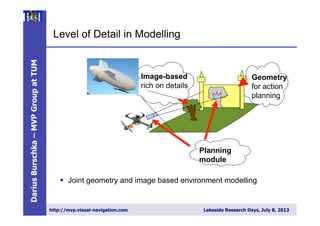
Level of Detail in Modelling
Geometry
for action
planning
Image-based
rich on details
Planning
module
§  Joint geometry and image based environment modelling
DariusBurschka–MVPGroupatTUM
http://mvp.visual-navigation.com Lakeside Research Days, July 8, 2013
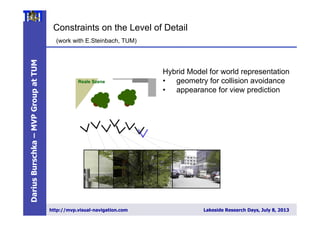
Constraints on the Level of Detail
(work with E.Steinbach, TUM)
Hybrid Model for world representation
•  geometry for collision avoidance
•  appearance for view prediction
DariusBurschka–MVPGroupatTUM
http://mvp.visual-navigation.com Lakeside Research Days, July 8, 2013
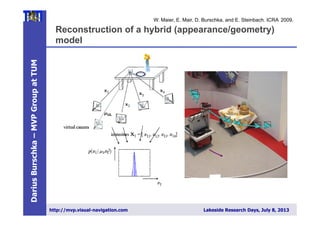
Reconstruction of a hybrid (appearance/geometry)
model
W. Maier, E. Mair, D. Burschka, and E. Steinbach. ICRA 2009.
DariusBurschka–MVPGroupatTUM
http://mvp.visual-navigation.com Lakeside Research Days, July 8, 20136
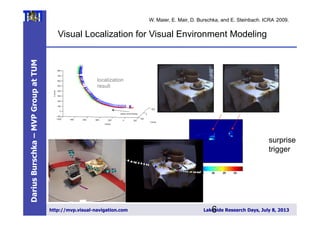
Visual Localization for Visual Environment Modeling
surprise
trigger
localization
result
W. Maier, E. Mair, D. Burschka, and E. Steinbach. ICRA 2009.
DariusBurschka–MVPGroupatTUM
http://mvp.visual-navigation.com Lakeside Research Days, July 8, 2013
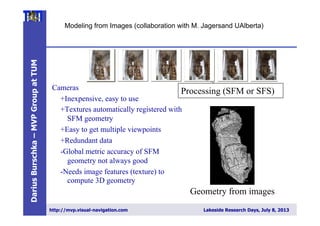
Modeling from Images (collaboration with M. Jagersand UAlberta)
Cameras
+Inexpensive, easy to use
+Textures automatically registered with
SFM geometry
+Easy to get multiple viewpoints
+Redundant data
-Global metric accuracy of SFM
geometry not always good
-Needs image features (texture) to
compute 3D geometry
Processing (SFM or SFS)
Geometry from images
DariusBurschka–MVPGroupatTUM
http://mvp.visual-navigation.com Lakeside Research Days, July 8, 2013
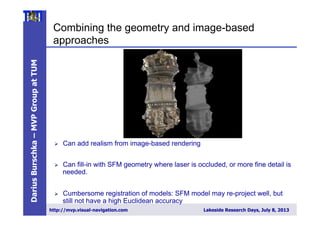
Combining the geometry and image-based
approaches
Ø  Can add realism from image-based rendering
Ø  Can fill-in with SFM geometry where laser is occluded, or more fine detail is
needed.
Ø  Cumbersome registration of models: SFM model may re-project well, but
still not have a high Euclidean accuracy
DariusBurschka–MVPGroupatTUM
http://mvp.visual-navigation.com Lakeside Research Days, July 8, 2013
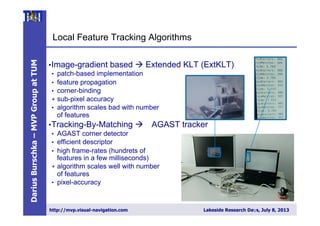
Local Feature Tracking Algorithms
• Image-gradient based à Extended KLT (ExtKLT)
•  patch-based implementation
•  feature propagation
•  corner-binding
+  sub-pixel accuracy
•  algorithm scales bad with number
of features
• Tracking-By-Matching à AGAST tracker
•  AGAST corner detector
•  efficient descriptor
•  high frame-rates (hundrets of
features in a few milliseconds)
+  algorithm scales well with number
of features
•  pixel-accuracy
8
DariusBurschka–MVPGroupatTUM
http://mvp.visual-navigation.com Lakeside Research Days, July 8, 2013
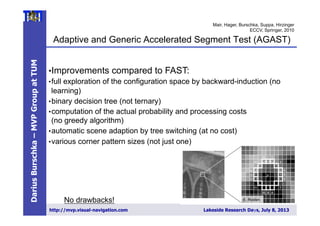
Adaptive and Generic Accelerated Segment Test (AGAST)
9
• Improvements compared to FAST:
• full exploration of the configuration space by backward-induction (no
learning)
• binary decision tree (not ternary)
• computation of the actual probability and processing costs
(no greedy algorithm)
• automatic scene adaption by tree switching (at no cost)
• various corner pattern sizes (not just one)
No drawbacks!
Mair, Hager, Burschka, Suppa, Hirzinger
ECCV, Springer, 2010
E. Rosten
DariusBurschka–MVPGroupatTUM
http://mvp.visual-navigation.com Lakeside Research Days, July 8, 2013
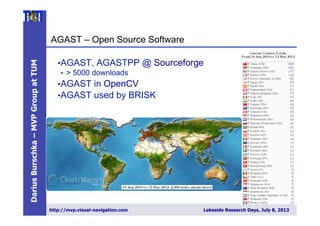
AGAST – Open Source Software
• AGAST, AGASTPP @ Sourceforge
•  > 5000 downloads
• AGAST in OpenCV
• AGAST used by BRISK
DariusBurschka–MVPGroupatTUM
http://mvp.visual-navigation.com Lakeside Research Days, July 8, 2013
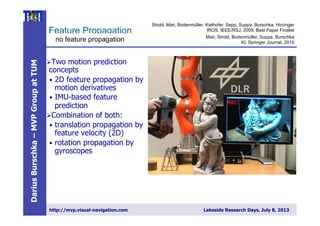
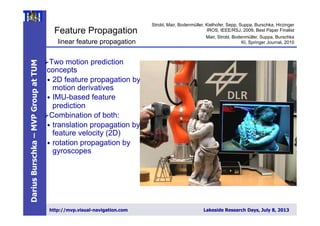
Feature Propagation
Ø Two motion prediction
concepts
•  2D feature propagation by
motion derivatives
•  IMU-based feature
prediction
Ø Combination of both:
•  translation propagation by
feature velocity (2D)
•  rotation propagation by
gyroscopes
no feature propagation
Strobl, Mair, Bodenmüller, Kielhofer, Sepp, Suppa, Burschka, Hirzinger
IROS, IEEE/RSJ, 2009, Best Paper Finalist
Mair, Strobl, Bodenmüller, Suppa, Burschka
KI, Springer Journal, 2010
DariusBurschka–MVPGroupatTUM
http://mvp.visual-navigation.com Lakeside Research Days, July 8, 2013
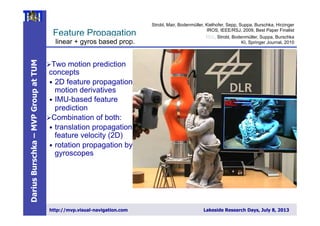
Feature Propagation
Ø Two motion prediction
concepts
•  2D feature propagation by
motion derivatives
•  IMU-based feature
prediction
Ø Combination of both:
•  translation propagation by
feature velocity (2D)
•  rotation propagation by
gyroscopes
linear feature propagation
Strobl, Mair, Bodenmüller, Kielhofer, Sepp, Suppa, Burschka, Hirzinger
IROS, IEEE/RSJ, 2009, Best Paper Finalist
Mair, Strobl, Bodenmüller, Suppa, Burschka
KI, Springer Journal, 2010
DariusBurschka–MVPGroupatTUM
http://mvp.visual-navigation.com Lakeside Research Days, July 8, 2013
Feature Propagation
Ø Two motion prediction
concepts
•  2D feature propagation by
motion derivatives
•  IMU-based feature
prediction
Ø Combination of both:
•  translation propagation by
feature velocity (2D)
•  rotation propagation by
gyroscopes
Strobl, Mair, Bodenmüller, Kielhofer, Sepp, Suppa, Burschka, Hirzinger
IROS, IEEE/RSJ, 2009, Best Paper Finalist
Mair, Strobl, Bodenmüller, Suppa, Burschka
KI, Springer Journal, 2010linear + gyros based prop.
DariusBurschka–MVPGroupatTUM
http://mvp.visual-navigation.com Lakeside Research Days, July 8, 2013
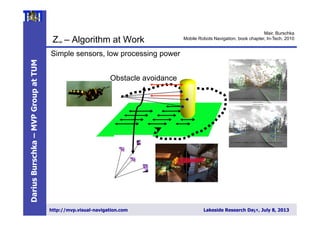
Z∞ – Algorithm at Work
14
Mair, Burschka
Mobile Robots Navigation, book chapter, In-Tech, 2010
Simple sensors, low processing power
Obstacle avoidance
DariusBurschka–MVPGroupatTUM
http://mvp.visual-navigation.com Lakeside Research Days, July 8, 2013http://www6.in.tum.de/burschka/
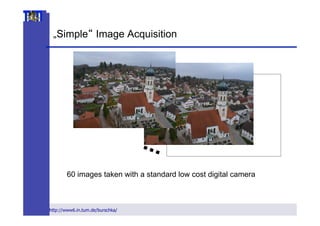
„Simple“ Image Acquisition
60 images taken with a standard low cost digital camera
DariusBurschka–MVPGroupatTUM
http://mvp.visual-navigation.com Lakeside Research Days, July 8, 2013
DariusBurschka–MVPGroupatTUM
http://mvp.visual-navigation.com Lakeside Research Days, July 8, 2013
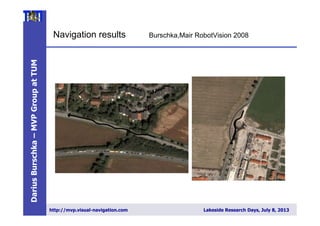
Navigation results Burschka,Mair RobotVision 2008
DariusBurschka–MVPGroupatTUM
http://mvp.visual-navigation.com Lakeside Research Days, July 8, 2013http://www6.in.tum.de/burschka/
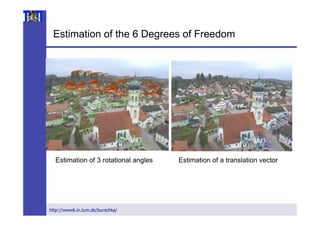
Estimation of the 6 Degrees of Freedom
Estimation of 3 rotational angles Estimation of a translation vector
DariusBurschka–MVPGroupatTUM
http://mvp.visual-navigation.com Lakeside Research Days, July 8, 2013
__________________________________________________________________
__________________________________________________________________
______________________________________________
Swarms to boost resolution
Possible measures:
•  Increase of the distance
between cameras (B)
•  Increase of the focal length
(f) → field of view
•  Decrease of the pixel-size
(px) → resolution of the
camera
[ ]pixel
zp
fB
d
x
p
1
⋅
⋅
=
75cm
DariusBurschka–MVPGroupatTUM
http://mvp.visual-navigation.com Lakeside Research Days, July 8, 2013
Collaborative Reconstruction with Self-Localization
(CVPR Workshop on Vision in Action: Efficient strategies for
cognitive agents in complex environments, Marseille : France (2008))
4 Darius Burschka
Fig. 2. Collaborative 3D reconstruction from 2 independently moving cameras.
directional system with a large field of view.
We decided to use omnidirectional systems in-
stead of fish-lens cameras, because their single view-
point property [2] is essential for our combined
localization and reconstruction approach (Fig. 3).
This property allows an easy recovery of the viewing
angle of the virtual camera with the focal point F
(Fig. 3) directly from the image coordinates (ui, νi).
A standard perspective camera can be mapped on
1-30Sep2008
in [3]. The original approach relied on an essential method to initialize the
3D structure in the world. Our system gives a more robust initialization method
minimizing the image error directly. The limited space of this paper does not
allow a detailed description of this part of the system. The recursive approach
from [3] is used to maintain the radial distance λx.
3 Results
Our flying systems use omnidirectional mirrors like the one depicted in Fig. 6
Fig. 6. Flying agent equipped with an omnidirectional sensor pointing upwards.
We tested the system on several indoor and outdoor sequences with two cam-
eras observing the world through different sized planar mirrors (Fig. 4) using a
Linux laptop computer with a 1.2 GHz Pentium Centrino processor. The system
was equipped with 1GB RAM and was operating two Firewire cameras with
standard PAL resolution of 768x576.
3.1 Accuracy of the Estimation of Extrinsic Parameters
We used the system to estimate the extrinsic motion parameters and achieved
results comparable with the extrinsic camera calibration results. We verified
the parameters by applying them to the 3D reconstruction process in (5) and
achieved measurement accuracy below the resolution of our test system. This
reconstruction was in the close range of the system which explains the high
inria-00325805,version1-30Sep2008
of the camera f=1) (ui, νi) to
ni =
(ui, νi, 1)T
||(ui, νi, 1)T ||
.
We rely on the fact that each camera can see the partner and the area
wants to reconstruct at the same time.
In our system, Camera 1 observes the position of the focal point F o
era 2 along the vector T , and the point P to be reconstructed along the ve
simultaneously (Fig. 2). The second camera (Camera 2) uses its own coo
frame to reconstruct the same point P along the vector V2. The point P o
by this camera has modified coordinates [10]:
V2 = R ∗ (V1 + T )
Collaborative Exploration - Vision in Actio
Since we cannot rely on any extrinsic calibration, we perform the c
of the extrinsic parameters directly from the current observation. W
find the transformation parameters (R, T) in (3) defining the trans
between the coordinate frames of the two cameras. Each camera define
coordinate frame.
2.1 3D Reconstruction from Motion Stereo
In our system, the cameras undergo an arbitrary motion (R, T ) whi
in two independent observations (n1, n2) of a point P. The equation (
written using (2) as
λ2n2 = R ∗ (λ1n1 + T ).
We need to find the radial distances (λ1, λ2) along the incoming rays to
the 3D coordinates of the point. We can find it by re-writing (4) to
(−Rn1, n2)
λ1
λ2
= R · T
λ1
λ2
= (−Rn1, n2)
−∗
· R · T = D−∗
· R · T
We use in (5) the pseudo inverse matrix D−∗
to solve for the two unk
Collaborative Exploration - Vision in Action
Since we cannot rely on any extrinsic calibration, we perform the calibrat
of the extrinsic parameters directly from the current observation. We need
find the transformation parameters (R, T) in (3) defining the transformat
between the coordinate frames of the two cameras. Each camera defines its o
coordinate frame.
2.1 3D Reconstruction from Motion Stereo
In our system, the cameras undergo an arbitrary motion (R, T ) which resu
in two independent observations (n1, n2) of a point P. The equation (3) can
written using (2) as
λ2n2 = R ∗ (λ1n1 + T ).
We need to find the radial distances (λ1, λ2) along the incoming rays to estim
the 3D coordinates of the point. We can find it by re-writing (4) to
(−Rn1, n2)
λ1
λ2
= R · T
λ1
λ2
= (−Rn1, n2)
−∗
· R · T = D−∗
· R · T
We use in (5) the pseudo inverse matrix D−∗
to solve for the two unknown
dial distances (λ1, λ2). A pseudo-inverse matrix to D can be calculated accord
to
D−∗
= (DT
· D)−1
· DT
.
The pseudo-inverse operation finds a least square approximation satisfying
overdetermined set of three equations with two unknowns (λ , λ ) in (5). D
1-30Sep2008
Collaborative Exploration - Vision in Action
Since we cannot rely on any extrinsic calibration, we perform the calibr
of the extrinsic parameters directly from the current observation. We nee
find the transformation parameters (R, T) in (3) defining the transform
between the coordinate frames of the two cameras. Each camera defines its
coordinate frame.
2.1 3D Reconstruction from Motion Stereo
In our system, the cameras undergo an arbitrary motion (R, T ) which re
in two independent observations (n1, n2) of a point P. The equation (3) ca
written using (2) as
λ2n2 = R ∗ (λ1n1 + T ).
We need to find the radial distances (λ1, λ2) along the incoming rays to esti
the 3D coordinates of the point. We can find it by re-writing (4) to
(−Rn1, n2)
λ1
λ2
= R · T
λ1
λ2
= (−Rn1, n2)
−∗
· R · T = D−∗
· R · T
We use in (5) the pseudo inverse matrix D−∗
to solve for the two unknow
dial distances (λ1, λ2). A pseudo-inverse matrix to D can be calculated acco
to
D−∗
= (DT
· D)−1
· DT
.
The pseudo-inverse operation finds a least square approximation satisfyin
overdetermined set of three equations with two unknowns (λ1, λ2) in (5).
to calibration and detection errors, the two lines V1 and V2 in Fig. 2 do
necessarily intersect. Equation (5) calculates the position of the point a
each line closest to the other line.
5,version1-30Sep2008
DariusBurschka–MVPGroupatTUM
http://mvp.visual-navigation.com Lakeside Research Days, July 8, 2013
Condition number for an angular configuration
The relative error in the solution caused by perturbations of parameters can
stimated from the condition number of the pseudo-inverse matrix D−∗
. The
dition number is the ratio between the largest and the smallest singular value
his matrix [4].
The condition number estimates the sensitivity of the solution of a linear
braic system to variations of parameters in matrix D−∗
and in the measure-
t vector T .
Consider the equation system with perturbations in matrix D−∗
and vec-
T :
(D−∗
+ δD−∗
)Tb = λ + δλ (8)
The relative error in the solution caused by perturbations of parameters can
stimated by the following inequality using the condition number κ calculated
D−∗
(see [7]):
||T − Tb||
||T ||
≤ κ
||δD−∗
||
||D−∗||
+
||δλ||
||λ||
+ O( 2
) (9)
Therefore, the relative error in solution λ can be as large as condition num-
times the relative error in D−∗
and T . The condition number together with
singular values of the matrix D−∗
describe the sensitivity of the system
hanges in the input parameters. Small condition numbers describe systems
small sensitivity to errors compared to large condition numbers that suggest
llel direction of the measured direction vectors (n1, n2). A quantitative eval-
on of this result can be found in Section 3.2. We use the condition number of
matrix D−∗
as a metric to evaluate the quality of the resulting configuration
he two cameras. We can move the cameras for a given region of interest to
nfiguration with a small condition number ensuring high accuracy of the
nstructed coordinates.
f we know the extrinsic motion parameters (R, T ), e.g. from a calibration
ess, then equation (5) allows to estimate directly the 3D position of an ob-
The collaborative exploration approach allows us to move the cameras
desired position to establish the best sensitivity and the highest robustn
errors in the parameter estimation. We mentioned already in section 2.1
the sensitivity of the reconstruction result (5) to parameter errors depen
the relative orientation of the reconstructing cameras (Fig. 8).
−5
−3
−1
1
3
5
7
−5
0
5
−5
0
5
0
50
100
150
Orientation Cam 1 [deg]
Orientation Cam 2 [deg]
Conditionnumber
Fig. 8. (left) The condition number of the 3D reconstruction is dependent o
relative orientation of the corresponding direction vectors V1, V2 in Fig. 2 obser
point;(right) a minimal condition number corresponds to a difference in the v
Best observation by 90° viewing angle
DariusBurschka–MVPGroupatTUM
http://mvp.visual-navigation.com Lakeside Research Days, July 8, 2013
Asynchronous stereo for dynamic scenes
4 Darius Burschka
Fig. 2. Collaborative 3D reconstruction from 2 independently moving cameras.
directional system with a large field of view.
Fig. 3. Single viewpoint
property.
We decided to use omnidirectional systems in-
stead of fish-lens cameras, because their single view-
point property [2] is essential for our combined
localization and reconstruction approach (Fig. 3).
This property allows an easy recovery of the viewing
angle of the virtual camera with the focal point F
(Fig. 3) directly from the image coordinates (ui, νi).
A standard perspective camera can be mapped on
our generic model of an omnidirectional sensor. The
only limitation of a standard perspective camera is
the limited viewing angle. In case of a standard per-
spective camera with a focal point at F, we can es-
timate the direction vector ni of the incoming rays
from the uni-focal image coordinates (focal length
of the camera f=1) (u , ν ) to
25805,version1-30Sep2008
NTP
Figure 2: Here: C0 and C1 are the camera centers of the
stereo pair, P0,P1,P2 are the 3D poses of the point at times
t0,t1,t2. Latter correspond to frame acquisition timestamps
of camera C0. P⇤ is the 3D pose of the point at time t⇤,
which correspond to the frame acquisition timestamp of the
camera C1. Vectors v0,v1,v2, are unit vectors pointing from
camera center C0, to corresponding 3D points. Vector v⇤ is
the unit vector pointing from camera center C to pose P⇤
Since the angle between the velocity dire
vector v3 and v0 is y, v3 and v2 is h, and v
ˆn is p
2 . We can compute the v3 by solving the fo
ing equation:
2
4
v0x v0y v0z
v2x v2y v2z
nx ny nz
3
5
2
4
v3x
v3y
v3z
3
5 =
2
4
cosy
cosh
0
3.2 Path Reconstruction
In the second stage of proposed method we com
the 3D pose P0. For reasons of simplicity we
represent the poses (Pi (i = 0..2), P⇤) depicted i
2 as:
Pi =
2
4
ai ⇤zi
bi ⇤zi
zi
3
5 P⇤ =
2
4
m⇤z⇤
0 +tx
s⇤z⇤
0 +ty
q⇤z⇤
0 +tz
3
5
where tx,ty,tz are the x,y and z componen
Submitted VISAPP 2014
DariusBurschka–MVPGroupatTUM
http://mvp.visual-navigation.com Lakeside Research Days, July 8, 2013
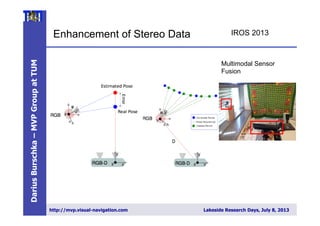
Enhancement of Stereo Data
Multimodal Sensor
Fusion
IROS 2013
DariusBurschka–MVPGroupatTUM
http://mvp.visual-navigation.com Lakeside Research Days, July 8, 20132
5
Towards Autonomous MAV Exploration in Cluttered Indoor and Outdoor Environments > Korbinian Schmid > 28/06/2013
Slide
INS filter design
25
[Schmid et al. IROS 2012]
"   Synchronization of realtime and non realtime modules by sensor hardware trigger
"   Direct system state:
"   High rate calculation by „Strap Down Algorithm“ (SDA)
"   Indirect system state:
"   Estimation by indirect Extended Kalman Filter (EKF)
"   Measurements: „pseudo gravity“, key frame based stereo odometry
"   Measurement delay compensation by filter state augmentation
DariusBurschka–MVPGroupatTUM
http://mvp.visual-navigation.com Lakeside Research Days, July 8, 20132
6
Slide
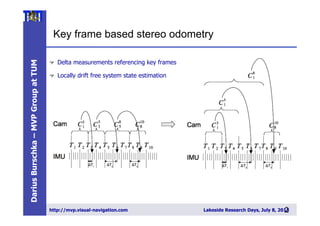
Key frame based stereo odometry
26
" Delta measurements referencing key frames
" Locally drift free system state estimation
DariusBurschka–MVPGroupatTUM
http://mvp.visual-navigation.com Lakeside Research Days, July 8, 20132
7
Slide
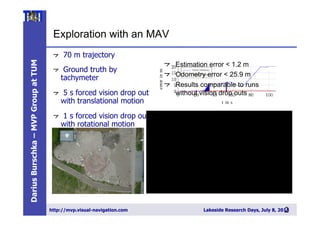
Exploration with an MAV
" 70 m trajectory
" Ground truth by
tachymeter
" 5 s forced vision drop out
with translational motion
" 1 s forced vision drop out
with rotational motion
27
"  Estimation error < 1.2 m
" Odometry error < 25.9 m
"  Results comparable to runs
without vision drop outs
DariusBurschka–MVPGroupatTUM
http://mvp.visual-navigation.com Lakeside Research Days, July 8, 20132
8
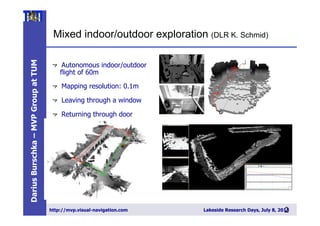
Mixed indoor/outdoor exploration (DLR K. Schmid)
28
" Autonomous indoor/outdoor
flight of 60m
" Mapping resolution: 0.1m
" Leaving through a window
" Returning through door
DariusBurschka–MVPGroupatTUM
http://mvp.visual-navigation.com Lakeside Research Days, July 8, 20132
9
Slide
INS filter design
29
[Schmid et al. IROS 2012]
"   Synchronization of realtime and non realtime modules by sensor hardware trigger
"   Direct system state:
"   High rate calculation by „Strap Down Algorithm“ (SDA)
"   Indirect system state:
"   Estimation by indirect Extended Kalman Filter (EKF)
"   Measurements: „pseudo gravity“, key frame based stereo odometry
"   Measurement delay compensation by filter state augmentation
DariusBurschka–MVPGroupatTUM
http://mvp.visual-navigation.com Lakeside Research Days, July 8, 20133
0
Slide
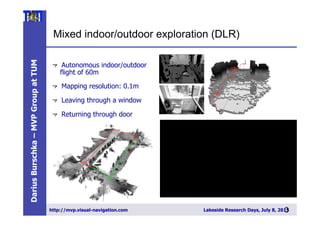
Mixed indoor/outdoor exploration (DLR)
30
" Autonomous indoor/outdoor
flight of 60m
" Mapping resolution: 0.1m
" Leaving through a window
" Returning through door
DariusBurschka–MVPGroupatTUM
http://mvp.visual-navigation.com Lakeside Research Days, July 8, 2013
3
1
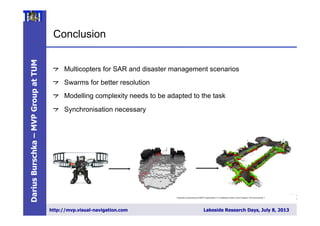
" Multicopters for SAR and disaster management scenarios
"  Swarms for better resolution
" Modelling complexity needs to be adapted to the task
" Synchronisation necessary
Towards Autonomous MAV Exploration in Cluttered Indoor and Outdoor Environments > Korbinian Schmid > 28/06/2013
Slide
Conclusion
31
DariusBurschka–MVPGroupatTUM
http://mvp.visual-navigation.com Lakeside Research Days, July 8, 2013
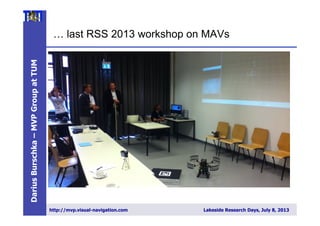
… last RSS 2013 workshop on MAVs
DariusBurschka–MVPGroupatTUM
http://mvp.visual-navigation.com Lakeside Research Days, July 8, 2013
MachineVisionandPerceptionGroup@TUMMVP
Research of the MVP Group http://mvp.visual-navigation.com
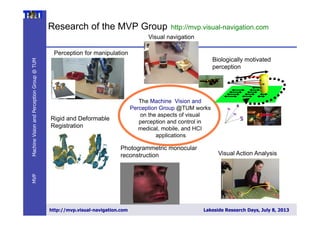
The Machine Vision and
Perception Group @TUM works
on the aspects of visual
perception and control in
medical, mobile, and HCI
applications
Visual navigation
Biologically motivated
perception
Perception for manipulation
Visual Action Analysis
Photogrammetric monocular
reconstruction
Rigid and Deformable
Registration
DariusBurschka–MVPGroupatTUM
http://mvp.visual-navigation.com Lakeside Research Days, July 8, 2013
MachineVisionandPerceptionGroup@TUMMVP
Research of the MVP Group http://mvp.visual-navigation.com
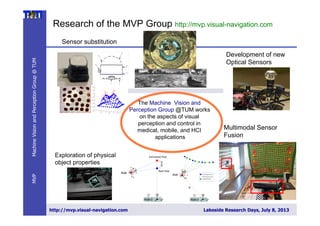
Exploration of physical
object properties
Sensor substitution
Multimodal Sensor
Fusion
Development of new
Optical Sensors
The Machine Vision and
Perception Group @TUM works
on the aspects of visual
perception and control in
medical, mobile, and HCI
applications

Fusion of Multi-MAV Data

  • 1.
    DariusBurschka–MVPGroupatTUM http://mvp.visual-navigation.com Lakeside ResearchDays, July 8, 2013 Darius Burschka Machine Vision and Perception Group Department of Computer Science Technische Universität München in collaboration with DLR Oberpfaffenhofen Fusion of Distributed Perception in Collaborative Visual-SLAM Approaches on Mini-UAVs
  • 2.
    DariusBurschka–MVPGroupatTUM http://mvp.visual-navigation.com Lakeside ResearchDays, July 8, 2013 Aspects of Collaborative Swarm Perception 4 Darius Burschka Fig. 2. Collaborative 3D reconstruction from 2 independently moving cameras. directional system with a large field of view. We decided to use omnidirectional systems in- stead of fish-lens cameras, because their single view- point property [2] is essential for our combined localization and reconstruction approach (Fig. 3). ep2008 •  What is the appropriate level of detail for model representation? •  How to boost measurement sensitivity at large distances? •  Global vs. local perception? •  Increase the exploration speed by sharing the exploration of free space •  Completeness of the instantaneous scene perception – true 3D instead of 2.5D
  • 3.
    DariusBurschka–MVPGroupatTUM http://mvp.visual-navigation.com Lakeside ResearchDays, July 8, 2013 Level of Detail in Modelling Geometry for action planning Image-based rich on details Planning module §  Joint geometry and image based environment modelling
  • 4.
    DariusBurschka–MVPGroupatTUM http://mvp.visual-navigation.com Lakeside ResearchDays, July 8, 2013 Constraints on the Level of Detail (work with E.Steinbach, TUM) Hybrid Model for world representation •  geometry for collision avoidance •  appearance for view prediction
  • 5.
    DariusBurschka–MVPGroupatTUM http://mvp.visual-navigation.com Lakeside ResearchDays, July 8, 2013 Reconstruction of a hybrid (appearance/geometry) model W. Maier, E. Mair, D. Burschka, and E. Steinbach. ICRA 2009.
  • 6.
    DariusBurschka–MVPGroupatTUM http://mvp.visual-navigation.com Lakeside ResearchDays, July 8, 20136 Visual Localization for Visual Environment Modeling surprise trigger localization result W. Maier, E. Mair, D. Burschka, and E. Steinbach. ICRA 2009.
  • 7.
    DariusBurschka–MVPGroupatTUM http://mvp.visual-navigation.com Lakeside ResearchDays, July 8, 2013 Modeling from Images (collaboration with M. Jagersand UAlberta) Cameras +Inexpensive, easy to use +Textures automatically registered with SFM geometry +Easy to get multiple viewpoints +Redundant data -Global metric accuracy of SFM geometry not always good -Needs image features (texture) to compute 3D geometry Processing (SFM or SFS) Geometry from images
  • 8.
    DariusBurschka–MVPGroupatTUM http://mvp.visual-navigation.com Lakeside ResearchDays, July 8, 2013 Combining the geometry and image-based approaches Ø  Can add realism from image-based rendering Ø  Can fill-in with SFM geometry where laser is occluded, or more fine detail is needed. Ø  Cumbersome registration of models: SFM model may re-project well, but still not have a high Euclidean accuracy
  • 9.
    DariusBurschka–MVPGroupatTUM http://mvp.visual-navigation.com Lakeside ResearchDays, July 8, 2013 Local Feature Tracking Algorithms • Image-gradient based à Extended KLT (ExtKLT) •  patch-based implementation •  feature propagation •  corner-binding +  sub-pixel accuracy •  algorithm scales bad with number of features • Tracking-By-Matching à AGAST tracker •  AGAST corner detector •  efficient descriptor •  high frame-rates (hundrets of features in a few milliseconds) +  algorithm scales well with number of features •  pixel-accuracy 8
  • 10.
    DariusBurschka–MVPGroupatTUM http://mvp.visual-navigation.com Lakeside ResearchDays, July 8, 2013 Adaptive and Generic Accelerated Segment Test (AGAST) 9 • Improvements compared to FAST: • full exploration of the configuration space by backward-induction (no learning) • binary decision tree (not ternary) • computation of the actual probability and processing costs (no greedy algorithm) • automatic scene adaption by tree switching (at no cost) • various corner pattern sizes (not just one) No drawbacks! Mair, Hager, Burschka, Suppa, Hirzinger ECCV, Springer, 2010 E. Rosten
  • 11.
    DariusBurschka–MVPGroupatTUM http://mvp.visual-navigation.com Lakeside ResearchDays, July 8, 2013 AGAST – Open Source Software • AGAST, AGASTPP @ Sourceforge •  > 5000 downloads • AGAST in OpenCV • AGAST used by BRISK
  • 12.
    DariusBurschka–MVPGroupatTUM http://mvp.visual-navigation.com Lakeside ResearchDays, July 8, 2013 Feature Propagation Ø Two motion prediction concepts •  2D feature propagation by motion derivatives •  IMU-based feature prediction Ø Combination of both: •  translation propagation by feature velocity (2D) •  rotation propagation by gyroscopes no feature propagation Strobl, Mair, Bodenmüller, Kielhofer, Sepp, Suppa, Burschka, Hirzinger IROS, IEEE/RSJ, 2009, Best Paper Finalist Mair, Strobl, Bodenmüller, Suppa, Burschka KI, Springer Journal, 2010
  • 13.
    DariusBurschka–MVPGroupatTUM http://mvp.visual-navigation.com Lakeside ResearchDays, July 8, 2013 Feature Propagation Ø Two motion prediction concepts •  2D feature propagation by motion derivatives •  IMU-based feature prediction Ø Combination of both: •  translation propagation by feature velocity (2D) •  rotation propagation by gyroscopes linear feature propagation Strobl, Mair, Bodenmüller, Kielhofer, Sepp, Suppa, Burschka, Hirzinger IROS, IEEE/RSJ, 2009, Best Paper Finalist Mair, Strobl, Bodenmüller, Suppa, Burschka KI, Springer Journal, 2010
  • 14.
    DariusBurschka–MVPGroupatTUM http://mvp.visual-navigation.com Lakeside ResearchDays, July 8, 2013 Feature Propagation Ø Two motion prediction concepts •  2D feature propagation by motion derivatives •  IMU-based feature prediction Ø Combination of both: •  translation propagation by feature velocity (2D) •  rotation propagation by gyroscopes Strobl, Mair, Bodenmüller, Kielhofer, Sepp, Suppa, Burschka, Hirzinger IROS, IEEE/RSJ, 2009, Best Paper Finalist Mair, Strobl, Bodenmüller, Suppa, Burschka KI, Springer Journal, 2010linear + gyros based prop.
  • 15.
    DariusBurschka–MVPGroupatTUM http://mvp.visual-navigation.com Lakeside ResearchDays, July 8, 2013 Z∞ – Algorithm at Work 14 Mair, Burschka Mobile Robots Navigation, book chapter, In-Tech, 2010 Simple sensors, low processing power Obstacle avoidance
  • 16.
    DariusBurschka–MVPGroupatTUM http://mvp.visual-navigation.com Lakeside ResearchDays, July 8, 2013http://www6.in.tum.de/burschka/ „Simple“ Image Acquisition 60 images taken with a standard low cost digital camera
  • 17.
  • 18.
    DariusBurschka–MVPGroupatTUM http://mvp.visual-navigation.com Lakeside ResearchDays, July 8, 2013 Navigation results Burschka,Mair RobotVision 2008
  • 19.
    DariusBurschka–MVPGroupatTUM http://mvp.visual-navigation.com Lakeside ResearchDays, July 8, 2013http://www6.in.tum.de/burschka/ Estimation of the 6 Degrees of Freedom Estimation of 3 rotational angles Estimation of a translation vector
  • 20.
    DariusBurschka–MVPGroupatTUM http://mvp.visual-navigation.com Lakeside ResearchDays, July 8, 2013 __________________________________________________________________ __________________________________________________________________ ______________________________________________ Swarms to boost resolution Possible measures: •  Increase of the distance between cameras (B) •  Increase of the focal length (f) → field of view •  Decrease of the pixel-size (px) → resolution of the camera [ ]pixel zp fB d x p 1 ⋅ ⋅ = 75cm
  • 21.
    DariusBurschka–MVPGroupatTUM http://mvp.visual-navigation.com Lakeside ResearchDays, July 8, 2013 Collaborative Reconstruction with Self-Localization (CVPR Workshop on Vision in Action: Efficient strategies for cognitive agents in complex environments, Marseille : France (2008)) 4 Darius Burschka Fig. 2. Collaborative 3D reconstruction from 2 independently moving cameras. directional system with a large field of view. We decided to use omnidirectional systems in- stead of fish-lens cameras, because their single view- point property [2] is essential for our combined localization and reconstruction approach (Fig. 3). This property allows an easy recovery of the viewing angle of the virtual camera with the focal point F (Fig. 3) directly from the image coordinates (ui, νi). A standard perspective camera can be mapped on 1-30Sep2008 in [3]. The original approach relied on an essential method to initialize the 3D structure in the world. Our system gives a more robust initialization method minimizing the image error directly. The limited space of this paper does not allow a detailed description of this part of the system. The recursive approach from [3] is used to maintain the radial distance λx. 3 Results Our flying systems use omnidirectional mirrors like the one depicted in Fig. 6 Fig. 6. Flying agent equipped with an omnidirectional sensor pointing upwards. We tested the system on several indoor and outdoor sequences with two cam- eras observing the world through different sized planar mirrors (Fig. 4) using a Linux laptop computer with a 1.2 GHz Pentium Centrino processor. The system was equipped with 1GB RAM and was operating two Firewire cameras with standard PAL resolution of 768x576. 3.1 Accuracy of the Estimation of Extrinsic Parameters We used the system to estimate the extrinsic motion parameters and achieved results comparable with the extrinsic camera calibration results. We verified the parameters by applying them to the 3D reconstruction process in (5) and achieved measurement accuracy below the resolution of our test system. This reconstruction was in the close range of the system which explains the high inria-00325805,version1-30Sep2008 of the camera f=1) (ui, νi) to ni = (ui, νi, 1)T ||(ui, νi, 1)T || . We rely on the fact that each camera can see the partner and the area wants to reconstruct at the same time. In our system, Camera 1 observes the position of the focal point F o era 2 along the vector T , and the point P to be reconstructed along the ve simultaneously (Fig. 2). The second camera (Camera 2) uses its own coo frame to reconstruct the same point P along the vector V2. The point P o by this camera has modified coordinates [10]: V2 = R ∗ (V1 + T ) Collaborative Exploration - Vision in Actio Since we cannot rely on any extrinsic calibration, we perform the c of the extrinsic parameters directly from the current observation. W find the transformation parameters (R, T) in (3) defining the trans between the coordinate frames of the two cameras. Each camera define coordinate frame. 2.1 3D Reconstruction from Motion Stereo In our system, the cameras undergo an arbitrary motion (R, T ) whi in two independent observations (n1, n2) of a point P. The equation ( written using (2) as λ2n2 = R ∗ (λ1n1 + T ). We need to find the radial distances (λ1, λ2) along the incoming rays to the 3D coordinates of the point. We can find it by re-writing (4) to (−Rn1, n2) λ1 λ2 = R · T λ1 λ2 = (−Rn1, n2) −∗ · R · T = D−∗ · R · T We use in (5) the pseudo inverse matrix D−∗ to solve for the two unk Collaborative Exploration - Vision in Action Since we cannot rely on any extrinsic calibration, we perform the calibrat of the extrinsic parameters directly from the current observation. We need find the transformation parameters (R, T) in (3) defining the transformat between the coordinate frames of the two cameras. Each camera defines its o coordinate frame. 2.1 3D Reconstruction from Motion Stereo In our system, the cameras undergo an arbitrary motion (R, T ) which resu in two independent observations (n1, n2) of a point P. The equation (3) can written using (2) as λ2n2 = R ∗ (λ1n1 + T ). We need to find the radial distances (λ1, λ2) along the incoming rays to estim the 3D coordinates of the point. We can find it by re-writing (4) to (−Rn1, n2) λ1 λ2 = R · T λ1 λ2 = (−Rn1, n2) −∗ · R · T = D−∗ · R · T We use in (5) the pseudo inverse matrix D−∗ to solve for the two unknown dial distances (λ1, λ2). A pseudo-inverse matrix to D can be calculated accord to D−∗ = (DT · D)−1 · DT . The pseudo-inverse operation finds a least square approximation satisfying overdetermined set of three equations with two unknowns (λ , λ ) in (5). D 1-30Sep2008 Collaborative Exploration - Vision in Action Since we cannot rely on any extrinsic calibration, we perform the calibr of the extrinsic parameters directly from the current observation. We nee find the transformation parameters (R, T) in (3) defining the transform between the coordinate frames of the two cameras. Each camera defines its coordinate frame. 2.1 3D Reconstruction from Motion Stereo In our system, the cameras undergo an arbitrary motion (R, T ) which re in two independent observations (n1, n2) of a point P. The equation (3) ca written using (2) as λ2n2 = R ∗ (λ1n1 + T ). We need to find the radial distances (λ1, λ2) along the incoming rays to esti the 3D coordinates of the point. We can find it by re-writing (4) to (−Rn1, n2) λ1 λ2 = R · T λ1 λ2 = (−Rn1, n2) −∗ · R · T = D−∗ · R · T We use in (5) the pseudo inverse matrix D−∗ to solve for the two unknow dial distances (λ1, λ2). A pseudo-inverse matrix to D can be calculated acco to D−∗ = (DT · D)−1 · DT . The pseudo-inverse operation finds a least square approximation satisfyin overdetermined set of three equations with two unknowns (λ1, λ2) in (5). to calibration and detection errors, the two lines V1 and V2 in Fig. 2 do necessarily intersect. Equation (5) calculates the position of the point a each line closest to the other line. 5,version1-30Sep2008
  • 22.
    DariusBurschka–MVPGroupatTUM http://mvp.visual-navigation.com Lakeside ResearchDays, July 8, 2013 Condition number for an angular configuration The relative error in the solution caused by perturbations of parameters can stimated from the condition number of the pseudo-inverse matrix D−∗ . The dition number is the ratio between the largest and the smallest singular value his matrix [4]. The condition number estimates the sensitivity of the solution of a linear braic system to variations of parameters in matrix D−∗ and in the measure- t vector T . Consider the equation system with perturbations in matrix D−∗ and vec- T : (D−∗ + δD−∗ )Tb = λ + δλ (8) The relative error in the solution caused by perturbations of parameters can stimated by the following inequality using the condition number κ calculated D−∗ (see [7]): ||T − Tb|| ||T || ≤ κ ||δD−∗ || ||D−∗|| + ||δλ|| ||λ|| + O( 2 ) (9) Therefore, the relative error in solution λ can be as large as condition num- times the relative error in D−∗ and T . The condition number together with singular values of the matrix D−∗ describe the sensitivity of the system hanges in the input parameters. Small condition numbers describe systems small sensitivity to errors compared to large condition numbers that suggest llel direction of the measured direction vectors (n1, n2). A quantitative eval- on of this result can be found in Section 3.2. We use the condition number of matrix D−∗ as a metric to evaluate the quality of the resulting configuration he two cameras. We can move the cameras for a given region of interest to nfiguration with a small condition number ensuring high accuracy of the nstructed coordinates. f we know the extrinsic motion parameters (R, T ), e.g. from a calibration ess, then equation (5) allows to estimate directly the 3D position of an ob- The collaborative exploration approach allows us to move the cameras desired position to establish the best sensitivity and the highest robustn errors in the parameter estimation. We mentioned already in section 2.1 the sensitivity of the reconstruction result (5) to parameter errors depen the relative orientation of the reconstructing cameras (Fig. 8). −5 −3 −1 1 3 5 7 −5 0 5 −5 0 5 0 50 100 150 Orientation Cam 1 [deg] Orientation Cam 2 [deg] Conditionnumber Fig. 8. (left) The condition number of the 3D reconstruction is dependent o relative orientation of the corresponding direction vectors V1, V2 in Fig. 2 obser point;(right) a minimal condition number corresponds to a difference in the v Best observation by 90° viewing angle
  • 23.
    DariusBurschka–MVPGroupatTUM http://mvp.visual-navigation.com Lakeside ResearchDays, July 8, 2013 Asynchronous stereo for dynamic scenes 4 Darius Burschka Fig. 2. Collaborative 3D reconstruction from 2 independently moving cameras. directional system with a large field of view. Fig. 3. Single viewpoint property. We decided to use omnidirectional systems in- stead of fish-lens cameras, because their single view- point property [2] is essential for our combined localization and reconstruction approach (Fig. 3). This property allows an easy recovery of the viewing angle of the virtual camera with the focal point F (Fig. 3) directly from the image coordinates (ui, νi). A standard perspective camera can be mapped on our generic model of an omnidirectional sensor. The only limitation of a standard perspective camera is the limited viewing angle. In case of a standard per- spective camera with a focal point at F, we can es- timate the direction vector ni of the incoming rays from the uni-focal image coordinates (focal length of the camera f=1) (u , ν ) to 25805,version1-30Sep2008 NTP Figure 2: Here: C0 and C1 are the camera centers of the stereo pair, P0,P1,P2 are the 3D poses of the point at times t0,t1,t2. Latter correspond to frame acquisition timestamps of camera C0. P⇤ is the 3D pose of the point at time t⇤, which correspond to the frame acquisition timestamp of the camera C1. Vectors v0,v1,v2, are unit vectors pointing from camera center C0, to corresponding 3D points. Vector v⇤ is the unit vector pointing from camera center C to pose P⇤ Since the angle between the velocity dire vector v3 and v0 is y, v3 and v2 is h, and v ˆn is p 2 . We can compute the v3 by solving the fo ing equation: 2 4 v0x v0y v0z v2x v2y v2z nx ny nz 3 5 2 4 v3x v3y v3z 3 5 = 2 4 cosy cosh 0 3.2 Path Reconstruction In the second stage of proposed method we com the 3D pose P0. For reasons of simplicity we represent the poses (Pi (i = 0..2), P⇤) depicted i 2 as: Pi = 2 4 ai ⇤zi bi ⇤zi zi 3 5 P⇤ = 2 4 m⇤z⇤ 0 +tx s⇤z⇤ 0 +ty q⇤z⇤ 0 +tz 3 5 where tx,ty,tz are the x,y and z componen Submitted VISAPP 2014
  • 24.
    DariusBurschka–MVPGroupatTUM http://mvp.visual-navigation.com Lakeside ResearchDays, July 8, 2013 Enhancement of Stereo Data Multimodal Sensor Fusion IROS 2013
  • 25.
    DariusBurschka–MVPGroupatTUM http://mvp.visual-navigation.com Lakeside ResearchDays, July 8, 20132 5 Towards Autonomous MAV Exploration in Cluttered Indoor and Outdoor Environments > Korbinian Schmid > 28/06/2013 Slide INS filter design 25 [Schmid et al. IROS 2012] "   Synchronization of realtime and non realtime modules by sensor hardware trigger "   Direct system state: "   High rate calculation by „Strap Down Algorithm“ (SDA) "   Indirect system state: "   Estimation by indirect Extended Kalman Filter (EKF) "   Measurements: „pseudo gravity“, key frame based stereo odometry "   Measurement delay compensation by filter state augmentation
  • 26.
    DariusBurschka–MVPGroupatTUM http://mvp.visual-navigation.com Lakeside ResearchDays, July 8, 20132 6 Slide Key frame based stereo odometry 26 " Delta measurements referencing key frames " Locally drift free system state estimation
  • 27.
    DariusBurschka–MVPGroupatTUM http://mvp.visual-navigation.com Lakeside ResearchDays, July 8, 20132 7 Slide Exploration with an MAV " 70 m trajectory " Ground truth by tachymeter " 5 s forced vision drop out with translational motion " 1 s forced vision drop out with rotational motion 27 "  Estimation error < 1.2 m " Odometry error < 25.9 m "  Results comparable to runs without vision drop outs
  • 28.
    DariusBurschka–MVPGroupatTUM http://mvp.visual-navigation.com Lakeside ResearchDays, July 8, 20132 8 Mixed indoor/outdoor exploration (DLR K. Schmid) 28 " Autonomous indoor/outdoor flight of 60m " Mapping resolution: 0.1m " Leaving through a window " Returning through door
  • 29.
    DariusBurschka–MVPGroupatTUM http://mvp.visual-navigation.com Lakeside ResearchDays, July 8, 20132 9 Slide INS filter design 29 [Schmid et al. IROS 2012] "   Synchronization of realtime and non realtime modules by sensor hardware trigger "   Direct system state: "   High rate calculation by „Strap Down Algorithm“ (SDA) "   Indirect system state: "   Estimation by indirect Extended Kalman Filter (EKF) "   Measurements: „pseudo gravity“, key frame based stereo odometry "   Measurement delay compensation by filter state augmentation
  • 30.
    DariusBurschka–MVPGroupatTUM http://mvp.visual-navigation.com Lakeside ResearchDays, July 8, 20133 0 Slide Mixed indoor/outdoor exploration (DLR) 30 " Autonomous indoor/outdoor flight of 60m " Mapping resolution: 0.1m " Leaving through a window " Returning through door
  • 31.
    DariusBurschka–MVPGroupatTUM http://mvp.visual-navigation.com Lakeside ResearchDays, July 8, 2013 3 1 " Multicopters for SAR and disaster management scenarios "  Swarms for better resolution " Modelling complexity needs to be adapted to the task " Synchronisation necessary Towards Autonomous MAV Exploration in Cluttered Indoor and Outdoor Environments > Korbinian Schmid > 28/06/2013 Slide Conclusion 31
  • 32.
    DariusBurschka–MVPGroupatTUM http://mvp.visual-navigation.com Lakeside ResearchDays, July 8, 2013 … last RSS 2013 workshop on MAVs
  • 33.
    DariusBurschka–MVPGroupatTUM http://mvp.visual-navigation.com Lakeside ResearchDays, July 8, 2013 MachineVisionandPerceptionGroup@TUMMVP Research of the MVP Group http://mvp.visual-navigation.com The Machine Vision and Perception Group @TUM works on the aspects of visual perception and control in medical, mobile, and HCI applications Visual navigation Biologically motivated perception Perception for manipulation Visual Action Analysis Photogrammetric monocular reconstruction Rigid and Deformable Registration
  • 34.
    DariusBurschka–MVPGroupatTUM http://mvp.visual-navigation.com Lakeside ResearchDays, July 8, 2013 MachineVisionandPerceptionGroup@TUMMVP Research of the MVP Group http://mvp.visual-navigation.com Exploration of physical object properties Sensor substitution Multimodal Sensor Fusion Development of new Optical Sensors The Machine Vision and Perception Group @TUM works on the aspects of visual perception and control in medical, mobile, and HCI applications