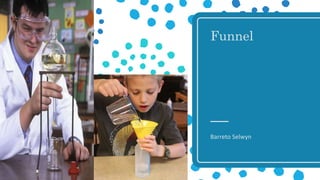
Funnel
Barreto Selwyn
Introduction
– A funnel is a tube or pipe that is wide at the top and narrow at
the bottom, used for guiding liquid or powder into a small
opening.
– The material used in its construction should be sturdy enough
to withstand the weight of the substance being transferred, and
it should not react with the substance.
– It is used to channel liquid or fine-grained substances into
containers with a small opening
Material used
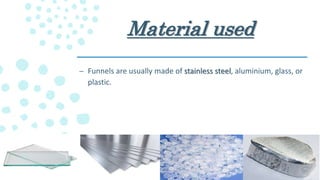
– Funnels are usually made of stainless steel, aluminium, glass, or
plastic.
Types of Funnels
– Plain Funnel
– Filter funnel
– Powder Funnel
– Separatory Funnel
– Hirsch funnel
– Büchner funnel
– Tullgren funnel
– Dropping funnel
– Hot filtration funnel
– Eco funnel
Plain Funnel
– Exist in various dimensions, with longer or shorter necks.
– Designed with a 60 Deg bowl angle to ensure precise fitting of
the filter paper
– High thermal shock resistance and chemical resistance
– Generally used for filtering and decanting liquids of varied
densities
Filter funnel
– A filter funnel is a laboratory funnel used for separating solids
from liquids via the laboratory process of filtering.
– In order to achieve this, a cone-like shaped piece of filter paper
is usually folded into a cone and placed within the funnel.
– The suspension of solid and liquid is then poured through the
funnel.
– The solid particles are too large to pass through the filter paper
and are left on the paper,
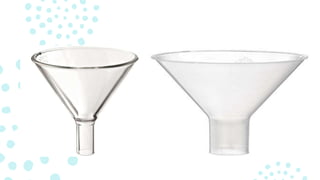
Powder Funnel
– Ideal for transferring powders
– Designed with a short wide stem to facilitate smooth flow
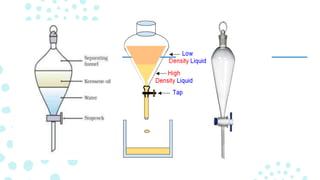
Separatory funnel
– A separatory funnel, is a piece of laboratory glassware used in liquid-
liquid extractions to separate the components of a mixture into two
immiscible solvent phases of different densities.
– Typically, one of the phases will be aqueous, and the other a lipophilic
organic solvent such as ether, MTBE, dichloromethane, chloroform, or
ethyl acetate. All of these solvents form a clear delineation between
the two liquids.
– The more dense liquid, typically the aqueous phase unless the organic
phase is halogenated, sinks and can be drained out through a valve
away from the less dense liquid, which remains in the separatory
funnel.
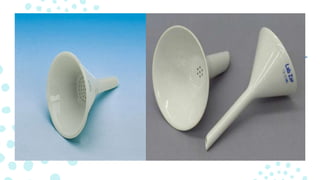
Hirsch funnel
– Hirsch funnels are essentially smaller Büchner funnels and
primarily used to collect a desired solid from a relatively small
volume of liquid (1-10 mL).
– The main difference is that the plate is much smaller, while the
walls of the funnel angle outward instead of being vertical.
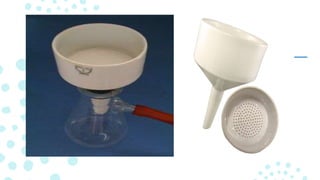
Büchner funnel
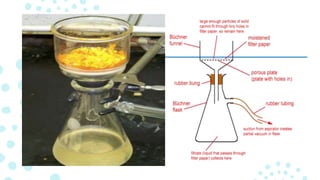
– Büchner funnel is one device used for pressure assisted
filtration. Buchner funnel is a cylindrical porcelain filtering
funnel (glass and plastic funnels are also available) that has a
perforated plate on which the flat filter paper is placed.
– A vacuum in the flask underneath the filter allows atmospheric
pressure on the sample to force the liquid through the filter
paper
Tullgren funnel
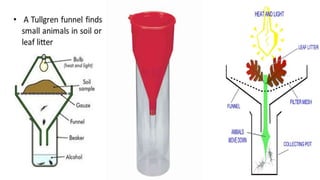
– A Tullgren funnel, is an apparatus used to extract living
organisms, particularly arthropods, from samples of soil.
– The Tullgren funnel works by creating a temperature gradient
over the sample such that mobile organisms will move away
from the higher temperatures and fall into a collecting vessel,
where they perish and are preserved for examination.
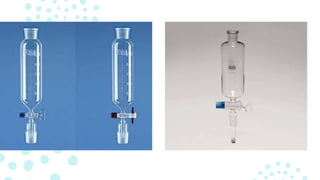
Dropping funnel
– A dropping funnel is a type of laboratory glassware used to
transfer fluids. They are fitted with a stopcock which allows the
flow to be controlled.
– Dropping funnels are useful for adding reagents slowly, i.e.
drop-wise. This may be desirable when the quick addition of the
reagent may result in side reactions, or if the reaction is too
vigorous.
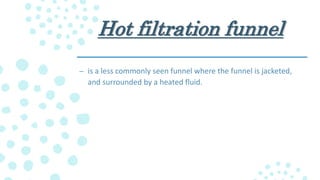
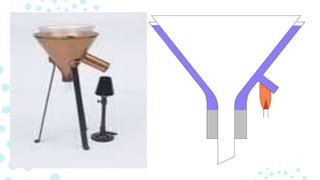
Hot filtration funnel
– is a less commonly seen funnel where the funnel is jacketed,
and surrounded by a heated fluid.
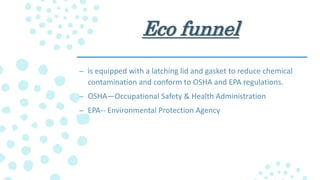
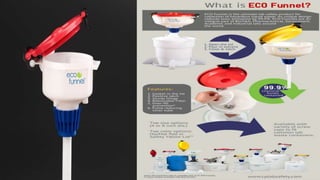
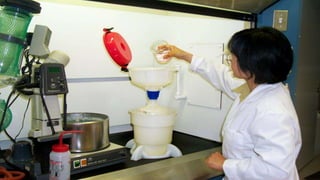
Eco funnel
– is equipped with a latching lid and gasket to reduce chemical
contamination and conform to OSHA and EPA regulations.
– OSHA—Occupational Safety & Health Administration
– EPA-- Environmental Protection Agency
Funnel
Funnel
Funnel

Funnel

  • 1.
  • 2.
    Introduction – A funnelis a tube or pipe that is wide at the top and narrow at the bottom, used for guiding liquid or powder into a small opening. – The material used in its construction should be sturdy enough to withstand the weight of the substance being transferred, and it should not react with the substance. – It is used to channel liquid or fine-grained substances into containers with a small opening
  • 3.
    Material used – Funnelsare usually made of stainless steel, aluminium, glass, or plastic.
  • 4.
    Types of Funnels –Plain Funnel – Filter funnel – Powder Funnel – Separatory Funnel – Hirsch funnel – Büchner funnel – Tullgren funnel – Dropping funnel – Hot filtration funnel – Eco funnel
  • 5.
    Plain Funnel – Existin various dimensions, with longer or shorter necks. – Designed with a 60 Deg bowl angle to ensure precise fitting of the filter paper – High thermal shock resistance and chemical resistance – Generally used for filtering and decanting liquids of varied densities
  • 7.
    Filter funnel – Afilter funnel is a laboratory funnel used for separating solids from liquids via the laboratory process of filtering. – In order to achieve this, a cone-like shaped piece of filter paper is usually folded into a cone and placed within the funnel. – The suspension of solid and liquid is then poured through the funnel. – The solid particles are too large to pass through the filter paper and are left on the paper,
  • 9.
    Powder Funnel – Idealfor transferring powders – Designed with a short wide stem to facilitate smooth flow
  • 11.
    Separatory funnel – Aseparatory funnel, is a piece of laboratory glassware used in liquid- liquid extractions to separate the components of a mixture into two immiscible solvent phases of different densities. – Typically, one of the phases will be aqueous, and the other a lipophilic organic solvent such as ether, MTBE, dichloromethane, chloroform, or ethyl acetate. All of these solvents form a clear delineation between the two liquids. – The more dense liquid, typically the aqueous phase unless the organic phase is halogenated, sinks and can be drained out through a valve away from the less dense liquid, which remains in the separatory funnel.
  • 13.
    Hirsch funnel – Hirschfunnels are essentially smaller Büchner funnels and primarily used to collect a desired solid from a relatively small volume of liquid (1-10 mL). – The main difference is that the plate is much smaller, while the walls of the funnel angle outward instead of being vertical.
  • 15.
    Büchner funnel – Büchnerfunnel is one device used for pressure assisted filtration. Buchner funnel is a cylindrical porcelain filtering funnel (glass and plastic funnels are also available) that has a perforated plate on which the flat filter paper is placed. – A vacuum in the flask underneath the filter allows atmospheric pressure on the sample to force the liquid through the filter paper
  • 18.
    Tullgren funnel – ATullgren funnel, is an apparatus used to extract living organisms, particularly arthropods, from samples of soil. – The Tullgren funnel works by creating a temperature gradient over the sample such that mobile organisms will move away from the higher temperatures and fall into a collecting vessel, where they perish and are preserved for examination.
  • 20.
    Dropping funnel – Adropping funnel is a type of laboratory glassware used to transfer fluids. They are fitted with a stopcock which allows the flow to be controlled. – Dropping funnels are useful for adding reagents slowly, i.e. drop-wise. This may be desirable when the quick addition of the reagent may result in side reactions, or if the reaction is too vigorous.
  • 22.
    Hot filtration funnel –is a less commonly seen funnel where the funnel is jacketed, and surrounded by a heated fluid.
  • 24.
    Eco funnel – isequipped with a latching lid and gasket to reduce chemical contamination and conform to OSHA and EPA regulations. – OSHA—Occupational Safety & Health Administration – EPA-- Environmental Protection Agency