






Fundraising 101 The Democratic Approach Trainers: Andrea M. Pagano
WHO DO YOU ASK? Hmmm?
Answer: EVERYONE YOU CAN
Why Do People Give? Candidate or solicitor stands for ideals the donor believes in.  Personal relationships.  Party affiliation/loyalty. Desire to defeat the opponent. Social connection/desire to join with cause or organization. Because They Were ASKED!
Contributions Come in All Sizes Donations come from people off all income levels. 19% of families on welfare contribute $72 each year. Don’t assume a wealthy person is always your best prospect. Build relationships with supporters at all income levels.
Your Best Donors Your family Your friends Your friend’s friends Your classmates Your work colleagues People who traditionally give to candidates and youth organizations
You start with a list! Names from your address book Names from email lists/list serves Names from lists of like-minded organizations or campaigns Democratic voters in your neighborhood Cold calls lists from the campaign
It is All About Relationships You want more than that first check, you want investment over time in your campaign or organization  You want to be able to go back to your donors in the future
HOW DO YOU ASK? Please!
Answer: You start with a plan knowing your financial goal  You develop a case/candidate statement You develop simple and easy-to-follow materials You rely on your instincts You use your head as well as your heart
Fundraising  Strategies & Options Personal contact Tele-fundraising/Phone banks Candidate call time Major gifts Events On-line Fundraising Friend-raising Direct mail
Old School  Fundraising Programs Childhood memories of raising money – they still work: Coin Drops – collecting change from students on campus, people on the street, peers in a bar Bake Sales – put up a table, make a sign, sell goodies Auctions – selling services of some type for a fee (e.g. – date auctions) Car washes – washing cars & hanging up fun signs to attract attention (good for messaging) Garage Sale – collect good from big donors, maybe sell on ebay
Personal Solicitation: Phone Most effective and cost efficient way to raise money Must be organized Keep detailed notes Be disciplined
Personal Solicitation: Face-to-face Be prepared (materials, etc) Appoint key people to attend meeting (be selective) Ask for a contribution Collect at meeting if possible Use for high donors and raisers
Events: Benefits Certain donors like to be seen and see other leaders Builds momentum Gives donors and surrogates a date specific for contributions Good visibility and/or press options Good central location to unveil plans and/or introduce new staff
Events: Drawbacks Can be expensive Requires a lot of planning and logistical timing Takes staff/volunteers to execute with less spending Requires a lot of follow up Could be hard to track and gather donor information
Events: Success ALWAYS have a ticket price Recruit a motivated and connected host committee Follow up phone calls to invitees Market you event for the appropriate audience Registration Follow up calls or letter to attendees
Direct Mail & Phone Banks Builds a donor base of consistent, small donors Can be expensive Re-solicitation is essential Example: D4YD
Direct Mail:  Guidelines and Tips Create a sense of urgency Short paragraphs that highlight and bold Always include a p.s. State a clear and compelling message Write from one person to one person Personalize whenever possible (phone or mail) Ask for a specific dollar amount Remember, it’s public!
Your “Pitch” Do not assume people will think to send money   Ask  Make your ask specific and tied to a particular need or goal Lay out your fundraising goal and how they can help you reach it. Explain what other support sources you have already
Making the Ask Do your RESEARCH: Know your donor Build RELATIONSHIP: Ask for opinions Make your pitch and REQUEST a gift in a specific amount After you ask, stop talking and listen. LISTEN and RESPOND to any concerns or questions and close the deal REVIEW and document your contact and always follow up
I can’t believe she said No!
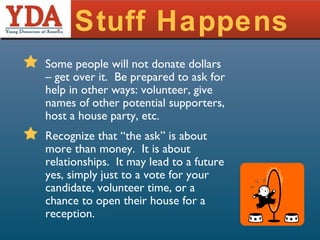
Stuff Happens Some people will not donate dollars – get over it.  Be prepared to ask for help in other ways: volunteer, give names of other potential supporters, host a house party, etc. Recognize that “the ask” is about more than money.  It is about relationships.  It may lead to a future yes, simply just to a vote for your candidate, volunteer time, or a chance to open their house for a reception.
But,  I’m nervous There is no room for nervous in fundraising! Uh Oh!
Overcoming Nervousness  by just Making the Ask Being nervous is natural – but get over it! When asking for money think of why you are giving your time and money –articulate your passion! This is an opportunity not an obligation – you are offering someone a chance to support their beliefs and ideals People aren’t offended and are often flattered
WHAT DO I ASK FOR How much is too much? $$$$$$
Answer: The only limit is the law!
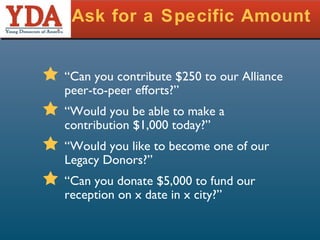
Ask for a Specific Amount “Can you contribute $250 to our Alliance peer-to-peer efforts?” “Would you be able to make a contribution $1,000 today?” “Would you like to become one of our Legacy Donors?” “Can you donate $5,000 to fund our reception on x date in x city?”
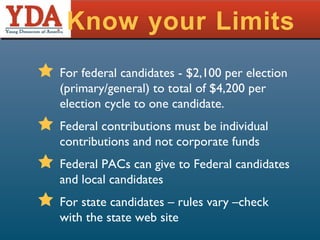
Know your Limits For federal candidates - $2,100 per election (primary/general) to total of $4,200 per election cycle to one candidate. Federal contributions must be individual contributions and not corporate funds Federal PACs can give to Federal candidates and local candidates For state candidates – rules vary –check with the state web site
Exactly what dollar amount makes sense?
Research your Prospects Check federal contributions by reviewing FEC Records www.fec.gov www.tray.com www.opensecrets.org It is illegal to prospect these lists but they can be helpful in determining an ask based on previous giving history if you already have contact info or a relationship with the donor
Other Sources for Info Web searches There is nothing like google Annual reports of organizations to see who major donors are A trusted source who know the donors Common sense!
Dealing with the “Investors” Think of donors as INVESTORS Current and past investors are the best source of major gifts Meet people face to face if you can Don’t only call when you want something Keep in touch! Before you ask for that next check make sure that they know how you spent the first one
Always Say “Thank You!” A personal thank you from you is as critical for $5.00 as it is for $5,000.00 Make sure that the investor feels appreciated Candidate/President/CEO/Executive Director personally respond to major gifts A thank you comes before you get the check and again after it is received Send a picture of your Chapter/Campaign doing an activity Send national publications (e.g. – YDA gift book)
A Fundraising Plan
What is in the plan? How much do you need? Where will you get your money? Who is going to help? What are your resources? What is it going to cost to raise what you need?
Every Campaign or Chapter Needs a Plan Know the chapter’s ultimate fundraising goal Find out how you fit into that plan Learn much money has been raised to date –to show that you are in this for keeps Know the others on the Finance Committee
I still don’t know what I am “selling” to my investors
The Plan/Chapter Statement A case or chapter/campaign statement explains where the money is going and why. Everyone involved in fundraising must be able to articulate the message of the chapter. Investors should know how their money will be spent.
Chapter/Org Statement Proving your chapter is growing and leading Viability can be demonstrated in a variety of ways:  Amount of money raised, press clips, voting statistics of young people, youth table, volunteers, etc.
All Chapters Need a  Finance Committee   Members of the finance committee either write or raise substantial contributions Finance committee members should have a long record of community involvement, are strongly committed to the chapter or have a ideological or political reason to be involved
What is a Finance Committee Group of people who raise through personal contact and events Provide new lists of potential donors to the campaign Host events Are included in the inner-workings of the organization so that they can be good advocates
The Bottom Line is  What Matters You are in this because you believe in your chapter There are going to be ups and downs Have high goals and low expectations Have your own plan Know that you are the number one investor and that your time and energy are as valuable as the dollars you raise
You Can Do It!
We Can Help! Fundraising tools from YDA National: YDA free processing system and credit card collection through DEMopolis – sign up today! D4YD Contact Andrea Pagano at apagano@yda.org for event planning, general assistance, grant & thank you letter reviewing, brain-storming ideas that work best in your state! THANKS!

Fundraising 101

  • 1.
    Fundraising 101 TheDemocratic Approach Trainers: Andrea M. Pagano
  • 2.
    WHO DO YOUASK? Hmmm?
  • 3.
  • 4.
    Why Do PeopleGive? Candidate or solicitor stands for ideals the donor believes in. Personal relationships. Party affiliation/loyalty. Desire to defeat the opponent. Social connection/desire to join with cause or organization. Because They Were ASKED!
  • 5.
    Contributions Come inAll Sizes Donations come from people off all income levels. 19% of families on welfare contribute $72 each year. Don’t assume a wealthy person is always your best prospect. Build relationships with supporters at all income levels.
  • 6.
    Your Best DonorsYour family Your friends Your friend’s friends Your classmates Your work colleagues People who traditionally give to candidates and youth organizations
  • 7.
    You start witha list! Names from your address book Names from email lists/list serves Names from lists of like-minded organizations or campaigns Democratic voters in your neighborhood Cold calls lists from the campaign
  • 8.
    It is AllAbout Relationships You want more than that first check, you want investment over time in your campaign or organization You want to be able to go back to your donors in the future
  • 9.
    HOW DO YOUASK? Please!
  • 10.
    Answer: You startwith a plan knowing your financial goal You develop a case/candidate statement You develop simple and easy-to-follow materials You rely on your instincts You use your head as well as your heart
  • 11.
    Fundraising Strategies& Options Personal contact Tele-fundraising/Phone banks Candidate call time Major gifts Events On-line Fundraising Friend-raising Direct mail
  • 12.
    Old School Fundraising Programs Childhood memories of raising money – they still work: Coin Drops – collecting change from students on campus, people on the street, peers in a bar Bake Sales – put up a table, make a sign, sell goodies Auctions – selling services of some type for a fee (e.g. – date auctions) Car washes – washing cars & hanging up fun signs to attract attention (good for messaging) Garage Sale – collect good from big donors, maybe sell on ebay
  • 13.
    Personal Solicitation: PhoneMost effective and cost efficient way to raise money Must be organized Keep detailed notes Be disciplined
  • 14.
    Personal Solicitation: Face-to-faceBe prepared (materials, etc) Appoint key people to attend meeting (be selective) Ask for a contribution Collect at meeting if possible Use for high donors and raisers
  • 15.
    Events: Benefits Certaindonors like to be seen and see other leaders Builds momentum Gives donors and surrogates a date specific for contributions Good visibility and/or press options Good central location to unveil plans and/or introduce new staff
  • 16.
    Events: Drawbacks Canbe expensive Requires a lot of planning and logistical timing Takes staff/volunteers to execute with less spending Requires a lot of follow up Could be hard to track and gather donor information
  • 17.
    Events: Success ALWAYShave a ticket price Recruit a motivated and connected host committee Follow up phone calls to invitees Market you event for the appropriate audience Registration Follow up calls or letter to attendees
  • 18.
    Direct Mail &Phone Banks Builds a donor base of consistent, small donors Can be expensive Re-solicitation is essential Example: D4YD
  • 19.
    Direct Mail: Guidelines and Tips Create a sense of urgency Short paragraphs that highlight and bold Always include a p.s. State a clear and compelling message Write from one person to one person Personalize whenever possible (phone or mail) Ask for a specific dollar amount Remember, it’s public!
  • 20.
    Your “Pitch” Donot assume people will think to send money  Ask  Make your ask specific and tied to a particular need or goal Lay out your fundraising goal and how they can help you reach it. Explain what other support sources you have already
  • 21.
    Making the AskDo your RESEARCH: Know your donor Build RELATIONSHIP: Ask for opinions Make your pitch and REQUEST a gift in a specific amount After you ask, stop talking and listen. LISTEN and RESPOND to any concerns or questions and close the deal REVIEW and document your contact and always follow up
  • 22.
    I can’t believeshe said No!
  • 23.
    Stuff Happens Somepeople will not donate dollars – get over it. Be prepared to ask for help in other ways: volunteer, give names of other potential supporters, host a house party, etc. Recognize that “the ask” is about more than money. It is about relationships. It may lead to a future yes, simply just to a vote for your candidate, volunteer time, or a chance to open their house for a reception.
  • 24.
    But, I’mnervous There is no room for nervous in fundraising! Uh Oh!
  • 25.
    Overcoming Nervousness by just Making the Ask Being nervous is natural – but get over it! When asking for money think of why you are giving your time and money –articulate your passion! This is an opportunity not an obligation – you are offering someone a chance to support their beliefs and ideals People aren’t offended and are often flattered
  • 26.
    WHAT DO IASK FOR How much is too much? $$$$$$
  • 27.
    Answer: The onlylimit is the law!
  • 28.
    Ask for aSpecific Amount “Can you contribute $250 to our Alliance peer-to-peer efforts?” “Would you be able to make a contribution $1,000 today?” “Would you like to become one of our Legacy Donors?” “Can you donate $5,000 to fund our reception on x date in x city?”
  • 29.
    Know your LimitsFor federal candidates - $2,100 per election (primary/general) to total of $4,200 per election cycle to one candidate. Federal contributions must be individual contributions and not corporate funds Federal PACs can give to Federal candidates and local candidates For state candidates – rules vary –check with the state web site
  • 30.
    Exactly what dollaramount makes sense?
  • 31.
    Research your ProspectsCheck federal contributions by reviewing FEC Records www.fec.gov www.tray.com www.opensecrets.org It is illegal to prospect these lists but they can be helpful in determining an ask based on previous giving history if you already have contact info or a relationship with the donor
  • 32.
    Other Sources forInfo Web searches There is nothing like google Annual reports of organizations to see who major donors are A trusted source who know the donors Common sense!
  • 33.
    Dealing with the“Investors” Think of donors as INVESTORS Current and past investors are the best source of major gifts Meet people face to face if you can Don’t only call when you want something Keep in touch! Before you ask for that next check make sure that they know how you spent the first one
  • 34.
    Always Say “ThankYou!” A personal thank you from you is as critical for $5.00 as it is for $5,000.00 Make sure that the investor feels appreciated Candidate/President/CEO/Executive Director personally respond to major gifts A thank you comes before you get the check and again after it is received Send a picture of your Chapter/Campaign doing an activity Send national publications (e.g. – YDA gift book)
  • 35.
  • 36.
    What is inthe plan? How much do you need? Where will you get your money? Who is going to help? What are your resources? What is it going to cost to raise what you need?
  • 37.
    Every Campaign orChapter Needs a Plan Know the chapter’s ultimate fundraising goal Find out how you fit into that plan Learn much money has been raised to date –to show that you are in this for keeps Know the others on the Finance Committee
  • 38.
    I still don’tknow what I am “selling” to my investors
  • 39.
    The Plan/Chapter StatementA case or chapter/campaign statement explains where the money is going and why. Everyone involved in fundraising must be able to articulate the message of the chapter. Investors should know how their money will be spent.
  • 40.
    Chapter/Org Statement Provingyour chapter is growing and leading Viability can be demonstrated in a variety of ways: Amount of money raised, press clips, voting statistics of young people, youth table, volunteers, etc.
  • 41.
    All Chapters Needa Finance Committee Members of the finance committee either write or raise substantial contributions Finance committee members should have a long record of community involvement, are strongly committed to the chapter or have a ideological or political reason to be involved
  • 42.
    What is aFinance Committee Group of people who raise through personal contact and events Provide new lists of potential donors to the campaign Host events Are included in the inner-workings of the organization so that they can be good advocates
  • 43.
    The Bottom Lineis What Matters You are in this because you believe in your chapter There are going to be ups and downs Have high goals and low expectations Have your own plan Know that you are the number one investor and that your time and energy are as valuable as the dollars you raise
  • 44.
  • 45.
    We Can Help!Fundraising tools from YDA National: YDA free processing system and credit card collection through DEMopolis – sign up today! D4YD Contact Andrea Pagano at apagano@yda.org for event planning, general assistance, grant & thank you letter reviewing, brain-storming ideas that work best in your state! THANKS!