International Research Journal of Engineering and Technology (IRJET) e-ISSN: 2395-0056
Volume: 06 Issue: 06 | June 2019 www.irjet.net p-ISSN: 2395-0072
© 2019, IRJET | Impact Factor value: 7.211 | ISO 9001:2008 Certified Journal | Page 3735
Design and Computational Analysis of Shell and Tube Heat Exchanger
Considering various Parameters
Pintu Kumar Yadav1, G Satish Kumar2
1Pintu Kumar Yadav, Mechanical Engineering Department, Narsimha Reddy EngineeringCollege, Secunderabad,
Telengana 500100, India
2G Satish Kumar, Associate Professor, Mechanical Engineering Department, Narsimha Reddy Engineering College,
Secunderabad, Telengana 500100, India
--------------------------------------------------------------------***---------------------------------------------------------------------
Abstract: In this project analysis on shell and tube heat
exchanger is carried out. While going through the process
we have to predict the performance of STHE. The process
solving in simulation consist of modeling and meshing
the basic geometry of shell and tube heat exchanger
using Computational Fluid Dynamics Package using
ANSYS 13.0. The slaying of heat exchanger is carried out
by using the package CFD with FLUENT and after that it is
compared to the existing performed values. After this an
attempt has been made to know the performance of the
heat exchanger by taking into account the helix baffles
instead of the so used steady Segmental Baffles and hence
the result so obtained has to be compared. The
performance parameters related to heat exchanger like
effectiveness, overall heat transfer coefficient, energy
extraction rate etc., has to be reported in this work. The
intent of this project is to contrive the shell tube heat
exchanger with helical baffle and then study the flow and
temperature field inside the shell. This type of heat
exchanger contains seven tubes of diameter 20 mm and
the shell length consists of 600 mm long and the diameter
90 mm. the helixes angle ranges from 00 to 200. Here the
simulation shows how the pressure varies inside the shell
due to different helix angle and flow rate. The flow pattern
are forced to be rotational with continuos helical baffle
present inside the shell. Therefore we see the results in an
rise of heat transfer coefficient per unit pressure drop in
this heat exchanger. The baffle cut here is 36 percent. The
heat exchanger is looked upon by varying its mass flow
rate and baffle inclination angle. Determining of the shell
side outlet temperature, pressure drop, for the given heat
exchanger is known using computational fluid dynamics.
As per the numerical experimental data the result here
obtained is increase in the performance of heat exchanger
in helical baffle instead of segmental baffle.
Keywords: Shell and tube heat exchanger,
computational fluid dynamics tools, helix Baffles,
Heat Transfer Coefficient, Pressure Decline.
I. INTRODUCTION
Heat exchangers are one of the mostly used equipment in
the process industries. Heat exchangers are used to
transfer heat between two process streams. One can
realize their usage that any process which involve cooling,
heating, condensation, boiling or evaporation will require
a heat exchanger for these purpose. Process fluids, usually
are heated or cooled before the process undergo a phase
change. Various heat exchangers are named as per their
applications. Let us see an example, heat exchangers used
to condense are known as condensers, in the same way
heat exchanger for boiling purposes are called boilers. The
Performance and efficiency of heat exchangers are
measured knowing the amount of heat transfer using least
area of heat transfer and pressure drop. Power
requirements (Running cost) of a heat exchanger can be
better known by the area and the pressure drop. There is
lots of literature and theories to design a heat exchanger as
per the requirements.
1.1Shell and tube heat exchanger.
A heat exchanger, higher pressure applications up to
552 bars, is the shell and tube heat exchanger. Shell
and tube type heat exchanger is an indirect contact type of
heat exchanger. THE shell tube heat exchanger consists of
a series of tubes, in which the fluids runs and whole this
are placed in the shell which looks like a container. A shell
is generally used due to its low cost and simplicity, and
has the highest log-mean temperature-difference
(LMTD) correction factor. Generally the tubes have single
or multiple passes, in which one pass is on the shell side,
while the other fluid flows within the shell over the tubes
to be heated or cooled. The tube side and shell side fluids
are separated by tube sheet. Baffles are one of the vital
components in the heat exchanger. It is used to support the
tubes in its structural rigidity as well as prevents tube
vibration and sagging. It diverts the flow across the bundle
to obtain a higher heat transfer coefficient. Baffle spacing
(B) is the center line distance between the two adjacent
baffles. Baffle is observed with a cut (Bc) which is shown
International Research Journal of Engineering and Technology (IRJET) e-ISSN: 2395-0056
Volume: 06 Issue: 06 | June 2019 www.irjet.net p-ISSN: 2395-0072
© 2019, IRJET | Impact Factor value: 7.211 | ISO 9001:2008 Certified Journal | Page 3736
as the percentage of the segment height to shell inside
diameter. Baffle cut can differ between 15 per cent and 45
per cent of the shell inside diameter. In this study 36 per
cent baffle cut (Bc) is considered. In general, conventional
shell and tube heat exchangers result in high shell- side
pressure drop and formation of recirculation zones near
the baffles. Mostly helical baffles were preferred by the
researchers, which gave better performance than single
segmental baffles but they involved high manufacturing
cost, installation cost and maintenance cost. The
complexity of experimental techniques involves
quantitative description of flow phenomena using
measurements dealing with one quantity at a time for a
limited range of problem and operating conditions.
Computational Fluid Dynamics is now an established
industrial design tool, offering lots of advantages. In this
study, a full 360° CFD model of shell and tube heat
exchanger is considered. With the help of modelling the
geometry can be as accurately as possible, the flow
structure and the temperature distribution inside the shell
are obtained.
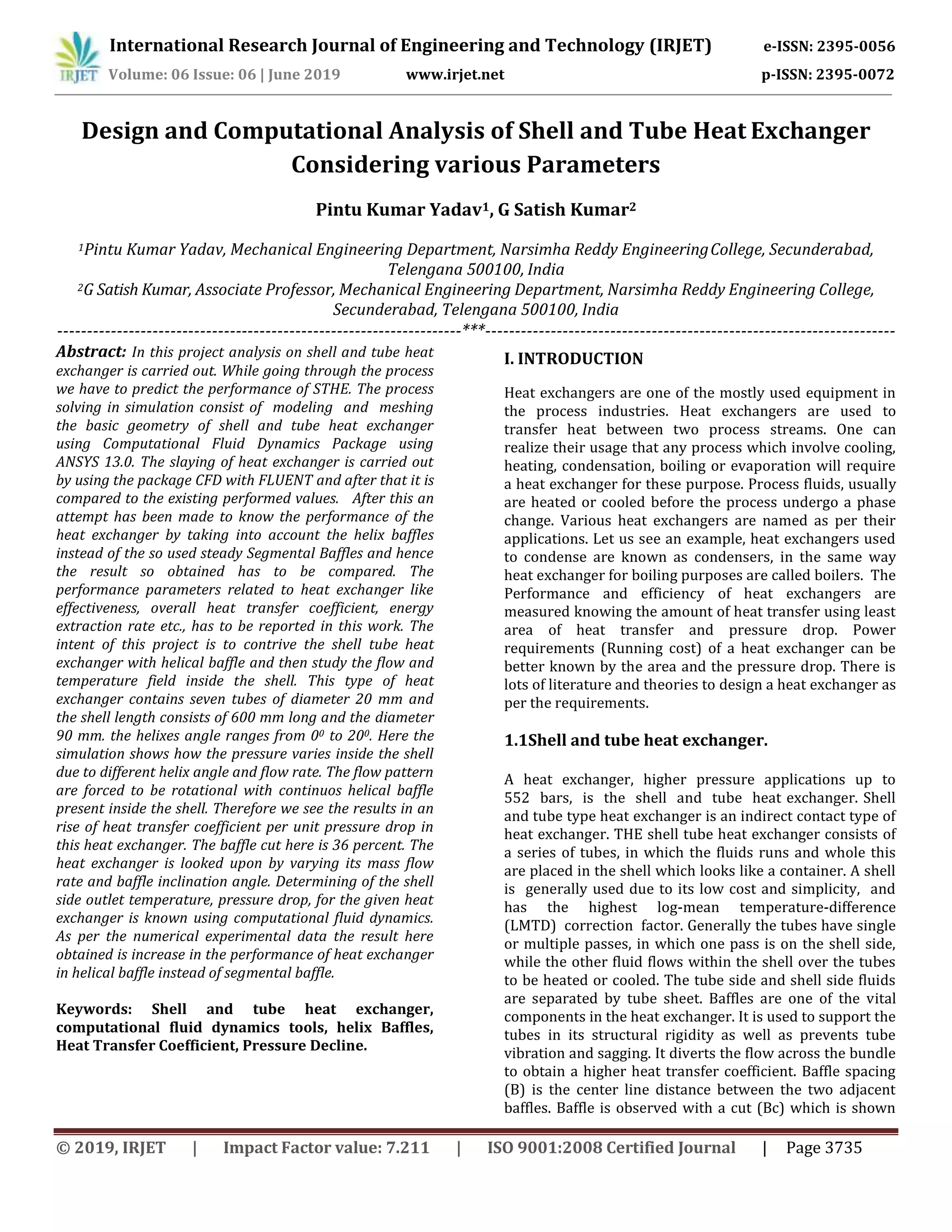
Fig.1.Components of Shell and Tube Heat Exchanger
II. LITERATURE REVIEW
The purpose of this chapter is to provide a literature
review of past research effort such as journals or articles
related to shell and tube heat exchanger and
computational fluid dynamics (CFD) analysis whether on
two dimension and three dimension modelling. Moreover,
review of other relevant research studies are made to
provide more information in order to understand more on
this research.
EMERSON, W.H. (August 1963 ) Shell-side pressure drop
and heat transfer with turbulent flow in segmentally
baffled shell-and-tube heat exchangers published in
International Journal of Heat and Mass Transfer
LUTCHA, J; NEMCANSKY, (May 01, 1990) Performance
improvement of tubular heat exchangers by helical baffles.
P. STEHLÍK, J. NĚMČANSKÝ, D. KRAL &L. W. SWANSON
(27 Aug 2007) Comparison of Correction Factors for Shell-
and-Tube Heat Exchangers with Segmental or Helical
Baffles
HUADONGLI, VOLKER KOTTKE (Volume 41, Issue 10,
May 1998), Effect of baffle spacing on pressure drop and
local heat transfer in shell-and-tube heat exchangers for
staggered tube arrangement International Journal of Heat
and Mass Transfer
D. KRAL, P. STEHLIK,H. J. VAN DER PLOEG &BASHIR I.
MASTER (27 Apr 2007) Helical Baffles in Shell-and-Tube
Heat Exchangers, Part I: Experimental Verification.
M THIRUMARIMURUGAN, T KANNADASAN, E
RAMASAMY (2008) Performance analysis of shell and
tube heat exchanger using miscible system published
in American Journal of Applied Sciences
A.D. DIAPER, L. E. HASELER (1990) crossflow pressure
drop and flow distribution within a tube bundle using
computational fluid dynamics
ROGER TEMAM (1977) Claude-Louis Navier and Gabriel
Stokes Navier-Stokes Equations: Theory and Numerical
Analysis, Institut for Scientific Computing and Applied
Mathematics, Indiana University, USA
SUNIL K.S. AND PANCHA M.H.,( (2012)) Comparative
thermal performance of shell and tube heat Exchanger
with continuous helical baffle using different angles,
International Journal of Engineering Research and
Applications
MP MURUGESAN, R BALASUBRAMANIAN (2012/12)
The Effect of Mass Flow Rate on the
Enhanced Heat T ransfer Charactristics in a Corrugated
type Plate heat Exchanger Research Journal of Engineering
Sciences.
2.1 Computational Fluid Dynamics (CFD)
Computational Fluid Dynamics (CFD) is helpful in a
wide assortment of uses and use in industry. CFD is one
of the parts of liquid mechanics that utilizations numerical
techniques and calculation can be utilized to take care of
and butt-centric y se issues that include liquid streams and
furthermore reproduce the stream over a funneling,
vehicle or hardware. PCs are utilized to play out the a large
number of counts required to reproduce the cooperation
of liquids and gases with the mind boggling surfaces
utilized in building. More exact codes that can precisely
and rapidly reproduce even complex situations, for
example, supersonic and tempestuous streams are
continuous research. Onwards the aeronautic trade has
incorporated CFD strategies into the outline, R and D and
International Research Journal of Engineering and Technology (IRJET) e-ISSN: 2395-0056
Volume: 06 Issue: 06 | June 2019 www.irjet.net p-ISSN: 2395-0072
© 2019, IRJET | Impact Factor value: 7.211 | ISO 9001:2008 Certified Journal | Page 3737
make of air ship and fly motors. All the more as of late the
strategies have been connected to the plan of inward
burning motor, ignition councils of gas turbine and heaters
additionally liquid streams and warmth move in heat
exchanger. Progressively CFD is turning into a crucial part
in the plan of modern items and procedures.
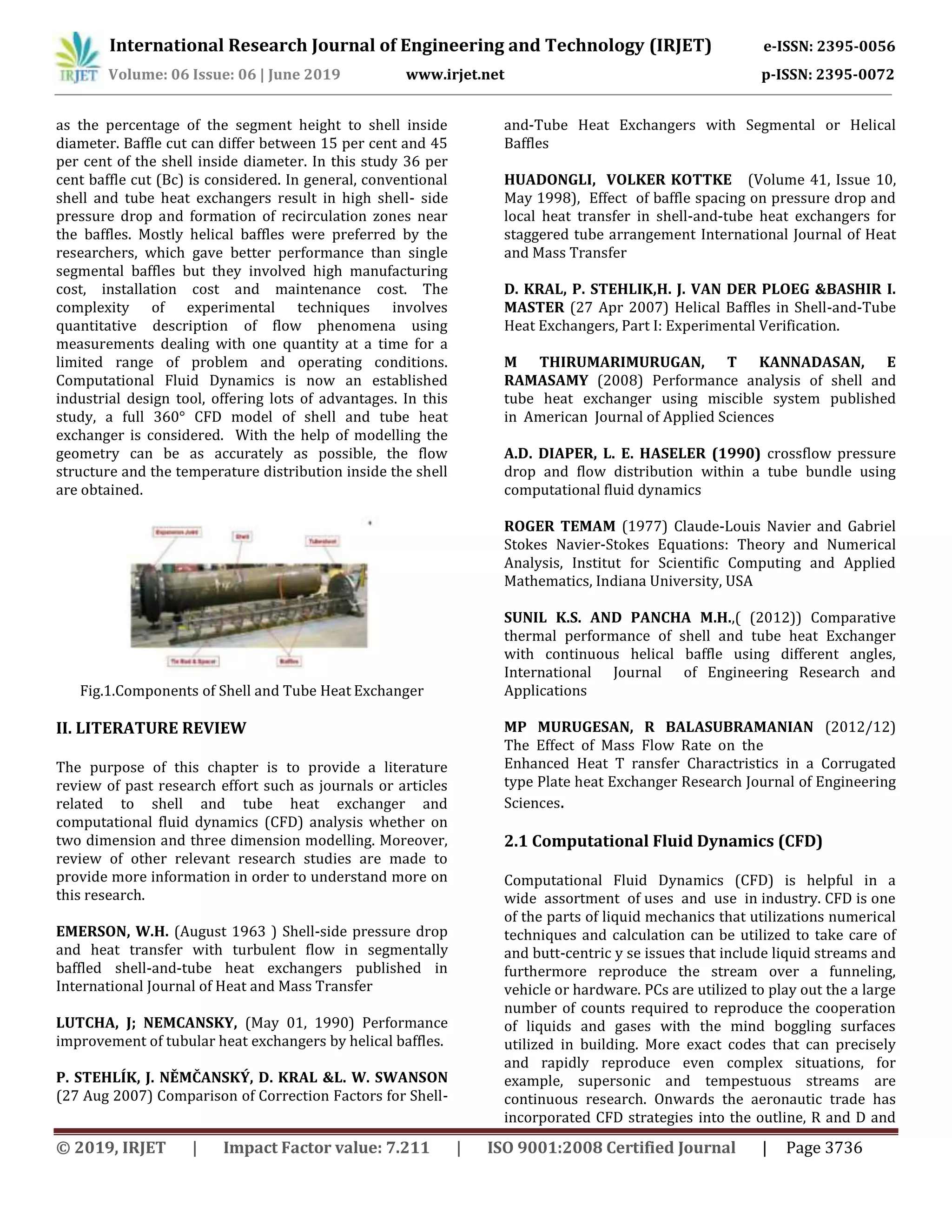
Fig.2.Fluid flow simulation for a shell and tube exchanger
III. DESIGN OF MODELING AND PARAMETERS
3.1Problem Description:
Plan of shell and tube warm exchanger with helical baffle
utilizing CFD. To think about the temperature and weight
inside the tube with various mass stream rate.
3.2Computational Model:
The computational model of a test tried Shell and Tube
Heat Exchanger (STHX) with 10 helix point and the
geometry parameters are recorded in Table 1. As can be
seen from the reproduced STHX has six cycles of baffles in
the shell side course with add up to number of tube 7 .The
entire calculation area is limited by the internal side of the
shell and everything in the shell contained in the area.
The gulf and out let of the area are associated with the
comparing tubes.
To streamline numerical reproduction, some
fundamental qualities of the procedure following
suspicion are made :
1. The shell side liquid is consistent warm properties
2. The liquid stream and warmth exchange forms are
fierce and in unfaltering state
3. The break streams among tube and bewilder and that
among confuses and shell are disregarded
4. The regular convection prompted by the liquid
thickness variety is ignored
5. The tube divider temperature kept steady in the entire
shell side
6. The heat exchanger is very much protected
subsequently the warmth misfortune to the earth is
completely disregarded.
3.3. Navier-Stokes Equation:
It is named after Claude-Louis Navier and Gabriel Stokes
(Temam, 1977), He portrayed the movement of liquid
substances. It's likewise a principal condition being
utilized by ANSYS and even in the present undertaking
work. These condition emerge from applying second law of
newton to smooth movement, together with the suspicion
that the liquid pressure is total of a diffusing gooey term, in
addition to a weight term. The deduction of the Navier
Stokes condition starts with an utilization of second law of
newton i.e protection of energy. In an inertial edge of
reference, the general type of the conditions of smooth
movement is
This Navier Stokes Equation explained in each chaos shell
and the reproduction demonstrates the outcome.
3.4. Geometry and Mesh:
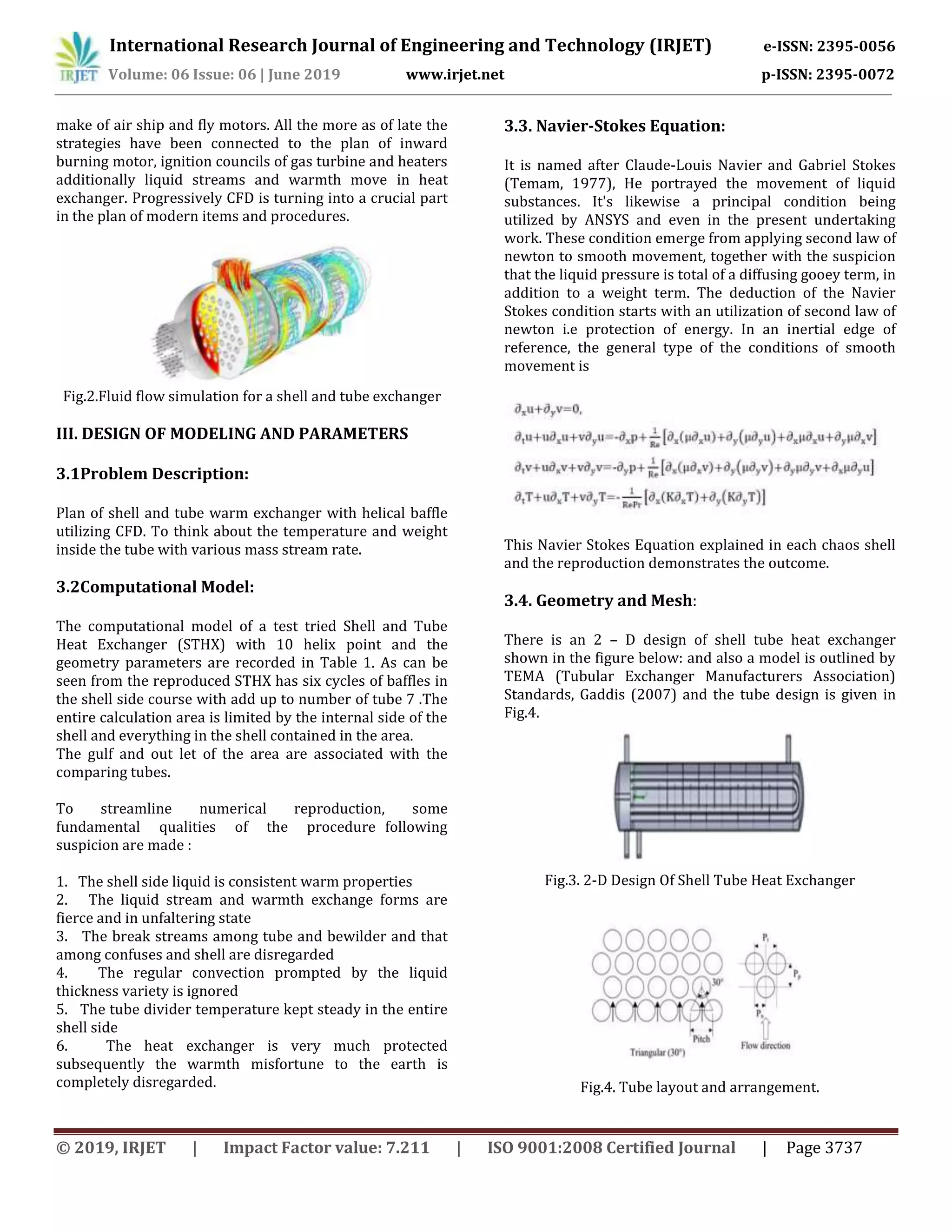
There is an 2 – D design of shell tube heat exchanger
shown in the figure below: and also a model is outlined by
TEMA (Tubular Exchanger Manufacturers Association)
Standards, Gaddis (2007) and the tube design is given in
Fig.4.
Fig.3. 2-D Design Of Shell Tube Heat Exchanger
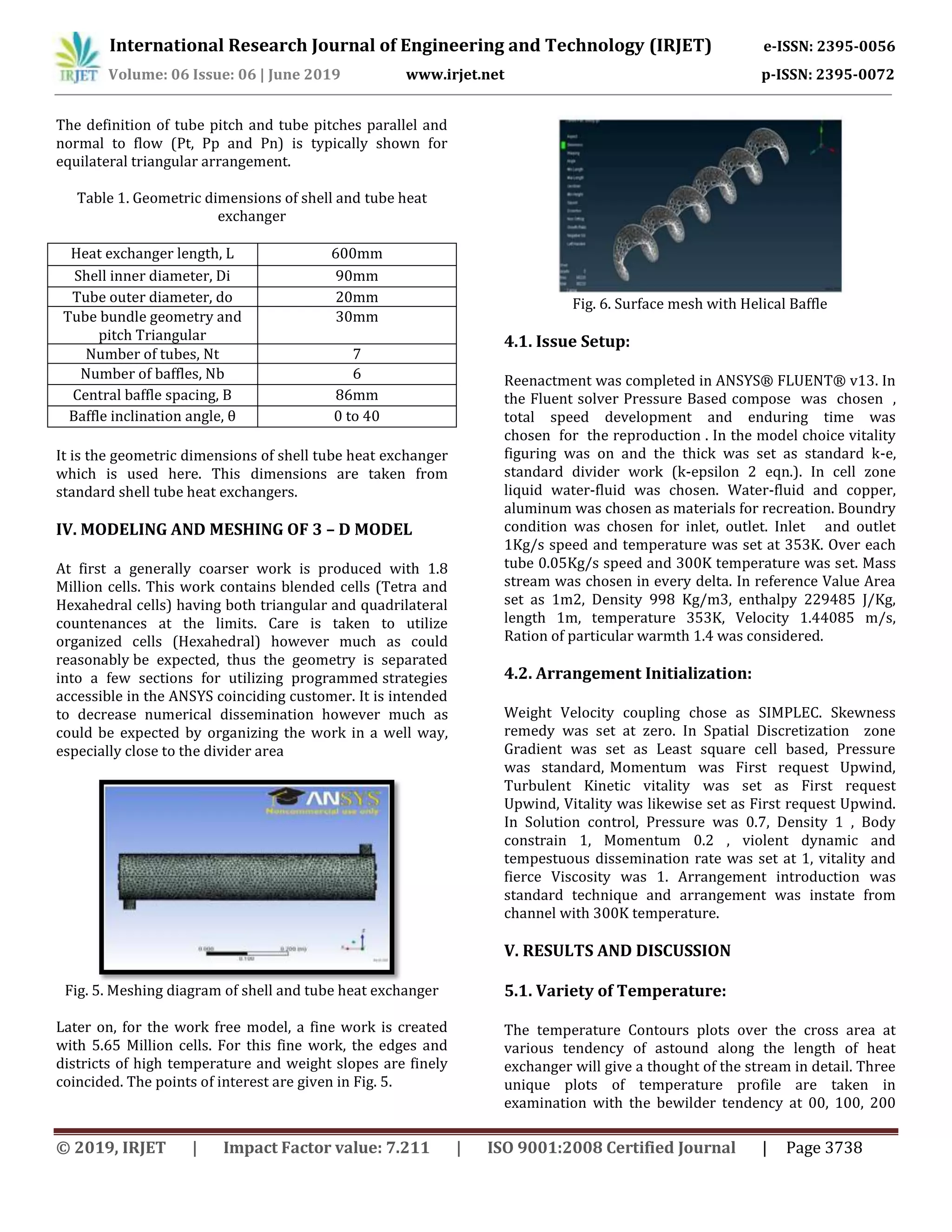
Fig.4. Tube layout and arrangement.
International Research Journal of Engineering and Technology (IRJET) e-ISSN: 2395-0056
Volume: 06 Issue: 06 | June 2019 www.irjet.net p-ISSN: 2395-0072
© 2019, IRJET | Impact Factor value: 7.211 | ISO 9001:2008 Certified Journal | Page 3738
The definition of tube pitch and tube pitches parallel and
normal to flow (Pt, Pp and Pn) is typically shown for
equilateral triangular arrangement.
Table 1. Geometric dimensions of shell and tube heat
exchanger
Heat exchanger length, L 600mm
Shell inner diameter, Di 90mm
Tube outer diameter, do 20mm
Tube bundle geometry and
pitch Triangular
30mm
Number of tubes, Nt 7
Number of baffles, Nb 6
Central baffle spacing, B 86mm
Baffle inclination angle, θ 0 to 40
It is the geometric dimensions of shell tube heat exchanger
which is used here. This dimensions are taken from
standard shell tube heat exchangers.
IV. MODELING AND MESHING OF 3 – D MODEL
At first a generally coarser work is produced with 1.8
Million cells. This work contains blended cells (Tetra and
Hexahedral cells) having both triangular and quadrilateral
countenances at the limits. Care is taken to utilize
organized cells (Hexahedral) however much as could
reasonably be expected, thus the geometry is separated
into a few sections for utilizing programmed strategies
accessible in the ANSYS coinciding customer. It is intended
to decrease numerical dissemination however much as
could be expected by organizing the work in a well way,
especially close to the divider area
Fig. 5. Meshing diagram of shell and tube heat exchanger
Later on, for the work free model, a fine work is created
with 5.65 Million cells. For this fine work, the edges and
districts of high temperature and weight slopes are finely
coincided. The points of interest are given in Fig. 5.
Fig. 6. Surface mesh with Helical Baffle
4.1. Issue Setup:
Reenactment was completed in ANSYS® FLUENT® v13. In
the Fluent solver Pressure Based compose was chosen ,
total speed development and enduring time was
chosen for the reproduction . In the model choice vitality
figuring was on and the thick was set as standard k-e,
standard divider work (k-epsilon 2 eqn.). In cell zone
liquid water-fluid was chosen. Water-fluid and copper,
aluminum was chosen as materials for recreation. Boundry
condition was chosen for inlet, outlet. Inlet and outlet
1Kg/s speed and temperature was set at 353K. Over each
tube 0.05Kg/s speed and 300K temperature was set. Mass
stream was chosen in every delta. In reference Value Area
set as 1m2, Density 998 Kg/m3, enthalpy 229485 J/Kg,
length 1m, temperature 353K, Velocity 1.44085 m/s,
Ration of particular warmth 1.4 was considered.
4.2. Arrangement Initialization:
Weight Velocity coupling chose as SIMPLEC. Skewness
remedy was set at zero. In Spatial Discretization zone
Gradient was set as Least square cell based, Pressure
was standard, Momentum was First request Upwind,
Turbulent Kinetic vitality was set as First request
Upwind, Vitality was likewise set as First request Upwind.
In Solution control, Pressure was 0.7, Density 1 , Body
constrain 1, Momentum 0.2 , violent dynamic and
tempestuous dissemination rate was set at 1, vitality and
fierce Viscosity was 1. Arrangement introduction was
standard technique and arrangement was instate from
channel with 300K temperature.
V. RESULTS AND DISCUSSION
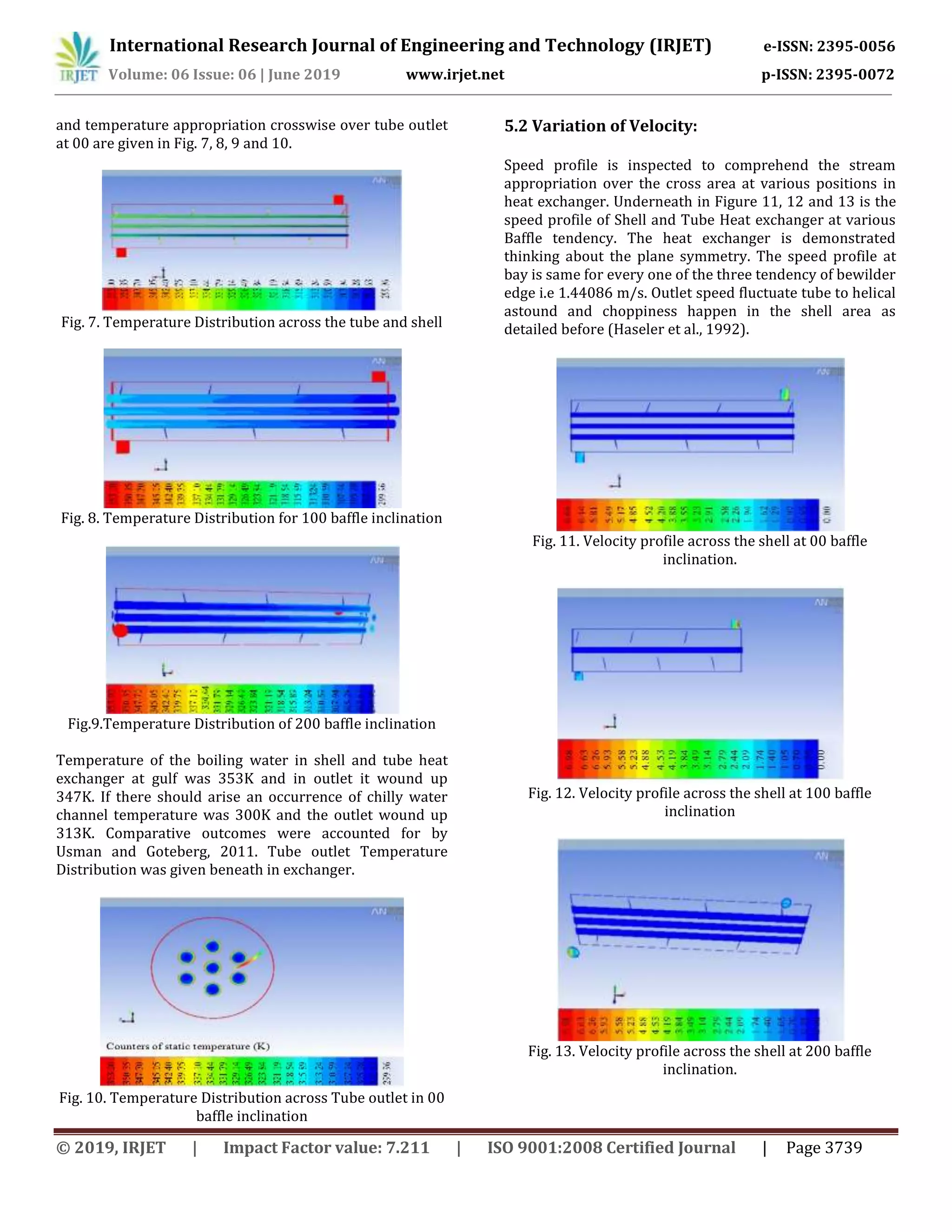
5.1. Variety of Temperature:
The temperature Contours plots over the cross area at
various tendency of astound along the length of heat
exchanger will give a thought of the stream in detail. Three
unique plots of temperature profile are taken in
examination with the bewilder tendency at 00, 100, 200
International Research Journal of Engineering and Technology (IRJET) e-ISSN: 2395-0056
Volume: 06 Issue: 06 | June 2019 www.irjet.net p-ISSN: 2395-0072
© 2019, IRJET | Impact Factor value: 7.211 | ISO 9001:2008 Certified Journal | Page 3739
and temperature appropriation crosswise over tube outlet
at 00 are given in Fig. 7, 8, 9 and 10.
Fig. 7. Temperature Distribution across the tube and shell
Fig. 8. Temperature Distribution for 100 baffle inclination
Fig.9.Temperature Distribution of 200 baffle inclination
Temperature of the boiling water in shell and tube heat
exchanger at gulf was 353K and in outlet it wound up
347K. If there should arise an occurrence of chilly water
channel temperature was 300K and the outlet wound up
313K. Comparative outcomes were accounted for by
Usman and Goteberg, 2011. Tube outlet Temperature
Distribution was given beneath in exchanger.
Fig. 10. Temperature Distribution across Tube outlet in 00
baffle inclination
5.2 Variation of Velocity:
Speed profile is inspected to comprehend the stream
appropriation over the cross area at various positions in
heat exchanger. Underneath in Figure 11, 12 and 13 is the
speed profile of Shell and Tube Heat exchanger at various
Baffle tendency. The heat exchanger is demonstrated
thinking about the plane symmetry. The speed profile at
bay is same for every one of the three tendency of bewilder
edge i.e 1.44086 m/s. Outlet speed fluctuate tube to helical
astound and choppiness happen in the shell area as
detailed before (Haseler et al., 1992).
Fig. 11. Velocity profile across the shell at 00 baffle
inclination.
Fig. 12. Velocity profile across the shell at 100 baffle
inclination
Fig. 13. Velocity profile across the shell at 200 baffle
inclination.
International Research Journal of Engineering and Technology (IRJET) e-ISSN: 2395-0056
Volume: 06 Issue: 06 | June 2019 www.irjet.net p-ISSN: 2395-0072
© 2019, IRJET | Impact Factor value: 7.211 | ISO 9001:2008 Certified Journal | Page 3740
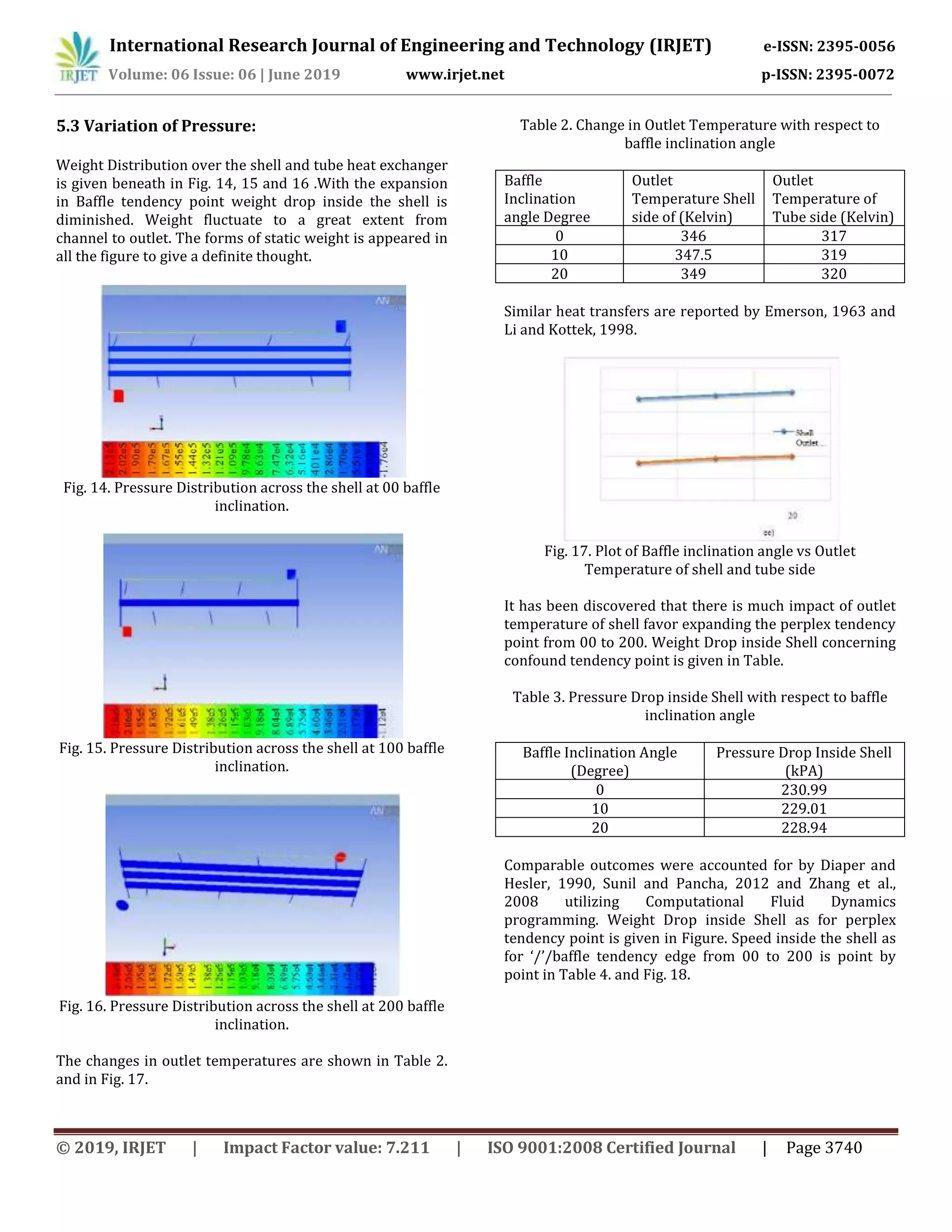
5.3 Variation of Pressure:
Weight Distribution over the shell and tube heat exchanger
is given beneath in Fig. 14, 15 and 16 .With the expansion
in Baffle tendency point weight drop inside the shell is
diminished. Weight fluctuate to a great extent from
channel to outlet. The forms of static weight is appeared in
all the figure to give a definite thought.
Fig. 14. Pressure Distribution across the shell at 00 baffle
inclination.
Fig. 15. Pressure Distribution across the shell at 100 baffle
inclination.
Fig. 16. Pressure Distribution across the shell at 200 baffle
inclination.
The changes in outlet temperatures are shown in Table 2.
and in Fig. 17.
Table 2. Change in Outlet Temperature with respect to
baffle inclination angle
Baffle
Inclination
angle Degree
Outlet
Temperature Shell
side of (Kelvin)
Outlet
Temperature of
Tube side (Kelvin)
0 346 317
10 347.5 319
20 349 320
Similar heat transfers are reported by Emerson, 1963 and
Li and Kottek, 1998.
Fig. 17. Plot of Baffle inclination angle vs Outlet
Temperature of shell and tube side
It has been discovered that there is much impact of outlet
temperature of shell favor expanding the perplex tendency
point from 00 to 200. Weight Drop inside Shell concerning
confound tendency point is given in Table.
Table 3. Pressure Drop inside Shell with respect to baffle
inclination angle
Baffle Inclination Angle
(Degree)
Pressure Drop Inside Shell
(kPA)
0 230.99
10 229.01
20 228.94
Comparable outcomes were accounted for by Diaper and
Hesler, 1990, Sunil and Pancha, 2012 and Zhang et al.,
2008 utilizing Computational Fluid Dynamics
programming. Weight Drop inside Shell as for perplex
tendency point is given in Figure. Speed inside the shell as
for ‘/’/baffle tendency edge from 00 to 200 is point by
point in Table 4. and Fig. 18.
International Research Journal of Engineering and Technology (IRJET) e-ISSN: 2395-0056
Volume: 06 Issue: 06 | June 2019 www.irjet.net p-ISSN: 2395-0072
© 2019, IRJET | Impact Factor value: 7.211 | ISO 9001:2008 Certified Journal | Page 3741
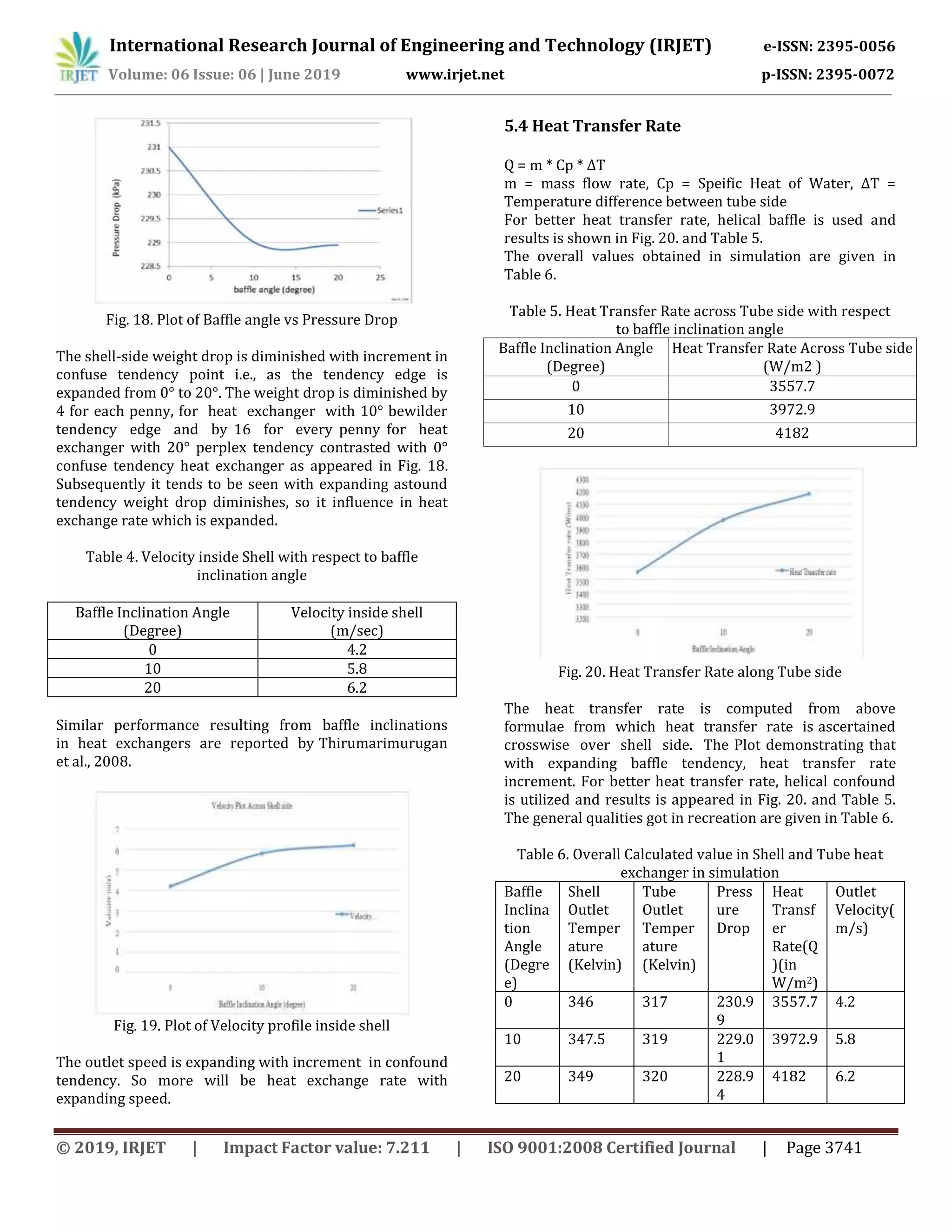
Fig. 18. Plot of Baffle angle vs Pressure Drop
The shell-side weight drop is diminished with increment in
confuse tendency point i.e., as the tendency edge is
expanded from 0° to 20°. The weight drop is diminished by
4 for each penny, for heat exchanger with 10° bewilder
tendency edge and by 16 for every penny for heat
exchanger with 20° perplex tendency contrasted with 0°
confuse tendency heat exchanger as appeared in Fig. 18.
Subsequently it tends to be seen with expanding astound
tendency weight drop diminishes, so it influence in heat
exchange rate which is expanded.
Table 4. Velocity inside Shell with respect to baffle
inclination angle
Baffle Inclination Angle
(Degree)
Velocity inside shell
(m/sec)
0 4.2
10 5.8
20 6.2
Similar performance resulting from baffle inclinations
in heat exchangers are reported by Thirumarimurugan
et al., 2008.
Fig. 19. Plot of Velocity profile inside shell
The outlet speed is expanding with increment in confound
tendency. So more will be heat exchange rate with
expanding speed.
5.4 Heat Transfer Rate
Q = m * Cp * ΔT
m = mass flow rate, Cp = Speific Heat of Water, ΔT =
Temperature difference between tube side
For better heat transfer rate, helical baffle is used and
results is shown in Fig. 20. and Table 5.
The overall values obtained in simulation are given in
Table 6.
Table 5. Heat Transfer Rate across Tube side with respect
to baffle inclination angle
Baffle Inclination Angle
(Degree)
Heat Transfer Rate Across Tube side
(W/m2 )
0 3557.7
10 3972.9
20 4182
Fig. 20. Heat Transfer Rate along Tube side
The heat transfer rate is computed from above
formulae from which heat transfer rate is ascertained
crosswise over shell side. The Plot demonstrating that
with expanding baffle tendency, heat transfer rate
increment. For better heat transfer rate, helical confound
is utilized and results is appeared in Fig. 20. and Table 5.
The general qualities got in recreation are given in Table 6.
Table 6. Overall Calculated value in Shell and Tube heat
exchanger in simulation
Baffle
Inclina
tion
Angle
(Degre
e)
Shell
Outlet
Temper
ature
(Kelvin)
Tube
Outlet
Temper
ature
(Kelvin)
Press
ure
Drop
Heat
Transf
er
Rate(Q
)(in
W/m2)
Outlet
Velocity(
m/s)
0 346 317 230.9
9
3557.7 4.2
10 347.5 319 229.0
1
3972.9 5.8
20 349 320 228.9
4
4182 6.2
International Research Journal of Engineering and Technology (IRJET) e-ISSN: 2395-0056
Volume: 06 Issue: 06 | June 2019 www.irjet.net p-ISSN: 2395-0072
© 2019, IRJET | Impact Factor value: 7.211 | ISO 9001:2008 Certified Journal | Page 3742
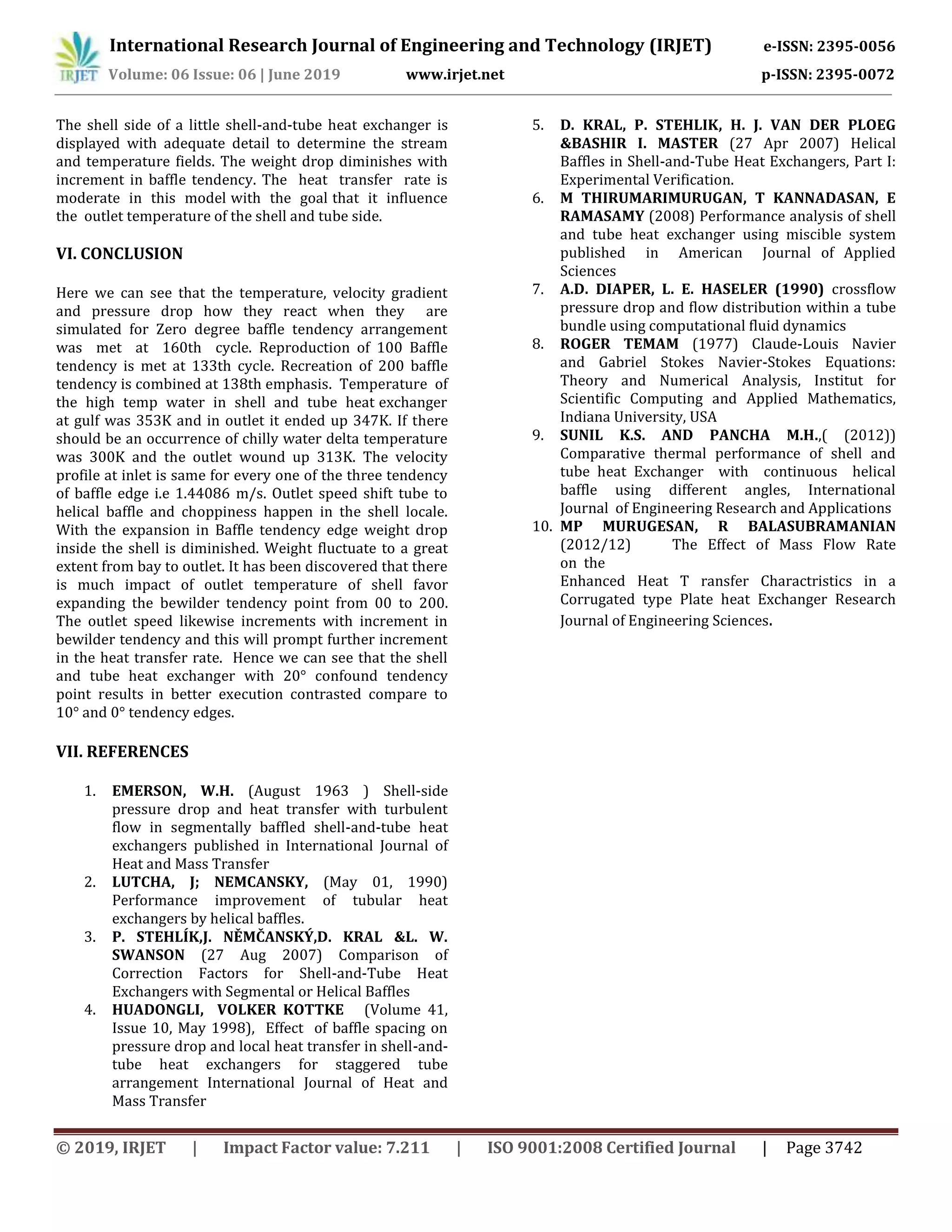
The shell side of a little shell-and-tube heat exchanger is
displayed with adequate detail to determine the stream
and temperature fields. The weight drop diminishes with
increment in baffle tendency. The heat transfer rate is
moderate in this model with the goal that it influence
the outlet temperature of the shell and tube side.
VI. CONCLUSION
Here we can see that the temperature, velocity gradient
and pressure drop how they react when they are
simulated for Zero degree baffle tendency arrangement
was met at 160th cycle. Reproduction of 100 Baffle
tendency is met at 133th cycle. Recreation of 200 baffle
tendency is combined at 138th emphasis. Temperature of
the high temp water in shell and tube heat exchanger
at gulf was 353K and in outlet it ended up 347K. If there
should be an occurrence of chilly water delta temperature
was 300K and the outlet wound up 313K. The velocity
profile at inlet is same for every one of the three tendency
of baffle edge i.e 1.44086 m/s. Outlet speed shift tube to
helical baffle and choppiness happen in the shell locale.
With the expansion in Baffle tendency edge weight drop
inside the shell is diminished. Weight fluctuate to a great
extent from bay to outlet. It has been discovered that there
is much impact of outlet temperature of shell favor
expanding the bewilder tendency point from 00 to 200.
The outlet speed likewise increments with increment in
bewilder tendency and this will prompt further increment
in the heat transfer rate. Hence we can see that the shell
and tube heat exchanger with 20° confound tendency
point results in better execution contrasted compare to
10° and 0° tendency edges.
VII. REFERENCES
1. EMERSON, W.H. (August 1963 ) Shell-side
pressure drop and heat transfer with turbulent
flow in segmentally baffled shell-and-tube heat
exchangers published in International Journal of
Heat and Mass Transfer
2. LUTCHA, J; NEMCANSKY, (May 01, 1990)
Performance improvement of tubular heat
exchangers by helical baffles.
3. P. STEHLÍK,J. NĚMČANSKÝ,D. KRAL &L. W.
SWANSON (27 Aug 2007) Comparison of
Correction Factors for Shell-and-Tube Heat
Exchangers with Segmental or Helical Baffles
4. HUADONGLI, VOLKER KOTTKE (Volume 41,
Issue 10, May 1998), Effect of baffle spacing on
pressure drop and local heat transfer in shell-and-
tube heat exchangers for staggered tube
arrangement International Journal of Heat and
Mass Transfer
5. D. KRAL, P. STEHLIK, H. J. VAN DER PLOEG
&BASHIR I. MASTER (27 Apr 2007) Helical
Baffles in Shell-and-Tube Heat Exchangers, Part I:
Experimental Verification.
6. M THIRUMARIMURUGAN, T KANNADASAN, E
RAMASAMY (2008) Performance analysis of shell
and tube heat exchanger using miscible system
published in American Journal of Applied
Sciences
7. A.D. DIAPER, L. E. HASELER (1990) crossflow
pressure drop and flow distribution within a tube
bundle using computational fluid dynamics
8. ROGER TEMAM (1977) Claude-Louis Navier
and Gabriel Stokes Navier-Stokes Equations:
Theory and Numerical Analysis, Institut for
Scientific Computing and Applied Mathematics,
Indiana University, USA
9. SUNIL K.S. AND PANCHA M.H.,( (2012))
Comparative thermal performance of shell and
tube heat Exchanger with continuous helical
baffle using different angles, International
Journal of Engineering Research and Applications
10. MP MURUGESAN, R BALASUBRAMANIAN
(2012/12) The Effect of Mass Flow Rate
on the
Enhanced Heat T ransfer Charactristics in a
Corrugated type Plate heat Exchanger Research
Journal of Engineering Sciences.

IRJET- Design and Computational Analysis of Shell and Tube Heat Exchanger Considering various Parameters

  • 1.
    International Research Journalof Engineering and Technology (IRJET) e-ISSN: 2395-0056 Volume: 06 Issue: 06 | June 2019 www.irjet.net p-ISSN: 2395-0072 © 2019, IRJET | Impact Factor value: 7.211 | ISO 9001:2008 Certified Journal | Page 3735 Design and Computational Analysis of Shell and Tube Heat Exchanger Considering various Parameters Pintu Kumar Yadav1, G Satish Kumar2 1Pintu Kumar Yadav, Mechanical Engineering Department, Narsimha Reddy EngineeringCollege, Secunderabad, Telengana 500100, India 2G Satish Kumar, Associate Professor, Mechanical Engineering Department, Narsimha Reddy Engineering College, Secunderabad, Telengana 500100, India --------------------------------------------------------------------***--------------------------------------------------------------------- Abstract: In this project analysis on shell and tube heat exchanger is carried out. While going through the process we have to predict the performance of STHE. The process solving in simulation consist of modeling and meshing the basic geometry of shell and tube heat exchanger using Computational Fluid Dynamics Package using ANSYS 13.0. The slaying of heat exchanger is carried out by using the package CFD with FLUENT and after that it is compared to the existing performed values. After this an attempt has been made to know the performance of the heat exchanger by taking into account the helix baffles instead of the so used steady Segmental Baffles and hence the result so obtained has to be compared. The performance parameters related to heat exchanger like effectiveness, overall heat transfer coefficient, energy extraction rate etc., has to be reported in this work. The intent of this project is to contrive the shell tube heat exchanger with helical baffle and then study the flow and temperature field inside the shell. This type of heat exchanger contains seven tubes of diameter 20 mm and the shell length consists of 600 mm long and the diameter 90 mm. the helixes angle ranges from 00 to 200. Here the simulation shows how the pressure varies inside the shell due to different helix angle and flow rate. The flow pattern are forced to be rotational with continuos helical baffle present inside the shell. Therefore we see the results in an rise of heat transfer coefficient per unit pressure drop in this heat exchanger. The baffle cut here is 36 percent. The heat exchanger is looked upon by varying its mass flow rate and baffle inclination angle. Determining of the shell side outlet temperature, pressure drop, for the given heat exchanger is known using computational fluid dynamics. As per the numerical experimental data the result here obtained is increase in the performance of heat exchanger in helical baffle instead of segmental baffle. Keywords: Shell and tube heat exchanger, computational fluid dynamics tools, helix Baffles, Heat Transfer Coefficient, Pressure Decline. I. INTRODUCTION Heat exchangers are one of the mostly used equipment in the process industries. Heat exchangers are used to transfer heat between two process streams. One can realize their usage that any process which involve cooling, heating, condensation, boiling or evaporation will require a heat exchanger for these purpose. Process fluids, usually are heated or cooled before the process undergo a phase change. Various heat exchangers are named as per their applications. Let us see an example, heat exchangers used to condense are known as condensers, in the same way heat exchanger for boiling purposes are called boilers. The Performance and efficiency of heat exchangers are measured knowing the amount of heat transfer using least area of heat transfer and pressure drop. Power requirements (Running cost) of a heat exchanger can be better known by the area and the pressure drop. There is lots of literature and theories to design a heat exchanger as per the requirements. 1.1Shell and tube heat exchanger. A heat exchanger, higher pressure applications up to 552 bars, is the shell and tube heat exchanger. Shell and tube type heat exchanger is an indirect contact type of heat exchanger. THE shell tube heat exchanger consists of a series of tubes, in which the fluids runs and whole this are placed in the shell which looks like a container. A shell is generally used due to its low cost and simplicity, and has the highest log-mean temperature-difference (LMTD) correction factor. Generally the tubes have single or multiple passes, in which one pass is on the shell side, while the other fluid flows within the shell over the tubes to be heated or cooled. The tube side and shell side fluids are separated by tube sheet. Baffles are one of the vital components in the heat exchanger. It is used to support the tubes in its structural rigidity as well as prevents tube vibration and sagging. It diverts the flow across the bundle to obtain a higher heat transfer coefficient. Baffle spacing (B) is the center line distance between the two adjacent baffles. Baffle is observed with a cut (Bc) which is shown
  • 2.
    International Research Journalof Engineering and Technology (IRJET) e-ISSN: 2395-0056 Volume: 06 Issue: 06 | June 2019 www.irjet.net p-ISSN: 2395-0072 © 2019, IRJET | Impact Factor value: 7.211 | ISO 9001:2008 Certified Journal | Page 3736 as the percentage of the segment height to shell inside diameter. Baffle cut can differ between 15 per cent and 45 per cent of the shell inside diameter. In this study 36 per cent baffle cut (Bc) is considered. In general, conventional shell and tube heat exchangers result in high shell- side pressure drop and formation of recirculation zones near the baffles. Mostly helical baffles were preferred by the researchers, which gave better performance than single segmental baffles but they involved high manufacturing cost, installation cost and maintenance cost. The complexity of experimental techniques involves quantitative description of flow phenomena using measurements dealing with one quantity at a time for a limited range of problem and operating conditions. Computational Fluid Dynamics is now an established industrial design tool, offering lots of advantages. In this study, a full 360° CFD model of shell and tube heat exchanger is considered. With the help of modelling the geometry can be as accurately as possible, the flow structure and the temperature distribution inside the shell are obtained. Fig.1.Components of Shell and Tube Heat Exchanger II. LITERATURE REVIEW The purpose of this chapter is to provide a literature review of past research effort such as journals or articles related to shell and tube heat exchanger and computational fluid dynamics (CFD) analysis whether on two dimension and three dimension modelling. Moreover, review of other relevant research studies are made to provide more information in order to understand more on this research. EMERSON, W.H. (August 1963 ) Shell-side pressure drop and heat transfer with turbulent flow in segmentally baffled shell-and-tube heat exchangers published in International Journal of Heat and Mass Transfer LUTCHA, J; NEMCANSKY, (May 01, 1990) Performance improvement of tubular heat exchangers by helical baffles. P. STEHLÍK, J. NĚMČANSKÝ, D. KRAL &L. W. SWANSON (27 Aug 2007) Comparison of Correction Factors for Shell- and-Tube Heat Exchangers with Segmental or Helical Baffles HUADONGLI, VOLKER KOTTKE (Volume 41, Issue 10, May 1998), Effect of baffle spacing on pressure drop and local heat transfer in shell-and-tube heat exchangers for staggered tube arrangement International Journal of Heat and Mass Transfer D. KRAL, P. STEHLIK,H. J. VAN DER PLOEG &BASHIR I. MASTER (27 Apr 2007) Helical Baffles in Shell-and-Tube Heat Exchangers, Part I: Experimental Verification. M THIRUMARIMURUGAN, T KANNADASAN, E RAMASAMY (2008) Performance analysis of shell and tube heat exchanger using miscible system published in American Journal of Applied Sciences A.D. DIAPER, L. E. HASELER (1990) crossflow pressure drop and flow distribution within a tube bundle using computational fluid dynamics ROGER TEMAM (1977) Claude-Louis Navier and Gabriel Stokes Navier-Stokes Equations: Theory and Numerical Analysis, Institut for Scientific Computing and Applied Mathematics, Indiana University, USA SUNIL K.S. AND PANCHA M.H.,( (2012)) Comparative thermal performance of shell and tube heat Exchanger with continuous helical baffle using different angles, International Journal of Engineering Research and Applications MP MURUGESAN, R BALASUBRAMANIAN (2012/12) The Effect of Mass Flow Rate on the Enhanced Heat T ransfer Charactristics in a Corrugated type Plate heat Exchanger Research Journal of Engineering Sciences. 2.1 Computational Fluid Dynamics (CFD) Computational Fluid Dynamics (CFD) is helpful in a wide assortment of uses and use in industry. CFD is one of the parts of liquid mechanics that utilizations numerical techniques and calculation can be utilized to take care of and butt-centric y se issues that include liquid streams and furthermore reproduce the stream over a funneling, vehicle or hardware. PCs are utilized to play out the a large number of counts required to reproduce the cooperation of liquids and gases with the mind boggling surfaces utilized in building. More exact codes that can precisely and rapidly reproduce even complex situations, for example, supersonic and tempestuous streams are continuous research. Onwards the aeronautic trade has incorporated CFD strategies into the outline, R and D and
  • 3.
    International Research Journalof Engineering and Technology (IRJET) e-ISSN: 2395-0056 Volume: 06 Issue: 06 | June 2019 www.irjet.net p-ISSN: 2395-0072 © 2019, IRJET | Impact Factor value: 7.211 | ISO 9001:2008 Certified Journal | Page 3737 make of air ship and fly motors. All the more as of late the strategies have been connected to the plan of inward burning motor, ignition councils of gas turbine and heaters additionally liquid streams and warmth move in heat exchanger. Progressively CFD is turning into a crucial part in the plan of modern items and procedures. Fig.2.Fluid flow simulation for a shell and tube exchanger III. DESIGN OF MODELING AND PARAMETERS 3.1Problem Description: Plan of shell and tube warm exchanger with helical baffle utilizing CFD. To think about the temperature and weight inside the tube with various mass stream rate. 3.2Computational Model: The computational model of a test tried Shell and Tube Heat Exchanger (STHX) with 10 helix point and the geometry parameters are recorded in Table 1. As can be seen from the reproduced STHX has six cycles of baffles in the shell side course with add up to number of tube 7 .The entire calculation area is limited by the internal side of the shell and everything in the shell contained in the area. The gulf and out let of the area are associated with the comparing tubes. To streamline numerical reproduction, some fundamental qualities of the procedure following suspicion are made : 1. The shell side liquid is consistent warm properties 2. The liquid stream and warmth exchange forms are fierce and in unfaltering state 3. The break streams among tube and bewilder and that among confuses and shell are disregarded 4. The regular convection prompted by the liquid thickness variety is ignored 5. The tube divider temperature kept steady in the entire shell side 6. The heat exchanger is very much protected subsequently the warmth misfortune to the earth is completely disregarded. 3.3. Navier-Stokes Equation: It is named after Claude-Louis Navier and Gabriel Stokes (Temam, 1977), He portrayed the movement of liquid substances. It's likewise a principal condition being utilized by ANSYS and even in the present undertaking work. These condition emerge from applying second law of newton to smooth movement, together with the suspicion that the liquid pressure is total of a diffusing gooey term, in addition to a weight term. The deduction of the Navier Stokes condition starts with an utilization of second law of newton i.e protection of energy. In an inertial edge of reference, the general type of the conditions of smooth movement is This Navier Stokes Equation explained in each chaos shell and the reproduction demonstrates the outcome. 3.4. Geometry and Mesh: There is an 2 – D design of shell tube heat exchanger shown in the figure below: and also a model is outlined by TEMA (Tubular Exchanger Manufacturers Association) Standards, Gaddis (2007) and the tube design is given in Fig.4. Fig.3. 2-D Design Of Shell Tube Heat Exchanger Fig.4. Tube layout and arrangement.
  • 4.
    International Research Journalof Engineering and Technology (IRJET) e-ISSN: 2395-0056 Volume: 06 Issue: 06 | June 2019 www.irjet.net p-ISSN: 2395-0072 © 2019, IRJET | Impact Factor value: 7.211 | ISO 9001:2008 Certified Journal | Page 3738 The definition of tube pitch and tube pitches parallel and normal to flow (Pt, Pp and Pn) is typically shown for equilateral triangular arrangement. Table 1. Geometric dimensions of shell and tube heat exchanger Heat exchanger length, L 600mm Shell inner diameter, Di 90mm Tube outer diameter, do 20mm Tube bundle geometry and pitch Triangular 30mm Number of tubes, Nt 7 Number of baffles, Nb 6 Central baffle spacing, B 86mm Baffle inclination angle, θ 0 to 40 It is the geometric dimensions of shell tube heat exchanger which is used here. This dimensions are taken from standard shell tube heat exchangers. IV. MODELING AND MESHING OF 3 – D MODEL At first a generally coarser work is produced with 1.8 Million cells. This work contains blended cells (Tetra and Hexahedral cells) having both triangular and quadrilateral countenances at the limits. Care is taken to utilize organized cells (Hexahedral) however much as could reasonably be expected, thus the geometry is separated into a few sections for utilizing programmed strategies accessible in the ANSYS coinciding customer. It is intended to decrease numerical dissemination however much as could be expected by organizing the work in a well way, especially close to the divider area Fig. 5. Meshing diagram of shell and tube heat exchanger Later on, for the work free model, a fine work is created with 5.65 Million cells. For this fine work, the edges and districts of high temperature and weight slopes are finely coincided. The points of interest are given in Fig. 5. Fig. 6. Surface mesh with Helical Baffle 4.1. Issue Setup: Reenactment was completed in ANSYS® FLUENT® v13. In the Fluent solver Pressure Based compose was chosen , total speed development and enduring time was chosen for the reproduction . In the model choice vitality figuring was on and the thick was set as standard k-e, standard divider work (k-epsilon 2 eqn.). In cell zone liquid water-fluid was chosen. Water-fluid and copper, aluminum was chosen as materials for recreation. Boundry condition was chosen for inlet, outlet. Inlet and outlet 1Kg/s speed and temperature was set at 353K. Over each tube 0.05Kg/s speed and 300K temperature was set. Mass stream was chosen in every delta. In reference Value Area set as 1m2, Density 998 Kg/m3, enthalpy 229485 J/Kg, length 1m, temperature 353K, Velocity 1.44085 m/s, Ration of particular warmth 1.4 was considered. 4.2. Arrangement Initialization: Weight Velocity coupling chose as SIMPLEC. Skewness remedy was set at zero. In Spatial Discretization zone Gradient was set as Least square cell based, Pressure was standard, Momentum was First request Upwind, Turbulent Kinetic vitality was set as First request Upwind, Vitality was likewise set as First request Upwind. In Solution control, Pressure was 0.7, Density 1 , Body constrain 1, Momentum 0.2 , violent dynamic and tempestuous dissemination rate was set at 1, vitality and fierce Viscosity was 1. Arrangement introduction was standard technique and arrangement was instate from channel with 300K temperature. V. RESULTS AND DISCUSSION 5.1. Variety of Temperature: The temperature Contours plots over the cross area at various tendency of astound along the length of heat exchanger will give a thought of the stream in detail. Three unique plots of temperature profile are taken in examination with the bewilder tendency at 00, 100, 200
  • 5.
    International Research Journalof Engineering and Technology (IRJET) e-ISSN: 2395-0056 Volume: 06 Issue: 06 | June 2019 www.irjet.net p-ISSN: 2395-0072 © 2019, IRJET | Impact Factor value: 7.211 | ISO 9001:2008 Certified Journal | Page 3739 and temperature appropriation crosswise over tube outlet at 00 are given in Fig. 7, 8, 9 and 10. Fig. 7. Temperature Distribution across the tube and shell Fig. 8. Temperature Distribution for 100 baffle inclination Fig.9.Temperature Distribution of 200 baffle inclination Temperature of the boiling water in shell and tube heat exchanger at gulf was 353K and in outlet it wound up 347K. If there should arise an occurrence of chilly water channel temperature was 300K and the outlet wound up 313K. Comparative outcomes were accounted for by Usman and Goteberg, 2011. Tube outlet Temperature Distribution was given beneath in exchanger. Fig. 10. Temperature Distribution across Tube outlet in 00 baffle inclination 5.2 Variation of Velocity: Speed profile is inspected to comprehend the stream appropriation over the cross area at various positions in heat exchanger. Underneath in Figure 11, 12 and 13 is the speed profile of Shell and Tube Heat exchanger at various Baffle tendency. The heat exchanger is demonstrated thinking about the plane symmetry. The speed profile at bay is same for every one of the three tendency of bewilder edge i.e 1.44086 m/s. Outlet speed fluctuate tube to helical astound and choppiness happen in the shell area as detailed before (Haseler et al., 1992). Fig. 11. Velocity profile across the shell at 00 baffle inclination. Fig. 12. Velocity profile across the shell at 100 baffle inclination Fig. 13. Velocity profile across the shell at 200 baffle inclination.
  • 6.
    International Research Journalof Engineering and Technology (IRJET) e-ISSN: 2395-0056 Volume: 06 Issue: 06 | June 2019 www.irjet.net p-ISSN: 2395-0072 © 2019, IRJET | Impact Factor value: 7.211 | ISO 9001:2008 Certified Journal | Page 3740 5.3 Variation of Pressure: Weight Distribution over the shell and tube heat exchanger is given beneath in Fig. 14, 15 and 16 .With the expansion in Baffle tendency point weight drop inside the shell is diminished. Weight fluctuate to a great extent from channel to outlet. The forms of static weight is appeared in all the figure to give a definite thought. Fig. 14. Pressure Distribution across the shell at 00 baffle inclination. Fig. 15. Pressure Distribution across the shell at 100 baffle inclination. Fig. 16. Pressure Distribution across the shell at 200 baffle inclination. The changes in outlet temperatures are shown in Table 2. and in Fig. 17. Table 2. Change in Outlet Temperature with respect to baffle inclination angle Baffle Inclination angle Degree Outlet Temperature Shell side of (Kelvin) Outlet Temperature of Tube side (Kelvin) 0 346 317 10 347.5 319 20 349 320 Similar heat transfers are reported by Emerson, 1963 and Li and Kottek, 1998. Fig. 17. Plot of Baffle inclination angle vs Outlet Temperature of shell and tube side It has been discovered that there is much impact of outlet temperature of shell favor expanding the perplex tendency point from 00 to 200. Weight Drop inside Shell concerning confound tendency point is given in Table. Table 3. Pressure Drop inside Shell with respect to baffle inclination angle Baffle Inclination Angle (Degree) Pressure Drop Inside Shell (kPA) 0 230.99 10 229.01 20 228.94 Comparable outcomes were accounted for by Diaper and Hesler, 1990, Sunil and Pancha, 2012 and Zhang et al., 2008 utilizing Computational Fluid Dynamics programming. Weight Drop inside Shell as for perplex tendency point is given in Figure. Speed inside the shell as for ‘/’/baffle tendency edge from 00 to 200 is point by point in Table 4. and Fig. 18.
  • 7.
    International Research Journalof Engineering and Technology (IRJET) e-ISSN: 2395-0056 Volume: 06 Issue: 06 | June 2019 www.irjet.net p-ISSN: 2395-0072 © 2019, IRJET | Impact Factor value: 7.211 | ISO 9001:2008 Certified Journal | Page 3741 Fig. 18. Plot of Baffle angle vs Pressure Drop The shell-side weight drop is diminished with increment in confuse tendency point i.e., as the tendency edge is expanded from 0° to 20°. The weight drop is diminished by 4 for each penny, for heat exchanger with 10° bewilder tendency edge and by 16 for every penny for heat exchanger with 20° perplex tendency contrasted with 0° confuse tendency heat exchanger as appeared in Fig. 18. Subsequently it tends to be seen with expanding astound tendency weight drop diminishes, so it influence in heat exchange rate which is expanded. Table 4. Velocity inside Shell with respect to baffle inclination angle Baffle Inclination Angle (Degree) Velocity inside shell (m/sec) 0 4.2 10 5.8 20 6.2 Similar performance resulting from baffle inclinations in heat exchangers are reported by Thirumarimurugan et al., 2008. Fig. 19. Plot of Velocity profile inside shell The outlet speed is expanding with increment in confound tendency. So more will be heat exchange rate with expanding speed. 5.4 Heat Transfer Rate Q = m * Cp * ΔT m = mass flow rate, Cp = Speific Heat of Water, ΔT = Temperature difference between tube side For better heat transfer rate, helical baffle is used and results is shown in Fig. 20. and Table 5. The overall values obtained in simulation are given in Table 6. Table 5. Heat Transfer Rate across Tube side with respect to baffle inclination angle Baffle Inclination Angle (Degree) Heat Transfer Rate Across Tube side (W/m2 ) 0 3557.7 10 3972.9 20 4182 Fig. 20. Heat Transfer Rate along Tube side The heat transfer rate is computed from above formulae from which heat transfer rate is ascertained crosswise over shell side. The Plot demonstrating that with expanding baffle tendency, heat transfer rate increment. For better heat transfer rate, helical confound is utilized and results is appeared in Fig. 20. and Table 5. The general qualities got in recreation are given in Table 6. Table 6. Overall Calculated value in Shell and Tube heat exchanger in simulation Baffle Inclina tion Angle (Degre e) Shell Outlet Temper ature (Kelvin) Tube Outlet Temper ature (Kelvin) Press ure Drop Heat Transf er Rate(Q )(in W/m2) Outlet Velocity( m/s) 0 346 317 230.9 9 3557.7 4.2 10 347.5 319 229.0 1 3972.9 5.8 20 349 320 228.9 4 4182 6.2
  • 8.
    International Research Journalof Engineering and Technology (IRJET) e-ISSN: 2395-0056 Volume: 06 Issue: 06 | June 2019 www.irjet.net p-ISSN: 2395-0072 © 2019, IRJET | Impact Factor value: 7.211 | ISO 9001:2008 Certified Journal | Page 3742 The shell side of a little shell-and-tube heat exchanger is displayed with adequate detail to determine the stream and temperature fields. The weight drop diminishes with increment in baffle tendency. The heat transfer rate is moderate in this model with the goal that it influence the outlet temperature of the shell and tube side. VI. CONCLUSION Here we can see that the temperature, velocity gradient and pressure drop how they react when they are simulated for Zero degree baffle tendency arrangement was met at 160th cycle. Reproduction of 100 Baffle tendency is met at 133th cycle. Recreation of 200 baffle tendency is combined at 138th emphasis. Temperature of the high temp water in shell and tube heat exchanger at gulf was 353K and in outlet it ended up 347K. If there should be an occurrence of chilly water delta temperature was 300K and the outlet wound up 313K. The velocity profile at inlet is same for every one of the three tendency of baffle edge i.e 1.44086 m/s. Outlet speed shift tube to helical baffle and choppiness happen in the shell locale. With the expansion in Baffle tendency edge weight drop inside the shell is diminished. Weight fluctuate to a great extent from bay to outlet. It has been discovered that there is much impact of outlet temperature of shell favor expanding the bewilder tendency point from 00 to 200. The outlet speed likewise increments with increment in bewilder tendency and this will prompt further increment in the heat transfer rate. Hence we can see that the shell and tube heat exchanger with 20° confound tendency point results in better execution contrasted compare to 10° and 0° tendency edges. VII. REFERENCES 1. EMERSON, W.H. (August 1963 ) Shell-side pressure drop and heat transfer with turbulent flow in segmentally baffled shell-and-tube heat exchangers published in International Journal of Heat and Mass Transfer 2. LUTCHA, J; NEMCANSKY, (May 01, 1990) Performance improvement of tubular heat exchangers by helical baffles. 3. P. STEHLÍK,J. NĚMČANSKÝ,D. KRAL &L. W. SWANSON (27 Aug 2007) Comparison of Correction Factors for Shell-and-Tube Heat Exchangers with Segmental or Helical Baffles 4. HUADONGLI, VOLKER KOTTKE (Volume 41, Issue 10, May 1998), Effect of baffle spacing on pressure drop and local heat transfer in shell-and- tube heat exchangers for staggered tube arrangement International Journal of Heat and Mass Transfer 5. D. KRAL, P. STEHLIK, H. J. VAN DER PLOEG &BASHIR I. MASTER (27 Apr 2007) Helical Baffles in Shell-and-Tube Heat Exchangers, Part I: Experimental Verification. 6. M THIRUMARIMURUGAN, T KANNADASAN, E RAMASAMY (2008) Performance analysis of shell and tube heat exchanger using miscible system published in American Journal of Applied Sciences 7. A.D. DIAPER, L. E. HASELER (1990) crossflow pressure drop and flow distribution within a tube bundle using computational fluid dynamics 8. ROGER TEMAM (1977) Claude-Louis Navier and Gabriel Stokes Navier-Stokes Equations: Theory and Numerical Analysis, Institut for Scientific Computing and Applied Mathematics, Indiana University, USA 9. SUNIL K.S. AND PANCHA M.H.,( (2012)) Comparative thermal performance of shell and tube heat Exchanger with continuous helical baffle using different angles, International Journal of Engineering Research and Applications 10. MP MURUGESAN, R BALASUBRAMANIAN (2012/12) The Effect of Mass Flow Rate on the Enhanced Heat T ransfer Charactristics in a Corrugated type Plate heat Exchanger Research Journal of Engineering Sciences.