Fundamentals of
Biomechanics
By
K.BALA MURUGAN
Biomechanics
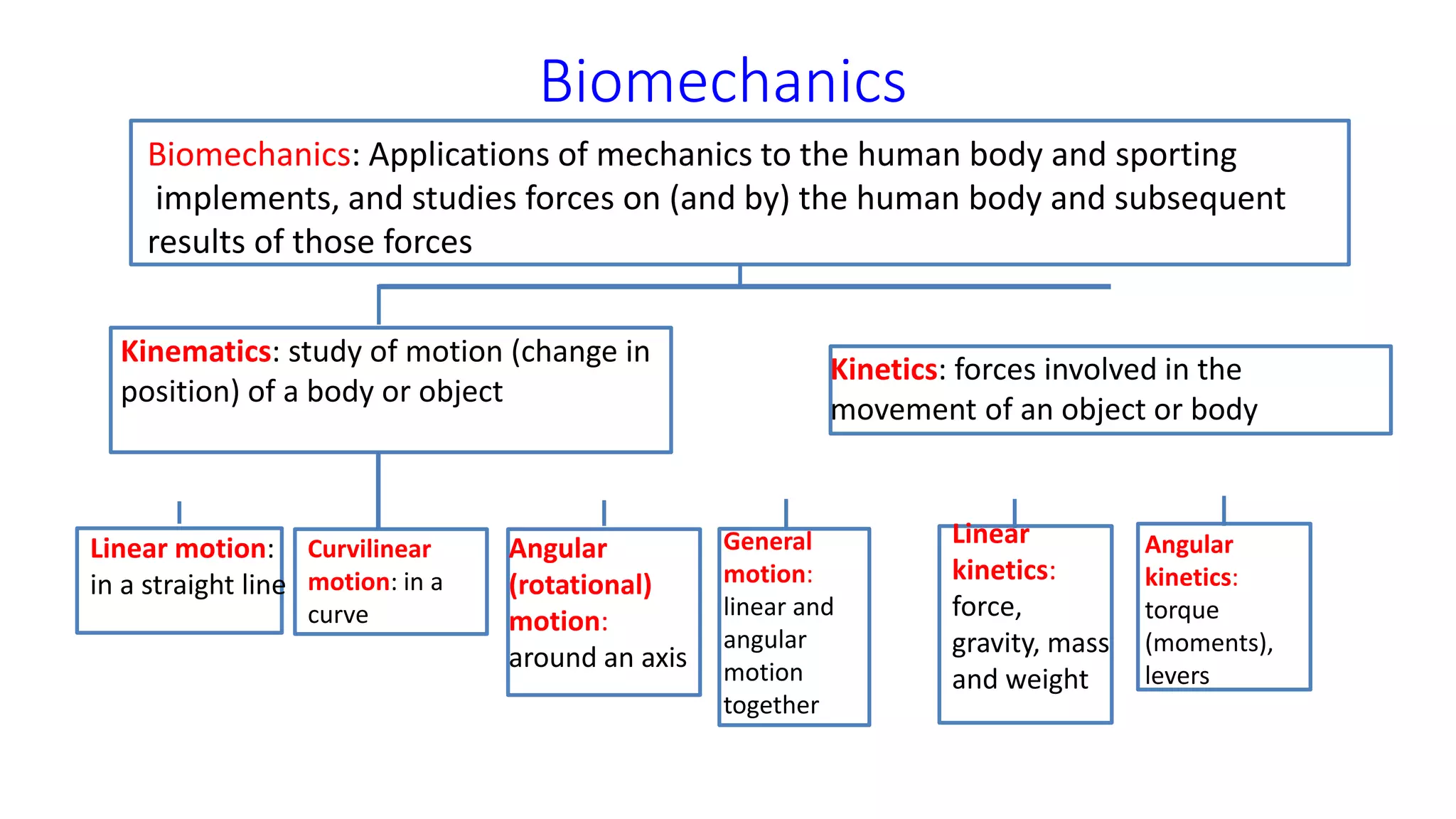
Biomechanics: Applications of mechanics to the human body and sporting
implements, and studies forces on (and by) the human body and subsequent
results of those forces
Kinematics: study of motion (change in
position) of a body or object
Kinetics: forces involved in the
movement of an object or body
Linear motion:
in a straight line
Curvilinear
motion: in a
curve
Angular
(rotational)
motion:
around an axis
General
motion:
linear and
angular
motion
together
Linear
kinetics:
force,
gravity, mass
and weight
Angular
kinetics:
torque
(moments),
levers
Biomechanics
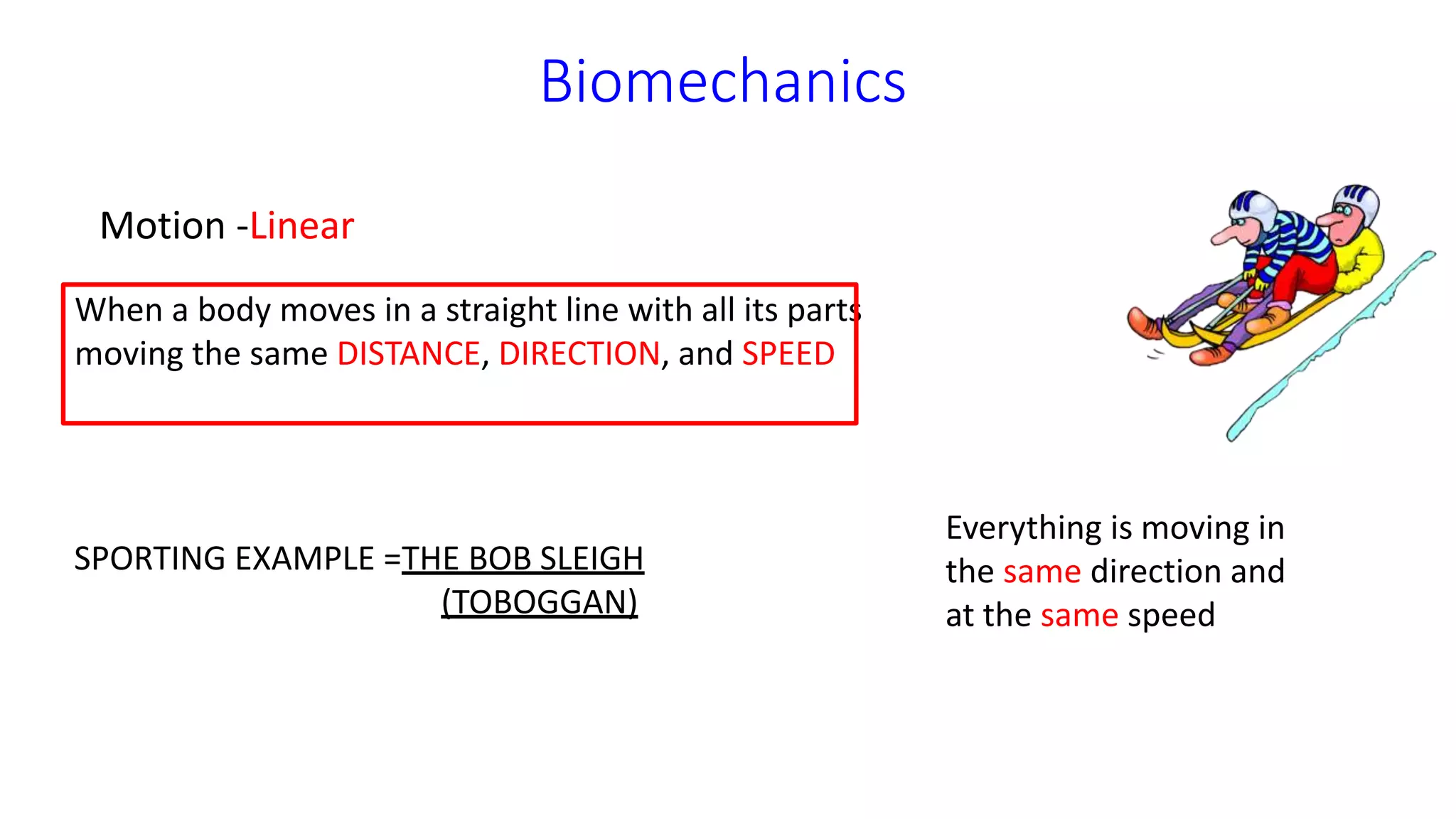
Motion -Linear
When a body moves in a straight line with all its parts
moving the same DISTANCE, DIRECTION, and SPEED
Everything is moving in
the same direction and
at the same speed
SPORTING EXAMPLE =THE BOB SLEIGH
(TOBOGGAN)
Biomechanics
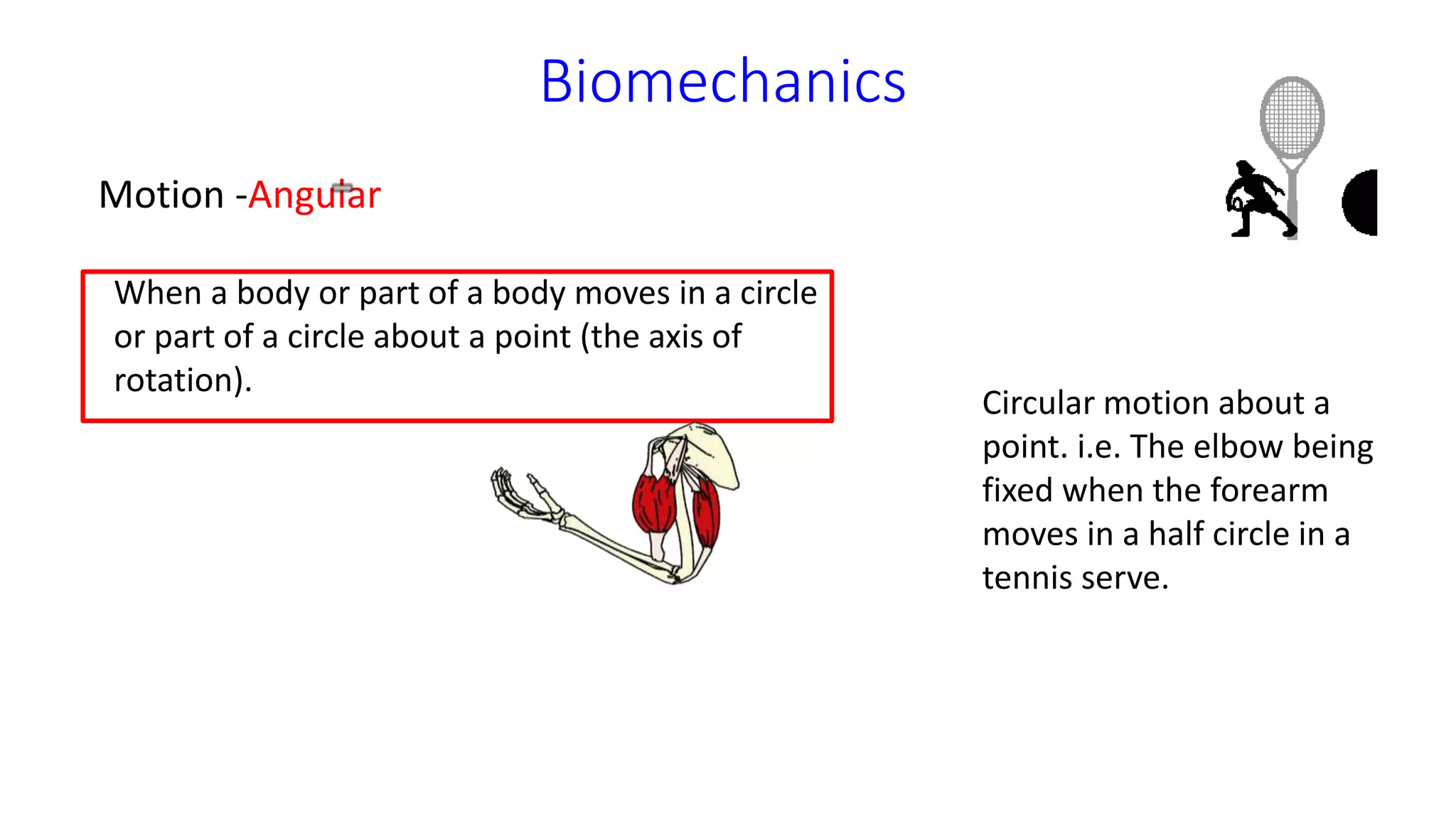
Motion -Angular
When a body or part of a body moves in a circle
or part of a circle about a point (the axis of
rotation).
Circular motion about a
point. i.e. The elbow being
fixed when the forearm
moves in a half circle in a
tennis serve.
Biomechanics
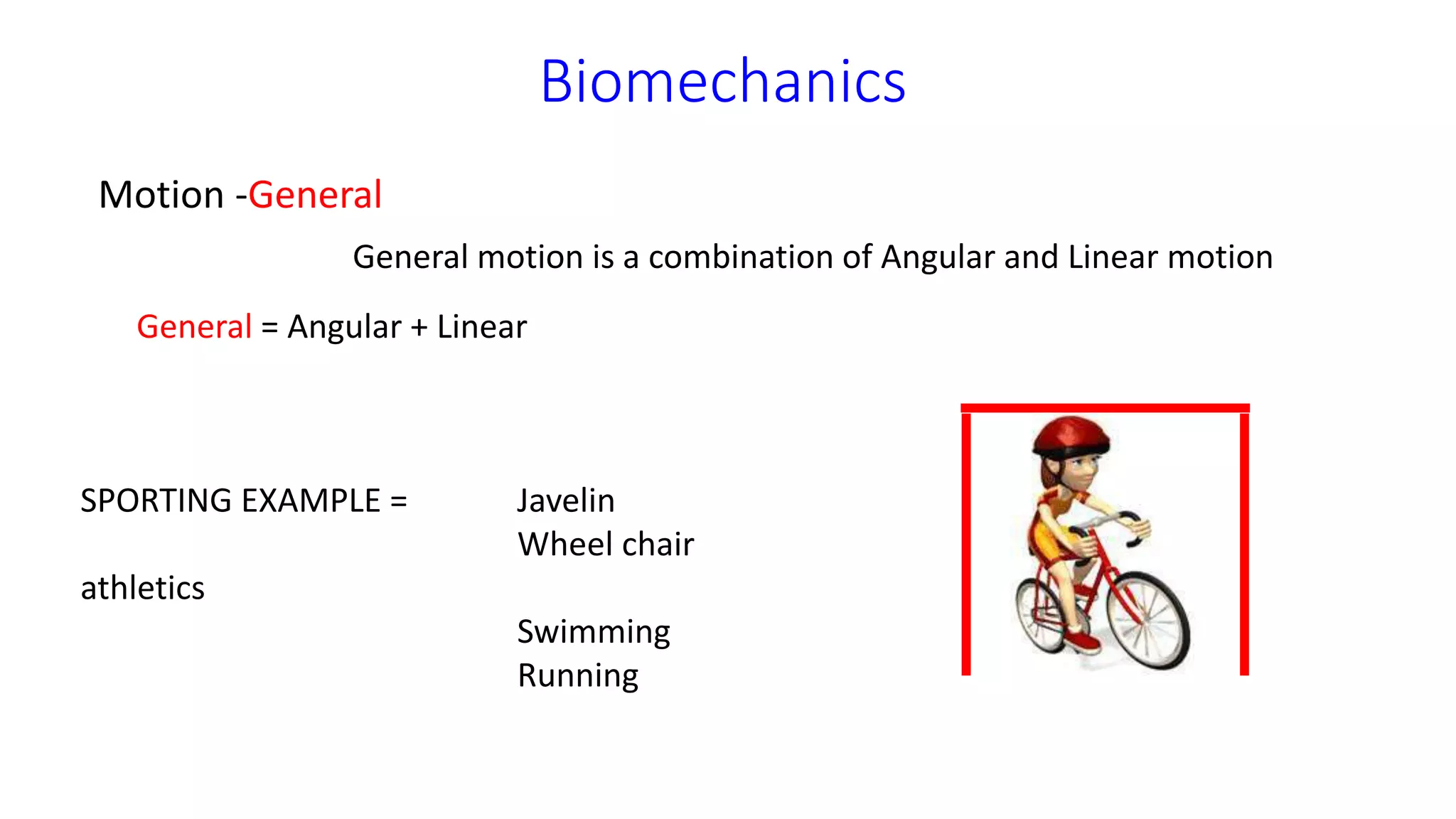
Motion -General
General = Angular + Linear
General motion is a combination of Angular and Linear motion
SPORTING EXAMPLE = Javelin
Wheel chair
athletics
Swimming
Running
Biomechanics
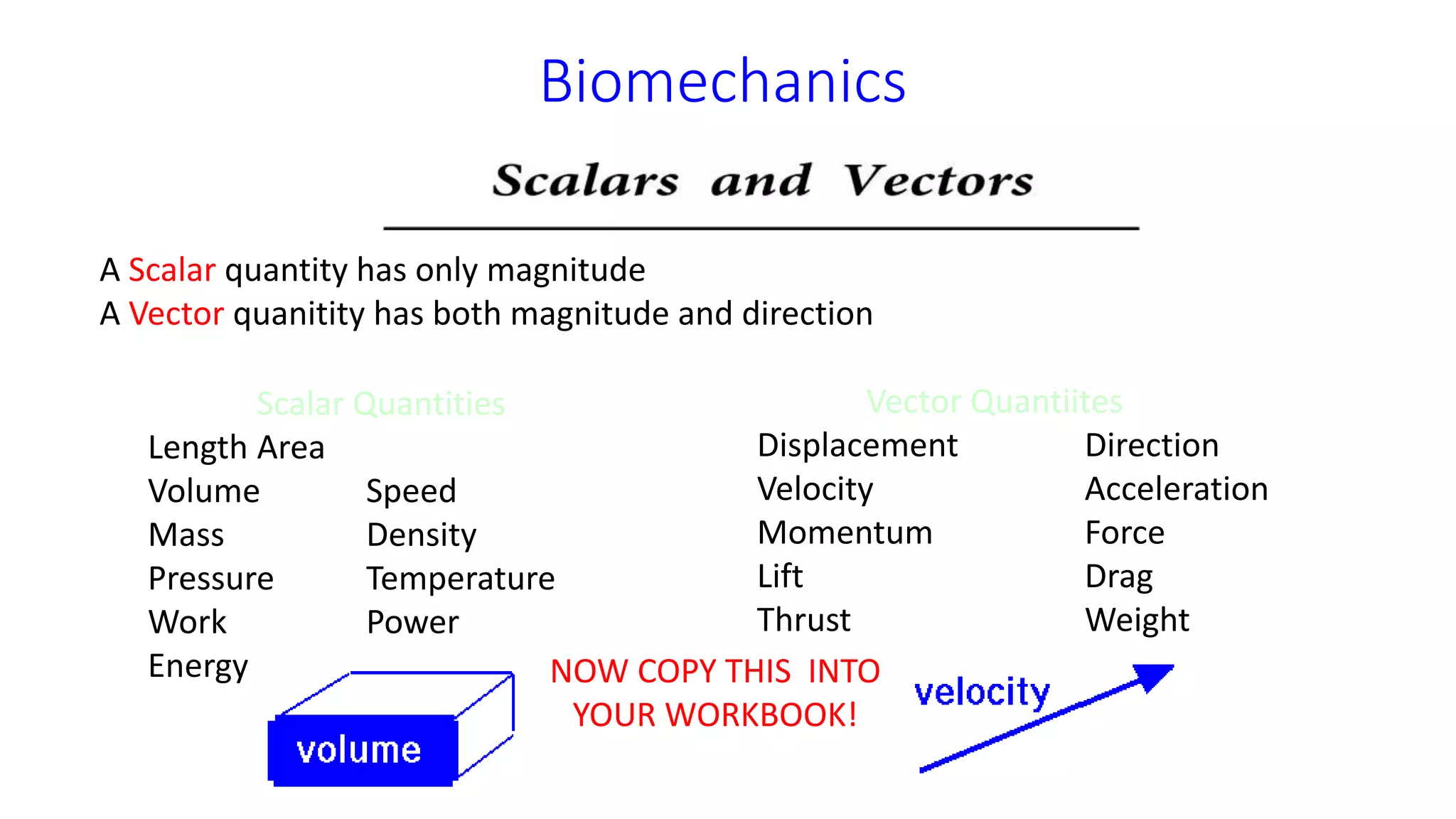
A Scalar quantity has only magnitude
A Vector quanitity has both magnitude and direction
Scalar Quantities
Length Area
Volume Speed
Mass Density
Pressure Temperature
Work Power
Energy
Vector Quantiites
Displacement Direction
Velocity Acceleration
Momentum Force
Lift Drag
Thrust Weight
NOW COPY THIS INTO
YOUR WORKBOOK!
Biomechanics
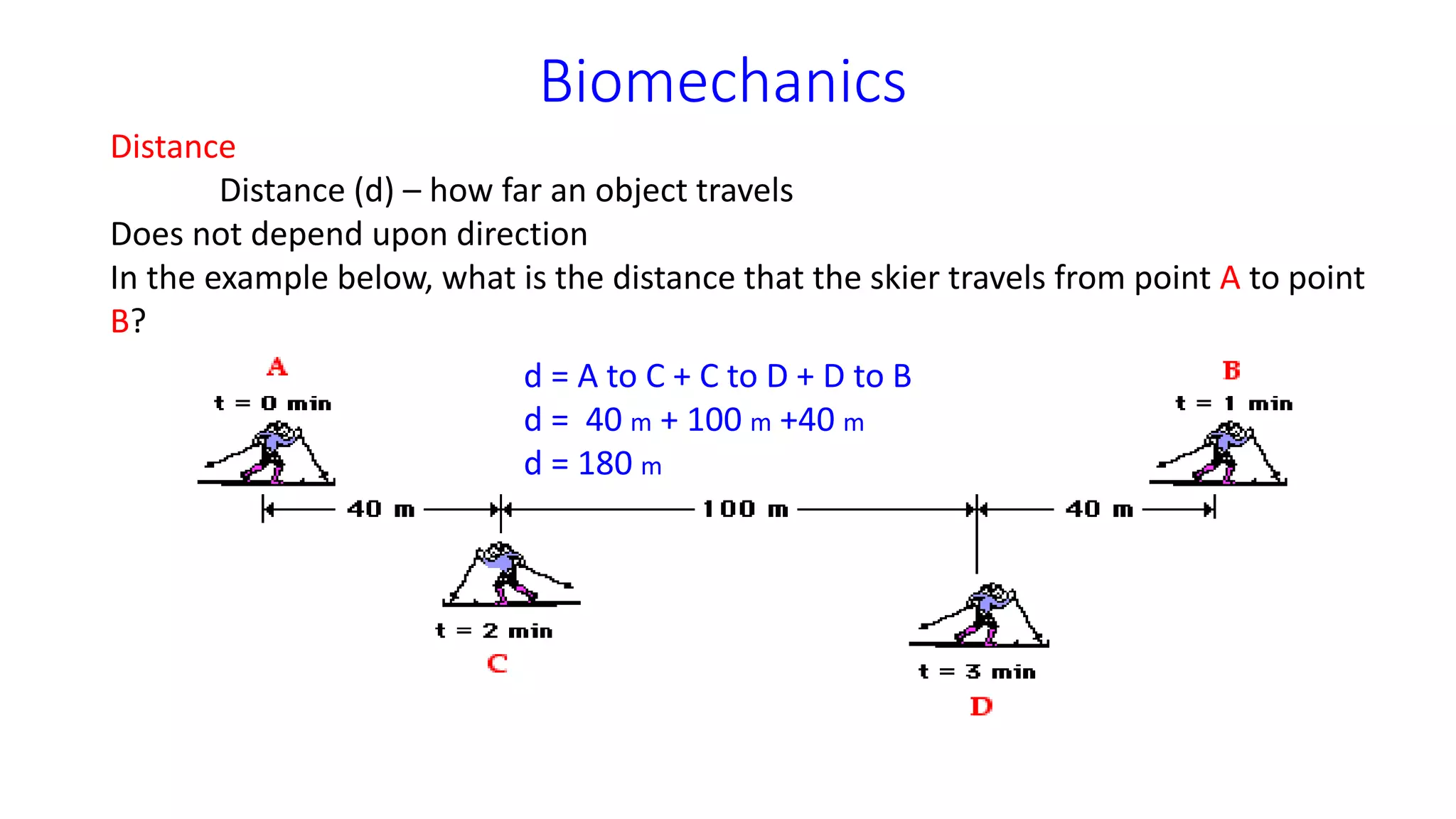
Distance
Distance (d) – how far an object travels
Does not depend upon direction
In the example below, what is the distance that the skier travels from point A to point
B?
d = A to C + C to D + D to B
d = 40 m + 100 m +40 m
d = 180 m
Biomechanics
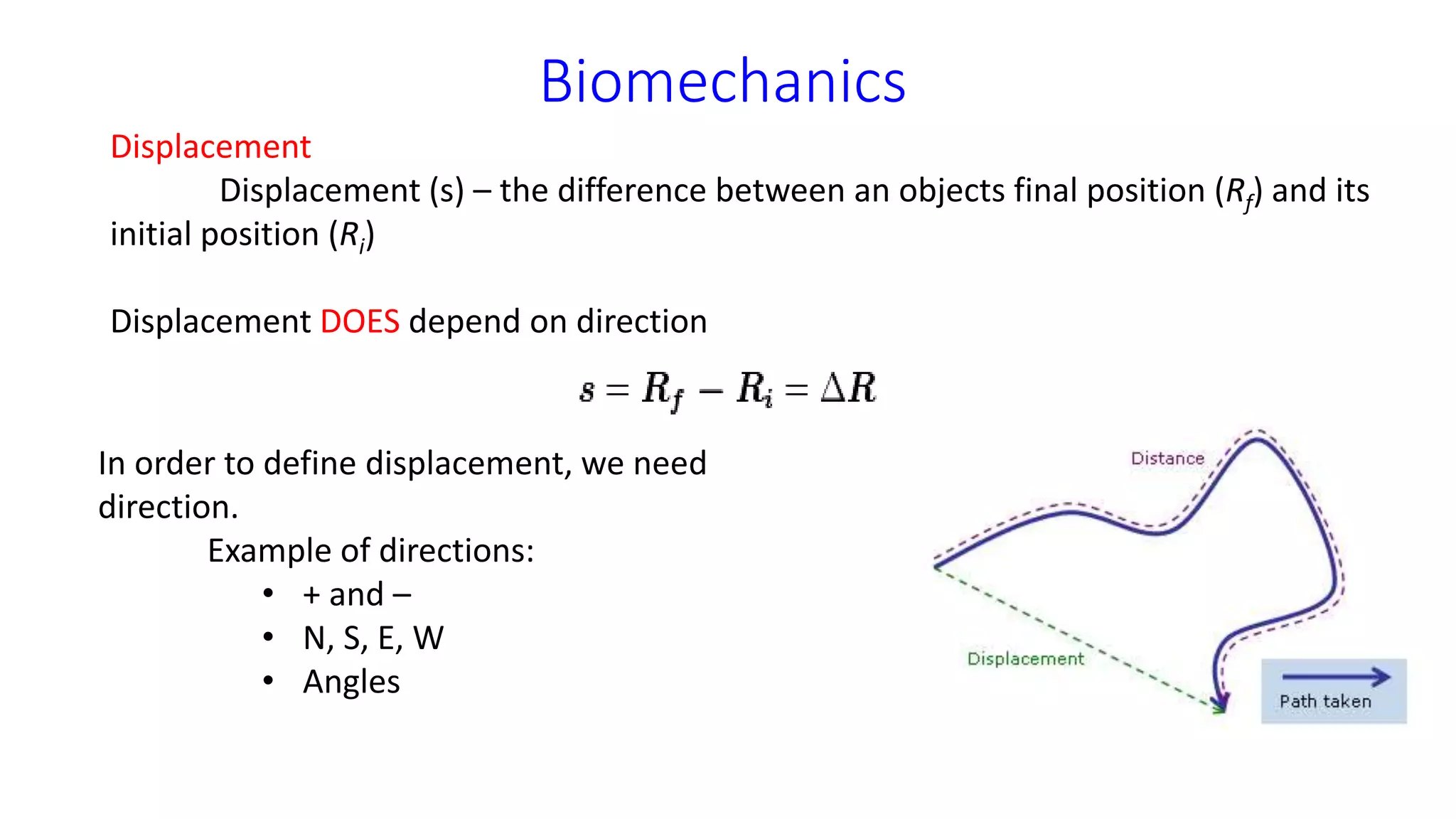
Displacement
Displacement (s) – the difference between an objects final position (Rf) and its
initial position (Ri)
Displacement DOES depend on direction
In order to define displacement, we need
direction.
Example of directions:
• + and –
• N, S, E, W
• Angles
Biomechanics
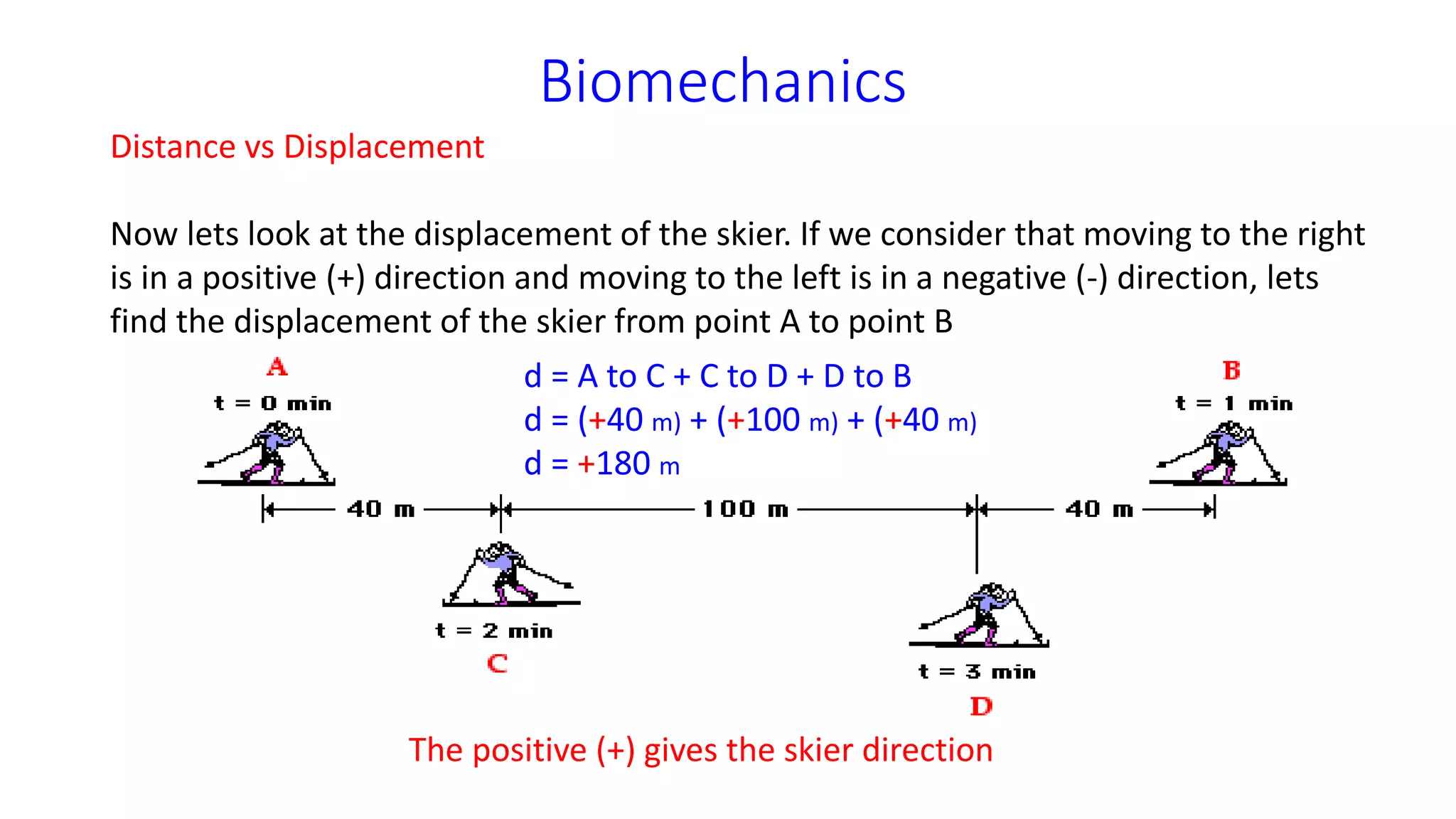
d = A to C + C to D + D to B
d = (+40 m) + (+100 m) + (+40 m)
d = +180 m
Distance vs Displacement
Now lets look at the displacement of the skier. If we consider that moving to the right
is in a positive (+) direction and moving to the left is in a negative (-) direction, lets
find the displacement of the skier from point A to point B
The positive (+) gives the skier direction
Biomechanics
Distance vs Displacement
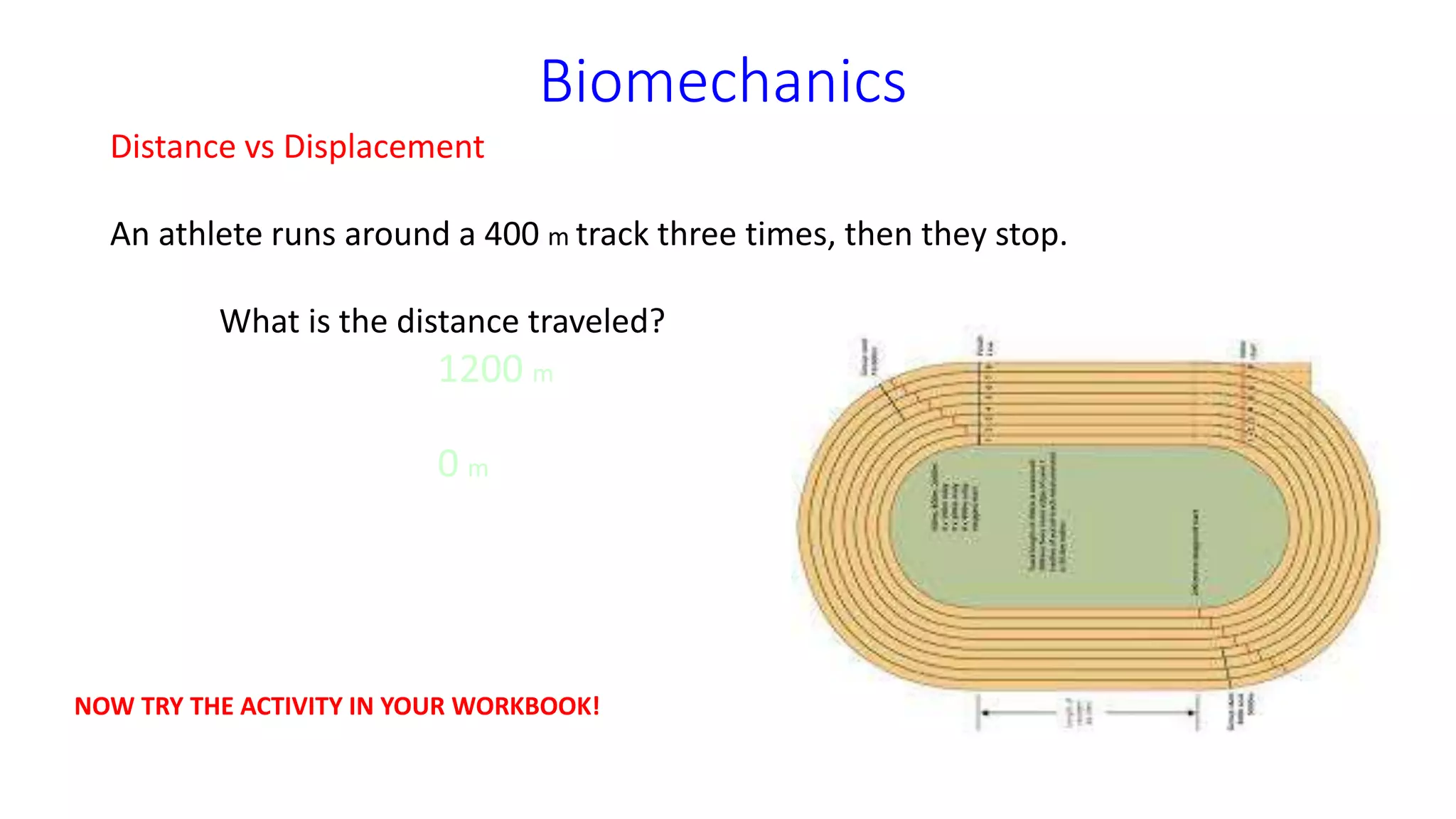
An athlete runs around a 400 m track three times, then they stop.
What is the distance traveled?
1200 m
What is the displacement?
0 m
NOW TRY THE ACTIVITY IN YOUR WORKBOOK!
Biomechanics
Speed vs Velocity
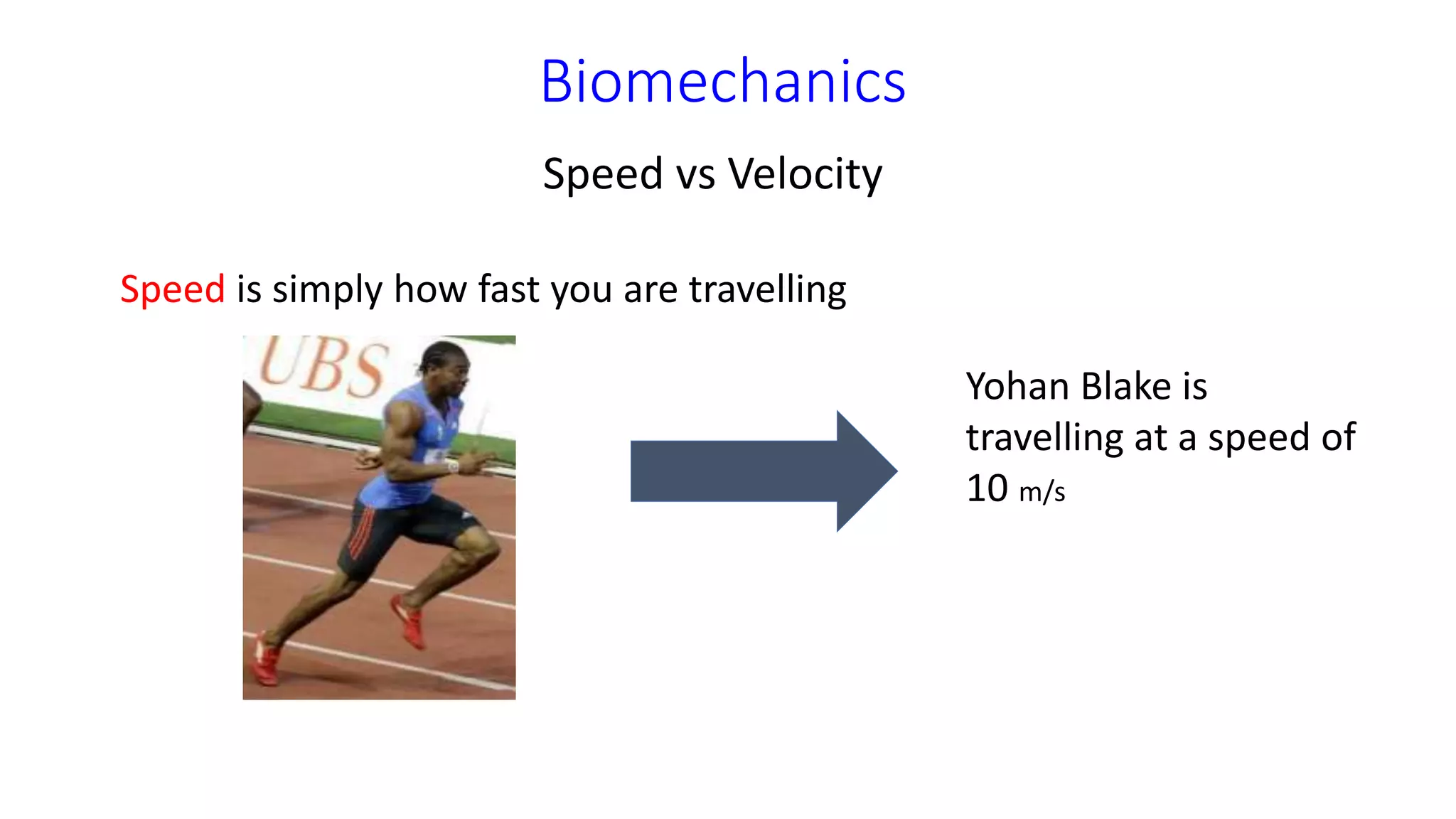
Speed is simply how fast you are travelling
Yohan Blake is
travelling at a speed of
10 m/s
Biomechanics
Speed vs Velocity
Velocity is speed in a given direction
Yohan Blake is
travelling at a speed of
10 m/s East
Biomechanics
Speed (Velocity)
Speed = Distance travelled Meters
(Velocity) Time taken Second
Biomechanics
Acceleration
Acceleration = Change in velocity
Time Taken
Example:
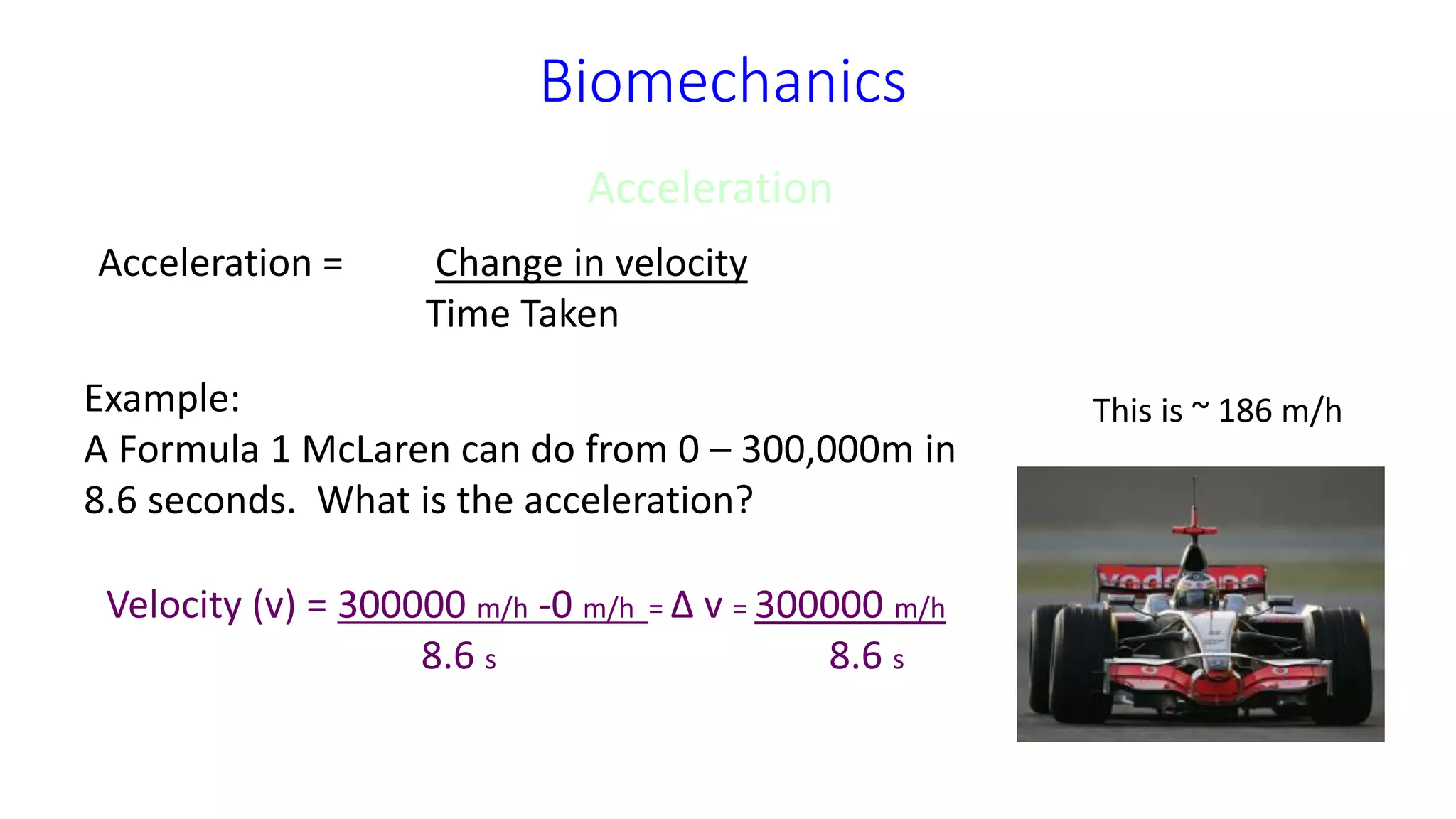
A Formula 1 McLaren can do from 0 – 300,000m in
8.6 seconds. What is the acceleration?
Velocity (v) = 300000 m/h -0 m/h = Δ v = 300000 m/h
8.6 s 8.6 s
This is ~ 186 m/h
Biomechanics
What is a Force?
A force is a push or a pull.
• A force acts on an object.
• Pushes and pulls are applied to
something.
• From the object’s perspective, it has a
force exerted on it.
Biomechanics
Force:
• Is a push or a pull
• Acts on an object
• Is a vector
• Can be a contact force or a long-range
force.
Biomechanics
Forces can produce three types of motion:
Translation: change
in position
Biomechanics
Forces can produce three types of motion:
Rotation: circular
movement of an object
around a center of
rotation.
Biomechanics
Forces can produce three types of motion:
Deformation: change in shape/size of an object due to
an applied force or a temperature change.

Fundamentals of Biomechanics.pptx

  • 1.
  • 2.
    Biomechanics Biomechanics: Applications ofmechanics to the human body and sporting implements, and studies forces on (and by) the human body and subsequent results of those forces Kinematics: study of motion (change in position) of a body or object Kinetics: forces involved in the movement of an object or body Linear motion: in a straight line Curvilinear motion: in a curve Angular (rotational) motion: around an axis General motion: linear and angular motion together Linear kinetics: force, gravity, mass and weight Angular kinetics: torque (moments), levers
  • 3.
    Biomechanics Motion -Linear When abody moves in a straight line with all its parts moving the same DISTANCE, DIRECTION, and SPEED Everything is moving in the same direction and at the same speed SPORTING EXAMPLE =THE BOB SLEIGH (TOBOGGAN)
  • 4.
    Biomechanics Motion -Angular When abody or part of a body moves in a circle or part of a circle about a point (the axis of rotation). Circular motion about a point. i.e. The elbow being fixed when the forearm moves in a half circle in a tennis serve.
  • 5.
    Biomechanics Motion -General General =Angular + Linear General motion is a combination of Angular and Linear motion SPORTING EXAMPLE = Javelin Wheel chair athletics Swimming Running
  • 6.
    Biomechanics A Scalar quantityhas only magnitude A Vector quanitity has both magnitude and direction Scalar Quantities Length Area Volume Speed Mass Density Pressure Temperature Work Power Energy Vector Quantiites Displacement Direction Velocity Acceleration Momentum Force Lift Drag Thrust Weight NOW COPY THIS INTO YOUR WORKBOOK!
  • 7.
    Biomechanics Distance Distance (d) –how far an object travels Does not depend upon direction In the example below, what is the distance that the skier travels from point A to point B? d = A to C + C to D + D to B d = 40 m + 100 m +40 m d = 180 m
  • 8.
    Biomechanics Displacement Displacement (s) –the difference between an objects final position (Rf) and its initial position (Ri) Displacement DOES depend on direction In order to define displacement, we need direction. Example of directions: • + and – • N, S, E, W • Angles
  • 9.
    Biomechanics d = Ato C + C to D + D to B d = (+40 m) + (+100 m) + (+40 m) d = +180 m Distance vs Displacement Now lets look at the displacement of the skier. If we consider that moving to the right is in a positive (+) direction and moving to the left is in a negative (-) direction, lets find the displacement of the skier from point A to point B The positive (+) gives the skier direction
  • 10.
    Biomechanics Distance vs Displacement Anathlete runs around a 400 m track three times, then they stop. What is the distance traveled? 1200 m What is the displacement? 0 m NOW TRY THE ACTIVITY IN YOUR WORKBOOK!
  • 11.
    Biomechanics Speed vs Velocity Speedis simply how fast you are travelling Yohan Blake is travelling at a speed of 10 m/s
  • 12.
    Biomechanics Speed vs Velocity Velocityis speed in a given direction Yohan Blake is travelling at a speed of 10 m/s East
  • 13.
    Biomechanics Speed (Velocity) Speed =Distance travelled Meters (Velocity) Time taken Second
  • 14.
    Biomechanics Acceleration Acceleration = Changein velocity Time Taken Example: A Formula 1 McLaren can do from 0 – 300,000m in 8.6 seconds. What is the acceleration? Velocity (v) = 300000 m/h -0 m/h = Δ v = 300000 m/h 8.6 s 8.6 s This is ~ 186 m/h
  • 15.
    Biomechanics What is aForce? A force is a push or a pull. • A force acts on an object. • Pushes and pulls are applied to something. • From the object’s perspective, it has a force exerted on it.
  • 16.
    Biomechanics Force: • Is apush or a pull • Acts on an object • Is a vector • Can be a contact force or a long-range force.
  • 17.
    Biomechanics Forces can producethree types of motion: Translation: change in position
  • 18.
    Biomechanics Forces can producethree types of motion: Rotation: circular movement of an object around a center of rotation.
  • 19.
    Biomechanics Forces can producethree types of motion: Deformation: change in shape/size of an object due to an applied force or a temperature change.