
FUNDAL SIZE DISCREPANCY
1   Smaller than date
    Larger than date
    Oligohydramnios
    Intrauterine growth restriction (IUGR)
    Polyhydramnios
REFERENCE
1.   http://www.scribd.com/doc/38032808/Obstetric-Highlights-Elma
2.   Oxford’s O&G


                                                           2
SMALLER THAN DATE
   Short case
     Findings?
   Differentials
        i.     Fetal: Fetal demise, IUGR, missed miscarriage, transverse lie,
               molar pregnancy
        ii.    Maternal: Wrong date, oligohydramnios*
   Investigated by USG
        i.     Fetal: Cardiac motion, fetal biometry (BPD, HC, AC, FL)
        ii.    Amniotic fluid: AFI <8 cm
        iii.   Placental: Texture, appearance


                                                                                3
   Management
     Manage the underlying problem (s) identified


                                                     4
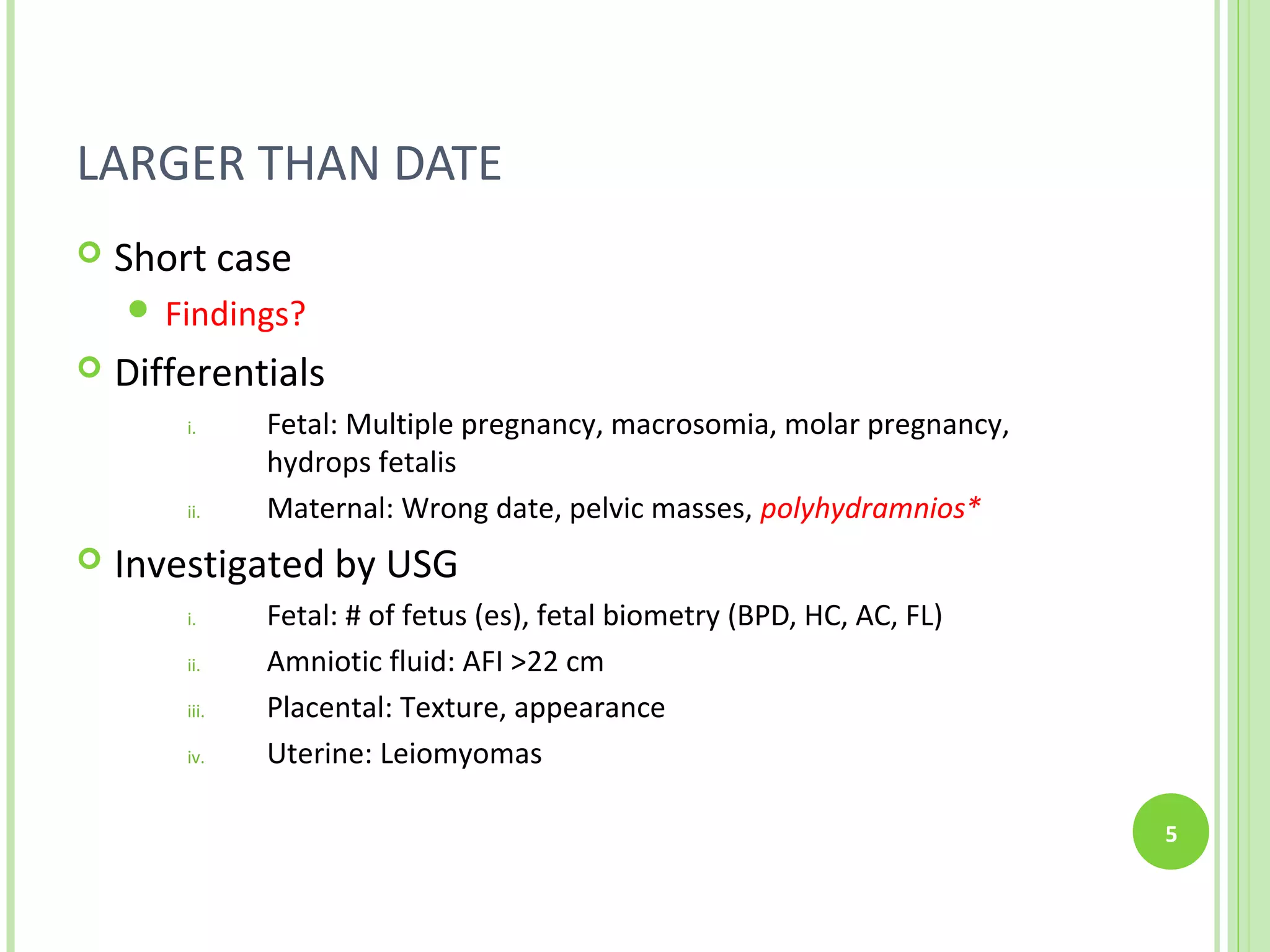
LARGER THAN DATE
   Short case
     Findings?
   Differentials
        i.     Fetal: Multiple pregnancy, macrosomia, molar pregnancy,
               hydrops fetalis
        ii.    Maternal: Wrong date, pelvic masses, polyhydramnios*
   Investigated by USG
        i.     Fetal: # of fetus (es), fetal biometry (BPD, HC, AC, FL)
        ii.    Amniotic fluid: AFI >22 cm
        iii.   Placental: Texture, appearance
        iv.    Uterine: Leiomyomas

                                                                          5
   Management
     Manage the underlying problem (s) identified


                                                     6
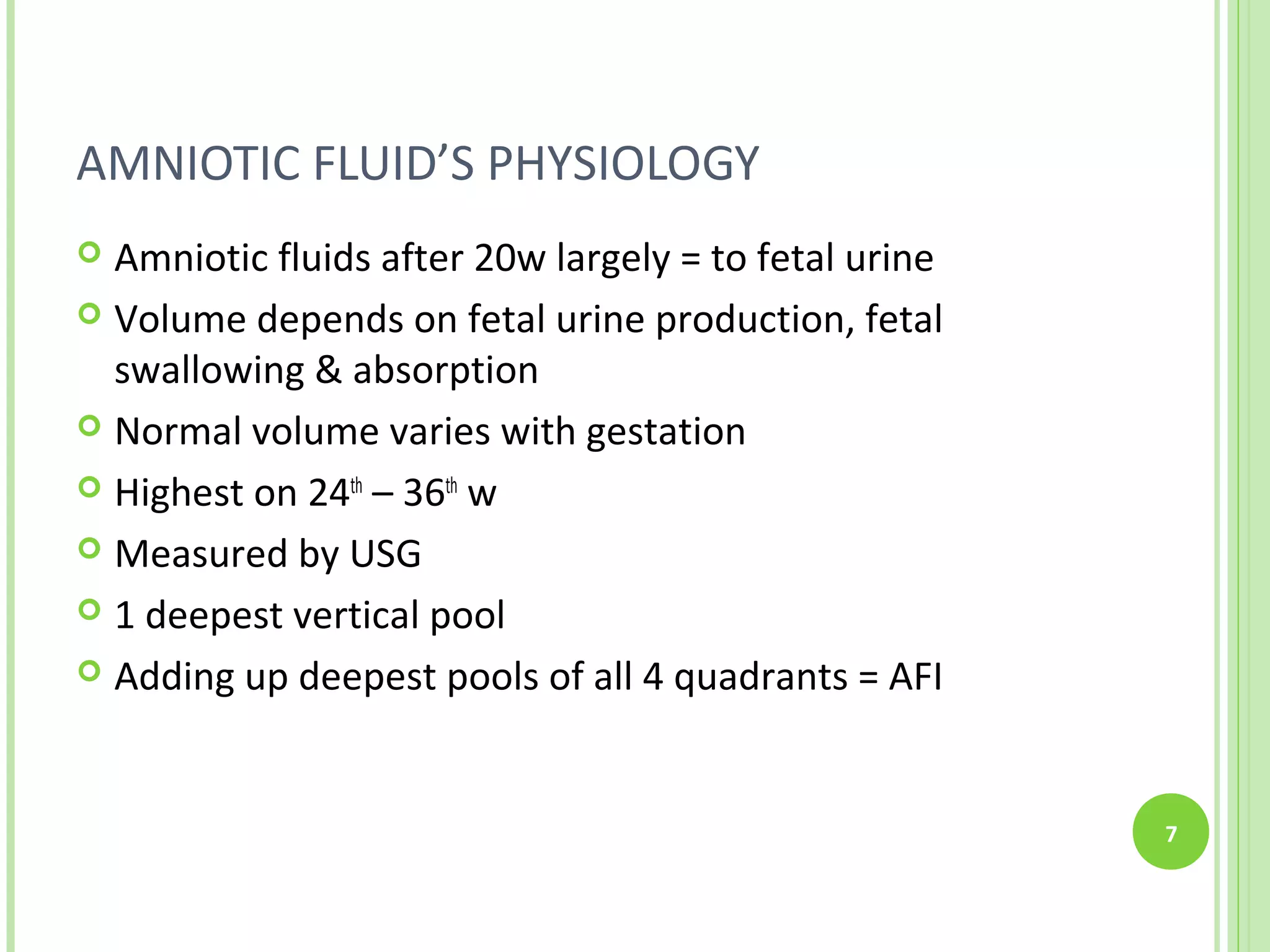
AMNIOTIC FLUID’S PHYSIOLOGY
 Amniotic fluids after 20w largely = to fetal urine
 Volume depends on fetal urine production, fetal
  swallowing & absorption
 Normal volume varies with gestation

 Highest on 24th – 36th w

 Measured by USG

 1 deepest vertical pool

 Adding up deepest pools of all 4 quadrants = AFI


                                                       7
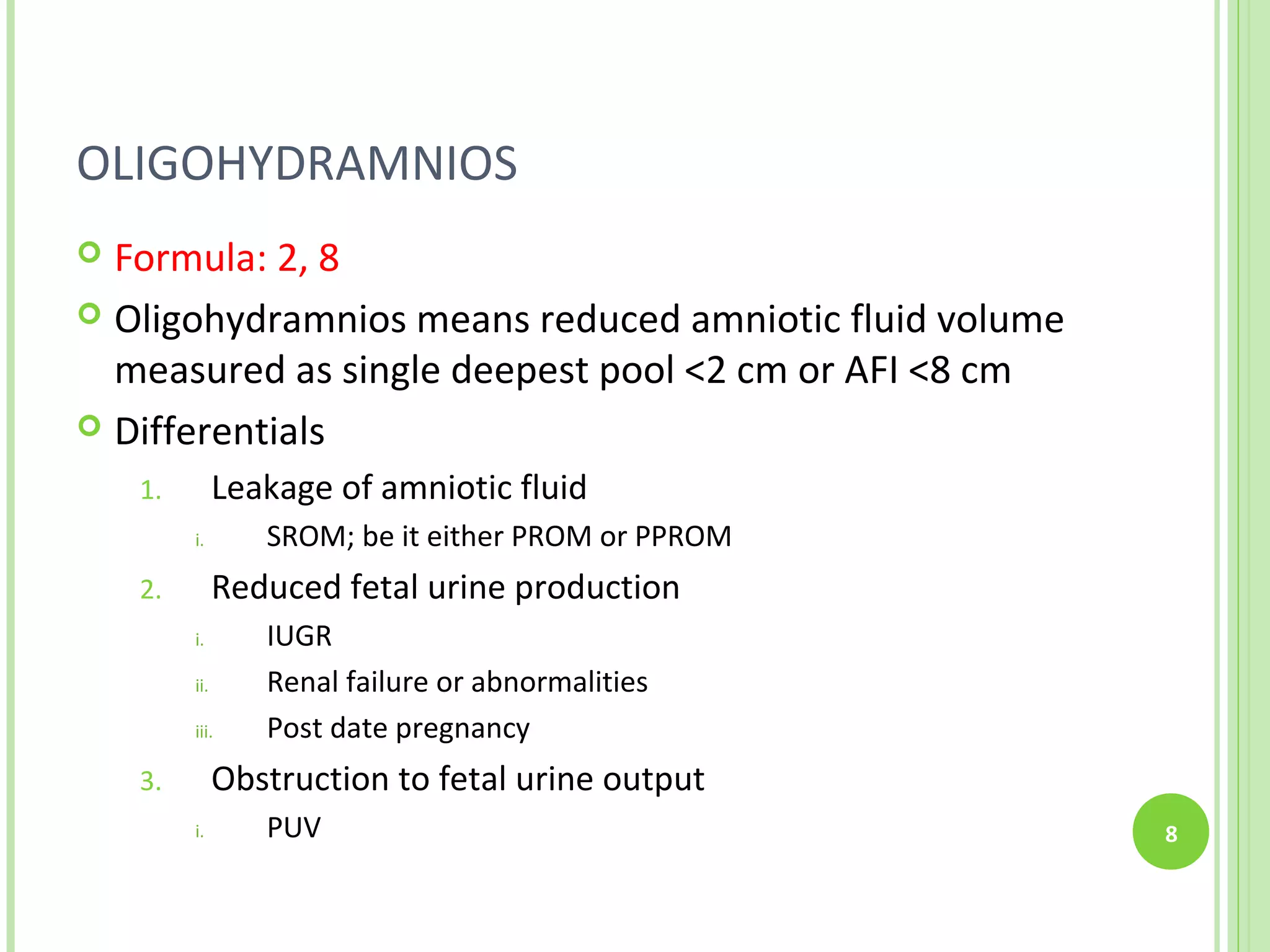
OLIGOHYDRAMNIOS
 Formula: 2, 8
 Oligohydramnios means reduced amniotic fluid volume
  measured as single deepest pool <2 cm or AFI <8 cm
 Differentials

    1.         Leakage of amniotic fluid
         i.       SROM; be it either PROM or PPROM
    2.         Reduced fetal urine production
         i.       IUGR
         ii.      Renal failure or abnormalities
         iii.     Post date pregnancy
    3.         Obstruction to fetal urine output
         i.       PUV                                   8
   Investigations
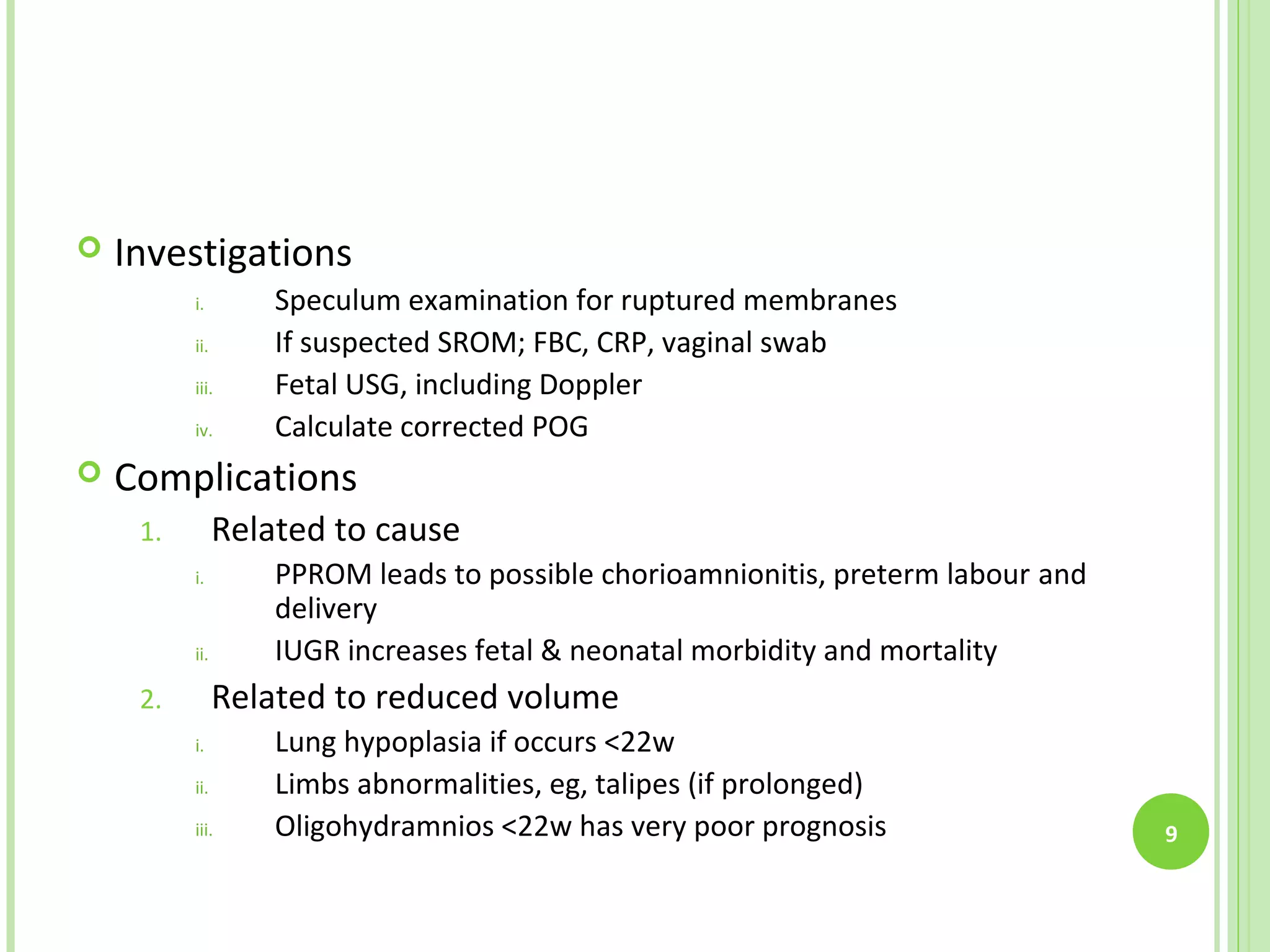
          i.        Speculum examination for ruptured membranes
          ii.       If suspected SROM; FBC, CRP, vaginal swab
          iii.      Fetal USG, including Doppler
          iv.       Calculate corrected POG
   Complications
     1.         Related to cause
          i.        PPROM leads to possible chorioamnionitis, preterm labour and
                    delivery
          ii.       IUGR increases fetal & neonatal morbidity and mortality
     2.         Related to reduced volume
          i.        Lung hypoplasia if occurs <22w
          ii.       Limbs abnormalities, eg, talipes (if prolonged)
          iii.      Oligohydramnios <22w has very poor prognosis                   9
   Management
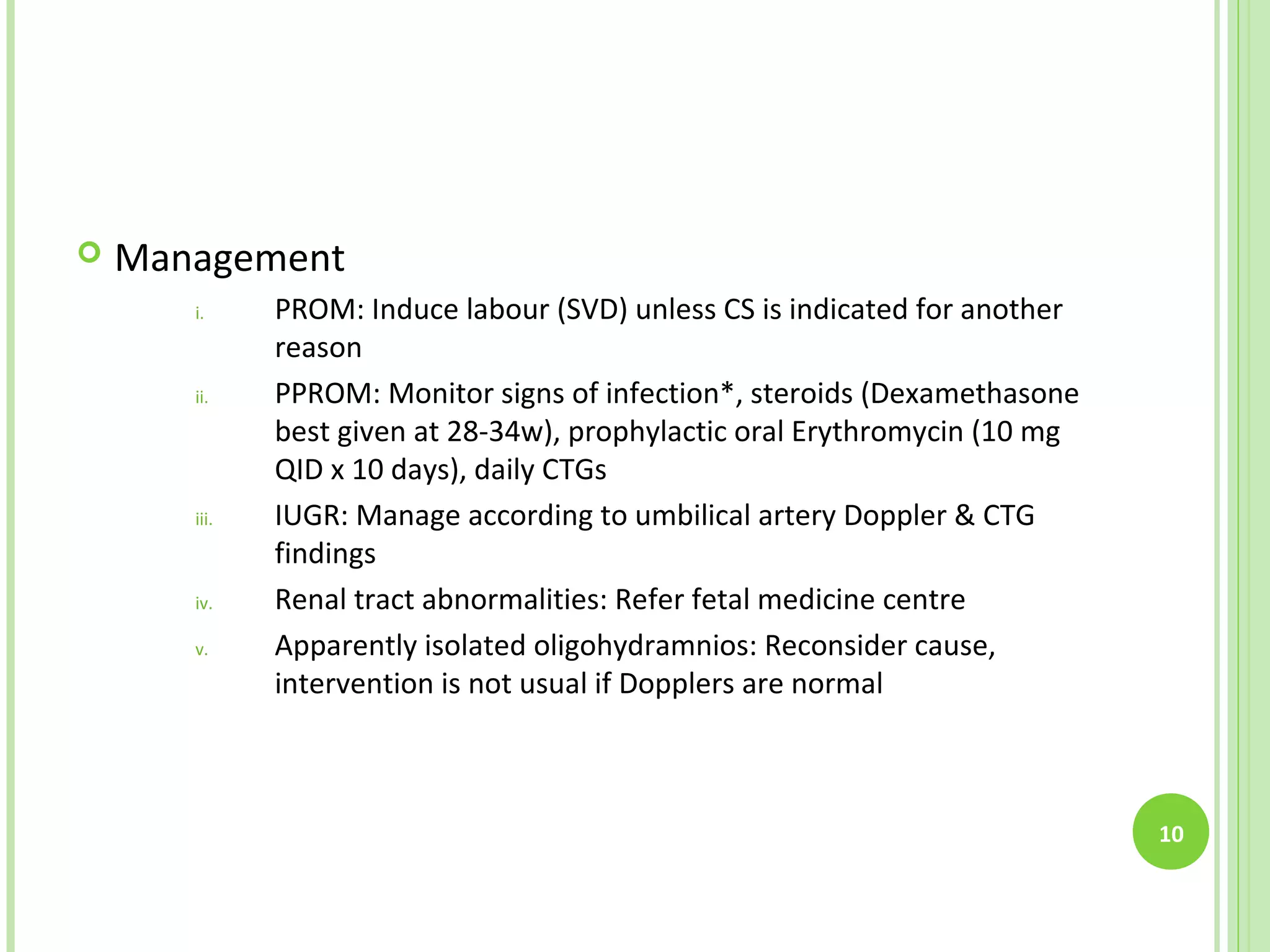
       i.     PROM: Induce labour (SVD) unless CS is indicated for another
              reason
       ii.    PPROM: Monitor signs of infection*, steroids (Dexamethasone
              best given at 28-34w), prophylactic oral Erythromycin (10 mg
              QID x 10 days), daily CTGs
       iii.   IUGR: Manage according to umbilical artery Doppler & CTG
              findings
       iv.    Renal tract abnormalities: Refer fetal medicine centre
       v.     Apparently isolated oligohydramnios: Reconsider cause,
              intervention is not usual if Dopplers are normal


                                                                             10
IUGR
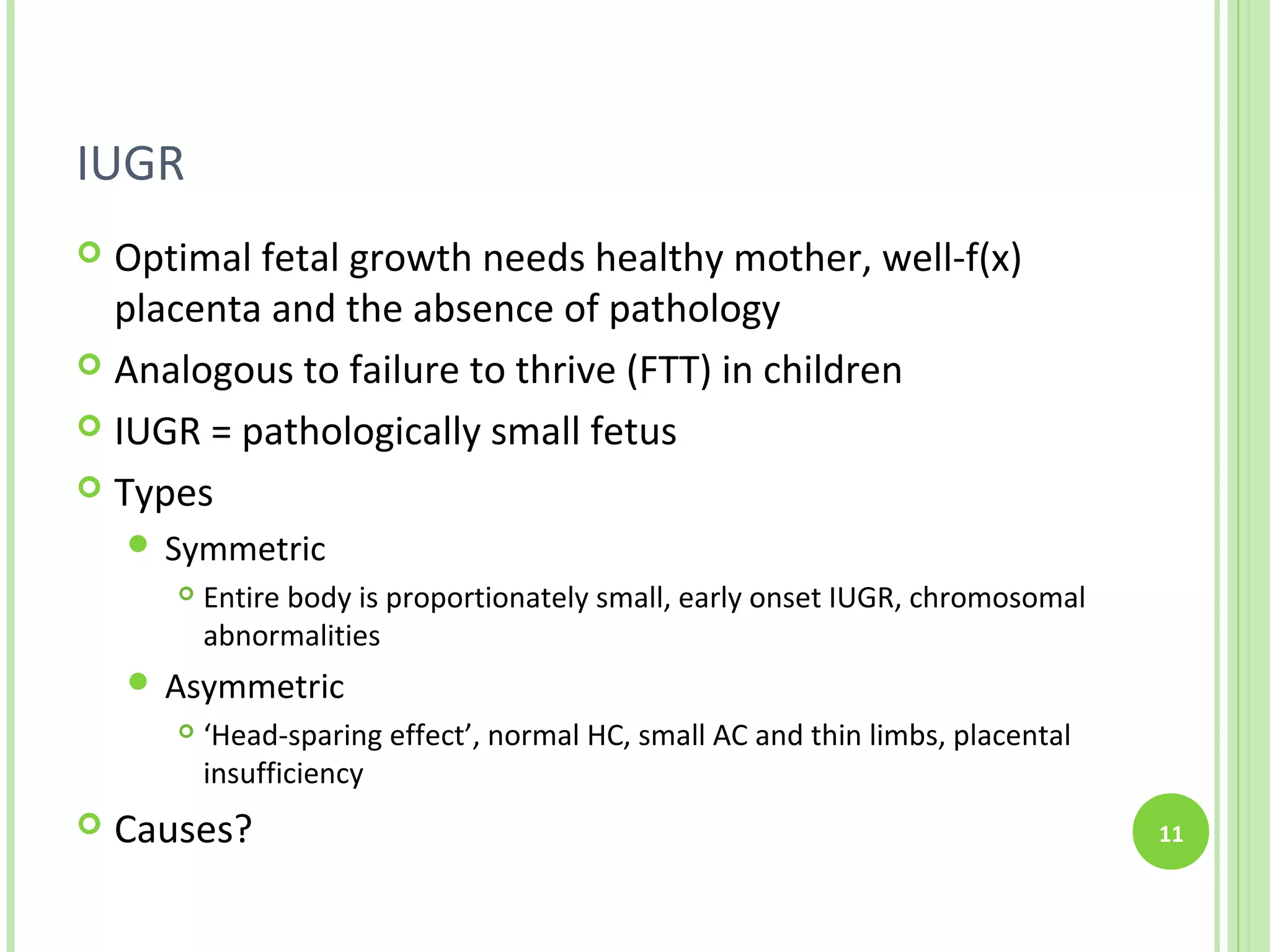
 Optimal fetal growth needs healthy mother, well-f(x)
  placenta and the absence of pathology
 Analogous to failure to thrive (FTT) in children

 IUGR = pathologically small fetus

 Types
     Symmetric
          Entire body is proportionately small, early onset IUGR, chromosomal
           abnormalities
     Asymmetric
          ‘Head-sparing effect’, normal HC, small AC and thin limbs, placental
           insufficiency
   Causes?                                                                       11
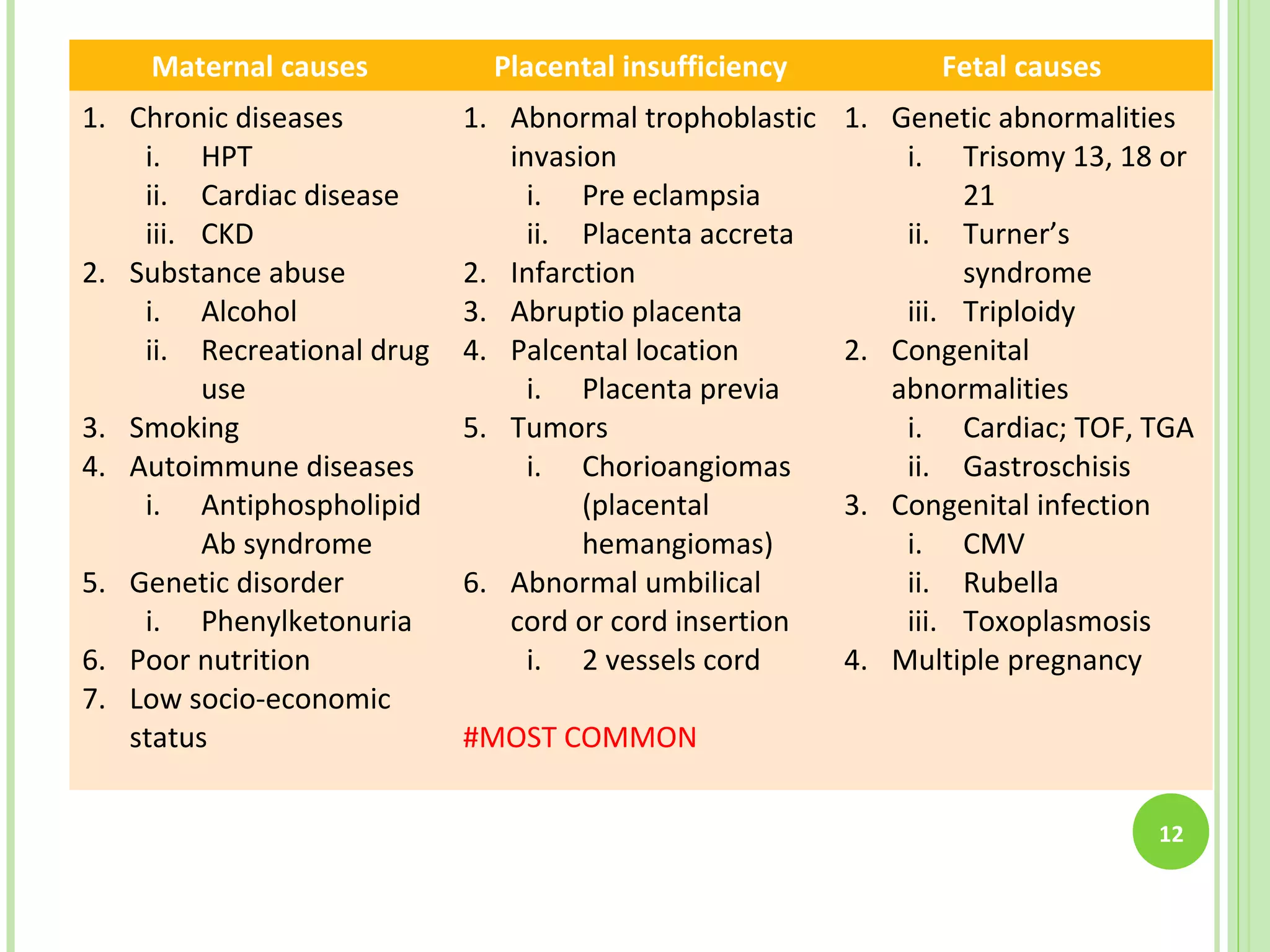
Maternal causes           Placental insufficiency         Fetal causes
1. Chronic diseases         1. Abnormal trophoblastic   1. Genetic abnormalities
    i. HPT                     invasion                     i. Trisomy 13, 18 or
    ii. Cardiac disease          i. Pre eclampsia                21
    iii. CKD                     ii. Placenta accreta       ii. Turner’s
2. Substance abuse          2. Infarction                        syndrome
    i. Alcohol              3. Abruptio placenta            iii. Triploidy
    ii. Recreational drug   4. Palcental location       2. Congenital
         use                     i. Placenta previa        abnormalities
3. Smoking                  5. Tumors                       i. Cardiac; TOF, TGA
4. Autoimmune diseases           i. Chorioangiomas          ii. Gastroschisis
    i. Antiphospholipid              (placental         3. Congenital infection
         Ab syndrome                 hemangiomas)           i. CMV
5. Genetic disorder         6. Abnormal umbilical           ii. Rubella
    i. Phenylketonuria         cord or cord insertion       iii. Toxoplasmosis
6. Poor nutrition                i. 2 vessels cord      4. Multiple pregnancy
7. Low socio-economic
   status                   #MOST COMMON

                                                                             12
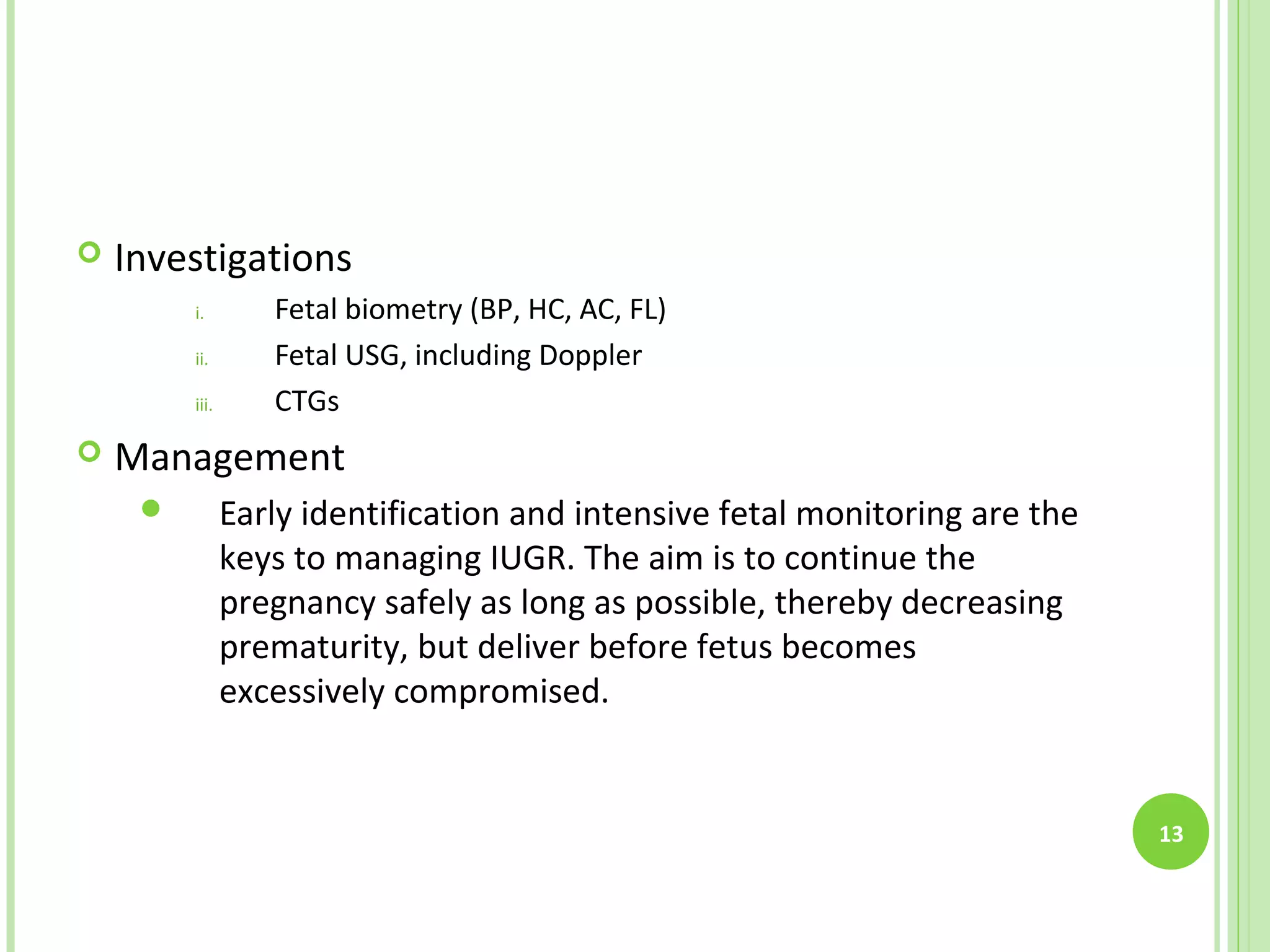
   Investigations
         i.        Fetal biometry (BP, HC, AC, FL)
         ii.       Fetal USG, including Doppler
         iii.      CTGs
   Management
               Early identification and intensive fetal monitoring are the
                keys to managing IUGR. The aim is to continue the
                pregnancy safely as long as possible, thereby decreasing
                prematurity, but deliver before fetus becomes
                excessively compromised.


                                                                              13
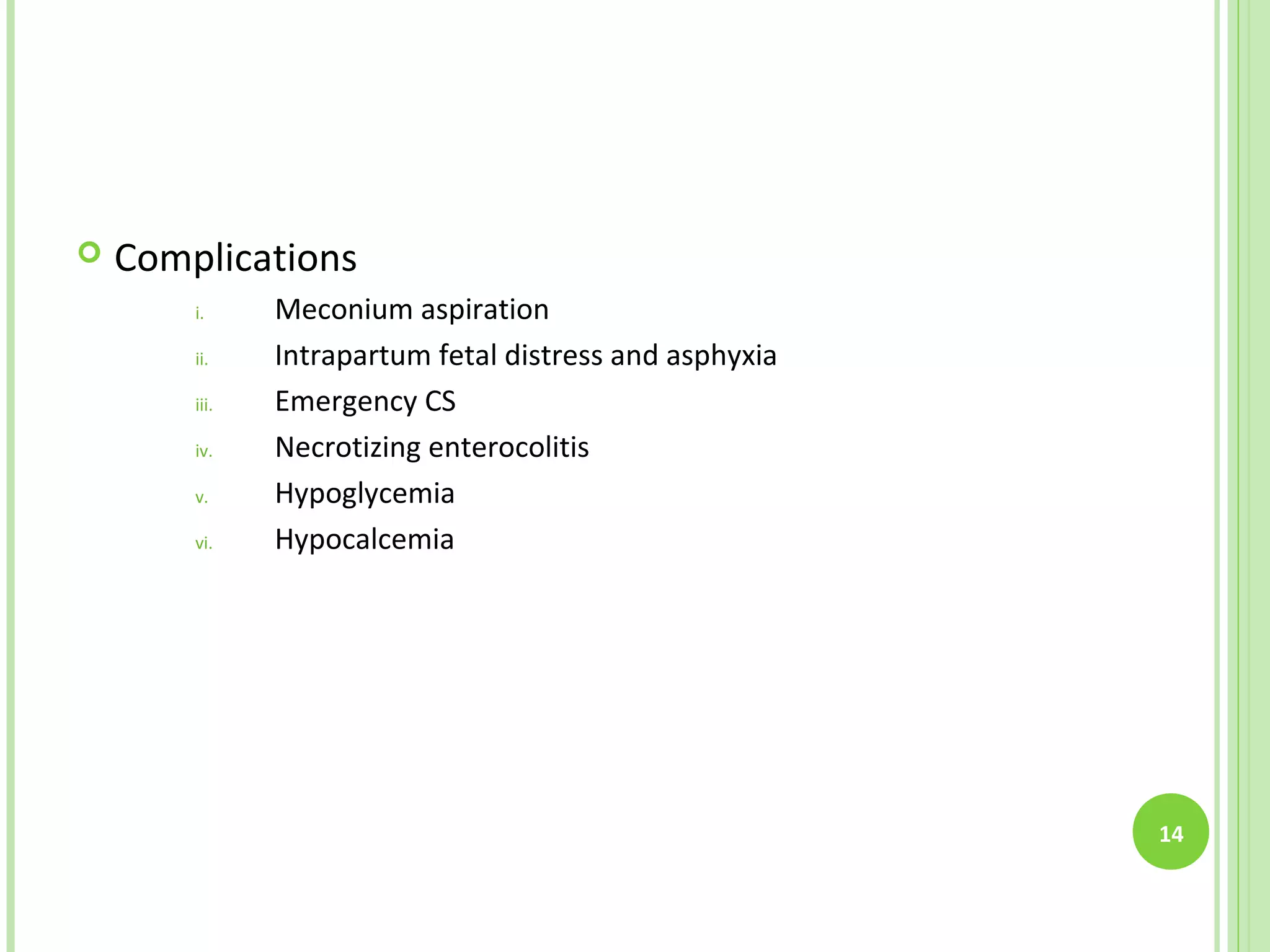
   Complications
        i.     Meconium aspiration
        ii.    Intrapartum fetal distress and asphyxia
        iii.   Emergency CS
        iv.    Necrotizing enterocolitis
        v.     Hypoglycemia
        vi.    Hypocalcemia


                                                         14
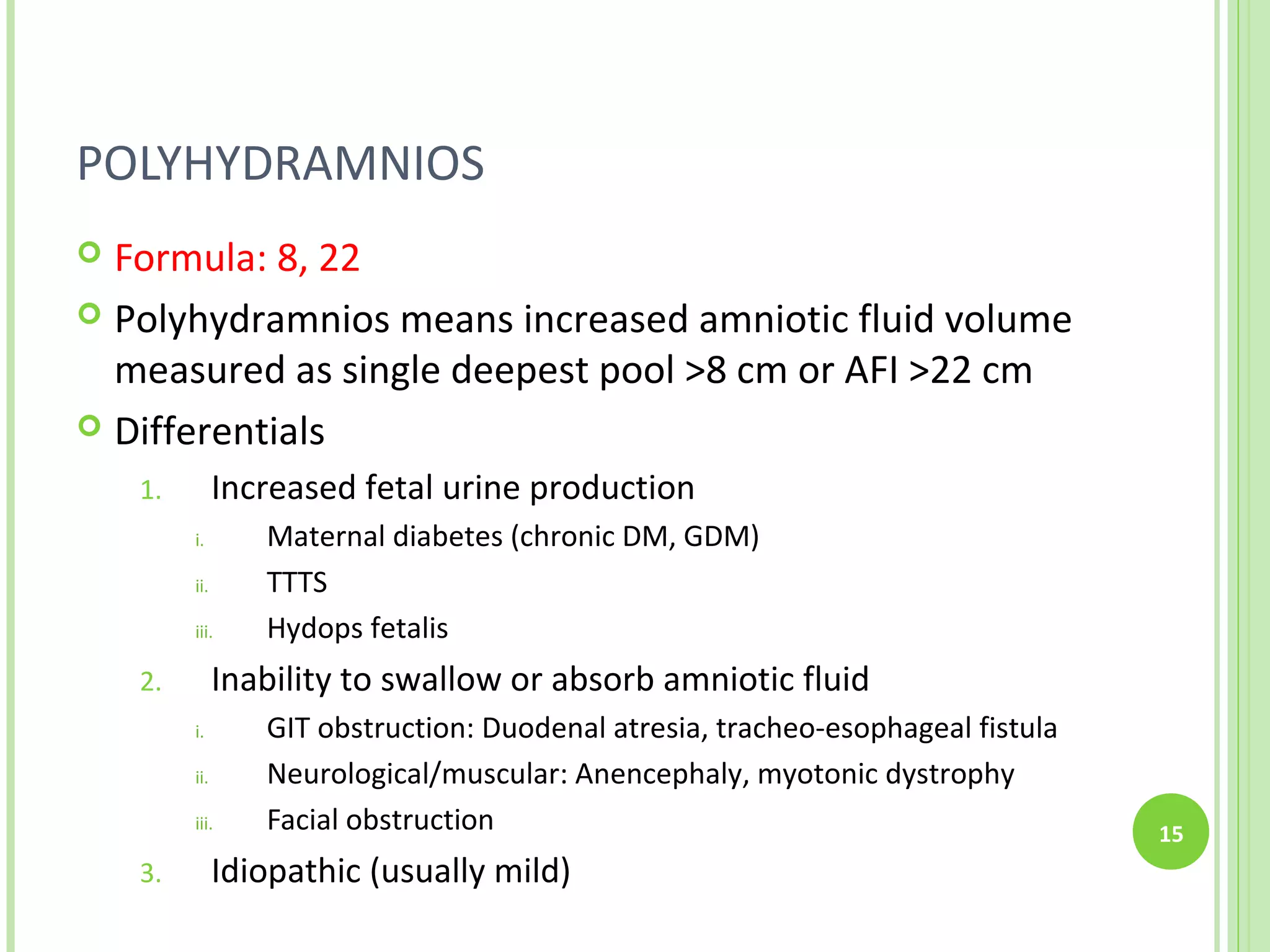
POLYHYDRAMNIOS
 Formula: 8, 22
 Polyhydramnios means increased amniotic fluid volume
  measured as single deepest pool >8 cm or AFI >22 cm
 Differentials

    1.         Increased fetal urine production
         i.       Maternal diabetes (chronic DM, GDM)
         ii.      TTTS
         iii.     Hydops fetalis
    2.         Inability to swallow or absorb amniotic fluid
         i.       GIT obstruction: Duodenal atresia, tracheo-esophageal fistula
         ii.      Neurological/muscular: Anencephaly, myotonic dystrophy
         iii.     Facial obstruction                                              15
    3.         Idiopathic (usually mild)
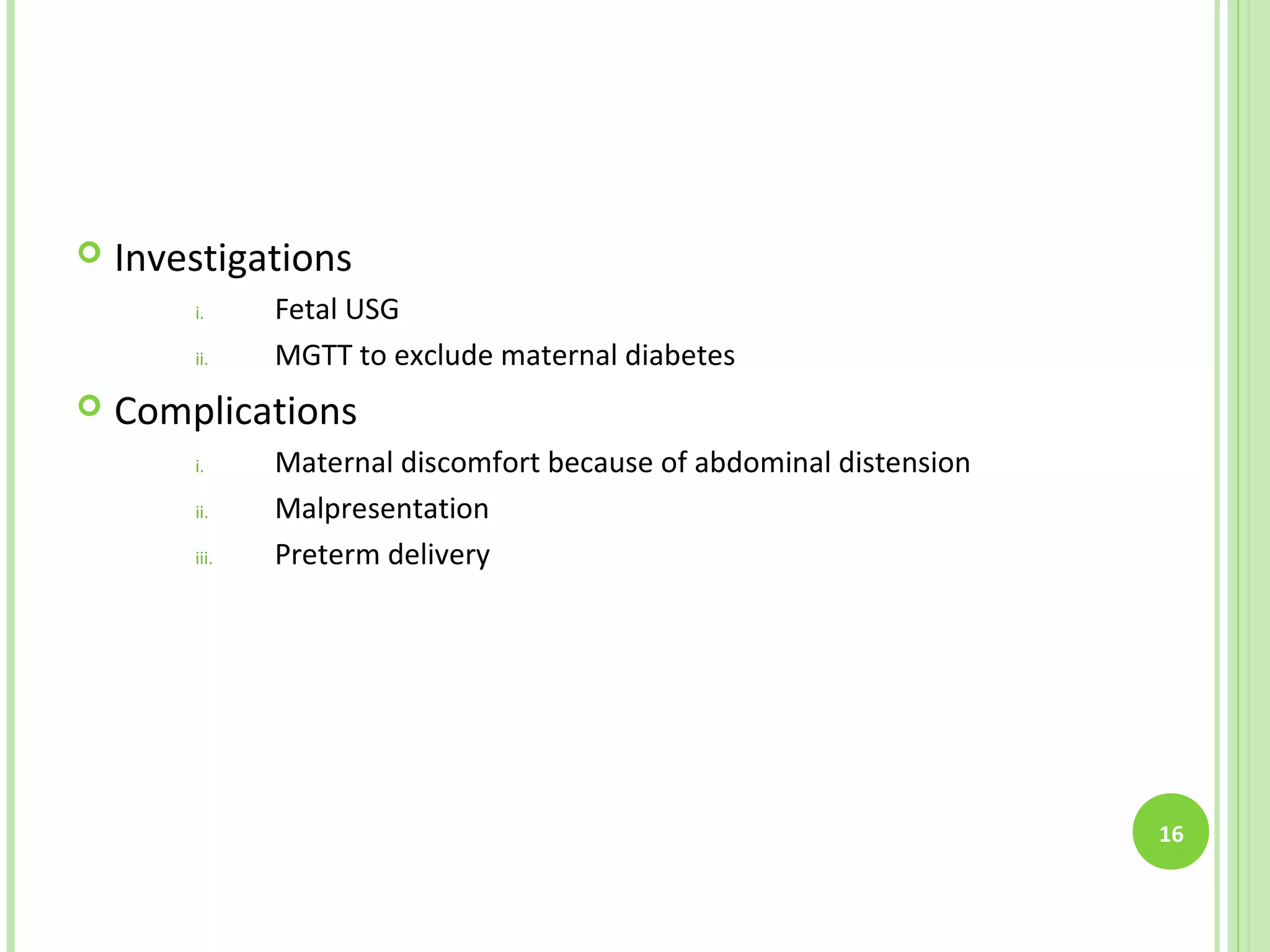
   Investigations
        i.     Fetal USG
        ii.    MGTT to exclude maternal diabetes
   Complications
        i.     Maternal discomfort because of abdominal distension
        ii.    Malpresentation
        iii.   Preterm delivery


                                                                     16
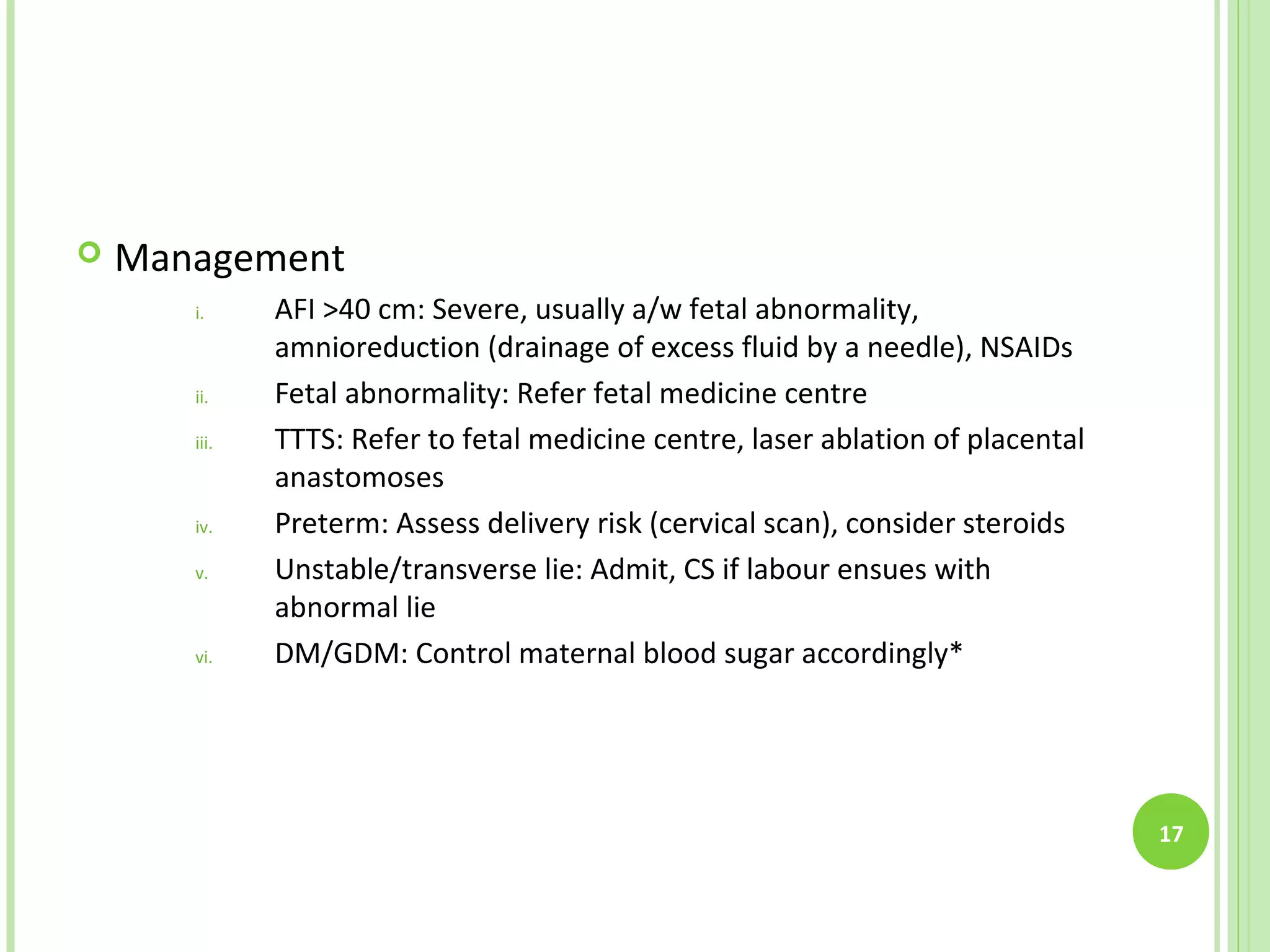
   Management
       i.     AFI >40 cm: Severe, usually a/w fetal abnormality,
              amnioreduction (drainage of excess fluid by a needle), NSAIDs
       ii.    Fetal abnormality: Refer fetal medicine centre
       iii.   TTTS: Refer to fetal medicine centre, laser ablation of placental
              anastomoses
       iv.    Preterm: Assess delivery risk (cervical scan), consider steroids
       v.     Unstable/transverse lie: Admit, CS if labour ensues with
              abnormal lie
       vi.    DM/GDM: Control maternal blood sugar accordingly*


                                                                                  17
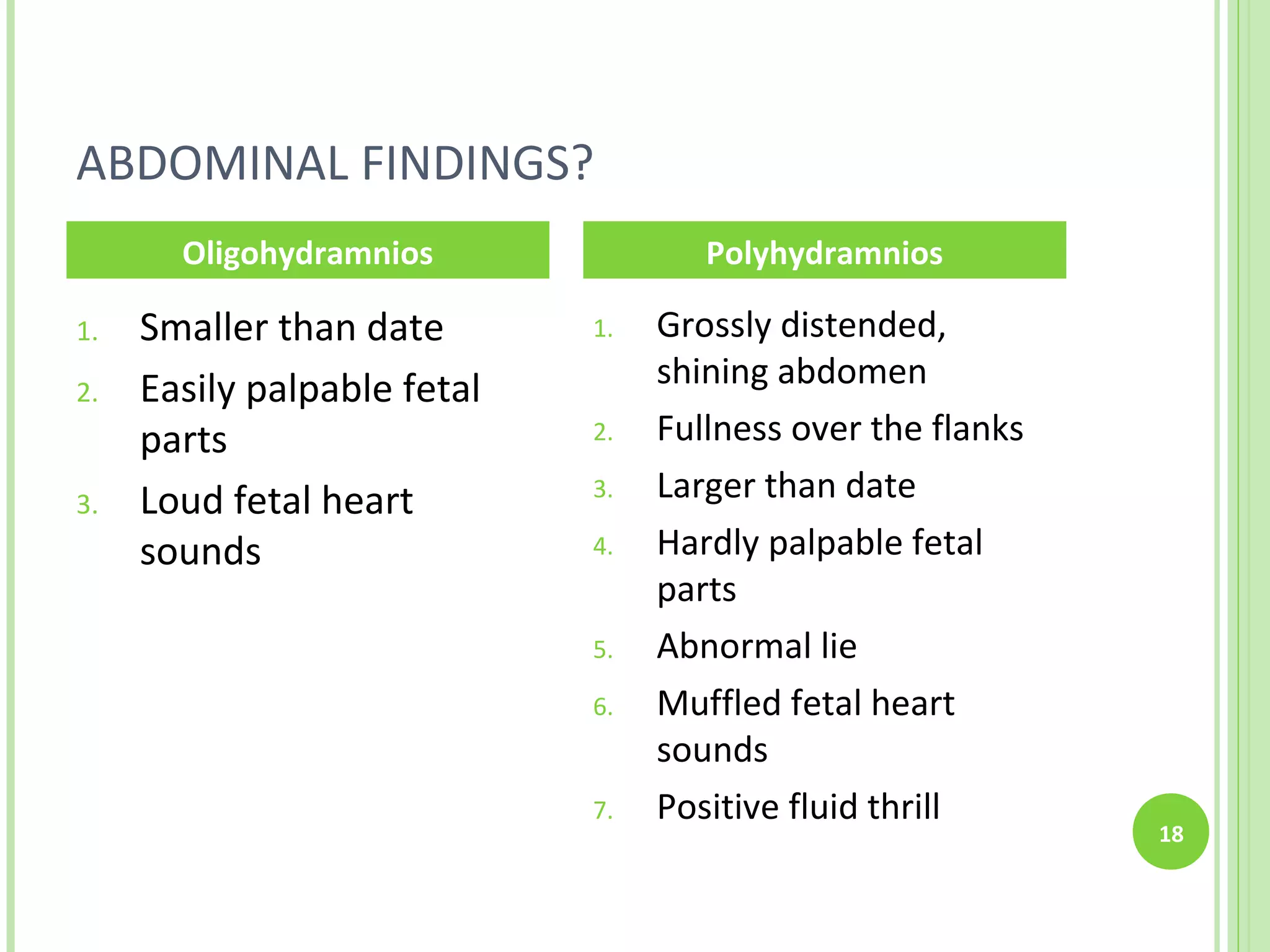
ABDOMINAL FINDINGS?
       Oligohydramnios               Polyhydramnios

1.   Smaller than date       1.   Grossly distended,
2.   Easily palpable fetal        shining abdomen
     parts                   2.   Fullness over the flanks
3.   Loud fetal heart        3.   Larger than date
     sounds                  4.   Hardly palpable fetal
                                  parts
                             5.   Abnormal lie
                             6.   Muffled fetal heart
                                  sounds
                             7.   Positive fluid thrill
                                                             18
THANKS, ALLAHUA’LAM. 
19

Fundal size discrepancy

  • 1.
    FUNDAL SIZE DISCREPANCY 1 Smaller than date Larger than date Oligohydramnios Intrauterine growth restriction (IUGR) Polyhydramnios
  • 2.
    REFERENCE 1. http://www.scribd.com/doc/38032808/Obstetric-Highlights-Elma 2. Oxford’s O&G 2
  • 3.
    SMALLER THAN DATE  Short case  Findings?  Differentials i. Fetal: Fetal demise, IUGR, missed miscarriage, transverse lie, molar pregnancy ii. Maternal: Wrong date, oligohydramnios*  Investigated by USG i. Fetal: Cardiac motion, fetal biometry (BPD, HC, AC, FL) ii. Amniotic fluid: AFI <8 cm iii. Placental: Texture, appearance 3
  • 4.
    Management  Manage the underlying problem (s) identified 4
  • 5.
    LARGER THAN DATE  Short case  Findings?  Differentials i. Fetal: Multiple pregnancy, macrosomia, molar pregnancy, hydrops fetalis ii. Maternal: Wrong date, pelvic masses, polyhydramnios*  Investigated by USG i. Fetal: # of fetus (es), fetal biometry (BPD, HC, AC, FL) ii. Amniotic fluid: AFI >22 cm iii. Placental: Texture, appearance iv. Uterine: Leiomyomas 5
  • 6.
    Management  Manage the underlying problem (s) identified 6
  • 7.
    AMNIOTIC FLUID’S PHYSIOLOGY Amniotic fluids after 20w largely = to fetal urine  Volume depends on fetal urine production, fetal swallowing & absorption  Normal volume varies with gestation  Highest on 24th – 36th w  Measured by USG  1 deepest vertical pool  Adding up deepest pools of all 4 quadrants = AFI 7
  • 8.
    OLIGOHYDRAMNIOS  Formula: 2,8  Oligohydramnios means reduced amniotic fluid volume measured as single deepest pool <2 cm or AFI <8 cm  Differentials 1. Leakage of amniotic fluid i. SROM; be it either PROM or PPROM 2. Reduced fetal urine production i. IUGR ii. Renal failure or abnormalities iii. Post date pregnancy 3. Obstruction to fetal urine output i. PUV 8
  • 9.
    Investigations i. Speculum examination for ruptured membranes ii. If suspected SROM; FBC, CRP, vaginal swab iii. Fetal USG, including Doppler iv. Calculate corrected POG  Complications 1. Related to cause i. PPROM leads to possible chorioamnionitis, preterm labour and delivery ii. IUGR increases fetal & neonatal morbidity and mortality 2. Related to reduced volume i. Lung hypoplasia if occurs <22w ii. Limbs abnormalities, eg, talipes (if prolonged) iii. Oligohydramnios <22w has very poor prognosis 9
  • 10.
    Management i. PROM: Induce labour (SVD) unless CS is indicated for another reason ii. PPROM: Monitor signs of infection*, steroids (Dexamethasone best given at 28-34w), prophylactic oral Erythromycin (10 mg QID x 10 days), daily CTGs iii. IUGR: Manage according to umbilical artery Doppler & CTG findings iv. Renal tract abnormalities: Refer fetal medicine centre v. Apparently isolated oligohydramnios: Reconsider cause, intervention is not usual if Dopplers are normal 10
  • 11.
    IUGR  Optimal fetalgrowth needs healthy mother, well-f(x) placenta and the absence of pathology  Analogous to failure to thrive (FTT) in children  IUGR = pathologically small fetus  Types  Symmetric  Entire body is proportionately small, early onset IUGR, chromosomal abnormalities  Asymmetric  ‘Head-sparing effect’, normal HC, small AC and thin limbs, placental insufficiency  Causes? 11
  • 12.
    Maternal causes Placental insufficiency Fetal causes 1. Chronic diseases 1. Abnormal trophoblastic 1. Genetic abnormalities i. HPT invasion i. Trisomy 13, 18 or ii. Cardiac disease i. Pre eclampsia 21 iii. CKD ii. Placenta accreta ii. Turner’s 2. Substance abuse 2. Infarction syndrome i. Alcohol 3. Abruptio placenta iii. Triploidy ii. Recreational drug 4. Palcental location 2. Congenital use i. Placenta previa abnormalities 3. Smoking 5. Tumors i. Cardiac; TOF, TGA 4. Autoimmune diseases i. Chorioangiomas ii. Gastroschisis i. Antiphospholipid (placental 3. Congenital infection Ab syndrome hemangiomas) i. CMV 5. Genetic disorder 6. Abnormal umbilical ii. Rubella i. Phenylketonuria cord or cord insertion iii. Toxoplasmosis 6. Poor nutrition i. 2 vessels cord 4. Multiple pregnancy 7. Low socio-economic status #MOST COMMON 12
  • 13.
    Investigations i. Fetal biometry (BP, HC, AC, FL) ii. Fetal USG, including Doppler iii. CTGs  Management  Early identification and intensive fetal monitoring are the keys to managing IUGR. The aim is to continue the pregnancy safely as long as possible, thereby decreasing prematurity, but deliver before fetus becomes excessively compromised. 13
  • 14.
    Complications i. Meconium aspiration ii. Intrapartum fetal distress and asphyxia iii. Emergency CS iv. Necrotizing enterocolitis v. Hypoglycemia vi. Hypocalcemia 14
  • 15.
    POLYHYDRAMNIOS  Formula: 8,22  Polyhydramnios means increased amniotic fluid volume measured as single deepest pool >8 cm or AFI >22 cm  Differentials 1. Increased fetal urine production i. Maternal diabetes (chronic DM, GDM) ii. TTTS iii. Hydops fetalis 2. Inability to swallow or absorb amniotic fluid i. GIT obstruction: Duodenal atresia, tracheo-esophageal fistula ii. Neurological/muscular: Anencephaly, myotonic dystrophy iii. Facial obstruction 15 3. Idiopathic (usually mild)
  • 16.
    Investigations i. Fetal USG ii. MGTT to exclude maternal diabetes  Complications i. Maternal discomfort because of abdominal distension ii. Malpresentation iii. Preterm delivery 16
  • 17.
    Management i. AFI >40 cm: Severe, usually a/w fetal abnormality, amnioreduction (drainage of excess fluid by a needle), NSAIDs ii. Fetal abnormality: Refer fetal medicine centre iii. TTTS: Refer to fetal medicine centre, laser ablation of placental anastomoses iv. Preterm: Assess delivery risk (cervical scan), consider steroids v. Unstable/transverse lie: Admit, CS if labour ensues with abnormal lie vi. DM/GDM: Control maternal blood sugar accordingly* 17
  • 18.
    ABDOMINAL FINDINGS? Oligohydramnios Polyhydramnios 1. Smaller than date 1. Grossly distended, 2. Easily palpable fetal shining abdomen parts 2. Fullness over the flanks 3. Loud fetal heart 3. Larger than date sounds 4. Hardly palpable fetal parts 5. Abnormal lie 6. Muffled fetal heart sounds 7. Positive fluid thrill 18
  • 19.