BUILDING MAINTENANCE
PRACTICES
• INTRODUCTION
• NEED FOR BUILDING MAINTENANCE
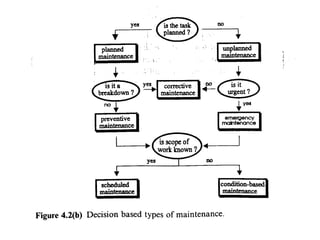
• TYPES OF MAINTENANCE
• PREVENTIVE MAINTENANCE
• MEASURES DURING/AFTER
CONSTRUCTION OF BUILDINGS
• MAINTENANCE SCHEDULES
BUILDING MAINTENANCE
PRACTICES
• MAINTENANCE IN MULTISTOREY
BUILDINGS
• MANAGEMENT INFORMATION SYSTEM
(MIS)
• CONCLUSION
INTRODUCTION
THE LITERAL MEANING OF MAINTENANCE IS
TO PRESERVE UP KEEP OF AN ASSET. IN
RELATION TO BUILDING MAINTENANCE IT
MEANS TO PRESERVE THE BUILDING TO ITS
ORIGINAL AESTHETIC, FUNCTIONAL,
STRUCTURAL STATE INCLUDING
TECHNOLOGICAL UPGRADATIONS. THIS WILL
INVOLVE VARIOUS CATEGORIES OF
MAINTENANCE COMMENSURATE WITH USER
REQUIREMENTS, TECHNICAL NECESSITY,
AVAILABILITY OF FUNDS TO ACHIEVE USER
SATISFACTION.
INTRODUCTION
Maintenance and design are treated as if they
are unconnected activities, but in fact they are
interdependent. Maintenance representative
should ideally be drafted at planning and
design stage to have an effective
performance delivery to the owner/ ultimate
user for the following functions:
To produce a building which is appropriate
and efficient for the functions for which it is
designed
INTRODUCTION
To produce a building which strikes
appropriate balance between initial and
operating costs
To produce building which is consistent with
the needs and aspirations of the community at
large
To produce a building with the optimum
physical and psychological environment for the
contents of the building both animate and
inanimate
INTRODUCTION
In spite of above aspects the buildings
require maintenance due to various
shortcomings, fair wear and tear and
natural forces. The maintenance planning
and implementation must take advantage
of computers through an appropriate
management information system.
Components of Maintenance
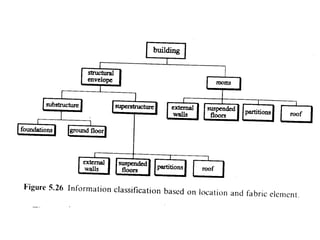
Maintenance relating to building outer
shell of the structure and its fittings
and fixtures viz. Foundations, walls,
doors, windows, roofs, floors
Water supply
Electric supply
Sewage
Gas supply
Components of Maintenance
Garbage disposal
Security
Cleaning
Fire fighting
Lifts and escalators
HVAC Services
Standby power
Hot water systems
Components of Maintenance
Landscaping
Amenities and recreation facilities
Communication systems
Internet
Facilities for handicapped
NEED FOR MAINTENANCE
• Neglect
• Structural defects/ design deficiencies
• Planning defects
• Cracks/ seepages
NEED FOR MAINTENANCE
As built drawings, Manufacturer’s manuals and
recorded defects:
 Architectural drawings, sections, elevations,
structural drawings, Services drawings –
Electrical ,water supply, sewage, air
conditioning, heating & ventilation,
communication, fire detection, fire fighting
 Manufacturer’s manuals for machinery, Air-
conditioning plant, pumps, lifts, escalators,
transformers, cranes, Ice plants, Maintenance
& Operating instructions, spares
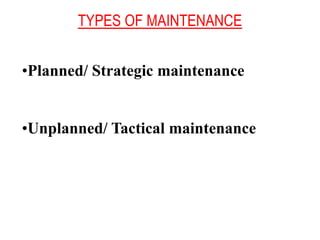
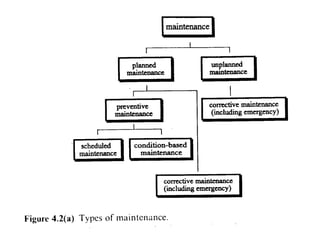
TYPES OF MAINTENANCE
•Planned/ Strategic maintenance
•Unplanned/ Tactical maintenance
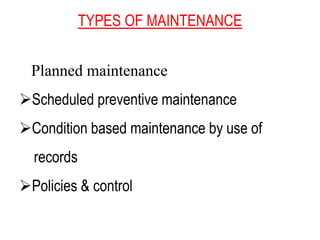
TYPES OF MAINTENANCE
Planned maintenance
Scheduled preventive maintenance
Condition based maintenance by use of
records
Policies & control
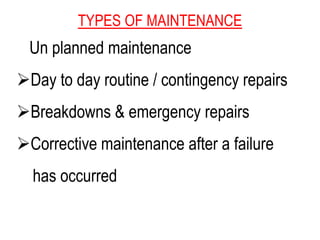
TYPES OF MAINTENANCE
Un planned maintenance
Day to day routine / contingency repairs
Breakdowns & emergency repairs
Corrective maintenance after a failure
has occurred
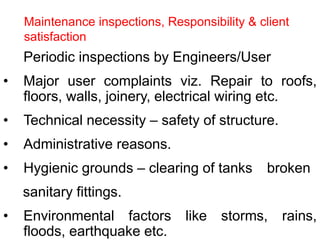
• Periodic inspections by Engineers/User
• Major user complaints viz. Repair to roofs,
floors, walls, joinery, electrical wiring etc.
• Technical necessity – safety of structure.
• Administrative reasons.
• Hygienic grounds – clearing of tanks broken
sanitary fittings.
• Environmental factors like storms, rains,
floods, earthquake etc.
Maintenance inspections, Responsibility & client
satisfaction
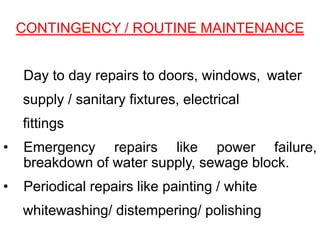
• Day to day repairs to doors, windows, water
supply / sanitary fixtures, electrical
fittings
• Emergency repairs like power failure,
breakdown of water supply, sewage block.
• Periodical repairs like painting / white
whitewashing/ distempering/ polishing
CONTINGENCY / ROUTINE MAINTENANCE
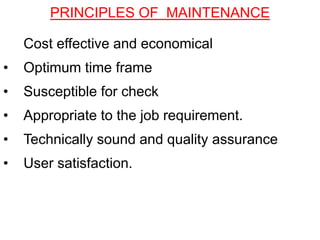
• Cost effective and economical
• Optimum time frame
• Susceptible for check
• Appropriate to the job requirement.
• Technically sound and quality assurance
• User satisfaction.
PRINCIPLES OF MAINTENANCE
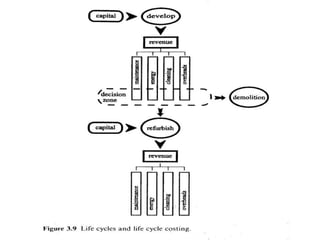
Life cycle costing: LCC of an asset over its
operating life, including initial capital cost,
occupation costs, operating costs and, the cost of
benefit deriving from disposal of the asst at the
end of life.
Sequence of life cycle:
Brief collection and development
Design
Construction
Commissioning
PRINCIPLES OF MAINTENANCE
Sequence of life cycle:
Maintenance
Modification
Replacement
Assessment:
Defining the life cycle period or building life (60
Years)
Machine life (10 – 15 years)
Assessing component or element life
PRINCIPLES OF MAINTENANCE
Obsolescence:
Physical
Functional
Economical
Building life is difficult to define, where as
component/ element life is easier to estimate. The
replacement of a component may be due to
deterioration, failure or obsolescence.
PRINCIPLES OF MAINTENANCE
• Departmentallyemployedworkmen&
procurement of resources.
• Contract system, Out sourcing.
• Agency services (Entrusting to an outside
agency)
SYSTEMS OF MAINTENANCE
. Annual programme: Based on the
inspections/complaints total quantum of work is
estimated building wise. The total work content is
divided into groups based on location, nature of
job. A tentative annual programme is made along
with cost. Allowance is made for the routine
maintenance which can be handled
departmentally. Balance work is divided into
definite identifiable jobs which can be contracted.
This programme is got approved by the
Administrative Authority showing the time
schedule and cost for each job
METHODOLOGY
Priorities are laid down leaving scope for revision
based on availability of funds
METHODOLOGY
Monthly / weekly programmes: The
annual programme could be supported with
monthly/ weekly programmes and funds
requirement. These programmes could be
reviewed / revised as required keeping the
over all annual programme in mind.
METHODOLOGY
Based on the priorities and grouping of the
jobs are tendered and agencies fixed.
Guide lines for implementation:
• Buildings could be grouped based on
geographical location & nature of job &
priority identification.
• Large quantum of trade items could be
combined for better control Viz. repairs to brick
work, plaster and white wash, floor repairs.
• Electrical works could be executed through a
separate agency.
• Petty repairs should be minimized since they
con not be identified after completion.
Guide lines for implementation
• Repairs to be carried out with minimum
possible disturbance to the occupants.
• Dismantled materials should be accounted.
• Users should be associated and their
signatures obtained after completion of job
record maintained
• Even flow of work should be ensured.
• Close supervision at various stages.
• Quality assurance & transparency.
• Working season to be taken into
consideration
Departmentally employed labour: Day to day
petty repairs like leaking taps, sewage blocks,
repairs to fittings & fixtures repairs to
doors/windows electrical repairs fall under this
category. Following activities are involved:
• Receipt & noting complaint.
• Provide material / tools.
• Preparation of Job card & deputing
tradesmen.
• Supervision of repairs & obtaining job
completion from user and make note against
complaint.
• Verification by supervisor / SDO
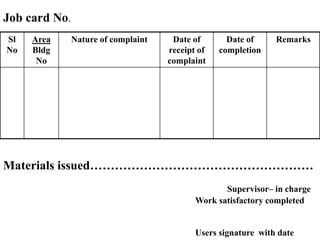
Job card No.
Sl
No
Area
Bldg
No
Nature of complaint Date of
receipt of
complaint
Date of
completion
Remarks
Materials issued………………………………………………
Supervisor– in charge
Work satisfactory completed
Users signature with date
GUIDE LINES
• Minimum reaction time gives better user
satisfaction.
• Materials should be ensured by advance
procurement based on previous experience
• IVR System should be implemented to cut
down delays and to provide round the clock
service.
• Power break downs water supply break
downs to be attended immediately.
• Available manpower should be gainfully
employed and output of each workman
should be recorded.
Types of Contracts:-
1. Contracts for large scale schedule items – Repairs to
plaster floor, doors & windows etc.
2. Term contracts – Scheduled petty items for a period of
one year
3. Periodical services like painting white washing, cement
based paint etc.
4. Cleaning of roof tops repairs & water proofing
treatment.
5. repairs to sewage lines.
6. Cleaning of septic tanks.
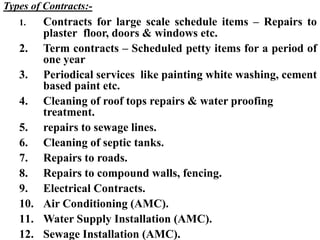
7. Repairs to roads.
8. Repairs to compound walls, fencing.
9. Electrical Contracts.
10. Air Conditioning (AMC).
11. Water Supply Installation (AMC).
12. Sewage Installation (AMC).
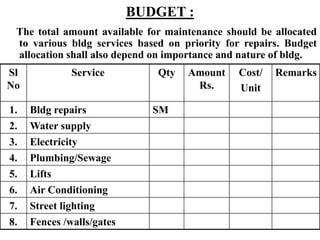
BUDGET :
The total amount available for maintenance should be allocated
to various bldg services based on priority for repairs. Budget
allocation shall also depend on importance and nature of bldg.
Sl
No
Service Qty Amount
Rs.
Cost/
Unit
Remarks
1. Bldg repairs SM
2. Water supply
3. Electricity
4. Plumbing/Sewage
5. Lifts
6. Air Conditioning
7. Street lighting
8. Fences /walls/gates
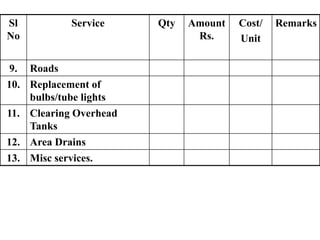
Sl
No
Service Qty Amount
Rs.
Cost/
Unit
Remarks
9. Roads
10. Replacement of
bulbs/tube lights
11. Clearing Overhead
Tanks
12. Area Drains
13. Misc services.
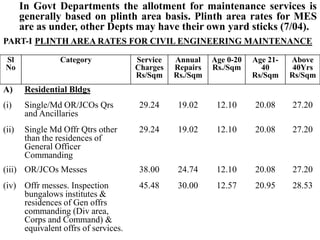
In Govt Departments the allotment for maintenance services is
generally based on plinth area basis. Plinth area rates for MES
are as under, other Depts may have their own yard sticks (7/04).
PART-I PLINTH AREA RATES FOR CIVIL ENGINEERING MAINTENANCE
Sl
No
Category Service
Charges
Rs/Sqm
Annual
Repairs
Rs./Sqm
Age 0-20
Rs./Sqm
Age 21-
40
Rs/Sqm
Above
40Yrs
Rs/Sqm
A) Residential Bldgs
(i) Single/Md OR/JCOs Qrs
and Ancillaries
29.24 19.02 12.10 20.08 27.20
(ii) Single Md Offr Qtrs other
than the residences of
General Officer
Commanding
29.24 19.02 12.10 20.08 27.20
(iii) OR/JCOs Messes 38.00 24.74 12.10 20.08 27.20
(iv) Offr messes. Inspection
bungalows institutes &
residences of Gen offrs
commanding (Div area,
Corps and Command) &
equivalent offrs of services.
45.48 30.00 12.57 20.95 28.53
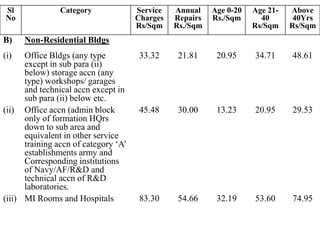
Sl
No
Category Service
Charges
Rs/Sqm
Annual
Repairs
Rs./Sqm
Age 0-20
Rs./Sqm
Age 21-
40
Rs/Sqm
Above
40Yrs
Rs/Sqm
B) Non-Residential Bldgs
(i) Office Bldgs (any type
except in sub para (ii)
below) storage accn (any
type) workshops/ garages
and technical accn except in
sub para (ii) below etc.
33.32 21.81 20.95 34.71 48.61
(ii) Office accn (admin block
only of formation HQrs
down to sub area and
equivalent in other service
training accn of category ‘A’
establishments army and
Corresponding institutions
of Navy/AF/R&D and
technical accn of R&D
laboratories.
45.48 30.00 13.23 20.95 29.53
(iii) MI Rooms and Hospitals 83.30 54.66 32.19 53.60 74.95
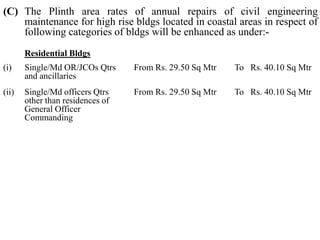
(C) The Plinth area rates of annual repairs of civil engineering
maintenance for high rise bldgs located in coastal areas in respect of
following categories of bldgs will be enhanced as under:-
Residential Bldgs
(i) Single/Md OR/JCOs Qtrs
and ancillaries
From Rs. 29.50 Sq Mtr To Rs. 40.10 Sq Mtr
(ii) Single/Md officers Qtrs
other than residences of
General Officer
Commanding
From Rs. 29.50 Sq Mtr To Rs. 40.10 Sq Mtr
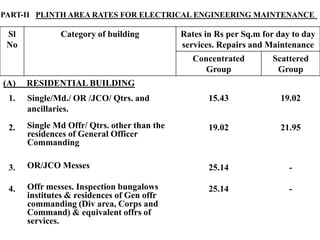
PART-II PLINTH AREA RATES FOR ELECTRICAL ENGINEERING MAINTENANCE
Sl
No
Category of building Rates in Rs per Sq.m for day to day
services. Repairs and Maintenance
Concentrated
Group
Scattered
Group
(A) RESIDENTIAL BUILDING
1. Single/Md./ OR /JCO/ Qtrs. and
ancillaries.
15.43 19.02
2. Single Md Offr/ Qtrs. other than the
residences of General Officer
Commanding
19.02 21.95
3. OR/JCO Messes 25.14 -
4. Offr messes. Inspection bungalows
institutes & residences of Gen offr
commanding (Div area, Corps and
Command) & equivalent offrs of
services.
25.14 -
Sl
No
Category of building Rates in Rs per Sq.m for day to day
services. Repairs and Maintenance
Concentrated
Group
Scattered
Group
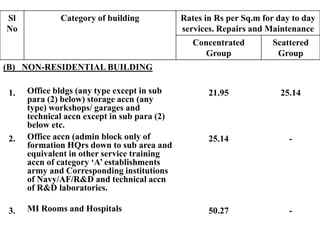
(B) NON-RESIDENTIAL BUILDING
1. Office bldgs (any type except in sub
para (2) below) storage accn (any
type) workshops/ garages and
technical accn except in sub para (2)
below etc.
21.95 25.14
2. Office accn (admin block only of
formation HQrs down to sub area and
equivalent in other service training
accn of category ‘A’ establishments
army and Corresponding institutions
of Navy/AF/R&D and technical accn
of R&D laboratories.
25.14 -
3. MI Rooms and Hospitals 50.27 -
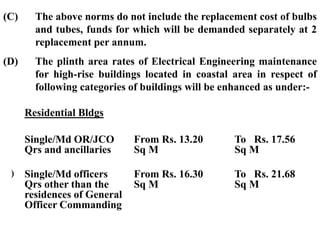
(C) The above norms do not include the replacement cost of bulbs
and tubes, funds for which will be demanded separately at 2
replacement per annum.
(D) The plinth area rates of Electrical Engineering maintenance
for high-rise buildings located in coastal area in respect of
following categories of buildings will be enhanced as under:-
Residential Bldgs
(i) Single/Md OR/JCO
Qrs and ancillaries
From Rs. 13.20
Sq M
To Rs. 17.56
Sq M
(ii) Single/Md officers
Qrs other than the
residences of General
Officer Commanding
From Rs. 16.30
Sq M
To Rs. 21.68
Sq M
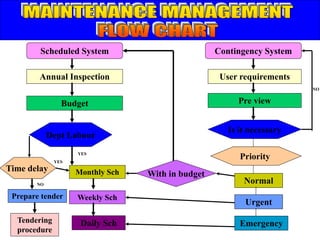
Scheduled System Contingency System
Annual Inspection User requirements
Budget Pre view
Dept Labour
Is it necessary
Time delay
Prepare tender
Tendering
procedure
Monthly Sch
Weekly Sch
Daily Sch
Priority
Normal
Urgent
Emergency
With in budget
NO
YES
YES
NO
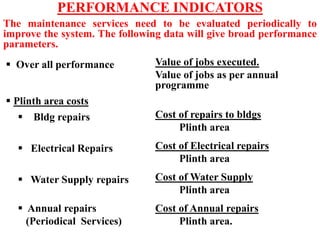
PERFORMANCE INDICATORS
The maintenance services need to be evaluated periodically to
improve the system. The following data will give broad performance
parameters.
 Over all performance Value of jobs executed.
Value of jobs as per annual
programme
 Plinth area costs
 Bldg repairs Cost of repairs to bldgs
Plinth area
 Electrical Repairs Cost of Electrical repairs
Plinth area
 Water Supply repairs Cost of Water Supply
Plinth area
 Annual repairs
(Periodical Services)
Cost of Annual repairs
Plinth area.
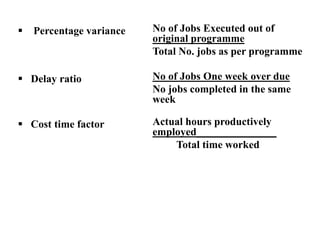
 Percentage variance No of Jobs Executed out of
original programme
Total No. jobs as per programme
 Delay ratio No of Jobs One week over due
No jobs completed in the same
week
 Cost time factor Actual hours productively
employed_______________
Total time worked
WORKER PERFORMANCE
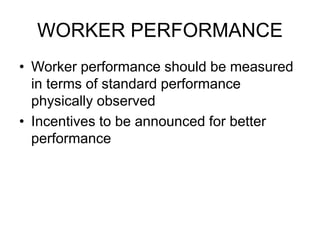
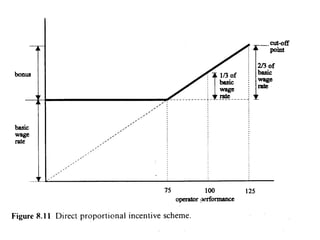
• Worker performance should be measured
in terms of standard performance
physically observed
• Incentives to be announced for better
performance
MANAGEMENT INFORMATION
SYSTEMS
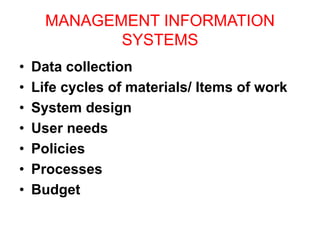
• Data collection
• Life cycles of materials/ Items of work
• System design
• User needs
• Policies
• Processes
• Budget
MANAGEMENT INFORMATION
SYSTEMS
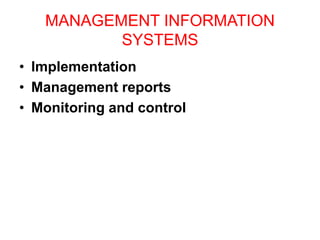
• Implementation
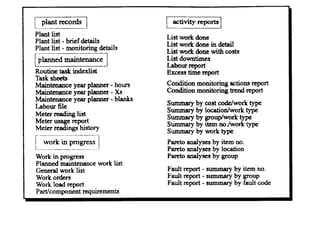
• Management reports
• Monitoring and control
MANAGEMENT INFORMATION
SYSTEMS
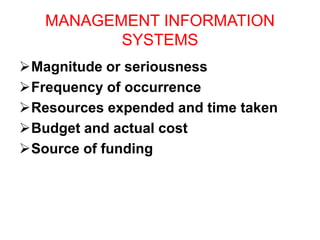
Magnitude or seriousness
Frequency of occurrence
Resources expended and time taken
Budget and actual cost
Source of funding
MANAGEMENT INFORMATION
SYSTEMS
Integrated computer based system
Direct on line entry of job information
Work orders
Invoicing
Payment details
Contractor information
MANAGEMENT INFORMATION
SYSTEMS
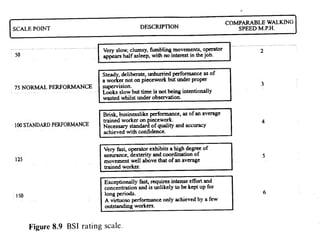
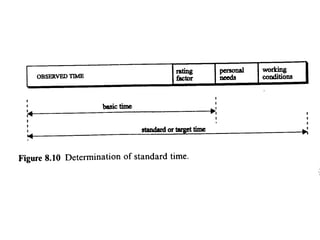
Worker performance
Normal performance
Standard performance
Below normal performance
Incentive scheme
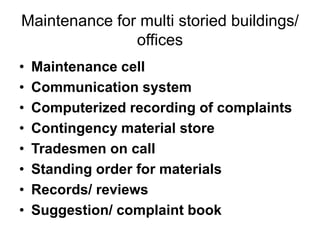
Frontline Management Reports
Maintenance for multi storied buildings/
offices
• Maintenance cell
• Communication system
• Computerized recording of complaints
• Contingency material store
• Tradesmen on call
• Standing order for materials
• Records/ reviews
• Suggestion/ complaint book
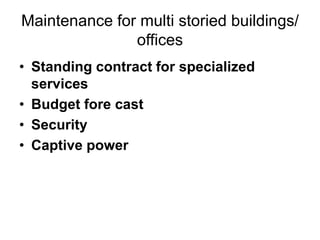
Maintenance for multi storied buildings/
offices
• Standing contract for specialized
services
• Budget fore cast
• Security
• Captive power
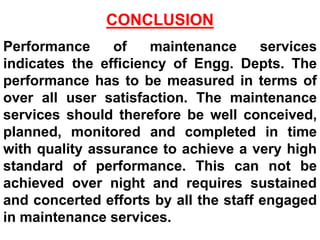
CONCLUSION
Performance of maintenance services
indicates the efficiency of Engg. Depts. The
performance has to be measured in terms of
over all user satisfaction. The maintenance
services should therefore be well conceived,
planned, monitored and completed in time
with quality assurance to achieve a very high
standard of performance. This can not be
achieved over night and requires sustained
and concerted efforts by all the staff engaged
in maintenance services.
Facilities_management_nccb.ppt4567894365

Facilities_management_nccb.ppt4567894365

  • 1.
    BUILDING MAINTENANCE PRACTICES • INTRODUCTION •NEED FOR BUILDING MAINTENANCE • TYPES OF MAINTENANCE • PREVENTIVE MAINTENANCE • MEASURES DURING/AFTER CONSTRUCTION OF BUILDINGS • MAINTENANCE SCHEDULES
  • 2.
    BUILDING MAINTENANCE PRACTICES • MAINTENANCEIN MULTISTOREY BUILDINGS • MANAGEMENT INFORMATION SYSTEM (MIS) • CONCLUSION
  • 3.
    INTRODUCTION THE LITERAL MEANINGOF MAINTENANCE IS TO PRESERVE UP KEEP OF AN ASSET. IN RELATION TO BUILDING MAINTENANCE IT MEANS TO PRESERVE THE BUILDING TO ITS ORIGINAL AESTHETIC, FUNCTIONAL, STRUCTURAL STATE INCLUDING TECHNOLOGICAL UPGRADATIONS. THIS WILL INVOLVE VARIOUS CATEGORIES OF MAINTENANCE COMMENSURATE WITH USER REQUIREMENTS, TECHNICAL NECESSITY, AVAILABILITY OF FUNDS TO ACHIEVE USER SATISFACTION.
  • 4.
    INTRODUCTION Maintenance and designare treated as if they are unconnected activities, but in fact they are interdependent. Maintenance representative should ideally be drafted at planning and design stage to have an effective performance delivery to the owner/ ultimate user for the following functions: To produce a building which is appropriate and efficient for the functions for which it is designed
  • 5.
    INTRODUCTION To produce abuilding which strikes appropriate balance between initial and operating costs To produce building which is consistent with the needs and aspirations of the community at large To produce a building with the optimum physical and psychological environment for the contents of the building both animate and inanimate
  • 6.
    INTRODUCTION In spite ofabove aspects the buildings require maintenance due to various shortcomings, fair wear and tear and natural forces. The maintenance planning and implementation must take advantage of computers through an appropriate management information system.
  • 12.
    Components of Maintenance Maintenancerelating to building outer shell of the structure and its fittings and fixtures viz. Foundations, walls, doors, windows, roofs, floors Water supply Electric supply Sewage Gas supply
  • 13.
    Components of Maintenance Garbagedisposal Security Cleaning Fire fighting Lifts and escalators HVAC Services Standby power Hot water systems
  • 14.
    Components of Maintenance Landscaping Amenitiesand recreation facilities Communication systems Internet Facilities for handicapped
  • 15.
    NEED FOR MAINTENANCE •Neglect • Structural defects/ design deficiencies • Planning defects • Cracks/ seepages
  • 16.
    NEED FOR MAINTENANCE Asbuilt drawings, Manufacturer’s manuals and recorded defects:  Architectural drawings, sections, elevations, structural drawings, Services drawings – Electrical ,water supply, sewage, air conditioning, heating & ventilation, communication, fire detection, fire fighting  Manufacturer’s manuals for machinery, Air- conditioning plant, pumps, lifts, escalators, transformers, cranes, Ice plants, Maintenance & Operating instructions, spares
  • 17.
    TYPES OF MAINTENANCE •Planned/Strategic maintenance •Unplanned/ Tactical maintenance
  • 18.
    TYPES OF MAINTENANCE Plannedmaintenance Scheduled preventive maintenance Condition based maintenance by use of records Policies & control
  • 19.
    TYPES OF MAINTENANCE Unplanned maintenance Day to day routine / contingency repairs Breakdowns & emergency repairs Corrective maintenance after a failure has occurred
  • 22.
    • Periodic inspectionsby Engineers/User • Major user complaints viz. Repair to roofs, floors, walls, joinery, electrical wiring etc. • Technical necessity – safety of structure. • Administrative reasons. • Hygienic grounds – clearing of tanks broken sanitary fittings. • Environmental factors like storms, rains, floods, earthquake etc. Maintenance inspections, Responsibility & client satisfaction
  • 23.
    • Day today repairs to doors, windows, water supply / sanitary fixtures, electrical fittings • Emergency repairs like power failure, breakdown of water supply, sewage block. • Periodical repairs like painting / white whitewashing/ distempering/ polishing CONTINGENCY / ROUTINE MAINTENANCE
  • 24.
    • Cost effectiveand economical • Optimum time frame • Susceptible for check • Appropriate to the job requirement. • Technically sound and quality assurance • User satisfaction. PRINCIPLES OF MAINTENANCE
  • 25.
    Life cycle costing:LCC of an asset over its operating life, including initial capital cost, occupation costs, operating costs and, the cost of benefit deriving from disposal of the asst at the end of life. Sequence of life cycle: Brief collection and development Design Construction Commissioning PRINCIPLES OF MAINTENANCE
  • 26.
    Sequence of lifecycle: Maintenance Modification Replacement Assessment: Defining the life cycle period or building life (60 Years) Machine life (10 – 15 years) Assessing component or element life PRINCIPLES OF MAINTENANCE
  • 27.
    Obsolescence: Physical Functional Economical Building life isdifficult to define, where as component/ element life is easier to estimate. The replacement of a component may be due to deterioration, failure or obsolescence. PRINCIPLES OF MAINTENANCE
  • 28.
    • Departmentallyemployedworkmen& procurement ofresources. • Contract system, Out sourcing. • Agency services (Entrusting to an outside agency) SYSTEMS OF MAINTENANCE
  • 29.
    . Annual programme:Based on the inspections/complaints total quantum of work is estimated building wise. The total work content is divided into groups based on location, nature of job. A tentative annual programme is made along with cost. Allowance is made for the routine maintenance which can be handled departmentally. Balance work is divided into definite identifiable jobs which can be contracted. This programme is got approved by the Administrative Authority showing the time schedule and cost for each job METHODOLOGY
  • 30.
    Priorities are laiddown leaving scope for revision based on availability of funds METHODOLOGY
  • 31.
    Monthly / weeklyprogrammes: The annual programme could be supported with monthly/ weekly programmes and funds requirement. These programmes could be reviewed / revised as required keeping the over all annual programme in mind. METHODOLOGY
  • 32.
    Based on thepriorities and grouping of the jobs are tendered and agencies fixed. Guide lines for implementation: • Buildings could be grouped based on geographical location & nature of job & priority identification. • Large quantum of trade items could be combined for better control Viz. repairs to brick work, plaster and white wash, floor repairs. • Electrical works could be executed through a separate agency. • Petty repairs should be minimized since they con not be identified after completion.
  • 33.
    Guide lines forimplementation • Repairs to be carried out with minimum possible disturbance to the occupants. • Dismantled materials should be accounted. • Users should be associated and their signatures obtained after completion of job record maintained • Even flow of work should be ensured. • Close supervision at various stages. • Quality assurance & transparency. • Working season to be taken into consideration
  • 34.
    Departmentally employed labour:Day to day petty repairs like leaking taps, sewage blocks, repairs to fittings & fixtures repairs to doors/windows electrical repairs fall under this category. Following activities are involved: • Receipt & noting complaint. • Provide material / tools. • Preparation of Job card & deputing tradesmen. • Supervision of repairs & obtaining job completion from user and make note against complaint. • Verification by supervisor / SDO
  • 35.
    Job card No. Sl No Area Bldg No Natureof complaint Date of receipt of complaint Date of completion Remarks Materials issued……………………………………………… Supervisor– in charge Work satisfactory completed Users signature with date
  • 36.
    GUIDE LINES • Minimumreaction time gives better user satisfaction. • Materials should be ensured by advance procurement based on previous experience • IVR System should be implemented to cut down delays and to provide round the clock service. • Power break downs water supply break downs to be attended immediately. • Available manpower should be gainfully employed and output of each workman should be recorded.
  • 37.
    Types of Contracts:- 1.Contracts for large scale schedule items – Repairs to plaster floor, doors & windows etc. 2. Term contracts – Scheduled petty items for a period of one year 3. Periodical services like painting white washing, cement based paint etc. 4. Cleaning of roof tops repairs & water proofing treatment. 5. repairs to sewage lines. 6. Cleaning of septic tanks. 7. Repairs to roads. 8. Repairs to compound walls, fencing. 9. Electrical Contracts. 10. Air Conditioning (AMC). 11. Water Supply Installation (AMC). 12. Sewage Installation (AMC).
  • 38.
    BUDGET : The totalamount available for maintenance should be allocated to various bldg services based on priority for repairs. Budget allocation shall also depend on importance and nature of bldg. Sl No Service Qty Amount Rs. Cost/ Unit Remarks 1. Bldg repairs SM 2. Water supply 3. Electricity 4. Plumbing/Sewage 5. Lifts 6. Air Conditioning 7. Street lighting 8. Fences /walls/gates
  • 39.
    Sl No Service Qty Amount Rs. Cost/ Unit Remarks 9.Roads 10. Replacement of bulbs/tube lights 11. Clearing Overhead Tanks 12. Area Drains 13. Misc services.
  • 40.
    In Govt Departmentsthe allotment for maintenance services is generally based on plinth area basis. Plinth area rates for MES are as under, other Depts may have their own yard sticks (7/04). PART-I PLINTH AREA RATES FOR CIVIL ENGINEERING MAINTENANCE Sl No Category Service Charges Rs/Sqm Annual Repairs Rs./Sqm Age 0-20 Rs./Sqm Age 21- 40 Rs/Sqm Above 40Yrs Rs/Sqm A) Residential Bldgs (i) Single/Md OR/JCOs Qrs and Ancillaries 29.24 19.02 12.10 20.08 27.20 (ii) Single Md Offr Qtrs other than the residences of General Officer Commanding 29.24 19.02 12.10 20.08 27.20 (iii) OR/JCOs Messes 38.00 24.74 12.10 20.08 27.20 (iv) Offr messes. Inspection bungalows institutes & residences of Gen offrs commanding (Div area, Corps and Command) & equivalent offrs of services. 45.48 30.00 12.57 20.95 28.53
  • 41.
    Sl No Category Service Charges Rs/Sqm Annual Repairs Rs./Sqm Age 0-20 Rs./Sqm Age21- 40 Rs/Sqm Above 40Yrs Rs/Sqm B) Non-Residential Bldgs (i) Office Bldgs (any type except in sub para (ii) below) storage accn (any type) workshops/ garages and technical accn except in sub para (ii) below etc. 33.32 21.81 20.95 34.71 48.61 (ii) Office accn (admin block only of formation HQrs down to sub area and equivalent in other service training accn of category ‘A’ establishments army and Corresponding institutions of Navy/AF/R&D and technical accn of R&D laboratories. 45.48 30.00 13.23 20.95 29.53 (iii) MI Rooms and Hospitals 83.30 54.66 32.19 53.60 74.95
  • 42.
    (C) The Plintharea rates of annual repairs of civil engineering maintenance for high rise bldgs located in coastal areas in respect of following categories of bldgs will be enhanced as under:- Residential Bldgs (i) Single/Md OR/JCOs Qtrs and ancillaries From Rs. 29.50 Sq Mtr To Rs. 40.10 Sq Mtr (ii) Single/Md officers Qtrs other than residences of General Officer Commanding From Rs. 29.50 Sq Mtr To Rs. 40.10 Sq Mtr
  • 43.
    PART-II PLINTH AREARATES FOR ELECTRICAL ENGINEERING MAINTENANCE Sl No Category of building Rates in Rs per Sq.m for day to day services. Repairs and Maintenance Concentrated Group Scattered Group (A) RESIDENTIAL BUILDING 1. Single/Md./ OR /JCO/ Qtrs. and ancillaries. 15.43 19.02 2. Single Md Offr/ Qtrs. other than the residences of General Officer Commanding 19.02 21.95 3. OR/JCO Messes 25.14 - 4. Offr messes. Inspection bungalows institutes & residences of Gen offr commanding (Div area, Corps and Command) & equivalent offrs of services. 25.14 -
  • 44.
    Sl No Category of buildingRates in Rs per Sq.m for day to day services. Repairs and Maintenance Concentrated Group Scattered Group (B) NON-RESIDENTIAL BUILDING 1. Office bldgs (any type except in sub para (2) below) storage accn (any type) workshops/ garages and technical accn except in sub para (2) below etc. 21.95 25.14 2. Office accn (admin block only of formation HQrs down to sub area and equivalent in other service training accn of category ‘A’ establishments army and Corresponding institutions of Navy/AF/R&D and technical accn of R&D laboratories. 25.14 - 3. MI Rooms and Hospitals 50.27 -
  • 45.
    (C) The abovenorms do not include the replacement cost of bulbs and tubes, funds for which will be demanded separately at 2 replacement per annum. (D) The plinth area rates of Electrical Engineering maintenance for high-rise buildings located in coastal area in respect of following categories of buildings will be enhanced as under:- Residential Bldgs (i) Single/Md OR/JCO Qrs and ancillaries From Rs. 13.20 Sq M To Rs. 17.56 Sq M (ii) Single/Md officers Qrs other than the residences of General Officer Commanding From Rs. 16.30 Sq M To Rs. 21.68 Sq M
  • 46.
    Scheduled System ContingencySystem Annual Inspection User requirements Budget Pre view Dept Labour Is it necessary Time delay Prepare tender Tendering procedure Monthly Sch Weekly Sch Daily Sch Priority Normal Urgent Emergency With in budget NO YES YES NO
  • 47.
    PERFORMANCE INDICATORS The maintenanceservices need to be evaluated periodically to improve the system. The following data will give broad performance parameters.  Over all performance Value of jobs executed. Value of jobs as per annual programme  Plinth area costs  Bldg repairs Cost of repairs to bldgs Plinth area  Electrical Repairs Cost of Electrical repairs Plinth area  Water Supply repairs Cost of Water Supply Plinth area  Annual repairs (Periodical Services) Cost of Annual repairs Plinth area.
  • 48.
     Percentage varianceNo of Jobs Executed out of original programme Total No. jobs as per programme  Delay ratio No of Jobs One week over due No jobs completed in the same week  Cost time factor Actual hours productively employed_______________ Total time worked
  • 49.
    WORKER PERFORMANCE • Workerperformance should be measured in terms of standard performance physically observed • Incentives to be announced for better performance
  • 53.
    MANAGEMENT INFORMATION SYSTEMS • Datacollection • Life cycles of materials/ Items of work • System design • User needs • Policies • Processes • Budget
  • 54.
    MANAGEMENT INFORMATION SYSTEMS • Implementation •Management reports • Monitoring and control
  • 55.
    MANAGEMENT INFORMATION SYSTEMS Magnitude orseriousness Frequency of occurrence Resources expended and time taken Budget and actual cost Source of funding
  • 56.
    MANAGEMENT INFORMATION SYSTEMS Integrated computerbased system Direct on line entry of job information Work orders Invoicing Payment details Contractor information
  • 57.
    MANAGEMENT INFORMATION SYSTEMS Worker performance Normalperformance Standard performance Below normal performance Incentive scheme
  • 58.
  • 61.
    Maintenance for multistoried buildings/ offices • Maintenance cell • Communication system • Computerized recording of complaints • Contingency material store • Tradesmen on call • Standing order for materials • Records/ reviews • Suggestion/ complaint book
  • 62.
    Maintenance for multistoried buildings/ offices • Standing contract for specialized services • Budget fore cast • Security • Captive power
  • 63.
    CONCLUSION Performance of maintenanceservices indicates the efficiency of Engg. Depts. The performance has to be measured in terms of over all user satisfaction. The maintenance services should therefore be well conceived, planned, monitored and completed in time with quality assurance to achieve a very high standard of performance. This can not be achieved over night and requires sustained and concerted efforts by all the staff engaged in maintenance services.