Functions in Python
Prof. (Dr.) Varsha Degaonkar
Department of Electronics and Telecommunication
International Institute of Information Technology, I²IT
www.isquareit.edu.in
1
Functions in Python:
 The function is a set of statements/code, that executes upon
calling to the function
 We may pass parameters to a function.
 It may return information as a result.
 We have to follow two steps:
 1. Function definition / creation
 2. Call to the Function
International Institute of Information Technology, I²IT, P-14, Rajiv Gandhi Infotech Park, Hinjawadi Phase 1, Pune - 411 057
Phone - +91 20 22933441/2/3 | Website - www.isquareit.edu.in | Email - info@isquareit.edu.in
2
Function definition:
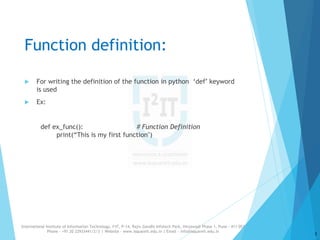
 For writing the definition of the function in python ‘def’ keyword
is used
 Ex:
def ex_func(): # Function Definition
print(“This is my first function")
3
International Institute of Information Technology, I²IT, P-14, Rajiv Gandhi Infotech Park, Hinjawadi Phase 1, Pune - 411 057
Phone - +91 20 22933441/2/3 | Website - www.isquareit.edu.in | Email - info@isquareit.edu.in
Call to the Function:
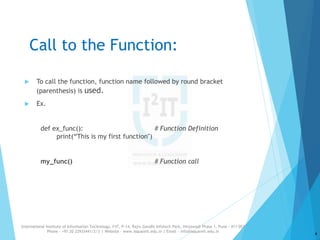
 To call the function, function name followed by round bracket
(parenthesis) is used.
 Ex.
def ex_func(): # Function Definition
print(“This is my first function")
my_func() # Function call
4
International Institute of Information Technology, I²IT, P-14, Rajiv Gandhi Infotech Park, Hinjawadi Phase 1, Pune - 411 057
Phone - +91 20 22933441/2/3 | Website - www.isquareit.edu.in | Email - info@isquareit.edu.in
Arguments in a Function:
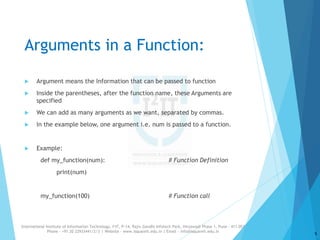
 Argument means the Information that can be passed to function
 Inside the parentheses, after the function name, these Arguments are
specified
 We can add as many arguments as we want, separated by commas.
 In the example below, one argument i.e. num is passed to a function.
 Example:
def my_function(num): # Function Definition
print(num)
my_function(100) # Function call
5
International Institute of Information Technology, I²IT, P-14, Rajiv Gandhi Infotech Park, Hinjawadi Phase 1, Pune - 411 057
Phone - +91 20 22933441/2/3 | Website - www.isquareit.edu.in | Email - info@isquareit.edu.in
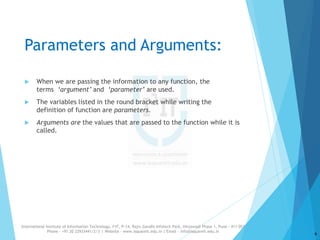
Parameters and Arguments:
 When we are passing the information to any function, the
terms ‘argument’ and ‘parameter’ are used.
 The variables listed in the round bracket while writing the
definition of function are parameters.
 Arguments are the values that are passed to the function while it is
called.
6
International Institute of Information Technology, I²IT, P-14, Rajiv Gandhi Infotech Park, Hinjawadi Phase 1, Pune - 411 057
Phone - +91 20 22933441/2/3 | Website - www.isquareit.edu.in | Email - info@isquareit.edu.in
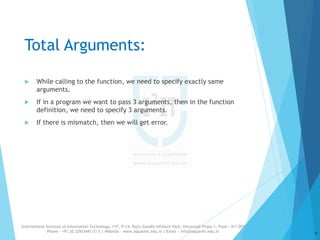
Total Arguments:
 While calling to the function, we need to specify exactly same
arguments.
 If in a program we want to pass 3 arguments, then in the function
definition, we need to specify 3 arguments.
 If there is mismatch, then we will get error.
7
International Institute of Information Technology, I²IT, P-14, Rajiv Gandhi Infotech Park, Hinjawadi Phase 1, Pune - 411 057
Phone - +91 20 22933441/2/3 | Website - www.isquareit.edu.in | Email - info@isquareit.edu.in
Arbitrary Arguments: *args
 While writing code, if we don’t know total arguments to be passed
to the function, then we can add a * before the name of the
parameter in the definition of function.
 As in function call, we are writing all the arguments separated by
comma, the function is receiving a tuple as arguments.
 Ex.
def ex_func(*city):
print(“My city name is " + city[1])
ex_func(“Pune", “Mumbai", “Nagpur")
8
International Institute of Information Technology, I²IT, P-14, Rajiv Gandhi Infotech Park, Hinjawadi Phase 1, Pune - 411 057
Phone - +91 20 22933441/2/3 | Website - www.isquareit.edu.in | Email - info@isquareit.edu.in
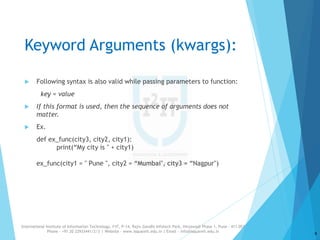
Keyword Arguments (kwargs):
 Following syntax is also valid while passing parameters to function:
key = value
 If this format is used, then the sequence of arguments does not
matter.
 Ex.
def ex_func(city3, city2, city1):
print(“My city is " + city1)
ex_func(city1 = " Pune ", city2 = “Mumbai", city3 = “Nagpur")
9
International Institute of Information Technology, I²IT, P-14, Rajiv Gandhi Infotech Park, Hinjawadi Phase 1, Pune - 411 057
Phone - +91 20 22933441/2/3 | Website - www.isquareit.edu.in | Email - info@isquareit.edu.in
Random Keyword Arguments
(**kwargs):
 If we are not aware of total keyword arguments to be passed to the
function, then two asterisks ** can be added before the parameter
name while writing the function definition.
 By passing the parameters this way, we are actually passing a
dictionary as arguments.
 Ex.
def ex_func(**city):
print("My favourite city is " + city["c3"])
ex_func(c1=" Pune ", c2="Mumbai", c3="Nagpur")
10
International Institute of Information Technology, I²IT, P-14, Rajiv Gandhi Infotech Park, Hinjawadi Phase 1, Pune - 411 057
Phone - +91 20 22933441/2/3 | Website - www.isquareit.edu.in | Email - info@isquareit.edu.in
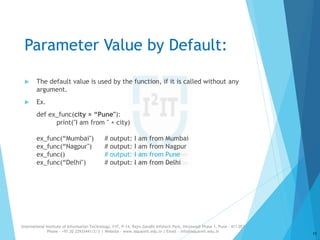
Parameter Value by Default:
 The default value is used by the function, if it is called without any
argument.
 Ex.
def ex_func(city = “Pune"):
print("I am from " + city)
ex_func(“Mumbai") # output: I am from Mumbai
ex_func(“Nagpur") # output: I am from Nagpur
ex_func() # output: I am from Pune
ex_func(“Delhi") # output: I am from Delhi
11
International Institute of Information Technology, I²IT, P-14, Rajiv Gandhi Infotech Park, Hinjawadi Phase 1, Pune - 411 057
Phone - +91 20 22933441/2/3 | Website - www.isquareit.edu.in | Email - info@isquareit.edu.in
Argument passing - a List:
 We can pass data of any type while calling the function. Inside the
function, it is considered as the same type.
 Ex.
def my_func(place): # List is received as argument
for a in place:
print(a)
city = [“Pune", “Mumbai", “Nagpur"]
my_func(city) # List is passed as parameter
12
International Institute of Information Technology, I²IT, P-14, Rajiv Gandhi Infotech Park, Hinjawadi Phase 1, Pune - 411 057
Phone - +91 20 22933441/2/3 | Website - www.isquareit.edu.in | Email - info@isquareit.edu.in
Return Values:
 The ‘return’ statement is used to return a data from function
 Ex.
def ex_func(val):
return 10 + val
print(ex_func(33))
print(ex_func(50))
print(ex_func(99))
13
International Institute of Information Technology, I²IT, P-14, Rajiv Gandhi Infotech Park, Hinjawadi Phase 1, Pune - 411 057
Phone - +91 20 22933441/2/3 | Website - www.isquareit.edu.in | Email - info@isquareit.edu.in
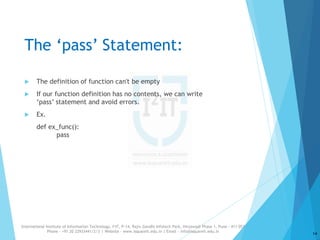
The ‘pass’ Statement:
 The definition of function can't be empty
 If our function definition has no contents, we can write
‘pass’ statement and avoid errors.
 Ex.
def ex_func():
pass
14
International Institute of Information Technology, I²IT, P-14, Rajiv Gandhi Infotech Park, Hinjawadi Phase 1, Pune - 411 057
Phone - +91 20 22933441/2/3 | Website - www.isquareit.edu.in | Email - info@isquareit.edu.in
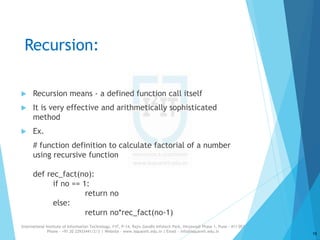
Recursion:
 Recursion means - a defined function call itself
 It is very effective and arithmetically sophisticated
method
 Ex.
# function definition to calculate factorial of a number
using recursive function
def rec_fact(no):
if no == 1:
return no
else:
return no*rec_fact(no-1)
15
International Institute of Information Technology, I²IT, P-14, Rajiv Gandhi Infotech Park, Hinjawadi Phase 1, Pune - 411 057
Phone - +91 20 22933441/2/3 | Website - www.isquareit.edu.in | Email - info@isquareit.edu.in
Thank you!!
16
International Institute of Information Technology, I²IT, P-14, Rajiv Gandhi Infotech Park, Hinjawadi Phase 1, Pune - 411 057
Phone - +91 20 22933441/2/3 | Website - www.isquareit.edu.in | Email - info@isquareit.edu.in
Prof. (Dr.) Varsha Degaonkar
Assistant Professor in
Department of Electronics and Telecommunication
International Institute of Information Technology (I²IT), Pune
varshad@isquareit.edu.in
17
International Institute of Information Technology, I²IT, P-14, Rajiv Gandhi Infotech Park, Hinjawadi Phase 1, Pune - 411 057
Phone - +91 20 22933441/2/3 | Website - www.isquareit.edu.in | Email - info@isquareit.edu.in

Functions in Python

  • 1.
    Functions in Python Prof.(Dr.) Varsha Degaonkar Department of Electronics and Telecommunication International Institute of Information Technology, I²IT www.isquareit.edu.in 1
  • 2.
    Functions in Python: The function is a set of statements/code, that executes upon calling to the function  We may pass parameters to a function.  It may return information as a result.  We have to follow two steps:  1. Function definition / creation  2. Call to the Function International Institute of Information Technology, I²IT, P-14, Rajiv Gandhi Infotech Park, Hinjawadi Phase 1, Pune - 411 057 Phone - +91 20 22933441/2/3 | Website - www.isquareit.edu.in | Email - info@isquareit.edu.in 2
  • 3.
    Function definition:  Forwriting the definition of the function in python ‘def’ keyword is used  Ex: def ex_func(): # Function Definition print(“This is my first function") 3 International Institute of Information Technology, I²IT, P-14, Rajiv Gandhi Infotech Park, Hinjawadi Phase 1, Pune - 411 057 Phone - +91 20 22933441/2/3 | Website - www.isquareit.edu.in | Email - info@isquareit.edu.in
  • 4.
    Call to theFunction:  To call the function, function name followed by round bracket (parenthesis) is used.  Ex. def ex_func(): # Function Definition print(“This is my first function") my_func() # Function call 4 International Institute of Information Technology, I²IT, P-14, Rajiv Gandhi Infotech Park, Hinjawadi Phase 1, Pune - 411 057 Phone - +91 20 22933441/2/3 | Website - www.isquareit.edu.in | Email - info@isquareit.edu.in
  • 5.
    Arguments in aFunction:  Argument means the Information that can be passed to function  Inside the parentheses, after the function name, these Arguments are specified  We can add as many arguments as we want, separated by commas.  In the example below, one argument i.e. num is passed to a function.  Example: def my_function(num): # Function Definition print(num) my_function(100) # Function call 5 International Institute of Information Technology, I²IT, P-14, Rajiv Gandhi Infotech Park, Hinjawadi Phase 1, Pune - 411 057 Phone - +91 20 22933441/2/3 | Website - www.isquareit.edu.in | Email - info@isquareit.edu.in
  • 6.
    Parameters and Arguments: When we are passing the information to any function, the terms ‘argument’ and ‘parameter’ are used.  The variables listed in the round bracket while writing the definition of function are parameters.  Arguments are the values that are passed to the function while it is called. 6 International Institute of Information Technology, I²IT, P-14, Rajiv Gandhi Infotech Park, Hinjawadi Phase 1, Pune - 411 057 Phone - +91 20 22933441/2/3 | Website - www.isquareit.edu.in | Email - info@isquareit.edu.in
  • 7.
    Total Arguments:  Whilecalling to the function, we need to specify exactly same arguments.  If in a program we want to pass 3 arguments, then in the function definition, we need to specify 3 arguments.  If there is mismatch, then we will get error. 7 International Institute of Information Technology, I²IT, P-14, Rajiv Gandhi Infotech Park, Hinjawadi Phase 1, Pune - 411 057 Phone - +91 20 22933441/2/3 | Website - www.isquareit.edu.in | Email - info@isquareit.edu.in
  • 8.
    Arbitrary Arguments: *args While writing code, if we don’t know total arguments to be passed to the function, then we can add a * before the name of the parameter in the definition of function.  As in function call, we are writing all the arguments separated by comma, the function is receiving a tuple as arguments.  Ex. def ex_func(*city): print(“My city name is " + city[1]) ex_func(“Pune", “Mumbai", “Nagpur") 8 International Institute of Information Technology, I²IT, P-14, Rajiv Gandhi Infotech Park, Hinjawadi Phase 1, Pune - 411 057 Phone - +91 20 22933441/2/3 | Website - www.isquareit.edu.in | Email - info@isquareit.edu.in
  • 9.
    Keyword Arguments (kwargs): Following syntax is also valid while passing parameters to function: key = value  If this format is used, then the sequence of arguments does not matter.  Ex. def ex_func(city3, city2, city1): print(“My city is " + city1) ex_func(city1 = " Pune ", city2 = “Mumbai", city3 = “Nagpur") 9 International Institute of Information Technology, I²IT, P-14, Rajiv Gandhi Infotech Park, Hinjawadi Phase 1, Pune - 411 057 Phone - +91 20 22933441/2/3 | Website - www.isquareit.edu.in | Email - info@isquareit.edu.in
  • 10.
    Random Keyword Arguments (**kwargs): If we are not aware of total keyword arguments to be passed to the function, then two asterisks ** can be added before the parameter name while writing the function definition.  By passing the parameters this way, we are actually passing a dictionary as arguments.  Ex. def ex_func(**city): print("My favourite city is " + city["c3"]) ex_func(c1=" Pune ", c2="Mumbai", c3="Nagpur") 10 International Institute of Information Technology, I²IT, P-14, Rajiv Gandhi Infotech Park, Hinjawadi Phase 1, Pune - 411 057 Phone - +91 20 22933441/2/3 | Website - www.isquareit.edu.in | Email - info@isquareit.edu.in
  • 11.
    Parameter Value byDefault:  The default value is used by the function, if it is called without any argument.  Ex. def ex_func(city = “Pune"): print("I am from " + city) ex_func(“Mumbai") # output: I am from Mumbai ex_func(“Nagpur") # output: I am from Nagpur ex_func() # output: I am from Pune ex_func(“Delhi") # output: I am from Delhi 11 International Institute of Information Technology, I²IT, P-14, Rajiv Gandhi Infotech Park, Hinjawadi Phase 1, Pune - 411 057 Phone - +91 20 22933441/2/3 | Website - www.isquareit.edu.in | Email - info@isquareit.edu.in
  • 12.
    Argument passing -a List:  We can pass data of any type while calling the function. Inside the function, it is considered as the same type.  Ex. def my_func(place): # List is received as argument for a in place: print(a) city = [“Pune", “Mumbai", “Nagpur"] my_func(city) # List is passed as parameter 12 International Institute of Information Technology, I²IT, P-14, Rajiv Gandhi Infotech Park, Hinjawadi Phase 1, Pune - 411 057 Phone - +91 20 22933441/2/3 | Website - www.isquareit.edu.in | Email - info@isquareit.edu.in
  • 13.
    Return Values:  The‘return’ statement is used to return a data from function  Ex. def ex_func(val): return 10 + val print(ex_func(33)) print(ex_func(50)) print(ex_func(99)) 13 International Institute of Information Technology, I²IT, P-14, Rajiv Gandhi Infotech Park, Hinjawadi Phase 1, Pune - 411 057 Phone - +91 20 22933441/2/3 | Website - www.isquareit.edu.in | Email - info@isquareit.edu.in
  • 14.
    The ‘pass’ Statement: The definition of function can't be empty  If our function definition has no contents, we can write ‘pass’ statement and avoid errors.  Ex. def ex_func(): pass 14 International Institute of Information Technology, I²IT, P-14, Rajiv Gandhi Infotech Park, Hinjawadi Phase 1, Pune - 411 057 Phone - +91 20 22933441/2/3 | Website - www.isquareit.edu.in | Email - info@isquareit.edu.in
  • 15.
    Recursion:  Recursion means- a defined function call itself  It is very effective and arithmetically sophisticated method  Ex. # function definition to calculate factorial of a number using recursive function def rec_fact(no): if no == 1: return no else: return no*rec_fact(no-1) 15 International Institute of Information Technology, I²IT, P-14, Rajiv Gandhi Infotech Park, Hinjawadi Phase 1, Pune - 411 057 Phone - +91 20 22933441/2/3 | Website - www.isquareit.edu.in | Email - info@isquareit.edu.in
  • 16.
    Thank you!! 16 International Instituteof Information Technology, I²IT, P-14, Rajiv Gandhi Infotech Park, Hinjawadi Phase 1, Pune - 411 057 Phone - +91 20 22933441/2/3 | Website - www.isquareit.edu.in | Email - info@isquareit.edu.in
  • 17.
    Prof. (Dr.) VarshaDegaonkar Assistant Professor in Department of Electronics and Telecommunication International Institute of Information Technology (I²IT), Pune varshad@isquareit.edu.in 17 International Institute of Information Technology, I²IT, P-14, Rajiv Gandhi Infotech Park, Hinjawadi Phase 1, Pune - 411 057 Phone - +91 20 22933441/2/3 | Website - www.isquareit.edu.in | Email - info@isquareit.edu.in