By, Dr. Shamanthakamani Narendran
M.D.(Pead), Ph.D. (Yoga Science)
DEFINITION
• Brainwaves/Electroencephalography (EEG) is the
recording of electrical activity along the scalp
produced by the firing of neurons within the brain.
• A rhythmic fluctuation of electric potential between
parts of the brain, as seen on an EEG.
• (Life Sciences & Allied Applications / Physiology)
any of the fluctuations of electrical potential in the
brain as represented on an EEG.
• They vary in frequency from 1 to 30 hertz See also
alpha rhythm, beta rhythm, delta rhythm
INTRODUCTION
• Brain is made up of billions of brain cells called
neurons, which use electricity to communicate
with each other. The combination of millions of
neurons sending signals at once produces an
enormous amount of electrical activity in the
brain, which can be detected using sensitive
medical equipment (such as an EEG), measuring
electricity levels over areas of the scalp.
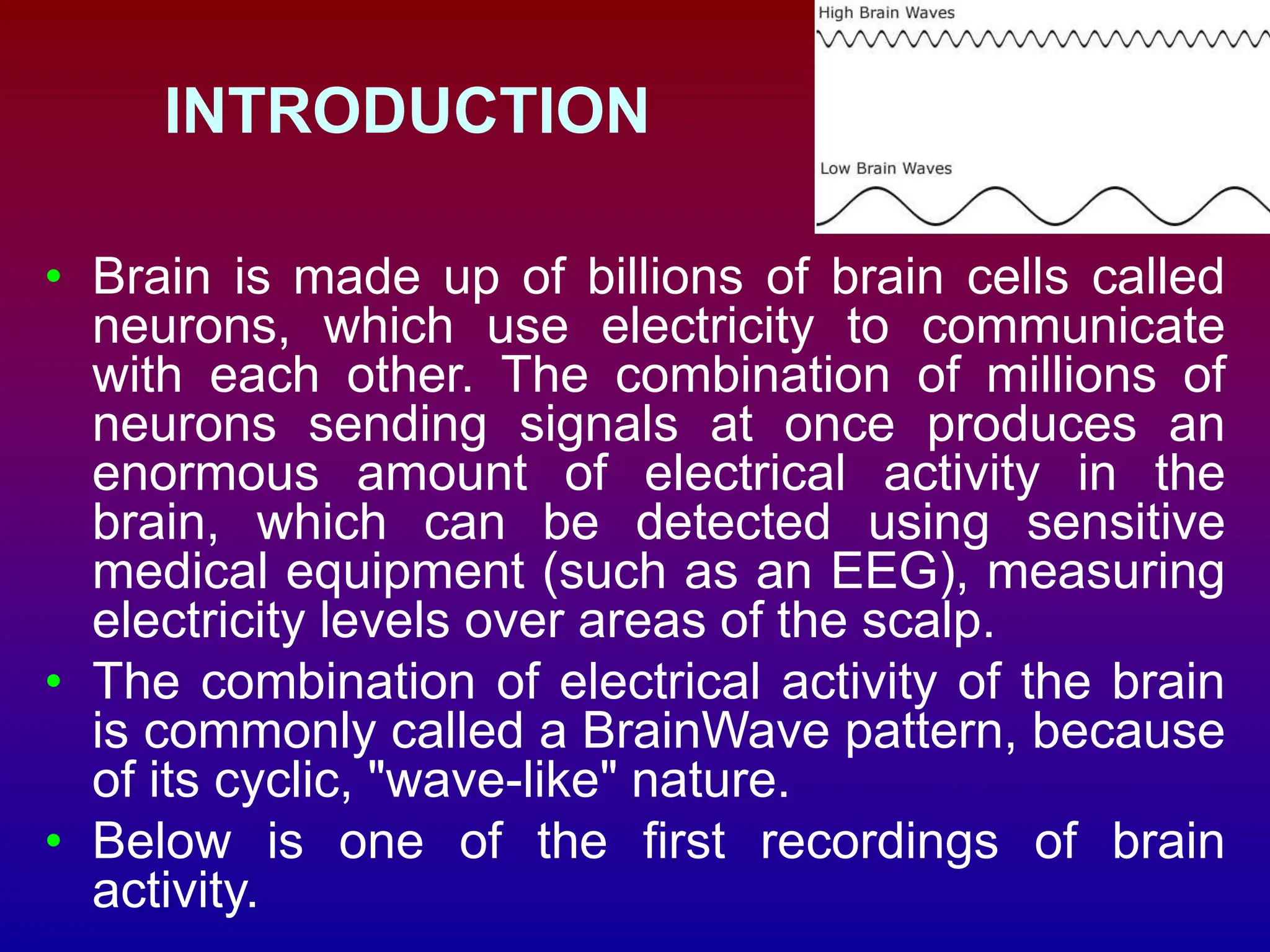
• The combination of electrical activity of the brain
is commonly called a BrainWave pattern, because
of its cyclic, "wave-like" nature.
• Below is one of the first recordings of brain
activity.
MODERN EEG RECORDING
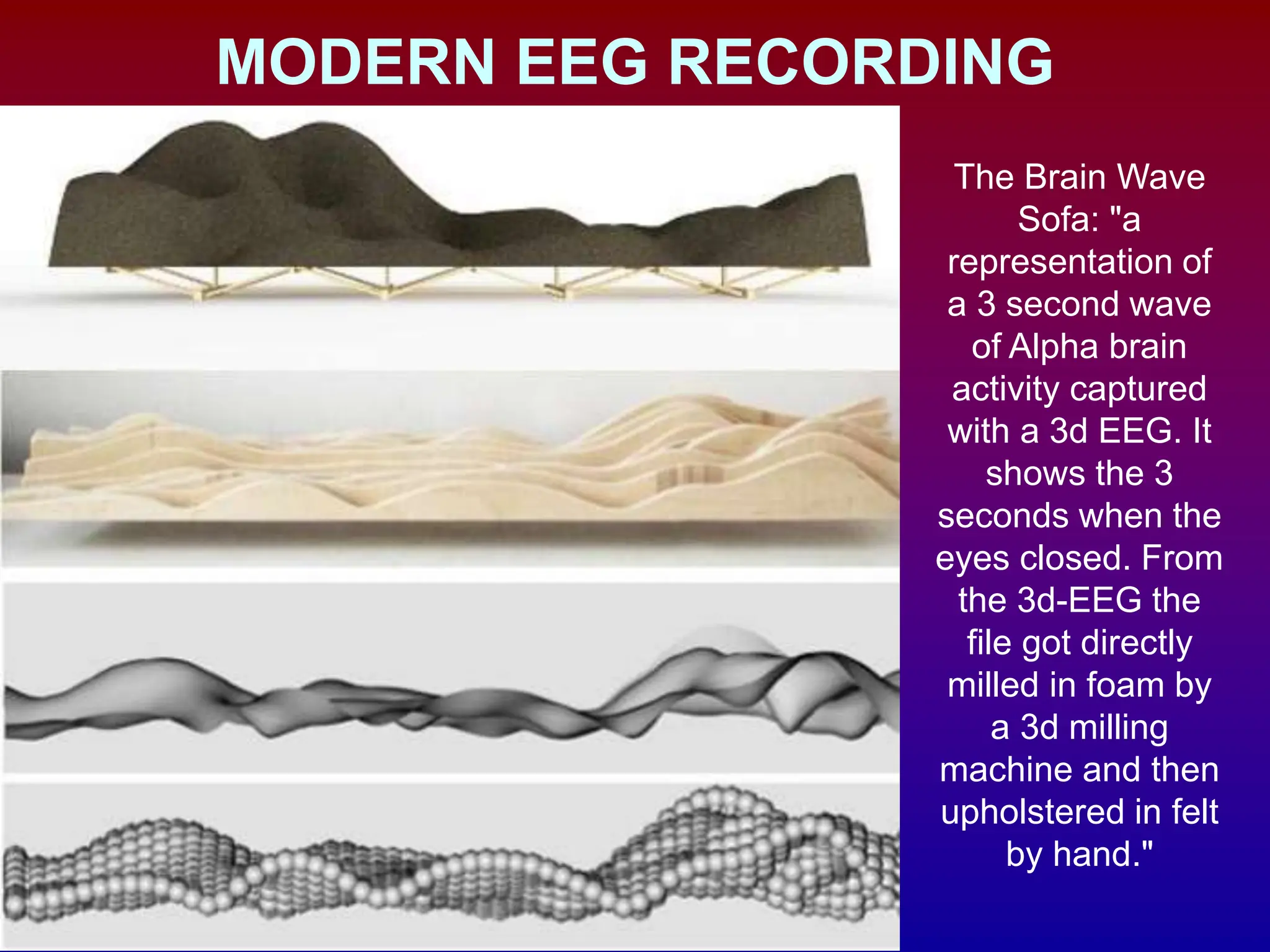
The Brain Wave
Sofa: "a
representation of
a 3 second wave
of Alpha brain
activity captured
with a 3d EEG. It
shows the 3
seconds when the
eyes closed. From
the 3d-EEG the
file got directly
milled in foam by
a 3d milling
machine and then
upholstered in felt
by hand."
BRAINWAVE FREQUENCIES
• With the discovery of brainwaves came the
discovery that electrical activity in the brain
will change depending on what the person is
doing.
• For instance, the brainwaves of a sleeping
person are vastly different than the
brainwaves of someone wide awake.
• Over the years, more sensitive equipment
has brought us closer to figuring out exactly
what brainwaves represent and with that,
what they mean about a person's health and
state of mind.
SPONTANEOUS BRAIN POTENTIALS
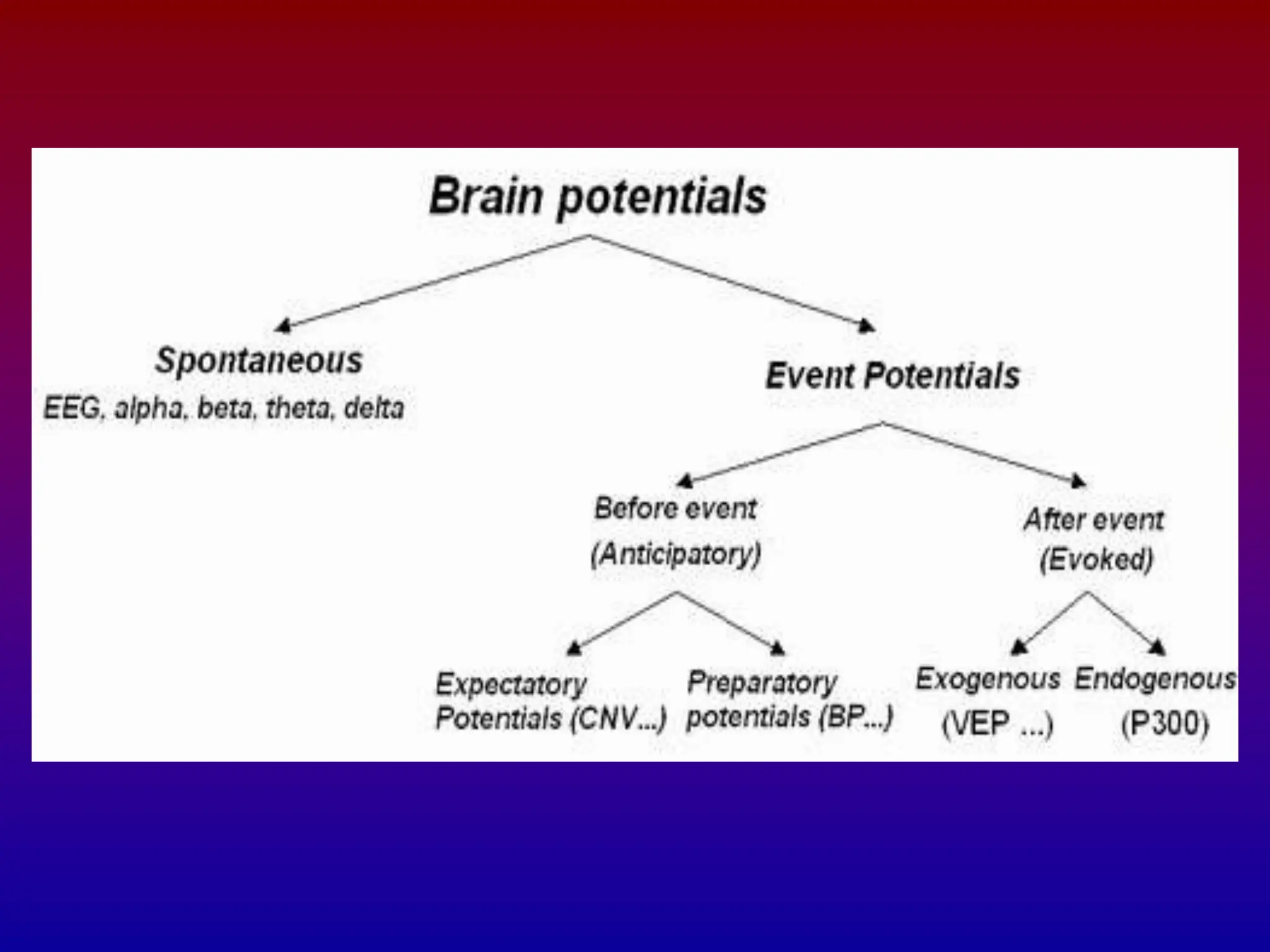
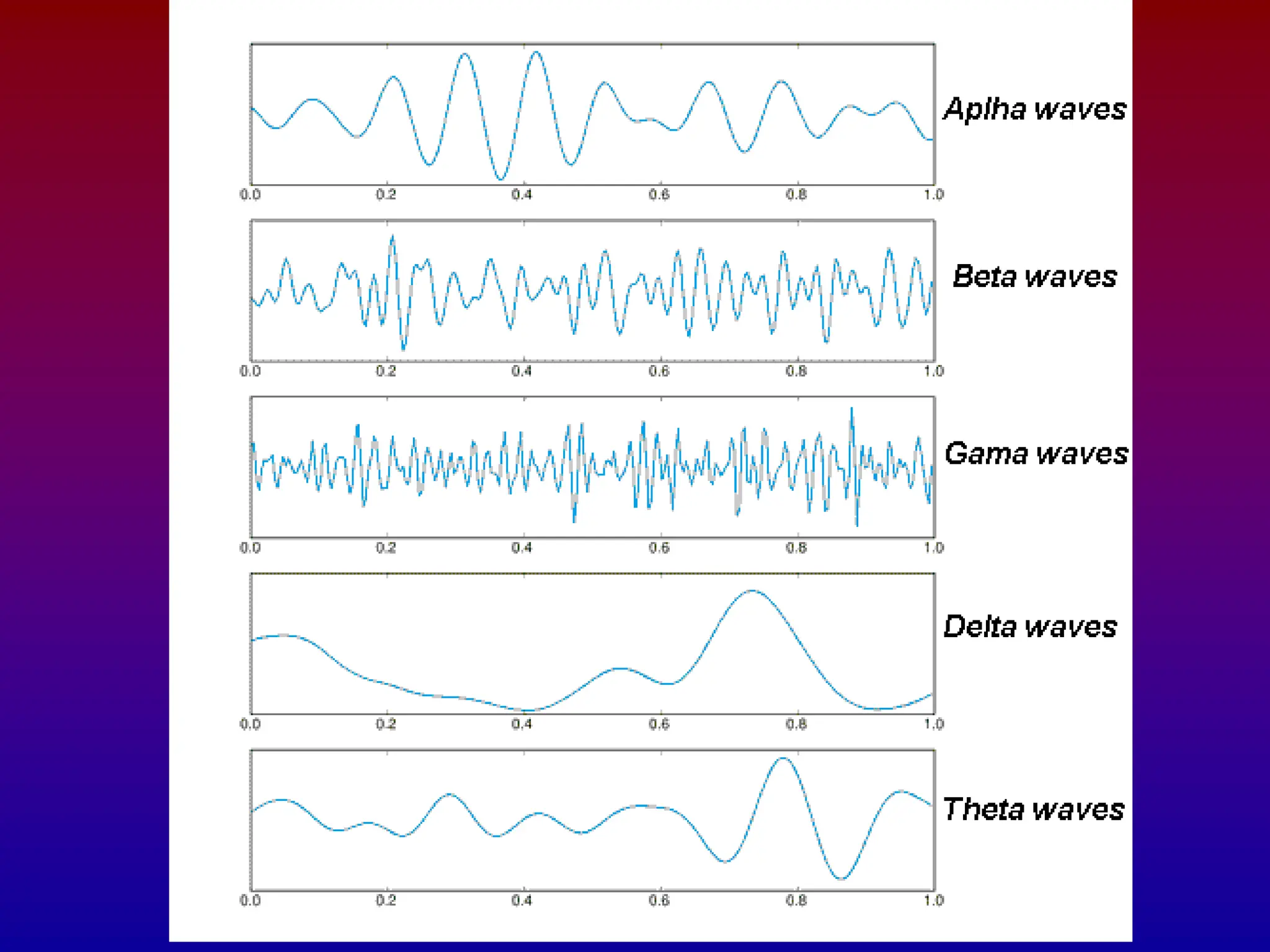
• Alpha, beta, theta and delta are names for
typical shape of so called spontaneous brain
potentials because they are not effect of
some stimulus from outside, but just from
inner examinee state (meditation, relaxation,
sleeping, calculating…).
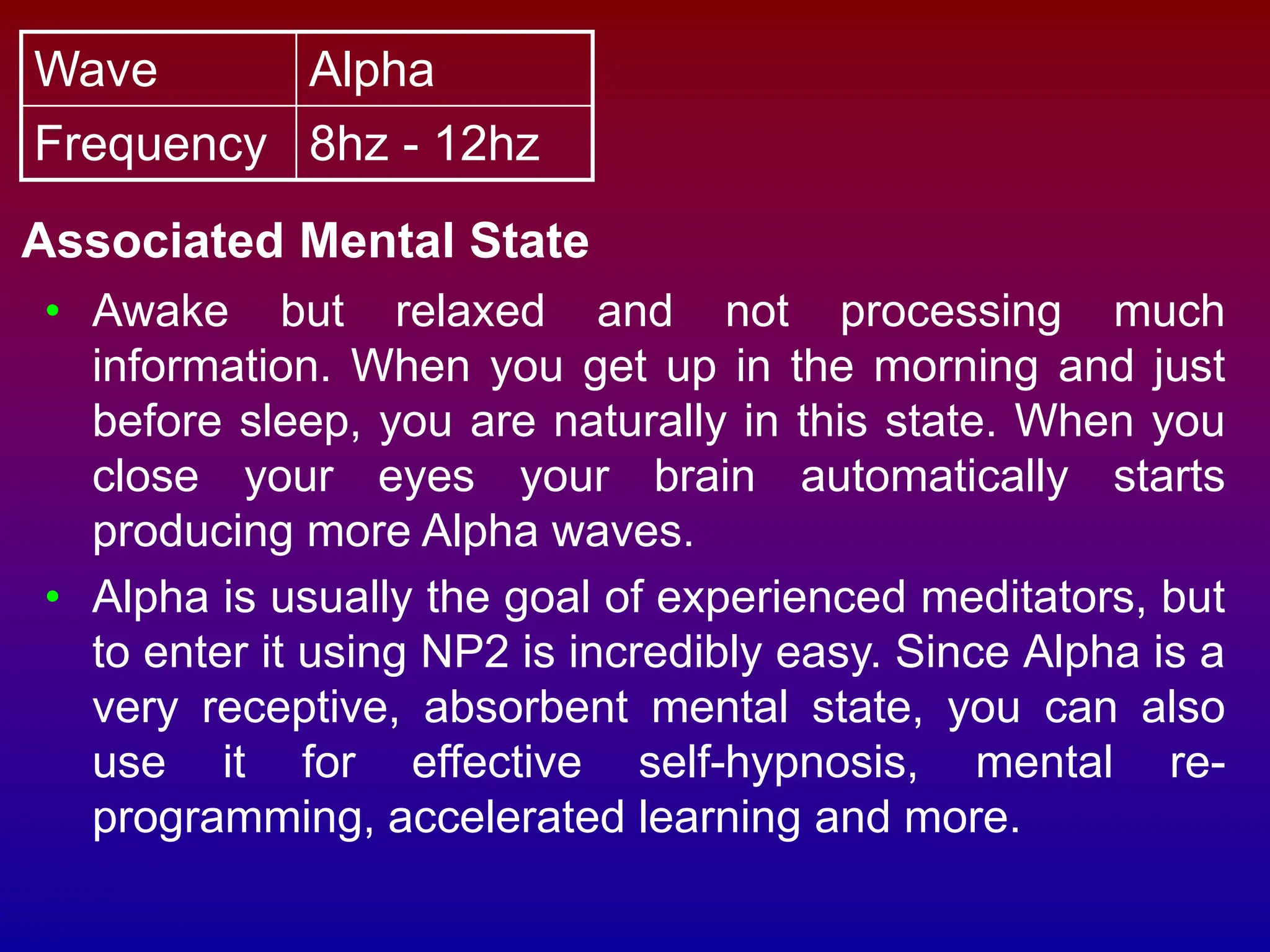
Wave Alpha
Frequency 8hz - 12hz
Associated Mental State
• Awake but relaxed and not processing much
information. When you get up in the morning and just
before sleep, you are naturally in this state. When you
close your eyes your brain automatically starts
producing more Alpha waves.
• Alpha is usually the goal of experienced meditators, but
to enter it using NP2 is incredibly easy. Since Alpha is a
very receptive, absorbent mental state, you can also
use it for effective self-hypnosis, mental re-
programming, accelerated learning and more.
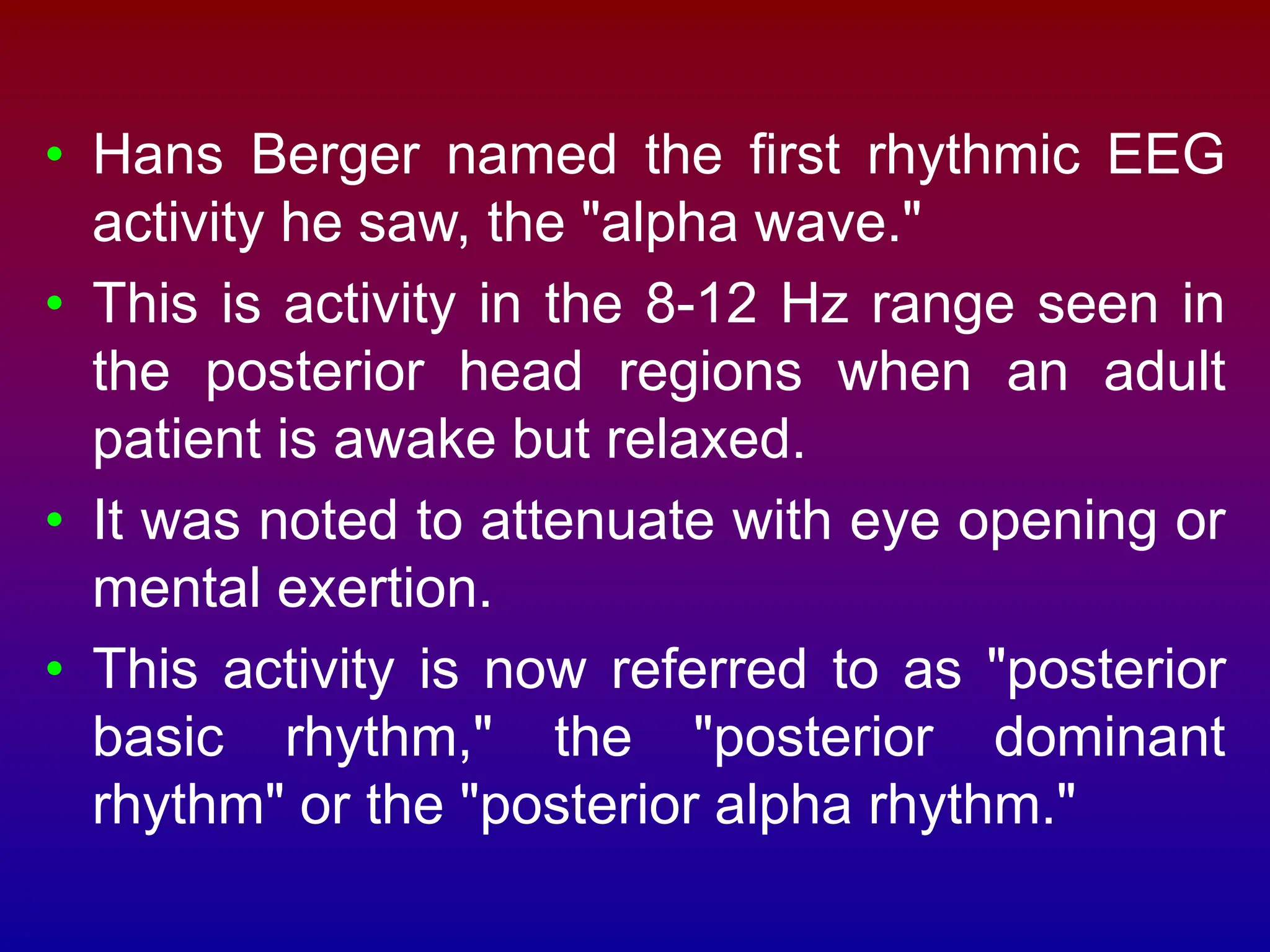
• Hans Berger named the first rhythmic EEG
activity he saw, the "alpha wave."
• This is activity in the 8-12 Hz range seen in
the posterior head regions when an adult
patient is awake but relaxed.
• It was noted to attenuate with eye opening or
mental exertion.
• This activity is now referred to as "posterior
basic rhythm," the "posterior dominant
rhythm" or the "posterior alpha rhythm."
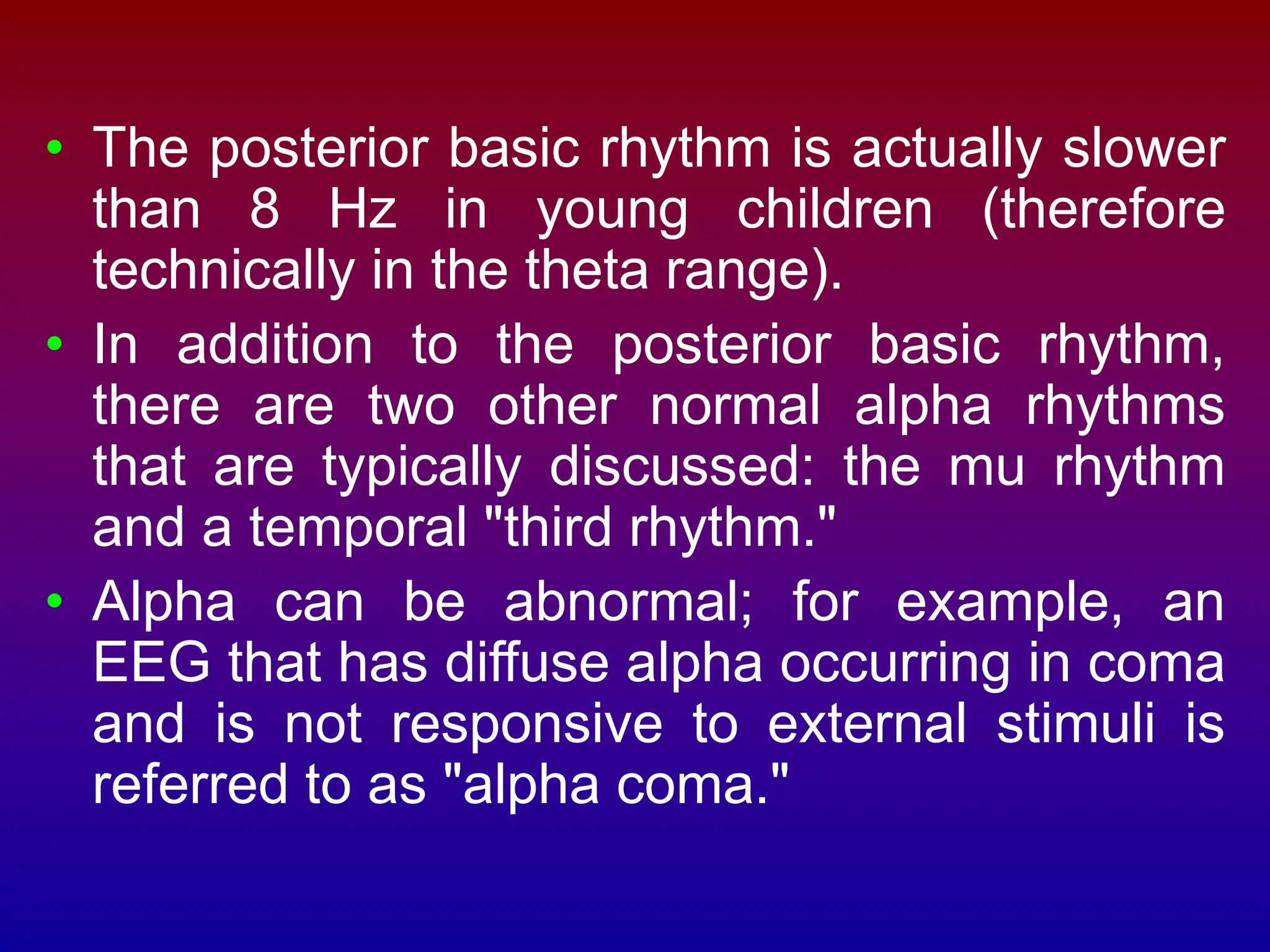
• The posterior basic rhythm is actually slower
than 8 Hz in young children (therefore
technically in the theta range).
• In addition to the posterior basic rhythm,
there are two other normal alpha rhythms
that are typically discussed: the mu rhythm
and a temporal "third rhythm."
• Alpha can be abnormal; for example, an
EEG that has diffuse alpha occurring in coma
and is not responsive to external stimuli is
referred to as "alpha coma."
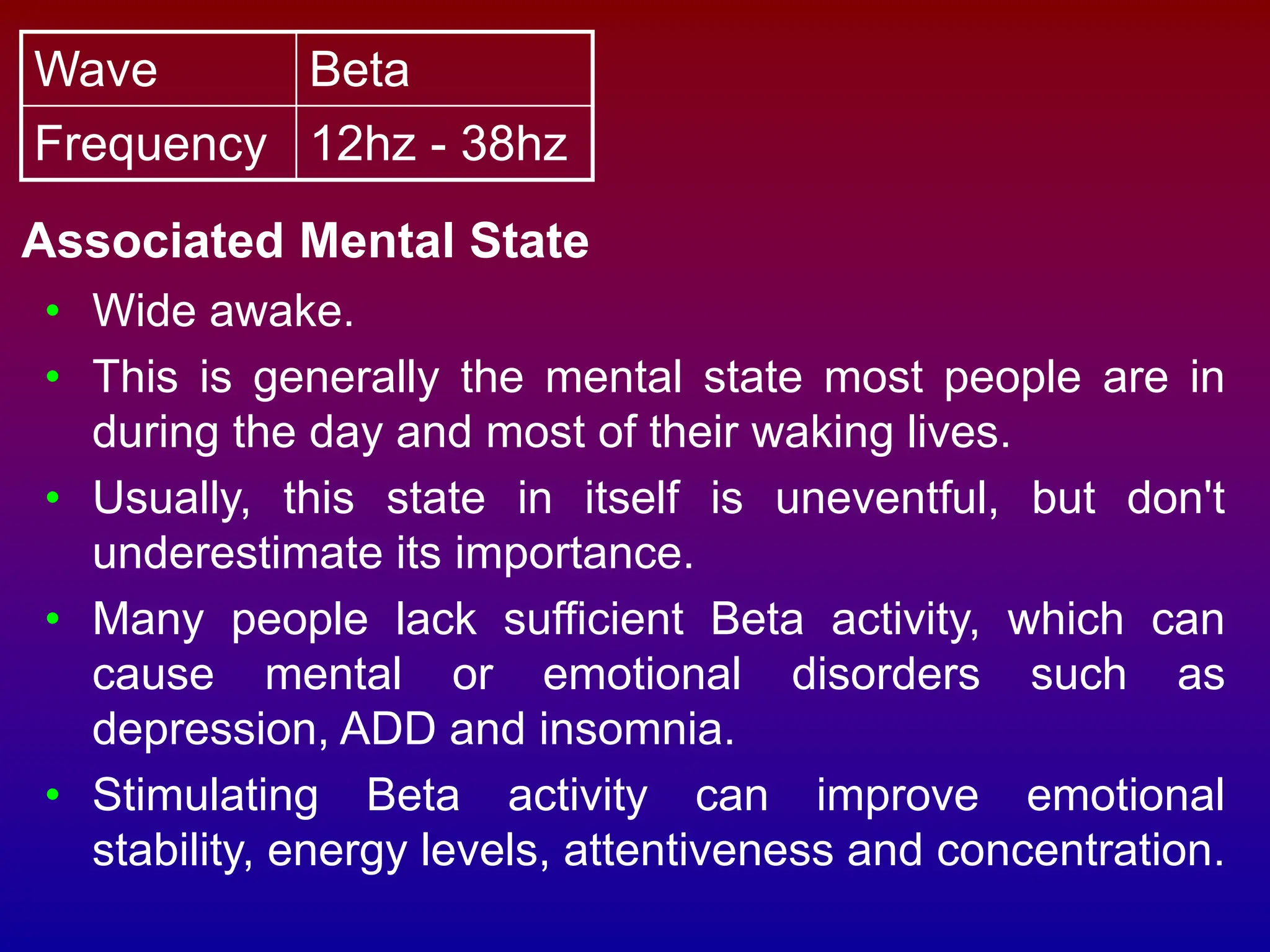
Wave Beta
Frequency 12hz - 38hz
Associated Mental State
• Wide awake.
• This is generally the mental state most people are in
during the day and most of their waking lives.
• Usually, this state in itself is uneventful, but don't
underestimate its importance.
• Many people lack sufficient Beta activity, which can
cause mental or emotional disorders such as
depression, ADD and insomnia.
• Stimulating Beta activity can improve emotional
stability, energy levels, attentiveness and concentration.
• Low amplitude beta with multiple and varying
frequencies is often associated with active,
busy or anxious thinking and active
concentration.
• Rhythmic beta with a dominant set of
frequencies is associated with various
pathologies and drug effects, especially
benzodiazepines.
• Activity over about 25 Hz seen in the scalp
EEG is rarely cerebral (i.e., it is most often
artifactual).
Wave Theta
Frequency 3hz - 8hz
Associated Mental State
• Light sleep or extreme relaxation.
• Theta can also be used for hypnosis, accelerated
learning and self-programming using pre-recorded
suggestions.
• Theta is seen normally in young children.
• It may be seen in drowsiness or arousal in older
children and adults; it can also be seen in meditation.
• Excess theta for age represents abnormal activity.
Wave Delta
Frequency 0.2hz - 3hz
Associated Mental State
• Deep, dreamless sleep.
• Delta is the slowest band of brainwaves.
• When dominant brainwave is Delta, the body is healing
itself and "resetting" its internal clocks.
• Do not dream in this state and are completely
unconscious.
• Delta is seen normally in adults in slow wave sleep.
• It is also seen normally in babies.
• It may be seen over focal lesions or diffusely in
encephalopathies
SIGNIFICANCE OF BRAINWAVES
• Can tell a lot about a person simply by observing
their brainwave patterns.
• For example, anxious people tend to produce an
overabundance of high Beta waves while people
with depression tend to produce an overabundance
of slower Alpha/Theta brainwaves.
• Researchers have found that not only are
brainwaves representative of mental state, but they
can be stimulated to change a person's mental
state, and even help treat a variety of mental
disorders.
• Certain Brainwave patterns can even be used to
access exotic or extraordinary experiences such as
"lucid dreaming" or ultra-realistic visualization.
STIMULATING THE BRAIN WITH
LIGHT & SOUND
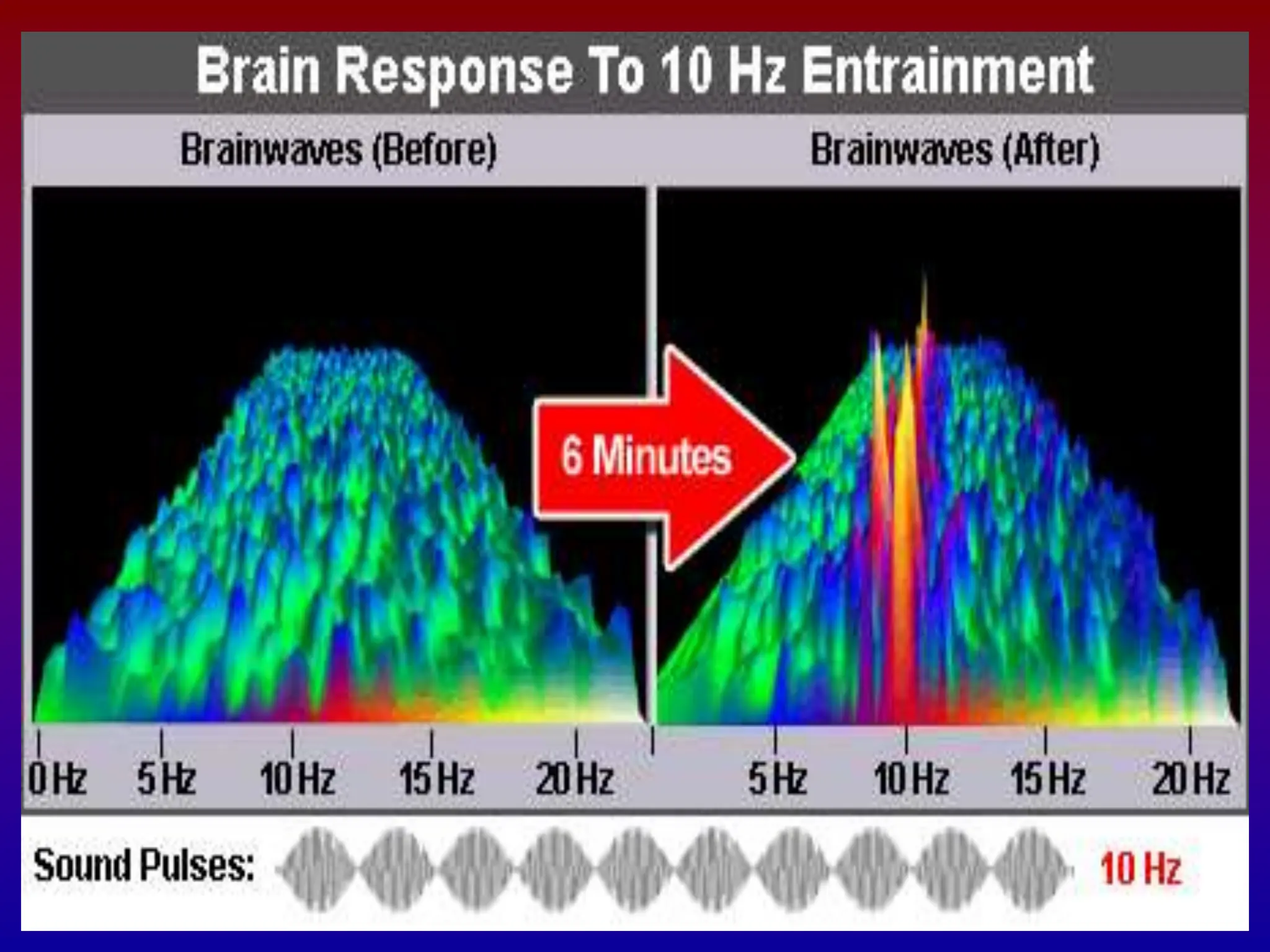
• The Neuro-Programmer uses sound and light to directly
affect the brain through a complex neural process called
Brainwave Entrainment.
What is Brainwave Entrainment?
• Refers to the brain's electrical response to rhythmic sensory
stimulation, such as pulses of sound or light.
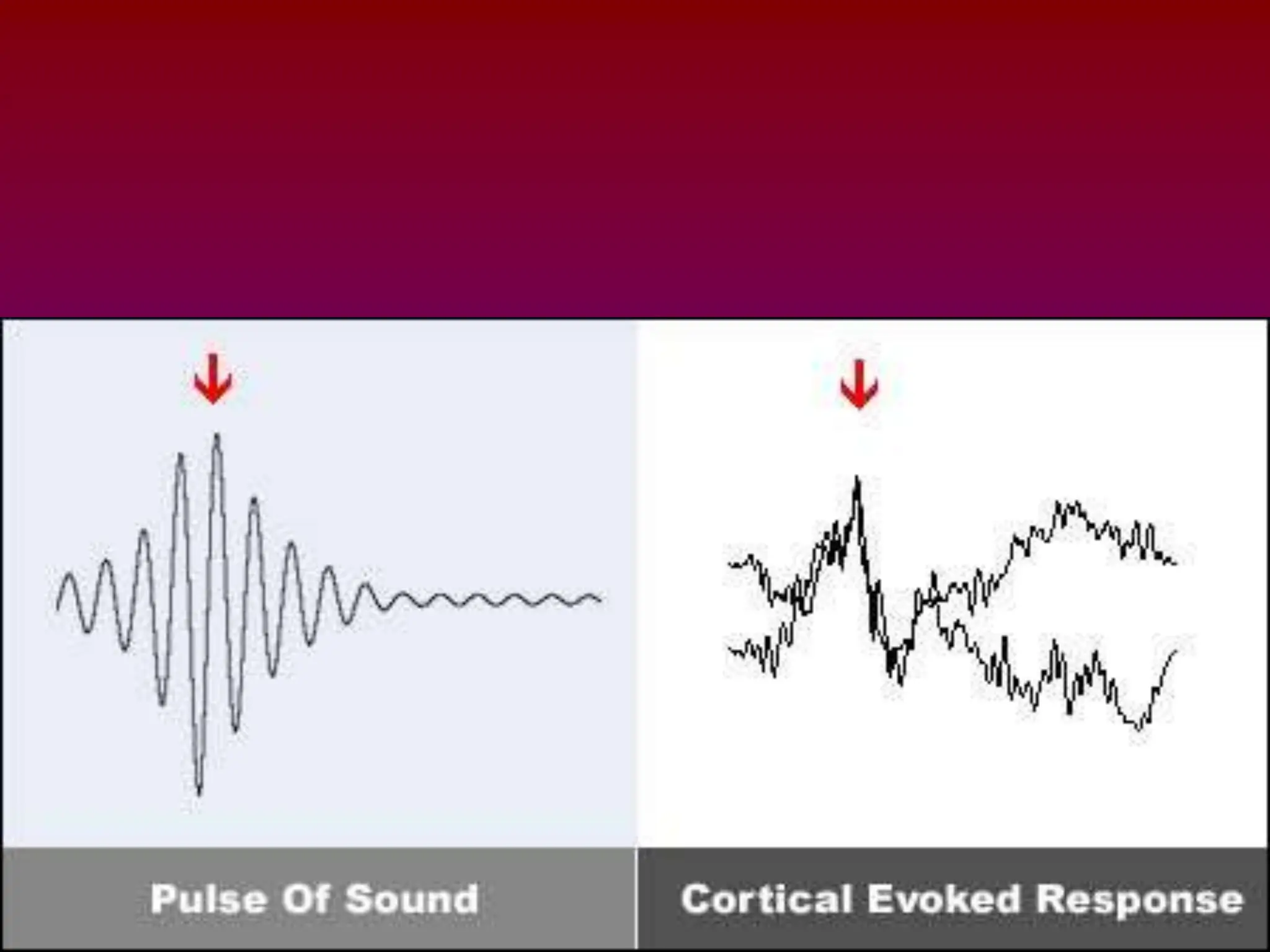
• When the brain is given a stimulus, through the ears, eyes
or other senses, it emits an electrical charge in response,
called a Cortical Evoked Response.
• These electrical responses travel throughout the brain to
become what you "see and hear."
• This activity can be measured using sensitive electrodes
attached to the scalp.
• When the brain is presented with a rhythmic
stimulus, such as a drum beat for example, the
rhythm is reproduced in the brain in the form of
these electrical impulses.
• If the rhythm becomes fast and consistent enough,
it can start to resemble the natural internal rhythms
of the brain, called brainwaves.
• When this happens, the brain responds by
synchronizing its own electric cycles to the same
rhythm.
• This is commonly called the Frequency Following
Response (or FFR)
• FFR can be useful because brainwaves are
very much related to mental state. For
example, a 4 Hz brainwave is associated
with sleep, so a 4 Hz sound pattern would
help reproduce the sleep state in your brain.
• The same concept can be applied to nearly
all mental states, including concentration,
creativity and many others.
• It can even act as a gateway to exotic or
extraordinary experiences, such as deep
meditation or "lucid dreaming" type states
ENTRAINMENT
• Entrainment is a principle of physics.
• It is defined as the synchronization of two or
more rhythmic cycles.
• The principles of entrainment are universal,
appearing in chemistry, neurology, biology,
pharmacology, medicine, astronomy and
more…
BENEFITS
Long-lasting benefits
• Using brainwave stimulation and dynamic
psychological techniques, the Neuro-Programmer
enables to achieve profound and lasting results.
Change your thought patterns and behaviors
• Self-Programming: Using focused, but
customizable psychological techniques, combined
with the methods of hypnosis and neuro-linguistic
programming (NLP), the Neuro-Programmer 2
helps us change nearly anything about us.
Emotional reactions, bad habits, behaviors, thought
patterns and more.
• Rid of bad habits
• Rid of limiting beliefs and destructive thought
patterns
• Change emotional reactions
• Access helpful mental states on demand
• Explore self-hypnosis and visualization
techniques
Fetal brainwaves and personhood
• Kushner emphasizes that what is significant
about the onset of fetal brain waves is that
the fetus in addition to being merely
biologically alive, now ‘has a life’ and can be
the subject of experiences.
• Kushner addresses the fact that thought the
nervous system is the first to start
developing, it is the last system to complete
development.
ELECTRICAL BRAIN POTENTIAL
• There are about 13 billion neurons in human brain;
they are communicating using electrochemical
connections.
• As human brain, skin, cerebral liquid and skull have
reasonably good conductivity it is possible to measure
electrical activity of synchronous active groups of
neurons by placing electrodes on the skull.
• We need two electrodes to get electric circuit closed;
voltage that we measure is a projection of vector that
shows directions of neurons activity to vector that is
defined with electrodes.
• It shows that measured voltage is not just a function of
number of active neurons, but also a function of they
position in brain rather to electrode position.
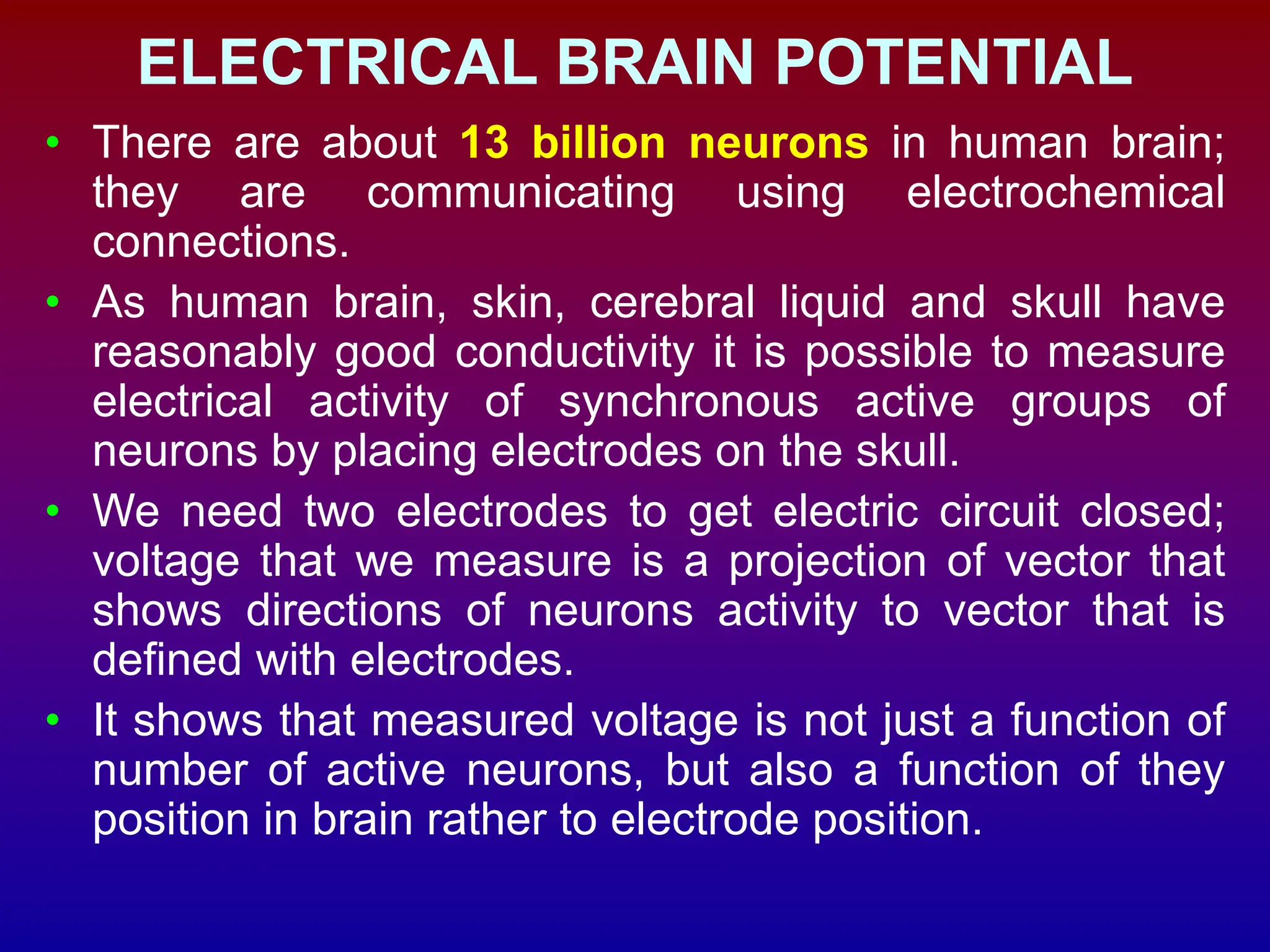
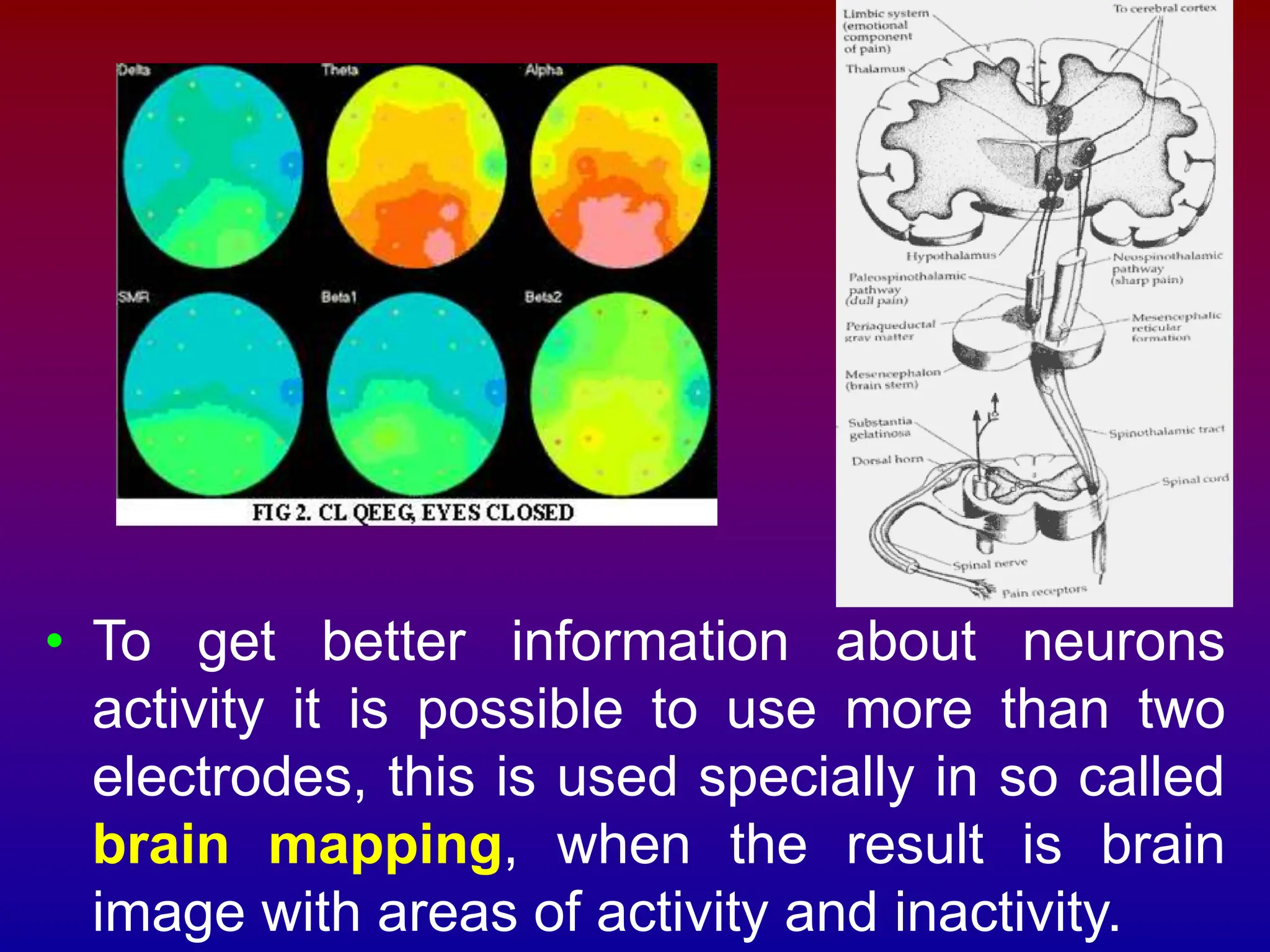
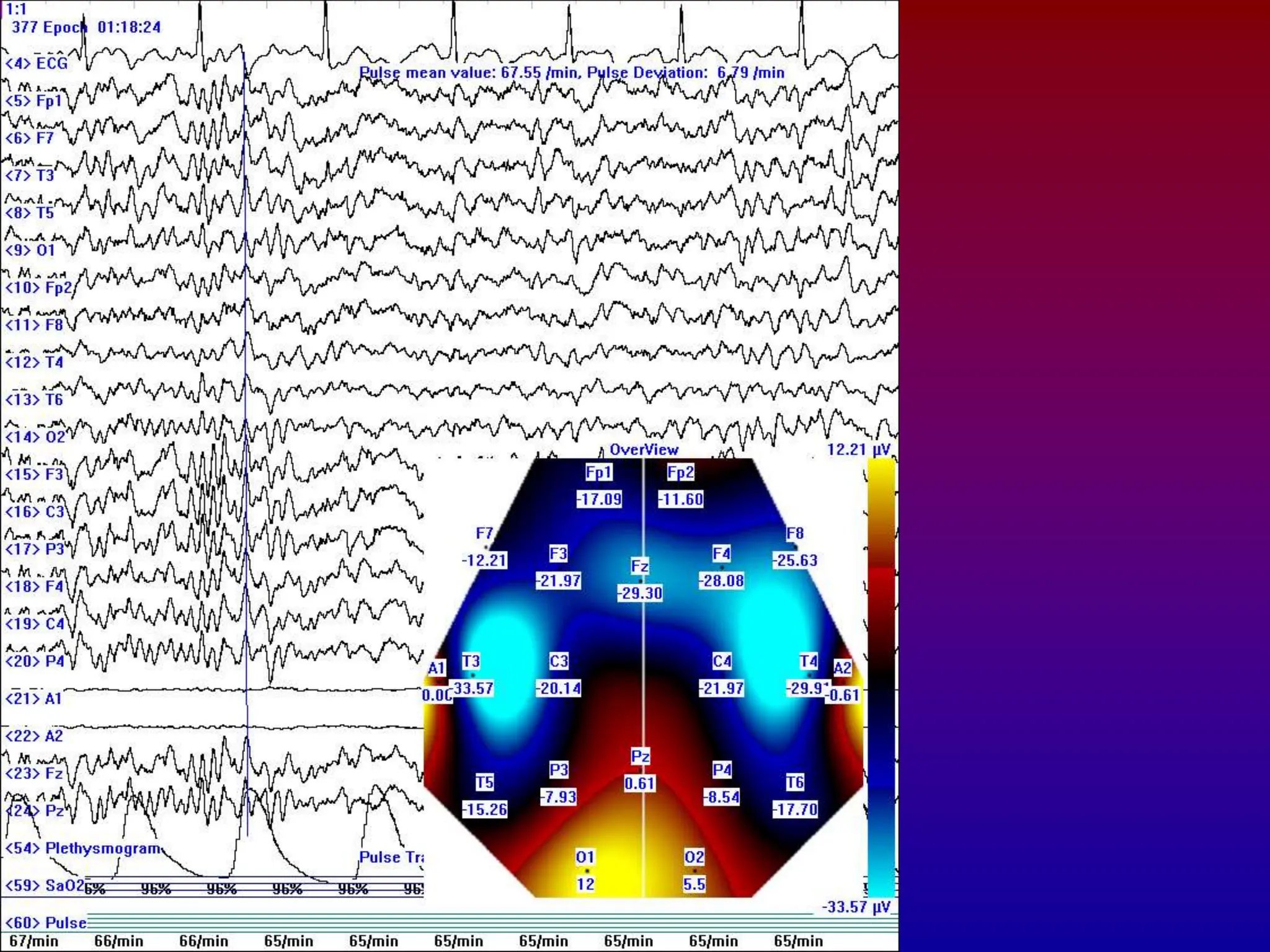
• To get better information about neurons
activity it is possible to use more than two
electrodes, this is used specially in so called
brain mapping, when the result is brain
image with areas of activity and inactivity.
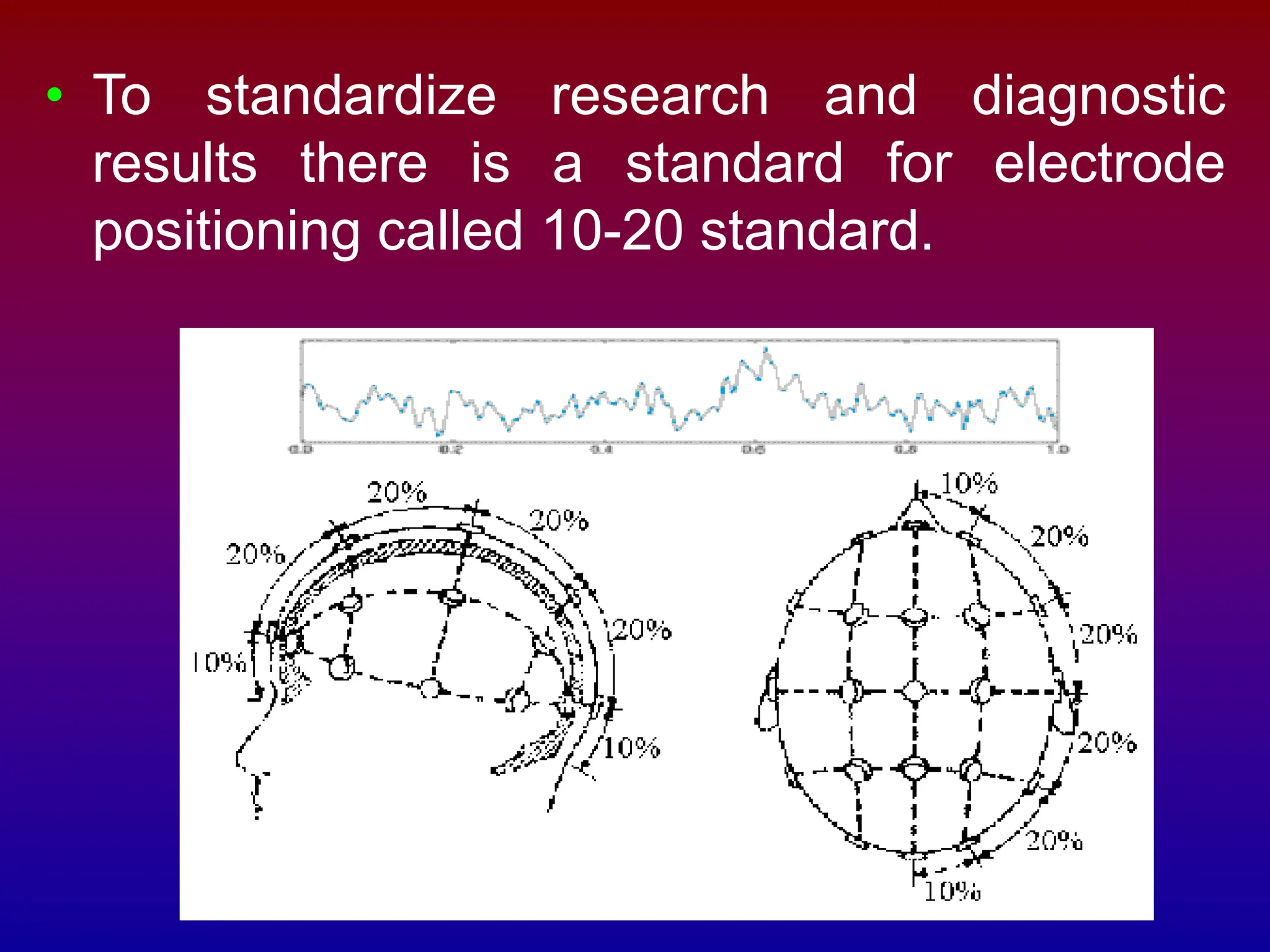
• To standardize research and diagnostic
results there is a standard for electrode
positioning called 10-20 standard.
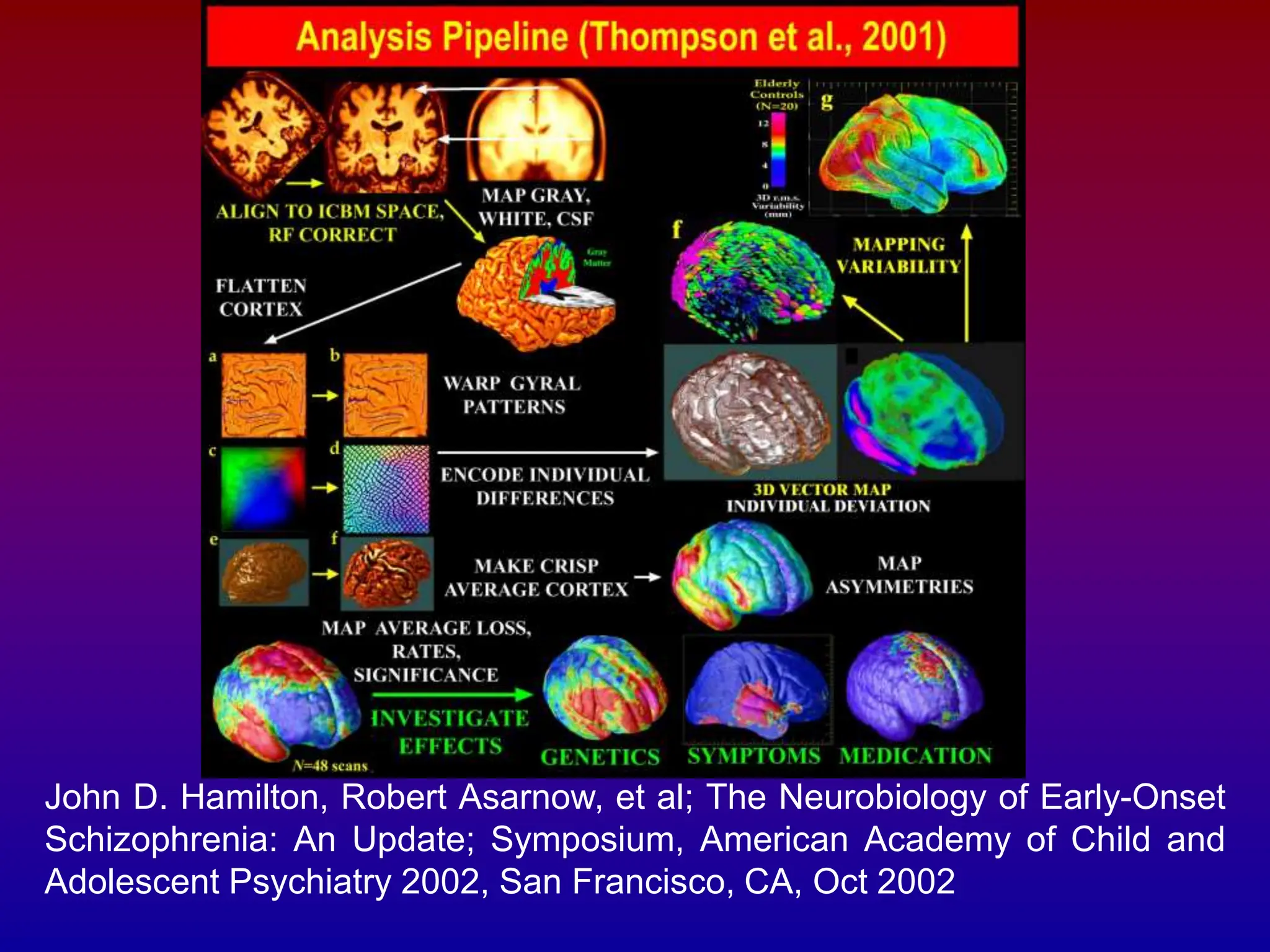
John D. Hamilton, Robert Asarnow, et al; The Neurobiology of Early-Onset
Schizophrenia: An Update; Symposium, American Academy of Child and
Adolescent Psychiatry 2002, San Francisco, CA, Oct 2002
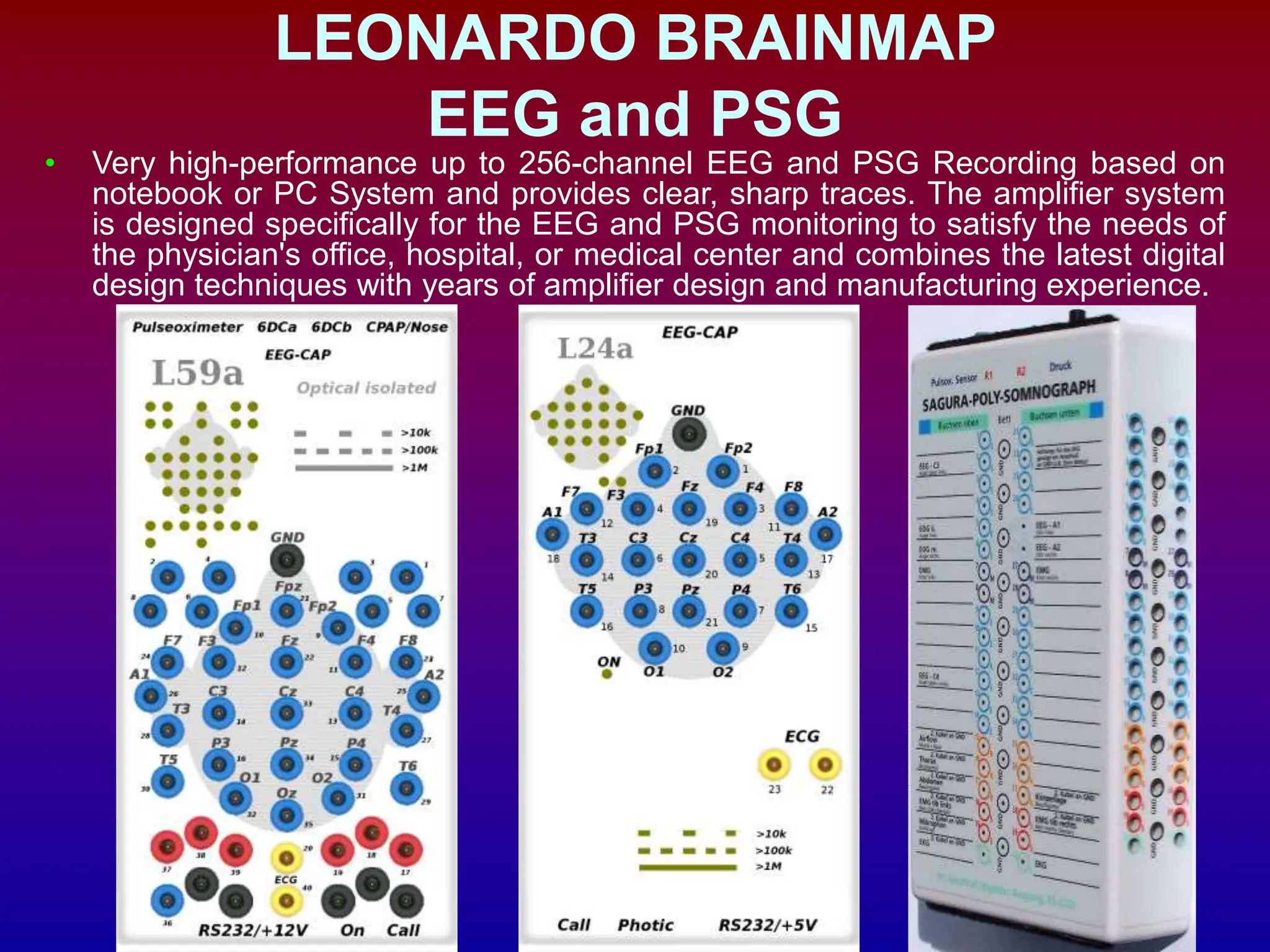
LEONARDO BRAINMAP
EEG and PSG
• Very high-performance up to 256-channel EEG and PSG Recording based on
notebook or PC System and provides clear, sharp traces. The amplifier system
is designed specifically for the EEG and PSG monitoring to satisfy the needs of
the physician's office, hospital, or medical center and combines the latest digital
design techniques with years of amplifier design and manufacturing experience.
AI on brain - waves activity ppt4916.ppt

AI on brain - waves activity ppt4916.ppt

  • 1.
    By, Dr. ShamanthakamaniNarendran M.D.(Pead), Ph.D. (Yoga Science)
  • 2.
    DEFINITION • Brainwaves/Electroencephalography (EEG)is the recording of electrical activity along the scalp produced by the firing of neurons within the brain. • A rhythmic fluctuation of electric potential between parts of the brain, as seen on an EEG. • (Life Sciences & Allied Applications / Physiology) any of the fluctuations of electrical potential in the brain as represented on an EEG. • They vary in frequency from 1 to 30 hertz See also alpha rhythm, beta rhythm, delta rhythm
  • 3.
    INTRODUCTION • Brain ismade up of billions of brain cells called neurons, which use electricity to communicate with each other. The combination of millions of neurons sending signals at once produces an enormous amount of electrical activity in the brain, which can be detected using sensitive medical equipment (such as an EEG), measuring electricity levels over areas of the scalp. • The combination of electrical activity of the brain is commonly called a BrainWave pattern, because of its cyclic, "wave-like" nature. • Below is one of the first recordings of brain activity.
  • 4.
    MODERN EEG RECORDING TheBrain Wave Sofa: "a representation of a 3 second wave of Alpha brain activity captured with a 3d EEG. It shows the 3 seconds when the eyes closed. From the 3d-EEG the file got directly milled in foam by a 3d milling machine and then upholstered in felt by hand."
  • 6.
    BRAINWAVE FREQUENCIES • Withthe discovery of brainwaves came the discovery that electrical activity in the brain will change depending on what the person is doing. • For instance, the brainwaves of a sleeping person are vastly different than the brainwaves of someone wide awake. • Over the years, more sensitive equipment has brought us closer to figuring out exactly what brainwaves represent and with that, what they mean about a person's health and state of mind.
  • 8.
    SPONTANEOUS BRAIN POTENTIALS •Alpha, beta, theta and delta are names for typical shape of so called spontaneous brain potentials because they are not effect of some stimulus from outside, but just from inner examinee state (meditation, relaxation, sleeping, calculating…).
  • 9.
    Wave Alpha Frequency 8hz- 12hz Associated Mental State • Awake but relaxed and not processing much information. When you get up in the morning and just before sleep, you are naturally in this state. When you close your eyes your brain automatically starts producing more Alpha waves. • Alpha is usually the goal of experienced meditators, but to enter it using NP2 is incredibly easy. Since Alpha is a very receptive, absorbent mental state, you can also use it for effective self-hypnosis, mental re- programming, accelerated learning and more.
  • 10.
    • Hans Bergernamed the first rhythmic EEG activity he saw, the "alpha wave." • This is activity in the 8-12 Hz range seen in the posterior head regions when an adult patient is awake but relaxed. • It was noted to attenuate with eye opening or mental exertion. • This activity is now referred to as "posterior basic rhythm," the "posterior dominant rhythm" or the "posterior alpha rhythm."
  • 11.
    • The posteriorbasic rhythm is actually slower than 8 Hz in young children (therefore technically in the theta range). • In addition to the posterior basic rhythm, there are two other normal alpha rhythms that are typically discussed: the mu rhythm and a temporal "third rhythm." • Alpha can be abnormal; for example, an EEG that has diffuse alpha occurring in coma and is not responsive to external stimuli is referred to as "alpha coma."
  • 12.
    Wave Beta Frequency 12hz- 38hz Associated Mental State • Wide awake. • This is generally the mental state most people are in during the day and most of their waking lives. • Usually, this state in itself is uneventful, but don't underestimate its importance. • Many people lack sufficient Beta activity, which can cause mental or emotional disorders such as depression, ADD and insomnia. • Stimulating Beta activity can improve emotional stability, energy levels, attentiveness and concentration.
  • 13.
    • Low amplitudebeta with multiple and varying frequencies is often associated with active, busy or anxious thinking and active concentration. • Rhythmic beta with a dominant set of frequencies is associated with various pathologies and drug effects, especially benzodiazepines. • Activity over about 25 Hz seen in the scalp EEG is rarely cerebral (i.e., it is most often artifactual).
  • 14.
    Wave Theta Frequency 3hz- 8hz Associated Mental State • Light sleep or extreme relaxation. • Theta can also be used for hypnosis, accelerated learning and self-programming using pre-recorded suggestions. • Theta is seen normally in young children. • It may be seen in drowsiness or arousal in older children and adults; it can also be seen in meditation. • Excess theta for age represents abnormal activity.
  • 15.
    Wave Delta Frequency 0.2hz- 3hz Associated Mental State • Deep, dreamless sleep. • Delta is the slowest band of brainwaves. • When dominant brainwave is Delta, the body is healing itself and "resetting" its internal clocks. • Do not dream in this state and are completely unconscious. • Delta is seen normally in adults in slow wave sleep. • It is also seen normally in babies. • It may be seen over focal lesions or diffusely in encephalopathies
  • 17.
    SIGNIFICANCE OF BRAINWAVES •Can tell a lot about a person simply by observing their brainwave patterns. • For example, anxious people tend to produce an overabundance of high Beta waves while people with depression tend to produce an overabundance of slower Alpha/Theta brainwaves. • Researchers have found that not only are brainwaves representative of mental state, but they can be stimulated to change a person's mental state, and even help treat a variety of mental disorders. • Certain Brainwave patterns can even be used to access exotic or extraordinary experiences such as "lucid dreaming" or ultra-realistic visualization.
  • 18.
    STIMULATING THE BRAINWITH LIGHT & SOUND • The Neuro-Programmer uses sound and light to directly affect the brain through a complex neural process called Brainwave Entrainment. What is Brainwave Entrainment? • Refers to the brain's electrical response to rhythmic sensory stimulation, such as pulses of sound or light. • When the brain is given a stimulus, through the ears, eyes or other senses, it emits an electrical charge in response, called a Cortical Evoked Response. • These electrical responses travel throughout the brain to become what you "see and hear." • This activity can be measured using sensitive electrodes attached to the scalp.
  • 20.
    • When thebrain is presented with a rhythmic stimulus, such as a drum beat for example, the rhythm is reproduced in the brain in the form of these electrical impulses. • If the rhythm becomes fast and consistent enough, it can start to resemble the natural internal rhythms of the brain, called brainwaves. • When this happens, the brain responds by synchronizing its own electric cycles to the same rhythm. • This is commonly called the Frequency Following Response (or FFR)
  • 22.
    • FFR canbe useful because brainwaves are very much related to mental state. For example, a 4 Hz brainwave is associated with sleep, so a 4 Hz sound pattern would help reproduce the sleep state in your brain. • The same concept can be applied to nearly all mental states, including concentration, creativity and many others. • It can even act as a gateway to exotic or extraordinary experiences, such as deep meditation or "lucid dreaming" type states
  • 23.
    ENTRAINMENT • Entrainment isa principle of physics. • It is defined as the synchronization of two or more rhythmic cycles. • The principles of entrainment are universal, appearing in chemistry, neurology, biology, pharmacology, medicine, astronomy and more…
  • 24.
    BENEFITS Long-lasting benefits • Usingbrainwave stimulation and dynamic psychological techniques, the Neuro-Programmer enables to achieve profound and lasting results. Change your thought patterns and behaviors • Self-Programming: Using focused, but customizable psychological techniques, combined with the methods of hypnosis and neuro-linguistic programming (NLP), the Neuro-Programmer 2 helps us change nearly anything about us. Emotional reactions, bad habits, behaviors, thought patterns and more.
  • 25.
    • Rid ofbad habits • Rid of limiting beliefs and destructive thought patterns • Change emotional reactions • Access helpful mental states on demand • Explore self-hypnosis and visualization techniques
  • 26.
    Fetal brainwaves andpersonhood • Kushner emphasizes that what is significant about the onset of fetal brain waves is that the fetus in addition to being merely biologically alive, now ‘has a life’ and can be the subject of experiences. • Kushner addresses the fact that thought the nervous system is the first to start developing, it is the last system to complete development.
  • 27.
    ELECTRICAL BRAIN POTENTIAL •There are about 13 billion neurons in human brain; they are communicating using electrochemical connections. • As human brain, skin, cerebral liquid and skull have reasonably good conductivity it is possible to measure electrical activity of synchronous active groups of neurons by placing electrodes on the skull. • We need two electrodes to get electric circuit closed; voltage that we measure is a projection of vector that shows directions of neurons activity to vector that is defined with electrodes. • It shows that measured voltage is not just a function of number of active neurons, but also a function of they position in brain rather to electrode position.
  • 28.
    • To getbetter information about neurons activity it is possible to use more than two electrodes, this is used specially in so called brain mapping, when the result is brain image with areas of activity and inactivity.
  • 29.
    • To standardizeresearch and diagnostic results there is a standard for electrode positioning called 10-20 standard.
  • 30.
    John D. Hamilton,Robert Asarnow, et al; The Neurobiology of Early-Onset Schizophrenia: An Update; Symposium, American Academy of Child and Adolescent Psychiatry 2002, San Francisco, CA, Oct 2002
  • 31.
    LEONARDO BRAINMAP EEG andPSG • Very high-performance up to 256-channel EEG and PSG Recording based on notebook or PC System and provides clear, sharp traces. The amplifier system is designed specifically for the EEG and PSG monitoring to satisfy the needs of the physician's office, hospital, or medical center and combines the latest digital design techniques with years of amplifier design and manufacturing experience.