© Art Traynor 2011
Mathematics
Definition
Mathematics
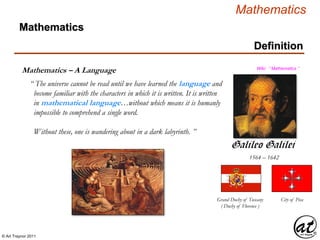
Wiki: “ Mathematics ”
1564 – 1642
Galileo Galilei
Grand Duchy of Tuscany
( Duchy of Florence )
City of Pisa
Mathematics – A Language
“ The universe cannot be read until we have learned the language and
become familiar with the characters in which it is written. It is written
in mathematical language…without which means it is humanly
impossible to comprehend a single word.
Without these, one is wandering about in a dark labyrinth. ”
© Art Traynor 2011
Mathematics
Definition
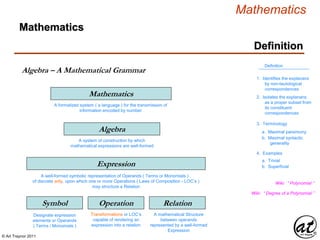
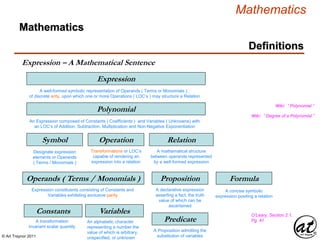
Algebra – A Mathematical Grammar
Mathematics
A formalized system ( a language ) for the transmission of
information encoded by number
Algebra
A system of construction by which
mathematical expressions are well-formed
Expression
Symbol Operation Relation
Designate expression
elements or Operands
( Terms / Monomials )
Transformations or LOC’s
capable of rendering an
expression into a relation
A mathematical Structure
between operands
represented by a well-formed
Expression
A well-formed symbolic representation of Operands ( Terms or Monomials ) ,
of discrete arity, upon which one or more Operations ( Laws of Composition - LOC’s )
may structure a Relation
1. Identifies the explanans
by non-tautological
correspondences
Definition
2. Isolates the explanans
as a proper subset from
its constituent
correspondences
3. Terminology
a. Maximal parsimony
b. Maximal syntactic
generality
4. Examples
a. Trivial
b. Superficial
Mathematics
Wiki: “ Polynomial ”
Wiki: “ Degree of a Polynomial ”
© Art Traynor 2011
Mathematics
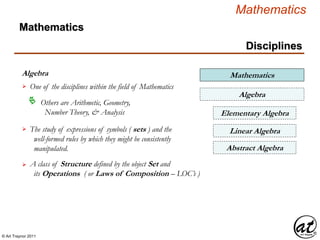
Disciplines
Algebra
One of the disciplines within the field of Mathematics
Mathematics
Others are Arithmetic, Geometry,
Number Theory, & Analysis

The study of expressions of symbols ( sets ) and the
well-formed rules by which they might be consistently
manipulated.

Algebra
Elementary Algebra
Abstract Algebra
A class of Structure defined by the object Set and
its Operations ( or Laws of Composition – LOC’s )

Linear Algebra
Mathematics
© Art Traynor 2011
Mathematics
Definitions
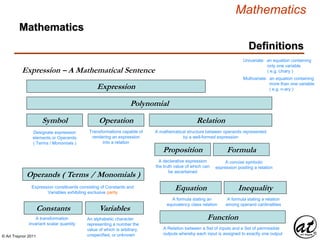
Expression
Symbol Operation Relation
Designate expression
elements or Operands
( Terms / Monomials )
Transformations or LOC’s
capable of rendering an
expression into a relation
A mathematical structure
between operands represented
by a well-formed expression
A well-formed symbolic representation of Operands ( Terms or Monomials ) ,
of discrete arity, upon which one or more Operations ( LOC’s ) may structure a Relation
Expression – A Mathematical Sentence
Proposition
A declarative expression
asserting a fact, the truth
value of which can be
ascertained
Formula
A concise symbolic
expression positing a relation
VariablesConstants
An alphabetic character
representing a number the
value of which is arbitrary,
unspecified, or unknown
Operands ( Terms / Monomials )
A transformation
invariant scalar quantity
Mathematics
Predicate
A Proposition admitting the
substitution of variables
O’Leary, Section 2.1,
Pg. 41
Expression constituents consisting of Constants and
Variables exhibiting exclusive parity
Polynomial
An Expression composed of Constants ( Coefficients ) and Variables ( Unknowns) with
an LOC’s of Addition, Subtraction, Multiplication and Non-Negative Exponentiation
Wiki: “ Polynomial ”
Wiki: “ Degree of a Polynomial ”
© Art Traynor 2011
Mathematics
Definitions
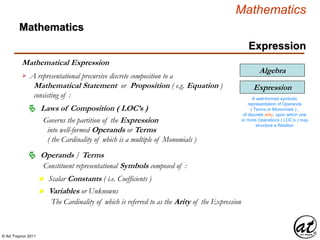
Expression
Symbol Operation Relation
Designate expression
elements or Operands
( Terms / Monomials )
Transformations capable of
rendering an expression
into a relation
A mathematical structure between operands represented
by a well-formed expression
Expression – A Mathematical Sentence
Proposition
A declarative expression
the truth value of which can
be ascertained
Formula
A concise symbolic
expression positing a relation
VariablesConstants
An alphabetic character
representing a number the
value of which is arbitrary,
unspecified, or unknown
Operands ( Terms / Monomials )
A transformation
invariant scalar quantity
Equation
A formula stating an
equivalency class relation
Inequality
A formula stating a relation
among operand cardinalities
Function
A Relation between a Set of inputs and a Set of permissible
outputs whereby each input is assigned to exactly one output
Univariate: an equation containing
only one variable
( e.g. Unary )
Multivariate: an equation containing
more than one variable
( e.g. n-ary )
Mathematics
Expression constituents consisting of Constants and
Variables exhibiting exclusive parity
Polynomial
© Art Traynor 2011
Mathematics
Definitions
Expression
Symbol Operation Relation
Expression – A Mathematical Sentence
Proposition Formula
VariablesConstants
Operands ( Terms )
Equation
A formula stating an
equivalency class relation
Linear Equation
An equation in which each term is either
a constant or the product of a constant
and (a) variable[s] of the first degree
Mathematics
Polynomial
© Art Traynor 2011
Mathematics
Expression
Mathematical Expression
A representational precursive discrete composition to a
Mathematical Statement or Proposition ( e.g. Equation )
consisting of :

Operands / Terms
Expression
A well-formed symbolic
representation of Operands
( Terms or Monomials ) ,
of discrete arity, upon which one
or more Operations ( LOC’s ) may
structure a Relation
Mathematics
n Scalar Constants ( i.e. Coefficients )
n Variables or Unknowns
The Cardinality of which is referred to as the Arity of the Expression
Constituent representational Symbols composed of :
Algebra
Laws of Composition ( LOC’s )
Governs the partition of the Expression
into well-formed Operands or Terms
( the Cardinality of which is a multiple of Monomials )
© Art Traynor 2011
Mathematics
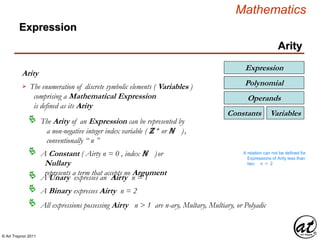
Arity
Arity
Expression
The enumeration of discrete symbolic elements ( Variables )
comprising a Mathematical Expression
is defined as its Arity

The Arity of an Expression can be represented by
a non-negative integer index variable ( ℤ + or ℕ ),
conventionally “ n ”

A Constant ( Airty n = 0 , index ℕ )or
Nullary
represents a term that accepts no Argument

A Unary expresses an Airty n = 1
A relation can not be defined for
Expressions of Arity less than
two: n < 2
A Binary expresses Airty n = 2
All expressions possessing Airty n > 1 are n-ary, Multary, Multiary, or Polyadic
VariablesConstants
Operands
Expression
Polynomial
© Art Traynor 2011
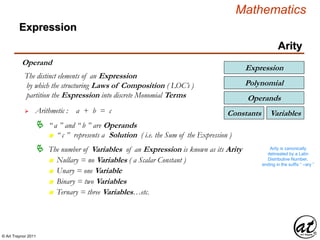
Mathematics
Expression
Arity
Operand
 Arithmetic : a + b = c
The distinct elements of an Expression
by which the structuring Laws of Composition ( LOC’s )
partition the Expression into discrete Monomial Terms
 “ a ” and “ b ” are Operands
 The number of Variables of an Expression is known as its Arity
n Nullary = no Variables ( a Scalar Constant )
n Unary = one Variable
n Binary = two Variables
n Ternary = three Variables…etc.
VariablesConstants
Operands
Expression
Polynomial
n “ c ” represents a Solution ( i.e. the Sum of the Expression )
Arity is canonically
delineated by a Latin
Distributive Number,
ending in the suffix “ –ary ”
© Art Traynor 2011
Mathematics
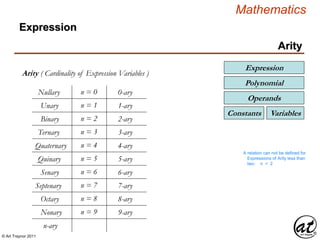
Arity
Arity ( Cardinality of Expression Variables )
Expression
A relation can not be defined for
Expressions of Arity less than
two: n < 2
Nullary
Unary
n = 0
n = 1
Binary n = 2
Ternary n = 3
1-ary
2-ary
3-ary
Quaternary n = 4 4-ary
Quinary n = 5 5-ary
Senary n = 6 6-ary
Septenary n = 7 7-ary
Octary n = 8 8-ary
Nonary n = 9 9-ary
n-ary
VariablesConstants
Operands
Expression
Polynomial
0-ary
© Art Traynor 2011
Mathematics
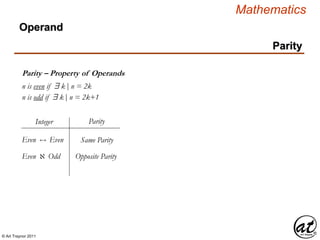
Operand
Parity – Property of Operands
Parity
n is even if $ k | n = 2k
n is odd if $ k | n = 2k+1
Even  Even
Integer Parity
Same Parity
Even  Odd Opposite Parity
© Art Traynor 2011
Mathematics
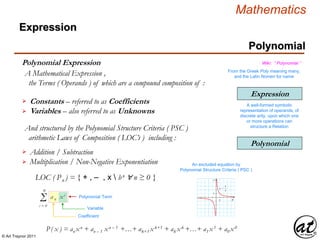
Polynomial
Expression
A well-formed symbolic
representation of operands, of
discrete arity, upon which one
or more operations can
structure a Relation
Expression
Polynomial Expression
A Mathematical Expression ,
the Terms ( Operands ) of which are a compound composition of :
Polynomial
Constants – referred to as Coefficients
Variables – also referred to as Unknowns
And structured by the Polynomial Structure Criteria ( PSC )
arithmetic Laws of Composition ( LOC’s ) including :
Addition / Subtraction
Multiplication / Non-Negative Exponentiation
LOC ( Pn ) = { + , – , x  bn ∀ n ≥ 0 }
Wiki: “ Polynomial ”
An excluded equation by
Polynomial Structure Criteria ( PSC )
Σ an xi
n
i = 0
P( x ) = an xn + an – 1 xn – 1 +…+ ak+1 xk+1 + ak xk +…+ a1 x1 + a0 x0
Variable
Coefficient
Polynomial Term
From the Greek Poly meaning many,
and the Latin Nomen for name




© Art Traynor 2011
Mathematics
Degree
Expression
Polynomial
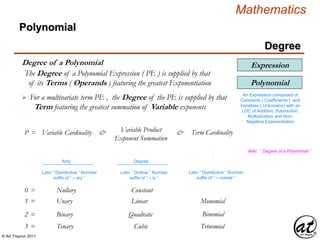
Degree of a Polynomial
Polynomial
Wiki: “ Degree of a Polynomial ”
The Degree of a Polynomial Expression ( PE ) is supplied by that
of its Terms ( Operands ) featuring the greatest Exponentiation
For a multivariate term PE , the Degree of the PE is supplied by that
Term featuring the greatest summation of Variable exponents

P = Variable Cardinality & Variable Product
Exponent Summation
& Term Cardinality
Arity
Latin “ Distributive ” Number
suffix of “ – ary ”
Degree
Latin “ Ordinal ” Number
suffix of “ – ic ”
Latin “ Distributive ” Number
suffix of “ – nomial ”
0 =
1 =
2 =
3 =
Nullary
Unary
Binary
Tenary
Constant
Linear
Quadratic
Cubic
Monomial
Binomial
Trinomial
An Expression composed of
Constants ( Coefficients ) and
Variables ( Unknowns) with an
LOC of Addition, Subtraction,
Multiplication and Non-
Negative Exponentiation
© Art Traynor 2011
Mathematics
Degree
Polynomial
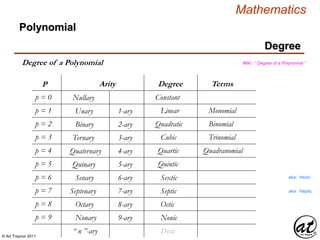
Degree of a Polynomial
Nullary
Unary
p = 0
p = 1 Linear
Binaryp = 2 Quadratic
Ternaryp = 3 Cubic
1-ary
2-ary
3-ary
Quaternaryp = 4 Quartic4-ary
Quinaryp = 5 5-ary
Senaryp = 6 6-ary
Septenaryp = 7 7-ary
Octaryp = 8 8-ary
Nonaryp = 9 9-ary
“ n ”-ary
Arity Degree
Monomial
Binomial
Trinomial
Quadranomial
Terms
Constant
Quintic
P
Wiki: “ Degree of a Polynomial ”
Septic
Octic
Nonic
Decic
Sextic
aka: Heptic
aka: Hexic
© Art Traynor 2011
Mathematics
Degree
Expression
Polynomial
Degree of a Polynomial
Polynomial
Wiki: “ Degree of a Polynomial ”
An Expression composed of
Constants ( Coefficients ) and
Variables ( Unknowns) with an
LOC of Addition, Subtraction,
Multiplication and Non-
Negative Exponentiation
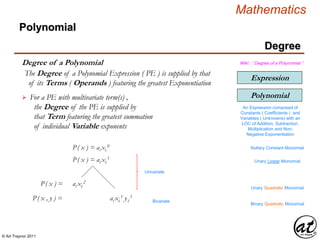
The Degree of a Polynomial Expression ( PE ) is supplied by that
of its Terms ( Operands ) featuring the greatest Exponentiation
For a PE with multivariate term(s) ,
the Degree of the PE is supplied by
that Term featuring the greatest summation
of individual Variable exponents

P( x ) = ai xi
0 Nullary Constant Monomial
P( x ) = ai xi
1
Unary Linear Monomial
P( x ) = ai xi
2
Unary Quadratic Monomial
ai xi
1 yi
1P( x , y ) =
Binary Quadratic Monomial
Univariate
Bivariate
© Art Traynor 2011
Mathematics
Degree
Expression
Polynomial
Degree of a Polynomial
Polynomial
Wiki: “ Degree of a Polynomial ”
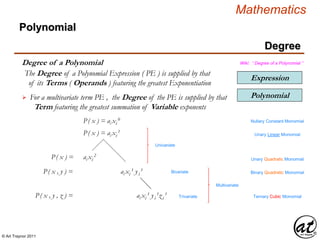
The Degree of a Polynomial Expression ( PE ) is supplied by that
of its Terms ( Operands ) featuring the greatest Exponentiation
For a multivariate term PE , the Degree of the PE is supplied by that
Term featuring the greatest summation of Variable exponents

P( x ) = ai xi
0 Nullary Constant Monomial
P( x ) = ai xi
1
Unary Linear Monomial
P( x ) = ai xi
2
Unary Quadratic Monomial
ai xi
1 yi
1P( x , y ) = Binary Quadratic Monomial
ai xi
1 yi
1zi
1P( x , y , z ) = Ternary Cubic Monomial
Univariate
Bivariate
Trivariate
Multivariate
© Art Traynor 2011
Mathematics
Quadratic
Expression
Polynomial
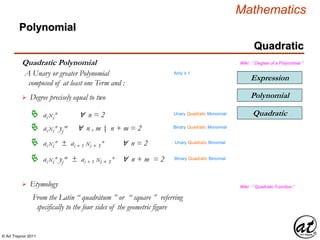
Quadratic Polynomial
Polynomial
Wiki: “ Degree of a Polynomial ”
A Unary or greater Polynomial
composed of at least one Term and :
Degree precisely equal to two
Quadratic ai xi
n ∀ n = 2
 ai xi
n yj
m ∀ n , m n + m = 2|:
Etymology
From the Latin “ quadrātum ” or “ square ” referring
specifically to the four sides of the geometric figure
Wiki: “ Quadratic Function ”
Arity ≥ 1
 ai xi
n ± ai + 1 xi + 1
n ∀ n = 2
Unary Quadratic Monomial
Binary Quadratic Monomial
Unary Quadratic Binomial
 ai xi
n yj
m ± ai + 1 xi + 1
n ∀ n + m = 2 Binary Quadratic Binomial
© Art Traynor 2011
Mathematics
Equation
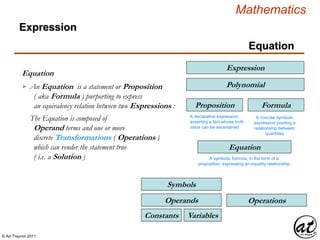
Equation
Expression
An Equation is a statement or Proposition
( aka Formula ) purporting to express
an equivalency relation between two Expressions :

Expression
Proposition
A declarative expression
asserting a fact whose truth
value can be ascertained
Equation
A symbolic formula, in the form of a
proposition, expressing an equality relationship
Formula
A concise symbolic
expression positing a
relationship between
quantities
VariablesConstants
Operands
Symbols
Operations
The Equation is composed of
Operand terms and one or more
discrete Transformations ( Operations )
which can render the statement true
( i.e. a Solution )
Polynomial
© Art Traynor 2011
Mathematics
Equation
Solution
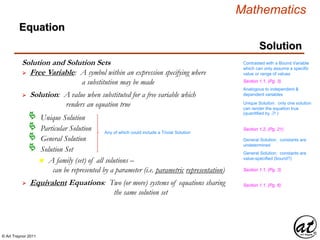
Solution and Solution Sets
 Free Variable: A symbol within an expression specifying where
a substitution may be made
Contrasted with a Bound Variable
which can only assume a specific
value or range of values
 Solution: A value when substituted for a free variable which
renders an equation true
Analogous to independent &
dependent variables
Unique Solution: only one solution
can render the equation true
(quantified by $! )
General Solution: constants are
undetermined
General Solution: constants are
value-specified (bound?)
Unique Solution
Particular Solution
General Solution
Solution Set
n A family (set) of all solutions –
can be represented by a parameter (i.e. parametric representation)
 Equivalent Equations: Two (or more) systems of equations sharing
the same solution set
Section 1.1, (Pg. 3)
Section 1.1, (Pg. 6)
Any of which could include a Trivial Solution
Section 1.2, (Pg. 21)
© Art Traynor 2011
Mathematics
Equation
Solution
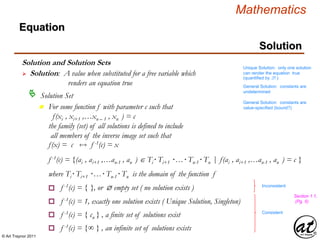
Solution and Solution Sets
 Solution: A value when substituted for a free variable which
renders an equation true
Unique Solution: only one solution
can render the equation true
(quantified by $! )
General Solution: constants are
undetermined
General Solution: constants are
value-specified (bound?)
Solution Set
n For some function f with parameter c such that
f(xi , xi+1 ,…xn – 1 , xn ) = c
the family (set) of all solutions is defined to include
all members of the inverse image set such that
f(x) = c  f -1(c) = x
f -1(c) = {(ai , ai+1 ,…an-1 , an )  Ti· Ti+1 ·…· Tn-1· Tn | f(ai , ai+1 ,…an-1 , an ) = c }
where Ti· Ti+1 ·…· Tn-1· Tn is the domain of the function f
o f -1(c) = { }, or empty set ( no solution exists )
o f -1(c) = 1, exactly one solution exists ( Unique Solution, Singleton)
o f -1(c) = { cn } , a finite set of solutions exist
o f -1(c) = {∞ } , an infinite set of solutions exists
Inconsistent
Consistent
Section 1.1,
(Pg. 5)
© Art Traynor 2011
Mathematics
Linear Equation
Linear Equation
Equation
An Equation consisting of:
Operands that are either
Any Variables are restricted to the First Order n = 1
Linear Equation
An equation in which each term
is either a constant or the
product of a constant and (a)
variable[s] of the first order
Expression
Proposition
Equation
Formula
n Constant(s) or
n A product of Constant(s) and
one or more Variable(s)
The Linear character of the Equation derives from the
geometry of its graph which is a line in the R2 plane

As a Relation the Arity of a Linear Equation must be
at least two, or n ≥ 2 , or a Binomial or greater Polynomial

Polynomial
© Art Traynor 2011
Mathematics
Equation
Linear Equation
Linear Equation
 An equation in which each term is either a constant or the product
of a constant and (a) variable[s] of the first order
Term ai represents a Coefficient
b = Σi= 1
n
ai xi = ai xi + ai+1 xi+1…+ an – 1 xn – 1 + an xn
Equation of a Line in n-variables
 A linear equation in “ n ” variables, xi + xi+1 …+ xn-1 + xn
has the form:
n Coefficients are distributed over a defined field
(e.g. N , Z , Q , R , C )
Term xi represents a Variable ( e.g. x, y, z )
n Term a1 is defined as the Leading Coefficient
n Term x1 is defined as the Leading Variable
Section 1.1, (Pg. 2)
Coefficient = a multiplicative factor
(scalar) of fixed value (constant)
Section 1.1, (Pg. 2)
© Art Traynor 2011
Mathematics
Linear Equation
Equation
Standard Form ( Polynomial )
 Ax + By = C
 Ax1 + By1 = C
For the equation to describe a line ( no curvature )
the variable indices must equal one

 ai xi + ai+1 xi+1 …+ an – 1 xn –1 + an xn = b
 ai xi
1 + ai+1 x 1 …+ an – 1 x 1 + a1 x 1 = bi+1 n – 1 n n
ℝ
2
: a1 x + a2 y = b
ℝ
3
: a1 x + a2 y + a3 z = b
Blitzer, Section 3.2, (Pg. 226)
Section 1.1, (Pg. 2)
Test for Linearity
 A Linear Equation can be expressed in Standard Form
As a species of Polynomial , a Linear Equation
can be expressed in Standard Form
 Every Variable term must be of precise order n = 1
Linear Equation
An equation in which each term
is either a constant or the
product of a constant and (a)
variable[s] of the first order
Expression
Proposition
Equation
Formula
Polynomial
© Art Traynor 2011
Mathematics
Sets
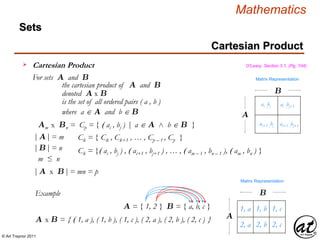
Cartesian Product
For sets A and B
the cartesian product of A and B
denoted A x B
Cartesian Product
is the set of all ordered pairs ( a , b )
where a  A and b  B
Am x Bn = Cp = { ( ai , bj ) | a  A  b  B }
A = { 1, 2 } B = { a, b, c }
A x B = { ( 1, a ), ( 1, b ), ( 1, c ), ( 2, a ), ( 2, b ), ( 2, c ) }
O’Leary, Section 3.1, (Pg. 104)
Matrix Representation
Example
| A | = m
| B | = n
| A x B | = mn = p
Ck = { Ck , Ck+1 , … , Cp – 1 , Cp }
Ck = {( ai , bj ) , ( ai+1 , bj+1 ) , … , ( am – 1 , bn – 1 ), ( am , bn ) }
m ≤ n
ai ,bj
B
A
ai ,bj+1
ai+1 ,bj ai+1 ,bj+1
1, a 1, b 1, c
2, a 2, b 2, c
A
Matrix Representation
B
© Art Traynor 2011
Mathematics
Sets
Cartesian Product
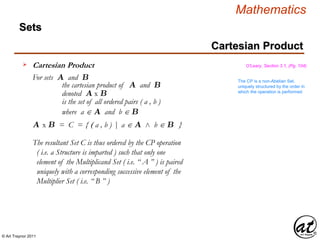
For sets A and B
the cartesian product of A and B
denoted A x B
Cartesian Product
is the set of all ordered pairs ( a , b )
where a  A and b  B
A x B = C = { ( a , b ) | a  A  b  B }
O’Leary, Section 3.1, (Pg. 104)
The CP is a non-Abelian Set,
uniquely structured by the order in
which the operation is performed
The resultant Set C is thus ordered by the CP operation
( i.e. a Structure is imparted ) such that only one
element of the Multiplicand Set ( i.e. “ A ” ) is paired
uniquely with a corresponding successive element of the
Multiplier Set ( i.e. “ B ” )
© Art Traynor 2011
Mathematics
Sets
Cartesian Product
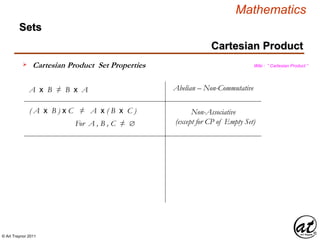
Cartesian Product Set Properties
Abelian – Non-CommutativeA x B ≠ B x A
Non-Associative
(except for CP of Empty Set)
Wiki : “ Cartesian Product ”
( A x B ) x C ≠ A x ( B x C )
For A , B , C ≠ 
© Art Traynor 2011
Mathematics
Discrete Structures
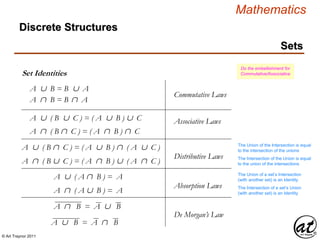
Set Identities
A  B = B  A
Commutative Laws
Associative Laws
Distributive Laws
Sets
A  B = B  A
A  ( B  C ) = ( A  B )  C
Absorption Laws
De Morgan’s Law
A  ( B  C ) = ( A  B )  C
A  ( B  C ) = ( A  B )  ( A  C )
A  ( B  C ) = ( A  B )  ( A  C )
The Union of the Intersection is equal
to the intersection of the unions
The Intersection of the Union is equal
to the union of the intersections
A  ( A  B ) = A
A  ( A  B ) = A
A  B = A  B
A  B = A  B
The Union of a set’s Intersection
(with another set) is an Identity
The Intersection of a set’s Union
(with another set) is an Identity
Do the embellishment for
Commutative/Associative
© Art Traynor 2011
Mathematics
Sets
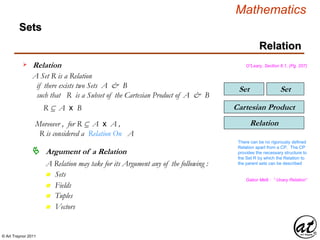
Relation
O”Leary, Section 6.1, (Pg. 207)Relation
A Set R is a Relation
if there exists two Sets A & B
such that R is a Subset of the Cartesian Product of A & B
R  A x B
SetSet
Relation
Cartesian Product
Moreover , for R  A x A ,
R is considered a Relation On A
Gabor Melli : “ Unary Relation”
Argument of a Relation
A Relation may take for its Argument any of the following :
Setsn
Fieldsn
Tuplesn
Vectorsn
There can be no rigorously defined
Relation apart from a CP. The CP
provides the necessary structure to
the Set R by which the Relation to
the parent sets can be described
© Art Traynor 2011
Mathematics
Sets
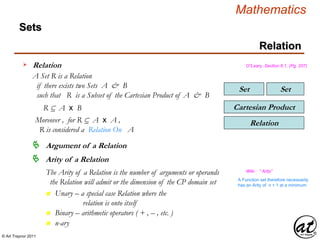
Relation
O”Leary, Section 6.1, (Pg. 207)Relation
A Set R is a Relation
if there exists two Sets A & B
such that R is a Subset of the Cartesian Product of A & B
R  A x B
SetSet
Relation
Cartesian Product
Moreover , for R  A x A ,
R is considered a Relation On A
Argument of a Relation
Arity of a Relation
The Arity of a Relation is the number of arguments or operands
the Relation will admit or the dimension of the CP domain set
Wiki : “ Arity”
Unary – a special case Relation where the
relation is onto itself
n
Binary – arithmetic operators ( + , – , etc. )n
n-aryn
A Function set therefore necessarily
has an Arity of n + 1 at a minimum
© Art Traynor 2011
Mathematics
Sets
SetSet
Relation
Cartesian Product
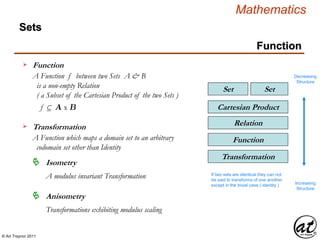
Function
Transformation
f  A x B
Function
A Function f between two Sets A & B
is a non-empty Relation
( a Subset of the Cartesian Product of the two Sets )
Function
Transformation
A Function which maps a domain set to an arbitrary
codomain set other than Identity
If two sets are identical they can not
be said to transforms of one another
except in the trivial case ( identity )
Decreasing
Structure
Increasing
Structure
Isometry
A modulus invariant Transformation
Anisometry
Transformations exhibiting modulus scaling
© Art Traynor 2011
Mathematics
Sets
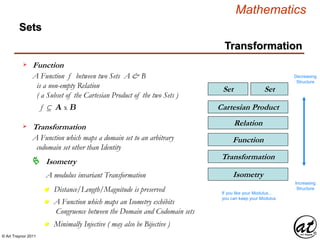
SetSet
Relation
Cartesian Product
Function
Transformation
f  A x B
Function
A Function f between two Sets A & B
is a non-empty Relation
( a Subset of the Cartesian Product of the two Sets )
Transformation
Transformation
A Function which maps a domain set to an arbitrary
codomain set other than Identity
Decreasing
Structure
Increasing
Structure
Isometry
n Distance/Length/Magnitude is preserved
Isometry
A modulus invariant Transformation
If you like your Modulus…
you can keep your Modulus
n A Function which maps an Isometry exhibits
Congruence between the Domain and Codomain sets
n Minimally Injective ( may also be Bijective )
© Art Traynor 2011
Mathematics
Sets
SetSet
Relation
Cartesian Product
Function
Transformation
Isometry
Transformation
A Function which maps a domain set to an arbitrary
codomain set other than Identity
Decreasing
Structure
Increasing
Structure
Isometry
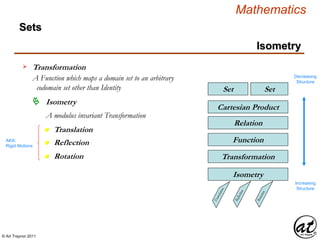
n Translation
Isometry
A modulus invariant Transformation
n Rotation
n ReflectionAKA:
Rigid Motions
© Art Traynor 2011
Mathematics
Sets
SetSet
Relation
Cartesian Product
Function
Transformation
Isometry
Transformation
A Function which maps a domain set to an arbitrary
codomain set other than Identity
Decreasing
Structure
Increasing
Structure
Isometry
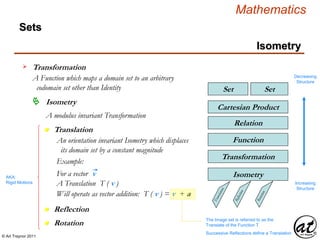
n Translation
Isometry
A modulus invariant Transformation
n Rotation
n Reflection
An orientation invariant Isometry which displaces
its domain set by a constant magnitude
AKA:
Rigid Motions
Example:
For a vector v
A Translation T ( v )
Will operate as vector addition: T ( v ) = v + a
The Image set is referred to as the
Translate of the Function T
Successive Reflections define a Translation
© Art Traynor 2011
Mathematics
Sets
SetSet
Relation
Cartesian Product
Function
Transformation
Isometry
Transformation
A Function which maps a domain set to an arbitrary
codomain set other than Identity
Decreasing
Structure
Increasing
Structure
Isometry
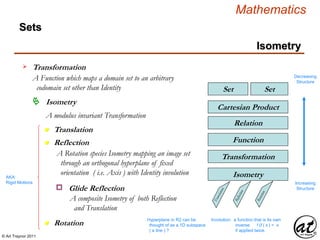
n Translation
Isometry
A modulus invariant Transformation
n Rotation
n Reflection
AKA:
Rigid Motions
A Rotation species Isometry mapping an image set
through an orthogonal hyperplane of fixed
orientation ( i.e. Axis ) with Identity involution
Involution: a function that is its own
inverse f (f ( x ) = x
if applied twice.
Glide Reflectiono
A composite Isometry of both Reflection
and Translation
Hyperplane in R2 can be
thought of as a 1D subspace
( a line ) ?
© Art Traynor 2011
Mathematics
Sets
SetSet
Relation
Cartesian Product
Function
Transformation
Isometry
Transformation
A Function which maps a domain set to an arbitrary
codomain set other than Identity
Decreasing
Structure
Increasing
Structure
Isometry
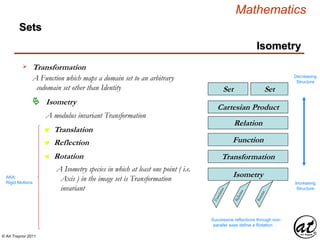
n Translation
Isometry
A modulus invariant Transformation
n Rotation
n Reflection
AKA:
Rigid Motions
Successive reflections through non-
parallel axes define a Rotation
A Isometry species in which at least one point ( i.e.
Axis ) in the image set is Transformation
invariant
© Art Traynor 2011
Mathematics
Sets
SetSet
Relation
Cartesian Product
Function
Transformation
Transformation
A Function which maps a domain set to an arbitrary
codomain set other than Identity
Decreasing
Structure
Increasing
Structure
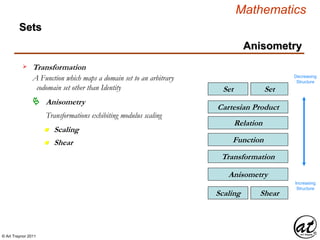
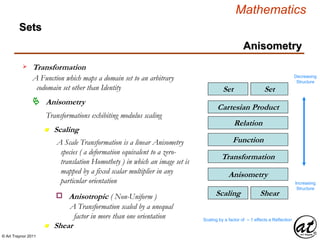
Anisometry
n Scaling
Anisometry
Transformations exhibiting modulus scaling
n Shear
ShearScaling
Anisometry
© Art Traynor 2011
Mathematics
Sets
SetSet
Relation
Cartesian Product
Function
Transformation
Transformation
A Function which maps a domain set to an arbitrary
codomain set other than Identity
Decreasing
Structure
Increasing
Structure
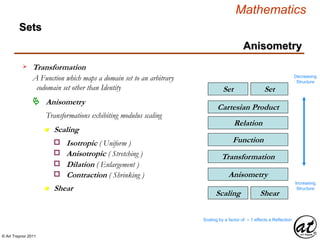
Anisometry
n Scaling
Anisometry
Transformations exhibiting modulus scaling
n Shear
ShearScaling
Anisometry
Isotropic ( Uniform )o
Anisotropic ( Stretching )o
Dilation ( Enlargement )o
Contraction ( Shrinking )o
Scaling by a factor of – 1 effects a Reflection
© Art Traynor 2011
Mathematics
Sets
SetSet
Relation
Cartesian Product
Function
Transformation
Transformation
A Function which maps a domain set to an arbitrary
codomain set other than Identity
Decreasing
Structure
Increasing
Structure
Anisometry
n Scaling
Anisometry
Transformations exhibiting modulus scaling
n Shear
ShearScaling
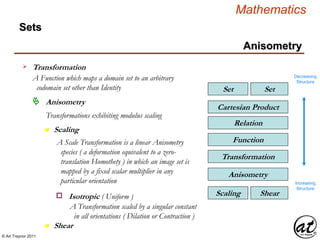
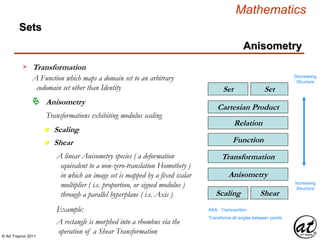
A Scale Transformation is a linear Anisometry
species ( a deformation equivalent to a zero-
translation Homothety ) in which an image set is
mapped by a fixed scalar multiplier in any
particular orientation
Anisometry
Isotropic ( Uniform )o
A Transformation scaled by a singular constant
in all orientations ( Dilation or Contraction )
© Art Traynor 2011
Mathematics
Sets
SetSet
Relation
Cartesian Product
Function
Transformation
Transformation
A Function which maps a domain set to an arbitrary
codomain set other than Identity
Decreasing
Structure
Increasing
Structure
Anisometry
n Scaling
Anisometry
Transformations exhibiting modulus scaling
n Shear
ShearScaling
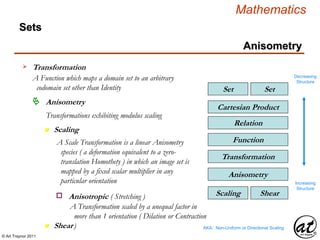
A Scale Transformation is a linear Anisometry
species ( a deformation equivalent to a zero-
translation Homothety ) in which an image set is
mapped by a fixed scalar multiplier in any
particular orientation
Anisometry
AKA: Non-Uniform or Directional Scaling
Anisotropic ( Stretching )o
A Transformation scaled by a unequal factor in
more than 1 orientation ( Dilation or Contraction
)
© Art Traynor 2011
Mathematics
Sets
SetSet
Relation
Cartesian Product
Function
Transformation
Transformation
A Function which maps a domain set to an arbitrary
codomain set other than Identity
Decreasing
Structure
Increasing
Structure
Anisometry
n Scaling
Anisometry
Transformations exhibiting modulus scaling
n Shear
ShearScaling
A Scale Transformation is a linear Anisometry
species ( a deformation equivalent to a zero-
translation Homothety ) in which an image set is
mapped by a fixed scalar multiplier in any
particular orientation
Anisometry
Scaling by a factor of – 1 effects a Reflection
Anisotropic ( Non-Uniform )o
A Transformation scaled by a unequal
factor in more than one orientation
© Art Traynor 2011
Mathematics
Sets
SetSet
Relation
Cartesian Product
Function
Transformation
Transformation
A Function which maps a domain set to an arbitrary
codomain set other than Identity
Decreasing
Structure
Increasing
Structure
Anisometry
n Scaling
Anisometry
Transformations exhibiting modulus scaling
n Shear
ShearScaling
Anisometry
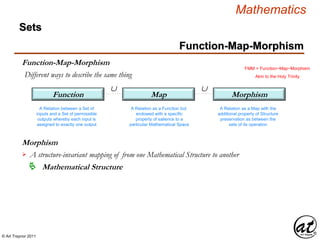
A linear Anisometry species ( a deformation
equivalent to a non-zero-translation Homothety )
in which an image set is mapped by a fixed scalar
multiplier ( i.e. proportion, or signed modulus )
through a parallel hyperplane ( i.e. Axis )
AKA: Transvection
Transforms all angles between points
Example:
A rectangle is morphed into a rhombus via the
operation of a Shear Transformation
© Art Traynor 2011
Mathematics
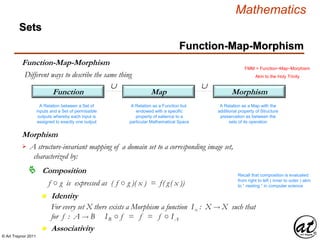
MapFunction Morphism
A Relation between a Set of
inputs and a Set of permissible
outputs whereby each input is
assigned to exactly one output
A Relation as a Function but
endowed with a specific
property of salience to a
particular Mathematical Space
A Relation as a Map with the
additional property of Structure
preservation as between the
sets of its operation
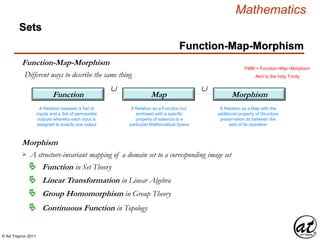
Function-Map-Morphism
Different ways to describe the same thing
Sets
Function-Map-Morphism
 
FMM = Function~Map~Morphism
Akin to the Holy Trinity
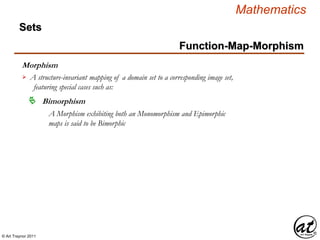
Morphism
A structure-invariant mapping of from one Mathematical Structure to another
Mathematical Structure
© Art Traynor 2011
Mathematics
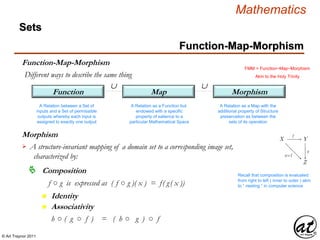
MapFunction Morphism
A Relation between a Set of
inputs and a Set of permissible
outputs whereby each input is
assigned to exactly one output
A Relation as a Function but
endowed with a specific
property of salience to a
particular Mathematical Space
A Relation as a Map with the
additional property of Structure
preservation as between the
sets of its operation
Function-Map-Morphism
Different ways to describe the same thing
Sets
Function-Map-Morphism
 
FMM = Function~Map~Morphism
Akin to the Holy Trinity
Morphism
A structure-invariant mapping of a domain set to a corresponding image set
Function in Set Theory
Linear Transformation in Linear Algebra
Group Homomorphism in Group Theory
Continuous Function in Topology
© Art Traynor 2011
Mathematics
MapFunction Morphism
A Relation between a Set of
inputs and a Set of permissible
outputs whereby each input is
assigned to exactly one output
A Relation as a Function but
endowed with a specific
property of salience to a
particular Mathematical Space
A Relation as a Map with the
additional property of Structure
preservation as between the
sets of its operation
Function-Map-Morphism
Different ways to describe the same thing
Sets
Function-Map-Morphism
 
FMM = Function~Map~Morphism
Akin to the Holy Trinity
Morphism
A structure-invariant mapping of a domain set to a corresponding image set,
characterized by:

Composition
n Identity
n Associativity
Recall that composition is evaluated
from right to left ( inner to outer ) akin
to “ nesting “ in computer sciencef ○ g is expressed as ( f ○ g )( x ) = f( g( x ))
For every set X there exists a Morphism a function Ix : X  X such that
for f : A  B IB ○ f = f = f ○ IA
© Art Traynor 2011
Mathematics
MapFunction Morphism
A Relation between a Set of
inputs and a Set of permissible
outputs whereby each input is
assigned to exactly one output
A Relation as a Function but
endowed with a specific
property of salience to a
particular Mathematical Space
A Relation as a Map with the
additional property of Structure
preservation as between the
sets of its operation
Function-Map-Morphism
Different ways to describe the same thing
Sets
Function-Map-Morphism
 
FMM = Function~Map~Morphism
Akin to the Holy Trinity
Morphism
A structure-invariant mapping of a domain set to a corresponding image set,
characterized by:

Composition
n Identity
n Associativity
Recall that composition is evaluated
from right to left ( inner to outer ) akin
to “ nesting “ in computer sciencef ○ g is expressed as ( f ○ g )( x ) = f( g( x ))
h ○ ( g ○ f ) = ( h ○ g ) ○ f
© Art Traynor 2011
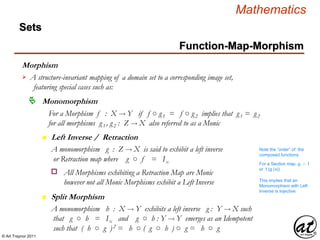
Mathematics
Sets
Function-Map-Morphism
Morphism
A structure-invariant mapping of a domain set to a corresponding image set,
featuring special cases such as:

Monomorphism
For a Morphism f : X  Y if f ○ g1 = f ○ g2 implies that g1 = g2
for all morphisms g1 , g2 : Z  X also referred to as a Monic
n Left Inverse / Retraction
A monomorphism g : Z  X is said to exhibit a left inverse
or Retraction map where g ○ f = Ix
All Morphisms exhibiting a Retraction Map are Monic
however not all Monic Morphisms exhibit a Left Inverse
o
n Split Morphism
A monomorphism h : X  Y exhibits a left inverse g : Y  X such
that g ○ h = Ix and g ○ h : Y  Y emerges as an Idempotent
such that ( h ○ g )2 = h ○ ( g ○ h ) ○ g = h ○ g
Note the “order” of the
composed functions
For a Section map g ○ f
or f (g (x))
This implies that an
Monomorphism with Left
Inverse is Injective
© Art Traynor 2011
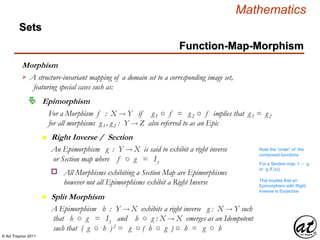
Mathematics
Sets
Function-Map-Morphism
Morphism
A structure-invariant mapping of a domain set to a corresponding image set,
featuring special cases such as:

Epimorphism
For a Morphism f : X  Y if g1 ○ f = g2 ○ f implies that g1 = g2
for all morphisms g1 , g2 : Y  Z also referred to as an Epic
n Right Inverse / Section
An Epimorphism g : Y  X is said to exhibit a right inverse
or Section map where f ○ g = Iy
Note the “order” of the
composed functions
For a Section map f ○ g
or g (f (x))
All Morphisms exhibiting a Section Map are Epimorphisms
however not all Epimorphisms exhibit a Right Inverse
o
n Split Morphism
A Epimorphism h : Y  X exhibits a right inverse g : X  Y such
that h ○ g = Iy and h ○ g : X  X emerges as an Idempotent
such that ( g ○ h )2 = g ○ ( h ○ g ) ○ h = g ○ h
This implies that an
Epimorphism with Right
Inverse is Surjective
© Art Traynor 2011
Mathematics
Sets
Function-Map-Morphism
Morphism
A structure-invariant mapping of a domain set to a corresponding image set,
featuring special cases such as:

Bimorphism
A Morphism exhibiting both an Monomorphism and Epimorphic
maps is said to be Bimorphic
© Art Traynor 2011
Mathematics
Sets
Function-Map-Morphism
Morphism
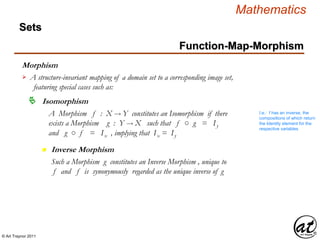
A structure-invariant mapping of a domain set to a corresponding image set,
featuring special cases such as:

Isomorphism
A Morphism f : X  Y constitutes an Isomorphism if there
exists a Morphism g : Y  X such that f ○ g = Iy
and g ○ f = Ix , implying that Ix = Iy
I.e.: f has an inverse, the
compositions of which return
the Identity element for the
respective variables
n Inverse Morphism
Such a Morphism g constitutes an Inverse Morphism , unique to
f and f is synonymously regarded as the unique inverse of g
© Art Traynor 2011
Mathematics
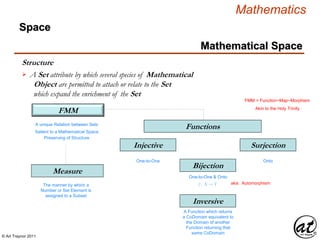
FMM
A unique Relation between Sets
Structure
A Set attribute by which several species of Mathematical
Object are permitted to attach or relate to the Set
which expand the enrichment of the Set

Space
Mathematical Space
Measure
The manner by which a
Number or Set Element is
assigned to a Subset
Salient to a Mathematical Space
Preserving of Structure
FMM = Function~Map~Morphism
Akin to the Holy Trinity
SurjectionInjective
Functions
One-to-One Onto
Bijection
Inversive
One-to-One & Onto
f : X  Y
A Function which returns
a CoDomain equivalent to
the Domain of another
Function returning that
same CoDomain
aka: Automorphism
© Art Traynor 2011
Mathematics
Relation
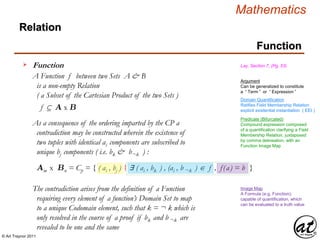
Function
Lay, Section 7, (Pg. 53)
f  A x B
Function
A Function f between two Sets A & B
is a non-empty Relation
( a Subset of the Cartesian Product of the two Sets )
As a consequence of the ordering imparted by the CP a
contradiction may be constructed wherein the existence of
two tuples with identical ai components are subscribed to
unique bj components ( i.e. bk & b¬k ) :
Am x Bn = Cp = { ( ai , bj ) ∃ ( ai , bk ) , (ai , b ¬k )  f , f(a) = b }|:
Argument
Can be generalized to constitute
a “ Term ” or “ Expression ”
Predicate (Bifurcated)
Compound expression composed
of a quantification clarifying a Field
Membership Relation, juxtaposed
by comma delineation, with an
Function Image Map
Domain Quantification
Ratifies Field Membership Relation
explicit existential instantiation ( EEI )
Image Map
A Formula (e.g. Function),
capable of quantification, which
can be evaluated to a truth value
The contradiction arises from the definition of a Function
requiring every element of a function’s Domain Set to map
to a unique Codomain element, such that k = ¬ k which is
only resolved in the course of a proof if bk and b ¬k are
revealed to be one and the same
© Art Traynor 2011
Mathematics
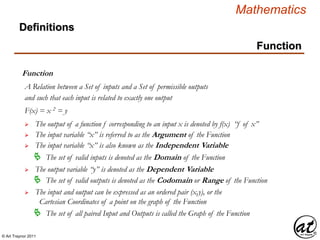
Function
Function
A Relation between a Set of inputs and a Set of permissible outputs
Definitions
and such that each input is related to exactly one output
 The output of a function f corresponding to an input x is denoted by f(x) “f of x”
 The input variable “x” is referred to as the Argument of the Function
 The output variable “y” is denoted as the Dependent Variable
F(x) = x 2 = y
 The input variable “x” is also known as the Independent Variable
 The input and output can be expressed as an ordered pair (x,y), or the
Cartesian Coordinates of a point on the graph of the Function
 The set of valid inputs is denoted as the Domain of the Function
 The set of valid outputs is denoted as the Codomain or Range of the Function
 The set of all paired Input and Outputs is called the Graph of the Function
© Art Traynor 2011
Mathematics
Function
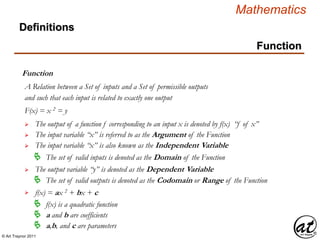
Function
A Relation between a Set of inputs and a Set of permissible outputs
Definitions
and such that each input is related to exactly one output
 The output of a function f corresponding to an input x is denoted by f(x) “f of x”
 The input variable “x” is referred to as the Argument of the Function
 The output variable “y” is denoted as the Dependent Variable
F(x) = x 2 = y
 The input variable “x” is also known as the Independent Variable
 The set of valid inputs is denoted as the Domain of the Function
 The set of valid outputs is denoted as the Codomain or Range of the Function

 f(x) is a quadratic function
f(x) = ax 2 + bx + c
 a and b are coefficients
 a,b, and c are parameters
© Art Traynor 2011
Mathematics
Constituents
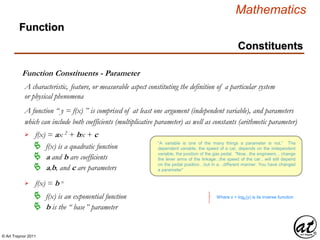
Function Constituents - Parameter
A characteristic, feature, or measurable aspect constituting the definition of a particular system
or physical phenomena
Function
A function “ y = f(x) ” is comprised of at least one argument (independent variable), and parameters

 f(x) is a quadratic function
f(x) = ax 2 + bx + c
 a and b are coefficients
 a,b, and c are parameters
which can include both coefficients (multiplicative parameter) as well as constants (arithmetic parameter)
 f(x) = b x
 f(x) is an exponential function
 b is the “ base” parameter
Where x = logb(y) is its inverse function
“A variable is one of the many things a parameter is not.“ The
dependent variable, the speed of a car, depends on the independent
variable, the position of the gas pedal. "Now...the engineers... change
the lever arms of the linkage...the speed of the car…will still depend
on the pedal position…but in a…different manner. You have changed
a parameter”
© Art Traynor 2011
Mathematics
Function
Function
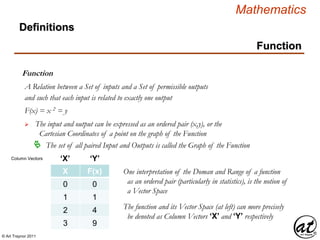
A Relation between a Set of inputs and a Set of permissible outputs
Definitions
and such that each input is related to exactly one output
F(x) = x 2 = y
 The input and output can be expressed as an ordered pair (x,y), or the
Cartesian Coordinates of a point on the graph of the Function
 The set of all paired Input and Outputs is called the Graph of the Function
X F(x)
0 0
1 1
2 4
3 9
One interpretation of the Doman and Range of a function
as an ordered pair (particularly in statistics), is the notion of
a Vector Space
The function and its Vector Space (at left) can more precisely
be denoted as Column Vectors ‘X’ and ‘Y’ respectively
‘X’ ‘Y’Column Vectors
© Art Traynor 2011
Mathematics
Function
Function
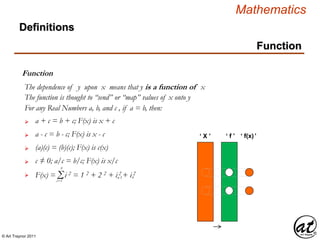
 a + c = b + c; F(x) is x + c
 a - c = b - c; F(x) is x - c
 (a)(c) = (b)(c); F(x) is c(x)
For any Real Numbers a, b, and c , if a = b, then:
 c ≠ 0; a/c = b/c; F(x) is x/c
Definitions
 Σ
n
i=1
F(x) = i 2 = 1 2 + 2 2 + i 2 + i 2
n-1 n
The dependence of y upon x means that y is a function of x
The function is thought to “send” or “map” values of x onto y
‘ X ’ ‘ f ’ ‘ f(x)’
© Art Traynor 2011
Mathematics
Elementary Function
Elementary Function
Function
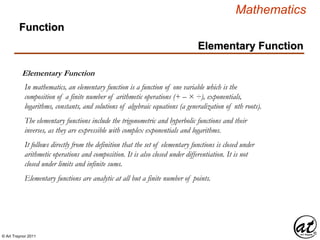
In mathematics, an elementary function is a function of one variable which is the
composition of a finite number of arithmetic operations (+ – × ÷), exponentials,
logarithms, constants, and solutions of algebraic equations (a generalization of nth roots).
The elementary functions include the trigonometric and hyperbolic functions and their
inverses, as they are expressible with complex exponentials and logarithms.
It follows directly from the definition that the set of elementary functions is closed under
arithmetic operations and composition. It is also closed under differentiation. It is not
closed under limits and infinite sums.
Elementary functions are analytic at all but a finite number of points.
© Art Traynor 2011
Mathematics
Function
Composite Function
Definitions
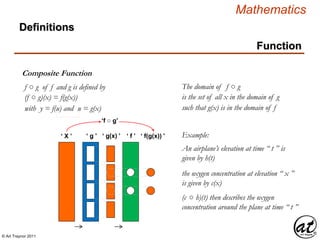
f ○ g of f and g is defined by
(f ○ g)(x) = f(g(x))
The domain of f ○ g
such that g(x) is in the domain of f
is the set of all x in the domain of g
‘ X ’ ‘ g ’ ‘ g(x) ’ ‘ f ’ ‘ f(g(x)) ’
‘f ○ g’
Example:
An airplane’s elevation at time “ t ” is
given by h(t)
the oxygen concentration at elevation “ x ”
is given by c(x)
(c ○ h)(t) then describes the oxygen
concentration around the plane at time “ t ”
with y = f(u) and u = g(x)
© Art Traynor 2011
Mathematics
Function
Composite Function
Definitions
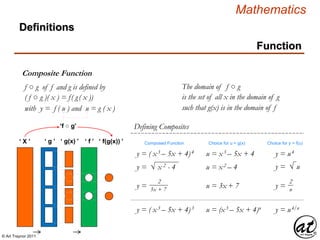
f ○ g of f and g is defined by
( f ○ g )( x ) = f( g( x ))
The domain of f ○ g
such that g(x) is in the domain of f
is the set of all x in the domain of g
‘ X ’ ‘ g ’ ‘ g(x) ’ ‘ f ’ ‘ f(g(x)) ’
‘f ○ g’
with y = f ( u ) and u = g ( x )
Defining Composites
y = ( x3 – 5x + 4)4
Composed Function
u = x3 – 5x + 4
Choice for u = g(x)
y = u4
Choice for y = f(u)
y = √ x 2 - 4 u = x2 – 4 y = √¯
u
2
3x + 7
y = u = 3x + 7
2
u
y =
y = ( x3 – 5x + 4)3 u = (x3 – 5x + 4)n y = u4/n
© Art Traynor 2011
Mathematics
Function
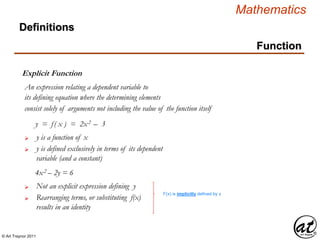
Explicit Function
Definitions
An expression relating a dependent variable to
its defining equation where the determining elements
consist solely of arguments not including the value of the function itself
y = f( x ) = 2x2 – 3
y is a function of x
y is defined exclusively in terms of its dependent
variable (and a constant)

4x2 – 2y = 6
Not an explicit expression defining y
Rearranging terms, or substituting f(x)
results in an identity

F(x) is implicitly defined by x
© Art Traynor 2011
Mathematics
Function
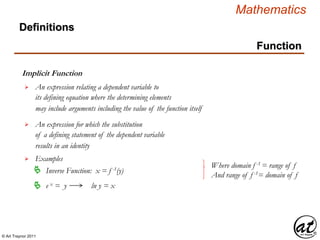
Implicit Function
Definitions
An expression relating a dependent variable to
its defining equation where the determining elements
may include arguments including the value of the function itself

An expression for which the substitution
of a defining statement of the dependent variable
results in an identity
 Inverse Function: x = f -1(y)
Examples
e x = y ln y = x
Where domain f -1 = range of f
And range of f -1= domain of f
© Art Traynor 2011
Mathematics
Function
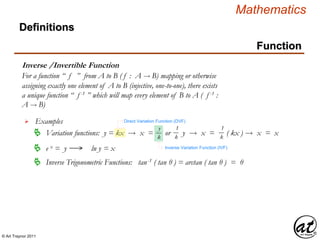
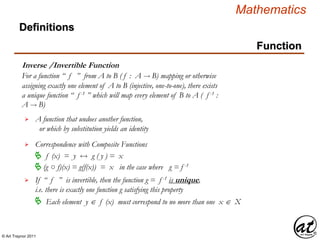
Inverse /Invertible Function
Definitions
For a function “ f ” from A to B ( f : A  B) mapping or otherwise
assigning exactly one element of A to B (injective, one-to-one), there exists
a unique function “ f -1 ” which will map every element of B to A ( f -1 :
A  B)
Correspondence with Composite Functions
 f (x) = y g ( y ) = x
A function that undoes another function,
or which by substitution yields an identity

(g ○ f)(x) = g(f(x)) = x in the case where g = f -1

If “ f ” is invertible, then the function g = f -1 is unique,
i.e. there is exactly one function g satisfying this property

 Each element y  f (x) must correspond to no more than one x  X
© Art Traynor 2011
Mathematics
Function
Inverse /Invertible Function
Definitions
For a function “ f ” from A to B ( f : A  B) mapping or otherwise
assigning exactly one element of A to B (injective, one-to-one), there exists
a unique function “ f -1 ” which will map every element of B to A ( f -1 :
A  B)
 Variation functions: y = kx  x = or y x = ( kx ) x = x
Examples
e x = y ln y = x
1
k
Direct Variation Function (DVF)
y
k
Inverse Variation Function (IVF)
1
k
Inverse Trigonometric Functions: tan-1 ( tan θ ) = arctan ( tan θ ) = θ
© Art Traynor 2011
Mathematics
Function
Inverse /Invertible Function
Definitions
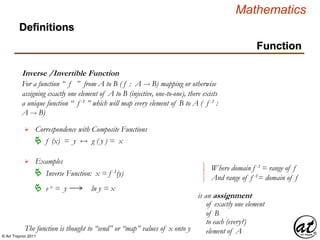
 Inverse Function: x = f -1(y)
Examples
e x = y ln y = x
Where domain f -1 = range of f
And range of f -1= domain of f
The function is thought to “send” or “map” values of x onto y
For a function “ f ” from A to B ( f : A  B) mapping or otherwise
assigning exactly one element of A to B (injective, one-to-one), there exists
a unique function “ f -1 ” which will map every element of B to A ( f -1 :
A  B)
is an assignment
of exactly one element
of B
to each (every?)
element of A
Correspondence with Composite Functions
 f (x) = y g ( y ) = x
© Art Traynor 2011
Mathematics
Discrete Structures
Function
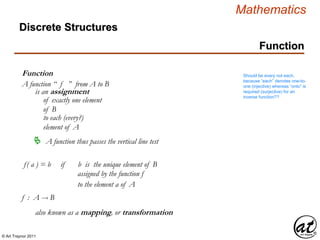
Function
A function “ f ” from A to B
is an assignment
of exactly one element
of B
to each (every?)
element of A
f( a ) = b if b is the unique element of B
assigned by the function f
to the element a of A
f : A  B
also known as a mapping, or transformation
Should be every not each,
because “each” denotes one-to-
one (injective) whereas “onto” is
required (surjective) for an
inverse function??
 A function thus passes the vertical line test
© Art Traynor 2011
Mathematics
Discrete Structures
Function
Function
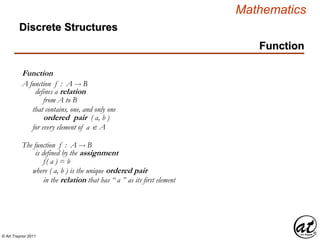
A function f : A  B
defines a relation
from A to B
that contains, one, and only one
ordered pair ( a, b )
for every element of a  A
The function f : A  B
is defined by the assignment
f( a ) = b
where ( a, b ) is the unique ordered pair
in the relation that has “ a ” as its first element
© Art Traynor 2011
Mathematics
Discrete Structures
Function
Function
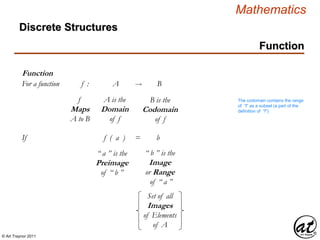
For a function f : A  B
A is the
Domain
of f
B is the
Codomain
of f
If f ( a ) = b
“ b ” is the
Image
or Range
of “ a ”
“ a ” is the
Preimage
of “ b ”
Set of all
Images
of Elements
of A
f
Maps
A to B
The codomain contains the range
of “f” as a subset (a part of the
definition of “f”)
© Art Traynor 2011
Mathematics
Discrete Structures
Bijection or Bijective Function
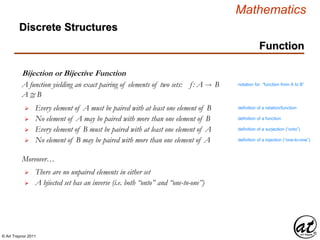
A function yielding an exact pairing of elements of two sets: f: A  B
 Every element of A must be paired with at least one element of B
 There are no unpaired elements in either set
 A bjiected set has an inverse (i.e. both “onto” and “one-to-one”)
notation for “function from A to B”
A @ B
 No element of A may be paired with more than one element of B
definition of a relation/function
definition of a function
 Every element of B must be paired with at least one element of A definition of a surjection (“onto”)
 No element of B may be paired with more than one element of A definition of a injection (“one-to-one”)
Moreover…
Function
© Art Traynor 2011
Mathematics
Discrete Structures
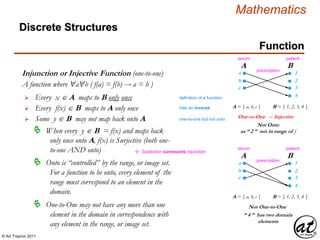
 Some y  B may not map back onto A
Injunction or Injective Function (one-to-one)
A function where "a"b ( f(a) = f(b)  a = b )
a
b
c
1
2
3
4
A = { a, b, c }
A B
B = { 1, 2, 3, 4 }
One-to-One  Injective
Not Onto
as “ 2 ” not in range of f
 Every x  A maps to B only once definition of a function
 Every f(x)  B maps to A only once
 When every y  B = f(x) and maps back
only once onto A, f(x) is Surjective (both one-
to-one AND onto)
one-to-one but not onto
 Surjection surmounts injunction
serum
prescription
patient
 Onto is “controlled” by the range, or image set.
For a function to be onto, every element of the
range must correspond to an element in the
domain.
 One-to-One may not have any more than one
element in the domain in correspondence with
any element in the range, or image set.
a
b
c
1
2
3
4
A = { a, b, c }
A B
B = { 1, 2, 3, 4 }
Not One-to-One
“ 4 ” has two domain
elements
serum
prescription
patient
Function
Has an inverse
© Art Traynor 2011
Mathematics
Discrete Structures
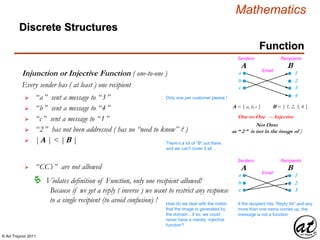
 “c” sent a message to “1”
Injunction or Injective Function ( one-to-one )
Every sender has ( at least ) one recipient
a
b
c
1
2
3
4
A = { a, b, c }
A B
B = { 1, 2, 3, 4 }
One-to-One  Injective
Not Onto
as “ 2 ” is not in the image of f
 “a” sent a message to “3”
 “b” sent a message to “4”
Senders
Email
Recipients
Function
 “2” has not been addressed ( has no “need to know” ? )
 “CC’s” are not allowed
 Violates definition of Function, only one recipient allowed!
Because if we get a reply ( inverse ) we want to restrict any response
to a single recipient (to avoid confusion) !
 |A | < |B |
If the recipient hits “Reply All” and any
more than one name comes up, the
message is not a function
a
b
c
1
2
3
A B
Senders
Email
Recipients
Only one per customer please !
There’s a lot of “B” out there
and we can’t cover it all…
How do we deal with the notion
that the image is generated by
the domain…if so, we could
never have a merely injective
function?
© Art Traynor 2011
Mathematics
Discrete Structures
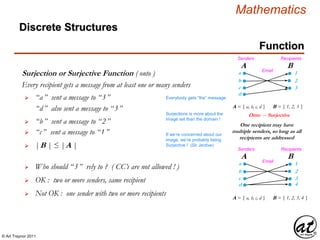
 “c” sent a message to “1”
Surjection or Surjective Function ( onto )
Every recipient gets a message from at least one or many senders
a
b
c
1
2
3
A = { a, b, c, d }
A B
B = { 1, 2, 3 }
Onto  Surjective
One recipient may have
multiple senders, so long as all
recipients are addressed
 “a” sent a message to “3”
 “b” sent a message to “2”
Senders
Email
Recipients
Function
 Who should “3” rely to ? ( CC’s are not allowed ! )
Everybody gets “the” message
d
“d” also sent a message to “3”
 |B | ≤ |A |
 OK : two or more senders, same recipient
 Not OK : one sender with two or more recipients
a
b
c
1
2
3
A B
Senders
Email
Recipients
d 4
Surjections is more about the
image set than the domain !
If we’re concerned about our
image, we’re probably being
Surjective ! (Sir Jective)
A = { a, b, c, d } B = { 1, 2, 3, 4 }
© Art Traynor 2011
Mathematics
Discrete Structures
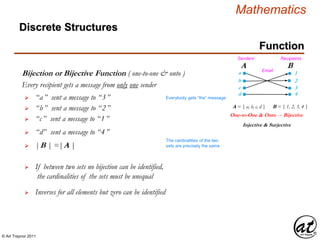
 “c” sent a message to “1”
Bijection or Bijective Function ( one-to-one & onto )
Every recipient gets a message from only one sender
a
b
c
1
2
3
A = { a, b, c, d }
A B
B = { 1, 2, 3, 4 }
One-to-One & Onto  Bijective
Injective & Surjective
 “a” sent a message to “3”
 “b” sent a message to “2”
Senders
Email
Recipients
Function
 If between two sets no bijection can be identified,
the cardinalities of the sets must be unequal
Everybody gets “the” message
d
 |B | =|A |
4
 “d” sent a message to “4”
The cardinalities of the two
sets are precisely the same
 Inverses for all elements but zero can be identified
© Art Traynor 2011
Mathematics
Discrete Structures
Function
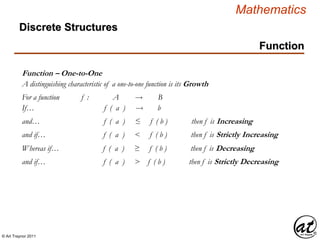
Function – One-to-One
A distinguishing characteristic of a one-to-one function is its Growth
For a function f : A  B
If… f ( a )  b
and… f ( a ) ≤ f ( b ) then f is Increasing
and if… f ( a ) < f ( b ) then f is Strictly Increasing
Whereas if… f ( a ) ≥ f ( b ) then f is Decreasing
and if… f ( a ) > f ( b ) then f is Strictly Decreasing
© Art Traynor 2011
Mathematics
Discrete Structures
Function
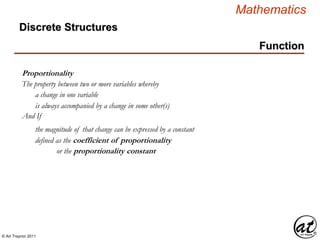
Proportionality
The property between two or more variables whereby
a change in one variable
is always accompanied by a change in some other(s)
And If
the magnitude of that change can be expressed by a constant
defined as the coefficient of proportionality
or the proportionality constant
© Art Traynor 2011
Mathematics
Discrete Structures
Equations
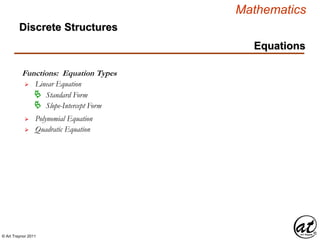
 Quadratic Equation
Functions: Equation Types
 Linear Equation
 Polynomial Equation
 Standard Form
 Slope-Intercept Form
© Art Traynor 2011
Mathematics
Discrete Structures
Equations
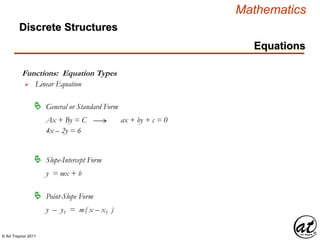
Functions: Equation Types
 Linear Equation
 General or Standard Form
 Slope-Intercept Form
Ax + By = C
4x – 2y = 6
y = mx + b
ax + by + c = 0
 Point-Slope Form
y – y1 = m( x – x1 )

Function_160416_01

  • 1.
    © Art Traynor2011 Mathematics Definition Mathematics Wiki: “ Mathematics ” 1564 – 1642 Galileo Galilei Grand Duchy of Tuscany ( Duchy of Florence ) City of Pisa Mathematics – A Language “ The universe cannot be read until we have learned the language and become familiar with the characters in which it is written. It is written in mathematical language…without which means it is humanly impossible to comprehend a single word. Without these, one is wandering about in a dark labyrinth. ”
  • 2.
    © Art Traynor2011 Mathematics Definition Algebra – A Mathematical Grammar Mathematics A formalized system ( a language ) for the transmission of information encoded by number Algebra A system of construction by which mathematical expressions are well-formed Expression Symbol Operation Relation Designate expression elements or Operands ( Terms / Monomials ) Transformations or LOC’s capable of rendering an expression into a relation A mathematical Structure between operands represented by a well-formed Expression A well-formed symbolic representation of Operands ( Terms or Monomials ) , of discrete arity, upon which one or more Operations ( Laws of Composition - LOC’s ) may structure a Relation 1. Identifies the explanans by non-tautological correspondences Definition 2. Isolates the explanans as a proper subset from its constituent correspondences 3. Terminology a. Maximal parsimony b. Maximal syntactic generality 4. Examples a. Trivial b. Superficial Mathematics Wiki: “ Polynomial ” Wiki: “ Degree of a Polynomial ”
  • 3.
    © Art Traynor2011 Mathematics Disciplines Algebra One of the disciplines within the field of Mathematics Mathematics Others are Arithmetic, Geometry, Number Theory, & Analysis  The study of expressions of symbols ( sets ) and the well-formed rules by which they might be consistently manipulated.  Algebra Elementary Algebra Abstract Algebra A class of Structure defined by the object Set and its Operations ( or Laws of Composition – LOC’s )  Linear Algebra Mathematics
  • 4.
    © Art Traynor2011 Mathematics Definitions Expression Symbol Operation Relation Designate expression elements or Operands ( Terms / Monomials ) Transformations or LOC’s capable of rendering an expression into a relation A mathematical structure between operands represented by a well-formed expression A well-formed symbolic representation of Operands ( Terms or Monomials ) , of discrete arity, upon which one or more Operations ( LOC’s ) may structure a Relation Expression – A Mathematical Sentence Proposition A declarative expression asserting a fact, the truth value of which can be ascertained Formula A concise symbolic expression positing a relation VariablesConstants An alphabetic character representing a number the value of which is arbitrary, unspecified, or unknown Operands ( Terms / Monomials ) A transformation invariant scalar quantity Mathematics Predicate A Proposition admitting the substitution of variables O’Leary, Section 2.1, Pg. 41 Expression constituents consisting of Constants and Variables exhibiting exclusive parity Polynomial An Expression composed of Constants ( Coefficients ) and Variables ( Unknowns) with an LOC’s of Addition, Subtraction, Multiplication and Non-Negative Exponentiation Wiki: “ Polynomial ” Wiki: “ Degree of a Polynomial ”
  • 5.
    © Art Traynor2011 Mathematics Definitions Expression Symbol Operation Relation Designate expression elements or Operands ( Terms / Monomials ) Transformations capable of rendering an expression into a relation A mathematical structure between operands represented by a well-formed expression Expression – A Mathematical Sentence Proposition A declarative expression the truth value of which can be ascertained Formula A concise symbolic expression positing a relation VariablesConstants An alphabetic character representing a number the value of which is arbitrary, unspecified, or unknown Operands ( Terms / Monomials ) A transformation invariant scalar quantity Equation A formula stating an equivalency class relation Inequality A formula stating a relation among operand cardinalities Function A Relation between a Set of inputs and a Set of permissible outputs whereby each input is assigned to exactly one output Univariate: an equation containing only one variable ( e.g. Unary ) Multivariate: an equation containing more than one variable ( e.g. n-ary ) Mathematics Expression constituents consisting of Constants and Variables exhibiting exclusive parity Polynomial
  • 6.
    © Art Traynor2011 Mathematics Definitions Expression Symbol Operation Relation Expression – A Mathematical Sentence Proposition Formula VariablesConstants Operands ( Terms ) Equation A formula stating an equivalency class relation Linear Equation An equation in which each term is either a constant or the product of a constant and (a) variable[s] of the first degree Mathematics Polynomial
  • 7.
    © Art Traynor2011 Mathematics Expression Mathematical Expression A representational precursive discrete composition to a Mathematical Statement or Proposition ( e.g. Equation ) consisting of :  Operands / Terms Expression A well-formed symbolic representation of Operands ( Terms or Monomials ) , of discrete arity, upon which one or more Operations ( LOC’s ) may structure a Relation Mathematics n Scalar Constants ( i.e. Coefficients ) n Variables or Unknowns The Cardinality of which is referred to as the Arity of the Expression Constituent representational Symbols composed of : Algebra Laws of Composition ( LOC’s ) Governs the partition of the Expression into well-formed Operands or Terms ( the Cardinality of which is a multiple of Monomials )
  • 8.
    © Art Traynor2011 Mathematics Arity Arity Expression The enumeration of discrete symbolic elements ( Variables ) comprising a Mathematical Expression is defined as its Arity  The Arity of an Expression can be represented by a non-negative integer index variable ( ℤ + or ℕ ), conventionally “ n ”  A Constant ( Airty n = 0 , index ℕ )or Nullary represents a term that accepts no Argument  A Unary expresses an Airty n = 1 A relation can not be defined for Expressions of Arity less than two: n < 2 A Binary expresses Airty n = 2 All expressions possessing Airty n > 1 are n-ary, Multary, Multiary, or Polyadic VariablesConstants Operands Expression Polynomial
  • 9.
    © Art Traynor2011 Mathematics Expression Arity Operand  Arithmetic : a + b = c The distinct elements of an Expression by which the structuring Laws of Composition ( LOC’s ) partition the Expression into discrete Monomial Terms  “ a ” and “ b ” are Operands  The number of Variables of an Expression is known as its Arity n Nullary = no Variables ( a Scalar Constant ) n Unary = one Variable n Binary = two Variables n Ternary = three Variables…etc. VariablesConstants Operands Expression Polynomial n “ c ” represents a Solution ( i.e. the Sum of the Expression ) Arity is canonically delineated by a Latin Distributive Number, ending in the suffix “ –ary ”
  • 10.
    © Art Traynor2011 Mathematics Arity Arity ( Cardinality of Expression Variables ) Expression A relation can not be defined for Expressions of Arity less than two: n < 2 Nullary Unary n = 0 n = 1 Binary n = 2 Ternary n = 3 1-ary 2-ary 3-ary Quaternary n = 4 4-ary Quinary n = 5 5-ary Senary n = 6 6-ary Septenary n = 7 7-ary Octary n = 8 8-ary Nonary n = 9 9-ary n-ary VariablesConstants Operands Expression Polynomial 0-ary
  • 11.
    © Art Traynor2011 Mathematics Operand Parity – Property of Operands Parity n is even if $ k | n = 2k n is odd if $ k | n = 2k+1 Even  Even Integer Parity Same Parity Even  Odd Opposite Parity
  • 12.
    © Art Traynor2011 Mathematics Polynomial Expression A well-formed symbolic representation of operands, of discrete arity, upon which one or more operations can structure a Relation Expression Polynomial Expression A Mathematical Expression , the Terms ( Operands ) of which are a compound composition of : Polynomial Constants – referred to as Coefficients Variables – also referred to as Unknowns And structured by the Polynomial Structure Criteria ( PSC ) arithmetic Laws of Composition ( LOC’s ) including : Addition / Subtraction Multiplication / Non-Negative Exponentiation LOC ( Pn ) = { + , – , x bn ∀ n ≥ 0 } Wiki: “ Polynomial ” An excluded equation by Polynomial Structure Criteria ( PSC ) Σ an xi n i = 0 P( x ) = an xn + an – 1 xn – 1 +…+ ak+1 xk+1 + ak xk +…+ a1 x1 + a0 x0 Variable Coefficient Polynomial Term From the Greek Poly meaning many, and the Latin Nomen for name    
  • 13.
    © Art Traynor2011 Mathematics Degree Expression Polynomial Degree of a Polynomial Polynomial Wiki: “ Degree of a Polynomial ” The Degree of a Polynomial Expression ( PE ) is supplied by that of its Terms ( Operands ) featuring the greatest Exponentiation For a multivariate term PE , the Degree of the PE is supplied by that Term featuring the greatest summation of Variable exponents  P = Variable Cardinality & Variable Product Exponent Summation & Term Cardinality Arity Latin “ Distributive ” Number suffix of “ – ary ” Degree Latin “ Ordinal ” Number suffix of “ – ic ” Latin “ Distributive ” Number suffix of “ – nomial ” 0 = 1 = 2 = 3 = Nullary Unary Binary Tenary Constant Linear Quadratic Cubic Monomial Binomial Trinomial An Expression composed of Constants ( Coefficients ) and Variables ( Unknowns) with an LOC of Addition, Subtraction, Multiplication and Non- Negative Exponentiation
  • 14.
    © Art Traynor2011 Mathematics Degree Polynomial Degree of a Polynomial Nullary Unary p = 0 p = 1 Linear Binaryp = 2 Quadratic Ternaryp = 3 Cubic 1-ary 2-ary 3-ary Quaternaryp = 4 Quartic4-ary Quinaryp = 5 5-ary Senaryp = 6 6-ary Septenaryp = 7 7-ary Octaryp = 8 8-ary Nonaryp = 9 9-ary “ n ”-ary Arity Degree Monomial Binomial Trinomial Quadranomial Terms Constant Quintic P Wiki: “ Degree of a Polynomial ” Septic Octic Nonic Decic Sextic aka: Heptic aka: Hexic
  • 15.
    © Art Traynor2011 Mathematics Degree Expression Polynomial Degree of a Polynomial Polynomial Wiki: “ Degree of a Polynomial ” An Expression composed of Constants ( Coefficients ) and Variables ( Unknowns) with an LOC of Addition, Subtraction, Multiplication and Non- Negative Exponentiation The Degree of a Polynomial Expression ( PE ) is supplied by that of its Terms ( Operands ) featuring the greatest Exponentiation For a PE with multivariate term(s) , the Degree of the PE is supplied by that Term featuring the greatest summation of individual Variable exponents  P( x ) = ai xi 0 Nullary Constant Monomial P( x ) = ai xi 1 Unary Linear Monomial P( x ) = ai xi 2 Unary Quadratic Monomial ai xi 1 yi 1P( x , y ) = Binary Quadratic Monomial Univariate Bivariate
  • 16.
    © Art Traynor2011 Mathematics Degree Expression Polynomial Degree of a Polynomial Polynomial Wiki: “ Degree of a Polynomial ” The Degree of a Polynomial Expression ( PE ) is supplied by that of its Terms ( Operands ) featuring the greatest Exponentiation For a multivariate term PE , the Degree of the PE is supplied by that Term featuring the greatest summation of Variable exponents  P( x ) = ai xi 0 Nullary Constant Monomial P( x ) = ai xi 1 Unary Linear Monomial P( x ) = ai xi 2 Unary Quadratic Monomial ai xi 1 yi 1P( x , y ) = Binary Quadratic Monomial ai xi 1 yi 1zi 1P( x , y , z ) = Ternary Cubic Monomial Univariate Bivariate Trivariate Multivariate
  • 17.
    © Art Traynor2011 Mathematics Quadratic Expression Polynomial Quadratic Polynomial Polynomial Wiki: “ Degree of a Polynomial ” A Unary or greater Polynomial composed of at least one Term and : Degree precisely equal to two Quadratic ai xi n ∀ n = 2  ai xi n yj m ∀ n , m n + m = 2|: Etymology From the Latin “ quadrātum ” or “ square ” referring specifically to the four sides of the geometric figure Wiki: “ Quadratic Function ” Arity ≥ 1  ai xi n ± ai + 1 xi + 1 n ∀ n = 2 Unary Quadratic Monomial Binary Quadratic Monomial Unary Quadratic Binomial  ai xi n yj m ± ai + 1 xi + 1 n ∀ n + m = 2 Binary Quadratic Binomial
  • 18.
    © Art Traynor2011 Mathematics Equation Equation Expression An Equation is a statement or Proposition ( aka Formula ) purporting to express an equivalency relation between two Expressions :  Expression Proposition A declarative expression asserting a fact whose truth value can be ascertained Equation A symbolic formula, in the form of a proposition, expressing an equality relationship Formula A concise symbolic expression positing a relationship between quantities VariablesConstants Operands Symbols Operations The Equation is composed of Operand terms and one or more discrete Transformations ( Operations ) which can render the statement true ( i.e. a Solution ) Polynomial
  • 19.
    © Art Traynor2011 Mathematics Equation Solution Solution and Solution Sets  Free Variable: A symbol within an expression specifying where a substitution may be made Contrasted with a Bound Variable which can only assume a specific value or range of values  Solution: A value when substituted for a free variable which renders an equation true Analogous to independent & dependent variables Unique Solution: only one solution can render the equation true (quantified by $! ) General Solution: constants are undetermined General Solution: constants are value-specified (bound?) Unique Solution Particular Solution General Solution Solution Set n A family (set) of all solutions – can be represented by a parameter (i.e. parametric representation)  Equivalent Equations: Two (or more) systems of equations sharing the same solution set Section 1.1, (Pg. 3) Section 1.1, (Pg. 3) Section 1.1, (Pg. 6) Any of which could include a Trivial Solution Section 1.2, (Pg. 21)
  • 20.
    © Art Traynor2011 Mathematics Equation Solution Solution and Solution Sets  Solution: A value when substituted for a free variable which renders an equation true Unique Solution: only one solution can render the equation true (quantified by $! ) General Solution: constants are undetermined General Solution: constants are value-specified (bound?) Solution Set n For some function f with parameter c such that f(xi , xi+1 ,…xn – 1 , xn ) = c the family (set) of all solutions is defined to include all members of the inverse image set such that f(x) = c  f -1(c) = x f -1(c) = {(ai , ai+1 ,…an-1 , an )  Ti· Ti+1 ·…· Tn-1· Tn | f(ai , ai+1 ,…an-1 , an ) = c } where Ti· Ti+1 ·…· Tn-1· Tn is the domain of the function f o f -1(c) = { }, or empty set ( no solution exists ) o f -1(c) = 1, exactly one solution exists ( Unique Solution, Singleton) o f -1(c) = { cn } , a finite set of solutions exist o f -1(c) = {∞ } , an infinite set of solutions exists Inconsistent Consistent Section 1.1, (Pg. 5)
  • 21.
    © Art Traynor2011 Mathematics Linear Equation Linear Equation Equation An Equation consisting of: Operands that are either Any Variables are restricted to the First Order n = 1 Linear Equation An equation in which each term is either a constant or the product of a constant and (a) variable[s] of the first order Expression Proposition Equation Formula n Constant(s) or n A product of Constant(s) and one or more Variable(s) The Linear character of the Equation derives from the geometry of its graph which is a line in the R2 plane  As a Relation the Arity of a Linear Equation must be at least two, or n ≥ 2 , or a Binomial or greater Polynomial  Polynomial
  • 22.
    © Art Traynor2011 Mathematics Equation Linear Equation Linear Equation  An equation in which each term is either a constant or the product of a constant and (a) variable[s] of the first order Term ai represents a Coefficient b = Σi= 1 n ai xi = ai xi + ai+1 xi+1…+ an – 1 xn – 1 + an xn Equation of a Line in n-variables  A linear equation in “ n ” variables, xi + xi+1 …+ xn-1 + xn has the form: n Coefficients are distributed over a defined field (e.g. N , Z , Q , R , C ) Term xi represents a Variable ( e.g. x, y, z ) n Term a1 is defined as the Leading Coefficient n Term x1 is defined as the Leading Variable Section 1.1, (Pg. 2) Section 1.1, (Pg. 2) Section 1.1, (Pg. 2) Section 1.1, (Pg. 2) Coefficient = a multiplicative factor (scalar) of fixed value (constant) Section 1.1, (Pg. 2)
  • 23.
    © Art Traynor2011 Mathematics Linear Equation Equation Standard Form ( Polynomial )  Ax + By = C  Ax1 + By1 = C For the equation to describe a line ( no curvature ) the variable indices must equal one   ai xi + ai+1 xi+1 …+ an – 1 xn –1 + an xn = b  ai xi 1 + ai+1 x 1 …+ an – 1 x 1 + a1 x 1 = bi+1 n – 1 n n ℝ 2 : a1 x + a2 y = b ℝ 3 : a1 x + a2 y + a3 z = b Blitzer, Section 3.2, (Pg. 226) Section 1.1, (Pg. 2) Test for Linearity  A Linear Equation can be expressed in Standard Form As a species of Polynomial , a Linear Equation can be expressed in Standard Form  Every Variable term must be of precise order n = 1 Linear Equation An equation in which each term is either a constant or the product of a constant and (a) variable[s] of the first order Expression Proposition Equation Formula Polynomial
  • 24.
    © Art Traynor2011 Mathematics Sets Cartesian Product For sets A and B the cartesian product of A and B denoted A x B Cartesian Product is the set of all ordered pairs ( a , b ) where a  A and b  B Am x Bn = Cp = { ( ai , bj ) | a  A  b  B } A = { 1, 2 } B = { a, b, c } A x B = { ( 1, a ), ( 1, b ), ( 1, c ), ( 2, a ), ( 2, b ), ( 2, c ) } O’Leary, Section 3.1, (Pg. 104) Matrix Representation Example | A | = m | B | = n | A x B | = mn = p Ck = { Ck , Ck+1 , … , Cp – 1 , Cp } Ck = {( ai , bj ) , ( ai+1 , bj+1 ) , … , ( am – 1 , bn – 1 ), ( am , bn ) } m ≤ n ai ,bj B A ai ,bj+1 ai+1 ,bj ai+1 ,bj+1 1, a 1, b 1, c 2, a 2, b 2, c A Matrix Representation B
  • 25.
    © Art Traynor2011 Mathematics Sets Cartesian Product For sets A and B the cartesian product of A and B denoted A x B Cartesian Product is the set of all ordered pairs ( a , b ) where a  A and b  B A x B = C = { ( a , b ) | a  A  b  B } O’Leary, Section 3.1, (Pg. 104) The CP is a non-Abelian Set, uniquely structured by the order in which the operation is performed The resultant Set C is thus ordered by the CP operation ( i.e. a Structure is imparted ) such that only one element of the Multiplicand Set ( i.e. “ A ” ) is paired uniquely with a corresponding successive element of the Multiplier Set ( i.e. “ B ” )
  • 26.
    © Art Traynor2011 Mathematics Sets Cartesian Product Cartesian Product Set Properties Abelian – Non-CommutativeA x B ≠ B x A Non-Associative (except for CP of Empty Set) Wiki : “ Cartesian Product ” ( A x B ) x C ≠ A x ( B x C ) For A , B , C ≠ 
  • 27.
    © Art Traynor2011 Mathematics Discrete Structures Set Identities A  B = B  A Commutative Laws Associative Laws Distributive Laws Sets A  B = B  A A  ( B  C ) = ( A  B )  C Absorption Laws De Morgan’s Law A  ( B  C ) = ( A  B )  C A  ( B  C ) = ( A  B )  ( A  C ) A  ( B  C ) = ( A  B )  ( A  C ) The Union of the Intersection is equal to the intersection of the unions The Intersection of the Union is equal to the union of the intersections A  ( A  B ) = A A  ( A  B ) = A A  B = A  B A  B = A  B The Union of a set’s Intersection (with another set) is an Identity The Intersection of a set’s Union (with another set) is an Identity Do the embellishment for Commutative/Associative
  • 28.
    © Art Traynor2011 Mathematics Sets Relation O”Leary, Section 6.1, (Pg. 207)Relation A Set R is a Relation if there exists two Sets A & B such that R is a Subset of the Cartesian Product of A & B R  A x B SetSet Relation Cartesian Product Moreover , for R  A x A , R is considered a Relation On A Gabor Melli : “ Unary Relation” Argument of a Relation A Relation may take for its Argument any of the following : Setsn Fieldsn Tuplesn Vectorsn There can be no rigorously defined Relation apart from a CP. The CP provides the necessary structure to the Set R by which the Relation to the parent sets can be described
  • 29.
    © Art Traynor2011 Mathematics Sets Relation O”Leary, Section 6.1, (Pg. 207)Relation A Set R is a Relation if there exists two Sets A & B such that R is a Subset of the Cartesian Product of A & B R  A x B SetSet Relation Cartesian Product Moreover , for R  A x A , R is considered a Relation On A Argument of a Relation Arity of a Relation The Arity of a Relation is the number of arguments or operands the Relation will admit or the dimension of the CP domain set Wiki : “ Arity” Unary – a special case Relation where the relation is onto itself n Binary – arithmetic operators ( + , – , etc. )n n-aryn A Function set therefore necessarily has an Arity of n + 1 at a minimum
  • 30.
    © Art Traynor2011 Mathematics Sets SetSet Relation Cartesian Product Function Transformation f  A x B Function A Function f between two Sets A & B is a non-empty Relation ( a Subset of the Cartesian Product of the two Sets ) Function Transformation A Function which maps a domain set to an arbitrary codomain set other than Identity If two sets are identical they can not be said to transforms of one another except in the trivial case ( identity ) Decreasing Structure Increasing Structure Isometry A modulus invariant Transformation Anisometry Transformations exhibiting modulus scaling
  • 31.
    © Art Traynor2011 Mathematics Sets SetSet Relation Cartesian Product Function Transformation f  A x B Function A Function f between two Sets A & B is a non-empty Relation ( a Subset of the Cartesian Product of the two Sets ) Transformation Transformation A Function which maps a domain set to an arbitrary codomain set other than Identity Decreasing Structure Increasing Structure Isometry n Distance/Length/Magnitude is preserved Isometry A modulus invariant Transformation If you like your Modulus… you can keep your Modulus n A Function which maps an Isometry exhibits Congruence between the Domain and Codomain sets n Minimally Injective ( may also be Bijective )
  • 32.
    © Art Traynor2011 Mathematics Sets SetSet Relation Cartesian Product Function Transformation Isometry Transformation A Function which maps a domain set to an arbitrary codomain set other than Identity Decreasing Structure Increasing Structure Isometry n Translation Isometry A modulus invariant Transformation n Rotation n ReflectionAKA: Rigid Motions
  • 33.
    © Art Traynor2011 Mathematics Sets SetSet Relation Cartesian Product Function Transformation Isometry Transformation A Function which maps a domain set to an arbitrary codomain set other than Identity Decreasing Structure Increasing Structure Isometry n Translation Isometry A modulus invariant Transformation n Rotation n Reflection An orientation invariant Isometry which displaces its domain set by a constant magnitude AKA: Rigid Motions Example: For a vector v A Translation T ( v ) Will operate as vector addition: T ( v ) = v + a The Image set is referred to as the Translate of the Function T Successive Reflections define a Translation
  • 34.
    © Art Traynor2011 Mathematics Sets SetSet Relation Cartesian Product Function Transformation Isometry Transformation A Function which maps a domain set to an arbitrary codomain set other than Identity Decreasing Structure Increasing Structure Isometry n Translation Isometry A modulus invariant Transformation n Rotation n Reflection AKA: Rigid Motions A Rotation species Isometry mapping an image set through an orthogonal hyperplane of fixed orientation ( i.e. Axis ) with Identity involution Involution: a function that is its own inverse f (f ( x ) = x if applied twice. Glide Reflectiono A composite Isometry of both Reflection and Translation Hyperplane in R2 can be thought of as a 1D subspace ( a line ) ?
  • 35.
    © Art Traynor2011 Mathematics Sets SetSet Relation Cartesian Product Function Transformation Isometry Transformation A Function which maps a domain set to an arbitrary codomain set other than Identity Decreasing Structure Increasing Structure Isometry n Translation Isometry A modulus invariant Transformation n Rotation n Reflection AKA: Rigid Motions Successive reflections through non- parallel axes define a Rotation A Isometry species in which at least one point ( i.e. Axis ) in the image set is Transformation invariant
  • 36.
    © Art Traynor2011 Mathematics Sets SetSet Relation Cartesian Product Function Transformation Transformation A Function which maps a domain set to an arbitrary codomain set other than Identity Decreasing Structure Increasing Structure Anisometry n Scaling Anisometry Transformations exhibiting modulus scaling n Shear ShearScaling Anisometry
  • 37.
    © Art Traynor2011 Mathematics Sets SetSet Relation Cartesian Product Function Transformation Transformation A Function which maps a domain set to an arbitrary codomain set other than Identity Decreasing Structure Increasing Structure Anisometry n Scaling Anisometry Transformations exhibiting modulus scaling n Shear ShearScaling Anisometry Isotropic ( Uniform )o Anisotropic ( Stretching )o Dilation ( Enlargement )o Contraction ( Shrinking )o Scaling by a factor of – 1 effects a Reflection
  • 38.
    © Art Traynor2011 Mathematics Sets SetSet Relation Cartesian Product Function Transformation Transformation A Function which maps a domain set to an arbitrary codomain set other than Identity Decreasing Structure Increasing Structure Anisometry n Scaling Anisometry Transformations exhibiting modulus scaling n Shear ShearScaling A Scale Transformation is a linear Anisometry species ( a deformation equivalent to a zero- translation Homothety ) in which an image set is mapped by a fixed scalar multiplier in any particular orientation Anisometry Isotropic ( Uniform )o A Transformation scaled by a singular constant in all orientations ( Dilation or Contraction )
  • 39.
    © Art Traynor2011 Mathematics Sets SetSet Relation Cartesian Product Function Transformation Transformation A Function which maps a domain set to an arbitrary codomain set other than Identity Decreasing Structure Increasing Structure Anisometry n Scaling Anisometry Transformations exhibiting modulus scaling n Shear ShearScaling A Scale Transformation is a linear Anisometry species ( a deformation equivalent to a zero- translation Homothety ) in which an image set is mapped by a fixed scalar multiplier in any particular orientation Anisometry AKA: Non-Uniform or Directional Scaling Anisotropic ( Stretching )o A Transformation scaled by a unequal factor in more than 1 orientation ( Dilation or Contraction )
  • 40.
    © Art Traynor2011 Mathematics Sets SetSet Relation Cartesian Product Function Transformation Transformation A Function which maps a domain set to an arbitrary codomain set other than Identity Decreasing Structure Increasing Structure Anisometry n Scaling Anisometry Transformations exhibiting modulus scaling n Shear ShearScaling A Scale Transformation is a linear Anisometry species ( a deformation equivalent to a zero- translation Homothety ) in which an image set is mapped by a fixed scalar multiplier in any particular orientation Anisometry Scaling by a factor of – 1 effects a Reflection Anisotropic ( Non-Uniform )o A Transformation scaled by a unequal factor in more than one orientation
  • 41.
    © Art Traynor2011 Mathematics Sets SetSet Relation Cartesian Product Function Transformation Transformation A Function which maps a domain set to an arbitrary codomain set other than Identity Decreasing Structure Increasing Structure Anisometry n Scaling Anisometry Transformations exhibiting modulus scaling n Shear ShearScaling Anisometry A linear Anisometry species ( a deformation equivalent to a non-zero-translation Homothety ) in which an image set is mapped by a fixed scalar multiplier ( i.e. proportion, or signed modulus ) through a parallel hyperplane ( i.e. Axis ) AKA: Transvection Transforms all angles between points Example: A rectangle is morphed into a rhombus via the operation of a Shear Transformation
  • 42.
    © Art Traynor2011 Mathematics MapFunction Morphism A Relation between a Set of inputs and a Set of permissible outputs whereby each input is assigned to exactly one output A Relation as a Function but endowed with a specific property of salience to a particular Mathematical Space A Relation as a Map with the additional property of Structure preservation as between the sets of its operation Function-Map-Morphism Different ways to describe the same thing Sets Function-Map-Morphism   FMM = Function~Map~Morphism Akin to the Holy Trinity Morphism A structure-invariant mapping of from one Mathematical Structure to another Mathematical Structure
  • 43.
    © Art Traynor2011 Mathematics MapFunction Morphism A Relation between a Set of inputs and a Set of permissible outputs whereby each input is assigned to exactly one output A Relation as a Function but endowed with a specific property of salience to a particular Mathematical Space A Relation as a Map with the additional property of Structure preservation as between the sets of its operation Function-Map-Morphism Different ways to describe the same thing Sets Function-Map-Morphism   FMM = Function~Map~Morphism Akin to the Holy Trinity Morphism A structure-invariant mapping of a domain set to a corresponding image set Function in Set Theory Linear Transformation in Linear Algebra Group Homomorphism in Group Theory Continuous Function in Topology
  • 44.
    © Art Traynor2011 Mathematics MapFunction Morphism A Relation between a Set of inputs and a Set of permissible outputs whereby each input is assigned to exactly one output A Relation as a Function but endowed with a specific property of salience to a particular Mathematical Space A Relation as a Map with the additional property of Structure preservation as between the sets of its operation Function-Map-Morphism Different ways to describe the same thing Sets Function-Map-Morphism   FMM = Function~Map~Morphism Akin to the Holy Trinity Morphism A structure-invariant mapping of a domain set to a corresponding image set, characterized by:  Composition n Identity n Associativity Recall that composition is evaluated from right to left ( inner to outer ) akin to “ nesting “ in computer sciencef ○ g is expressed as ( f ○ g )( x ) = f( g( x )) For every set X there exists a Morphism a function Ix : X  X such that for f : A  B IB ○ f = f = f ○ IA
  • 45.
    © Art Traynor2011 Mathematics MapFunction Morphism A Relation between a Set of inputs and a Set of permissible outputs whereby each input is assigned to exactly one output A Relation as a Function but endowed with a specific property of salience to a particular Mathematical Space A Relation as a Map with the additional property of Structure preservation as between the sets of its operation Function-Map-Morphism Different ways to describe the same thing Sets Function-Map-Morphism   FMM = Function~Map~Morphism Akin to the Holy Trinity Morphism A structure-invariant mapping of a domain set to a corresponding image set, characterized by:  Composition n Identity n Associativity Recall that composition is evaluated from right to left ( inner to outer ) akin to “ nesting “ in computer sciencef ○ g is expressed as ( f ○ g )( x ) = f( g( x )) h ○ ( g ○ f ) = ( h ○ g ) ○ f
  • 46.
    © Art Traynor2011 Mathematics Sets Function-Map-Morphism Morphism A structure-invariant mapping of a domain set to a corresponding image set, featuring special cases such as:  Monomorphism For a Morphism f : X  Y if f ○ g1 = f ○ g2 implies that g1 = g2 for all morphisms g1 , g2 : Z  X also referred to as a Monic n Left Inverse / Retraction A monomorphism g : Z  X is said to exhibit a left inverse or Retraction map where g ○ f = Ix All Morphisms exhibiting a Retraction Map are Monic however not all Monic Morphisms exhibit a Left Inverse o n Split Morphism A monomorphism h : X  Y exhibits a left inverse g : Y  X such that g ○ h = Ix and g ○ h : Y  Y emerges as an Idempotent such that ( h ○ g )2 = h ○ ( g ○ h ) ○ g = h ○ g Note the “order” of the composed functions For a Section map g ○ f or f (g (x)) This implies that an Monomorphism with Left Inverse is Injective
  • 47.
    © Art Traynor2011 Mathematics Sets Function-Map-Morphism Morphism A structure-invariant mapping of a domain set to a corresponding image set, featuring special cases such as:  Epimorphism For a Morphism f : X  Y if g1 ○ f = g2 ○ f implies that g1 = g2 for all morphisms g1 , g2 : Y  Z also referred to as an Epic n Right Inverse / Section An Epimorphism g : Y  X is said to exhibit a right inverse or Section map where f ○ g = Iy Note the “order” of the composed functions For a Section map f ○ g or g (f (x)) All Morphisms exhibiting a Section Map are Epimorphisms however not all Epimorphisms exhibit a Right Inverse o n Split Morphism A Epimorphism h : Y  X exhibits a right inverse g : X  Y such that h ○ g = Iy and h ○ g : X  X emerges as an Idempotent such that ( g ○ h )2 = g ○ ( h ○ g ) ○ h = g ○ h This implies that an Epimorphism with Right Inverse is Surjective
  • 48.
    © Art Traynor2011 Mathematics Sets Function-Map-Morphism Morphism A structure-invariant mapping of a domain set to a corresponding image set, featuring special cases such as:  Bimorphism A Morphism exhibiting both an Monomorphism and Epimorphic maps is said to be Bimorphic
  • 49.
    © Art Traynor2011 Mathematics Sets Function-Map-Morphism Morphism A structure-invariant mapping of a domain set to a corresponding image set, featuring special cases such as:  Isomorphism A Morphism f : X  Y constitutes an Isomorphism if there exists a Morphism g : Y  X such that f ○ g = Iy and g ○ f = Ix , implying that Ix = Iy I.e.: f has an inverse, the compositions of which return the Identity element for the respective variables n Inverse Morphism Such a Morphism g constitutes an Inverse Morphism , unique to f and f is synonymously regarded as the unique inverse of g
  • 50.
    © Art Traynor2011 Mathematics FMM A unique Relation between Sets Structure A Set attribute by which several species of Mathematical Object are permitted to attach or relate to the Set which expand the enrichment of the Set  Space Mathematical Space Measure The manner by which a Number or Set Element is assigned to a Subset Salient to a Mathematical Space Preserving of Structure FMM = Function~Map~Morphism Akin to the Holy Trinity SurjectionInjective Functions One-to-One Onto Bijection Inversive One-to-One & Onto f : X  Y A Function which returns a CoDomain equivalent to the Domain of another Function returning that same CoDomain aka: Automorphism
  • 51.
    © Art Traynor2011 Mathematics Relation Function Lay, Section 7, (Pg. 53) f  A x B Function A Function f between two Sets A & B is a non-empty Relation ( a Subset of the Cartesian Product of the two Sets ) As a consequence of the ordering imparted by the CP a contradiction may be constructed wherein the existence of two tuples with identical ai components are subscribed to unique bj components ( i.e. bk & b¬k ) : Am x Bn = Cp = { ( ai , bj ) ∃ ( ai , bk ) , (ai , b ¬k )  f , f(a) = b }|: Argument Can be generalized to constitute a “ Term ” or “ Expression ” Predicate (Bifurcated) Compound expression composed of a quantification clarifying a Field Membership Relation, juxtaposed by comma delineation, with an Function Image Map Domain Quantification Ratifies Field Membership Relation explicit existential instantiation ( EEI ) Image Map A Formula (e.g. Function), capable of quantification, which can be evaluated to a truth value The contradiction arises from the definition of a Function requiring every element of a function’s Domain Set to map to a unique Codomain element, such that k = ¬ k which is only resolved in the course of a proof if bk and b ¬k are revealed to be one and the same
  • 52.
    © Art Traynor2011 Mathematics Function Function A Relation between a Set of inputs and a Set of permissible outputs Definitions and such that each input is related to exactly one output  The output of a function f corresponding to an input x is denoted by f(x) “f of x”  The input variable “x” is referred to as the Argument of the Function  The output variable “y” is denoted as the Dependent Variable F(x) = x 2 = y  The input variable “x” is also known as the Independent Variable  The input and output can be expressed as an ordered pair (x,y), or the Cartesian Coordinates of a point on the graph of the Function  The set of valid inputs is denoted as the Domain of the Function  The set of valid outputs is denoted as the Codomain or Range of the Function  The set of all paired Input and Outputs is called the Graph of the Function
  • 53.
    © Art Traynor2011 Mathematics Function Function A Relation between a Set of inputs and a Set of permissible outputs Definitions and such that each input is related to exactly one output  The output of a function f corresponding to an input x is denoted by f(x) “f of x”  The input variable “x” is referred to as the Argument of the Function  The output variable “y” is denoted as the Dependent Variable F(x) = x 2 = y  The input variable “x” is also known as the Independent Variable  The set of valid inputs is denoted as the Domain of the Function  The set of valid outputs is denoted as the Codomain or Range of the Function   f(x) is a quadratic function f(x) = ax 2 + bx + c  a and b are coefficients  a,b, and c are parameters
  • 54.
    © Art Traynor2011 Mathematics Constituents Function Constituents - Parameter A characteristic, feature, or measurable aspect constituting the definition of a particular system or physical phenomena Function A function “ y = f(x) ” is comprised of at least one argument (independent variable), and parameters   f(x) is a quadratic function f(x) = ax 2 + bx + c  a and b are coefficients  a,b, and c are parameters which can include both coefficients (multiplicative parameter) as well as constants (arithmetic parameter)  f(x) = b x  f(x) is an exponential function  b is the “ base” parameter Where x = logb(y) is its inverse function “A variable is one of the many things a parameter is not.“ The dependent variable, the speed of a car, depends on the independent variable, the position of the gas pedal. "Now...the engineers... change the lever arms of the linkage...the speed of the car…will still depend on the pedal position…but in a…different manner. You have changed a parameter”
  • 55.
    © Art Traynor2011 Mathematics Function Function A Relation between a Set of inputs and a Set of permissible outputs Definitions and such that each input is related to exactly one output F(x) = x 2 = y  The input and output can be expressed as an ordered pair (x,y), or the Cartesian Coordinates of a point on the graph of the Function  The set of all paired Input and Outputs is called the Graph of the Function X F(x) 0 0 1 1 2 4 3 9 One interpretation of the Doman and Range of a function as an ordered pair (particularly in statistics), is the notion of a Vector Space The function and its Vector Space (at left) can more precisely be denoted as Column Vectors ‘X’ and ‘Y’ respectively ‘X’ ‘Y’Column Vectors
  • 56.
    © Art Traynor2011 Mathematics Function Function  a + c = b + c; F(x) is x + c  a - c = b - c; F(x) is x - c  (a)(c) = (b)(c); F(x) is c(x) For any Real Numbers a, b, and c , if a = b, then:  c ≠ 0; a/c = b/c; F(x) is x/c Definitions  Σ n i=1 F(x) = i 2 = 1 2 + 2 2 + i 2 + i 2 n-1 n The dependence of y upon x means that y is a function of x The function is thought to “send” or “map” values of x onto y ‘ X ’ ‘ f ’ ‘ f(x)’
  • 57.
    © Art Traynor2011 Mathematics Elementary Function Elementary Function Function In mathematics, an elementary function is a function of one variable which is the composition of a finite number of arithmetic operations (+ – × ÷), exponentials, logarithms, constants, and solutions of algebraic equations (a generalization of nth roots). The elementary functions include the trigonometric and hyperbolic functions and their inverses, as they are expressible with complex exponentials and logarithms. It follows directly from the definition that the set of elementary functions is closed under arithmetic operations and composition. It is also closed under differentiation. It is not closed under limits and infinite sums. Elementary functions are analytic at all but a finite number of points.
  • 58.
    © Art Traynor2011 Mathematics Function Composite Function Definitions f ○ g of f and g is defined by (f ○ g)(x) = f(g(x)) The domain of f ○ g such that g(x) is in the domain of f is the set of all x in the domain of g ‘ X ’ ‘ g ’ ‘ g(x) ’ ‘ f ’ ‘ f(g(x)) ’ ‘f ○ g’ Example: An airplane’s elevation at time “ t ” is given by h(t) the oxygen concentration at elevation “ x ” is given by c(x) (c ○ h)(t) then describes the oxygen concentration around the plane at time “ t ” with y = f(u) and u = g(x)
  • 59.
    © Art Traynor2011 Mathematics Function Composite Function Definitions f ○ g of f and g is defined by ( f ○ g )( x ) = f( g( x )) The domain of f ○ g such that g(x) is in the domain of f is the set of all x in the domain of g ‘ X ’ ‘ g ’ ‘ g(x) ’ ‘ f ’ ‘ f(g(x)) ’ ‘f ○ g’ with y = f ( u ) and u = g ( x ) Defining Composites y = ( x3 – 5x + 4)4 Composed Function u = x3 – 5x + 4 Choice for u = g(x) y = u4 Choice for y = f(u) y = √ x 2 - 4 u = x2 – 4 y = √¯ u 2 3x + 7 y = u = 3x + 7 2 u y = y = ( x3 – 5x + 4)3 u = (x3 – 5x + 4)n y = u4/n
  • 60.
    © Art Traynor2011 Mathematics Function Explicit Function Definitions An expression relating a dependent variable to its defining equation where the determining elements consist solely of arguments not including the value of the function itself y = f( x ) = 2x2 – 3 y is a function of x y is defined exclusively in terms of its dependent variable (and a constant)  4x2 – 2y = 6 Not an explicit expression defining y Rearranging terms, or substituting f(x) results in an identity  F(x) is implicitly defined by x
  • 61.
    © Art Traynor2011 Mathematics Function Implicit Function Definitions An expression relating a dependent variable to its defining equation where the determining elements may include arguments including the value of the function itself  An expression for which the substitution of a defining statement of the dependent variable results in an identity  Inverse Function: x = f -1(y) Examples e x = y ln y = x Where domain f -1 = range of f And range of f -1= domain of f
  • 62.
    © Art Traynor2011 Mathematics Function Inverse /Invertible Function Definitions For a function “ f ” from A to B ( f : A  B) mapping or otherwise assigning exactly one element of A to B (injective, one-to-one), there exists a unique function “ f -1 ” which will map every element of B to A ( f -1 : A  B) Correspondence with Composite Functions  f (x) = y g ( y ) = x A function that undoes another function, or which by substitution yields an identity  (g ○ f)(x) = g(f(x)) = x in the case where g = f -1  If “ f ” is invertible, then the function g = f -1 is unique, i.e. there is exactly one function g satisfying this property   Each element y  f (x) must correspond to no more than one x  X
  • 63.
    © Art Traynor2011 Mathematics Function Inverse /Invertible Function Definitions For a function “ f ” from A to B ( f : A  B) mapping or otherwise assigning exactly one element of A to B (injective, one-to-one), there exists a unique function “ f -1 ” which will map every element of B to A ( f -1 : A  B)  Variation functions: y = kx  x = or y x = ( kx ) x = x Examples e x = y ln y = x 1 k Direct Variation Function (DVF) y k Inverse Variation Function (IVF) 1 k Inverse Trigonometric Functions: tan-1 ( tan θ ) = arctan ( tan θ ) = θ
  • 64.
    © Art Traynor2011 Mathematics Function Inverse /Invertible Function Definitions  Inverse Function: x = f -1(y) Examples e x = y ln y = x Where domain f -1 = range of f And range of f -1= domain of f The function is thought to “send” or “map” values of x onto y For a function “ f ” from A to B ( f : A  B) mapping or otherwise assigning exactly one element of A to B (injective, one-to-one), there exists a unique function “ f -1 ” which will map every element of B to A ( f -1 : A  B) is an assignment of exactly one element of B to each (every?) element of A Correspondence with Composite Functions  f (x) = y g ( y ) = x
  • 65.
    © Art Traynor2011 Mathematics Discrete Structures Function Function A function “ f ” from A to B is an assignment of exactly one element of B to each (every?) element of A f( a ) = b if b is the unique element of B assigned by the function f to the element a of A f : A  B also known as a mapping, or transformation Should be every not each, because “each” denotes one-to- one (injective) whereas “onto” is required (surjective) for an inverse function??  A function thus passes the vertical line test
  • 66.
    © Art Traynor2011 Mathematics Discrete Structures Function Function A function f : A  B defines a relation from A to B that contains, one, and only one ordered pair ( a, b ) for every element of a  A The function f : A  B is defined by the assignment f( a ) = b where ( a, b ) is the unique ordered pair in the relation that has “ a ” as its first element
  • 67.
    © Art Traynor2011 Mathematics Discrete Structures Function Function For a function f : A  B A is the Domain of f B is the Codomain of f If f ( a ) = b “ b ” is the Image or Range of “ a ” “ a ” is the Preimage of “ b ” Set of all Images of Elements of A f Maps A to B The codomain contains the range of “f” as a subset (a part of the definition of “f”)
  • 68.
    © Art Traynor2011 Mathematics Discrete Structures Bijection or Bijective Function A function yielding an exact pairing of elements of two sets: f: A  B  Every element of A must be paired with at least one element of B  There are no unpaired elements in either set  A bjiected set has an inverse (i.e. both “onto” and “one-to-one”) notation for “function from A to B” A @ B  No element of A may be paired with more than one element of B definition of a relation/function definition of a function  Every element of B must be paired with at least one element of A definition of a surjection (“onto”)  No element of B may be paired with more than one element of A definition of a injection (“one-to-one”) Moreover… Function
  • 69.
    © Art Traynor2011 Mathematics Discrete Structures  Some y  B may not map back onto A Injunction or Injective Function (one-to-one) A function where "a"b ( f(a) = f(b)  a = b ) a b c 1 2 3 4 A = { a, b, c } A B B = { 1, 2, 3, 4 } One-to-One  Injective Not Onto as “ 2 ” not in range of f  Every x  A maps to B only once definition of a function  Every f(x)  B maps to A only once  When every y  B = f(x) and maps back only once onto A, f(x) is Surjective (both one- to-one AND onto) one-to-one but not onto  Surjection surmounts injunction serum prescription patient  Onto is “controlled” by the range, or image set. For a function to be onto, every element of the range must correspond to an element in the domain.  One-to-One may not have any more than one element in the domain in correspondence with any element in the range, or image set. a b c 1 2 3 4 A = { a, b, c } A B B = { 1, 2, 3, 4 } Not One-to-One “ 4 ” has two domain elements serum prescription patient Function Has an inverse
  • 70.
    © Art Traynor2011 Mathematics Discrete Structures  “c” sent a message to “1” Injunction or Injective Function ( one-to-one ) Every sender has ( at least ) one recipient a b c 1 2 3 4 A = { a, b, c } A B B = { 1, 2, 3, 4 } One-to-One  Injective Not Onto as “ 2 ” is not in the image of f  “a” sent a message to “3”  “b” sent a message to “4” Senders Email Recipients Function  “2” has not been addressed ( has no “need to know” ? )  “CC’s” are not allowed  Violates definition of Function, only one recipient allowed! Because if we get a reply ( inverse ) we want to restrict any response to a single recipient (to avoid confusion) !  |A | < |B | If the recipient hits “Reply All” and any more than one name comes up, the message is not a function a b c 1 2 3 A B Senders Email Recipients Only one per customer please ! There’s a lot of “B” out there and we can’t cover it all… How do we deal with the notion that the image is generated by the domain…if so, we could never have a merely injective function?
  • 71.
    © Art Traynor2011 Mathematics Discrete Structures  “c” sent a message to “1” Surjection or Surjective Function ( onto ) Every recipient gets a message from at least one or many senders a b c 1 2 3 A = { a, b, c, d } A B B = { 1, 2, 3 } Onto  Surjective One recipient may have multiple senders, so long as all recipients are addressed  “a” sent a message to “3”  “b” sent a message to “2” Senders Email Recipients Function  Who should “3” rely to ? ( CC’s are not allowed ! ) Everybody gets “the” message d “d” also sent a message to “3”  |B | ≤ |A |  OK : two or more senders, same recipient  Not OK : one sender with two or more recipients a b c 1 2 3 A B Senders Email Recipients d 4 Surjections is more about the image set than the domain ! If we’re concerned about our image, we’re probably being Surjective ! (Sir Jective) A = { a, b, c, d } B = { 1, 2, 3, 4 }
  • 72.
    © Art Traynor2011 Mathematics Discrete Structures  “c” sent a message to “1” Bijection or Bijective Function ( one-to-one & onto ) Every recipient gets a message from only one sender a b c 1 2 3 A = { a, b, c, d } A B B = { 1, 2, 3, 4 } One-to-One & Onto  Bijective Injective & Surjective  “a” sent a message to “3”  “b” sent a message to “2” Senders Email Recipients Function  If between two sets no bijection can be identified, the cardinalities of the sets must be unequal Everybody gets “the” message d  |B | =|A | 4  “d” sent a message to “4” The cardinalities of the two sets are precisely the same  Inverses for all elements but zero can be identified
  • 73.
    © Art Traynor2011 Mathematics Discrete Structures Function Function – One-to-One A distinguishing characteristic of a one-to-one function is its Growth For a function f : A  B If… f ( a )  b and… f ( a ) ≤ f ( b ) then f is Increasing and if… f ( a ) < f ( b ) then f is Strictly Increasing Whereas if… f ( a ) ≥ f ( b ) then f is Decreasing and if… f ( a ) > f ( b ) then f is Strictly Decreasing
  • 74.
    © Art Traynor2011 Mathematics Discrete Structures Function Proportionality The property between two or more variables whereby a change in one variable is always accompanied by a change in some other(s) And If the magnitude of that change can be expressed by a constant defined as the coefficient of proportionality or the proportionality constant
  • 75.
    © Art Traynor2011 Mathematics Discrete Structures Equations  Quadratic Equation Functions: Equation Types  Linear Equation  Polynomial Equation  Standard Form  Slope-Intercept Form
  • 76.
    © Art Traynor2011 Mathematics Discrete Structures Equations Functions: Equation Types  Linear Equation  General or Standard Form  Slope-Intercept Form Ax + By = C 4x – 2y = 6 y = mx + b ax + by + c = 0  Point-Slope Form y – y1 = m( x – x1 )