© Art Traynor 2011
Mathematics
Definition
Mathematics
Wiki: “ Mathematics ”
1564 – 1642
Galileo Galilei
Grand Duchy of Tuscany
( Duchy of Florence )
City of Pisa
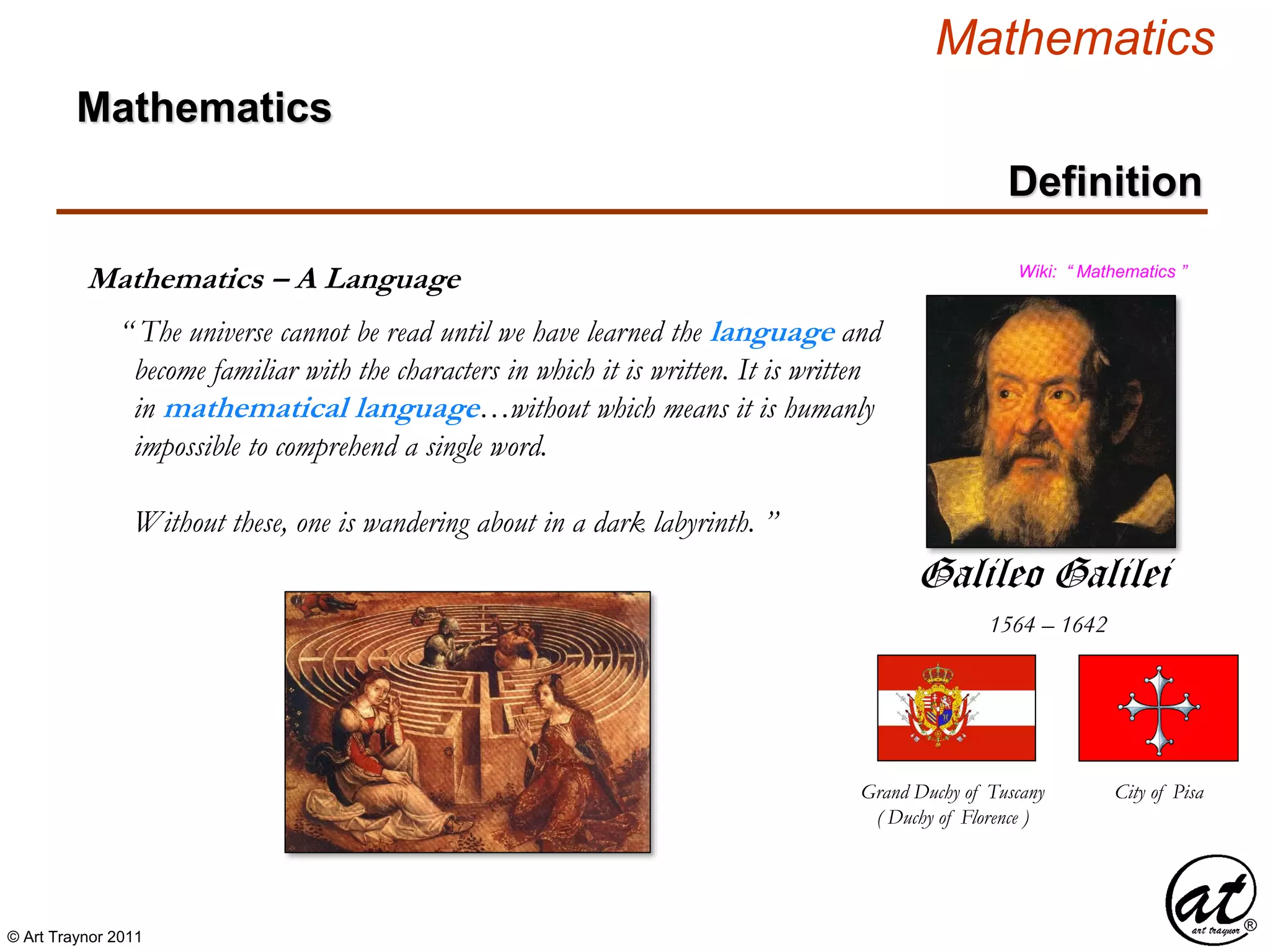
Mathematics – A Language
“ The universe cannot be read until we have learned the language and
become familiar with the characters in which it is written. It is written
in mathematical language…without which means it is humanly
impossible to comprehend a single word.
Without these, one is wandering about in a dark labyrinth. ”
© Art Traynor 2011
Mathematics
Definition
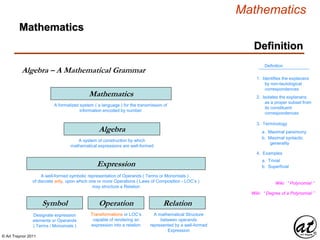
Algebra – A Mathematical Grammar
Mathematics
A formalized system ( a language ) for the transmission of
information encoded by number
Algebra
A system of construction by which
mathematical expressions are well-formed
Expression
Symbol Operation Relation
Designate expression
elements or Operands
( Terms / Monomials )
Transformations or LOC’s
capable of rendering an
expression into a relation
A mathematical Structure
between operands
represented by a well-formed
Expression
A well-formed symbolic representation of Operands ( Terms or Monomials ) ,
of discrete arity, upon which one or more Operations ( Laws of Composition - LOC’s )
may structure a Relation
1. Identifies the explanans
by non-tautological
correspondences
Definition
2. Isolates the explanans
as a proper subset from
its constituent
correspondences
3. Terminology
a. Maximal parsimony
b. Maximal syntactic
generality
4. Examples
a. Trivial
b. Superficial
Mathematics
Wiki: “ Polynomial ”
Wiki: “ Degree of a Polynomial ”
© Art Traynor 2011
Mathematics
Disciplines
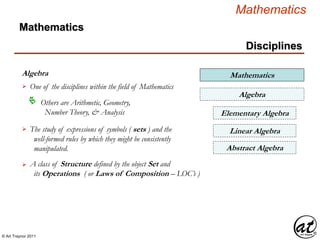
Algebra
One of the disciplines within the field of Mathematics
Mathematics
Others are Arithmetic, Geometry,
Number Theory, & Analysis

The study of expressions of symbols ( sets ) and the
well-formed rules by which they might be consistently
manipulated.

Algebra
Elementary Algebra
Abstract Algebra
A class of Structure defined by the object Set and
its Operations ( or Laws of Composition – LOC’s )

Linear Algebra
Mathematics
© Art Traynor 2011
Mathematics
Definitions
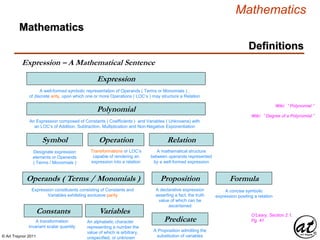
Expression
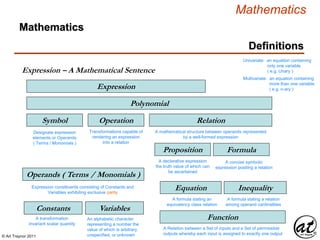
Symbol Operation Relation
Designate expression
elements or Operands
( Terms / Monomials )
Transformations or LOC’s
capable of rendering an
expression into a relation
A mathematical structure
between operands represented
by a well-formed expression
A well-formed symbolic representation of Operands ( Terms or Monomials ) ,
of discrete arity, upon which one or more Operations ( LOC’s ) may structure a Relation
Expression – A Mathematical Sentence
Proposition
A declarative expression
asserting a fact, the truth
value of which can be
ascertained
Formula
A concise symbolic
expression positing a relation
VariablesConstants
An alphabetic character
representing a number the
value of which is arbitrary,
unspecified, or unknown
Operands ( Terms / Monomials )
A transformation
invariant scalar quantity
Mathematics
Predicate
A Proposition admitting the
substitution of variables
O’Leary, Section 2.1,
Pg. 41
Expression constituents consisting of Constants and
Variables exhibiting exclusive parity
Polynomial
An Expression composed of Constants ( Coefficients ) and Variables ( Unknowns) with
an LOC’s of Addition, Subtraction, Multiplication and Non-Negative Exponentiation
Wiki: “ Polynomial ”
Wiki: “ Degree of a Polynomial ”
© Art Traynor 2011
Mathematics
Definitions
Expression
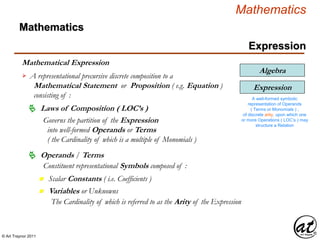
Symbol Operation Relation
Designate expression
elements or Operands
( Terms / Monomials )
Transformations capable of
rendering an expression
into a relation
A mathematical structure between operands represented
by a well-formed expression
Expression – A Mathematical Sentence
Proposition
A declarative expression
the truth value of which can
be ascertained
Formula
A concise symbolic
expression positing a relation
VariablesConstants
An alphabetic character
representing a number the
value of which is arbitrary,
unspecified, or unknown
Operands ( Terms / Monomials )
A transformation
invariant scalar quantity
Equation
A formula stating an
equivalency class relation
Inequality
A formula stating a relation
among operand cardinalities
Function
A Relation between a Set of inputs and a Set of permissible
outputs whereby each input is assigned to exactly one output
Univariate: an equation containing
only one variable
( e.g. Unary )
Multivariate: an equation containing
more than one variable
( e.g. n-ary )
Mathematics
Expression constituents consisting of Constants and
Variables exhibiting exclusive parity
Polynomial
© Art Traynor 2011
Mathematics
Definitions
Expression
Symbol Operation Relation
Expression – A Mathematical Sentence
Proposition Formula
VariablesConstants
Operands ( Terms )
Equation
A formula stating an
equivalency class relation
Linear Equation
An equation in which each term is either
a constant or the product of a constant
and (a) variable[s] of the first degree
Mathematics
Polynomial
© Art Traynor 2011
Mathematics
Expression
Mathematical Expression
A representational precursive discrete composition to a
Mathematical Statement or Proposition ( e.g. Equation )
consisting of :

Operands / Terms
Expression
A well-formed symbolic
representation of Operands
( Terms or Monomials ) ,
of discrete arity, upon which one
or more Operations ( LOC’s ) may
structure a Relation
Mathematics
n Scalar Constants ( i.e. Coefficients )
n Variables or Unknowns
The Cardinality of which is referred to as the Arity of the Expression
Constituent representational Symbols composed of :
Algebra
Laws of Composition ( LOC’s )
Governs the partition of the Expression
into well-formed Operands or Terms
( the Cardinality of which is a multiple of Monomials )
© Art Traynor 2011
Mathematics
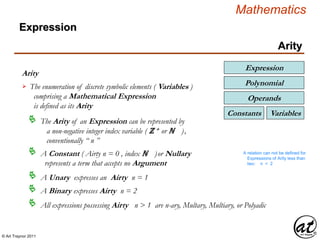
Arity
Arity
Expression
The enumeration of discrete symbolic elements ( Variables )
comprising a Mathematical Expression
is defined as its Arity

The Arity of an Expression can be represented by
a non-negative integer index variable ( ℤ + or ℕ ),
conventionally “ n ”

A Constant ( Airty n = 0 , index ℕ )or Nullary
represents a term that accepts no Argument

A Unary expresses an Airty n = 1
A relation can not be defined for
Expressions of Arity less than
two: n < 2
A Binary expresses Airty n = 2
All expressions possessing Airty n > 1 are n-ary, Multary, Multiary, or Polyadic
VariablesConstants
Operands
Expression
Polynomial
© Art Traynor 2011
Mathematics
Expression
Arity
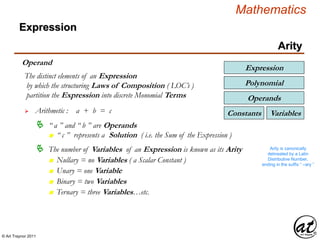
Operand
 Arithmetic : a + b = c
The distinct elements of an Expression
by which the structuring Laws of Composition ( LOC’s )
partition the Expression into discrete Monomial Terms
 “ a ” and “ b ” are Operands
 The number of Variables of an Expression is known as its Arity
n Nullary = no Variables ( a Scalar Constant )
n Unary = one Variable
n Binary = two Variables
n Ternary = three Variables…etc.
VariablesConstants
Operands
Expression
Polynomial
n “ c ” represents a Solution ( i.e. the Sum of the Expression )
Arity is canonically
delineated by a Latin
Distributive Number,
ending in the suffix “ –ary ”
© Art Traynor 2011
Mathematics
Arity
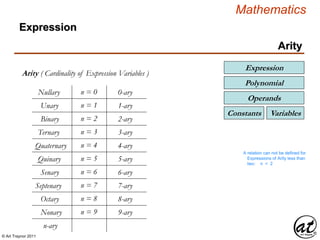
Arity ( Cardinality of Expression Variables )
Expression
A relation can not be defined for
Expressions of Arity less than
two: n < 2
Nullary
Unary
n = 0
n = 1
Binary n = 2
Ternary n = 3
1-ary
2-ary
3-ary
Quaternary n = 4 4-ary
Quinary n = 5 5-ary
Senary n = 6 6-ary
Septenary n = 7 7-ary
Octary n = 8 8-ary
Nonary n = 9 9-ary
n-ary
VariablesConstants
Operands
Expression
Polynomial
0-ary
© Art Traynor 2011
Mathematics
Operand
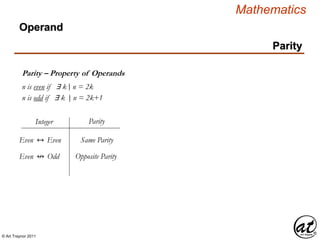
Parity – Property of Operands
Parity
n is even if ∃ k n = 2k
n is odd if ∃ k n = 2k+1
Even ↔ Even
Integer Parity
Same Parity
Even ↮ Odd Opposite Parity
|:
|:
© Art Traynor 2011
Mathematics
Polynomial
Expression
A well-formed symbolic
representation of operands, of
discrete arity, upon which one
or more operations can
structure a Relation
Expression
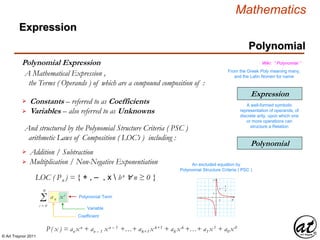
Polynomial Expression
A Mathematical Expression ,
the Terms ( Operands ) of which are a compound composition of :
Polynomial
Constants – referred to as Coefficients
Variables – also referred to as Unknowns
And structured by the Polynomial Structure Criteria ( PSC )
arithmetic Laws of Composition ( LOC’s ) including :
Addition / Subtraction
Multiplication / Non-Negative Exponentiation
LOC ( Pn ) = { + , – , x  bn ∀ n ≥ 0 }
Wiki: “ Polynomial ”
An excluded equation by
Polynomial Structure Criteria ( PSC )
Σ an xi
n
i = 0
P( x ) = an xn + an – 1 xn – 1 +…+ ak+1 xk+1 + ak xk +…+ a1 x1 + a0 x0
Variable
Coefficient
Polynomial Term
From the Greek Poly meaning many,
and the Latin Nomen for name




© Art Traynor 2011
Mathematics
Degree
Expression
Polynomial
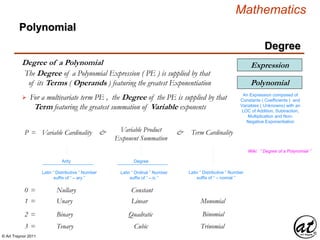
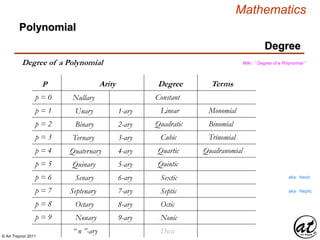
Degree of a Polynomial
Polynomial
Wiki: “ Degree of a Polynomial ”
The Degree of a Polynomial Expression ( PE ) is supplied by that
of its Terms ( Operands ) featuring the greatest Exponentiation
For a multivariate term PE , the Degree of the PE is supplied by that
Term featuring the greatest summation of Variable exponents

P = Variable Cardinality & Variable Product
Exponent Summation
& Term Cardinality
Arity
Latin “ Distributive ” Number
suffix of “ – ary ”
Degree
Latin “ Ordinal ” Number
suffix of “ – ic ”
Latin “ Distributive ” Number
suffix of “ – nomial ”
0 =
1 =
2 =
3 =
Nullary
Unary
Binary
Tenary
Constant
Linear
Quadratic
Cubic
Monomial
Binomial
Trinomial
An Expression composed of
Constants ( Coefficients ) and
Variables ( Unknowns) with an
LOC of Addition, Subtraction,
Multiplication and Non-
Negative Exponentiation
© Art Traynor 2011
Mathematics
Degree
Polynomial
Degree of a Polynomial
Nullary
Unary
p = 0
p = 1 Linear
Binaryp = 2 Quadratic
Ternaryp = 3 Cubic
1-ary
2-ary
3-ary
Quaternaryp = 4 Quartic4-ary
Quinaryp = 5 5-ary
Senaryp = 6 6-ary
Septenaryp = 7 7-ary
Octaryp = 8 8-ary
Nonaryp = 9 9-ary
“ n ”-ary
Arity Degree
Monomial
Binomial
Trinomial
Quadranomial
Terms
Constant
Quintic
P
Wiki: “ Degree of a Polynomial ”
Septic
Octic
Nonic
Decic
Sextic
aka: Heptic
aka: Hexic
© Art Traynor 2011
Mathematics
Degree
Expression
Polynomial
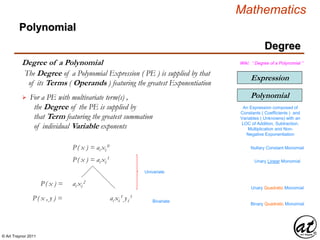
Degree of a Polynomial
Polynomial
Wiki: “ Degree of a Polynomial ”
An Expression composed of
Constants ( Coefficients ) and
Variables ( Unknowns) with an
LOC of Addition, Subtraction,
Multiplication and Non-
Negative Exponentiation
The Degree of a Polynomial Expression ( PE ) is supplied by that
of its Terms ( Operands ) featuring the greatest Exponentiation
For a PE with multivariate term(s) ,
the Degree of the PE is supplied by
that Term featuring the greatest summation
of individual Variable exponents

P( x ) = ai xi
0 Nullary Constant Monomial
P( x ) = ai xi
1
Unary Linear Monomial
P( x ) = ai xi
2
Unary Quadratic Monomial
ai xi
1 yi
1P( x , y ) =
Binary Quadratic Monomial
Univariate
Bivariate
© Art Traynor 2011
Mathematics
Degree
Expression
Polynomial
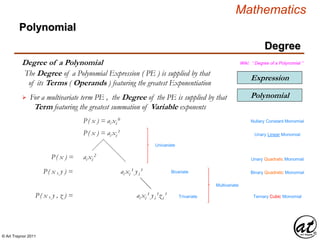
Degree of a Polynomial
Polynomial
Wiki: “ Degree of a Polynomial ”
The Degree of a Polynomial Expression ( PE ) is supplied by that
of its Terms ( Operands ) featuring the greatest Exponentiation
For a multivariate term PE , the Degree of the PE is supplied by that
Term featuring the greatest summation of Variable exponents

P( x ) = ai xi
0 Nullary Constant Monomial
P( x ) = ai xi
1
Unary Linear Monomial
P( x ) = ai xi
2
Unary Quadratic Monomial
ai xi
1 yi
1P( x , y ) = Binary Quadratic Monomial
ai xi
1 yi
1zi
1P( x , y , z ) = Ternary Cubic Monomial
Univariate
Bivariate
Trivariate
Multivariate
© Art Traynor 2011
Mathematics
Quadratic
Expression
Polynomial
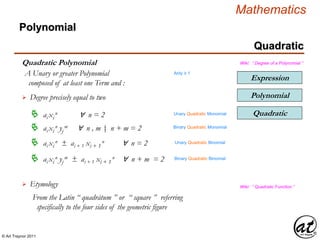
Quadratic Polynomial
Polynomial
Wiki: “ Degree of a Polynomial ”
A Unary or greater Polynomial
composed of at least one Term and :
Degree precisely equal to two
Quadratic ai xi
n ∀ n = 2
 ai xi
n yj
m ∀ n , m n + m = 2|:
Etymology
From the Latin “ quadrātum ” or “ square ” referring
specifically to the four sides of the geometric figure
Wiki: “ Quadratic Function ”
Arity ≥ 1
 ai xi
n ± ai + 1 xi + 1
n ∀ n = 2
Unary Quadratic Monomial
Binary Quadratic Monomial
Unary Quadratic Binomial
 ai xi
n yj
m ± ai + 1 xi + 1
n ∀ n + m = 2 Binary Quadratic Binomial
© Art Traynor 2011
Mathematics
Equation
Equation
Expression
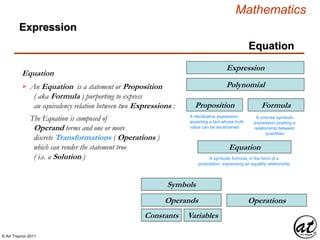
An Equation is a statement or Proposition
( aka Formula ) purporting to express
an equivalency relation between two Expressions :

Expression
Proposition
A declarative expression
asserting a fact whose truth
value can be ascertained
Equation
A symbolic formula, in the form of a
proposition, expressing an equality relationship
Formula
A concise symbolic
expression positing a
relationship between
quantities
VariablesConstants
Operands
Symbols
Operations
The Equation is composed of
Operand terms and one or more
discrete Transformations ( Operations )
which can render the statement true
( i.e. a Solution )
Polynomial
© Art Traynor 2011
Mathematics
Equation
Solution
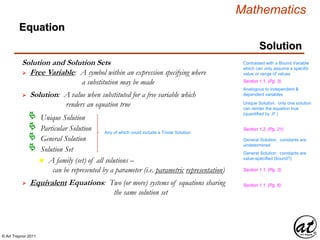
Solution and Solution Sets
 Free Variable: A symbol within an expression specifying where
a substitution may be made
Contrasted with a Bound Variable
which can only assume a specific
value or range of values
 Solution: A value when substituted for a free variable which
renders an equation true
Analogous to independent &
dependent variables
Unique Solution: only one solution
can render the equation true
(quantified by $! )
General Solution: constants are
undetermined
General Solution: constants are
value-specified (bound?)
Unique Solution
Particular Solution
General Solution
Solution Set
n A family (set) of all solutions –
can be represented by a parameter (i.e. parametric representation)
 Equivalent Equations: Two (or more) systems of equations sharing
the same solution set
Section 1.1, (Pg. 3)
Section 1.1, (Pg. 6)
Any of which could include a Trivial Solution
Section 1.2, (Pg. 21)
© Art Traynor 2011
Mathematics
Equation
Solution
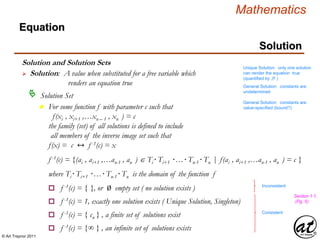
Solution and Solution Sets
 Solution: A value when substituted for a free variable which
renders an equation true
Unique Solution: only one solution
can render the equation true
(quantified by $! )
General Solution: constants are
undetermined
General Solution: constants are
value-specified (bound?)
Solution Set
n For some function f with parameter c such that
f(xi , xi+1 ,…xn – 1 , xn ) = c
the family (set) of all solutions is defined to include
all members of the inverse image set such that
f(x) = c ↔ f -1(c) = x
f -1(c) = {(ai , ai+1 ,…an-1 , an ) Ti· Ti+1 ·…· Tn-1· Tn |f(ai , ai+1 ,…an-1 , an ) = c }
where Ti· Ti+1 ·…· Tn-1· Tn is the domain of the function f
o f -1(c) = { }, or Ø empty set ( no solution exists )
o f -1(c) = 1, exactly one solution exists ( Unique Solution, Singleton)
o f -1(c) = { cn } , a finite set of solutions exist
o f -1(c) = {∞ } , an infinite set of solutions exists
Inconsistent
Consistent
Section 1.1,
(Pg. 5)
© Art Traynor 2011
Mathematics
Linear Equation
Linear Equation
Equation
An Equation consisting of:
Operands that are either
Any Variables are restricted to the First Order n = 1
Linear Equation
An equation in which each term
is either a constant or the
product of a constant and (a)
variable[s] of the first order
Expression
Proposition
Equation
Formula
n Constant(s) or
n A product of Constant(s) and
one or more Variable(s)
The Linear character of the Equation derives from the
geometry of its graph which is a line in the R2 plane

As a Relation the Arity of a Linear Equation must be
at least two, or n ≥ 2 , or a Binomial or greater Polynomial

Polynomial
© Art Traynor 2011
Mathematics
Equation
Linear Equation
Linear Equation
 An equation in which each term is either a constant or the product
of a constant and (a) variable[s] of the first order
Term ai represents a Coefficient
b = Σi= 1
n
ai xi = ai xi + ai+1 xi+1…+ an – 1 xn – 1 + an xn
Equation of a Line in n-variables
 A linear equation in “ n ” variables, xi + xi+1 …+ xn-1 + xn
has the form:
n Coefficients are distributed over a defined field
(e.g. ℕ , ℤ , ℚ , ℝ , ℂ )
Term xi represents a Variable ( e.g. x, y, z )
n Term a1 is defined as the Leading Coefficient
n Term x1 is defined as the Leading Variable
Section 1.1, (Pg. 2)
Coefficient = a multiplicative factor
(scalar) of fixed value (constant)
Section 1.1, (Pg. 2)
© Art Traynor 2011
Mathematics
Linear Equation
Equation
Standard Form ( Polynomial )
 Ax + By = C
 Ax1 + By1 = C
For the equation to describe a line ( no curvature )
the variable indices must equal one

 ai xi + ai+1 xi+1 …+ an – 1 xn –1 + an xn = b
 ai xi
1 + ai+1 x 1 …+ an – 1 x 1 + a1 x 1 = bi+1 n – 1 n n
ℝ
2
: a1 x + a2 y = b
ℝ
3
: a1 x + a2 y + a3 z = b
Blitzer, Section 3.2, (Pg. 226)
Section 1.1, (Pg. 2)
Test for Linearity
 A Linear Equation can be expressed in Standard Form
As a species of Polynomial , a Linear Equation
can be expressed in Standard Form
 Every Variable term must be of precise order n = 1
Linear Equation
An equation in which each term
is either a constant or the
product of a constant and (a)
variable[s] of the first order
Expression
Proposition
Equation
Formula
Polynomial
© Art Traynor 2011
Mathematics
Definition
Sequence
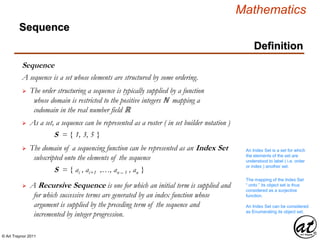
Sequence
 The order structuring a sequence is typically supplied by a function
whose domain is restricted to the positive integers ℕ mapping a
codomain in the real number field ℝ
A sequence is a set whose elements are structured by some ordering.
S = { 1, 3, 5 }
 As a set, a sequence can be represented as a roster ( in set builder notation )
 The domain of a sequencing function can be represented as an Index Set
subscripted onto the elements of the sequence
S = { ai , ai+1 ,…, an – 1 , an }
The mapping of the Index Set
“ onto ” its object set is thus
considered as a surjective
function.
An Index Set is a set for which
the elements of the set are
understood to label ( i.e. order
or index ) another set.
An Index Set can be considered
as Enumerating its object set.
 A Recursive Sequence is one for which an initial term is supplied and
for which successive terms are generated by an index function whose
argument is supplied by the preceding term of the sequence and
incremented by integer progression.
© Art Traynor 2011
Mathematics
Sequence
A collection of real numbers that stands
in one-to-one correspondence with the set of positive integers. Swok, Section 11.1, (Pg. 520)
A set whose elements are structured by some ordering.
An Ordered Set
Wiki / AT: “ Sequence ”
A Function f
the domain of which is the set of positive integers. A Function
 To each positive Integer “ k ” ,
there corresponds a Real Number “ f( k ) ”
f : ℤ + → ℝ , dom ( S ) = { k , n ℤ + | [ ak , ak+1 , … , an – 1 , an ] }
ran ( S ) = { k , n ℤ + | [ f(k) , f(k+1) , … , f(n – 1) , f(n) ] }
f(k) = ak → ℤ + x ℝ → ( k , ak ) , ( k +1 , ak+1 ) , … The Cartesian Product
… , ( n – 1, an – 1 ) , ( n , an )
Not necessarily a Sum (as is
the case with a Series)
The Cartesian Product
Definition
Sequence
© Art Traynor 2011
Mathematics
Sequence
Set
Sequence
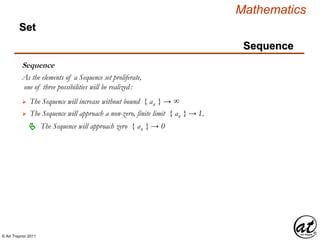
As the elements of a Sequence set proliferate,
one of three possibilities will be realized:
 The Sequence will increase without bound { an } → ∞
 The Sequence will approach a non-zero, finite limit { an } → L
The Sequence will approach zero { an } → 0
© Art Traynor 2011
Mathematics
Sequence
Set
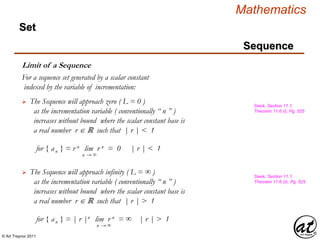
Limit of a Sequence
For a sequence set generated by a scalar constant
indexed by the variable of incrementation:
 The Sequence will approach zero ( L = 0 )
as the incrementation variable ( conventionally “ n ” )
increases without bound where the scalar constant base is
a real number r ℝ such that | r | < 1
for { an } = r n lim r n = 0 | r | < 1
n → ∞
Swok, Section 11.1,
Theorem 11.6 (i), Pg. 525
 The Sequence will approach infinity ( L = ∞ )
as the incrementation variable ( conventionally “ n ” )
increases without bound where the scalar constant base is
a real number r ℝ such that | r | > 1
for { an } = | r |n lim r n = ∞ | r | > 1
n → ∞
Swok, Section 11.1,
Theorem 11.6 (ii), Pg. 525
© Art Traynor 2011
Mathematics
Sequence
Set
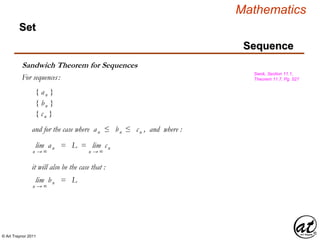
Sandwich Theorem for Sequences
For sequences:
Swok, Section 11.1,
Theorem 11.7, Pg. 527
{ an }
{ bn }
{ cn }
and for the case where an ≤ bn ≤ cn , and where :
lim an
n = L = lim cn
n → ∞ n → ∞
it will also be the case that :
lim bn
n = L
n → ∞
© Art Traynor 2011
Mathematics
Sequence
Set
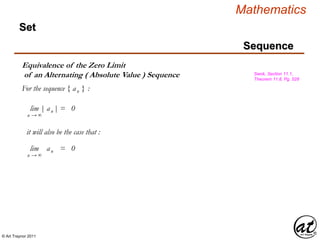
Equivalence of the Zero Limit
of an Alternating ( Absolute Value ) Sequence Swok, Section 11.1,
Theorem 11.8, Pg. 528
For the sequence { an } :
lim | an | = 0
n → ∞
it will also be the case that :
lim | an | = 0
n → ∞
© Art Traynor 2011
Mathematics
Sequence
Set
Sequence Properties
Swok, Section 11.1, Pg. 528
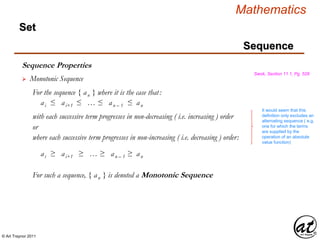
ai ≤ ai+1 ≤ … ≤ an – 1 ≤ an
 Monotonic Sequence
For the sequence { an } where it is the case that:
with each successive term progresses in non-decreasing ( i.e. increasing ) order
where each successive term progresses in non-increasing ( i.e. decreasing ) order:
or
ai ≥ ai+1 ≥ … ≥ an – 1 ≥ an
For such a sequence, { an } is denoted a Monotonic Sequence
It would seem that this
definition only excludes an
alternating sequence ( e.g.
one for which the terms
are supplied by the
operation of an absolute
value function)
© Art Traynor 2011
Mathematics
Sequence
Set
Sequence Properties
Swok, Section 11.1, Pg. 528
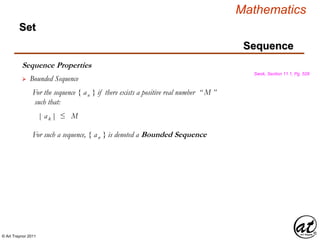
 Bounded Sequence
For the sequence { an } if there exists a positive real number “ M ”
such that:
| ak | ≤ M
For such a sequence, { an } is denoted a Bounded Sequence
© Art Traynor 2011
Mathematics
Sequence
Set
Sequence Properties
Swok, Section 11.1, Pg. 528
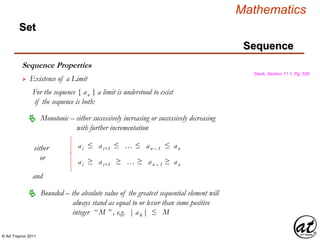
 Existence of a Limit
For the sequence { an } a limit is understood to exist
if the sequence is both:
Monotonic – either successively increasing or successively decreasing
with further incrementation

Bounded – the absolute value of the greatest sequential element will
always stand as equal to or lesser than some positive
integer “ M ” , e.g. | ak | ≤ M

and
ai ≤ ai+1 ≤ … ≤ an – 1 ≤ an
ai ≥ ai+1 ≥ … ≥ an – 1 ≥ an
either
or
© Art Traynor 2011
Mathematics
Sequence
Set
Sequence Properties
Swok, Section 11.1, Pg. 528
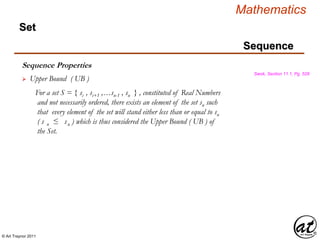
 Upper Bound ( UB )
For a set S = { si , si+1 ,…sn-1 , sn } , constituted of Real Numbers
and not necessarily ordered, there exists an element of the set su such
that every element of the set will stand either less than or equal to su
( s n ≤ su ) which is thus considered the Upper Bound ( UB ) of
the Set.
© Art Traynor 2011
Mathematics
Sequence
Set
Sequence Properties
Swok, Section 11.1, Pg. 528
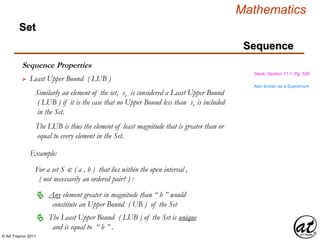
 Least Upper Bound ( LUB )
Similarly an element of the set, sv is considered a Least Upper Bound
( LUB ) if it is the case that no Upper Bound less than sv is included
in the Set.
The LUB is thus the element of least magnitude that is greater than or
equal to every element in the Set.
Example:
For a set S  ( a , b ) that lies within the open interval ,
( not necessarily an ordered pair? ) :
Any element greater in magnitude than “ b ” would
constitute an Upper Bound ( UB ) of the Set

The Least Upper Bound ( LUB ) of the Set is unique
and is equal to “ b ” .

Also known as a Supremum
© Art Traynor 2011
Mathematics
Sequence
Set
Sequence Properties
Swok, Section 11.1, Pg. 528
 Least Upper Bound ( LUB )
Similarly an element of the set, sv is considered a Least Upper Bound
( LUB ) if it is the case that no Upper Bound less than sv is included
in the Set.
The LUB is thus the element of least magnitude that is greater than or
equal to every element in the Set.
© Art Traynor 2011
Mathematics
Sequence
Set
Sequence Properties
Swok, Section 11.1, Pg. 529
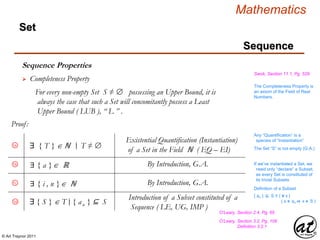
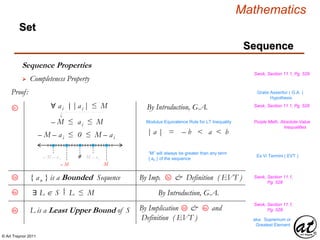
 Completeness Property
The Completeness Property is
an axiom of the Field of Real
Numbers.
For every non-empty Set S ≠ possessing an Upper Bound, it is
always the case that such a Set will concomitantly possess a Least
Upper Bound ( LUB ), “ L ” .
Proof:
Introduction of a Subset constituted of a
Sequence ( LE, UG, IMP )
$ { T } ℕ T ≠
Any “Quantification” is a
species of “Instantiation”
$ { S } T { an } ⊆ S
Existential Quantification (Instantiation)
of a Set in the Field ℕ ( EQ – EI) The Set “S” is not empty (G.A.)
If we’ve instantiated a Set, we
need only “declare” a Subset,
as every Set is constituted of
its trivial Subsets
Definition of a Subset
{ an } ⊆ S ≡ ( ∀ x )
( x ∊ an ⇒ x ∊ S )
O’Leary, Section 2.4, Pg. 65
O’Leary, Section 3.2, Pg. 109
Definition 3.2.1
1b
∃ { a } ℝ By Introduction, G.A.
1a
1d
1c
∃ { i , n }ℕ By Introduction, G.A.
|:
|:
© Art Traynor 2011
Mathematics
Sequence
Set
Sequence Properties
Swok, Section 11.1, Pg. 529
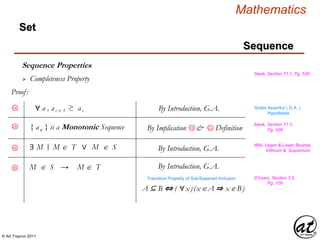
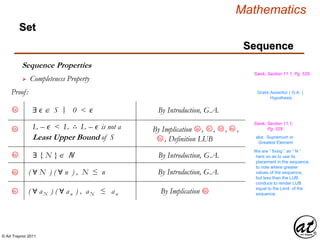
 Completeness Property
Proof:
Gratis Asseritur ( G.A. )
Hypothesis
2b
Swok, Section 11.1,
Pg. 528{ an } is a Monotonic Sequence
∀ a , ai + 1 ≥ ai By Introduction, G.A.2a
2aBy Implication & Definition1d
|:∃ M M  T ∨ M  S By Introduction, G.A.3a
M  S → M  T By Introduction, G.A.3b
A ⊆ B ⇔ ( ∀x)(xA ⇒ xB)
Transitive Property of Sub/Superset Inclusion O’Leary, Section 3.2,
Pg. 109
Wiki, Upper & Lower Bounds,
Infimum & Supremum
© Art Traynor 2011
Mathematics
Sequence
Set
Sequence Properties
Swok, Section 11.1, Pg. 529
 Completeness Property
Proof: Gratis Asseritur ( G.A. )
Hypothesis
∀ ai |ai |≤ M
– M ≤ ai ≤ M
0
| a | = – b < a < b
Modulus Equivalence Rule for LT Inequality
– M – ai ≤ 0 ≤ M – ai
– M – a i M – a i
M– M
By Introduction, G.A.
“M” will always be greater than any term
{ an } of the sequence
3c
3d { an } is a Bounded Sequence By Imp. & Definition ( EVT )3a
Ex Vi Termini ( EVT )
Swok, Section 11.1,
Pg. 528
|: Swok, Section 11.1, Pg. 528
Purple Math, Absolute-Value
Inequalities
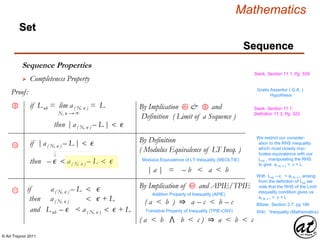
∃ L  S L ≤ M By Introduction, G.A.4a |:
4b L is a Least Upper Bound of S By Implication & and
Definition ( EVT )
3d 4a
Swok, Section 11.1,
Pg. 528
aka: Supremum or
Greatest Element
© Art Traynor 2011
Mathematics
Sequence
Set
Sequence Properties
Swok, Section 11.1, Pg. 529
 Completeness Property
Proof: Gratis Asseritur ( G.A. )
Hypothesis
By Introduction, G.A.5a ∃ ϵ  S 0 < ϵ|:
L – ϵ < L ∴ L – ϵ is not a
Least Upper Bound of S
Swok, Section 11.1,
Pg. 5285b 3c
By Implication , , , ,
, Definition LUB
3a 3d 4a
5a aka: Supremum or
Greatest Element
By Introduction, G.A.6a ∃ { N }ℕ
We are “ fixing ” an “ N ”
here so as to use its
placement in the sequence
to note where greater
values of the sequence,
but less than the LUB,
conduce to render LUB
equal to the Limit of the
sequence.
6c By Implication 6b( ∀ aN ) ( ∀ an ) , aN ≤ an
( ∀ N ) ( ∀ n ) , N ≤ n By Introduction, G.A.6b
© Art Traynor 2011
Mathematics
Sequence
Set
Sequence Properties
Swok, Section 11.1, Pg. 529
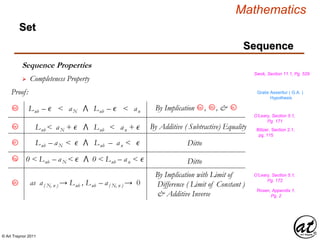
 Completeness Property
Proof: Gratis Asseritur ( G.A. )
Hypothesis
O’Leary, Section 5.1,
Pg. 171
Lub – ϵ < aN ⋀ Lub – ϵ < an
6d 6b
By Implication , , &6a 6c
Lub < aN + ϵ ⋀ Lub < an + ϵ
Lub – aN < ϵ ⋀ Lub – an < ϵ
0 < Lub – aN < ϵ ⋀ 0 < Lub – an < ϵ
as a( N, n ) → Lub , Lub – a( N, n ) → 0
By Additive ( Subtractive) Equality Blitzer, Section 2.1,
pg. 115
Ditto
Ditto
6e
6f
6g
6h
By Implication with Limit of
Difference ( Limit of Constant )
& Additive Inverse
O’Leary, Section 5.1,
Pg. 172
Rosen, Appendix 1,
Pg. 2
© Art Traynor 2011
Mathematics
Sequence
Set
Sequence Properties
Swok, Section 11.1, Pg. 529
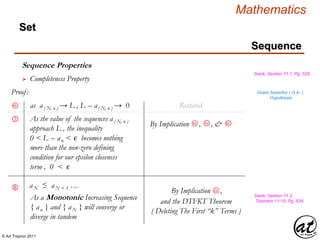
 Completeness Property
Proof: Gratis Asseritur ( G.A. )
Hypothesis
as a( N, n ) → L , L – a( N, n ) → 0
As the value of the sequences a( N, n )
approach L , the inequality
0 < L – an < ϵ becomes nothing
more than the non-zero defining
condition for our epsilon closeness
term , 0 < ϵ
6h
⑦
Restated
5a
By Implication , , &4a 6h
Swok, Section 11.2,
Theorem 11.19, Pg. 539
aN ≤ aN + 1 …
By Implication ,2a
As a Monotonic Increasing Sequence
{ an } and { aN } will converge or
diverge in tandem
and the DTFKT Theorem
( Deleting The First “k” Terms )
⑧
© Art Traynor 2011
Mathematics
Sequence
Set
Sequence Properties
Swok, Section 11.1, Pg. 529
 Completeness Property
Proof: Gratis Asseritur ( G.A. )
Hypothesis
if Lub = lim a( N, n ) = L⑨
N, n → ∞
then |a( N, n ) – L |< ϵ
Swok, Section 11.1,
Definition 11.3, Pg. 522
By Implication & and
Definition ( Limit of a Sequence )
4b ⑧
if |a( N, n ) – L |< ϵ
then – ϵ < a( N, n ) – L < ϵ
10
| a | = – b < a < b
Modulus Equivalence of LT Inequality (MEOLTIE)
By Definition
( Modulus Equivalence of LT Ineq. )
if a( N, n ) – L < ϵ
then a( N, n ) < ϵ + L
We restrict our consider-
ation to the RHS inequality
which most closely imp-
licates equivalence with our
Lub , manipulating the RHS
to give a( N, n ) < ϵ + L
11
By Implication of and APIE/TPIE6d
With Lub – ϵ < a( N, n ) arising
from the definition of Lub we
note that the RHS of the Limit
inequality condition gives us
a( N, n ) < ϵ + L
Wiki: “Inequality (Mathematics)Transitive Property of Inequality (TPIE-CNV)and Lub – ϵ < a( N, n ) < ϵ + L
Addition Property of Inequality (APIE)
( a < b ⋀ b < c ) ⇒ a < b < c
( a < b ) ⇒ a – c < b – c Blitzer, Section 2.7, pg 186
© Art Traynor 2011
Mathematics
Sequence
Set
Sequence Properties
Swok, Section 11.1, Pg. 529
 Completeness Property
Proof:
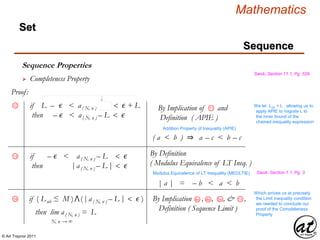
12 We let Lub = L , allowing us to
apply APIE to migrate L to
the inner bound of the
chained inequality expression
Addition Property of Inequality (APIE)
( a < b ) ⇒ a – c < b – c
By Implication of and
Definition ( APIE )
11if L – ϵ < a( N, n ) < ϵ + L
then – ϵ < a( N, n ) – L < ϵ
if – ϵ < a( N, n ) – L < ϵ
then |a( N, n ) – L |< ϵ
Swok, Section 1.1, Pg. 3
Which arrives us at precisely
the Limit inequality condition
we needed to conclude our
proof of the Completeness
Property
| a | = – b < a < b
Modulus Equivalence of LT Inequality (MEOLTIE)
By Definition
( Modulus Equivalence of LT Ineq. )
then lim a( N, n ) = L
N, n → ∞
if ( Lub ≤ M )⋀( |a( N, n ) – L |< ϵ )
13
14 5aBy Implication , , , & ,
Definition ( Sequence Limit )
4b 134a
© Art Traynor 2011
Mathematics
Sequence
Set
Sequence Properties
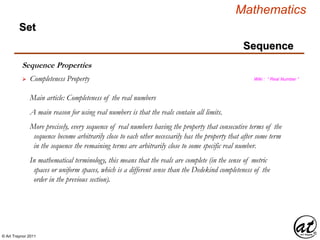
 Completeness Property Wiki : “ Real Number ”
Main article: Completeness of the real numbers
A main reason for using real numbers is that the reals contain all limits.
More precisely, every sequence of real numbers having the property that consecutive terms of the
sequence become arbitrarily close to each other necessarily has the property that after some term
in the sequence the remaining terms are arbitrarily close to some specific real number.
In mathematical terminology, this means that the reals are complete (in the sense of metric
spaces or uniform spaces, which is a different sense than the Dedekind completeness of the
order in the previous section).
© Art Traynor 2011
Mathematics
Sequence
Set
Sequence Properties
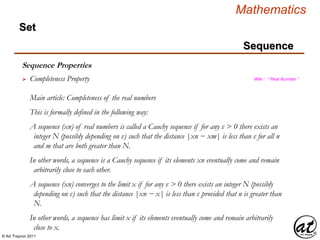
 Completeness Property Wiki : “ Real Number ”
Main article: Completeness of the real numbers
This is formally defined in the following way:
A sequence (xn) of real numbers is called a Cauchy sequence if for any ε > 0 there exists an
integer N (possibly depending on ε) such that the distance |xn − xm| is less than ε for all n
and m that are both greater than N.
In other words, a sequence is a Cauchy sequence if its elements xn eventually come and remain
arbitrarily close to each other.
A sequence (xn) converges to the limit x if for any ε > 0 there exists an integer N (possibly
depending on ε) such that the distance |xn − x| is less than ε provided that n is greater than
N.
In other words, a sequence has limit x if its elements eventually come and remain arbitrarily
close to x.
© Art Traynor 2011
Mathematics
Sequence
Set
Sequence Properties
 Completeness Property Wiki : “ Real Number ”
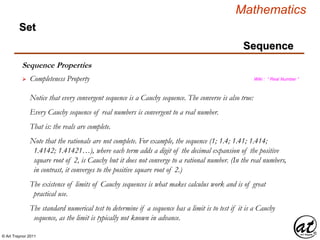
Notice that every convergent sequence is a Cauchy sequence. The converse is also true:
Every Cauchy sequence of real numbers is convergent to a real number.
That is: the reals are complete.
Note that the rationals are not complete. For example, the sequence (1; 1.4; 1.41; 1.414;
1.4142; 1.41421…), where each term adds a digit of the decimal expansion of the positive
square root of 2, is Cauchy but it does not converge to a rational number. (In the real numbers,
in contrast, it converges to the positive square root of 2.)
The existence of limits of Cauchy sequences is what makes calculus work and is of great
practical use.
The standard numerical test to determine if a sequence has a limit is to test if it is a Cauchy
sequence, as the limit is typically not known in advance.
© Art Traynor 2011
Mathematics
Sequence
Set
Sequence Properties
 Completeness Property Wiki : “ Real Number ”
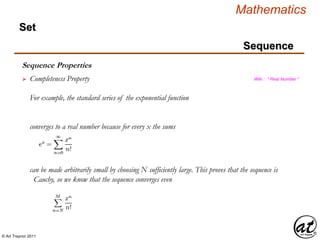
For example, the standard series of the exponential function
converges to a real number because for every x the sums
can be made arbitrarily small by choosing N sufficiently large. This proves that the sequence is
Cauchy, so we know that the sequence converges even
© Art Traynor 2011
Mathematics
Sequence
Limit
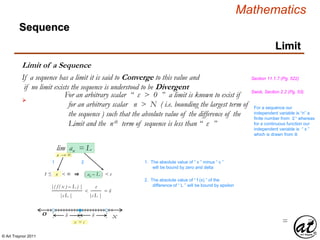
lim an = L
n → ∞
xO
x = c
δ δ
1
1 ≤ n < ∞ ⇒
1. The absolute value of “ x ” minus “ c ”
will be bound by zero and delta
| an – L | < ε
2
2. The absolute value of “ f (x) ” of the
difference of “ L ” will be bound by epsilon|( f ( x ) – L ) |
= =
|c L |
<
|c L |
ε
= δ
Limit of a Sequence

For an arbitrary scalar “ ε > 0 ” a limit is known to exist if
for an arbitrary scalar n > N ( i.e. bounding the largest term of
the sequence ) such that the absolute value of the difference of the
Limit and the nth term of sequence is less than “ ε ”
If a sequence has a limit it is said to Converge to this value and
if no limit exists the sequence is understood to be Divergent
Section 11.1.7 (Pg. 522)
Swok, Section 2.2 (Pg. 53)
For a sequence our
independent variable is “n” a
finite number from ℤ+ whereas
for a continuous function our
independent variable is “ x ”
which is drawn from ℝ
© Art Traynor 2011
Mathematics
Series
Set
Infinite Series
Swok, Section 11.2, Pg. 533
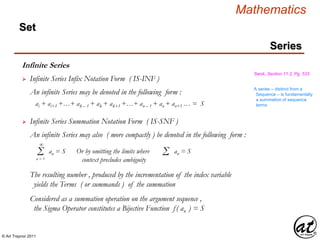
An infinite Series may be denoted in the following form : A series – distinct from a
Sequence – is fundamentally
a summation of sequence
terms
 Infinite Series Infix Notation Form ( IS-INF )
ai + ai+1 +…+ ak – 1 + ak + ak+1 +…+ an – 1 + an + an+1 … = S
Σn = 1
∞
an = S
An infinite Series may also ( more compactly ) be denoted in the following form :
 Infinite Series Summation Notation Form ( IS-SNF )
Or by omitting the limits where
context precludes ambiguity
Σ an = S
The resulting number , produced by the incrementation of the index variable
yields the Terms ( or summands ) of the summation
Considered as a summation operation on the argument sequence ,
the Sigma Operator constitutes a Bijective Function f( an ) = S
© Art Traynor 2011
Mathematics
Canonical Forms
Series
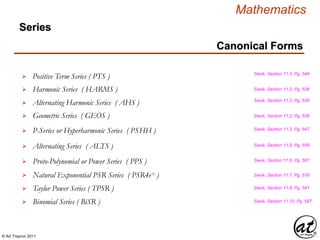
Positive Term Series ( PTS )
Harmonic Series ( HARMS )
Alternating Harmonic Series ( AHS )
Geometric Series ( GEOS )
P-Series or Hyperharmonic Series ( PSHH )
Alternating Series ( ALTS )
Swok, Section 11.3, Pg. 544
Swok, Section 11.2, Pg. 536
Natural Exponential PSR Series ( PSR4ex ) Swok, Section 11.7, Pg. 576
Swok, Section 11.8, Pg. 581Taylor Power Series ( TPSR )
Swok, Section 11.3, Pg. 547
Swok, Section 11.5, Pg. 558
Proto-Polynomial or Power Series ( PPS ) Swok, Section 11.6, Pg. 567
Swok, Section 11.10, Pg. 597Binomial Series ( BiSR )
© Art Traynor 2011
Mathematics
Series
Set
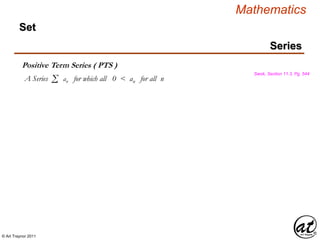
Positive Term Series ( PTS )
Swok, Section 11.3, Pg. 544
A Series for which all 0 < an for all nΣ an
© Art Traynor 2011
Mathematics
Canonical Series
Set
Canonical Series
Swok, Section 11.2, Pg. 536
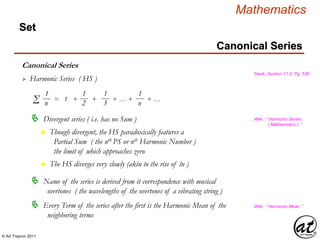
 Harmonic Series ( HS )
1
nΣ = 1 + + + … + + …
1
2
1
3
1
n
 Divergent series ( i.e. has no Sum )
 Name of the series is derived from it correspondence with musical
overtones ( the wavelengths of the overtones of a vibrating string )
 Every Term of the series after the first is the Harmonic Mean of the
neighboring terms
Wiki: “ Harmonic Series
( Mathematics ) ”
Though divergent, the HS paradoxically features a
Partial Sum ( the nth PS or nth Harmonic Number )
the limit of which approaches zero
n
The HS diverges very slowly (akin to the rise of ln )n
Wiki: “ Harmonic Mean ”
© Art Traynor 2011
Mathematics
Set
Canonical Series
Swok, Section 11.2, Pg. 536
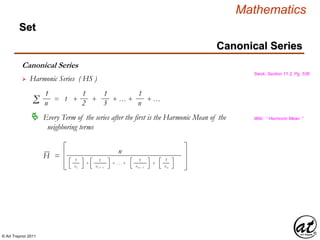
 Harmonic Series ( HS )
1
nΣ = 1 + + + … + + …
1
2
1
3
1
n
 Every Term of the series after the first is the Harmonic Mean of the
neighboring terms
Wiki: “ Harmonic Mean ”
1
xi
H =
n
+ + … + +
1
xi + 1
1
xn – 1
1
xn
Canonical Series
© Art Traynor 2011
Mathematics
Canonical Series
Set
Canonical Series
Swok, Section 11.2, Pg. 536
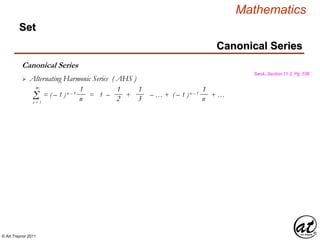
 Alternating Harmonic Series ( AHS )
= ( – 1 )n – 1 = 1 – + – … + ( – 1 )n – 1 + …
1
n
1
2Σn = 1
∞ 1
3
1
n
© Art Traynor 2011
Mathematics
Set
Canonical Series
Swok, Section 11.2, Pg. 536
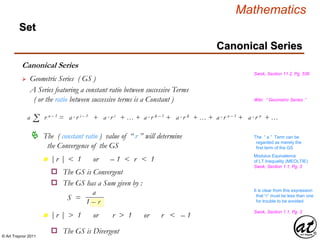
 Geometric Series ( GS )
Σa r n – 1 = a·r i – 1 + a·r i + … + a·r k – 1 + a·r k + … + a·r n – 1 + a·r n + …
 The ( constant ratio ) value of “ r ” will determine
the Convergence of the GS
|r | < 1 or – 1 < r < 1n
|r | > 1 or r > 1 or r < – 1n
o The GS is Convergent
o The GS has a Sum given by :
a
1 – r
S =
o The GS is Divergent
A Series featuring a constant ratio between successive Terms
( or the ratio between successive terms is a Constant )
The “ a ” Term can be
regarded as merely the
first term of the GS
Wiki: “ Geometric Series ”
Swok, Section 1.1, Pg. 3
Modulus Equivalence
of LT Inequality (MEOLTIE)
Swok, Section 1.1, Pg. 3
It is clear from this expression
that “r” must be less than one
for trouble to be avoided
Canonical Series
© Art Traynor 2011
Mathematics
Set
Canonical Series
Swok, Section 11.3, Pg. 547
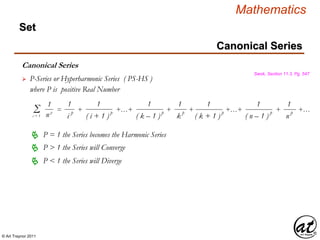
 P-Series or Hyperharmonic Series ( PS-HS )
Σi = 1
= + +…+ + + +…+ + +…
1
n p
1
i
p
1
( i + 1 )
p
1
( k – 1 )
p
1
k p
1
( k + 1 )
p
1
( n – 1 )
p
1
n
p
where P is positive Real Number
P = 1 the Series becomes the Harmonic Series
P > 1 the Series will Converge
P < 1 the Series will Diverge
Canonical Series
© Art Traynor 2011
Mathematics
Set
Canonical Series
Swok, Section 11.5, Pg. 558
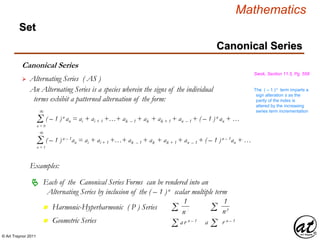
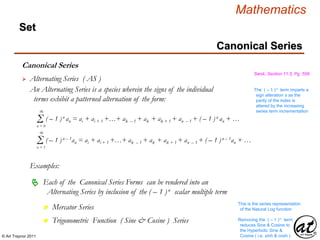
 Alternating Series ( AS )
An Alternating Series is a species wherein the signs of the individual
terms exhibit a patterned alternation of the form:
Σn = 0
( – 1 )n an = ai + ai + 1 +…+ ak – 1 + ak + ak + 1 + an – 1 + ( – 1 )n an + …
∞
Σn = 1
( – 1 )n – 1an = ai + ai + 1 +…+ ak – 1 + ak + ak + 1 + an – 1 + ( – 1 )n – 1an + …
∞
The ( – 1 )n term imparts a
sign alteration ± as the
parity of the index is
altered by the increasing
series term incrementation
Examples:
Each of the Canonical Series Forms can be rendered into an
Alternating Series by inclusion of the ( – 1 )n scalar multiple term

Harmonic-Hyperharmonic ( P ) Seriesn
Geometric Seriesn
1
n1Σ Σ
1
n p
Σa r n – 1
Σ ar n – 1
Canonical Series
© Art Traynor 2011
Mathematics
Set
Canonical Series
Swok, Section 11.5, Pg. 558
 Alternating Series ( AS )
An Alternating Series is a species wherein the signs of the individual
terms exhibit a patterned alternation of the form:
Σn = 0
( – 1 )n an = ai + ai + 1 +…+ ak – 1 + ak + ak + 1 + an – 1 + ( – 1 )n an + …
∞
Σn = 1
( – 1 )n – 1an = ai + ai + 1 +…+ ak – 1 + ak + ak + 1 + an – 1 + ( – 1 )n – 1an + …
∞
The ( – 1 )n term imparts a
sign alteration ± as the
parity of the index is
altered by the increasing
series term incrementation
Examples:
Each of the Canonical Series Forms can be rendered into an
Alternating Series by inclusion of the ( – 1 )n scalar multiple term

Mercator Seriesn
Trigonometric Function ( Sine & Cosine ) Seriesn Removing the ( – 1 )n term
reduces Sine & Cosine to
the Hyperbolic Sine &
Cosine ( i.e. sinh & cosh )
This is the series representation
of the Natural Log function
Canonical Series
© Art Traynor 2011
Mathematics
Set
Canonical Series
Swok, Section 11.6, Pg. 567
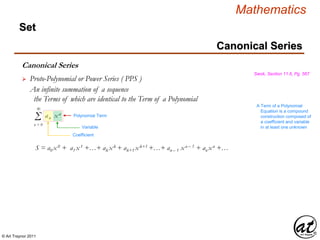
 Proto-Polynomial or Power Series ( PPS )
An infinite summation of a sequence
the Terms of which are identical to the Term of a Polynomial
Canonical Series
Σ an xn
∞
n = 0
S = a0 x0 + a1 x1 +…+ ak xk + ak+1 xk+1 +…+ an – 1 xn – 1 + an xn +…
Variable
Coefficient
Polynomial Term
A Term of a Polynomial
Equation is a compound
construction composed of
a coefficient and variable
in at least one unknown
© Art Traynor 2011
Mathematics
Canonical Series
Set
Canonical Series
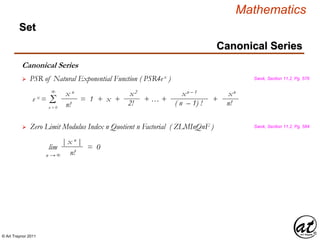
Swok, Section 11.2, Pg. 576 PSR of Natural Exponential Function ( PSR4ex )
x2
2!e x = = 1 + x + + … + +Σ
∞
n = 0
x n
n!
xn – 1
( n – 1) !
xn
n!
Swok, Section 11.2, Pg. 584 Zero Limit Modulus Index n Quotient n Factorial ( ZLMInQnF )
lim = 0
| x n |
n!n → ∞
© Art Traynor 2011
Mathematics
Power Series
Series
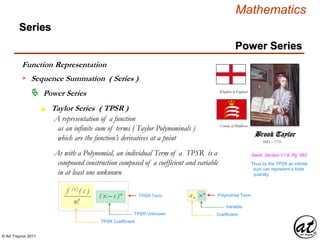
 Power Series
Taylor Series ( TPSR )n
Function Representation
 Sequence Summation ( Series )
A representation of a function
as an infinite sum of terms ( Taylor Polynominals )
which are the function’s derivatives at a point 1685 – 1731
Brook Taylor
Kingdom of England
County of Middlesex
Swok, Section 11.8, Pg. 582
Thus by the TPSR an infinite
sum can represent a finite
quantity
( x – c )n
f (n) ( c )
n!
As with a Polynomial, an individual Term of a TPSR is a
compound construction composed of a coefficient and variable
in at least one unknown
an xn
Variable
Coefficient
Polynomial Term
TPSR Unknown
TPSR Coefficient
TPSR Term
© Art Traynor 2011
Mathematics
Power Series
Series
 Power Series
Taylor Series ( TPSR )n
Function Representation
 Sequence Summation ( Series )
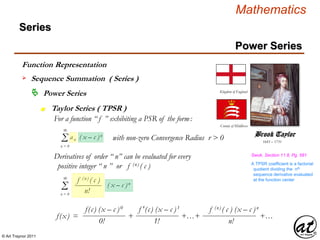
Σ an ( x – c )n
∞
n = 0
For a function “ f ” exhibiting a PSR of the form:
with non-zero Convergence Radius r > 0 1685 – 1731
Brook Taylor
Kingdom of England
County of Middlesex
Derivatives of order “ n” can be evaluated for every
positive integer “ n ” or f (n) ( c )
f(c) (x – c )0 f ′(c) (x – c )1 f (n) ( c ) (x – c )n
0!
f(x) = + +…+ +…
1! n!
Σ ( x – c )n
∞
n = 0
f (n) ( c )
n!
A TPSR coefficient is a factorial
quotient dividing the nth
sequence derivative evaluated
at the function center
Swok, Section 11.8, Pg. 581
© Art Traynor 2011
Mathematics
Power Series
Series
 Power Series
Function Representation
 Sequence Summation ( Series )
1685 – 1731
Brook Taylor
Kingdom of England
County of Middlesex
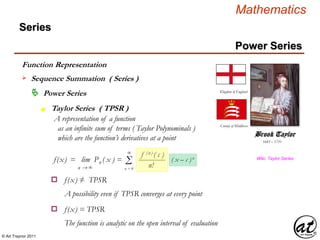
f(x) = lim Pn ( x ) =
n → ∞
Taylor Series ( TPSR )n
A representation of a function
as an infinite sum of terms ( Taylor Polynominals )
which are the function’s derivatives at a point
Wiki, Taylor Series
Σ ( x – c )n
∞
n = 0
f (n) ( c )
n!
f(x) ≠ TPSRo
A possibility even if TPSR converges at every point
f(x) = TPSRo
The function is analytic on the open interval of evaluation
© Art Traynor 2011
Mathematics
Power Series
Series
 Power Series
Taylor Series Polynomial ( TSP )n
Function Representation
 Sequence Summation ( Series )
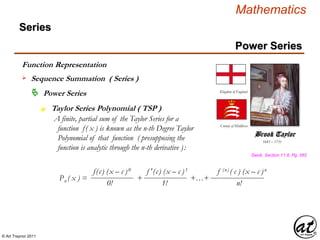
A finite, partial sum of the Taylor Series for a
function f( x ) is known as the n-th Degree Taylor
Polynomial of that function ( presupposing the
function is analytic through the n-th derivative ):
1685 – 1731
Brook Taylor
Kingdom of England
County of Middlesex
Swok, Section 11.8, Pg. 582
f(c) (x – c )0 f ′(c) (x – c )1 f (n) ( c ) (x – c )n
0!
Pn ( x ) = + +…+
1! n!
© Art Traynor 2011
Mathematics
Power Series
Series
 Power Series
n
Function Representation
 Sequence Summation ( Series )
Maclaurin Seriesn
1685 – 1731
Brook Taylor
Kingdom of England
County of Middlesex
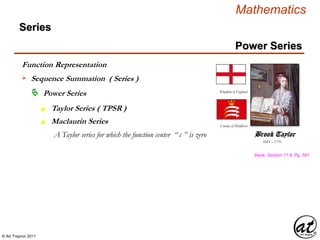
A Taylor series for which the function center “ c ” is zero
Swok, Section 11.8, Pg. 581
Taylor Series ( TPSR )
© Art Traynor 2011
Mathematics
z x
Power Series
Series
 Power Series
Taylor Series Remainder ( TSR )n
Function Representation
 Sequence Summation ( Series )
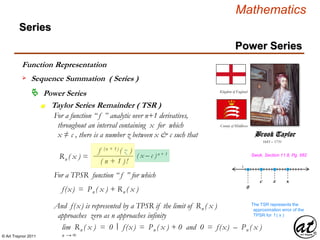
For a function “ f ” analytic over n+1 derivatives,
throughout an interval containing x for which
x ≠ c , there is a number z between x & c such that
1685 – 1731
Brook Taylor
Kingdom of England
County of Middlesex
Swok, Section 11.8, Pg. 582
f(x) = Pn ( x ) + Rn ( x ) 0
c
Rn ( x ) = ( x – c )n + 1
f (n + 1) ( z )
( n + 1 )!
For a TPSR function “ f ” for which
lim Rn ( x ) = 0 f(x) = Pn ( x ) + 0 and 0 = f(x) – Pn ( x )
n → ∞
And f(x) is represented by a TPSR if the limit of Rn ( x )
approaches zero as n approaches infinity
|:
The TSR represents the
approximation error of the
TPSR for f ( x )
© Art Traynor 2011
Mathematics
Canonical Series
Set
Canonical Series
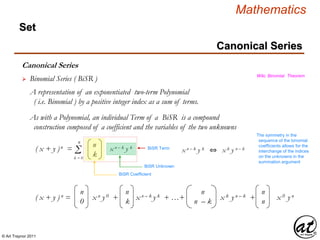
 Binomial Series ( BiSR ) Wiki, Binomial Theorem
A representation of an exponentiated two-term Polynomial
( i.e. Binomial ) by a positive integer index as a sum of terms.
As with a Polynomial, an individual Term of a BiSR is a compound
construction composed of a coefficient and the variables of the two unknowns
( x + y )n = Σ
n
k = 0
n
k
x n – k y k BiSR Term
BiSR Coefficient
BiSR Unknown
x n – k y k ⇔ x k y n – k
The symmetry in the
sequence of the binomial
coefficients allows for the
interchange of the indices
on the unknowns in the
summation argument
( x + y ) n = x n y 0 + x n – k y k + …+ x k y n – k + x 0 y n
n
0
n
k
n
n – k
n
n
© Art Traynor 2011
Mathematics
Canonical Series
Set
Canonical Series
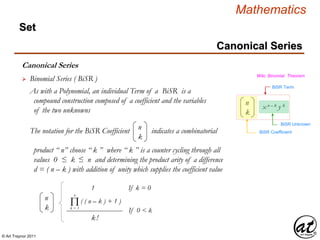
 Binomial Series ( BiSR ) Wiki, Binomial Theorem
As with a Polynomial, an individual Term of a BiSR is a
compound construction composed of a coefficient and the variables
of the two unknowns
n
k
x n – k y k
BiSR Term
BiSR Coefficient
BiSR Unknown
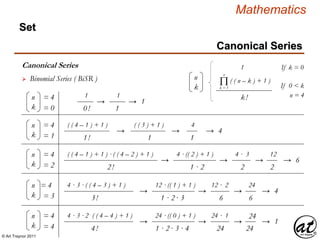
The notation for the BiSR Coefficient indicates a combinatorial
product “ n” choose “ k ” where “ k ” is a counter cycling through all
values 0 ≤ k ≤ n and determining the product arity of a difference
d = ( n – k ) with addition of unity which supplies the coefficient value
n
k
n
k
( ( n – k ) + 1 )
1 If k = 0
k!
If 0 < k
Πk = 1
n
© Art Traynor 2011
Mathematics
Canonical Series
Set
Canonical Series
 Binomial Series ( BiSR )
n
k
= 4
= 0
1
0!
n
k
= 4
= 1
( ( 4 – 1 ) + 1 )
1!
n
k
= 4
= 2
( ( 4 – 1 ) + 1 ) · ( ( 4 – 2 ) + 1 )
2!
→
( ( 3 ) + 1 )
1
→
4
1
→ 4
1
1
→ → 1
4 · (( 2 ) + 1 )
1 · 2
→ → → 6
4 · 3
2
→
12
2
n
k
= 4
= 3
4 · 3 · ( ( 4 – 3 ) + 1 )
3!
12 · (( 1 ) + 1 )
1 · 2· 3
→ → → 4
12 · 2
6
→
24
6
n
k
= 4
= 4
4 · 3 · 2 ( ( 4 – 4 ) + 1 )
4!
24 · (( 0 ) + 1 )
1 · 2· 3 · 4
→ → → 1
24 · 1
24
→
24
24
n
k
( ( n – k ) + 1 )
1 If k = 0
k!
If 0 < kΠk = 1
n
n = 4
© Art Traynor 2011
Mathematics
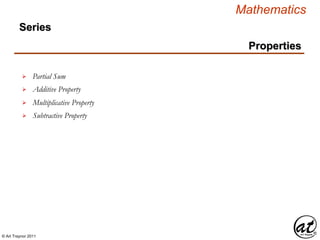
Properties
Series
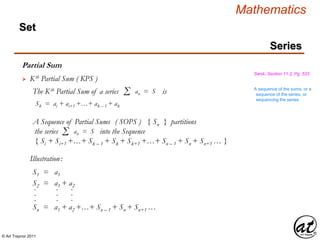
Partial Sum
Additive Property
Multiplicative Property
Subtractive Property
© Art Traynor 2011
Mathematics
Series
Set
Partial Sum
Swok, Section 11.2, Pg. 533
 Kth Partial Sum ( KPS )
The Kth Partial Sum of a series isΣ an = S
Sk = ai + ai+1 +…+ ak – 1 + ak
A Sequence of Partial Sums ( SOPS ) { Sn } partitions
the series into the Sequence
{ Si + Si+1 +…+ Sk – 1 + Sk + Sk+1 +…+ Sn – 1 + Sn + Sn+1 … }
Σ an = S
A sequence of the sums, or a
sequence of the series, or
sequencing the series
Illustration:
S1 = a1
S2 = a1 + a2
.
.
.
.
.
.
.
.
.
Sn = a1 + a2 +…+ Sn – 1 + Sn + Sn+1 …
© Art Traynor 2011
Mathematics
Series
Set
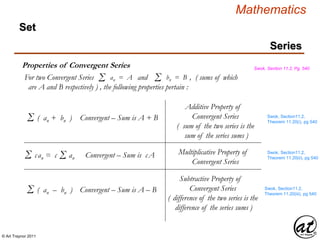
Properties of Convergent Series Swok, Section 11.2, Pg. 540
Swok, Section11.2,
Theorem 11.20(i), pg 540
Additive Property of
Convergent Series
( sum of the two series is the
sum of the series sums )
For two Convergent Series and , ( sums of which
are A and B respectively ) , the following properties pertain :
Σ an = A Σ bn = B
Σ ( an + bn ) Convergent – Sum is A + B
Σ can = c an Convergent – Sum is cAΣ Multiplicative Property of
Convergent Series
Swok, Section11.2,
Theorem 11.20(ii), pg 540
Swok, Section11.2,
Theorem 11.20(iii), pg 540
Subtractive Property of
Convergent Series
( difference of the two series is the
difference of the series sums )
Σ ( an – bn ) Convergent – Sum is A – B
© Art Traynor 2011
Mathematics
Series
Set
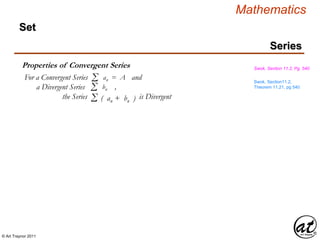
Properties of Convergent Series Swok, Section 11.2, Pg. 540
For a Convergent Series and
a Divergent Series ,
the Series is Divergent
Σ an = A
Σ bn
Σ ( an + bn )
Swok, Section11.2,
Theorem 11.21, pg 540
© Art Traynor 2011
Mathematics
Tests
Series
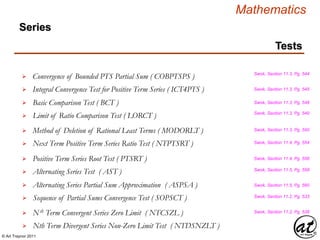
Convergence of Bounded PTS Partial Sum ( COBPTSPS )
Integral Convergence Test for Positive Term Series ( ICT4PTS )
Basic Comparison Test ( BCT )
Limit of Ratio Comparison Test ( LORCT )
Method of Deletion of Rational Least Terms ( MODORLT )
Next Term Positive Term Series Ratio Test ( NTPTSRT )
Positive Term Series Root Test ( PTSRT )
Alternating Series Test ( AST )
Alternating Series Partial Sum Approximation ( ASPSA )
Sequence of Partial Sums Convergence Test ( SOPSCT )
Nth Term Convergent Series Zero Limit ( NTCSZL )
Nth Term Divergent Series Non-Zero Limit Test ( NTDSNZLT )
Swok, Section 11.3, Pg. 544
Swok, Section 11.3, Pg. 545
Swok, Section 11.3, Pg. 548
Swok, Section 11.3, Pg. 550
Swok, Section 11.3, Pg. 549
Swok, Section 11.4, Pg. 554
Swok, Section 11.4, Pg. 556
Swok, Section 11.5, Pg. 558
Swok, Section 11.5, Pg. 560
Swok, Section 11.2, Pg. 533
Swok, Section 11.2, Pg. 538
© Art Traynor 2011
Mathematics
Tests
Series
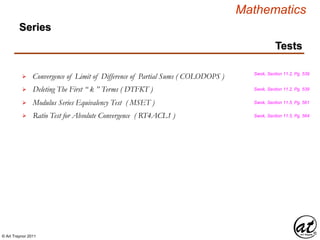
Convergence of Limit of Difference of Partial Sums ( COLODOPS )
Deleting The First “ k ” Terms ( DTFKT )
Modulus Series Equivalency Test ( MSET )
Ratio Test for Absolute Convergence ( RT4ACL1 )
Swok, Section 11.2, Pg. 539
Swok, Section 11.5, Pg. 561
Swok, Section 11.5, Pg. 564
© Art Traynor 2011
Mathematics
Convergence Tests
Series
Swok, Section 11.3, Pg. 544
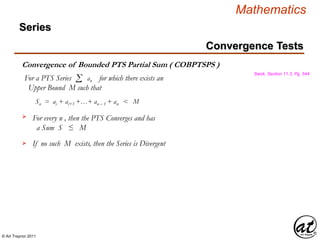
Convergence of Bounded PTS Partial Sum ( COBPTSPS )
For a PTS Series for which there exists an
Upper Bound M such that
Σ an
Sn = ai + ai+1 +…+ an – 1 + an < M
For every n , then the PTS Converges and has
a Sum S ≤ M
If no such M exists, then the Series is Divergent


© Art Traynor 2011
Mathematics
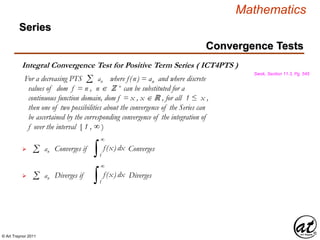
Integral Convergence Test for Positive Term Series ( ICT4PTS )
Swok, Section 11.3, Pg. 545
For a decreasing PTS where f(n) = an and where discrete
values of dom f = n , n ℤ + can be substituted for a
continuous function domain, dom f = x , x ℝ , for all 1 ≤ x ,
then one of two possibilities about the convergence of the Series can
be ascertained by the corresponding convergence of the integration of
f over the interval [ 1 , ∞ )
Σ an
Converges if Converges Σ an
∫ f(x) dx
1
∞
Diverges if Diverges Σ an
∫ f(x) dx
1
∞
Convergence Tests
Series
© Art Traynor 2011
Mathematics
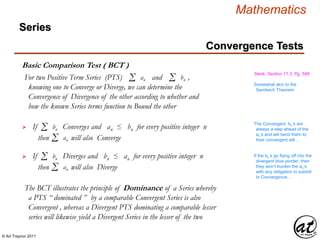
Basic Comparison Test ( BCT )
Swok, Section 11.3, Pg. 548
If Converges and an ≤ bn for every positive integer n Σ bn
For two Positive Term Series (PTS) and ,
knowing one to Converge or Diverge, we can determine the
Convergence of Divergence of the other according to whether and
how the known Series terms function to Bound the other
Σ an Σ bn
Somewhat akin to the
Sandwich Theorem
Σ anthen will also Converge
If Diverges and bn ≤ an for every positive integer n Σ bn
Σ anthen will also Diverge
The Convergent bn’s are
always a step ahead of the
an’s and will bend them to
their convergent will…
If the bn’s go flying off into the
divergent blue yonder, then
they won’t burden the an’s
with any obligation to submit
to Convergence…
The BCT illustrates the principle of Dominance of a Series whereby
a PTS “ dominated ” by a comparable Convergent Series is also
Convergent , whereas a Divergent PTS dominating a comparable lesser
series will likewise yield a Divergent Series in the lesser of the two
Convergence Tests
Series
© Art Traynor 2011
Mathematics
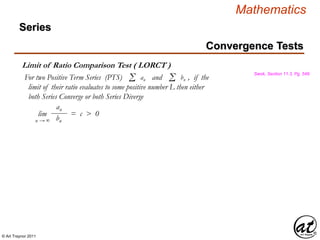
Limit of Ratio Comparison Test ( LORCT )
Swok, Section 11.3, Pg. 549
For two Positive Term Series (PTS) and , if the
limit of their ratio evaluates to some positive number L then either
both Series Converge or both Series Diverge
Σ an Σ bn
lim = c > 0
n → ∞
an
bn
Convergence Tests
Series
© Art Traynor 2011
Mathematics
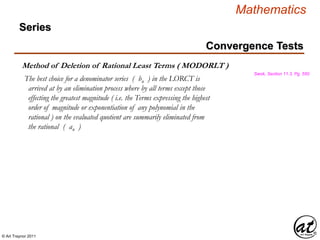
Swok, Section 11.3, Pg. 550
Method of Deletion of Rational Least Terms ( MODORLT )
The best choice for a denominator series ( bn ) in the LORCT is
arrived at by an elimination process where by all terms except those
effecting the greatest magnitude ( i.e. the Terms expressing the highest
order of magnitude or exponentiation of any polynomial in the
rational ) on the evaluated quotient are summarily eliminated from
the rational ( an )
Convergence Tests
Series
© Art Traynor 2011
Mathematics
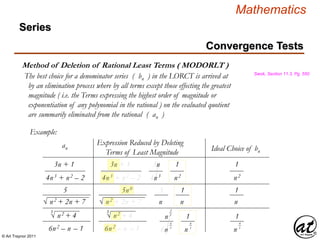
Method of Deletion of Rational Least Terms ( MODORLT )
Swok, Section 11.3, Pg. 550
The best choice for a denominator series ( bn ) in the LORCT is arrived at
by an elimination process where by all terms except those effecting the greatest
magnitude ( i.e. the Terms expressing the highest order of magnitude or
exponentiation of any polynomial in the rational ) on the evaluated quotient
are summarily eliminated from the rational ( an )
Example:
an
Expression Reduced by Deleting
Terms of Least Magnitude Ideal Choice of bn
3n + 1
4n3 + n2 – 2
√ n2 + 2n + 7
5
√ n2 + 4
3
6n2 – n – 1
3n + 1
4n3 + n2 – 2
√ n2 + 2n + 7
5n0
√ n2 + 4
3
6n2 – n – 1
3n
4n3
5
n
n
6n
2
3
6
3
1
n2
1
n
1
n
4
3
1
n2
1
n
1
n
4
3
Convergence Tests
Series
© Art Traynor 2011
Mathematics
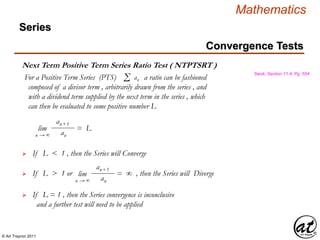
Next Term Positive Term Series Ratio Test ( NTPTSRT )
Swok, Section 11.4, Pg. 554
For a Positive Term Series (PTS) a ratio can be fashioned
composed of a divisor term , arbitrarily drawn from the series , and
with a dividend term supplied by the next term in the series , which
can then be evaluated to some positive number L
Σ an
lim = L
n → ∞
an+1
an
If L < 1 , then the Series will Converge
If L > 1 or , then the Series will Diverge
If L = 1 , then the Series convergence is inconclusive
and a further test will need to be applied

lim = ∞
n → ∞
an+1
an
Convergence Tests
Series
© Art Traynor 2011
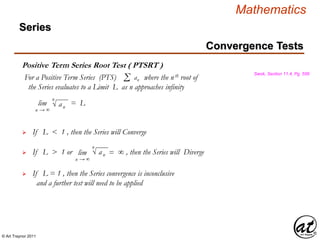
Mathematics
Positive Term Series Root Test ( PTSRT )
Swok, Section 11.4, Pg. 556
For a Positive Term Series (PTS) where the nth root of
the Series evaluates to a Limit L as n approaches infinity
Σ an
lim = L
n → ∞
√ an
n
If L < 1 , then the Series will Converge
If L > 1 or , then the Series will Diverge
If L = 1 , then the Series convergence is inconclusive
and a further test will need to be applied

lim = ∞
n → ∞
√ an
n
Convergence Tests
Series
© Art Traynor 2011
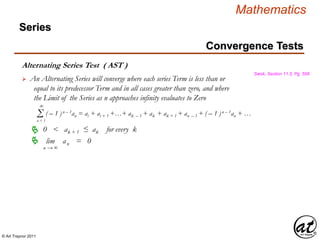
Mathematics
Alternating Series Test ( AST )
Swok, Section 11.5, Pg. 558
 An Alternating Series will converge where each series Term is less than or
equal to its predecessor Term and in all cases greater than zero, and where
the Limit of the Series as n approaches infinity evaluates to Zero
0 < ak + 1 ≤ ak for every k
Σn = 1
( – 1 )n – 1an = ai + ai + 1 +…+ ak – 1 + ak + ak + 1 + an – 1 + ( – 1 )n – 1an + …
∞
lim | an | = 0
n → ∞

Convergence Tests
Series
© Art Traynor 2011
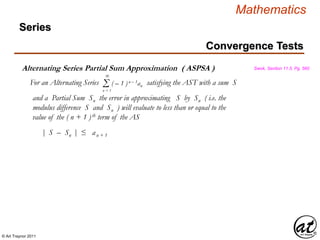
Mathematics
Alternating Series Partial Sum Approximation ( ASPSA )
For an Alternating Series satisfying the AST with a sum S
Swok, Section 11.5, Pg. 560
Σn = 1
( – 1 )n – 1an
∞
and a Partial Sum Sn the error in approximating S by Sn ( i.e. the
modulus difference S and Sn ) will evaluate to less than or equal to the
value of the ( n + 1 )th term of the AS
| S – Sn | ≤ an + 1
Convergence Tests
Series
© Art Traynor 2011
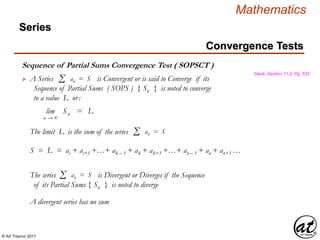
Mathematics
Sequence of Partial Sums Convergence Test ( SOPSCT )
Swok, Section 11.2, Pg. 533
 A Series is Convergent or is said to Converge if its
Sequence of Partial Sums ( SOPS ) { Sn } is noted to converge
to a value L or:
Σ an = S
lim | Sn | = L
n → ∞
S = L = ai + ai+1 +…+ ak – 1 + ak + ak+1 +…+ an – 1 + an + an+1 …
The limit L is the sum of the series Σ an = S
The series is Divergent or Diverges if the Sequence
of its Partial Sums { Sn } is noted to diverge
Σ an = S
A divergent series has no sum
Convergence Tests
Series
© Art Traynor 2011
Mathematics
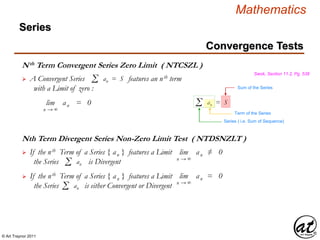
Nth Term Convergent Series Zero Limit ( NTCSZL )
Swok, Section 11.2, Pg. 538
 A Convergent Series features an nth term
with a Limit of zero :
Σ an = S
lim | an | = 0
n → ∞
Σ an = S
Term of the Series
Series ( i.e. Sum of Sequence)
Sum of the Series
Nth Term Divergent Series Non-Zero Limit Test ( NTDSNZLT )
 If the nth Term of a Series { an } features a Limit
the Series is DivergentΣ an
lim | an |≠ 0
n → ∞
 If the nth Term of a Series { an } features a Limit
the Series is either Convergent or Divergent
lim | an |= 0
n → ∞
Σ an
Convergence Tests
Series
© Art Traynor 2011
Mathematics
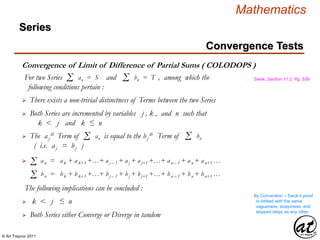
Convergence of Limit of Difference of Partial Sums ( COLODOPS )
Swok, Section 11.2, Pg. 539
 There exists a non-trivial distinctness of Terms between the two Series
For two Series and , among which the
following conditions pertain :
Σ an = S Σ bn = T
 Both Series are incremented by variables j , k , and n such that
k < j and k ≤ n
 The aj
th Term of is equal to the bj
th Term of
( i.e. aj = bj )
Σ an Σ bn
Σ an = ak + ak+1 +…+ aj – 1 + aj + aj+1 +…+ an – 1 + an + an+1 …
Σ bn = bk + bk+1 +…+ bj – 1 + bj + bj+1 +…+ bn – 1 + bn + bn+1 …
The following implications can be concluded :
 k < j ≤ n
By Convention – Swok’s proof
is riddled with the same
vagueness, sloppiness, and
skipped steps as any other
 Both Series either Converge or Diverge in tandem
Convergence Tests
Series
© Art Traynor 2011
Mathematics
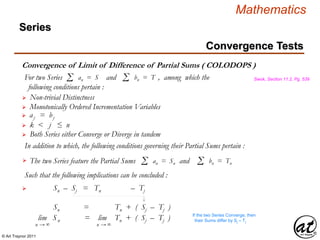
Convergence of Limit of Difference of Partial Sums ( COLODOPS )
Swok, Section 11.2, Pg. 539
 Non-trivial Distinctness
For two Series and , among which the
following conditions pertain :
Σ an = S Σ bn = T
 Monotonically Ordered Incrementation Variables
 aj = bj
 Sn – Sj = Tn – Tj
In addition to which, the following conditions governing their Partial Sums pertain :
The two Series feature the Partial Sums andΣ an = Sn Σ bn = Tn

 k < j ≤ n
 Both Series either Converge or Diverge in tandem
Such that the following implications can be concluded :
Sn = Tn + ( Sj – Tj )
lim |Sn | = lim Tn + ( Sj – Tj )
n → ∞ n → ∞
If the two Series Converge, then
their Sums differ by Sj – Tj
Convergence Tests
Series
© Art Traynor 2011
Mathematics
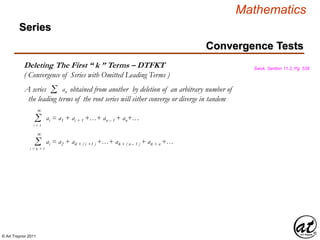
Deleting The First “ k ” Terms – DTFKT
( Convergence of Series with Omitted Leading Terms )
Swok, Section 11.2, Pg. 539
A series obtained from another by deletion of an arbitrary number of
the leading terms of the root series will either converge or diverge in tandem
Σ an
Σi = 1
ai = a1 + ai + 1 +…+ an – 1 + an+…
∞
Σi = k + 1
ai = a2 + ak + ( i +1 ) +…+ ak + ( n – 1 ) + ak + n +…
∞
Convergence Tests
Series
© Art Traynor 2011
Mathematics
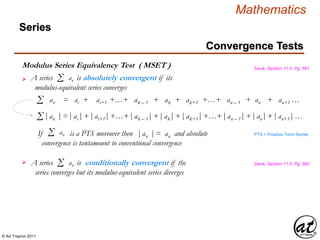
Modulus Series Equivalency Test ( MSET ) Swok, Section 11.5, Pg. 561
A series is absolutely convergent if its
modulus-equivalent series converges
Σ an
Convergence Tests
Series
|an | = |ai |+ | ai+1 |+…+ |ak – 1 |+ |ak |+ |ak+1 |+…+ |an – 1 |+ |an |+ |an+1 |…Σ
an = ai + ai+1 +…+ ak – 1 + ak + ak+1 +…+ an – 1 + an + an+1 …Σ
If is a PTS moreover then |an | = an and absolute
convergence is tantamount to conventional convergence
Σ an PTS = Positive Term Series
A series is conditionally convergent if the
series converges but its modulus-equivalent series diverges
Σ an

 Swok, Section 11.5, Pg. 562
© Art Traynor 2011
Mathematics
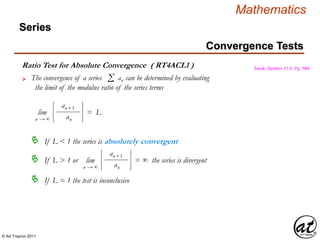
Ratio Test for Absolute Convergence ( RT4ACL1 ) Swok, Section 11.5, Pg. 564
Convergence Tests
Series
lim = L
n → ∞
an+1
an
The convergence of a series can be determined by evaluating
the limit of the modulus ratio of the series terms
Σ an
If L < 1 the series is absolutely convergent
If L > 1 or the series is divergent lim = ∞
n → ∞
an+1
an
If L = 1 the test is inconclusive
© Art Traynor 2011
Mathematics
Set
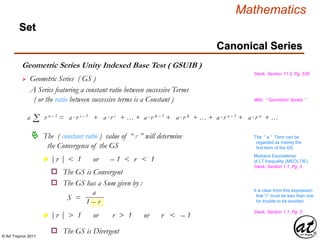
Geometric Series Unity Indexed Base Test ( GSUIB )
Swok, Section 11.2, Pg. 536
 Geometric Series ( GS )
Σa r n – 1 = a·r i – 1 + a·r i + … + a·r k – 1 + a·r k + … + a·r n – 1 + a·r n + …
 The ( constant ratio ) value of “ r ” will determine
the Convergence of the GS
|r | < 1 or – 1 < r < 1n
|r | > 1 or r > 1 or r < – 1n
o The GS is Convergent
o The GS has a Sum given by :
a
1 – r
S =
o The GS is Divergent
A Series featuring a constant ratio between successive Terms
( or the ratio between successive terms is a Constant )
The “ a ” Term can be
regarded as merely the
first term of the GS
Wiki: “ Geometric Series ”
Swok, Section 1.1, Pg. 3
Modulus Equivalence
of LT Inequality (MEOLTIE)
Swok, Section 1.1, Pg. 3
It is clear from this expression
that “r” must be less than one
for trouble to be avoided
Canonical Series
© Art Traynor 2011
Mathematics
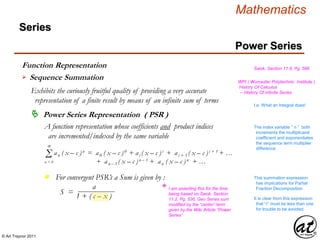
Function Representation Swok, Section 11.6, Pg. 566
Power Series
Series
Exhibits the curiously fruitful quality of providing a very accurate
representation of a finite result by means of an infinite sum of terms

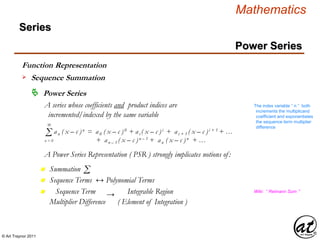
 Power Series Representation ( PSR )
A function representation whose coefficients and product indices
are incremented/indexed by the same variable
Σ an ( x – c )n = a0 ( x – c )0 + ai ( x – c )i + ai + 1 ( x – c )i + 1 + …
+ an – 1 ( x – c )n – 1 + an ( x – c )n + …
∞
n = 0
The index variable “ n ” both
increments the multiplicand
coefficient and exponentiates
the sequence term multiplier
difference
WPI ( Worcester Polytechnic Institute )
History Of Calculus
– History Of Infinite Series
I.e. What an Integral does!
For convergent PSR’s a Sum is given by :
a
1 + ( c – x )
S =
It is clear from this expression
that “r” must be less than one
for trouble to be avoided
This summation expression
has implications for Partial
Fraction Decomposition
n
I am asserting this for the time
being based on Swok, Section
11.2, Pg. 536, Geo Series sum
modified by the “center” term
given by the Wiki Article “Power
Series”
*
Sequence Summation
© Art Traynor 2011
Mathematics
Power Series
Series
 Power Series
A series whose coefficients and product indices are
incremented/indexed by the same variable
Σ an ( x – c )n = a0 ( x – c )0 + ai ( x – c )i + ai + 1 ( x – c )i + 1 + …
+ an – 1 ( x – c )n – 1 + an ( x – c )n + …
∞
n = 0
Summationn
A Power Series Representation ( PSR ) strongly implicates notions of:
Σ
Sequence Terms ↔ Polynomial Termsn
Sequence Term Integrable Regionn Wiki: “ Reimann Sum ”
The index variable “ n ” both
increments the multiplicand
coefficient and exponentiates
the sequence term multiplier
difference
Multiplier Difference ( Element of Integration )
→
Function Representation
Sequence Summation
© Art Traynor 2011
Mathematics
Power Series
Series
 Power Series
A series whose coefficients and product indices are
incremented/indexed by the same variable
Σ an ( x – c )n = a0 ( x – c )0 + ai ( x – c )i + ai + 1 ( x – c )i + 1 + …
+ an – 1 ( x – c )n – 1 + an ( x – c )n + …
∞
n = 0
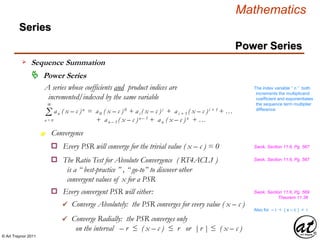
Convergence
The index variable “ n ” both
increments the multiplicand
coefficient and exponentiates
the sequence term multiplier
difference
n
o Every PSR will converge for the trivial value ( x – c ) = 0
o The Ratio Test for Absolute Convergence ( RT4ACL1 )
is a “ best-practice ” , “ go-to” to discover other
convergent values of x for a PSR
Swok, Section 11.6, Pg. 567
o Every convergent PSR will either: Swok, Section 11.6, Pg. 569
Theorem 11.38
 Converge Absolutely: the PSR converges for every value ( x – c )
 Converge Radially: the PSR converges only
on the interval – r ≤ ( x – c ) ≤ r or |r | ≤ ( x – c )
Also for – r < ( x – c ) < r
Sequence Summation
© Art Traynor 2011
Mathematics
Power Series
Series
 Power Series
A series whose coefficients and product indices are
incremented/indexed by the same variable
x
x , c = 0
r r
Σ an ( x – c )n = a0 ( x – c )0 + ai ( x – c )i + ai + 1 ( x – c )i + 1 + …
+ an – 1 ( x – c )n – 1 + an ( x – c )n + …
∞
n = 0
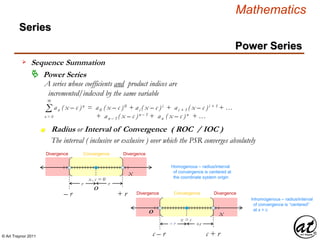
Radius or Interval of Convergence ( ROC / IOC )n
xO
x = c
– r +r
O
– r + r
The interval ( inclusive or exclusive ) over which the PSR converges absolutely
Homogenous – radius/interval
of convergence is centered at
the coordinate system origin
Inhomogenous – radius/interval
of convergence is “centered”
at x = c
c – r c + r
ConvergenceDivergence Divergence
Sequence Summation
© Art Traynor 2011
Mathematics
Power Series
Series
 Power Series
A series whose coefficients and product indices are
incremented/indexed by the same variable
Σ an ( x – c )n = a0 ( x – c )0 + ai ( x – c )i + ai + 1 ( x – c )i + 1 + …
+ an – 1 ( x – c )n – 1 + an ( x – c )n + …
∞
n = 0
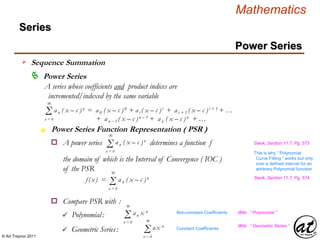
Power Series Function Representation ( PSR )n
o A power series determines a function f Swok, Section 11.7, Pg. 573
Σ an ( x – c )n
∞
n = 0
the domain of which is the Interval of Convergence ( IOC )
of the PSR
Σf(x) = an ( x – c )n
∞
n = 0
o Compare PSR with :
Swok, Section 11.7, Pg. 574
 Polynomial:
 Geometric Series:
This is why “ Polynomial
Curve Fitting ” works but only
over a defined interval for an
arbitrary Polynomial function
Σ an x n
∞
n = 0
Wiki: “ Polynomial ”
Σ ax n
∞
n = 0
Wiki: “ Geometric Series ”
Non-constant Coefficients
Constant Coefficients
Sequence Summation
© Art Traynor 2011
Mathematics
Power Series
Series
 Power Series
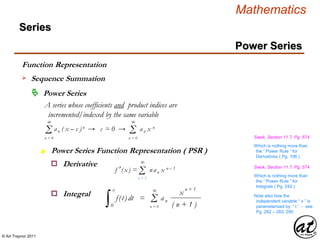
A series whose coefficients and product indices are
incremented/indexed by the same variable
Σ an ( x – c )n → c = 0 → an x n
∞
n = 0
Power Series Function Representation ( PSR )n
o Derivative
Swok, Section 11.7, Pg. 574
Σ
∞
n = 0
Σf ′(x) = nan x n – 1
∞
n = 1
Which is nothing more than
the “ Power Rule ” for
Derivatives ( Pg. 106 )
o Integral
Swok, Section 11.7, Pg. 574
Which is nothing more than
the “ Power Rule ” for
Integrals ( Pg. 242 )
∫ f(t) dt = an
0
x
x
n + 1
( n + 1 )
Σ
∞
n = 0
Note also how the
independent variable “ x ” is
parameterized by “ t ” - see
Pg. 282 – 283, 290
Sequence Summation
Function Representation
© Art Traynor 2011
Mathematics
Kingdom of Scotland
1638 – 1675
Burgh (Borough) of Edin
Edinburgh
1668
Infinite Series Representation of ArcTan
By geometrical expression, Gregory derived
an infinite series representation for the inverse
tangent function stated as the summation
(series) of an infinite sequence of terms
Series Mathematics
History
James Gregory
→
Gregory’s derivation implicated the unique
properties of the Tangent function (the
geometrical representation of a derivative)
which he subsequently generalized to describe
(by infinite series representation) the Tangent
and Secant functions
WPI ( Worcester Polytechnic Institute )
History Of Calculus – History Of Infinite Series
arctan x =
∫ dt
0
x
1
1 + t2
Swok, Section 8.2, Pg. 434
Swok, Section 11.7 Pg. 576
Function Representation

We note ( by inspection ) that this
expression bears an uncanny
resemblance to the Geometric
Series Sum
Σn = 0
∞
ar n = S =
a
1 – r
S = or
a
1 – r
Swok, Section 11.2 Pg. 536
I’ve not been able to figure out why/how
the summation of a scaled index term
gets to be equal to the inverse difference
of its base and unity, but there it is!
Sequence Summation
© Art Traynor 2011
Mathematics
Kingdom of Scotland
1638 – 1675
Burgh (Borough) of Edin
Edinburgh
1668
Infinite Series Representation of ArcTan
By geometrical expression, Gregory derived
an infinite series representation for the inverse
tangent function stated as the summation
(series) of an infinite sequence of terms
Series Mathematics
History
James Gregory
→
Gregory’s derivation implicated the unique
properties of the Tangent function (the
geometrical representation of a derivative)
which he subsequently generalized to describe
(by infinite series representation) the Tangent
and Secant functions
WPI ( Worcester Polytechnic Institute )
History Of Calculus – History Of Infinite Series
arctan x =
∫ dt
0
x
1
1 + t2
Swok, Section 8.2, Pg. 434
Swok, Section 11.7 Pg. 576
We note ( by inspection ) that this
expression bears an uncanny
resemblance to the Geometric
Series Sum
Swok, Section 11.2 Pg. 536
Substitution Table
a r
1 – t
Σn = 0
∞
a r n = S = = = = ( 1 ) ( – t )n
a
1 – r
1
1 – ( – t )
1
1 + t Σn = 0
∞
|r | < 1
or – 1 < r < 1
We need to keep our “r” term and any substitution
for it within the range of its radius of convergence
Function Representation
 Sequence Summation
© Art Traynor 2011
Mathematics
Kingdom of Scotland
1638 – 1675
Burgh (Borough) of Edin
Edinburgh
1668
Infinite Series Representation of ArcTan
By geometrical expression, Gregory derived
an infinite series representation for the inverse
tangent function stated as the summation
(series) of an infinite sequence of terms
Series Mathematics
History
James Gregory
→
Gregory’s derivation implicated the unique
properties of the Tangent function (the
geometrical representation of a derivative)
which he subsequently generalized to describe
(by infinite series representation) the Tangent
and Secant functions
WPI ( Worcester Polytechnic Institute )
History Of Calculus – History Of Infinite Series
arctan x =
∫ dt
0
x
1
1 + t2
Swok, Section 8.2, Pg. 434
Swok, Section 11.7 Pg. 576
We note ( by inspection ) that this
expression bears an uncanny
resemblance to the Geometric
Series Sum
Swok, Section 11.2 Pg. 536
Substitution Table
a r
1 – t
Σn = 0
∞
a r n = ( 1 ) ( – t )n = ( 1 )( – 1 )n ( t )n = ( – 1 )n ( t )n
Σn = 0
∞
Σn = 0
∞
Σn = 0
∞
If we need a positive term in the
denominator of the Integrand, then
we must unavoidably introduce an
alternating sign into the summation
Function Representation
 Sequence Summation
© Art Traynor 2011
Mathematics
Kingdom of Scotland
1638 – 1675
Burgh (Borough) of Edin
Edinburgh
1668
Infinite Series Representation of ArcTan
By geometrical expression, Gregory derived
an infinite series representation for the inverse
tangent function stated as the summation
(series) of an infinite sequence of terms
Series Mathematics
History
James Gregory
→
Gregory’s derivation implicated the unique
properties of the Tangent function (the
geometrical representation of a derivative)
which he subsequently generalized to describe
(by infinite series representation) the Tangent
and Secant functions
WPI ( Worcester Polytechnic Institute )
History Of Calculus – History Of Infinite Series
arctan x =
∫ dt
0
x
1
1 + t2
Swok, Section 8.2, Pg. 434
Swok, Section 11.7 Pg. 576
We note ( by inspection ) that this
expression bears an uncanny
resemblance to the Geometric
Series Sum
Swok, Section 11.2 Pg. 536
Substitution Table
a r
1 – t 2
Σn = 0
∞
a r n = ( 1 ) ( – t 2 )n = ( 1 )( – 1 )n ( t2 )n = ( – 1 )n ( t ) 2n
Σn = 0
∞
Σn = 0
∞
To get a positive square term into the
denominator, we just modify our
substitution, still with the alternating
sign in the summation
Σn = 0
∞
Function Representation
 Sequence Summation
© Art Traynor 2011
Mathematics
Kingdom of Scotland
1638 – 1675
Burgh (Borough) of Edin
Edinburgh
1668
Infinite Series Representation of ArcTan
By geometrical expression, Gregory derived
an infinite series representation for the inverse
tangent function stated as the summation
(series) of an infinite sequence of terms
Series Mathematics
History
James Gregory
→
Gregory’s derivation implicated the unique
properties of the Tangent function (the
geometrical representation of a derivative)
which he subsequently generalized to describe
(by infinite series representation) the Tangent
and Secant functions
WPI ( Worcester Polytechnic Institute )
History Of Calculus – History Of Infinite Series
arctan x =
∫ dt
0
x
1
1 + t2
With our substituted summation integrand,
we now integrate noting that with our
variable of integration of “ t ” all else is
considered as a constant
( – 1 )n ( t ) 2n
Σn = 0
∞
arctan x =
∫ dt
0
x
( – 1 )n ( t ) 2n
Σn = 0
∞
arctan x =
∫ dt
0
x
∫x r dx =
x r + 1
r + 1
+ C
r ≠ – 1
Power Rule
for
Indefinite Integration
Substitution Table
r
2n
Function Representation
 Sequence Summation
© Art Traynor 2011
Mathematics
Kingdom of Scotland
1638 – 1675
Burgh (Borough) of Edin
Edinburgh
1668
Infinite Series Representation of ArcTan
By geometrical expression, Gregory derived
an infinite series representation for the inverse
tangent function stated as the summation
(series) of an infinite sequence of terms
Series Mathematics
History
James Gregory
→
Gregory’s derivation implicated the unique
properties of the Tangent function (the
geometrical representation of a derivative)
which he subsequently generalized to describe
(by infinite series representation) the Tangent
and Secant functions
WPI ( Worcester Polytechnic Institute )
History Of Calculus – History Of Infinite Series
arctan x =
∫ dt
0
x
1
1 + t2
( – 1 )n ( t ) 2n
Σn = 0
∞
arctan x =
∫ dt
0
x
∫x r dx =
x r + 1
r + 1
+ C
r ≠ – 1
Power Rule
for
Indefinite Integration
Substitution Table
r
2n
arctan x = ( – 1 )n
Σn = 0
∞
t 2n + 1
2n + 1
Function Representation
 Sequence Summation

SequencesAndSeries_160505_01b

  • 1.
    © Art Traynor2011 Mathematics Definition Mathematics Wiki: “ Mathematics ” 1564 – 1642 Galileo Galilei Grand Duchy of Tuscany ( Duchy of Florence ) City of Pisa Mathematics – A Language “ The universe cannot be read until we have learned the language and become familiar with the characters in which it is written. It is written in mathematical language…without which means it is humanly impossible to comprehend a single word. Without these, one is wandering about in a dark labyrinth. ”
  • 2.
    © Art Traynor2011 Mathematics Definition Algebra – A Mathematical Grammar Mathematics A formalized system ( a language ) for the transmission of information encoded by number Algebra A system of construction by which mathematical expressions are well-formed Expression Symbol Operation Relation Designate expression elements or Operands ( Terms / Monomials ) Transformations or LOC’s capable of rendering an expression into a relation A mathematical Structure between operands represented by a well-formed Expression A well-formed symbolic representation of Operands ( Terms or Monomials ) , of discrete arity, upon which one or more Operations ( Laws of Composition - LOC’s ) may structure a Relation 1. Identifies the explanans by non-tautological correspondences Definition 2. Isolates the explanans as a proper subset from its constituent correspondences 3. Terminology a. Maximal parsimony b. Maximal syntactic generality 4. Examples a. Trivial b. Superficial Mathematics Wiki: “ Polynomial ” Wiki: “ Degree of a Polynomial ”
  • 3.
    © Art Traynor2011 Mathematics Disciplines Algebra One of the disciplines within the field of Mathematics Mathematics Others are Arithmetic, Geometry, Number Theory, & Analysis  The study of expressions of symbols ( sets ) and the well-formed rules by which they might be consistently manipulated.  Algebra Elementary Algebra Abstract Algebra A class of Structure defined by the object Set and its Operations ( or Laws of Composition – LOC’s )  Linear Algebra Mathematics
  • 4.
    © Art Traynor2011 Mathematics Definitions Expression Symbol Operation Relation Designate expression elements or Operands ( Terms / Monomials ) Transformations or LOC’s capable of rendering an expression into a relation A mathematical structure between operands represented by a well-formed expression A well-formed symbolic representation of Operands ( Terms or Monomials ) , of discrete arity, upon which one or more Operations ( LOC’s ) may structure a Relation Expression – A Mathematical Sentence Proposition A declarative expression asserting a fact, the truth value of which can be ascertained Formula A concise symbolic expression positing a relation VariablesConstants An alphabetic character representing a number the value of which is arbitrary, unspecified, or unknown Operands ( Terms / Monomials ) A transformation invariant scalar quantity Mathematics Predicate A Proposition admitting the substitution of variables O’Leary, Section 2.1, Pg. 41 Expression constituents consisting of Constants and Variables exhibiting exclusive parity Polynomial An Expression composed of Constants ( Coefficients ) and Variables ( Unknowns) with an LOC’s of Addition, Subtraction, Multiplication and Non-Negative Exponentiation Wiki: “ Polynomial ” Wiki: “ Degree of a Polynomial ”
  • 5.
    © Art Traynor2011 Mathematics Definitions Expression Symbol Operation Relation Designate expression elements or Operands ( Terms / Monomials ) Transformations capable of rendering an expression into a relation A mathematical structure between operands represented by a well-formed expression Expression – A Mathematical Sentence Proposition A declarative expression the truth value of which can be ascertained Formula A concise symbolic expression positing a relation VariablesConstants An alphabetic character representing a number the value of which is arbitrary, unspecified, or unknown Operands ( Terms / Monomials ) A transformation invariant scalar quantity Equation A formula stating an equivalency class relation Inequality A formula stating a relation among operand cardinalities Function A Relation between a Set of inputs and a Set of permissible outputs whereby each input is assigned to exactly one output Univariate: an equation containing only one variable ( e.g. Unary ) Multivariate: an equation containing more than one variable ( e.g. n-ary ) Mathematics Expression constituents consisting of Constants and Variables exhibiting exclusive parity Polynomial
  • 6.
    © Art Traynor2011 Mathematics Definitions Expression Symbol Operation Relation Expression – A Mathematical Sentence Proposition Formula VariablesConstants Operands ( Terms ) Equation A formula stating an equivalency class relation Linear Equation An equation in which each term is either a constant or the product of a constant and (a) variable[s] of the first degree Mathematics Polynomial
  • 7.
    © Art Traynor2011 Mathematics Expression Mathematical Expression A representational precursive discrete composition to a Mathematical Statement or Proposition ( e.g. Equation ) consisting of :  Operands / Terms Expression A well-formed symbolic representation of Operands ( Terms or Monomials ) , of discrete arity, upon which one or more Operations ( LOC’s ) may structure a Relation Mathematics n Scalar Constants ( i.e. Coefficients ) n Variables or Unknowns The Cardinality of which is referred to as the Arity of the Expression Constituent representational Symbols composed of : Algebra Laws of Composition ( LOC’s ) Governs the partition of the Expression into well-formed Operands or Terms ( the Cardinality of which is a multiple of Monomials )
  • 8.
    © Art Traynor2011 Mathematics Arity Arity Expression The enumeration of discrete symbolic elements ( Variables ) comprising a Mathematical Expression is defined as its Arity  The Arity of an Expression can be represented by a non-negative integer index variable ( ℤ + or ℕ ), conventionally “ n ”  A Constant ( Airty n = 0 , index ℕ )or Nullary represents a term that accepts no Argument  A Unary expresses an Airty n = 1 A relation can not be defined for Expressions of Arity less than two: n < 2 A Binary expresses Airty n = 2 All expressions possessing Airty n > 1 are n-ary, Multary, Multiary, or Polyadic VariablesConstants Operands Expression Polynomial
  • 9.
    © Art Traynor2011 Mathematics Expression Arity Operand  Arithmetic : a + b = c The distinct elements of an Expression by which the structuring Laws of Composition ( LOC’s ) partition the Expression into discrete Monomial Terms  “ a ” and “ b ” are Operands  The number of Variables of an Expression is known as its Arity n Nullary = no Variables ( a Scalar Constant ) n Unary = one Variable n Binary = two Variables n Ternary = three Variables…etc. VariablesConstants Operands Expression Polynomial n “ c ” represents a Solution ( i.e. the Sum of the Expression ) Arity is canonically delineated by a Latin Distributive Number, ending in the suffix “ –ary ”
  • 10.
    © Art Traynor2011 Mathematics Arity Arity ( Cardinality of Expression Variables ) Expression A relation can not be defined for Expressions of Arity less than two: n < 2 Nullary Unary n = 0 n = 1 Binary n = 2 Ternary n = 3 1-ary 2-ary 3-ary Quaternary n = 4 4-ary Quinary n = 5 5-ary Senary n = 6 6-ary Septenary n = 7 7-ary Octary n = 8 8-ary Nonary n = 9 9-ary n-ary VariablesConstants Operands Expression Polynomial 0-ary
  • 11.
    © Art Traynor2011 Mathematics Operand Parity – Property of Operands Parity n is even if ∃ k n = 2k n is odd if ∃ k n = 2k+1 Even ↔ Even Integer Parity Same Parity Even ↮ Odd Opposite Parity |: |:
  • 12.
    © Art Traynor2011 Mathematics Polynomial Expression A well-formed symbolic representation of operands, of discrete arity, upon which one or more operations can structure a Relation Expression Polynomial Expression A Mathematical Expression , the Terms ( Operands ) of which are a compound composition of : Polynomial Constants – referred to as Coefficients Variables – also referred to as Unknowns And structured by the Polynomial Structure Criteria ( PSC ) arithmetic Laws of Composition ( LOC’s ) including : Addition / Subtraction Multiplication / Non-Negative Exponentiation LOC ( Pn ) = { + , – , x bn ∀ n ≥ 0 } Wiki: “ Polynomial ” An excluded equation by Polynomial Structure Criteria ( PSC ) Σ an xi n i = 0 P( x ) = an xn + an – 1 xn – 1 +…+ ak+1 xk+1 + ak xk +…+ a1 x1 + a0 x0 Variable Coefficient Polynomial Term From the Greek Poly meaning many, and the Latin Nomen for name    
  • 13.
    © Art Traynor2011 Mathematics Degree Expression Polynomial Degree of a Polynomial Polynomial Wiki: “ Degree of a Polynomial ” The Degree of a Polynomial Expression ( PE ) is supplied by that of its Terms ( Operands ) featuring the greatest Exponentiation For a multivariate term PE , the Degree of the PE is supplied by that Term featuring the greatest summation of Variable exponents  P = Variable Cardinality & Variable Product Exponent Summation & Term Cardinality Arity Latin “ Distributive ” Number suffix of “ – ary ” Degree Latin “ Ordinal ” Number suffix of “ – ic ” Latin “ Distributive ” Number suffix of “ – nomial ” 0 = 1 = 2 = 3 = Nullary Unary Binary Tenary Constant Linear Quadratic Cubic Monomial Binomial Trinomial An Expression composed of Constants ( Coefficients ) and Variables ( Unknowns) with an LOC of Addition, Subtraction, Multiplication and Non- Negative Exponentiation
  • 14.
    © Art Traynor2011 Mathematics Degree Polynomial Degree of a Polynomial Nullary Unary p = 0 p = 1 Linear Binaryp = 2 Quadratic Ternaryp = 3 Cubic 1-ary 2-ary 3-ary Quaternaryp = 4 Quartic4-ary Quinaryp = 5 5-ary Senaryp = 6 6-ary Septenaryp = 7 7-ary Octaryp = 8 8-ary Nonaryp = 9 9-ary “ n ”-ary Arity Degree Monomial Binomial Trinomial Quadranomial Terms Constant Quintic P Wiki: “ Degree of a Polynomial ” Septic Octic Nonic Decic Sextic aka: Heptic aka: Hexic
  • 15.
    © Art Traynor2011 Mathematics Degree Expression Polynomial Degree of a Polynomial Polynomial Wiki: “ Degree of a Polynomial ” An Expression composed of Constants ( Coefficients ) and Variables ( Unknowns) with an LOC of Addition, Subtraction, Multiplication and Non- Negative Exponentiation The Degree of a Polynomial Expression ( PE ) is supplied by that of its Terms ( Operands ) featuring the greatest Exponentiation For a PE with multivariate term(s) , the Degree of the PE is supplied by that Term featuring the greatest summation of individual Variable exponents  P( x ) = ai xi 0 Nullary Constant Monomial P( x ) = ai xi 1 Unary Linear Monomial P( x ) = ai xi 2 Unary Quadratic Monomial ai xi 1 yi 1P( x , y ) = Binary Quadratic Monomial Univariate Bivariate
  • 16.
    © Art Traynor2011 Mathematics Degree Expression Polynomial Degree of a Polynomial Polynomial Wiki: “ Degree of a Polynomial ” The Degree of a Polynomial Expression ( PE ) is supplied by that of its Terms ( Operands ) featuring the greatest Exponentiation For a multivariate term PE , the Degree of the PE is supplied by that Term featuring the greatest summation of Variable exponents  P( x ) = ai xi 0 Nullary Constant Monomial P( x ) = ai xi 1 Unary Linear Monomial P( x ) = ai xi 2 Unary Quadratic Monomial ai xi 1 yi 1P( x , y ) = Binary Quadratic Monomial ai xi 1 yi 1zi 1P( x , y , z ) = Ternary Cubic Monomial Univariate Bivariate Trivariate Multivariate
  • 17.
    © Art Traynor2011 Mathematics Quadratic Expression Polynomial Quadratic Polynomial Polynomial Wiki: “ Degree of a Polynomial ” A Unary or greater Polynomial composed of at least one Term and : Degree precisely equal to two Quadratic ai xi n ∀ n = 2  ai xi n yj m ∀ n , m n + m = 2|: Etymology From the Latin “ quadrātum ” or “ square ” referring specifically to the four sides of the geometric figure Wiki: “ Quadratic Function ” Arity ≥ 1  ai xi n ± ai + 1 xi + 1 n ∀ n = 2 Unary Quadratic Monomial Binary Quadratic Monomial Unary Quadratic Binomial  ai xi n yj m ± ai + 1 xi + 1 n ∀ n + m = 2 Binary Quadratic Binomial
  • 18.
    © Art Traynor2011 Mathematics Equation Equation Expression An Equation is a statement or Proposition ( aka Formula ) purporting to express an equivalency relation between two Expressions :  Expression Proposition A declarative expression asserting a fact whose truth value can be ascertained Equation A symbolic formula, in the form of a proposition, expressing an equality relationship Formula A concise symbolic expression positing a relationship between quantities VariablesConstants Operands Symbols Operations The Equation is composed of Operand terms and one or more discrete Transformations ( Operations ) which can render the statement true ( i.e. a Solution ) Polynomial
  • 19.
    © Art Traynor2011 Mathematics Equation Solution Solution and Solution Sets  Free Variable: A symbol within an expression specifying where a substitution may be made Contrasted with a Bound Variable which can only assume a specific value or range of values  Solution: A value when substituted for a free variable which renders an equation true Analogous to independent & dependent variables Unique Solution: only one solution can render the equation true (quantified by $! ) General Solution: constants are undetermined General Solution: constants are value-specified (bound?) Unique Solution Particular Solution General Solution Solution Set n A family (set) of all solutions – can be represented by a parameter (i.e. parametric representation)  Equivalent Equations: Two (or more) systems of equations sharing the same solution set Section 1.1, (Pg. 3) Section 1.1, (Pg. 3) Section 1.1, (Pg. 6) Any of which could include a Trivial Solution Section 1.2, (Pg. 21)
  • 20.
    © Art Traynor2011 Mathematics Equation Solution Solution and Solution Sets  Solution: A value when substituted for a free variable which renders an equation true Unique Solution: only one solution can render the equation true (quantified by $! ) General Solution: constants are undetermined General Solution: constants are value-specified (bound?) Solution Set n For some function f with parameter c such that f(xi , xi+1 ,…xn – 1 , xn ) = c the family (set) of all solutions is defined to include all members of the inverse image set such that f(x) = c ↔ f -1(c) = x f -1(c) = {(ai , ai+1 ,…an-1 , an ) Ti· Ti+1 ·…· Tn-1· Tn |f(ai , ai+1 ,…an-1 , an ) = c } where Ti· Ti+1 ·…· Tn-1· Tn is the domain of the function f o f -1(c) = { }, or Ø empty set ( no solution exists ) o f -1(c) = 1, exactly one solution exists ( Unique Solution, Singleton) o f -1(c) = { cn } , a finite set of solutions exist o f -1(c) = {∞ } , an infinite set of solutions exists Inconsistent Consistent Section 1.1, (Pg. 5)
  • 21.
    © Art Traynor2011 Mathematics Linear Equation Linear Equation Equation An Equation consisting of: Operands that are either Any Variables are restricted to the First Order n = 1 Linear Equation An equation in which each term is either a constant or the product of a constant and (a) variable[s] of the first order Expression Proposition Equation Formula n Constant(s) or n A product of Constant(s) and one or more Variable(s) The Linear character of the Equation derives from the geometry of its graph which is a line in the R2 plane  As a Relation the Arity of a Linear Equation must be at least two, or n ≥ 2 , or a Binomial or greater Polynomial  Polynomial
  • 22.
    © Art Traynor2011 Mathematics Equation Linear Equation Linear Equation  An equation in which each term is either a constant or the product of a constant and (a) variable[s] of the first order Term ai represents a Coefficient b = Σi= 1 n ai xi = ai xi + ai+1 xi+1…+ an – 1 xn – 1 + an xn Equation of a Line in n-variables  A linear equation in “ n ” variables, xi + xi+1 …+ xn-1 + xn has the form: n Coefficients are distributed over a defined field (e.g. ℕ , ℤ , ℚ , ℝ , ℂ ) Term xi represents a Variable ( e.g. x, y, z ) n Term a1 is defined as the Leading Coefficient n Term x1 is defined as the Leading Variable Section 1.1, (Pg. 2) Section 1.1, (Pg. 2) Section 1.1, (Pg. 2) Section 1.1, (Pg. 2) Coefficient = a multiplicative factor (scalar) of fixed value (constant) Section 1.1, (Pg. 2)
  • 23.
    © Art Traynor2011 Mathematics Linear Equation Equation Standard Form ( Polynomial )  Ax + By = C  Ax1 + By1 = C For the equation to describe a line ( no curvature ) the variable indices must equal one   ai xi + ai+1 xi+1 …+ an – 1 xn –1 + an xn = b  ai xi 1 + ai+1 x 1 …+ an – 1 x 1 + a1 x 1 = bi+1 n – 1 n n ℝ 2 : a1 x + a2 y = b ℝ 3 : a1 x + a2 y + a3 z = b Blitzer, Section 3.2, (Pg. 226) Section 1.1, (Pg. 2) Test for Linearity  A Linear Equation can be expressed in Standard Form As a species of Polynomial , a Linear Equation can be expressed in Standard Form  Every Variable term must be of precise order n = 1 Linear Equation An equation in which each term is either a constant or the product of a constant and (a) variable[s] of the first order Expression Proposition Equation Formula Polynomial
  • 24.
    © Art Traynor2011 Mathematics Definition Sequence Sequence  The order structuring a sequence is typically supplied by a function whose domain is restricted to the positive integers ℕ mapping a codomain in the real number field ℝ A sequence is a set whose elements are structured by some ordering. S = { 1, 3, 5 }  As a set, a sequence can be represented as a roster ( in set builder notation )  The domain of a sequencing function can be represented as an Index Set subscripted onto the elements of the sequence S = { ai , ai+1 ,…, an – 1 , an } The mapping of the Index Set “ onto ” its object set is thus considered as a surjective function. An Index Set is a set for which the elements of the set are understood to label ( i.e. order or index ) another set. An Index Set can be considered as Enumerating its object set.  A Recursive Sequence is one for which an initial term is supplied and for which successive terms are generated by an index function whose argument is supplied by the preceding term of the sequence and incremented by integer progression.
  • 25.
    © Art Traynor2011 Mathematics Sequence A collection of real numbers that stands in one-to-one correspondence with the set of positive integers. Swok, Section 11.1, (Pg. 520) A set whose elements are structured by some ordering. An Ordered Set Wiki / AT: “ Sequence ” A Function f the domain of which is the set of positive integers. A Function  To each positive Integer “ k ” , there corresponds a Real Number “ f( k ) ” f : ℤ + → ℝ , dom ( S ) = { k , n ℤ + | [ ak , ak+1 , … , an – 1 , an ] } ran ( S ) = { k , n ℤ + | [ f(k) , f(k+1) , … , f(n – 1) , f(n) ] } f(k) = ak → ℤ + x ℝ → ( k , ak ) , ( k +1 , ak+1 ) , … The Cartesian Product … , ( n – 1, an – 1 ) , ( n , an ) Not necessarily a Sum (as is the case with a Series) The Cartesian Product Definition Sequence
  • 26.
    © Art Traynor2011 Mathematics Sequence Set Sequence As the elements of a Sequence set proliferate, one of three possibilities will be realized:  The Sequence will increase without bound { an } → ∞  The Sequence will approach a non-zero, finite limit { an } → L The Sequence will approach zero { an } → 0
  • 27.
    © Art Traynor2011 Mathematics Sequence Set Limit of a Sequence For a sequence set generated by a scalar constant indexed by the variable of incrementation:  The Sequence will approach zero ( L = 0 ) as the incrementation variable ( conventionally “ n ” ) increases without bound where the scalar constant base is a real number r ℝ such that | r | < 1 for { an } = r n lim r n = 0 | r | < 1 n → ∞ Swok, Section 11.1, Theorem 11.6 (i), Pg. 525  The Sequence will approach infinity ( L = ∞ ) as the incrementation variable ( conventionally “ n ” ) increases without bound where the scalar constant base is a real number r ℝ such that | r | > 1 for { an } = | r |n lim r n = ∞ | r | > 1 n → ∞ Swok, Section 11.1, Theorem 11.6 (ii), Pg. 525
  • 28.
    © Art Traynor2011 Mathematics Sequence Set Sandwich Theorem for Sequences For sequences: Swok, Section 11.1, Theorem 11.7, Pg. 527 { an } { bn } { cn } and for the case where an ≤ bn ≤ cn , and where : lim an n = L = lim cn n → ∞ n → ∞ it will also be the case that : lim bn n = L n → ∞
  • 29.
    © Art Traynor2011 Mathematics Sequence Set Equivalence of the Zero Limit of an Alternating ( Absolute Value ) Sequence Swok, Section 11.1, Theorem 11.8, Pg. 528 For the sequence { an } : lim | an | = 0 n → ∞ it will also be the case that : lim | an | = 0 n → ∞
  • 30.
    © Art Traynor2011 Mathematics Sequence Set Sequence Properties Swok, Section 11.1, Pg. 528 ai ≤ ai+1 ≤ … ≤ an – 1 ≤ an  Monotonic Sequence For the sequence { an } where it is the case that: with each successive term progresses in non-decreasing ( i.e. increasing ) order where each successive term progresses in non-increasing ( i.e. decreasing ) order: or ai ≥ ai+1 ≥ … ≥ an – 1 ≥ an For such a sequence, { an } is denoted a Monotonic Sequence It would seem that this definition only excludes an alternating sequence ( e.g. one for which the terms are supplied by the operation of an absolute value function)
  • 31.
    © Art Traynor2011 Mathematics Sequence Set Sequence Properties Swok, Section 11.1, Pg. 528  Bounded Sequence For the sequence { an } if there exists a positive real number “ M ” such that: | ak | ≤ M For such a sequence, { an } is denoted a Bounded Sequence
  • 32.
    © Art Traynor2011 Mathematics Sequence Set Sequence Properties Swok, Section 11.1, Pg. 528  Existence of a Limit For the sequence { an } a limit is understood to exist if the sequence is both: Monotonic – either successively increasing or successively decreasing with further incrementation  Bounded – the absolute value of the greatest sequential element will always stand as equal to or lesser than some positive integer “ M ” , e.g. | ak | ≤ M  and ai ≤ ai+1 ≤ … ≤ an – 1 ≤ an ai ≥ ai+1 ≥ … ≥ an – 1 ≥ an either or
  • 33.
    © Art Traynor2011 Mathematics Sequence Set Sequence Properties Swok, Section 11.1, Pg. 528  Upper Bound ( UB ) For a set S = { si , si+1 ,…sn-1 , sn } , constituted of Real Numbers and not necessarily ordered, there exists an element of the set su such that every element of the set will stand either less than or equal to su ( s n ≤ su ) which is thus considered the Upper Bound ( UB ) of the Set.
  • 34.
    © Art Traynor2011 Mathematics Sequence Set Sequence Properties Swok, Section 11.1, Pg. 528  Least Upper Bound ( LUB ) Similarly an element of the set, sv is considered a Least Upper Bound ( LUB ) if it is the case that no Upper Bound less than sv is included in the Set. The LUB is thus the element of least magnitude that is greater than or equal to every element in the Set. Example: For a set S  ( a , b ) that lies within the open interval , ( not necessarily an ordered pair? ) : Any element greater in magnitude than “ b ” would constitute an Upper Bound ( UB ) of the Set  The Least Upper Bound ( LUB ) of the Set is unique and is equal to “ b ” .  Also known as a Supremum
  • 35.
    © Art Traynor2011 Mathematics Sequence Set Sequence Properties Swok, Section 11.1, Pg. 528  Least Upper Bound ( LUB ) Similarly an element of the set, sv is considered a Least Upper Bound ( LUB ) if it is the case that no Upper Bound less than sv is included in the Set. The LUB is thus the element of least magnitude that is greater than or equal to every element in the Set.
  • 36.
    © Art Traynor2011 Mathematics Sequence Set Sequence Properties Swok, Section 11.1, Pg. 529  Completeness Property The Completeness Property is an axiom of the Field of Real Numbers. For every non-empty Set S ≠ possessing an Upper Bound, it is always the case that such a Set will concomitantly possess a Least Upper Bound ( LUB ), “ L ” . Proof: Introduction of a Subset constituted of a Sequence ( LE, UG, IMP ) $ { T } ℕ T ≠ Any “Quantification” is a species of “Instantiation” $ { S } T { an } ⊆ S Existential Quantification (Instantiation) of a Set in the Field ℕ ( EQ – EI) The Set “S” is not empty (G.A.) If we’ve instantiated a Set, we need only “declare” a Subset, as every Set is constituted of its trivial Subsets Definition of a Subset { an } ⊆ S ≡ ( ∀ x ) ( x ∊ an ⇒ x ∊ S ) O’Leary, Section 2.4, Pg. 65 O’Leary, Section 3.2, Pg. 109 Definition 3.2.1 1b ∃ { a } ℝ By Introduction, G.A. 1a 1d 1c ∃ { i , n }ℕ By Introduction, G.A. |: |:
  • 37.
    © Art Traynor2011 Mathematics Sequence Set Sequence Properties Swok, Section 11.1, Pg. 529  Completeness Property Proof: Gratis Asseritur ( G.A. ) Hypothesis 2b Swok, Section 11.1, Pg. 528{ an } is a Monotonic Sequence ∀ a , ai + 1 ≥ ai By Introduction, G.A.2a 2aBy Implication & Definition1d |:∃ M M  T ∨ M  S By Introduction, G.A.3a M  S → M  T By Introduction, G.A.3b A ⊆ B ⇔ ( ∀x)(xA ⇒ xB) Transitive Property of Sub/Superset Inclusion O’Leary, Section 3.2, Pg. 109 Wiki, Upper & Lower Bounds, Infimum & Supremum
  • 38.
    © Art Traynor2011 Mathematics Sequence Set Sequence Properties Swok, Section 11.1, Pg. 529  Completeness Property Proof: Gratis Asseritur ( G.A. ) Hypothesis ∀ ai |ai |≤ M – M ≤ ai ≤ M 0 | a | = – b < a < b Modulus Equivalence Rule for LT Inequality – M – ai ≤ 0 ≤ M – ai – M – a i M – a i M– M By Introduction, G.A. “M” will always be greater than any term { an } of the sequence 3c 3d { an } is a Bounded Sequence By Imp. & Definition ( EVT )3a Ex Vi Termini ( EVT ) Swok, Section 11.1, Pg. 528 |: Swok, Section 11.1, Pg. 528 Purple Math, Absolute-Value Inequalities ∃ L  S L ≤ M By Introduction, G.A.4a |: 4b L is a Least Upper Bound of S By Implication & and Definition ( EVT ) 3d 4a Swok, Section 11.1, Pg. 528 aka: Supremum or Greatest Element
  • 39.
    © Art Traynor2011 Mathematics Sequence Set Sequence Properties Swok, Section 11.1, Pg. 529  Completeness Property Proof: Gratis Asseritur ( G.A. ) Hypothesis By Introduction, G.A.5a ∃ ϵ  S 0 < ϵ|: L – ϵ < L ∴ L – ϵ is not a Least Upper Bound of S Swok, Section 11.1, Pg. 5285b 3c By Implication , , , , , Definition LUB 3a 3d 4a 5a aka: Supremum or Greatest Element By Introduction, G.A.6a ∃ { N }ℕ We are “ fixing ” an “ N ” here so as to use its placement in the sequence to note where greater values of the sequence, but less than the LUB, conduce to render LUB equal to the Limit of the sequence. 6c By Implication 6b( ∀ aN ) ( ∀ an ) , aN ≤ an ( ∀ N ) ( ∀ n ) , N ≤ n By Introduction, G.A.6b
  • 40.
    © Art Traynor2011 Mathematics Sequence Set Sequence Properties Swok, Section 11.1, Pg. 529  Completeness Property Proof: Gratis Asseritur ( G.A. ) Hypothesis O’Leary, Section 5.1, Pg. 171 Lub – ϵ < aN ⋀ Lub – ϵ < an 6d 6b By Implication , , &6a 6c Lub < aN + ϵ ⋀ Lub < an + ϵ Lub – aN < ϵ ⋀ Lub – an < ϵ 0 < Lub – aN < ϵ ⋀ 0 < Lub – an < ϵ as a( N, n ) → Lub , Lub – a( N, n ) → 0 By Additive ( Subtractive) Equality Blitzer, Section 2.1, pg. 115 Ditto Ditto 6e 6f 6g 6h By Implication with Limit of Difference ( Limit of Constant ) & Additive Inverse O’Leary, Section 5.1, Pg. 172 Rosen, Appendix 1, Pg. 2
  • 41.
    © Art Traynor2011 Mathematics Sequence Set Sequence Properties Swok, Section 11.1, Pg. 529  Completeness Property Proof: Gratis Asseritur ( G.A. ) Hypothesis as a( N, n ) → L , L – a( N, n ) → 0 As the value of the sequences a( N, n ) approach L , the inequality 0 < L – an < ϵ becomes nothing more than the non-zero defining condition for our epsilon closeness term , 0 < ϵ 6h ⑦ Restated 5a By Implication , , &4a 6h Swok, Section 11.2, Theorem 11.19, Pg. 539 aN ≤ aN + 1 … By Implication ,2a As a Monotonic Increasing Sequence { an } and { aN } will converge or diverge in tandem and the DTFKT Theorem ( Deleting The First “k” Terms ) ⑧
  • 42.
    © Art Traynor2011 Mathematics Sequence Set Sequence Properties Swok, Section 11.1, Pg. 529  Completeness Property Proof: Gratis Asseritur ( G.A. ) Hypothesis if Lub = lim a( N, n ) = L⑨ N, n → ∞ then |a( N, n ) – L |< ϵ Swok, Section 11.1, Definition 11.3, Pg. 522 By Implication & and Definition ( Limit of a Sequence ) 4b ⑧ if |a( N, n ) – L |< ϵ then – ϵ < a( N, n ) – L < ϵ 10 | a | = – b < a < b Modulus Equivalence of LT Inequality (MEOLTIE) By Definition ( Modulus Equivalence of LT Ineq. ) if a( N, n ) – L < ϵ then a( N, n ) < ϵ + L We restrict our consider- ation to the RHS inequality which most closely imp- licates equivalence with our Lub , manipulating the RHS to give a( N, n ) < ϵ + L 11 By Implication of and APIE/TPIE6d With Lub – ϵ < a( N, n ) arising from the definition of Lub we note that the RHS of the Limit inequality condition gives us a( N, n ) < ϵ + L Wiki: “Inequality (Mathematics)Transitive Property of Inequality (TPIE-CNV)and Lub – ϵ < a( N, n ) < ϵ + L Addition Property of Inequality (APIE) ( a < b ⋀ b < c ) ⇒ a < b < c ( a < b ) ⇒ a – c < b – c Blitzer, Section 2.7, pg 186
  • 43.
    © Art Traynor2011 Mathematics Sequence Set Sequence Properties Swok, Section 11.1, Pg. 529  Completeness Property Proof: 12 We let Lub = L , allowing us to apply APIE to migrate L to the inner bound of the chained inequality expression Addition Property of Inequality (APIE) ( a < b ) ⇒ a – c < b – c By Implication of and Definition ( APIE ) 11if L – ϵ < a( N, n ) < ϵ + L then – ϵ < a( N, n ) – L < ϵ if – ϵ < a( N, n ) – L < ϵ then |a( N, n ) – L |< ϵ Swok, Section 1.1, Pg. 3 Which arrives us at precisely the Limit inequality condition we needed to conclude our proof of the Completeness Property | a | = – b < a < b Modulus Equivalence of LT Inequality (MEOLTIE) By Definition ( Modulus Equivalence of LT Ineq. ) then lim a( N, n ) = L N, n → ∞ if ( Lub ≤ M )⋀( |a( N, n ) – L |< ϵ ) 13 14 5aBy Implication , , , & , Definition ( Sequence Limit ) 4b 134a
  • 44.
    © Art Traynor2011 Mathematics Sequence Set Sequence Properties  Completeness Property Wiki : “ Real Number ” Main article: Completeness of the real numbers A main reason for using real numbers is that the reals contain all limits. More precisely, every sequence of real numbers having the property that consecutive terms of the sequence become arbitrarily close to each other necessarily has the property that after some term in the sequence the remaining terms are arbitrarily close to some specific real number. In mathematical terminology, this means that the reals are complete (in the sense of metric spaces or uniform spaces, which is a different sense than the Dedekind completeness of the order in the previous section).
  • 45.
    © Art Traynor2011 Mathematics Sequence Set Sequence Properties  Completeness Property Wiki : “ Real Number ” Main article: Completeness of the real numbers This is formally defined in the following way: A sequence (xn) of real numbers is called a Cauchy sequence if for any ε > 0 there exists an integer N (possibly depending on ε) such that the distance |xn − xm| is less than ε for all n and m that are both greater than N. In other words, a sequence is a Cauchy sequence if its elements xn eventually come and remain arbitrarily close to each other. A sequence (xn) converges to the limit x if for any ε > 0 there exists an integer N (possibly depending on ε) such that the distance |xn − x| is less than ε provided that n is greater than N. In other words, a sequence has limit x if its elements eventually come and remain arbitrarily close to x.
  • 46.
    © Art Traynor2011 Mathematics Sequence Set Sequence Properties  Completeness Property Wiki : “ Real Number ” Notice that every convergent sequence is a Cauchy sequence. The converse is also true: Every Cauchy sequence of real numbers is convergent to a real number. That is: the reals are complete. Note that the rationals are not complete. For example, the sequence (1; 1.4; 1.41; 1.414; 1.4142; 1.41421…), where each term adds a digit of the decimal expansion of the positive square root of 2, is Cauchy but it does not converge to a rational number. (In the real numbers, in contrast, it converges to the positive square root of 2.) The existence of limits of Cauchy sequences is what makes calculus work and is of great practical use. The standard numerical test to determine if a sequence has a limit is to test if it is a Cauchy sequence, as the limit is typically not known in advance.
  • 47.
    © Art Traynor2011 Mathematics Sequence Set Sequence Properties  Completeness Property Wiki : “ Real Number ” For example, the standard series of the exponential function converges to a real number because for every x the sums can be made arbitrarily small by choosing N sufficiently large. This proves that the sequence is Cauchy, so we know that the sequence converges even
  • 48.
    © Art Traynor2011 Mathematics Sequence Limit lim an = L n → ∞ xO x = c δ δ 1 1 ≤ n < ∞ ⇒ 1. The absolute value of “ x ” minus “ c ” will be bound by zero and delta | an – L | < ε 2 2. The absolute value of “ f (x) ” of the difference of “ L ” will be bound by epsilon|( f ( x ) – L ) | = = |c L | < |c L | ε = δ Limit of a Sequence  For an arbitrary scalar “ ε > 0 ” a limit is known to exist if for an arbitrary scalar n > N ( i.e. bounding the largest term of the sequence ) such that the absolute value of the difference of the Limit and the nth term of sequence is less than “ ε ” If a sequence has a limit it is said to Converge to this value and if no limit exists the sequence is understood to be Divergent Section 11.1.7 (Pg. 522) Swok, Section 2.2 (Pg. 53) For a sequence our independent variable is “n” a finite number from ℤ+ whereas for a continuous function our independent variable is “ x ” which is drawn from ℝ
  • 49.
    © Art Traynor2011 Mathematics Series Set Infinite Series Swok, Section 11.2, Pg. 533 An infinite Series may be denoted in the following form : A series – distinct from a Sequence – is fundamentally a summation of sequence terms  Infinite Series Infix Notation Form ( IS-INF ) ai + ai+1 +…+ ak – 1 + ak + ak+1 +…+ an – 1 + an + an+1 … = S Σn = 1 ∞ an = S An infinite Series may also ( more compactly ) be denoted in the following form :  Infinite Series Summation Notation Form ( IS-SNF ) Or by omitting the limits where context precludes ambiguity Σ an = S The resulting number , produced by the incrementation of the index variable yields the Terms ( or summands ) of the summation Considered as a summation operation on the argument sequence , the Sigma Operator constitutes a Bijective Function f( an ) = S
  • 50.
    © Art Traynor2011 Mathematics Canonical Forms Series Positive Term Series ( PTS ) Harmonic Series ( HARMS ) Alternating Harmonic Series ( AHS ) Geometric Series ( GEOS ) P-Series or Hyperharmonic Series ( PSHH ) Alternating Series ( ALTS ) Swok, Section 11.3, Pg. 544 Swok, Section 11.2, Pg. 536 Swok, Section 11.2, Pg. 536 Swok, Section 11.2, Pg. 536 Natural Exponential PSR Series ( PSR4ex ) Swok, Section 11.7, Pg. 576 Swok, Section 11.8, Pg. 581Taylor Power Series ( TPSR ) Swok, Section 11.3, Pg. 547 Swok, Section 11.5, Pg. 558 Proto-Polynomial or Power Series ( PPS ) Swok, Section 11.6, Pg. 567 Swok, Section 11.10, Pg. 597Binomial Series ( BiSR )
  • 51.
    © Art Traynor2011 Mathematics Series Set Positive Term Series ( PTS ) Swok, Section 11.3, Pg. 544 A Series for which all 0 < an for all nΣ an
  • 52.
    © Art Traynor2011 Mathematics Canonical Series Set Canonical Series Swok, Section 11.2, Pg. 536  Harmonic Series ( HS ) 1 nΣ = 1 + + + … + + … 1 2 1 3 1 n  Divergent series ( i.e. has no Sum )  Name of the series is derived from it correspondence with musical overtones ( the wavelengths of the overtones of a vibrating string )  Every Term of the series after the first is the Harmonic Mean of the neighboring terms Wiki: “ Harmonic Series ( Mathematics ) ” Though divergent, the HS paradoxically features a Partial Sum ( the nth PS or nth Harmonic Number ) the limit of which approaches zero n The HS diverges very slowly (akin to the rise of ln )n Wiki: “ Harmonic Mean ”
  • 53.
    © Art Traynor2011 Mathematics Set Canonical Series Swok, Section 11.2, Pg. 536  Harmonic Series ( HS ) 1 nΣ = 1 + + + … + + … 1 2 1 3 1 n  Every Term of the series after the first is the Harmonic Mean of the neighboring terms Wiki: “ Harmonic Mean ” 1 xi H = n + + … + + 1 xi + 1 1 xn – 1 1 xn Canonical Series
  • 54.
    © Art Traynor2011 Mathematics Canonical Series Set Canonical Series Swok, Section 11.2, Pg. 536  Alternating Harmonic Series ( AHS ) = ( – 1 )n – 1 = 1 – + – … + ( – 1 )n – 1 + … 1 n 1 2Σn = 1 ∞ 1 3 1 n
  • 55.
    © Art Traynor2011 Mathematics Set Canonical Series Swok, Section 11.2, Pg. 536  Geometric Series ( GS ) Σa r n – 1 = a·r i – 1 + a·r i + … + a·r k – 1 + a·r k + … + a·r n – 1 + a·r n + …  The ( constant ratio ) value of “ r ” will determine the Convergence of the GS |r | < 1 or – 1 < r < 1n |r | > 1 or r > 1 or r < – 1n o The GS is Convergent o The GS has a Sum given by : a 1 – r S = o The GS is Divergent A Series featuring a constant ratio between successive Terms ( or the ratio between successive terms is a Constant ) The “ a ” Term can be regarded as merely the first term of the GS Wiki: “ Geometric Series ” Swok, Section 1.1, Pg. 3 Modulus Equivalence of LT Inequality (MEOLTIE) Swok, Section 1.1, Pg. 3 It is clear from this expression that “r” must be less than one for trouble to be avoided Canonical Series
  • 56.
    © Art Traynor2011 Mathematics Set Canonical Series Swok, Section 11.3, Pg. 547  P-Series or Hyperharmonic Series ( PS-HS ) Σi = 1 = + +…+ + + +…+ + +… 1 n p 1 i p 1 ( i + 1 ) p 1 ( k – 1 ) p 1 k p 1 ( k + 1 ) p 1 ( n – 1 ) p 1 n p where P is positive Real Number P = 1 the Series becomes the Harmonic Series P > 1 the Series will Converge P < 1 the Series will Diverge Canonical Series
  • 57.
    © Art Traynor2011 Mathematics Set Canonical Series Swok, Section 11.5, Pg. 558  Alternating Series ( AS ) An Alternating Series is a species wherein the signs of the individual terms exhibit a patterned alternation of the form: Σn = 0 ( – 1 )n an = ai + ai + 1 +…+ ak – 1 + ak + ak + 1 + an – 1 + ( – 1 )n an + … ∞ Σn = 1 ( – 1 )n – 1an = ai + ai + 1 +…+ ak – 1 + ak + ak + 1 + an – 1 + ( – 1 )n – 1an + … ∞ The ( – 1 )n term imparts a sign alteration ± as the parity of the index is altered by the increasing series term incrementation Examples: Each of the Canonical Series Forms can be rendered into an Alternating Series by inclusion of the ( – 1 )n scalar multiple term  Harmonic-Hyperharmonic ( P ) Seriesn Geometric Seriesn 1 n1Σ Σ 1 n p Σa r n – 1 Σ ar n – 1 Canonical Series
  • 58.
    © Art Traynor2011 Mathematics Set Canonical Series Swok, Section 11.5, Pg. 558  Alternating Series ( AS ) An Alternating Series is a species wherein the signs of the individual terms exhibit a patterned alternation of the form: Σn = 0 ( – 1 )n an = ai + ai + 1 +…+ ak – 1 + ak + ak + 1 + an – 1 + ( – 1 )n an + … ∞ Σn = 1 ( – 1 )n – 1an = ai + ai + 1 +…+ ak – 1 + ak + ak + 1 + an – 1 + ( – 1 )n – 1an + … ∞ The ( – 1 )n term imparts a sign alteration ± as the parity of the index is altered by the increasing series term incrementation Examples: Each of the Canonical Series Forms can be rendered into an Alternating Series by inclusion of the ( – 1 )n scalar multiple term  Mercator Seriesn Trigonometric Function ( Sine & Cosine ) Seriesn Removing the ( – 1 )n term reduces Sine & Cosine to the Hyperbolic Sine & Cosine ( i.e. sinh & cosh ) This is the series representation of the Natural Log function Canonical Series
  • 59.
    © Art Traynor2011 Mathematics Set Canonical Series Swok, Section 11.6, Pg. 567  Proto-Polynomial or Power Series ( PPS ) An infinite summation of a sequence the Terms of which are identical to the Term of a Polynomial Canonical Series Σ an xn ∞ n = 0 S = a0 x0 + a1 x1 +…+ ak xk + ak+1 xk+1 +…+ an – 1 xn – 1 + an xn +… Variable Coefficient Polynomial Term A Term of a Polynomial Equation is a compound construction composed of a coefficient and variable in at least one unknown
  • 60.
    © Art Traynor2011 Mathematics Canonical Series Set Canonical Series Swok, Section 11.2, Pg. 576 PSR of Natural Exponential Function ( PSR4ex ) x2 2!e x = = 1 + x + + … + +Σ ∞ n = 0 x n n! xn – 1 ( n – 1) ! xn n! Swok, Section 11.2, Pg. 584 Zero Limit Modulus Index n Quotient n Factorial ( ZLMInQnF ) lim = 0 | x n | n!n → ∞
  • 61.
    © Art Traynor2011 Mathematics Power Series Series  Power Series Taylor Series ( TPSR )n Function Representation  Sequence Summation ( Series ) A representation of a function as an infinite sum of terms ( Taylor Polynominals ) which are the function’s derivatives at a point 1685 – 1731 Brook Taylor Kingdom of England County of Middlesex Swok, Section 11.8, Pg. 582 Thus by the TPSR an infinite sum can represent a finite quantity ( x – c )n f (n) ( c ) n! As with a Polynomial, an individual Term of a TPSR is a compound construction composed of a coefficient and variable in at least one unknown an xn Variable Coefficient Polynomial Term TPSR Unknown TPSR Coefficient TPSR Term
  • 62.
    © Art Traynor2011 Mathematics Power Series Series  Power Series Taylor Series ( TPSR )n Function Representation  Sequence Summation ( Series ) Σ an ( x – c )n ∞ n = 0 For a function “ f ” exhibiting a PSR of the form: with non-zero Convergence Radius r > 0 1685 – 1731 Brook Taylor Kingdom of England County of Middlesex Derivatives of order “ n” can be evaluated for every positive integer “ n ” or f (n) ( c ) f(c) (x – c )0 f ′(c) (x – c )1 f (n) ( c ) (x – c )n 0! f(x) = + +…+ +… 1! n! Σ ( x – c )n ∞ n = 0 f (n) ( c ) n! A TPSR coefficient is a factorial quotient dividing the nth sequence derivative evaluated at the function center Swok, Section 11.8, Pg. 581
  • 63.
    © Art Traynor2011 Mathematics Power Series Series  Power Series Function Representation  Sequence Summation ( Series ) 1685 – 1731 Brook Taylor Kingdom of England County of Middlesex f(x) = lim Pn ( x ) = n → ∞ Taylor Series ( TPSR )n A representation of a function as an infinite sum of terms ( Taylor Polynominals ) which are the function’s derivatives at a point Wiki, Taylor Series Σ ( x – c )n ∞ n = 0 f (n) ( c ) n! f(x) ≠ TPSRo A possibility even if TPSR converges at every point f(x) = TPSRo The function is analytic on the open interval of evaluation
  • 64.
    © Art Traynor2011 Mathematics Power Series Series  Power Series Taylor Series Polynomial ( TSP )n Function Representation  Sequence Summation ( Series ) A finite, partial sum of the Taylor Series for a function f( x ) is known as the n-th Degree Taylor Polynomial of that function ( presupposing the function is analytic through the n-th derivative ): 1685 – 1731 Brook Taylor Kingdom of England County of Middlesex Swok, Section 11.8, Pg. 582 f(c) (x – c )0 f ′(c) (x – c )1 f (n) ( c ) (x – c )n 0! Pn ( x ) = + +…+ 1! n!
  • 65.
    © Art Traynor2011 Mathematics Power Series Series  Power Series n Function Representation  Sequence Summation ( Series ) Maclaurin Seriesn 1685 – 1731 Brook Taylor Kingdom of England County of Middlesex A Taylor series for which the function center “ c ” is zero Swok, Section 11.8, Pg. 581 Taylor Series ( TPSR )
  • 66.
    © Art Traynor2011 Mathematics z x Power Series Series  Power Series Taylor Series Remainder ( TSR )n Function Representation  Sequence Summation ( Series ) For a function “ f ” analytic over n+1 derivatives, throughout an interval containing x for which x ≠ c , there is a number z between x & c such that 1685 – 1731 Brook Taylor Kingdom of England County of Middlesex Swok, Section 11.8, Pg. 582 f(x) = Pn ( x ) + Rn ( x ) 0 c Rn ( x ) = ( x – c )n + 1 f (n + 1) ( z ) ( n + 1 )! For a TPSR function “ f ” for which lim Rn ( x ) = 0 f(x) = Pn ( x ) + 0 and 0 = f(x) – Pn ( x ) n → ∞ And f(x) is represented by a TPSR if the limit of Rn ( x ) approaches zero as n approaches infinity |: The TSR represents the approximation error of the TPSR for f ( x )
  • 67.
    © Art Traynor2011 Mathematics Canonical Series Set Canonical Series  Binomial Series ( BiSR ) Wiki, Binomial Theorem A representation of an exponentiated two-term Polynomial ( i.e. Binomial ) by a positive integer index as a sum of terms. As with a Polynomial, an individual Term of a BiSR is a compound construction composed of a coefficient and the variables of the two unknowns ( x + y )n = Σ n k = 0 n k x n – k y k BiSR Term BiSR Coefficient BiSR Unknown x n – k y k ⇔ x k y n – k The symmetry in the sequence of the binomial coefficients allows for the interchange of the indices on the unknowns in the summation argument ( x + y ) n = x n y 0 + x n – k y k + …+ x k y n – k + x 0 y n n 0 n k n n – k n n
  • 68.
    © Art Traynor2011 Mathematics Canonical Series Set Canonical Series  Binomial Series ( BiSR ) Wiki, Binomial Theorem As with a Polynomial, an individual Term of a BiSR is a compound construction composed of a coefficient and the variables of the two unknowns n k x n – k y k BiSR Term BiSR Coefficient BiSR Unknown The notation for the BiSR Coefficient indicates a combinatorial product “ n” choose “ k ” where “ k ” is a counter cycling through all values 0 ≤ k ≤ n and determining the product arity of a difference d = ( n – k ) with addition of unity which supplies the coefficient value n k n k ( ( n – k ) + 1 ) 1 If k = 0 k! If 0 < k Πk = 1 n
  • 69.
    © Art Traynor2011 Mathematics Canonical Series Set Canonical Series  Binomial Series ( BiSR ) n k = 4 = 0 1 0! n k = 4 = 1 ( ( 4 – 1 ) + 1 ) 1! n k = 4 = 2 ( ( 4 – 1 ) + 1 ) · ( ( 4 – 2 ) + 1 ) 2! → ( ( 3 ) + 1 ) 1 → 4 1 → 4 1 1 → → 1 4 · (( 2 ) + 1 ) 1 · 2 → → → 6 4 · 3 2 → 12 2 n k = 4 = 3 4 · 3 · ( ( 4 – 3 ) + 1 ) 3! 12 · (( 1 ) + 1 ) 1 · 2· 3 → → → 4 12 · 2 6 → 24 6 n k = 4 = 4 4 · 3 · 2 ( ( 4 – 4 ) + 1 ) 4! 24 · (( 0 ) + 1 ) 1 · 2· 3 · 4 → → → 1 24 · 1 24 → 24 24 n k ( ( n – k ) + 1 ) 1 If k = 0 k! If 0 < kΠk = 1 n n = 4
  • 70.
    © Art Traynor2011 Mathematics Properties Series Partial Sum Additive Property Multiplicative Property Subtractive Property
  • 71.
    © Art Traynor2011 Mathematics Series Set Partial Sum Swok, Section 11.2, Pg. 533  Kth Partial Sum ( KPS ) The Kth Partial Sum of a series isΣ an = S Sk = ai + ai+1 +…+ ak – 1 + ak A Sequence of Partial Sums ( SOPS ) { Sn } partitions the series into the Sequence { Si + Si+1 +…+ Sk – 1 + Sk + Sk+1 +…+ Sn – 1 + Sn + Sn+1 … } Σ an = S A sequence of the sums, or a sequence of the series, or sequencing the series Illustration: S1 = a1 S2 = a1 + a2 . . . . . . . . . Sn = a1 + a2 +…+ Sn – 1 + Sn + Sn+1 …
  • 72.
    © Art Traynor2011 Mathematics Series Set Properties of Convergent Series Swok, Section 11.2, Pg. 540 Swok, Section11.2, Theorem 11.20(i), pg 540 Additive Property of Convergent Series ( sum of the two series is the sum of the series sums ) For two Convergent Series and , ( sums of which are A and B respectively ) , the following properties pertain : Σ an = A Σ bn = B Σ ( an + bn ) Convergent – Sum is A + B Σ can = c an Convergent – Sum is cAΣ Multiplicative Property of Convergent Series Swok, Section11.2, Theorem 11.20(ii), pg 540 Swok, Section11.2, Theorem 11.20(iii), pg 540 Subtractive Property of Convergent Series ( difference of the two series is the difference of the series sums ) Σ ( an – bn ) Convergent – Sum is A – B
  • 73.
    © Art Traynor2011 Mathematics Series Set Properties of Convergent Series Swok, Section 11.2, Pg. 540 For a Convergent Series and a Divergent Series , the Series is Divergent Σ an = A Σ bn Σ ( an + bn ) Swok, Section11.2, Theorem 11.21, pg 540
  • 74.
    © Art Traynor2011 Mathematics Tests Series Convergence of Bounded PTS Partial Sum ( COBPTSPS ) Integral Convergence Test for Positive Term Series ( ICT4PTS ) Basic Comparison Test ( BCT ) Limit of Ratio Comparison Test ( LORCT ) Method of Deletion of Rational Least Terms ( MODORLT ) Next Term Positive Term Series Ratio Test ( NTPTSRT ) Positive Term Series Root Test ( PTSRT ) Alternating Series Test ( AST ) Alternating Series Partial Sum Approximation ( ASPSA ) Sequence of Partial Sums Convergence Test ( SOPSCT ) Nth Term Convergent Series Zero Limit ( NTCSZL ) Nth Term Divergent Series Non-Zero Limit Test ( NTDSNZLT ) Swok, Section 11.3, Pg. 544 Swok, Section 11.3, Pg. 545 Swok, Section 11.3, Pg. 548 Swok, Section 11.3, Pg. 550 Swok, Section 11.3, Pg. 549 Swok, Section 11.4, Pg. 554 Swok, Section 11.4, Pg. 556 Swok, Section 11.5, Pg. 558 Swok, Section 11.5, Pg. 560 Swok, Section 11.2, Pg. 533 Swok, Section 11.2, Pg. 538
  • 75.
    © Art Traynor2011 Mathematics Tests Series Convergence of Limit of Difference of Partial Sums ( COLODOPS ) Deleting The First “ k ” Terms ( DTFKT ) Modulus Series Equivalency Test ( MSET ) Ratio Test for Absolute Convergence ( RT4ACL1 ) Swok, Section 11.2, Pg. 539 Swok, Section 11.2, Pg. 539 Swok, Section 11.5, Pg. 561 Swok, Section 11.5, Pg. 564
  • 76.
    © Art Traynor2011 Mathematics Convergence Tests Series Swok, Section 11.3, Pg. 544 Convergence of Bounded PTS Partial Sum ( COBPTSPS ) For a PTS Series for which there exists an Upper Bound M such that Σ an Sn = ai + ai+1 +…+ an – 1 + an < M For every n , then the PTS Converges and has a Sum S ≤ M If no such M exists, then the Series is Divergent  
  • 77.
    © Art Traynor2011 Mathematics Integral Convergence Test for Positive Term Series ( ICT4PTS ) Swok, Section 11.3, Pg. 545 For a decreasing PTS where f(n) = an and where discrete values of dom f = n , n ℤ + can be substituted for a continuous function domain, dom f = x , x ℝ , for all 1 ≤ x , then one of two possibilities about the convergence of the Series can be ascertained by the corresponding convergence of the integration of f over the interval [ 1 , ∞ ) Σ an Converges if Converges Σ an ∫ f(x) dx 1 ∞ Diverges if Diverges Σ an ∫ f(x) dx 1 ∞ Convergence Tests Series
  • 78.
    © Art Traynor2011 Mathematics Basic Comparison Test ( BCT ) Swok, Section 11.3, Pg. 548 If Converges and an ≤ bn for every positive integer n Σ bn For two Positive Term Series (PTS) and , knowing one to Converge or Diverge, we can determine the Convergence of Divergence of the other according to whether and how the known Series terms function to Bound the other Σ an Σ bn Somewhat akin to the Sandwich Theorem Σ anthen will also Converge If Diverges and bn ≤ an for every positive integer n Σ bn Σ anthen will also Diverge The Convergent bn’s are always a step ahead of the an’s and will bend them to their convergent will… If the bn’s go flying off into the divergent blue yonder, then they won’t burden the an’s with any obligation to submit to Convergence… The BCT illustrates the principle of Dominance of a Series whereby a PTS “ dominated ” by a comparable Convergent Series is also Convergent , whereas a Divergent PTS dominating a comparable lesser series will likewise yield a Divergent Series in the lesser of the two Convergence Tests Series
  • 79.
    © Art Traynor2011 Mathematics Limit of Ratio Comparison Test ( LORCT ) Swok, Section 11.3, Pg. 549 For two Positive Term Series (PTS) and , if the limit of their ratio evaluates to some positive number L then either both Series Converge or both Series Diverge Σ an Σ bn lim = c > 0 n → ∞ an bn Convergence Tests Series
  • 80.
    © Art Traynor2011 Mathematics Swok, Section 11.3, Pg. 550 Method of Deletion of Rational Least Terms ( MODORLT ) The best choice for a denominator series ( bn ) in the LORCT is arrived at by an elimination process where by all terms except those effecting the greatest magnitude ( i.e. the Terms expressing the highest order of magnitude or exponentiation of any polynomial in the rational ) on the evaluated quotient are summarily eliminated from the rational ( an ) Convergence Tests Series
  • 81.
    © Art Traynor2011 Mathematics Method of Deletion of Rational Least Terms ( MODORLT ) Swok, Section 11.3, Pg. 550 The best choice for a denominator series ( bn ) in the LORCT is arrived at by an elimination process where by all terms except those effecting the greatest magnitude ( i.e. the Terms expressing the highest order of magnitude or exponentiation of any polynomial in the rational ) on the evaluated quotient are summarily eliminated from the rational ( an ) Example: an Expression Reduced by Deleting Terms of Least Magnitude Ideal Choice of bn 3n + 1 4n3 + n2 – 2 √ n2 + 2n + 7 5 √ n2 + 4 3 6n2 – n – 1 3n + 1 4n3 + n2 – 2 √ n2 + 2n + 7 5n0 √ n2 + 4 3 6n2 – n – 1 3n 4n3 5 n n 6n 2 3 6 3 1 n2 1 n 1 n 4 3 1 n2 1 n 1 n 4 3 Convergence Tests Series
  • 82.
    © Art Traynor2011 Mathematics Next Term Positive Term Series Ratio Test ( NTPTSRT ) Swok, Section 11.4, Pg. 554 For a Positive Term Series (PTS) a ratio can be fashioned composed of a divisor term , arbitrarily drawn from the series , and with a dividend term supplied by the next term in the series , which can then be evaluated to some positive number L Σ an lim = L n → ∞ an+1 an If L < 1 , then the Series will Converge If L > 1 or , then the Series will Diverge If L = 1 , then the Series convergence is inconclusive and a further test will need to be applied  lim = ∞ n → ∞ an+1 an Convergence Tests Series
  • 83.
    © Art Traynor2011 Mathematics Positive Term Series Root Test ( PTSRT ) Swok, Section 11.4, Pg. 556 For a Positive Term Series (PTS) where the nth root of the Series evaluates to a Limit L as n approaches infinity Σ an lim = L n → ∞ √ an n If L < 1 , then the Series will Converge If L > 1 or , then the Series will Diverge If L = 1 , then the Series convergence is inconclusive and a further test will need to be applied  lim = ∞ n → ∞ √ an n Convergence Tests Series
  • 84.
    © Art Traynor2011 Mathematics Alternating Series Test ( AST ) Swok, Section 11.5, Pg. 558  An Alternating Series will converge where each series Term is less than or equal to its predecessor Term and in all cases greater than zero, and where the Limit of the Series as n approaches infinity evaluates to Zero 0 < ak + 1 ≤ ak for every k Σn = 1 ( – 1 )n – 1an = ai + ai + 1 +…+ ak – 1 + ak + ak + 1 + an – 1 + ( – 1 )n – 1an + … ∞ lim | an | = 0 n → ∞  Convergence Tests Series
  • 85.
    © Art Traynor2011 Mathematics Alternating Series Partial Sum Approximation ( ASPSA ) For an Alternating Series satisfying the AST with a sum S Swok, Section 11.5, Pg. 560 Σn = 1 ( – 1 )n – 1an ∞ and a Partial Sum Sn the error in approximating S by Sn ( i.e. the modulus difference S and Sn ) will evaluate to less than or equal to the value of the ( n + 1 )th term of the AS | S – Sn | ≤ an + 1 Convergence Tests Series
  • 86.
    © Art Traynor2011 Mathematics Sequence of Partial Sums Convergence Test ( SOPSCT ) Swok, Section 11.2, Pg. 533  A Series is Convergent or is said to Converge if its Sequence of Partial Sums ( SOPS ) { Sn } is noted to converge to a value L or: Σ an = S lim | Sn | = L n → ∞ S = L = ai + ai+1 +…+ ak – 1 + ak + ak+1 +…+ an – 1 + an + an+1 … The limit L is the sum of the series Σ an = S The series is Divergent or Diverges if the Sequence of its Partial Sums { Sn } is noted to diverge Σ an = S A divergent series has no sum Convergence Tests Series
  • 87.
    © Art Traynor2011 Mathematics Nth Term Convergent Series Zero Limit ( NTCSZL ) Swok, Section 11.2, Pg. 538  A Convergent Series features an nth term with a Limit of zero : Σ an = S lim | an | = 0 n → ∞ Σ an = S Term of the Series Series ( i.e. Sum of Sequence) Sum of the Series Nth Term Divergent Series Non-Zero Limit Test ( NTDSNZLT )  If the nth Term of a Series { an } features a Limit the Series is DivergentΣ an lim | an |≠ 0 n → ∞  If the nth Term of a Series { an } features a Limit the Series is either Convergent or Divergent lim | an |= 0 n → ∞ Σ an Convergence Tests Series
  • 88.
    © Art Traynor2011 Mathematics Convergence of Limit of Difference of Partial Sums ( COLODOPS ) Swok, Section 11.2, Pg. 539  There exists a non-trivial distinctness of Terms between the two Series For two Series and , among which the following conditions pertain : Σ an = S Σ bn = T  Both Series are incremented by variables j , k , and n such that k < j and k ≤ n  The aj th Term of is equal to the bj th Term of ( i.e. aj = bj ) Σ an Σ bn Σ an = ak + ak+1 +…+ aj – 1 + aj + aj+1 +…+ an – 1 + an + an+1 … Σ bn = bk + bk+1 +…+ bj – 1 + bj + bj+1 +…+ bn – 1 + bn + bn+1 … The following implications can be concluded :  k < j ≤ n By Convention – Swok’s proof is riddled with the same vagueness, sloppiness, and skipped steps as any other  Both Series either Converge or Diverge in tandem Convergence Tests Series
  • 89.
    © Art Traynor2011 Mathematics Convergence of Limit of Difference of Partial Sums ( COLODOPS ) Swok, Section 11.2, Pg. 539  Non-trivial Distinctness For two Series and , among which the following conditions pertain : Σ an = S Σ bn = T  Monotonically Ordered Incrementation Variables  aj = bj  Sn – Sj = Tn – Tj In addition to which, the following conditions governing their Partial Sums pertain : The two Series feature the Partial Sums andΣ an = Sn Σ bn = Tn   k < j ≤ n  Both Series either Converge or Diverge in tandem Such that the following implications can be concluded : Sn = Tn + ( Sj – Tj ) lim |Sn | = lim Tn + ( Sj – Tj ) n → ∞ n → ∞ If the two Series Converge, then their Sums differ by Sj – Tj Convergence Tests Series
  • 90.
    © Art Traynor2011 Mathematics Deleting The First “ k ” Terms – DTFKT ( Convergence of Series with Omitted Leading Terms ) Swok, Section 11.2, Pg. 539 A series obtained from another by deletion of an arbitrary number of the leading terms of the root series will either converge or diverge in tandem Σ an Σi = 1 ai = a1 + ai + 1 +…+ an – 1 + an+… ∞ Σi = k + 1 ai = a2 + ak + ( i +1 ) +…+ ak + ( n – 1 ) + ak + n +… ∞ Convergence Tests Series
  • 91.
    © Art Traynor2011 Mathematics Modulus Series Equivalency Test ( MSET ) Swok, Section 11.5, Pg. 561 A series is absolutely convergent if its modulus-equivalent series converges Σ an Convergence Tests Series |an | = |ai |+ | ai+1 |+…+ |ak – 1 |+ |ak |+ |ak+1 |+…+ |an – 1 |+ |an |+ |an+1 |…Σ an = ai + ai+1 +…+ ak – 1 + ak + ak+1 +…+ an – 1 + an + an+1 …Σ If is a PTS moreover then |an | = an and absolute convergence is tantamount to conventional convergence Σ an PTS = Positive Term Series A series is conditionally convergent if the series converges but its modulus-equivalent series diverges Σ an   Swok, Section 11.5, Pg. 562
  • 92.
    © Art Traynor2011 Mathematics Ratio Test for Absolute Convergence ( RT4ACL1 ) Swok, Section 11.5, Pg. 564 Convergence Tests Series lim = L n → ∞ an+1 an The convergence of a series can be determined by evaluating the limit of the modulus ratio of the series terms Σ an If L < 1 the series is absolutely convergent If L > 1 or the series is divergent lim = ∞ n → ∞ an+1 an If L = 1 the test is inconclusive
  • 93.
    © Art Traynor2011 Mathematics Set Geometric Series Unity Indexed Base Test ( GSUIB ) Swok, Section 11.2, Pg. 536  Geometric Series ( GS ) Σa r n – 1 = a·r i – 1 + a·r i + … + a·r k – 1 + a·r k + … + a·r n – 1 + a·r n + …  The ( constant ratio ) value of “ r ” will determine the Convergence of the GS |r | < 1 or – 1 < r < 1n |r | > 1 or r > 1 or r < – 1n o The GS is Convergent o The GS has a Sum given by : a 1 – r S = o The GS is Divergent A Series featuring a constant ratio between successive Terms ( or the ratio between successive terms is a Constant ) The “ a ” Term can be regarded as merely the first term of the GS Wiki: “ Geometric Series ” Swok, Section 1.1, Pg. 3 Modulus Equivalence of LT Inequality (MEOLTIE) Swok, Section 1.1, Pg. 3 It is clear from this expression that “r” must be less than one for trouble to be avoided Canonical Series
  • 94.
    © Art Traynor2011 Mathematics Function Representation Swok, Section 11.6, Pg. 566 Power Series Series Exhibits the curiously fruitful quality of providing a very accurate representation of a finite result by means of an infinite sum of terms   Power Series Representation ( PSR ) A function representation whose coefficients and product indices are incremented/indexed by the same variable Σ an ( x – c )n = a0 ( x – c )0 + ai ( x – c )i + ai + 1 ( x – c )i + 1 + … + an – 1 ( x – c )n – 1 + an ( x – c )n + … ∞ n = 0 The index variable “ n ” both increments the multiplicand coefficient and exponentiates the sequence term multiplier difference WPI ( Worcester Polytechnic Institute ) History Of Calculus – History Of Infinite Series I.e. What an Integral does! For convergent PSR’s a Sum is given by : a 1 + ( c – x ) S = It is clear from this expression that “r” must be less than one for trouble to be avoided This summation expression has implications for Partial Fraction Decomposition n I am asserting this for the time being based on Swok, Section 11.2, Pg. 536, Geo Series sum modified by the “center” term given by the Wiki Article “Power Series” * Sequence Summation
  • 95.
    © Art Traynor2011 Mathematics Power Series Series  Power Series A series whose coefficients and product indices are incremented/indexed by the same variable Σ an ( x – c )n = a0 ( x – c )0 + ai ( x – c )i + ai + 1 ( x – c )i + 1 + … + an – 1 ( x – c )n – 1 + an ( x – c )n + … ∞ n = 0 Summationn A Power Series Representation ( PSR ) strongly implicates notions of: Σ Sequence Terms ↔ Polynomial Termsn Sequence Term Integrable Regionn Wiki: “ Reimann Sum ” The index variable “ n ” both increments the multiplicand coefficient and exponentiates the sequence term multiplier difference Multiplier Difference ( Element of Integration ) → Function Representation Sequence Summation
  • 96.
    © Art Traynor2011 Mathematics Power Series Series  Power Series A series whose coefficients and product indices are incremented/indexed by the same variable Σ an ( x – c )n = a0 ( x – c )0 + ai ( x – c )i + ai + 1 ( x – c )i + 1 + … + an – 1 ( x – c )n – 1 + an ( x – c )n + … ∞ n = 0 Convergence The index variable “ n ” both increments the multiplicand coefficient and exponentiates the sequence term multiplier difference n o Every PSR will converge for the trivial value ( x – c ) = 0 o The Ratio Test for Absolute Convergence ( RT4ACL1 ) is a “ best-practice ” , “ go-to” to discover other convergent values of x for a PSR Swok, Section 11.6, Pg. 567 Swok, Section 11.6, Pg. 567 o Every convergent PSR will either: Swok, Section 11.6, Pg. 569 Theorem 11.38  Converge Absolutely: the PSR converges for every value ( x – c )  Converge Radially: the PSR converges only on the interval – r ≤ ( x – c ) ≤ r or |r | ≤ ( x – c ) Also for – r < ( x – c ) < r Sequence Summation
  • 97.
    © Art Traynor2011 Mathematics Power Series Series  Power Series A series whose coefficients and product indices are incremented/indexed by the same variable x x , c = 0 r r Σ an ( x – c )n = a0 ( x – c )0 + ai ( x – c )i + ai + 1 ( x – c )i + 1 + … + an – 1 ( x – c )n – 1 + an ( x – c )n + … ∞ n = 0 Radius or Interval of Convergence ( ROC / IOC )n xO x = c – r +r O – r + r The interval ( inclusive or exclusive ) over which the PSR converges absolutely Homogenous – radius/interval of convergence is centered at the coordinate system origin Inhomogenous – radius/interval of convergence is “centered” at x = c c – r c + r ConvergenceDivergence Divergence ConvergenceDivergence Divergence Sequence Summation
  • 98.
    © Art Traynor2011 Mathematics Power Series Series  Power Series A series whose coefficients and product indices are incremented/indexed by the same variable Σ an ( x – c )n = a0 ( x – c )0 + ai ( x – c )i + ai + 1 ( x – c )i + 1 + … + an – 1 ( x – c )n – 1 + an ( x – c )n + … ∞ n = 0 Power Series Function Representation ( PSR )n o A power series determines a function f Swok, Section 11.7, Pg. 573 Σ an ( x – c )n ∞ n = 0 the domain of which is the Interval of Convergence ( IOC ) of the PSR Σf(x) = an ( x – c )n ∞ n = 0 o Compare PSR with : Swok, Section 11.7, Pg. 574  Polynomial:  Geometric Series: This is why “ Polynomial Curve Fitting ” works but only over a defined interval for an arbitrary Polynomial function Σ an x n ∞ n = 0 Wiki: “ Polynomial ” Σ ax n ∞ n = 0 Wiki: “ Geometric Series ” Non-constant Coefficients Constant Coefficients Sequence Summation
  • 99.
    © Art Traynor2011 Mathematics Power Series Series  Power Series A series whose coefficients and product indices are incremented/indexed by the same variable Σ an ( x – c )n → c = 0 → an x n ∞ n = 0 Power Series Function Representation ( PSR )n o Derivative Swok, Section 11.7, Pg. 574 Σ ∞ n = 0 Σf ′(x) = nan x n – 1 ∞ n = 1 Which is nothing more than the “ Power Rule ” for Derivatives ( Pg. 106 ) o Integral Swok, Section 11.7, Pg. 574 Which is nothing more than the “ Power Rule ” for Integrals ( Pg. 242 ) ∫ f(t) dt = an 0 x x n + 1 ( n + 1 ) Σ ∞ n = 0 Note also how the independent variable “ x ” is parameterized by “ t ” - see Pg. 282 – 283, 290 Sequence Summation Function Representation
  • 100.
    © Art Traynor2011 Mathematics Kingdom of Scotland 1638 – 1675 Burgh (Borough) of Edin Edinburgh 1668 Infinite Series Representation of ArcTan By geometrical expression, Gregory derived an infinite series representation for the inverse tangent function stated as the summation (series) of an infinite sequence of terms Series Mathematics History James Gregory → Gregory’s derivation implicated the unique properties of the Tangent function (the geometrical representation of a derivative) which he subsequently generalized to describe (by infinite series representation) the Tangent and Secant functions WPI ( Worcester Polytechnic Institute ) History Of Calculus – History Of Infinite Series arctan x = ∫ dt 0 x 1 1 + t2 Swok, Section 8.2, Pg. 434 Swok, Section 11.7 Pg. 576 Function Representation  We note ( by inspection ) that this expression bears an uncanny resemblance to the Geometric Series Sum Σn = 0 ∞ ar n = S = a 1 – r S = or a 1 – r Swok, Section 11.2 Pg. 536 I’ve not been able to figure out why/how the summation of a scaled index term gets to be equal to the inverse difference of its base and unity, but there it is! Sequence Summation
  • 101.
    © Art Traynor2011 Mathematics Kingdom of Scotland 1638 – 1675 Burgh (Borough) of Edin Edinburgh 1668 Infinite Series Representation of ArcTan By geometrical expression, Gregory derived an infinite series representation for the inverse tangent function stated as the summation (series) of an infinite sequence of terms Series Mathematics History James Gregory → Gregory’s derivation implicated the unique properties of the Tangent function (the geometrical representation of a derivative) which he subsequently generalized to describe (by infinite series representation) the Tangent and Secant functions WPI ( Worcester Polytechnic Institute ) History Of Calculus – History Of Infinite Series arctan x = ∫ dt 0 x 1 1 + t2 Swok, Section 8.2, Pg. 434 Swok, Section 11.7 Pg. 576 We note ( by inspection ) that this expression bears an uncanny resemblance to the Geometric Series Sum Swok, Section 11.2 Pg. 536 Substitution Table a r 1 – t Σn = 0 ∞ a r n = S = = = = ( 1 ) ( – t )n a 1 – r 1 1 – ( – t ) 1 1 + t Σn = 0 ∞ |r | < 1 or – 1 < r < 1 We need to keep our “r” term and any substitution for it within the range of its radius of convergence Function Representation  Sequence Summation
  • 102.
    © Art Traynor2011 Mathematics Kingdom of Scotland 1638 – 1675 Burgh (Borough) of Edin Edinburgh 1668 Infinite Series Representation of ArcTan By geometrical expression, Gregory derived an infinite series representation for the inverse tangent function stated as the summation (series) of an infinite sequence of terms Series Mathematics History James Gregory → Gregory’s derivation implicated the unique properties of the Tangent function (the geometrical representation of a derivative) which he subsequently generalized to describe (by infinite series representation) the Tangent and Secant functions WPI ( Worcester Polytechnic Institute ) History Of Calculus – History Of Infinite Series arctan x = ∫ dt 0 x 1 1 + t2 Swok, Section 8.2, Pg. 434 Swok, Section 11.7 Pg. 576 We note ( by inspection ) that this expression bears an uncanny resemblance to the Geometric Series Sum Swok, Section 11.2 Pg. 536 Substitution Table a r 1 – t Σn = 0 ∞ a r n = ( 1 ) ( – t )n = ( 1 )( – 1 )n ( t )n = ( – 1 )n ( t )n Σn = 0 ∞ Σn = 0 ∞ Σn = 0 ∞ If we need a positive term in the denominator of the Integrand, then we must unavoidably introduce an alternating sign into the summation Function Representation  Sequence Summation
  • 103.
    © Art Traynor2011 Mathematics Kingdom of Scotland 1638 – 1675 Burgh (Borough) of Edin Edinburgh 1668 Infinite Series Representation of ArcTan By geometrical expression, Gregory derived an infinite series representation for the inverse tangent function stated as the summation (series) of an infinite sequence of terms Series Mathematics History James Gregory → Gregory’s derivation implicated the unique properties of the Tangent function (the geometrical representation of a derivative) which he subsequently generalized to describe (by infinite series representation) the Tangent and Secant functions WPI ( Worcester Polytechnic Institute ) History Of Calculus – History Of Infinite Series arctan x = ∫ dt 0 x 1 1 + t2 Swok, Section 8.2, Pg. 434 Swok, Section 11.7 Pg. 576 We note ( by inspection ) that this expression bears an uncanny resemblance to the Geometric Series Sum Swok, Section 11.2 Pg. 536 Substitution Table a r 1 – t 2 Σn = 0 ∞ a r n = ( 1 ) ( – t 2 )n = ( 1 )( – 1 )n ( t2 )n = ( – 1 )n ( t ) 2n Σn = 0 ∞ Σn = 0 ∞ To get a positive square term into the denominator, we just modify our substitution, still with the alternating sign in the summation Σn = 0 ∞ Function Representation  Sequence Summation
  • 104.
    © Art Traynor2011 Mathematics Kingdom of Scotland 1638 – 1675 Burgh (Borough) of Edin Edinburgh 1668 Infinite Series Representation of ArcTan By geometrical expression, Gregory derived an infinite series representation for the inverse tangent function stated as the summation (series) of an infinite sequence of terms Series Mathematics History James Gregory → Gregory’s derivation implicated the unique properties of the Tangent function (the geometrical representation of a derivative) which he subsequently generalized to describe (by infinite series representation) the Tangent and Secant functions WPI ( Worcester Polytechnic Institute ) History Of Calculus – History Of Infinite Series arctan x = ∫ dt 0 x 1 1 + t2 With our substituted summation integrand, we now integrate noting that with our variable of integration of “ t ” all else is considered as a constant ( – 1 )n ( t ) 2n Σn = 0 ∞ arctan x = ∫ dt 0 x ( – 1 )n ( t ) 2n Σn = 0 ∞ arctan x = ∫ dt 0 x ∫x r dx = x r + 1 r + 1 + C r ≠ – 1 Power Rule for Indefinite Integration Substitution Table r 2n Function Representation  Sequence Summation
  • 105.
    © Art Traynor2011 Mathematics Kingdom of Scotland 1638 – 1675 Burgh (Borough) of Edin Edinburgh 1668 Infinite Series Representation of ArcTan By geometrical expression, Gregory derived an infinite series representation for the inverse tangent function stated as the summation (series) of an infinite sequence of terms Series Mathematics History James Gregory → Gregory’s derivation implicated the unique properties of the Tangent function (the geometrical representation of a derivative) which he subsequently generalized to describe (by infinite series representation) the Tangent and Secant functions WPI ( Worcester Polytechnic Institute ) History Of Calculus – History Of Infinite Series arctan x = ∫ dt 0 x 1 1 + t2 ( – 1 )n ( t ) 2n Σn = 0 ∞ arctan x = ∫ dt 0 x ∫x r dx = x r + 1 r + 1 + C r ≠ – 1 Power Rule for Indefinite Integration Substitution Table r 2n arctan x = ( – 1 )n Σn = 0 ∞ t 2n + 1 2n + 1 Function Representation  Sequence Summation