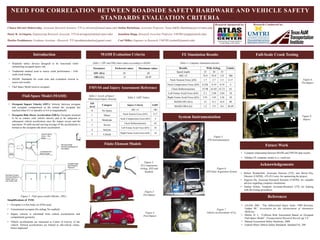
NEED FOR CORRELATION BETWEEN ROADSIDE SAFETY HARDWARE AND VEHICLE SAFETY
STANDARDS EVALUATION CRITERIA
Introduction
References
• Roadside safety devices designed to be functional while
minimizing occupant injury risk
• Traditional method used to assess crash performance - Full-
scale crash testing
• MASH: Standards for crash tests and evaluation criteria to
assess test results.
• Flail Space Model used as occupant.
Research Conducted by:Research Sponsored by:
Chiara Silvestri Dobrovolny, Associate Research Scientist, TTI (c-silvestri@ttimail.tamu.edu)
Dusty R. Arrington, Engineering Research Associate, TTI (d-arrington@ttimail.tamu.edu)
Harika Prodduturu, Graduate Assistant - Research, TTI (prodduturuharika@gmail.com)
Simplifications of FSM:
• Occupant is a free body, no ATDs used.
• Unrestrained occupant (No airbag, No seatbelt)
• Impact velocity is calculated from vehicle accelerations and
compartment geometry
• Vehicle accelerations are measured at Centre of Gravity of the
vehicle. Vertical accelerations are limited to sub-critical values,
hence neglected.
Parameter Preferred values Maximum values
OIV (ft/s) 30 40
ORA (G) 15 20.49
Flail-Space Model (MASH)
• Occupant Impact Velocity (OIV): Velocity between occupant
and occupant compartment at the instant the occupant has
reached either 0.3 m laterally or 0.6 m longitudinally
• Occupant Ride Down Acceleration (ORA): Occupant assumed
to be in contact with vehicle interior and to be subjected to
subsequent vehicle acceleration once the impact occurs and the
maximum 10 milli-second moving average of the accelerations is
termed as the occupant ride down acceleration.
Figure 1. Flail space model (Michie, 1981).
FMVSS and Injury Assessment Reference
Finite Element Models
Table 1. OIV and ORA limit values according to MASH.
AIS
level
Category
0 No injury
1 Minor
2 Moderate
3 Severe
4 Serious
5 Critical
Results With Airbag Limits
Speed (mph) 23 30 35
HIC-15 74.9 93.8 155 700
Neck Tension Force (kN) 1.7 2.7 3.3 4.17
Neck Compression Force (kN) 0.226 0.19 0.19 4
Chest Deflection(mm) 53.98 63.85 67.21 63
Left Femur Axial Force (kN) 2.1 2.88 2.84 10
Right Femur Axial Force (kN) 2.91 1.65 3.36 10
MASH OIV (ft/s) 12 15.1 16.9 40
MASH ORA (G) 1.2 5.9 8.6 20.49
Table 2. Levels of Injury –
Abbreviated Injury Severity.
Table 4. Computer Simulation Results.
• AAAM, 2001. “The Abbreviated Injury Scale: 1990 Revision,
Update 98,” Association for the Advancement of Automotive
Medicine.
• Michie D. J., “Collision Risk Assessment Based on Occupant
Flail-Space Model”, Transportation Research Record, pp 1-9.
• Manual Assessment Safety Hardware, 2009.
• Federal Motor Vehicle Safety Standards, Standard No. 208.
MASH Evaluation Criteria
System Instrumentation
Future Work
FE Simulation Results
Injury Criteria IARV
HIC-15 700
Neck Tension Force (kN) 4.17
Neck Compression Force (kN) 4
Chest Deflection(mm) 63
Left Femur Axial Force (kN) 10
Right Femur Axial Force (kN) 10
Table 3. IARV Values.
Figure 5.
ATD Instrumentation.
Figure 3.
Pre-Impact.
Figure 9.
Impact.
Acknowledgements
Figure 2.
FE Components:
Airbag, ATD and
Seatbelt.
Figure 8.
Pre-Impact.
Figure 4.
Post-Impact.
• Compute relationship between MASH and FMVSS data results.
• Validate FE computer model w.r.t. crash test.
Figure 6.
ATD Data Acquisition System.
Full-Scale Crash Testing
• Robert Wunderlich, Associate Director (TTI), and David Eby,
Director (UMTRI), ATLAS Center, for sponsoring the project.
• Jingwen Hu, Associate Research Scientist (UMTRI), for valuable
advices regarding computer simulations.
• Nathan Schulz, Graduate Assistant-Research (TTI) for helping
with the testing procedures.
Figure 7.
Vehicle Accelerometer (CG).
Stefan Hurlebaus, Associate Professor, Texas A&M (shurlebaus@civil.tamu.edu)
Jonathan Rupp, Research Associate Professor, UMTRI (jrupp@umich.edu)
Carl Miller, Engineer in Research, UMTRI (carlmill@umich.edu)

2015-TSC_MASH-FMVSS_Prodduturu

  • 1.
    NEED FOR CORRELATIONBETWEEN ROADSIDE SAFETY HARDWARE AND VEHICLE SAFETY STANDARDS EVALUATION CRITERIA Introduction References • Roadside safety devices designed to be functional while minimizing occupant injury risk • Traditional method used to assess crash performance - Full- scale crash testing • MASH: Standards for crash tests and evaluation criteria to assess test results. • Flail Space Model used as occupant. Research Conducted by:Research Sponsored by: Chiara Silvestri Dobrovolny, Associate Research Scientist, TTI (c-silvestri@ttimail.tamu.edu) Dusty R. Arrington, Engineering Research Associate, TTI (d-arrington@ttimail.tamu.edu) Harika Prodduturu, Graduate Assistant - Research, TTI (prodduturuharika@gmail.com) Simplifications of FSM: • Occupant is a free body, no ATDs used. • Unrestrained occupant (No airbag, No seatbelt) • Impact velocity is calculated from vehicle accelerations and compartment geometry • Vehicle accelerations are measured at Centre of Gravity of the vehicle. Vertical accelerations are limited to sub-critical values, hence neglected. Parameter Preferred values Maximum values OIV (ft/s) 30 40 ORA (G) 15 20.49 Flail-Space Model (MASH) • Occupant Impact Velocity (OIV): Velocity between occupant and occupant compartment at the instant the occupant has reached either 0.3 m laterally or 0.6 m longitudinally • Occupant Ride Down Acceleration (ORA): Occupant assumed to be in contact with vehicle interior and to be subjected to subsequent vehicle acceleration once the impact occurs and the maximum 10 milli-second moving average of the accelerations is termed as the occupant ride down acceleration. Figure 1. Flail space model (Michie, 1981). FMVSS and Injury Assessment Reference Finite Element Models Table 1. OIV and ORA limit values according to MASH. AIS level Category 0 No injury 1 Minor 2 Moderate 3 Severe 4 Serious 5 Critical Results With Airbag Limits Speed (mph) 23 30 35 HIC-15 74.9 93.8 155 700 Neck Tension Force (kN) 1.7 2.7 3.3 4.17 Neck Compression Force (kN) 0.226 0.19 0.19 4 Chest Deflection(mm) 53.98 63.85 67.21 63 Left Femur Axial Force (kN) 2.1 2.88 2.84 10 Right Femur Axial Force (kN) 2.91 1.65 3.36 10 MASH OIV (ft/s) 12 15.1 16.9 40 MASH ORA (G) 1.2 5.9 8.6 20.49 Table 2. Levels of Injury – Abbreviated Injury Severity. Table 4. Computer Simulation Results. • AAAM, 2001. “The Abbreviated Injury Scale: 1990 Revision, Update 98,” Association for the Advancement of Automotive Medicine. • Michie D. J., “Collision Risk Assessment Based on Occupant Flail-Space Model”, Transportation Research Record, pp 1-9. • Manual Assessment Safety Hardware, 2009. • Federal Motor Vehicle Safety Standards, Standard No. 208. MASH Evaluation Criteria System Instrumentation Future Work FE Simulation Results Injury Criteria IARV HIC-15 700 Neck Tension Force (kN) 4.17 Neck Compression Force (kN) 4 Chest Deflection(mm) 63 Left Femur Axial Force (kN) 10 Right Femur Axial Force (kN) 10 Table 3. IARV Values. Figure 5. ATD Instrumentation. Figure 3. Pre-Impact. Figure 9. Impact. Acknowledgements Figure 2. FE Components: Airbag, ATD and Seatbelt. Figure 8. Pre-Impact. Figure 4. Post-Impact. • Compute relationship between MASH and FMVSS data results. • Validate FE computer model w.r.t. crash test. Figure 6. ATD Data Acquisition System. Full-Scale Crash Testing • Robert Wunderlich, Associate Director (TTI), and David Eby, Director (UMTRI), ATLAS Center, for sponsoring the project. • Jingwen Hu, Associate Research Scientist (UMTRI), for valuable advices regarding computer simulations. • Nathan Schulz, Graduate Assistant-Research (TTI) for helping with the testing procedures. Figure 7. Vehicle Accelerometer (CG). Stefan Hurlebaus, Associate Professor, Texas A&M (shurlebaus@civil.tamu.edu) Jonathan Rupp, Research Associate Professor, UMTRI (jrupp@umich.edu) Carl Miller, Engineer in Research, UMTRI (carlmill@umich.edu)