Performance-based Budgeting
Craig Ross
#FUELGOOD18
YOUR PRESENTER
Craig Ross
Vice-President, Business Development
Questica Inc.
#FUELGOOD18
1. Public Sector Budgeting Methodologies
• Pros and Cons
2. Performance-based Budgeting (PBB)
• Pros and Cons
• Performance Indicators
• Benchmarking and Examples
3. Bringing it all Together
• Transitioning
• Key Considerations
• How Questica Can Help
4. Q&A
AGENDA
#FUELGOOD18
Public Sector
Budgeting
Methodologies:
Pros and Cons
#FUELGOOD18
Public Sector Budget Methodologies
Incremental or Baseline Budgeting
Zero-based Budgeting
Participatory Budgeting
Activity-based Budgeting
Budgeting for Outcomes
Performance-based Budgeting
#FUELGOOD18
Incremental/Baseline Budgeting
• Organization’s budgets are based on last year’s
budget framework
• Only new revenue is allocated
• Budget cuts are made as % of historical budget,
typically across the board
#FUELGOOD18
Incremental or Baseline Budgeting
Pros
• Easy to implement
• Less prep time

• Budget stability
Cons
• Lack of previous year budget
review
• Limited in vision of value
• No incentive to reduce costs
#FUELGOOD18
Zero-based Budgeting
• Organizations start with a clean state every
year
• Must justify each expense
• Focused on needs and benefits rather then
history
#FUELGOOD18
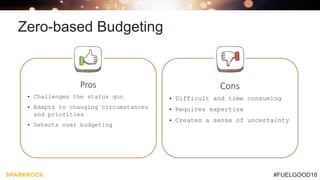
Zero-based Budgeting
Pros
• Challenges the status quo
• Adapts to changing circumstances
and priorities
• Detects over budgeting
Cons
• Difficult and time consuming
• Requires expertise
• Creates a sense of uncertainty
#FUELGOOD18
Participatory Budgeting
• Community members identify spending priorities
for the organization
• Organization provides stakeholders with as much
influence as possible
• Community votes on proposals to fund
#FUELGOOD18
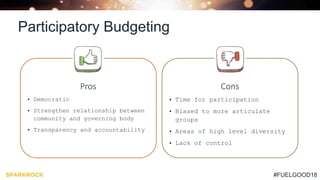
Participatory Budgeting
Pros
• Democratic
• Strengthen relationship between
community and governing body
• Transparency and accountability
Cons
• Time for participation
• Biased to more articulate
groups
• Areas of high level diversity
• Lack of control
#FUELGOOD18
Activity-based Budgeting
• Allocate financial resources to activities that
see the greatest return (in the form of
increased revenues)
• Identify and fund high value activities, cut
back on low value activities
• Revenues generated are allocated directly to
the unit responsible for the activity
#FUELGOOD18
Activity-Based Budgeting
Pros
• Units have direct control of
activities
• Creates incentives
• Continued increase in revenue
Cons
• Requires time and resources
• Logistically difficult for
cross-department programs
• Neglects non-revenue
generating activities
#FUELGOOD18
Budgeting for Outcomes
• Budgeting at the organization is based on
prioritizing programs and services that are most
important to the public
• Uses performance measurement to evaluate if a
program is producing results
• Form of Performance-based Budgeting
• Considered a best practice by GFOA
#FUELGOOD18
Budgeting for Outcomes
Pros
• Reflects stakeholder priorities
• Efficient, transparent and
innovative
• Collaboration between
departments
Cons
• Requires a lot of effort and
time
• Organization must undergo
substantial change
#FUELGOOD18
Performance-based
Budgeting (PBB)
#FUELGOOD18
Performance-based Budgeting
• PBB’s goal is to improve efficiency and
effectiveness of public expenditure, by linking
the funding of public sector organizations to the
results they deliver. Can also improve
prioritization of expenditures.
• Uses systematic performance information (i.e.,
indicators, evaluations, program costings, etc.)
to make this connection.
• PBB cannot begin until a system of performance
measurement has been instituted.
#FUELGOOD18
PBB is a Management Tool
• Performance budgets focus on missions, goals,
and objectives to explain why money is being
spent and provide a way to allocate resources
to achieve specific results
• PBB is intended to be a management tool for
program improvement, not a “carrot and stick”
methodology used to “punish” departments for
not meeting goals
#FUELGOOD18
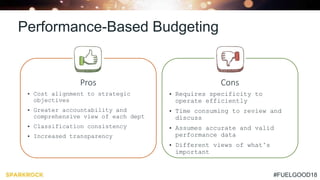
Performance-Based Budgeting
Pros
• Cost alignment to strategic
objectives
• Greater accountability and
comprehensive view of each dept
• Classification consistency
• Increased transparency
Cons
• Requires specificity to
operate efficiently
• Time consuming to review and
discuss
• Assumes accurate and valid
performance data
• Different views of what’s
important
#FUELGOOD18
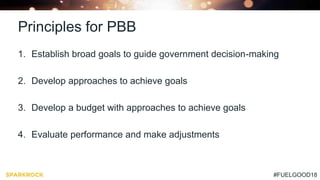
Principles for PBB
1. Establish broad goals to guide government decision-making
2. Develop approaches to achieve goals
3. Develop a budget with approaches to achieve goals
4. Evaluate performance and make adjustments
#FUELGOOD18
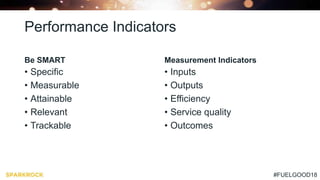
Performance Indicators
Be SMART
• Specific
• Measurable
• Attainable
• Relevant
• Trackable
Measurement Indicators
• Inputs
• Outputs
• Efficiency
• Service quality
• Outcomes
#FUELGOOD18
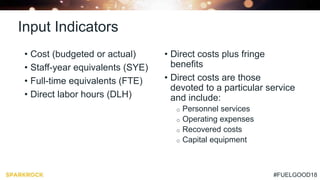
Input Indicators
• Cost (budgeted or actual)
• Staff-year equivalents (SYE)
• Full-time equivalents (FTE)
• Direct labor hours (DLH)
• Direct costs plus fringe
benefits
• Direct costs are those
devoted to a particular service
and include:
o Personnel services
o Operating expenses
o Recovered costs
o Capital equipment
#FUELGOOD18
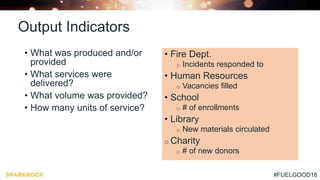
Output Indicators
• What was produced and/or
provided
• What services were
delivered?
• What volume was provided?
• How many units of service?
• Fire Dept.
o Incidents responded to
• Human Resources
o Vacancies filled
• School
o # of enrollments
• Library
o New materials circulated
o Charity
o # of new donors
#FUELGOOD18
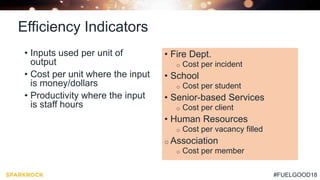
Efficiency Indicators
• Inputs used per unit of
output
• Cost per unit where the input
is money/dollars
• Productivity where the input
is staff hours
• Fire Dept.
o Cost per incident
• School
o Cost per student
• Senior-based Services
o Cost per client
• Human Resources
o Cost per vacancy filled
o Association
o Cost per member
#FUELGOOD18
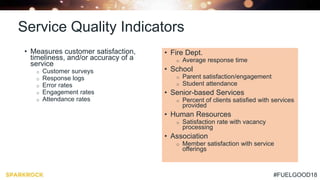
Service Quality Indicators
• Measures customer satisfaction,
timeliness, and/or accuracy of a
service
o Customer surveys
o Response logs
o Error rates
o Engagement rates
o Attendance rates
• Fire Dept.
o Average response time
• School
o Parent satisfaction/engagement
o Student attendance
• Senior-based Services
o Percent of clients satisfied with services
provided
• Human Resources
o Satisfaction rate with vacancy
processing
• Association
o Member satisfaction with service
offerings
#FUELGOOD18
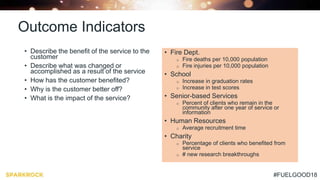
Outcome Indicators
• Describe the benefit of the service to the
customer
• Describe what was changed or
accomplished as a result of the service
• How has the customer benefited?
• Why is the customer better off?
• What is the impact of the service?
• Fire Dept.
o Fire deaths per 10,000 population
o Fire injuries per 10,000 population
• School
o Increase in graduation rates
o Increase in test scores
• Senior-based Services
o Percent of clients who remain in the
community after one year of service or
information
• Human Resources
o Average recruitment time
• Charity
o Percentage of clients who benefited from
service
o # new research breakthroughs
#FUELGOOD18
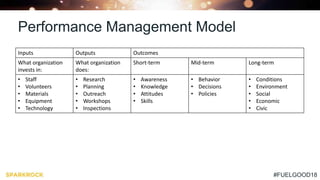
Performance Management Model
Inputs Outputs Outcomes
What organization
invests in:
What organization
does:
Short-term Mid-term Long-term
• Staff
• Volunteers
• Materials
• Equipment
• Technology
• Research
• Planning
• Outreach
• Workshops
• Inspections
• Awareness
• Knowledge
• Attitudes
• Skills
• Behavior
• Decisions
• Policies
• Conditions
• Environment
• Social
• Economic
• Civic
#FUELGOOD18
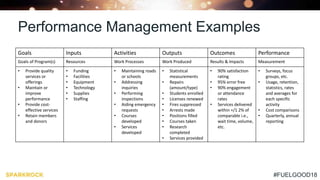
Performance Management Examples
Goals Inputs Activities Outputs Outcomes Performance
Goals of Program(s) Resources Work Processes Work Produced Results & Impacts Measurement
• Provide quality
services or
offerings
• Maintain or
improve
performance
• Provide cost-
effective services
• Retain members
and donors
• Funding
• Facilities
• Equipment
• Technology
• Supplies
• Staffing
• Maintaining roads
or schools
• Addressing
inquiries
• Performing
inspections
• Aiding emergency
requests
• Courses
developed
• Services
developed
• Statistical
measurements
• Repairs
(amount/type)
• Students enrolled
• Licenses renewed
• Fires suppressed
• Arrests made
• Positions filled
• Courses taken
• Research
completed
• Services provided
• 90% satisfaction
rating
• 95% error free
• 90% engagement
or attendance
rates
• Services delivered
within +/1 2% of
comparable i.e.,
wait time, volume,
etc.
• Surveys, focus
groups, etc.
• Usage, retention,
statistics, rates
and averages for
each specific
activity
• Cost comparisons
• Quarterly, annual
reporting
#FUELGOOD18
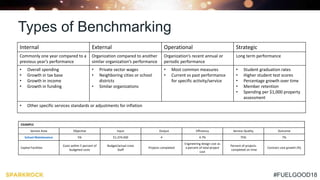
Types of Benchmarking
Internal External Operational Strategic
Commonly one year compared to a
previous year’s performance
Organization compared to another
similar organization’s performance
Organization’s recent annual or
periodic performance
Long term performance
• Overall spending
• Growth in tax base
• Growth in income
• Growth in funding
• Private sector wages
• Neighboring cities or school
districts
• Similar organizations
• Most common measures
• Current vs past performance
for specific activity/service
• Student graduation rates
• Higher student test scores
• Percentage growth over time
• Member retention
• Spending per $1,000 property
assessment
• Other specific services standards or adjustments for inflation
EXAMPLE
Service Area Objective Input Output Efficiency Service Quality Outcome
School Maintenance 5% $1,374,500 4 4.7% 75% 7%
Capital Facilities
Costs within 5 percent of
budgeted costs
Budget/actual costs
Staff
Projects completed
Engineering design cost as
a percent of total project
cost
Percent of projects
completed on time
Contract cost growth (%)
#FUELGOOD18
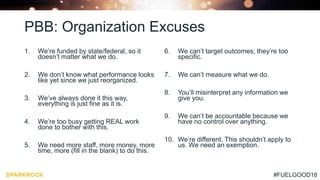
PBB: Organization Excuses
1. We’re funded by state/federal, so it
doesn’t matter what we do.
2. We don’t know what performance looks
like yet since we just reorganized.
3. We’ve always done it this way,
everything is just fine as it is.
4. We’re too busy getting REAL work
done to bother with this.
5. We need more staff, more money, more
time, more (fill in the blank) to do this.
6. We can’t target outcomes; they’re too
specific.
7. We can’t measure what we do.
8. You’ll misinterpret any information we
give you.
9. We can’t be accountable because we
have no control over anything.
10. We’re different. This shouldn’t apply to
us. We need an exemption.
#FUELGOOD18
Bringing it
all Together
#FUELGOOD18
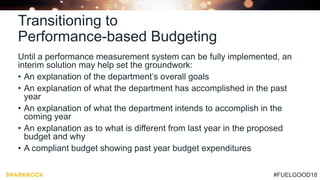
Transitioning to
Performance-based Budgeting
Until a performance measurement system can be fully implemented, an
interim solution may help set the groundwork:
• An explanation of the department’s overall goals
• An explanation of what the department has accomplished in the past
year
• An explanation of what the department intends to accomplish in the
coming year
• An explanation as to what is different from last year in the proposed
budget and why
• A compliant budget showing past year budget expenditures
#FUELGOOD18
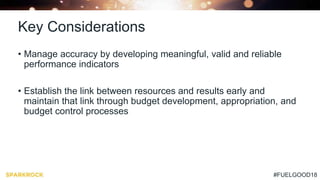
Key Considerations
• Manage accuracy by developing meaningful, valid and reliable
performance indicators
• Establish the link between resources and results early and
maintain that link through budget development, appropriation, and
budget control processes
#FUELGOOD18
How Questica Can Help
• Comprehensive budgeting and performance software
• Transparency and data visualization software
#FUELGOOD18
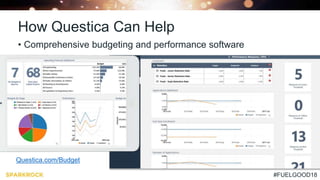
How Questica Can Help
• Comprehensive budgeting and performance software
Questica.com/Budget
#FUELGOOD18
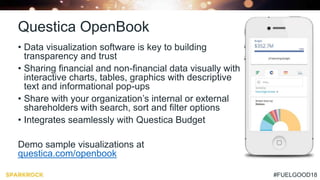
Questica OpenBook
• Data visualization software is key to building
transparency and trust
• Sharing financial and non-financial data visually with
interactive charts, tables, graphics with descriptive
text and informational pop-ups
• Share with your organization’s internal or external
shareholders with search, sort and filter options
• Integrates seamlessly with Questica Budget
Demo sample visualizations at
questica.com/openbook
#FUELGOOD18
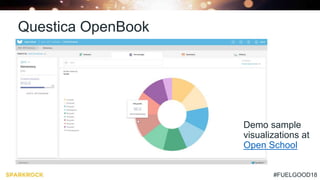
Questica OpenBook
Demo sample
visualizations at
Open School
#FUELGOOD18
Q&A
#FUELGOOD18
THANKS!
Craig Ross
cross@questica.com
1.877.707.7755 x 513
All presentations will be made available after the conference.
#FUELGOOD18
Please take 5mins to
fill out your session
evaluations
One lucky winner will
win an Amazon Echo!
#FUELGOOD18
www.sparkrock.com @sparkrockinc
Nonprofit, Human Services & K12
software to help you serve more
people, with less effort, stress &
expense.

Fuel Good 2018: Performance-based Budgeting with Questica

  • 1.
  • 2.
  • 3.
    #FUELGOOD18 1. Public SectorBudgeting Methodologies • Pros and Cons 2. Performance-based Budgeting (PBB) • Pros and Cons • Performance Indicators • Benchmarking and Examples 3. Bringing it all Together • Transitioning • Key Considerations • How Questica Can Help 4. Q&A AGENDA
  • 4.
  • 5.
    #FUELGOOD18 Public Sector BudgetMethodologies Incremental or Baseline Budgeting Zero-based Budgeting Participatory Budgeting Activity-based Budgeting Budgeting for Outcomes Performance-based Budgeting
  • 6.
    #FUELGOOD18 Incremental/Baseline Budgeting • Organization’sbudgets are based on last year’s budget framework • Only new revenue is allocated • Budget cuts are made as % of historical budget, typically across the board
  • 7.
    #FUELGOOD18 Incremental or BaselineBudgeting Pros • Easy to implement • Less prep time • Budget stability Cons • Lack of previous year budget review • Limited in vision of value • No incentive to reduce costs
  • 8.
    #FUELGOOD18 Zero-based Budgeting • Organizationsstart with a clean state every year • Must justify each expense • Focused on needs and benefits rather then history
  • 9.
    #FUELGOOD18 Zero-based Budgeting Pros • Challengesthe status quo • Adapts to changing circumstances and priorities • Detects over budgeting Cons • Difficult and time consuming • Requires expertise • Creates a sense of uncertainty
  • 10.
    #FUELGOOD18 Participatory Budgeting • Communitymembers identify spending priorities for the organization • Organization provides stakeholders with as much influence as possible • Community votes on proposals to fund
  • 11.
    #FUELGOOD18 Participatory Budgeting Pros • Democratic •Strengthen relationship between community and governing body • Transparency and accountability Cons • Time for participation • Biased to more articulate groups • Areas of high level diversity • Lack of control
  • 12.
    #FUELGOOD18 Activity-based Budgeting • Allocatefinancial resources to activities that see the greatest return (in the form of increased revenues) • Identify and fund high value activities, cut back on low value activities • Revenues generated are allocated directly to the unit responsible for the activity
  • 13.
    #FUELGOOD18 Activity-Based Budgeting Pros • Unitshave direct control of activities • Creates incentives • Continued increase in revenue Cons • Requires time and resources • Logistically difficult for cross-department programs • Neglects non-revenue generating activities
  • 14.
    #FUELGOOD18 Budgeting for Outcomes •Budgeting at the organization is based on prioritizing programs and services that are most important to the public • Uses performance measurement to evaluate if a program is producing results • Form of Performance-based Budgeting • Considered a best practice by GFOA
  • 15.
    #FUELGOOD18 Budgeting for Outcomes Pros •Reflects stakeholder priorities • Efficient, transparent and innovative • Collaboration between departments Cons • Requires a lot of effort and time • Organization must undergo substantial change
  • 16.
  • 17.
    #FUELGOOD18 Performance-based Budgeting • PBB’sgoal is to improve efficiency and effectiveness of public expenditure, by linking the funding of public sector organizations to the results they deliver. Can also improve prioritization of expenditures. • Uses systematic performance information (i.e., indicators, evaluations, program costings, etc.) to make this connection. • PBB cannot begin until a system of performance measurement has been instituted.
  • 18.
    #FUELGOOD18 PBB is aManagement Tool • Performance budgets focus on missions, goals, and objectives to explain why money is being spent and provide a way to allocate resources to achieve specific results • PBB is intended to be a management tool for program improvement, not a “carrot and stick” methodology used to “punish” departments for not meeting goals
  • 19.
    #FUELGOOD18 Performance-Based Budgeting Pros • Costalignment to strategic objectives • Greater accountability and comprehensive view of each dept • Classification consistency • Increased transparency Cons • Requires specificity to operate efficiently • Time consuming to review and discuss • Assumes accurate and valid performance data • Different views of what’s important
  • 20.
    #FUELGOOD18 Principles for PBB 1.Establish broad goals to guide government decision-making 2. Develop approaches to achieve goals 3. Develop a budget with approaches to achieve goals 4. Evaluate performance and make adjustments
  • 21.
    #FUELGOOD18 Performance Indicators Be SMART •Specific • Measurable • Attainable • Relevant • Trackable Measurement Indicators • Inputs • Outputs • Efficiency • Service quality • Outcomes
  • 22.
    #FUELGOOD18 Input Indicators • Cost(budgeted or actual) • Staff-year equivalents (SYE) • Full-time equivalents (FTE) • Direct labor hours (DLH) • Direct costs plus fringe benefits • Direct costs are those devoted to a particular service and include: o Personnel services o Operating expenses o Recovered costs o Capital equipment
  • 23.
    #FUELGOOD18 Output Indicators • Whatwas produced and/or provided • What services were delivered? • What volume was provided? • How many units of service? • Fire Dept. o Incidents responded to • Human Resources o Vacancies filled • School o # of enrollments • Library o New materials circulated o Charity o # of new donors
  • 24.
    #FUELGOOD18 Efficiency Indicators • Inputsused per unit of output • Cost per unit where the input is money/dollars • Productivity where the input is staff hours • Fire Dept. o Cost per incident • School o Cost per student • Senior-based Services o Cost per client • Human Resources o Cost per vacancy filled o Association o Cost per member
  • 25.
    #FUELGOOD18 Service Quality Indicators •Measures customer satisfaction, timeliness, and/or accuracy of a service o Customer surveys o Response logs o Error rates o Engagement rates o Attendance rates • Fire Dept. o Average response time • School o Parent satisfaction/engagement o Student attendance • Senior-based Services o Percent of clients satisfied with services provided • Human Resources o Satisfaction rate with vacancy processing • Association o Member satisfaction with service offerings
  • 26.
    #FUELGOOD18 Outcome Indicators • Describethe benefit of the service to the customer • Describe what was changed or accomplished as a result of the service • How has the customer benefited? • Why is the customer better off? • What is the impact of the service? • Fire Dept. o Fire deaths per 10,000 population o Fire injuries per 10,000 population • School o Increase in graduation rates o Increase in test scores • Senior-based Services o Percent of clients who remain in the community after one year of service or information • Human Resources o Average recruitment time • Charity o Percentage of clients who benefited from service o # new research breakthroughs
  • 27.
    #FUELGOOD18 Performance Management Model InputsOutputs Outcomes What organization invests in: What organization does: Short-term Mid-term Long-term • Staff • Volunteers • Materials • Equipment • Technology • Research • Planning • Outreach • Workshops • Inspections • Awareness • Knowledge • Attitudes • Skills • Behavior • Decisions • Policies • Conditions • Environment • Social • Economic • Civic
  • 28.
    #FUELGOOD18 Performance Management Examples GoalsInputs Activities Outputs Outcomes Performance Goals of Program(s) Resources Work Processes Work Produced Results & Impacts Measurement • Provide quality services or offerings • Maintain or improve performance • Provide cost- effective services • Retain members and donors • Funding • Facilities • Equipment • Technology • Supplies • Staffing • Maintaining roads or schools • Addressing inquiries • Performing inspections • Aiding emergency requests • Courses developed • Services developed • Statistical measurements • Repairs (amount/type) • Students enrolled • Licenses renewed • Fires suppressed • Arrests made • Positions filled • Courses taken • Research completed • Services provided • 90% satisfaction rating • 95% error free • 90% engagement or attendance rates • Services delivered within +/1 2% of comparable i.e., wait time, volume, etc. • Surveys, focus groups, etc. • Usage, retention, statistics, rates and averages for each specific activity • Cost comparisons • Quarterly, annual reporting
  • 29.
    #FUELGOOD18 Types of Benchmarking InternalExternal Operational Strategic Commonly one year compared to a previous year’s performance Organization compared to another similar organization’s performance Organization’s recent annual or periodic performance Long term performance • Overall spending • Growth in tax base • Growth in income • Growth in funding • Private sector wages • Neighboring cities or school districts • Similar organizations • Most common measures • Current vs past performance for specific activity/service • Student graduation rates • Higher student test scores • Percentage growth over time • Member retention • Spending per $1,000 property assessment • Other specific services standards or adjustments for inflation EXAMPLE Service Area Objective Input Output Efficiency Service Quality Outcome School Maintenance 5% $1,374,500 4 4.7% 75% 7% Capital Facilities Costs within 5 percent of budgeted costs Budget/actual costs Staff Projects completed Engineering design cost as a percent of total project cost Percent of projects completed on time Contract cost growth (%)
  • 30.
    #FUELGOOD18 PBB: Organization Excuses 1.We’re funded by state/federal, so it doesn’t matter what we do. 2. We don’t know what performance looks like yet since we just reorganized. 3. We’ve always done it this way, everything is just fine as it is. 4. We’re too busy getting REAL work done to bother with this. 5. We need more staff, more money, more time, more (fill in the blank) to do this. 6. We can’t target outcomes; they’re too specific. 7. We can’t measure what we do. 8. You’ll misinterpret any information we give you. 9. We can’t be accountable because we have no control over anything. 10. We’re different. This shouldn’t apply to us. We need an exemption.
  • 31.
  • 32.
    #FUELGOOD18 Transitioning to Performance-based Budgeting Untila performance measurement system can be fully implemented, an interim solution may help set the groundwork: • An explanation of the department’s overall goals • An explanation of what the department has accomplished in the past year • An explanation of what the department intends to accomplish in the coming year • An explanation as to what is different from last year in the proposed budget and why • A compliant budget showing past year budget expenditures
  • 33.
    #FUELGOOD18 Key Considerations • Manageaccuracy by developing meaningful, valid and reliable performance indicators • Establish the link between resources and results early and maintain that link through budget development, appropriation, and budget control processes
  • 34.
    #FUELGOOD18 How Questica CanHelp • Comprehensive budgeting and performance software • Transparency and data visualization software
  • 35.
    #FUELGOOD18 How Questica CanHelp • Comprehensive budgeting and performance software Questica.com/Budget
  • 36.
    #FUELGOOD18 Questica OpenBook • Datavisualization software is key to building transparency and trust • Sharing financial and non-financial data visually with interactive charts, tables, graphics with descriptive text and informational pop-ups • Share with your organization’s internal or external shareholders with search, sort and filter options • Integrates seamlessly with Questica Budget Demo sample visualizations at questica.com/openbook
  • 37.
  • 38.
  • 39.
    #FUELGOOD18 THANKS! Craig Ross cross@questica.com 1.877.707.7755 x513 All presentations will be made available after the conference.
  • 40.
    #FUELGOOD18 Please take 5minsto fill out your session evaluations One lucky winner will win an Amazon Echo!
  • 41.
    #FUELGOOD18 www.sparkrock.com @sparkrockinc Nonprofit, HumanServices & K12 software to help you serve more people, with less effort, stress & expense.

Editor's Notes

  • #13 There’s an element of performance involved in that you are measuring “cost per activity”. This is a more conceptual methodology rather than how the budget is structured (for example. Division > Dept > CC or Program > Services). Activities – departments generating tuition, fees, etc.
  • #42 Have this slide up as people exit the room.