Operating Budget for Local
Governments
Strengthening The Financial Foundation of
Local Government
Training of Trainers Workshop
June 4- 15 2007 Nadi, Fiji
Based on Financial Management Training Series- UNHSP
Dr Ravikant Joshi
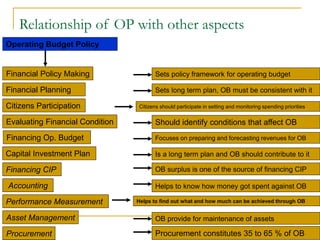
Relationship of OP with other aspects
Financial Policy Making
Financial Planning
Citizens Participation
Evaluating Financial Condition
Asset Management
Performance Measurement
Accounting
Financing CIP
Capital Investment Plan
Financing Op. Budget
Procurement
Helps to find out what and how much can be achieved through OB
Sets policy framework for operating budget
Sets long term plan, OB must be consistent with it
Citizens should participate in setting and monitoring spending priorities
Should identify conditions that affect OB
Focuses on preparing and forecasting revenues for OB
Is a long term plan and OB should contribute to it
OB surplus is one of the source of financing CIP
Helps to know how money got spent against OB
Procurement constitutes 35 to 65 % of OB
OB provide for maintenance of assets
Operating Budget Policy
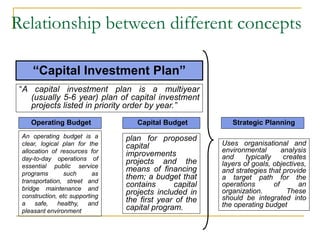
Relationship between different concepts
“A capital investment plan is a multiyear
(usually 5-6 year) plan of capital investment
projects listed in priority order by year.”
“Capital Investment Plan”
Operating Budget Capital Budget Strategic Planning
plan for proposed
capital
improvements
projects and the
means of financing
them; a budget that
contains capital
projects included in
the first year of the
capital program.
Uses organisational and
environmental analysis
and typically creates
layers of goals, objectives,
and strategies that provide
a target path for the
operations of an
organization. These
should be integrated into
the operating budget
An operating budget is a
clear, logical plan for the
allocation of resources for
day-to-day operations of
essential public service
programs such as
transportation, street and
bridge maintenance and
construction, etc supporting
a safe, healthy, and
pleasant environment
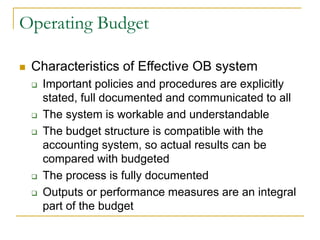
Operating Budget
◼ Characteristics of Effective OB system
❑ Important policies and procedures are explicitly
stated, full documented and communicated to all
❑ The system is workable and understandable
❑ The budget structure is compatible with the
accounting system, so actual results can be
compared with budgeted
❑ The process is fully documented
❑ Outputs or performance measures are an integral
part of the budget
Learning
Application
Go to Page No 74, Vol 2
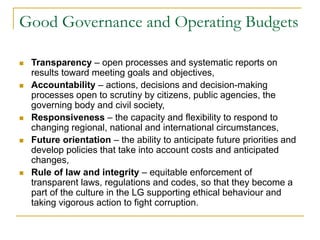
Good Governance and Operating Budgets
◼ Transparency – open processes and systematic reports on
results toward meeting goals and objectives,
◼ Accountability – actions, decisions and decision-making
processes open to scrutiny by citizens, public agencies, the
governing body and civil society,
◼ Responsiveness – the capacity and flexibility to respond to
changing regional, national and international circumstances,
◼ Future orientation – the ability to anticipate future priorities and
develop policies that take into account costs and anticipated
changes,
◼ Rule of law and integrity – equitable enforcement of
transparent laws, regulations and codes, so that they become a
part of the culture in the LG supporting ethical behaviour and
taking vigorous action to fight corruption.
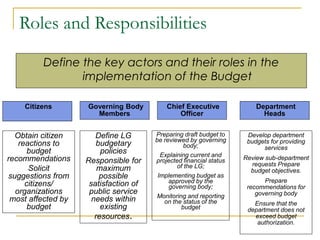
Roles and Responsibilities
Define the key actors and their roles in the
implementation of the Budget
Citizens Governing Body
Members
Chief Executive
Officer
Define LG
budgetary
policies
Responsible for
maximum
possible
satisfaction of
public service
needs within
existing
resources.
Develop department
budgets for providing
services
Review sub-department
requests Prepare
budget objectives.
Prepare
recommendations for
governing body
Ensure that the
department does not
exceed budget
authorization.
Department
Heads
Obtain citizen
reactions to
budget
recommendations
Solicit
suggestions from
citizens/
organizations
most affected by
budget
Preparing draft budget to
be reviewed by governing
body;
Explaining current and
projected financial status
of the LG;
Implementing budget as
approved by the
governing body;
Monitoring and reporting
on the status of the
budget
Learning
Application
Go to Page No 81, Vol 2
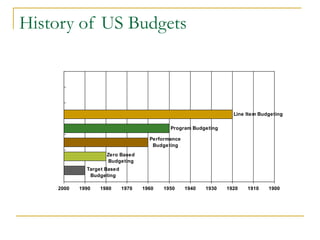
History of US Budgets
Line Item Budgeting
Program Budgeting
Performance
Budgeting
Zero Based
Budgeting
Target Based
Budgeting
1900
1910
1920
1930
1940
1950
1960
1970
1980
1990
2000
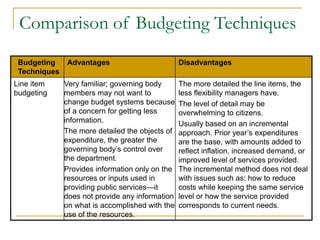
Comparison of Budgeting Techniques
Budgeting
Techniques
Advantages Disadvantages
Line item
budgeting
Very familiar; governing body
members may not want to
change budget systems because
of a concern for getting less
information.
The more detailed the objects of
expenditure, the greater the
governing body’s control over
the department.
Provides information only on the
resources or inputs used in
providing public services—it
does not provide any information
on what is accomplished with the
use of the resources.
The more detailed the line items, the
less flexibility managers have.
The level of detail may be
overwhelming to citizens.
Usually based on an incremental
approach. Prior year’s expenditures
are the base, with amounts added to
reflect inflation, increased demand, or
improved level of services provided.
The incremental method does not deal
with issues such as: how to reduce
costs while keeping the same service
level or how the service provided
corresponds to current needs.
Comparison of Budgeting Techniques
Budgeting
Techniques
Advantages Disadvantages
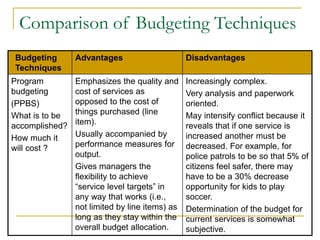
Program
budgeting
(PPBS)
What is to be
accomplished?
How much it
will cost ?
Emphasizes the quality and
cost of services as
opposed to the cost of
things purchased (line
item).
Usually accompanied by
performance measures for
output.
Gives managers the
flexibility to achieve
“service level targets” in
any way that works (i.e.,
not limited by line items) as
long as they stay within the
overall budget allocation.
Increasingly complex.
Very analysis and paperwork
oriented.
May intensify conflict because it
reveals that if one service is
increased another must be
decreased. For example, for
police patrols to be so that 5% of
citizens feel safer, there may
have to be a 30% decrease
opportunity for kids to play
soccer.
Determination of the budget for
current services is somewhat
subjective.
Comparison of Budgeting Techniques
Budgeting
Techniques
Advantages Disadvantages
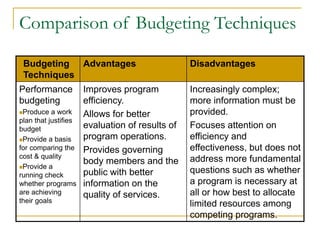
Performance
budgeting
◼Produce a work
plan that justifies
budget
◼Provide a basis
for comparing the
cost & quality
◼Provide a
running check
whether programs
are achieving
their goals
Improves program
efficiency.
Allows for better
evaluation of results of
program operations.
Provides governing
body members and the
public with better
information on the
quality of services.
Increasingly complex;
more information must be
provided.
Focuses attention on
efficiency and
effectiveness, but does not
address more fundamental
questions such as whether
a program is necessary at
all or how best to allocate
limited resources among
competing programs.
Comparison of Budgeting Techniques
Budgeting
Techniques
Advantages Disadvantages
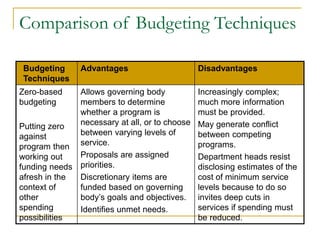
Zero-based
budgeting
Putting zero
against
program then
working out
funding needs
afresh in the
context of
other
spending
possibilities
Allows governing body
members to determine
whether a program is
necessary at all, or to choose
between varying levels of
service.
Proposals are assigned
priorities.
Discretionary items are
funded based on governing
body’s goals and objectives.
Identifies unmet needs.
Increasingly complex;
much more information
must be provided.
May generate conflict
between competing
programs.
Department heads resist
disclosing estimates of the
cost of minimum service
levels because to do so
invites deep cuts in
services if spending must
be reduced.
Comparison of Budgeting Techniques
Budgeting
Techniques
Advantages Disadvantages
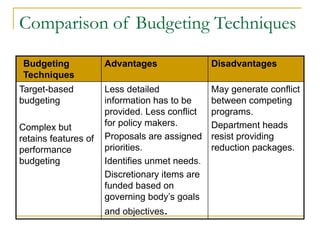
Target-based
budgeting
Complex but
retains features of
performance
budgeting
Less detailed
information has to be
provided. Less conflict
for policy makers.
Proposals are assigned
priorities.
Identifies unmet needs.
Discretionary items are
funded based on
governing body’s goals
and objectives.
May generate conflict
between competing
programs.
Department heads
resist providing
reduction packages.
Participatory Budgeting- Brazil
◼ See Page 89
Accounting and Operating Budget
◼ Accounting System
❑ Accounting is the fundamental building block in the
budgeting system
❑ Accounting system must parallel budget programs
◼ Classification of Accounts
❑ Mechanism relating accounting to budget through
classification/ chart of accounts
❑ Tailor to needs of user LG
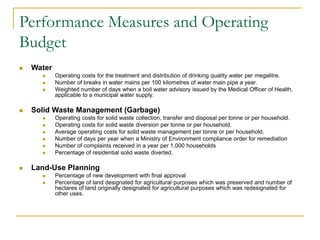
Performance Measures and Operating
Budget
◼ Water
◼ Operating costs for the treatment and distribution of drinking quality water per megalitre.
◼ Number of breaks in water mains per 100 kilometres of water main pipe a year.
◼ Weighted number of days when a boil water advisory issued by the Medical Officer of Health,
applicable to a municipal water supply.
◼ Solid Waste Management (Garbage)
◼ Operating costs for solid waste collection, transfer and disposal per tonne or per household.
◼ Operating costs for solid waste diversion per tonne or per household.
◼ Average operating costs for solid waste management per tonne or per household.
◼ Number of days per year when a Ministry of Environment compliance order for remediation
◼ Number of complaints received in a year per 1,000 households
◼ Percentage of residential solid waste diverted.
◼ Land-Use Planning
◼ Percentage of new development with final approval
◼ Percentage of land designated for agricultural purposes which was preserved and number of
hectares of land originally designated for agricultural purposes which was redesignated for
other uses.
Performance Audits and the operating
budget
◼ Have the goals of the previous year achieved?
◼ Have standards for measuring the degree of
goal accomplishment sharpened?
◼ Has management abandoned obsolete goals?
◼ Were alternative means considered, tested
and evaluated?
◼ Are necessary management analytical
techniques in use?
Learning
Application
Go to Page No 93, Vol 2
Policies – sample operating budget policy
Benefits
◼ Legal Documentation
◼ Preparation of OP budget thru established process ensures compliance
with applicable laws or statutes
◼ Policy Compliance
◼ Ensures implementation of goals, policies;
◼ Establishes priorities
◼ Political Impact
◼ Defines impact of political changes on the activities of the LG
◼ Financial Plan
◼ Regulates annual financial operations
◼ Management Plan
◼ Manages services and expenditure by allocating money to specific
programs
◼ Communications Tool
◼ Provides feedback for citizen feedback
◼ Publicizes what LG will be doing during fiscal year
Learning
Application
Go to Page No 101, Vol 2
Obstacles and Risks
◼ Management resistance
❑ Concern that elected officials, citizens and media will use
additional information to assign blame and to withdraw
resources – ‘passing fads’ or ‘make work’ exercise and see
no benefit in it
◼ Political resistance
❑ Elected officials are not taken in confidence about benefits
of proposed changes
◼ Lack of resources
❑ Lack of analytical staff, time, information technology and
finally funds to implement changes
Learning
Application
Go to Page No 103, Vol 2
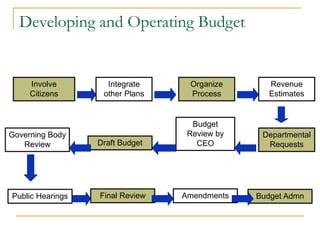
Developing and Operating Budget
Involve
Citizens
Integrate
other Plans
Organize
Process
Revenue
Estimates
Budget
Review by
CEO
Draft Budget
Departmental
Requests
Governing Body
Review
Public Hearings Final Review Amendments Budget Admn
Learning
Application
Go to Page No 131, Vol 2
Advanced Budgeting Concepts
◼ Cost Containment – cost control and productivity improvement
❑ Expenditure Management and Control
❑ Cost Analysis
❑ Alternate Service Delivery – Contracting out, Privatizing infrastructure,
Public-public partnership, Franchise Agreement, Voucher Arrangements,
Subsidy Arrangements,
◼ Cost Finding
◼ Management Analysis
❑ Re-Engineering
❑ Management Audits
❑ Value Analysis
❑ Benchmarking
❑ Total Quality management
❑ Technology/ Capital Substitution
◼ Grant awarding
Learning
Application
Go to Page No 153, Vol 2
Learning
Application
Go to Page No 155, Vol 2
Developing a Grant Award Program
◼ Step1- Identify service/ funds required
◼ Step 2- Get Organized
◼ Step 3-Determine LG’s level of involvement
◼ Step 4- Decide process (competitive/ non competitive)
◼ Step 5- Prepare Request for Application Material
◼ Step 6- Market Grant Program
◼ Step 7- Review/ select grantee
◼ Step 8- Negotiate Grant Terms
◼ Step 9- Administer Grant
Learning
Application
Go to Page No 165, Vol 2
Thank You

Operating Budget in Local Government

  • 1.
    Operating Budget forLocal Governments Strengthening The Financial Foundation of Local Government Training of Trainers Workshop June 4- 15 2007 Nadi, Fiji Based on Financial Management Training Series- UNHSP Dr Ravikant Joshi
  • 2.
    Relationship of OPwith other aspects Financial Policy Making Financial Planning Citizens Participation Evaluating Financial Condition Asset Management Performance Measurement Accounting Financing CIP Capital Investment Plan Financing Op. Budget Procurement Helps to find out what and how much can be achieved through OB Sets policy framework for operating budget Sets long term plan, OB must be consistent with it Citizens should participate in setting and monitoring spending priorities Should identify conditions that affect OB Focuses on preparing and forecasting revenues for OB Is a long term plan and OB should contribute to it OB surplus is one of the source of financing CIP Helps to know how money got spent against OB Procurement constitutes 35 to 65 % of OB OB provide for maintenance of assets Operating Budget Policy
  • 3.
    Relationship between differentconcepts “A capital investment plan is a multiyear (usually 5-6 year) plan of capital investment projects listed in priority order by year.” “Capital Investment Plan” Operating Budget Capital Budget Strategic Planning plan for proposed capital improvements projects and the means of financing them; a budget that contains capital projects included in the first year of the capital program. Uses organisational and environmental analysis and typically creates layers of goals, objectives, and strategies that provide a target path for the operations of an organization. These should be integrated into the operating budget An operating budget is a clear, logical plan for the allocation of resources for day-to-day operations of essential public service programs such as transportation, street and bridge maintenance and construction, etc supporting a safe, healthy, and pleasant environment
  • 4.
    Operating Budget ◼ Characteristicsof Effective OB system ❑ Important policies and procedures are explicitly stated, full documented and communicated to all ❑ The system is workable and understandable ❑ The budget structure is compatible with the accounting system, so actual results can be compared with budgeted ❑ The process is fully documented ❑ Outputs or performance measures are an integral part of the budget
  • 5.
  • 6.
    Good Governance andOperating Budgets ◼ Transparency – open processes and systematic reports on results toward meeting goals and objectives, ◼ Accountability – actions, decisions and decision-making processes open to scrutiny by citizens, public agencies, the governing body and civil society, ◼ Responsiveness – the capacity and flexibility to respond to changing regional, national and international circumstances, ◼ Future orientation – the ability to anticipate future priorities and develop policies that take into account costs and anticipated changes, ◼ Rule of law and integrity – equitable enforcement of transparent laws, regulations and codes, so that they become a part of the culture in the LG supporting ethical behaviour and taking vigorous action to fight corruption.
  • 7.
    Roles and Responsibilities Definethe key actors and their roles in the implementation of the Budget Citizens Governing Body Members Chief Executive Officer Define LG budgetary policies Responsible for maximum possible satisfaction of public service needs within existing resources. Develop department budgets for providing services Review sub-department requests Prepare budget objectives. Prepare recommendations for governing body Ensure that the department does not exceed budget authorization. Department Heads Obtain citizen reactions to budget recommendations Solicit suggestions from citizens/ organizations most affected by budget Preparing draft budget to be reviewed by governing body; Explaining current and projected financial status of the LG; Implementing budget as approved by the governing body; Monitoring and reporting on the status of the budget
  • 8.
  • 9.
    History of USBudgets Line Item Budgeting Program Budgeting Performance Budgeting Zero Based Budgeting Target Based Budgeting 1900 1910 1920 1930 1940 1950 1960 1970 1980 1990 2000
  • 10.
    Comparison of BudgetingTechniques Budgeting Techniques Advantages Disadvantages Line item budgeting Very familiar; governing body members may not want to change budget systems because of a concern for getting less information. The more detailed the objects of expenditure, the greater the governing body’s control over the department. Provides information only on the resources or inputs used in providing public services—it does not provide any information on what is accomplished with the use of the resources. The more detailed the line items, the less flexibility managers have. The level of detail may be overwhelming to citizens. Usually based on an incremental approach. Prior year’s expenditures are the base, with amounts added to reflect inflation, increased demand, or improved level of services provided. The incremental method does not deal with issues such as: how to reduce costs while keeping the same service level or how the service provided corresponds to current needs.
  • 11.
    Comparison of BudgetingTechniques Budgeting Techniques Advantages Disadvantages Program budgeting (PPBS) What is to be accomplished? How much it will cost ? Emphasizes the quality and cost of services as opposed to the cost of things purchased (line item). Usually accompanied by performance measures for output. Gives managers the flexibility to achieve “service level targets” in any way that works (i.e., not limited by line items) as long as they stay within the overall budget allocation. Increasingly complex. Very analysis and paperwork oriented. May intensify conflict because it reveals that if one service is increased another must be decreased. For example, for police patrols to be so that 5% of citizens feel safer, there may have to be a 30% decrease opportunity for kids to play soccer. Determination of the budget for current services is somewhat subjective.
  • 12.
    Comparison of BudgetingTechniques Budgeting Techniques Advantages Disadvantages Performance budgeting ◼Produce a work plan that justifies budget ◼Provide a basis for comparing the cost & quality ◼Provide a running check whether programs are achieving their goals Improves program efficiency. Allows for better evaluation of results of program operations. Provides governing body members and the public with better information on the quality of services. Increasingly complex; more information must be provided. Focuses attention on efficiency and effectiveness, but does not address more fundamental questions such as whether a program is necessary at all or how best to allocate limited resources among competing programs.
  • 13.
    Comparison of BudgetingTechniques Budgeting Techniques Advantages Disadvantages Zero-based budgeting Putting zero against program then working out funding needs afresh in the context of other spending possibilities Allows governing body members to determine whether a program is necessary at all, or to choose between varying levels of service. Proposals are assigned priorities. Discretionary items are funded based on governing body’s goals and objectives. Identifies unmet needs. Increasingly complex; much more information must be provided. May generate conflict between competing programs. Department heads resist disclosing estimates of the cost of minimum service levels because to do so invites deep cuts in services if spending must be reduced.
  • 14.
    Comparison of BudgetingTechniques Budgeting Techniques Advantages Disadvantages Target-based budgeting Complex but retains features of performance budgeting Less detailed information has to be provided. Less conflict for policy makers. Proposals are assigned priorities. Identifies unmet needs. Discretionary items are funded based on governing body’s goals and objectives. May generate conflict between competing programs. Department heads resist providing reduction packages.
  • 15.
  • 16.
    Accounting and OperatingBudget ◼ Accounting System ❑ Accounting is the fundamental building block in the budgeting system ❑ Accounting system must parallel budget programs ◼ Classification of Accounts ❑ Mechanism relating accounting to budget through classification/ chart of accounts ❑ Tailor to needs of user LG
  • 17.
    Performance Measures andOperating Budget ◼ Water ◼ Operating costs for the treatment and distribution of drinking quality water per megalitre. ◼ Number of breaks in water mains per 100 kilometres of water main pipe a year. ◼ Weighted number of days when a boil water advisory issued by the Medical Officer of Health, applicable to a municipal water supply. ◼ Solid Waste Management (Garbage) ◼ Operating costs for solid waste collection, transfer and disposal per tonne or per household. ◼ Operating costs for solid waste diversion per tonne or per household. ◼ Average operating costs for solid waste management per tonne or per household. ◼ Number of days per year when a Ministry of Environment compliance order for remediation ◼ Number of complaints received in a year per 1,000 households ◼ Percentage of residential solid waste diverted. ◼ Land-Use Planning ◼ Percentage of new development with final approval ◼ Percentage of land designated for agricultural purposes which was preserved and number of hectares of land originally designated for agricultural purposes which was redesignated for other uses.
  • 18.
    Performance Audits andthe operating budget ◼ Have the goals of the previous year achieved? ◼ Have standards for measuring the degree of goal accomplishment sharpened? ◼ Has management abandoned obsolete goals? ◼ Were alternative means considered, tested and evaluated? ◼ Are necessary management analytical techniques in use?
  • 19.
  • 20.
    Policies – sampleoperating budget policy
  • 21.
    Benefits ◼ Legal Documentation ◼Preparation of OP budget thru established process ensures compliance with applicable laws or statutes ◼ Policy Compliance ◼ Ensures implementation of goals, policies; ◼ Establishes priorities ◼ Political Impact ◼ Defines impact of political changes on the activities of the LG ◼ Financial Plan ◼ Regulates annual financial operations ◼ Management Plan ◼ Manages services and expenditure by allocating money to specific programs ◼ Communications Tool ◼ Provides feedback for citizen feedback ◼ Publicizes what LG will be doing during fiscal year
  • 22.
  • 23.
    Obstacles and Risks ◼Management resistance ❑ Concern that elected officials, citizens and media will use additional information to assign blame and to withdraw resources – ‘passing fads’ or ‘make work’ exercise and see no benefit in it ◼ Political resistance ❑ Elected officials are not taken in confidence about benefits of proposed changes ◼ Lack of resources ❑ Lack of analytical staff, time, information technology and finally funds to implement changes
  • 24.
  • 25.
    Developing and OperatingBudget Involve Citizens Integrate other Plans Organize Process Revenue Estimates Budget Review by CEO Draft Budget Departmental Requests Governing Body Review Public Hearings Final Review Amendments Budget Admn
  • 26.
  • 27.
    Advanced Budgeting Concepts ◼Cost Containment – cost control and productivity improvement ❑ Expenditure Management and Control ❑ Cost Analysis ❑ Alternate Service Delivery – Contracting out, Privatizing infrastructure, Public-public partnership, Franchise Agreement, Voucher Arrangements, Subsidy Arrangements, ◼ Cost Finding ◼ Management Analysis ❑ Re-Engineering ❑ Management Audits ❑ Value Analysis ❑ Benchmarking ❑ Total Quality management ❑ Technology/ Capital Substitution ◼ Grant awarding
  • 28.
  • 29.
  • 30.
    Developing a GrantAward Program ◼ Step1- Identify service/ funds required ◼ Step 2- Get Organized ◼ Step 3-Determine LG’s level of involvement ◼ Step 4- Decide process (competitive/ non competitive) ◼ Step 5- Prepare Request for Application Material ◼ Step 6- Market Grant Program ◼ Step 7- Review/ select grantee ◼ Step 8- Negotiate Grant Terms ◼ Step 9- Administer Grant
  • 31.
  • 32.