Strategic Funding Models
Alain Mootoo
#FUELGOOD18
YOUR PRESENTER
Alain Mootoo
Vice-President, Surrey Place Centre
• Queen's 2018 Masters of Management,
Innovation & Entrepreneurship Candidate
• Non-Profit & For-Profit Background
• Passionate non-profit innovator
#FUELGOOD18
1. Non-Profit Trends
2. What are Non-Profit Funding Models
3. Creating a Strategic Non-Profit Funding Model
4. Actual Non-Profit Funding Model Results
5. Question & Answer Period
AGENDA
#FUELGOOD18
Non-Profit Trends
#FUELGOOD18
Sustainability?
• Changes in government policy (Bill 148) & funding
• Donor fatigue
• Lower investment income
#FUELGOOD18
91%89%
Provincial Governments Increase Budget
Allocation to Charity Funding
(Blumberas Snapshot of the Canadian Charitable Sector,
2017)
2010 201
7
#FUELGOOD18
decrease in provincial spending increases 2017-2018 budget from $6B to $2.8B
50%
Ontario Non-Profit Network, 2017
#FUELGOOD18
Fundraisers face a loss of
$100
For every gain of
$96 AEP and Urban Institute, 2012
#FUELGOOD18
> 50%
Have a plan to grow revenues
…worried it will increase their complexity
#FUELGOOD18
Non-Profit Funding
Models
#FUELGOOD18
• 144 large nonprofit organizations created since 1970
• Grown to ≥ $50M in annual revenue
• Grew by pursuing specific sources of revenue
• Often concentrated on one source in particular
• Built internal capabilities to maximize that source
• Attracted complementary revenue to mitigate risk
ADD SLIDE TITLE HERE
#FUELGOOD18
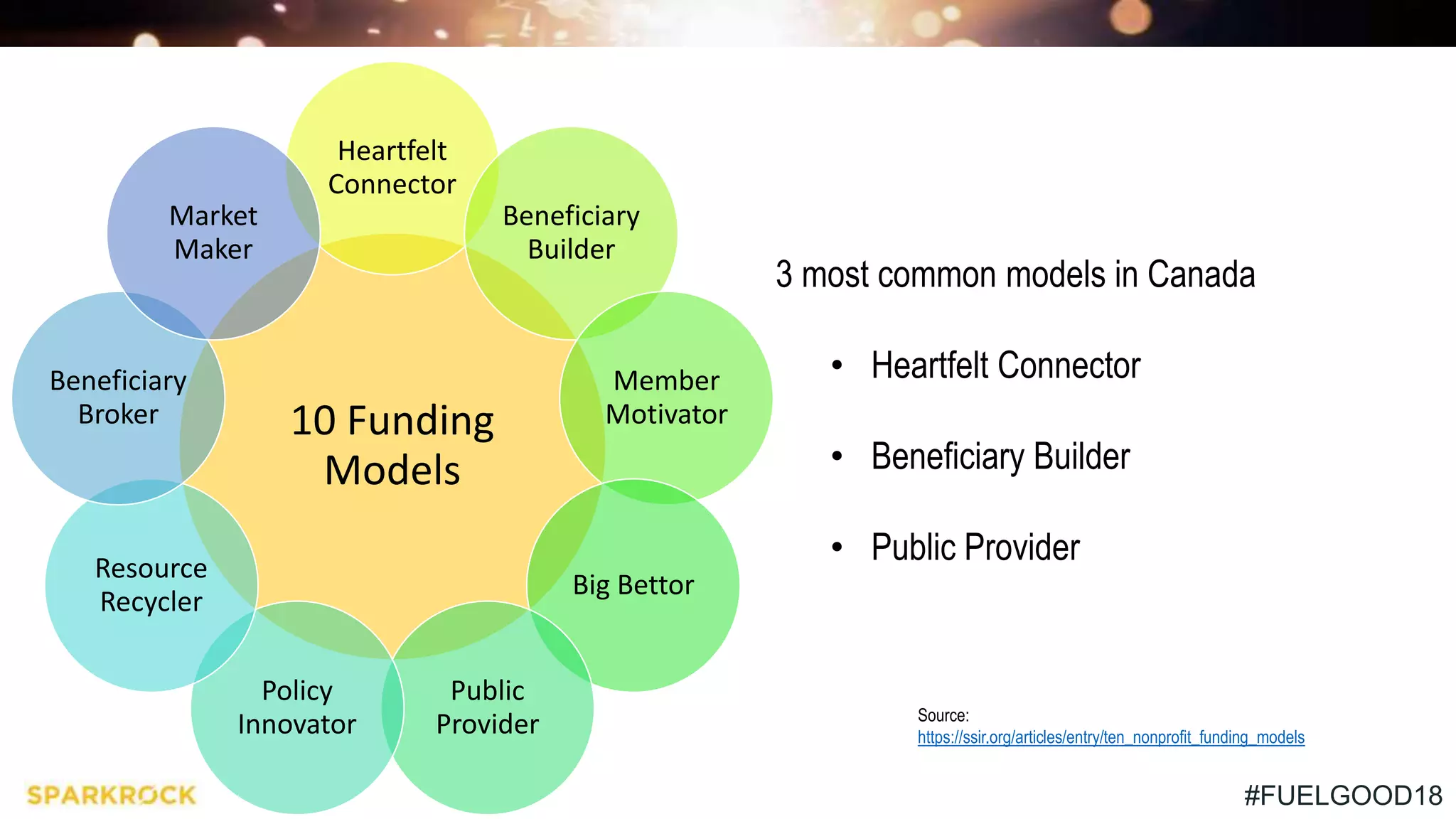
10 Funding
Models
Heartfelt
Connector
Beneficiary
Builder
Member
Motivator
Big Bettor
Public
Provider
Policy
Innovator
Resource
Recycler
Beneficiary
Broker
Market
Maker
Source:
https://ssir.org/articles/entry/ten_nonprofit_funding_models
3 most common models in Canada
• Heartfelt Connector
• Beneficiary Builder
• Public Provider
#FUELGOOD18
Heart Felt Connector
Focus: Issues with broad appeal, touches lives of
funder’s family and friends.
Commonly used for: Medical research,
environment, international causes.
Funding Model: Donations, events, corporate
sponsors
75% donors + 25% events = $27M
29% increase  $85M
#FUELGOOD18
Heart Felt Connector: Success Factor
The Cause: Anyone can get cancer. Anyone can cure it.
Efficacy: Research; 9% admin; $17: $100 fundraising;
$0.75 to the cause.
Infrastructure: $85.7M reserve, fundraising, events.
#FUELGOOD18
Beneficiary Builder
Focus: Leveraging people who benefitted In
the past, strong individual connection,
memorable experiences.
Commonly used for: Art, universities,
hospitals.
Funding Model: Fees, major gifts, donations.
80% Fees & Gov’t + 3% Donors = $3.2B
Increase of 239%
#FUELGOOD18
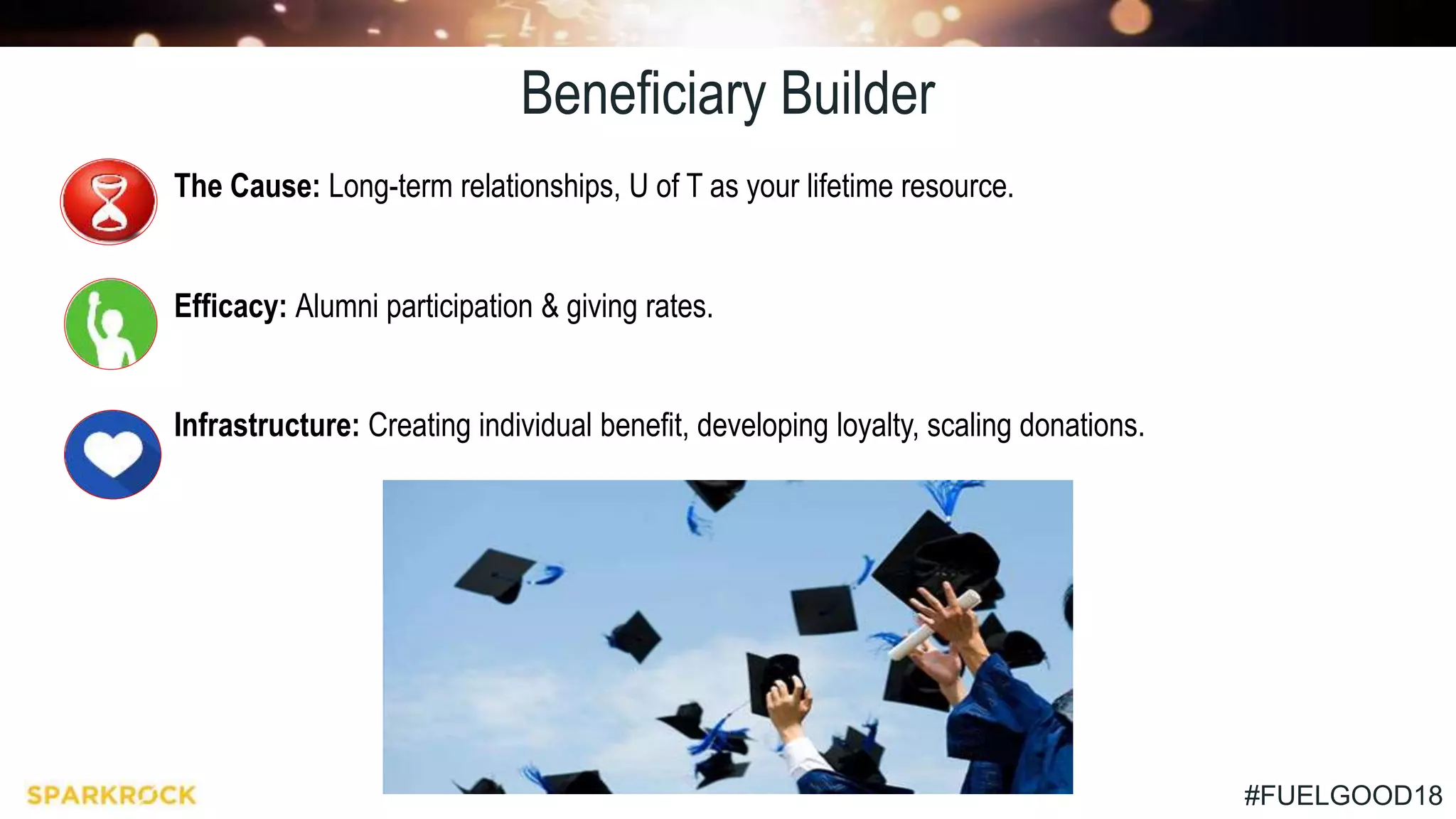
Beneficiary Builder
The Cause: Long-term relationships, U of T as your lifetime resource.
Efficacy: Alumni participation & giving rates.
Infrastructure: Creating individual benefit, developing loyalty, scaling donations.
#FUELGOOD18
Public Provider
Focus: Provision of essential services funded by the
government.
Commonly used for: Housing, human services, education.
Funding Mode: Governments, donations, fees.
78% Gov’t + 23% Fees & Donors = $124M
Increase of 53%
#FUELGOOD18
Public Provider
The Cause: Wide range of services for individuals with
physical disabilities.
Efficacy: Contract retention, new contracts, fundraising
fees.
Infrastructure: Contract targets & requirements, fees &
donations management.
#FUELGOOD18
Creating a Strategic
Nonprofit Funding
Model
#FUELGOOD18
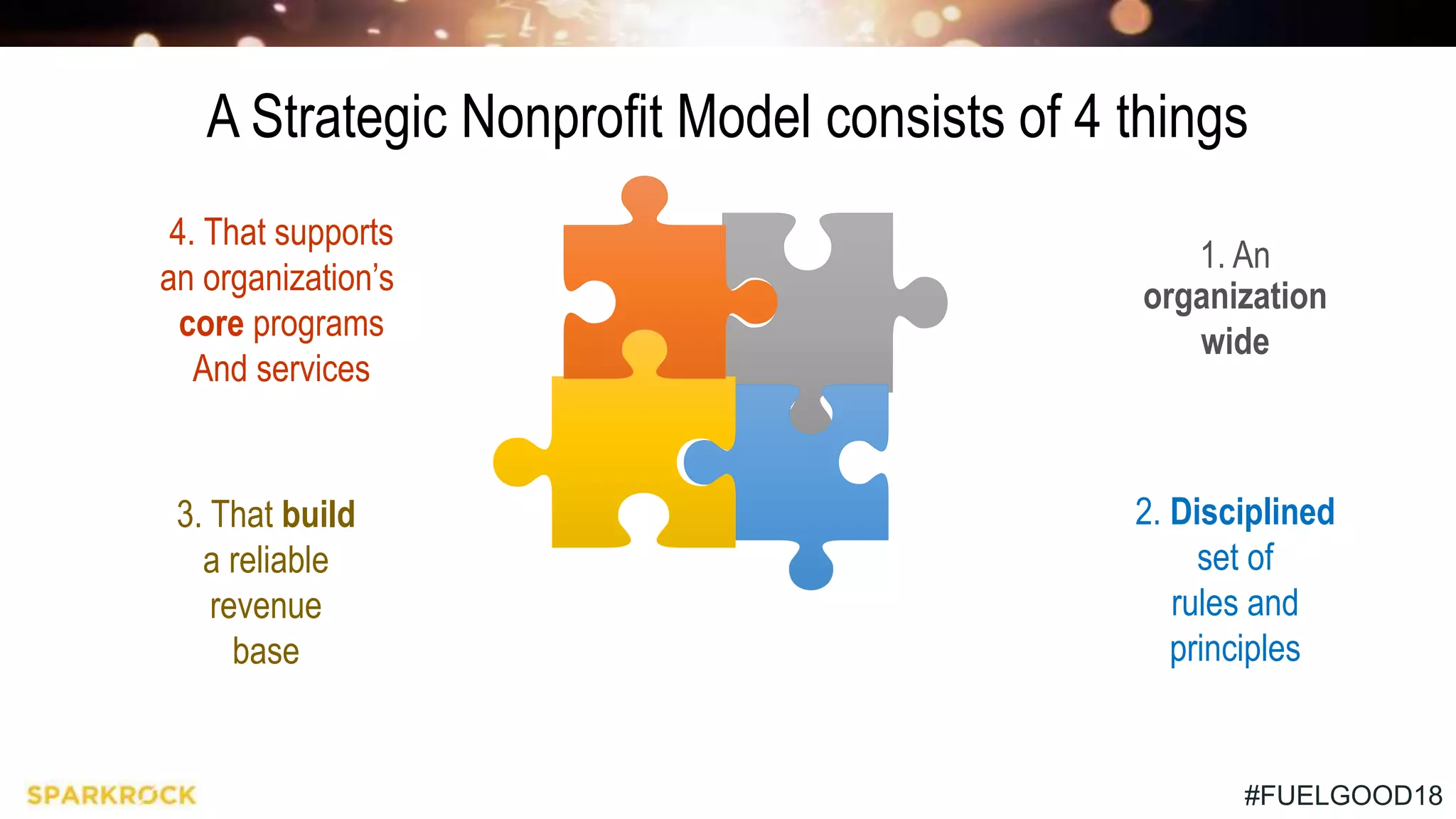
1. An
organization
wide
2. Disciplined
set of
rules and
principles
3. That build
a reliable
revenue
base
4. That supports
an organization’s
core programs
And services
A Strategic Nonprofit Model consists of 4 things
#FUELGOOD18
Strategic funding models require 4 conditions
1. Freedom from immediate financial distress
2. Willing and able leadership
3. Critical mass or $3M or more in annual revenue
4. Clarity on program goals and priorities
#FUELGOOD18
Actual Nonprofit Funding
Model Results
#FUELGOOD18
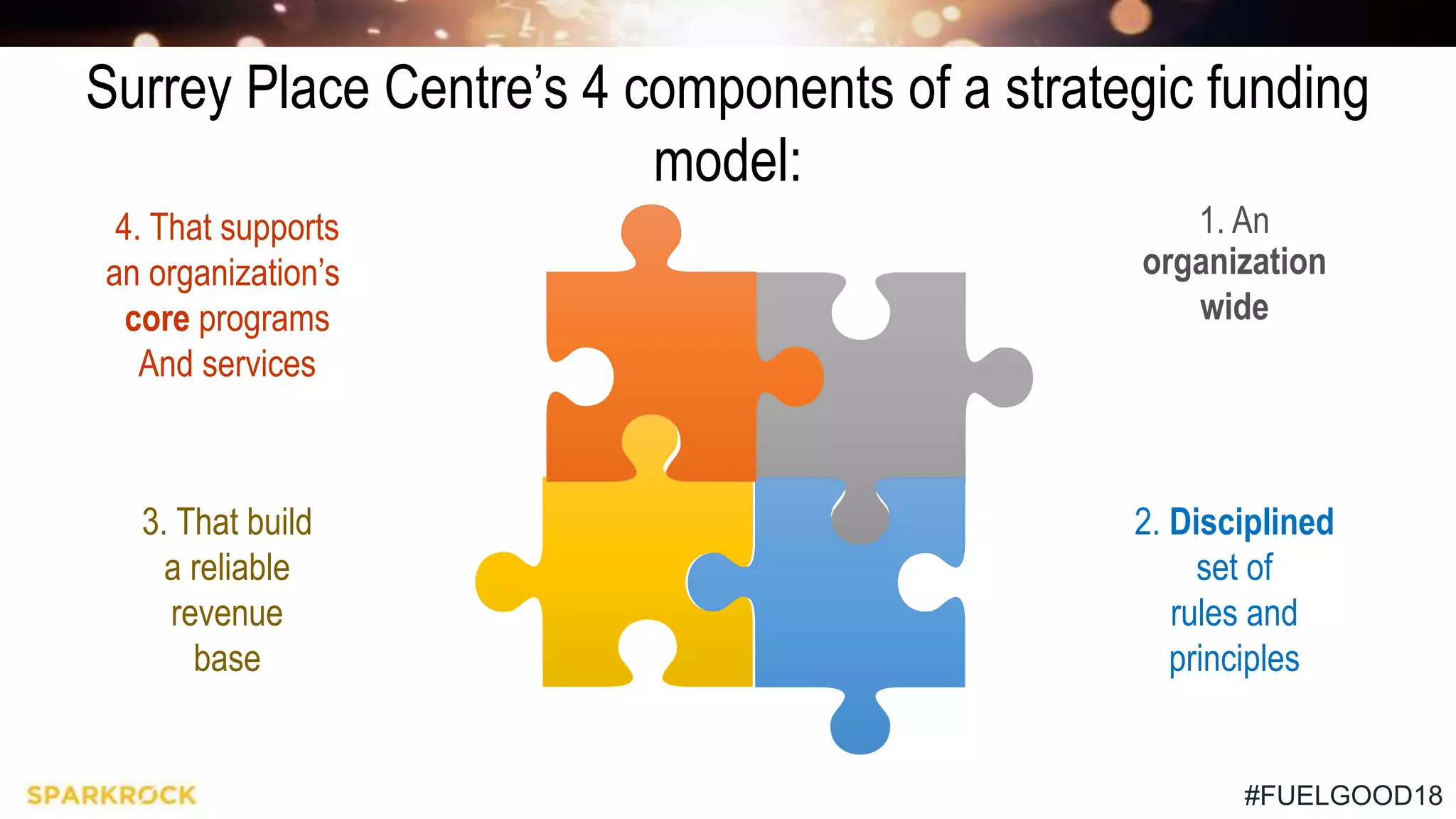
1. An
organization
wide
2. Disciplined
set of
rules and
principles
3. That build
a reliable
revenue
base
4. That supports
an organization’s
core programs
And services
Surrey Place Centre’s 4 components of a strategic funding
model:
#FUELGOOD18
Strategic funding models require 4 conditions:
1.Freedom from immediate financial distress
2. Willing and able leadership
3. Critical mass or $3M or more in annual revenue
4. Clarity on program goals and priorities
#FUELGOOD18
Surrey Place Centre Actual Results
2007
$23M
98% government
$1M reserve
2017
$53M (108% increase)
99% government
$1.6M reserve
#FUELGOOD18
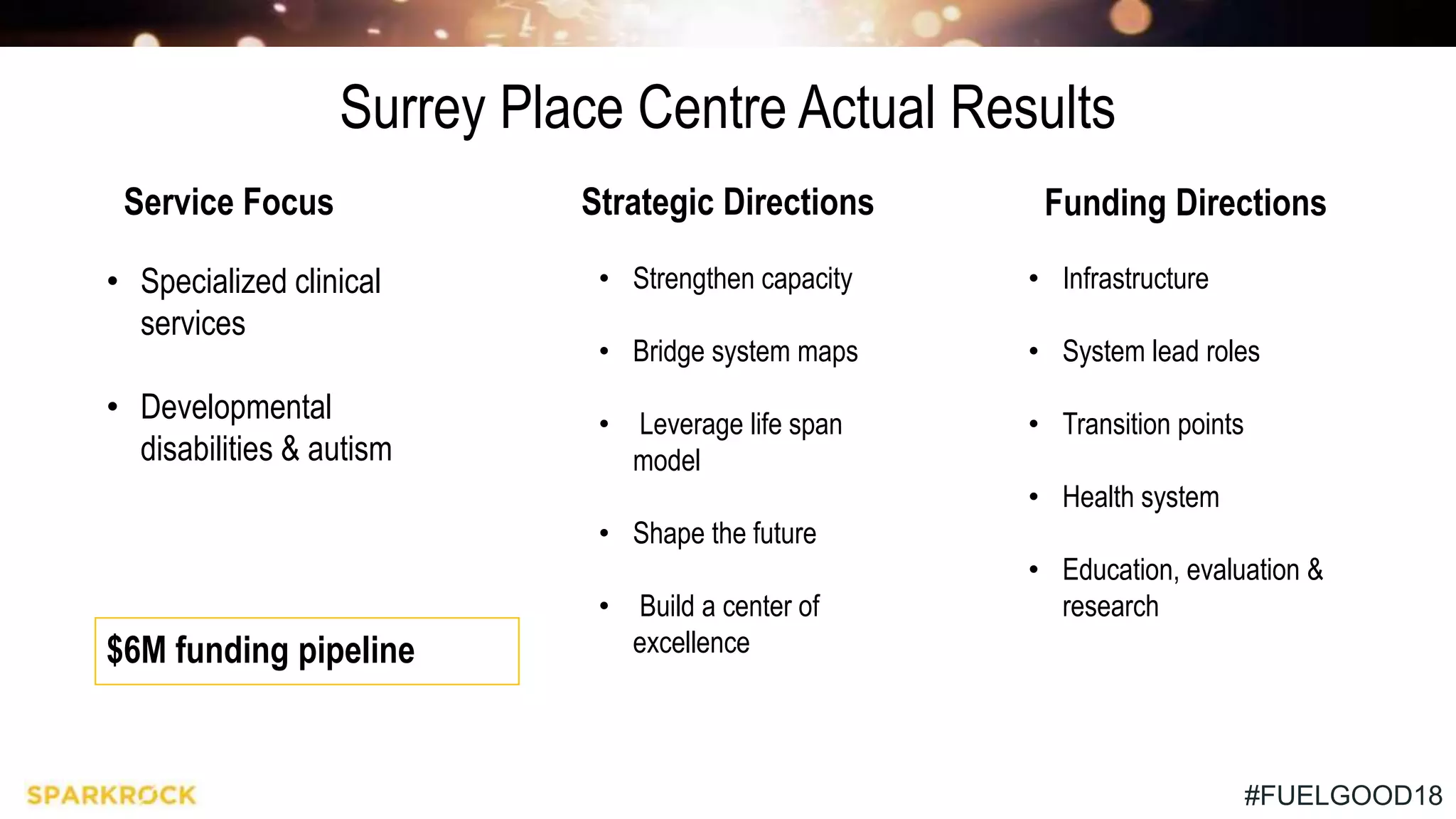
Surrey Place Centre Actual Results
Service Focus Strategic Directions Funding Directions
• Specialized clinical
services
• Developmental
disabilities & autism
• Strengthen capacity
• Bridge system maps
• Leverage life span
model
• Shape the future
• Build a center of
excellence
• Infrastructure
• System lead roles
• Transition points
• Health system
• Education, evaluation &
research
$6M funding pipeline
#FUELGOOD18
Any Questions?
#FUELGOOD18
Q&A
#FUELGOOD18
THANK YOU!
Alain Mootoo
alain.mootoo@surreyplace.on.ca
All presentations will be made available after the conference
#FUELGOOD18
Please take 5mins to fill out
your session evaluations
One lucky winner will win
an Amazon Echo!
#FUELGOOD18
www.sparkrock.com @sparkrockinc
Nonprofit, Human Services &
K12 software to help you serve
more people, with less effort,
stress & expense.

Fuel Good 2018: The Framework for Funding Your Organization

Editor's Notes

  • #2 Have this slide up as people enter the room
  • #3 Take 5mins to give the audience a bit of background about you
  • #6 GT’s 4th annual state of the nfp sector report identifies 3 mega trends affecting nonprofit sustainability: Government policy and funding changes Minimum wage, vacation and paid leaves, overtime Donor fatigue around persistent causes that do not show evidence of significant improvement United Way Toronto change Lower investment income with depressed markets
  • #7 Blumberg’s last summary of Canadian Charity Returns showed: Increasing reliance on provincial governments providing 91% of charity funding up from 89% in 2010 (Blumberas Snapshot of the Canadian Charitable Sector, 2017)
  • #8 For those charities that rely on provincial spending increases, it is sobering to see that the most recent provincial budget actually had a 50% reduction in funding increases from the previous budget from $6B to 2.8B
  • #9 For those of you that fundraise, the last AFP and Urban Institute detailed fundraising study suggested that most fundraisers lost $96 for every $100 in new dollars they raised
  • #10 In a more recent US study over 50% of charities reported they developed a plan to increase their revenues but worried that it would increase their complexity in an unsustainable manner
  • #12 The Stanford Social Innovation Review with the Bridgespan group released the findings from a large study in 2009 which excluded hospitals and universities noting that organizations that grew to a significant size followed a strategic funding model strategy
  • #13 They suggested 10 funding models but I am going to focus on the top 3 that I think are most relevant to us
  • #14 One of the most common funding models they found and defined is called the Heartfelt Connector. Can anyone guess which organization I am referring to by the picture? That’s right it’s the Terry Fox Foundation. What’s common with the Heartfelt Connector is that: The cause they pursue has broad appeal – TFF is focused on cancer research This type of cause is one that tends to have immense personal meaning in the lives of the funders families and friends It is often used for medical, research, environmental and international causes that have strong personal meaning The funding model is one that is based on donations, events and corporate sponsors For 2016-17 75% of their revenue came from donations and 25% from events for a total annual revenue of $27M Over the last three years alone their revenue has increased by 29% despite the TFF being in existence since 1988 or almost 30 years. Over those years they have accumulated an $85M reserve.
  • #15 So why are they so successful? Compelling inspiring narrative – Terry Fox Terry was a 20-year old cancer patient that ran 5,373 kilometers across Canada to raise awareness and funds for cancer research Clear mission – Terry Fox Foundation’s mission is to realize Terry Fox’s vision of a world without cancer by funding innovative cancer research Evidence of mission effectiveness – has funded over 1,200 cancer research projects internationally, even helping diagnose a rare sub-type of ovarian cancer that has been very difficult to identify. Key performance metrics – Administrative costs are 9% of revenues Fundraising costs come to 16% of donations. For every dollar donated, 75 cents goes to the cause , falling within Ci’s reasonable range. TFF has funding reserves of $85.7m that can cover 3.6 years of program costs.diagnosing a rare sub-type of ovarian cancer that has been very difficult to identify..One of the most common funding models they found and defined is called the Heartfelt Connector. It is interesting to note that their main event the Terry Fox Run is used to engage ongoing monthly donors. To speak to how they are developed their capacity with their main funding stream, they are one of the most effective fundraising organizations in Canada and it costs them approximately $17 to raise $100 in fundraising.
  • #16 Another common model is called the Beneficiary Builder. Can anyone guess which organization I am referring to by the picture? That’s right it’s the University of Toronto. What’s common with the Beneficiary Builder is that: They rely on people who benefited in the past for donations They try to build strong individual connections and memorable experiences for students It is a common funding model for arts, universities and hospitals with revenues coming from fees, government and donors In 2017 UofT received 80% of their funding from fees and government and 3% from donors for their $3.2B in revenue. This reflects an increase of 239% since 1998. If you dive deeper into their financials you will see that they have accumulated a $2.3B reserve which increased by almost 2x over this period or $1.5B.
  • #17 So why are they so successful? The focus on building long term relationships with their student alumni – UofT Your Lifetime Resource – with events and services – dedicated alumni website Pay attention to key metrics like alumni giving rates for both annual and future needs Design their infrastructure to be successful in creating individual benefit with students, developing long term loyalty and scaling donations
  • #18 Another common model is called the Public Provider. Can anyone guess which organization I am referring to by the picture? That’s right it is March of Dimes Canada What’s common with the Public provider is that: They provide essential public services that are viewed as a responsibility of the government and in turn funded by the government It is common with issues like housing, human services, education In 2017 MOD received 76% of their funding all three levels of government and 23% from fees and fundraising for their $124M in revenue. This reflects an increase of 53% since 2006. They have increased their reserves to $14.3M or over 4x by $11.5M
  • #19 So why are they so successful? Focus on essential services that society views as an important component of government funding Efficacy - Retaining important funding contracts and securing new funding contracts – over the last 11 years increased government funding by 58% from $60M to $94M Monitor fees and fundraising – increased by 85% from $18M to $28M over that time Infrastructure is build around – efficacy of government contract fulfillment, fee rates and activities and scaling donations
  • #24 SPC has been developing these components organically over its evolution as an organization
  • #25 We continue to work diligently in these areas every year, particularly in clarifying program goals and priorities in rapidly changing developmental disabilities and autism environment, being selective and partnering in non-core areas: Residential program funding expansion DD employment program funding expansion DD social enterprise developments
  • #26 Over the last 10 years: Revenue growth of 108% Greater concentration in government funding source, although some diversification with municipal, health and foundations Improvement in reserves but still work to do in that area No real development of fees and fundraising to supplement income and diversify reserves although there may be potential with the center of excellence exploration
  • #27 The organization has been successful by: Having a clear service and population focus Clear strategic directions That can be translated into clear funding directions Capacity – enhanced clinical model, clinical spaces, clinical tools, training, systems modernization and integration Bridging system gaps – CSP, OAP, CNSC, DDPCP, Video conferencing, Research and Education, Evaluation Lifespan – transition points with ECM Shape the future – DDPCP, medical services Centre of excellence – autism, CSP, DDPCP and others
  • #32 Have this slide up as people exit the room.