Measuring and improving
state sector productivity
Officials’ briefing
11 December 2017
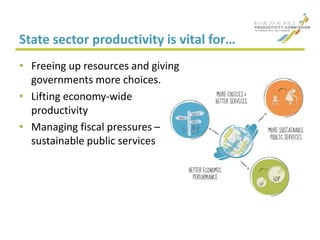
State sector productivity is vital for…
• Freeing up resources and giving
governments more choices.
• Lifting economy-wide
productivity
• Managing fiscal pressures –
sustainable public services
Our inquiry in brief
• Focused on:
• how to measure productivity at sector and service level
• measuring technical efficiency (steered away from the
investment approach and allocative efficiency)
• the capability, culture and systems needed for
measurement and improvement of productivity
• Aim is to provide practical guidance for Ministers, officials
and other decision-makers
• Illustrated with case studies
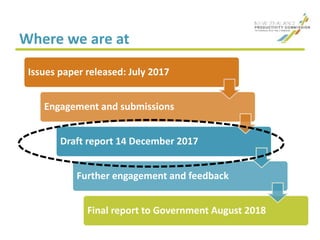
Where we are at
Issues paper released: July 2017
Engagement and submissions
Draft report 14 December 2017
Further engagement and feedback
Final report to Government August 2018
Supporting case studies
• Case studies to illustrate methodologies
– Police response to mental health incidents
– Early childhood education
– Quality-adjusting school outputs
– Using MSD’s iCAM model to measure productivity
– Issues in health system productivity measurement
– Quality-adjusted productivity in tertiary education
– Productivity of New Zealand Courts
• Health warning: results are illustrative only!
Police productivity case study
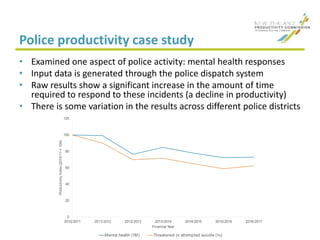
• Examined one aspect of police activity: mental health responses
• Input data is generated through the police dispatch system
• Raw results show a significant increase in the amount of time
required to respond to these incidents (a decline in productivity)
• There is some variation in the results across different police districts
0
20
40
60
80
100
120
2010/2011 2011/2012 2012/2013 2013/2014 2014/2015 2015/2016 2016/2017
ProductivityIndex(2010/11=100)
Financial Year
Mental health (1M) Threatened or attempted suicide (1x)
MSD productivity case study
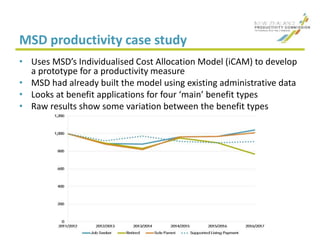
• Uses MSD’s Individualised Cost Allocation Model (iCAM) to develop
a prototype for a productivity measure
• MSD had already built the model using existing administrative data
• Looks at benefit applications for four ‘main’ benefit types
• Raw results show some variation between the benefit types
Additional commissioned work
• Analysis of the 2016 PSA member survey by VUW
– Staff perceptions of performance and
effectiveness
• Semi-structured interviews current and former
state sector leaders (Pickens 2017)
• History of efficiency measures in the Health
Sector (Knopf, 2017)
Case studies and commissioned work published on
the Commission’s website
Structure of the draft
• Broadly three components:
– Chapters 2-5 focus on methodological issues
– Chapters 6-7 focus on implementation issues
– Chapter 8 focuses on improving productivity
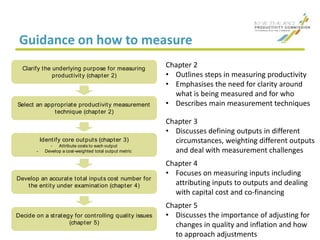
Guidance on how to measure
Chapter 2
• Outlines steps in measuring productivity
• Emphasises the need for clarity around
what is being measured and for who
• Describes main measurement techniques
Chapter 3
• Discusses defining outputs in different
circumstances, weighting different outputs
and deal with measurement challenges
Chapter 4
• Focuses on measuring inputs including
attributing inputs to outputs and dealing
with capital cost and co-financing
Chapter 5
• Discusses the importance of adjusting for
changes in quality and inflation and how
to approach adjustments
Develop an accurate total inputs cost number for
the entity under examination (chapter 4)
Select an appropriate productivity measurement
technique (chapter 2)
Decide on a strategy for controlling quality issues
(chapter 5)
Identify core outputs (chapter 3)
- Attribute costs to each output
- Develop a cost-weighted total output metric
Clarify the underlying purpose for measuring
productivity (chapter 2)
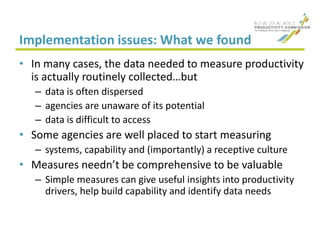
Implementation issues: What we found
• In many cases, the data needed to measure productivity
is actually routinely collected…but
– data is often dispersed
– agencies are unaware of its potential
– data is difficult to access
• Some agencies are well placed to start measuring
– systems, capability and (importantly) a receptive culture
• Measures needn’t be comprehensive to be valuable
– Simple measures can give useful insights into productivity
drivers, help build capability and identify data needs
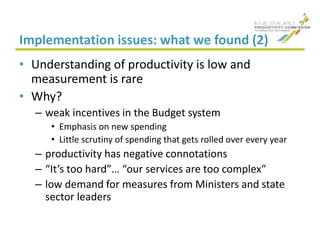
Implementation issues: what we found (2)
• Understanding of productivity is low and
measurement is rare
• Why?
– weak incentives in the Budget system
• Emphasis on new spending
• Little scrutiny of spending that gets rolled over every year
– productivity has negative connotations
– “It’s too hard”… “our services are too complex”
– low demand for measures from Ministers and state
sector leaders
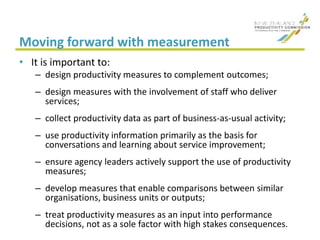
Moving forward with measurement
• It is important to:
– design productivity measures to complement outcomes;
– design measures with the involvement of staff who deliver
services;
– collect productivity data as part of business-as-usual activity;
– use productivity information primarily as the basis for
conversations and learning about service improvement;
– ensure agency leaders actively support the use of productivity
measures;
– develop measures that enable comparisons between similar
organisations, business units or outputs;
– treat productivity measures as an input into performance
decisions, not as a sole factor with high stakes consequences.
Encouraging productivity improvement
• Stakeholders’ views sought
– Should Budget rules place more emphasise on
existing expenditure?
– Could staff be better engaged in determining how
public services are delivered?
– How can government encourage the diffusion of
productivity enhancing innovation across the state
sector?
– How can incentives to improve productivity be
strengthened?
Next steps
• 14 December 2017: Public release of draft report
• March 2018: Public submissions due on draft
report
• April-May 2018: Engagement with participants
and refinement of inquiry results.
• 31 August 2018: Final report delivered
15www.productivity.govt.nz
Questions and comments
Thank you for your time
judy.kavanagh@productivity.govt.nz
www.productivity.govt.nz
Twitter: @Nzprocom

Measuring and improving state sector productivity - draft report

  • 1.
    Measuring and improving statesector productivity Officials’ briefing 11 December 2017
  • 2.
    State sector productivityis vital for… • Freeing up resources and giving governments more choices. • Lifting economy-wide productivity • Managing fiscal pressures – sustainable public services
  • 3.
    Our inquiry inbrief • Focused on: • how to measure productivity at sector and service level • measuring technical efficiency (steered away from the investment approach and allocative efficiency) • the capability, culture and systems needed for measurement and improvement of productivity • Aim is to provide practical guidance for Ministers, officials and other decision-makers • Illustrated with case studies
  • 4.
    Where we areat Issues paper released: July 2017 Engagement and submissions Draft report 14 December 2017 Further engagement and feedback Final report to Government August 2018
  • 5.
    Supporting case studies •Case studies to illustrate methodologies – Police response to mental health incidents – Early childhood education – Quality-adjusting school outputs – Using MSD’s iCAM model to measure productivity – Issues in health system productivity measurement – Quality-adjusted productivity in tertiary education – Productivity of New Zealand Courts • Health warning: results are illustrative only!
  • 6.
    Police productivity casestudy • Examined one aspect of police activity: mental health responses • Input data is generated through the police dispatch system • Raw results show a significant increase in the amount of time required to respond to these incidents (a decline in productivity) • There is some variation in the results across different police districts 0 20 40 60 80 100 120 2010/2011 2011/2012 2012/2013 2013/2014 2014/2015 2015/2016 2016/2017 ProductivityIndex(2010/11=100) Financial Year Mental health (1M) Threatened or attempted suicide (1x)
  • 7.
    MSD productivity casestudy • Uses MSD’s Individualised Cost Allocation Model (iCAM) to develop a prototype for a productivity measure • MSD had already built the model using existing administrative data • Looks at benefit applications for four ‘main’ benefit types • Raw results show some variation between the benefit types
  • 8.
    Additional commissioned work •Analysis of the 2016 PSA member survey by VUW – Staff perceptions of performance and effectiveness • Semi-structured interviews current and former state sector leaders (Pickens 2017) • History of efficiency measures in the Health Sector (Knopf, 2017) Case studies and commissioned work published on the Commission’s website
  • 9.
    Structure of thedraft • Broadly three components: – Chapters 2-5 focus on methodological issues – Chapters 6-7 focus on implementation issues – Chapter 8 focuses on improving productivity
  • 10.
    Guidance on howto measure Chapter 2 • Outlines steps in measuring productivity • Emphasises the need for clarity around what is being measured and for who • Describes main measurement techniques Chapter 3 • Discusses defining outputs in different circumstances, weighting different outputs and deal with measurement challenges Chapter 4 • Focuses on measuring inputs including attributing inputs to outputs and dealing with capital cost and co-financing Chapter 5 • Discusses the importance of adjusting for changes in quality and inflation and how to approach adjustments Develop an accurate total inputs cost number for the entity under examination (chapter 4) Select an appropriate productivity measurement technique (chapter 2) Decide on a strategy for controlling quality issues (chapter 5) Identify core outputs (chapter 3) - Attribute costs to each output - Develop a cost-weighted total output metric Clarify the underlying purpose for measuring productivity (chapter 2)
  • 11.
    Implementation issues: Whatwe found • In many cases, the data needed to measure productivity is actually routinely collected…but – data is often dispersed – agencies are unaware of its potential – data is difficult to access • Some agencies are well placed to start measuring – systems, capability and (importantly) a receptive culture • Measures needn’t be comprehensive to be valuable – Simple measures can give useful insights into productivity drivers, help build capability and identify data needs
  • 12.
    Implementation issues: whatwe found (2) • Understanding of productivity is low and measurement is rare • Why? – weak incentives in the Budget system • Emphasis on new spending • Little scrutiny of spending that gets rolled over every year – productivity has negative connotations – “It’s too hard”… “our services are too complex” – low demand for measures from Ministers and state sector leaders
  • 13.
    Moving forward withmeasurement • It is important to: – design productivity measures to complement outcomes; – design measures with the involvement of staff who deliver services; – collect productivity data as part of business-as-usual activity; – use productivity information primarily as the basis for conversations and learning about service improvement; – ensure agency leaders actively support the use of productivity measures; – develop measures that enable comparisons between similar organisations, business units or outputs; – treat productivity measures as an input into performance decisions, not as a sole factor with high stakes consequences.
  • 14.
    Encouraging productivity improvement •Stakeholders’ views sought – Should Budget rules place more emphasise on existing expenditure? – Could staff be better engaged in determining how public services are delivered? – How can government encourage the diffusion of productivity enhancing innovation across the state sector? – How can incentives to improve productivity be strengthened?
  • 15.
    Next steps • 14December 2017: Public release of draft report • March 2018: Public submissions due on draft report • April-May 2018: Engagement with participants and refinement of inquiry results. • 31 August 2018: Final report delivered 15www.productivity.govt.nz
  • 16.
    Questions and comments Thankyou for your time judy.kavanagh@productivity.govt.nz www.productivity.govt.nz Twitter: @Nzprocom