FUEL CELLS
BY
CHILUKURI PAVAN CHOWDARY
17321
HISTORY OF FUEL CELLS
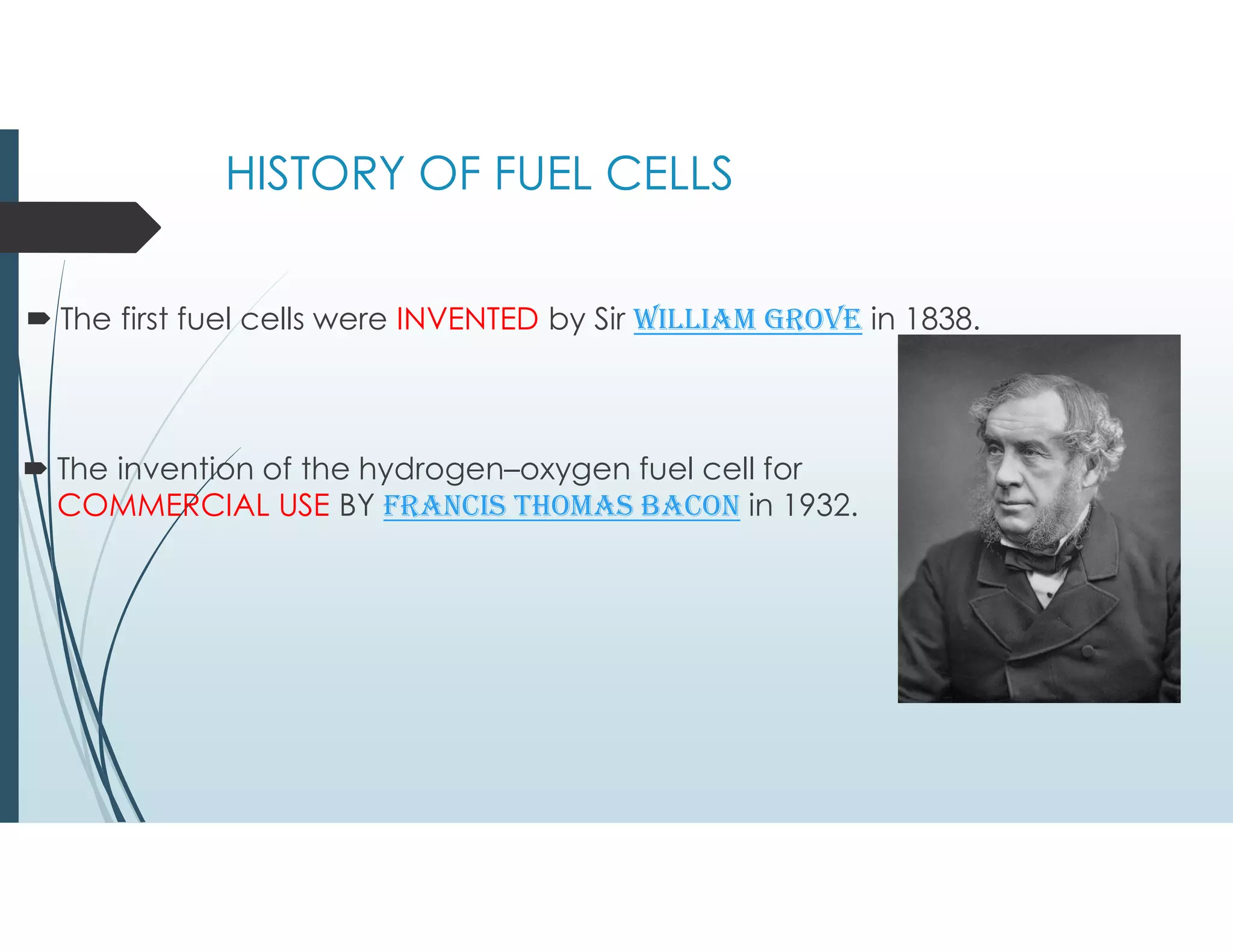
 The first fuel cells were INVENTED by Sir WILLIAm GROVe in 1838.
 The invention of the hydrogen–oxygen fuel cell for
COMMERCIAL USE BY FRANCIs THOmAs BACON in 1932.
 WHAT IS A FUEL CELL ?
 A Fuel Cell is an electrochemical device that combines hydrogen and
oxygen to produce electricity, with water and heat as its by-product.
 It is an energy conversion device or electricity generator.
 It is an example for a primary cell.
 This is capable of supplying current as long as it is provided with the supply of
reactants.
 GENERAL EQUATION :
FUEL + OXYGEN →OXIDATION PRODUCTS + ELECTRICITY
(OXIDANT)
FUEL CELL
HOW DOES A FUEL CELL WORK
 It operates similarly to a battery, but it does not run down nor does it require
recharging
 As long as fuel is supplied, a Fuel Cell will produce both energy and HEAT
 A Fuel Cell consists of two catalyst coated electrodes surrounding an
electrolyte
 One electrode is an anode and the other is a cathode
 The process begins when Hydrogen molecules enter the anode
 The catalyst coating separates hydrogen’s negatively charged electrons
from the positively charged protons.
HOW DOES A FUEL
CELL WORK
 The electrolyte allows the protons to pass through to the cathode, but not
the electrons
 Instead the electrons are directed through an external circuit which
creates electrical current
 While the electrons pass through the external circuit, oxygen molecules
pass through the cathode
 There the oxygen and the protons combine with the electrons after they
have passed through the external circuit
HOW DOES A FUEL CELL WORK ???
 When the oxygen and the protons
combine with the electrons it
produces water and heat.
Picture of fuel cell
mOsT ImPORTANT CHARACTeRIsTICs
 High efficiency
 Low emission levels
 Low noise levels
 Fuel cells are free from vibration, heat transfer and
thermal pollution
EXAMPLES OF FUEL CELLS
 HYDROGEN-OXYGEN CELLS
Types of H2-O2 Fuel Cell
 Alkaline fuel cells (AFC)
 Phosphoric acid fuel cells(PAFC)
 Molten carbonate fuel cells(MCFC)
 Solid oxide fuel cells(SOFC)
 Proton exchange membrane fuel cells (PEMFC)
HYDROEN-OXYGEN FUEL CELL(H2-O2)
 A common type of fuel cell based on the combustion of hydrogen gas.
Equation : 2H2 + O2 2H2O
(g) (g) (l)
 consists two electrodes
 made up of graphite
 catalyst platinum or metal oxide
 placed in aqueous solution (KOH or NAOH)
 H2 Gas evolves in anode
 O2 Gas evolve in cathod
REACTION
 AT Anode
H2 + 2OH− → 2H2O + 2e−
(g) (aq) (L)
 AT CATHOD
O2(g) + 2H2O + 4e− → 4OH
(g) (l)
2H2 + O2 → 2H2O
(g) (g) (L)
 THE Standard EMF Of H2 – O2 CELLS
E° = E°(cathode) - E°(anode)
USES OF H2 – O2 CELLS
• used in space craft because of their high
efficiency, lightness
• used in submarines or other military vehicles
• used as the primary source of electrical energy
on the Apollo moon flights. Approximately 200
kg of fuel is sufficient for 11 days in space
ADVANTAGES OF FUEL CELLS
 The energy conversion (chemical into
electrical) is very high by fuel cells (75-82.8%).
 H2-O2 fuel cell produces H2O, which is used as
drinking purpose by astronauts
 Noise and thermal pollution are low.
 Such type of cells never becomes dead,
because of continuous supply of fuel
ADVANTAGES OF FUEL
CELLS
Modular and other parts of fuel cells
are exchangeable
Fuels cells having low maintenance
cost
Fuels cells saves fossil fuels.
Disadvantages of Fuel Cells
 High initial cost.
 Large weight and volume of gas-fuel storage
system.
 High cost of pure hydrogen.
Life-times of such type of cells are not
accurately known.
Fuel cell

Fuel cell

  • 1.
  • 2.
    HISTORY OF FUELCELLS  The first fuel cells were INVENTED by Sir WILLIAm GROVe in 1838.  The invention of the hydrogen–oxygen fuel cell for COMMERCIAL USE BY FRANCIs THOmAs BACON in 1932.
  • 3.
     WHAT ISA FUEL CELL ?  A Fuel Cell is an electrochemical device that combines hydrogen and oxygen to produce electricity, with water and heat as its by-product.  It is an energy conversion device or electricity generator.  It is an example for a primary cell.  This is capable of supplying current as long as it is provided with the supply of reactants.  GENERAL EQUATION : FUEL + OXYGEN →OXIDATION PRODUCTS + ELECTRICITY (OXIDANT)
  • 4.
  • 5.
    HOW DOES AFUEL CELL WORK  It operates similarly to a battery, but it does not run down nor does it require recharging  As long as fuel is supplied, a Fuel Cell will produce both energy and HEAT  A Fuel Cell consists of two catalyst coated electrodes surrounding an electrolyte  One electrode is an anode and the other is a cathode  The process begins when Hydrogen molecules enter the anode  The catalyst coating separates hydrogen’s negatively charged electrons from the positively charged protons.
  • 6.
    HOW DOES AFUEL CELL WORK  The electrolyte allows the protons to pass through to the cathode, but not the electrons  Instead the electrons are directed through an external circuit which creates electrical current  While the electrons pass through the external circuit, oxygen molecules pass through the cathode  There the oxygen and the protons combine with the electrons after they have passed through the external circuit
  • 7.
    HOW DOES AFUEL CELL WORK ???  When the oxygen and the protons combine with the electrons it produces water and heat. Picture of fuel cell
  • 8.
    mOsT ImPORTANT CHARACTeRIsTICs High efficiency  Low emission levels  Low noise levels  Fuel cells are free from vibration, heat transfer and thermal pollution
  • 9.
    EXAMPLES OF FUELCELLS  HYDROGEN-OXYGEN CELLS Types of H2-O2 Fuel Cell  Alkaline fuel cells (AFC)  Phosphoric acid fuel cells(PAFC)  Molten carbonate fuel cells(MCFC)  Solid oxide fuel cells(SOFC)  Proton exchange membrane fuel cells (PEMFC)
  • 10.
    HYDROEN-OXYGEN FUEL CELL(H2-O2) A common type of fuel cell based on the combustion of hydrogen gas. Equation : 2H2 + O2 2H2O (g) (g) (l)
  • 12.
     consists twoelectrodes  made up of graphite  catalyst platinum or metal oxide  placed in aqueous solution (KOH or NAOH)  H2 Gas evolves in anode  O2 Gas evolve in cathod REACTION  AT Anode H2 + 2OH− → 2H2O + 2e− (g) (aq) (L)  AT CATHOD O2(g) + 2H2O + 4e− → 4OH (g) (l) 2H2 + O2 → 2H2O (g) (g) (L)
  • 13.
     THE StandardEMF Of H2 – O2 CELLS E° = E°(cathode) - E°(anode)
  • 14.
    USES OF H2– O2 CELLS • used in space craft because of their high efficiency, lightness • used in submarines or other military vehicles • used as the primary source of electrical energy on the Apollo moon flights. Approximately 200 kg of fuel is sufficient for 11 days in space
  • 15.
    ADVANTAGES OF FUELCELLS  The energy conversion (chemical into electrical) is very high by fuel cells (75-82.8%).  H2-O2 fuel cell produces H2O, which is used as drinking purpose by astronauts  Noise and thermal pollution are low.  Such type of cells never becomes dead, because of continuous supply of fuel
  • 16.
    ADVANTAGES OF FUEL CELLS Modularand other parts of fuel cells are exchangeable Fuels cells having low maintenance cost Fuels cells saves fossil fuels.
  • 17.
    Disadvantages of FuelCells  High initial cost.  Large weight and volume of gas-fuel storage system.  High cost of pure hydrogen. Life-times of such type of cells are not accurately known.