1
Lecture
 Logistics
 Lab 8 this week to be done in pairs
 Find a partner before your lab period
 Otherwise you will have to wait for a pairing which will slow you down
 HW5 and HW6 solutions out today
 Graded HW5 available at review session tomorrow
 HW7 out today due Wednesday March 4
 Midterm 2 Wednesday
 Covers material up to simple FSM
 Review session tomorrow, 4:30 here, EEB 037
 Last lecture
 Counter FSM design
 General Finite State Machine Design
 Vending machine example
 Today
 Moore/Mealy machines
 Midterm 2 topics and logistics
2
The “WHY” slide
 Moore/Mealy machines
 There are two different ways to express the FSMs with
respect to the output. Both have different advantages so it is
good to know them.
3
Inputs
Outputs
Next State
Current State
output
logic
Next-state
logic
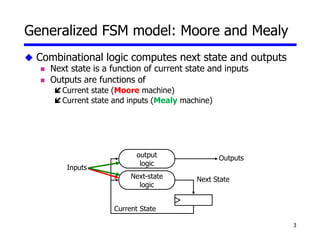
Generalized FSM model: Moore and Mealy
 Combinational logic computes next state and outputs
 Next state is a function of current state and inputs
 Outputs are functions of
Current state (Moore machine)
Current state and inputs (Mealy machine)
4
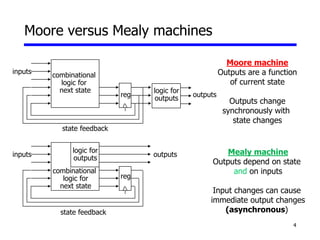
Moore versus Mealy machines
outputs
state feedback
inputs
reg
combinational
logic for
next state logic for
outputs
Moore machine
Outputs are a function
of current state
Outputs change
synchronously with
state changes
Mealy machine
Outputs depend on state
and on inputs
Input changes can cause
immediate output changes
(asynchronous)
inputs outputs
state feedback
reg
combinational
logic for
next state
logic for
outputs
5
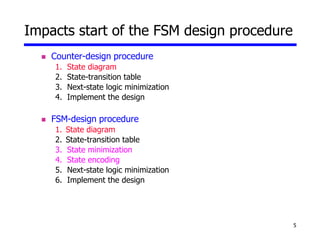
Impacts start of the FSM design procedure
 Counter-design procedure
1. State diagram
2. State-transition table
3. Next-state logic minimization
4. Implement the design
 FSM-design procedure
1. State diagram
2. State-transition table
3. State minimization
4. State encoding
5. Next-state logic minimization
6. Implement the design
6
State Diagrams
 Moore machine
 Each state is labeled by a pair:
state-name/output or state-name [output]
 Mealy machine
 Each transition arc is labeled by a pair:
input-condition/output
7
D Q
Q
D Q
Q
D Q
Q
D Q
Q
A
B
clock
out
D Q
Q
D Q
Q
A
B
clock
out
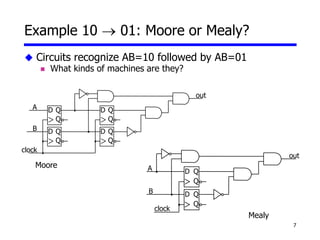
Example 10  01: Moore or Mealy?
 Circuits recognize AB=10 followed by AB=01
 What kinds of machines are they?
Moore
Mealy
8
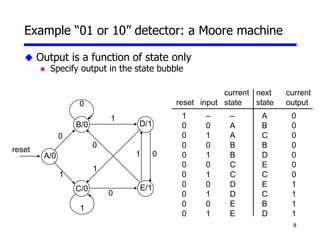
Example “01 or 10” detector: a Moore machine
 Output is a function of state only
 Specify output in the state bubble
D/1
E/1
B/0
A/0
C/0
1
0
0
0
0
1
1
1
1
0
reset
current next current
reset input state state output
1 – – A 0
0 0 A B 0
0 1 A C 0
0 0 B B 0
0 1 B D 0
0 0 C E 0
0 1 C C 0
0 0 D E 1
0 1 D C 1
0 0 E B 1
0 1 E D 1
9
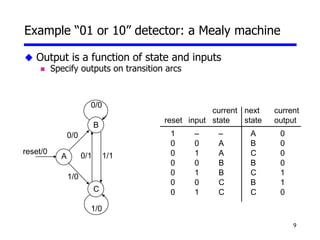
Example “01 or 10” detector: a Mealy machine
 Output is a function of state and inputs
 Specify outputs on transition arcs
current next current
reset input state state output
B
A
C
0/1
0/0
0/0
1/1
1/0
1/0
reset/0
1 – – A 0
0 0 A B 0
0 1 A C 0
0 0 B B 0
0 1 B C 1
0 0 C B 1
0 1 C C 0
10
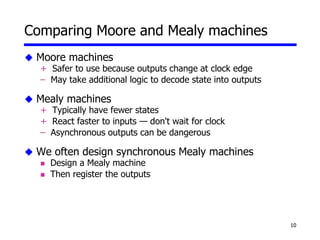
Comparing Moore and Mealy machines
 Moore machines
+ Safer to use because outputs change at clock edge
– May take additional logic to decode state into outputs
 Mealy machines
+ Typically have fewer states
+ React faster to inputs — don't wait for clock
– Asynchronous outputs can be dangerous
 We often design synchronous Mealy machines
 Design a Mealy machine
 Then register the outputs
11
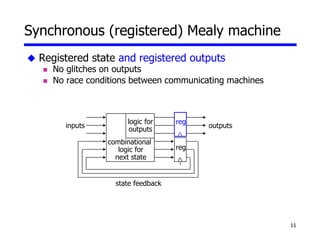
Synchronous (registered) Mealy machine
 Registered state and registered outputs
 No glitches on outputs
 No race conditions between communicating machines
inputs outputs
state feedback
reg
combinational
logic for
next state
logic for
outputs
reg
12
D Q
Q
B
A
clock
out
D Q
Q
D Q
Q
clock
out
A
B
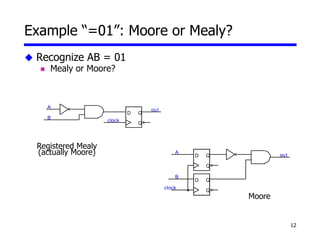
Example “=01”: Moore or Mealy?
 Recognize AB = 01
 Mealy or Moore?
Registered Mealy
(actually Moore)
Moore
13
Example: A parity checker
 Serial input string
 OUT=1 if odd # of 1s in input
 OUT=0 if even # of 1s in input
 Let’s do this for Moore and Mealy
14
Example: A parity checker
Even
[0]
Odd
[1]
0
1 1
1. State diagram
Moore Mealy
Even
[0]
Odd
[1]
0
1 1
0/0
1/1 1/0
0/1
15
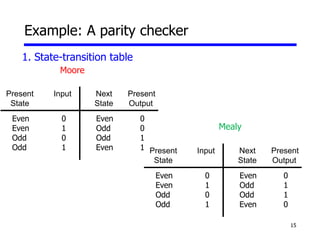
Example: A parity checker
Present Input Next Present
State State Output
Even 0 Even 0
Even 1 Odd 0
Odd 0 Odd 1
Odd 1 Even 1
1. State-transition table
Present Input Next Present
State State Output
Even 0 Even 0
Even 1 Odd 1
Odd 0 Odd 1
Odd 1 Even 0
Moore
Mealy
16
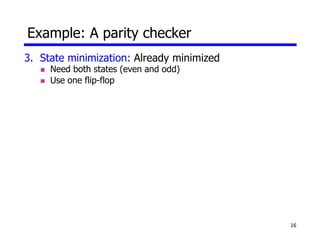
3. State minimization: Already minimized
 Need both states (even and odd)
 Use one flip-flop
Example: A parity checker
17
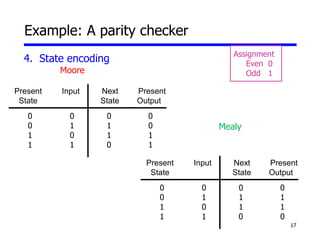
4. State encoding
Present Input Next Present
State State Output
0 0 0 0
0 1 1 0
1 0 1 1
1 1 0 1
Assignment
Even 0
Odd 1
Present Input Next Present
State State Output
0 0 0 0
0 1 1 1
1 0 1 1
1 1 0 0
Moore
Mealy
Example: A parity checker
18
Example: A parity checker
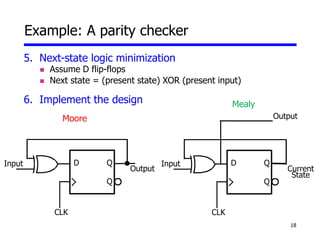
5. Next-state logic minimization
 Assume D flip-flops
 Next state = (present state) XOR (present input)
6. Implement the design
CLK
Input
Output
D Q
Q
CLK
Input
Current
State
D Q
Q
Output
Moore
Mealy
19
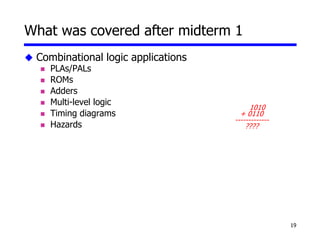
What was covered after midterm 1
 Combinational logic applications
 PLAs/PALs
 ROMs
 Adders
 Multi-level logic
 Timing diagrams
 Hazards
1010
+ 0110
-------------
????
20
What was covered after midterm 1
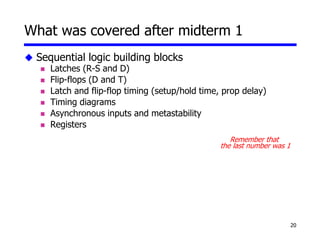
 Sequential logic building blocks
 Latches (R-S and D)
 Flip-flops (D and T)
 Latch and flip-flop timing (setup/hold time, prop delay)
 Timing diagrams
 Asynchronous inputs and metastability
 Registers
Remember that
the last number was 1
21
What was covered after midterm 1
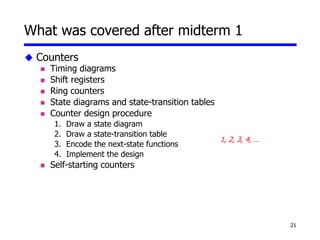
 Counters
 Timing diagrams
 Shift registers
 Ring counters
 State diagrams and state-transition tables
 Counter design procedure
1. Draw a state diagram
2. Draw a state-transition table
3. Encode the next-state functions
4. Implement the design
 Self-starting counters
1, 2, 3, 4, …
22
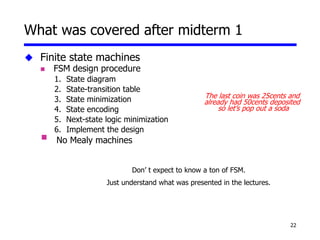
 Finite state machines
 FSM design procedure
1. State diagram
2. State-transition table
3. State minimization
4. State encoding
5. Next-state logic minimization
6. Implement the design
 No Mealy machines
What was covered after midterm 1
The last coin was 25cents and
already had 50cents deposited
so let’s pop out a soda
Don’ t expect to know a ton of FSM.
Just understand what was presented in the lectures.
23
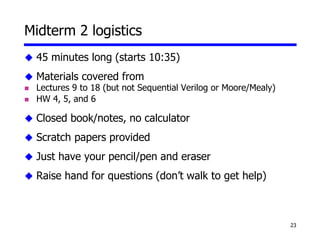
Midterm 2 logistics
 45 minutes long (starts 10:35)
 Materials covered from
 Lectures 9 to 18 (but not Sequential Verilog or Moore/Mealy)
 HW 4, 5, and 6
 Closed book/notes, no calculator
 Scratch papers provided
 Just have your pencil/pen and eraser
 Raise hand for questions (don’t walk to get help)

19-MooreMealy.ppt

  • 1.
    1 Lecture  Logistics  Lab8 this week to be done in pairs  Find a partner before your lab period  Otherwise you will have to wait for a pairing which will slow you down  HW5 and HW6 solutions out today  Graded HW5 available at review session tomorrow  HW7 out today due Wednesday March 4  Midterm 2 Wednesday  Covers material up to simple FSM  Review session tomorrow, 4:30 here, EEB 037  Last lecture  Counter FSM design  General Finite State Machine Design  Vending machine example  Today  Moore/Mealy machines  Midterm 2 topics and logistics
  • 2.
    2 The “WHY” slide Moore/Mealy machines  There are two different ways to express the FSMs with respect to the output. Both have different advantages so it is good to know them.
  • 3.
    3 Inputs Outputs Next State Current State output logic Next-state logic GeneralizedFSM model: Moore and Mealy  Combinational logic computes next state and outputs  Next state is a function of current state and inputs  Outputs are functions of Current state (Moore machine) Current state and inputs (Mealy machine)
  • 4.
    4 Moore versus Mealymachines outputs state feedback inputs reg combinational logic for next state logic for outputs Moore machine Outputs are a function of current state Outputs change synchronously with state changes Mealy machine Outputs depend on state and on inputs Input changes can cause immediate output changes (asynchronous) inputs outputs state feedback reg combinational logic for next state logic for outputs
  • 5.
    5 Impacts start ofthe FSM design procedure  Counter-design procedure 1. State diagram 2. State-transition table 3. Next-state logic minimization 4. Implement the design  FSM-design procedure 1. State diagram 2. State-transition table 3. State minimization 4. State encoding 5. Next-state logic minimization 6. Implement the design
  • 6.
    6 State Diagrams  Mooremachine  Each state is labeled by a pair: state-name/output or state-name [output]  Mealy machine  Each transition arc is labeled by a pair: input-condition/output
  • 7.
    7 D Q Q D Q Q DQ Q D Q Q A B clock out D Q Q D Q Q A B clock out Example 10  01: Moore or Mealy?  Circuits recognize AB=10 followed by AB=01  What kinds of machines are they? Moore Mealy
  • 8.
    8 Example “01 or10” detector: a Moore machine  Output is a function of state only  Specify output in the state bubble D/1 E/1 B/0 A/0 C/0 1 0 0 0 0 1 1 1 1 0 reset current next current reset input state state output 1 – – A 0 0 0 A B 0 0 1 A C 0 0 0 B B 0 0 1 B D 0 0 0 C E 0 0 1 C C 0 0 0 D E 1 0 1 D C 1 0 0 E B 1 0 1 E D 1
  • 9.
    9 Example “01 or10” detector: a Mealy machine  Output is a function of state and inputs  Specify outputs on transition arcs current next current reset input state state output B A C 0/1 0/0 0/0 1/1 1/0 1/0 reset/0 1 – – A 0 0 0 A B 0 0 1 A C 0 0 0 B B 0 0 1 B C 1 0 0 C B 1 0 1 C C 0
  • 10.
    10 Comparing Moore andMealy machines  Moore machines + Safer to use because outputs change at clock edge – May take additional logic to decode state into outputs  Mealy machines + Typically have fewer states + React faster to inputs — don't wait for clock – Asynchronous outputs can be dangerous  We often design synchronous Mealy machines  Design a Mealy machine  Then register the outputs
  • 11.
    11 Synchronous (registered) Mealymachine  Registered state and registered outputs  No glitches on outputs  No race conditions between communicating machines inputs outputs state feedback reg combinational logic for next state logic for outputs reg
  • 12.
    12 D Q Q B A clock out D Q Q DQ Q clock out A B Example “=01”: Moore or Mealy?  Recognize AB = 01  Mealy or Moore? Registered Mealy (actually Moore) Moore
  • 13.
    13 Example: A paritychecker  Serial input string  OUT=1 if odd # of 1s in input  OUT=0 if even # of 1s in input  Let’s do this for Moore and Mealy
  • 14.
    14 Example: A paritychecker Even [0] Odd [1] 0 1 1 1. State diagram Moore Mealy Even [0] Odd [1] 0 1 1 0/0 1/1 1/0 0/1
  • 15.
    15 Example: A paritychecker Present Input Next Present State State Output Even 0 Even 0 Even 1 Odd 0 Odd 0 Odd 1 Odd 1 Even 1 1. State-transition table Present Input Next Present State State Output Even 0 Even 0 Even 1 Odd 1 Odd 0 Odd 1 Odd 1 Even 0 Moore Mealy
  • 16.
    16 3. State minimization:Already minimized  Need both states (even and odd)  Use one flip-flop Example: A parity checker
  • 17.
    17 4. State encoding PresentInput Next Present State State Output 0 0 0 0 0 1 1 0 1 0 1 1 1 1 0 1 Assignment Even 0 Odd 1 Present Input Next Present State State Output 0 0 0 0 0 1 1 1 1 0 1 1 1 1 0 0 Moore Mealy Example: A parity checker
  • 18.
    18 Example: A paritychecker 5. Next-state logic minimization  Assume D flip-flops  Next state = (present state) XOR (present input) 6. Implement the design CLK Input Output D Q Q CLK Input Current State D Q Q Output Moore Mealy
  • 19.
    19 What was coveredafter midterm 1  Combinational logic applications  PLAs/PALs  ROMs  Adders  Multi-level logic  Timing diagrams  Hazards 1010 + 0110 ------------- ????
  • 20.
    20 What was coveredafter midterm 1  Sequential logic building blocks  Latches (R-S and D)  Flip-flops (D and T)  Latch and flip-flop timing (setup/hold time, prop delay)  Timing diagrams  Asynchronous inputs and metastability  Registers Remember that the last number was 1
  • 21.
    21 What was coveredafter midterm 1  Counters  Timing diagrams  Shift registers  Ring counters  State diagrams and state-transition tables  Counter design procedure 1. Draw a state diagram 2. Draw a state-transition table 3. Encode the next-state functions 4. Implement the design  Self-starting counters 1, 2, 3, 4, …
  • 22.
    22  Finite statemachines  FSM design procedure 1. State diagram 2. State-transition table 3. State minimization 4. State encoding 5. Next-state logic minimization 6. Implement the design  No Mealy machines What was covered after midterm 1 The last coin was 25cents and already had 50cents deposited so let’s pop out a soda Don’ t expect to know a ton of FSM. Just understand what was presented in the lectures.
  • 23.
    23 Midterm 2 logistics 45 minutes long (starts 10:35)  Materials covered from  Lectures 9 to 18 (but not Sequential Verilog or Moore/Mealy)  HW 4, 5, and 6  Closed book/notes, no calculator  Scratch papers provided  Just have your pencil/pen and eraser  Raise hand for questions (don’t walk to get help)