F.Sc. 2.Chemistry CHAPTER #01
Malik Xufyan Cell # 0313-7355727
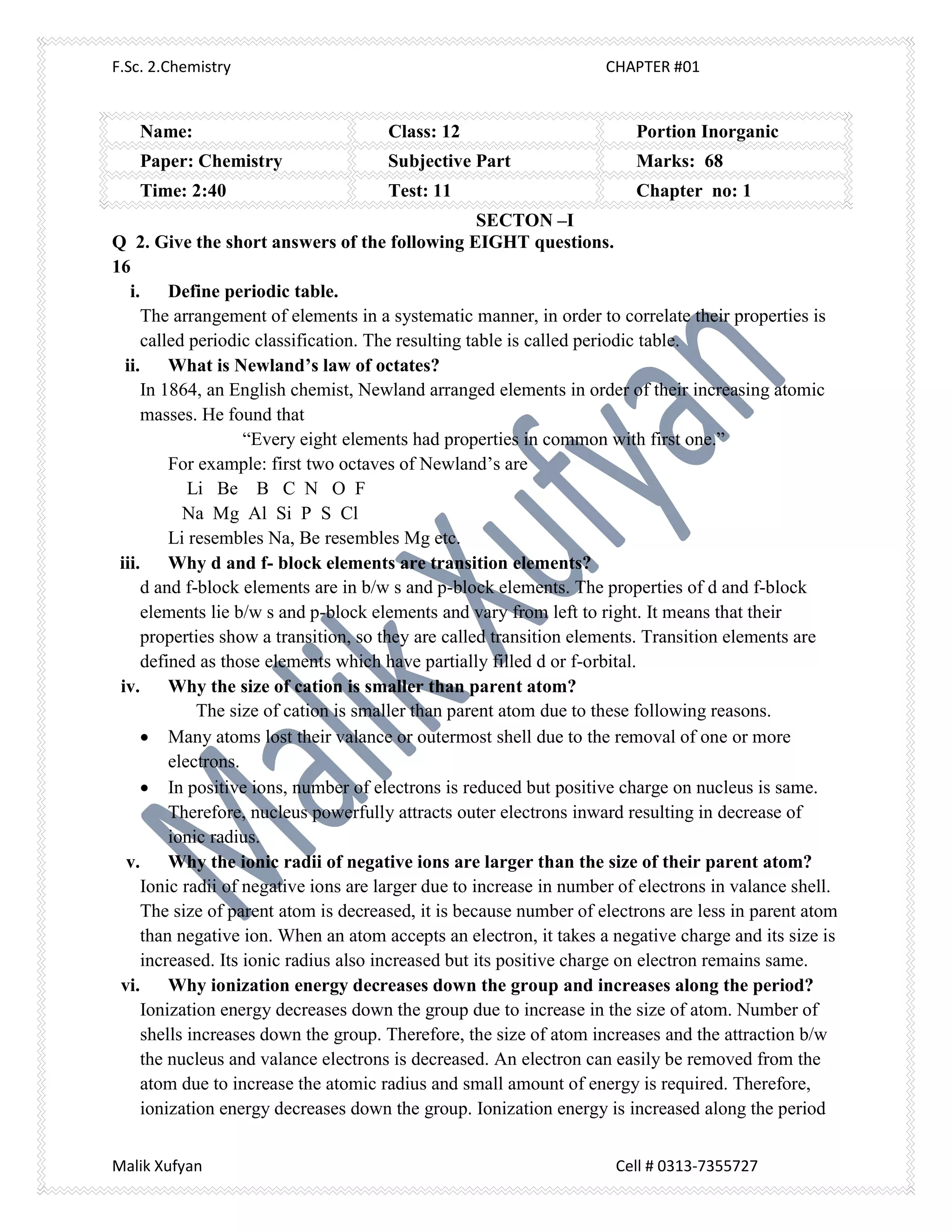
Name: Class: 12 Portion Inorganic
Paper: Chemistry Subjective Part Marks: 68
Time: 2:40 Test: 11 Chapter no: 1
SECTON –I
Q 2. Give the short answers of the following EIGHT questions.
16
i. Define periodic table.
The arrangement of elements in a systematic manner, in order to correlate their properties is
called periodic classification. The resulting table is called periodic table.
ii. What is Newland’s law of octates?
In 1864, an English chemist, Newland arranged elements in order of their increasing atomic
masses. He found that
“Every eight elements had properties in common with first one.”
For example: first two octaves of Newland’s are
Li Be B C N O F
Na Mg Al Si P S Cl
Li resembles Na, Be resembles Mg etc.
iii. Why d and f- block elements are transition elements?
d and f-block elements are in b/w s and p-block elements. The properties of d and f-block
elements lie b/w s and p-block elements and vary from left to right. It means that their
properties show a transition, so they are called transition elements. Transition elements are
defined as those elements which have partially filled d or f-orbital.
iv. Why the size of cation is smaller than parent atom?
The size of cation is smaller than parent atom due to these following reasons.
 Many atoms lost their valance or outermost shell due to the removal of one or more
electrons.
 In positive ions, number of electrons is reduced but positive charge on nucleus is same.
Therefore, nucleus powerfully attracts outer electrons inward resulting in decrease of
ionic radius.
v. Why the ionic radii of negative ions are larger than the size of their parent atom?
Ionic radii of negative ions are larger due to increase in number of electrons in valance shell.
The size of parent atom is decreased, it is because number of electrons are less in parent atom
than negative ion. When an atom accepts an electron, it takes a negative charge and its size is
increased. Its ionic radius also increased but its positive charge on electron remains same.
vi. Why ionization energy decreases down the group and increases along the period?
Ionization energy decreases down the group due to increase in the size of atom. Number of
shells increases down the group. Therefore, the size of atom increases and the attraction b/w
the nucleus and valance electrons is decreased. An electron can easily be removed from the
atom due to increase the atomic radius and small amount of energy is required. Therefore,
ionization energy decreases down the group. Ionization energy is increased along the period
F.Sc. 2.Chemistry CHAPTER #01
Malik Xufyan Cell # 0313-7355727
due to the strong attraction of nucleus to their electrons and atomic radius is also decreased.
An electron cannot be removed from the atom due to the strong attraction of nucleus to their
electrons. A large amount of energy is required to remove electron from atom. Therefore,
ionization energy increases along the period.
vii. Why the second value of electron affinity of an element is shown with a positive
sign?
When a second electron is added in a un-negative ion, the incoming electron is repelled by
the negative ion and energy is absorbed in the process indicated by the positive figure.
e.g;
O(g) + eˉ Oˉ E.A1 = -141kJmol-1
O(g) + eˉ O2
ˉ E.A2 = +780kJmol-1
viii. Why the metallic character increases from top to bottom in a group of metal?
Metallic character increases from top to bottom due to increase in atomic size.
e.g.,
in halogens, metallic character increases from top to bottom. Thus, the iodine is
most metallic.
ix. Lanthanide contraction controls the atomic sizes of elements of 6th
and 7th
periods.
Explain.
Lanthanides are present in 6th
period and actinides are present in 7th
period of periodic table.
In case of lanthanide and actinide, there is a gradual decrease in the atomic size from left to
right due to increase in the nuclear charge. The gradual reduction of atomic sizes in
lanthanide or actinides is called Lanthanide contraction.
x. Why the oxidation states vary in a period but remain almost constant in a group?
Oxidation states of elements depend upon the electronic configuration of elements. In periods
of periodic table, the electronic configuration change but in a group electronic configuration
remains constant.
Sue to same electronic configuration in a group, the elements of the same group have same
oxidation states and due to different electronic configuration in a period, the elements of the
same period have different oxidation states.
xi. Why the ionic character of halides decreases from left to right in a period?
Ionic character of halides depends upon the difference of electronegativity b/w halogen atom
and other atom forming halide.
Along a period, difference of electronegativity decreases due to which ionic character of
halides decreases.
For example; in 3rd
period, NaCl and MgCl2 are ionic. AlCl3 is polymeric and SiCl4, PCl3,
S2Cl2 are covalent in nature.
xii. How alkali metals give ionic hydrides.
Alkali metals are highly electropositive elements due to bigger size. Due to bigger size, they
have low ionization energies and lose electron easily. When these elements react with
F.Sc. 2.Chemistry CHAPTER #01
Malik Xufyan Cell # 0313-7355727
hydrogen they lose one electron and hydrogen accept one electron and form hydride ion.
These metal ions and hydride ion combine to form ionic hydrides.
M M+
+ 1e-
H + 1e-
H-
M+
+ H-
MH
Q 3. Give the answers of the following EIGHT questions.
16
i. Why the oxidation state of noble gases is usually zero?
Oxidation state of noble gases is usually zero. It is because no vacancy is present in their
valance shell. No electron will be added in the noble gases. All the shells in noble gass is
completed. Therefore, noble gases are also called zero group elements.
ii. Why diamond is a non-conductor and graphite is fairly a good conductor?
In diamond, C in the form of diamond is non-conductor. It is because all its valance electrons
are used up in making tetrahedral structure and no free electron is present in it.
But C in the form of graphite is a good conductor. It is because it has free valance
electrons.
iii. Differentiate b/w acid oxides basic and amphoteric oxides.
Sr
#
Acid oxides Basic oxides Amphoteric oxides
1. Oxides of non-metals are
generally acidic.
Oxides of metals are
generally basic.
Oxides of relatively less
electropositive elements.
E.g; BeO.
2. These form acids in water. These form bases in
water.
They show properties of
both acidic and basic
oxides.
iv. Define oxidation states and hydration energy.
Oxidation state is defined as:
“It is apparent charge with sign, which an atom has in a compound.”
e.g; In ionic compounds, It is usually the number of electrons gain or lost. In NaCl,
oxidation state of
Na is +1 and that of chlorine is -1.
Hydration energy is defined as:
“it is the amount of heat evolved or absorbed when 1 mole of ions dissolve in
H2O to give infinitely dilute charge.”
e.g; when 1 mole of gaseous hydrogen ions is dissolved in water, 1075 kj energy is
released.
H⁺ + H2O H3O⁺(aq) ∆H h = -1075kmol-1
v. What is meant by the electrical conductivity? This property depends upon different
factors also write down.
F.Sc. 2.Chemistry CHAPTER #01
Malik Xufyan Cell # 0313-7355727
Electrical conductivity is a property of elements that causes the electricity. This property
is due to the free electrons in elements. Free electrons are present in metals. Therefore,
metals are the good conductor of electricity. This property depends upon:
 Presence of loose electrons in valance shell of elements.
 Easy removal of loose electrons.
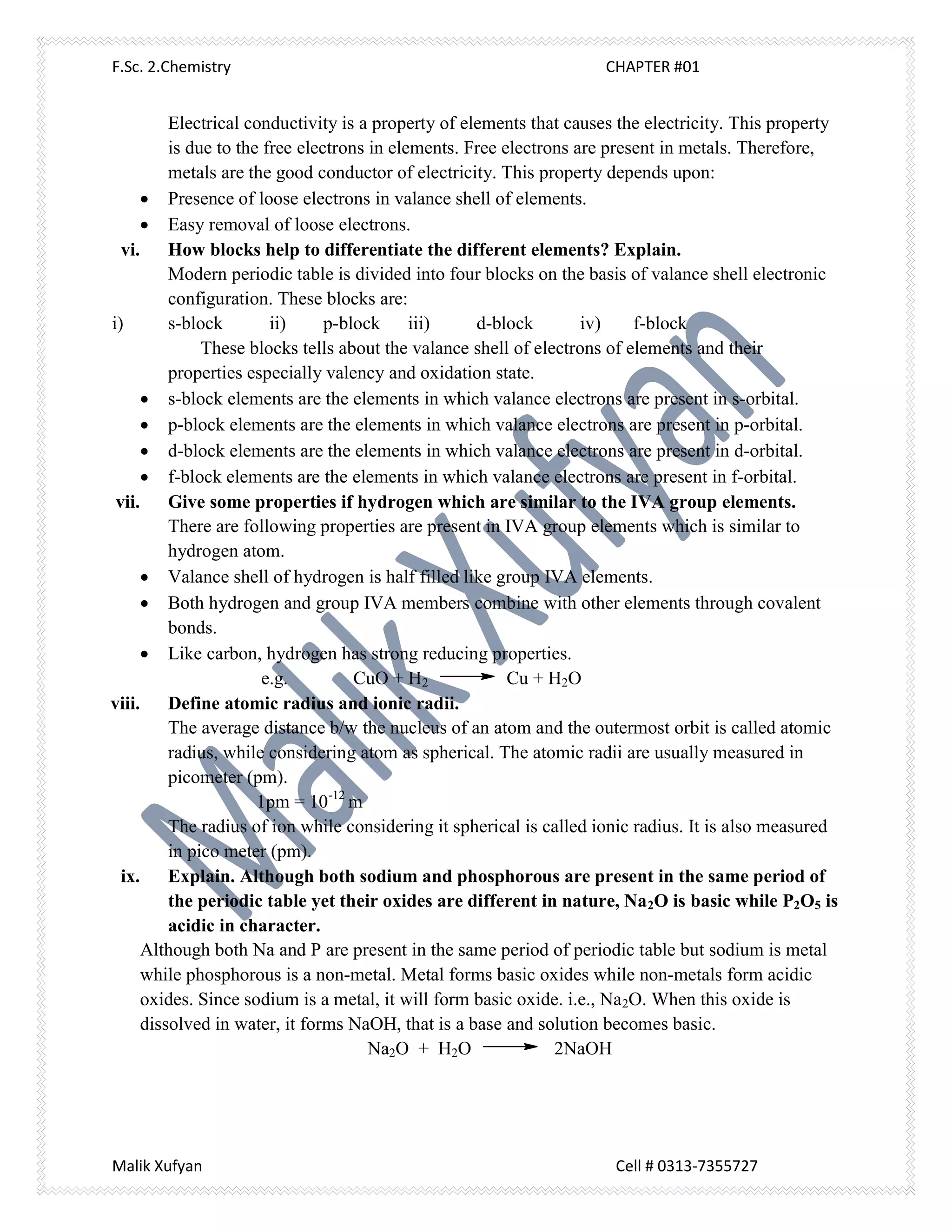
vi. How blocks help to differentiate the different elements? Explain.
Modern periodic table is divided into four blocks on the basis of valance shell electronic
configuration. These blocks are:
i) s-block ii) p-block iii) d-block iv) f-block
These blocks tells about the valance shell of electrons of elements and their
properties especially valency and oxidation state.
 s-block elements are the elements in which valance electrons are present in s-orbital.
 p-block elements are the elements in which valance electrons are present in p-orbital.
 d-block elements are the elements in which valance electrons are present in d-orbital.
 f-block elements are the elements in which valance electrons are present in f-orbital.
vii. Give some properties if hydrogen which are similar to the IVA group elements.
There are following properties are present in IVA group elements which is similar to
hydrogen atom.
 Valance shell of hydrogen is half filled like group IVA elements.
 Both hydrogen and group IVA members combine with other elements through covalent
bonds.
 Like carbon, hydrogen has strong reducing properties.
e.g. CuO + H2 Cu + H2O
viii. Define atomic radius and ionic radii.
The average distance b/w the nucleus of an atom and the outermost orbit is called atomic
radius, while considering atom as spherical. The atomic radii are usually measured in
picometer (pm).
1pm = 10-12
m
The radius of ion while considering it spherical is called ionic radius. It is also measured
in pico meter (pm).
ix. Explain. Although both sodium and phosphorous are present in the same period of
the periodic table yet their oxides are different in nature, Na2O is basic while P2O5 is
acidic in character.
Although both Na and P are present in the same period of periodic table but sodium is metal
while phosphorous is a non-metal. Metal forms basic oxides while non-metals form acidic
oxides. Since sodium is a metal, it will form basic oxide. i.e., Na2O. When this oxide is
dissolved in water, it forms NaOH, that is a base and solution becomes basic.
Na2O + H2O 2NaOH
F.Sc. 2.Chemistry CHAPTER #01
Malik Xufyan Cell # 0313-7355727
Phosphorous is a non-metal so it will form acidic oxide i.e. P2O5. When this oxide is
dissolved in water, it produces H3PO4, which is an acid, and solution becomes acidic due to
formation of H3PO4.
P2O5 + 3H2O 2H3PO4
x. Give some differences of hydrogen from halides.
 Hydride ion H-
is unstable in aqueous solution while halide ions, i.e., F-
, Cl-
, Br-
etc.
are stable.
H-
+ H2O H2 + OH-
 Hydrogen has just one electron in its outermost shell while halogens have seven
electrons in their outermost shells.
 Hydrogen forms very stable compound H2O with oxygen while halogens do not form.
 Alkali metals hydrides e.g., NaH are strongly basic while alkali metals halides e.g.,
NaCl are neutral.
 Hydrogen can form H+
ion by loosing electron, while halogens do not form positive
ions.
xi. What do you know about semimetals?
 These type of elements show properties of both metals and non-metals.
 These form amphoteric oxides which show properties of both acidic and basic oxides.
 These include lower members of group III A to VA, which are present just under the
stepped line in periodic table. For example: Si, As, Te etc.
xii. Define shielding effect.
It is the decrease in force of attraction b/w outermost electrons and the nucleus due to inner
electrons.
When shells are added down the group, outer electrons are less attracted by nucleus due to
shielding effect of inner shell electrons. These outer electrons, therefore, move outward &
hence atomic size increases.
Q 4. Give the answers of the following SIX questions.
12
i. Why atomic radius increases down the group? Explain.
Atomic radius increases down the group due to their two factors.
i) Increase in number of shell ii) Shielding effect
From up to down number of shell increases and the size of atom is also increased.
Therefore, atomic radius is also increased.
It is the decrease in force of attraction b/w outermost shell and nucleus due to the inner
shell electrons. Shielding effect increases due to increase in size of atom. Therefore,
atomic radius is also increased.
ii. What factors effecting on ionization energy along period and group? Explain.
Following factors effecting on ionization energy along period;
 From left to right in the periodic table magnitude of nuclear charge increases and I.E is
also increased.
F.Sc. 2.Chemistry CHAPTER #01
Malik Xufyan Cell # 0313-7355727
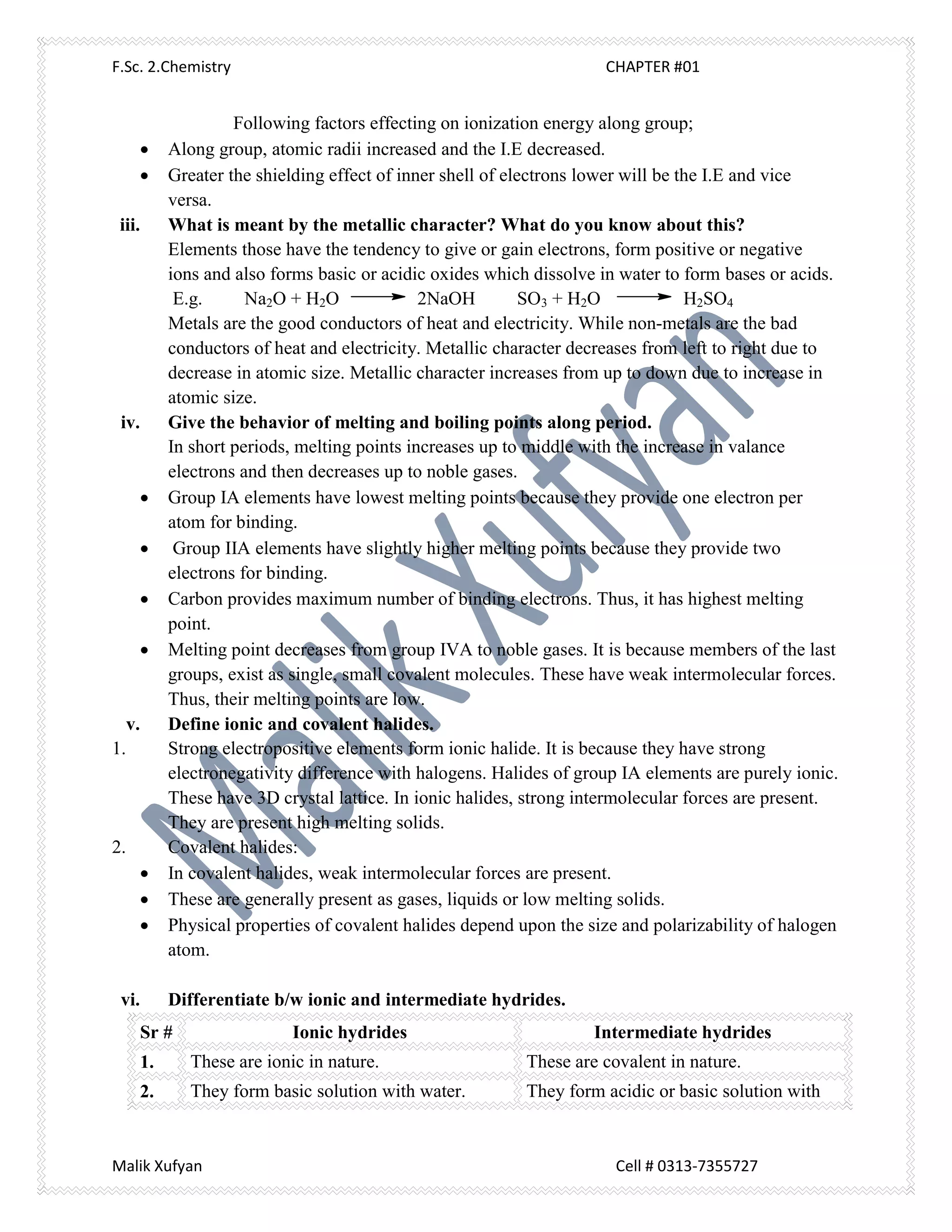
Following factors effecting on ionization energy along group;
 Along group, atomic radii increased and the I.E decreased.
 Greater the shielding effect of inner shell of electrons lower will be the I.E and vice
versa.
iii. What is meant by the metallic character? What do you know about this?
Elements those have the tendency to give or gain electrons, form positive or negative
ions and also forms basic or acidic oxides which dissolve in water to form bases or acids.
E.g. Na2O + H2O 2NaOH SO3 + H2O H2SO4
Metals are the good conductors of heat and electricity. While non-metals are the bad
conductors of heat and electricity. Metallic character decreases from left to right due to
decrease in atomic size. Metallic character increases from up to down due to increase in
atomic size.
iv. Give the behavior of melting and boiling points along period.
In short periods, melting points increases up to middle with the increase in valance
electrons and then decreases up to noble gases.
 Group IA elements have lowest melting points because they provide one electron per
atom for binding.
 Group IIA elements have slightly higher melting points because they provide two
electrons for binding.
 Carbon provides maximum number of binding electrons. Thus, it has highest melting
point.
 Melting point decreases from group IVA to noble gases. It is because members of the last
groups, exist as single, small covalent molecules. These have weak intermolecular forces.
Thus, their melting points are low.
v. Define ionic and covalent halides.
1. Strong electropositive elements form ionic halide. It is because they have strong
electronegativity difference with halogens. Halides of group IA elements are purely ionic.
These have 3D crystal lattice. In ionic halides, strong intermolecular forces are present.
They are present high melting solids.
2. Covalent halides:
 In covalent halides, weak intermolecular forces are present.
 These are generally present as gases, liquids or low melting solids.
 Physical properties of covalent halides depend upon the size and polarizability of halogen
atom.
vi. Differentiate b/w ionic and intermediate hydrides.
Sr # Ionic hydrides Intermediate hydrides
1. These are ionic in nature. These are covalent in nature.
2. They form basic solution with water. They form acidic or basic solution with
F.Sc. 2.Chemistry CHAPTER #01
Malik Xufyan Cell # 0313-7355727
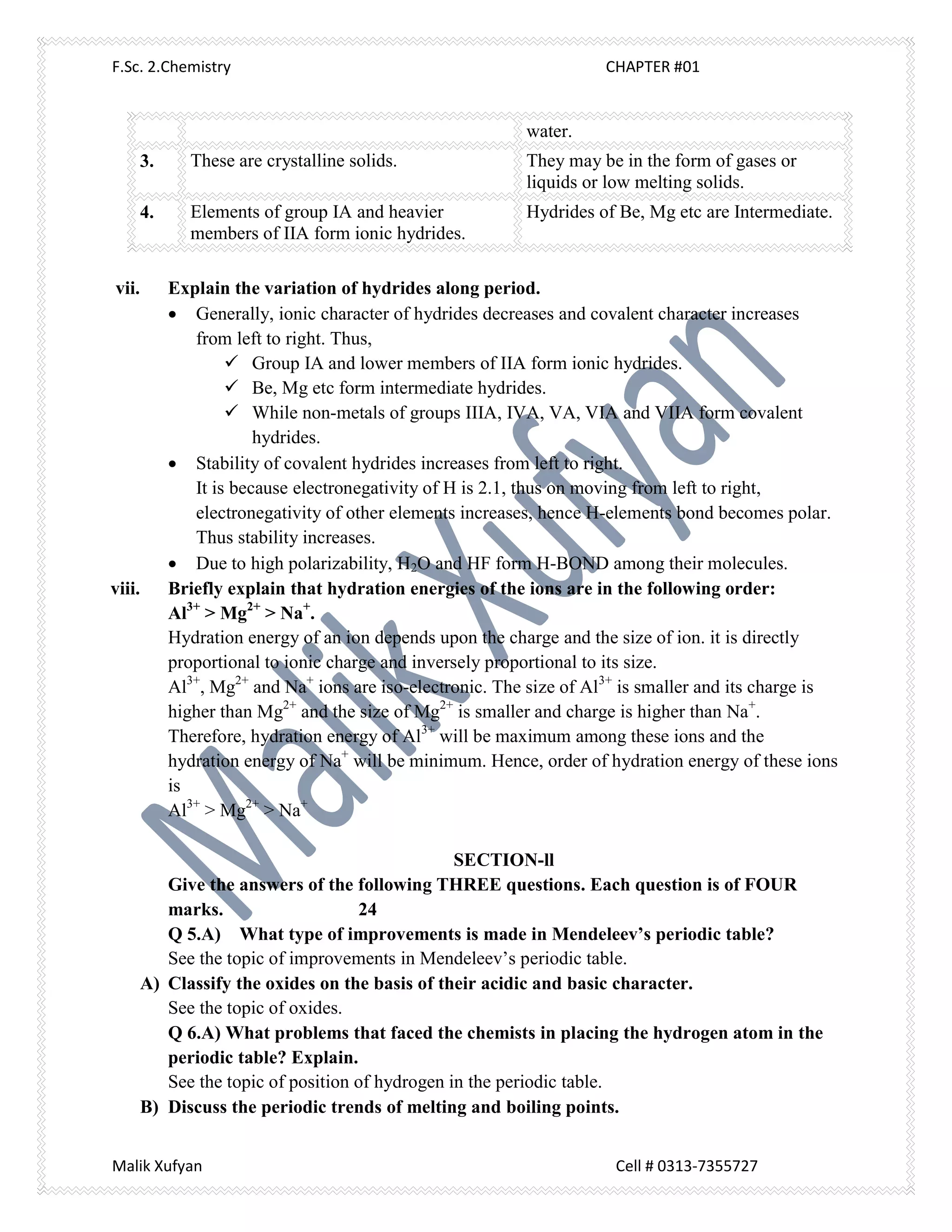
water.
3. These are crystalline solids. They may be in the form of gases or
liquids or low melting solids.
4. Elements of group IA and heavier
members of IIA form ionic hydrides.
Hydrides of Be, Mg etc are Intermediate.
vii. Explain the variation of hydrides along period.
 Generally, ionic character of hydrides decreases and covalent character increases
from left to right. Thus,
 Group IA and lower members of IIA form ionic hydrides.
 Be, Mg etc form intermediate hydrides.
 While non-metals of groups IIIA, IVA, VA, VIA and VIIA form covalent
hydrides.
 Stability of covalent hydrides increases from left to right.
It is because electronegativity of H is 2.1, thus on moving from left to right,
electronegativity of other elements increases, hence H-elements bond becomes polar.
Thus stability increases.
 Due to high polarizability, H2O and HF form H-BOND among their molecules.
viii. Briefly explain that hydration energies of the ions are in the following order:
Al3+
> Mg2+
> Na+
.
Hydration energy of an ion depends upon the charge and the size of ion. it is directly
proportional to ionic charge and inversely proportional to its size.
Al3+
, Mg2+
and Na+
ions are iso-electronic. The size of Al3+
is smaller and its charge is
higher than Mg2+
and the size of Mg2+
is smaller and charge is higher than Na+
.
Therefore, hydration energy of Al3+
will be maximum among these ions and the
hydration energy of Na+
will be minimum. Hence, order of hydration energy of these ions
is
Al3+
> Mg2+
> Na+
SECTION-ll
Give the answers of the following THREE questions. Each question is of FOUR
marks. 24
Q 5.A) What type of improvements is made in Mendeleev’s periodic table?
See the topic of improvements in Mendeleev’s periodic table.
A) Classify the oxides on the basis of their acidic and basic character.
See the topic of oxides.
Q 6.A) What problems that faced the chemists in placing the hydrogen atom in the
periodic table? Explain.
See the topic of position of hydrogen in the periodic table.
B) Discuss the periodic trends of melting and boiling points.
F.Sc. 2.Chemistry CHAPTER #01
Malik Xufyan Cell # 0313-7355727
See the topic of Melting and boiling points.
Q 7.A) Define and explain hydration energy.
See the topic f hydration energy.
B) Discuss about the classification of hydrides and oxides.
See the topic of hydrides and oxides.
Exercise
Q 14. Give brief reason for the following;
a) d and f- block elements are transition elements.
d and f-block elements are in b/w s and p-block elements. The properties of d and f-block
elements lie b/w s and p-block elements and vary from left to right. It means that their
properties show a transition, so they are called transition elements. Transition elements are
defined as those elements which have partially filled d or f-orbital.
b) Lanthanide contraction controls the atomic sizes of elements of 6th
and 7th
periods.
Lanthanides are present in 6th
period and actinides are present in 7th
period of periodic table.
In case of lanthanide and actinide, there is a gradual decrease in the atomic size from left to
right due to increase in the nuclear charge. The gradual reduction of atomic sizes in
lanthanide or actinides is called Lanthanide contraction.
c) The oxidation states vary in a period but remain almost constant in a group.
Oxidation states of elements depend upon the electronic configuration of elements. In periods
of periodic table, the electronic configuration change but in a group electronic configuration
remains constant.
Sue to same electronic configuration in a group, the elements of the same group have same
oxidation states and due to different electronic configuration in a period, the elements of the
same period have different oxidation states.
d) Hydration energies of the ions are in the following order:
Al3+
> Mg2+
> Na+
.
Hydration energy of an ion depends upon the charge and the size of ion. it is directly
proportional to ionic charge and inversely proportional to its size.
Al3+
, Mg2+
and Na+
ions are iso-electronic. The size of Al3+
is smaller and its charge is higher
than Mg2+
and the size of Mg2+
is smaller and charge is higher than Na+
.
Therefore, hydration energy of Al3+
will be maximum among these ions and the hydration
energy of Na+
will be minimum. Hence, order of hydration energy of these ions is
Al3+
> Mg2+
> Na+
.
e) Ionic character of halides decreases from left to right in a period.
Ionic character of halides depends upon the difference of electronegativity b/w halogen atom
and other atom forming halide.
Along a period, difference of electronegativity decreases due to which ionic character of
halides decreases.
F.Sc. 2.Chemistry CHAPTER #01
Malik Xufyan Cell # 0313-7355727
For example; in 3rd
period, NaCl and MgCl2 are ionic. AlCl3 is polymeric and SiCl4, PCl3,
S2Cl2 are covalent in nature.
f) Alkali metals give ionic hydrides.
Alkali metals are highly electropositive elements due to bigger size. Due to bigger size, they
have low ionization energies and lose electron easily. When these elements react with
hydrogen they lose one electron and hydrogen accept one electron and form hydride ion.
These metal ions and hydride ion combine to form ionic hydrides.
M M+
+ 1e-
H + 1e-
H-
M+
+ H-
MH
g) Although both sodium and phosphorous are present in the same period of the
periodic table yet their oxides are different in nature, Na2O is basic while P2O5 is
acidic in character.
Although both Na and P are present in the same period of periodic table but sodium is metal
while phosphorous is a non-metal. Metal forms basic oxides while non-metals form acidic
oxides. Since sodium is a metal, it will form basic oxide. i.e., Na2O. When this oxide is
dissolved in water, it forms NaOH, that is a base and solution becomes basic.
Na2O + H2O 2NaOH
Phosphorous is a non-metal so it will form acidic oxide i.e. P2O5. When this oxide is
dissolved in water, it produces H3PO4, which is an acid, and solution becomes acidic due to
formation of H3PO4.
P2O5 + 3H2O 2H3PO4

F.sc.2.Chemistry.Ch.01 Solved Test (Malik Xufyan)

  • 1.
    F.Sc. 2.Chemistry CHAPTER#01 Malik Xufyan Cell # 0313-7355727 Name: Class: 12 Portion Inorganic Paper: Chemistry Subjective Part Marks: 68 Time: 2:40 Test: 11 Chapter no: 1 SECTON –I Q 2. Give the short answers of the following EIGHT questions. 16 i. Define periodic table. The arrangement of elements in a systematic manner, in order to correlate their properties is called periodic classification. The resulting table is called periodic table. ii. What is Newland’s law of octates? In 1864, an English chemist, Newland arranged elements in order of their increasing atomic masses. He found that “Every eight elements had properties in common with first one.” For example: first two octaves of Newland’s are Li Be B C N O F Na Mg Al Si P S Cl Li resembles Na, Be resembles Mg etc. iii. Why d and f- block elements are transition elements? d and f-block elements are in b/w s and p-block elements. The properties of d and f-block elements lie b/w s and p-block elements and vary from left to right. It means that their properties show a transition, so they are called transition elements. Transition elements are defined as those elements which have partially filled d or f-orbital. iv. Why the size of cation is smaller than parent atom? The size of cation is smaller than parent atom due to these following reasons.  Many atoms lost their valance or outermost shell due to the removal of one or more electrons.  In positive ions, number of electrons is reduced but positive charge on nucleus is same. Therefore, nucleus powerfully attracts outer electrons inward resulting in decrease of ionic radius. v. Why the ionic radii of negative ions are larger than the size of their parent atom? Ionic radii of negative ions are larger due to increase in number of electrons in valance shell. The size of parent atom is decreased, it is because number of electrons are less in parent atom than negative ion. When an atom accepts an electron, it takes a negative charge and its size is increased. Its ionic radius also increased but its positive charge on electron remains same. vi. Why ionization energy decreases down the group and increases along the period? Ionization energy decreases down the group due to increase in the size of atom. Number of shells increases down the group. Therefore, the size of atom increases and the attraction b/w the nucleus and valance electrons is decreased. An electron can easily be removed from the atom due to increase the atomic radius and small amount of energy is required. Therefore, ionization energy decreases down the group. Ionization energy is increased along the period
  • 2.
    F.Sc. 2.Chemistry CHAPTER#01 Malik Xufyan Cell # 0313-7355727 due to the strong attraction of nucleus to their electrons and atomic radius is also decreased. An electron cannot be removed from the atom due to the strong attraction of nucleus to their electrons. A large amount of energy is required to remove electron from atom. Therefore, ionization energy increases along the period. vii. Why the second value of electron affinity of an element is shown with a positive sign? When a second electron is added in a un-negative ion, the incoming electron is repelled by the negative ion and energy is absorbed in the process indicated by the positive figure. e.g; O(g) + eˉ Oˉ E.A1 = -141kJmol-1 O(g) + eˉ O2 ˉ E.A2 = +780kJmol-1 viii. Why the metallic character increases from top to bottom in a group of metal? Metallic character increases from top to bottom due to increase in atomic size. e.g., in halogens, metallic character increases from top to bottom. Thus, the iodine is most metallic. ix. Lanthanide contraction controls the atomic sizes of elements of 6th and 7th periods. Explain. Lanthanides are present in 6th period and actinides are present in 7th period of periodic table. In case of lanthanide and actinide, there is a gradual decrease in the atomic size from left to right due to increase in the nuclear charge. The gradual reduction of atomic sizes in lanthanide or actinides is called Lanthanide contraction. x. Why the oxidation states vary in a period but remain almost constant in a group? Oxidation states of elements depend upon the electronic configuration of elements. In periods of periodic table, the electronic configuration change but in a group electronic configuration remains constant. Sue to same electronic configuration in a group, the elements of the same group have same oxidation states and due to different electronic configuration in a period, the elements of the same period have different oxidation states. xi. Why the ionic character of halides decreases from left to right in a period? Ionic character of halides depends upon the difference of electronegativity b/w halogen atom and other atom forming halide. Along a period, difference of electronegativity decreases due to which ionic character of halides decreases. For example; in 3rd period, NaCl and MgCl2 are ionic. AlCl3 is polymeric and SiCl4, PCl3, S2Cl2 are covalent in nature. xii. How alkali metals give ionic hydrides. Alkali metals are highly electropositive elements due to bigger size. Due to bigger size, they have low ionization energies and lose electron easily. When these elements react with
  • 3.
    F.Sc. 2.Chemistry CHAPTER#01 Malik Xufyan Cell # 0313-7355727 hydrogen they lose one electron and hydrogen accept one electron and form hydride ion. These metal ions and hydride ion combine to form ionic hydrides. M M+ + 1e- H + 1e- H- M+ + H- MH Q 3. Give the answers of the following EIGHT questions. 16 i. Why the oxidation state of noble gases is usually zero? Oxidation state of noble gases is usually zero. It is because no vacancy is present in their valance shell. No electron will be added in the noble gases. All the shells in noble gass is completed. Therefore, noble gases are also called zero group elements. ii. Why diamond is a non-conductor and graphite is fairly a good conductor? In diamond, C in the form of diamond is non-conductor. It is because all its valance electrons are used up in making tetrahedral structure and no free electron is present in it. But C in the form of graphite is a good conductor. It is because it has free valance electrons. iii. Differentiate b/w acid oxides basic and amphoteric oxides. Sr # Acid oxides Basic oxides Amphoteric oxides 1. Oxides of non-metals are generally acidic. Oxides of metals are generally basic. Oxides of relatively less electropositive elements. E.g; BeO. 2. These form acids in water. These form bases in water. They show properties of both acidic and basic oxides. iv. Define oxidation states and hydration energy. Oxidation state is defined as: “It is apparent charge with sign, which an atom has in a compound.” e.g; In ionic compounds, It is usually the number of electrons gain or lost. In NaCl, oxidation state of Na is +1 and that of chlorine is -1. Hydration energy is defined as: “it is the amount of heat evolved or absorbed when 1 mole of ions dissolve in H2O to give infinitely dilute charge.” e.g; when 1 mole of gaseous hydrogen ions is dissolved in water, 1075 kj energy is released. H⁺ + H2O H3O⁺(aq) ∆H h = -1075kmol-1 v. What is meant by the electrical conductivity? This property depends upon different factors also write down.
  • 4.
    F.Sc. 2.Chemistry CHAPTER#01 Malik Xufyan Cell # 0313-7355727 Electrical conductivity is a property of elements that causes the electricity. This property is due to the free electrons in elements. Free electrons are present in metals. Therefore, metals are the good conductor of electricity. This property depends upon:  Presence of loose electrons in valance shell of elements.  Easy removal of loose electrons. vi. How blocks help to differentiate the different elements? Explain. Modern periodic table is divided into four blocks on the basis of valance shell electronic configuration. These blocks are: i) s-block ii) p-block iii) d-block iv) f-block These blocks tells about the valance shell of electrons of elements and their properties especially valency and oxidation state.  s-block elements are the elements in which valance electrons are present in s-orbital.  p-block elements are the elements in which valance electrons are present in p-orbital.  d-block elements are the elements in which valance electrons are present in d-orbital.  f-block elements are the elements in which valance electrons are present in f-orbital. vii. Give some properties if hydrogen which are similar to the IVA group elements. There are following properties are present in IVA group elements which is similar to hydrogen atom.  Valance shell of hydrogen is half filled like group IVA elements.  Both hydrogen and group IVA members combine with other elements through covalent bonds.  Like carbon, hydrogen has strong reducing properties. e.g. CuO + H2 Cu + H2O viii. Define atomic radius and ionic radii. The average distance b/w the nucleus of an atom and the outermost orbit is called atomic radius, while considering atom as spherical. The atomic radii are usually measured in picometer (pm). 1pm = 10-12 m The radius of ion while considering it spherical is called ionic radius. It is also measured in pico meter (pm). ix. Explain. Although both sodium and phosphorous are present in the same period of the periodic table yet their oxides are different in nature, Na2O is basic while P2O5 is acidic in character. Although both Na and P are present in the same period of periodic table but sodium is metal while phosphorous is a non-metal. Metal forms basic oxides while non-metals form acidic oxides. Since sodium is a metal, it will form basic oxide. i.e., Na2O. When this oxide is dissolved in water, it forms NaOH, that is a base and solution becomes basic. Na2O + H2O 2NaOH
  • 5.
    F.Sc. 2.Chemistry CHAPTER#01 Malik Xufyan Cell # 0313-7355727 Phosphorous is a non-metal so it will form acidic oxide i.e. P2O5. When this oxide is dissolved in water, it produces H3PO4, which is an acid, and solution becomes acidic due to formation of H3PO4. P2O5 + 3H2O 2H3PO4 x. Give some differences of hydrogen from halides.  Hydride ion H- is unstable in aqueous solution while halide ions, i.e., F- , Cl- , Br- etc. are stable. H- + H2O H2 + OH-  Hydrogen has just one electron in its outermost shell while halogens have seven electrons in their outermost shells.  Hydrogen forms very stable compound H2O with oxygen while halogens do not form.  Alkali metals hydrides e.g., NaH are strongly basic while alkali metals halides e.g., NaCl are neutral.  Hydrogen can form H+ ion by loosing electron, while halogens do not form positive ions. xi. What do you know about semimetals?  These type of elements show properties of both metals and non-metals.  These form amphoteric oxides which show properties of both acidic and basic oxides.  These include lower members of group III A to VA, which are present just under the stepped line in periodic table. For example: Si, As, Te etc. xii. Define shielding effect. It is the decrease in force of attraction b/w outermost electrons and the nucleus due to inner electrons. When shells are added down the group, outer electrons are less attracted by nucleus due to shielding effect of inner shell electrons. These outer electrons, therefore, move outward & hence atomic size increases. Q 4. Give the answers of the following SIX questions. 12 i. Why atomic radius increases down the group? Explain. Atomic radius increases down the group due to their two factors. i) Increase in number of shell ii) Shielding effect From up to down number of shell increases and the size of atom is also increased. Therefore, atomic radius is also increased. It is the decrease in force of attraction b/w outermost shell and nucleus due to the inner shell electrons. Shielding effect increases due to increase in size of atom. Therefore, atomic radius is also increased. ii. What factors effecting on ionization energy along period and group? Explain. Following factors effecting on ionization energy along period;  From left to right in the periodic table magnitude of nuclear charge increases and I.E is also increased.
  • 6.
    F.Sc. 2.Chemistry CHAPTER#01 Malik Xufyan Cell # 0313-7355727 Following factors effecting on ionization energy along group;  Along group, atomic radii increased and the I.E decreased.  Greater the shielding effect of inner shell of electrons lower will be the I.E and vice versa. iii. What is meant by the metallic character? What do you know about this? Elements those have the tendency to give or gain electrons, form positive or negative ions and also forms basic or acidic oxides which dissolve in water to form bases or acids. E.g. Na2O + H2O 2NaOH SO3 + H2O H2SO4 Metals are the good conductors of heat and electricity. While non-metals are the bad conductors of heat and electricity. Metallic character decreases from left to right due to decrease in atomic size. Metallic character increases from up to down due to increase in atomic size. iv. Give the behavior of melting and boiling points along period. In short periods, melting points increases up to middle with the increase in valance electrons and then decreases up to noble gases.  Group IA elements have lowest melting points because they provide one electron per atom for binding.  Group IIA elements have slightly higher melting points because they provide two electrons for binding.  Carbon provides maximum number of binding electrons. Thus, it has highest melting point.  Melting point decreases from group IVA to noble gases. It is because members of the last groups, exist as single, small covalent molecules. These have weak intermolecular forces. Thus, their melting points are low. v. Define ionic and covalent halides. 1. Strong electropositive elements form ionic halide. It is because they have strong electronegativity difference with halogens. Halides of group IA elements are purely ionic. These have 3D crystal lattice. In ionic halides, strong intermolecular forces are present. They are present high melting solids. 2. Covalent halides:  In covalent halides, weak intermolecular forces are present.  These are generally present as gases, liquids or low melting solids.  Physical properties of covalent halides depend upon the size and polarizability of halogen atom. vi. Differentiate b/w ionic and intermediate hydrides. Sr # Ionic hydrides Intermediate hydrides 1. These are ionic in nature. These are covalent in nature. 2. They form basic solution with water. They form acidic or basic solution with
  • 7.
    F.Sc. 2.Chemistry CHAPTER#01 Malik Xufyan Cell # 0313-7355727 water. 3. These are crystalline solids. They may be in the form of gases or liquids or low melting solids. 4. Elements of group IA and heavier members of IIA form ionic hydrides. Hydrides of Be, Mg etc are Intermediate. vii. Explain the variation of hydrides along period.  Generally, ionic character of hydrides decreases and covalent character increases from left to right. Thus,  Group IA and lower members of IIA form ionic hydrides.  Be, Mg etc form intermediate hydrides.  While non-metals of groups IIIA, IVA, VA, VIA and VIIA form covalent hydrides.  Stability of covalent hydrides increases from left to right. It is because electronegativity of H is 2.1, thus on moving from left to right, electronegativity of other elements increases, hence H-elements bond becomes polar. Thus stability increases.  Due to high polarizability, H2O and HF form H-BOND among their molecules. viii. Briefly explain that hydration energies of the ions are in the following order: Al3+ > Mg2+ > Na+ . Hydration energy of an ion depends upon the charge and the size of ion. it is directly proportional to ionic charge and inversely proportional to its size. Al3+ , Mg2+ and Na+ ions are iso-electronic. The size of Al3+ is smaller and its charge is higher than Mg2+ and the size of Mg2+ is smaller and charge is higher than Na+ . Therefore, hydration energy of Al3+ will be maximum among these ions and the hydration energy of Na+ will be minimum. Hence, order of hydration energy of these ions is Al3+ > Mg2+ > Na+ SECTION-ll Give the answers of the following THREE questions. Each question is of FOUR marks. 24 Q 5.A) What type of improvements is made in Mendeleev’s periodic table? See the topic of improvements in Mendeleev’s periodic table. A) Classify the oxides on the basis of their acidic and basic character. See the topic of oxides. Q 6.A) What problems that faced the chemists in placing the hydrogen atom in the periodic table? Explain. See the topic of position of hydrogen in the periodic table. B) Discuss the periodic trends of melting and boiling points.
  • 8.
    F.Sc. 2.Chemistry CHAPTER#01 Malik Xufyan Cell # 0313-7355727 See the topic of Melting and boiling points. Q 7.A) Define and explain hydration energy. See the topic f hydration energy. B) Discuss about the classification of hydrides and oxides. See the topic of hydrides and oxides. Exercise Q 14. Give brief reason for the following; a) d and f- block elements are transition elements. d and f-block elements are in b/w s and p-block elements. The properties of d and f-block elements lie b/w s and p-block elements and vary from left to right. It means that their properties show a transition, so they are called transition elements. Transition elements are defined as those elements which have partially filled d or f-orbital. b) Lanthanide contraction controls the atomic sizes of elements of 6th and 7th periods. Lanthanides are present in 6th period and actinides are present in 7th period of periodic table. In case of lanthanide and actinide, there is a gradual decrease in the atomic size from left to right due to increase in the nuclear charge. The gradual reduction of atomic sizes in lanthanide or actinides is called Lanthanide contraction. c) The oxidation states vary in a period but remain almost constant in a group. Oxidation states of elements depend upon the electronic configuration of elements. In periods of periodic table, the electronic configuration change but in a group electronic configuration remains constant. Sue to same electronic configuration in a group, the elements of the same group have same oxidation states and due to different electronic configuration in a period, the elements of the same period have different oxidation states. d) Hydration energies of the ions are in the following order: Al3+ > Mg2+ > Na+ . Hydration energy of an ion depends upon the charge and the size of ion. it is directly proportional to ionic charge and inversely proportional to its size. Al3+ , Mg2+ and Na+ ions are iso-electronic. The size of Al3+ is smaller and its charge is higher than Mg2+ and the size of Mg2+ is smaller and charge is higher than Na+ . Therefore, hydration energy of Al3+ will be maximum among these ions and the hydration energy of Na+ will be minimum. Hence, order of hydration energy of these ions is Al3+ > Mg2+ > Na+ . e) Ionic character of halides decreases from left to right in a period. Ionic character of halides depends upon the difference of electronegativity b/w halogen atom and other atom forming halide. Along a period, difference of electronegativity decreases due to which ionic character of halides decreases.
  • 9.
    F.Sc. 2.Chemistry CHAPTER#01 Malik Xufyan Cell # 0313-7355727 For example; in 3rd period, NaCl and MgCl2 are ionic. AlCl3 is polymeric and SiCl4, PCl3, S2Cl2 are covalent in nature. f) Alkali metals give ionic hydrides. Alkali metals are highly electropositive elements due to bigger size. Due to bigger size, they have low ionization energies and lose electron easily. When these elements react with hydrogen they lose one electron and hydrogen accept one electron and form hydride ion. These metal ions and hydride ion combine to form ionic hydrides. M M+ + 1e- H + 1e- H- M+ + H- MH g) Although both sodium and phosphorous are present in the same period of the periodic table yet their oxides are different in nature, Na2O is basic while P2O5 is acidic in character. Although both Na and P are present in the same period of periodic table but sodium is metal while phosphorous is a non-metal. Metal forms basic oxides while non-metals form acidic oxides. Since sodium is a metal, it will form basic oxide. i.e., Na2O. When this oxide is dissolved in water, it forms NaOH, that is a base and solution becomes basic. Na2O + H2O 2NaOH Phosphorous is a non-metal so it will form acidic oxide i.e. P2O5. When this oxide is dissolved in water, it produces H3PO4, which is an acid, and solution becomes acidic due to formation of H3PO4. P2O5 + 3H2O 2H3PO4