Improve your
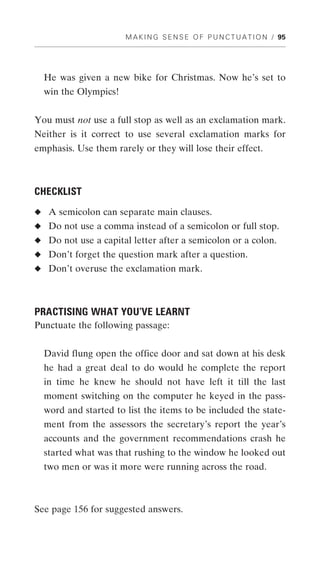
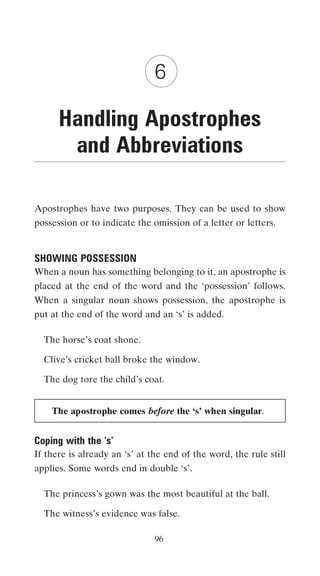
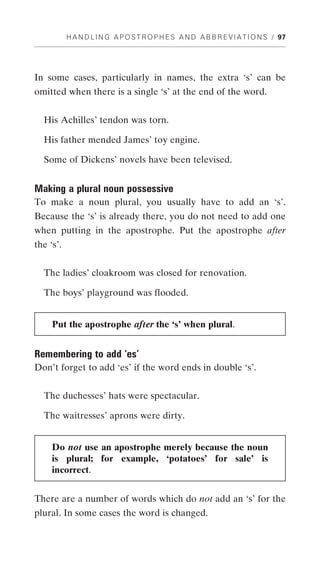
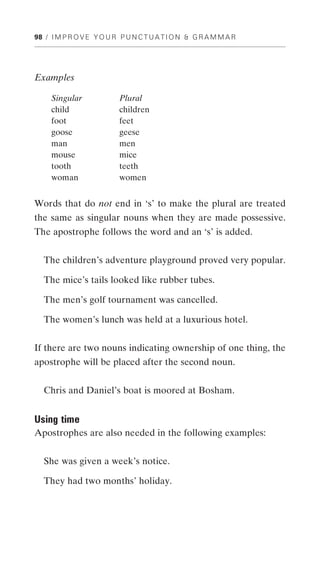
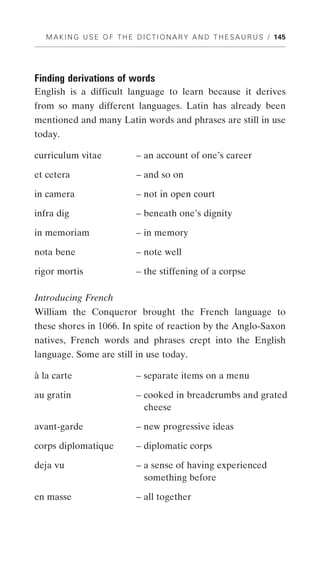
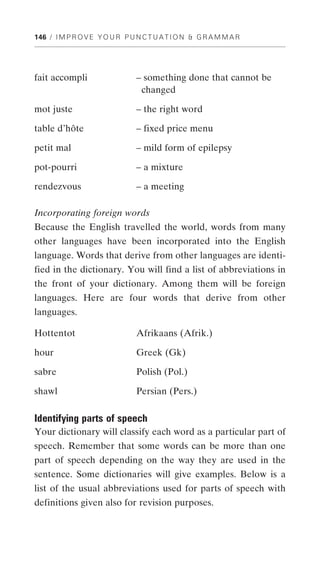
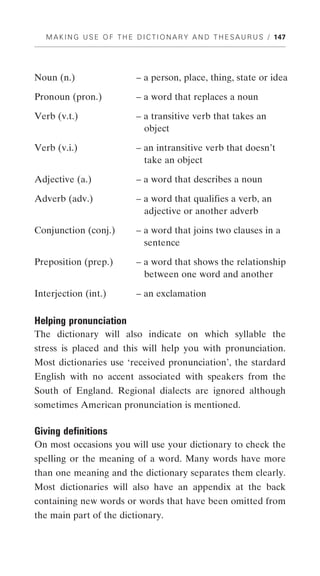
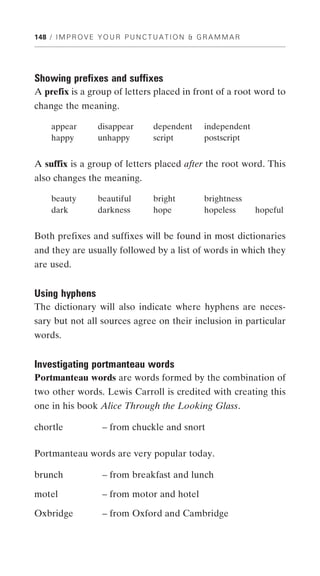
Punctuation
andGrammar
Visit our How To website at
www.howto.co.uk

At www.howto.co.uk you can engage in
conversation with our authors – all of whom have
‘been there and done that’ in their specialist fields.
You can get access to special offers and additional
content but most importantly you will be able to
engage with, and become a part of, a wide and
growing community of people just like yourself.

At www.howto.co.uk you’ll be able to talk and share
tips with people who have similar interests and are
facing similar challenges in their lives. People who, just
like you, have the desire to change their lives for the
better – be it through moving to a new country,
starting a new business, growing your own vegetables,
or writing a novel.

At www.howto.co.uk you’ll find the support and
encouragement you need to help make your
aspirations a reality.

For more information on punctuation and grammar
visit www.improveyourpunctuationandgrammar.co.uk


How To Books strives to present authentic,
inspiring, practical information in their books.
Now, when you buy a title from How To Books,
you get even more than just words on a page.
Improve your
Punctuation
andGrammar

  MARION FIELD
Published by How To Content,
A division of How To Books Ltd,
Spring Hill House, Spring Hill Road, Begbroke,
Oxford OX5 1RX, United Kingdom.
Tel: (01865) 375794. Fax: (01865) 379162.
info@howtobooks.co.uk
www.howtobooks.co.uk

How To Books greatly reduce the carbon footprint of their books
by sourcing their typesetting and printing in the UK.

All rights reserved. No part of this work may be reproduced
or stored in an information retrieval system (other than for
purposes of review) without the express permission of the
publisher in writing.

The right of Marion Field to be identified as author of this
work has been asserted by her in accordance with the
Copyright, Designs and Patents Act 1988.

© 2009 Marion Field

First edition 2000
Reprinted 2000
Second edition 2003
Reprinted 2004
Reprinted 2005
Reprinted 2006 (twice)
Reprinted 2007
Third edition 2009
First published in electronic form 2009

British Library Cataloguing in Publication Data.
A catalogue record for this book is available from
the British Library.

ISBN 978 1 84803 329 0

Produced for How To Books by Deer Park Productions, Tavistock
Typeset by Kestrel Data, Exeter

NOTE: The material contained in this book is set out in good
faith for general guidance and no liability can be accepted
for loss or expense incurred as a result of relying in particular
circumstances on statements made in the book. Laws and
regulations are complex and liable to change, and readers should
check the current position with the relevant authorities before
making personal arrangements.
Contents

Preface                                    ix


1   Following grammatical guidelines        1
    Discovering nouns                       1
    Knowing the articles                    7
    Making use of pronouns                  7
    Finding out about verbs                12
    Recognising interjections              24
    Checklist                              24
    Practising what you’ve learnt          25

2   Learning about sentence construction   27
    Analysing the simple sentence          27
    Introducing phrases                    28
    Identifying main clauses               35
    Identifying subordinate clauses        37
    Checklist                              47
    Practising what you’ve learnt          47

3   Varying your sentences                 50
    Experimenting with simple sentence     50
    Forming compound sentences             52
    Checking your commas                   55
    Forming complex sentences              57
    Writing non-sentences                  60
    Assessing the mood                     63
    Checklist                              64
    Practising what you’ve learnt          65


                             v
vi / I M P R O V E Y O U R P U N C T U A T I O N & G R A M M A R


4   Colouring your writing                                          66
    Describing the nouns                                            66
    Comparing adjectives                                            68
    Helping your verbs                                              76
    Comparing adverbs                                               77
    Dealing with other adverbs                                      81
    Checklist                                                       86
    Practising what you’ve learnt                                   87

5   Making sense of punctuation                                     88
    Experimenting with the semicolon                                88
    Using the colon                                                 91
    Discovering the dash                                            91
    Looking at brackets                                             92
    Remembering the question mark                                   93
    Avoiding the exclamation mark                                   94
    Checklist                                                       95
    Practising what you’ve learnt                                   95

6   Handling apostrophes and abbreviations                          96
    Showing possession                                              96
    Abbreviating words                                              99
    Handling contractions                                          100
    Using initial letters                                          101
    Using acronyms                                                 101
    Checklist                                                      102
    Practising what you’ve learnt                                  102

7   Writing dialogue                                               103
    Setting out direct speech                                      103
    Using quotations                                               106
    Using titles                                                   107
    Changing to indirect speech                                    108
    Writing a play                                                 110
    Checklist                                                      110
    Practising what you’ve learnt                                  111

8   Avoiding common mistakes                                       112
    Revising your punctuation                                      112
    Making nouns and verbs agree                                   112
C O N T E N T S / vii


    Using pronouns correctly                               115
    Avoiding tautologies                                   117
    Avoiding malapropisms                                  118
    Checking homophones                                    120
    Coping with homonyms                                   122
    Checking your spelling                                 122
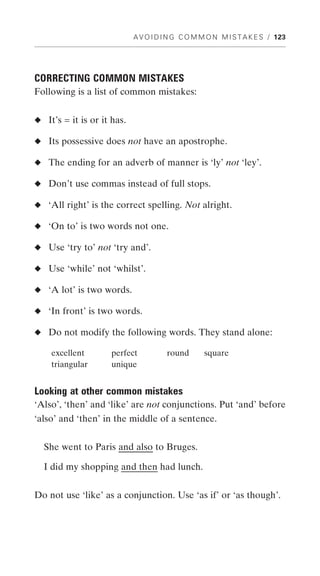
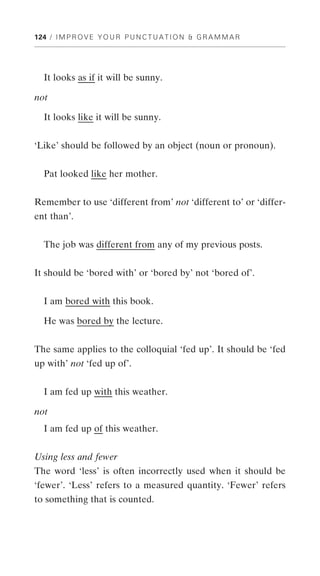
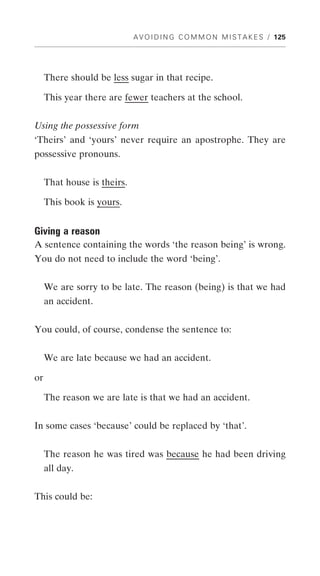
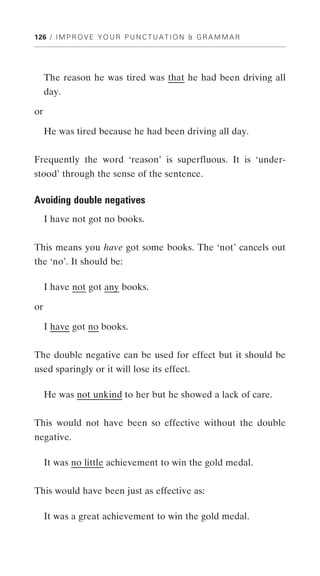
    Correcting common mistakes                             123
    Checklist                                              127
    Practising what you’ve learnt                          127

9   Improving your style                                   128
    Structuring a paragraph                                128
    Summing up                                             130
    Eliminating jargon                                     131
    Avoiding clichés                                       131
    Dispensing with colloquial language                    132
    Choosing your words                                    132
    Varying your style                                     133
    Checklist                                              134
    Practising what you’ve learnt                          134

10 Revising your work                                      135
   Revising the parts of speech                            135
   Reviewing sentence construction                         138
   Checking punctuation marks                              139
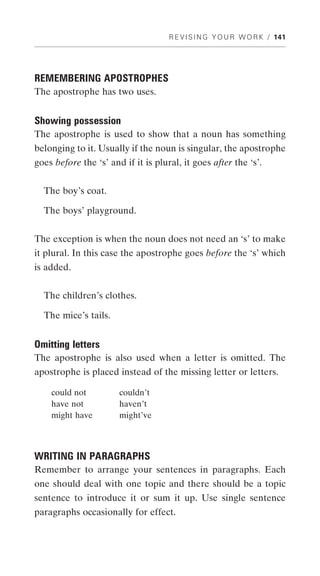
   Remembering apostrophes                                 141
   Writing in paragraphs                                   141
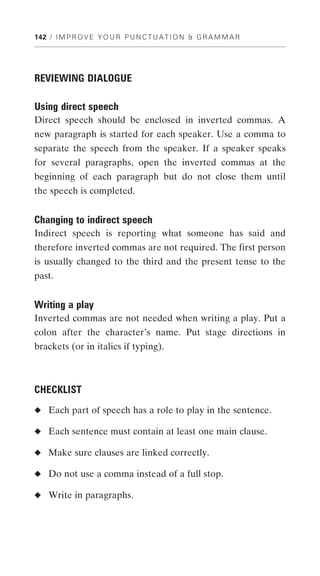
   Reviewing dialogue                                      142
   Checklist                                               142
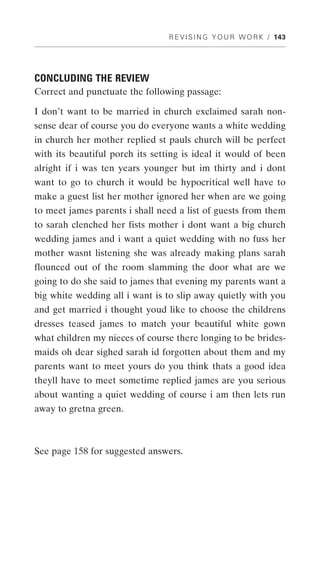
   Concluding the review                                   143

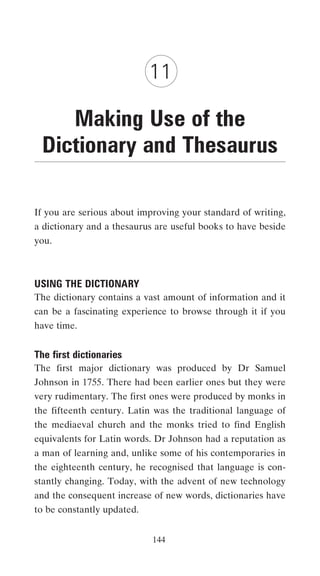
11 Making use of the dictionary and thesaurus              144
   Using the dictionary                                    144
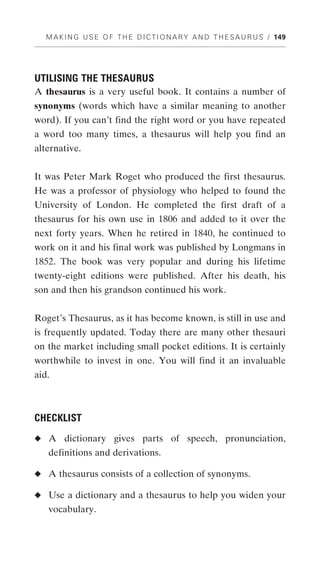
   Utilising the thesaurus                                 149
   Checklist                                               149

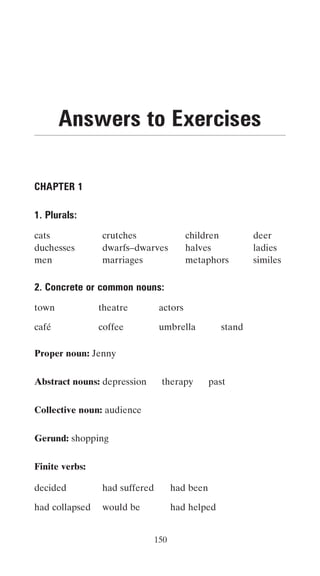
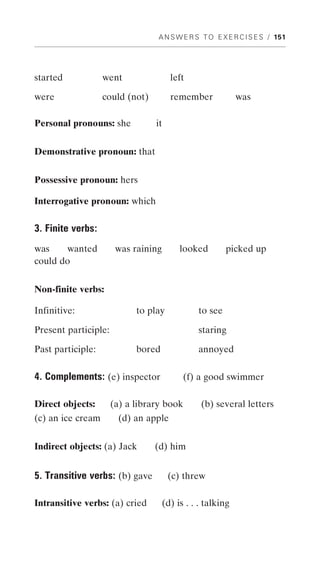
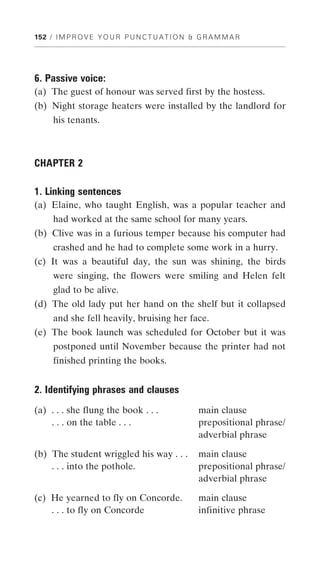
Answers to exercises                                       150
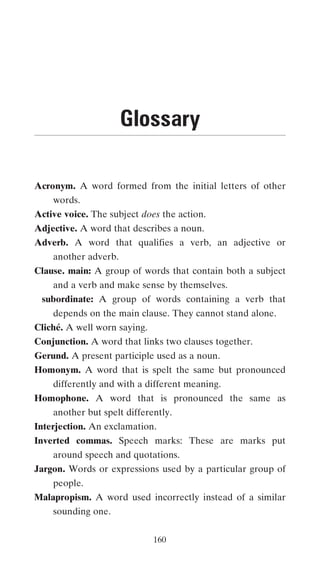
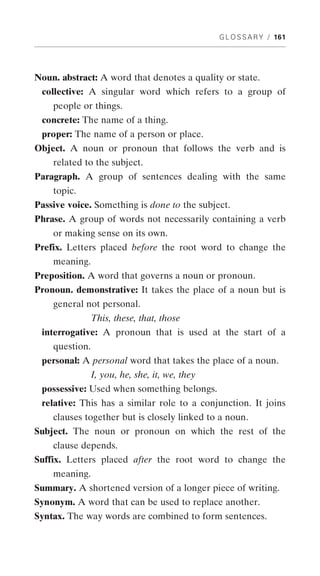
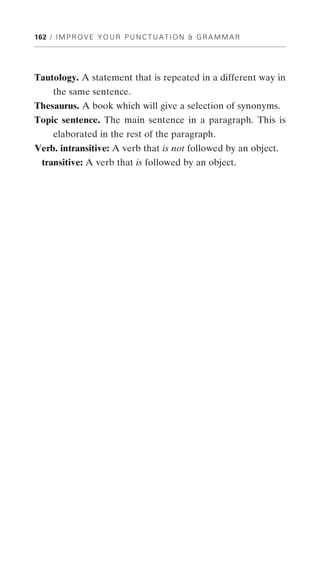
Glossary                                                   160
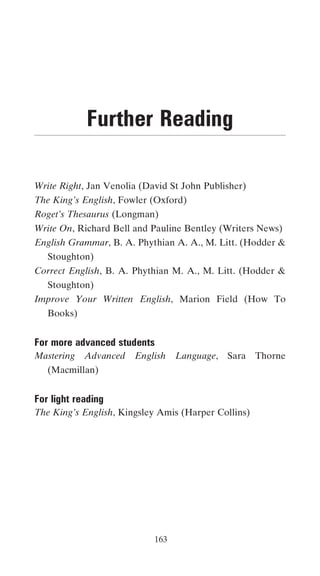
Further reading                                            163
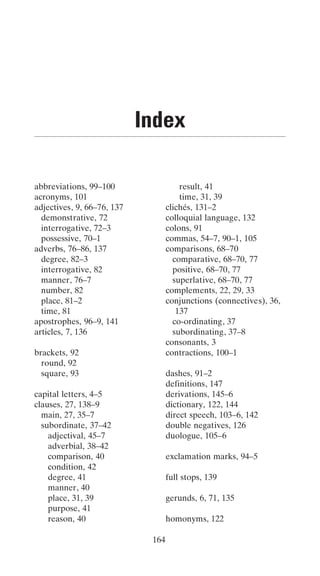
Index                                                      164
This page intentionally left blank
Preface
                    to the Third Edition


Do you have trouble with punctuation? Are you frustrated
when you can’t remember whether to use a comma or a full
stop? Do you have difficulty constructing a sentence that
sounds right? If so, then this book should help you. Written
in an easy-to-read style, it takes you through the basics of
English grammar. It explains the various parts of speech
showing what role they each play in a sentence. It shows you
how to improve your writing by choosing the right words and
varying your sentence structure.


The use of the various punctuation marks is explained and
examples given. After reading this book, you will never
again use a comma instead of a full stop! There is a chapter
on the use of apostrophes. You are shown how to write
dialogue and even how to set out a play. There is a chapter
on avoiding the most common mistakes. At the end of each
chapter there are exercises which will help to reinforce what
you have learnt.


Written in a simple style with frequent headings, this book is
for anyone – of any age – who wishes to improve the
standard of his or her English.


                                                Marion Field


                              ix
This page intentionally left blank
1

    Following Grammatical
          Guidelines

The organisation of language is known as grammar. Every
word in the English language is a particular part of speech
and has a name by which to identify it. Some parts of speech
must be included in a sentence for it to make sense. Others
are used to enhance your writing and make it interesting
to read. The parts of speech that are essential for every
sentence are nouns (or pronouns) and verbs.


DISCOVERING NOUNS
Nouns are the names of things, people or places. There are
different types of nouns but you must include at least one
noun or one pronoun in each sentence you write. There will
be more about pronouns later.


Identifying concrete or common nouns
A concrete or common noun is the name given to a physical
thing – something that can be seen:

    book            cake            dog        elephant
    fire            garage          hair       jewel
    key             letter          needle     orchid
    parchment       queen           recipe     sailor
    tattoo          volunteer       watch      zoo


                                1
2 / IMPROVE YOUR PUNCTUATION & GRAMMAR


Forming plurals
A noun is singular if it refers to one thing. Plural means
there is more than one of the item. To make a concrete noun
plural, it is usually necessary to add an ‘s’ at the end of the
word:

              Singular       Plural
              bone           bones
              dog            dogs
              ear            ears
              friend         friends
              simile         similes
              metaphor       metaphors
              zoo            zoos


Words that end in ‘ch’, ‘s’, ‘sh’ and ‘z’ have to add ‘es’ for
ease of pronunciation:

              Singular       Plural
              bush           bushes
              buzz           buzzes
              crutch         crutches
              church         churches
              dash           dashes
              duchess        duchesses
              flash          flashes
              princess       princesses
              witness        witnesses


Some words keep the same word for the plural as the
singular:

              Singular       Plural
              cod            cod
              deer           deer
              salmon         salmon
              sheep          sheep
FOLLOWING GRAMMATICAL GUIDELINES / 3


Other words change the form of the word as in the following:

              Singular       Plural
              child          children
              foot           feet
              goose          geese
              ox             oxen
              man            men
              tooth          teeth
              woman          women


Identifying vowels and consonants
All words are composed of vowels (a, e, i, o, u) and con-
sonants (all other letters). Words that end in ‘y’ preceded by
a consonant change the ‘y’ to an ‘i’ before adding ‘es’:

              Singular       Plural
              ally           allies
              county         counties
              cry            cries
              enemy          enemies
              reply          replies


Some nouns that end in ‘f’ or ‘fe’ change the ending to ‘ves’
to make the plural:

              Singular       Plural
              half           halves
              knife          knives
              wolf           wolves


Unfortunately some words ending in ‘f’ keep it before add-
ing an ‘s’:

              Singular       Plural
              hoof           hoofs
              proof          proofs
4 / IMPROVE YOUR PUNCTUATION & GRAMMAR


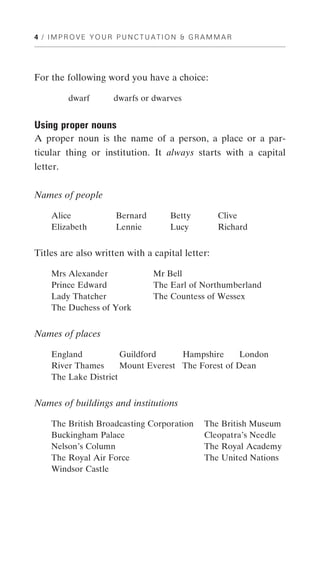
For the following word you have a choice:

          dwarf     dwarfs or dwarves


Using proper nouns
A proper noun is the name of a person, a place or a par-
ticular thing or institution. It always starts with a capital
letter.


Names of people

    Alice            Bernard       Betty         Clive
    Elizabeth        Lennie        Lucy          Richard


Titles are also written with a capital letter:

    Mrs Alexander              Mr Bell
    Prince Edward              The Earl of Northumberland
    Lady Thatcher              The Countess of Wessex
    The Duchess of York


Names of places

    England           Guildford     Hampshire      London
    River Thames      Mount Everest The Forest of Dean
    The Lake District


Names of buildings and institutions

    The British Broadcasting Corporation    The British Museum
    Buckingham Palace                       Cleopatra’s Needle
    Nelson’s Column                         The Royal Academy
    The Royal Air Force                     The United Nations
    Windsor Castle
FOLLOWING GRAMMATICAL GUIDELINES / 5


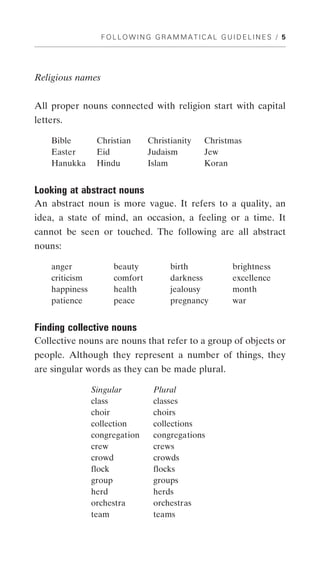
Religious names


All proper nouns connected with religion start with capital
letters.

    Bible        Christian     Christianity   Christmas
    Easter       Eid           Judaism        Jew
    Hanukka      Hindu         Islam          Koran


Looking at abstract nouns
An abstract noun is more vague. It refers to a quality, an
idea, a state of mind, an occasion, a feeling or a time. It
cannot be seen or touched. The following are all abstract
nouns:

    anger            beauty          birth          brightness
    criticism        comfort         darkness       excellence
    happiness        health          jealousy       month
    patience         peace           pregnancy      war


Finding collective nouns
Collective nouns are nouns that refer to a group of objects or
people. Although they represent a number of things, they
are singular words as they can be made plural.

                Singular        Plural
                class           classes
                choir           choirs
                collection      collections
                congregation    congregations
                crew            crews
                crowd           crowds
                flock           flocks
                group           groups
                herd            herds
                orchestra       orchestras
                team            teams
6 / IMPROVE YOUR PUNCTUATION & GRAMMAR


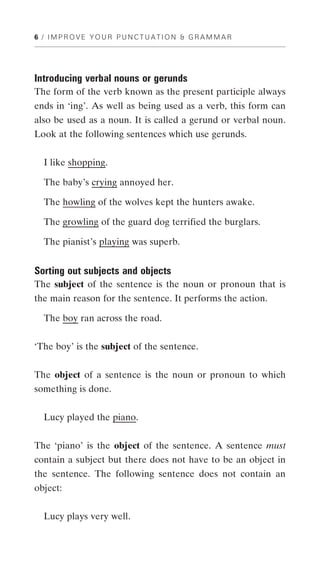
Introducing verbal nouns or gerunds
The form of the verb known as the present participle always
ends in ‘ing’. As well as being used as a verb, this form can
also be used as a noun. It is called a gerund or verbal noun.
Look at the following sentences which use gerunds.


  I like shopping.

  The baby’s crying annoyed her.

  The howling of the wolves kept the hunters awake.

  The growling of the guard dog terrified the burglars.

  The pianist’s playing was superb.


Sorting out subjects and objects
The subject of the sentence is the noun or pronoun that is
the main reason for the sentence. It performs the action.

  The boy ran across the road.


‘The boy’ is the subject of the sentence.


The object of a sentence is the noun or pronoun to which
something is done.


  Lucy played the piano.


The ‘piano’ is the object of the sentence. A sentence must
contain a subject but there does not have to be an object in
the sentence. The following sentence does not contain an
object:


  Lucy plays very well.
FOLLOWING GRAMMATICAL GUIDELINES / 7


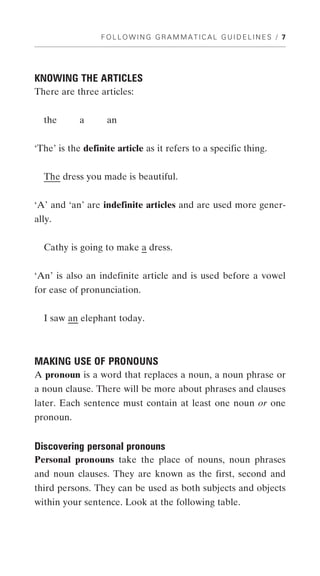
KNOWING THE ARTICLES
There are three articles:


  the       a      an


‘The’ is the definite article as it refers to a specific thing.


  The dress you made is beautiful.


‘A’ and ‘an’ are indefinite articles and are used more gener-
ally.


  Cathy is going to make a dress.


‘An’ is also an indefinite article and is used before a vowel
for ease of pronunciation.


  I saw an elephant today.


MAKING USE OF PRONOUNS
A pronoun is a word that replaces a noun, a noun phrase or
a noun clause. There will be more about phrases and clauses
later. Each sentence must contain at least one noun or one
pronoun.


Discovering personal pronouns
Personal pronouns take the place of nouns, noun phrases
and noun clauses. They are known as the first, second and
third persons. They can be used as both subjects and objects
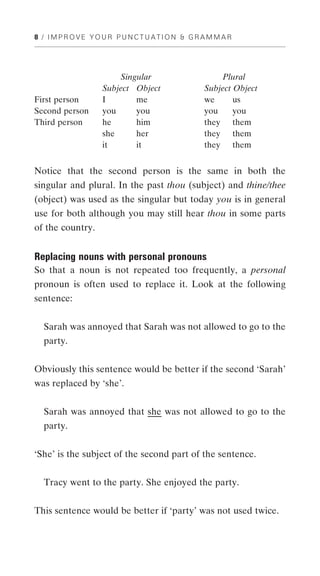
within your sentence. Look at the following table.
8 / IMPROVE YOUR PUNCTUATION & GRAMMAR


                      Singular                Plural
                  Subject Object          Subject Object
First person      I       me              we      us
Second person     you     you             you     you
Third person      he      him             they them
                  she     her             they them
                  it      it              they them


Notice that the second person is the same in both the
singular and plural. In the past thou (subject) and thine/thee
(object) was used as the singular but today you is in general
use for both although you may still hear thou in some parts
of the country.


Replacing nouns with personal pronouns
So that a noun is not repeated too frequently, a personal
pronoun is often used to replace it. Look at the following
sentence:


  Sarah was annoyed that Sarah was not allowed to go to the
  party.


Obviously this sentence would be better if the second ‘Sarah’
was replaced by ‘she’.


  Sarah was annoyed that she was not allowed to go to the
  party.


‘She’ is the subject of the second part of the sentence.


  Tracy went to the party. She enjoyed the party.


This sentence would be better if ‘party’ was not used twice.
FOLLOWING GRAMMATICAL GUIDELINES / 9


  Tracy went to the party. She enjoyed it.


‘It’ is the object of the second sentence.


When writing, check that you don’t repeat nouns unneces-
sarily. Replace them with pronouns.


Using demonstrative pronouns
Demonstrative pronouns can also replace nouns. The
demonstrative pronouns are:

         Singular:        this      that
         Plural:          these     those
  This is their house.


In the above sentence ‘this’ stands for ‘their house’.


  Those are his cattle.


‘Those’ replaces ‘his cattle’.


‘This’, ‘that’, ‘these’ and ‘those’ can also be used as adjec-
tives if they are attached to a noun. There will be more
about this in a later chapter.


Using possessive pronouns
Possessive pronouns also replace nouns and indicate that
something ‘belongs’. They are related to the personal pro-
nouns.
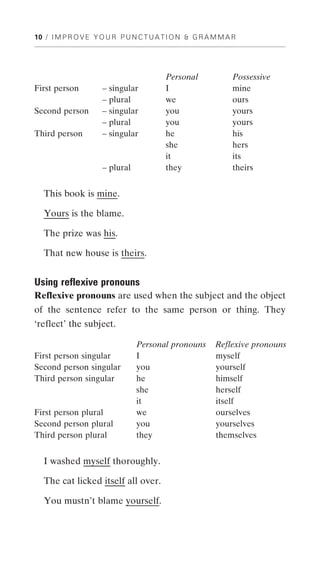
10 / I M P R O V E Y O U R P U N C T U A T I O N & G R A M M A R


                                         Personal             Possessive
First person         – singular          I                    mine
                     – plural            we                   ours
Second person        – singular          you                  yours
                     – plural            you                  yours
Third person         – singular          he                   his
                                         she                  hers
                                         it                   its
                     – plural            they                 theirs


   This book is mine.

   Yours is the blame.

   The prize was his.

  That new house is theirs.


Using reflexive pronouns
Reflexive pronouns are used when the subject and the object
of the sentence refer to the same person or thing. They
‘reflect’ the subject.

                                Personal pronouns        Reflexive pronouns
First person singular           I                        myself
Second person singular          you                      yourself
Third person singular           he                       himself
                                she                      herself
                                it                       itself
First person plural             we                       ourselves
Second person plural            you                      yourselves
Third person plural             they                     themselves


   I washed myself thoroughly.

   The cat licked itself all over.

   You mustn’t blame yourself.
F O L L O W I N G G R A M M A T I C A L G U I D E L I N E S / 11


Notice that the reflexive third person plural pronoun is
themselves not theirselves.


  They wore themselves out.

not

  They wore theirselves out.


Using intensive pronouns
Intensive pronouns are the same words as reflexive pro-
nouns but are used for emphasis.


  He, himself, presented the prizes.

  I wrote it myself.


It is not correct to use this form of the pronoun when the
object does not reflect the subject.


  That house belongs to myself.


This is incorrect. It should be:

  That house belongs to me.


Asking a question
Interrogative pronouns are used to ask a question and are
usually at the beginning of a sentence. They are:

        which          who          whom            whose


  Which will you wear?

  Who is that boy?
12 / I M P R O V E Y O U R P U N C T U A T I O N & G R A M M A R


   To whom are you speaking?

   Whose is that?


     Do remember to put a question mark at the end of
     your sentence.


FINDING OUT ABOUT VERBS
Verbs are the ‘doing’ or ‘being’ words in a sentence. Without
them your work will make no sense. There is one ‘being’
verb, the verb ‘to be’; the rest are ‘doing’ verbs. The verb ‘to
be’ and the verb ‘to have’ are often joined with other words
to change the tense. They are known as auxiliary verbs. The
verb ‘to do’ can also sometimes be used as an auxiliary verb
and placed before another verb.


   The truant was running down the street.

   The child has fallen over.

   She did bake a cake for the competition.


Using finite verbs
For a sentence to make sense it must contain a finite verb as
well as the noun or pronoun which is the subject of the
sentence. The verb must show ‘person’ (first, second or
third), number (singular or plural) and tense (past, present
or future). A finite verb changes its form depending on the
tense. Look at the following sentence:

   Mary drew a picture.
F O L L O W I N G G R A M M A T I C A L G U I D E L I N E S / 13


‘Mary’ (third person– she) is the subject of the sentence. The
verb ‘drew’ has a ‘person’ connected to it, ‘Mary’, who is
singular (number), and ‘drew’ is the past tense of the verb ‘to
draw’. Therefore it is a finite verb. It would also be a finite
verb in the present tense:

  Mary draws a picture.


    All sentences must contain at least one finite verb.


Using non-finite verbs
Non-finite verbs never change their form. The non-finite
parts of the verbs are:


◆ the base form of the verb: write, dance

◆ the infinitive – the verb introduced by ‘to’: to be, to write,
   to dance

◆ the present participle which always ends in ‘ing’: writing,
   dancing

◆ the past participle which sometimes ends in ‘ed’ but has
   exceptions as many verbs are irregular.


Looking at the participles
The present and the past participles of ‘doing’ verbs can be
used with the auxiliary verbs ‘to be’ and ‘to have’. This will
change the form of the verb and make a finite verb. A verb
sometimes consists of more than one word.
14 / I M P R O V E Y O U R P U N C T U A T I O N & G R A M M A R


Revising the verb ‘to be’
Present and past tenses of the verb ‘to be’
                                Present tense        Past tense
            I                   am                   was
            you                 are                  were
            he, she, it         is                   was
            we                  are                  were
            they                are                  were


Present and past tenses of the verb ‘to have’

            I                   have                 had
            you                 have                 had
            he, she, it         has                  had
            we                  have                 had
            they                have                 had


Using the present participle
The present participle of the verb can be used with the verb
‘to be’ to form the present and past ‘progressive’ tenses. This
suggests that the action is still continuing. The participle
remains the same but the tense of the verb ‘to be’ changes.


The present progressive tense using the present participle
‘writing’

   I am writing.

  You are writing.

   He, she is writing.

   We are writing.

   They are writing.
F O L L O W I N G G R A M M A T I C A L G U I D E L I N E S / 15


The past progressive tense using ‘writing’

     I was writing.

     You were writing.

     He, she was writing.

     We were writing.

     They were writing.


Checking the tenses
Both the present progressive and the past progressive tenses
use the present participle not the past. Mistakes are often
made with the verb ‘to sit’.

     I was sat in my place.


This is wrong. ‘Sat’ is the past participle of the verb to ‘to sit’
and should be used with the verb ‘to have’ not ‘to be’. The
sentence should read:

     I was sitting in my place.        (verb ‘to be’ + the present
                                        participle)

or

     I had sat in my place. (verb ‘to have’ + the past participle)


The progressive aspect of the verb can also be used in the
perfect tense. This also suggests a continuous action. In this
case the past participle of the verb ‘to be’, ‘been’ is placed
with the verb ‘to have’ and the verb that is being used.


Present perfect progressive tense

     The baby has been crying all day.
16 / I M P R O V E Y O U R P U N C T U A T I O N & G R A M M A R


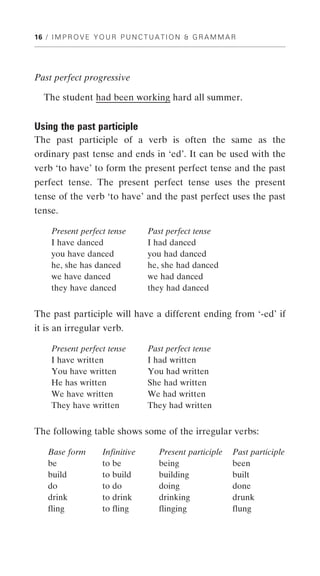
Past perfect progressive

   The student had been working hard all summer.


Using the past participle
The past participle of a verb is often the same as the
ordinary past tense and ends in ‘ed’. It can be used with the
verb ‘to have’ to form the present perfect tense and the past
perfect tense. The present perfect tense uses the present
tense of the verb ‘to have’ and the past perfect uses the past
tense.

     Present perfect tense         Past perfect tense
     I have danced                 I had danced
     you have danced               you had danced
     he, she has danced            he, she had danced
     we have danced                we had danced
     they have danced              they had danced


The past participle will have a different ending from ‘-ed’ if
it is an irregular verb.

     Present perfect tense         Past perfect tense
     I have written                I had written
     You have written              You had written
     He has written                She had written
     We have written               We had written
     They have written             They had written


The following table shows some of the irregular verbs:

    Base form        Infinitive        Present participle     Past participle
    be               to be             being                  been
    build            to build          building               built
    do               to do             doing                  done
    drink            to drink          drinking               drunk
    fling            to fling          flinging               flung
F O L L O W I N G G R A M M A T I C A L G U I D E L I N E S / 17


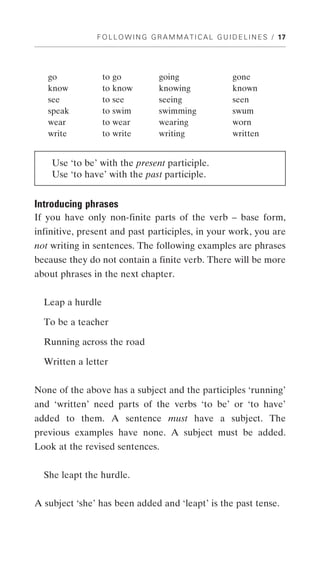
   go             to go             going                   gone
   know           to know           knowing                 known
   see            to see            seeing                  seen
   speak          to swim           swimming                swum
   wear           to wear           wearing                 worn
   write          to write          writing                 written


    Use ‘to be’ with the present participle.
    Use ‘to have’ with the past participle.


Introducing phrases
If you have only non-finite parts of the verb – base form,
infinitive, present and past participles, in your work, you are
not writing in sentences. The following examples are phrases
because they do not contain a finite verb. There will be more
about phrases in the next chapter.


  Leap a hurdle

  To be a teacher

  Running across the road

  Written a letter


None of the above has a subject and the participles ‘running’
and ‘written’ need parts of the verbs ‘to be’ or ‘to have’
added to them. A sentence must have a subject. The
previous examples have none. A subject must be added.
Look at the revised sentences.


  She leapt the hurdle.


A subject ‘she’ has been added and ‘leapt’ is the past tense.
18 / I M P R O V E Y O U R P U N C T U A T I O N & G R A M M A R


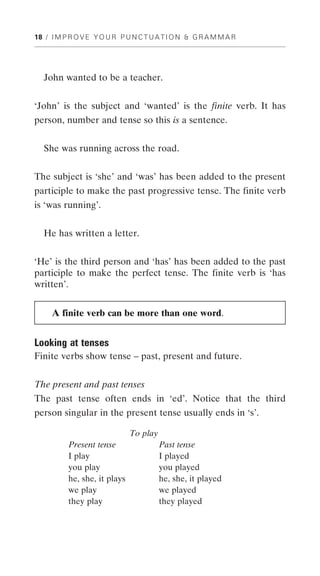
   John wanted to be a teacher.


‘John’ is the subject and ‘wanted’ is the finite verb. It has
person, number and tense so this is a sentence.


   She was running across the road.


The subject is ‘she’ and ‘was’ has been added to the present
participle to make the past progressive tense. The finite verb
is ‘was running’.


   He has written a letter.


‘He’ is the third person and ‘has’ has been added to the past
participle to make the perfect tense. The finite verb is ‘has
written’.


     A finite verb can be more than one word.


Looking at tenses
Finite verbs show tense – past, present and future.


The present and past tenses
The past tense often ends in ‘ed’. Notice that the third
person singular in the present tense usually ends in ‘s’.

                              To play
          Present tense                 Past tense
          I play                        I played
          you play                      you played
          he, she, it plays             he, she, it played
          we play                       we played
          they play                     they played
F O L L O W I N G G R A M M A T I C A L G U I D E L I N E S / 19


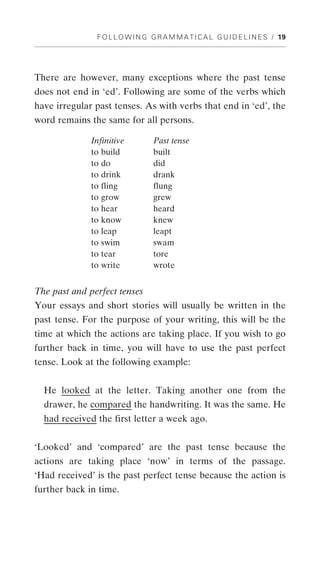
There are however, many exceptions where the past tense
does not end in ‘ed’. Following are some of the verbs which
have irregular past tenses. As with verbs that end in ‘ed’, the
word remains the same for all persons.

              Infinitive          Past tense
              to build            built
              to do               did
              to drink            drank
              to fling            flung
              to grow             grew
              to hear             heard
              to know             knew
              to leap             leapt
              to swim             swam
              to tear             tore
              to write            wrote


The past and perfect tenses
Your essays and short stories will usually be written in the
past tense. For the purpose of your writing, this will be the
time at which the actions are taking place. If you wish to go
further back in time, you will have to use the past perfect
tense. Look at the following example:


  He looked at the letter. Taking another one from the
  drawer, he compared the handwriting. It was the same. He
  had received the first letter a week ago.


‘Looked’ and ‘compared’ are the past tense because the
actions are taking place ‘now’ in terms of the passage.
‘Had received’ is the past perfect tense because the action is
further back in time.
20 / I M P R O V E Y O U R P U N C T U A T I O N & G R A M M A R


The future tense
When writing the future tense of the verb, use ‘shall’ with
the first person and ‘will’ with the second and third person.


   I shall go to London tomorrow.

   You will work hard at school.

   Mark will write to you this evening.

   That tree will shed its leaves in the aturum.

   We shall win the match.

   They will move house next month.


However, sometimes ‘shall’ and ‘will’ can change places for
emphasis.


   I will go to London tomorrow. (This suggests
  determination)

  You shall go to the ball, Cinderella. (It will be made
   possible)


Present participle and infinitive
The verb ‘to be’ followed by the present participle ‘going’ is
also used to express the future tense. It is followed by the
infinitive of the appropriate verb. The use of this is be-
coming more common.


   I am going to start writing a novel.

  They are going to visit their mother.
F O L L O W I N G G R A M M A T I C A L G U I D E L I N E S / 21


Sometimes the verb ‘to be’ followed by the present participle
also indicates the future.


  The train is leaving in five minutes.

  The film is starting soon.


The future progressive
As with the present progressive and the past progressive
tenses, the future progressive also uses the present participle.


  I shall be visiting her next week.

  The Browns will be buying a dog soon.


Looking at direct and indirect objects
There are both direct and indirect objects. If there is only
one object in a sentence, it will be a direct object and will
have something ‘done to it’ by the subject.


  Tom scored a goal (direct object).

  Judy ate her lunch (direct object).


Sometimes there are two objects as in the following sen-
tences:


  She gave me some sweets.

  He threw Mary the ball.


‘Sweets’ and ‘ball’ are both direct objects. ‘Me’ and ‘Mary’
are indirect objects. The word ‘to’ is ‘understood’ before
them.
22 / I M P R O V E Y O U R P U N C T U A T I O N & G R A M M A R


   She gave (to) me the sweets.

   He threw (to) Mary the ball.


Looking at complements
If the word at the end of the sentence refers directly to the
subject, it is known as the complement and the preceding
verb will usually be the verb ‘to be’.


   Joan (subject) is a nurse (complement).

   Michael (subject) was the winner of the race
   (complement).


Transitive and intransitive verbs
Verbs that are followed by an object are called transitive
verbs. Those that have no object are intransitive. Some verbs
can be used both transitively and intransitively.


Transitive verbs
If there is an object in the sentence, the verb is transitive.


   He threw the ball.


‘The ball’ is the object and therefore the verb ‘threw’ is
transitive.


   The doctor examined the patient.


‘The patient’ is the object. The verb ‘examined’ is transitive.
F O L L O W I N G G R A M M A T I C A L G U I D E L I N E S / 23


Intransitive verbs
If the verb is not followed by an object, then it is an intransi-
tive verb.


  She dances beautifully.
  He writes very neatly.

There is no object in either of these sentences so both
‘dances’ and ‘writes’ are intransitive.


Verbs that are both transitive and intransitive
Many verbs can be used both transitively and intransitively.
It depends on how they are used in the sentence.


  He wrote a letter. (transitive: ‘letter’ is the object.)

  She writes beautifully. (intransitive. There is no object.)

  Joe swam a length. (transitive: ‘length’ is the object.)

  The girls swam quickly. (intransitive. There is no object.)


Using the active or passive voice
Look at these two sentences:


  His mother scolded Tom. (Active voice)

  Tom was scolded by his mother. (Passive voice)


In the first sentence the mother is doing the action. This is
called the active voice. In the second sentence Tom has
something done to him. This is known as the passive voice.
Both are acceptable but you can choose which is more
suitable for the work you are writing. The active voice is
24 / I M P R O V E Y O U R P U N C T U A T I O N & G R A M M A R


commonly used as it has a more direct effect and usually uses
fewer words. However, there are certain situations where the
passive voice is more appropriate. Look at the following
sentence:


   The traitor was condemned to death.


The important person here is the traitor. We are not in-
terested in who condemned him to death.


RECOGNISING INTERJECTIONS
Interjections have no particular part to play in the sentence.
They can express disgust, surprise, fear, fatigue, elation,
boredom or some other emotion. Some examples are:


          ah         eh         oh         er        hello
          well       really


They can sometimes be more than one word and are often
followed by exclamation marks:


     Oh dear!              What a pity!          Oh no!            Dear, dear!


CHECKLIST
◆ Nouns are the names of things.

◆ Proper nouns always start with a capital letter.

◆ Pronouns take the place of nouns.
F O L L O W I N G G R A M M A T I C A L G U I D E L I N E S / 25


◆ Verbs are ‘doing’ or ‘being’ words.

◆ A sentence must contain at least one noun or pronoun
   and one finite verb.


PRACTISING WHAT YOU’VE LEARNT
1. Write the plurals of the following words:

    cat       crutch              child            deer
    duchess   dwarf               half             lady
    man       marriage            metaphor         simile


2. In the passage identify all the following:

    concrete nouns                proper nouns        abstract nouns
    collective nouns              gerunds             finite verbs
    personal pronouns             demonstrative pronouns
    possessive pronouns           interrogative pronouns

  Jenny decided to go to the town. She had suffered a bout
  of depression the day before when she had been in the
  audience at the local theatre. One of the actors had
  collapsed. She thought a day’s shopping would be therapy
  for her. That had helped her in the past. It started to rain
  hard and she went to a cafe for a coffee. She left her
  umbrella in the stand. When she left, there were several
  umbrellas and she couldn’t remember which was hers.
  Which one was it?


3. In the following passage, identify the non-finite and finite
   verbs.

  Jo was bored. He wanted to play football but it was
  raining. Staring gloomily out of the window, he looked in
26 / I M P R O V E Y O U R P U N C T U A T I O N & G R A M M A R


   vain for some blue sky. Annoyed, he picked up his latest
   football magazine to see if he could do the crossword.


4. In the following sentences identify the complements,
    direct objects and indirect objects


    (a) The teacher gave Jack a library book to read.
    (b) She wrote several letters while she was waiting.
    (c) He bought an ice cream at the kiosk near the beach.
    (d) She gave him an apple.
    (e) Their headmaster became an inspector.
    (f) Peter is a good swimmer.


5. In the following sentences which verbs are used transi-
    tively and which intransitively?


    (a) The baby cried all day.
    (b) He gave a lecture about the eclipse.
    (c) He threw the ball accurately at the wicket.
    (d) She is always talking.


6. Change the following sentences to the passive voice.


    (a) The hostess served the guest of honour first.
    (b) The landlord installed night storage heaters for his
    XXstenants.


See page 151 for suggested answers.
2

        Learning About
     Sentence Construction

Words must be combined in a certain way to form sentences.
This is known as syntax. In the previous chapter it was
established that each sentence must contain a subject (noun
or pronoun) and a finite verb (showing person, number and
tense). However, your writing will be very monotonous if
you use only this pattern and do not vary your sentence
construction. There are many different forms you can use.
Sections of your sentences that contain finite verbs and are
linked together are called clauses. There are two types –
main and subordinate. They will be explained in detail later.


ANALYSING THE SIMPLE SENTENCE
A sentence that consists of a subject and a finite verb is
known as a simple sentence. This is a grammatical term and
has nothing to do with the content of the sentence. It may
contain additional words or phrases (groups of words that do
not contain a finite verb). It consists of one main clause.


Looking at the subject and predicate
The simple sentence can be divided into two parts – the
subject and the rest of the sentence called the predicate.


                               27
28 / I M P R O V E Y O U R P U N C T U A T I O N & G R A M M A R


           Subject              Predicate
           The boy              ran across the road.
           The stream           trickled along beside the path.
           Jack                 is an electrician.
           She                  gave me my wages.


A variety of phrases and clauses can be used to enhance your
writing.


INTRODUCING PHRASES
Phrases are groups of two or more words that do not contain
a finite verb. They do not make sense on their own but add
detail to the sentence. Phrases can do the same work as parts
of speech. There are adjectival phrases, adverbial phrases
and noun phrases. There will be more about adjectives and
adverbs later. There are also prepositional phrases, par-
ticipial phrases and infinitive phrases. Some phrases can be
classified under two headings.


In the above sentences ‘across the road’ and ‘beside the
path’ are both phrases. They don’t make sense by themselves
but they can be used as the subject, object or the com-
plement of the sentence. They are sometimes introduced by
a non-finite verb – the infinitive or the present or past
participle.


Looking at infinitive phrases
The infinitive is the part of the verb introduced by ‘to’. An
infinitive phrase is introduced by the infinitive.


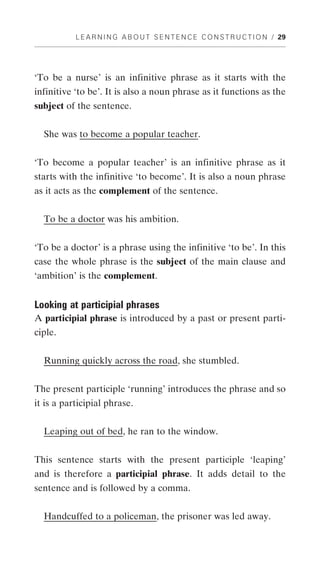
   To be a nurse was her ambition.
L E A R N I N G A B O U T S E N T E N C E C O N S T R U C T I O N / 29


‘To be a nurse’ is an infinitive phrase as it starts with the
infinitive ‘to be’. It is also a noun phrase as it functions as the
subject of the sentence.


  She was to become a popular teacher.


‘To become a popular teacher’ is an infinitive phrase as it
starts with the infinitive ‘to become’. It is also a noun phrase
as it acts as the complement of the sentence.


  To be a doctor was his ambition.


‘To be a doctor’ is a phrase using the infinitive ‘to be’. In this
case the whole phrase is the subject of the main clause and
‘ambition’ is the complement.


Looking at participial phrases
A participial phrase is introduced by a past or present parti-
ciple.


  Running quickly across the road, she stumbled.


The present participle ‘running’ introduces the phrase and so
it is a participial phrase.


  Leaping out of bed, he ran to the window.


This sentence starts with the present participle ‘leaping’
and is therefore a participial phrase. It adds detail to the
sentence and is followed by a comma.


  Handcuffed to a policeman, the prisoner was led away.
30 / I M P R O V E Y O U R P U N C T U A T I O N & G R A M M A R


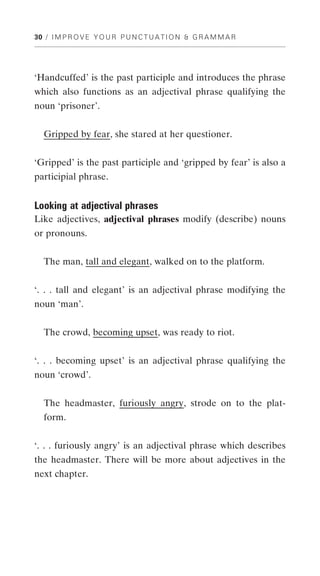
‘Handcuffed’ is the past participle and introduces the phrase
which also functions as an adjectival phrase qualifying the
noun ‘prisoner’.


   Gripped by fear, she stared at her questioner.


‘Gripped’ is the past participle and ‘gripped by fear’ is also a
participial phrase.


Looking at adjectival phrases
Like adjectives, adjectival phrases modify (describe) nouns
or pronouns.


   The man, tall and elegant, walked on to the platform.


‘. . . tall and elegant’ is an adjectival phrase modifying the
noun ‘man’.


   The crowd, becoming upset, was ready to riot.


‘. . . becoming upset’ is an adjectival phrase qualifying the
noun ‘crowd’.


  The headmaster, furiously angry, strode on to the plat-
  form.


‘. . . furiously angry’ is an adjectival phrase which describes
the headmaster. There will be more about adjectives in the
next chapter.
L E A R N I N G A B O U T S E N T E N C E C O N S T R U C T I O N / 31


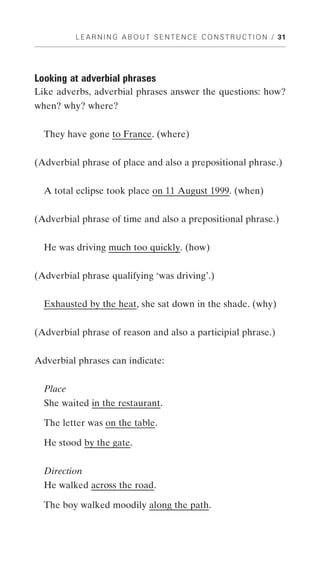
Looking at adverbial phrases
Like adverbs, adverbial phrases answer the questions: how?
when? why? where?


  They have gone to France. (where)


(Adverbial phrase of place and also a prepositional phrase.)


  A total eclipse took place on 11 August 1999. (when)


(Adverbial phrase of time and also a prepositional phrase.)


  He was driving much too quickly. (how)


(Adverbial phrase qualifying ‘was driving’.)


  Exhausted by the heat, she sat down in the shade. (why)


(Adverbial phrase of reason and also a participial phrase.)


Adverbial phrases can indicate:


  Place
  She waited in the restaurant.

  The letter was on the table.

  He stood by the gate.


  Direction
  He walked across the road.

  The boy walked moodily along the path.
32 / I M P R O V E Y O U R P U N C T U A T I O N & G R A M M A R


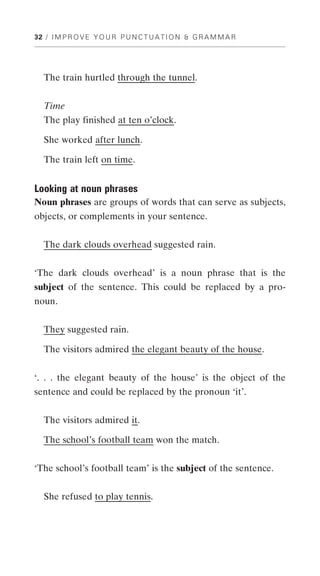
   The train hurtled through the tunnel.


  Time
  The play finished at ten o’clock.

   She worked after lunch.

   The train left on time.


Looking at noun phrases
Noun phrases are groups of words that can serve as subjects,
objects, or complements in your sentence.


   The dark clouds overhead suggested rain.


‘The dark clouds overhead’ is a noun phrase that is the
subject of the sentence. This could be replaced by a pro-
noun.


   They suggested rain.

   The visitors admired the elegant beauty of the house.


‘. . . the elegant beauty of the house’ is the object of the
sentence and could be replaced by the pronoun ‘it’.


   The visitors admired it.

   The school’s football team won the match.


‘The school’s football team’ is the subject of the sentence.


   She refused to play tennis.
L E A R N I N G A B O U T S E N T E N C E C O N S T R U C T I O N / 33


‘. . . to play tennis’ is the object of the sentence. It is also an
infinitive phrase.


  Her ambition was to write a novel.


‘. . . to write a novel’ is the complement of the sentence. It
refers to ‘ambition’. It is also an infinitive phrase.


Using a gerundive phrase
A gerund is the present participle used as a noun. A gerun-
dive phrase begins with a gerund.


  Swimming every day helped him to recover.


‘Swimming’ is a gerund and ‘Swimming every day’ is the
subject of the sentence.


Learning about prepositions
A preposition is a word that indicates the relationship of a
noun or pronoun to some other part of the sentence. The
word ‘preposition’ means to be ‘placed before’. Prepositions
are usually placed before the noun and are often used in
phrases.


Some prepositions are:

above       after        at             before         by          down
for         from         in             into           near        on
opposite    past         towards        through        to          under
with        without


Some of these words can also be used as other parts of
speech. It will depend on their role in the sentence.
34 / I M P R O V E Y O U R P U N C T U A T I O N & G R A M M A R


Looking at prepositional phrases.
A prepositional phrase begins with a preposition. In the
following sentences the prepositions, followed by nouns,
form phrases and are underlined.


   Cautiously, they crept into the room.

   She placed the book on the table.

   The clouds moved across the sky.


Most prepositional phrases can be identified as other phrases
as well. The above sentences are all adverbial phrases as
they say where something happened. There will be more
about adverbs later. Look at the following sentences.


   The treasure was buried under the apple tree.


‘. . . under the apple tree’ is a prepositional phrase as it
begins with a preposition. It is also an adverbial phrase of
place as it says where the treasure was buried.


  The house, by the lake, belongs to Lord Melton.


‘. . . by the lake’ begins with the preposition ‘by’ and so is a
prepositional phrase. However it is also an adjectival phrase
as it describes the lake.


Using phrasal verbs
Phrasal verbs are verbs that are followed by a preposition
which is part of the meaning of the verb. The preposition can
be separated from the verb but this often produces a clumsy
construction so it is better to keep them together. In most
L E A R N I N G A B O U T S E N T E N C E C O N S T R U C T I O N / 35


cases they have to be kept together or the sense is lost. Some
examples are:

    clear off         clear up        fall over        fly away
    kick off          jump up         pick up          run away
    throw away

  He jumped up in alarm.

  She threw away the wrapping paper.

  When the baby fell over, she cried.

  The boy ran away from school.


IDENTIFYING MAIN CLAUSES
A simple sentence contains one main clause which can be
constructed in various ways. However, it must contain only
one finite verb. A main clause can be constructed in various
ways. Some are suggested below.


Subject and finite verb

  It (subject) rained (finite verb).


Subject, finite verb and direct object

  Kay (subject) watched (finite verb) television (direct
  object).


Subject, finite verb, indirect object and direct object

  His parents (subject) gave (finite verb) Brian (ind. object)
  a bike (dir. object).
36 / I M P R O V E Y O U R P U N C T U A T I O N & G R A M M A R


Subject, finite verb and complement

   The trickle of water (subject) became (finite verb) a
   deluge (complement).


Phrase, subject, finite verb, direct object and phrase

   Fielding the ball (phrase), he (subject) threw (finite verb)
   it (direct object) at the wicket (phrase).


List of main clauses

   David was doing his homework, Mary was playing the
   piano, Tony was cooking the dinner and Sue was feeding
   the baby.

Each of the above main clauses is separated by a comma and
the last one is preceded by ‘and’.


Joining main clauses joined by conjunctions (connectives)
Two or more main clauses can be joined together to make a
compound sentence. To do this you will need to use one of
the co-ordinating conjunctions ‘and’, ‘but’, ‘or’. Conjunc-
tions (connectives) are joining words used to link clauses,
phrases and words together.


Making use of co-ordinating conjunctions
Simple sentences are all main clauses because they contain
only one finite verb. If there is more than one finite verb in
your sentence, you will have more than one clause. Check
that you have used a conjunction to join them. In each of the
following sentences there are two main clauses which have
been linked with a co-ordinating conjunction. They are com-
pound sentences.
L E A R N I N G A B O U T S E N T E N C E C O N S T R U C T I O N / 37


  (The teacher shouted) and (the class fell silent).

  (Jane may go to the party) but (you will remain at home).

  (You will do your homework) or (you will not be allowed
  to go out).


The co-ordinating conjunctions can also be used to link items
and introduce phrases.


◆ hat and coat

◆ a raincoat but no umbrella

◆ London or Paris


  He heard the tramp of feet and the shouts of the men.
  (phrase)

  There was paper but no sign of a pen. (phrase)

  You can use that book or this collection of newspapers.
  (phrase)


    Do not use commas to separate two main clauses.


IDENTIFYING SUBORDINATE CLAUSES
Subordinate clauses are linked to a main clause by subordi-
nating conjunctions. A sentence that contains main clauses
and subordinate clauses is known as a complex sentence.


Using subordinating conjunctions
Subordinating conjunctions are used to link main clauses to
subordinate clauses. Some of them are:
38 / I M P R O V E Y O U R P U N C T U A T I O N & G R A M M A R


after          although         as          because          before
if             since            that        though           unless
until          when             while

The conjunction can go between the two clauses.


   (They played tennis) although (it had started to rain).

   (She went to the supermarket) because (she had run out
   of milk).


The conjunction can also be placed at the beginning of the
sentence. In this case the subordinate clause comes first and
a comma separates the two clauses.


   Although (it had started to rain), (they played tennis).

   Because (she had run out of milk), (she went to the
   supermarket).


        If you begin a sentence with a subordinating
        conjunction, you must follow this with two clauses
        and put a comma between them.


Forming subordinate clauses
There are a variety of subordinate clauses you can use. They
have the same role as parts of speech.


Using adverbial clauses
There are a variety of adverbial clauses. The type depends
on their function in the sentence.
L E A R N I N G A B O U T S E N T E N C E C O N S T R U C T I O N / 39


Adverbial clauses of time
An adverbial clause of time will indicate when an event
happened. Remember that it must contain a subject (possibly
‘understood’) and a finite verb.


  The traffic started to move when the police had cleared
  the road.


In the above sentence the adverbial clause of time could
stand alone. The subject is ‘police’ and ‘had cleared’ is the
finite verb. The clause tells us when the traffic started to
move.


  As the shadow of the moon moved across the sun, it
  became very dark.

  When the children had left, she cleared up the remains of
  the party.


‘. . . the shadow of the moon moved across the sun’ and ‘the
children had left’ are adverbial clauses of time saying when
something happened.


Adverbial clauses of place
Adverbial clauses of place show where something took place.
They are often introduced by the word ‘where’.


  A flourishing town grew up where once a bomb had been
  dropped.

  I can’t remember where I left my bag.
40 / I M P R O V E Y O U R P U N C T U A T I O N & G R A M M A R


‘. . . once a bomb had been dropped’ and ‘I left my bag’ are
both adverbial clauses of place linked to the main clauses by
‘where’. They say where something happened.


Adverbial clauses of reason
Sometimes the subordinate clause will give a reason for the
main clause. This is known as an adverbial clause of reason.


   The match was cancelled because it was raining.


‘. . . it was raining’ was the reason for the match being
cancelled.


  As he was late home, they went out for a meal.


‘. . . he was late home’ is an adverbial clause of reason
answering the question why they went out for a meal.


Adverbial clauses of manner
Like adverbs of manner, adverbial clauses of manner say
how something is done.


  She ran as though her life depended upon it.


The adverbial clause of manner ‘her life depended on it’
explains how she ran.


Adverbial clauses of comparison
An adverbial clause of comparison makes an explicit
comparison.


  Sandra works harder than her sister does.
L E A R N I N G A B O U T S E N T E N C E C O N S T R U C T I O N / 41


Sandra is being compared with her sister.


Adverbial clauses of degree
An adverbial clause of degree will indicate the degree to
which something is done.


  I love you more than I can say.

  He works as hard as he can.


Both the adverbial clauses of degree show to what extent ‘I
love’ and ‘he works’.


Adverbial clauses of purpose
Adverbial clauses of purpose indicate the purpose of the
main clause.


  The prisoner was locked in so that he would not escape.


The purpose of the locked door was to prevent the prisoner’s
escape.


Adverbial clauses of result
An adverbial clause of result shows what results from the
main clause.


  It was so hot that her shirt was sticking to her.


Her shirt was sticking to her as a result of the heat.
42 / I M P R O V E Y O U R P U N C T U A T I O N & G R A M M A R


Adverbial clauses of condition
An adverbial clause of condition indicates the conditions
under which something will be done.


   If you finish your homework, you may go out.


Finishing the homework is the condition which must be
fulfilled before the main clause ‘you may go out’ can take
effect.


   Unless it stops raining, the repairs will not be completed.


Including ‘then’
If the subordinate clause begins with ‘if’, the main clause
after the comma can sometimes begin with ‘then’. In this
case it does not need ‘and’ before it.


   If fairy tales are entertainment, then explaining the
   symbolism is a waste of time.


The subjunctive
If the adverbial clause of condition suggests something that
cannot be fulfilled, the subjunctive tense of the verb is used.
The clause usually starts with ‘if’ and applies to the first or
third persons. Instead of using ‘was’, ‘were’ is used.


   If I were to tell you, you would not believe it.

   If she were taller, she could be a model.
L E A R N I N G A B O U T S E N T E N C E C O N S T R U C T I O N / 43


Using relative pronouns
Relative pronouns have a similar function to conjunctions.
They link subordinate clauses to main clauses. They are
usually preceded by a noun.
The relative pronouns are:

    which      that      who      whose        whom


‘Which’ and ‘that’ are linked to things while the others are
used with people. ‘That’ can be either a conjunction or a
relative pronoun. It depends how it is used.


  I like the dress that is green.


‘That’ follows the noun ‘dress’ so it is a relative pronoun.


Notice that in the following examples the main clause has
been ‘split’ by the subordinate clause which has been in-
serted into it. Commas have been placed either side of the
subordinate clause.


  The thief, who was a young boy, ran away.


 The main clause is                        The thief . . . ran away.
 The subordinate clause is                 . . . was a young boy

  The subject of the subordinate clause is ‘the thief’ which is
  ‘understood’.


  The house, which had been empty for years, was now
  occupied.
44 / I M P R O V E Y O U R P U N C T U A T I O N & G R A M M A R


  Main clause:                  The house . . . was now occupied.
  Subordinate clause:           (The house) had been empty for
                                years

  The boy, whose trainers had been stolen, won the race.


  Main clause:                  The boy . . . won the race.
  Subordinate clause:           . . . trainers had been stolen

  The golfer, whom I supported, played very well.


  Main clause:                  The golfer . . . played very well.
  Subordinate clause:           . . . I supported

The relative pronoun usually follows the noun to which it
refers. This will avoid ambiguity. Make sure your writing
is clear and that you have said what you mean. If your
sentences are too long, it is easy for your reader to lose the
sense of what you are saying.


Using whom
‘Whom’ can sometimes be preceded by a preposition. There
is a tendency today to ignore the traditional rule, ‘Don’t end
a sentence with a preposition.’ Prepositions are often found
at the end of sentences today. However, those who wish to
preserve the purity of the English language will probably
keep the rule.


   This is the boy to whom I gave the money.


The preposition, ‘to’ precedes ‘whom’. The colloquial form
would be:
L E A R N I N G A B O U T S E N T E N C E C O N S T R U C T I O N / 45


  This is the boy who I gave the money to.


In this case ‘who’ is used instead of ‘whom’ and the preposi-
tion ‘to’ ends the sentence. The ‘who’ could be omitted and
‘understood’.


  This is the boy I gave the money to.


Here are two more examples of the formal and the informal:


  To whom are you speaking?


This sounds rather pompous so you would probably say:


  Who are you speaking to?

  It is the schoolmaster for whom the bell tolls.

  It is the schoolmaster who the bells tolls for.


In the latter example the first sentence sounds better. Your
choice of sentence will probably depend on the particular
type of writing you are doing at the time.


Using adjectival clauses
Like adjectives, the adjectival clause qualifies a noun or
pronoun which is found in the main clause. Remember that
all clauses must contain a subject (sometimes ‘understood’)
and a finite verb.


  He looked at the door which was locked.
46 / I M P R O V E Y O U R P U N C T U A T I O N & G R A M M A R


The door is described as being locked. The adjectival clause
is ‘. . . was locked’. The subject ‘door’ is ‘understood’ and the
relative pronoun ‘which’ links the adjectival clause to the
main clause. The finite verb in the adjectival phrase is ‘was
locked’.


   His wife, who is a model, has gone on holiday.


‘. . . is a model’ describes the wife. The main clause is ‘His
wife . . . has gone on holiday’. The relative pronoun, ‘who’,
links the adjectival clause to it. The finite verb in the adjecti-
val clause is ‘is’.


Adjectival clauses are often introduced by the following
words:

     who      whom        whose      which       that


‘That’ can sometimes be ‘understood’ so it is not always
necessary to include it.


   This is the house (that) they have built.


It is important to put the adjectival clause as close as
possible to the noun or pronoun it is describing. If you don’t,
your sentence may be ambiguous.


   She bought a dress from the charity shop which needed
   some repair.


Obviously it was the dress not the shop that needed repair!
L E A R N I N G A B O U T S E N T E N C E C O N S T R U C T I O N / 47


  She bought a dress, which needed some repair, from the
  charity shop.


CHECKLIST
◆ Each clause must contain a subject and a finite verb.

◆ There are main and subordinate clauses.

◆ Conjunctions and relative pronouns link clauses.

◆ A preposition shows the relation between one word and
   another.

◆ Don’t use commas instead of full stops.

◆ A phrase is a group of words that does not contain a
   finite verb.

◆ There are different types of phrases.

◆ Adjectival clauses qualify a noun.

◆ There are a variety of adverbial clauses.


PRACTISING WHAT YOU’VE LEARNT
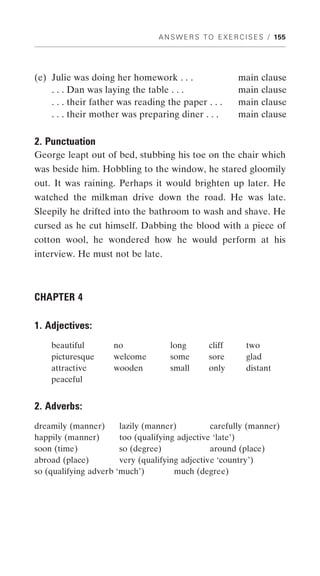
1. Make each of the following groups of sentences into one
   sentence by using conjunctions or relative pronouns.


   (a) Elaine was a popular teacher. She had worked at the
   XXssame school for many years. She taught English.
   (b) Clive was in a furious temper. His computer has
   XXscrashed. He had to complete some work in a hurry.
   (c) It was a beautiful day. The sun was shining. The birds
48 / I M P R O V E Y O U R P U N C T U A T I O N & G R A M M A R


    XXswere singing. The flowers were smiling. Helen felt
    XXsglad to be alive.
    (d) The old lady put her hand on the shelf. It collapsed.
    XXsShe fell heavily bruising her face.
    (e) The book launch was scheduled for October. It was
    XXspostponed until November. The printer had not
    XXsfinished printing the books.


2. Pick out and name the clauses and phrases in the follow-
    ing sentences:


    (a) Angrily, she flung the book on the table.
    (b) The student wriggled his way into the pothole.
    (c) He yearned to fly on Concorde.
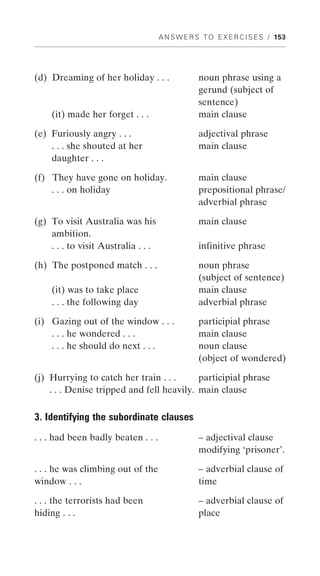
    (d) Dreaming of her holiday made her forget her un-
    XXshappiness.
    (e) Furiously angry, she shouted at her daughter.
    (f) They have gone on holiday.
    (g) To visit Australia was his ambition.
    (h) The postponed match was to take place the following
    XXsday.
    (i) Gazing out of the window, he wondered what he
    XXsshould do next.
    (j) Hurrying to catch her train, Denise tripped and fell
    XXsheavily.


3. Pick out and identify the subordinate clauses in the
    following passage:


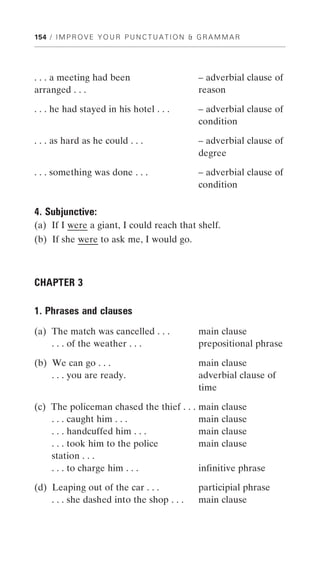
  The prisoner, who had been badly beaten, crouched in the
  corner of his cell. He had been caught while he was
  climbing out of the window of the house where the
L E A R N I N G A B O U T S E N T E N C E C O N S T R U C T I O N / 49


  terrorists had been hiding. He had gone there because a
  meeting had been arranged with the leader. If he had
  stayed in his hotel, he would have been safe. He had tried
  as hard as he could to persuade the terrorists to release
  their hostage but it had not worked. Unless something was
  done soon, the hostage would be killed.


4. Correct the following sentences:


   (a) If I was a giant, I could reach that shelf.
   (b) If she was to ask me, I would go.


See page 154 for suggested answers.
3

               Varying Your
                Sentences

It is important to vary your sentence structure. If all your
sentences are simple ones consisting of one main clause, the
impression you give will be rather juvenile. You will need
some simple sentences and you can vary their pattern but
you will also need compound sentences (two or more main
clauses) and complex sentences (a mixture of main clauses
and subordinate clauses).


EXPERIMENTING WITH THE SIMPLE SENTENCE
As we have already seen, there are a number of variations
you can use with the simple sentence. It does not always
form the same pattern.


Looking at examples
The simple sentence can consist of only two words.


  Helen gasped.


This follows the accepted grammatical pattern. It has a
subject (Helen) and a finite verb (gasped). The latter, as
required, shows person (third), number (singular) and tense


                            50
V A R Y I N G Y O U R S E N T E N C E S / 51


(past). The next sentence is slightly longer and contains an
object as well.


  She (subject) gripped (finite verb) the table (object).


It could be elaborated with the addition of a phrase.


  She gripped the table with both hands (phrase).

  Then, collapsing on the floor, she sobbed.


‘Then’ is an adverb of time introducing the participial
phrase, ‘collapsing on to the floor’, which is followed by the
main clause, ‘she sobbed’.


  The events of the day had upset her.


‘The events of the day’ is a noun phrase acting as the subject
of the sentence.


‘Had upset’ is the finite verb.


‘Her’ is the object of the sentence.


  She was terrified.


The above sentence uses the adjective ‘terrified’ as the com-
plement of the sentence. It refers to the subject ‘she’.


  Never again would she go out alone.
52 / I M P R O V E Y O U R P U N C T U A T I O N & G R A M M A R


This sentence starts with a phrase; the verb ‘would’ and the
subject ‘she’ have been inverted in this construction. In the
following sentence a phrase has been used as the comple-
ment.


   It would cause more trouble.


‘It’ is the subject.


‘Would cause’ is the finite verb.


‘More trouble’ is a noun phrase used as the complement.


When all the sentences are put together, they make
an acceptable paragraph. Although they are all simple
sentences, the pattern has been varied to make the work
more interesting.


   Helen gasped. She gripped the table with both hands.
   Then, collapsing on to the floor, she sobbed. The events of
   the day had upset her. She was terrified. Never again
   would she go out alone. It would cause more trouble.


FORMING COMPOUND SENTENCES
Compound sentences are composed of two or more main
clauses and there are several variations that can be used.
You can have a number of main clauses within one sentence
provided your construction is correct. A clause has to
contain a subject and a finite verb. You can have several
clauses in a sentence and each of them will have a specific
purpose. There are two types of clauses – main and sub-
V A R Y I N G Y O U R S E N T E N C E S / 53


ordinate. Each clause must contain a subject and a finite
verb. Each sentence must contain at least one main clause. If
there is only one clause in a sentence, it is a main clause
and the sentence is a simple sentence. Remember that you
cannot use a comma to separate two main clauses unless
you have started your sentence with a conjunction. Use a
co-ordinating conjunction to join them or separate them
using a full stop.


Linking main clauses
To join two main clauses to form a compound sentence, you
will have to use one of the co-ordinating conjunctions, ‘and’,
‘but’, ‘or’. The main clauses can consist of only a subject and
a finite verb or they can be expanded with extra words or
phrases.


  (It was very quiet) and (there was a strange atmosphere).


The two bracketed main clauses are linked by the co-
ordinating conjunction ‘and’. The following sentence has
three main clauses.


  (She tried to get up) but (her legs were shaking) and (they
  would not support her).


The conjunction ‘but’ separates the first two main clauses.
The final clause ‘they would not support her’ is introduced
by ‘and’. The pronoun ‘they’ could have been left out as it
would have been ‘understood’.


  . . . her legs were shaking and would not support her.
54 / I M P R O V E Y O U R P U N C T U A T I O N & G R A M M A R


The following sentence uses the conjunction ‘or’ to link the
clauses.


   (She must leave soon) or (it would be too dark to see).


     Use a co-ordinating conjunction to link two clauses
     – not a comma.


If your work is constructed properly, you can use a number
of clauses within one sentence.


Making a list
You can use a list of main clauses. In this case, as in any
other list, the clauses are separated by commas and the last
one is preceded by ‘and’. Although it is not now considered
necessary to put a comma before ‘and’, it is sometimes done.
If so, it is known as the Oxford comma as the Oxford
University Press uses it but many other publishers do not.
If there is a danger of the sentence being misunderstood,
then a comma should be inserted before ‘and’. (Fowler, the
acknowledged authority on English usage feels the omission
of the Oxford comma is usually ‘unwise’.) It is not used in
the following examples. ‘I’ is the subject of each of the
clauses in the following sentences but it needs to be used
only once – at the beginning. It is ‘understood’ in the follow-
ing clauses.


   I closed down the computer, (I) signed my letters, (I)
   tidied my desk, (I) picked up my coat and (I) left the
   office.
V A R Y I N G Y O U R S E N T E N C E S / 55


It is certainly not necessary to include the ‘I’ in each clause.
The first four main clauses are separated by commas and the
last one is preceded by ‘and’. In the following sentence the
subject of each of the clauses is different so the subject
obviously has to be included. Again, commas separate the
first four and the last one is preceded by ‘and’.


  The wind howled round the house, the rain beat against
  the windows, the lightning flashed, the thunder roared and
  Sarah cowered under the table.


In the following sentence, although three of the clauses have
the same subject ‘he’, the subject has to be included so the
sentence makes sense.


  He was annoyed, his wife was late, he disliked the house,
  he was very tired and the food was tasteless.


Because ‘his wife was late’ is between ‘He was annoyed’ and
‘he disliked the house’, ‘he’ has to be repeated.


CHECKING YOUR COMMAS
The comma was introduced into English in the sixteenth
century and plays a very important part in punctuation.
However, it must not be used instead of a full stop. If you
write a sentence with two main clauses separated by a
comma, it is wrong. Either put a full stop between them or
use a conjunction to link them.


  My name is Bob, I live in London.
56 / I M P R O V E Y O U R P U N C T U A T I O N & G R A M M A R


This is wrong. It should be:


     My name is Bob. I live in London.

or

     My name is Bob and I live in London.


The two clauses could also be separated by a semicolon.
There will be more about this later.


     My name is Bob; I live in London.


Using commas
Commas can be used for the following purposes:


◆ To separate items in a list. Remember there must be
      ‘and’ before the last one.

     I bought some pens, a pencil, a file, a pad, a ruler and an
     eraser.


◆ To separate a list of main clauses.

     Jack was doing his homework, his sister was practising the
     piano, their father was reading the paper and the baby was
     crying.


◆ To separate the subordinate clause from the main clause
      when starting the sentence with a subordinating con-
      junction.

     Because she was ill, she stayed at home.
V A R Y I N G Y O U R S E N T E N C E S / 57


◆ To separate a subordinate clause in the middle of a main
   clause.

  The dog, who was barking loudly, strained at his leash.


◆ After a participial phrase at the beginning of a sentence.

  Looking out of the window, she realised it was raining.


◆ To separate phrases in the middle of a main clause.

  The girl, tall and elegant, stepped into her car.


There will be more about commas in the chapter on
dialogue.


FORMING COMPLEX SENTENCES
A complex sentence can contain any number of main clauses
and subordinate clauses. It must contain at least one main
clause and it must be carefully constructed so that all the
clauses are linked correctly.

Using subordinate clauses
There are a variety of subordinate clauses you can use to
make your writing more interesting. Vary them and their
positions so that your work ‘flows’. Following are some
examples:


  She hobbled to the door which was shut.


 Main clause:                         She hobbled to the door . . .
 Adjectival clause modifying
  the noun ‘door’:                    . . . was shut.
 Relative pronoun as link:            which
58 / I M P R O V E Y O U R P U N C T U A T I O N & G R A M M A R


   Before she could open it, she heard a noise.


  Main clause:                 . . . she heard a noise.
  Adverbial clause of time:    . . . she could open it
  Subordinating conjunction:   Before . . .
  The comma separates the clauses because the sentence
  begins with a conjunction.

   She ran to the window, which was open, and peered out.


  Main clause:                             She ran to the window . . .
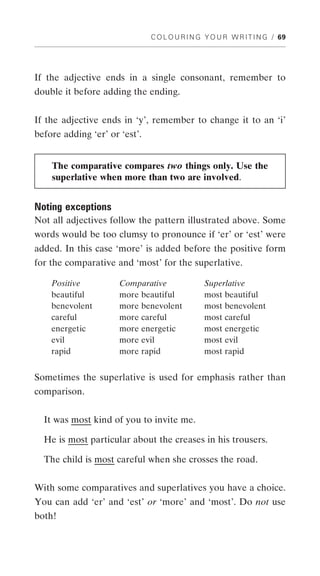
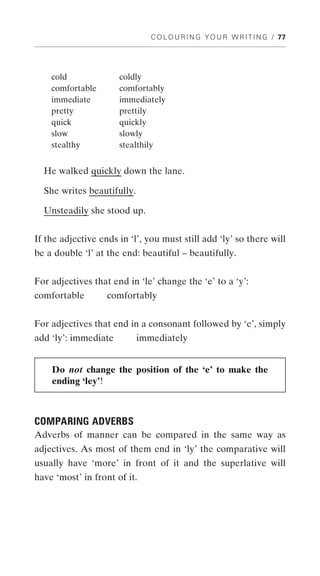
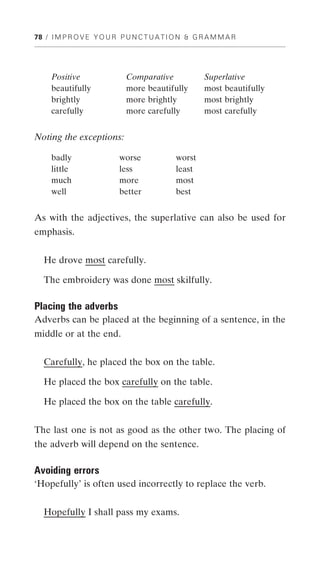
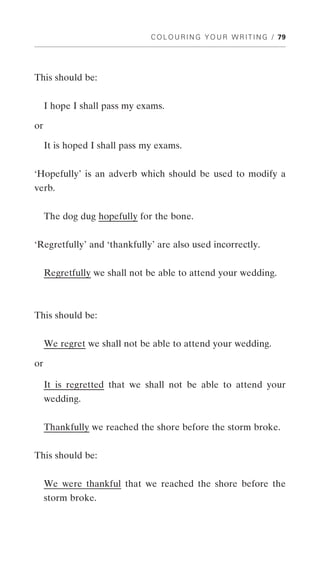
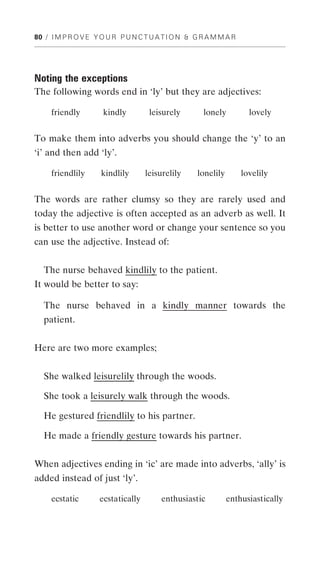
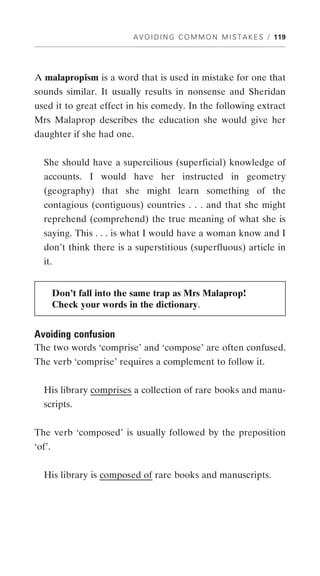
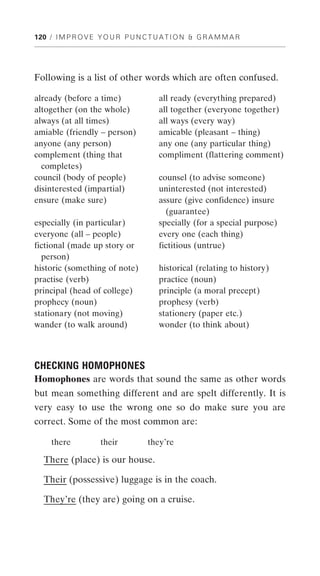
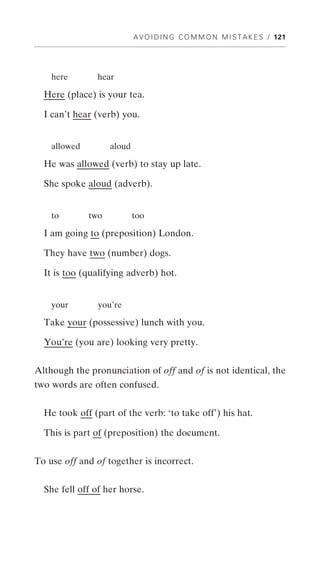
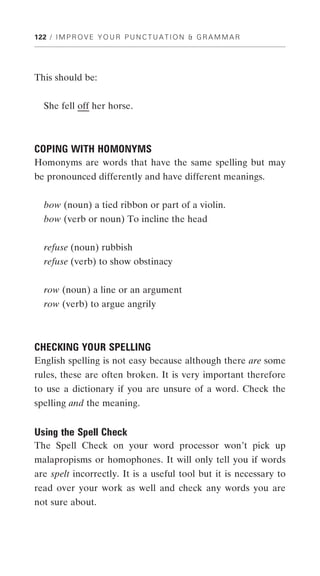
  Adjectival clause modifying
   ‘window’:                               . . . was open . . .
  Relative pronoun linking
   clauses:                                . . . which . . .
  Main clause (subject
   understood):                            . . . (she) peered out.
  Co-ordinating conjunction:               . . . and . . .

Using ‘who’
  The man, who was looking up at her, looked very angry.


  Main clause: The man . . .               . . . looked very angry.
  Adjectival clause:                       . . . was looking up at her . . .
  Relative pronoun:                        . . . who . . .

  It was the man who had followed her and who had
  frightened her dog so he had run away.


  Main clause:                             It was the man . . .
  Adjectival clause:                       . . . had followed her . . .
  Adjectival clause:                       . . . had frightened her
                                              dog . . .
  Adverbial clause of reason:              . . . he had run away.
  Relative pronoun:                        who
  Subordinating conjunction:               so
V A R Y I N G Y O U R S E N T E N C E S / 59


Be careful with the construction in the above sentence.
‘Who’ has been used twice. You can only use ‘and who’ if it
follows a subordinate clause which has been introduced by
‘who’. In this sentence ‘who followed her’ is a subordinate
clause introduced by ‘who’ so the ‘and who’ that follows
later is correct. The following sentence is incorrect:


  The man had followed her and who had frightened her
  dog.


The ‘who’ is, of course, unnecessary. It should be:


  The man had followed her and had frightened her dog.


Looking at more examples
  Shaking with fear, she rushed to the door and tried to
  open it while the doorbell rang persistently.


 Main clause:                      . . . she rushed to the
                                      door . . .
 Main clause:                      . . . tried to open it . . .
 Co-ordinating conjunction:        . . . and . . .
 Adverbial clause of time:         . . . the doorbell rang
                                      persistently
 Participial phrase:               Shaking with fear . . .

  She had to get away but the door was locked and she
  could not open it.


 Main clause:                      She had to get away . . .
 Main clause:                      . . . the door was locked . . .
 Main clause:                      . . . she could not open it.
 Co-ordinating conjunctions:       . . . but . . . and . . .
60 / I M P R O V E Y O U R P U N C T U A T I O N & G R A M M A R


   While she was trying to open the door, a light appeared at
   the window and she screamed.


  Main clause:                             . . . a light appeared at the
                                              window . . .
  Main clause:                             . . . she screamed.
  Adverbial clause of time:                . . . she was trying to open
                                              the door . . .

  Subordinating conjunction:               While . . .
  Co-ordinating conjunction:               . . . and . . .

Omitting relative pronouns
Like the subjects of clauses, relative pronouns can also
sometimes be omitted. They are ‘understood’ so the sense is
not lost. Leaving out ‘that’ can often ‘tighten’ your writing.


   I chose the book (that) you recommended.

   Here is the article (that) I enjoyed.


‘That’ is unnecessary as both sentences can be understood
without it.


   I chose the book you recommended.

   Here is the article I enjoyed.


WRITING NON SENTENCES
There are occasions when properly constructed sentences
are not used. When writing dialogue or using very informal
language, the rules will sometimes be ignored although the
words must still make sense.
V A R Y I N G Y O U R S E N T E N C E S / 61


Newspapers often omit words to make their headlines more
eye-catching. Look at the following:


  Murdered by her son
  MP found guilty of fraud
  Pile-up on the motorway
  Miracle birth


All of these headlines make sense although words are
missing from the ‘sentences’. We also frequently ignore
grammatical rules when we talk. We also often use ‘non-
sentences’ when writing notices.


Speech
  A pound of apples please.
  No smoking
  Got a pencil?
  What a nuisance!


Notices
  No smoking
  Keep off the grass
  Cycling prohibited


All of these make sense although they are not proper
sentences. They would not be used in formal writing.


Using ‘and’ and ‘but’
In his amusing book, The King’s English, Kingsley Amis
describes the idea that you may not start a sentence with
‘and’ or ‘but’ as an ‘empty superstition’. It is permissible to
start a sentence or even a paragraph with either of the two
62 / I M P R O V E Y O U R P U N C T U A T I O N & G R A M M A R


co-ordinating conjunctions but they must not be overused in
this way or they lose their effect. They can be used for
emphasis or to suggest what is to follow later. But they must
not be used as the continuation of the previous sentence.
They should start a new idea but be used sparingly.


Examples using ‘and’

   He walked to the bus stop. And waited half an hour for a
   bus.


This is incorrect as the second sentence follows on from the
first. No full stop is needed between the two clauses.


   He walked to the bus stop and waited half an hour for a
   bus.


   It was too cold and wet to go out. He was bored. And he
   had finished his library book.


The ‘and’ at the beginning of the last sentence adds momen-
tum to the idea of the boredom. If the last two sentences
were joined, it would not be as effective.


Examples using ‘but’
‘But’ can be used in the same way. Remember not to use it
at the beginning of a sentence if it is a continuation of the
previous one.


   She waited all day but her son did not come.

   She waited all day. But her son did not come.
V A R Y I N G Y O U R S E N T E N C E S / 63


Either of the above examples would be acceptable although
the second one has a stronger emphasis.


  At last he met her again. But he had waited many years.


Joining these two sentences with ‘but’ would not work and
some of the sense would be lost.


  I hoped to play tennis but it rained all day.


This sentence is better using ‘but’ as a conjunction. Little
would be gained if ‘but’ started a second sentence.


ASSESSING THE MOOD
The mood refers to the particular attitude of the speaker or
writer contained in the content of the sentence. There are
three moods – the declarative mood, the interrogative mood
and the imperative mood.


Making use of the declarative mood
The declarative mood is used when you are making a state-
ment so this is the one you are likely to use most frequently.
Properly constructed sentences will be used.


  The man entered the house but found it empty. There was
  a chair overturned by the table and the window was open.


Utilising the interrogative mood
The interrogative mood, as its name suggests, is used for
asking questions so is more likely to be used when you are
writing dialogue.
64 / I M P R O V E Y O U R P U N C T U A T I O N & G R A M M A R


   ‘Is there anyone there?’ he called. ‘Where are you?’


It is also sometimes effective within a narrative to create a
particular effect.


Using the imperative
The imperative is also more likely to be used in dialogue. It
is used for commands.


   Come here.
   Put out that cigarette.
   Stop talking.
   Go to bed.


All of these are sentences and follow the rules but the
subject, ‘you’ (second person – singular or plural) is under-
stood. The person being given the orders is ‘you’.


CHECKLIST
◆ Each sentence must contain at least one main clause.

◆ A simple sentence has only one main clause.

◆ A compound sentence contains two or more main
    clauses.

◆ A complex sentence contains a mixture of main and
    subordinate clauses.

◆ Don’t use commas to separate two main clauses.

◆ Vary your sentence structure.

◆ There are a variety of different clauses you can use.
V A R Y I N G Y O U R S E N T E N C E S / 65


PRACTISING WHAT YOU’VE LEARNT
1. Identify the phrases and clauses in the following
   sentences.


   (a) The match was cancelled because of the weather.
   (b) We can go when you are ready.
   (c) The policeman chased the thief, caught him, hand-
   XXscuffed him and took him to the police station to
   XXscharge him.
   (d) Leaping out of the car, she dashed into the shop.
   (e) Julie was doing her homework, Dan was laying the
   XXstable, their father was reading the paper and their
   XXsmother was preparing dinner.


2. Punctuate the following passage:


  George leapt out of bed stubbing his toe on the chair that
  was beside him hobbling to the window he stared gloomily
  out it was raining perhaps it would brighten up later he
  watched the milkman drive down the road he was late
  sleepily he drifted into the bathroom to wash and shave he
  cursed as he cut himself dabbing the blood with a piece of
  cotton wool he wondered how he would perform at the
  interview he must not be late


See page 154 for suggested answers.
4

     Colouring Your Writing

The remaining parts of speech can be used to enhance your
writing. Adjectives and Adverbs are modifiers. To modify
means to add a word to another word to increase, lessen or
change slightly its meaning.


DESCRIBING THE NOUNS
Adjectives are words which modify nouns or pronouns. A
noun by itself can be very stark. It also does not always
provide enough information. If you ask in a shop for
oranges, you do not need to describe them but if you need
help in buying a coat, you will have to give more informa-
tion. Adjectives will be required to describe it:

    blue     long   red   short     thick   thin


When writing, adjectives can add colour to your sentences
and enable you to paint a picture with words. They are
always related to a noun or pronoun and the most common
ones are those which describe some quality in a person or
thing.


Positioning your adjective
Adjectives can be placed before the noun, as in the following
sentences:

                               66
C O L O U R I N G Y O U R W R I T I N G / 67


  She was wearing a blue dress.

  They had a delicious meal.

  The clever boy passed his exams.


Listing the adjectives
If there is a list of adjectives before the noun, separate them
with commas.


  She was wearing a blue, flowered dress.

  They had a huge, delicious meal.

  The clever, little boy passed his exams.

  You are a very naughty, disobedient, mischievous boy.


Ending the sentence
Adjectives can also be placed at the end of the sentence
following the verb.


  Her essay was excellent.

  The sky grew dark.

  The leaves turned brown.


If there is a list of adjectives at the end of the clause,
remember that the last one must be preceded by ‘and’.


  The lecturer was handsome, kind, gentle and good-
  natured.

  The book was readable, humorous and well-written.
68 / I M P R O V E Y O U R P U N C T U A T I O N & G R A M M A R


COMPARING ADJECTIVES
Adjectives can be used to compare one thing with another
and to show varying degrees. Look at the following sentences.


   Julie was tall.

   Ben was taller.

  Chris was the tallest.


In the first sentence ‘tall’ describes Julie. It is known as the
positive degree. In the second one, ‘taller’ compares the two
by implication and is known as the comparative degree.
‘Tallest’, the superlative degree, suggests that in the matter
of height, Chris is superior to the other two.


To form the comparative for most adjectives ‘er’ is added
while the superlative ends in ‘est’.

     Positive                Comparative             Superlative
     bright                  brighter                brightest
     cold                    colder                  coldest
     dark                    darker                  darkest
     fast                    faster                  fastest
     few                     fewer                   fewest
     happy                   happier                 happiest
     hot                     hotter                  hottest
     nice                    nicer                   nicest
     pale                    paler                   palest
     pretty                  prettier                prettiest
     quick                   quicker                 quickest
     sad                     sadder                  saddest
     short                   shorter                 shortest
     small                   smaller                 smallest
     thick                   thicker                 thickest
     thin                    thinner                 thinnest
     wide                    wider                   widest
C O L O U R I N G Y O U R W R I T I N G / 69


If the adjective ends in a single consonant, remember to
double it before adding the ending.


If the adjective ends in ‘y’, remember to change it to an ‘i’
before adding ‘er’ or ‘est’.


    The comparative compares two things only. Use the
    superlative when more than two are involved.


Noting exceptions
Not all adjectives follow the pattern illustrated above. Some
words would be too clumsy to pronounce if ‘er’ or ‘est’ were
added. In this case ‘more’ is added before the positive form
for the comparative and ‘most’ for the superlative.

    Positive          Comparative               Superlative
    beautiful         more beautiful            most beautiful
    benevolent        more benevolent           most benevolent
    careful           more careful              most careful
    energetic         more energetic            most energetic
    evil              more evil                 most evil
    rapid             more rapid                most rapid


Sometimes the superlative is used for emphasis rather than
comparison.


  It was most kind of you to invite me.

  He is most particular about the creases in his trousers.

  The child is most careful when she crosses the road.


With some comparatives and superlatives you have a choice.
You can add ‘er’ and ‘est’ or ‘more’ and ‘most’. Do not use
both!
70 / I M P R O V E Y O U R P U N C T U A T I O N & G R A M M A R


     lovely        lovelier (more lovely)              loveliest (most lovely)
     clever        cleverer (more clever)              cleverest (most clever)


This rule has no exceptions. You either use one or the other.


     Do not use more lovelier or most cleverest!


Some adjectives change the word for the comparative and
superlative.

     Postive       Comparative               Superlative
     bad           worse                     worst
     far           farther (or further)      farthest (or furthest)
     good          better                    best
     little        less                      least
     much          more                      most


Some adjectives because of their meaning stand alone and
the comparative and superlative forms cannot be used. Some
of these are:

     perfect          round         square        unique           excellent


Using possessive adjectives
Don’t confuse possessive adjectives with possessive pro-
nouns which usually stand alone. Possessive adjectives
usually precede a noun. They are:

     my        your           his     her        its        our         their


   That is my book.

  Where is your homework?

   His behaviour was atrocious.
C O L O U R I N G Y O U R W R I T I N G / 71


  Her hair looks pretty.

  Its fur was wet

  This is our house.

  Their daughters are visiting today.

Personal Pronoun       Possessive Pronoun        Possessive Adjective
I                      mine                      my
you                    yours                     your
he                     his                       his
she                    hers                      her
it                     its                       its
we                     ours                      our
they                   theirs                    their


    None of the possessive pronouns have apostrophes.


Coping with the gerund
The possessive adjective should also be used before a gerund
(verbal noun) as in the following examples:

  I hope you don’t mind my mentioning it.


‘Mentioning’ is the gerund and ‘my’ the possessive adjective
that modifies it.

  His parents disapproved of his smoking.


‘Smoking’ is the gerund and ‘his’ the possessive adjective
that modifies it.

Noting the errors
Note that the object form is incorrect. The following
sentences are wrong.
72 / I M P R O V E Y O U R P U N C T U A T I O N & G R A M M A R


   I hope you don’t mind me mentioning it.

   His parents disapproved of him smoking.


‘Me’ and ‘him’ are objects and cannot serve as adjectives.


Demonstrating with adjectives
Demonstrative adjectives are the same words as demonstra-
tive pronouns but they are always used before a noun, not
alone. They are:

     this          that          these          those


   This book is very readable.

   That pavilion has just been built.

   These apples are very juicy.

   Those flowers are beautiful.


‘This’ (singular) and ‘these’ (plural) are used for something
nearby. ‘That’ (singular) and ‘Those’ (plural) are used for
things at a distance.


Asking questions
Interrogative adjectives, which also precede a noun, are
used to ask questions and a question mark is placed at the
end.


   Whose book is this?

   Which coat do you prefer?

   What town is this?
C O L O U R I N G Y O U R W R I T I N G / 73


  When are you going away?

  Why have you told me?


Deciding on the quantity
Some adjectives can indicate the number or quantity. They
must precede a noun.


  There were only ten players on their team.

  There were many phone calls as a result of the advertise-
  ment.

  She won several matches.

  They showed no interest in the house.

  Have you any money?

  There are some biscuits left in the tin.


Using ‘few’
‘Few’ is a strange word as it can be used in different ways.


  I intend to take a few days off.


This indicates the number of days but not when and uses the
indefinite article ‘a’.


  There are few telephones left in the sale.


This suggests there are hardly any telephones left and no
article is used.


  The few days remaining she spent clearing her desk.
74 / I M P R O V E Y O U R P U N C T U A T I O N & G R A M M A R


This indicates the particular days that are left and uses the
definite article ‘the’.


Using a noun as an adjective
Sometimes a noun is used as an adjective. You can tell which
part of speech it is because of its function in the sentence.


   He climbed over the garden wall.


‘Garden’ is an adjective modifying wall.


   She walked into the garden.


‘Garden’ is a noun.


  I received twenty birthday cards.


‘Birthday’ is an adjective modifying ‘cards’.


  It was my birthday yesterday.


‘Birthday’ is a noun.


  They chose apple pie for dessert.


‘Apple’ is an adjective modifying ‘pie’.


  Most of the apples fell off the tree.


‘Apples’ is a noun.
C O L O U R I N G Y O U R W R I T I N G / 75


  They wore summer dresses for the outing.


‘Summer’ is an adjective modifying ‘dresses’.


  She bought new dresses for the summer.


‘Summer’ is a noun.


  The girls disliked their school uniform.


‘School’ is an adjective modifying ‘uniform’.


  Their school was burgled last week.


‘School’ is a noun.


Borrowing the present participle
The present participle which ends in ‘ing’ can also be used as
an adjective if it is placed before a noun to describe it.


  The mother picked up the crying baby.

  The child was frightened of the barking dog.

  The plumber mended the dripping tap.

  She stared sadly at the pouring rain.


Starting with capital letters
When forming an adjective from a proper noun always start
with a capital letter.
76 / I M P R O V E Y O U R P U N C T U A T I O N & G R A M M A R


         Proper Noun               Adjective
         Belgium                   Belgian
         England                   English
         France                    French
         Spain                     Spanish


     All adjectives relating to countries begin with a
     capital letter.

         Dutch                     Flemish


Adjectives should be used sparingly. Don’t litter your work
with them. Use them to enhance your writing. Never use
them to ‘pad’ your work. Some adjectives are grossly over-
worked. ‘Nice’, ‘good’, and ‘bad’ are examples. Find
synonyms (similar words) to replace them. If you can’t think
of one, use a thesaurus to help you. There will be more
about the thesaurus later.


HELPING YOUR VERBS
Adverbs are words that qualify or modify verbs, adjectives
or other adverbs. There are various types.


Ending words with ‘ly’
Adverbs of manner usually end in ‘ly’. They say how some-
thing is done. They are formed by adding ‘ly’ to an adjective
and they contribute to the meaning of the verb. The follow-
ing list gives you some examples.

     Adjective             Adverb
     beautiful             beautifully
     brisk                 briskly
     careful               carefully
C O L O U R I N G Y O U R W R I T I N G / 77


    cold              coldly
    comfortable       comfortably
    immediate         immediately
    pretty            prettily
    quick             quickly
    slow              slowly
    stealthy          stealthily


  He walked quickly down the lane.

  She writes beautifully.

  Unsteadily she stood up.


If the adjective ends in ‘l’, you must still add ‘ly’ so there will
be a double ‘l’ at the end: beautiful – beautifully.


For adjectives that end in ‘le’ change the ‘e’ to a ‘y’:
comfortable        comfortably


For adjectives that end in a consonant followed by ‘e’, simply
add ‘ly’: immediate         immediately


    Do not change the position of the ‘e’ to make the
    ending ‘ley’!


COMPARING ADVERBS
Adverbs of manner can be compared in the same way as
adjectives. As most of them end in ‘ly’ the comparative will
usually have ‘more’ in front of it and the superlative will
have ‘most’ in front of it.
78 / I M P R O V E Y O U R P U N C T U A T I O N & G R A M M A R


     Positive                Comparative             Superlative
     beautifully             more beautifully        most beautifully
     brightly                more brightly           most brightly
     carefully               more carefully          most carefully


Noting the exceptions:

     badly                 worse            worst
     little                less             least
     much                  more             most
     well                  better           best


As with the adjectives, the superlative can also be used for
emphasis.


   He drove most carefully.

   The embroidery was done most skilfully.

Placing the adverbs
Adverbs can be placed at the beginning of a sentence, in the
middle or at the end.


   Carefully, he placed the box on the table.

   He placed the box carefully on the table.

   He placed the box on the table carefully.


The last one is not as good as the other two. The placing of
the adverb will depend on the sentence.

Avoiding errors
‘Hopefully’ is often used incorrectly to replace the verb.


   Hopefully I shall pass my exams.
C O L O U R I N G Y O U R W R I T I N G / 79


This should be:


     I hope I shall pass my exams.

or

     It is hoped I shall pass my exams.


‘Hopefully’ is an adverb which should be used to modify a
verb.


     The dog dug hopefully for the bone.


‘Regretfully’ and ‘thankfully’ are also used incorrectly.


     Regretfully we shall not be able to attend your wedding.


This should be:


     We regret we shall not be able to attend your wedding.

or

     It is regretted that we shall not be able to attend your
     wedding.


     Thankfully we reached the shore before the storm broke.


This should be:


     We were thankful that we reached the shore before the
     storm broke.
80 / I M P R O V E Y O U R P U N C T U A T I O N & G R A M M A R


Noting the exceptions
The following words end in ‘ly’ but they are adjectives:

     friendly        kindly         leisurely        lonely          lovely


To make them into adverbs you should change the ‘y’ to an
‘i’ and then add ‘ly’.

     friendlily      kindlily      leisurelily     lonelily        lovelily


The words are rather clumsy so they are rarely used and
today the adjective is often accepted as an adverb as well. It
is better to use another word or change your sentence so you
can use the adjective. Instead of:


   The nurse behaved kindlily to the patient.
It would be better to say:

   The nurse behaved in a kindly manner towards the
  patient.


Here are two more examples;


  She walked leisurelily through the woods.

  She took a leisurely walk through the woods.

   He gestured friendlily to his partner.

  He made a friendly gesture towards his partner.


When adjectives ending in ‘ic’ are made into adverbs, ‘ally’ is
added instead of just ‘ly’.

     ecstatic       ecstatically        enthusiastic          enthusiastically
C O L O U R I N G Y O U R W R I T I N G / 81


DEALING WITH OTHER ADVERBS
Adverbs can have several other functions.


Looking at the time
Adverbs of time say when something takes place. Look at
the following examples. The adverbs of time are under-
lined.


  Robert went to London yesterday.

  She arrived late for her interview.

  The party is tomorrow.

  The train will soon be here.

  Then they entered the castle.

  The match has now ended.


    Then is an adverb of time. Do not use it as a
    conjunction to join clauses! If you place it between
    two clauses put and before it.
         They locked the car and then went to the town.
    not: They locked the car, then went to the town.


Finding the place
Adverbs of place say where something took place. All the
following sentences answer the question ‘where?’ The ad-
verbs of place are underlined.


  The fog swirled around.

  The play will take place there.

  Here is your packed lunch.
82 / I M P R O V E Y O U R P U N C T U A T I O N & G R A M M A R


   We went abroad this year.

   The golf player searched everywhere for his ball.


Asking a question
Interrogative adverbs ask a question and usually start the
sentence. They answer the questions: where? how? why?
when?


   Where are you going?

   How are you?

   Why did you buy it?

   When do you go on holiday?


     Don’t forget to put a question mark at the end!


Some of the words used as adverbs can also be used as other
parts of speech depending on their use in the sentence.


Knowing the number and degree
Adverbs of number show how often an action takes place.


   He scored twice.

   The child was allowed to go on the roundabout once.


Adverbs of degree show the extent to which an action takes
place.


   I quite like it.
C O L O U R I N G Y O U R W R I T I N G / 83


  The area had been completely devastated by the bomb.

  You have had enough.


Modifying adjectives
Adverbs of degree can also modify adjectives.


In the following examples all the adverbs modify the adjec-
tive they precede.


  It was extremely hot.


The adverb ‘extremely’ modifies the adjective ‘hot’.


  He was very kind.


The adverb ‘very’ modifies the adjective ‘kind’.


  She was terribly upset.


The adverb ‘terribly’ modifies the adjective ‘upset’.


  He was too late for the wedding.


The adverb ‘too’ modifies the adjective ‘late’.


Modifying other adverbs
In the following examples the adverbs modify other adverbs.


  Joan has worked fairly hard.


The adverb ‘fairly’ modifies the adverb ‘hard’.
84 / I M P R O V E Y O U R P U N C T U A T I O N & G R A M M A R


   The winner ran exceedingly fast.


The adverb ‘exceedingly’ modifies the adverb ‘fast’.


  The ambulance came very quickly.


The adverb ‘very’ modifies the other adverb ‘quickly’.


Adverbs can also be used with adjectives to modify them.


   I am extremely well, thank you.


The adverb ‘extremely’ modifies the adjective ‘well’.


Other adverbs used in this way are: too, much, more, how-
ever.


Classifying the adverbs
Some adverbs cannot be classified in the same way as those
above. Words like ‘yes’, ‘no’ and ‘not’ are sometimes classi-
fied as adverbs. So are words that suggest agreement or
uncertainty as in the following.

     assuredly             certainly        maybe             perhaps
     probably              surely


   Certainly you can come with me.

   Surely it’s going to be fine.

   It’s probably going to rain.
C O L O U R I N G Y O U R W R I T I N G / 85


‘Maybe’ and ‘perhaps’ have similar meanings. ‘Perhaps’ is
the more formal word. ‘Maybe’ can be used when writing in
a more colloquial style or in dialogue.


Sparing the adverbs
As with adjectives, some adverbs are used unnecessarily. By
their incessant use, they often lose their impact and even
their meaning can become obscured. Look at the following
examples.


  He’s a terrifyingly good player.


‘Terrifyingly’ has connotations of terror but this sentence
debases the word. Why not replace both adverb and adjec-
tive with ‘excellent’?


  He’s an excellent player.


What about the following?


  She cooked a superbly delicious meal.


This is going ‘over the top’. Use the adjective ‘superb’ by
itself.


  She cooked a superb meal.


The following are familiar expressions but in all of them the
adverb has lost its original meaning.


  I’m frightfully sorry.
86 / I M P R O V E Y O U R P U N C T U A T I O N & G R A M M A R


   She’s awfully happy.

   He’s terribly kind.


Using ‘only’
The word ‘only’ should be placed immediately before the
word or phrase it is intended to modify.


   He only went to the Tower of London. (He went nowhere
  else.)

  Jeff is the only one allowed to visit her. (No one else can
   go.)

   She spoke only to her friends. (She spoke to no one else.)


Other words that follow a similar pattern are:

     even           mainly           often           quite         rarely


   It is quite ready.

   Her garden is mainly grass.

  She could not even write her name.

  They rarely go out.

   It often rains in August.


CHECKLIST
◆ Adjectives qualify or modify nouns or pronouns.

◆ Adjectives formed from a proper noun start with a
    capital letter.
C O L O U R I N G Y O U R W R I T I N G / 87


◆ Don’t    confuse possessive pronouns and possessive
   adjectives.

◆ Adverbs qualify or modify verbs, adjectives and other
   adverbs.


PRACTISING WHAT YOU’VE LEARNT
1. Pick out the adjectives from the following passage.


  It was a beautiful day; there was no sign of rain so Doreen
  and Jack decided to go for a long walk along the cliff top.
  Having sauntered along for two hours, they stopped at a
  picturesque pub for a welcome coffee and some biscuits.
  Their feet were very sore and they were glad to sit in the
  attractive garden on the wooden benches overlooking the
  small bay. The only sound was the distant roaring of the
  sea and the crying of the gulls. It was so peaceful.


2. Identify the types of adverbs in the following passage.


  Doreen looked dreamily over the bay. Jack was taking a
  leisurely stroll to the cliff edge and she watched him lazily.
  Carefully, she eased her feet out of her shoes and leant
  back, sighing happily. She knew they would be too late for
  tea if they did not soon move but she felt so content.
  Butterflies floated around and she wondered why anyone
  ever went abroad. Why not stay in this very beautiful
  country? It had so much to offer.


See page 155 for suggested answers.
5

              Making Sense
              of Punctuation

Punctuation, as we have already seen, is vitally important.
Words must be broken up into sentences so they make sense
and each word must be chosen carefully. As well as commas
and full stops, there are five other punctuation marks that
can be used to vary your work.


EXPERIMENTING WITH THE SEMICOLON
The semicolon was first recorded in England in 1644. You
will sometimes find it spelt with a hyphen but as both the
Oxford Dictionary and Fowler, the acknowledged authority
on English, write it as one word, that is assumed to be correct!
It can be used to separate sentences when you don’t wish to
use a full stop. Usually the sentence following a semicolon is
closely linked to the previous one. Both sentences must
contain a main clause. They must make complete sense on
their own. There is no capital letter after a semicolon.


  He looked up at the sky; dark clouds indicated a storm.


In the preceding example two simple sentences have been
separated by a semicolon. A full stop could have been used
instead.

                              88
M A K I N G S E N S E O F P U N C T U A T I O N / 89


  He looked up at the sky. Dark clouds indicated a storm.


You could also link the two clauses by a conjunction.


  He looked up at the sky where dark clouds indicated a
  storm.


    Do not use a comma instead of a semicolon.


Making use of the semicolon
You can use more than one semicolon in a sentence. In this
case the sentences will follow naturally on from one another.

  She opened the door; the room had been ransacked;
  clothes and papers were everywhere; the window was
  broken.


You can also use a semicolon if the second clause empha-
sises the previous one.


  Jack won a medal for bravery; it was presented by the
  Queen.


A conjunction could have been used to join the statements
but the second one would then have lost some of its power.


  Jack won a medal for bravery which was presented by the
  Queen.

Emphasising a contrast
If you wish to emphasise a contrast, you could also use a
semicolon.
90 / I M P R O V E Y O U R P U N C T U A T I O N & G R A M M A R


   Claire passed the test with flying colours; Laura failed.


‘Laura failed’ stands in stark contrast to the previous
sentence.


There is no reason why complex sentences should not also
use semicolons.


   Because it was raining, they stayed indoors; they played
   Scrabble.


The first section contains a subordinate clause followed by a
main clause. The second one contains only a main clause.


Varying your sentences
Using a semicolon can provide variety in your writing. You
have a range of possible sentence patterns. Vary the length
of your sentences. Don’t make them too long. A simple
sentence can be effective if it follows a series of complex
ones. Sometimes a number of short sentences can be used to
build up suspense in a story. If you use complex sentences,
make sure they are constructed correctly.


You can also use a semicolon to separate a list of items when
these contain commas. In this case clauses are not used.


   Those present at the conference were the Chairman of the
   Governors, Mr Ken Regan; the Headmistress, Ms Judith
   Ray; the Deputy, Mr John Smith; two members of staff,
   Mrs Kay Winter and Mr Tom King.
M A K I N G S E N S E O F P U N C T U A T I O N / 91


Commas only, could have been used provided the last one
was preceded by ‘and’. However, as each name is rather
long, it is better to break up the sentence with semicolons.


USING THE COLON
The colon was adopted into the English language in the
sixteenth century. It is not one of the most frequently used
punctuation marks. Like the semicolon, it is not followed by
a capital letter. It has several purposes.


◆ To introduce examples expanding the previous sentence.

  It had not rained for months: the ground was dry, the
  animals were dying and there was nothing to harvest.


◆ To introduce a list.

  The following items were put into the auction: a Victorian
  gilt mirror, a Constable painting, an Edwardian chair and
  a tapestry needlecase.


◆ To emphasise two main clauses.

  To err is human: to forgive, divine (the finite verb ‘is’ is
  understood).


◆ To reinforce the previous sentence.

  I have no sense of direction: I always get lost when I visit a
  new town.


DISCOVERING THE DASH
The dash is often overworked today. If it is used too much, it
92 / I M P R O V E Y O U R P U N C T U A T I O N & G R A M M A R


loses its effect. Use it sparingly and never use it instead of a
comma or full stop. It can be used for emphasis but not too
frequently.


Use it in the middle of a sentence to separate your additional
words: a dash should go either side of them.


   I saw – or thought I saw – a white figure disappearing into
   the woods.


A single dash can be used between two clauses to reinforce
the first one.


   Your spelling is weak – you must learn the basic rules.


LOOKING AT BRACKETS
Round brackets can sometimes be used instead of dashes to
insert an extra idea into a sentence. Like dashes, they should
be used sparingly.


   The Millennium Dome (in spite of all the problems) was
   completed on time.


Both dashes and brackets can usually be replaced by com-
mas if they are in the middle of a sentence.


   I saw, or thought I saw, a white figure disappearing into
   the woods.

   The Millennium Dome, in spite of all the problems, was
   completed on time.
M A K I N G S E N S E O F P U N C T U A T I O N / 93


Square brackets are used when words within a quotation are
not part of the original material.


  The lecturer stated, ‘I consider this play [Hamlet] to be
  Shakespeare’s greatest.’


Explaining parentheses
Extra ideas that are inserted in this way to expand the
sentence are known as parentheses. If said aloud, they are
spoken in a lower tone and there is a pause either side of
them. They resemble ‘throwaway’ lines.


Do not use parentheses too frequently or they will lose their
impact. They will interrupt the ‘flow’ of your work and
irritate your reader. Used sparingly, they are effective but
usually it is better to rework them into the main structure of
your sentence. Think carefully before you use them and
make sure they are used correctly and add something to your
sentence.


REMEMBERING THE QUESTION MARK
A question mark is always placed at the end of a question.
Do remember it. So many people forget to include it. If you
have used a question mark, you do not require a full stop as
well.


  Where are you?

  It’s not raining, is it?


If you are reporting a question that someone else has said,
you do not need a question mark.
94 / I M P R O V E Y O U R P U N C T U A T I O N & G R A M M A R


   She asked if I had change for a pound.


However, if the actual question she asked is used, a question
mark is required.

   ‘Do you have change for a pound?’ she asked.


Notice that the question mark goes inside the inverted com-
mas. There will be more about dialogue in Chapter 7.


Single words that ask a question are also followed by a
question mark.

   How?        Why?         When?         Where?         Who?      What?


AVOIDING THE EXCLAMATION MARK
Like the dash, the exclamation mark should be used rarely if
it is not to lose its effect. Do not use it for emphasis. Your
choice of words should convey this. If a speaker exclaims, an
exclamation mark should be used after the words.

   ‘Don’t touch me!’ she exclaimed.


The word ‘exclaimed’ does not have to be used. It can be
suggested, as in the following sentence:

   ‘They’ve won!’ she shouted.


An exclamation mark can also be used to indicate an
element of irony. The speaker or writer is commenting with
‘tongue in cheek’.
M A K I N G S E N S E O F P U N C T U A T I O N / 95


  He was given a new bike for Christmas. Now he’s set to
  win the Olympics!


You must not use a full stop as well as an exclamation mark.
Neither is it correct to use several exclamation marks for
emphasis. Use them rarely or they will lose their effect.


CHECKLIST
◆ A semicolon can separate main clauses.
◆ Do not use a comma instead of a semicolon or full stop.
◆ Do not use a capital letter after a semicolon or a colon.
◆ Don’t forget the question mark after a question.
◆ Don’t overuse the exclamation mark.


PRACTISING WHAT YOU’VE LEARNT
Punctuate the following passage:


  David flung open the office door and sat down at his desk
  he had a great deal to do would he complete the report
  in time he knew he should not have left it till the last
  moment switching on the computer he keyed in the pass-
  word and started to list the items to be included the state-
  ment from the assessors the secretary’s report the year’s
  accounts and the government recommendations crash he
  started what was that rushing to the window he looked out
  two men or was it more were running across the road.


See page 156 for suggested answers.
6

      Handling Apostrophes
       and Abbreviations

Apostrophes have two purposes. They can be used to show
possession or to indicate the omission of a letter or letters.


SHOWING POSSESSION
When a noun has something belonging to it, an apostrophe is
placed at the end of the word and the ‘possession’ follows.
When a singular noun shows possession, the apostrophe is
put at the end of the word and an ‘s’ is added.

  The horse’s coat shone.

  Clive’s cricket ball broke the window.

  The dog tore the child’s coat.


    The apostrophe comes before the ‘s’ when singular.


Coping with the ‘s’
If there is already an ‘s’ at the end of the word, the rule still
applies. Some words end in double ‘s’.

  The princess’s gown was the most beautiful at the ball.

  The witness’s evidence was false.

                               96
H A N D L I N G A P O S T R O P H E S A N D A B B R E V I A T I O N S / 97


In some cases, particularly in names, the extra ‘s’ can be
omitted when there is a single ‘s’ at the end of the word.


  His Achilles’ tendon was torn.

  His father mended James’ toy engine.

  Some of Dickens’ novels have been televised.


Making a plural noun possessive
To make a noun plural, you usually have to add an ‘s’.
Because the ‘s’ is already there, you do not need to add one
when putting in the apostrophe. Put the apostrophe after
the ‘s’.


  The ladies’ cloakroom was closed for renovation.

  The boys’ playground was flooded.


     Put the apostrophe after the ‘s’ when plural.


Remembering to add ‘es’
Don’t forget to add ‘es’ if the word ends in double ‘s’.


  The duchesses’ hats were spectacular.

  The waitresses’ aprons were dirty.


     Do not use an apostrophe merely because the noun
     is plural; for example, ‘potatoes’ for sale’ is
     incorrect.


There are a number of words which do not add an ‘s’ for the
plural. In some cases the word is changed.
98 / I M P R O V E Y O U R P U N C T U A T I O N & G R A M M A R


Examples

     Singular              Plural
     child                 children
     foot                  feet
     goose                 geese
     man                   men
     mouse                 mice
     tooth                 teeth
     woman                 women


Words that do not end in ‘s’ to make the plural are treated
the same as singular nouns when they are made possessive.
The apostrophe follows the word and an ‘s’ is added.


   The children’s adventure playground proved very popular.

   The mice’s tails looked like rubber tubes.

   The men’s golf tournament was cancelled.

   The women’s lunch was held at a luxurious hotel.


If there are two nouns indicating ownership of one thing, the
apostrophe will be placed after the second noun.


   Chris and Daniel’s boat is moored at Bosham.


Using time
Apostrophes are also needed in the following examples:


   She was given a week’s notice.

   They had two months’ holiday.
H A N D L I N G A P O S T R O P H E S A N D A B B R E V I A T I O N S / 99


ABBREVIATING WORDS
When writing in a formal style, do not abbreviate words
unless you are using dialogue.


Omitting letters
If you omit letters from a word to abbreviate it, put an
apostrophe in place of the letters.

    Cannot               Can’t
    Could have           Could’ve
    Do not               Don’t
    It has               It’s
    It is                It’s


    ‘Its’ possessive has no apostrophe.
    It’s = it is or it has
    The abbreviation for ‘have’ is ‘ve’ not ‘of’.
    Could’ve = could have        Might’ve = might have


Shortening a word
If a word is shortened and therefore the missing letters are at
the end of the word, a full stop is used to indicate this:

    abbreviation         abbr.
    adjective            adj.
    adverb               adv.
    document             doc.
    etcetera             etc.
    information          info.
    language             lang.


The names of counties are also shortened and require full
stops. They always start with capital letters.

    Berkshire                      Berks.
    Buckinghamshire                Bucks.
100 / I M P R O V E Y O U R P U N C T U A T I O N & G R A M M A R


     Gloucestershire               Glos.
     Lincolnshire                  Lincs.
     Nottinghamshire               Notts.
     Staffordshire                 Staffs.


Counties that have their own abbreviations also require full
stops.

     Hampshire            Hants.
     Oxfordshire          Oxon.


If you write the initials of a person’s name before the sur-
name, separate them with a full stop.

     B.J. Brown            M.R. Moss              V.A. Thomas


However, it is becoming increasingly common to omit the
full stop particularly when typing the name.


Titles can be abbreviated if they are followed by the person’s
full name and a full stop is then used. The abbreviation
should not be used if only the surname follows it.


  Capt. Kenneth Smythe or Captain Smythe not Capt.
  Smythe

  Prof. Ian Blythe or Professor Blythe not Prof. Blythe

  Rev. Anthony Harris or Reverend Harris not Rev. Harris


HANDLING CONTRACTIONS
Contractions are when the abbreviation is created by using
the first and last letters of the original word. A full stop at
the end is not required.
H A N D L I N G A P O S T R O P H E S A N D A B B R E V I A T I O N S / 101


    Doctor            Dr            Mister           Mr
    Mistress          Mrs           Road             Rd
    Saint             St            Street           St


    No full stop is required after a contraction.


USING INITIAL LETTERS
The names of many groups and organisations are now better
known by the initial letters of their names. No full stop
between the letters is required.

    BA           Bachelor of Arts
    BBC          British Broadcasting Corporation
    BC           Before Christ
    MP           Member of Parliament
    RAF          Royal Air Force
    USA          United States of America


LEARNING ACRONYMS
Other initial letters can be pronounced as words. These
are known as acronyms. It is becoming so common to use
acronyms that we often forget what the letters stand for. No
full stops are needed between the letters. Here are some
examples:

    AIDS              Acquired Immune Deficiency Syndrome
    ASH               Action on Smoking and Health
    LAMDA             London Academy of Music and Dramatic Art
    NATO              North Atlantic Treaty Organisation
    RADA              Royal Academy of Dramatic Art
    UNICEF            United Nations Children’s Emergency Fund
    VAT               Value Added Tax
102 / I M P R O V E Y O U R P U N C T U A T I O N & G R A M M A R


CHECKLIST
◆ An apostrophe is used to show possession or when letters
    are omitted.

◆ The apostrophe goes before the ‘s’ when the noun is
    singular.

◆ The apostrophe goes after the ‘s’ when the noun is plural.

◆ Do not use full stops after contractions.

◆ An acronym is a word formed from the initial letters of
    other words.


PRACTISING WHAT YOU’VE LEARNT
Put apostrophes where necessary in the following passage.
You may have to correct some words.


  Johns parents were going on a weeks holiday. While they
  were away, he would stay at his grandparents house. He
  hoped theyd take him to the childrens adventure play-
  ground. He would go on lots of rides. His mothers dog
  would be put in the kennels while they were away. His
  friends family was going on a months holiday to America.
  John had been very envious of Bens new suitcase.
      His parents and Bens parents took the two boys out for
  a meal before they left. John noticed that the waitress
  stockings were laddered. He didnt like some of the food
  on the menu but eventually decided on the ‘chefs special’.
  He would of liked a hamburger but it was not available.


See page 156 for suggested answers.
7

            Writing Dialogue

Within a short story, a novel or even a biography, dialogue
can be written either as direct speech or as indirect speech.


SETTING OUT DIRECT SPEECH
Direct speech is the actual words that are said by a character.
They are enclosed in inverted commas and there are rules to
be followed:


◆ When a person starts to speak, always begin a new para-
   graph.

◆ The paragraph begins at the beginning of the sentence in
   which the speech occurs.

◆ The first word of a person’s speech always starts with a
   capital letter.

◆ Always put a punctuation mark before closing the
   inverted commas.

◆ A comma is usually used to separate the speech from
   words before or after it.

◆ Use a full stop if no words follow the speech.


                               103
104 / I M P R O V E Y O U R P U N C T U A T I O N & G R A M M A R


◆ The punctuation mark always goes inside the inverted
    commas.


Looking at examples
  ‘I don’t want to go,’ she said.

  He replied, ‘It is important.’


Notice the commas before ‘she’ and after ‘replied’ and the
full stop after ‘important’. If a question is asked, a question
mark replaces the comma. You do not need both punctua-
tion marks.


  ‘Are you going to London?’ she asked.


     There must always be a punctuation mark before
     the inverted commas are closed.


Sometimes the sentence is broken in the middle by ‘she said’
or something similar. In this case the punctuation is a little
more complicated. If the speech is broken in the middle of a
sentence, a comma follows the extra words.


  ‘I know,’ Esther remarked, ‘where the treasure is hidden.’


There is a comma after ‘remarked’ because Esther has not
completed her sentence. However, if the sentence is com-
pleted but the speaker continues to speak, a full stop is
needed.
W R I T I N G D I A L O G U E / 105


 ‘I know where the treasure is hidden,’ remarked Esther.
‘It’s beneath the apple tree in Bingham’s Wood.’


Here, two separate sentences have been interrupted by
‘remarked Esther’. The full stop could not have been placed
after ‘hidden’ so it comes after ‘Esther’. If a speaker speaks
for several sentences, close the inverted commas at the end
of the speech. Do not close them at the end of each sentence.

Addressing a character
Commas are also used when someone is addressed by name.
Depending on the position of it, the comma goes before or
after the name.


  ‘John, come here,’ said the teacher.

  ‘Come here, John,’ said the teacher.

Asking a question
A comma is also used before the following phrases at the
end of a sentence:


  didn’t you? won’t it? hasn’t he? don’t you? didn’t she? etc.

  It won’t rain, will it?

  She hasn’t got a coat, has she?


Sometimes this type of question is rhetorical. That means it
does not require an answer.

Having a duologue
If there are only two speakers, it is not always necessary to
identify them after each speech. Each person’s speech is one
106 / I M P R O V E Y O U R P U N C T U A T I O N & G R A M M A R


paragraph even if it is only a single word. When the speech is
finished, start a new paragraph when you return to the
narrative.


‘Laura’s coming to dinner,’ announced Helen.
  ‘Why did you invite her?’ demanded her husband. ‘You
know I can’t stand her.’
  ‘She took me out for lunch so I wanted to repay her
invitation. You don’t really mind, do you?’
  ‘Is anyone else coming?’
  ‘No.’
  ‘I think I’ll go to the pub,’ remarked Jerry. ‘Two’s com-
pany. Three’s a crowd.’
  ‘Oh please, Jerry,’ pleaded Helen, ‘don’t go. She’ll think it
so strange.’
  ‘Too bad.’
  ‘Don’t be late, will you?’
  He headed for the door and slammed it behind him. Helen
burst into tears.


Speaking in paragraphs
If, for some reason, a character is speaking for a long time, the
words will have to be broken up into paragraphs. Perhaps a
story is being told. It might continue for several pages. In this
case put inverted commas at the beginning of each paragraph
but do not close them until the person has finished speaking.


USING QUOTATIONS
If quotations are used, these are placed within inverted
commas. However, when typing, quotations can be shown in
italics.
W R I T I N G D I A L O G U E / 107


Quoting within a speech
Occasionally a quotation may be incorporated within the
direct speech. This will also need inverted commas to
separate it from the main body of the speech. You can use
either single or double inverted commas to enclose direct
speech. If you have used single ones, use double ones for
your quotation or vice versa. If the quotation comes at
the end of the speech, put the punctuation mark after the
‘quotation marks’ and then close the inverted commas.


  Harry asked, ‘Who said, ‘‘Greater love has no man than
  this that a man lay down his life for his friends’’?’


Harry is asking a question so the question mark goes after
the quotation and then the inverted commas are closed.


USING TITLES
You will also need inverted commas when writing the titles
of books, plays, films, etc. Italics are usually used when the
work is printed.


  Shakespeare’s play ‘Hamlet’ is one of the greatest plays
  ever written.


If a title is used within direct speech, the same rules apply as
for quotations.


  ‘I’m going to see the film ‘‘Shakespeare in Love’’,’
  announced Julie.
108 / I M P R O V E Y O U R P U N C T U A T I O N & G R A M M A R


  ‘‘For GCSE we’re studying ‘Romeo and Juliet’, ‘Far from
  the Madding Crowd’ and ‘Anthology of War Poems’,’’
  Peter told his mother.


Notice that each title is enclosed in inverted commas. In the
first example single inverted commas have been used for
the direct speech and double for the title. In the second
example it is the other way round. Nowadays publishers
usually use single inverted commas for direct speech and
quotations and titles apear in italics.


CHANGING TO INDIRECT SPEECH
Sometimes you may wish to ‘report’ what someone has said
rather than quote the actual words. This is called indirect
speech or ‘reported speech’ and no inverted commas are
needed. In the following example the direct speech has been
changed to indirect.

Direct speech:         ‘I am going to London,’ she said.

Indirect speech:       She said that she was going to London.

The conjunction ‘that’ has been added and the first person ‘I’
has been changed to the third person ‘she’. All pronouns and
possessive adjectives must also be changed into the third
person when writing indirect speech. The tense has been
changed from the present to the past.


In all cases of indirect speech there must be a ‘saying’ verb
followed by ‘that’. (Sometimes ‘that’ can be omitted and
‘understood’.) The tense of the ‘saying’ verb determines the
tense of the verbs that follow it. In the previous example
W R I T I N G D I A L O G U E / 109


‘said’ is the past tense so the past tense is used in ‘was going’
and ‘said’. Look at the following examples:


  Ben Williams reports from Brussels that the European
  Parliament is now sitting.


  The government announced that the crisis was over.

  The sales force reports that business is booming.


Because indirect speech is not so ‘immediate’ as direct
speech, some words also need to be changed:

    here             becomes          there
    this             becomes          that
    these            becomes          those
    today            becomes          that day
    tomorrow         becomes          the following day
    yesterday        becomes          the previous day


  ‘I’ve been here before,’ he said.

  He said that he had been there before.

  ‘Did you go out yesterday, Sally?’ asked John.

  John asked Sally if she had gone out the previous day.

  ‘We’ll go to the Zoo tomorrow,’ he told his son.

  He told his son (that) they would go to the Zoo the
  following day.


The word ‘that’ could be omitted so it is ‘understood’; ‘he told
his son’ has been moved to the beginning of the sentence.
110 / I M P R O V E Y O U R P U N C T U A T I O N & G R A M M A R


WRITING A PLAY
Inverted commas are not required when writing a play. Stage
directions are shown in italics or brackets. The characters’
names are followed by a colon. When one character leaves
the stage, the stage direction is ‘Exit’. When two or more
characters leave the stage, use the plural form ‘Exeunt’.


(Enter Helen and David. He is carrying a tray of tea.)

Helen:       Put the tray on the table, please.

David:       (Puts tray on table) Do you want me to pour?

Helen:       No, it’s all right. I’ll wait till Betty comes in.

David:       Shall I call her?

Helen:       No thank you. She said she had to finish a letter.
             She’ll be here soon.


CHECKLIST
◆ Direct speech is enclosed in inverted commas.

◆ Always put a punctuation mark before closing the
    inverted commas.

◆ A new paragraph is used for each speaker.

◆ No inverted commas are used for indirect speech.

◆ Put a colon after the character when writing a play and
    do not use inverted commas.
W R I T I N G D I A L O G U E / 111


PRACTISING WHAT YOU’VE LEARNT
1. Correct the following passage:


  Alan stared at his wife in dismay are you sure your
  pregnant he asked of course Im sure she replied crossly
  but we agreed we couldnt afford a baby yet did you forget
  to take the pill I suppose I must have done what are we
  going to do about it he queried there’s nothing we can do
  of course there is I wont have an abortion if thats what
  you mean I might of agreed once but not now but how can
  we afford to keep a child he said in exasperation we hardly
  afford to keep ourselves dont be so ridiculous Kate scoffed
  Im going to read the pamphlet the doctor gave me its
  called Baby Care she left the room before he could reply.


2. Set out the above passage in play form.


See page 157 for suggested answers.
8

          Avoiding Common
              Mistakes

It is important always to check your work to make sure you
have not made any careless mistakes.


REVISING YOUR PUNCTUATION
Always check that your punctuation is correct. Make sure
you have not used commas instead of full stops. If you are in
doubt, always use a full stop or a semicolon. If you do this,
you are less likely to make a mistake. Remember that each
sentence must contain at least one main clause. A main
clause consists of the subject and a finite verb. There may be
additional words but they are optional. Don’t forget to put a
question mark at the end of a question.


MAKING NOUNS AND VERBS AGREE
If a noun is singular, it must be followed by the singular form
of the verb. Remember that collective nouns are singular
although they refer to a number of people or objects. It is a
common mistake to use the plural form of the verb with
some collective nouns. ‘Government’ is a singular noun so
the singular form of the verb should be used with it.


                             112
A V O I D I N G C O M M O N M I S T A K E S / 113


  The government is planning to hold a referendum.

  The team was playing very well.


The following words are also singular:

    each     everyone    everything        nobody        someone

  Everyone is here.

  Each of you has three questions to answer.

  Everything is ready.

  Has nobody come?

  Someone has done this.


Looking at more examples
‘Either . . . or’ and ‘neither . . . nor’ are also followed by the
singular form of the verb if the nouns are singular.


  Either you or your partner was given the manuscript.

  Neither Jane nor Peter was allowed to go on the trip.


However if the nouns are plural, the plural form will be
used.


  Neither his employers nor his colleagues are willing to
  support him.


If two nouns are used before a verb, the following verb will
be plural.


  Jack and Mary are moving house.
114 / I M P R O V E Y O U R P U N C T U A T I O N & G R A M M A R


If ‘Jack and Mary’ were replaced by the pronoun ‘they’, the
plural form of the verb would automatically be used. If you
are in doubt, replace the nouns with a pronoun to find the
correct form of the verb.


Adding a phrase
Sometimes a singular noun is followed by a phrase which
contains a plural noun. In this case the verb is connected to
the singular noun and will therefore be singular.


  The award winning athlete, with all his team mates, was
  invited to Berlin.


‘Athlete’ is singular so it is followed by the singular form of
the verb, ‘was invited’. If both nouns had been incorporated
into a noun phrase as the subject of the sentence, the plural
form of the verb would have been used.


  The award winning athlete and all his team mates were
  invited to Berlin.


‘The award winning athlete and all his team mates’ is a noun
phrase acting as the subject of the sentence. It is plural so the
plural form of the verb follows.


Looking at exceptions
There are some expressions which contain two nouns
so closely linked with each other that they are almost in-
separable. Because of this, it has become acceptable to use
the singular form of the verb. Most of them seem to be
involved with food!
A V O I D I N G C O M M O N M I S T A K E S / 115


  Your fish and chips is on the table.

  Salt and pepper seasons food.

  A roll and butter goes together.

  Roast beef and Yorkshire pudding is a traditional Sunday
  meal.

  Bread and butter was handed round.

  There is a needle and thread in my workbasket.


Using ‘of’
If a singular noun is followed by ‘of’ and a plural noun, the
singular verb is used. It is the singular noun that is related to
the verb. In the following examples the singular noun and
the verb are both underlined.


  There is a pile of plates on the table.

  That pair of socks belongs to Dan.

  The collection of papers has blown out of the window.

  His pocketful of coins was jingling.

  A pound of pears is very expensive.


USING PRONOUNS CORRECTLY
There is often confusion when two pronouns or a noun and a
pronoun are used at the beginning or end of a sentence or
clause. When a pronoun is used as an object, its form is
different from its use as the subject of the sentence.
116 / I M P R O V E Y O U R P U N C T U A T I O N & G R A M M A R


     Subject              Object
     I                    me
     you                  you
     he, she, it          him, her, it
     we                   us
     they                 them


  Peter and I are going shopping.


There are two subjects in this sentence – ‘Peter’ and ‘I’. If
you remove ‘Peter’, you will know that ‘I’ is the correct
pronoun. It would not be:


  Peter and me are going shopping.

  You would not say, ‘Me is going shopping.’

  However if the pronoun is used as an object, it is different.


  The audience liked my partner and me.


‘My partner and me’ are the objects of the sentence so in this
case the pronoun is ‘me’. Remove ‘my partner’ and you will
realise why. You would not say: The audience liked I.


Other examples:

  The teacher praised him for his project. (object)

  He was praised for his project. (subject)

  I gave her some sweets. (object)

  She gave me some sweets. (object)
A V O I D I N G C O M M O N M I S T A K E S / 117


The problem usually arises when there are two subjects or
two objects. To check you have the correct word, remove
one of them to see if the remaining one sounds right.


AVOIDING TAUTOLOGIES
A tautology is when the same thing is said twice in different
ways. ‘Tauto’ is Greek for ‘the same’. Tautologies should be
avoided as they are unnecessary. Your writing should be
clear and you should not need to repeat yourself. If you
think carefully about what you wish to say, you will avoid
using superfluous words. They will spoil your writing. It is so
easy to add an extra adjective for emphasis when all you are
doing is repeating yourself.


Looking at examples
  She picked up the tiny, little baby.


‘Tiny’ and ‘little’ mean the same thing. You don’t need both.


  She cried tears.


Of course she did! We use tautologies often when speaking
but the spoken word and the written word are different.
When you write, think about your words first and then edit
them to get the best sentence. How often have you heard the
following expressions?


  First and foremost

  Each and every one
118 / I M P R O V E Y O U R P U N C T U A T I O N & G R A M M A R


They are tautologies. One of the words is sufficient. Equally
absurd are the following:

     A round circle                A circle is, of course, round.

     An unexpected surprise. A surprise has to be unexpected.

     An old antique picture.       You can hardly have a new
                                   antique!

     A three-cornered              Of course a triangle is
     triangle.                     three-cornered.

     Looking back in               ‘Looking back’ is the same as
     retrospect.                   ‘in retrospect’.

     Future outlook.               An outlook always looks to the
                                   future.

     New innovation.               An innovation is new.

     Final completion.             A completion has to be final.


Look at the following sentences and note the obvious tau-
tologies:

  The first chapter started the book.

  The students received the prizes one after the other in
  succession.

  The applause was deafening as every member of the
  audience clapped loudly.


AVOIDING MALAPROPISMS
In Sheridan’s play The Rivals his character, Mrs Malaprop,
loved the sound of long words. Unfortunately she was never
sure of their meaning and consequently often used the wrong
one. She has given her name to the misuse of words.
A V O I D I N G C O M M O N M I S T A K E S / 119


A malapropism is a word that is used in mistake for one that
sounds similar. It usually results in nonsense and Sheridan
used it to great effect in his comedy. In the following extract
Mrs Malaprop describes the education she would give her
daughter if she had one.


  She should have a supercilious (superficial) knowledge of
  accounts. I would have her instructed in geometry
  (geography) that she might learn something of the
  contagious (contiguous) countries . . . and that she might
  reprehend (comprehend) the true meaning of what she is
  saying. This . . . is what I would have a woman know and I
  don’t think there is a superstitious (superfluous) article in
  it.


        Don’t fall into the same trap as Mrs Malaprop!
        Check your words in the dictionary.


Avoiding confusion
The two words ‘comprise’ and ‘compose’ are often confused.
The verb ‘comprise’ requires a complement to follow it.


  His library comprises a collection of rare books and manu-
  scripts.


The verb ‘composed’ is usually followed by the preposition
‘of’.


  His library is composed of rare books and manuscripts.
120 / I M P R O V E Y O U R P U N C T U A T I O N & G R A M M A R


Following is a list of other words which are often confused.

already (before a time)                all ready (everything prepared)
altogether (on the whole)              all together (everyone together)
always (at all times)                  all ways (every way)
amiable (friendly – person)            amicable (pleasant – thing)
anyone (any person)                    any one (any particular thing)
complement (thing that                 compliment (flattering comment)
  completes)
council (body of people)               counsel (to advise someone)
disinterested (impartial)              uninterested (not interested)
ensure (make sure)                     assure (give confidence) insure
                                         (guarantee)
especially (in particular)             specially (for a special purpose)
everyone (all – people)                every one (each thing)
fictional (made up story or            fictitious (untrue)
  person)
historic (something of note)           historical (relating to history)
practise (verb)                        practice (noun)
principal (head of college)            principle (a moral precept)
prophecy (noun)                        prophesy (verb)
stationary (not moving)                stationery (paper etc.)
wander (to walk around)                wonder (to think about)


CHECKING HOMOPHONES
Homophones are words that sound the same as other words
but mean something different and are spelt differently. It is
very easy to use the wrong one so do make sure you are
correct. Some of the most common are:

     there          their          they’re

  There (place) is our house.

  Their (possessive) luggage is in the coach.

  They’re (they are) going on a cruise.
A V O I D I N G C O M M O N M I S T A K E S / 121


    here       hear

  Here (place) is your tea.

  I can’t hear (verb) you.


    allowed         aloud

  He was allowed (verb) to stay up late.

  She spoke aloud (adverb).


    to        two           too

  I am going to (preposition) London.

  They have two (number) dogs.

  It is too (qualifying adverb) hot.


    your        you’re

  Take your (possessive) lunch with you.

  You’re (you are) looking very pretty.


Although the pronunciation of off and of is not identical, the
two words are often confused.


  He took off (part of the verb: ‘to take off’) his hat.

  This is part of (preposition) the document.


To use off and of together is incorrect.


  She fell off of her horse.
122 / I M P R O V E Y O U R P U N C T U A T I O N & G R A M M A R


This should be:


  She fell off her horse.


COPING WITH HOMONYMS
Homonyms are words that have the same spelling but may
be pronounced differently and have different meanings.


  bow (noun) a tied ribbon or part of a violin.
  bow (verb or noun) To incline the head


  refuse (noun) rubbish
  refuse (verb) to show obstinacy


  row (noun) a line or an argument
  row (verb) to argue angrily


CHECKING YOUR SPELLING
English spelling is not easy because although there are some
rules, these are often broken. It is very important therefore
to use a dictionary if you are unsure of a word. Check the
spelling and the meaning.


Using the Spell Check
The Spell Check on your word processor won’t pick up
malapropisms or homophones. It will only tell you if words
are spelt incorrectly. It is a useful tool but it is necessary to
read over your work as well and check any words you are
not sure about.
A V O I D I N G C O M M O N M I S T A K E S / 123


CORRECTING COMMON MISTAKES
Following is a list of common mistakes:


◆ It’s = it is or it has.

◆ Its possessive does not have an apostrophe.

◆ The ending for an adverb of manner is ‘ly’ not ‘ley’.

◆ Don’t use commas instead of full stops.

◆ ‘All right’ is the correct spelling. Not alright.

◆ ‘On to’ is two words not one.

◆ Use ‘try to’ not ‘try and’.

◆ Use ‘while’ not ‘whilst’.

◆ ‘A lot’ is two words.

◆ ‘In front’ is two words.

◆ Do not modify the following words. They stand alone:

    excellent        perfect          round       square
    triangular       unique


Looking at other common mistakes
‘Also’, ‘then’ and ‘like’ are not conjunctions. Put ‘and’ before
‘also’ and ‘then’ in the middle of a sentence.


  She went to Paris and also to Bruges.

  I did my shopping and then had lunch.


Do not use ‘like’ as a conjunction. Use ‘as if’ or ‘as though’.
124 / I M P R O V E Y O U R P U N C T U A T I O N & G R A M M A R


  It looks as if it will be sunny.

not

  It looks like it will be sunny.


‘Like’ should be followed by an object (noun or pronoun).


  Pat looked like her mother.


Remember to use ‘different from’ not ‘different to’ or ‘differ-
ent than’.


  The job was different from any of my previous posts.


It should be ‘bored with’ or ‘bored by’ not ‘bored of’.


  I am bored with this book.

  He was bored by the lecture.


The same applies to the colloquial ‘fed up’. It should be ‘fed
up with’ not ‘fed up of’.


  I am fed up with this weather.

not
  I am fed up of this weather.


Using less and fewer
The word ‘less’ is often incorrectly used when it should be
‘fewer’. ‘Less’ refers to a measured quantity. ‘Fewer’ refers
to something that is counted.
A V O I D I N G C O M M O N M I S T A K E S / 125


     There should be less sugar in that recipe.

     This year there are fewer teachers at the school.


Using the possessive form
‘Theirs’ and ‘yours’ never require an apostrophe. They are
possessive pronouns.


     That house is theirs.

     This book is yours.


Giving a reason
A sentence containing the words ‘the reason being’ is wrong.
You do not need to include the word ‘being’.


     We are sorry to be late. The reason (being) is that we had
     an accident.


You could, of course, condense the sentence to:


     We are late because we had an accident.

or

     The reason we are late is that we had an accident.


In some cases ‘because’ could be replaced by ‘that’.


     The reason he was tired was because he had been driving
     all day.


This could be:
126 / I M P R O V E Y O U R P U N C T U A T I O N & G R A M M A R


     The reason he was tired was that he had been driving all
     day.

or

     He was tired because he had been driving all day.


Frequently the word ‘reason’ is superfluous. It is ‘under-
stood’ through the sense of the sentence.

Avoiding double negatives
     I have not got no books.


This means you have got some books. The ‘not’ cancels out
the ‘no’. It should be:

     I have not got any books.

or

     I have got no books.


The double negative can be used for effect but it should be
used sparingly or it will lose its effect.

     He was not unkind to her but he showed a lack of care.


This would not have been so effective without the double
negative.

     It was no little achievement to win the gold medal.


This would have been just as effective as:

     It was a great achievement to win the gold medal.
A V O I D I N G C O M M O N M I S T A K E S / 127


CHECKLIST
◆ Don’t use commas instead of full stops.

◆ Make sure your nouns and verbs agree.

◆ Avoid tautologies and malapropisms.

◆ Avoid double negatives.

◆ Check your work carefully.


PRACTISING WHAT YOU’VE LEARNT
Correct and punctuate the following passage:


  The government are planning a referendum about a
  common currency neither the labour nor the conservative
  party have spoken a great deal about it as their have been
  alot of other events to occupy there time recently
  they have been to busy too talk to their constituents about
  it many MPs have been abroad and each and everyone
  have been on holiday from westminster when they return
  it is hoped they will here what the people are saying
  parliament is very different to the parliament of too
  hundred years ago today it comprises of both men and
  women peers and they will attend the opening of
  parliament in november they have to be present they
  cannot give no reasons for not attending.


See page 158 for suggested answers.
9

       Improving Your Style

You have now been shown how to vary your sentence
construction. Your sentences should be organised into
paragraphs and you must plan your work before you start
writing. Decide what is to go into each paragraph.


STRUCTURING A PARAGRAPH
A paragraph consists of several sentences dealing with one
topic. Your work should always be broken up into para-
graphs. If it is one long piece with no paragraphs, it will be
very difficult to read. Each paragraph should be indented so
that the reader is aware you are starting afresh. (For typed
letters and single spaced typing a space can be left between
the paragraphs instead of indenting. However, this should
not be done in hand-written work.)


Each paragraph should be related in some way to the one
before it and the one after it.

Planning the topic sentence
The topic sentence is the main sentence in the paragraph.
The other sentences expand on it. Its positioning in the
sentence can vary. In the following example it comes at
the beginning and the rest of the sentences tell you more
about it.

                              128
I M P P R O V I N G Y O U R S T Y L E / 129


Starting the paragraph
  Kate sat dejectedly in the airport lounge and stared
  around her. Two teenagers were chattering excitedly
  about their proposed holiday. A mother was tearfully
  bidding good-bye to her daughter while her husband stood
  beside her. A small boy was zooming around making loud
  aeroplane noises. All of them seemed to have purpose in
  their lives except her.


The topic sentence which starts the paragraph sets the scene
and we are then told more detail in the following sentences.
The last one leads naturally on to the following paragraph
which will explain why Kate is depressed.


Ending the paragraph
  She should have been so happy. A man walked by and she
  looked up, startled. For a moment she had thought it was
  Mark. She wondered what he was doing now. Was he
  thinking of her? Tears flooded her eyes. Tomorrow should
  have been her wedding day.


In the above paragraph the sentence leads up to the topic
sentence at the end. It sums up the previous sentences and
suggests that the following paragraph will give reasons for
the cancelled wedding. Sometimes the topic sentence will be
in the middle with the opening sentences preparing the
groundwork and the following ones continuing to expand it.


Inserting the topic sentence
  She should have known something was wrong when he so
  often worked late. He had frequently made excuses for
  not meeting her. However, she was unprepared for the
130 / I M P R O V E Y O U R P U N C T U A T I O N & G R A M M A R


  stark message left on her answer phone. He had told
  her bluntly that he was going to marry her best friend.
  He hoped she would understand and they could remain
  friends. She could still hear every word. It was burnt into
  her memory for ever.


The first two sentences build up to the answer phone
message and the ones after the topic sentence expand it.


Choosing a single sentence paragraph
It is important to vary the length of your paragraphs. Occa-
sionally you can use a single sentence paragraph but don’t
use it too often. It is sometimes used for dramatic effect.


  Kate was relaxing in the drawing room with a book when
  she heard the front door bell. Idly she speculated about
  the visitor. It was no doubt someone for her aunt. After all
  no one knew where she was. She heard the door behind
  her open and her aunt’s voice informing her she had a
  visitor. Turning quickly, she gasped.
      Mark stood in the doorway, looking sheepish.


In the previous example the single sentence paragraph
stands out starkly after the build up to it in the previous
paragraph.


Summing up
Your opening paragraph should provide an introduction to
your work and the last one a conclusion. Make sure the
opening sentences are interesting so the reader will want to
read on. Your paragraphs should work for you. Vary the
I M P P R O V I N G Y O U R S T Y L E / 131


length and change the position of the topic sentence. Make
sure that one paragraph leads naturally on to the next. Use
the single sentence paragraph sparingly. Remember that
dialogue has specific rules for paragraphing. Each speaker
starts the speech at the beginning of a new paragraph.


ELIMINATING JARGON
‘Jargon’ derives from a Middle English word meaning
‘meaningless chatter’. It is described in the Oxford dictionary
as ‘unintelligible words, gibberish’. It has come to mean
language used by a particular group of people – lawyers,
teachers, politicians and others. Some ‘jargon’ words have
become common usage. Words ending in ‘-ise’ have become
embedded in our language:

    finalise      prioritise        privatise           normalise


If you are a member of a particular group, you may be
tempted to use your ‘in’ jargon at other times. Guard against
this. Remember that the words and expressions will probably
only be intelligible to other members of your group.


    Avoid using jargon.


AVOIDING CLICHÉS
You should also avoid clichés in your writing. These are
expressions that have been used over and over again. They
were original when used for the first time – probably by
Shakespeare or in the Bible.


  He stopped dead in his tracks.
132 / I M P R O V E Y O U R P U N C T U A T I O N & G R A M M A R


  She went as white as a sheet.

  I can see it in my mind’s eye. (Shakespeare)

  All that glitters (glisters) is not gold. (Shakespeare)

  There’s nothing new under the sun. (The Bible)

  Don’t hide your light under a bushel. (The Bible)


It is very easy to use clichés because they are so well known
and often seem exactly right. But it is better to create your
own original expression.


     Avoid clichés. Create your own expressions.


DISPENSING WITH COLLOQUIAL LANGUAGE
Colloquial language is language that is used in speech or
when writing informally. It should be avoided in formal
writing. It is not always easy to distinguish between colloqui-
alisms and slang. One dictionary may classify a word as
colloquial while another may regard it as slang. Slang is the
most extreme type of informal language.


When writing formally, avoid colloquialisms and slang
although they are permissible in your dialogue. Occasionally
you may wish to use a colloquial word in your formal work
to create a particular effect. In this case enclose it in inverted
commas.


CHOOSING YOUR WORDS
As well as making sure your grammar and punctuation are
accurate, you should think carefully about your choice of
I M P P R O V I N G Y O U R S T Y L E / 133


words before you write. This is why planning any piece of
work you do is essential.


Economising on words
Make your writing ‘tight’ by avoiding repetition and making
sure you don’t use several words if one will do. Delete
unnecessary   adverbs       of   manner.       Your      verb      should
frequently be sufficient to indicate how something is done.


  She ran quickly out of the room.


This would be more effective if you used the verb ‘rushed’.


  She rushed out of the room.


Don’t use tautologies which are simply repetition or
malapropisms (words that sound similar to other words but
are used incorrectly)!


VARYING YOUR STYLE
You will have to adapt your style of writing to the particular
work you are doing. A newspaper report will not be the
same as a short story. The report of a football match will
differ from a true account of an exciting incident. Read
widely to enlarge your vocabulary and notice how other
writers use language. Don’t copy them. Learn from them but
develop your own style. Write frequently and your style will
improve.
134 / I M P R O V E Y O U R P U N C T U A T I O N & G R A M M A R


CHECKLIST
◆ A paragraph deals with one topic.

◆ Use the single sentence paragraph sparingly.

◆ Avoid jargon, clichés and colloquialisms in formal
    writing.


PRACTISING WHAT YOU’VE LEARNT
Write a short story or an article using one of the following
titles:


◆ Lost!

◆ Remembering Yesterday

◆ A Childhood Memory

◆ The Journey

◆ The Visit

◆ Escape!

◆ The Hostage
10

          Revising Your Work

This chapter is a revision one to reinforce what you have
learnt.


REVISING THE PARTS OF SPEECH
Each word is a part of speech which has a role to play in
your sentence.


Remembering nouns
Concrete or common nouns are the names of things:
book         table
Proper nouns are the names of people or places and always
start with a capital letter:

    Alison           England


Abstract nouns are states or feelings:     beauty   happiness
Collective nouns are singular words which refer to a group of
objects or people:

    team         crowd          audience


Gerunds are verb-nouns formed from the present participle
of the verb:

    crying           shopping


                                 135
136 / I M P R O V E Y O U R P U N C T U A T I O N & G R A M M A R


Using the articles
The articles are the words:             the     a     an


‘The’ is the definite article used for specific items.


‘A’ and ‘an’ are more general. ‘An’ is used before a vowel.
These are the indefinite articles.


Utilising pronouns
Pronouns take the place of nouns:

     the boy                       he
     my brother and I              we


Relative pronouns link clauses:


  This is the girl who stole the book.


Choosing the right verb form
Verbs are ‘doing’ or ‘being’ words. Finite verbs are ‘com-
pleted’ verbs which show person, number and tense.


  She threw the ball.


‘Threw’ is the finite verb; ‘she’ is the third person singular
(number) and the tense is the past.


The non-finite verbs are:

the infinitive                                       to do      to jump
present participle (always ends in ‘-ing’)           doing      jumping
past participle (used with verb to have)             He had done.
                                                     She has jumped.
R E V I S I N G Y O U R W O R K / 137


Using adjectives
Adjectives qualify nouns. They either precede the noun or
follow the verb ‘to be’.


  I will use the blue counter.

  My counter is blue.


Identifying adverbs
Adverbs qualify verbs, adjectives and other adverbs.


  She laughed happily. (Adverb of manner qualifying verb
  ‘laughed’.)
  He was very handsome. (Adverb qualifying adjective
  ‘handsome’.)
  They ran very quickly to the scene. (Adverb qualifying
  adverb ‘quickly’.)


Making use of conjunctions
Conjunctions link clauses:       because      while       when       if


  You can go out when it stops raining.


Using prepositions
Prepositions show the relationship between one word and
another:


  The bird flew into the room.
138 / I M P R O V E Y O U R P U N C T U A T I O N & G R A M M A R


Adding interjections
Interjections are expressions showing an emotion. They are
not necessary to the sentence.


  Oh!       Goodness me!


REVIEWING SENTENCE CONSTRUCTION
A sentence must contain at least one noun or pronoun,
which is the subject of the sentence, and a finite verb.


Classifying clauses
There are two types of clause – main and subordinate. Each
sentence must contain at least one main clause. A clause
contains one finite verb. Subordinate clauses can be linked to
main clauses by the use of conjunctions. If you have more
than one finite verb in a sentence, you have more than one
clause. Check that you have linked the clauses with conjunc-
tions.


  She was crying because her mother had punished her.


  She was crying                                   (main clause)

  her mother had punished her                      (subordinate clause)

  because                                          (conjunction)

Do not put a comma between two main clauses unless you
are writing a list of main clauses. Remember that the last one
must be preceded by ‘and’.
R E V I S I N G Y O U R W O R K / 139


  Jack switched on the computer, picked up his notes, keyed
  in his password and started typing.


Using phrases
Phrases are groups of words that do not contain a finite verb
and can be used to add detail to a sentence.


  Running across the road, she embraced her sister.

    Running across the road (participial phrase)


  He carefully placed the evidence on the table.

    on the table             (prepositional phrase)


CHECKING PUNCTUATION MARKS

Remembering the full stop
Never use a comma instead of a full stop. Put the latter when
your sentence is completed, checking that you have linked
your clauses appropriately. A full stop can also be used after
abbreviations but not contractions.


Using the comma
Use a comma for the following purposes:


◆ To separate items or clauses in a list remembering the
   last one must be preceded by ‘and’.

◆ To separate the subordinate clause from the main clause
   when you start your sentence with a conjunction.

◆ To separate dialogue from the person who is speaking.
140 / I M P R O V E Y O U R P U N C T U A T I O N & G R A M M A R


◆ To separate adjectival clauses in the middle of a main
    clause.

◆ To separate phrases from the rest of the clause.

◆ Before or after a name when the person concerned is
    being addressed.

◆ Before expressions like ‘will you?’ ‘haven’t you?’


Making use of the semicolon
A semicolon is not as strong as a full stop and can be used to
separate main clauses if one follows closely on to the first.
You can also use it if a list of things or people follow it.


Using the colon
A colon can also be used to introduce a list and to expand
the previous sentence. It is sometimes used to reinforce the
previous sentence. A colon is also used after the character’s
name when writing a play.


Sparing the exclamation mark
Use the exclamation mark if you have written the word
‘exclaimed’ but be wary of its use at other times. Don’t use it
too much or its effect will be lost.


Remembering the question mark
Do remember to put a question mark at the end of a
question even if it is a rhetorical one (one that does not
require an answer).
R E V I S I N G Y O U R W O R K / 141


REMEMBERING APOSTROPHES
The apostrophe has two uses.


Showing possession
The apostrophe is used to show that a noun has something
belonging to it. Usually if the noun is singular, the apostrophe
goes before the ‘s’ and if it is plural, it goes after the ‘s’.


  The boy’s coat.

  The boys’ playground.


The exception is when the noun does not need an ‘s’ to make
it plural. In this case the apostrophe goes before the ‘s’ which
is added.


  The children’s clothes.

  The mice’s tails.


Omitting letters
The apostrophe is also used when a letter is omitted. The
apostrophe is placed instead of the missing letter or letters.

    could not          couldn’t
    have not           haven’t
    might have         might’ve


WRITING IN PARAGRAPHS
Remember to arrange your sentences in paragraphs. Each
one should deal with one topic and there should be a topic
sentence to introduce it or sum it up. Use single sentence
paragraphs occasionally for effect.
142 / I M P R O V E Y O U R P U N C T U A T I O N & G R A M M A R


REVIEWING DIALOGUE

Using direct speech
Direct speech should be enclosed in inverted commas. A
new paragraph is started for each speaker. Use a comma to
separate the speech from the speaker. If a speaker speaks
for several paragraphs, open the inverted commas at the
beginning of each paragraph but do not close them until
the speech is completed.


Changing to indirect speech
Indirect speech is reporting what someone has said and
therefore inverted commas are not required. The first person
is usually changed to the third and the present tense to the
past.


Writing a play
Inverted commas are not needed when writing a play. Put a
colon after the character’s name. Put stage directions in
brackets (or in italics if typing).


CHECKLIST
◆ Each part of speech has a role to play in the sentence.

◆ Each sentence must contain at least one main clause.

◆ Make sure clauses are linked correctly.

◆ Do not use a comma instead of a full stop.

◆ Write in paragraphs.
R E V I S I N G Y O U R W O R K / 143


CONCLUDING THE REVIEW
Correct and punctuate the following passage:

I don’t want to be married in church exclaimed sarah non-
sense dear of course you do everyone wants a white wedding
in church her mother replied st pauls church will be perfect
with its beautiful porch its setting is ideal it would of been
alright if i was ten years younger but im thirty and i dont
want to go to church it would be hypocritical well have to
make a guest list her mother ignored her when are we going
to meet james parents i shall need a list of guests from them
to sarah clenched her fists mother i dont want a big church
wedding james and i want a quiet wedding with no fuss her
mother wasnt listening she was already making plans sarah
flounced out of the room slamming the door what are we
going to do she said to james that evening my parents want a
big white wedding all i want is to slip away quietly with you
and get married i thought youd like to choose the childrens
dresses teased james to match your beautiful white gown
what children my nieces of course there longing to be brides-
maids oh dear sighed sarah id forgotten about them and my
parents want to meet yours do you think thats a good idea
theyll have to meet sometime replied james are you serious
about wanting a quiet wedding of course i am then lets run
away to gretna green.


See page 158 for suggested answers.
11

    Making Use of the
 Dictionary and Thesaurus

If you are serious about improving your standard of writing,
a dictionary and a thesaurus are useful books to have beside
you.


USING THE DICTIONARY
The dictionary contains a vast amount of information and it
can be a fascinating experience to browse through it if you
have time.


The first dictionaries
The first major dictionary was produced by Dr Samuel
Johnson in 1755. There had been earlier ones but they were
very rudimentary. The first ones were produced by monks in
the fifteenth century. Latin was the traditional language of
the mediaeval church and the monks tried to find English
equivalents for Latin words. Dr Johnson had a reputation as
a man of learning and, unlike some of his contemporaries in
the eighteenth century, he recognised that language is con-
stantly changing. Today, with the advent of new technology
and the consequent increase of new words, dictionaries have
to be constantly updated.


                            144
M A K I N G U S E O F T H E D I C T I O N A R Y A N D T H E S A U R U S / 145


Finding derivations of words
English is a difficult language to learn because it derives
from so many different languages. Latin has already been
mentioned and many Latin words and phrases are still in use
today.

curriculum vitae                – an account of one’s career

et cetera                       – and so on

in camera                       – not in open court

infra dig                       – beneath one’s dignity

in memoriam                     – in memory

nota bene                       – note well

rigor mortis                    – the stiffening of a corpse

Introducing French
William the Conqueror brought the French language to
these shores in 1066. In spite of reaction by the Anglo-Saxon
natives, French words and phrases crept into the English
language. Some are still in use today.

à la carte                      – separate items on a menu

au gratin                       – cooked in breadcrumbs and grated
                                  cheese

avant-garde                     – new progressive ideas

corps diplomatique              – diplomatic corps

deja vu                         – a sense of having experienced
                                  something before

en masse                        – all together
146 / I M P R O V E Y O U R P U N C T U A T I O N & G R A M M A R


fait accompli                   – something done that cannot be
                                 changed

mot juste                       – the right word

table d’hôte                    – fixed price menu

petit mal                       – mild form of epilepsy

pot-pourri                      – a mixture

rendezvous                      – a meeting

Incorporating foreign words
Because the English travelled the world, words from many
other languages have been incorporated into the English
language. Words that derive from other languages are identi-
fied in the dictionary. You will find a list of abbreviations in
the front of your dictionary. Among them will be foreign
languages. Here are four words that derive from other
languages.

Hottentot                       Afrikaans (Afrik.)

hour                            Greek (Gk)

sabre                           Polish (Pol.)

shawl                           Persian (Pers.)

Identifying parts of speech
Your dictionary will classify each word as a particular part of
speech. Remember that some words can be more than one
part of speech depending on the way they are used in the
sentence. Some dictionaries will give examples. Below is a
list of the usual abbreviations used for parts of speech with
definitions given also for revision purposes.
M A K I N G U S E O F T H E D I C T I O N A R Y A N D T H E S A U R U S / 147


Noun (n.)                       – a person, place, thing, state or idea

Pronoun (pron.)                 – a word that replaces a noun

Verb (v.t.)                     – a transitive verb that takes an
                                  object

Verb (v.i.)                     – an intransitive verb that doesn’t
                                  take an object

Adjective (a.)                  – a word that describes a noun

Adverb (adv.)                   – a word that qualifies a verb, an
                                  adjective or another adverb

Conjunction (conj.)             – a word that joins two clauses in a
                                  sentence

Preposition (prep.)             – a word that shows the relationship
                                  between one word and another

Interjection (int.)             – an exclamation

Helping pronunciation
The dictionary will also indicate on which syllable the
stress is placed and this will help you with pronunciation.
Most dictionaries use ‘received pronunciation’, the stardard
English with no accent associated with speakers from the
South of England. Regional dialects are ignored although
sometimes American pronunciation is mentioned.

Giving definitions
On most occasions you will use your dictionary to check the
spelling or the meaning of a word. Many words have more
than one meaning and the dictionary separates them clearly.
Most dictionaries will also have an appendix at the back
containing new words or words that have been omitted from
the main part of the dictionary.
148 / I M P R O V E Y O U R P U N C T U A T I O N & G R A M M A R


Showing prefixes and suffixes
A prefix is a group of letters placed in front of a root word to
change the meaning.

     appear         disappear        dependent       independent
     happy          unhappy          script          postscript


A suffix is a group of letters placed after the root word. This
also changes the meaning.

     beauty         beautiful        bright          brightness
     dark           darkness         hope            hopeless       hopeful


Both prefixes and suffixes will be found in most dictionaries
and they are usually followed by a list of words in which they
are used.


Using hyphens
The dictionary will also indicate where hyphens are neces-
sary but not all sources agree on their inclusion in particular
words.


Investigating portmanteau words
Portmanteau words are words formed by the combination of
two other words. Lewis Carroll is credited with creating this
one in his book Alice Through the Looking Glass.

chortle              – from chuckle and snort

Portmanteau words are very popular today.

brunch               – from breakfast and lunch

motel                – from motor and hotel

Oxbridge             – from Oxford and Cambridge
M A K I N G U S E O F T H E D I C T I O N A R Y A N D T H E S A U R U S / 149


UTILISING THE THESAURUS
A thesaurus is a very useful book. It contains a number of
synonyms (words which have a similar meaning to another
word). If you can’t find the right word or you have repeated
a word too many times, a thesaurus will help you find an
alternative.


It was Peter Mark Roget who produced the first thesaurus.
He was a professor of physiology who helped to found the
University of London. He completed the first draft of a
thesaurus for his own use in 1806 and added to it over the
next forty years. When he retired in 1840, he continued to
work on it and his final work was published by Longmans in
1852. The book was very popular and during his lifetime
twenty-eight editions were published. After his death, his
son and then his grandson continued his work.


Roget’s Thesaurus, as it has become known, is still in use and
is frequently updated. Today there are many other thesauri
on the market including small pocket editions. It is certainly
worthwhile to invest in one. You will find it an invaluable
aid.


CHECKLIST
◆ A dictionary gives parts of speech, pronunciation,
   definitions and derivations.

◆ A thesaurus consists of a collection of synonyms.

◆ Use a dictionary and a thesaurus to help you widen your
   vocabulary.
Answers to Exercises

CHAPTER 1

1. Plurals:
cats            crutches                 children          deer
duchesses       dwarfs–dwarves           halves            ladies
men             marriages                metaphors         similes

2. Concrete or common nouns:
town            theatre         actors

café            coffee          umbrella           stand

Proper noun: Jenny


Abstract nouns: depression      therapy         past


Collective noun: audience


Gerund: shopping


Finite verbs:

decided         had suffered         had been

had collapsed   would be             had helped


                               150
A N S W E R S T O E X E R C I S E S / 151


started            went                left

were               could (not)         remember             was

Personal pronouns: she           it


Demonstrative pronoun: that


Possessive pronoun: hers

Interrogative pronoun: which

3. Finite verbs:
was    wanted          was raining        looked        picked up
could do


Non-finite verbs:

Infinitive:                 to play            to see

Present participle:                            staring

Past participle:            bored              annoyed

4. Complements: (e) inspector              (f) a good swimmer

Direct objects:       (a) a library book        (b) several letters
(c) an ice cream       (d) an apple


Indirect objects: (a) Jack       (d) him


5. Transitive verbs: (b) gave         (c) threw

Intransitive verbs: (a) cried        (d) is . . . talking
152 / I M P R O V E Y O U R P U N C T U A T I O N & G R A M M A R


6. Passive voice:
(a) The guest of honour was served first by the hostess.
(b) Night storage heaters were installed by the landlord for
     his tenants.


CHAPTER 2

1. Linking sentences
(a) Elaine, who taught English, was a popular teacher and
     had worked at the same school for many years.
(b) Clive was in a furious temper because his computer had
     crashed and he had to complete some work in a hurry.
(c) It was a beautiful day, the sun was shining, the birds
     were singing, the flowers were smiling and Helen felt
     glad to be alive.
(d) The old lady put her hand on the shelf but it collapsed
     and she fell heavily, bruising her face.
(e) The book launch was scheduled for October but it was
     postponed until November because the printer had not
     finished printing the books.


2. Identifying phrases and clauses
(a) . . . she flung the book . . .                 main clause
    . . . on the table . . .                       prepositional phrase/
                                                   adverbial phrase

(b) The student wriggled his way . . .             main clause
    . . . into the pothole.                        prepositional phrase/
                                                   adverbial phrase

(c) He yearned to fly on Concorde.                 main clause
    . . . to fly on Concorde                       infinitive phrase
A N S W E R S T O E X E R C I S E S / 153


(d) Dreaming of her holiday . . .                noun phrase using a
                                                 gerund (subject of
                                                 sentence)
    (it) made her forget . . .                   main clause

(e) Furiously angry . . .                        adjectival phrase
    . . . she shouted at her                     main clause
    daughter . . .

(f) They have gone on holiday.                   main clause
    . . . on holiday                             prepositional phrase/
                                                 adverbial phrase

(g) To visit Australia was his                   main clause
    ambition.
    . . . to visit Australia . . .               infinitive phrase

(h) The postponed match . . .                    noun phrase
                                                 (subject of sentence)
    (it) was to take place                       main clause
    . . . the following day                      adverbial phrase

(i) Gazing out of the window . . .               participial phrase
    . . . he wondered . . .                      main clause
    . . . he should do next . . .                noun clause
                                                 (object of wondered)

(j) Hurrying to catch her train . . .      participial phrase
    . . . Denise tripped and fell heavily. main clause

3. Identifying the subordinate clauses
. . . had been badly beaten . . .                – adjectival clause
                                                 modifying ‘prisoner’.

. . . he was climbing out of the                 – adverbial clause of
window . . .                                     time

. . . the terrorists had been                    – adverbial clause of
hiding . . .                                     place
154 / I M P R O V E Y O U R P U N C T U A T I O N & G R A M M A R


. . . a meeting had been                           – adverbial clause of
arranged . . .                                     reason

. . . he had stayed in his hotel . . .             – adverbial clause of
                                                   condition

. . . as hard as he could . . .                    – adverbial clause of
                                                   degree

. . . something was done . . .                     – adverbial clause of
                                                   condition

4. Subjunctive:
(a) If I were a giant, I could reach that shelf.
(b) If she were to ask me, I would go.


CHAPTER 3

1. Phrases and clauses
(a) The match was cancelled . . .                  main clause
    . . . of the weather . . .                     prepositional phrase

(b) We can go . . .                                main clause
    . . . you are ready.                           adverbial clause of
                                                   time

(c) The policeman chased the thief . . .           main clause
    . . . caught him . . .                         main clause
    . . . handcuffed him . . .                     main clause
    . . . took him to the police                   main clause
    station . . .
    . . . to charge him . . .                      infinitive phrase

(d) Leaping out of the car . . .                   participial phrase
    . . . she dashed into the shop . . .           main clause
A N S W E R S T O E X E R C I S E S / 155


(e) Julie was doing her homework . . .                    main clause
    . . . Dan was laying the table . . .                  main clause
    . . . their father was reading the paper . . .        main clause
    . . . their mother was preparing diner . . .          main clause

2. Punctuation
George leapt out of bed, stubbing his toe on the chair which
was beside him. Hobbling to the window, he stared gloomily
out. It was raining. Perhaps it would brighten up later. He
watched the milkman drive down the road. He was late.
Sleepily he drifted into the bathroom to wash and shave. He
cursed as he cut himself. Dabbing the blood with a piece of
cotton wool, he wondered how he would perform at his
interview. He must not be late.


CHAPTER 4

1. Adjectives:
    beautiful        no             long         cliff       two
    picturesque      welcome        some         sore        glad
    attractive       wooden         small        only        distant
    peaceful


2. Adverbs:
dreamily (manner)      lazily (manner)          carefully (manner)
happily (manner)       too (qualifying adjective ‘late’)
soon (time)            so (degree)              around (place)
abroad (place)         very (qualifying adjective ‘country’)
so (qualifying adverb ‘much’)         much (degree)
156 / I M P R O V E Y O U R P U N C T U A T I O N & G R A M M A R


CHAPTER 5

Punctuation
David flung open the office door and sat down at his desk;
he had a great deal to do. Would he complete the report in
time? He knew he should not have left it till the last
moment. Switching on the computer, he keyed in the pass-
word and started to list the items to be included: the state-
ment from the assessors, the secretary’s report, the year’s
accounts and the government’s recommendations. Crash! He
started. What was that? Rushing to the window, he looked
out. Two men – or was it more – were running across the
road.


CHAPTER 6

Apostrophes
John’s parents were going on a week’s holiday. While they
were away, he would stay at his grandparents’ house. He
hoped they’d take him to the children’s adventure play-
ground. He would go on lots of rides. His mother’s dog
would be put in the kennels while they were away. His
friend’s family was going on a month’s holiday to America.
John had been very envious of Ben’s new suitcase.
  His parents and Ben’s parents took the two boys out for
a meal before they left. John noticed that the waitress’s
stockings were laddered. He didn’t like some of the food on
the menu but eventually decided on the ‘chef’s special’. He
would’ve liked a hamburger but it was not available.
A N S W E R S T O E X E R C I S E S / 157


CHAPTER 7

1. Dialogue
 Alan stared at his wife in dismay.
 ‘Are you sure you’re pregnant?’ he asked.
 ‘Of course I’m sure,’ she replied crossly.
 ‘But we agreed we couldn’t afford a baby yet. Did you
forget to take the pill?’
 ‘I suppose I must have done.’
 ‘What are we going to do about it?’ he queried.
 ‘There’s nothing we can do.’
 ‘Of course there is.’
 ‘I won’t have an abortion if that’s what you mean. I
might’ve agreed once but not now.’
 ‘But how can we afford to keep a child?’ he said in
exasperation. ‘We can hardly afford to keep ourselves.’
 ‘Don’t be so ridiculous,’ Kate scoffed. ‘I’m going to read
the pamphlet the doctor gave me. It’s called ‘‘Baby Care’’.’
 She left the room before he could reply.


2. Play form:
(Enter Alan and his wife, Kate)

Alan:   Are you sure you’re pregnant?

Kate:   Of course I’m sure.

Alan:   But we agreed we couldn’t afford a baby yet. Did
        you forget to take the pill?

Kate:   I suppose I must have done.

Alan:   What are we going to do about it?

Kate:   There’s nothing we can do.
158 / I M P R O V E Y O U R P U N C T U A T I O N & G R A M M A R


Alan:     Of course there is.

Kate:     I won’t have an abortion if that’s what you mean.
          I might’ve agreed once but not now.

Alan:     But how can we afford to keep a child? We can
          hardly afford to keep ourselves.

Kate:     Don’t be so ridiculous. I’m going to read the
          pamphlet the doctor gave me. It’s called Baby
          Care. (Exit)


CHAPTER 8

Correction:
The government is planning a referendum about a common
currency. Neither the Labour nor the Conservative party has
spoken a great deal about it as there have been a lot of other
events to occupy their time. Recently they have been too
busy to talk to their constituents about it. Many MPs
have been abroad and each one has been on holiday from
Westminster. When they return, it is hoped they will hear
what the people are saying. Parliament is very different from
the parliament of two hundred years ago. Today it comprises
both men and women peers and they will attend the opening
of Parliament in November. They have to be present. They
cannot give reasons for not attending.


CHAPTER 10

Punctuation
  ‘I don’t want to be married in church!’ exclaimed Sarah.
A N S W E R S T O E X E R C I S E S / 159


 ‘Nonsense, dear. Of course you do; everyone wants a white
wedding in church,’ her mother replied. ‘St Paul’s Church
will be perfect with its beautiful porch. Its setting is ideal.’
 ‘It would’ve been all right if I was ten years younger. But
I’m thirty and I don’t want to go to church. It would be
hypocritical.’
 ‘We’ll have to make a guest list.’ Her mother ignored her.
‘When are we going to meet James’ parents? I shall need a
list of guests from them too.’
 Sarah clenched her fists. ‘Mother, I don’t want a big church
wedding. James and I want a quiet wedding with no fuss.’
 Her mother wasn’t listening. She was already making
plans. Sarah flounced out of the room slamming the door.
 ‘What are we going to do?’ she said to James that evening.
‘My parents want a big white wedding. All I want is to slip
away quietly with you and get married.’
 ‘I thought you’d like to choose the children’s dresses,’
teased James, ‘to match your beautiful white gown.’
 ‘What children?’
 ‘My nieces, of course. They’re longing to be bridesmaids.’
 ‘Oh dear,’ sighed Sarah. ‘I’d forgotten about them. And
my parents want to meet yours. Do you think that’s a good
idea?’
 ‘They’ll have to meet some time,’ replied James. ‘Are you
serious about wanting a quiet wedding?’
 ‘Of course I am.’
 ‘Then let’s run away to Gretna Green.’
Glossary

Acronym. A word formed from the initial letters of other
    words.
Active voice. The subject does the action.
Adjective. A word that describes a noun.
Adverb. A word that qualifies a verb, an adjective or
    another adverb.
Clause. main: A group of words that contain both a subject
    and a verb and make sense by themselves.
 subordinate: A group of words containing a verb that
    depends on the main clause. They cannot stand alone.
Cliché. A well worn saying.
Conjunction. A word that links two clauses together.
Gerund. A present participle used as a noun.
Homonym. A word that is spelt the same but pronounced
    differently and with a different meaning.
Homophone. A word that is pronounced the same as
    another but spelt differently.
Interjection. An exclamation.
Inverted commas. Speech marks: These are marks put
    around speech and quotations.
Jargon. Words or expressions used by a particular group of
    people.
Malapropism. A word used incorrectly instead of a similar
    sounding one.

                              160
G L O S S A R Y / 161


Noun. abstract: A word that denotes a quality or state.
 collective: A singular word which refers to a group of
    people or things.
 concrete: The name of a thing.
 proper: The name of a person or place.
Object. A noun or pronoun that follows the verb and is
    related to the subject.
Paragraph. A group of sentences dealing with the same
    topic.
Passive voice. Something is done to the subject.
Phrase. A group of words not necessarily containing a verb
    or making sense on its own.
Prefix. Letters placed before the root word to change the
    meaning.
Preposition. A word that governs a noun or pronoun.
Pronoun. demonstrative: It takes the place of a noun but is
    general not personal.
                This, these, that, those
 interrogative: A pronoun that is used at the start of a
    question.
 personal: A personal word that takes the place of a noun.
                I, you, he, she, it, we, they
 possessive: Used when something belongs.
 relative: This has a similar role to a conjunction. It joins
    clauses together but is closely linked to a noun.
Subject. The noun or pronoun on which the rest of the
    clause depends.
Suffix. Letters placed after the root word to change the
    meaning.
Summary. A shortened version of a longer piece of writing.
Synonym. A word that can be used to replace another.
Syntax. The way words are combined to form sentences.
162 / I M P R O V E Y O U R P U N C T U A T I O N & G R A M M A R


Tautology. A statement that is repeated in a different way in
     the same sentence.
Thesaurus. A book which will give a selection of synonyms.
Topic sentence. The main sentence in a paragraph. This is
     elaborated in the rest of the paragraph.
Verb. intransitive: A verb that is not followed by an object.
  transitive: A verb that is followed by an object.
Further Reading

Write Right, Jan Venolia (David St John Publisher)
The King’s English, Fowler (Oxford)
Roget’s Thesaurus (Longman)
Write On, Richard Bell and Pauline Bentley (Writers News)
English Grammar, B. A. Phythian A. A., M. Litt. (Hodder &
   Stoughton)
Correct English, B. A. Phythian M. A., M. Litt. (Hodder &
   Stoughton)
Improve Your Written English, Marion Field (How To
   Books)


For more advanced students
Mastering   Advanced   English    Language, Sara     Thorne
   (Macmillan)


For light reading
The King’s English, Kingsley Amis (Harper Collins)


                            163
Index

abbreviations, 99–100                  result, 41
acronyms, 101                          time, 31, 39
adjectives, 9, 66–76, 137          clichés, 131–2
  demonstrative, 72                colloquial language, 132
  interrogative, 72–3              colons, 91
  possessive, 70–1                 commas, 54–7, 90–1, 105
adverbs, 76–86, 137                comparisons, 68–70
  degree, 82–3                       comparative, 68–70, 77
  interrogative, 82                  positive, 68–70, 77
  manner, 76–7                       superlative, 68–70, 77
  number, 82                       complements, 22, 29, 33
  place, 81–2                      conjunctions (connectives), 36,
  time, 81                            137
apostrophes, 96–9, 141               co-ordinating, 37
articles, 7, 136                     subordinating, 37–8
                                   consonants, 3
brackets, 92                       contractions, 100–1
  round, 92
  square, 93                       dashes, 91–2
                                   definitions, 147
capital letters, 4–5               derivations, 145–6
clauses, 27, 138–9                 dictionary, 122, 144
  main, 27, 35–7                   direct speech, 103–6, 142
  subordinate, 37–42               double negatives, 126
    adjectival, 45–7               duologue, 105–6
    adverbial, 38–42
    comparison, 40                 exclamation marks, 94–5
    condition, 42
    degree, 41                     full stops, 139
    manner, 40
    place, 31, 39                  gerunds, 6, 71, 135
    purpose, 41
    reason, 40                     homonyms, 122

                             164
I N D E X / 165


homophones, 120–2                  prepositional, 28, 34
hyphens, 148                     play form, 110, 142
                                 plurals, 2–5, 97–8
indirect speech, 108–9, 142      portmanteau words, 148
infinitives, 23, 28–30, 146      predicates, 27–8
initial letters, 101             prefixes, 148
interjections, 24, 138           prepositions, 33, 137
inverted commas, 94              parentheses, 93
                                 pronouns, 7–12, 115–17, 136
jargon, 131                        demonstrative, 9
                                   intensive, 11
malapropisms, 118–19               interrogative, 11–12
mistakes, 112–28                   personal, 7–9, 71
modifiers, 67                      possessive, 9–10, 71
moods, 63–4                        reflexive, 10–11
 declarative, 63                   relative, 43–7, 60, 136
 imperative, 64                  pronunciation, 147
 interrogative, 63               punctuation, 88–94, 139–40

nouns, 1–5, 74, 112–14, 135      question marks, 93–4
 abstract, 5, 135                quotation marks, 106–7
 collective, 5
 concrete/common, 1, 135         rhetorical questions, 105
 proper, 4, 135
                                 semicolons, 88–91
objects, 6–7, 32, 116–17         sentences, 27–64, 90–1
 direct, 21–2                      complex, 37, 57–60
 indirect, 21–2                    compound, 36, 52–5
Oxford comma, 54                   non sentences, 60–1
                                   simple, 27, 50–2
paragraphing, 106, 128–31, 141   singulars, 2–5
parentheses, 93                  spelling, 122
persons, 7                       style, 129–33
 first, 7–8                      subject, 6–7, 27–9, 32, 116–17
 second, 7–8                     subjunctive, 42
 third, 7–8                      suffixes, 148
phrases, 17–18, 28, 114, 139     syntax, 27
 adjectival, 28, 30
 adverbial, 28, 31–2             tautology, 117–18
 gerundive, 39                   thesaurus, 149
 infinitive, 28                  titles, 107–8
 noun, 28, 32–3                  topic sentences, 128–31
 participial, 28–30
166 / I M P R O V E Y O U R P U N C T U A T I O N & G R A M M A R


verbs, 12, 136                             subjunctive, 42
  active voice, 23–4                       tenses, 18
  auxilliary, 12                             future, 18, 20
  finite, 12–13, 136                         future progressive, 21
  infinitive, 13, 19–20, 136                 past, 14, 18–19
  intransitive, 22, 23                       past perfect, 16, 19
  irregular, 16–17                           past perfect progressive, 16
  non-finite, 13, 136                        past progressive, 15
  participles                                present, 14, 18
    past, 13, 15, 16–17, 136                 present perfect, 16
    present, 13, 15, 20, 75, 136             present perfect progressive,
  passive voice, 23–4                          15
  phrasal, 34                                transitive, 22–3
  pass participle, 13, 15, 16–17,        vowels, 3, 7
     136
  present participle, 13–15, 20,
     75, 136

Improve-Your-Punctuation-and-Grammar

  • 2.
  • 3.
    Visit our HowTo website at www.howto.co.uk At www.howto.co.uk you can engage in conversation with our authors – all of whom have ‘been there and done that’ in their specialist fields. You can get access to special offers and additional content but most importantly you will be able to engage with, and become a part of, a wide and growing community of people just like yourself. At www.howto.co.uk you’ll be able to talk and share tips with people who have similar interests and are facing similar challenges in their lives. People who, just like you, have the desire to change their lives for the better – be it through moving to a new country, starting a new business, growing your own vegetables, or writing a novel. At www.howto.co.uk you’ll find the support and encouragement you need to help make your aspirations a reality. For more information on punctuation and grammar visit www.improveyourpunctuationandgrammar.co.uk How To Books strives to present authentic, inspiring, practical information in their books. Now, when you buy a title from How To Books, you get even more than just words on a page.
  • 4.
  • 5.
    Published by HowTo Content, A division of How To Books Ltd, Spring Hill House, Spring Hill Road, Begbroke, Oxford OX5 1RX, United Kingdom. Tel: (01865) 375794. Fax: (01865) 379162. info@howtobooks.co.uk www.howtobooks.co.uk How To Books greatly reduce the carbon footprint of their books by sourcing their typesetting and printing in the UK. All rights reserved. No part of this work may be reproduced or stored in an information retrieval system (other than for purposes of review) without the express permission of the publisher in writing. The right of Marion Field to be identified as author of this work has been asserted by her in accordance with the Copyright, Designs and Patents Act 1988. © 2009 Marion Field First edition 2000 Reprinted 2000 Second edition 2003 Reprinted 2004 Reprinted 2005 Reprinted 2006 (twice) Reprinted 2007 Third edition 2009 First published in electronic form 2009 British Library Cataloguing in Publication Data. A catalogue record for this book is available from the British Library. ISBN 978 1 84803 329 0 Produced for How To Books by Deer Park Productions, Tavistock Typeset by Kestrel Data, Exeter NOTE: The material contained in this book is set out in good faith for general guidance and no liability can be accepted for loss or expense incurred as a result of relying in particular circumstances on statements made in the book. Laws and regulations are complex and liable to change, and readers should check the current position with the relevant authorities before making personal arrangements.
  • 6.
    Contents Preface ix 1 Following grammatical guidelines 1 Discovering nouns 1 Knowing the articles 7 Making use of pronouns 7 Finding out about verbs 12 Recognising interjections 24 Checklist 24 Practising what you’ve learnt 25 2 Learning about sentence construction 27 Analysing the simple sentence 27 Introducing phrases 28 Identifying main clauses 35 Identifying subordinate clauses 37 Checklist 47 Practising what you’ve learnt 47 3 Varying your sentences 50 Experimenting with simple sentence 50 Forming compound sentences 52 Checking your commas 55 Forming complex sentences 57 Writing non-sentences 60 Assessing the mood 63 Checklist 64 Practising what you’ve learnt 65 v
  • 7.
    vi / IM P R O V E Y O U R P U N C T U A T I O N & G R A M M A R 4 Colouring your writing 66 Describing the nouns 66 Comparing adjectives 68 Helping your verbs 76 Comparing adverbs 77 Dealing with other adverbs 81 Checklist 86 Practising what you’ve learnt 87 5 Making sense of punctuation 88 Experimenting with the semicolon 88 Using the colon 91 Discovering the dash 91 Looking at brackets 92 Remembering the question mark 93 Avoiding the exclamation mark 94 Checklist 95 Practising what you’ve learnt 95 6 Handling apostrophes and abbreviations 96 Showing possession 96 Abbreviating words 99 Handling contractions 100 Using initial letters 101 Using acronyms 101 Checklist 102 Practising what you’ve learnt 102 7 Writing dialogue 103 Setting out direct speech 103 Using quotations 106 Using titles 107 Changing to indirect speech 108 Writing a play 110 Checklist 110 Practising what you’ve learnt 111 8 Avoiding common mistakes 112 Revising your punctuation 112 Making nouns and verbs agree 112
  • 8.
    C O NT E N T S / vii Using pronouns correctly 115 Avoiding tautologies 117 Avoiding malapropisms 118 Checking homophones 120 Coping with homonyms 122 Checking your spelling 122 Correcting common mistakes 123 Checklist 127 Practising what you’ve learnt 127 9 Improving your style 128 Structuring a paragraph 128 Summing up 130 Eliminating jargon 131 Avoiding clichés 131 Dispensing with colloquial language 132 Choosing your words 132 Varying your style 133 Checklist 134 Practising what you’ve learnt 134 10 Revising your work 135 Revising the parts of speech 135 Reviewing sentence construction 138 Checking punctuation marks 139 Remembering apostrophes 141 Writing in paragraphs 141 Reviewing dialogue 142 Checklist 142 Concluding the review 143 11 Making use of the dictionary and thesaurus 144 Using the dictionary 144 Utilising the thesaurus 149 Checklist 149 Answers to exercises 150 Glossary 160 Further reading 163 Index 164
  • 9.
  • 10.
    Preface to the Third Edition Do you have trouble with punctuation? Are you frustrated when you can’t remember whether to use a comma or a full stop? Do you have difficulty constructing a sentence that sounds right? If so, then this book should help you. Written in an easy-to-read style, it takes you through the basics of English grammar. It explains the various parts of speech showing what role they each play in a sentence. It shows you how to improve your writing by choosing the right words and varying your sentence structure. The use of the various punctuation marks is explained and examples given. After reading this book, you will never again use a comma instead of a full stop! There is a chapter on the use of apostrophes. You are shown how to write dialogue and even how to set out a play. There is a chapter on avoiding the most common mistakes. At the end of each chapter there are exercises which will help to reinforce what you have learnt. Written in a simple style with frequent headings, this book is for anyone – of any age – who wishes to improve the standard of his or her English. Marion Field ix
  • 11.
  • 12.
    1 Following Grammatical Guidelines The organisation of language is known as grammar. Every word in the English language is a particular part of speech and has a name by which to identify it. Some parts of speech must be included in a sentence for it to make sense. Others are used to enhance your writing and make it interesting to read. The parts of speech that are essential for every sentence are nouns (or pronouns) and verbs. DISCOVERING NOUNS Nouns are the names of things, people or places. There are different types of nouns but you must include at least one noun or one pronoun in each sentence you write. There will be more about pronouns later. Identifying concrete or common nouns A concrete or common noun is the name given to a physical thing – something that can be seen: book cake dog elephant fire garage hair jewel key letter needle orchid parchment queen recipe sailor tattoo volunteer watch zoo 1
  • 13.
    2 / IMPROVEYOUR PUNCTUATION & GRAMMAR Forming plurals A noun is singular if it refers to one thing. Plural means there is more than one of the item. To make a concrete noun plural, it is usually necessary to add an ‘s’ at the end of the word: Singular Plural bone bones dog dogs ear ears friend friends simile similes metaphor metaphors zoo zoos Words that end in ‘ch’, ‘s’, ‘sh’ and ‘z’ have to add ‘es’ for ease of pronunciation: Singular Plural bush bushes buzz buzzes crutch crutches church churches dash dashes duchess duchesses flash flashes princess princesses witness witnesses Some words keep the same word for the plural as the singular: Singular Plural cod cod deer deer salmon salmon sheep sheep
  • 14.
    FOLLOWING GRAMMATICAL GUIDELINES/ 3 Other words change the form of the word as in the following: Singular Plural child children foot feet goose geese ox oxen man men tooth teeth woman women Identifying vowels and consonants All words are composed of vowels (a, e, i, o, u) and con- sonants (all other letters). Words that end in ‘y’ preceded by a consonant change the ‘y’ to an ‘i’ before adding ‘es’: Singular Plural ally allies county counties cry cries enemy enemies reply replies Some nouns that end in ‘f’ or ‘fe’ change the ending to ‘ves’ to make the plural: Singular Plural half halves knife knives wolf wolves Unfortunately some words ending in ‘f’ keep it before add- ing an ‘s’: Singular Plural hoof hoofs proof proofs
  • 15.
    4 / IMPROVEYOUR PUNCTUATION & GRAMMAR For the following word you have a choice: dwarf dwarfs or dwarves Using proper nouns A proper noun is the name of a person, a place or a par- ticular thing or institution. It always starts with a capital letter. Names of people Alice Bernard Betty Clive Elizabeth Lennie Lucy Richard Titles are also written with a capital letter: Mrs Alexander Mr Bell Prince Edward The Earl of Northumberland Lady Thatcher The Countess of Wessex The Duchess of York Names of places England Guildford Hampshire London River Thames Mount Everest The Forest of Dean The Lake District Names of buildings and institutions The British Broadcasting Corporation The British Museum Buckingham Palace Cleopatra’s Needle Nelson’s Column The Royal Academy The Royal Air Force The United Nations Windsor Castle
  • 16.
    FOLLOWING GRAMMATICAL GUIDELINES/ 5 Religious names All proper nouns connected with religion start with capital letters. Bible Christian Christianity Christmas Easter Eid Judaism Jew Hanukka Hindu Islam Koran Looking at abstract nouns An abstract noun is more vague. It refers to a quality, an idea, a state of mind, an occasion, a feeling or a time. It cannot be seen or touched. The following are all abstract nouns: anger beauty birth brightness criticism comfort darkness excellence happiness health jealousy month patience peace pregnancy war Finding collective nouns Collective nouns are nouns that refer to a group of objects or people. Although they represent a number of things, they are singular words as they can be made plural. Singular Plural class classes choir choirs collection collections congregation congregations crew crews crowd crowds flock flocks group groups herd herds orchestra orchestras team teams
  • 17.
    6 / IMPROVEYOUR PUNCTUATION & GRAMMAR Introducing verbal nouns or gerunds The form of the verb known as the present participle always ends in ‘ing’. As well as being used as a verb, this form can also be used as a noun. It is called a gerund or verbal noun. Look at the following sentences which use gerunds. I like shopping. The baby’s crying annoyed her. The howling of the wolves kept the hunters awake. The growling of the guard dog terrified the burglars. The pianist’s playing was superb. Sorting out subjects and objects The subject of the sentence is the noun or pronoun that is the main reason for the sentence. It performs the action. The boy ran across the road. ‘The boy’ is the subject of the sentence. The object of a sentence is the noun or pronoun to which something is done. Lucy played the piano. The ‘piano’ is the object of the sentence. A sentence must contain a subject but there does not have to be an object in the sentence. The following sentence does not contain an object: Lucy plays very well.
  • 18.
    FOLLOWING GRAMMATICAL GUIDELINES/ 7 KNOWING THE ARTICLES There are three articles: the a an ‘The’ is the definite article as it refers to a specific thing. The dress you made is beautiful. ‘A’ and ‘an’ are indefinite articles and are used more gener- ally. Cathy is going to make a dress. ‘An’ is also an indefinite article and is used before a vowel for ease of pronunciation. I saw an elephant today. MAKING USE OF PRONOUNS A pronoun is a word that replaces a noun, a noun phrase or a noun clause. There will be more about phrases and clauses later. Each sentence must contain at least one noun or one pronoun. Discovering personal pronouns Personal pronouns take the place of nouns, noun phrases and noun clauses. They are known as the first, second and third persons. They can be used as both subjects and objects within your sentence. Look at the following table.
  • 19.
    8 / IMPROVEYOUR PUNCTUATION & GRAMMAR Singular Plural Subject Object Subject Object First person I me we us Second person you you you you Third person he him they them she her they them it it they them Notice that the second person is the same in both the singular and plural. In the past thou (subject) and thine/thee (object) was used as the singular but today you is in general use for both although you may still hear thou in some parts of the country. Replacing nouns with personal pronouns So that a noun is not repeated too frequently, a personal pronoun is often used to replace it. Look at the following sentence: Sarah was annoyed that Sarah was not allowed to go to the party. Obviously this sentence would be better if the second ‘Sarah’ was replaced by ‘she’. Sarah was annoyed that she was not allowed to go to the party. ‘She’ is the subject of the second part of the sentence. Tracy went to the party. She enjoyed the party. This sentence would be better if ‘party’ was not used twice.
  • 20.
    FOLLOWING GRAMMATICAL GUIDELINES/ 9 Tracy went to the party. She enjoyed it. ‘It’ is the object of the second sentence. When writing, check that you don’t repeat nouns unneces- sarily. Replace them with pronouns. Using demonstrative pronouns Demonstrative pronouns can also replace nouns. The demonstrative pronouns are: Singular: this that Plural: these those This is their house. In the above sentence ‘this’ stands for ‘their house’. Those are his cattle. ‘Those’ replaces ‘his cattle’. ‘This’, ‘that’, ‘these’ and ‘those’ can also be used as adjec- tives if they are attached to a noun. There will be more about this in a later chapter. Using possessive pronouns Possessive pronouns also replace nouns and indicate that something ‘belongs’. They are related to the personal pro- nouns.
  • 21.
    10 / IM P R O V E Y O U R P U N C T U A T I O N & G R A M M A R Personal Possessive First person – singular I mine – plural we ours Second person – singular you yours – plural you yours Third person – singular he his she hers it its – plural they theirs This book is mine. Yours is the blame. The prize was his. That new house is theirs. Using reflexive pronouns Reflexive pronouns are used when the subject and the object of the sentence refer to the same person or thing. They ‘reflect’ the subject. Personal pronouns Reflexive pronouns First person singular I myself Second person singular you yourself Third person singular he himself she herself it itself First person plural we ourselves Second person plural you yourselves Third person plural they themselves I washed myself thoroughly. The cat licked itself all over. You mustn’t blame yourself.
  • 22.
    F O LL O W I N G G R A M M A T I C A L G U I D E L I N E S / 11 Notice that the reflexive third person plural pronoun is themselves not theirselves. They wore themselves out. not They wore theirselves out. Using intensive pronouns Intensive pronouns are the same words as reflexive pro- nouns but are used for emphasis. He, himself, presented the prizes. I wrote it myself. It is not correct to use this form of the pronoun when the object does not reflect the subject. That house belongs to myself. This is incorrect. It should be: That house belongs to me. Asking a question Interrogative pronouns are used to ask a question and are usually at the beginning of a sentence. They are: which who whom whose Which will you wear? Who is that boy?
  • 23.
    12 / IM P R O V E Y O U R P U N C T U A T I O N & G R A M M A R To whom are you speaking? Whose is that? Do remember to put a question mark at the end of your sentence. FINDING OUT ABOUT VERBS Verbs are the ‘doing’ or ‘being’ words in a sentence. Without them your work will make no sense. There is one ‘being’ verb, the verb ‘to be’; the rest are ‘doing’ verbs. The verb ‘to be’ and the verb ‘to have’ are often joined with other words to change the tense. They are known as auxiliary verbs. The verb ‘to do’ can also sometimes be used as an auxiliary verb and placed before another verb. The truant was running down the street. The child has fallen over. She did bake a cake for the competition. Using finite verbs For a sentence to make sense it must contain a finite verb as well as the noun or pronoun which is the subject of the sentence. The verb must show ‘person’ (first, second or third), number (singular or plural) and tense (past, present or future). A finite verb changes its form depending on the tense. Look at the following sentence: Mary drew a picture.
  • 24.
    F O LL O W I N G G R A M M A T I C A L G U I D E L I N E S / 13 ‘Mary’ (third person– she) is the subject of the sentence. The verb ‘drew’ has a ‘person’ connected to it, ‘Mary’, who is singular (number), and ‘drew’ is the past tense of the verb ‘to draw’. Therefore it is a finite verb. It would also be a finite verb in the present tense: Mary draws a picture. All sentences must contain at least one finite verb. Using non-finite verbs Non-finite verbs never change their form. The non-finite parts of the verbs are: ◆ the base form of the verb: write, dance ◆ the infinitive – the verb introduced by ‘to’: to be, to write, to dance ◆ the present participle which always ends in ‘ing’: writing, dancing ◆ the past participle which sometimes ends in ‘ed’ but has exceptions as many verbs are irregular. Looking at the participles The present and the past participles of ‘doing’ verbs can be used with the auxiliary verbs ‘to be’ and ‘to have’. This will change the form of the verb and make a finite verb. A verb sometimes consists of more than one word.
  • 25.
    14 / IM P R O V E Y O U R P U N C T U A T I O N & G R A M M A R Revising the verb ‘to be’ Present and past tenses of the verb ‘to be’ Present tense Past tense I am was you are were he, she, it is was we are were they are were Present and past tenses of the verb ‘to have’ I have had you have had he, she, it has had we have had they have had Using the present participle The present participle of the verb can be used with the verb ‘to be’ to form the present and past ‘progressive’ tenses. This suggests that the action is still continuing. The participle remains the same but the tense of the verb ‘to be’ changes. The present progressive tense using the present participle ‘writing’ I am writing. You are writing. He, she is writing. We are writing. They are writing.
  • 26.
    F O LL O W I N G G R A M M A T I C A L G U I D E L I N E S / 15 The past progressive tense using ‘writing’ I was writing. You were writing. He, she was writing. We were writing. They were writing. Checking the tenses Both the present progressive and the past progressive tenses use the present participle not the past. Mistakes are often made with the verb ‘to sit’. I was sat in my place. This is wrong. ‘Sat’ is the past participle of the verb to ‘to sit’ and should be used with the verb ‘to have’ not ‘to be’. The sentence should read: I was sitting in my place. (verb ‘to be’ + the present participle) or I had sat in my place. (verb ‘to have’ + the past participle) The progressive aspect of the verb can also be used in the perfect tense. This also suggests a continuous action. In this case the past participle of the verb ‘to be’, ‘been’ is placed with the verb ‘to have’ and the verb that is being used. Present perfect progressive tense The baby has been crying all day.
  • 27.
    16 / IM P R O V E Y O U R P U N C T U A T I O N & G R A M M A R Past perfect progressive The student had been working hard all summer. Using the past participle The past participle of a verb is often the same as the ordinary past tense and ends in ‘ed’. It can be used with the verb ‘to have’ to form the present perfect tense and the past perfect tense. The present perfect tense uses the present tense of the verb ‘to have’ and the past perfect uses the past tense. Present perfect tense Past perfect tense I have danced I had danced you have danced you had danced he, she has danced he, she had danced we have danced we had danced they have danced they had danced The past participle will have a different ending from ‘-ed’ if it is an irregular verb. Present perfect tense Past perfect tense I have written I had written You have written You had written He has written She had written We have written We had written They have written They had written The following table shows some of the irregular verbs: Base form Infinitive Present participle Past participle be to be being been build to build building built do to do doing done drink to drink drinking drunk fling to fling flinging flung
  • 28.
    F O LL O W I N G G R A M M A T I C A L G U I D E L I N E S / 17 go to go going gone know to know knowing known see to see seeing seen speak to swim swimming swum wear to wear wearing worn write to write writing written Use ‘to be’ with the present participle. Use ‘to have’ with the past participle. Introducing phrases If you have only non-finite parts of the verb – base form, infinitive, present and past participles, in your work, you are not writing in sentences. The following examples are phrases because they do not contain a finite verb. There will be more about phrases in the next chapter. Leap a hurdle To be a teacher Running across the road Written a letter None of the above has a subject and the participles ‘running’ and ‘written’ need parts of the verbs ‘to be’ or ‘to have’ added to them. A sentence must have a subject. The previous examples have none. A subject must be added. Look at the revised sentences. She leapt the hurdle. A subject ‘she’ has been added and ‘leapt’ is the past tense.
  • 29.
    18 / IM P R O V E Y O U R P U N C T U A T I O N & G R A M M A R John wanted to be a teacher. ‘John’ is the subject and ‘wanted’ is the finite verb. It has person, number and tense so this is a sentence. She was running across the road. The subject is ‘she’ and ‘was’ has been added to the present participle to make the past progressive tense. The finite verb is ‘was running’. He has written a letter. ‘He’ is the third person and ‘has’ has been added to the past participle to make the perfect tense. The finite verb is ‘has written’. A finite verb can be more than one word. Looking at tenses Finite verbs show tense – past, present and future. The present and past tenses The past tense often ends in ‘ed’. Notice that the third person singular in the present tense usually ends in ‘s’. To play Present tense Past tense I play I played you play you played he, she, it plays he, she, it played we play we played they play they played
  • 30.
    F O LL O W I N G G R A M M A T I C A L G U I D E L I N E S / 19 There are however, many exceptions where the past tense does not end in ‘ed’. Following are some of the verbs which have irregular past tenses. As with verbs that end in ‘ed’, the word remains the same for all persons. Infinitive Past tense to build built to do did to drink drank to fling flung to grow grew to hear heard to know knew to leap leapt to swim swam to tear tore to write wrote The past and perfect tenses Your essays and short stories will usually be written in the past tense. For the purpose of your writing, this will be the time at which the actions are taking place. If you wish to go further back in time, you will have to use the past perfect tense. Look at the following example: He looked at the letter. Taking another one from the drawer, he compared the handwriting. It was the same. He had received the first letter a week ago. ‘Looked’ and ‘compared’ are the past tense because the actions are taking place ‘now’ in terms of the passage. ‘Had received’ is the past perfect tense because the action is further back in time.
  • 31.
    20 / IM P R O V E Y O U R P U N C T U A T I O N & G R A M M A R The future tense When writing the future tense of the verb, use ‘shall’ with the first person and ‘will’ with the second and third person. I shall go to London tomorrow. You will work hard at school. Mark will write to you this evening. That tree will shed its leaves in the aturum. We shall win the match. They will move house next month. However, sometimes ‘shall’ and ‘will’ can change places for emphasis. I will go to London tomorrow. (This suggests determination) You shall go to the ball, Cinderella. (It will be made possible) Present participle and infinitive The verb ‘to be’ followed by the present participle ‘going’ is also used to express the future tense. It is followed by the infinitive of the appropriate verb. The use of this is be- coming more common. I am going to start writing a novel. They are going to visit their mother.
  • 32.
    F O LL O W I N G G R A M M A T I C A L G U I D E L I N E S / 21 Sometimes the verb ‘to be’ followed by the present participle also indicates the future. The train is leaving in five minutes. The film is starting soon. The future progressive As with the present progressive and the past progressive tenses, the future progressive also uses the present participle. I shall be visiting her next week. The Browns will be buying a dog soon. Looking at direct and indirect objects There are both direct and indirect objects. If there is only one object in a sentence, it will be a direct object and will have something ‘done to it’ by the subject. Tom scored a goal (direct object). Judy ate her lunch (direct object). Sometimes there are two objects as in the following sen- tences: She gave me some sweets. He threw Mary the ball. ‘Sweets’ and ‘ball’ are both direct objects. ‘Me’ and ‘Mary’ are indirect objects. The word ‘to’ is ‘understood’ before them.
  • 33.
    22 / IM P R O V E Y O U R P U N C T U A T I O N & G R A M M A R She gave (to) me the sweets. He threw (to) Mary the ball. Looking at complements If the word at the end of the sentence refers directly to the subject, it is known as the complement and the preceding verb will usually be the verb ‘to be’. Joan (subject) is a nurse (complement). Michael (subject) was the winner of the race (complement). Transitive and intransitive verbs Verbs that are followed by an object are called transitive verbs. Those that have no object are intransitive. Some verbs can be used both transitively and intransitively. Transitive verbs If there is an object in the sentence, the verb is transitive. He threw the ball. ‘The ball’ is the object and therefore the verb ‘threw’ is transitive. The doctor examined the patient. ‘The patient’ is the object. The verb ‘examined’ is transitive.
  • 34.
    F O LL O W I N G G R A M M A T I C A L G U I D E L I N E S / 23 Intransitive verbs If the verb is not followed by an object, then it is an intransi- tive verb. She dances beautifully. He writes very neatly. There is no object in either of these sentences so both ‘dances’ and ‘writes’ are intransitive. Verbs that are both transitive and intransitive Many verbs can be used both transitively and intransitively. It depends on how they are used in the sentence. He wrote a letter. (transitive: ‘letter’ is the object.) She writes beautifully. (intransitive. There is no object.) Joe swam a length. (transitive: ‘length’ is the object.) The girls swam quickly. (intransitive. There is no object.) Using the active or passive voice Look at these two sentences: His mother scolded Tom. (Active voice) Tom was scolded by his mother. (Passive voice) In the first sentence the mother is doing the action. This is called the active voice. In the second sentence Tom has something done to him. This is known as the passive voice. Both are acceptable but you can choose which is more suitable for the work you are writing. The active voice is
  • 35.
    24 / IM P R O V E Y O U R P U N C T U A T I O N & G R A M M A R commonly used as it has a more direct effect and usually uses fewer words. However, there are certain situations where the passive voice is more appropriate. Look at the following sentence: The traitor was condemned to death. The important person here is the traitor. We are not in- terested in who condemned him to death. RECOGNISING INTERJECTIONS Interjections have no particular part to play in the sentence. They can express disgust, surprise, fear, fatigue, elation, boredom or some other emotion. Some examples are: ah eh oh er hello well really They can sometimes be more than one word and are often followed by exclamation marks: Oh dear! What a pity! Oh no! Dear, dear! CHECKLIST ◆ Nouns are the names of things. ◆ Proper nouns always start with a capital letter. ◆ Pronouns take the place of nouns.
  • 36.
    F O LL O W I N G G R A M M A T I C A L G U I D E L I N E S / 25 ◆ Verbs are ‘doing’ or ‘being’ words. ◆ A sentence must contain at least one noun or pronoun and one finite verb. PRACTISING WHAT YOU’VE LEARNT 1. Write the plurals of the following words: cat crutch child deer duchess dwarf half lady man marriage metaphor simile 2. In the passage identify all the following: concrete nouns proper nouns abstract nouns collective nouns gerunds finite verbs personal pronouns demonstrative pronouns possessive pronouns interrogative pronouns Jenny decided to go to the town. She had suffered a bout of depression the day before when she had been in the audience at the local theatre. One of the actors had collapsed. She thought a day’s shopping would be therapy for her. That had helped her in the past. It started to rain hard and she went to a cafe for a coffee. She left her umbrella in the stand. When she left, there were several umbrellas and she couldn’t remember which was hers. Which one was it? 3. In the following passage, identify the non-finite and finite verbs. Jo was bored. He wanted to play football but it was raining. Staring gloomily out of the window, he looked in
  • 37.
    26 / IM P R O V E Y O U R P U N C T U A T I O N & G R A M M A R vain for some blue sky. Annoyed, he picked up his latest football magazine to see if he could do the crossword. 4. In the following sentences identify the complements, direct objects and indirect objects (a) The teacher gave Jack a library book to read. (b) She wrote several letters while she was waiting. (c) He bought an ice cream at the kiosk near the beach. (d) She gave him an apple. (e) Their headmaster became an inspector. (f) Peter is a good swimmer. 5. In the following sentences which verbs are used transi- tively and which intransitively? (a) The baby cried all day. (b) He gave a lecture about the eclipse. (c) He threw the ball accurately at the wicket. (d) She is always talking. 6. Change the following sentences to the passive voice. (a) The hostess served the guest of honour first. (b) The landlord installed night storage heaters for his XXstenants. See page 151 for suggested answers.
  • 38.
    2 Learning About Sentence Construction Words must be combined in a certain way to form sentences. This is known as syntax. In the previous chapter it was established that each sentence must contain a subject (noun or pronoun) and a finite verb (showing person, number and tense). However, your writing will be very monotonous if you use only this pattern and do not vary your sentence construction. There are many different forms you can use. Sections of your sentences that contain finite verbs and are linked together are called clauses. There are two types – main and subordinate. They will be explained in detail later. ANALYSING THE SIMPLE SENTENCE A sentence that consists of a subject and a finite verb is known as a simple sentence. This is a grammatical term and has nothing to do with the content of the sentence. It may contain additional words or phrases (groups of words that do not contain a finite verb). It consists of one main clause. Looking at the subject and predicate The simple sentence can be divided into two parts – the subject and the rest of the sentence called the predicate. 27
  • 39.
    28 / IM P R O V E Y O U R P U N C T U A T I O N & G R A M M A R Subject Predicate The boy ran across the road. The stream trickled along beside the path. Jack is an electrician. She gave me my wages. A variety of phrases and clauses can be used to enhance your writing. INTRODUCING PHRASES Phrases are groups of two or more words that do not contain a finite verb. They do not make sense on their own but add detail to the sentence. Phrases can do the same work as parts of speech. There are adjectival phrases, adverbial phrases and noun phrases. There will be more about adjectives and adverbs later. There are also prepositional phrases, par- ticipial phrases and infinitive phrases. Some phrases can be classified under two headings. In the above sentences ‘across the road’ and ‘beside the path’ are both phrases. They don’t make sense by themselves but they can be used as the subject, object or the com- plement of the sentence. They are sometimes introduced by a non-finite verb – the infinitive or the present or past participle. Looking at infinitive phrases The infinitive is the part of the verb introduced by ‘to’. An infinitive phrase is introduced by the infinitive. To be a nurse was her ambition.
  • 40.
    L E AR N I N G A B O U T S E N T E N C E C O N S T R U C T I O N / 29 ‘To be a nurse’ is an infinitive phrase as it starts with the infinitive ‘to be’. It is also a noun phrase as it functions as the subject of the sentence. She was to become a popular teacher. ‘To become a popular teacher’ is an infinitive phrase as it starts with the infinitive ‘to become’. It is also a noun phrase as it acts as the complement of the sentence. To be a doctor was his ambition. ‘To be a doctor’ is a phrase using the infinitive ‘to be’. In this case the whole phrase is the subject of the main clause and ‘ambition’ is the complement. Looking at participial phrases A participial phrase is introduced by a past or present parti- ciple. Running quickly across the road, she stumbled. The present participle ‘running’ introduces the phrase and so it is a participial phrase. Leaping out of bed, he ran to the window. This sentence starts with the present participle ‘leaping’ and is therefore a participial phrase. It adds detail to the sentence and is followed by a comma. Handcuffed to a policeman, the prisoner was led away.
  • 41.
    30 / IM P R O V E Y O U R P U N C T U A T I O N & G R A M M A R ‘Handcuffed’ is the past participle and introduces the phrase which also functions as an adjectival phrase qualifying the noun ‘prisoner’. Gripped by fear, she stared at her questioner. ‘Gripped’ is the past participle and ‘gripped by fear’ is also a participial phrase. Looking at adjectival phrases Like adjectives, adjectival phrases modify (describe) nouns or pronouns. The man, tall and elegant, walked on to the platform. ‘. . . tall and elegant’ is an adjectival phrase modifying the noun ‘man’. The crowd, becoming upset, was ready to riot. ‘. . . becoming upset’ is an adjectival phrase qualifying the noun ‘crowd’. The headmaster, furiously angry, strode on to the plat- form. ‘. . . furiously angry’ is an adjectival phrase which describes the headmaster. There will be more about adjectives in the next chapter.
  • 42.
    L E AR N I N G A B O U T S E N T E N C E C O N S T R U C T I O N / 31 Looking at adverbial phrases Like adverbs, adverbial phrases answer the questions: how? when? why? where? They have gone to France. (where) (Adverbial phrase of place and also a prepositional phrase.) A total eclipse took place on 11 August 1999. (when) (Adverbial phrase of time and also a prepositional phrase.) He was driving much too quickly. (how) (Adverbial phrase qualifying ‘was driving’.) Exhausted by the heat, she sat down in the shade. (why) (Adverbial phrase of reason and also a participial phrase.) Adverbial phrases can indicate: Place She waited in the restaurant. The letter was on the table. He stood by the gate. Direction He walked across the road. The boy walked moodily along the path.
  • 43.
    32 / IM P R O V E Y O U R P U N C T U A T I O N & G R A M M A R The train hurtled through the tunnel. Time The play finished at ten o’clock. She worked after lunch. The train left on time. Looking at noun phrases Noun phrases are groups of words that can serve as subjects, objects, or complements in your sentence. The dark clouds overhead suggested rain. ‘The dark clouds overhead’ is a noun phrase that is the subject of the sentence. This could be replaced by a pro- noun. They suggested rain. The visitors admired the elegant beauty of the house. ‘. . . the elegant beauty of the house’ is the object of the sentence and could be replaced by the pronoun ‘it’. The visitors admired it. The school’s football team won the match. ‘The school’s football team’ is the subject of the sentence. She refused to play tennis.
  • 44.
    L E AR N I N G A B O U T S E N T E N C E C O N S T R U C T I O N / 33 ‘. . . to play tennis’ is the object of the sentence. It is also an infinitive phrase. Her ambition was to write a novel. ‘. . . to write a novel’ is the complement of the sentence. It refers to ‘ambition’. It is also an infinitive phrase. Using a gerundive phrase A gerund is the present participle used as a noun. A gerun- dive phrase begins with a gerund. Swimming every day helped him to recover. ‘Swimming’ is a gerund and ‘Swimming every day’ is the subject of the sentence. Learning about prepositions A preposition is a word that indicates the relationship of a noun or pronoun to some other part of the sentence. The word ‘preposition’ means to be ‘placed before’. Prepositions are usually placed before the noun and are often used in phrases. Some prepositions are: above after at before by down for from in into near on opposite past towards through to under with without Some of these words can also be used as other parts of speech. It will depend on their role in the sentence.
  • 45.
    34 / IM P R O V E Y O U R P U N C T U A T I O N & G R A M M A R Looking at prepositional phrases. A prepositional phrase begins with a preposition. In the following sentences the prepositions, followed by nouns, form phrases and are underlined. Cautiously, they crept into the room. She placed the book on the table. The clouds moved across the sky. Most prepositional phrases can be identified as other phrases as well. The above sentences are all adverbial phrases as they say where something happened. There will be more about adverbs later. Look at the following sentences. The treasure was buried under the apple tree. ‘. . . under the apple tree’ is a prepositional phrase as it begins with a preposition. It is also an adverbial phrase of place as it says where the treasure was buried. The house, by the lake, belongs to Lord Melton. ‘. . . by the lake’ begins with the preposition ‘by’ and so is a prepositional phrase. However it is also an adjectival phrase as it describes the lake. Using phrasal verbs Phrasal verbs are verbs that are followed by a preposition which is part of the meaning of the verb. The preposition can be separated from the verb but this often produces a clumsy construction so it is better to keep them together. In most
  • 46.
    L E AR N I N G A B O U T S E N T E N C E C O N S T R U C T I O N / 35 cases they have to be kept together or the sense is lost. Some examples are: clear off clear up fall over fly away kick off jump up pick up run away throw away He jumped up in alarm. She threw away the wrapping paper. When the baby fell over, she cried. The boy ran away from school. IDENTIFYING MAIN CLAUSES A simple sentence contains one main clause which can be constructed in various ways. However, it must contain only one finite verb. A main clause can be constructed in various ways. Some are suggested below. Subject and finite verb It (subject) rained (finite verb). Subject, finite verb and direct object Kay (subject) watched (finite verb) television (direct object). Subject, finite verb, indirect object and direct object His parents (subject) gave (finite verb) Brian (ind. object) a bike (dir. object).
  • 47.
    36 / IM P R O V E Y O U R P U N C T U A T I O N & G R A M M A R Subject, finite verb and complement The trickle of water (subject) became (finite verb) a deluge (complement). Phrase, subject, finite verb, direct object and phrase Fielding the ball (phrase), he (subject) threw (finite verb) it (direct object) at the wicket (phrase). List of main clauses David was doing his homework, Mary was playing the piano, Tony was cooking the dinner and Sue was feeding the baby. Each of the above main clauses is separated by a comma and the last one is preceded by ‘and’. Joining main clauses joined by conjunctions (connectives) Two or more main clauses can be joined together to make a compound sentence. To do this you will need to use one of the co-ordinating conjunctions ‘and’, ‘but’, ‘or’. Conjunc- tions (connectives) are joining words used to link clauses, phrases and words together. Making use of co-ordinating conjunctions Simple sentences are all main clauses because they contain only one finite verb. If there is more than one finite verb in your sentence, you will have more than one clause. Check that you have used a conjunction to join them. In each of the following sentences there are two main clauses which have been linked with a co-ordinating conjunction. They are com- pound sentences.
  • 48.
    L E AR N I N G A B O U T S E N T E N C E C O N S T R U C T I O N / 37 (The teacher shouted) and (the class fell silent). (Jane may go to the party) but (you will remain at home). (You will do your homework) or (you will not be allowed to go out). The co-ordinating conjunctions can also be used to link items and introduce phrases. ◆ hat and coat ◆ a raincoat but no umbrella ◆ London or Paris He heard the tramp of feet and the shouts of the men. (phrase) There was paper but no sign of a pen. (phrase) You can use that book or this collection of newspapers. (phrase) Do not use commas to separate two main clauses. IDENTIFYING SUBORDINATE CLAUSES Subordinate clauses are linked to a main clause by subordi- nating conjunctions. A sentence that contains main clauses and subordinate clauses is known as a complex sentence. Using subordinating conjunctions Subordinating conjunctions are used to link main clauses to subordinate clauses. Some of them are:
  • 49.
    38 / IM P R O V E Y O U R P U N C T U A T I O N & G R A M M A R after although as because before if since that though unless until when while The conjunction can go between the two clauses. (They played tennis) although (it had started to rain). (She went to the supermarket) because (she had run out of milk). The conjunction can also be placed at the beginning of the sentence. In this case the subordinate clause comes first and a comma separates the two clauses. Although (it had started to rain), (they played tennis). Because (she had run out of milk), (she went to the supermarket). If you begin a sentence with a subordinating conjunction, you must follow this with two clauses and put a comma between them. Forming subordinate clauses There are a variety of subordinate clauses you can use. They have the same role as parts of speech. Using adverbial clauses There are a variety of adverbial clauses. The type depends on their function in the sentence.
  • 50.
    L E AR N I N G A B O U T S E N T E N C E C O N S T R U C T I O N / 39 Adverbial clauses of time An adverbial clause of time will indicate when an event happened. Remember that it must contain a subject (possibly ‘understood’) and a finite verb. The traffic started to move when the police had cleared the road. In the above sentence the adverbial clause of time could stand alone. The subject is ‘police’ and ‘had cleared’ is the finite verb. The clause tells us when the traffic started to move. As the shadow of the moon moved across the sun, it became very dark. When the children had left, she cleared up the remains of the party. ‘. . . the shadow of the moon moved across the sun’ and ‘the children had left’ are adverbial clauses of time saying when something happened. Adverbial clauses of place Adverbial clauses of place show where something took place. They are often introduced by the word ‘where’. A flourishing town grew up where once a bomb had been dropped. I can’t remember where I left my bag.
  • 51.
    40 / IM P R O V E Y O U R P U N C T U A T I O N & G R A M M A R ‘. . . once a bomb had been dropped’ and ‘I left my bag’ are both adverbial clauses of place linked to the main clauses by ‘where’. They say where something happened. Adverbial clauses of reason Sometimes the subordinate clause will give a reason for the main clause. This is known as an adverbial clause of reason. The match was cancelled because it was raining. ‘. . . it was raining’ was the reason for the match being cancelled. As he was late home, they went out for a meal. ‘. . . he was late home’ is an adverbial clause of reason answering the question why they went out for a meal. Adverbial clauses of manner Like adverbs of manner, adverbial clauses of manner say how something is done. She ran as though her life depended upon it. The adverbial clause of manner ‘her life depended on it’ explains how she ran. Adverbial clauses of comparison An adverbial clause of comparison makes an explicit comparison. Sandra works harder than her sister does.
  • 52.
    L E AR N I N G A B O U T S E N T E N C E C O N S T R U C T I O N / 41 Sandra is being compared with her sister. Adverbial clauses of degree An adverbial clause of degree will indicate the degree to which something is done. I love you more than I can say. He works as hard as he can. Both the adverbial clauses of degree show to what extent ‘I love’ and ‘he works’. Adverbial clauses of purpose Adverbial clauses of purpose indicate the purpose of the main clause. The prisoner was locked in so that he would not escape. The purpose of the locked door was to prevent the prisoner’s escape. Adverbial clauses of result An adverbial clause of result shows what results from the main clause. It was so hot that her shirt was sticking to her. Her shirt was sticking to her as a result of the heat.
  • 53.
    42 / IM P R O V E Y O U R P U N C T U A T I O N & G R A M M A R Adverbial clauses of condition An adverbial clause of condition indicates the conditions under which something will be done. If you finish your homework, you may go out. Finishing the homework is the condition which must be fulfilled before the main clause ‘you may go out’ can take effect. Unless it stops raining, the repairs will not be completed. Including ‘then’ If the subordinate clause begins with ‘if’, the main clause after the comma can sometimes begin with ‘then’. In this case it does not need ‘and’ before it. If fairy tales are entertainment, then explaining the symbolism is a waste of time. The subjunctive If the adverbial clause of condition suggests something that cannot be fulfilled, the subjunctive tense of the verb is used. The clause usually starts with ‘if’ and applies to the first or third persons. Instead of using ‘was’, ‘were’ is used. If I were to tell you, you would not believe it. If she were taller, she could be a model.
  • 54.
    L E AR N I N G A B O U T S E N T E N C E C O N S T R U C T I O N / 43 Using relative pronouns Relative pronouns have a similar function to conjunctions. They link subordinate clauses to main clauses. They are usually preceded by a noun. The relative pronouns are: which that who whose whom ‘Which’ and ‘that’ are linked to things while the others are used with people. ‘That’ can be either a conjunction or a relative pronoun. It depends how it is used. I like the dress that is green. ‘That’ follows the noun ‘dress’ so it is a relative pronoun. Notice that in the following examples the main clause has been ‘split’ by the subordinate clause which has been in- serted into it. Commas have been placed either side of the subordinate clause. The thief, who was a young boy, ran away. The main clause is The thief . . . ran away. The subordinate clause is . . . was a young boy The subject of the subordinate clause is ‘the thief’ which is ‘understood’. The house, which had been empty for years, was now occupied.
  • 55.
    44 / IM P R O V E Y O U R P U N C T U A T I O N & G R A M M A R Main clause: The house . . . was now occupied. Subordinate clause: (The house) had been empty for years The boy, whose trainers had been stolen, won the race. Main clause: The boy . . . won the race. Subordinate clause: . . . trainers had been stolen The golfer, whom I supported, played very well. Main clause: The golfer . . . played very well. Subordinate clause: . . . I supported The relative pronoun usually follows the noun to which it refers. This will avoid ambiguity. Make sure your writing is clear and that you have said what you mean. If your sentences are too long, it is easy for your reader to lose the sense of what you are saying. Using whom ‘Whom’ can sometimes be preceded by a preposition. There is a tendency today to ignore the traditional rule, ‘Don’t end a sentence with a preposition.’ Prepositions are often found at the end of sentences today. However, those who wish to preserve the purity of the English language will probably keep the rule. This is the boy to whom I gave the money. The preposition, ‘to’ precedes ‘whom’. The colloquial form would be:
  • 56.
    L E AR N I N G A B O U T S E N T E N C E C O N S T R U C T I O N / 45 This is the boy who I gave the money to. In this case ‘who’ is used instead of ‘whom’ and the preposi- tion ‘to’ ends the sentence. The ‘who’ could be omitted and ‘understood’. This is the boy I gave the money to. Here are two more examples of the formal and the informal: To whom are you speaking? This sounds rather pompous so you would probably say: Who are you speaking to? It is the schoolmaster for whom the bell tolls. It is the schoolmaster who the bells tolls for. In the latter example the first sentence sounds better. Your choice of sentence will probably depend on the particular type of writing you are doing at the time. Using adjectival clauses Like adjectives, the adjectival clause qualifies a noun or pronoun which is found in the main clause. Remember that all clauses must contain a subject (sometimes ‘understood’) and a finite verb. He looked at the door which was locked.
  • 57.
    46 / IM P R O V E Y O U R P U N C T U A T I O N & G R A M M A R The door is described as being locked. The adjectival clause is ‘. . . was locked’. The subject ‘door’ is ‘understood’ and the relative pronoun ‘which’ links the adjectival clause to the main clause. The finite verb in the adjectival phrase is ‘was locked’. His wife, who is a model, has gone on holiday. ‘. . . is a model’ describes the wife. The main clause is ‘His wife . . . has gone on holiday’. The relative pronoun, ‘who’, links the adjectival clause to it. The finite verb in the adjecti- val clause is ‘is’. Adjectival clauses are often introduced by the following words: who whom whose which that ‘That’ can sometimes be ‘understood’ so it is not always necessary to include it. This is the house (that) they have built. It is important to put the adjectival clause as close as possible to the noun or pronoun it is describing. If you don’t, your sentence may be ambiguous. She bought a dress from the charity shop which needed some repair. Obviously it was the dress not the shop that needed repair!
  • 58.
    L E AR N I N G A B O U T S E N T E N C E C O N S T R U C T I O N / 47 She bought a dress, which needed some repair, from the charity shop. CHECKLIST ◆ Each clause must contain a subject and a finite verb. ◆ There are main and subordinate clauses. ◆ Conjunctions and relative pronouns link clauses. ◆ A preposition shows the relation between one word and another. ◆ Don’t use commas instead of full stops. ◆ A phrase is a group of words that does not contain a finite verb. ◆ There are different types of phrases. ◆ Adjectival clauses qualify a noun. ◆ There are a variety of adverbial clauses. PRACTISING WHAT YOU’VE LEARNT 1. Make each of the following groups of sentences into one sentence by using conjunctions or relative pronouns. (a) Elaine was a popular teacher. She had worked at the XXssame school for many years. She taught English. (b) Clive was in a furious temper. His computer has XXscrashed. He had to complete some work in a hurry. (c) It was a beautiful day. The sun was shining. The birds
  • 59.
    48 / IM P R O V E Y O U R P U N C T U A T I O N & G R A M M A R XXswere singing. The flowers were smiling. Helen felt XXsglad to be alive. (d) The old lady put her hand on the shelf. It collapsed. XXsShe fell heavily bruising her face. (e) The book launch was scheduled for October. It was XXspostponed until November. The printer had not XXsfinished printing the books. 2. Pick out and name the clauses and phrases in the follow- ing sentences: (a) Angrily, she flung the book on the table. (b) The student wriggled his way into the pothole. (c) He yearned to fly on Concorde. (d) Dreaming of her holiday made her forget her un- XXshappiness. (e) Furiously angry, she shouted at her daughter. (f) They have gone on holiday. (g) To visit Australia was his ambition. (h) The postponed match was to take place the following XXsday. (i) Gazing out of the window, he wondered what he XXsshould do next. (j) Hurrying to catch her train, Denise tripped and fell XXsheavily. 3. Pick out and identify the subordinate clauses in the following passage: The prisoner, who had been badly beaten, crouched in the corner of his cell. He had been caught while he was climbing out of the window of the house where the
  • 60.
    L E AR N I N G A B O U T S E N T E N C E C O N S T R U C T I O N / 49 terrorists had been hiding. He had gone there because a meeting had been arranged with the leader. If he had stayed in his hotel, he would have been safe. He had tried as hard as he could to persuade the terrorists to release their hostage but it had not worked. Unless something was done soon, the hostage would be killed. 4. Correct the following sentences: (a) If I was a giant, I could reach that shelf. (b) If she was to ask me, I would go. See page 154 for suggested answers.
  • 61.
    3 Varying Your Sentences It is important to vary your sentence structure. If all your sentences are simple ones consisting of one main clause, the impression you give will be rather juvenile. You will need some simple sentences and you can vary their pattern but you will also need compound sentences (two or more main clauses) and complex sentences (a mixture of main clauses and subordinate clauses). EXPERIMENTING WITH THE SIMPLE SENTENCE As we have already seen, there are a number of variations you can use with the simple sentence. It does not always form the same pattern. Looking at examples The simple sentence can consist of only two words. Helen gasped. This follows the accepted grammatical pattern. It has a subject (Helen) and a finite verb (gasped). The latter, as required, shows person (third), number (singular) and tense 50
  • 62.
    V A RY I N G Y O U R S E N T E N C E S / 51 (past). The next sentence is slightly longer and contains an object as well. She (subject) gripped (finite verb) the table (object). It could be elaborated with the addition of a phrase. She gripped the table with both hands (phrase). Then, collapsing on the floor, she sobbed. ‘Then’ is an adverb of time introducing the participial phrase, ‘collapsing on to the floor’, which is followed by the main clause, ‘she sobbed’. The events of the day had upset her. ‘The events of the day’ is a noun phrase acting as the subject of the sentence. ‘Had upset’ is the finite verb. ‘Her’ is the object of the sentence. She was terrified. The above sentence uses the adjective ‘terrified’ as the com- plement of the sentence. It refers to the subject ‘she’. Never again would she go out alone.
  • 63.
    52 / IM P R O V E Y O U R P U N C T U A T I O N & G R A M M A R This sentence starts with a phrase; the verb ‘would’ and the subject ‘she’ have been inverted in this construction. In the following sentence a phrase has been used as the comple- ment. It would cause more trouble. ‘It’ is the subject. ‘Would cause’ is the finite verb. ‘More trouble’ is a noun phrase used as the complement. When all the sentences are put together, they make an acceptable paragraph. Although they are all simple sentences, the pattern has been varied to make the work more interesting. Helen gasped. She gripped the table with both hands. Then, collapsing on to the floor, she sobbed. The events of the day had upset her. She was terrified. Never again would she go out alone. It would cause more trouble. FORMING COMPOUND SENTENCES Compound sentences are composed of two or more main clauses and there are several variations that can be used. You can have a number of main clauses within one sentence provided your construction is correct. A clause has to contain a subject and a finite verb. You can have several clauses in a sentence and each of them will have a specific purpose. There are two types of clauses – main and sub-
  • 64.
    V A RY I N G Y O U R S E N T E N C E S / 53 ordinate. Each clause must contain a subject and a finite verb. Each sentence must contain at least one main clause. If there is only one clause in a sentence, it is a main clause and the sentence is a simple sentence. Remember that you cannot use a comma to separate two main clauses unless you have started your sentence with a conjunction. Use a co-ordinating conjunction to join them or separate them using a full stop. Linking main clauses To join two main clauses to form a compound sentence, you will have to use one of the co-ordinating conjunctions, ‘and’, ‘but’, ‘or’. The main clauses can consist of only a subject and a finite verb or they can be expanded with extra words or phrases. (It was very quiet) and (there was a strange atmosphere). The two bracketed main clauses are linked by the co- ordinating conjunction ‘and’. The following sentence has three main clauses. (She tried to get up) but (her legs were shaking) and (they would not support her). The conjunction ‘but’ separates the first two main clauses. The final clause ‘they would not support her’ is introduced by ‘and’. The pronoun ‘they’ could have been left out as it would have been ‘understood’. . . . her legs were shaking and would not support her.
  • 65.
    54 / IM P R O V E Y O U R P U N C T U A T I O N & G R A M M A R The following sentence uses the conjunction ‘or’ to link the clauses. (She must leave soon) or (it would be too dark to see). Use a co-ordinating conjunction to link two clauses – not a comma. If your work is constructed properly, you can use a number of clauses within one sentence. Making a list You can use a list of main clauses. In this case, as in any other list, the clauses are separated by commas and the last one is preceded by ‘and’. Although it is not now considered necessary to put a comma before ‘and’, it is sometimes done. If so, it is known as the Oxford comma as the Oxford University Press uses it but many other publishers do not. If there is a danger of the sentence being misunderstood, then a comma should be inserted before ‘and’. (Fowler, the acknowledged authority on English usage feels the omission of the Oxford comma is usually ‘unwise’.) It is not used in the following examples. ‘I’ is the subject of each of the clauses in the following sentences but it needs to be used only once – at the beginning. It is ‘understood’ in the follow- ing clauses. I closed down the computer, (I) signed my letters, (I) tidied my desk, (I) picked up my coat and (I) left the office.
  • 66.
    V A RY I N G Y O U R S E N T E N C E S / 55 It is certainly not necessary to include the ‘I’ in each clause. The first four main clauses are separated by commas and the last one is preceded by ‘and’. In the following sentence the subject of each of the clauses is different so the subject obviously has to be included. Again, commas separate the first four and the last one is preceded by ‘and’. The wind howled round the house, the rain beat against the windows, the lightning flashed, the thunder roared and Sarah cowered under the table. In the following sentence, although three of the clauses have the same subject ‘he’, the subject has to be included so the sentence makes sense. He was annoyed, his wife was late, he disliked the house, he was very tired and the food was tasteless. Because ‘his wife was late’ is between ‘He was annoyed’ and ‘he disliked the house’, ‘he’ has to be repeated. CHECKING YOUR COMMAS The comma was introduced into English in the sixteenth century and plays a very important part in punctuation. However, it must not be used instead of a full stop. If you write a sentence with two main clauses separated by a comma, it is wrong. Either put a full stop between them or use a conjunction to link them. My name is Bob, I live in London.
  • 67.
    56 / IM P R O V E Y O U R P U N C T U A T I O N & G R A M M A R This is wrong. It should be: My name is Bob. I live in London. or My name is Bob and I live in London. The two clauses could also be separated by a semicolon. There will be more about this later. My name is Bob; I live in London. Using commas Commas can be used for the following purposes: ◆ To separate items in a list. Remember there must be ‘and’ before the last one. I bought some pens, a pencil, a file, a pad, a ruler and an eraser. ◆ To separate a list of main clauses. Jack was doing his homework, his sister was practising the piano, their father was reading the paper and the baby was crying. ◆ To separate the subordinate clause from the main clause when starting the sentence with a subordinating con- junction. Because she was ill, she stayed at home.
  • 68.
    V A RY I N G Y O U R S E N T E N C E S / 57 ◆ To separate a subordinate clause in the middle of a main clause. The dog, who was barking loudly, strained at his leash. ◆ After a participial phrase at the beginning of a sentence. Looking out of the window, she realised it was raining. ◆ To separate phrases in the middle of a main clause. The girl, tall and elegant, stepped into her car. There will be more about commas in the chapter on dialogue. FORMING COMPLEX SENTENCES A complex sentence can contain any number of main clauses and subordinate clauses. It must contain at least one main clause and it must be carefully constructed so that all the clauses are linked correctly. Using subordinate clauses There are a variety of subordinate clauses you can use to make your writing more interesting. Vary them and their positions so that your work ‘flows’. Following are some examples: She hobbled to the door which was shut. Main clause: She hobbled to the door . . . Adjectival clause modifying the noun ‘door’: . . . was shut. Relative pronoun as link: which
  • 69.
    58 / IM P R O V E Y O U R P U N C T U A T I O N & G R A M M A R Before she could open it, she heard a noise. Main clause: . . . she heard a noise. Adverbial clause of time: . . . she could open it Subordinating conjunction: Before . . . The comma separates the clauses because the sentence begins with a conjunction. She ran to the window, which was open, and peered out. Main clause: She ran to the window . . . Adjectival clause modifying ‘window’: . . . was open . . . Relative pronoun linking clauses: . . . which . . . Main clause (subject understood): . . . (she) peered out. Co-ordinating conjunction: . . . and . . . Using ‘who’ The man, who was looking up at her, looked very angry. Main clause: The man . . . . . . looked very angry. Adjectival clause: . . . was looking up at her . . . Relative pronoun: . . . who . . . It was the man who had followed her and who had frightened her dog so he had run away. Main clause: It was the man . . . Adjectival clause: . . . had followed her . . . Adjectival clause: . . . had frightened her dog . . . Adverbial clause of reason: . . . he had run away. Relative pronoun: who Subordinating conjunction: so
  • 70.
    V A RY I N G Y O U R S E N T E N C E S / 59 Be careful with the construction in the above sentence. ‘Who’ has been used twice. You can only use ‘and who’ if it follows a subordinate clause which has been introduced by ‘who’. In this sentence ‘who followed her’ is a subordinate clause introduced by ‘who’ so the ‘and who’ that follows later is correct. The following sentence is incorrect: The man had followed her and who had frightened her dog. The ‘who’ is, of course, unnecessary. It should be: The man had followed her and had frightened her dog. Looking at more examples Shaking with fear, she rushed to the door and tried to open it while the doorbell rang persistently. Main clause: . . . she rushed to the door . . . Main clause: . . . tried to open it . . . Co-ordinating conjunction: . . . and . . . Adverbial clause of time: . . . the doorbell rang persistently Participial phrase: Shaking with fear . . . She had to get away but the door was locked and she could not open it. Main clause: She had to get away . . . Main clause: . . . the door was locked . . . Main clause: . . . she could not open it. Co-ordinating conjunctions: . . . but . . . and . . .
  • 71.
    60 / IM P R O V E Y O U R P U N C T U A T I O N & G R A M M A R While she was trying to open the door, a light appeared at the window and she screamed. Main clause: . . . a light appeared at the window . . . Main clause: . . . she screamed. Adverbial clause of time: . . . she was trying to open the door . . . Subordinating conjunction: While . . . Co-ordinating conjunction: . . . and . . . Omitting relative pronouns Like the subjects of clauses, relative pronouns can also sometimes be omitted. They are ‘understood’ so the sense is not lost. Leaving out ‘that’ can often ‘tighten’ your writing. I chose the book (that) you recommended. Here is the article (that) I enjoyed. ‘That’ is unnecessary as both sentences can be understood without it. I chose the book you recommended. Here is the article I enjoyed. WRITING NON SENTENCES There are occasions when properly constructed sentences are not used. When writing dialogue or using very informal language, the rules will sometimes be ignored although the words must still make sense.
  • 72.
    V A RY I N G Y O U R S E N T E N C E S / 61 Newspapers often omit words to make their headlines more eye-catching. Look at the following: Murdered by her son MP found guilty of fraud Pile-up on the motorway Miracle birth All of these headlines make sense although words are missing from the ‘sentences’. We also frequently ignore grammatical rules when we talk. We also often use ‘non- sentences’ when writing notices. Speech A pound of apples please. No smoking Got a pencil? What a nuisance! Notices No smoking Keep off the grass Cycling prohibited All of these make sense although they are not proper sentences. They would not be used in formal writing. Using ‘and’ and ‘but’ In his amusing book, The King’s English, Kingsley Amis describes the idea that you may not start a sentence with ‘and’ or ‘but’ as an ‘empty superstition’. It is permissible to start a sentence or even a paragraph with either of the two
  • 73.
    62 / IM P R O V E Y O U R P U N C T U A T I O N & G R A M M A R co-ordinating conjunctions but they must not be overused in this way or they lose their effect. They can be used for emphasis or to suggest what is to follow later. But they must not be used as the continuation of the previous sentence. They should start a new idea but be used sparingly. Examples using ‘and’ He walked to the bus stop. And waited half an hour for a bus. This is incorrect as the second sentence follows on from the first. No full stop is needed between the two clauses. He walked to the bus stop and waited half an hour for a bus. It was too cold and wet to go out. He was bored. And he had finished his library book. The ‘and’ at the beginning of the last sentence adds momen- tum to the idea of the boredom. If the last two sentences were joined, it would not be as effective. Examples using ‘but’ ‘But’ can be used in the same way. Remember not to use it at the beginning of a sentence if it is a continuation of the previous one. She waited all day but her son did not come. She waited all day. But her son did not come.
  • 74.
    V A RY I N G Y O U R S E N T E N C E S / 63 Either of the above examples would be acceptable although the second one has a stronger emphasis. At last he met her again. But he had waited many years. Joining these two sentences with ‘but’ would not work and some of the sense would be lost. I hoped to play tennis but it rained all day. This sentence is better using ‘but’ as a conjunction. Little would be gained if ‘but’ started a second sentence. ASSESSING THE MOOD The mood refers to the particular attitude of the speaker or writer contained in the content of the sentence. There are three moods – the declarative mood, the interrogative mood and the imperative mood. Making use of the declarative mood The declarative mood is used when you are making a state- ment so this is the one you are likely to use most frequently. Properly constructed sentences will be used. The man entered the house but found it empty. There was a chair overturned by the table and the window was open. Utilising the interrogative mood The interrogative mood, as its name suggests, is used for asking questions so is more likely to be used when you are writing dialogue.
  • 75.
    64 / IM P R O V E Y O U R P U N C T U A T I O N & G R A M M A R ‘Is there anyone there?’ he called. ‘Where are you?’ It is also sometimes effective within a narrative to create a particular effect. Using the imperative The imperative is also more likely to be used in dialogue. It is used for commands. Come here. Put out that cigarette. Stop talking. Go to bed. All of these are sentences and follow the rules but the subject, ‘you’ (second person – singular or plural) is under- stood. The person being given the orders is ‘you’. CHECKLIST ◆ Each sentence must contain at least one main clause. ◆ A simple sentence has only one main clause. ◆ A compound sentence contains two or more main clauses. ◆ A complex sentence contains a mixture of main and subordinate clauses. ◆ Don’t use commas to separate two main clauses. ◆ Vary your sentence structure. ◆ There are a variety of different clauses you can use.
  • 76.
    V A RY I N G Y O U R S E N T E N C E S / 65 PRACTISING WHAT YOU’VE LEARNT 1. Identify the phrases and clauses in the following sentences. (a) The match was cancelled because of the weather. (b) We can go when you are ready. (c) The policeman chased the thief, caught him, hand- XXscuffed him and took him to the police station to XXscharge him. (d) Leaping out of the car, she dashed into the shop. (e) Julie was doing her homework, Dan was laying the XXstable, their father was reading the paper and their XXsmother was preparing dinner. 2. Punctuate the following passage: George leapt out of bed stubbing his toe on the chair that was beside him hobbling to the window he stared gloomily out it was raining perhaps it would brighten up later he watched the milkman drive down the road he was late sleepily he drifted into the bathroom to wash and shave he cursed as he cut himself dabbing the blood with a piece of cotton wool he wondered how he would perform at the interview he must not be late See page 154 for suggested answers.
  • 77.
    4 Colouring Your Writing The remaining parts of speech can be used to enhance your writing. Adjectives and Adverbs are modifiers. To modify means to add a word to another word to increase, lessen or change slightly its meaning. DESCRIBING THE NOUNS Adjectives are words which modify nouns or pronouns. A noun by itself can be very stark. It also does not always provide enough information. If you ask in a shop for oranges, you do not need to describe them but if you need help in buying a coat, you will have to give more informa- tion. Adjectives will be required to describe it: blue long red short thick thin When writing, adjectives can add colour to your sentences and enable you to paint a picture with words. They are always related to a noun or pronoun and the most common ones are those which describe some quality in a person or thing. Positioning your adjective Adjectives can be placed before the noun, as in the following sentences: 66
  • 78.
    C O LO U R I N G Y O U R W R I T I N G / 67 She was wearing a blue dress. They had a delicious meal. The clever boy passed his exams. Listing the adjectives If there is a list of adjectives before the noun, separate them with commas. She was wearing a blue, flowered dress. They had a huge, delicious meal. The clever, little boy passed his exams. You are a very naughty, disobedient, mischievous boy. Ending the sentence Adjectives can also be placed at the end of the sentence following the verb. Her essay was excellent. The sky grew dark. The leaves turned brown. If there is a list of adjectives at the end of the clause, remember that the last one must be preceded by ‘and’. The lecturer was handsome, kind, gentle and good- natured. The book was readable, humorous and well-written.
  • 79.
    68 / IM P R O V E Y O U R P U N C T U A T I O N & G R A M M A R COMPARING ADJECTIVES Adjectives can be used to compare one thing with another and to show varying degrees. Look at the following sentences. Julie was tall. Ben was taller. Chris was the tallest. In the first sentence ‘tall’ describes Julie. It is known as the positive degree. In the second one, ‘taller’ compares the two by implication and is known as the comparative degree. ‘Tallest’, the superlative degree, suggests that in the matter of height, Chris is superior to the other two. To form the comparative for most adjectives ‘er’ is added while the superlative ends in ‘est’. Positive Comparative Superlative bright brighter brightest cold colder coldest dark darker darkest fast faster fastest few fewer fewest happy happier happiest hot hotter hottest nice nicer nicest pale paler palest pretty prettier prettiest quick quicker quickest sad sadder saddest short shorter shortest small smaller smallest thick thicker thickest thin thinner thinnest wide wider widest
  • 80.
    C O LO U R I N G Y O U R W R I T I N G / 69 If the adjective ends in a single consonant, remember to double it before adding the ending. If the adjective ends in ‘y’, remember to change it to an ‘i’ before adding ‘er’ or ‘est’. The comparative compares two things only. Use the superlative when more than two are involved. Noting exceptions Not all adjectives follow the pattern illustrated above. Some words would be too clumsy to pronounce if ‘er’ or ‘est’ were added. In this case ‘more’ is added before the positive form for the comparative and ‘most’ for the superlative. Positive Comparative Superlative beautiful more beautiful most beautiful benevolent more benevolent most benevolent careful more careful most careful energetic more energetic most energetic evil more evil most evil rapid more rapid most rapid Sometimes the superlative is used for emphasis rather than comparison. It was most kind of you to invite me. He is most particular about the creases in his trousers. The child is most careful when she crosses the road. With some comparatives and superlatives you have a choice. You can add ‘er’ and ‘est’ or ‘more’ and ‘most’. Do not use both!
  • 81.
    70 / IM P R O V E Y O U R P U N C T U A T I O N & G R A M M A R lovely lovelier (more lovely) loveliest (most lovely) clever cleverer (more clever) cleverest (most clever) This rule has no exceptions. You either use one or the other. Do not use more lovelier or most cleverest! Some adjectives change the word for the comparative and superlative. Postive Comparative Superlative bad worse worst far farther (or further) farthest (or furthest) good better best little less least much more most Some adjectives because of their meaning stand alone and the comparative and superlative forms cannot be used. Some of these are: perfect round square unique excellent Using possessive adjectives Don’t confuse possessive adjectives with possessive pro- nouns which usually stand alone. Possessive adjectives usually precede a noun. They are: my your his her its our their That is my book. Where is your homework? His behaviour was atrocious.
  • 82.
    C O LO U R I N G Y O U R W R I T I N G / 71 Her hair looks pretty. Its fur was wet This is our house. Their daughters are visiting today. Personal Pronoun Possessive Pronoun Possessive Adjective I mine my you yours your he his his she hers her it its its we ours our they theirs their None of the possessive pronouns have apostrophes. Coping with the gerund The possessive adjective should also be used before a gerund (verbal noun) as in the following examples: I hope you don’t mind my mentioning it. ‘Mentioning’ is the gerund and ‘my’ the possessive adjective that modifies it. His parents disapproved of his smoking. ‘Smoking’ is the gerund and ‘his’ the possessive adjective that modifies it. Noting the errors Note that the object form is incorrect. The following sentences are wrong.
  • 83.
    72 / IM P R O V E Y O U R P U N C T U A T I O N & G R A M M A R I hope you don’t mind me mentioning it. His parents disapproved of him smoking. ‘Me’ and ‘him’ are objects and cannot serve as adjectives. Demonstrating with adjectives Demonstrative adjectives are the same words as demonstra- tive pronouns but they are always used before a noun, not alone. They are: this that these those This book is very readable. That pavilion has just been built. These apples are very juicy. Those flowers are beautiful. ‘This’ (singular) and ‘these’ (plural) are used for something nearby. ‘That’ (singular) and ‘Those’ (plural) are used for things at a distance. Asking questions Interrogative adjectives, which also precede a noun, are used to ask questions and a question mark is placed at the end. Whose book is this? Which coat do you prefer? What town is this?
  • 84.
    C O LO U R I N G Y O U R W R I T I N G / 73 When are you going away? Why have you told me? Deciding on the quantity Some adjectives can indicate the number or quantity. They must precede a noun. There were only ten players on their team. There were many phone calls as a result of the advertise- ment. She won several matches. They showed no interest in the house. Have you any money? There are some biscuits left in the tin. Using ‘few’ ‘Few’ is a strange word as it can be used in different ways. I intend to take a few days off. This indicates the number of days but not when and uses the indefinite article ‘a’. There are few telephones left in the sale. This suggests there are hardly any telephones left and no article is used. The few days remaining she spent clearing her desk.
  • 85.
    74 / IM P R O V E Y O U R P U N C T U A T I O N & G R A M M A R This indicates the particular days that are left and uses the definite article ‘the’. Using a noun as an adjective Sometimes a noun is used as an adjective. You can tell which part of speech it is because of its function in the sentence. He climbed over the garden wall. ‘Garden’ is an adjective modifying wall. She walked into the garden. ‘Garden’ is a noun. I received twenty birthday cards. ‘Birthday’ is an adjective modifying ‘cards’. It was my birthday yesterday. ‘Birthday’ is a noun. They chose apple pie for dessert. ‘Apple’ is an adjective modifying ‘pie’. Most of the apples fell off the tree. ‘Apples’ is a noun.
  • 86.
    C O LO U R I N G Y O U R W R I T I N G / 75 They wore summer dresses for the outing. ‘Summer’ is an adjective modifying ‘dresses’. She bought new dresses for the summer. ‘Summer’ is a noun. The girls disliked their school uniform. ‘School’ is an adjective modifying ‘uniform’. Their school was burgled last week. ‘School’ is a noun. Borrowing the present participle The present participle which ends in ‘ing’ can also be used as an adjective if it is placed before a noun to describe it. The mother picked up the crying baby. The child was frightened of the barking dog. The plumber mended the dripping tap. She stared sadly at the pouring rain. Starting with capital letters When forming an adjective from a proper noun always start with a capital letter.
  • 87.
    76 / IM P R O V E Y O U R P U N C T U A T I O N & G R A M M A R Proper Noun Adjective Belgium Belgian England English France French Spain Spanish All adjectives relating to countries begin with a capital letter. Dutch Flemish Adjectives should be used sparingly. Don’t litter your work with them. Use them to enhance your writing. Never use them to ‘pad’ your work. Some adjectives are grossly over- worked. ‘Nice’, ‘good’, and ‘bad’ are examples. Find synonyms (similar words) to replace them. If you can’t think of one, use a thesaurus to help you. There will be more about the thesaurus later. HELPING YOUR VERBS Adverbs are words that qualify or modify verbs, adjectives or other adverbs. There are various types. Ending words with ‘ly’ Adverbs of manner usually end in ‘ly’. They say how some- thing is done. They are formed by adding ‘ly’ to an adjective and they contribute to the meaning of the verb. The follow- ing list gives you some examples. Adjective Adverb beautiful beautifully brisk briskly careful carefully
  • 88.
    C O LO U R I N G Y O U R W R I T I N G / 77 cold coldly comfortable comfortably immediate immediately pretty prettily quick quickly slow slowly stealthy stealthily He walked quickly down the lane. She writes beautifully. Unsteadily she stood up. If the adjective ends in ‘l’, you must still add ‘ly’ so there will be a double ‘l’ at the end: beautiful – beautifully. For adjectives that end in ‘le’ change the ‘e’ to a ‘y’: comfortable comfortably For adjectives that end in a consonant followed by ‘e’, simply add ‘ly’: immediate immediately Do not change the position of the ‘e’ to make the ending ‘ley’! COMPARING ADVERBS Adverbs of manner can be compared in the same way as adjectives. As most of them end in ‘ly’ the comparative will usually have ‘more’ in front of it and the superlative will have ‘most’ in front of it.
  • 89.
    78 / IM P R O V E Y O U R P U N C T U A T I O N & G R A M M A R Positive Comparative Superlative beautifully more beautifully most beautifully brightly more brightly most brightly carefully more carefully most carefully Noting the exceptions: badly worse worst little less least much more most well better best As with the adjectives, the superlative can also be used for emphasis. He drove most carefully. The embroidery was done most skilfully. Placing the adverbs Adverbs can be placed at the beginning of a sentence, in the middle or at the end. Carefully, he placed the box on the table. He placed the box carefully on the table. He placed the box on the table carefully. The last one is not as good as the other two. The placing of the adverb will depend on the sentence. Avoiding errors ‘Hopefully’ is often used incorrectly to replace the verb. Hopefully I shall pass my exams.
  • 90.
    C O LO U R I N G Y O U R W R I T I N G / 79 This should be: I hope I shall pass my exams. or It is hoped I shall pass my exams. ‘Hopefully’ is an adverb which should be used to modify a verb. The dog dug hopefully for the bone. ‘Regretfully’ and ‘thankfully’ are also used incorrectly. Regretfully we shall not be able to attend your wedding. This should be: We regret we shall not be able to attend your wedding. or It is regretted that we shall not be able to attend your wedding. Thankfully we reached the shore before the storm broke. This should be: We were thankful that we reached the shore before the storm broke.
  • 91.
    80 / IM P R O V E Y O U R P U N C T U A T I O N & G R A M M A R Noting the exceptions The following words end in ‘ly’ but they are adjectives: friendly kindly leisurely lonely lovely To make them into adverbs you should change the ‘y’ to an ‘i’ and then add ‘ly’. friendlily kindlily leisurelily lonelily lovelily The words are rather clumsy so they are rarely used and today the adjective is often accepted as an adverb as well. It is better to use another word or change your sentence so you can use the adjective. Instead of: The nurse behaved kindlily to the patient. It would be better to say: The nurse behaved in a kindly manner towards the patient. Here are two more examples; She walked leisurelily through the woods. She took a leisurely walk through the woods. He gestured friendlily to his partner. He made a friendly gesture towards his partner. When adjectives ending in ‘ic’ are made into adverbs, ‘ally’ is added instead of just ‘ly’. ecstatic ecstatically enthusiastic enthusiastically
  • 92.
    C O LO U R I N G Y O U R W R I T I N G / 81 DEALING WITH OTHER ADVERBS Adverbs can have several other functions. Looking at the time Adverbs of time say when something takes place. Look at the following examples. The adverbs of time are under- lined. Robert went to London yesterday. She arrived late for her interview. The party is tomorrow. The train will soon be here. Then they entered the castle. The match has now ended. Then is an adverb of time. Do not use it as a conjunction to join clauses! If you place it between two clauses put and before it. They locked the car and then went to the town. not: They locked the car, then went to the town. Finding the place Adverbs of place say where something took place. All the following sentences answer the question ‘where?’ The ad- verbs of place are underlined. The fog swirled around. The play will take place there. Here is your packed lunch.
  • 93.
    82 / IM P R O V E Y O U R P U N C T U A T I O N & G R A M M A R We went abroad this year. The golf player searched everywhere for his ball. Asking a question Interrogative adverbs ask a question and usually start the sentence. They answer the questions: where? how? why? when? Where are you going? How are you? Why did you buy it? When do you go on holiday? Don’t forget to put a question mark at the end! Some of the words used as adverbs can also be used as other parts of speech depending on their use in the sentence. Knowing the number and degree Adverbs of number show how often an action takes place. He scored twice. The child was allowed to go on the roundabout once. Adverbs of degree show the extent to which an action takes place. I quite like it.
  • 94.
    C O LO U R I N G Y O U R W R I T I N G / 83 The area had been completely devastated by the bomb. You have had enough. Modifying adjectives Adverbs of degree can also modify adjectives. In the following examples all the adverbs modify the adjec- tive they precede. It was extremely hot. The adverb ‘extremely’ modifies the adjective ‘hot’. He was very kind. The adverb ‘very’ modifies the adjective ‘kind’. She was terribly upset. The adverb ‘terribly’ modifies the adjective ‘upset’. He was too late for the wedding. The adverb ‘too’ modifies the adjective ‘late’. Modifying other adverbs In the following examples the adverbs modify other adverbs. Joan has worked fairly hard. The adverb ‘fairly’ modifies the adverb ‘hard’.
  • 95.
    84 / IM P R O V E Y O U R P U N C T U A T I O N & G R A M M A R The winner ran exceedingly fast. The adverb ‘exceedingly’ modifies the adverb ‘fast’. The ambulance came very quickly. The adverb ‘very’ modifies the other adverb ‘quickly’. Adverbs can also be used with adjectives to modify them. I am extremely well, thank you. The adverb ‘extremely’ modifies the adjective ‘well’. Other adverbs used in this way are: too, much, more, how- ever. Classifying the adverbs Some adverbs cannot be classified in the same way as those above. Words like ‘yes’, ‘no’ and ‘not’ are sometimes classi- fied as adverbs. So are words that suggest agreement or uncertainty as in the following. assuredly certainly maybe perhaps probably surely Certainly you can come with me. Surely it’s going to be fine. It’s probably going to rain.
  • 96.
    C O LO U R I N G Y O U R W R I T I N G / 85 ‘Maybe’ and ‘perhaps’ have similar meanings. ‘Perhaps’ is the more formal word. ‘Maybe’ can be used when writing in a more colloquial style or in dialogue. Sparing the adverbs As with adjectives, some adverbs are used unnecessarily. By their incessant use, they often lose their impact and even their meaning can become obscured. Look at the following examples. He’s a terrifyingly good player. ‘Terrifyingly’ has connotations of terror but this sentence debases the word. Why not replace both adverb and adjec- tive with ‘excellent’? He’s an excellent player. What about the following? She cooked a superbly delicious meal. This is going ‘over the top’. Use the adjective ‘superb’ by itself. She cooked a superb meal. The following are familiar expressions but in all of them the adverb has lost its original meaning. I’m frightfully sorry.
  • 97.
    86 / IM P R O V E Y O U R P U N C T U A T I O N & G R A M M A R She’s awfully happy. He’s terribly kind. Using ‘only’ The word ‘only’ should be placed immediately before the word or phrase it is intended to modify. He only went to the Tower of London. (He went nowhere else.) Jeff is the only one allowed to visit her. (No one else can go.) She spoke only to her friends. (She spoke to no one else.) Other words that follow a similar pattern are: even mainly often quite rarely It is quite ready. Her garden is mainly grass. She could not even write her name. They rarely go out. It often rains in August. CHECKLIST ◆ Adjectives qualify or modify nouns or pronouns. ◆ Adjectives formed from a proper noun start with a capital letter.
  • 98.
    C O LO U R I N G Y O U R W R I T I N G / 87 ◆ Don’t confuse possessive pronouns and possessive adjectives. ◆ Adverbs qualify or modify verbs, adjectives and other adverbs. PRACTISING WHAT YOU’VE LEARNT 1. Pick out the adjectives from the following passage. It was a beautiful day; there was no sign of rain so Doreen and Jack decided to go for a long walk along the cliff top. Having sauntered along for two hours, they stopped at a picturesque pub for a welcome coffee and some biscuits. Their feet were very sore and they were glad to sit in the attractive garden on the wooden benches overlooking the small bay. The only sound was the distant roaring of the sea and the crying of the gulls. It was so peaceful. 2. Identify the types of adverbs in the following passage. Doreen looked dreamily over the bay. Jack was taking a leisurely stroll to the cliff edge and she watched him lazily. Carefully, she eased her feet out of her shoes and leant back, sighing happily. She knew they would be too late for tea if they did not soon move but she felt so content. Butterflies floated around and she wondered why anyone ever went abroad. Why not stay in this very beautiful country? It had so much to offer. See page 155 for suggested answers.
  • 99.
    5 Making Sense of Punctuation Punctuation, as we have already seen, is vitally important. Words must be broken up into sentences so they make sense and each word must be chosen carefully. As well as commas and full stops, there are five other punctuation marks that can be used to vary your work. EXPERIMENTING WITH THE SEMICOLON The semicolon was first recorded in England in 1644. You will sometimes find it spelt with a hyphen but as both the Oxford Dictionary and Fowler, the acknowledged authority on English, write it as one word, that is assumed to be correct! It can be used to separate sentences when you don’t wish to use a full stop. Usually the sentence following a semicolon is closely linked to the previous one. Both sentences must contain a main clause. They must make complete sense on their own. There is no capital letter after a semicolon. He looked up at the sky; dark clouds indicated a storm. In the preceding example two simple sentences have been separated by a semicolon. A full stop could have been used instead. 88
  • 100.
    M A KI N G S E N S E O F P U N C T U A T I O N / 89 He looked up at the sky. Dark clouds indicated a storm. You could also link the two clauses by a conjunction. He looked up at the sky where dark clouds indicated a storm. Do not use a comma instead of a semicolon. Making use of the semicolon You can use more than one semicolon in a sentence. In this case the sentences will follow naturally on from one another. She opened the door; the room had been ransacked; clothes and papers were everywhere; the window was broken. You can also use a semicolon if the second clause empha- sises the previous one. Jack won a medal for bravery; it was presented by the Queen. A conjunction could have been used to join the statements but the second one would then have lost some of its power. Jack won a medal for bravery which was presented by the Queen. Emphasising a contrast If you wish to emphasise a contrast, you could also use a semicolon.
  • 101.
    90 / IM P R O V E Y O U R P U N C T U A T I O N & G R A M M A R Claire passed the test with flying colours; Laura failed. ‘Laura failed’ stands in stark contrast to the previous sentence. There is no reason why complex sentences should not also use semicolons. Because it was raining, they stayed indoors; they played Scrabble. The first section contains a subordinate clause followed by a main clause. The second one contains only a main clause. Varying your sentences Using a semicolon can provide variety in your writing. You have a range of possible sentence patterns. Vary the length of your sentences. Don’t make them too long. A simple sentence can be effective if it follows a series of complex ones. Sometimes a number of short sentences can be used to build up suspense in a story. If you use complex sentences, make sure they are constructed correctly. You can also use a semicolon to separate a list of items when these contain commas. In this case clauses are not used. Those present at the conference were the Chairman of the Governors, Mr Ken Regan; the Headmistress, Ms Judith Ray; the Deputy, Mr John Smith; two members of staff, Mrs Kay Winter and Mr Tom King.
  • 102.
    M A KI N G S E N S E O F P U N C T U A T I O N / 91 Commas only, could have been used provided the last one was preceded by ‘and’. However, as each name is rather long, it is better to break up the sentence with semicolons. USING THE COLON The colon was adopted into the English language in the sixteenth century. It is not one of the most frequently used punctuation marks. Like the semicolon, it is not followed by a capital letter. It has several purposes. ◆ To introduce examples expanding the previous sentence. It had not rained for months: the ground was dry, the animals were dying and there was nothing to harvest. ◆ To introduce a list. The following items were put into the auction: a Victorian gilt mirror, a Constable painting, an Edwardian chair and a tapestry needlecase. ◆ To emphasise two main clauses. To err is human: to forgive, divine (the finite verb ‘is’ is understood). ◆ To reinforce the previous sentence. I have no sense of direction: I always get lost when I visit a new town. DISCOVERING THE DASH The dash is often overworked today. If it is used too much, it
  • 103.
    92 / IM P R O V E Y O U R P U N C T U A T I O N & G R A M M A R loses its effect. Use it sparingly and never use it instead of a comma or full stop. It can be used for emphasis but not too frequently. Use it in the middle of a sentence to separate your additional words: a dash should go either side of them. I saw – or thought I saw – a white figure disappearing into the woods. A single dash can be used between two clauses to reinforce the first one. Your spelling is weak – you must learn the basic rules. LOOKING AT BRACKETS Round brackets can sometimes be used instead of dashes to insert an extra idea into a sentence. Like dashes, they should be used sparingly. The Millennium Dome (in spite of all the problems) was completed on time. Both dashes and brackets can usually be replaced by com- mas if they are in the middle of a sentence. I saw, or thought I saw, a white figure disappearing into the woods. The Millennium Dome, in spite of all the problems, was completed on time.
  • 104.
    M A KI N G S E N S E O F P U N C T U A T I O N / 93 Square brackets are used when words within a quotation are not part of the original material. The lecturer stated, ‘I consider this play [Hamlet] to be Shakespeare’s greatest.’ Explaining parentheses Extra ideas that are inserted in this way to expand the sentence are known as parentheses. If said aloud, they are spoken in a lower tone and there is a pause either side of them. They resemble ‘throwaway’ lines. Do not use parentheses too frequently or they will lose their impact. They will interrupt the ‘flow’ of your work and irritate your reader. Used sparingly, they are effective but usually it is better to rework them into the main structure of your sentence. Think carefully before you use them and make sure they are used correctly and add something to your sentence. REMEMBERING THE QUESTION MARK A question mark is always placed at the end of a question. Do remember it. So many people forget to include it. If you have used a question mark, you do not require a full stop as well. Where are you? It’s not raining, is it? If you are reporting a question that someone else has said, you do not need a question mark.
  • 105.
    94 / IM P R O V E Y O U R P U N C T U A T I O N & G R A M M A R She asked if I had change for a pound. However, if the actual question she asked is used, a question mark is required. ‘Do you have change for a pound?’ she asked. Notice that the question mark goes inside the inverted com- mas. There will be more about dialogue in Chapter 7. Single words that ask a question are also followed by a question mark. How? Why? When? Where? Who? What? AVOIDING THE EXCLAMATION MARK Like the dash, the exclamation mark should be used rarely if it is not to lose its effect. Do not use it for emphasis. Your choice of words should convey this. If a speaker exclaims, an exclamation mark should be used after the words. ‘Don’t touch me!’ she exclaimed. The word ‘exclaimed’ does not have to be used. It can be suggested, as in the following sentence: ‘They’ve won!’ she shouted. An exclamation mark can also be used to indicate an element of irony. The speaker or writer is commenting with ‘tongue in cheek’.
  • 106.
    M A KI N G S E N S E O F P U N C T U A T I O N / 95 He was given a new bike for Christmas. Now he’s set to win the Olympics! You must not use a full stop as well as an exclamation mark. Neither is it correct to use several exclamation marks for emphasis. Use them rarely or they will lose their effect. CHECKLIST ◆ A semicolon can separate main clauses. ◆ Do not use a comma instead of a semicolon or full stop. ◆ Do not use a capital letter after a semicolon or a colon. ◆ Don’t forget the question mark after a question. ◆ Don’t overuse the exclamation mark. PRACTISING WHAT YOU’VE LEARNT Punctuate the following passage: David flung open the office door and sat down at his desk he had a great deal to do would he complete the report in time he knew he should not have left it till the last moment switching on the computer he keyed in the pass- word and started to list the items to be included the state- ment from the assessors the secretary’s report the year’s accounts and the government recommendations crash he started what was that rushing to the window he looked out two men or was it more were running across the road. See page 156 for suggested answers.
  • 107.
    6 Handling Apostrophes and Abbreviations Apostrophes have two purposes. They can be used to show possession or to indicate the omission of a letter or letters. SHOWING POSSESSION When a noun has something belonging to it, an apostrophe is placed at the end of the word and the ‘possession’ follows. When a singular noun shows possession, the apostrophe is put at the end of the word and an ‘s’ is added. The horse’s coat shone. Clive’s cricket ball broke the window. The dog tore the child’s coat. The apostrophe comes before the ‘s’ when singular. Coping with the ‘s’ If there is already an ‘s’ at the end of the word, the rule still applies. Some words end in double ‘s’. The princess’s gown was the most beautiful at the ball. The witness’s evidence was false. 96
  • 108.
    H A ND L I N G A P O S T R O P H E S A N D A B B R E V I A T I O N S / 97 In some cases, particularly in names, the extra ‘s’ can be omitted when there is a single ‘s’ at the end of the word. His Achilles’ tendon was torn. His father mended James’ toy engine. Some of Dickens’ novels have been televised. Making a plural noun possessive To make a noun plural, you usually have to add an ‘s’. Because the ‘s’ is already there, you do not need to add one when putting in the apostrophe. Put the apostrophe after the ‘s’. The ladies’ cloakroom was closed for renovation. The boys’ playground was flooded. Put the apostrophe after the ‘s’ when plural. Remembering to add ‘es’ Don’t forget to add ‘es’ if the word ends in double ‘s’. The duchesses’ hats were spectacular. The waitresses’ aprons were dirty. Do not use an apostrophe merely because the noun is plural; for example, ‘potatoes’ for sale’ is incorrect. There are a number of words which do not add an ‘s’ for the plural. In some cases the word is changed.
  • 109.
    98 / IM P R O V E Y O U R P U N C T U A T I O N & G R A M M A R Examples Singular Plural child children foot feet goose geese man men mouse mice tooth teeth woman women Words that do not end in ‘s’ to make the plural are treated the same as singular nouns when they are made possessive. The apostrophe follows the word and an ‘s’ is added. The children’s adventure playground proved very popular. The mice’s tails looked like rubber tubes. The men’s golf tournament was cancelled. The women’s lunch was held at a luxurious hotel. If there are two nouns indicating ownership of one thing, the apostrophe will be placed after the second noun. Chris and Daniel’s boat is moored at Bosham. Using time Apostrophes are also needed in the following examples: She was given a week’s notice. They had two months’ holiday.
  • 110.
    H A ND L I N G A P O S T R O P H E S A N D A B B R E V I A T I O N S / 99 ABBREVIATING WORDS When writing in a formal style, do not abbreviate words unless you are using dialogue. Omitting letters If you omit letters from a word to abbreviate it, put an apostrophe in place of the letters. Cannot Can’t Could have Could’ve Do not Don’t It has It’s It is It’s ‘Its’ possessive has no apostrophe. It’s = it is or it has The abbreviation for ‘have’ is ‘ve’ not ‘of’. Could’ve = could have Might’ve = might have Shortening a word If a word is shortened and therefore the missing letters are at the end of the word, a full stop is used to indicate this: abbreviation abbr. adjective adj. adverb adv. document doc. etcetera etc. information info. language lang. The names of counties are also shortened and require full stops. They always start with capital letters. Berkshire Berks. Buckinghamshire Bucks.
  • 111.
    100 / IM P R O V E Y O U R P U N C T U A T I O N & G R A M M A R Gloucestershire Glos. Lincolnshire Lincs. Nottinghamshire Notts. Staffordshire Staffs. Counties that have their own abbreviations also require full stops. Hampshire Hants. Oxfordshire Oxon. If you write the initials of a person’s name before the sur- name, separate them with a full stop. B.J. Brown M.R. Moss V.A. Thomas However, it is becoming increasingly common to omit the full stop particularly when typing the name. Titles can be abbreviated if they are followed by the person’s full name and a full stop is then used. The abbreviation should not be used if only the surname follows it. Capt. Kenneth Smythe or Captain Smythe not Capt. Smythe Prof. Ian Blythe or Professor Blythe not Prof. Blythe Rev. Anthony Harris or Reverend Harris not Rev. Harris HANDLING CONTRACTIONS Contractions are when the abbreviation is created by using the first and last letters of the original word. A full stop at the end is not required.
  • 112.
    H A ND L I N G A P O S T R O P H E S A N D A B B R E V I A T I O N S / 101 Doctor Dr Mister Mr Mistress Mrs Road Rd Saint St Street St No full stop is required after a contraction. USING INITIAL LETTERS The names of many groups and organisations are now better known by the initial letters of their names. No full stop between the letters is required. BA Bachelor of Arts BBC British Broadcasting Corporation BC Before Christ MP Member of Parliament RAF Royal Air Force USA United States of America LEARNING ACRONYMS Other initial letters can be pronounced as words. These are known as acronyms. It is becoming so common to use acronyms that we often forget what the letters stand for. No full stops are needed between the letters. Here are some examples: AIDS Acquired Immune Deficiency Syndrome ASH Action on Smoking and Health LAMDA London Academy of Music and Dramatic Art NATO North Atlantic Treaty Organisation RADA Royal Academy of Dramatic Art UNICEF United Nations Children’s Emergency Fund VAT Value Added Tax
  • 113.
    102 / IM P R O V E Y O U R P U N C T U A T I O N & G R A M M A R CHECKLIST ◆ An apostrophe is used to show possession or when letters are omitted. ◆ The apostrophe goes before the ‘s’ when the noun is singular. ◆ The apostrophe goes after the ‘s’ when the noun is plural. ◆ Do not use full stops after contractions. ◆ An acronym is a word formed from the initial letters of other words. PRACTISING WHAT YOU’VE LEARNT Put apostrophes where necessary in the following passage. You may have to correct some words. Johns parents were going on a weeks holiday. While they were away, he would stay at his grandparents house. He hoped theyd take him to the childrens adventure play- ground. He would go on lots of rides. His mothers dog would be put in the kennels while they were away. His friends family was going on a months holiday to America. John had been very envious of Bens new suitcase. His parents and Bens parents took the two boys out for a meal before they left. John noticed that the waitress stockings were laddered. He didnt like some of the food on the menu but eventually decided on the ‘chefs special’. He would of liked a hamburger but it was not available. See page 156 for suggested answers.
  • 114.
    7 Writing Dialogue Within a short story, a novel or even a biography, dialogue can be written either as direct speech or as indirect speech. SETTING OUT DIRECT SPEECH Direct speech is the actual words that are said by a character. They are enclosed in inverted commas and there are rules to be followed: ◆ When a person starts to speak, always begin a new para- graph. ◆ The paragraph begins at the beginning of the sentence in which the speech occurs. ◆ The first word of a person’s speech always starts with a capital letter. ◆ Always put a punctuation mark before closing the inverted commas. ◆ A comma is usually used to separate the speech from words before or after it. ◆ Use a full stop if no words follow the speech. 103
  • 115.
    104 / IM P R O V E Y O U R P U N C T U A T I O N & G R A M M A R ◆ The punctuation mark always goes inside the inverted commas. Looking at examples ‘I don’t want to go,’ she said. He replied, ‘It is important.’ Notice the commas before ‘she’ and after ‘replied’ and the full stop after ‘important’. If a question is asked, a question mark replaces the comma. You do not need both punctua- tion marks. ‘Are you going to London?’ she asked. There must always be a punctuation mark before the inverted commas are closed. Sometimes the sentence is broken in the middle by ‘she said’ or something similar. In this case the punctuation is a little more complicated. If the speech is broken in the middle of a sentence, a comma follows the extra words. ‘I know,’ Esther remarked, ‘where the treasure is hidden.’ There is a comma after ‘remarked’ because Esther has not completed her sentence. However, if the sentence is com- pleted but the speaker continues to speak, a full stop is needed.
  • 116.
    W R IT I N G D I A L O G U E / 105 ‘I know where the treasure is hidden,’ remarked Esther. ‘It’s beneath the apple tree in Bingham’s Wood.’ Here, two separate sentences have been interrupted by ‘remarked Esther’. The full stop could not have been placed after ‘hidden’ so it comes after ‘Esther’. If a speaker speaks for several sentences, close the inverted commas at the end of the speech. Do not close them at the end of each sentence. Addressing a character Commas are also used when someone is addressed by name. Depending on the position of it, the comma goes before or after the name. ‘John, come here,’ said the teacher. ‘Come here, John,’ said the teacher. Asking a question A comma is also used before the following phrases at the end of a sentence: didn’t you? won’t it? hasn’t he? don’t you? didn’t she? etc. It won’t rain, will it? She hasn’t got a coat, has she? Sometimes this type of question is rhetorical. That means it does not require an answer. Having a duologue If there are only two speakers, it is not always necessary to identify them after each speech. Each person’s speech is one
  • 117.
    106 / IM P R O V E Y O U R P U N C T U A T I O N & G R A M M A R paragraph even if it is only a single word. When the speech is finished, start a new paragraph when you return to the narrative. ‘Laura’s coming to dinner,’ announced Helen. ‘Why did you invite her?’ demanded her husband. ‘You know I can’t stand her.’ ‘She took me out for lunch so I wanted to repay her invitation. You don’t really mind, do you?’ ‘Is anyone else coming?’ ‘No.’ ‘I think I’ll go to the pub,’ remarked Jerry. ‘Two’s com- pany. Three’s a crowd.’ ‘Oh please, Jerry,’ pleaded Helen, ‘don’t go. She’ll think it so strange.’ ‘Too bad.’ ‘Don’t be late, will you?’ He headed for the door and slammed it behind him. Helen burst into tears. Speaking in paragraphs If, for some reason, a character is speaking for a long time, the words will have to be broken up into paragraphs. Perhaps a story is being told. It might continue for several pages. In this case put inverted commas at the beginning of each paragraph but do not close them until the person has finished speaking. USING QUOTATIONS If quotations are used, these are placed within inverted commas. However, when typing, quotations can be shown in italics.
  • 118.
    W R IT I N G D I A L O G U E / 107 Quoting within a speech Occasionally a quotation may be incorporated within the direct speech. This will also need inverted commas to separate it from the main body of the speech. You can use either single or double inverted commas to enclose direct speech. If you have used single ones, use double ones for your quotation or vice versa. If the quotation comes at the end of the speech, put the punctuation mark after the ‘quotation marks’ and then close the inverted commas. Harry asked, ‘Who said, ‘‘Greater love has no man than this that a man lay down his life for his friends’’?’ Harry is asking a question so the question mark goes after the quotation and then the inverted commas are closed. USING TITLES You will also need inverted commas when writing the titles of books, plays, films, etc. Italics are usually used when the work is printed. Shakespeare’s play ‘Hamlet’ is one of the greatest plays ever written. If a title is used within direct speech, the same rules apply as for quotations. ‘I’m going to see the film ‘‘Shakespeare in Love’’,’ announced Julie.
  • 119.
    108 / IM P R O V E Y O U R P U N C T U A T I O N & G R A M M A R ‘‘For GCSE we’re studying ‘Romeo and Juliet’, ‘Far from the Madding Crowd’ and ‘Anthology of War Poems’,’’ Peter told his mother. Notice that each title is enclosed in inverted commas. In the first example single inverted commas have been used for the direct speech and double for the title. In the second example it is the other way round. Nowadays publishers usually use single inverted commas for direct speech and quotations and titles apear in italics. CHANGING TO INDIRECT SPEECH Sometimes you may wish to ‘report’ what someone has said rather than quote the actual words. This is called indirect speech or ‘reported speech’ and no inverted commas are needed. In the following example the direct speech has been changed to indirect. Direct speech: ‘I am going to London,’ she said. Indirect speech: She said that she was going to London. The conjunction ‘that’ has been added and the first person ‘I’ has been changed to the third person ‘she’. All pronouns and possessive adjectives must also be changed into the third person when writing indirect speech. The tense has been changed from the present to the past. In all cases of indirect speech there must be a ‘saying’ verb followed by ‘that’. (Sometimes ‘that’ can be omitted and ‘understood’.) The tense of the ‘saying’ verb determines the tense of the verbs that follow it. In the previous example
  • 120.
    W R IT I N G D I A L O G U E / 109 ‘said’ is the past tense so the past tense is used in ‘was going’ and ‘said’. Look at the following examples: Ben Williams reports from Brussels that the European Parliament is now sitting. The government announced that the crisis was over. The sales force reports that business is booming. Because indirect speech is not so ‘immediate’ as direct speech, some words also need to be changed: here becomes there this becomes that these becomes those today becomes that day tomorrow becomes the following day yesterday becomes the previous day ‘I’ve been here before,’ he said. He said that he had been there before. ‘Did you go out yesterday, Sally?’ asked John. John asked Sally if she had gone out the previous day. ‘We’ll go to the Zoo tomorrow,’ he told his son. He told his son (that) they would go to the Zoo the following day. The word ‘that’ could be omitted so it is ‘understood’; ‘he told his son’ has been moved to the beginning of the sentence.
  • 121.
    110 / IM P R O V E Y O U R P U N C T U A T I O N & G R A M M A R WRITING A PLAY Inverted commas are not required when writing a play. Stage directions are shown in italics or brackets. The characters’ names are followed by a colon. When one character leaves the stage, the stage direction is ‘Exit’. When two or more characters leave the stage, use the plural form ‘Exeunt’. (Enter Helen and David. He is carrying a tray of tea.) Helen: Put the tray on the table, please. David: (Puts tray on table) Do you want me to pour? Helen: No, it’s all right. I’ll wait till Betty comes in. David: Shall I call her? Helen: No thank you. She said she had to finish a letter. She’ll be here soon. CHECKLIST ◆ Direct speech is enclosed in inverted commas. ◆ Always put a punctuation mark before closing the inverted commas. ◆ A new paragraph is used for each speaker. ◆ No inverted commas are used for indirect speech. ◆ Put a colon after the character when writing a play and do not use inverted commas.
  • 122.
    W R IT I N G D I A L O G U E / 111 PRACTISING WHAT YOU’VE LEARNT 1. Correct the following passage: Alan stared at his wife in dismay are you sure your pregnant he asked of course Im sure she replied crossly but we agreed we couldnt afford a baby yet did you forget to take the pill I suppose I must have done what are we going to do about it he queried there’s nothing we can do of course there is I wont have an abortion if thats what you mean I might of agreed once but not now but how can we afford to keep a child he said in exasperation we hardly afford to keep ourselves dont be so ridiculous Kate scoffed Im going to read the pamphlet the doctor gave me its called Baby Care she left the room before he could reply. 2. Set out the above passage in play form. See page 157 for suggested answers.
  • 123.
    8 Avoiding Common Mistakes It is important always to check your work to make sure you have not made any careless mistakes. REVISING YOUR PUNCTUATION Always check that your punctuation is correct. Make sure you have not used commas instead of full stops. If you are in doubt, always use a full stop or a semicolon. If you do this, you are less likely to make a mistake. Remember that each sentence must contain at least one main clause. A main clause consists of the subject and a finite verb. There may be additional words but they are optional. Don’t forget to put a question mark at the end of a question. MAKING NOUNS AND VERBS AGREE If a noun is singular, it must be followed by the singular form of the verb. Remember that collective nouns are singular although they refer to a number of people or objects. It is a common mistake to use the plural form of the verb with some collective nouns. ‘Government’ is a singular noun so the singular form of the verb should be used with it. 112
  • 124.
    A V OI D I N G C O M M O N M I S T A K E S / 113 The government is planning to hold a referendum. The team was playing very well. The following words are also singular: each everyone everything nobody someone Everyone is here. Each of you has three questions to answer. Everything is ready. Has nobody come? Someone has done this. Looking at more examples ‘Either . . . or’ and ‘neither . . . nor’ are also followed by the singular form of the verb if the nouns are singular. Either you or your partner was given the manuscript. Neither Jane nor Peter was allowed to go on the trip. However if the nouns are plural, the plural form will be used. Neither his employers nor his colleagues are willing to support him. If two nouns are used before a verb, the following verb will be plural. Jack and Mary are moving house.
  • 125.
    114 / IM P R O V E Y O U R P U N C T U A T I O N & G R A M M A R If ‘Jack and Mary’ were replaced by the pronoun ‘they’, the plural form of the verb would automatically be used. If you are in doubt, replace the nouns with a pronoun to find the correct form of the verb. Adding a phrase Sometimes a singular noun is followed by a phrase which contains a plural noun. In this case the verb is connected to the singular noun and will therefore be singular. The award winning athlete, with all his team mates, was invited to Berlin. ‘Athlete’ is singular so it is followed by the singular form of the verb, ‘was invited’. If both nouns had been incorporated into a noun phrase as the subject of the sentence, the plural form of the verb would have been used. The award winning athlete and all his team mates were invited to Berlin. ‘The award winning athlete and all his team mates’ is a noun phrase acting as the subject of the sentence. It is plural so the plural form of the verb follows. Looking at exceptions There are some expressions which contain two nouns so closely linked with each other that they are almost in- separable. Because of this, it has become acceptable to use the singular form of the verb. Most of them seem to be involved with food!
  • 126.
    A V OI D I N G C O M M O N M I S T A K E S / 115 Your fish and chips is on the table. Salt and pepper seasons food. A roll and butter goes together. Roast beef and Yorkshire pudding is a traditional Sunday meal. Bread and butter was handed round. There is a needle and thread in my workbasket. Using ‘of’ If a singular noun is followed by ‘of’ and a plural noun, the singular verb is used. It is the singular noun that is related to the verb. In the following examples the singular noun and the verb are both underlined. There is a pile of plates on the table. That pair of socks belongs to Dan. The collection of papers has blown out of the window. His pocketful of coins was jingling. A pound of pears is very expensive. USING PRONOUNS CORRECTLY There is often confusion when two pronouns or a noun and a pronoun are used at the beginning or end of a sentence or clause. When a pronoun is used as an object, its form is different from its use as the subject of the sentence.
  • 127.
    116 / IM P R O V E Y O U R P U N C T U A T I O N & G R A M M A R Subject Object I me you you he, she, it him, her, it we us they them Peter and I are going shopping. There are two subjects in this sentence – ‘Peter’ and ‘I’. If you remove ‘Peter’, you will know that ‘I’ is the correct pronoun. It would not be: Peter and me are going shopping. You would not say, ‘Me is going shopping.’ However if the pronoun is used as an object, it is different. The audience liked my partner and me. ‘My partner and me’ are the objects of the sentence so in this case the pronoun is ‘me’. Remove ‘my partner’ and you will realise why. You would not say: The audience liked I. Other examples: The teacher praised him for his project. (object) He was praised for his project. (subject) I gave her some sweets. (object) She gave me some sweets. (object)
  • 128.
    A V OI D I N G C O M M O N M I S T A K E S / 117 The problem usually arises when there are two subjects or two objects. To check you have the correct word, remove one of them to see if the remaining one sounds right. AVOIDING TAUTOLOGIES A tautology is when the same thing is said twice in different ways. ‘Tauto’ is Greek for ‘the same’. Tautologies should be avoided as they are unnecessary. Your writing should be clear and you should not need to repeat yourself. If you think carefully about what you wish to say, you will avoid using superfluous words. They will spoil your writing. It is so easy to add an extra adjective for emphasis when all you are doing is repeating yourself. Looking at examples She picked up the tiny, little baby. ‘Tiny’ and ‘little’ mean the same thing. You don’t need both. She cried tears. Of course she did! We use tautologies often when speaking but the spoken word and the written word are different. When you write, think about your words first and then edit them to get the best sentence. How often have you heard the following expressions? First and foremost Each and every one
  • 129.
    118 / IM P R O V E Y O U R P U N C T U A T I O N & G R A M M A R They are tautologies. One of the words is sufficient. Equally absurd are the following: A round circle A circle is, of course, round. An unexpected surprise. A surprise has to be unexpected. An old antique picture. You can hardly have a new antique! A three-cornered Of course a triangle is triangle. three-cornered. Looking back in ‘Looking back’ is the same as retrospect. ‘in retrospect’. Future outlook. An outlook always looks to the future. New innovation. An innovation is new. Final completion. A completion has to be final. Look at the following sentences and note the obvious tau- tologies: The first chapter started the book. The students received the prizes one after the other in succession. The applause was deafening as every member of the audience clapped loudly. AVOIDING MALAPROPISMS In Sheridan’s play The Rivals his character, Mrs Malaprop, loved the sound of long words. Unfortunately she was never sure of their meaning and consequently often used the wrong one. She has given her name to the misuse of words.
  • 130.
    A V OI D I N G C O M M O N M I S T A K E S / 119 A malapropism is a word that is used in mistake for one that sounds similar. It usually results in nonsense and Sheridan used it to great effect in his comedy. In the following extract Mrs Malaprop describes the education she would give her daughter if she had one. She should have a supercilious (superficial) knowledge of accounts. I would have her instructed in geometry (geography) that she might learn something of the contagious (contiguous) countries . . . and that she might reprehend (comprehend) the true meaning of what she is saying. This . . . is what I would have a woman know and I don’t think there is a superstitious (superfluous) article in it. Don’t fall into the same trap as Mrs Malaprop! Check your words in the dictionary. Avoiding confusion The two words ‘comprise’ and ‘compose’ are often confused. The verb ‘comprise’ requires a complement to follow it. His library comprises a collection of rare books and manu- scripts. The verb ‘composed’ is usually followed by the preposition ‘of’. His library is composed of rare books and manuscripts.
  • 131.
    120 / IM P R O V E Y O U R P U N C T U A T I O N & G R A M M A R Following is a list of other words which are often confused. already (before a time) all ready (everything prepared) altogether (on the whole) all together (everyone together) always (at all times) all ways (every way) amiable (friendly – person) amicable (pleasant – thing) anyone (any person) any one (any particular thing) complement (thing that compliment (flattering comment) completes) council (body of people) counsel (to advise someone) disinterested (impartial) uninterested (not interested) ensure (make sure) assure (give confidence) insure (guarantee) especially (in particular) specially (for a special purpose) everyone (all – people) every one (each thing) fictional (made up story or fictitious (untrue) person) historic (something of note) historical (relating to history) practise (verb) practice (noun) principal (head of college) principle (a moral precept) prophecy (noun) prophesy (verb) stationary (not moving) stationery (paper etc.) wander (to walk around) wonder (to think about) CHECKING HOMOPHONES Homophones are words that sound the same as other words but mean something different and are spelt differently. It is very easy to use the wrong one so do make sure you are correct. Some of the most common are: there their they’re There (place) is our house. Their (possessive) luggage is in the coach. They’re (they are) going on a cruise.
  • 132.
    A V OI D I N G C O M M O N M I S T A K E S / 121 here hear Here (place) is your tea. I can’t hear (verb) you. allowed aloud He was allowed (verb) to stay up late. She spoke aloud (adverb). to two too I am going to (preposition) London. They have two (number) dogs. It is too (qualifying adverb) hot. your you’re Take your (possessive) lunch with you. You’re (you are) looking very pretty. Although the pronunciation of off and of is not identical, the two words are often confused. He took off (part of the verb: ‘to take off’) his hat. This is part of (preposition) the document. To use off and of together is incorrect. She fell off of her horse.
  • 133.
    122 / IM P R O V E Y O U R P U N C T U A T I O N & G R A M M A R This should be: She fell off her horse. COPING WITH HOMONYMS Homonyms are words that have the same spelling but may be pronounced differently and have different meanings. bow (noun) a tied ribbon or part of a violin. bow (verb or noun) To incline the head refuse (noun) rubbish refuse (verb) to show obstinacy row (noun) a line or an argument row (verb) to argue angrily CHECKING YOUR SPELLING English spelling is not easy because although there are some rules, these are often broken. It is very important therefore to use a dictionary if you are unsure of a word. Check the spelling and the meaning. Using the Spell Check The Spell Check on your word processor won’t pick up malapropisms or homophones. It will only tell you if words are spelt incorrectly. It is a useful tool but it is necessary to read over your work as well and check any words you are not sure about.
  • 134.
    A V OI D I N G C O M M O N M I S T A K E S / 123 CORRECTING COMMON MISTAKES Following is a list of common mistakes: ◆ It’s = it is or it has. ◆ Its possessive does not have an apostrophe. ◆ The ending for an adverb of manner is ‘ly’ not ‘ley’. ◆ Don’t use commas instead of full stops. ◆ ‘All right’ is the correct spelling. Not alright. ◆ ‘On to’ is two words not one. ◆ Use ‘try to’ not ‘try and’. ◆ Use ‘while’ not ‘whilst’. ◆ ‘A lot’ is two words. ◆ ‘In front’ is two words. ◆ Do not modify the following words. They stand alone: excellent perfect round square triangular unique Looking at other common mistakes ‘Also’, ‘then’ and ‘like’ are not conjunctions. Put ‘and’ before ‘also’ and ‘then’ in the middle of a sentence. She went to Paris and also to Bruges. I did my shopping and then had lunch. Do not use ‘like’ as a conjunction. Use ‘as if’ or ‘as though’.
  • 135.
    124 / IM P R O V E Y O U R P U N C T U A T I O N & G R A M M A R It looks as if it will be sunny. not It looks like it will be sunny. ‘Like’ should be followed by an object (noun or pronoun). Pat looked like her mother. Remember to use ‘different from’ not ‘different to’ or ‘differ- ent than’. The job was different from any of my previous posts. It should be ‘bored with’ or ‘bored by’ not ‘bored of’. I am bored with this book. He was bored by the lecture. The same applies to the colloquial ‘fed up’. It should be ‘fed up with’ not ‘fed up of’. I am fed up with this weather. not I am fed up of this weather. Using less and fewer The word ‘less’ is often incorrectly used when it should be ‘fewer’. ‘Less’ refers to a measured quantity. ‘Fewer’ refers to something that is counted.
  • 136.
    A V OI D I N G C O M M O N M I S T A K E S / 125 There should be less sugar in that recipe. This year there are fewer teachers at the school. Using the possessive form ‘Theirs’ and ‘yours’ never require an apostrophe. They are possessive pronouns. That house is theirs. This book is yours. Giving a reason A sentence containing the words ‘the reason being’ is wrong. You do not need to include the word ‘being’. We are sorry to be late. The reason (being) is that we had an accident. You could, of course, condense the sentence to: We are late because we had an accident. or The reason we are late is that we had an accident. In some cases ‘because’ could be replaced by ‘that’. The reason he was tired was because he had been driving all day. This could be:
  • 137.
    126 / IM P R O V E Y O U R P U N C T U A T I O N & G R A M M A R The reason he was tired was that he had been driving all day. or He was tired because he had been driving all day. Frequently the word ‘reason’ is superfluous. It is ‘under- stood’ through the sense of the sentence. Avoiding double negatives I have not got no books. This means you have got some books. The ‘not’ cancels out the ‘no’. It should be: I have not got any books. or I have got no books. The double negative can be used for effect but it should be used sparingly or it will lose its effect. He was not unkind to her but he showed a lack of care. This would not have been so effective without the double negative. It was no little achievement to win the gold medal. This would have been just as effective as: It was a great achievement to win the gold medal.
  • 138.
    A V OI D I N G C O M M O N M I S T A K E S / 127 CHECKLIST ◆ Don’t use commas instead of full stops. ◆ Make sure your nouns and verbs agree. ◆ Avoid tautologies and malapropisms. ◆ Avoid double negatives. ◆ Check your work carefully. PRACTISING WHAT YOU’VE LEARNT Correct and punctuate the following passage: The government are planning a referendum about a common currency neither the labour nor the conservative party have spoken a great deal about it as their have been alot of other events to occupy there time recently they have been to busy too talk to their constituents about it many MPs have been abroad and each and everyone have been on holiday from westminster when they return it is hoped they will here what the people are saying parliament is very different to the parliament of too hundred years ago today it comprises of both men and women peers and they will attend the opening of parliament in november they have to be present they cannot give no reasons for not attending. See page 158 for suggested answers.
  • 139.
    9 Improving Your Style You have now been shown how to vary your sentence construction. Your sentences should be organised into paragraphs and you must plan your work before you start writing. Decide what is to go into each paragraph. STRUCTURING A PARAGRAPH A paragraph consists of several sentences dealing with one topic. Your work should always be broken up into para- graphs. If it is one long piece with no paragraphs, it will be very difficult to read. Each paragraph should be indented so that the reader is aware you are starting afresh. (For typed letters and single spaced typing a space can be left between the paragraphs instead of indenting. However, this should not be done in hand-written work.) Each paragraph should be related in some way to the one before it and the one after it. Planning the topic sentence The topic sentence is the main sentence in the paragraph. The other sentences expand on it. Its positioning in the sentence can vary. In the following example it comes at the beginning and the rest of the sentences tell you more about it. 128
  • 140.
    I M PP R O V I N G Y O U R S T Y L E / 129 Starting the paragraph Kate sat dejectedly in the airport lounge and stared around her. Two teenagers were chattering excitedly about their proposed holiday. A mother was tearfully bidding good-bye to her daughter while her husband stood beside her. A small boy was zooming around making loud aeroplane noises. All of them seemed to have purpose in their lives except her. The topic sentence which starts the paragraph sets the scene and we are then told more detail in the following sentences. The last one leads naturally on to the following paragraph which will explain why Kate is depressed. Ending the paragraph She should have been so happy. A man walked by and she looked up, startled. For a moment she had thought it was Mark. She wondered what he was doing now. Was he thinking of her? Tears flooded her eyes. Tomorrow should have been her wedding day. In the above paragraph the sentence leads up to the topic sentence at the end. It sums up the previous sentences and suggests that the following paragraph will give reasons for the cancelled wedding. Sometimes the topic sentence will be in the middle with the opening sentences preparing the groundwork and the following ones continuing to expand it. Inserting the topic sentence She should have known something was wrong when he so often worked late. He had frequently made excuses for not meeting her. However, she was unprepared for the
  • 141.
    130 / IM P R O V E Y O U R P U N C T U A T I O N & G R A M M A R stark message left on her answer phone. He had told her bluntly that he was going to marry her best friend. He hoped she would understand and they could remain friends. She could still hear every word. It was burnt into her memory for ever. The first two sentences build up to the answer phone message and the ones after the topic sentence expand it. Choosing a single sentence paragraph It is important to vary the length of your paragraphs. Occa- sionally you can use a single sentence paragraph but don’t use it too often. It is sometimes used for dramatic effect. Kate was relaxing in the drawing room with a book when she heard the front door bell. Idly she speculated about the visitor. It was no doubt someone for her aunt. After all no one knew where she was. She heard the door behind her open and her aunt’s voice informing her she had a visitor. Turning quickly, she gasped. Mark stood in the doorway, looking sheepish. In the previous example the single sentence paragraph stands out starkly after the build up to it in the previous paragraph. Summing up Your opening paragraph should provide an introduction to your work and the last one a conclusion. Make sure the opening sentences are interesting so the reader will want to read on. Your paragraphs should work for you. Vary the
  • 142.
    I M PP R O V I N G Y O U R S T Y L E / 131 length and change the position of the topic sentence. Make sure that one paragraph leads naturally on to the next. Use the single sentence paragraph sparingly. Remember that dialogue has specific rules for paragraphing. Each speaker starts the speech at the beginning of a new paragraph. ELIMINATING JARGON ‘Jargon’ derives from a Middle English word meaning ‘meaningless chatter’. It is described in the Oxford dictionary as ‘unintelligible words, gibberish’. It has come to mean language used by a particular group of people – lawyers, teachers, politicians and others. Some ‘jargon’ words have become common usage. Words ending in ‘-ise’ have become embedded in our language: finalise prioritise privatise normalise If you are a member of a particular group, you may be tempted to use your ‘in’ jargon at other times. Guard against this. Remember that the words and expressions will probably only be intelligible to other members of your group. Avoid using jargon. AVOIDING CLICHÉS You should also avoid clichés in your writing. These are expressions that have been used over and over again. They were original when used for the first time – probably by Shakespeare or in the Bible. He stopped dead in his tracks.
  • 143.
    132 / IM P R O V E Y O U R P U N C T U A T I O N & G R A M M A R She went as white as a sheet. I can see it in my mind’s eye. (Shakespeare) All that glitters (glisters) is not gold. (Shakespeare) There’s nothing new under the sun. (The Bible) Don’t hide your light under a bushel. (The Bible) It is very easy to use clichés because they are so well known and often seem exactly right. But it is better to create your own original expression. Avoid clichés. Create your own expressions. DISPENSING WITH COLLOQUIAL LANGUAGE Colloquial language is language that is used in speech or when writing informally. It should be avoided in formal writing. It is not always easy to distinguish between colloqui- alisms and slang. One dictionary may classify a word as colloquial while another may regard it as slang. Slang is the most extreme type of informal language. When writing formally, avoid colloquialisms and slang although they are permissible in your dialogue. Occasionally you may wish to use a colloquial word in your formal work to create a particular effect. In this case enclose it in inverted commas. CHOOSING YOUR WORDS As well as making sure your grammar and punctuation are accurate, you should think carefully about your choice of
  • 144.
    I M PP R O V I N G Y O U R S T Y L E / 133 words before you write. This is why planning any piece of work you do is essential. Economising on words Make your writing ‘tight’ by avoiding repetition and making sure you don’t use several words if one will do. Delete unnecessary adverbs of manner. Your verb should frequently be sufficient to indicate how something is done. She ran quickly out of the room. This would be more effective if you used the verb ‘rushed’. She rushed out of the room. Don’t use tautologies which are simply repetition or malapropisms (words that sound similar to other words but are used incorrectly)! VARYING YOUR STYLE You will have to adapt your style of writing to the particular work you are doing. A newspaper report will not be the same as a short story. The report of a football match will differ from a true account of an exciting incident. Read widely to enlarge your vocabulary and notice how other writers use language. Don’t copy them. Learn from them but develop your own style. Write frequently and your style will improve.
  • 145.
    134 / IM P R O V E Y O U R P U N C T U A T I O N & G R A M M A R CHECKLIST ◆ A paragraph deals with one topic. ◆ Use the single sentence paragraph sparingly. ◆ Avoid jargon, clichés and colloquialisms in formal writing. PRACTISING WHAT YOU’VE LEARNT Write a short story or an article using one of the following titles: ◆ Lost! ◆ Remembering Yesterday ◆ A Childhood Memory ◆ The Journey ◆ The Visit ◆ Escape! ◆ The Hostage
  • 146.
    10 Revising Your Work This chapter is a revision one to reinforce what you have learnt. REVISING THE PARTS OF SPEECH Each word is a part of speech which has a role to play in your sentence. Remembering nouns Concrete or common nouns are the names of things: book table Proper nouns are the names of people or places and always start with a capital letter: Alison England Abstract nouns are states or feelings: beauty happiness Collective nouns are singular words which refer to a group of objects or people: team crowd audience Gerunds are verb-nouns formed from the present participle of the verb: crying shopping 135
  • 147.
    136 / IM P R O V E Y O U R P U N C T U A T I O N & G R A M M A R Using the articles The articles are the words: the a an ‘The’ is the definite article used for specific items. ‘A’ and ‘an’ are more general. ‘An’ is used before a vowel. These are the indefinite articles. Utilising pronouns Pronouns take the place of nouns: the boy he my brother and I we Relative pronouns link clauses: This is the girl who stole the book. Choosing the right verb form Verbs are ‘doing’ or ‘being’ words. Finite verbs are ‘com- pleted’ verbs which show person, number and tense. She threw the ball. ‘Threw’ is the finite verb; ‘she’ is the third person singular (number) and the tense is the past. The non-finite verbs are: the infinitive to do to jump present participle (always ends in ‘-ing’) doing jumping past participle (used with verb to have) He had done. She has jumped.
  • 148.
    R E VI S I N G Y O U R W O R K / 137 Using adjectives Adjectives qualify nouns. They either precede the noun or follow the verb ‘to be’. I will use the blue counter. My counter is blue. Identifying adverbs Adverbs qualify verbs, adjectives and other adverbs. She laughed happily. (Adverb of manner qualifying verb ‘laughed’.) He was very handsome. (Adverb qualifying adjective ‘handsome’.) They ran very quickly to the scene. (Adverb qualifying adverb ‘quickly’.) Making use of conjunctions Conjunctions link clauses: because while when if You can go out when it stops raining. Using prepositions Prepositions show the relationship between one word and another: The bird flew into the room.
  • 149.
    138 / IM P R O V E Y O U R P U N C T U A T I O N & G R A M M A R Adding interjections Interjections are expressions showing an emotion. They are not necessary to the sentence. Oh! Goodness me! REVIEWING SENTENCE CONSTRUCTION A sentence must contain at least one noun or pronoun, which is the subject of the sentence, and a finite verb. Classifying clauses There are two types of clause – main and subordinate. Each sentence must contain at least one main clause. A clause contains one finite verb. Subordinate clauses can be linked to main clauses by the use of conjunctions. If you have more than one finite verb in a sentence, you have more than one clause. Check that you have linked the clauses with conjunc- tions. She was crying because her mother had punished her. She was crying (main clause) her mother had punished her (subordinate clause) because (conjunction) Do not put a comma between two main clauses unless you are writing a list of main clauses. Remember that the last one must be preceded by ‘and’.
  • 150.
    R E VI S I N G Y O U R W O R K / 139 Jack switched on the computer, picked up his notes, keyed in his password and started typing. Using phrases Phrases are groups of words that do not contain a finite verb and can be used to add detail to a sentence. Running across the road, she embraced her sister. Running across the road (participial phrase) He carefully placed the evidence on the table. on the table (prepositional phrase) CHECKING PUNCTUATION MARKS Remembering the full stop Never use a comma instead of a full stop. Put the latter when your sentence is completed, checking that you have linked your clauses appropriately. A full stop can also be used after abbreviations but not contractions. Using the comma Use a comma for the following purposes: ◆ To separate items or clauses in a list remembering the last one must be preceded by ‘and’. ◆ To separate the subordinate clause from the main clause when you start your sentence with a conjunction. ◆ To separate dialogue from the person who is speaking.
  • 151.
    140 / IM P R O V E Y O U R P U N C T U A T I O N & G R A M M A R ◆ To separate adjectival clauses in the middle of a main clause. ◆ To separate phrases from the rest of the clause. ◆ Before or after a name when the person concerned is being addressed. ◆ Before expressions like ‘will you?’ ‘haven’t you?’ Making use of the semicolon A semicolon is not as strong as a full stop and can be used to separate main clauses if one follows closely on to the first. You can also use it if a list of things or people follow it. Using the colon A colon can also be used to introduce a list and to expand the previous sentence. It is sometimes used to reinforce the previous sentence. A colon is also used after the character’s name when writing a play. Sparing the exclamation mark Use the exclamation mark if you have written the word ‘exclaimed’ but be wary of its use at other times. Don’t use it too much or its effect will be lost. Remembering the question mark Do remember to put a question mark at the end of a question even if it is a rhetorical one (one that does not require an answer).
  • 152.
    R E VI S I N G Y O U R W O R K / 141 REMEMBERING APOSTROPHES The apostrophe has two uses. Showing possession The apostrophe is used to show that a noun has something belonging to it. Usually if the noun is singular, the apostrophe goes before the ‘s’ and if it is plural, it goes after the ‘s’. The boy’s coat. The boys’ playground. The exception is when the noun does not need an ‘s’ to make it plural. In this case the apostrophe goes before the ‘s’ which is added. The children’s clothes. The mice’s tails. Omitting letters The apostrophe is also used when a letter is omitted. The apostrophe is placed instead of the missing letter or letters. could not couldn’t have not haven’t might have might’ve WRITING IN PARAGRAPHS Remember to arrange your sentences in paragraphs. Each one should deal with one topic and there should be a topic sentence to introduce it or sum it up. Use single sentence paragraphs occasionally for effect.
  • 153.
    142 / IM P R O V E Y O U R P U N C T U A T I O N & G R A M M A R REVIEWING DIALOGUE Using direct speech Direct speech should be enclosed in inverted commas. A new paragraph is started for each speaker. Use a comma to separate the speech from the speaker. If a speaker speaks for several paragraphs, open the inverted commas at the beginning of each paragraph but do not close them until the speech is completed. Changing to indirect speech Indirect speech is reporting what someone has said and therefore inverted commas are not required. The first person is usually changed to the third and the present tense to the past. Writing a play Inverted commas are not needed when writing a play. Put a colon after the character’s name. Put stage directions in brackets (or in italics if typing). CHECKLIST ◆ Each part of speech has a role to play in the sentence. ◆ Each sentence must contain at least one main clause. ◆ Make sure clauses are linked correctly. ◆ Do not use a comma instead of a full stop. ◆ Write in paragraphs.
  • 154.
    R E VI S I N G Y O U R W O R K / 143 CONCLUDING THE REVIEW Correct and punctuate the following passage: I don’t want to be married in church exclaimed sarah non- sense dear of course you do everyone wants a white wedding in church her mother replied st pauls church will be perfect with its beautiful porch its setting is ideal it would of been alright if i was ten years younger but im thirty and i dont want to go to church it would be hypocritical well have to make a guest list her mother ignored her when are we going to meet james parents i shall need a list of guests from them to sarah clenched her fists mother i dont want a big church wedding james and i want a quiet wedding with no fuss her mother wasnt listening she was already making plans sarah flounced out of the room slamming the door what are we going to do she said to james that evening my parents want a big white wedding all i want is to slip away quietly with you and get married i thought youd like to choose the childrens dresses teased james to match your beautiful white gown what children my nieces of course there longing to be brides- maids oh dear sighed sarah id forgotten about them and my parents want to meet yours do you think thats a good idea theyll have to meet sometime replied james are you serious about wanting a quiet wedding of course i am then lets run away to gretna green. See page 158 for suggested answers.
  • 155.
    11 Making Use of the Dictionary and Thesaurus If you are serious about improving your standard of writing, a dictionary and a thesaurus are useful books to have beside you. USING THE DICTIONARY The dictionary contains a vast amount of information and it can be a fascinating experience to browse through it if you have time. The first dictionaries The first major dictionary was produced by Dr Samuel Johnson in 1755. There had been earlier ones but they were very rudimentary. The first ones were produced by monks in the fifteenth century. Latin was the traditional language of the mediaeval church and the monks tried to find English equivalents for Latin words. Dr Johnson had a reputation as a man of learning and, unlike some of his contemporaries in the eighteenth century, he recognised that language is con- stantly changing. Today, with the advent of new technology and the consequent increase of new words, dictionaries have to be constantly updated. 144
  • 156.
    M A KI N G U S E O F T H E D I C T I O N A R Y A N D T H E S A U R U S / 145 Finding derivations of words English is a difficult language to learn because it derives from so many different languages. Latin has already been mentioned and many Latin words and phrases are still in use today. curriculum vitae – an account of one’s career et cetera – and so on in camera – not in open court infra dig – beneath one’s dignity in memoriam – in memory nota bene – note well rigor mortis – the stiffening of a corpse Introducing French William the Conqueror brought the French language to these shores in 1066. In spite of reaction by the Anglo-Saxon natives, French words and phrases crept into the English language. Some are still in use today. à la carte – separate items on a menu au gratin – cooked in breadcrumbs and grated cheese avant-garde – new progressive ideas corps diplomatique – diplomatic corps deja vu – a sense of having experienced something before en masse – all together
  • 157.
    146 / IM P R O V E Y O U R P U N C T U A T I O N & G R A M M A R fait accompli – something done that cannot be changed mot juste – the right word table d’hôte – fixed price menu petit mal – mild form of epilepsy pot-pourri – a mixture rendezvous – a meeting Incorporating foreign words Because the English travelled the world, words from many other languages have been incorporated into the English language. Words that derive from other languages are identi- fied in the dictionary. You will find a list of abbreviations in the front of your dictionary. Among them will be foreign languages. Here are four words that derive from other languages. Hottentot Afrikaans (Afrik.) hour Greek (Gk) sabre Polish (Pol.) shawl Persian (Pers.) Identifying parts of speech Your dictionary will classify each word as a particular part of speech. Remember that some words can be more than one part of speech depending on the way they are used in the sentence. Some dictionaries will give examples. Below is a list of the usual abbreviations used for parts of speech with definitions given also for revision purposes.
  • 158.
    M A KI N G U S E O F T H E D I C T I O N A R Y A N D T H E S A U R U S / 147 Noun (n.) – a person, place, thing, state or idea Pronoun (pron.) – a word that replaces a noun Verb (v.t.) – a transitive verb that takes an object Verb (v.i.) – an intransitive verb that doesn’t take an object Adjective (a.) – a word that describes a noun Adverb (adv.) – a word that qualifies a verb, an adjective or another adverb Conjunction (conj.) – a word that joins two clauses in a sentence Preposition (prep.) – a word that shows the relationship between one word and another Interjection (int.) – an exclamation Helping pronunciation The dictionary will also indicate on which syllable the stress is placed and this will help you with pronunciation. Most dictionaries use ‘received pronunciation’, the stardard English with no accent associated with speakers from the South of England. Regional dialects are ignored although sometimes American pronunciation is mentioned. Giving definitions On most occasions you will use your dictionary to check the spelling or the meaning of a word. Many words have more than one meaning and the dictionary separates them clearly. Most dictionaries will also have an appendix at the back containing new words or words that have been omitted from the main part of the dictionary.
  • 159.
    148 / IM P R O V E Y O U R P U N C T U A T I O N & G R A M M A R Showing prefixes and suffixes A prefix is a group of letters placed in front of a root word to change the meaning. appear disappear dependent independent happy unhappy script postscript A suffix is a group of letters placed after the root word. This also changes the meaning. beauty beautiful bright brightness dark darkness hope hopeless hopeful Both prefixes and suffixes will be found in most dictionaries and they are usually followed by a list of words in which they are used. Using hyphens The dictionary will also indicate where hyphens are neces- sary but not all sources agree on their inclusion in particular words. Investigating portmanteau words Portmanteau words are words formed by the combination of two other words. Lewis Carroll is credited with creating this one in his book Alice Through the Looking Glass. chortle – from chuckle and snort Portmanteau words are very popular today. brunch – from breakfast and lunch motel – from motor and hotel Oxbridge – from Oxford and Cambridge
  • 160.
    M A KI N G U S E O F T H E D I C T I O N A R Y A N D T H E S A U R U S / 149 UTILISING THE THESAURUS A thesaurus is a very useful book. It contains a number of synonyms (words which have a similar meaning to another word). If you can’t find the right word or you have repeated a word too many times, a thesaurus will help you find an alternative. It was Peter Mark Roget who produced the first thesaurus. He was a professor of physiology who helped to found the University of London. He completed the first draft of a thesaurus for his own use in 1806 and added to it over the next forty years. When he retired in 1840, he continued to work on it and his final work was published by Longmans in 1852. The book was very popular and during his lifetime twenty-eight editions were published. After his death, his son and then his grandson continued his work. Roget’s Thesaurus, as it has become known, is still in use and is frequently updated. Today there are many other thesauri on the market including small pocket editions. It is certainly worthwhile to invest in one. You will find it an invaluable aid. CHECKLIST ◆ A dictionary gives parts of speech, pronunciation, definitions and derivations. ◆ A thesaurus consists of a collection of synonyms. ◆ Use a dictionary and a thesaurus to help you widen your vocabulary.
  • 161.
    Answers to Exercises CHAPTER1 1. Plurals: cats crutches children deer duchesses dwarfs–dwarves halves ladies men marriages metaphors similes 2. Concrete or common nouns: town theatre actors café coffee umbrella stand Proper noun: Jenny Abstract nouns: depression therapy past Collective noun: audience Gerund: shopping Finite verbs: decided had suffered had been had collapsed would be had helped 150
  • 162.
    A N SW E R S T O E X E R C I S E S / 151 started went left were could (not) remember was Personal pronouns: she it Demonstrative pronoun: that Possessive pronoun: hers Interrogative pronoun: which 3. Finite verbs: was wanted was raining looked picked up could do Non-finite verbs: Infinitive: to play to see Present participle: staring Past participle: bored annoyed 4. Complements: (e) inspector (f) a good swimmer Direct objects: (a) a library book (b) several letters (c) an ice cream (d) an apple Indirect objects: (a) Jack (d) him 5. Transitive verbs: (b) gave (c) threw Intransitive verbs: (a) cried (d) is . . . talking
  • 163.
    152 / IM P R O V E Y O U R P U N C T U A T I O N & G R A M M A R 6. Passive voice: (a) The guest of honour was served first by the hostess. (b) Night storage heaters were installed by the landlord for his tenants. CHAPTER 2 1. Linking sentences (a) Elaine, who taught English, was a popular teacher and had worked at the same school for many years. (b) Clive was in a furious temper because his computer had crashed and he had to complete some work in a hurry. (c) It was a beautiful day, the sun was shining, the birds were singing, the flowers were smiling and Helen felt glad to be alive. (d) The old lady put her hand on the shelf but it collapsed and she fell heavily, bruising her face. (e) The book launch was scheduled for October but it was postponed until November because the printer had not finished printing the books. 2. Identifying phrases and clauses (a) . . . she flung the book . . . main clause . . . on the table . . . prepositional phrase/ adverbial phrase (b) The student wriggled his way . . . main clause . . . into the pothole. prepositional phrase/ adverbial phrase (c) He yearned to fly on Concorde. main clause . . . to fly on Concorde infinitive phrase
  • 164.
    A N SW E R S T O E X E R C I S E S / 153 (d) Dreaming of her holiday . . . noun phrase using a gerund (subject of sentence) (it) made her forget . . . main clause (e) Furiously angry . . . adjectival phrase . . . she shouted at her main clause daughter . . . (f) They have gone on holiday. main clause . . . on holiday prepositional phrase/ adverbial phrase (g) To visit Australia was his main clause ambition. . . . to visit Australia . . . infinitive phrase (h) The postponed match . . . noun phrase (subject of sentence) (it) was to take place main clause . . . the following day adverbial phrase (i) Gazing out of the window . . . participial phrase . . . he wondered . . . main clause . . . he should do next . . . noun clause (object of wondered) (j) Hurrying to catch her train . . . participial phrase . . . Denise tripped and fell heavily. main clause 3. Identifying the subordinate clauses . . . had been badly beaten . . . – adjectival clause modifying ‘prisoner’. . . . he was climbing out of the – adverbial clause of window . . . time . . . the terrorists had been – adverbial clause of hiding . . . place
  • 165.
    154 / IM P R O V E Y O U R P U N C T U A T I O N & G R A M M A R . . . a meeting had been – adverbial clause of arranged . . . reason . . . he had stayed in his hotel . . . – adverbial clause of condition . . . as hard as he could . . . – adverbial clause of degree . . . something was done . . . – adverbial clause of condition 4. Subjunctive: (a) If I were a giant, I could reach that shelf. (b) If she were to ask me, I would go. CHAPTER 3 1. Phrases and clauses (a) The match was cancelled . . . main clause . . . of the weather . . . prepositional phrase (b) We can go . . . main clause . . . you are ready. adverbial clause of time (c) The policeman chased the thief . . . main clause . . . caught him . . . main clause . . . handcuffed him . . . main clause . . . took him to the police main clause station . . . . . . to charge him . . . infinitive phrase (d) Leaping out of the car . . . participial phrase . . . she dashed into the shop . . . main clause
  • 166.
    A N SW E R S T O E X E R C I S E S / 155 (e) Julie was doing her homework . . . main clause . . . Dan was laying the table . . . main clause . . . their father was reading the paper . . . main clause . . . their mother was preparing diner . . . main clause 2. Punctuation George leapt out of bed, stubbing his toe on the chair which was beside him. Hobbling to the window, he stared gloomily out. It was raining. Perhaps it would brighten up later. He watched the milkman drive down the road. He was late. Sleepily he drifted into the bathroom to wash and shave. He cursed as he cut himself. Dabbing the blood with a piece of cotton wool, he wondered how he would perform at his interview. He must not be late. CHAPTER 4 1. Adjectives: beautiful no long cliff two picturesque welcome some sore glad attractive wooden small only distant peaceful 2. Adverbs: dreamily (manner) lazily (manner) carefully (manner) happily (manner) too (qualifying adjective ‘late’) soon (time) so (degree) around (place) abroad (place) very (qualifying adjective ‘country’) so (qualifying adverb ‘much’) much (degree)
  • 167.
    156 / IM P R O V E Y O U R P U N C T U A T I O N & G R A M M A R CHAPTER 5 Punctuation David flung open the office door and sat down at his desk; he had a great deal to do. Would he complete the report in time? He knew he should not have left it till the last moment. Switching on the computer, he keyed in the pass- word and started to list the items to be included: the state- ment from the assessors, the secretary’s report, the year’s accounts and the government’s recommendations. Crash! He started. What was that? Rushing to the window, he looked out. Two men – or was it more – were running across the road. CHAPTER 6 Apostrophes John’s parents were going on a week’s holiday. While they were away, he would stay at his grandparents’ house. He hoped they’d take him to the children’s adventure play- ground. He would go on lots of rides. His mother’s dog would be put in the kennels while they were away. His friend’s family was going on a month’s holiday to America. John had been very envious of Ben’s new suitcase. His parents and Ben’s parents took the two boys out for a meal before they left. John noticed that the waitress’s stockings were laddered. He didn’t like some of the food on the menu but eventually decided on the ‘chef’s special’. He would’ve liked a hamburger but it was not available.
  • 168.
    A N SW E R S T O E X E R C I S E S / 157 CHAPTER 7 1. Dialogue Alan stared at his wife in dismay. ‘Are you sure you’re pregnant?’ he asked. ‘Of course I’m sure,’ she replied crossly. ‘But we agreed we couldn’t afford a baby yet. Did you forget to take the pill?’ ‘I suppose I must have done.’ ‘What are we going to do about it?’ he queried. ‘There’s nothing we can do.’ ‘Of course there is.’ ‘I won’t have an abortion if that’s what you mean. I might’ve agreed once but not now.’ ‘But how can we afford to keep a child?’ he said in exasperation. ‘We can hardly afford to keep ourselves.’ ‘Don’t be so ridiculous,’ Kate scoffed. ‘I’m going to read the pamphlet the doctor gave me. It’s called ‘‘Baby Care’’.’ She left the room before he could reply. 2. Play form: (Enter Alan and his wife, Kate) Alan: Are you sure you’re pregnant? Kate: Of course I’m sure. Alan: But we agreed we couldn’t afford a baby yet. Did you forget to take the pill? Kate: I suppose I must have done. Alan: What are we going to do about it? Kate: There’s nothing we can do.
  • 169.
    158 / IM P R O V E Y O U R P U N C T U A T I O N & G R A M M A R Alan: Of course there is. Kate: I won’t have an abortion if that’s what you mean. I might’ve agreed once but not now. Alan: But how can we afford to keep a child? We can hardly afford to keep ourselves. Kate: Don’t be so ridiculous. I’m going to read the pamphlet the doctor gave me. It’s called Baby Care. (Exit) CHAPTER 8 Correction: The government is planning a referendum about a common currency. Neither the Labour nor the Conservative party has spoken a great deal about it as there have been a lot of other events to occupy their time. Recently they have been too busy to talk to their constituents about it. Many MPs have been abroad and each one has been on holiday from Westminster. When they return, it is hoped they will hear what the people are saying. Parliament is very different from the parliament of two hundred years ago. Today it comprises both men and women peers and they will attend the opening of Parliament in November. They have to be present. They cannot give reasons for not attending. CHAPTER 10 Punctuation ‘I don’t want to be married in church!’ exclaimed Sarah.
  • 170.
    A N SW E R S T O E X E R C I S E S / 159 ‘Nonsense, dear. Of course you do; everyone wants a white wedding in church,’ her mother replied. ‘St Paul’s Church will be perfect with its beautiful porch. Its setting is ideal.’ ‘It would’ve been all right if I was ten years younger. But I’m thirty and I don’t want to go to church. It would be hypocritical.’ ‘We’ll have to make a guest list.’ Her mother ignored her. ‘When are we going to meet James’ parents? I shall need a list of guests from them too.’ Sarah clenched her fists. ‘Mother, I don’t want a big church wedding. James and I want a quiet wedding with no fuss.’ Her mother wasn’t listening. She was already making plans. Sarah flounced out of the room slamming the door. ‘What are we going to do?’ she said to James that evening. ‘My parents want a big white wedding. All I want is to slip away quietly with you and get married.’ ‘I thought you’d like to choose the children’s dresses,’ teased James, ‘to match your beautiful white gown.’ ‘What children?’ ‘My nieces, of course. They’re longing to be bridesmaids.’ ‘Oh dear,’ sighed Sarah. ‘I’d forgotten about them. And my parents want to meet yours. Do you think that’s a good idea?’ ‘They’ll have to meet some time,’ replied James. ‘Are you serious about wanting a quiet wedding?’ ‘Of course I am.’ ‘Then let’s run away to Gretna Green.’
  • 171.
    Glossary Acronym. A wordformed from the initial letters of other words. Active voice. The subject does the action. Adjective. A word that describes a noun. Adverb. A word that qualifies a verb, an adjective or another adverb. Clause. main: A group of words that contain both a subject and a verb and make sense by themselves. subordinate: A group of words containing a verb that depends on the main clause. They cannot stand alone. Cliché. A well worn saying. Conjunction. A word that links two clauses together. Gerund. A present participle used as a noun. Homonym. A word that is spelt the same but pronounced differently and with a different meaning. Homophone. A word that is pronounced the same as another but spelt differently. Interjection. An exclamation. Inverted commas. Speech marks: These are marks put around speech and quotations. Jargon. Words or expressions used by a particular group of people. Malapropism. A word used incorrectly instead of a similar sounding one. 160
  • 172.
    G L OS S A R Y / 161 Noun. abstract: A word that denotes a quality or state. collective: A singular word which refers to a group of people or things. concrete: The name of a thing. proper: The name of a person or place. Object. A noun or pronoun that follows the verb and is related to the subject. Paragraph. A group of sentences dealing with the same topic. Passive voice. Something is done to the subject. Phrase. A group of words not necessarily containing a verb or making sense on its own. Prefix. Letters placed before the root word to change the meaning. Preposition. A word that governs a noun or pronoun. Pronoun. demonstrative: It takes the place of a noun but is general not personal. This, these, that, those interrogative: A pronoun that is used at the start of a question. personal: A personal word that takes the place of a noun. I, you, he, she, it, we, they possessive: Used when something belongs. relative: This has a similar role to a conjunction. It joins clauses together but is closely linked to a noun. Subject. The noun or pronoun on which the rest of the clause depends. Suffix. Letters placed after the root word to change the meaning. Summary. A shortened version of a longer piece of writing. Synonym. A word that can be used to replace another. Syntax. The way words are combined to form sentences.
  • 173.
    162 / IM P R O V E Y O U R P U N C T U A T I O N & G R A M M A R Tautology. A statement that is repeated in a different way in the same sentence. Thesaurus. A book which will give a selection of synonyms. Topic sentence. The main sentence in a paragraph. This is elaborated in the rest of the paragraph. Verb. intransitive: A verb that is not followed by an object. transitive: A verb that is followed by an object.
  • 174.
    Further Reading Write Right,Jan Venolia (David St John Publisher) The King’s English, Fowler (Oxford) Roget’s Thesaurus (Longman) Write On, Richard Bell and Pauline Bentley (Writers News) English Grammar, B. A. Phythian A. A., M. Litt. (Hodder & Stoughton) Correct English, B. A. Phythian M. A., M. Litt. (Hodder & Stoughton) Improve Your Written English, Marion Field (How To Books) For more advanced students Mastering Advanced English Language, Sara Thorne (Macmillan) For light reading The King’s English, Kingsley Amis (Harper Collins) 163
  • 175.
    Index abbreviations, 99–100 result, 41 acronyms, 101 time, 31, 39 adjectives, 9, 66–76, 137 clichés, 131–2 demonstrative, 72 colloquial language, 132 interrogative, 72–3 colons, 91 possessive, 70–1 commas, 54–7, 90–1, 105 adverbs, 76–86, 137 comparisons, 68–70 degree, 82–3 comparative, 68–70, 77 interrogative, 82 positive, 68–70, 77 manner, 76–7 superlative, 68–70, 77 number, 82 complements, 22, 29, 33 place, 81–2 conjunctions (connectives), 36, time, 81 137 apostrophes, 96–9, 141 co-ordinating, 37 articles, 7, 136 subordinating, 37–8 consonants, 3 brackets, 92 contractions, 100–1 round, 92 square, 93 dashes, 91–2 definitions, 147 capital letters, 4–5 derivations, 145–6 clauses, 27, 138–9 dictionary, 122, 144 main, 27, 35–7 direct speech, 103–6, 142 subordinate, 37–42 double negatives, 126 adjectival, 45–7 duologue, 105–6 adverbial, 38–42 comparison, 40 exclamation marks, 94–5 condition, 42 degree, 41 full stops, 139 manner, 40 place, 31, 39 gerunds, 6, 71, 135 purpose, 41 reason, 40 homonyms, 122 164
  • 176.
    I N DE X / 165 homophones, 120–2 prepositional, 28, 34 hyphens, 148 play form, 110, 142 plurals, 2–5, 97–8 indirect speech, 108–9, 142 portmanteau words, 148 infinitives, 23, 28–30, 146 predicates, 27–8 initial letters, 101 prefixes, 148 interjections, 24, 138 prepositions, 33, 137 inverted commas, 94 parentheses, 93 pronouns, 7–12, 115–17, 136 jargon, 131 demonstrative, 9 intensive, 11 malapropisms, 118–19 interrogative, 11–12 mistakes, 112–28 personal, 7–9, 71 modifiers, 67 possessive, 9–10, 71 moods, 63–4 reflexive, 10–11 declarative, 63 relative, 43–7, 60, 136 imperative, 64 pronunciation, 147 interrogative, 63 punctuation, 88–94, 139–40 nouns, 1–5, 74, 112–14, 135 question marks, 93–4 abstract, 5, 135 quotation marks, 106–7 collective, 5 concrete/common, 1, 135 rhetorical questions, 105 proper, 4, 135 semicolons, 88–91 objects, 6–7, 32, 116–17 sentences, 27–64, 90–1 direct, 21–2 complex, 37, 57–60 indirect, 21–2 compound, 36, 52–5 Oxford comma, 54 non sentences, 60–1 simple, 27, 50–2 paragraphing, 106, 128–31, 141 singulars, 2–5 parentheses, 93 spelling, 122 persons, 7 style, 129–33 first, 7–8 subject, 6–7, 27–9, 32, 116–17 second, 7–8 subjunctive, 42 third, 7–8 suffixes, 148 phrases, 17–18, 28, 114, 139 syntax, 27 adjectival, 28, 30 adverbial, 28, 31–2 tautology, 117–18 gerundive, 39 thesaurus, 149 infinitive, 28 titles, 107–8 noun, 28, 32–3 topic sentences, 128–31 participial, 28–30
  • 177.
    166 / IM P R O V E Y O U R P U N C T U A T I O N & G R A M M A R verbs, 12, 136 subjunctive, 42 active voice, 23–4 tenses, 18 auxilliary, 12 future, 18, 20 finite, 12–13, 136 future progressive, 21 infinitive, 13, 19–20, 136 past, 14, 18–19 intransitive, 22, 23 past perfect, 16, 19 irregular, 16–17 past perfect progressive, 16 non-finite, 13, 136 past progressive, 15 participles present, 14, 18 past, 13, 15, 16–17, 136 present perfect, 16 present, 13, 15, 20, 75, 136 present perfect progressive, passive voice, 23–4 15 phrasal, 34 transitive, 22–3 pass participle, 13, 15, 16–17, vowels, 3, 7 136 present participle, 13–15, 20, 75, 136