9 th  Edition, © 2008, Thomson/South-Western Chapter 2 Parts of Speech
Learning Objectives Define the eight parts of speech. Recognize how parts of speech function in sentences. Compose sentences showing words playing more than one grammatical role.
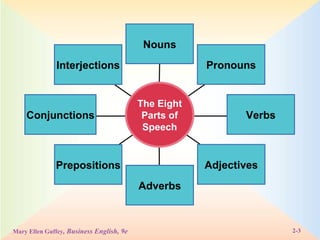
Interjections Conjunctions Prepositions Adverbs Adjectives Verbs Pronouns Nouns The Eight Parts of Speech
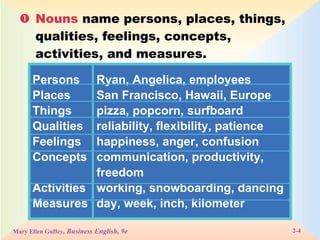
 Nouns  name persons, places, things, qualities, feelings, concepts, activities, and measures.  Persons Ryan, Angelica, employees Places San Francisco, Hawaii, Europe Things pizza, popcorn, surfboard Qualities reliability, flexibility, patience Feelings happiness, anger, confusion Concepts communication, productivity,  freedom Activities working, snowboarding, dancing Measures day, week, inch, kilometer
To test for a noun, use the word in question with the verb  is  or  are .   Try these nouns with  is  or  are . Laurie is . . . . Managers are . . . . Initiative is . . . .
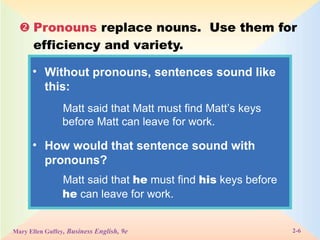
 Pronouns  replace nouns.  Use them for efficiency and variety.  Without pronouns, sentences sound like this: Matt said that Matt must find Matt’s keys before Matt can leave for work. How would that sentence sound with pronouns? Matt said that  he  must find  his  keys before  he  can leave for work.
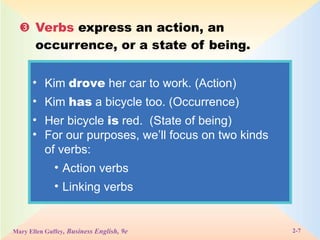
 Verbs  express an action, an occurrence, or a state of being.  Kim  drove  her car to work. (Action) Kim  has  a bicycle too. (Occurrence) Her bicycle  is  red.  (State of being) For our purposes, we’ll focus on two kinds  of verbs: Action verbs Linking verbs
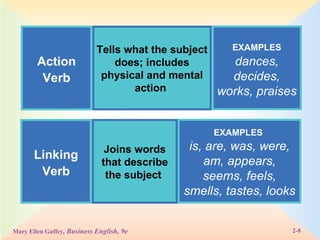
Action Verb Tells what the subject does; includes physical and mental action   EXAMPLES   dances, decides, works, praises Linking Verb Joins words that describe the subject   EXAMPLES   is, are, was, were, am, appears, seems, feels, smells, tastes, looks
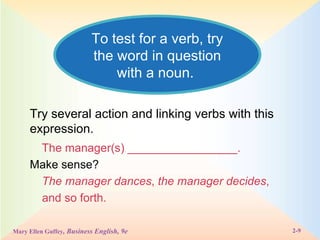
To test for a verb, try the word in question with a noun.  Try several action and linking verbs with this expression. The manager(s) _________________. Make sense?   The manager dances ,  the manager decides , and so forth.
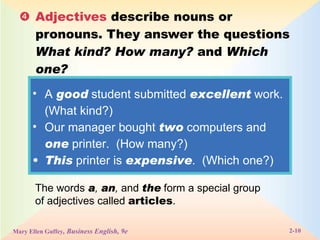
 Adjectives  describe nouns or pronouns. They answer the questions  What kind?   How many?  and  Which one? A  good  student submitted  excellent  work.  (What kind?) Our manager bought  two  computers and  one  printer.  (How many?) This  printer is  expensive .  (Which one?) The words  a ,  an ,  and  the  form a special group of adjectives called  articles .
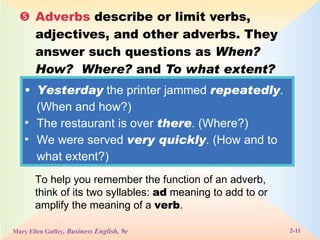
 Adverbs  describe or limit verbs, adjectives, and other adverbs. They answer such questions as  When? How?  Where?  and  To what extent? Yesterday  the printer jammed  repeatedly . (When and how?) The restaurant is over  there . (Where?) We were served  very quickly . (How and to what extent?)  To help you remember the function of an adverb, think of its two syllables:  ad  meaning to add to or amplify the meaning of a  verb .
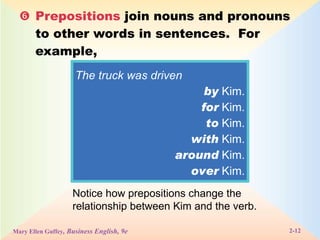
 Prepositions  join nouns and pronouns to other words in sentences.  For example, The truck was driven   by  Kim. for  Kim. to  Kim. with  Kim. around  Kim. over  Kim. Notice how prepositions change the relationship between Kim and the verb.
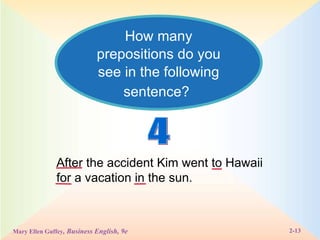
How many prepositions do you see in the following sentence?   After the accident Kim went to Hawaii for a vacation in the sun. 4
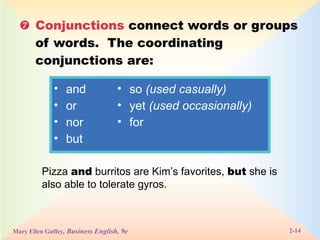
 Conjunctions  connect words or groups of words.  The coordinating conjunctions are:  Pizza  and  burritos are Kim’s favorites,  but  she is also able to tolerate gyros.  and or nor but  so  (used casually) yet  (used occasionally) for
 Interjections  show surprise, disbelief, or strong feeling. Oops , I can’t believe I forgot the attachment again! Wow ! Did you feel that tremor?
TIP The same word can function as different parts of speech depending on how it is used in a sentence.  Consider the word  service .   We received good  service  here. (Noun) He operates a  service  station. (Adjective) Did you  service   your car? (Verb)
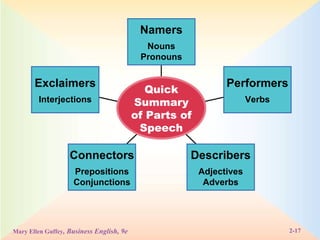
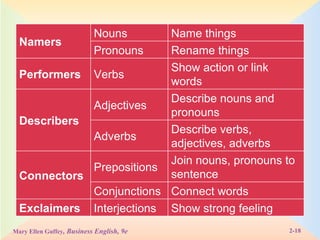
Exclaimers Interjections Connectors Prepositions Conjunctions Describers Adjectives Adverbs Performers Verbs Namers Nouns Pronouns Quick Summary of Parts of Speech
Show strong feeling Interjections Exclaimers Connect words Conjunctions Join nouns, pronouns to sentence Prepositions Connectors Describe verbs, adjectives, adverbs Adverbs Describe nouns and pronouns Adjectives Describers Show action or link words Verbs Performers Rename things Pronouns Name things Nouns Namers
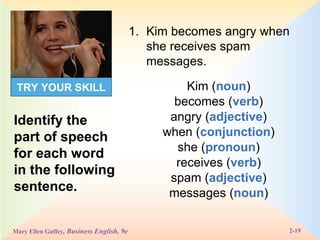
Identify the part of speech for each word in the following sentence. TRY YOUR SKILL Kim becomes angry when she receives spam messages. Kim ( noun ) becomes ( verb ) angry ( adjective ) when ( conjunction ) she ( pronoun ) receives ( verb ) spam ( adjective ) messages ( noun )
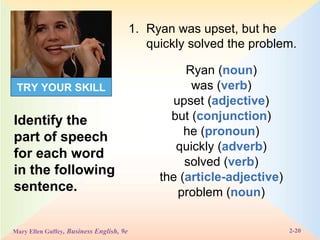
TRY YOUR SKILL Ryan was upset, but he quickly solved the problem. Ryan ( noun ) was ( verb ) upset ( adjective ) but ( conjunction ) he ( pronoun ) quickly ( adverb ) solved ( verb ) the ( article-adjective ) problem ( noun ) Identify the part of speech for each word in the following sentence.
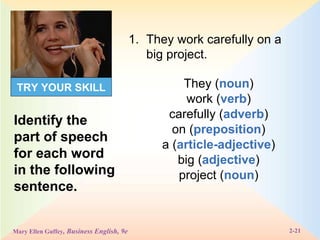
TRY YOUR SKILL They work carefully on a big project.  They ( noun ) work ( verb ) carefully ( adverb ) on ( preposition ) a ( article-adjective ) big ( adjective ) project ( noun ) Identify the part of speech for each word in the following sentence.
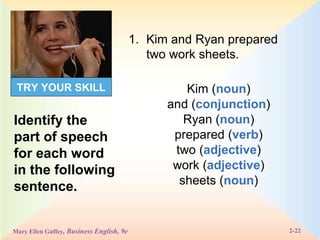
TRY YOUR SKILL Kim and Ryan prepared two work sheets.  Kim ( noun ) and ( conjunction ) Ryan ( noun ) prepared ( verb ) two ( adjective ) work ( adjective ) sheets ( noun ) Identify the part of speech for each word in the following sentence.
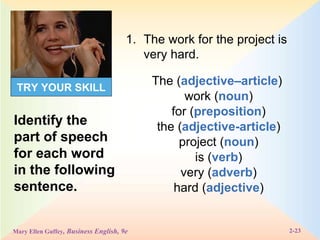
TRY YOUR SKILL The work for the project is very hard.  The ( adjective–article )  work ( noun ) for ( preposition ) the ( adjective-article ) project ( noun ) is ( verb ) very ( adverb ) hard ( adjective ) Identify the part of speech for each word in the following sentence.
Language is like a house that is made of bricks (vocabulary) and cement (grammar).  Without bricks, you can't build a house; without cement, the house will fall apart.  Grammar holds your vocabulary together and helps make your meaning exact.

Be9e 02 Chp 2

  • 1.
    9 th Edition, © 2008, Thomson/South-Western Chapter 2 Parts of Speech
  • 2.
    Learning Objectives Definethe eight parts of speech. Recognize how parts of speech function in sentences. Compose sentences showing words playing more than one grammatical role.
  • 3.
    Interjections Conjunctions PrepositionsAdverbs Adjectives Verbs Pronouns Nouns The Eight Parts of Speech
  • 4.
     Nouns name persons, places, things, qualities, feelings, concepts, activities, and measures. Persons Ryan, Angelica, employees Places San Francisco, Hawaii, Europe Things pizza, popcorn, surfboard Qualities reliability, flexibility, patience Feelings happiness, anger, confusion Concepts communication, productivity, freedom Activities working, snowboarding, dancing Measures day, week, inch, kilometer
  • 5.
    To test fora noun, use the word in question with the verb is or are . Try these nouns with is or are . Laurie is . . . . Managers are . . . . Initiative is . . . .
  • 6.
     Pronouns replace nouns. Use them for efficiency and variety. Without pronouns, sentences sound like this: Matt said that Matt must find Matt’s keys before Matt can leave for work. How would that sentence sound with pronouns? Matt said that he must find his keys before he can leave for work.
  • 7.
     Verbs express an action, an occurrence, or a state of being. Kim drove her car to work. (Action) Kim has a bicycle too. (Occurrence) Her bicycle is red. (State of being) For our purposes, we’ll focus on two kinds of verbs: Action verbs Linking verbs
  • 8.
    Action Verb Tellswhat the subject does; includes physical and mental action EXAMPLES dances, decides, works, praises Linking Verb Joins words that describe the subject EXAMPLES is, are, was, were, am, appears, seems, feels, smells, tastes, looks
  • 9.
    To test fora verb, try the word in question with a noun. Try several action and linking verbs with this expression. The manager(s) _________________. Make sense? The manager dances , the manager decides , and so forth.
  • 10.
     Adjectives describe nouns or pronouns. They answer the questions What kind? How many? and Which one? A good student submitted excellent work. (What kind?) Our manager bought two computers and one printer. (How many?) This printer is expensive . (Which one?) The words a , an , and the form a special group of adjectives called articles .
  • 11.
     Adverbs describe or limit verbs, adjectives, and other adverbs. They answer such questions as When? How? Where? and To what extent? Yesterday the printer jammed repeatedly . (When and how?) The restaurant is over there . (Where?) We were served very quickly . (How and to what extent?) To help you remember the function of an adverb, think of its two syllables: ad meaning to add to or amplify the meaning of a verb .
  • 12.
     Prepositions join nouns and pronouns to other words in sentences. For example, The truck was driven by Kim. for Kim. to Kim. with Kim. around Kim. over Kim. Notice how prepositions change the relationship between Kim and the verb.
  • 13.
    How many prepositionsdo you see in the following sentence? After the accident Kim went to Hawaii for a vacation in the sun. 4
  • 14.
     Conjunctions connect words or groups of words. The coordinating conjunctions are: Pizza and burritos are Kim’s favorites, but she is also able to tolerate gyros. and or nor but so (used casually) yet (used occasionally) for
  • 15.
     Interjections show surprise, disbelief, or strong feeling. Oops , I can’t believe I forgot the attachment again! Wow ! Did you feel that tremor?
  • 16.
    TIP The sameword can function as different parts of speech depending on how it is used in a sentence. Consider the word service . We received good service here. (Noun) He operates a service station. (Adjective) Did you service your car? (Verb)
  • 17.
    Exclaimers Interjections ConnectorsPrepositions Conjunctions Describers Adjectives Adverbs Performers Verbs Namers Nouns Pronouns Quick Summary of Parts of Speech
  • 18.
    Show strong feelingInterjections Exclaimers Connect words Conjunctions Join nouns, pronouns to sentence Prepositions Connectors Describe verbs, adjectives, adverbs Adverbs Describe nouns and pronouns Adjectives Describers Show action or link words Verbs Performers Rename things Pronouns Name things Nouns Namers
  • 19.
    Identify the partof speech for each word in the following sentence. TRY YOUR SKILL Kim becomes angry when she receives spam messages. Kim ( noun ) becomes ( verb ) angry ( adjective ) when ( conjunction ) she ( pronoun ) receives ( verb ) spam ( adjective ) messages ( noun )
  • 20.
    TRY YOUR SKILLRyan was upset, but he quickly solved the problem. Ryan ( noun ) was ( verb ) upset ( adjective ) but ( conjunction ) he ( pronoun ) quickly ( adverb ) solved ( verb ) the ( article-adjective ) problem ( noun ) Identify the part of speech for each word in the following sentence.
  • 21.
    TRY YOUR SKILLThey work carefully on a big project. They ( noun ) work ( verb ) carefully ( adverb ) on ( preposition ) a ( article-adjective ) big ( adjective ) project ( noun ) Identify the part of speech for each word in the following sentence.
  • 22.
    TRY YOUR SKILLKim and Ryan prepared two work sheets. Kim ( noun ) and ( conjunction ) Ryan ( noun ) prepared ( verb ) two ( adjective ) work ( adjective ) sheets ( noun ) Identify the part of speech for each word in the following sentence.
  • 23.
    TRY YOUR SKILLThe work for the project is very hard. The ( adjective–article ) work ( noun ) for ( preposition ) the ( adjective-article ) project ( noun ) is ( verb ) very ( adverb ) hard ( adjective ) Identify the part of speech for each word in the following sentence.
  • 24.
    Language is likea house that is made of bricks (vocabulary) and cement (grammar). Without bricks, you can't build a house; without cement, the house will fall apart. Grammar holds your vocabulary together and helps make your meaning exact.