Risk Management
Time to blow it up and start over?

@alexhutton
Met E.T. Jaynes
probability theory, the logic of
science
Kuhn’s Protoscience
 A stage in the development of a science
that is described by:

• somewhat random fact gathering
  (mainly of readily accessible data)
• a “morass” of interesting, trivial,

  irrelevant observations
• A variety of theories (that are spawned

  from what he calls philosophical
  speculation) that provide little guidance
  to data gathering
only the wisest and stupidest of
men never change
Confucius
Destroy GRC
Musings of a Risk Management
Deconstructivist
A feeling of diss-connect
between GRC and Security
let’s talk governance
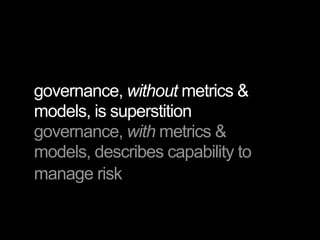
governance, without metrics &
models, is superstition
governance, with metrics &
models, describes capability to
manage risk
Why does what you
execute on and how
you execute matter?
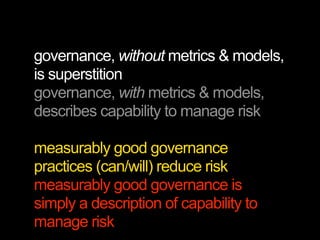
governance, without metrics & models,
is superstition
governance, with metrics & models,
describes capability to manage risk

measurably good governance
practices (can/will) reduce risk
measurably good governance is
simply a description of capability to
manage risk
not sucking eggs at security is a
good idea
compliance*, without metrics, is
superstition
compliance*, with metrics, is risk
management


                          *(regulatory)
But “GRC” Risk
Management

Find issue, call
issue bad, fix issue,
hope you don’t find
it again...
What is risk?
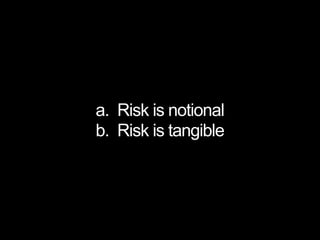
a. Risk is notional
b. Risk is tangible
Problems with “tangible”

- complex systems, complexity
science

- usefulness outside of the very
specific

- measurements

- lots of belief statements
How Complex Systems Fail
(Being a Short Treatise on the Nature of Failure; How Failure
is Evaluated; How Failure is Attributed to Proximate Cause;
and the Resulting New Understanding of Patient Safety)

Richard I. Cook, MD
Cognitive technologies Laboratory
University of Chicago

http://www.ctlab.org/documents/How
%20Complex%20Systems
%20Fail.pdf
Catastrophe requires multiple failures
single point failures are not enough..

The array of defenses works. System operations are generally successful. Overt
catastrophic failure occurs when small, apparently innocuous failures join to create
opportunity for a systemic accident. Each of these small failures is necessary to cause
catastrophe but only the combination is sufficient to permit failure. Put another way, there are
many more failure opportunities than overt system accidents. Most initial failure trajectories
are blocked by designed system safety components. Trajectories that reach the operational
level are mostly blocked, usually by practitioners.


Complex systems contain changing mixtures of failures latent within them.

The complexity of these systems makes it impossible for them to run without multiple
flaws being present. Because these are individually insufficient to cause failure they are
regarded as minor factors during operations. Eradication of all latent failures is limited
primarily by economic cost but also because it is difficult before the fact to see how
such failures might contribute to an accident. The failures change constantly
because of changing technology, work organization, and efforts to eradicate failures.
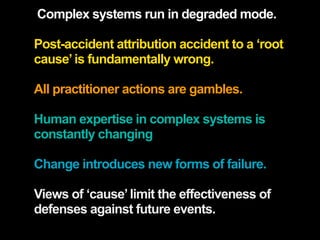
Complex systems run in degraded mode.

Post-accident attribution accident to a ‘root
cause’ is fundamentally wrong.

All practitioner actions are gambles.

Human expertise in complex systems is
constantly changing

Change introduces new forms of failure.

Views of ‘cause’ limit the effectiveness of
defenses against future events.
Problems with “notional”

- becomes difficult to extract wisdom - we
want a “Gross Domestic Product”

- unable to be defended

- pseudo-scientific

- lots of belief statements
from Mark Curphey’s SecurityBullshit
What is risk?
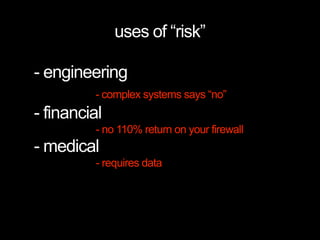
uses of “risk”

- engineering
         - complex systems says “no”
- financial
          - no 110% return on your firewall
- medical
          - requires data
our standards say:

Find issue, call
issue bad, fix issue,
hope you don’t find
it again...
Managing risk means aligning the
capabilities of the organization, and
the exposure of the organization
with the tolerance of the data
owners
                              - Jack Jones
evidence based medicine, meet information security


     What is evidence-based risk
           management?

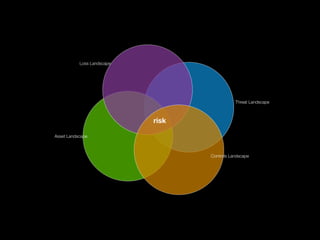
        a deconstructed, notional view of risk
Loss Landscape


                                              Threat Landscape


                            risk

Asset Landscape


                                   Controls Landscape
Loss Landscape

                                                                  a balanced
                                                                  scorecard?


Asset Landscape                                                Threat Landscape


                                   risk


                                          Controls Landscape
Loss Landscape                                              a balanced
                                                                              scorecard?

                                                                              capability
                                                                              (destroys “g”
                                                                              introducing quality
                                                                              management & mgmt.
Asset Landscape                                            Threat Landscape   science elements into
                                                                              infosec)


                               risk                                           exposure

                                                                              change

                                                                              “compliance”
                                                                              simply becomes a
                                                                              factor of loss
                                                                              landscape and/or
                                                                              operating as a
                                      Controls Landscape
                                                                              control group for
                                                                              comparative data
The Achilles heel again, lack of
             data
Models and data
sharing
Good Lord Of The Dance, something a
vendor might actually help you with
Verizon Incident Sharing Framework
             it’s open*!


                            * kinda
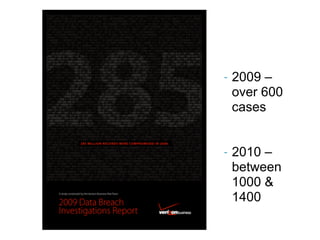
Verizon has shared data
-   2009 –
    over 600
    cases


-   2010 –
    between
    1000 &
    1400
Verizon is sharing our
framework
What is the Verizon Incident Sharing (VerIS)
Framework?

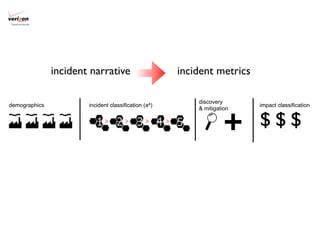
 - A means   to create metrics
   from the incident narrative
    -   how Verizon creates measurements for the DBIR

    -   how *anyone* can create measurements from an incident

    -   http://securityblog.verizonbusiness.com/wp-content/uploads/
        2010/03/VerIS_Framework_Beta_1.pdf
What makes up the VerIS framework?


 -   Demographics
 -   Incident Classification
     -   Event Modeling (a4)

 -   Discovery & Mitigation
 -   Impact Classification
     -   Impact Modeling
Cybertrust Security


                      demographics   -   company industry

                                     -   company size

                                     -   geographic location
                                         -   of business unit in incident


                                     -   size of security
                                         department
Cybertrust Security


                       incident classification                                                   -   agent
                                                         error
                                                     misuse
                                                                                                     -   what acts against us
                                        malware
                                  hacking               environmental

                      external                                                                   -   asset
                                                              social
                                            action              physical                             -   what the agent acts
                                                                                                         against
internal                        agent

                                            asset
                                                                  confidentiality
                                                                           possession            -   action
                      partner
                                                                                  availability       -   what the agent does to the
                                    type             attribute                   utility                 asset
                                       function

                                                                           authenticity
                                                                    integrity                    -   attribute
                                                                                                     -   the result of the agent’s
                                                                                                         action against the asset
Cybertrust Security


                      incident classification
                      a4 event model


             the series of events (a4) creates an “attack model”


                          1     >             2        >           3   >   4   >
                                                                                   5
Cybertrust Security


                      discovery & mitigation   -   incident timeline
                                               -   discovery method
                                                   evidence sources


                                  +
                                               -

                                               -   control capability
                                               -   corrective action
                                                   -   most straightforward manner
                                                       in which the incident could be
                                                       prevented

                                                   -   the cost of preventative
                                                       controls
Cybertrust Security


                      Impact classification   -   impact
                                                  categorization
                                                  -   sources of Impact


                                $
                                                      (direct, indirect)
                                                  -   similar to iso 27005/FAIR


                                              -   impact estimation
                                                  -   distribution for
                                                      amount of impact

                                              -   impact
                                                  qualification
                                                  -   relative impact
                                                      rating
Cybertrust Security


                      incident narrative                     incident metrics

                                                                 discovery
demographics                  incident classification (a4)                      impact classification


                                                                          +
                                                                 & mitigation

                                 1> 2> 3> 4 > 5                                 $$$
Cybertrust Security
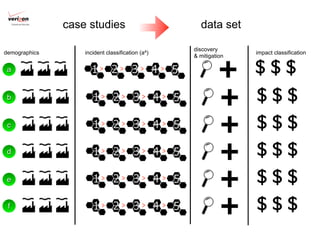
                           case studies                         data set

                                                              discovery
demographics                   incident classification (a4)                  impact classification


                                                                       +
                                                              & mitigation

 a                               1> 2> 3> 4 > 5                              $$$
 b                                1> 2> 3> 4 > 5
                                                                       +     $$$
 c                                1> 2> 3> 4 > 5
                                                                       +     $$$
 d                                1> 2> 3> 4 > 5
                                                                       +     $$$
 e                                1> 2> 3> 4 > 5
                                                                       +     $$$
 f                                1> 2> 3> 4 > 5
                                                                       +     $$$
Cybertrust Security
                           data set                       knowledge & wisdom

                                                            discovery
demographics               incident classification (a4)                    impact classification


                                                                     +
                                                            & mitigation

 a                           1> 2> 3> 4 > 5                                $$$
 b                            1> 2> 3> 4 > 5
                                                                     +     $$$
 c                            1> 2> 3> 4 > 5
                                                                     +     $$$
 d                            1> 2> 3> 4 > 5
                                                                     +     $$$
 e                            1> 2> 3> 4 > 5
                                                                     +     $$$
 f                            1> 2> 3> 4 > 5
                                                                     +     $$$
Cybertrust Security
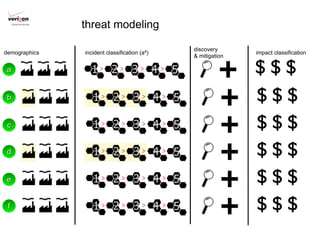
                           threat modeling

                                                          discovery
demographics               incident classification (a4)                  impact classification


                                                                   +
                                                          & mitigation

 a                           1> 2> 3> 4 > 5                              $$$
 b                            1> 2> 3> 4 > 5
                                                                   +     $$$
 c                            1> 2> 3> 4 > 5
                                                                   +     $$$
 d                            1> 2> 3> 4 > 5
                                                                   +     $$$
 e                            1> 2> 3> 4 > 5
                                                                   +     $$$
 f                            1> 2> 3> 4 > 5
                                                                   +     $$$
Cybertrust Security
                           threat modeling

                                                          discovery
demographics               incident classification (a4)                  impact classification


                                                                   +
                                                          & mitigation

 a                           1> 2> 3> 4 > 5                              $$$
 b                            1> 2> 3> 4 > 5
                                                                   +     $$$
 c                            1> 2> 3> 4 > 5
                                                                   +     $$$
 d                            1> 2> 3> 4 > 5
                                                                   +     $$$
 e                            1> 2> 3> 4 > 5
                                                                   +     $$$
 f                            1> 2> 3> 4 > 5
                                                                   +     $$$
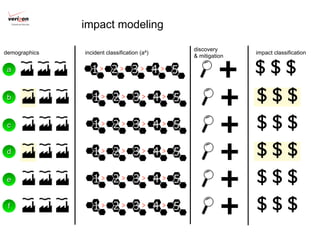
Cybertrust Security
                           impact modeling

                                                          discovery
demographics               incident classification (a4)                  impact classification


                                                                   +
                                                          & mitigation

 a                           1> 2> 3> 4 > 5                              $$$
 b                            1> 2> 3> 4 > 5
                                                                   +     $$$
 c                            1> 2> 3> 4 > 5
                                                                   +     $$$
 d                            1> 2> 3> 4 > 5
                                                                   +     $$$
 e                            1> 2> 3> 4 > 5
                                                                   +     $$$
 f                            1> 2> 3> 4 > 5
                                                                   +     $$$
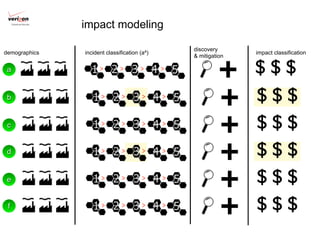
Cybertrust Security
                           impact modeling

                                                          discovery
demographics               incident classification (a4)                  impact classification


                                                                   +
                                                          & mitigation

 a                           1> 2> 3> 4 > 5                              $$$
 b                            1> 2> 3> 4 > 5
                                                                   +     $$$
 c                            1> 2> 3> 4 > 5
                                                                   +     $$$
 d                            1> 2> 3> 4 > 5
                                                                   +     $$$
 e                            1> 2> 3> 4 > 5
                                                                   +     $$$
 f                            1> 2> 3> 4 > 5
                                                                   +     $$$
Problems:

Data sharing, incidents, privacy

Failures vs. Successes
(where management capability helps)


Talking to the business owner
(might still need a “tangible approach here, but pseudo-actuarial data can help - we
still want a GDP)
Successes:

Bridge the gap
(IRM becomes tactically actionable based on threat/attack modeling)

(Capability measurements bridged to notional increase/decrease in risk)

(complex system problems addressed by showing multiple sources of causes)


Accurate, notional likelihood

Accurate tangible impact
Requirements:
Data Sets

Models

Technology

Sciences - complexity, management/TQM/Probability/
Game Theory, biomimicry...

Hutton B Side Sf

  • 1.
    Risk Management Time toblow it up and start over? @alexhutton
  • 2.
    Met E.T. Jaynes probabilitytheory, the logic of science
  • 3.
    Kuhn’s Protoscience Astage in the development of a science that is described by: • somewhat random fact gathering (mainly of readily accessible data) • a “morass” of interesting, trivial, irrelevant observations • A variety of theories (that are spawned from what he calls philosophical speculation) that provide little guidance to data gathering
  • 4.
    only the wisestand stupidest of men never change Confucius
  • 5.
    Destroy GRC Musings ofa Risk Management Deconstructivist
  • 6.
    A feeling ofdiss-connect between GRC and Security
  • 7.
  • 8.
    governance, without metrics& models, is superstition governance, with metrics & models, describes capability to manage risk
  • 9.
    Why does whatyou execute on and how you execute matter?
  • 12.
    governance, without metrics& models, is superstition governance, with metrics & models, describes capability to manage risk measurably good governance practices (can/will) reduce risk measurably good governance is simply a description of capability to manage risk
  • 13.
    not sucking eggsat security is a good idea
  • 14.
    compliance*, without metrics,is superstition compliance*, with metrics, is risk management *(regulatory)
  • 15.
    But “GRC” Risk Management Findissue, call issue bad, fix issue, hope you don’t find it again...
  • 16.
  • 17.
    a. Risk isnotional b. Risk is tangible
  • 18.
    Problems with “tangible” -complex systems, complexity science - usefulness outside of the very specific - measurements - lots of belief statements
  • 19.
    How Complex SystemsFail (Being a Short Treatise on the Nature of Failure; How Failure is Evaluated; How Failure is Attributed to Proximate Cause; and the Resulting New Understanding of Patient Safety) Richard I. Cook, MD Cognitive technologies Laboratory University of Chicago http://www.ctlab.org/documents/How %20Complex%20Systems %20Fail.pdf
  • 20.
    Catastrophe requires multiplefailures single point failures are not enough.. The array of defenses works. System operations are generally successful. Overt catastrophic failure occurs when small, apparently innocuous failures join to create opportunity for a systemic accident. Each of these small failures is necessary to cause catastrophe but only the combination is sufficient to permit failure. Put another way, there are many more failure opportunities than overt system accidents. Most initial failure trajectories are blocked by designed system safety components. Trajectories that reach the operational level are mostly blocked, usually by practitioners. Complex systems contain changing mixtures of failures latent within them. The complexity of these systems makes it impossible for them to run without multiple flaws being present. Because these are individually insufficient to cause failure they are regarded as minor factors during operations. Eradication of all latent failures is limited primarily by economic cost but also because it is difficult before the fact to see how such failures might contribute to an accident. The failures change constantly because of changing technology, work organization, and efforts to eradicate failures.
  • 21.
    Complex systems runin degraded mode. Post-accident attribution accident to a ‘root cause’ is fundamentally wrong. All practitioner actions are gambles. Human expertise in complex systems is constantly changing Change introduces new forms of failure. Views of ‘cause’ limit the effectiveness of defenses against future events.
  • 22.
    Problems with “notional” -becomes difficult to extract wisdom - we want a “Gross Domestic Product” - unable to be defended - pseudo-scientific - lots of belief statements
  • 23.
    from Mark Curphey’sSecurityBullshit
  • 24.
  • 25.
    uses of “risk” -engineering - complex systems says “no” - financial - no 110% return on your firewall - medical - requires data
  • 26.
    our standards say: Findissue, call issue bad, fix issue, hope you don’t find it again...
  • 27.
    Managing risk meansaligning the capabilities of the organization, and the exposure of the organization with the tolerance of the data owners - Jack Jones
  • 28.
    evidence based medicine,meet information security What is evidence-based risk management? a deconstructed, notional view of risk
  • 29.
    Loss Landscape Threat Landscape risk Asset Landscape Controls Landscape
  • 30.
    Loss Landscape a balanced scorecard? Asset Landscape Threat Landscape risk Controls Landscape
  • 31.
    Loss Landscape a balanced scorecard? capability (destroys “g” introducing quality management & mgmt. Asset Landscape Threat Landscape science elements into infosec) risk exposure change “compliance” simply becomes a factor of loss landscape and/or operating as a Controls Landscape control group for comparative data
  • 32.
    The Achilles heelagain, lack of data
  • 33.
    Models and data sharing GoodLord Of The Dance, something a vendor might actually help you with
  • 34.
    Verizon Incident SharingFramework it’s open*! * kinda
  • 35.
  • 36.
    - 2009 – over 600 cases - 2010 – between 1000 & 1400
  • 37.
    Verizon is sharingour framework
  • 38.
    What is theVerizon Incident Sharing (VerIS) Framework? - A means to create metrics from the incident narrative - how Verizon creates measurements for the DBIR - how *anyone* can create measurements from an incident - http://securityblog.verizonbusiness.com/wp-content/uploads/ 2010/03/VerIS_Framework_Beta_1.pdf
  • 39.
    What makes upthe VerIS framework? - Demographics - Incident Classification - Event Modeling (a4) - Discovery & Mitigation - Impact Classification - Impact Modeling
  • 40.
    Cybertrust Security demographics - company industry - company size - geographic location - of business unit in incident - size of security department
  • 41.
    Cybertrust Security incident classification - agent error misuse - what acts against us malware hacking environmental external - asset social action physical - what the agent acts against internal agent asset confidentiality possession - action partner availability - what the agent does to the type attribute utility asset function authenticity integrity - attribute - the result of the agent’s action against the asset
  • 42.
    Cybertrust Security incident classification a4 event model the series of events (a4) creates an “attack model” 1 > 2 > 3 > 4 > 5
  • 43.
    Cybertrust Security discovery & mitigation - incident timeline - discovery method evidence sources + - - control capability - corrective action - most straightforward manner in which the incident could be prevented - the cost of preventative controls
  • 44.
    Cybertrust Security Impact classification - impact categorization - sources of Impact $ (direct, indirect) - similar to iso 27005/FAIR - impact estimation - distribution for amount of impact - impact qualification - relative impact rating
  • 45.
    Cybertrust Security incident narrative incident metrics discovery demographics incident classification (a4) impact classification + & mitigation 1> 2> 3> 4 > 5 $$$
  • 46.
    Cybertrust Security case studies data set discovery demographics incident classification (a4) impact classification + & mitigation a 1> 2> 3> 4 > 5 $$$ b 1> 2> 3> 4 > 5 + $$$ c 1> 2> 3> 4 > 5 + $$$ d 1> 2> 3> 4 > 5 + $$$ e 1> 2> 3> 4 > 5 + $$$ f 1> 2> 3> 4 > 5 + $$$
  • 47.
    Cybertrust Security data set knowledge & wisdom discovery demographics incident classification (a4) impact classification + & mitigation a 1> 2> 3> 4 > 5 $$$ b 1> 2> 3> 4 > 5 + $$$ c 1> 2> 3> 4 > 5 + $$$ d 1> 2> 3> 4 > 5 + $$$ e 1> 2> 3> 4 > 5 + $$$ f 1> 2> 3> 4 > 5 + $$$
  • 48.
    Cybertrust Security threat modeling discovery demographics incident classification (a4) impact classification + & mitigation a 1> 2> 3> 4 > 5 $$$ b 1> 2> 3> 4 > 5 + $$$ c 1> 2> 3> 4 > 5 + $$$ d 1> 2> 3> 4 > 5 + $$$ e 1> 2> 3> 4 > 5 + $$$ f 1> 2> 3> 4 > 5 + $$$
  • 49.
    Cybertrust Security threat modeling discovery demographics incident classification (a4) impact classification + & mitigation a 1> 2> 3> 4 > 5 $$$ b 1> 2> 3> 4 > 5 + $$$ c 1> 2> 3> 4 > 5 + $$$ d 1> 2> 3> 4 > 5 + $$$ e 1> 2> 3> 4 > 5 + $$$ f 1> 2> 3> 4 > 5 + $$$
  • 50.
    Cybertrust Security impact modeling discovery demographics incident classification (a4) impact classification + & mitigation a 1> 2> 3> 4 > 5 $$$ b 1> 2> 3> 4 > 5 + $$$ c 1> 2> 3> 4 > 5 + $$$ d 1> 2> 3> 4 > 5 + $$$ e 1> 2> 3> 4 > 5 + $$$ f 1> 2> 3> 4 > 5 + $$$
  • 51.
    Cybertrust Security impact modeling discovery demographics incident classification (a4) impact classification + & mitigation a 1> 2> 3> 4 > 5 $$$ b 1> 2> 3> 4 > 5 + $$$ c 1> 2> 3> 4 > 5 + $$$ d 1> 2> 3> 4 > 5 + $$$ e 1> 2> 3> 4 > 5 + $$$ f 1> 2> 3> 4 > 5 + $$$
  • 52.
    Problems: Data sharing, incidents,privacy Failures vs. Successes (where management capability helps) Talking to the business owner (might still need a “tangible approach here, but pseudo-actuarial data can help - we still want a GDP)
  • 53.
    Successes: Bridge the gap (IRMbecomes tactically actionable based on threat/attack modeling) (Capability measurements bridged to notional increase/decrease in risk) (complex system problems addressed by showing multiple sources of causes) Accurate, notional likelihood Accurate tangible impact
  • 54.
    Requirements: Data Sets Models Technology Sciences -complexity, management/TQM/Probability/ Game Theory, biomimicry...