Threat Modeling
                                             LIVE
Alex Hutton                                Allison Miller
Principal, Risk & Intelligence - Verizon   Group Manager, Account Risk & Security -
Business                                   PayPal

http://securityblog.verizonbusiness.com
http://www.newschoolsecurity.com

Society of Information Risk Analysts
http://societyinforisk.org/

@alexhutton on the twitter
what is this presentation about?
-
    new way to look at risk management via
    data and threat modeling
what is a model?
what is risk management?
Managing risk means aligning
the capabilities of the
organization, and the exposure
of the organization with the
tolerance of the data owners
                         - Jack Jones
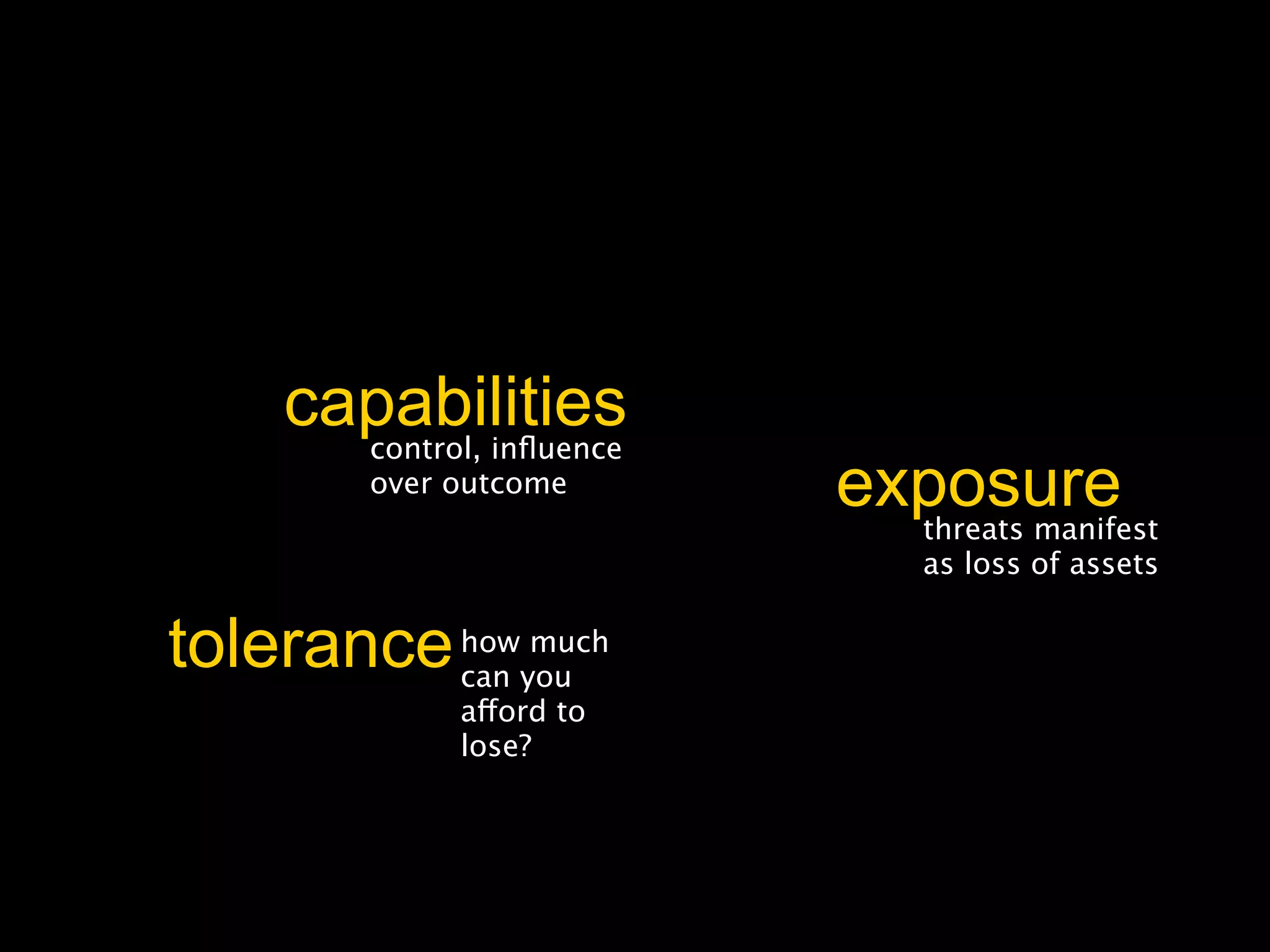
Managing risk means aligning
the capabilities of the
       control, influence
organization, and the exposure
       over outcome
                          threats manifest
of the organization with the of assets
                          as loss


tolerance howyou data owners
              ofmuch
             can
                    the
            afford to
            lose?
Traditional Risk
Management

Find issue, call
issue bad, fix
issue, hope you
don’t find it again...
Traditional Risk
Management

emphasis on
assessment,
compliance...what
about security?
Closing the
Gap


              Between
              Assessment
              and Defense
Design
Management
Operations
Design
Evolution strongly favors
strategies that minimize the
risk of loss, rather than which
maximize the chance of gain.


Len Fisher
Rock, Paper, Scissors: Game Theory in Everyday Life
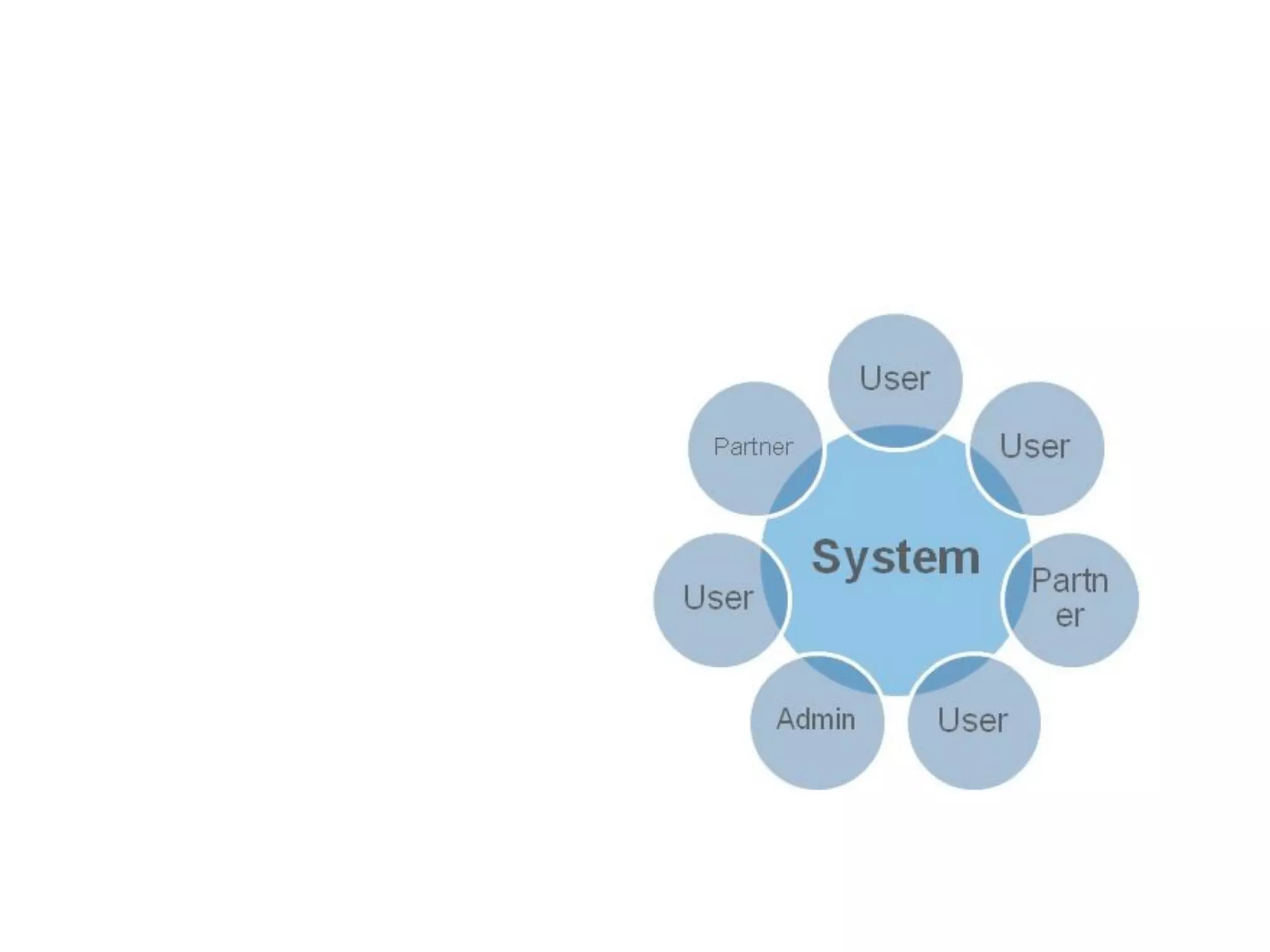
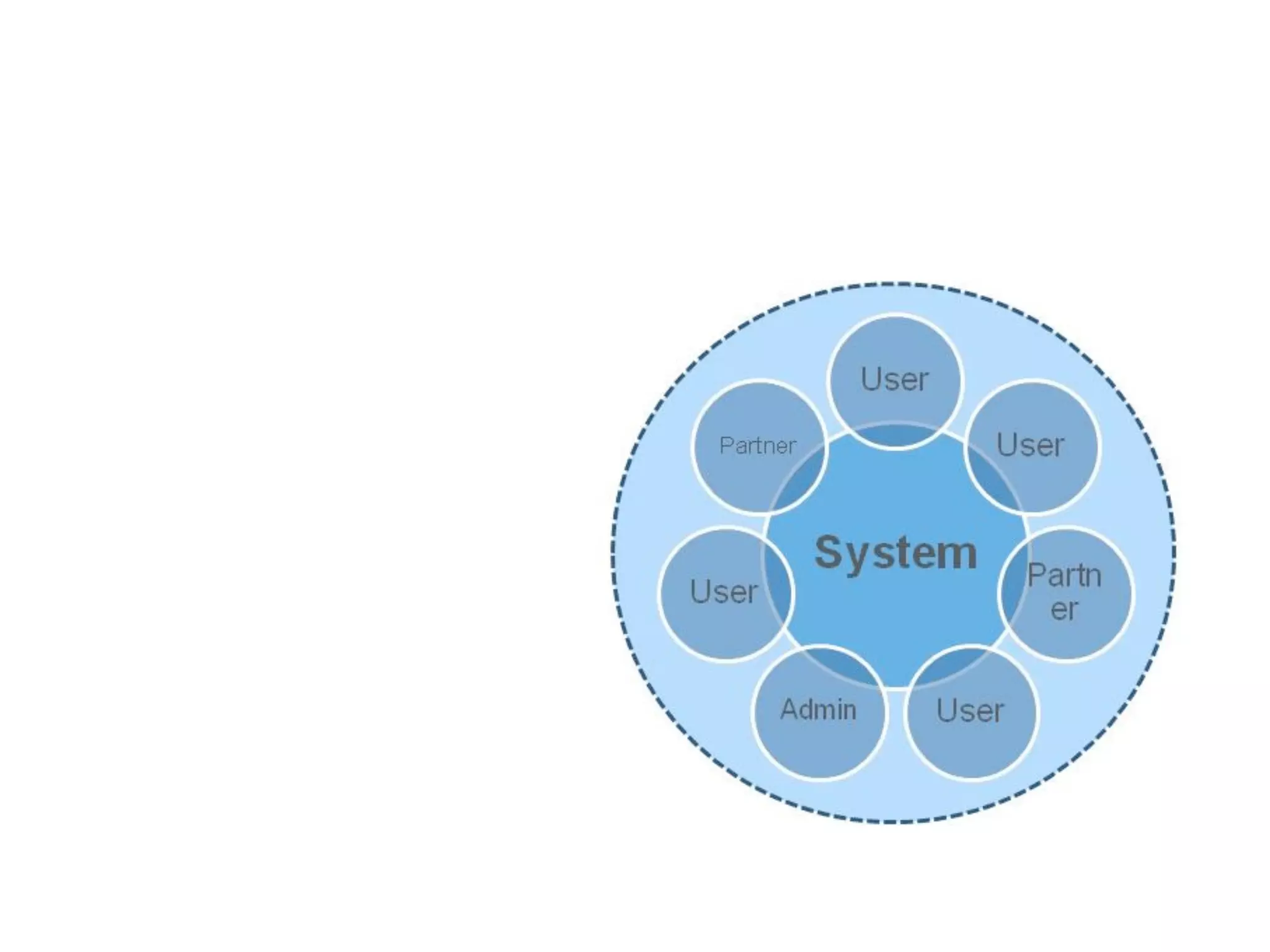
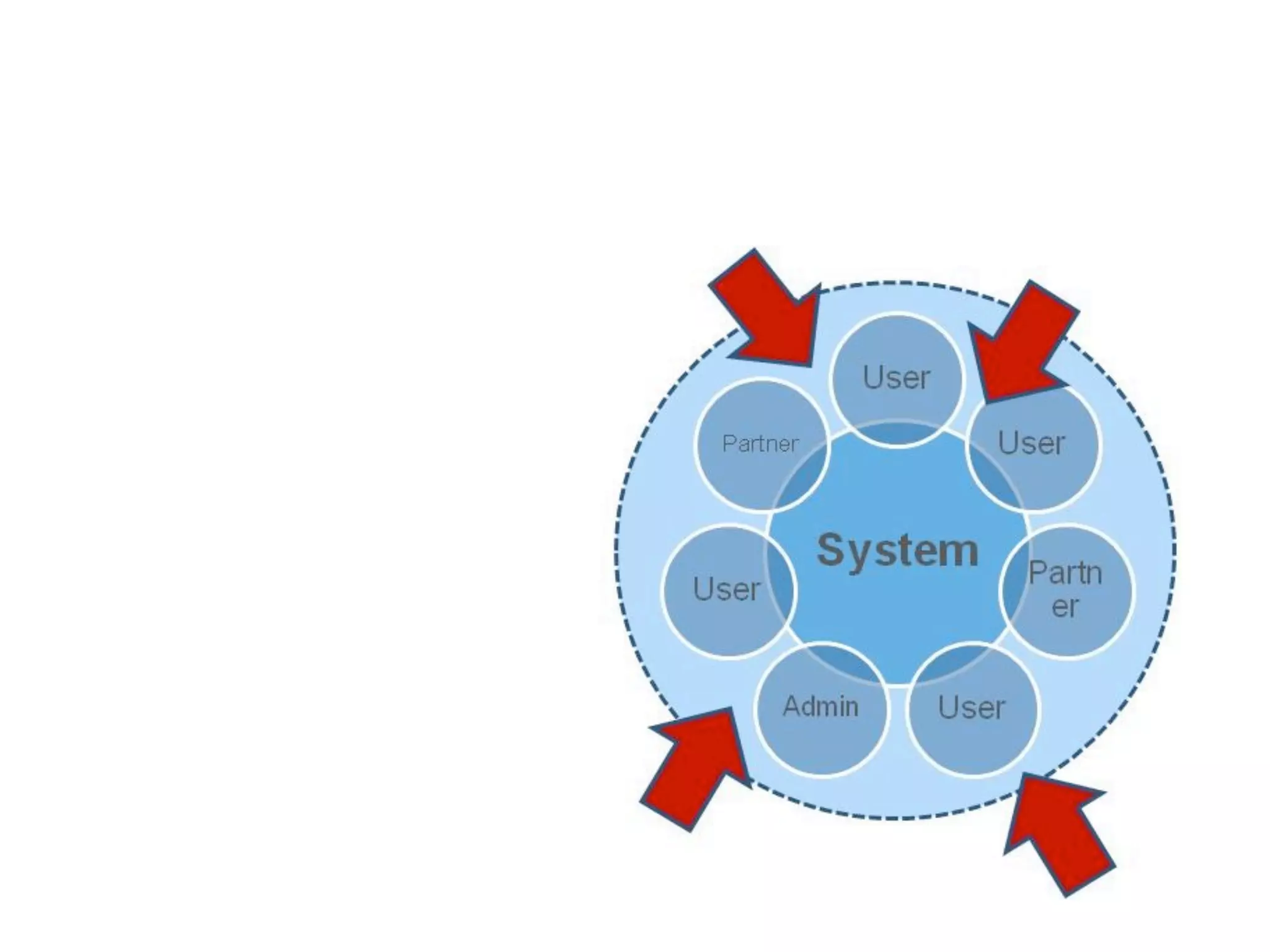
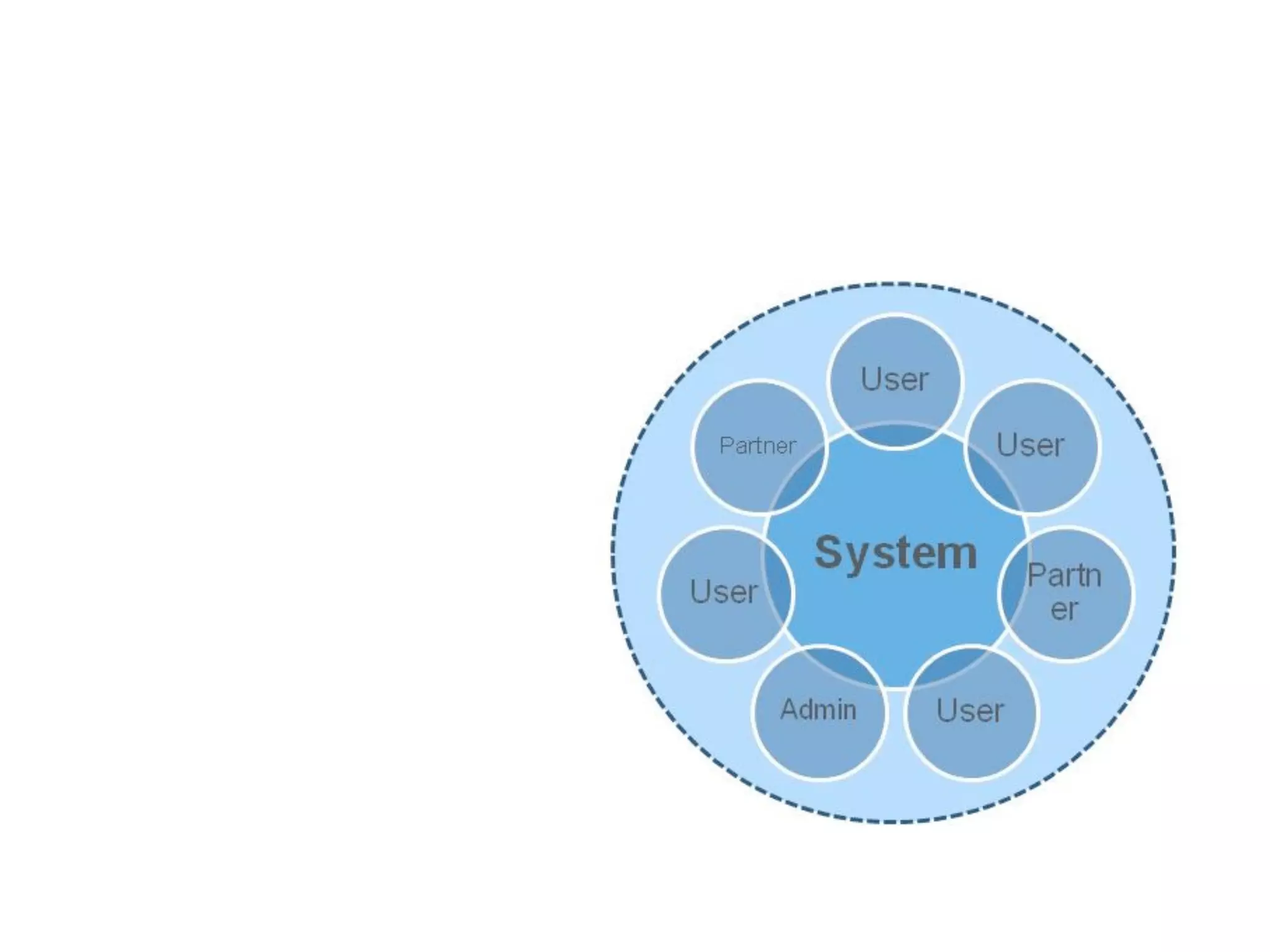
system models are
different from maps,
they include dynamics
and boundaries
Management
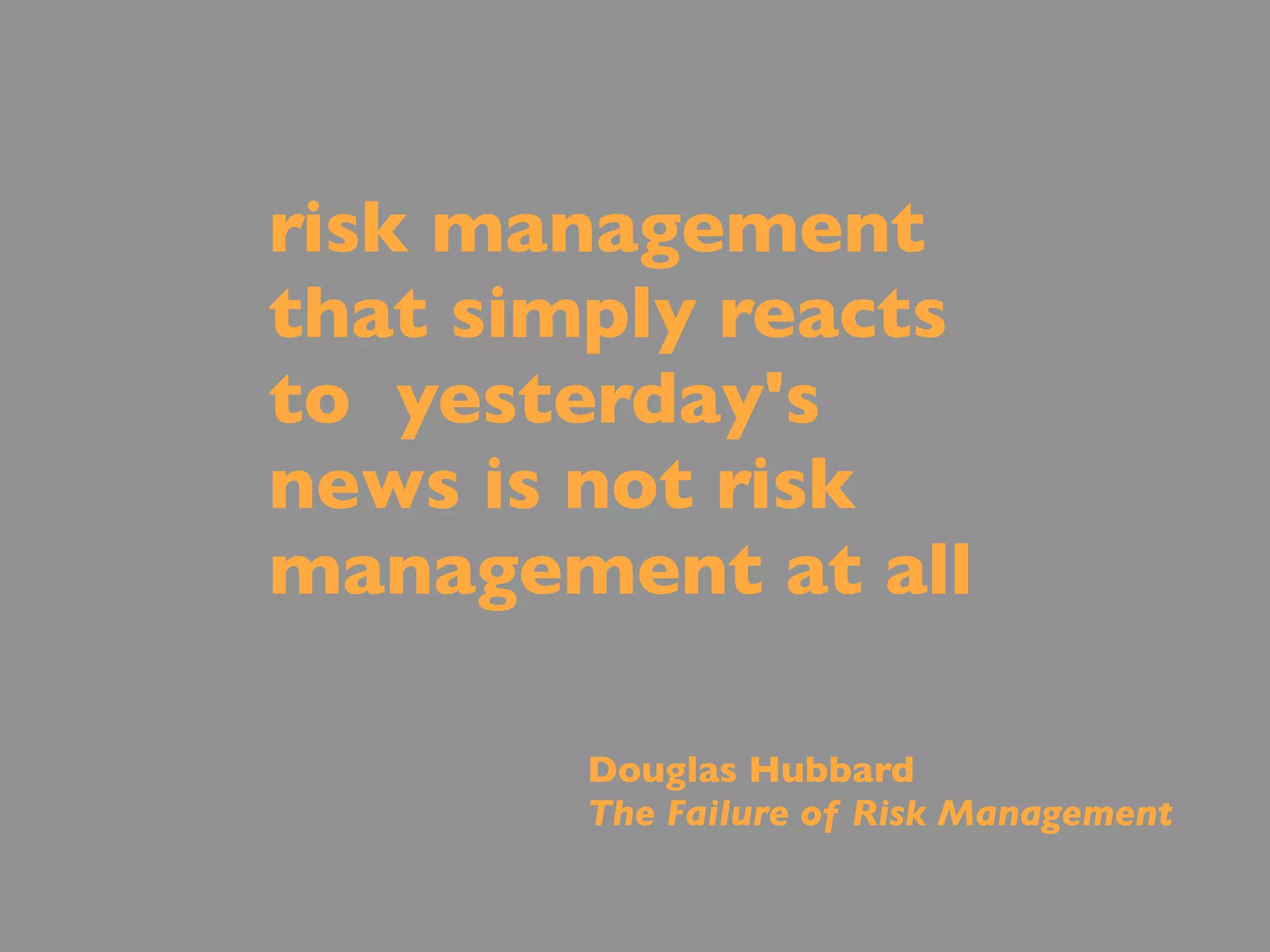
risk management
that simply reacts
to yesterday's
news is not risk
management at all

        Douglas Hubbard
        The Failure of Risk Management
the importance of
feedback loop
instrumentation


(that‘s where
metrics come from)
Operations
Prediction is very difficult, especially
                     about the future
                           Niels Bohr
Models in
operations tend to
assist in
automating
system decisions,
or monitoring for
quality defects
This means we
need to understand
what makes a good
decision vs a bad
decision
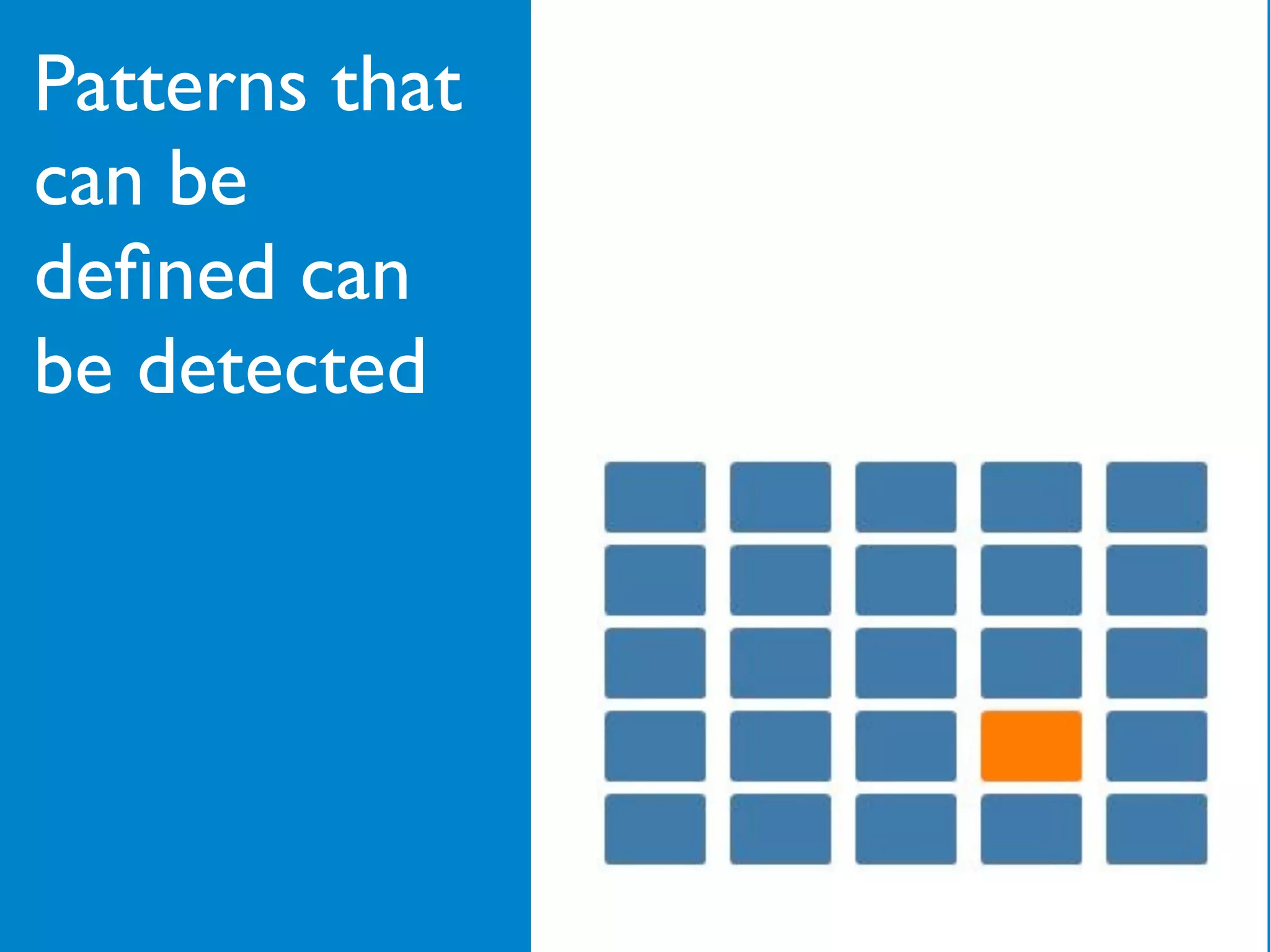
Patterns that
can be
defined can
be detected
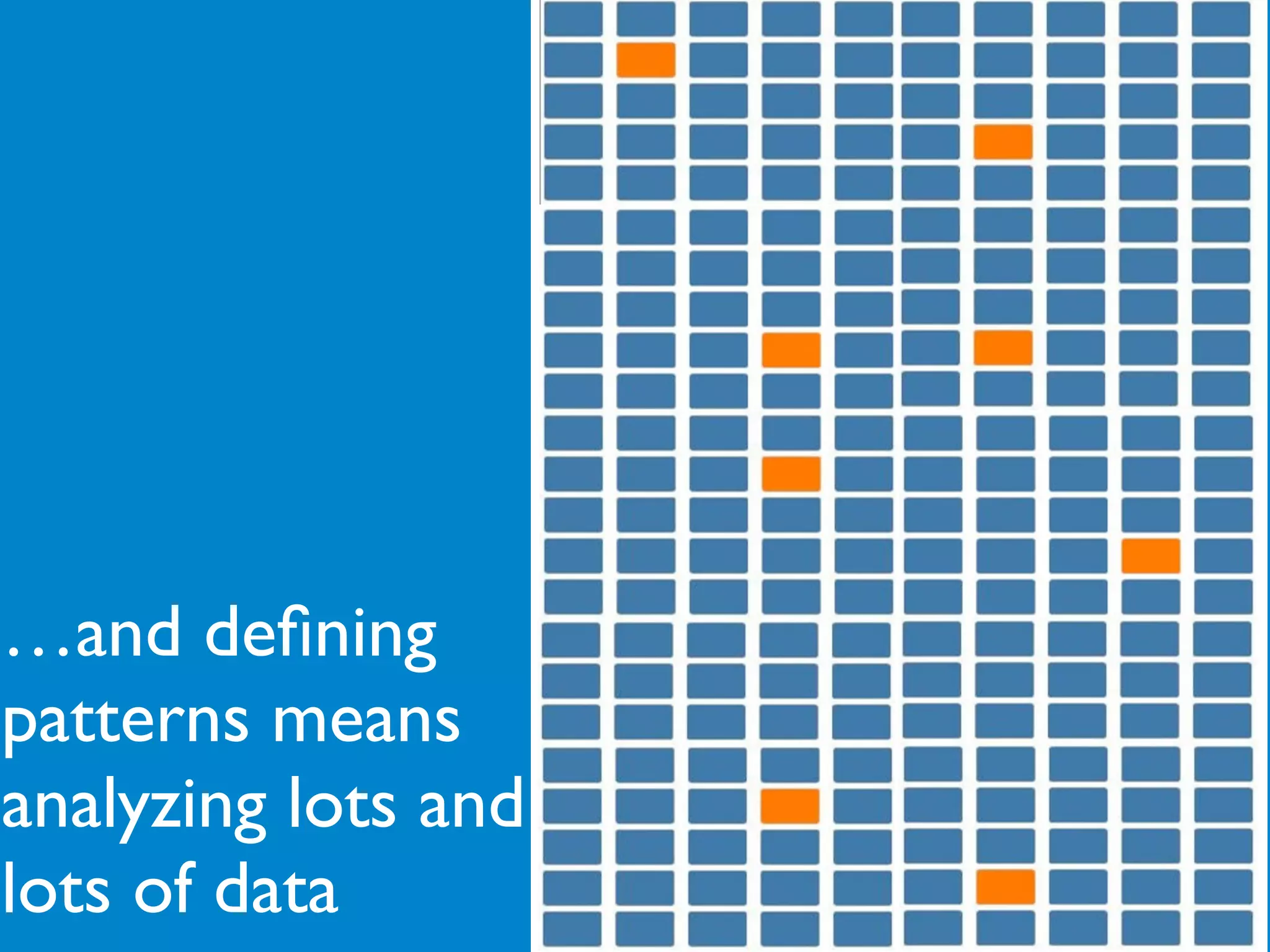
…and defining
patterns means
analyzing lots and
lots of data
We don't talk about
what we see;
we see only what we
can talk about


        Donella Meadows
        Thinking in Systems: A Primer
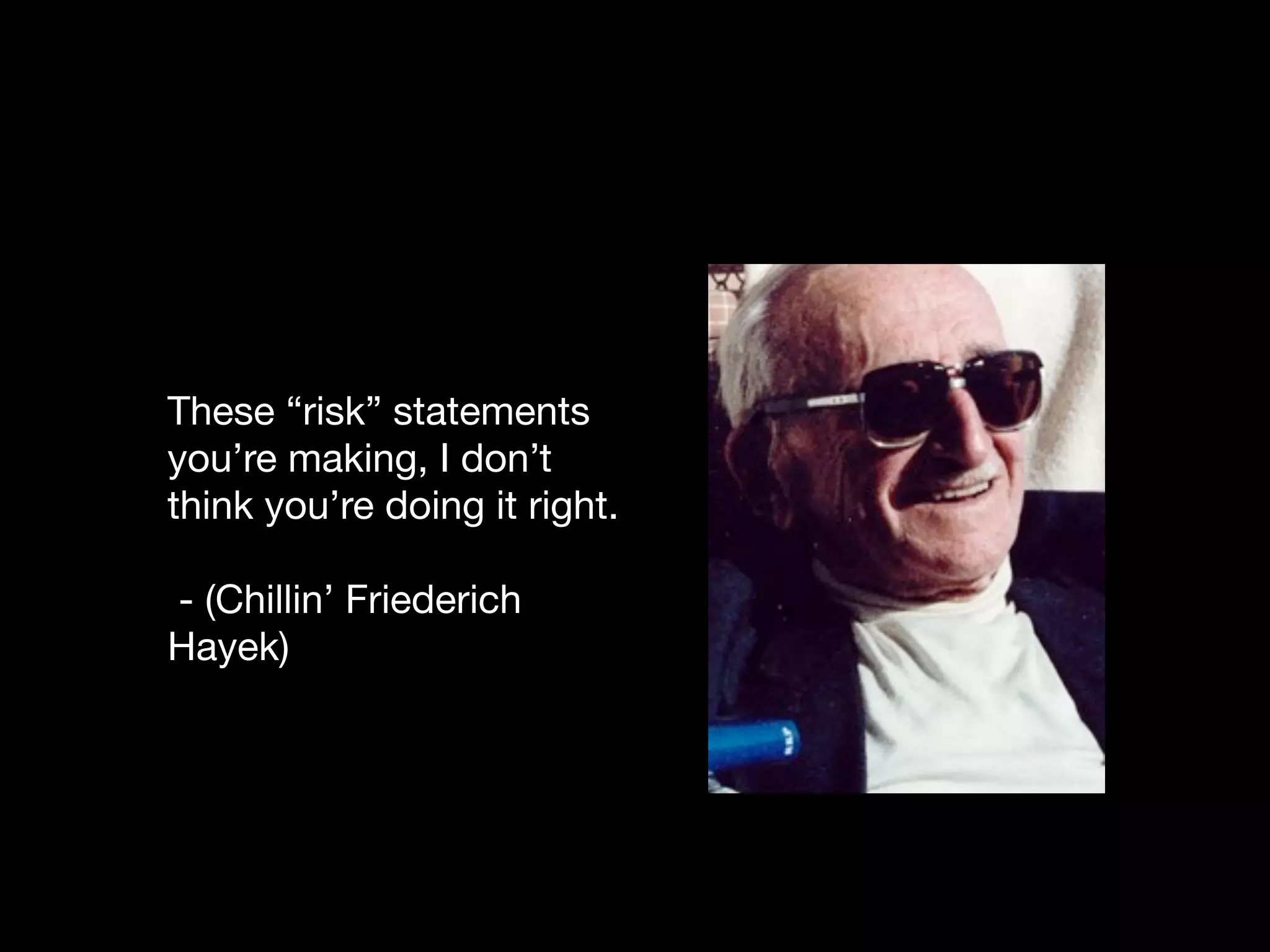
Friederich Hayek
invades our dreams to
give us visions of a new
approach
These “risk” statements
you’re making, I don’t
think you’re doing it right.

- (Chillin’ Friederich
Hayek)
Risk Assessment Current Practice

Dutch Model, Likelihood & Impact statement

very physics/engineering oriented
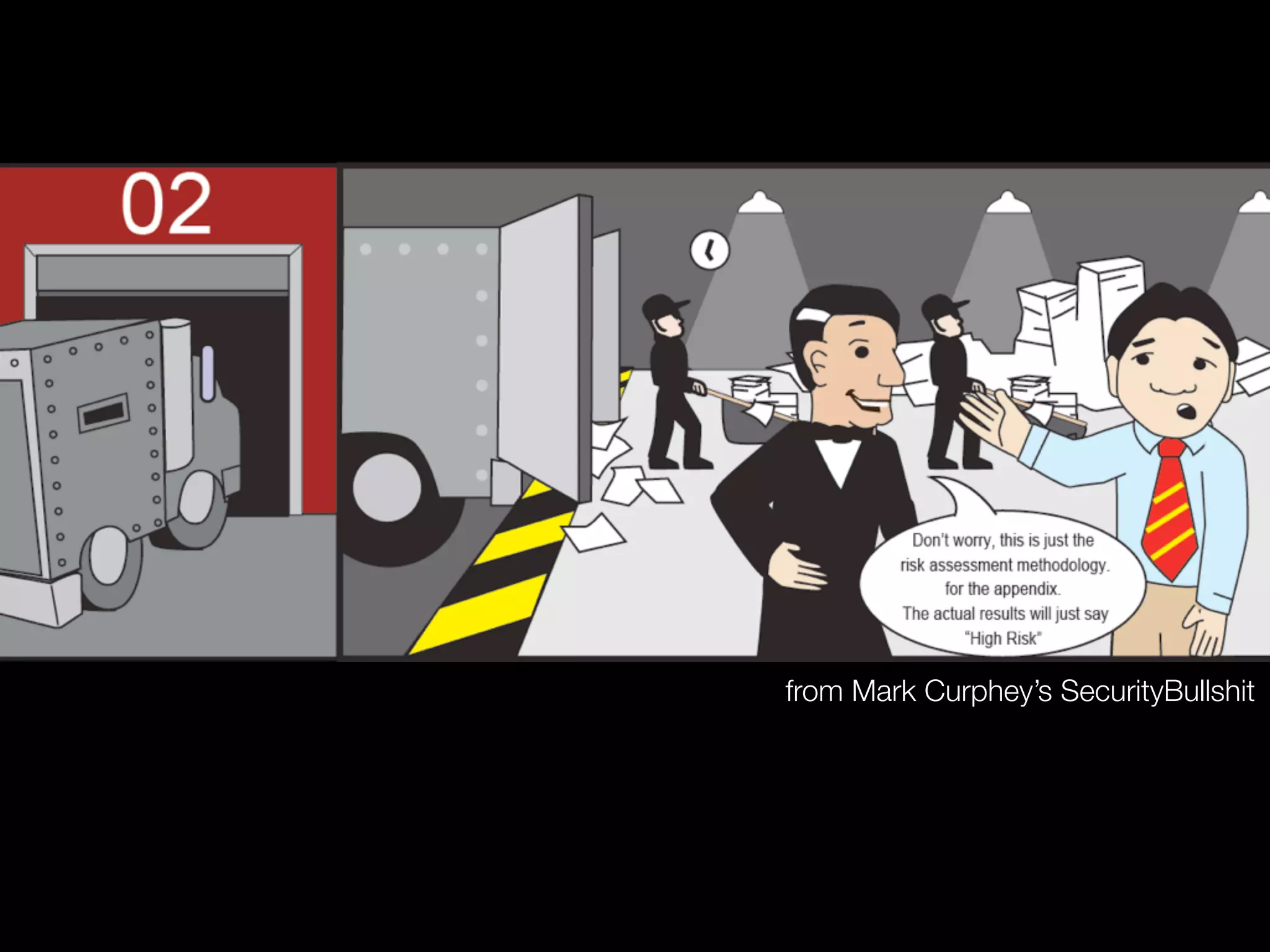
from Mark Curphey’s SecurityBullshit
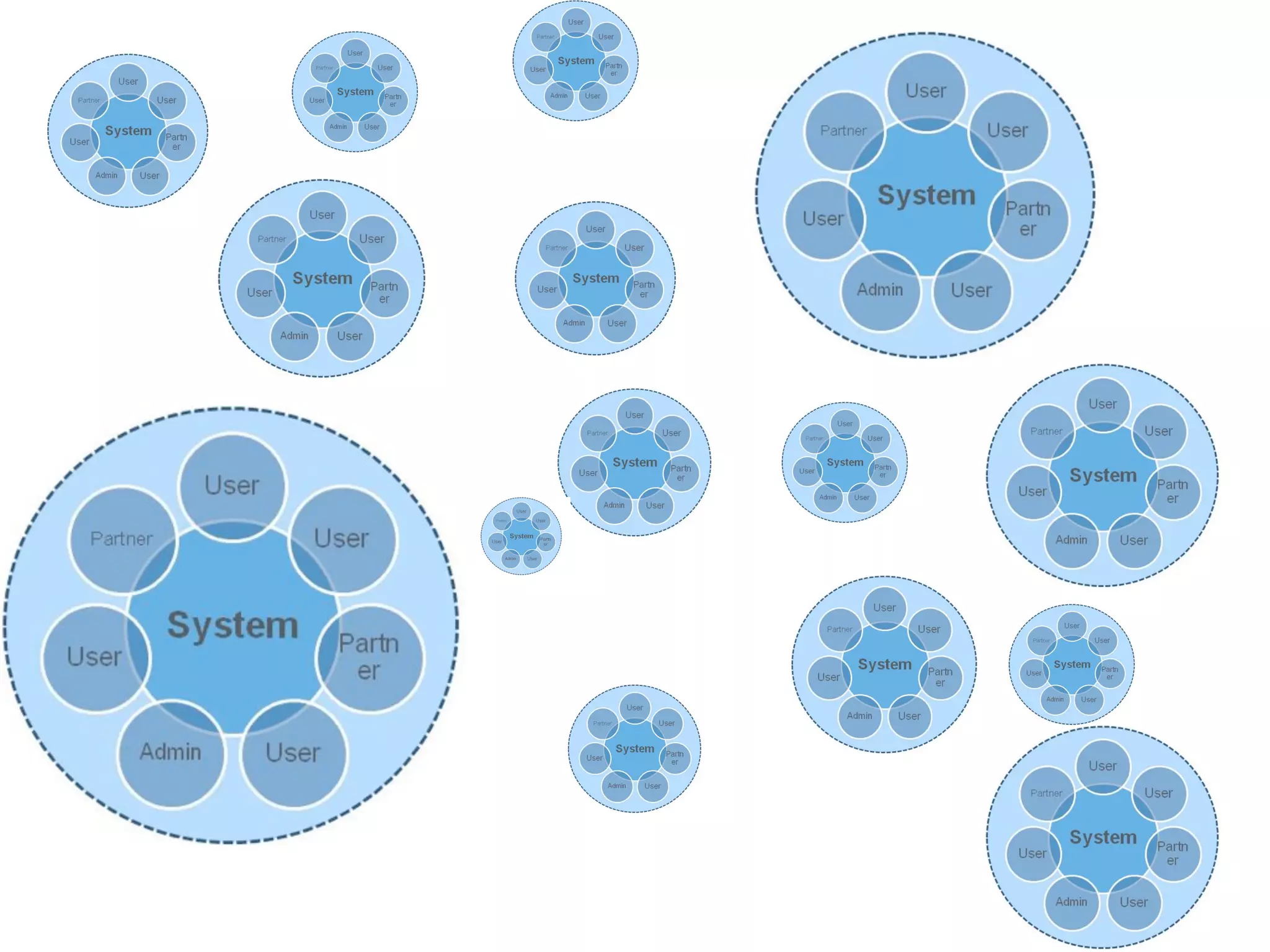
Complex
Systems
Complex Adaptive
Systems
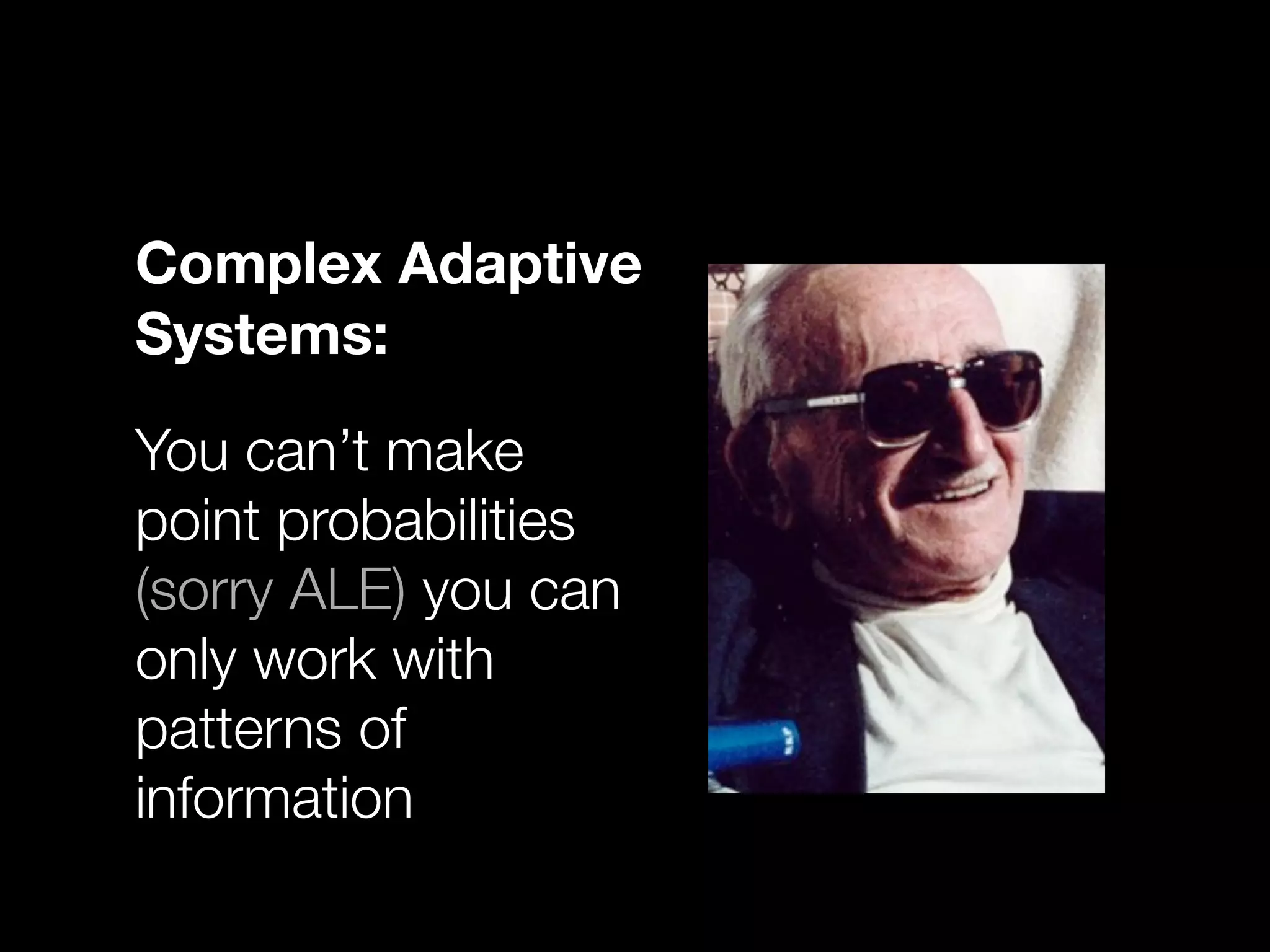
Complex Adaptive
Systems:

You can’t make
point probabilities
(sorry ALE) you can
only work with
patterns of
information
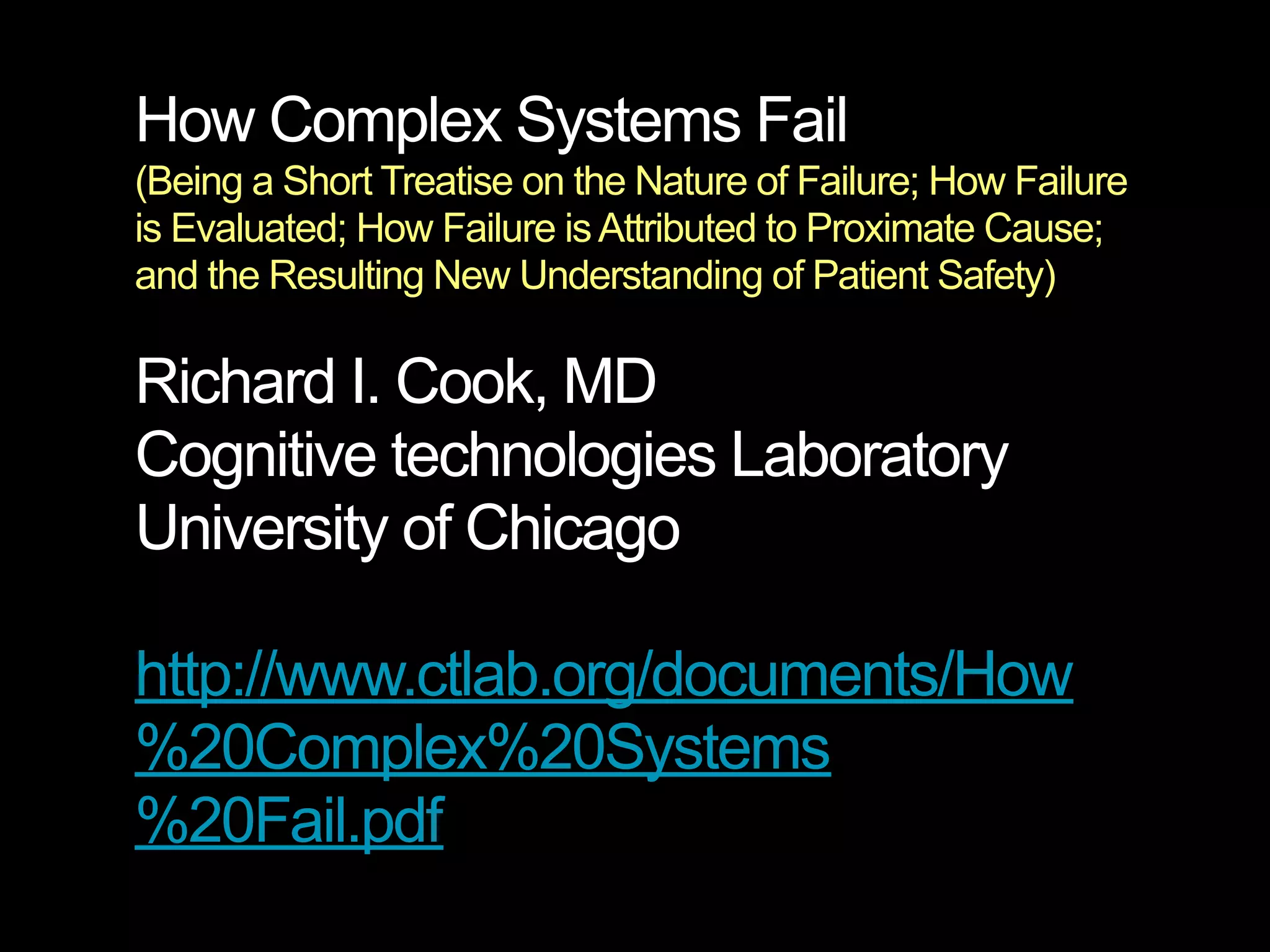
How Complex Systems Fail
(Being a Short Treatise on the Nature of Failure; How Failure
is Evaluated; How Failure is Attributed to Proximate Cause;
and the Resulting New Understanding of Patient Safety)

Richard I. Cook, MD
Cognitive technologies Laboratory
University of Chicago

http://www.ctlab.org/documents/How
%20Complex%20Systems
%20Fail.pdf
Because we’re dealing with
Complex Adaptive Systems

engineering risk statements = bankrupt


                                 (sorry GRC)
We need a new approach
Complex Systems Create a business process

Process is a collection of system interaction
(system behavior)

Process has human interaction
(human behavior)
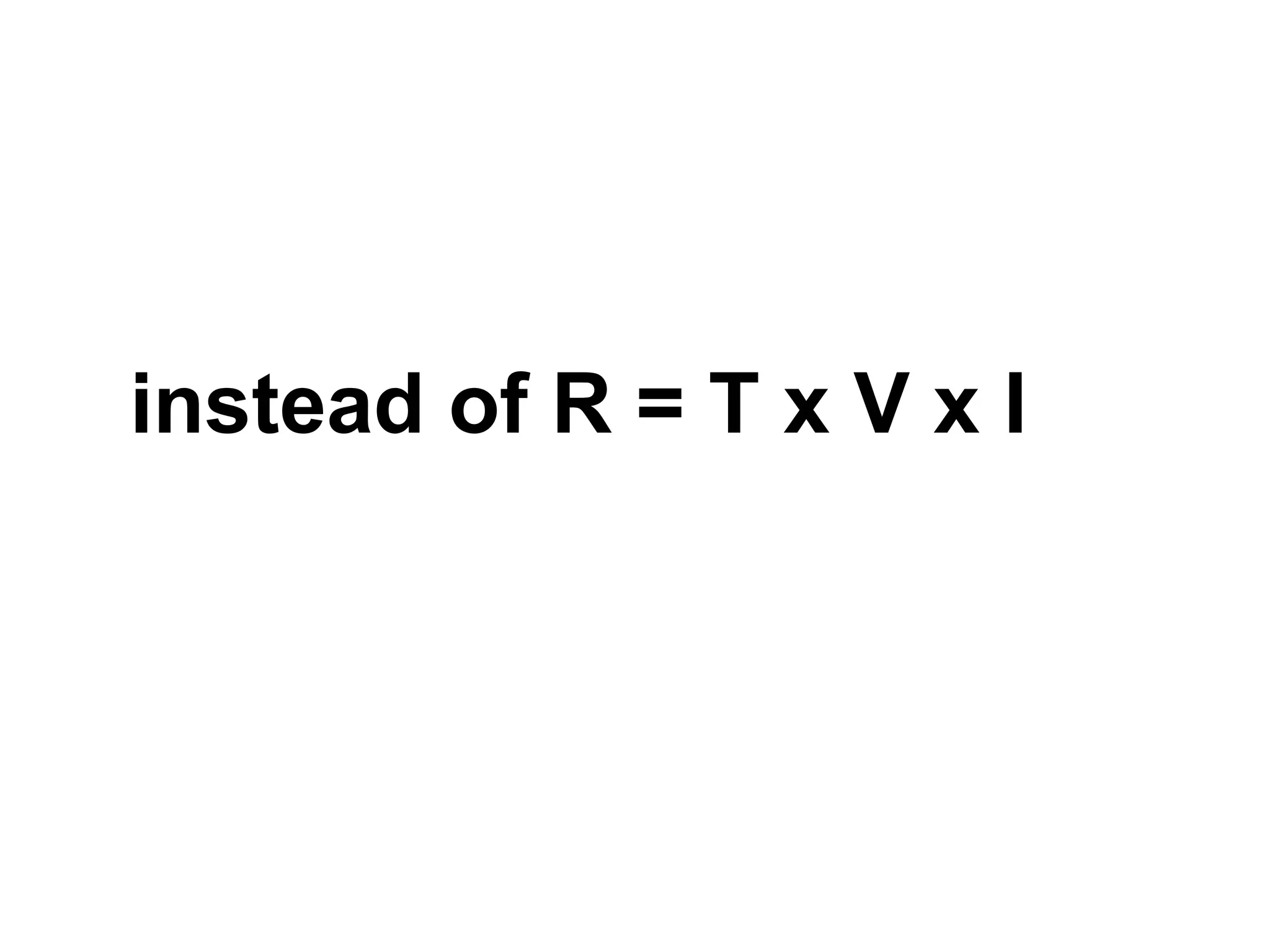
instead of R = T x V x I
behavioral analytics &
data driven management
evidence based risk
management
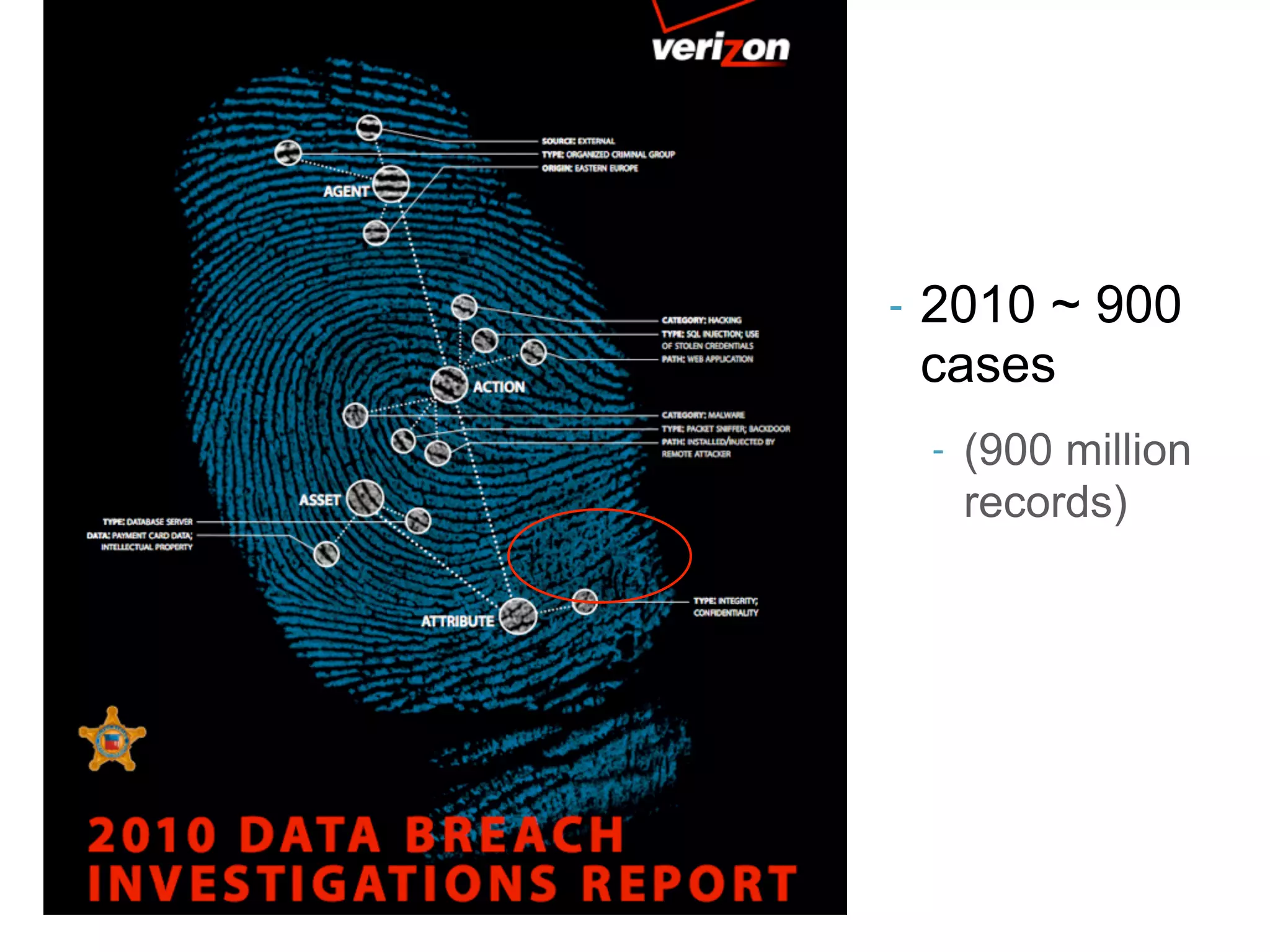
Verizon has shared data
-   2010 ~ 900
    cases
    -   (900 million
        records)
Verizon is sharing our
framework
Verizon Enterprise Risk & Incident Sharing
          (VERIS) Framework
                it’s open*!


                                 * kinda
What is the Verizon Incident Sharing (VERIS)
Framework?


 - A means   to create metrics
   from the incident narrative

    -   how Verizon creates measurements for the
        DBIR
    -   how *anyone* can create measurements from
        an incident
    -   https://verisframework.wiki.zoho.com
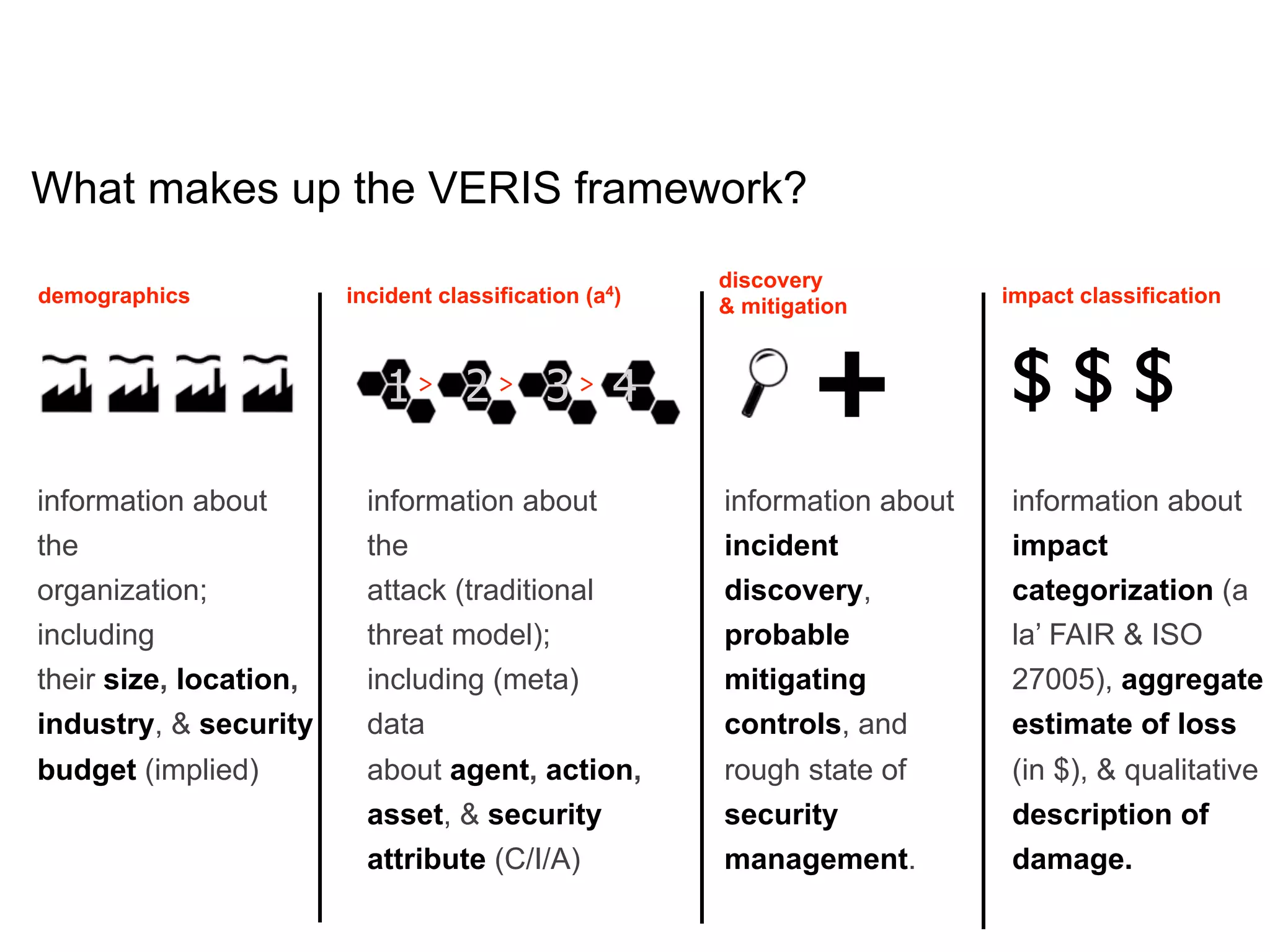
What makes up the VERIS framework?
                                                       discovery
demographics            incident classification (a4)   & mitigation        impact classification


                            1> 2> 3> 4
                                                               +           $$$
information about         information about            information about   information about
the                       the                          incident            impact
organization;             attack (traditional          discovery,          categorization (a
including                 threat model);               probable            la’ FAIR & ISO
their size, location,     including (meta)             mitigating          27005), aggregate
industry, & security      data                         controls, and       estimate of loss
budget (implied)          about agent, action,         rough state of      (in $), & qualitative
                          asset, & security            security            description of
                          attribute (C/I/A)            management.         damage.
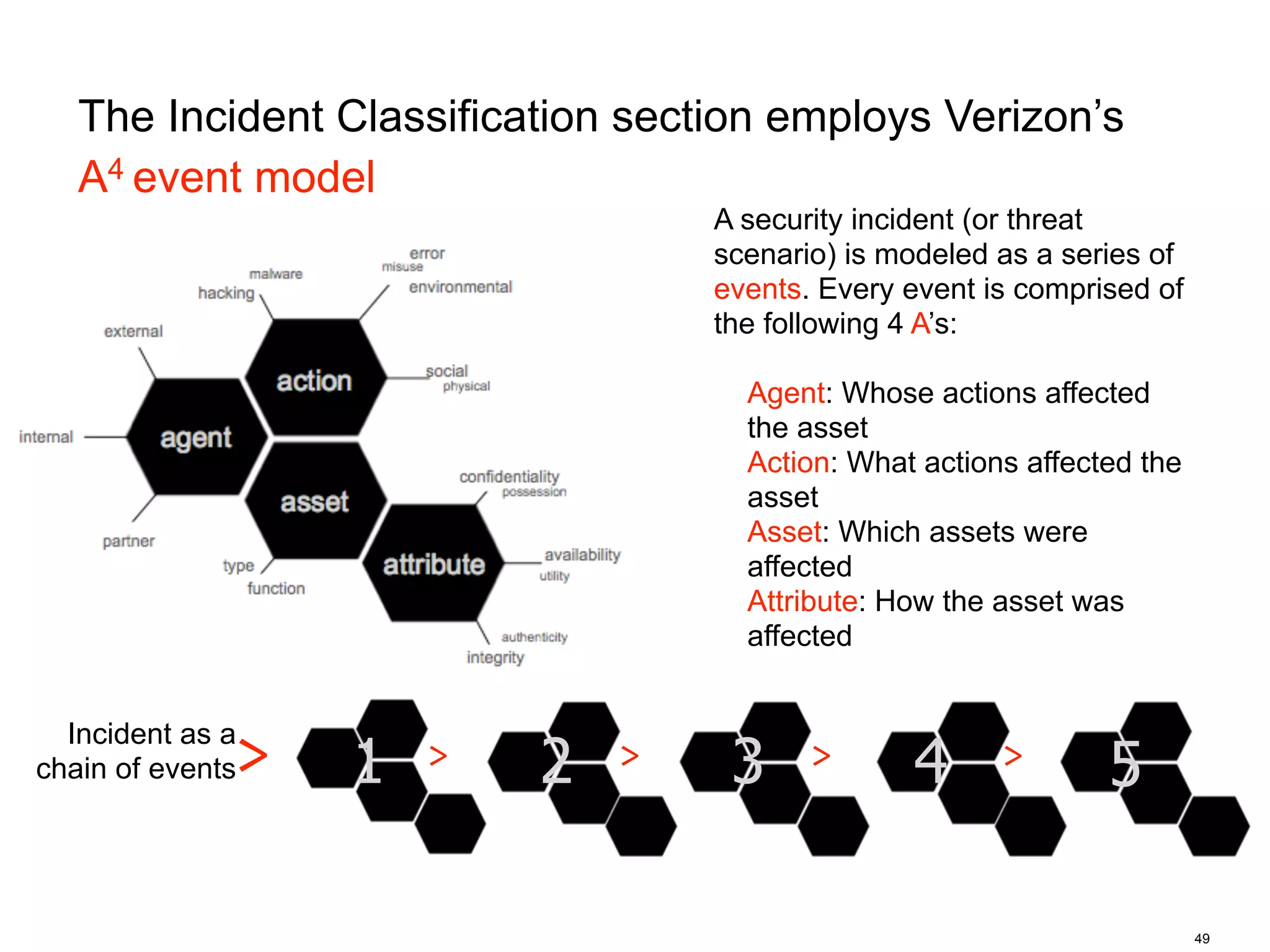
The Incident Classification section employs Verizon’s
   A4 event model
                                   A security incident (or threat
                                   scenario) is modeled as a series of
                                   events. Every event is comprised of
                                   the following 4 A’s:

                                     Agent: Whose actions affected
                                     the asset
                                     Action: What actions affected the
                                     asset
                                     Asset: Which assets were
                                     affected
                                     Attribute: How the asset was
                                     affected


              >
  Incident as a
chain of events   1   >   2   >     3     >      4      >       5

                                                                         49
Cybertrust Security


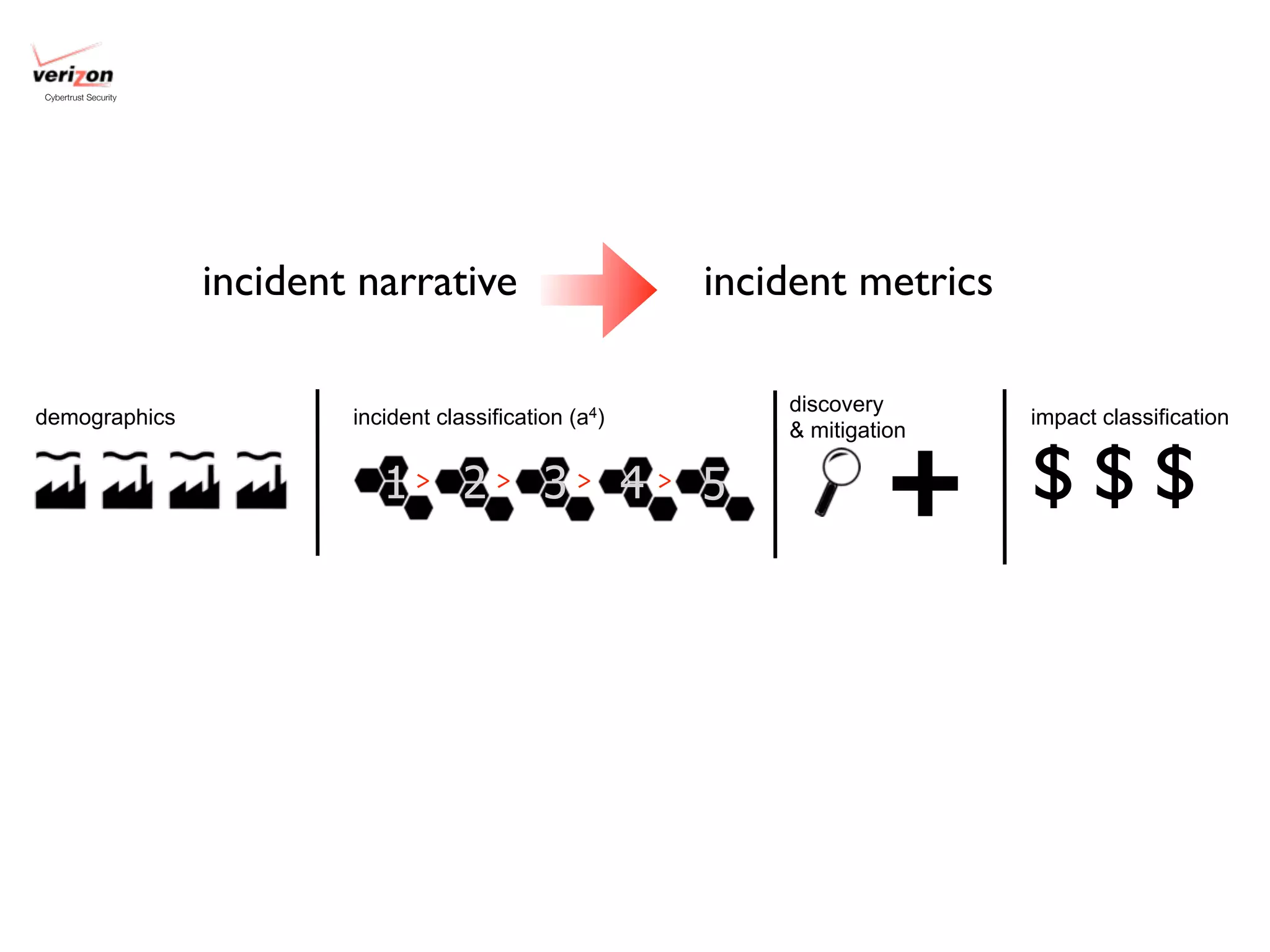
                      incident narrative                     incident metrics

                                                                 discovery
demographics                  incident classification (a4)                      impact classification


                                                                          +
                                                                 & mitigation

                                 1> 2> 3> 4 > 5                                 $$$
Cybertrust Security
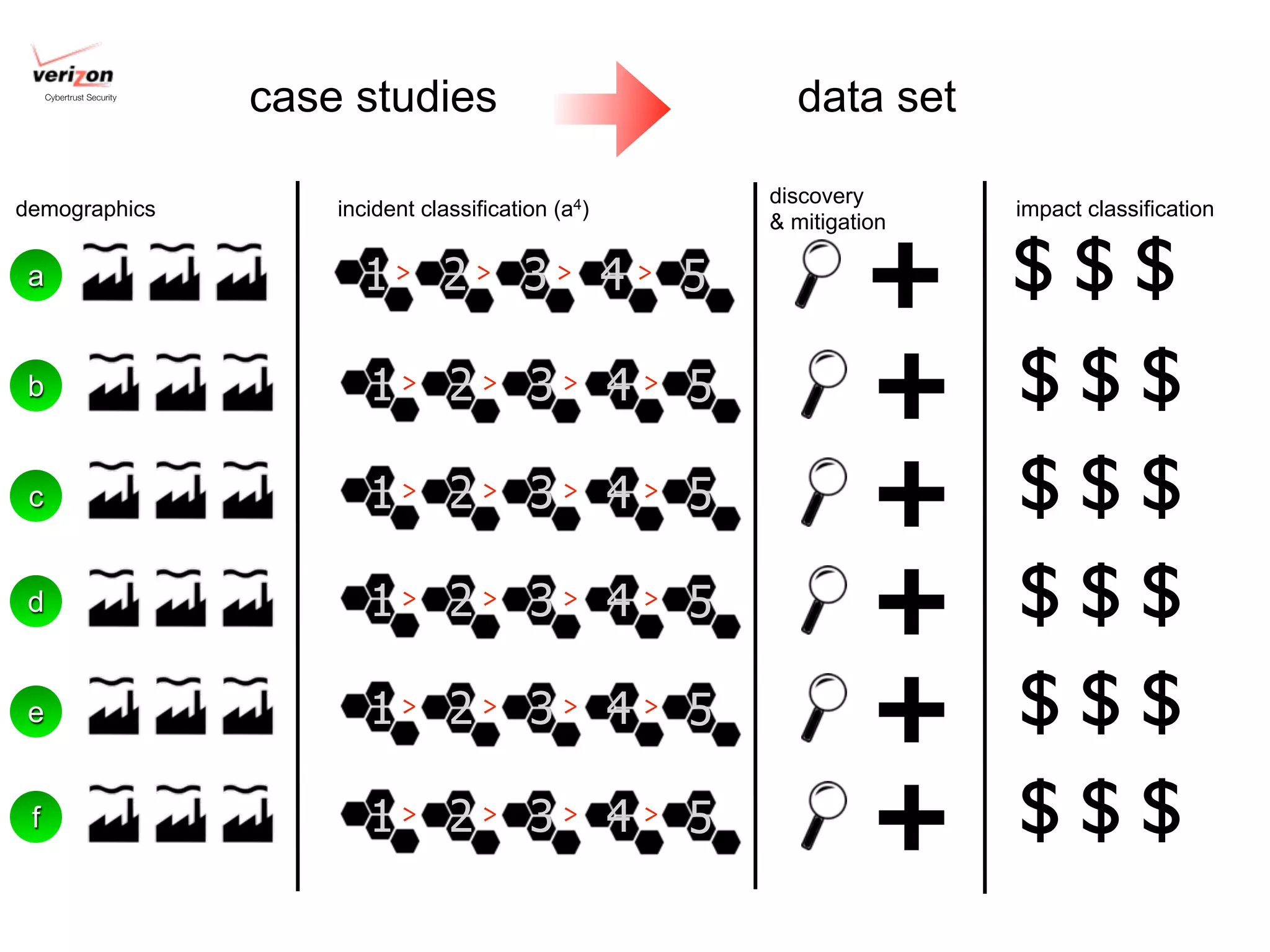
                           case studies                         data set

                                                              discovery
demographics                   incident classification (a4)                  impact classification


                                                                       +
                                                              & mitigation

 a                               1> 2> 3> 4 > 5                              $$$
 b                                1> 2> 3> 4 > 5
                                                                       +     $$$
 c                                1> 2> 3> 4 > 5
                                                                       +     $$$
 d                                1> 2> 3> 4 > 5
                                                                       +     $$$
 e                                1> 2> 3> 4 > 5
                                                                       +     $$$
 f                                1> 2> 3> 4 > 5
                                                                       +     $$$
Cybertrust Security


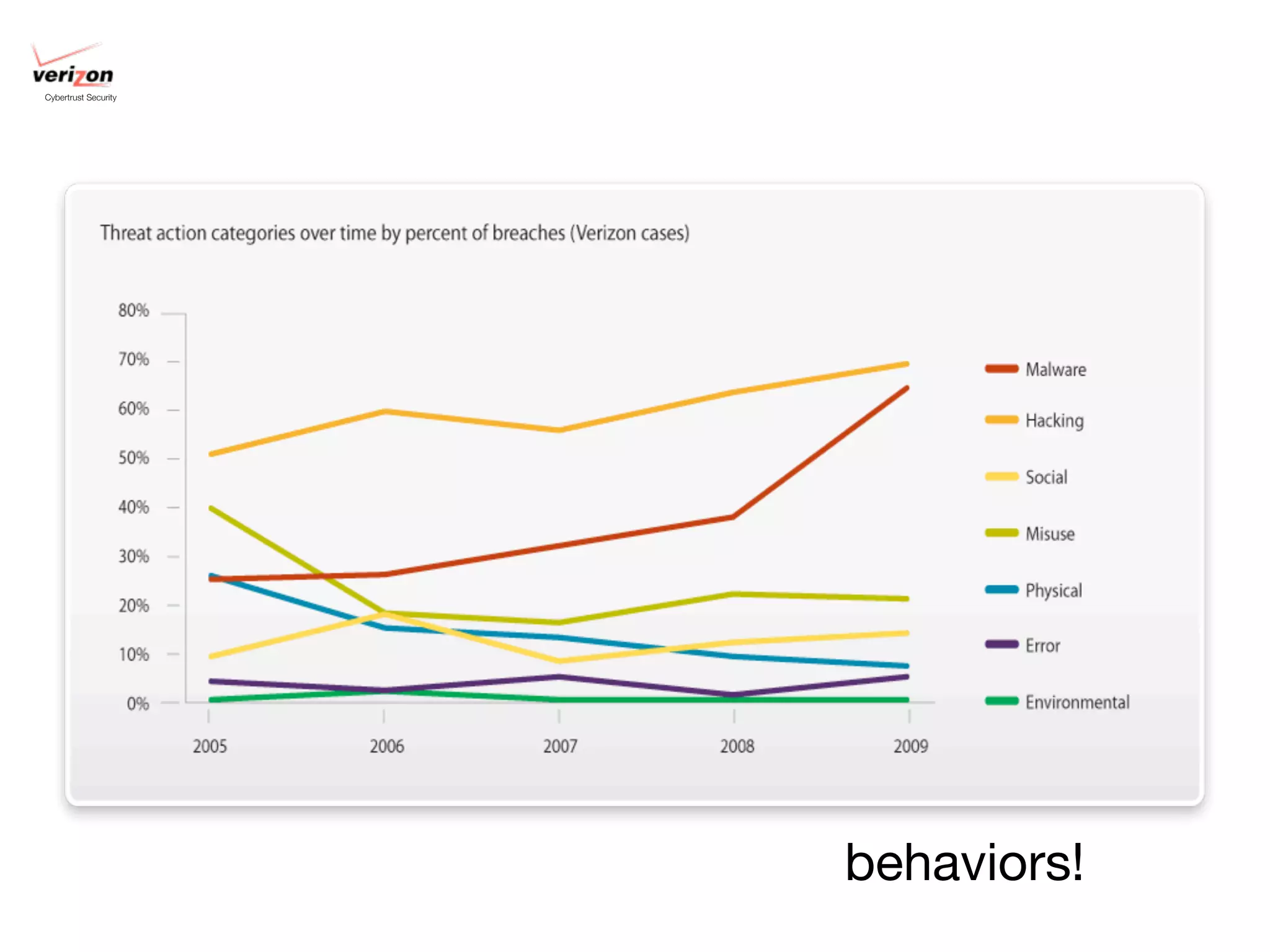
                      behaviors!
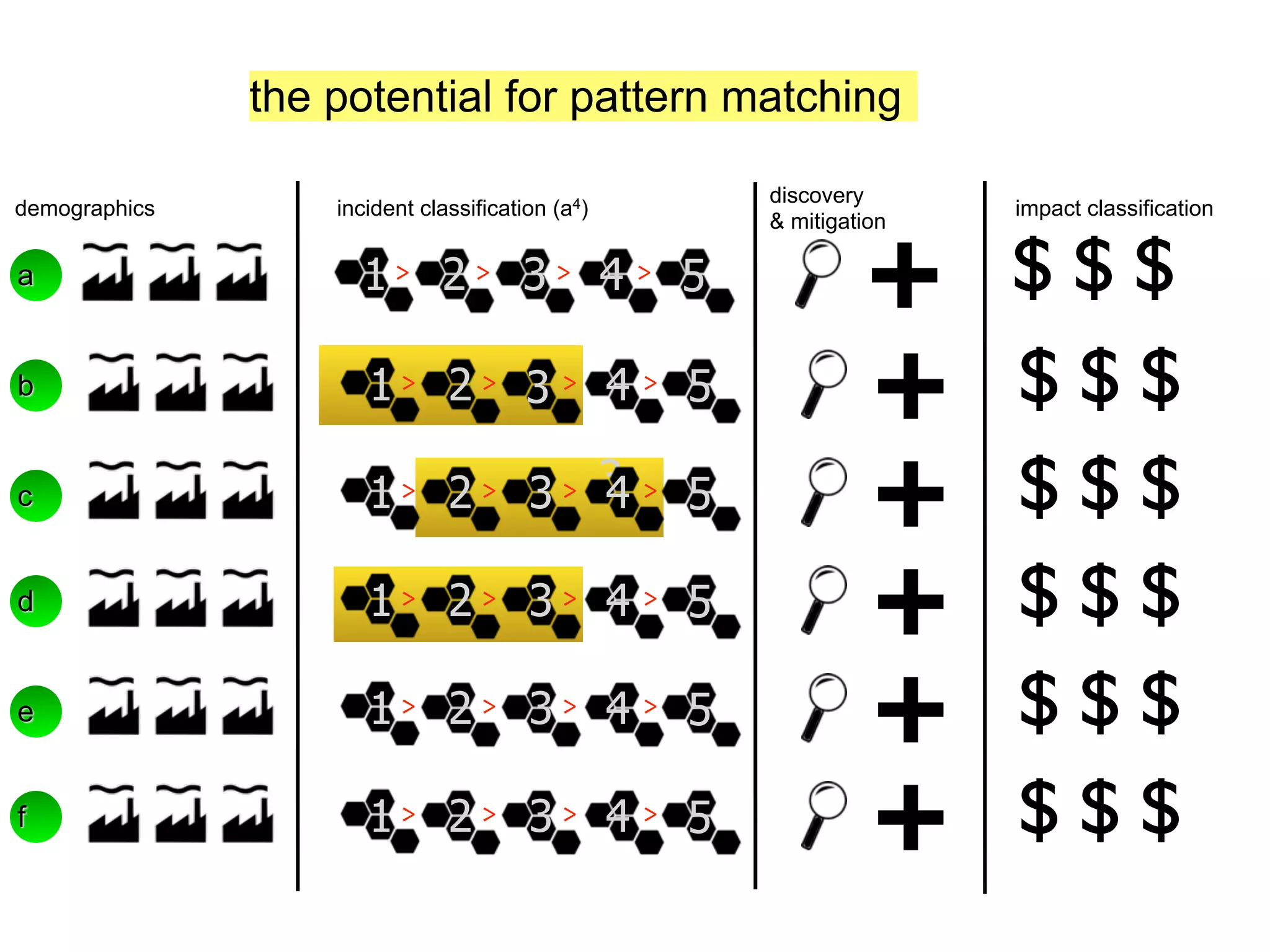
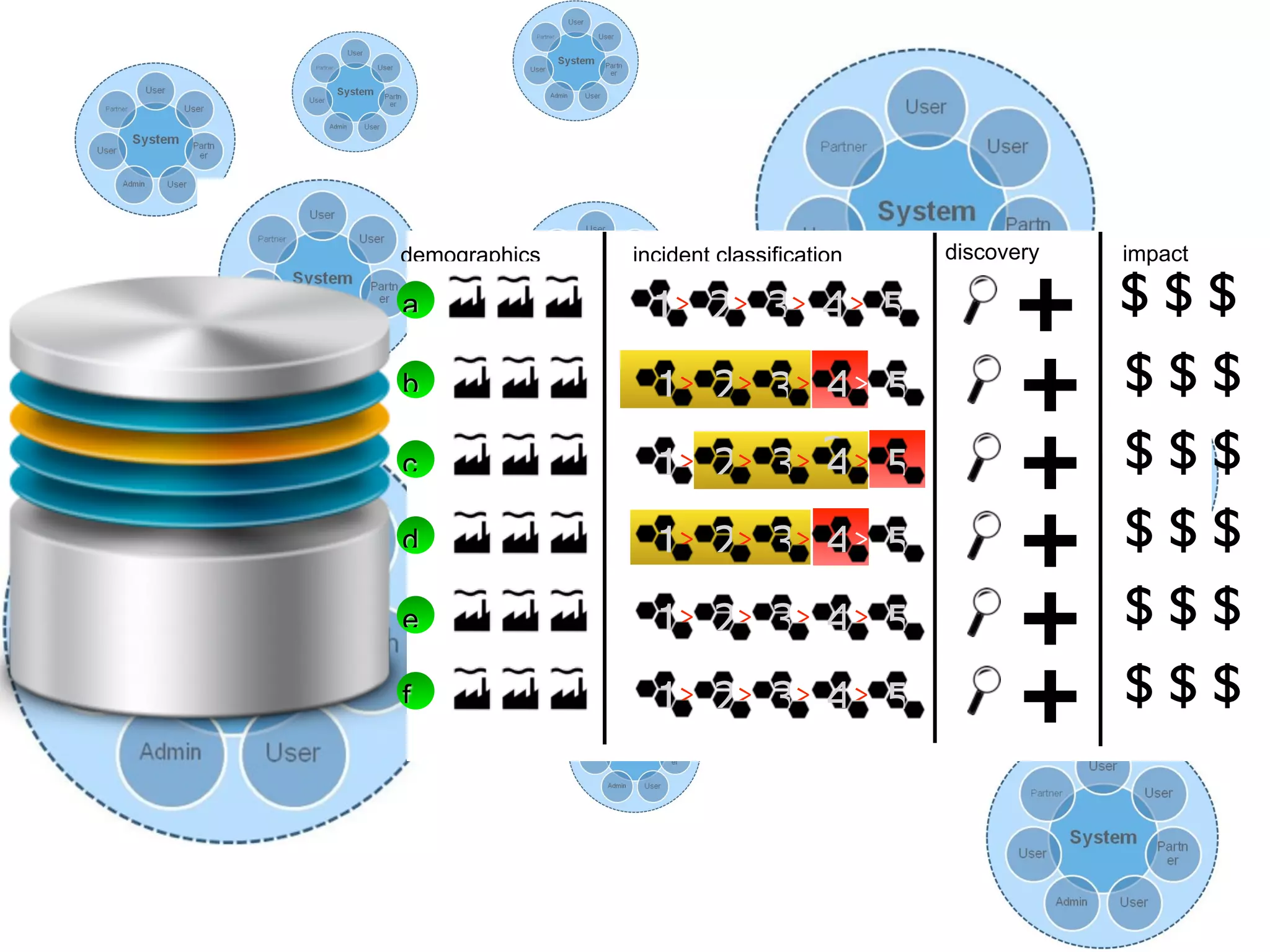
the potential for pattern matching

                                                  discovery
demographics       incident classification (a4)                  impact classification


                                                           +
                                                  & mitigation

a                    1> 2> 3> 4 > 5                              $$$
b                     1> 2> 3 > 4 > 5
                                                           +     $$$
c                     1> 2> 3> 3 > 5
                               4
                                                           +     $$$
d                     1> 2> 3> 4 > 5
                                                           +     $$$
e                     1> 2> 3> 4 > 5
                                                           +     $$$
f                     1> 2> 3> 4 > 5
                                                           +     $$$
Fraud, Incidents, and
Good Lord Of The Dance:

creating models for
the real management
of risk
F
r
a
u
d
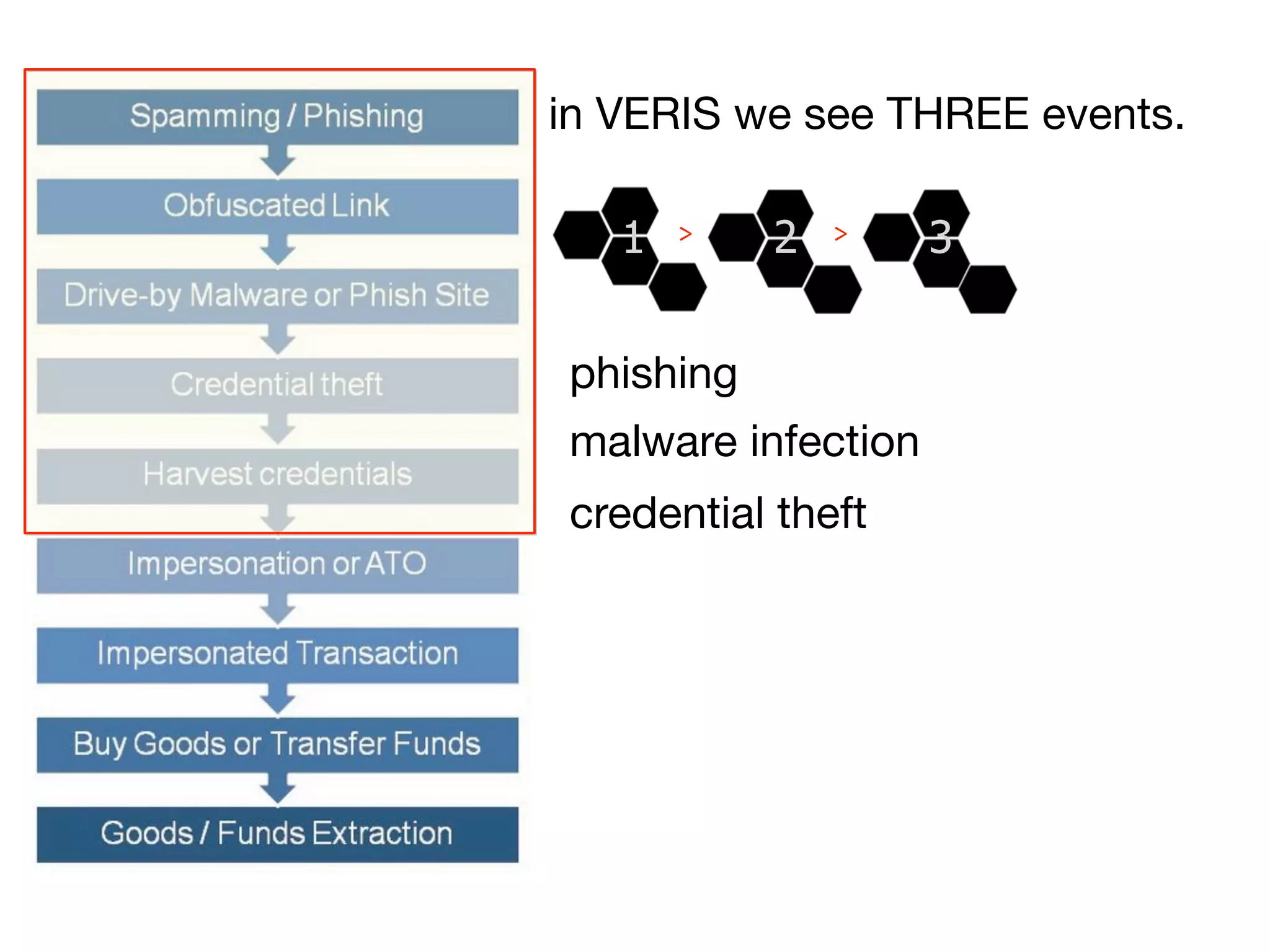
in VERIS we see THREE events.

   1   >   2   >    3


phishing
malware infection
credential theft
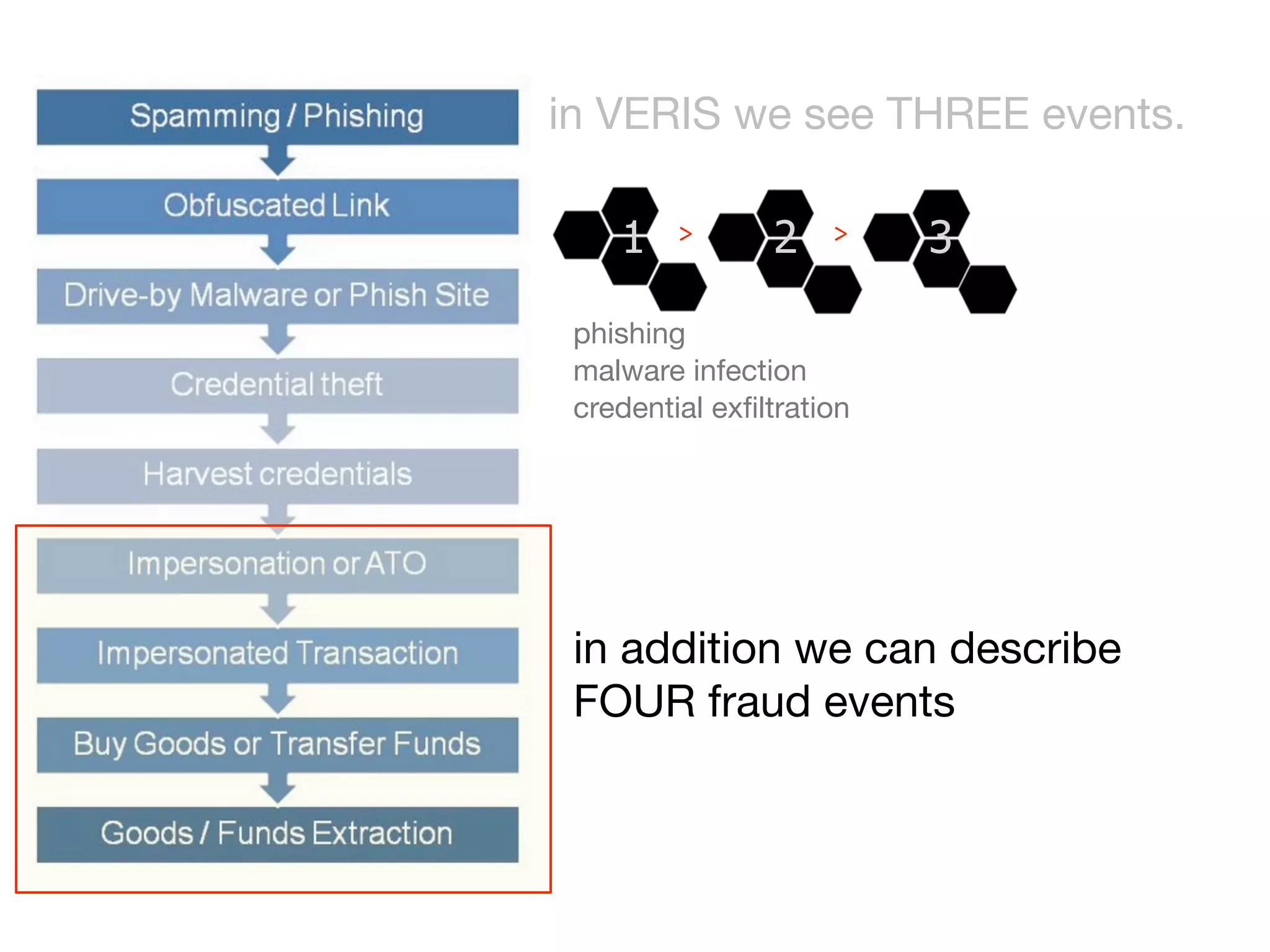
in VERIS we see THREE events.

    1    >      2    >    3

 phishing
 malware infection
 credential exfiltration


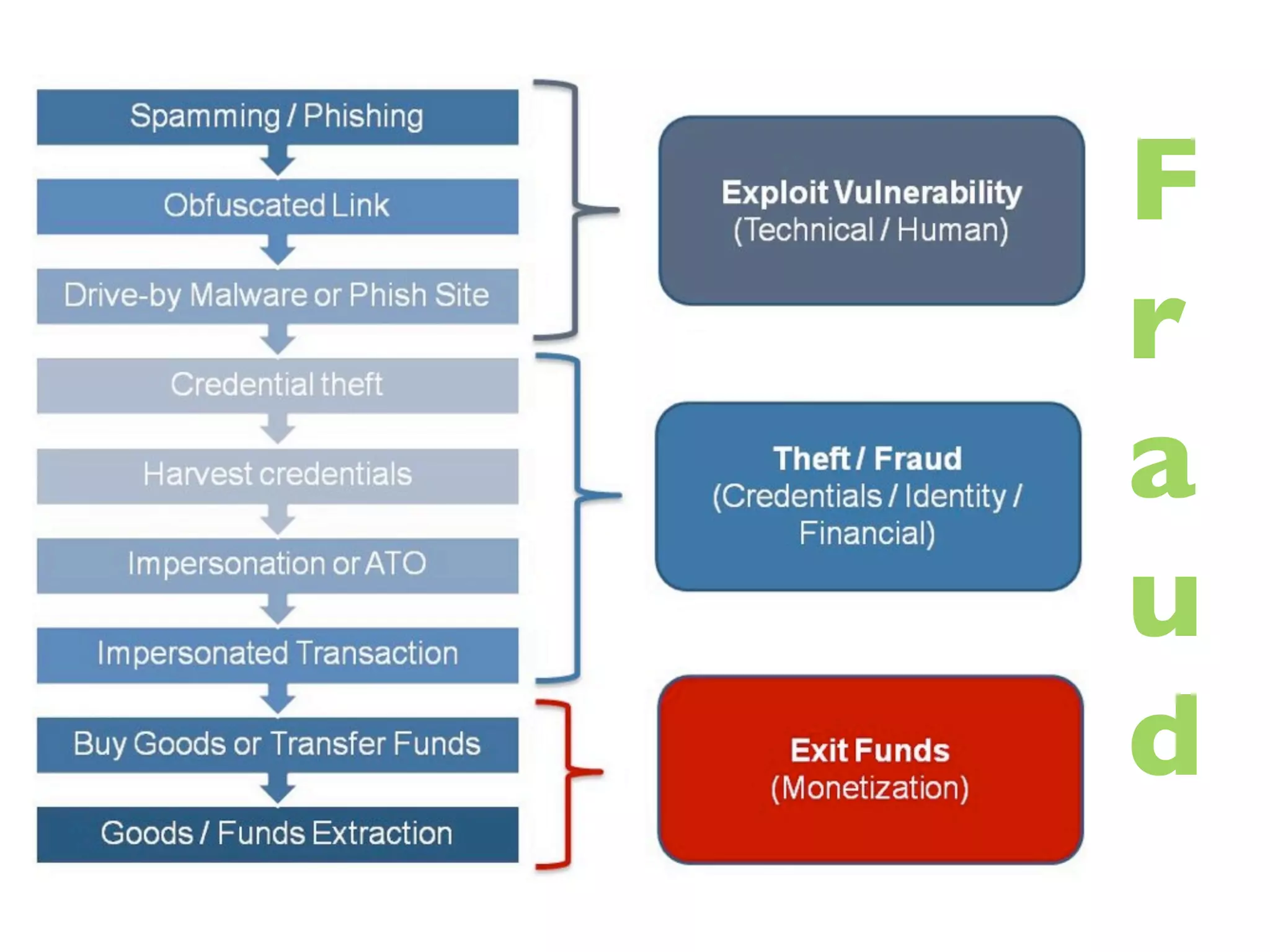
 in addition we can describe
 FOUR fraud events
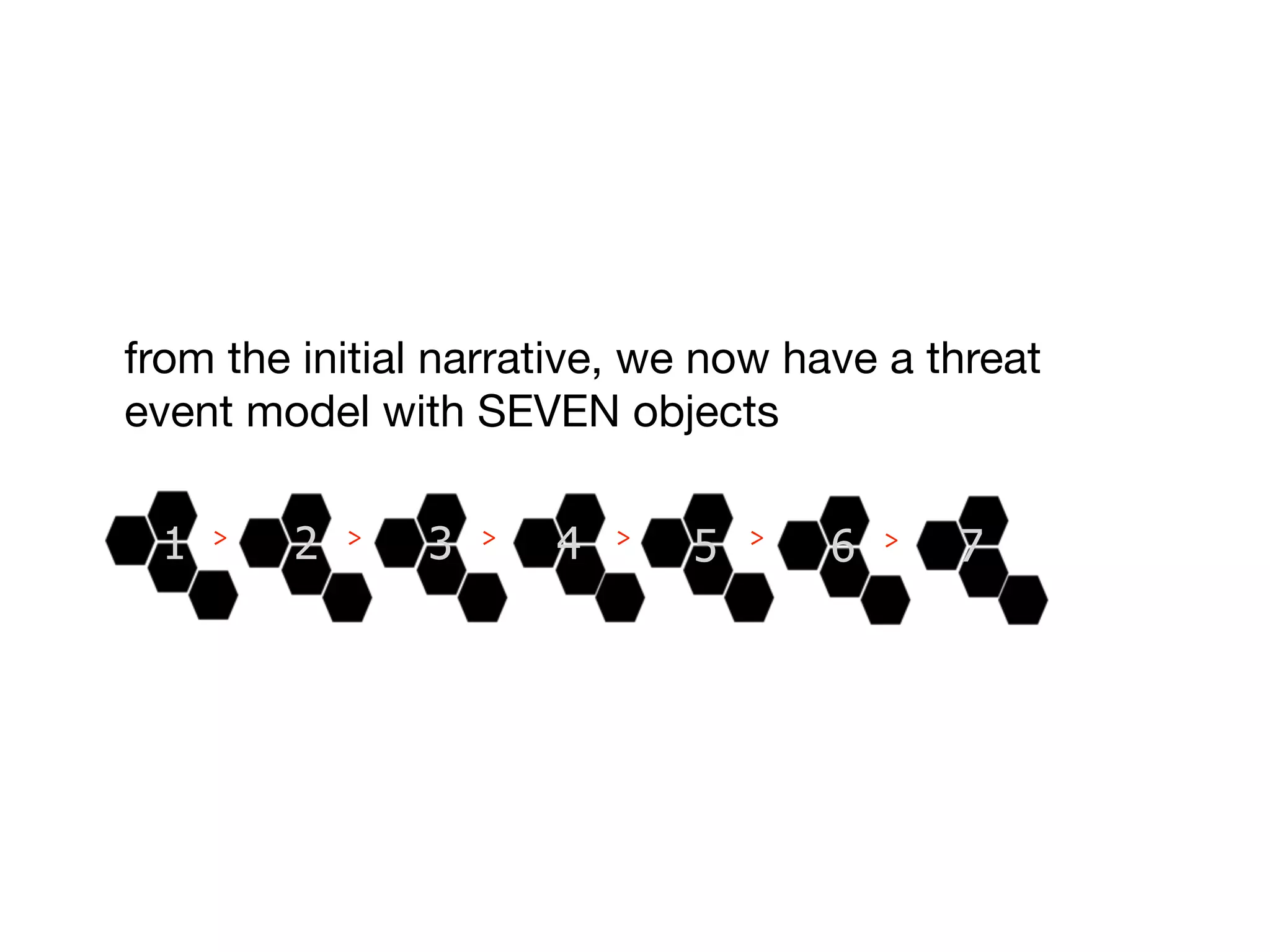
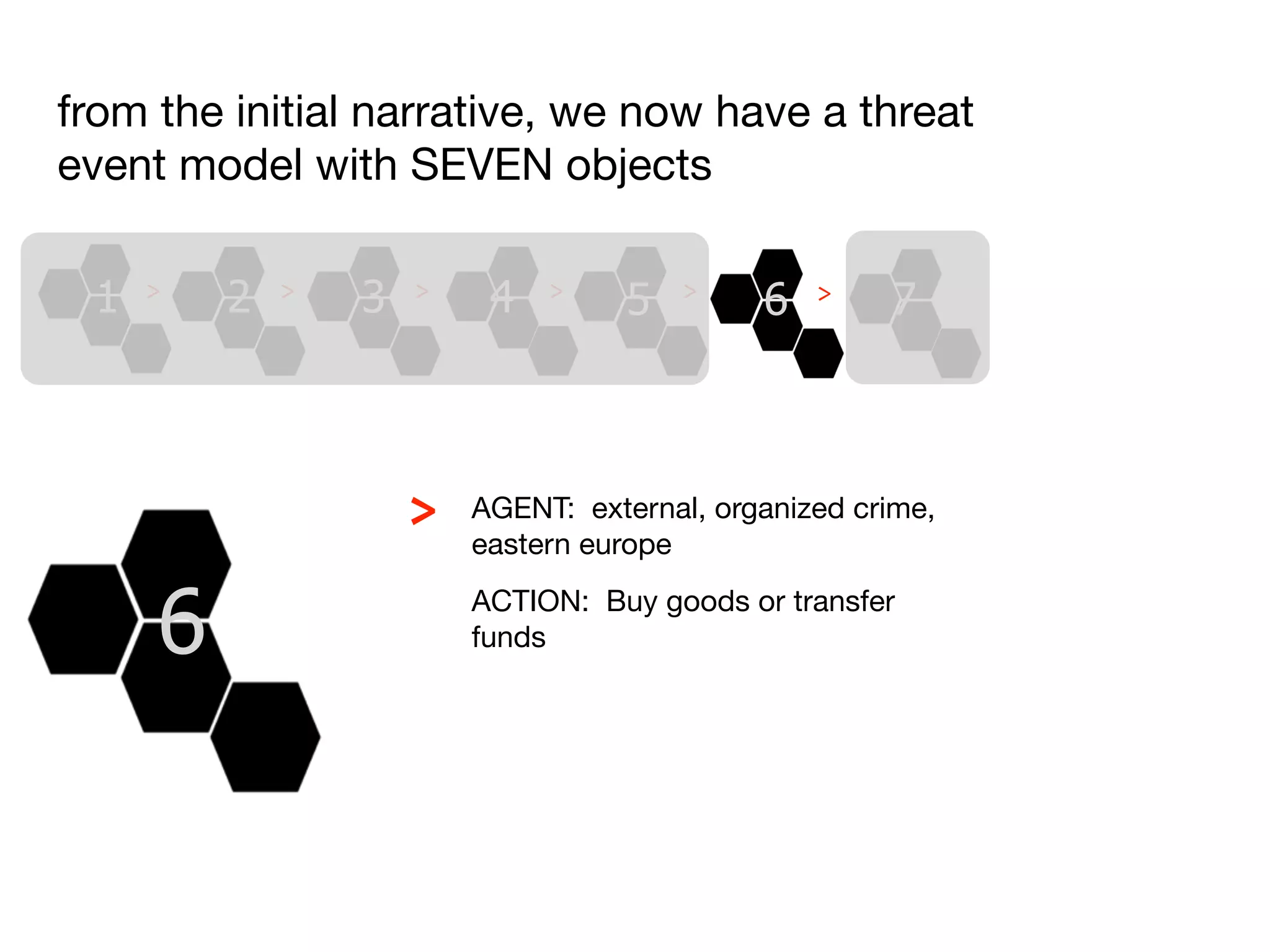
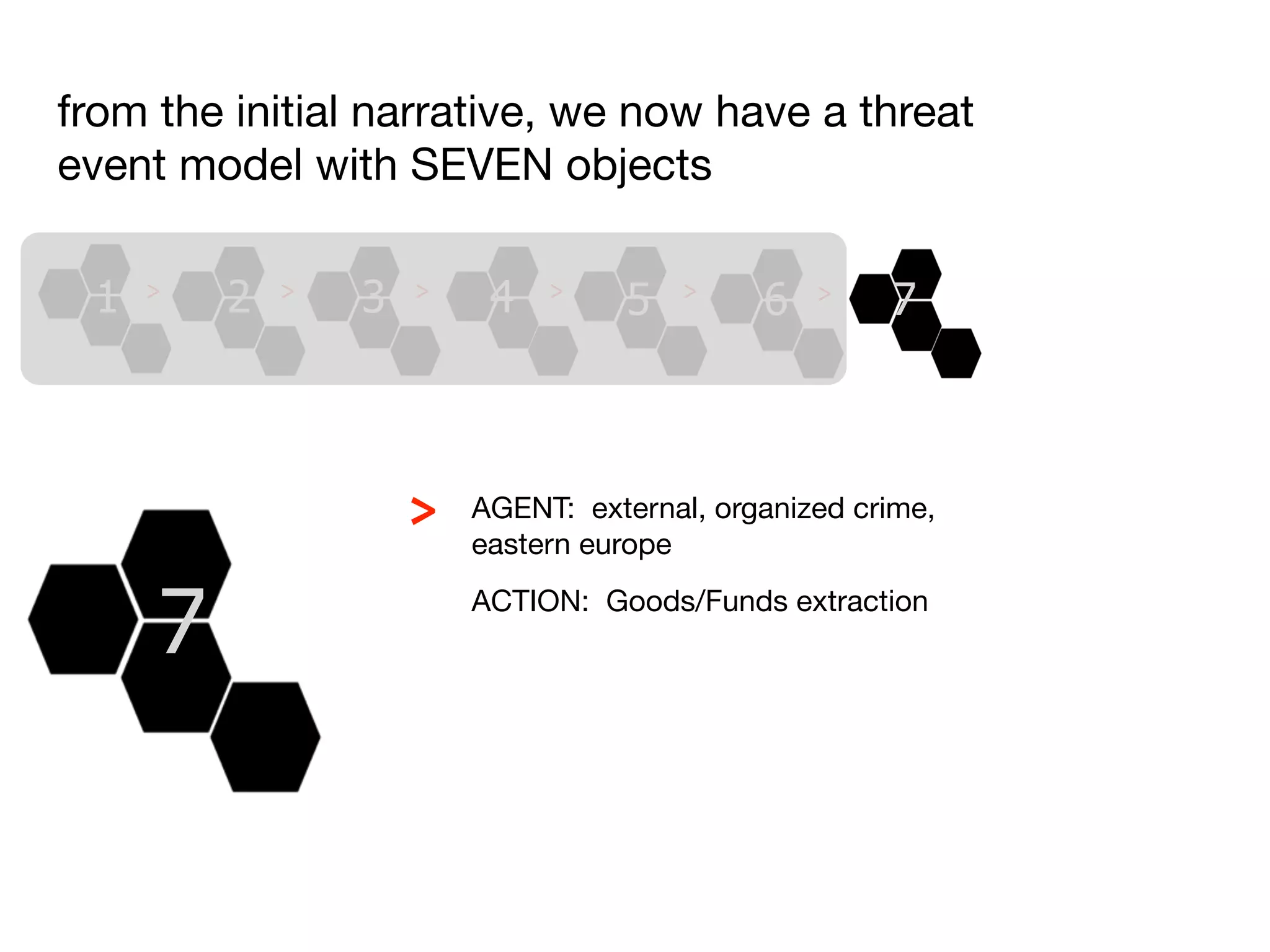
from the initial narrative, we now have a threat
event model with SEVEN objects

 1   >   2   >   3   >   4   >
                                 5   >
                                         6   >   7
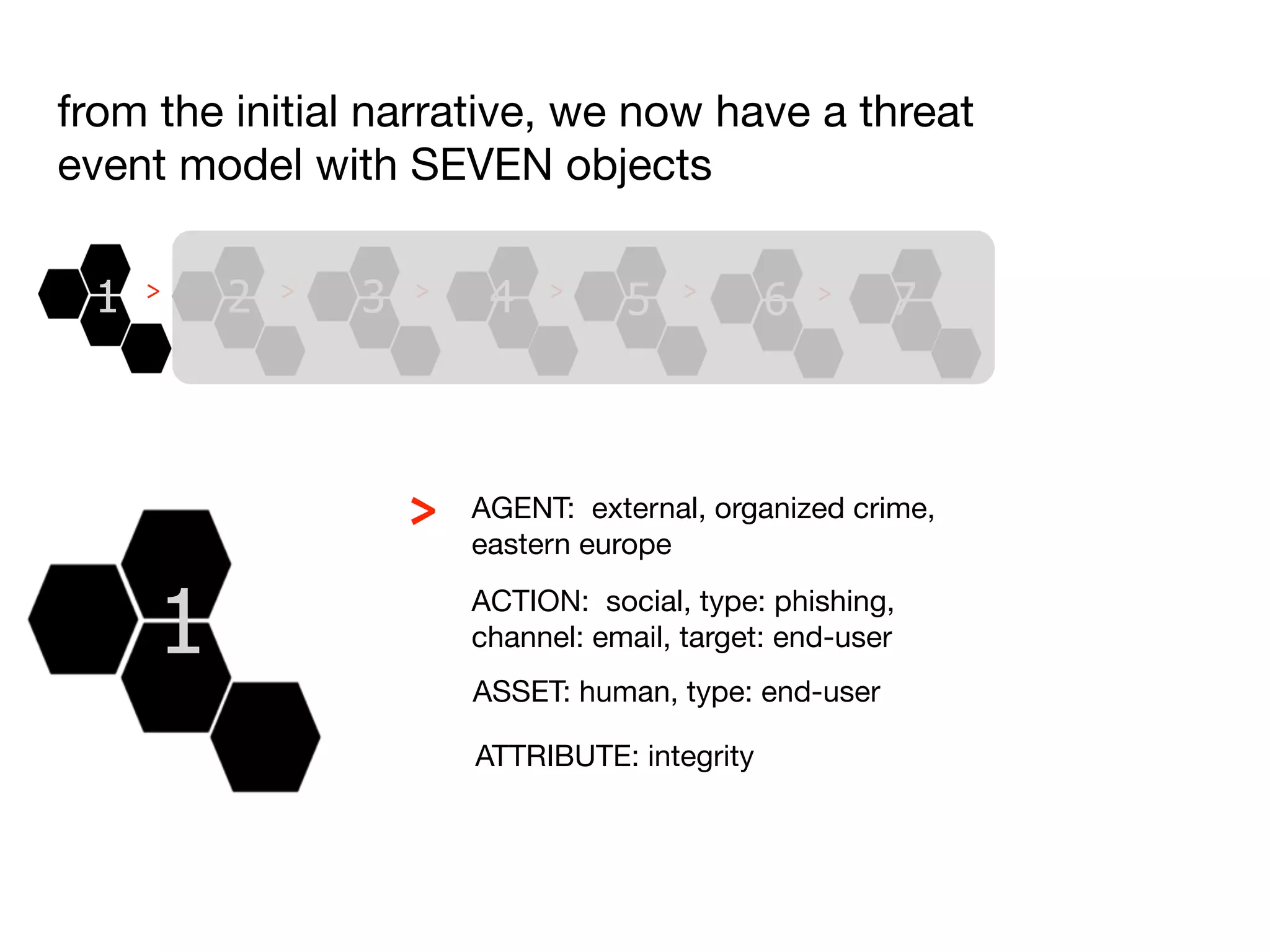
from the initial narrative, we now have a threat
event model with SEVEN objects

 1   >   2   >   3   >    4   >
                                    5   >
                                                6   >   7


                     >   AGENT: external, organized crime,
                         eastern europe


     1                   ACTION: social, type: phishing,
                         channel: email, target: end-user
                         ASSET: human, type: end-user

                         ATTRIBUTE: integrity
from the initial narrative, we now have a threat
event model with SEVEN objects

 1   >   2   >   3   >    4   >
                                    5   >
                                                6   >   7


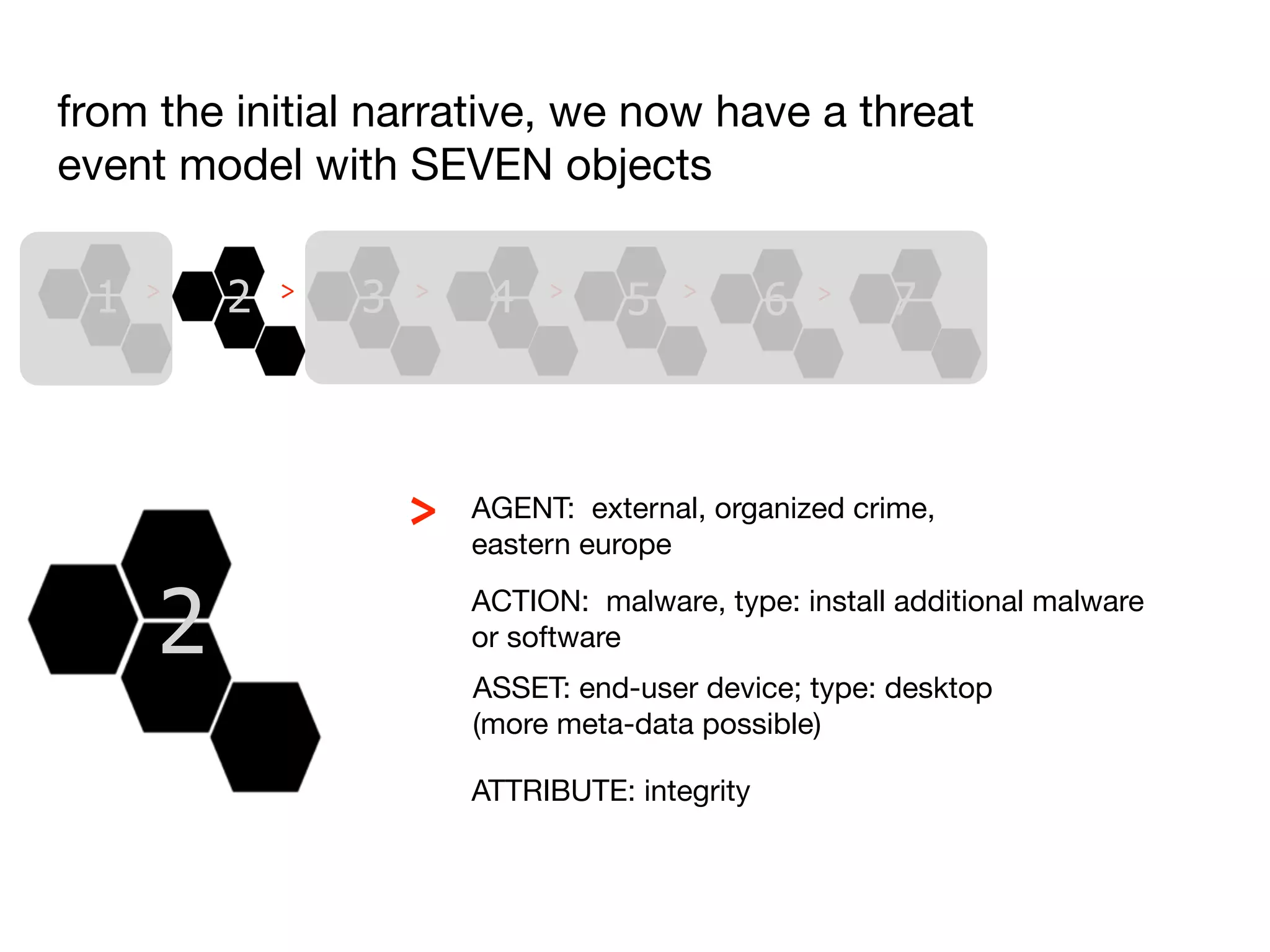
                     >   AGENT: external, organized crime,
                         eastern europe


     2                   ACTION: malware, type: install additional malware
                         or software
                         ASSET: end-user device; type: desktop
                         (more meta-data possible)

                         ATTRIBUTE: integrity
from the initial narrative, we now have a threat
event model with SEVEN objects

 1   >   2   >   3   >    4   >
                                    5   >
                                                 6   >   7


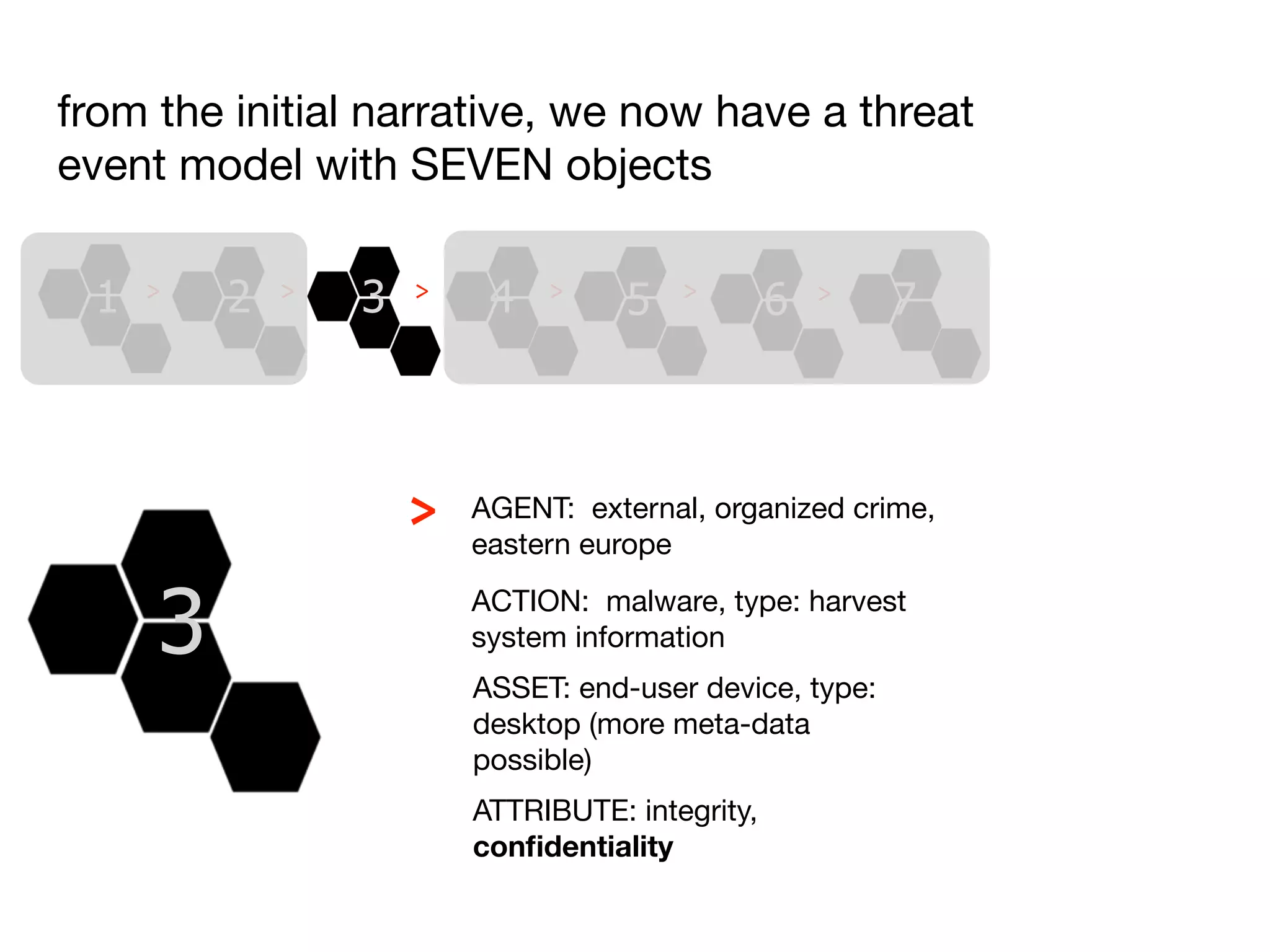
                     >   AGENT: external, organized crime,
                         eastern europe


     3                   ACTION: malware, type: harvest
                         system information
                         ASSET: end-user device, type:
                         desktop (more meta-data
                         possible)
                         ATTRIBUTE: integrity,
                         confidentiality
from the initial narrative, we now have a threat
event model with SEVEN objects

 1   >   2   >   3   >    4   >
                                    5   >
                                             6   >    7


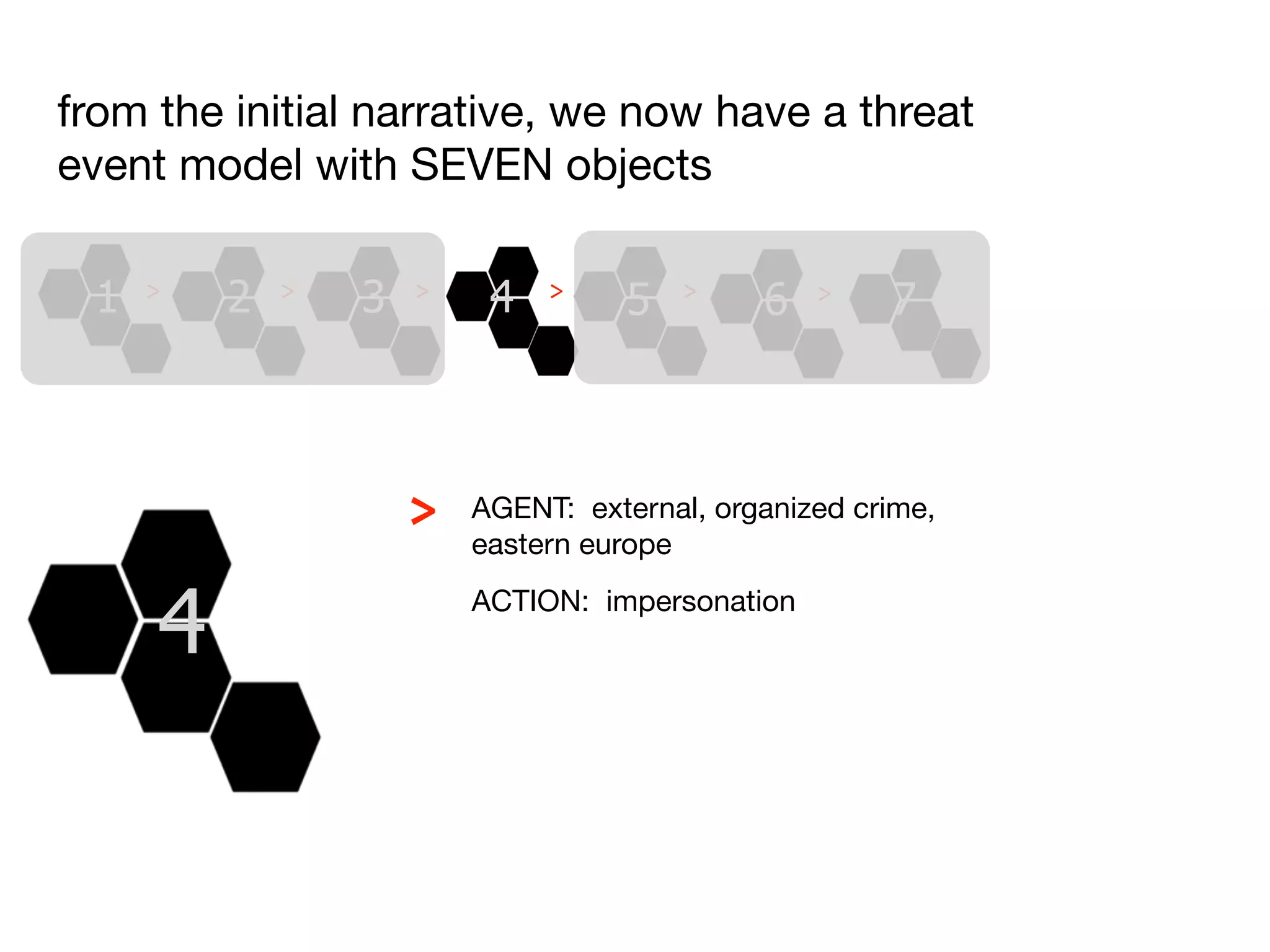
                     >   AGENT: external, organized crime,
                         eastern europe


     4                   ACTION: impersonation
from the initial narrative, we now have a threat
event model with SEVEN objects

 1   >   2   >   3   >    4   >
                                    5   >
                                             6   >    7


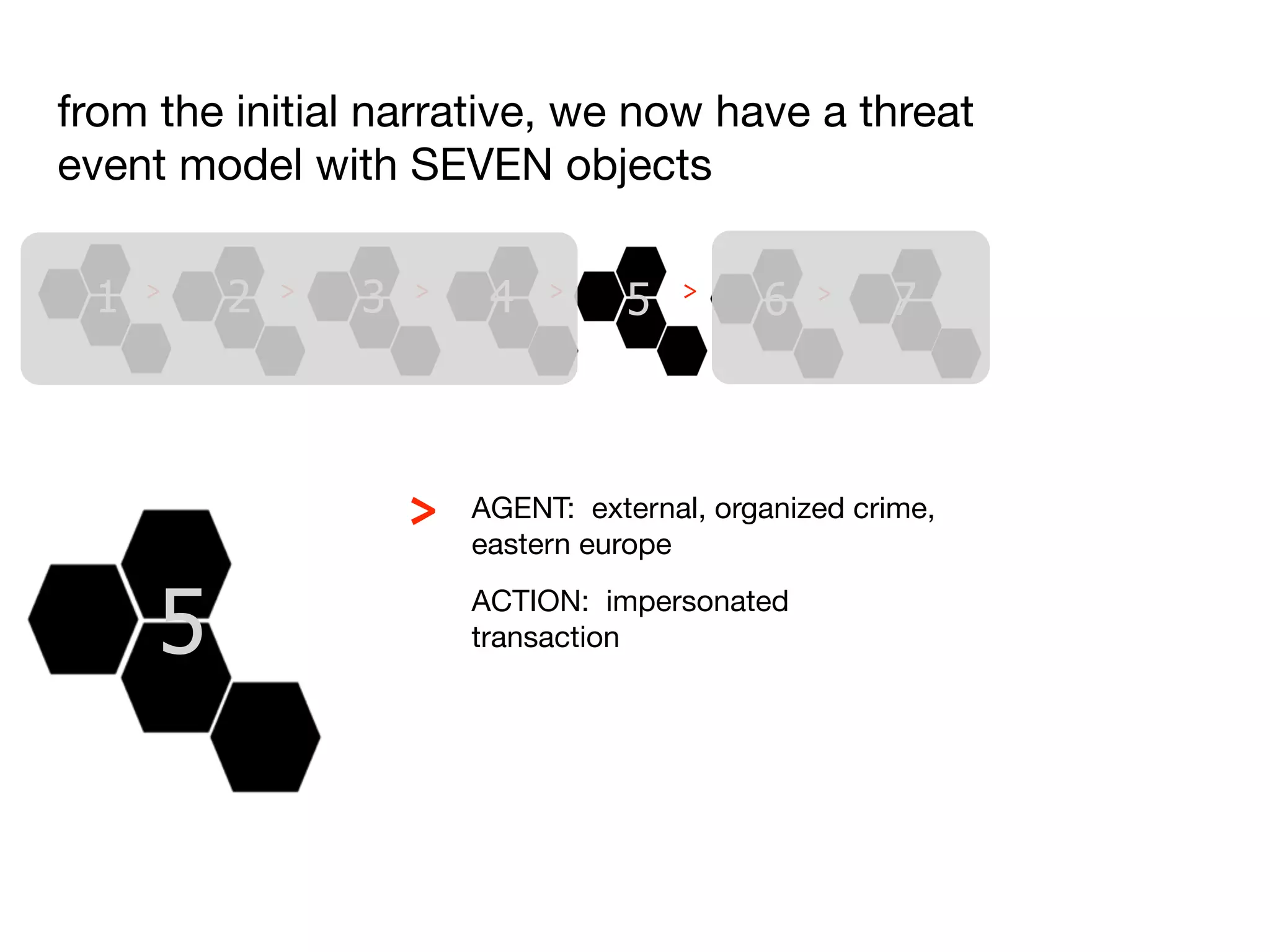
                     >   AGENT: external, organized crime,
                         eastern europe


     5                   ACTION: impersonated
                         transaction
from the initial narrative, we now have a threat
event model with SEVEN objects

 1   >   2   >   3   >    4   >
                                    5   >
                                             6   >    7


                     >   AGENT: external, organized crime,
                         eastern europe


     6                   ACTION: Buy goods or transfer
                         funds
from the initial narrative, we now have a threat
event model with SEVEN objects

 1   >   2   >   3   >    4   >
                                    5   >
                                             6   >    7


                     >   AGENT: external, organized crime,
                         eastern europe


     7                   ACTION: Goods/Funds extraction
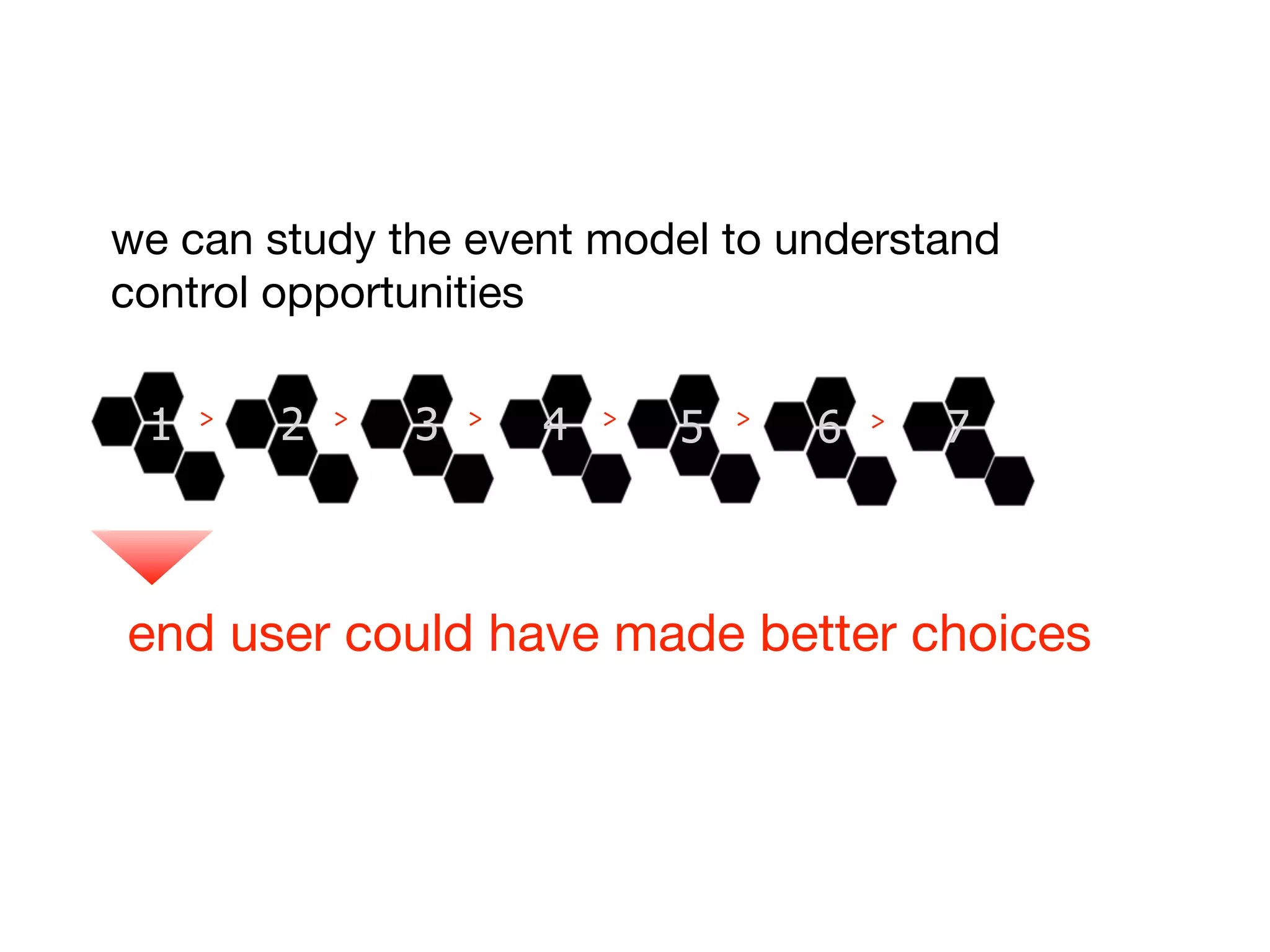
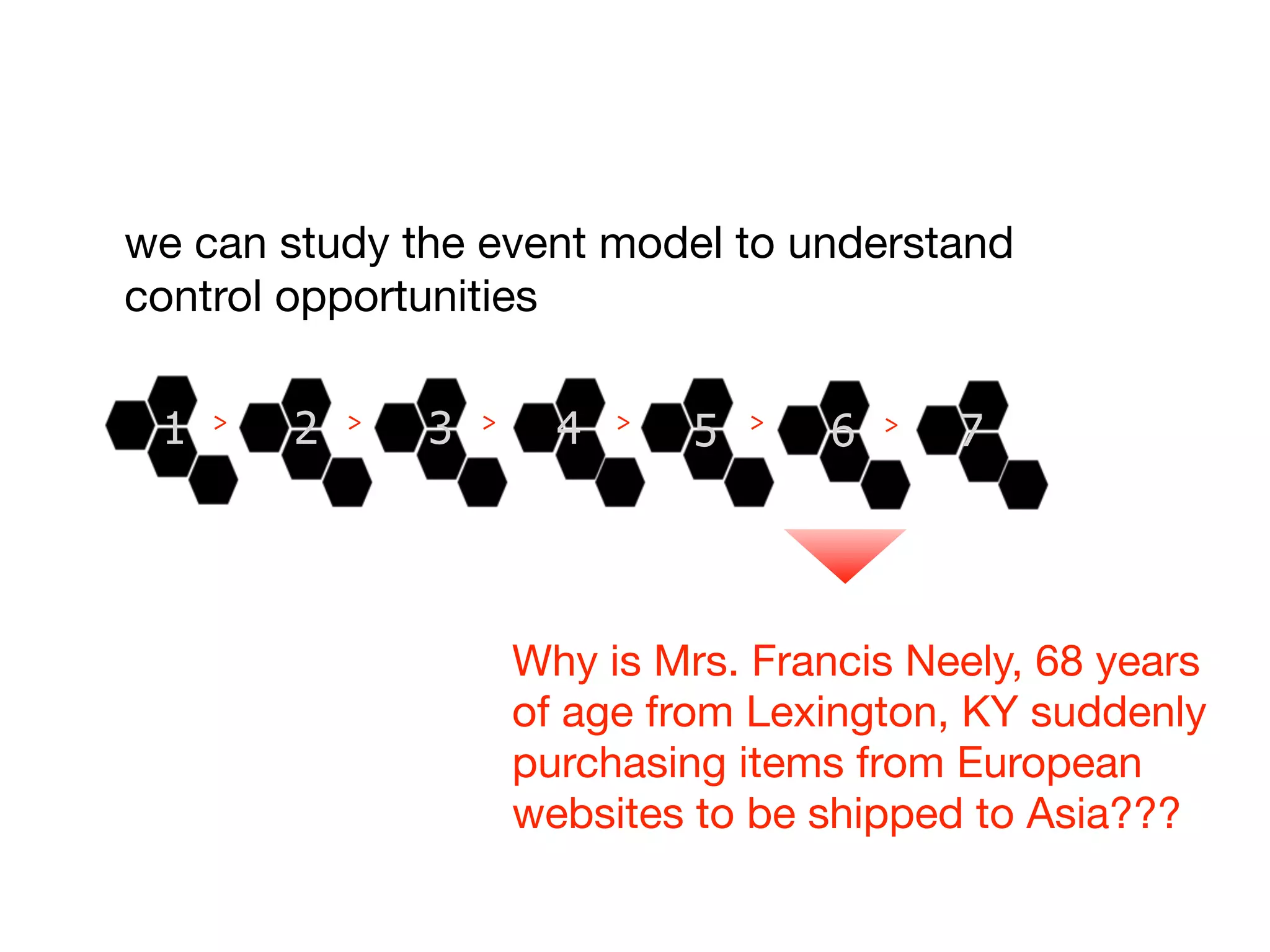
we can study the event model to understand
control opportunities

 1   >   2   >   3   >   4   >
                                 5   >
                                         6   >   7


end user could have made better choices
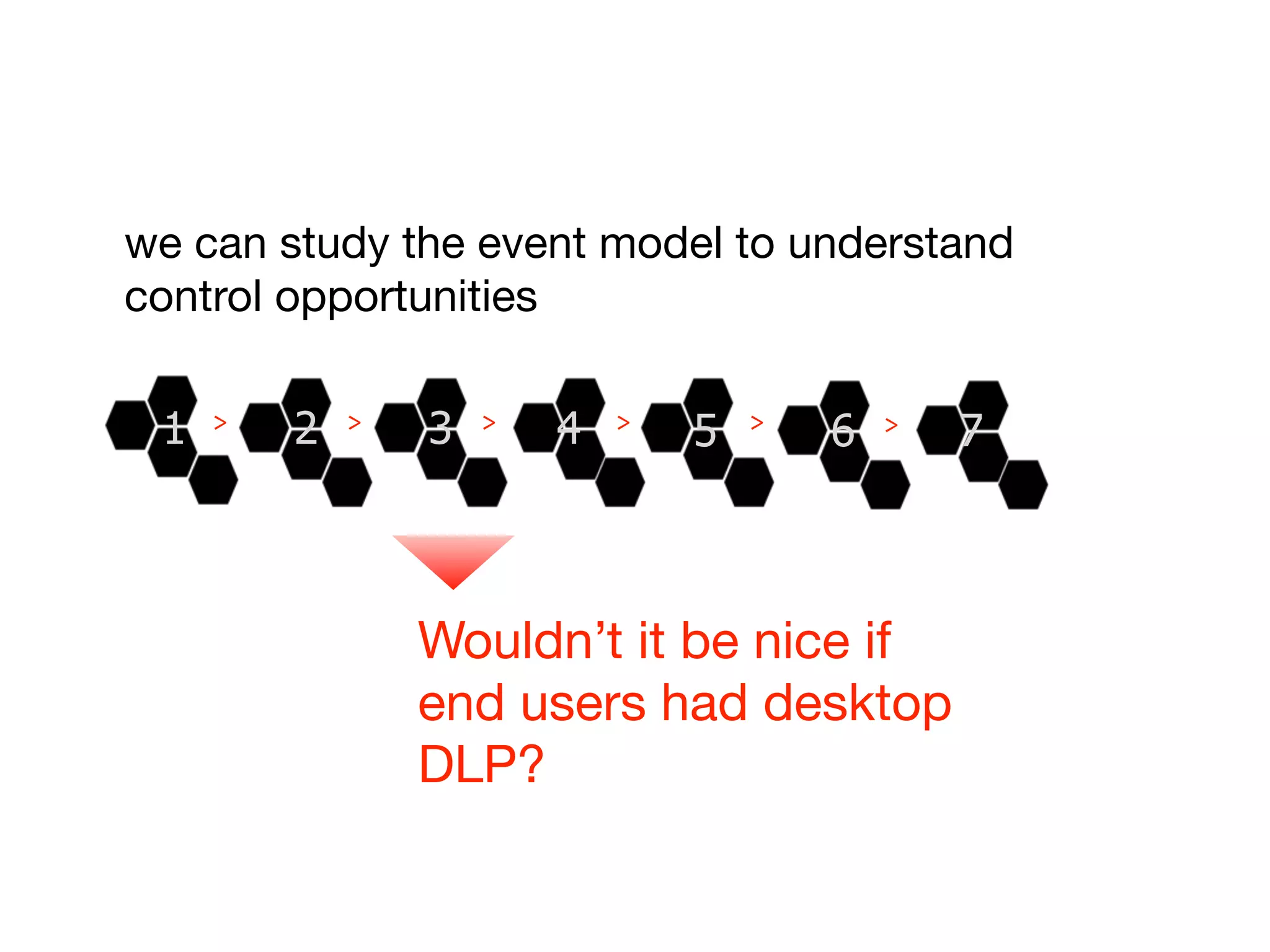
we can study the event model to understand
control opportunities

 1   >   2   >   3   >   4   >
                                 5   >
                                         6   >   7


                 Wouldn’t it be nice if
                 end users had desktop
                 DLP?
we can study the event model to understand
control opportunities

 1   >   2   >   3   >     4   >
                                   5   >
                                           6   >   7


                         Why is Mrs. Francis Neely, 68 years
                         of age from Lexington, KY suddenly
                         purchasing items from European
                         websites to be shipped to Asia???
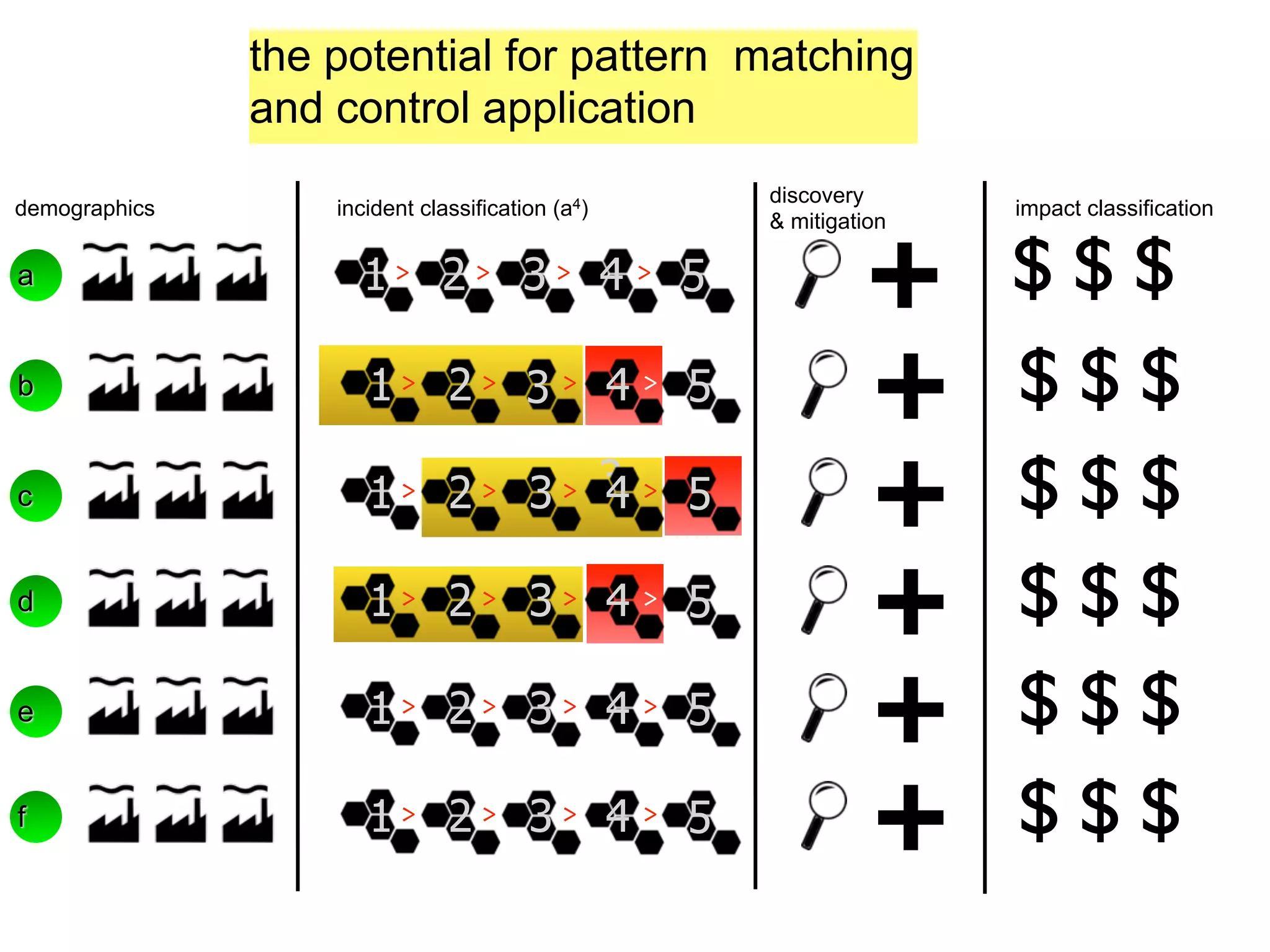
the potential for pattern matching
               and control application
                                                  discovery
demographics       incident classification (a4)                  impact classification


                                                           +
                                                  & mitigation

a                    1> 2> 3> 4 > 5                              $$$
b                     1> 2> 3 > 4 > 5
                                                           +     $$$
c                     1> 2> 3> 3 > 5
                               4
                                                           +     $$$
d                     1> 2> 3> 4 > 5
                                                           +     $$$
e                     1> 2> 3> 4 > 5
                                                           +     $$$
f                     1> 2> 3> 4 > 5
                                                           +     $$$
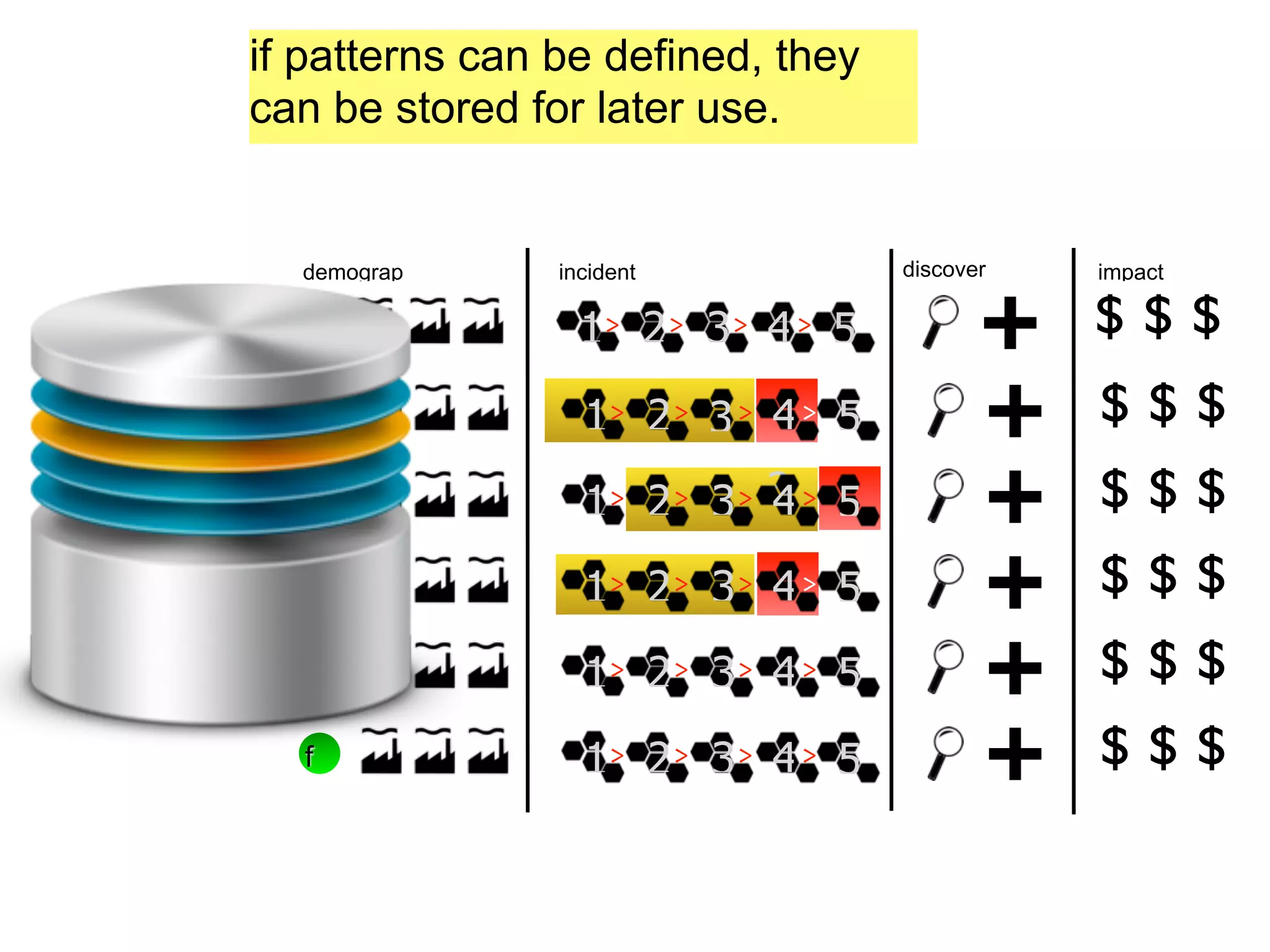
if patterns can be defined, they
can be stored for later use.


  demograp      incident             discover   impact

  a               1> 2 > 3 > 4 > 5          +   $$$
  b               1> 2 > 3 > 4 > 5          +   $$$
  c               1> 2 > 3 > 3 > 5
                             4              +   $$$
  d               1> 2 > 3 > 4 > 5          +   $$$
  e               1> 2 > 3 > 4 > 5          +   $$$
  f               1> 2 > 3 > 4 > 5          +   $$$
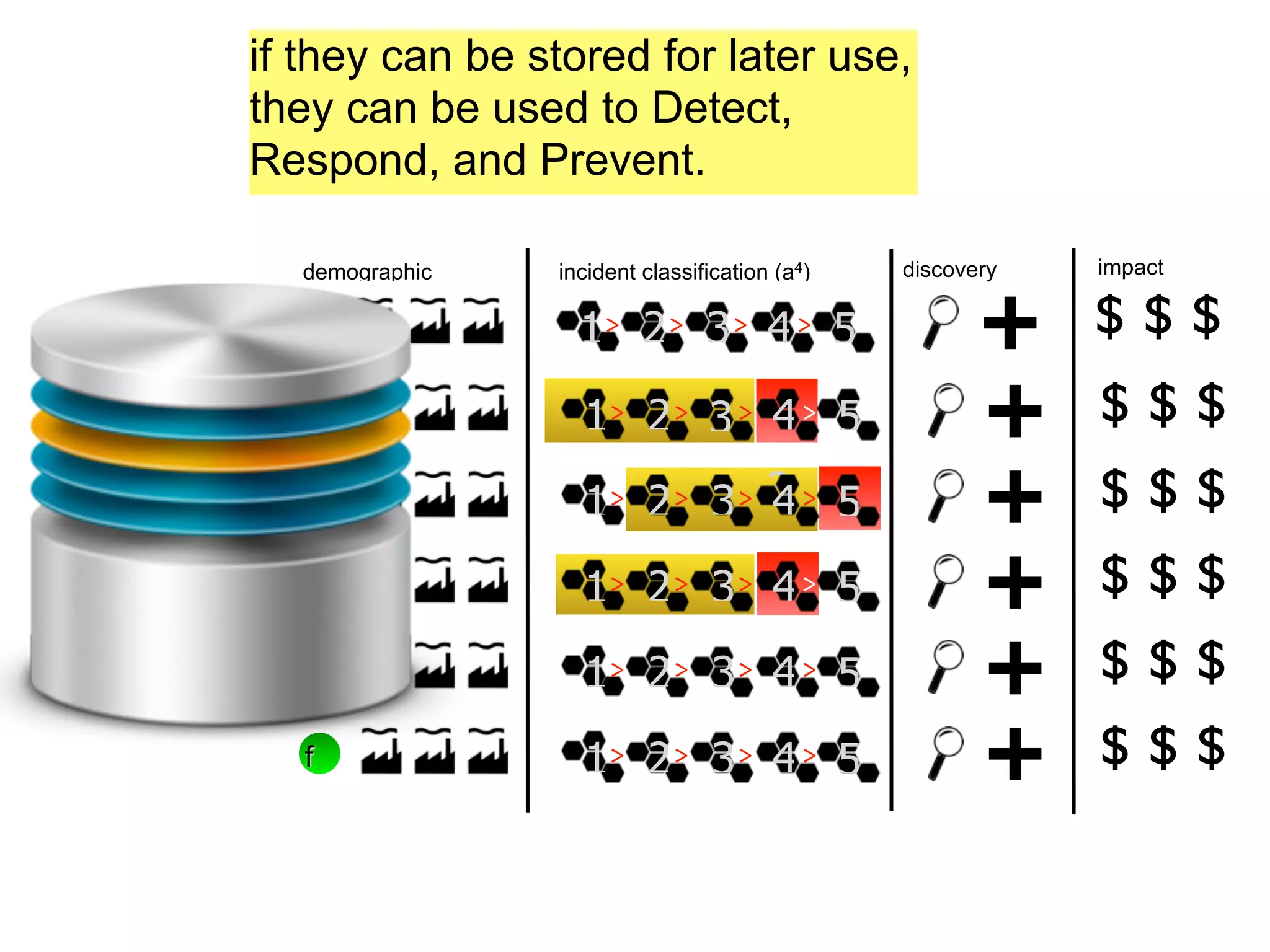
if they can be stored for later use,
they can be used to Detect,
Respond, and Prevent.

  demographic   incident classification (a4)   discovery   impact

   a              1> 2 > 3 > 4 > 5                    +    $$$
   b              1> 2 > 3 > 4 > 5                    +    $$$
   c              1> 2 > 3 > 3 > 5
                             4                        +    $$$
   d              1> 2 > 3 > 4 > 5                    +    $$$
   e              1> 2 > 3 > 4 > 5                    +    $$$
   f              1> 2 > 3 > 4 > 5                    +    $$$
demographics   incident classification   discovery   impact

a                1> 2> 3> 4 > 5                +     $$$
b                1> 2> 3 > 4 > 5               +     $$$
c                1> 2> 3> 3 > 5
                           4                   +     $$$
d                1> 2> 3> 4 > 5                +     $$$
e                1> 2> 3> 4 > 5                +     $$$
f                1> 2> 3> 4 > 5                +     $$$
OBLIGATORY QUESTIONS SLIDE
MUCHAS GRACIAS

Hutton/Miller SourceBarcelona

  • 1.
    Threat Modeling LIVE Alex Hutton Allison Miller Principal, Risk & Intelligence - Verizon Group Manager, Account Risk & Security - Business PayPal http://securityblog.verizonbusiness.com http://www.newschoolsecurity.com Society of Information Risk Analysts http://societyinforisk.org/ @alexhutton on the twitter
  • 2.
    what is thispresentation about? - new way to look at risk management via data and threat modeling
  • 3.
    what is amodel?
  • 4.
    what is riskmanagement?
  • 5.
    Managing risk meansaligning the capabilities of the organization, and the exposure of the organization with the tolerance of the data owners - Jack Jones
  • 6.
    Managing risk meansaligning the capabilities of the control, influence organization, and the exposure over outcome threats manifest of the organization with the of assets as loss tolerance howyou data owners ofmuch can the afford to lose?
  • 7.
    Traditional Risk Management Find issue,call issue bad, fix issue, hope you don’t find it again...
  • 8.
  • 9.
    Closing the Gap Between Assessment and Defense
  • 10.
  • 11.
  • 12.
    Evolution strongly favors strategiesthat minimize the risk of loss, rather than which maximize the chance of gain. Len Fisher Rock, Paper, Scissors: Game Theory in Everyday Life
  • 13.
    system models are differentfrom maps, they include dynamics and boundaries
  • 17.
  • 18.
    risk management that simplyreacts to yesterday's news is not risk management at all Douglas Hubbard The Failure of Risk Management
  • 19.
    the importance of feedbackloop instrumentation (that‘s where metrics come from)
  • 20.
  • 21.
    Prediction is verydifficult, especially about the future Niels Bohr
  • 22.
    Models in operations tendto assist in automating system decisions, or monitoring for quality defects
  • 23.
    This means we needto understand what makes a good decision vs a bad decision
  • 24.
  • 25.
  • 26.
    We don't talkabout what we see; we see only what we can talk about Donella Meadows Thinking in Systems: A Primer
  • 27.
    Friederich Hayek invades ourdreams to give us visions of a new approach
  • 28.
    These “risk” statements you’remaking, I don’t think you’re doing it right. - (Chillin’ Friederich Hayek)
  • 29.
    Risk Assessment CurrentPractice Dutch Model, Likelihood & Impact statement very physics/engineering oriented
  • 30.
    from Mark Curphey’sSecurityBullshit
  • 33.
  • 34.
  • 35.
    Complex Adaptive Systems: You can’tmake point probabilities (sorry ALE) you can only work with patterns of information
  • 36.
    How Complex SystemsFail (Being a Short Treatise on the Nature of Failure; How Failure is Evaluated; How Failure is Attributed to Proximate Cause; and the Resulting New Understanding of Patient Safety) Richard I. Cook, MD Cognitive technologies Laboratory University of Chicago http://www.ctlab.org/documents/How %20Complex%20Systems %20Fail.pdf
  • 37.
    Because we’re dealingwith Complex Adaptive Systems engineering risk statements = bankrupt (sorry GRC)
  • 38.
    We need anew approach
  • 39.
    Complex Systems Createa business process Process is a collection of system interaction (system behavior) Process has human interaction (human behavior)
  • 40.
    instead of R= T x V x I
  • 41.
    behavioral analytics & datadriven management
  • 42.
  • 43.
  • 44.
    - 2010 ~ 900 cases - (900 million records)
  • 45.
    Verizon is sharingour framework
  • 46.
    Verizon Enterprise Risk& Incident Sharing (VERIS) Framework it’s open*! * kinda
  • 47.
    What is theVerizon Incident Sharing (VERIS) Framework? - A means to create metrics from the incident narrative - how Verizon creates measurements for the DBIR - how *anyone* can create measurements from an incident - https://verisframework.wiki.zoho.com
  • 48.
    What makes upthe VERIS framework? discovery demographics incident classification (a4) & mitigation impact classification 1> 2> 3> 4 + $$$ information about information about information about information about the the incident impact organization; attack (traditional discovery, categorization (a including threat model); probable la’ FAIR & ISO their size, location, including (meta) mitigating 27005), aggregate industry, & security data controls, and estimate of loss budget (implied) about agent, action, rough state of (in $), & qualitative asset, & security security description of attribute (C/I/A) management. damage.
  • 49.
    The Incident Classificationsection employs Verizon’s A4 event model A security incident (or threat scenario) is modeled as a series of events. Every event is comprised of the following 4 A’s: Agent: Whose actions affected the asset Action: What actions affected the asset Asset: Which assets were affected Attribute: How the asset was affected > Incident as a chain of events 1 > 2 > 3 > 4 > 5 49
  • 50.
    Cybertrust Security incident narrative incident metrics discovery demographics incident classification (a4) impact classification + & mitigation 1> 2> 3> 4 > 5 $$$
  • 51.
    Cybertrust Security case studies data set discovery demographics incident classification (a4) impact classification + & mitigation a 1> 2> 3> 4 > 5 $$$ b 1> 2> 3> 4 > 5 + $$$ c 1> 2> 3> 4 > 5 + $$$ d 1> 2> 3> 4 > 5 + $$$ e 1> 2> 3> 4 > 5 + $$$ f 1> 2> 3> 4 > 5 + $$$
  • 52.
  • 53.
    the potential forpattern matching discovery demographics incident classification (a4) impact classification + & mitigation a 1> 2> 3> 4 > 5 $$$ b 1> 2> 3 > 4 > 5 + $$$ c 1> 2> 3> 3 > 5 4 + $$$ d 1> 2> 3> 4 > 5 + $$$ e 1> 2> 3> 4 > 5 + $$$ f 1> 2> 3> 4 > 5 + $$$
  • 54.
    Fraud, Incidents, and GoodLord Of The Dance: creating models for the real management of risk
  • 55.
  • 56.
    in VERIS wesee THREE events. 1 > 2 > 3 phishing malware infection credential theft
  • 57.
    in VERIS wesee THREE events. 1 > 2 > 3 phishing malware infection credential exfiltration in addition we can describe FOUR fraud events
  • 58.
    from the initialnarrative, we now have a threat event model with SEVEN objects 1 > 2 > 3 > 4 > 5 > 6 > 7
  • 59.
    from the initialnarrative, we now have a threat event model with SEVEN objects 1 > 2 > 3 > 4 > 5 > 6 > 7 > AGENT: external, organized crime, eastern europe 1 ACTION: social, type: phishing, channel: email, target: end-user ASSET: human, type: end-user ATTRIBUTE: integrity
  • 60.
    from the initialnarrative, we now have a threat event model with SEVEN objects 1 > 2 > 3 > 4 > 5 > 6 > 7 > AGENT: external, organized crime, eastern europe 2 ACTION: malware, type: install additional malware or software ASSET: end-user device; type: desktop (more meta-data possible) ATTRIBUTE: integrity
  • 61.
    from the initialnarrative, we now have a threat event model with SEVEN objects 1 > 2 > 3 > 4 > 5 > 6 > 7 > AGENT: external, organized crime, eastern europe 3 ACTION: malware, type: harvest system information ASSET: end-user device, type: desktop (more meta-data possible) ATTRIBUTE: integrity, confidentiality
  • 62.
    from the initialnarrative, we now have a threat event model with SEVEN objects 1 > 2 > 3 > 4 > 5 > 6 > 7 > AGENT: external, organized crime, eastern europe 4 ACTION: impersonation
  • 63.
    from the initialnarrative, we now have a threat event model with SEVEN objects 1 > 2 > 3 > 4 > 5 > 6 > 7 > AGENT: external, organized crime, eastern europe 5 ACTION: impersonated transaction
  • 64.
    from the initialnarrative, we now have a threat event model with SEVEN objects 1 > 2 > 3 > 4 > 5 > 6 > 7 > AGENT: external, organized crime, eastern europe 6 ACTION: Buy goods or transfer funds
  • 65.
    from the initialnarrative, we now have a threat event model with SEVEN objects 1 > 2 > 3 > 4 > 5 > 6 > 7 > AGENT: external, organized crime, eastern europe 7 ACTION: Goods/Funds extraction
  • 66.
    we can studythe event model to understand control opportunities 1 > 2 > 3 > 4 > 5 > 6 > 7 end user could have made better choices
  • 67.
    we can studythe event model to understand control opportunities 1 > 2 > 3 > 4 > 5 > 6 > 7 Wouldn’t it be nice if end users had desktop DLP?
  • 68.
    we can studythe event model to understand control opportunities 1 > 2 > 3 > 4 > 5 > 6 > 7 Why is Mrs. Francis Neely, 68 years of age from Lexington, KY suddenly purchasing items from European websites to be shipped to Asia???
  • 69.
    the potential forpattern matching and control application discovery demographics incident classification (a4) impact classification + & mitigation a 1> 2> 3> 4 > 5 $$$ b 1> 2> 3 > 4 > 5 + $$$ c 1> 2> 3> 3 > 5 4 + $$$ d 1> 2> 3> 4 > 5 + $$$ e 1> 2> 3> 4 > 5 + $$$ f 1> 2> 3> 4 > 5 + $$$
  • 70.
    if patterns canbe defined, they can be stored for later use. demograp incident discover impact a 1> 2 > 3 > 4 > 5 + $$$ b 1> 2 > 3 > 4 > 5 + $$$ c 1> 2 > 3 > 3 > 5 4 + $$$ d 1> 2 > 3 > 4 > 5 + $$$ e 1> 2 > 3 > 4 > 5 + $$$ f 1> 2 > 3 > 4 > 5 + $$$
  • 71.
    if they canbe stored for later use, they can be used to Detect, Respond, and Prevent. demographic incident classification (a4) discovery impact a 1> 2 > 3 > 4 > 5 + $$$ b 1> 2 > 3 > 4 > 5 + $$$ c 1> 2 > 3 > 3 > 5 4 + $$$ d 1> 2 > 3 > 4 > 5 + $$$ e 1> 2 > 3 > 4 > 5 + $$$ f 1> 2 > 3 > 4 > 5 + $$$
  • 73.
    demographics incident classification discovery impact a 1> 2> 3> 4 > 5 + $$$ b 1> 2> 3 > 4 > 5 + $$$ c 1> 2> 3> 3 > 5 4 + $$$ d 1> 2> 3> 4 > 5 + $$$ e 1> 2> 3> 4 > 5 + $$$ f 1> 2> 3> 4 > 5 + $$$
  • 74.
  • 75.