“A Policy Agenda for Increasing Access
to Higher Education in the EU”
Robyn Bowers
EAD 850
Spring 2014
Welcome…
Agenda of presentation:
Summary of policy report
Critical analysis of policy report
Recommendations
References
Please click on the megaphone icon on
each slide!!
The document…
A Policy Agenda for Improving Access to Higher Education in
the EU
Analytical report for the European Commission
Prepared by: European Expert Network on Economics and
Education (EENEE)
Audience: European Commission: executive body of the EU,
28 commissioners, including one from each nation-state
The problem…
 “Increasing access to Higher Education will be pivotal in
Europe to be able to provide the skills needed for a smart
and sustainable growth in the future” (Veugelers, 2011, p.2).
EUROPE 2020
Impetus for policy report…
 Targets for Europe 2020:
 Share of population 30-34 completed tertiary education (32% to
40%)
 Dropouts from school 10%
 Access for underrepresented groups to reduce poverty
 “It will become more important to educate the pool of young
people more intensively, ie to improve access to higher
education for a wider group of people and to ensure a higher
throughput to tertiary graduation” (Veugelers, 2011, p. 2).
Major points of report…
 Significant barriers to access: poor pre-training,
disadvantaged socio-economic background, lack of financial
ability, poor job prospects
 Proportion of EU population graduating from higher
education is lower than US or Japan
 Socially disadvantaged students access HE at lower rates
 Higher education leads to better job prospects and higher
earnings
 Funding for HE in Europe relies more heavily on public
sources
Recommendations…
Policy should be part
of a systemic agenda
Address both entry
and successful
completion
Fit into primary,
secondary, job, and
lifelong training
Appropriate
leveraging of private
funding
Principles for policymaking
around higher education in
Europe with the goal of
encouraging wider access
Recommendations cont’d…
Use of public funding to
encourage access
Incentivize diversity for
HE institutions
Raise awareness of
higher education among
disadvantaged groups
Better indicators and
data for analysis
Principles for policymaking
around higher education in
Europe with the goal of
encouraging wider access
Policy analysis…
Neoliberalism:
 “There is thus a global shift towards a neoliberal values
orientation, manifested most clearly in privatization policies
and in policies that assume the validity of market
mechanisms to solve the various problems and crises facing
governments” (Rizvi & Lingard, 2010, p. 72)
Policy analysis…
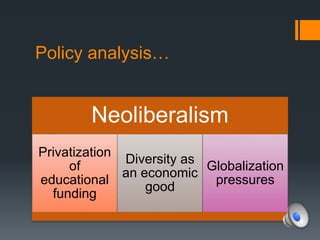
Neoliberalism
Privatization
of
educational
funding
Diversity as
an economic
good
Globalization
pressures
Privatization of educational funding
“All this evidence suggests more scope for leveraging private funding
of higher education and in particular for asking students to pay higher
tuition fees, particularly for those degrees where private returns are
substantial” (Veugelers, 2011, p. 15)
Education leads to private
returns, so it should be
paid for by private
individuals
View of education as key in
producing social efficiency and
mobility (Rizvi & Lingard, 2010,
Ch. 4)
World Bank’s commitment to
human capital approach and
private investment in education
(Spring, 2008)
Meaning: Examples:
Diversity as an economic good
“As Europe approaches the world technology possibility
frontier…innovation and highly-educated people have become crucial
drivers of its growth potential” (Veugelers, 2011, p. 1)
Widening access to
education is important to
sustain economic
feasibility and growth
“Economics of diversity”
approach (Archer, 2007)
Move from person-centered
education to “strategic
cosmopolitan” education
(Mitchell, 2003)
“Social inclusion” policies (Rizvi
& Lingard, 2010, Ch. 7)
Meaning: Examples:
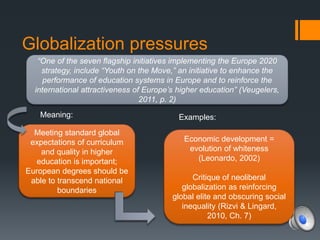
Globalization pressures
“One of the seven flagship initiatives implementing the Europe 2020
strategy, include “Youth on the Move,” an initiative to enhance the
performance of education systems in Europe and to reinforce the
international attractiveness of Europe’s higher education” (Veugelers,
2011, p. 2)
Meeting standard global
expectations of curriculum
and quality in higher
education is important;
European degrees should be
able to transcend national
boundaries
Economic development =
evolution of whiteness
(Leonardo, 2002)
Critique of neoliberal
globalization as reinforcing
global elite and obscuring social
inequality (Rizvi & Lingard,
2010, Ch. 7)
Meaning: Examples:
Recommendations…
 1) Acknowledge sociopolitical realities: Situate any efforts for
educational access reform within a comprehensive effort to
address social inequality
 “This is why the first step toward authentic intercultural practice is
undertaking shifts in consciousness that acknowledge
sociopolitical context, raise questions regarding control and
power, and inform, rather than deferring to, shifts in practice”
(Gorski, 2008, p. 522).
Recommendations
 2) Provide policy vehicles to ensure the ability of nations and
local communities to tailor policies to the needs of their
environments and situations
 “The combination of scientific knowledge and capitalism within
the context of superiority provided the framework through which
the new lands and people became known to the Europeans and
subsequently became the basis for European control of them”
(Sharp, 2008, p. 4).
References
 Archer, L. (2007). Diversity, equality and higher education: a
critical reflection on the ab/uses of equity discourse within
widening participation. Teaching in Higher Education 12(5),
635-653.
 Gorski, P. (2008). Good intentions are not enough: A
decolonizing intercultural education. Intercultural
Education, 19 (6), 515-525.
 Leonardo, Z. (2002). The souls of white folk: Critical
pedagogy, whiteness studies, and globalization discourse.
Race, Ethnicity and Education, 5(1), 29-50.
 Mitchell, K. (2003). Educating the national citizen in
neoliberal times: From the multicultural self to the strategic
cosmopolitan. Transactions of the Institute of British
Geographers, 28(4), 387-403.
References
 Rizvi, F. & Lingard, B. (2010). Ch 7: Equity policies in
education and Ch. 8: Mobility and policy dilemmas. In
Globalizing Education Policy (pp. 140-183). New York:
Routledge.
 Rizvi, F. & Lingard, B. (2010). Ch 4: Education policy and
allocation of values. In Globalizing Education Policy (pp. 71-
92). New York: Routledge.
 Sharp, J. (2008). Geographies of postcoloniality. Thousand
Oaks: Sage Publications.
 Spring, J. (2008). Research on the globalization of education.
Review of Educational Research, 78(2), 330–363.

Bowers.module4

  • 1.
    “A Policy Agendafor Increasing Access to Higher Education in the EU” Robyn Bowers EAD 850 Spring 2014
  • 2.
    Welcome… Agenda of presentation: Summaryof policy report Critical analysis of policy report Recommendations References Please click on the megaphone icon on each slide!!
  • 3.
    The document… A PolicyAgenda for Improving Access to Higher Education in the EU Analytical report for the European Commission Prepared by: European Expert Network on Economics and Education (EENEE) Audience: European Commission: executive body of the EU, 28 commissioners, including one from each nation-state
  • 4.
    The problem…  “Increasingaccess to Higher Education will be pivotal in Europe to be able to provide the skills needed for a smart and sustainable growth in the future” (Veugelers, 2011, p.2). EUROPE 2020
  • 5.
    Impetus for policyreport…  Targets for Europe 2020:  Share of population 30-34 completed tertiary education (32% to 40%)  Dropouts from school 10%  Access for underrepresented groups to reduce poverty  “It will become more important to educate the pool of young people more intensively, ie to improve access to higher education for a wider group of people and to ensure a higher throughput to tertiary graduation” (Veugelers, 2011, p. 2).
  • 6.
    Major points ofreport…  Significant barriers to access: poor pre-training, disadvantaged socio-economic background, lack of financial ability, poor job prospects  Proportion of EU population graduating from higher education is lower than US or Japan  Socially disadvantaged students access HE at lower rates  Higher education leads to better job prospects and higher earnings  Funding for HE in Europe relies more heavily on public sources
  • 7.
    Recommendations… Policy should bepart of a systemic agenda Address both entry and successful completion Fit into primary, secondary, job, and lifelong training Appropriate leveraging of private funding Principles for policymaking around higher education in Europe with the goal of encouraging wider access
  • 8.
    Recommendations cont’d… Use ofpublic funding to encourage access Incentivize diversity for HE institutions Raise awareness of higher education among disadvantaged groups Better indicators and data for analysis Principles for policymaking around higher education in Europe with the goal of encouraging wider access
  • 9.
    Policy analysis… Neoliberalism:  “Thereis thus a global shift towards a neoliberal values orientation, manifested most clearly in privatization policies and in policies that assume the validity of market mechanisms to solve the various problems and crises facing governments” (Rizvi & Lingard, 2010, p. 72)
  • 10.
  • 11.
    Privatization of educationalfunding “All this evidence suggests more scope for leveraging private funding of higher education and in particular for asking students to pay higher tuition fees, particularly for those degrees where private returns are substantial” (Veugelers, 2011, p. 15) Education leads to private returns, so it should be paid for by private individuals View of education as key in producing social efficiency and mobility (Rizvi & Lingard, 2010, Ch. 4) World Bank’s commitment to human capital approach and private investment in education (Spring, 2008) Meaning: Examples:
  • 12.
    Diversity as aneconomic good “As Europe approaches the world technology possibility frontier…innovation and highly-educated people have become crucial drivers of its growth potential” (Veugelers, 2011, p. 1) Widening access to education is important to sustain economic feasibility and growth “Economics of diversity” approach (Archer, 2007) Move from person-centered education to “strategic cosmopolitan” education (Mitchell, 2003) “Social inclusion” policies (Rizvi & Lingard, 2010, Ch. 7) Meaning: Examples:
  • 13.
    Globalization pressures “One ofthe seven flagship initiatives implementing the Europe 2020 strategy, include “Youth on the Move,” an initiative to enhance the performance of education systems in Europe and to reinforce the international attractiveness of Europe’s higher education” (Veugelers, 2011, p. 2) Meeting standard global expectations of curriculum and quality in higher education is important; European degrees should be able to transcend national boundaries Economic development = evolution of whiteness (Leonardo, 2002) Critique of neoliberal globalization as reinforcing global elite and obscuring social inequality (Rizvi & Lingard, 2010, Ch. 7) Meaning: Examples:
  • 14.
    Recommendations…  1) Acknowledgesociopolitical realities: Situate any efforts for educational access reform within a comprehensive effort to address social inequality  “This is why the first step toward authentic intercultural practice is undertaking shifts in consciousness that acknowledge sociopolitical context, raise questions regarding control and power, and inform, rather than deferring to, shifts in practice” (Gorski, 2008, p. 522).
  • 15.
    Recommendations  2) Providepolicy vehicles to ensure the ability of nations and local communities to tailor policies to the needs of their environments and situations  “The combination of scientific knowledge and capitalism within the context of superiority provided the framework through which the new lands and people became known to the Europeans and subsequently became the basis for European control of them” (Sharp, 2008, p. 4).
  • 16.
    References  Archer, L.(2007). Diversity, equality and higher education: a critical reflection on the ab/uses of equity discourse within widening participation. Teaching in Higher Education 12(5), 635-653.  Gorski, P. (2008). Good intentions are not enough: A decolonizing intercultural education. Intercultural Education, 19 (6), 515-525.  Leonardo, Z. (2002). The souls of white folk: Critical pedagogy, whiteness studies, and globalization discourse. Race, Ethnicity and Education, 5(1), 29-50.  Mitchell, K. (2003). Educating the national citizen in neoliberal times: From the multicultural self to the strategic cosmopolitan. Transactions of the Institute of British Geographers, 28(4), 387-403.
  • 17.
    References  Rizvi, F.& Lingard, B. (2010). Ch 7: Equity policies in education and Ch. 8: Mobility and policy dilemmas. In Globalizing Education Policy (pp. 140-183). New York: Routledge.  Rizvi, F. & Lingard, B. (2010). Ch 4: Education policy and allocation of values. In Globalizing Education Policy (pp. 71- 92). New York: Routledge.  Sharp, J. (2008). Geographies of postcoloniality. Thousand Oaks: Sage Publications.  Spring, J. (2008). Research on the globalization of education. Review of Educational Research, 78(2), 330–363.