







Legacy
content
conversion
in a flash
Hello
@richardthyde
Conversion
process
Future
proofing
Why
bother?
Common
pitfalls
01
Why bother?
Why are you converting
legacy e-learning to a
modern format?Q
Once upon a
time an SME
toiled for you
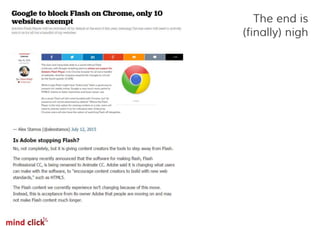
The end is
(finally) nigh
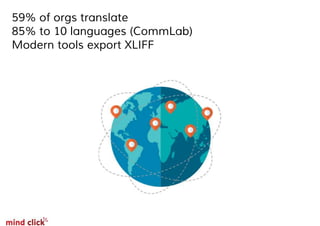
59% of orgs translate
85% to 10 languages (CommLab)
Modern tools export XLIFF
Adaptive learning
Personalised mandatory
Big savings
02
Conversion process
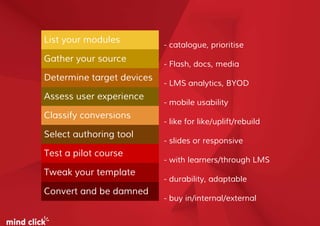
Gather your source
Classify conversions
List your modules
Test a pilot course
Assess user experience
Select authoring tool
Determine target devices
Tweak your template
Convert and be damned
- catalogue, prioritise
- Flash, docs, media
- LMS analytics, BYOD
- mobile usability
- like for like/uplift/rebuild
- slides or responsive
- with learners/through LMS
- durability, adaptable
- buy in/internal/external
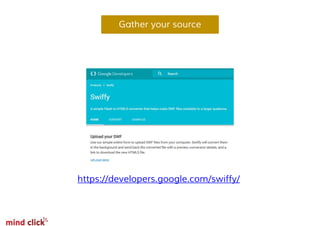
Gather your source
https://developers.google.com/swiffy/
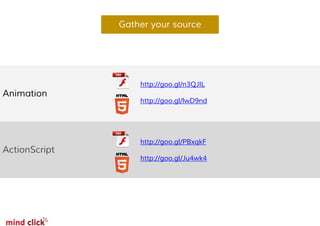
Animation
ActionScript
Gather your source
http://goo.gl/n3QJIL
http://goo.gl/lwD9nd
http://goo.gl/PBxqkF
http://goo.gl/Ju4wk4
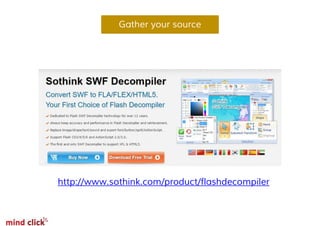
Gather your source
http://www.sothink.com/product/flashdecompiler
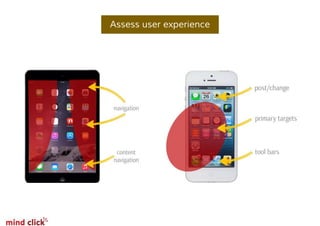
Assess user experience
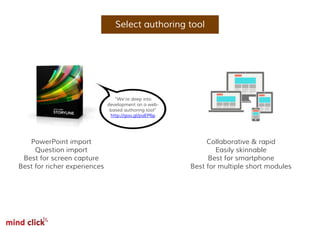
PowerPoint import
Question import
Best for screen capture
Best for richer experiences
Select authoring tool
Collaborative & rapid
Easily skinnable
Best for smartphone
Best for multiple short modules
“We’re deep into
development on a web-
based authoring tool“
http://goo.gl/paEP6p
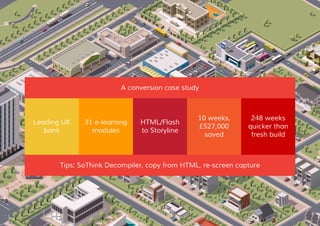
31 e-learning
modules
10 weeks,
£527,000
saved
HTML/Flash
to Storyline
Leading UK
bank
248 weeks
quicker than
fresh build
A conversion case study
Tips: SoThink Decompiler, copy from HTML, re-screen capture
Which authoring tool are
you converting to and
why?Q
03
Common pitfalls
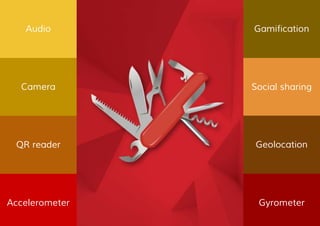
Camera Social sharing
Audio Gamification
GeolocationQR reader
Accelerometer Gyrometer
SECURITY
Do not wait
for leaders;
do it alone,
person to
person
04
Future proofing
content design interaction
Where we can help
conversions@mind-click.com
In house
conversion
toolkit for swift
conversion
20 minute
module
converted in less
than two weeks
Average savings of
£10k per module
compared to a
bespoke build
At least six weeks
quicker than a
new bespoke
project
Thank
you
@richardthyde
Questions?
www.mind-click.com/conversions
Email a module to
conversions@mind-click.com
for a free quote within 24 hours

From Flash to HTML5 in a flash: your ultimate guide to converting legacy e-learning

Editor's Notes

  • #2 Based on the conversion work we’ve been doing with several orgs Legacy e-learning having a serious negative impact on their business Often large catalogues of compliance training Mostly around conversion to multi-device HTML5 This session will describe our experiences with conversion Why bother - problems, benefits Options for conversion - tools and a process Common pitfalls - things to consider Future proofing - make things easier in the future
  • #3 What benefits?
  • #4 Please answer this in the chat
  • #5 Think of the time your SMEs have invested You owe it to them! Writing content Checking content Thinking of media Creating media Typical investment for one 30 min course = 5 days Quite often the visuals need improving but the base content is sound
  • #6 Google: Flash will vanish from Chrome by the end of the year. Need to turn it on Adobe: changed the name to Animate CC to ‘encourage’ different output formats Microsoft: Edge will still supports it
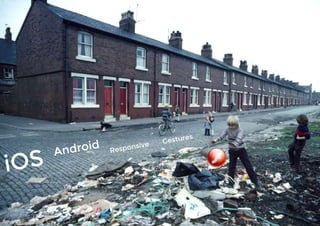
  • #7 We know that Flash doesn’t work on iOS Android 4.1 Jelly Bean does not support Flash Legacy courses don’t respond to the device Flash developed for mouse rollover not gestures http://blog.commlabindia.com/elearning-development/convert-legacy-e-learning-courses-using-articulate-storyline
  • #8 As organisations grow and become more global Translating courses into other languages becomes more of a requirement Modern authoring tools have better options for translation The number of companies needing to translate is increasing 59% of orgs translating their eLearning courses is important (survey by CommLab India) 85% translate their e-learning into 10 different languages XLIFF (XML Localisation Interchange File Format) is an XML-based format created to standardize the way localizable data
  • #9 Why the cameleon? Good question Change their colour to suit environment, as can online learning Adaptive learning is learning that adapts to the learner’s requirements Gaining interest for mandatory training Reduce learner time to a minimum More than a pretest, content is added or taken away in real time as a learner takes a course Content needs to be in smaller nuggets Generally not possible with legacy content
  • #10 Let’s think about a process and tools
  • #11 This is our conversion process. No There is no silver bullet for conversion Very lucky if conversion is automated There will always be manual work
  • #12 But we can make our lives easier with a process: List your modules - catalogue and prioritise, bulk conversion is more economic, get buy in Gather your source - Flash, external files (docs, media) Determine mobile devices - analytics from LMS, BYOD Assess user experience - are you creating a different resource? Mobile use? Classify your conversions - like for like, visual uplift, complete rebuild Select authoring tool - slide-based (Storyline, Lectora, Captivate) or online responsive Test a pilot course - on devices and through LMS Tweak your template - performance, design Convert and be damned - internal/external, plan resources http://www.eidesign.net/blog/how-to-convert-legacy-courses-into-html5-the-right-way/ http://www.eidesign.net/blog/8-tips-to-convert-flash-to-html5-that-will-help-your-business/ http://elearningindustry.com/migration-from-flash-to-html5-warning-may-losing-money
  • #13 https://developers.google.com/swiffy/ Impressive for animation conversion But htm versions can be 10 times as big Download in IE using Save As Use only for critical animations
  • #14 SWF animation: http://dev.mind-click.com/published/testarea/legacy-examples/54841.swf http://dev.mind-click.com/published/testarea/legacy-examples/54841.htm SWF AS2: http://dev.mind-click.com/published/testarea/legacy-examples/60774.swf http://dev.mind-click.com/published/testarea/legacy-examples/60774.htm
  • #15 http://www.sothink.com/product/flashdecompiler/ Use for when FLAs have been lost Replace image/shape/text/sound and export font/button/sprite/ActionScript. Support Flash CS3/4/5/6 and ActionScript 2.0/3.0. The first and only SWF Decompiler to support XFL & HTML5. Convert Flash SWF to HTML5 files, and then you can play it normally in HTML5 compatible browsers.
  • #16 Touch changes everything Mobile needs to be designed for gesture Tablet and phone demand a different user experience Not just a scaled down version
  • #17 Decision needs to be made as late as possible Articulate report on the future of mobile authoring We’re deep into development on a web-based authoring tool that makes it easy to create responsive web-based courses These web-based courses run directly in modern web browsers without the need for a player http://articulate-downloads.s3.amazonaws.com/Delivering%20E-Learning%20in%20a%20Mobile%20World.pdf http://www.slideshare.net/Brightwave/sharpest-tool-in-the-box-choosing-the-right-authoring-tool-for-your-learning-strategy
  • #18 A major conversion project Some HTML and some Flash Only run on IE8 and not work on new LMS SoThink Flash Decompiler essential Copy text from HTML screens Legacy authoring tool Screen captured the running course Run legacy/converted side by side
  • #19 Please answer this in the chat
  • #21 Main consideration is why limit conversion to like for like? Failing to leverage the many affordances of mobile https://www.upsidelearning.com/blog/index.php/2014/02/27/5-mobile-learning-pitfalls-to-avoid/
  • #22 Compared to Flash actionscript, HTML5 / javascript is easier to decompile and re-use More of a concern to a supplier developing advanced plugins!
  • #23 Initiating conversion throws up plenty of challenges Easy to lose enthusiasm Find a pilot where the cost benefits will be significant Low hanging fruits Legacy reference material to mobile resource?
  • #24 So how can we protect us from legacy conversion in the future? Or at least make our future lives easier
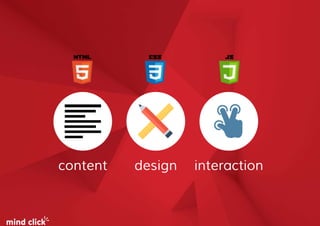
  • #25 Way back, I was taught to separate the 3 elements of coding Content, design and interaction do different jobs There is no good reason for them to be combined in a single source A lot of legacy material, particularly Flash, embeds them all The positive thing is that HTML5, CSS and JavaScript fits this perfectly Maybe I’ll never need to give this talk again? But always consider what format is my content in and how can I get hold of it?
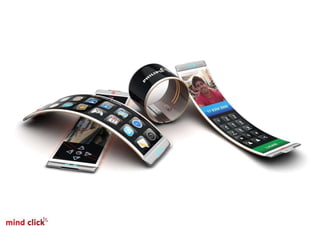
  • #26 We don’t know what’s around the corner Don’t assume learning will always be this way Wearable, immersive, adaptive, user generated, micro learning
  • #27 Text
  • #28 Text