Tupton Hall School
OCR A2 Media Studies - Critical Perspectives in Media (Section B)
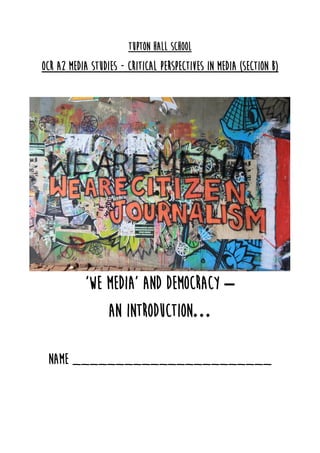
‘We Media’ and Democracy –
An introduction…
NAME _______________________
C.Welch/THS/A2 Critical Perspectives ‘Introduction to ‘We Media’ and Democracy’
2
YOUR COURSE at A2
As per your course at AS, A2 is assessed by 50% coursework and 50% examination. You have already
made a start on your coursework so this guide is intended to give you an introduction to the media
debate that you will be investigating. Half of your exam involves you analysing your own
productions; the other half of it is answering a question about a key debate about the media in
terms of social and cultural contexts.
All of the course links together. Your knowledge of technical aspects of production in TV drama;
issues around representation; types of institutions and your own choices in your productions have
hopefully improved your understanding of how media producers create meaning, how audiences
understand that meaning, ways in which it is funded and produced and how the digital age is having
an impact on all of this.
The big difference is that at A2 we expect you to investigate and indulge in the area which you are
already experts in – your own media use, interests and habits. At AS, we gave you examples and told
you they were ‘important’, ‘interesting’ or ‘significant’. Whether they were previous exam clips or
‘Utopia’, thriller examples or Warp Films – these were media sources chosen by us. We (or the exam
board) have been essentially saying, ‘watch this! It is good quality. It is important’.
A2 is more democratic: you will be choosing which song, artist, genre and style to go for in your
music video productions and choosing your own examples to research and analyse. Similarly, for this
we may provide you with some case studies but we expect you to contribute and share your
examples. After all, our tastes are not all the same!
So in the spirit of democracy each of us will bring something: you will bring examples from your
media use and then exchange them with others in the group. We will bring the theories and help
you use these to get a better picture of what your media use can tell us about what is happening in
the wider media and what this might mean for us (democracy).
C.Welch/THS/A2 Critical Perspectives ‘Introduction to ‘We Media’ and Democracy’
3
‘We Media’ and Democracy – What is it about?
“People shouldn’t be afraid of their government. Governments should be afraid of their people.”
(Alan Moore; V for Vendetta)
Let’s start with this word ‘democracy’. What does it mean to you? To many people, it is about
Westminster politicians arguing over who is right or wrong, presenting some ideas to change the
country and us voting for or against their ideas in elections every five years. This is, of course, an
important part of it but it is much more than that. If we look at an issue such as same sex marriage –
these often start with a group of people (sometimes referred to as a pressure group) wanting to
change something that exists (in this case, same sex marriage being illegal) and working to get public
support for an idea until it becomes widespread, mainstream almost, and eventually forcing a
change in policy as politicians realise how popular the idea is becoming. It often takes a long time,
involves having views that are often unpopular or controversial and a feeling that it will not succeed.
A previous Chesterfield MP, Tony Benn put it like this, “First they ignore you, then they say you’re
mad, then dangerous, then there’s a pause and then you can’t find anyone who disagrees with you.”
So we need to get away from the idea that democracy is just about Westminster, Prime Ministers
and all that. We’ll explore different ideas about what it is in the autumn however here’s one quick
definition: ‘a community in which everyone and anyone can participate and contribute.’
You might be thinking, “What has this got to do with Media? And...”this sounds like politics! I signed
up for Media Studies!” Well, depending on your viewpoint, the mass or established media1
either
plays a role in brainwashing the population into thinking certain ways or it reflects the society we
live in and its habits and concerns. Or it does a bit of both. We either accept a lot of what we are told
by our TV stations, websites and newspapers (Hall ‘Reception Theory’ – dominant reading), trust
certain ones but not others (negotiated reading) or take a view that it’s all lies and propaganda and
end up trusting nothing we read or see…unless it’s on the internet (oppositional). There are values,
opinions and views of the world encoded2
in all media texts (consciously or sub-consciously) from
news articles to soap operas, music videos and YouTube channels.
In terms of the media landscape, you were all born into an exciting, turbulent age with regards to
the media. Rapid changes in technology have changed media production, consumption and the way
in which content is distributed (David Gauntlett’ ‘Media 2.0’). We are now living in a sophisticated
but confusing age (known as Internet 3.0…are you following?) where, thanks to cookies on your
internet browser, our computer ends up knowing what we like and tailoring our internet use around
us. One of the questions that underpins this area of study is really, what are the positives and
negatives of the changes to the media in this age? Is the media becoming more or less democratic?
Big media organisations are adapting and using social media, apps, news aggregators3
and often
provocative headlines as clickbait in order to reach their existing and new audiences. Some have
been more successful than others. For example, The Sun is still the most popular print newspaper
but online ‘The Daily Mail’ and ‘The Guardian’ are the most widely read. But it has forced large
1
Sometimes referred to as ‘big media’ but generally established media includes media companies that have
been around for a long time such as the BBC, Sky, Channel 4, Daily Mail, The Guardian etc. Increasingly we can
count online media institutions as ‘established’
2
How we or anyone else include our views and values in things we write or make, it can be conscious or sub-
conscious.
3
Apps or websites that just collate news together from different sources all in one place such as Flipboard.
C.Welch/THS/A2 Critical Perspectives ‘Introduction to ‘We Media’ and Democracy’
4
media organisations to rethink their business models. None of them have yet worked out how to
make money out of it as consumers get used to getting everything for free. The result has been that
most news groups have cut investigative journalism4
: a very important but lengthy process which
costs more money but will often uncover corruption or scandals. Most predict that the newspaper
in its printed format will disappear over the next 30 years. The Independent was the first national
newspaper to, after 30 years, go completely online due to lack of paper sales.
The main idea for this section of the course comes from a book by Dan Gillmor (2004) called ‘We the
Media’ which put forward the theory that the media, because of the internet and advances in
technology, is becoming more democratic. He argues that we no longer have to get our news or
media from what he calls ‘Big Media’ (News International, BBC, Daily Mail, CNN, Google etc.) and
that is allowing for a wider range of voices and perspectives to be heard which will make the media
more democratic and representative of people5
. He predicted that:
‘The spreading of an item of news, or of something much larger, will occur – much more so
than today – without any help from mass media as we know it. The people who’ll understand
this best are probably just being born. In the meantime, even the beginnings of this ‘shift’ are
forcing all of us to adjust our assumptions and behaviour.’ (Gillmor 2004:42-3)
He’s talking about you lot! Although his book is already over ten years old we can see plenty of
evidence through citizen journalists. These are people who perhaps do not even see themselves as,
or want to be, journalists but either start a campaign about an issue they believe in or become an
eyewitness. Notice how many pictures or video footage that now gets used by news channels, where
the main footage has been filmed by people on their smartphones. They often get there before the
news crews or they may be a victim or bystander when something dramatic occurs. The 24 hours
rolling news stations need images and news quickly so those images often become the ones that
people associate with the news story: the ‘iconic’6
picture or grainy, wobbly video clip. This has been
going on for quite some time and goes hand in hand with technology becoming better, cheaper and
more portable. For example, the first terrifying footage from the 2001 September 11th
attacks was
captured by people on their personal cameras. It has also become useful, for example, for
communities in Iraq or Syria (where being a journalist is too dangerous) for people to be able to
show the world what is happening to them.
Supporters of Gillmor’s ‘citizen journalists’ could also look at the London riots of 2011. BBC and Sky
media crews were attacked and so they pulled their camera crews out. In an era of 24 hour media
coverage of events, viewers faced something of a media blackout with recycled aerial shots of
buildings burning. We have become used to having events explained to us as they are unfolding.
That void was partly filled by journalists such as Paul Lewis from The Guardian who relied on eye-
witness reports on Twitter to follow clues as to what was happening and where. Most of these were
reliable: people genuinely trying to help to get information out. Where there were hoaxers or people
‘trolling’ these were often contradicted and disputed by other users. The clean-up that followed was
organised by a citizen on Twitter and was not some official call from the mass media.
We can apply these ideas to virtually every area of media. People can create their own media or
YouTube channel or broadcast live on Facebook and various other platforms which surely means
that the media is becoming more democratic as we aren’t just being told the news by organisations
4
Different to reporting. An investigative journalist goes and finds information out for themselves and does
their own research.
5
More voices are heard rather than just the reporters or ‘important people’
6
The image that everybody associates with a particular event
C.Welch/THS/A2 Critical Perspectives ‘Introduction to ‘We Media’ and Democracy’
5
who may have their own bias and interest in what they are showing us. The popularity of vlogs and
YouTubers further demonstrates the changing nature of media use. An important voice in this
debate, Morozov, author of ‘The Net Delusion’ argues that in reality most people use the internet
for ‘sex, shopping and entertainment’ and is more sceptical of the internet’s ability to change the
world. However, the available technology means that somebody can broadcast their views and
ideas without them being edited or misrepresented by someone else. On the flipside we have seen
the horrendous use of the Facebook broadcast live facility.
So we see ‘big media’ now actively using ‘We Media’ or citizen journalists7
as their sources where
previously it would have been a reporter and news crew. However, questions still remain about how
they use certain bits of user generated content8
. The power of being the editor! For example, if a
teenager dies in mysterious circumstances, newspapers often look for a photo or comments from
their social media usage that suits their chosen narrative9
. A picture of a teen with a bottle of vodka
in their hand or adopting mean-looking gangster-poses being used over and over again creates a
different impression to a nice smiley shot with the family cat!
Then there are people using social media to speak directly to their ‘audience’ or each other. What
this gives bloggers and vloggers is control over the story. You or I may give an interview or be invited
onto a programme to give our view but we have no control thereafter as to how we are
represented. Supporters of ‘We Media’ would claim that this could end up to be the most
democratising10
development in media history: greater control. Gillmor claims that it is ‘the former
audience’ who are now making the news and who will increasingly set the media agenda. Others see
this as too optimistic and point to the fact that platforms such as Facebook, YouTube etc are now
huge multinational11
companies and have control over the content (although when a scandal
happens they will always claim it is the user not they who are responsible) – all that has changed is
the people making the content.
You can find out anything on the internet...
It is undisputable that the internet is the biggest library of human information that has ever been
available to humankind. A quick google search can give you reliable and unreliable information
about virtually anything in seconds. It is important to stress what an empowering tool this is for
citizens. But it is also a confusing world of information overload where we never get to finish the
story…there is no end to the distractions whether positive or negative.
However, increasingly most of our information comes recommended from friends or from the
internet knowing what we like and giving us more of it. Especially if you are more likely to get your
information via Facebook or Twitter. Take Facebook as an example, they really wanted news
organisations such as The Daily Mail, The BBC etc to publish their stories on Facebook. Why?
Because it means that users of Facebook don’t need to leave the site to go and read or watch
content from other sites. For the news organisations it’s another way to reach their audience or a
new audience. Facebook realised that their users were getting a bit fed up with being bombarded by
content from mainstream media organisations as people joined Facebook originally to connect with
7
Ordinary citizens who decide to or find themselves in the place where they are recording or commenting on
news events.
8
Or UGC, original material created by a ‘user’ rather than a ‘producer’ now anyone can create media.
9
The way in which a media producer may choose to tell or present the story.
10
Creating greater democracy
11
Operating across the world as a global platform/company
C.Welch/THS/A2 Critical Perspectives ‘Introduction to ‘We Media’ and Democracy’
6
friends. Other forms of social networks – particularly closed networks such as WhatsApp – started to
grow. So, Facebook tweaked their algorithms12
so that you would mainly see stuff that your friends
and family had liked or shared. This then creates a bubble where people who agree with each other
tell each other more stuff that they will agree on. Debate and different viewpoints, vital to
democracy, start to get lost and your internet use can quickly become an echo chamber with people
repeating similar views.
During the referendum to leave the EU, a lot of people who voted both remain and leave would say
that they didn’t know anyone who disagreed with them. If most of the stuff you read on social media
is from friends of yours who may be from a similar area, background, level of education and have
similar values, then is it that surprising?
What’s wrong with ‘big media’?
We live in a liberal democracy and one of the fundamental aspects of this is the right to express
your opinion as long as you are not inciting hatred towards a group or promoting violence. The
media in all its forms has a job to hold power to account but what about the power of media itself?
A good place to start is if we have a look at where news comes from. In a newspaper or a news
website there is often a mixture of reporting done by the organisation’s journalists, opinion pieces
written by ‘commentators’13
and (increasingly so) a re-telling of news released from global news
agencies.
This leads on from your AS exam and the issue of media ownership. Let’s look at one of the largest
private media corporations, News Corp, owned by Rupert Murdoch. In the UK, he owns or is a
majority owner of ‘Sky’, ‘The Sun’, ‘The Times’ and the ‘Press Association’. The first three you
probably will have heard of but the last one is interesting as it is one of the main global news
agencies who collect news and report it quickly and (they would argue) just stick to the facts. These
agencies are where the majority of news content comes from. Newspapers, websites and TV stations
often will re-report this news to their audience but put their own slant and interpretation on it and
add aspects such as people’s reactions to the news. Next time you are reading or watching some
news, try and work out if any ‘journalism’ has taken place. By this, I mean that the TV/Radio station
or newspaper has actually got one of their reporters or journalists to investigate the story further or
find out stuff for themselves not just explain it to you. If not, they are probably just using one of
these agencies. ‘Metro’ newspaper is a good example of a newspaper which mainly uses agencies
which allows them to give it away for free.
So, we have a situation where there is a huge amount of websites where you can read the news but
a lot of the major news actually is actually coming from very few people which is then regurgitated
in various ways around the media. That is a lot of power in very few hands.
Although all of the separate titles and channels have their own style, Murdoch makes no attempt to
hide his political views and analysing the news from his organisation you will often find many of
these views present. For example, Murdoch believes in privatisation of public services –
organisations like the NHS should be run by private companies who can profit from it. It might be
useful to do a quick scan of some of these titles and look at how they report the NHS. Notice also
12
A process or set of rules to be followed in a calculation particularly in computer programming.
13
People who put their opinions or analysis forward rather than report on the news.
C.Welch/THS/A2 Critical Perspectives ‘Introduction to ‘We Media’ and Democracy’
7
whether they are as critical of hospitals or services run by private companies. The Guardian
newspaper has a different set of beliefs and you are more likely to see stories about struggling
hospitals, lack of government funding, scandals within private hospitals and positive stories about
the NHS.
Then there is the problem (as the phone hacking trials demonstrated) about how this affects our
democracy when media corporations have that much power that they influence politicians and
politics far more than us – the people who vote them in! Murdoch has been very powerful in the UK,
Australia and US in setting the agenda with politicians too friendly with him or too scared of losing
his news corporation’s support. The first major leader of a political party in recent times who openly
criticised this as being undemocratic and a form of corruption was Ed Miliband14
. If any of you can
find me a positive story about Ed Miliband in News Corporation’s titles then I will buy you a bacon
sandwich! I am not suggesting that this won or lost the election or that Rupert Murdoch is secretly
running the country but we would be foolish if we thought that his meetings with various Prime
Ministers were occasions where he discussed what was best for us. We would also be equally naive
if we believed that a government would not consider the consequences of annoying Mr Murdoch.
But, is this good for democracy?
If we can all accept that all newspapers and TV stations have an ‘agenda’ or a bias then we can be
more informed when watching and reading them. This does not mean that we should not trust
anything they write or say – there is a lot of excellent journalism out there which does thorough
investigating and raises issues that may go unnoticed –but we need to be more active and
questioning when consuming news.
The BBC is a bit different as it is funded by the taxpayer and has strict rules about giving both sides
to the story. They have to try to be impartial15
. However, it is often accused by right-wingers as
having a left-wing16
bias and vice versa. This makes their decision making a bit different to other
channels.
How much influence this has on our understanding of events or issues is open to question and I want
you to decide this for yourself. Let’s be clear: we do not live in a dictatorship so we are not talking
about the ‘Hyperdermic Needle’ effects model where we are unthinking and helpless to resist the
propaganda but perhaps a ‘Cultivation’ model where audience understanding is shaped partly by
‘opinion formers’ of which news programmes and newspapers are key players.
To give one example, a 2009 study, ‘Hoodies or altar boys’ by Women in Journalism looked at news
representation of teenage boys. They scanned over 8000 news stories in national and regional
newspapers about teenage males and found that over half were about crime. The most commonly
used words were "yobs" (591 times), followed by "thugs" (254 times), "sick" (119 times) and "feral"
(96 times). They also found that teenage boys’ best chance of having a positive news story written
about them was if they met a violent or tragic end! Do you think this would affect how people view
teenage males? Or indeed how they (or you) view themselves or each other?
Here’s a couple of questions for you: immigration is often in the news and the word ‘migrant’ has
come to mean many different things. Immigration was a huge and controversial issue in the recent
EU referendum. However, it is a purely descriptive word that doesn’t relate to someone’s country
14
Labour Party leader from 2010-15.
15
To give both sides of the debate and not promote one viewpoint over another.
16
Political viewpoints – you’ll have to do your own research for this as there’s not enough space to explain the
difference here!
C.Welch/THS/A2 Critical Perspectives ‘Introduction to ‘We Media’ and Democracy’
8
(there is no ‘Migrantland’!) which now has negative connotations. There was confusion between EU
migration and the ongoing migrant/refugee crisis that exploded in Europe last summer which for
many people became a concern that the levels of immigration to the UK were too high. Interestingly,
areas who were more likely to vote leave (although immigration was only one of the reasons and,
for some people, not a reason for them voting to leave) were ones where there had been, relatively
speaking, very little net migration. A lot of areas with more migration often voted ‘remain’
suggesting that the fear of immigration was greater than the reality.
So, how many of the world’s refugee population comes to the UK? Which countries in Europe
(including us) take the most refugees? What about over the world?
Secondly, it’s hard to turn on your TV and open your newspaper without seeing a programme about
people on benefits, someone on benefits with 15 kids who lives a lavish life or people fraudulently
claiming a disability benefit when they are fine to work. Channel 4’s ‘Benefits Street’ showed some
of the behaviour and lifestyles associated with welfare recipients. The Jeremy Kyle show and many
programmes on Channel 5 will often focus on people in areas where there are more people receiving
benefits. The country has a big deficit caused by the financial crash of 2008 and greater attention
than ever has been paid to those who are taking advantage of the benefits system. Government has
responded by tightening up the system for those claiming benefits, cutting the amount they can
claim, forcing all of those classified with having a disability to be re-assessed and changing how
people apply for benefits. The Chancellor George Osborne said he was going after ‘the skivers’ who
live off ‘the strivers’.
So, how much of the overall welfare budget in the UK is believed to be wrongly claimed?
You can find the answer at the end of this booklet…if you are at all surprised then think about why
you thought what you did. Was it what you have experienced or heard? And where did you hear it
from? If it was someone else, where did they get their information from? What role do you think the
media have played in this? And, why have they wanted you think this? Also, what is the effect of this
on people’s attitudes and perhaps who or what they will vote for? Difficult questions but worth
exploring.
Another criticism of so-called ‘big media’ is who works in it. The writer Owen Jones, in his book ‘The
Establishment’ mentions how more than half of the top 100 media professionals in Britain come
from private schools, even though only 7% of Britons are privately educated (Jones himself is from a
comprehensive in Stockport) – it begs the question, are these people best placed to make big
decisions about how ‘we’ are represented or served by the media? Can they be relied to ‘get it’
when commenting or framing the news or a story in a way which represents people’s views
(democracy)?
That is not to say that if you are privately educated you cannot relate to the majority of the
population or to not appreciate the level of skills and experiences of such professionals, but it does
suggest that a certain type of person, from a certain type of background (still very male, white and
privileged) is the one telling the story and setting the agenda. Can we expect the media to question
and challenge the status quo when most of the people in it have done very well out of things being
the way they are? Furthermore, when we move away from news and think about many of the
programmes on TV: does it narrow the stories being told?
However, perhaps we are being a bit unfair on ‘big media’ to claim they are anti-democratic. More
than ever, we see ordinary people becoming the ‘stars’ of so-called ‘fly on the wall’ documentaries.
Sometimes gaining celebrity status as a result. It could also be argued that, in programmes such as X-
C.Welch/THS/A2 Critical Perspectives ‘Introduction to ‘We Media’ and Democracy’
9
Factor etc where the audience votes they show an open-mindedness about who gets to win, voting
for people with different ethnic backgrounds, sexual preferences or disabilities. Ordinary people
being on TV used to be a big thing but is now very commonplace and there is scarcely a job from
working in a chicken shop to ’24 Hours in A&E’ that hasn’t had a camera follow them around. Isn’t
this democracy with the media reflecting our lives back to us and informing us about other people’s
lives and jobs?
Also, if ‘We Media’ is such a movement then why do we still have these big, very Media 1.0,
participatory shows – ‘a community in which everyone and anyone can participate and contribute.’ If
we are living in an age of greater democracy in the media then why are people watching and
participating in great numbers in these shows rather than creating blogs and sharing their own
created content with each other?
Some claim that programmes like this are ‘low quality’, cheap and demeaning to working class
people, in particular, they serve to disempower17
citizens by making them look ignorant and
immoral. Others argue that the critics of these programmes are snobs who would prefer to see
working class people being talked to or about, rather than doing the talking and taking centre stage.
Also, perhaps it is too easy to just see everything as biased and therefore untrue. Everyone has a
certain level of bias and being aware of that helps us weigh up their argument and evidence but it
doesn’t make what they are writing or saying untrue. Many journalists are dedicated, professional
and forensic in their approach to their job. Can the same be true of somebody on social media who
claims to ‘speak the truth THEY don’t want you to hear!’?
Finally, ‘We Media’ throws up some interesting contradictions. The ideas of ‘We Media’ and ‘Media
2.0’ suggest that if you were to witness some injustice – for example, an injustice committed by a
Police officer against a teenager – you could capture this on your mobile phone, post about it on
social media or set up a blog and campaign to try and get some justice for the teenager without
having to rely on someone from the established media listening to your story. Your footage and
campaign could even then force its way into the ‘big media’ – something that is happening with
greater regularity. In the USA, the release of horrendous phone footage of the killing of black people
at the hands of the Police led to the use of the hashtag #blacklivesmatter which has turned into a
coordinated movement against racism and police brutality. Arguably, these extra eyes, ears and
keypads could lead to more accurate media reporting, greater citizen involvement and a healthier
democracy as a result.
However, it could also be argued that the sheer amount of content means we rarely get beyond the
headline. How many of us ‘like’ a status or share a post without having read what we are sharing or
thought about it too much? We may believe someone who may be a trustworthy friend without
checking the story behind the ‘story’. Are we more likely to believe something because it DOESN’T
come from the mass media and therefore isn’t tainted by bias or power? Does it just mean our news
feeds are just full of narcissistic rubbish, misinformation and petitions about whether or not Kanye
West should headline Glastonbury? On a darker note, perhaps we should take the rose-tinted
glasses off about the power the internet gives to users when we think about how the group known
as ISIS use new technology as a means of production to spread their propaganda and recruit around
the world.
17
Take power away from rather than ‘empower’
C.Welch/THS/A2 Critical Perspectives ‘Introduction to ‘We Media’ and Democracy’
10
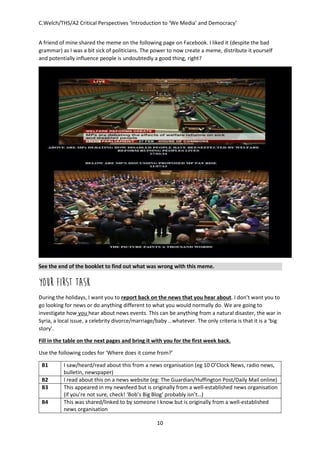
A friend of mine shared the meme on the following page on Facebook. I liked it (despite the bad
grammar) as I was a bit sick of politicians. The power to now create a meme, distribute it yourself
and potentially influence people is undoubtedly a good thing, right?
See the end of the booklet to find out what was wrong with this meme.
YOUR FIRST TASK
During the holidays, I want you to report back on the news that you hear about. I don’t want you to
go looking for news or do anything different to what you would normally do. We are going to
investigate how you hear about news events. This can be anything from a natural disaster, the war in
Syria, a local issue, a celebrity divorce/marriage/baby …whatever. The only criteria is that it is a ‘big
story’.
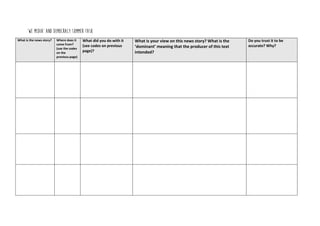
Fill in the table on the next pages and bring it with you for the first week back.
Use the following codes for ‘Where does it come from?’
B1 I saw/heard/read about this from a news organisation (eg 10 O’Clock News, radio news,
bulletin, newspaper)
B2 I read about this on a news website (eg: The Guardian/Huffington Post/Daily Mail online)
B3 This appeared in my newsfeed but is originally from a well-established news organisation
(if you’re not sure, check! ‘Bob’s Big Blog’ probably isn’t…)
B4 This was shared/linked to by someone I know but is originally from a well-established
news organisation
C.Welch/THS/A2 Critical Perspectives ‘Introduction to ‘We Media’ and Democracy’
11
W1 Somebody told me about this but I am not sure where they heard about it
W2 I saw some ‘friends’ talking about this on social media but am not sure where they got
their information from
W3 I think this is from a non ‘big media’ source: for example, someone’s blog or a petition
that was sent to me.
W4 I saw this on YouTube but the person does not seem to work for a big organisation
Use the following codes for ‘What did you do with it?’
Headline I just read/heard the headline but didn’t read much more about it
Depth I watched a feature on it/read a whole article/listened to the whole report
Shared I shared this with people on social media
Target share I shared this with friends via various social media platforms
Your second task
First week back you will be given a comprehension (understanding test) on this booklet to reassure
me that I haven’t wasted my time writing it and no tree creatures lost their home for nothing! So
make sure you read it.
YOUR THIRD TASK
Test your understanding of what is and isn’t ‘We Media’ by taking the quiz on the final page.
INCONCLUSIVE CONCLUSION-HINT FOR NEXT YEAR...THERE IS NO CORRECT
ANSWER.
So, plenty of food for thought.
If we can agree that ‘big media’ is anti-democratic (and maybe we can find many examples where it
is isn’t) and, if we accept that ‘We Media’ provides opportunities for the ‘former audience’ to create
their own content – be it news or their own TV series – or respond and contribute towards
traditional media sources, then we are surely living in an age of greater democracy where
‘everyone and anyone can participate and contribute.’?
We shall investigate further at A2!
‘We Media’ and Democracy Summer Task
What is the news story? Where does it
come from?
(use the codes
on the
previous page)
What did you do with it
(see codes on previous
page)?
What is your view on this news story? What is the
‘dominant’ meaning that the producer of this text
intended?
Do you trust it to be
accurate? Why?
LOOKING FOR ANSWERS?
Refugees: The UK takes less than 1% of the world’s estimated 50million refugees. Only 25% of these are given
refugee status; 75% refused. Within the EU, Germany and Sweden provide the most sanctuary to people fleeing
conflict or poverty. In fact, richer countries do not take their ‘fair share’ at all with the vast majority of refugees
going to neighbouring countries. For example, a quarter of Lebanon’s population are Syrian refugees.
https://www.refugeecouncil.org.uk/policy_research/the_truth_about_asylum/facts_about_asylum_-_page_6
Benefits: The government’s own figures estimate that only 2% of the total fraud committed in the UK is from people
wrongly claiming benefits. Overall, total fraud across the economy amounts to £73billion. It is believed that this costs
the country £1bn – which is a large amount. But not when compared to tax fraud which was around £14.5 bn. Or as
percentage of the overall welfare bill, 0.56%. In actual fact, the government’s audits showed that £17.7bn in benefits
and tax credits that people qualified for went unclaimed as some people do not know they are entitled to them, feel
it too much paperwork or are too embarrassed to claim!
http://www.cas.org.uk/features/myth-busting-real-figures-benefit-fraud
http://www.huffingtonpost.co.uk/dr-simon-duffy/welfare-myth-benefit-fraud_b_2947000.html
The Meme about parliament.
The bottom picture (packed to debate their own pay) claims to be from 11th
July 2013. However, there was no
debate on that day. The picture was actually from Prime Ministers questions which is always well attended as MPs
get to directly question the PM on anything of their choice and the news channels all run extracts from it. The
screengrab above was from a debate about the impact of welfare changes but it was hours into the debate when
MPs often go off to other meetings or appointments. The meme feeds into popular anger at MPs being ‘in it for
themselves’ but is incorrect. This throws up one of the issues with ‘We Media’, if we understand a newspaper’s
agenda then we can read articles from it with a bit more of a sense of power – are we critical enough of what we
read online if it suits our opinions/beliefs?
http://blogs.spectator.co.uk/coffeehouse/2014/11/the-menace-of-memes-how-pictures-can-paint-a-thousand-lies/
Further reading, watching and sources
Try Adam Curtis ‘Bitter Lake’ BBC iplayer: lengthy and a upsetting in places, Curtis’ central point is that the mass
media just bombard us with events with very little depth or back-story meaning we become more confused and feel
more helpless.
OCR Media Studies for A2 Third Edition by Julian McDougall– this textbook is a few years old now so you should be
able to find it a bit cheaper 2nd
hand
Women In Journalism. ‘Hoodies or Altar Boys’
http://womeninjournalism.co.uk/hoodies-or-altar-boys/
http://www.independent.co.uk/news/uk/home-news/hoodies-louts-scum-how-media-demonises-teenagers-
1643964.html
Citizen Journalism and the 2011 Riots
http://www.theguardian.com/uk/2011/dec/07/twitter-riots-how-news-spread
http://www.theguardian.com/uk/2011/aug/12/uk-riots-paul-lewis-five-day-journey
Inside the Murdoch Empire http://www.bbc.co.uk/news/uk-14030051
Analysing the news http://www.mediaknowall.com/gcse/news/news.php
‘We the Media: Grassroots journalism, for the people, by the people’ by Dan Gillmor
C.Welch/THS/A2 Critical Perspectives ‘Introduction to ‘We Media’ and Democracy’
14
‘Mediactive’ by Dan Gillmor (you can find this as a PDF online)
Check out our ‘A2 Critical Perspectives’ playlist (more to follow on this playlist)
‘The Net Delusion’ by Evgeny Morozov
Brexit: fear of immigration greater than reality
http://www.theguardian.com/politics/2016/jun/24/voting-details-show-immigration-fears-were-paradoxical-but-
decisive
How Facebook algorithms rival the power of the mass media: the online bubble
http://gu.com/p/4nfhd?CMP=Share_iOSApp_Other
Quiz: ‘WE MEDIA’ OR NOT WE MEDIA – ARE THE FOLLOWING EXAMPLES ‘WE MEDIA’ OR NOT?
1. Your old pal, Mel, creates a Facebook group and posts details of a protest against
cuts to the local hospital that she has organised.
2. You read an article from the BBC on one of your social media platforms.
3. Your old mate, Kate, shares a video from the Daily Mail and comment ‘This is the
most disgusting thing I’ve ever seen! We need to do something about this’
4. Your old friend, Ben, starts a hashtag to campaign for free education which ends up
becoming a big story.
5. Underneath a Facebook post from The Guardian, you have a debate with somebody
in Canada about sexism.
6. Your cousin Bob starts a YouTube channel where he mocks the main news of the day
and some of the politicians.
7. You take a video of a President or Prime Minister’s speech and cut it up, re-edit it and
set it to music to mock them.
8. You share the video above with the comment, ‘This is amazing! Must watch.’

We Media and Democracy v2 2016

  • 1.
    Tupton Hall School OCRA2 Media Studies - Critical Perspectives in Media (Section B) ‘We Media’ and Democracy – An introduction… NAME _______________________
  • 2.
    C.Welch/THS/A2 Critical Perspectives‘Introduction to ‘We Media’ and Democracy’ 2 YOUR COURSE at A2 As per your course at AS, A2 is assessed by 50% coursework and 50% examination. You have already made a start on your coursework so this guide is intended to give you an introduction to the media debate that you will be investigating. Half of your exam involves you analysing your own productions; the other half of it is answering a question about a key debate about the media in terms of social and cultural contexts. All of the course links together. Your knowledge of technical aspects of production in TV drama; issues around representation; types of institutions and your own choices in your productions have hopefully improved your understanding of how media producers create meaning, how audiences understand that meaning, ways in which it is funded and produced and how the digital age is having an impact on all of this. The big difference is that at A2 we expect you to investigate and indulge in the area which you are already experts in – your own media use, interests and habits. At AS, we gave you examples and told you they were ‘important’, ‘interesting’ or ‘significant’. Whether they were previous exam clips or ‘Utopia’, thriller examples or Warp Films – these were media sources chosen by us. We (or the exam board) have been essentially saying, ‘watch this! It is good quality. It is important’. A2 is more democratic: you will be choosing which song, artist, genre and style to go for in your music video productions and choosing your own examples to research and analyse. Similarly, for this we may provide you with some case studies but we expect you to contribute and share your examples. After all, our tastes are not all the same! So in the spirit of democracy each of us will bring something: you will bring examples from your media use and then exchange them with others in the group. We will bring the theories and help you use these to get a better picture of what your media use can tell us about what is happening in the wider media and what this might mean for us (democracy).
  • 3.
    C.Welch/THS/A2 Critical Perspectives‘Introduction to ‘We Media’ and Democracy’ 3 ‘We Media’ and Democracy – What is it about? “People shouldn’t be afraid of their government. Governments should be afraid of their people.” (Alan Moore; V for Vendetta) Let’s start with this word ‘democracy’. What does it mean to you? To many people, it is about Westminster politicians arguing over who is right or wrong, presenting some ideas to change the country and us voting for or against their ideas in elections every five years. This is, of course, an important part of it but it is much more than that. If we look at an issue such as same sex marriage – these often start with a group of people (sometimes referred to as a pressure group) wanting to change something that exists (in this case, same sex marriage being illegal) and working to get public support for an idea until it becomes widespread, mainstream almost, and eventually forcing a change in policy as politicians realise how popular the idea is becoming. It often takes a long time, involves having views that are often unpopular or controversial and a feeling that it will not succeed. A previous Chesterfield MP, Tony Benn put it like this, “First they ignore you, then they say you’re mad, then dangerous, then there’s a pause and then you can’t find anyone who disagrees with you.” So we need to get away from the idea that democracy is just about Westminster, Prime Ministers and all that. We’ll explore different ideas about what it is in the autumn however here’s one quick definition: ‘a community in which everyone and anyone can participate and contribute.’ You might be thinking, “What has this got to do with Media? And...”this sounds like politics! I signed up for Media Studies!” Well, depending on your viewpoint, the mass or established media1 either plays a role in brainwashing the population into thinking certain ways or it reflects the society we live in and its habits and concerns. Or it does a bit of both. We either accept a lot of what we are told by our TV stations, websites and newspapers (Hall ‘Reception Theory’ – dominant reading), trust certain ones but not others (negotiated reading) or take a view that it’s all lies and propaganda and end up trusting nothing we read or see…unless it’s on the internet (oppositional). There are values, opinions and views of the world encoded2 in all media texts (consciously or sub-consciously) from news articles to soap operas, music videos and YouTube channels. In terms of the media landscape, you were all born into an exciting, turbulent age with regards to the media. Rapid changes in technology have changed media production, consumption and the way in which content is distributed (David Gauntlett’ ‘Media 2.0’). We are now living in a sophisticated but confusing age (known as Internet 3.0…are you following?) where, thanks to cookies on your internet browser, our computer ends up knowing what we like and tailoring our internet use around us. One of the questions that underpins this area of study is really, what are the positives and negatives of the changes to the media in this age? Is the media becoming more or less democratic? Big media organisations are adapting and using social media, apps, news aggregators3 and often provocative headlines as clickbait in order to reach their existing and new audiences. Some have been more successful than others. For example, The Sun is still the most popular print newspaper but online ‘The Daily Mail’ and ‘The Guardian’ are the most widely read. But it has forced large 1 Sometimes referred to as ‘big media’ but generally established media includes media companies that have been around for a long time such as the BBC, Sky, Channel 4, Daily Mail, The Guardian etc. Increasingly we can count online media institutions as ‘established’ 2 How we or anyone else include our views and values in things we write or make, it can be conscious or sub- conscious. 3 Apps or websites that just collate news together from different sources all in one place such as Flipboard.
  • 4.
    C.Welch/THS/A2 Critical Perspectives‘Introduction to ‘We Media’ and Democracy’ 4 media organisations to rethink their business models. None of them have yet worked out how to make money out of it as consumers get used to getting everything for free. The result has been that most news groups have cut investigative journalism4 : a very important but lengthy process which costs more money but will often uncover corruption or scandals. Most predict that the newspaper in its printed format will disappear over the next 30 years. The Independent was the first national newspaper to, after 30 years, go completely online due to lack of paper sales. The main idea for this section of the course comes from a book by Dan Gillmor (2004) called ‘We the Media’ which put forward the theory that the media, because of the internet and advances in technology, is becoming more democratic. He argues that we no longer have to get our news or media from what he calls ‘Big Media’ (News International, BBC, Daily Mail, CNN, Google etc.) and that is allowing for a wider range of voices and perspectives to be heard which will make the media more democratic and representative of people5 . He predicted that: ‘The spreading of an item of news, or of something much larger, will occur – much more so than today – without any help from mass media as we know it. The people who’ll understand this best are probably just being born. In the meantime, even the beginnings of this ‘shift’ are forcing all of us to adjust our assumptions and behaviour.’ (Gillmor 2004:42-3) He’s talking about you lot! Although his book is already over ten years old we can see plenty of evidence through citizen journalists. These are people who perhaps do not even see themselves as, or want to be, journalists but either start a campaign about an issue they believe in or become an eyewitness. Notice how many pictures or video footage that now gets used by news channels, where the main footage has been filmed by people on their smartphones. They often get there before the news crews or they may be a victim or bystander when something dramatic occurs. The 24 hours rolling news stations need images and news quickly so those images often become the ones that people associate with the news story: the ‘iconic’6 picture or grainy, wobbly video clip. This has been going on for quite some time and goes hand in hand with technology becoming better, cheaper and more portable. For example, the first terrifying footage from the 2001 September 11th attacks was captured by people on their personal cameras. It has also become useful, for example, for communities in Iraq or Syria (where being a journalist is too dangerous) for people to be able to show the world what is happening to them. Supporters of Gillmor’s ‘citizen journalists’ could also look at the London riots of 2011. BBC and Sky media crews were attacked and so they pulled their camera crews out. In an era of 24 hour media coverage of events, viewers faced something of a media blackout with recycled aerial shots of buildings burning. We have become used to having events explained to us as they are unfolding. That void was partly filled by journalists such as Paul Lewis from The Guardian who relied on eye- witness reports on Twitter to follow clues as to what was happening and where. Most of these were reliable: people genuinely trying to help to get information out. Where there were hoaxers or people ‘trolling’ these were often contradicted and disputed by other users. The clean-up that followed was organised by a citizen on Twitter and was not some official call from the mass media. We can apply these ideas to virtually every area of media. People can create their own media or YouTube channel or broadcast live on Facebook and various other platforms which surely means that the media is becoming more democratic as we aren’t just being told the news by organisations 4 Different to reporting. An investigative journalist goes and finds information out for themselves and does their own research. 5 More voices are heard rather than just the reporters or ‘important people’ 6 The image that everybody associates with a particular event
  • 5.
    C.Welch/THS/A2 Critical Perspectives‘Introduction to ‘We Media’ and Democracy’ 5 who may have their own bias and interest in what they are showing us. The popularity of vlogs and YouTubers further demonstrates the changing nature of media use. An important voice in this debate, Morozov, author of ‘The Net Delusion’ argues that in reality most people use the internet for ‘sex, shopping and entertainment’ and is more sceptical of the internet’s ability to change the world. However, the available technology means that somebody can broadcast their views and ideas without them being edited or misrepresented by someone else. On the flipside we have seen the horrendous use of the Facebook broadcast live facility. So we see ‘big media’ now actively using ‘We Media’ or citizen journalists7 as their sources where previously it would have been a reporter and news crew. However, questions still remain about how they use certain bits of user generated content8 . The power of being the editor! For example, if a teenager dies in mysterious circumstances, newspapers often look for a photo or comments from their social media usage that suits their chosen narrative9 . A picture of a teen with a bottle of vodka in their hand or adopting mean-looking gangster-poses being used over and over again creates a different impression to a nice smiley shot with the family cat! Then there are people using social media to speak directly to their ‘audience’ or each other. What this gives bloggers and vloggers is control over the story. You or I may give an interview or be invited onto a programme to give our view but we have no control thereafter as to how we are represented. Supporters of ‘We Media’ would claim that this could end up to be the most democratising10 development in media history: greater control. Gillmor claims that it is ‘the former audience’ who are now making the news and who will increasingly set the media agenda. Others see this as too optimistic and point to the fact that platforms such as Facebook, YouTube etc are now huge multinational11 companies and have control over the content (although when a scandal happens they will always claim it is the user not they who are responsible) – all that has changed is the people making the content. You can find out anything on the internet... It is undisputable that the internet is the biggest library of human information that has ever been available to humankind. A quick google search can give you reliable and unreliable information about virtually anything in seconds. It is important to stress what an empowering tool this is for citizens. But it is also a confusing world of information overload where we never get to finish the story…there is no end to the distractions whether positive or negative. However, increasingly most of our information comes recommended from friends or from the internet knowing what we like and giving us more of it. Especially if you are more likely to get your information via Facebook or Twitter. Take Facebook as an example, they really wanted news organisations such as The Daily Mail, The BBC etc to publish their stories on Facebook. Why? Because it means that users of Facebook don’t need to leave the site to go and read or watch content from other sites. For the news organisations it’s another way to reach their audience or a new audience. Facebook realised that their users were getting a bit fed up with being bombarded by content from mainstream media organisations as people joined Facebook originally to connect with 7 Ordinary citizens who decide to or find themselves in the place where they are recording or commenting on news events. 8 Or UGC, original material created by a ‘user’ rather than a ‘producer’ now anyone can create media. 9 The way in which a media producer may choose to tell or present the story. 10 Creating greater democracy 11 Operating across the world as a global platform/company
  • 6.
    C.Welch/THS/A2 Critical Perspectives‘Introduction to ‘We Media’ and Democracy’ 6 friends. Other forms of social networks – particularly closed networks such as WhatsApp – started to grow. So, Facebook tweaked their algorithms12 so that you would mainly see stuff that your friends and family had liked or shared. This then creates a bubble where people who agree with each other tell each other more stuff that they will agree on. Debate and different viewpoints, vital to democracy, start to get lost and your internet use can quickly become an echo chamber with people repeating similar views. During the referendum to leave the EU, a lot of people who voted both remain and leave would say that they didn’t know anyone who disagreed with them. If most of the stuff you read on social media is from friends of yours who may be from a similar area, background, level of education and have similar values, then is it that surprising? What’s wrong with ‘big media’? We live in a liberal democracy and one of the fundamental aspects of this is the right to express your opinion as long as you are not inciting hatred towards a group or promoting violence. The media in all its forms has a job to hold power to account but what about the power of media itself? A good place to start is if we have a look at where news comes from. In a newspaper or a news website there is often a mixture of reporting done by the organisation’s journalists, opinion pieces written by ‘commentators’13 and (increasingly so) a re-telling of news released from global news agencies. This leads on from your AS exam and the issue of media ownership. Let’s look at one of the largest private media corporations, News Corp, owned by Rupert Murdoch. In the UK, he owns or is a majority owner of ‘Sky’, ‘The Sun’, ‘The Times’ and the ‘Press Association’. The first three you probably will have heard of but the last one is interesting as it is one of the main global news agencies who collect news and report it quickly and (they would argue) just stick to the facts. These agencies are where the majority of news content comes from. Newspapers, websites and TV stations often will re-report this news to their audience but put their own slant and interpretation on it and add aspects such as people’s reactions to the news. Next time you are reading or watching some news, try and work out if any ‘journalism’ has taken place. By this, I mean that the TV/Radio station or newspaper has actually got one of their reporters or journalists to investigate the story further or find out stuff for themselves not just explain it to you. If not, they are probably just using one of these agencies. ‘Metro’ newspaper is a good example of a newspaper which mainly uses agencies which allows them to give it away for free. So, we have a situation where there is a huge amount of websites where you can read the news but a lot of the major news actually is actually coming from very few people which is then regurgitated in various ways around the media. That is a lot of power in very few hands. Although all of the separate titles and channels have their own style, Murdoch makes no attempt to hide his political views and analysing the news from his organisation you will often find many of these views present. For example, Murdoch believes in privatisation of public services – organisations like the NHS should be run by private companies who can profit from it. It might be useful to do a quick scan of some of these titles and look at how they report the NHS. Notice also 12 A process or set of rules to be followed in a calculation particularly in computer programming. 13 People who put their opinions or analysis forward rather than report on the news.
  • 7.
    C.Welch/THS/A2 Critical Perspectives‘Introduction to ‘We Media’ and Democracy’ 7 whether they are as critical of hospitals or services run by private companies. The Guardian newspaper has a different set of beliefs and you are more likely to see stories about struggling hospitals, lack of government funding, scandals within private hospitals and positive stories about the NHS. Then there is the problem (as the phone hacking trials demonstrated) about how this affects our democracy when media corporations have that much power that they influence politicians and politics far more than us – the people who vote them in! Murdoch has been very powerful in the UK, Australia and US in setting the agenda with politicians too friendly with him or too scared of losing his news corporation’s support. The first major leader of a political party in recent times who openly criticised this as being undemocratic and a form of corruption was Ed Miliband14 . If any of you can find me a positive story about Ed Miliband in News Corporation’s titles then I will buy you a bacon sandwich! I am not suggesting that this won or lost the election or that Rupert Murdoch is secretly running the country but we would be foolish if we thought that his meetings with various Prime Ministers were occasions where he discussed what was best for us. We would also be equally naive if we believed that a government would not consider the consequences of annoying Mr Murdoch. But, is this good for democracy? If we can all accept that all newspapers and TV stations have an ‘agenda’ or a bias then we can be more informed when watching and reading them. This does not mean that we should not trust anything they write or say – there is a lot of excellent journalism out there which does thorough investigating and raises issues that may go unnoticed –but we need to be more active and questioning when consuming news. The BBC is a bit different as it is funded by the taxpayer and has strict rules about giving both sides to the story. They have to try to be impartial15 . However, it is often accused by right-wingers as having a left-wing16 bias and vice versa. This makes their decision making a bit different to other channels. How much influence this has on our understanding of events or issues is open to question and I want you to decide this for yourself. Let’s be clear: we do not live in a dictatorship so we are not talking about the ‘Hyperdermic Needle’ effects model where we are unthinking and helpless to resist the propaganda but perhaps a ‘Cultivation’ model where audience understanding is shaped partly by ‘opinion formers’ of which news programmes and newspapers are key players. To give one example, a 2009 study, ‘Hoodies or altar boys’ by Women in Journalism looked at news representation of teenage boys. They scanned over 8000 news stories in national and regional newspapers about teenage males and found that over half were about crime. The most commonly used words were "yobs" (591 times), followed by "thugs" (254 times), "sick" (119 times) and "feral" (96 times). They also found that teenage boys’ best chance of having a positive news story written about them was if they met a violent or tragic end! Do you think this would affect how people view teenage males? Or indeed how they (or you) view themselves or each other? Here’s a couple of questions for you: immigration is often in the news and the word ‘migrant’ has come to mean many different things. Immigration was a huge and controversial issue in the recent EU referendum. However, it is a purely descriptive word that doesn’t relate to someone’s country 14 Labour Party leader from 2010-15. 15 To give both sides of the debate and not promote one viewpoint over another. 16 Political viewpoints – you’ll have to do your own research for this as there’s not enough space to explain the difference here!
  • 8.
    C.Welch/THS/A2 Critical Perspectives‘Introduction to ‘We Media’ and Democracy’ 8 (there is no ‘Migrantland’!) which now has negative connotations. There was confusion between EU migration and the ongoing migrant/refugee crisis that exploded in Europe last summer which for many people became a concern that the levels of immigration to the UK were too high. Interestingly, areas who were more likely to vote leave (although immigration was only one of the reasons and, for some people, not a reason for them voting to leave) were ones where there had been, relatively speaking, very little net migration. A lot of areas with more migration often voted ‘remain’ suggesting that the fear of immigration was greater than the reality. So, how many of the world’s refugee population comes to the UK? Which countries in Europe (including us) take the most refugees? What about over the world? Secondly, it’s hard to turn on your TV and open your newspaper without seeing a programme about people on benefits, someone on benefits with 15 kids who lives a lavish life or people fraudulently claiming a disability benefit when they are fine to work. Channel 4’s ‘Benefits Street’ showed some of the behaviour and lifestyles associated with welfare recipients. The Jeremy Kyle show and many programmes on Channel 5 will often focus on people in areas where there are more people receiving benefits. The country has a big deficit caused by the financial crash of 2008 and greater attention than ever has been paid to those who are taking advantage of the benefits system. Government has responded by tightening up the system for those claiming benefits, cutting the amount they can claim, forcing all of those classified with having a disability to be re-assessed and changing how people apply for benefits. The Chancellor George Osborne said he was going after ‘the skivers’ who live off ‘the strivers’. So, how much of the overall welfare budget in the UK is believed to be wrongly claimed? You can find the answer at the end of this booklet…if you are at all surprised then think about why you thought what you did. Was it what you have experienced or heard? And where did you hear it from? If it was someone else, where did they get their information from? What role do you think the media have played in this? And, why have they wanted you think this? Also, what is the effect of this on people’s attitudes and perhaps who or what they will vote for? Difficult questions but worth exploring. Another criticism of so-called ‘big media’ is who works in it. The writer Owen Jones, in his book ‘The Establishment’ mentions how more than half of the top 100 media professionals in Britain come from private schools, even though only 7% of Britons are privately educated (Jones himself is from a comprehensive in Stockport) – it begs the question, are these people best placed to make big decisions about how ‘we’ are represented or served by the media? Can they be relied to ‘get it’ when commenting or framing the news or a story in a way which represents people’s views (democracy)? That is not to say that if you are privately educated you cannot relate to the majority of the population or to not appreciate the level of skills and experiences of such professionals, but it does suggest that a certain type of person, from a certain type of background (still very male, white and privileged) is the one telling the story and setting the agenda. Can we expect the media to question and challenge the status quo when most of the people in it have done very well out of things being the way they are? Furthermore, when we move away from news and think about many of the programmes on TV: does it narrow the stories being told? However, perhaps we are being a bit unfair on ‘big media’ to claim they are anti-democratic. More than ever, we see ordinary people becoming the ‘stars’ of so-called ‘fly on the wall’ documentaries. Sometimes gaining celebrity status as a result. It could also be argued that, in programmes such as X-
  • 9.
    C.Welch/THS/A2 Critical Perspectives‘Introduction to ‘We Media’ and Democracy’ 9 Factor etc where the audience votes they show an open-mindedness about who gets to win, voting for people with different ethnic backgrounds, sexual preferences or disabilities. Ordinary people being on TV used to be a big thing but is now very commonplace and there is scarcely a job from working in a chicken shop to ’24 Hours in A&E’ that hasn’t had a camera follow them around. Isn’t this democracy with the media reflecting our lives back to us and informing us about other people’s lives and jobs? Also, if ‘We Media’ is such a movement then why do we still have these big, very Media 1.0, participatory shows – ‘a community in which everyone and anyone can participate and contribute.’ If we are living in an age of greater democracy in the media then why are people watching and participating in great numbers in these shows rather than creating blogs and sharing their own created content with each other? Some claim that programmes like this are ‘low quality’, cheap and demeaning to working class people, in particular, they serve to disempower17 citizens by making them look ignorant and immoral. Others argue that the critics of these programmes are snobs who would prefer to see working class people being talked to or about, rather than doing the talking and taking centre stage. Also, perhaps it is too easy to just see everything as biased and therefore untrue. Everyone has a certain level of bias and being aware of that helps us weigh up their argument and evidence but it doesn’t make what they are writing or saying untrue. Many journalists are dedicated, professional and forensic in their approach to their job. Can the same be true of somebody on social media who claims to ‘speak the truth THEY don’t want you to hear!’? Finally, ‘We Media’ throws up some interesting contradictions. The ideas of ‘We Media’ and ‘Media 2.0’ suggest that if you were to witness some injustice – for example, an injustice committed by a Police officer against a teenager – you could capture this on your mobile phone, post about it on social media or set up a blog and campaign to try and get some justice for the teenager without having to rely on someone from the established media listening to your story. Your footage and campaign could even then force its way into the ‘big media’ – something that is happening with greater regularity. In the USA, the release of horrendous phone footage of the killing of black people at the hands of the Police led to the use of the hashtag #blacklivesmatter which has turned into a coordinated movement against racism and police brutality. Arguably, these extra eyes, ears and keypads could lead to more accurate media reporting, greater citizen involvement and a healthier democracy as a result. However, it could also be argued that the sheer amount of content means we rarely get beyond the headline. How many of us ‘like’ a status or share a post without having read what we are sharing or thought about it too much? We may believe someone who may be a trustworthy friend without checking the story behind the ‘story’. Are we more likely to believe something because it DOESN’T come from the mass media and therefore isn’t tainted by bias or power? Does it just mean our news feeds are just full of narcissistic rubbish, misinformation and petitions about whether or not Kanye West should headline Glastonbury? On a darker note, perhaps we should take the rose-tinted glasses off about the power the internet gives to users when we think about how the group known as ISIS use new technology as a means of production to spread their propaganda and recruit around the world. 17 Take power away from rather than ‘empower’
  • 10.
    C.Welch/THS/A2 Critical Perspectives‘Introduction to ‘We Media’ and Democracy’ 10 A friend of mine shared the meme on the following page on Facebook. I liked it (despite the bad grammar) as I was a bit sick of politicians. The power to now create a meme, distribute it yourself and potentially influence people is undoubtedly a good thing, right? See the end of the booklet to find out what was wrong with this meme. YOUR FIRST TASK During the holidays, I want you to report back on the news that you hear about. I don’t want you to go looking for news or do anything different to what you would normally do. We are going to investigate how you hear about news events. This can be anything from a natural disaster, the war in Syria, a local issue, a celebrity divorce/marriage/baby …whatever. The only criteria is that it is a ‘big story’. Fill in the table on the next pages and bring it with you for the first week back. Use the following codes for ‘Where does it come from?’ B1 I saw/heard/read about this from a news organisation (eg 10 O’Clock News, radio news, bulletin, newspaper) B2 I read about this on a news website (eg: The Guardian/Huffington Post/Daily Mail online) B3 This appeared in my newsfeed but is originally from a well-established news organisation (if you’re not sure, check! ‘Bob’s Big Blog’ probably isn’t…) B4 This was shared/linked to by someone I know but is originally from a well-established news organisation
  • 11.
    C.Welch/THS/A2 Critical Perspectives‘Introduction to ‘We Media’ and Democracy’ 11 W1 Somebody told me about this but I am not sure where they heard about it W2 I saw some ‘friends’ talking about this on social media but am not sure where they got their information from W3 I think this is from a non ‘big media’ source: for example, someone’s blog or a petition that was sent to me. W4 I saw this on YouTube but the person does not seem to work for a big organisation Use the following codes for ‘What did you do with it?’ Headline I just read/heard the headline but didn’t read much more about it Depth I watched a feature on it/read a whole article/listened to the whole report Shared I shared this with people on social media Target share I shared this with friends via various social media platforms Your second task First week back you will be given a comprehension (understanding test) on this booklet to reassure me that I haven’t wasted my time writing it and no tree creatures lost their home for nothing! So make sure you read it. YOUR THIRD TASK Test your understanding of what is and isn’t ‘We Media’ by taking the quiz on the final page. INCONCLUSIVE CONCLUSION-HINT FOR NEXT YEAR...THERE IS NO CORRECT ANSWER. So, plenty of food for thought. If we can agree that ‘big media’ is anti-democratic (and maybe we can find many examples where it is isn’t) and, if we accept that ‘We Media’ provides opportunities for the ‘former audience’ to create their own content – be it news or their own TV series – or respond and contribute towards traditional media sources, then we are surely living in an age of greater democracy where ‘everyone and anyone can participate and contribute.’? We shall investigate further at A2!
  • 12.
    ‘We Media’ andDemocracy Summer Task What is the news story? Where does it come from? (use the codes on the previous page) What did you do with it (see codes on previous page)? What is your view on this news story? What is the ‘dominant’ meaning that the producer of this text intended? Do you trust it to be accurate? Why?
  • 13.
    LOOKING FOR ANSWERS? Refugees:The UK takes less than 1% of the world’s estimated 50million refugees. Only 25% of these are given refugee status; 75% refused. Within the EU, Germany and Sweden provide the most sanctuary to people fleeing conflict or poverty. In fact, richer countries do not take their ‘fair share’ at all with the vast majority of refugees going to neighbouring countries. For example, a quarter of Lebanon’s population are Syrian refugees. https://www.refugeecouncil.org.uk/policy_research/the_truth_about_asylum/facts_about_asylum_-_page_6 Benefits: The government’s own figures estimate that only 2% of the total fraud committed in the UK is from people wrongly claiming benefits. Overall, total fraud across the economy amounts to £73billion. It is believed that this costs the country £1bn – which is a large amount. But not when compared to tax fraud which was around £14.5 bn. Or as percentage of the overall welfare bill, 0.56%. In actual fact, the government’s audits showed that £17.7bn in benefits and tax credits that people qualified for went unclaimed as some people do not know they are entitled to them, feel it too much paperwork or are too embarrassed to claim! http://www.cas.org.uk/features/myth-busting-real-figures-benefit-fraud http://www.huffingtonpost.co.uk/dr-simon-duffy/welfare-myth-benefit-fraud_b_2947000.html The Meme about parliament. The bottom picture (packed to debate their own pay) claims to be from 11th July 2013. However, there was no debate on that day. The picture was actually from Prime Ministers questions which is always well attended as MPs get to directly question the PM on anything of their choice and the news channels all run extracts from it. The screengrab above was from a debate about the impact of welfare changes but it was hours into the debate when MPs often go off to other meetings or appointments. The meme feeds into popular anger at MPs being ‘in it for themselves’ but is incorrect. This throws up one of the issues with ‘We Media’, if we understand a newspaper’s agenda then we can read articles from it with a bit more of a sense of power – are we critical enough of what we read online if it suits our opinions/beliefs? http://blogs.spectator.co.uk/coffeehouse/2014/11/the-menace-of-memes-how-pictures-can-paint-a-thousand-lies/ Further reading, watching and sources Try Adam Curtis ‘Bitter Lake’ BBC iplayer: lengthy and a upsetting in places, Curtis’ central point is that the mass media just bombard us with events with very little depth or back-story meaning we become more confused and feel more helpless. OCR Media Studies for A2 Third Edition by Julian McDougall– this textbook is a few years old now so you should be able to find it a bit cheaper 2nd hand Women In Journalism. ‘Hoodies or Altar Boys’ http://womeninjournalism.co.uk/hoodies-or-altar-boys/ http://www.independent.co.uk/news/uk/home-news/hoodies-louts-scum-how-media-demonises-teenagers- 1643964.html Citizen Journalism and the 2011 Riots http://www.theguardian.com/uk/2011/dec/07/twitter-riots-how-news-spread http://www.theguardian.com/uk/2011/aug/12/uk-riots-paul-lewis-five-day-journey Inside the Murdoch Empire http://www.bbc.co.uk/news/uk-14030051 Analysing the news http://www.mediaknowall.com/gcse/news/news.php ‘We the Media: Grassroots journalism, for the people, by the people’ by Dan Gillmor
  • 14.
    C.Welch/THS/A2 Critical Perspectives‘Introduction to ‘We Media’ and Democracy’ 14 ‘Mediactive’ by Dan Gillmor (you can find this as a PDF online) Check out our ‘A2 Critical Perspectives’ playlist (more to follow on this playlist) ‘The Net Delusion’ by Evgeny Morozov Brexit: fear of immigration greater than reality http://www.theguardian.com/politics/2016/jun/24/voting-details-show-immigration-fears-were-paradoxical-but- decisive How Facebook algorithms rival the power of the mass media: the online bubble http://gu.com/p/4nfhd?CMP=Share_iOSApp_Other Quiz: ‘WE MEDIA’ OR NOT WE MEDIA – ARE THE FOLLOWING EXAMPLES ‘WE MEDIA’ OR NOT? 1. Your old pal, Mel, creates a Facebook group and posts details of a protest against cuts to the local hospital that she has organised. 2. You read an article from the BBC on one of your social media platforms. 3. Your old mate, Kate, shares a video from the Daily Mail and comment ‘This is the most disgusting thing I’ve ever seen! We need to do something about this’ 4. Your old friend, Ben, starts a hashtag to campaign for free education which ends up becoming a big story. 5. Underneath a Facebook post from The Guardian, you have a debate with somebody in Canada about sexism. 6. Your cousin Bob starts a YouTube channel where he mocks the main news of the day and some of the politicians. 7. You take a video of a President or Prime Minister’s speech and cut it up, re-edit it and set it to music to mock them. 8. You share the video above with the comment, ‘This is amazing! Must watch.’