The Reader
the Text
the Poem
The Transactional Theory of the
Literary Work
Louise
M.Rosenblatt
CHAPTER 4: EVOKING A POEM
 Rosenblatt

sketches some of the major
process involved in evoking the work
from the text.
 There are different functions readers go
through as they read the text and how
this activities influence their response to
literature.
CHAPTER 4: EVOKING A POEM
 Through

conscious and unconscious
choice, the reader uses the verbal clues
given by the author ( diction, setting,
character development) along with
personal circumstance and experience,
to form his or her response to the work.
 Through these activities, the reader
becomes part of the creative process
along with the author.
CHAPTER 4: EVOKING A POEM
 Through

the reader’s evocation and
interpretation of a poem, actually has the
power to change the text.
 Different readers have “decidedly
diverse personal responses which
become woven into the texture of the
experienced poem” (p. 65)
CHAPTER 4: EVOKING A POEM
 The

author gives the examples of a
reader’s cultural background, personal
experience and literary knowledge as
elements which can dramatically change
a piece of literature for that reader.
 There are no “wrong” response because
reader response is always the reader
response. It is built out of logic and
experience of the reader.
CHAPTER 4: EVOKING A POEM
 So,

teachers must not set boundaries for
interpretation of the text instead give the
students the freedom to be part of the
creative process and respond to the text
according their personal experience.
CHAPTER 4: EVOKING A POEM
 Explains

that the experience of evoking
the poem goes on as the reader gets
further into the works.

 The

term poem here refers to the artistic
creation that the reader constructs while
reading a literary work. (Rosenblatt is not
discussing only poetry here but any
artistic work of literature)
CHAPTER 4: EVOKING A POEM
 The

reader “is immersed in a creative
process that goes on largely below the
threshold of awareness” (p.52).

 This

process “imposes the delicate task
of sorting the relevant from the irrelevant
in a continuing process of selection,
revision and expansion: (p.53)
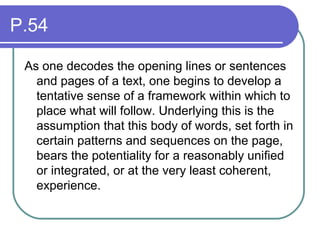
P.54
As one decodes the opening lines or sentences
and pages of a text, one begins to develop a
tentative sense of a framework within which to
place what will follow. Underlying this is the
assumption that this body of words, set forth in
certain patterns and sequences on the page,
bears the potentiality for a reasonably unified
or integrated, or at the very least coherent,
experience.
P.54
One evolves certain expectations about
the diction, the subject, the ideas, the
themes, the kind of text, that will signal
certain possibilities and exclude others,
thus limiting the arc of expectations.
What the reader has elicited form the
text up to any point generates a
receptivity to certain kinds of ideas,
overtones, or attitudes.
P. 54
Perhaps one can think of this as an
alerting certain areas of memory, a
stirring-up of certain reservoirs of
experience, knowledge, and feeling. As
the reading proceeds, attention will be
fixed on the reverberations of
implications that result from fulfillment or
frustration of those expectations.
CHAPTER 4: EVOKING A POEM
 This

process itself is part of the appeal
of reading a work of literature.

 P.54-55
CAPTER 4: EVOKING A POEM
 One

potential objection to the reader-response
theory of literary criticism is that it suggests
that anyone’s reading of a work is just as valid
as any other reading.

 Some

readings are more informed than others
and that people can become better readers
through practice and experience:
Extract from the book:
 Past

literary experiences serve as subliminal
guides as to anticipated, the details to be
attended to, the kinds of organizing patterns to
be evolved. (p.57)

 Traditional

subjects, themes, treatments, may
provide the guides to organization and the
background against which to recognize
something new or original in the text. (p.57)
Extract from the book:
 Awareness-more

or less explicit-of
repetitions, echoes, resonances,
repercussions, linkages, cumulative
effects, contrasts, of surprises is the
mnemonic matrix for the structuring of
emotion, idea, situation, character, plotin short, for the evocation of a work of
art. (p.58)
CHAPTER 4: EVOKING THE POEM
 For

the experienced reader, much of this
has become automatic, carried on
through a continuing flow of responses,
syntheses, readjustment and
assimilation.

 The

reader’s reading process allows
“compatible associations into the focus
of attention. (p.60)
TO SUMMARIZE:
2

streams of responses involved in any
reading event:
# evocation
# interpretation

 Cannot

be separated.
TO SUMMARIZE:
 Rosenblatt

argues “the range of potential
responses and the gamut of degrees of
intensity and articulateness are infinitely
vast, since they depend not only on the
character of the text but even more on
the special character of the individual
reader” (p.49)
TO SUMMARIZE:
 The

readers’ role in evoking and
interpreting the poem can be quite
complex.

 The

text’s involvement in this process is
of equal importance
TO SUMMARIZE:
 Each

genre makes different demands of a
reader.

 New

meaning arrives on the scene concerning
the expectation the reader has of each
particular work.

 Brings

to work past associations and
experiences
THE END
Presented by:
AZLINDA ZAFIRAH BINTI ASHAARY
AFIQAH AMANINA
NOOR HARMIMI BT ABDUL HALIM

Evoking the poem2

  • 1.
    The Reader the Text thePoem The Transactional Theory of the Literary Work Louise M.Rosenblatt
  • 2.
    CHAPTER 4: EVOKINGA POEM  Rosenblatt sketches some of the major process involved in evoking the work from the text.  There are different functions readers go through as they read the text and how this activities influence their response to literature.
  • 3.
    CHAPTER 4: EVOKINGA POEM  Through conscious and unconscious choice, the reader uses the verbal clues given by the author ( diction, setting, character development) along with personal circumstance and experience, to form his or her response to the work.  Through these activities, the reader becomes part of the creative process along with the author.
  • 4.
    CHAPTER 4: EVOKINGA POEM  Through the reader’s evocation and interpretation of a poem, actually has the power to change the text.  Different readers have “decidedly diverse personal responses which become woven into the texture of the experienced poem” (p. 65)
  • 5.
    CHAPTER 4: EVOKINGA POEM  The author gives the examples of a reader’s cultural background, personal experience and literary knowledge as elements which can dramatically change a piece of literature for that reader.  There are no “wrong” response because reader response is always the reader response. It is built out of logic and experience of the reader.
  • 6.
    CHAPTER 4: EVOKINGA POEM  So, teachers must not set boundaries for interpretation of the text instead give the students the freedom to be part of the creative process and respond to the text according their personal experience.
  • 7.
    CHAPTER 4: EVOKINGA POEM  Explains that the experience of evoking the poem goes on as the reader gets further into the works.  The term poem here refers to the artistic creation that the reader constructs while reading a literary work. (Rosenblatt is not discussing only poetry here but any artistic work of literature)
  • 8.
    CHAPTER 4: EVOKINGA POEM  The reader “is immersed in a creative process that goes on largely below the threshold of awareness” (p.52).  This process “imposes the delicate task of sorting the relevant from the irrelevant in a continuing process of selection, revision and expansion: (p.53)
  • 9.
    P.54 As one decodesthe opening lines or sentences and pages of a text, one begins to develop a tentative sense of a framework within which to place what will follow. Underlying this is the assumption that this body of words, set forth in certain patterns and sequences on the page, bears the potentiality for a reasonably unified or integrated, or at the very least coherent, experience.
  • 10.
    P.54 One evolves certainexpectations about the diction, the subject, the ideas, the themes, the kind of text, that will signal certain possibilities and exclude others, thus limiting the arc of expectations. What the reader has elicited form the text up to any point generates a receptivity to certain kinds of ideas, overtones, or attitudes.
  • 11.
    P. 54 Perhaps onecan think of this as an alerting certain areas of memory, a stirring-up of certain reservoirs of experience, knowledge, and feeling. As the reading proceeds, attention will be fixed on the reverberations of implications that result from fulfillment or frustration of those expectations.
  • 12.
    CHAPTER 4: EVOKINGA POEM  This process itself is part of the appeal of reading a work of literature.  P.54-55
  • 13.
    CAPTER 4: EVOKINGA POEM  One potential objection to the reader-response theory of literary criticism is that it suggests that anyone’s reading of a work is just as valid as any other reading.  Some readings are more informed than others and that people can become better readers through practice and experience:
  • 14.
    Extract from thebook:  Past literary experiences serve as subliminal guides as to anticipated, the details to be attended to, the kinds of organizing patterns to be evolved. (p.57)  Traditional subjects, themes, treatments, may provide the guides to organization and the background against which to recognize something new or original in the text. (p.57)
  • 15.
    Extract from thebook:  Awareness-more or less explicit-of repetitions, echoes, resonances, repercussions, linkages, cumulative effects, contrasts, of surprises is the mnemonic matrix for the structuring of emotion, idea, situation, character, plotin short, for the evocation of a work of art. (p.58)
  • 16.
    CHAPTER 4: EVOKINGTHE POEM  For the experienced reader, much of this has become automatic, carried on through a continuing flow of responses, syntheses, readjustment and assimilation.  The reader’s reading process allows “compatible associations into the focus of attention. (p.60)
  • 17.
    TO SUMMARIZE: 2 streams ofresponses involved in any reading event: # evocation # interpretation  Cannot be separated.
  • 18.
    TO SUMMARIZE:  Rosenblatt argues“the range of potential responses and the gamut of degrees of intensity and articulateness are infinitely vast, since they depend not only on the character of the text but even more on the special character of the individual reader” (p.49)
  • 19.
    TO SUMMARIZE:  The readers’role in evoking and interpreting the poem can be quite complex.  The text’s involvement in this process is of equal importance
  • 20.
    TO SUMMARIZE:  Each genremakes different demands of a reader.  New meaning arrives on the scene concerning the expectation the reader has of each particular work.  Brings to work past associations and experiences
  • 21.
    THE END Presented by: AZLINDAZAFIRAH BINTI ASHAARY AFIQAH AMANINA NOOR HARMIMI BT ABDUL HALIM