From Couch Potato to Industry
Leader
Eddie Vidal
Family
2
@eddievidal
Take Education Seriously
@eddievidal
Find a Mentor Early in Your Career
@eddievidal
Love What You Do
@eddievidal
Money
Year is 1996
@eddievidal
Create a Draft
@eddievidal
Communicate Communicate
Communicate
@eddievidal
Metrics Stops the Hearsay and Those
Who Scream the Loudest
@eddievidal
Failure is an Option
“Run when you can, walk if you
have to, crawl if you must, just
never give up!”
D
ean Karnazes
@eddievidal
Get Noticed When You Make a Bad Call
@eddievidal
Professional Development Not 9 to 5
@eddievidal
@eddievidal
One Metric Does Not Make a Case
@eddievidal
Give Back…Pay It Forward
@eddievidal
Take Education Seriously
Eddie Vidal
• HDI & Fusion Track Chair & Speaker
• HDI Strategic Advisory Board
• Founder of South Florida HDI Local
Chapter
• Published in Support World
Magazine & HDI Connect
• HDI Support Center Manager
Certified
• ITIL V3 Foundation & OSA Certified
• itSMF Monthly Podcast Producer
• 2014 itSMF President’s Award
Managing Director, EJV Corp
eddie_vidal@yahoo.com @eddievidal
http://www.linkedin.com/in/eddievidal
@eddievidal
Eddie Vidal | 305-439-9240 | eddie_vidal@yahoo.com | @eddievidal
Thank you for attending this
session.
Please don’t forget to complete an
evaluation form!

From Couch Potato to Industry Leader

Editor's Notes

  • #2 Monday, November 02 at 7:30 AM View schedule Experience Level: Expert How did an unhappy couch potato, with little drive and ambition, transform his life to become a leader in his industry? In this breakfast briefing, attendees learn the advantages of taking risks, making mistakes, and turning failure into a positive learning experience. You’ll discover why tools like using metrics to share your story, communication principles, finding a mentor, and professional development are essential in accepting the challenge to take your career to the next level. Find out how to become a leader in your organization where failing is just another part of the journey to success. Definition of a couch Potato - A person who spends much time sitting or lying down, usually watching television. Laziness – Why? Fear? Fear of being successful? Fear of Hard Work? What changed to make myself an industry leader? Started volunteering Said Yes to opportunities Do things that our uncomfortable
  • #3 Set expectations for our family and kids Young kids expectations Please, Thank you Teenagers Participate in the family outings/dinner No phones at dinner Be respectful of adults Make smart choices School work, report card, grades
  • #4 Take education seriously.  It’s OK to play, but work and study hard. Don't take 20 years to finish college, like I did.  I graduated with a degree in MIS at the age of 40 and regret not applying myself sooner.  If I had worked harder at a younger age, a lot more opportunities would have been available during my career. I never took education seriously in my youth. I was moving along in my career. Making money an deciding to drop out of school Heck, the internet and technology was blowing up. Why bother with school. Cruising along moving from company to company every 5 years and then BOOM! What do you think happened? I was LAID OFF! Married with 3 kids, ages 8,7 and 5 years old. I started looking for work and talking with people and the one question I heard repeatedly…”Do you have a degree? Where is it? Why not? I didn’t have a good answer. Certifications, are you technical? Enough to do some damage. Even though that was a joke, at this time in my life it wasn’t time to joke around. What happens next? No interview of job offers for 6 months. I called everyone in my contact list. This was before Facebook, LinkedIn and social media What did I do during this time to make money and put food on the table? I delivered Yellow Pages and visited 84 Winn-Dixie Supermarkets working on a project for a friend. First interview and job offer was at FIU for 50% less than what I was making. FIU will hire you but with one stipulation….GET A DEGREE!
  • #5 Find a mentor early in your career.  It’s important to surround yourself with smart people.  If you are lucky enough to find someone like this, grab them and don’t let go!  Find ways to learn and absorb this person’s experience.  Offer to go to breakfast or lunch.  Don’t place all the responsibilities on the mentor.  Determine your goals and see how your mentor can help you reach them. Start with a question to the attendees Who here does NOT have a mentor?.....if not, What are you waiting for? If you don’t feel you need a mentor because you are a veteran in the industry, think again, you do need one. If not, who are you mentoring? Who are you sharing your knowledge with? I didn’t have a mentor for such a long time. Thought I could do it all by myself, little did I know. Mentors don’t always have to be older than you. I am not here today if it wasn’t for having a mentor. It’s made me a better person When I write I reach out to peers and mentors to help me edit the article When speaking I share my slidedecks in advance and ask for feedback. When I first started presenting at conference I found people who I trust and asked for constructive and HONEST feedback. The last think I want to hear is you did a good job. I’ve learned from another mentor if I hear that phrase I asked them specifically what was so good about it, what did you get from the presentation. I also film myself and watch the video to learn more about my delivery Podcasts and webinars, I ask for feedback and I also listen to the recording to determine if there are any areas for improvement. This is no different than athletes watching video of themselves Still struggling with finding a mentor at work but have found plenty with HDI and itSMF A few of my mentors have been Albert Noa, Ish Pimienta, Darien Chimoff, Tony Di Perna, Rae Ann Bruno, Manley Fienberg, Julie Montgomery and Doug Tedder. What an all start cast to have around and be able to pick up the phone and ask for guidance and feedback. I’m sure I missed naming some mentors. It’s similar to all Oscar winners who forget to name someone in their acceptance speech. There is one that I’ll never forget and she goes by the hashtag #myLuli Once you’ve had the experience of learning from a mentor it’s time for you to do the same. ITS BETTER TO GIVE THAN RECEIVE Now that I’m older and wiser, its time to give back! In my current position at the U, I provide guidance to my own team members by providing career advice, doing mock interview and reviewing their resumes. At first there was this look of confusion when I offered to do these things. They probably thought I was like I’m trying to rid of them. If that’s what they were thinking where do you think the TRUST factor was? Nothing feels better than seeing someone succeed that you felt you had a art in helping them grow and reach their goals. At HDI, I’ve helped build local chapters from the ground up and have shared my experiences and knowledge. I’m now part of the dream team for all the success we had in South Florida. In addition, I’ve been fortunate enough to be a track chair for the last several years for both Fusion and HDI. This has allowed me to help people reach one of their goals of speaking a conference.
  • #6 Find something you love to do, regardless of the money. Be passionate about it and you will succeed.  I studied Accounting then Finance, and finally decided on a career in Information Technology and Service Management.  I enjoy putting together puzzles and I compare that to finding ways to make my job easier.  A question I always try to answer when faced with a new project, role or organization is, “How would I do this or run this department if it were my own company?”  I enjoy finding ways to be more efficient and taking an approach that hasn’t been thought of in the past.  I learned this term at a recent conference, “Go Opposite”; it helps my approach and attitude when dealing with difficult situations. Money motivates everyone? Not really. Certain things like money, a nice office and job security can help people from becoming less motivated, but they usually don't help people to become more motivated. A key goal is to understand the motivations of each of your employees. I started studying Accounting then Finance because I enjoy working with numbers. Then I fell into IT by accident. I remember my Dad having an IBM Mod 30 computer and calling me over to show me something. I would always ask, “Dad, are you done yet?” Memories of helping him fix our cars when we were young would cross my mind. We always found a way to leave the hours and find something to keep us busy. Has this feeling ever crossed your mind in your current job? Do you look at the clock looking forward for the day to end? Do you dread going to work every day, especially Mondays? If som find another job, career our your happiness elsewhere. How do you go about doing this? Volunteer for a project, find your motivation, Money does not motivate us but its part of the equation Find your niche, do it better than anyone else Find weaknesses in your organziaion, fill in the missing piece
  • #8 Create a draft.  Don’t go for the home-run when writing a document, suggesting a proposal, etc.  In the past when writing a proposal or a new process I would submit it and think it was complete.  When I received feedback, I would get upset because I thought I had considered everything that was requested.  Looking back, I never collaborated and asked for input from team members.  If I had asked for feedback and submitted drafts, I would have saved a lot of headaches and learned the importance of feedback and teamwork much sooner. In my youth, I was asked to write something, a process, policy or contribute to a project. I would spend many hours putting it together and then submitting it. I was happy with my work and felt I was done. WAKE UP CALL!! That was just the beginning. I submitted some work with no feedback from anyone. NO TEAMWORK involved, I was flying solo. When it was returned because of XYZ reason, I would get A) mad B) furious C) upset D) All of the above I learned from my failures and I learned by not involving my team What do I do now? Ensure I understand what’s required of me I ask who else I should get involved? If no one, I seek someone I start with a one page description or a bulleted outline and submit a draft. I look for approval and/or direction I’m now in a position to ask for team members to submit written documents to me and I communicate the expectations in advance and ask for a one page document or less. I continually ask for revisions and provide feedback along the way. The ensures successful end result.
  • #9 Communicate, Communicate, Communicate. In IT, how often do we communicate after the fact?  I’ve learned to think as the customer and our customers tell us all the time that we don’t communicate!  Learn to partner with the business and customer.  Include them in rollouts and changes and create IT customer advisory boards in your organization.  Proactive communication scores big!  Let’s compare our industry to the release of a new movie.  Interviews with the cast on all the talk shows, movie trailer, music is released prior to the premiere.  How is this any different than rolling out an ERP solution, new email system or a service management solution?  Learn to communicate like the marketing department! Who here has planned a wedding? How many guys have done this? What did it take to plan it? Not the logistics part but the communication part? Tough points, how many? Movie premiere, what happens? Trailer – 2 minutes Posters – flyers ; logos #hashtags are created, FB page, web site, Social Media stuff Actors, they appear in magazines, talk shows, interviews, do the promotional tour IT project is being rolled out? What happens? SPOM – Single Point of Marketing Logos, Yammer, Social Media, emails How many times should you send? Fusion Conference – how many times did you receive an email, receive something via snail mail or see a social media post? HDI Local Chapter – 8 touch points via email, not including social media posts
  • #10 Metrics stop the hearsay and those who scream the loudest. At one of my previous organizations I started sharing some metrics regarding our service levels.  I made the data available to everyone but no one ever took the time to dig deep and determine how we were really doing.  My findings were very interesting and it showed which areas were performing and those that needed improvement.  People who were "squeaky wheels" didn’t believe the numbers at first, but soon realized they needed to change their approach or get left behind.  Use the data available before making assumptions and use it to improve your areas. In an immature or small organizations, there are individuals who have been around for a LONG time and have always gotten their way or did things their way In past organizations they would criticize our team. I always ask, provide me an example. Their feedback and comments were generalizations. When I asked for specifics I wouldn’t receive anything. Then I started publishing metrics and those same individuals would question the numbers and ask where I got them from? Seriously? Once the numbers came out, those shouting their criticisms were now all of a sudden quiet. Even today when I hear complaints about our team I ask, Do you have an incident number? User Name? When and what time did they call? Give me specifics Why? So I can coach my team members. Help eliminate mistakes, show the team a new process or correct behaviors This also works in reverse, sometimes my team comes to me and states, XYZ team is not working with us. I ask them the same questions and request specifics Examples – project rollouts for Outlook to students. We are getting killed with calls? Really, 30,000 students, let’s look at the number of incidents, 15. REALLY? In our organization, we can slow down project roll outs from past projects which impact on our call volume. We’ve been able to obtain casual workers for project roll outs. I use feedback from other to coach our team members. All calls are recorded so we can hear what really happened
  • #11 It's OK to fail. Learn more from your mistakes than your successes, .  During every interview I conduct there is one question I ask potential candidates, “Tell me the biggest mistake you made in your professional career, but more importantly, what did you learn from it?”  This shows me the kind of risks a person is willing to take. Hopefully you work in a trusting environment where you can take risks and also fail.  Failure makes us stronger and creates learning opportunities.  Don’t be afraid to take the risks. What’s the biggest mistake you have made in your professional career? More importantly, what did you learn from it? This is a question I ask during every interview. This is a similar question you can ask your teenager or young adult. Share with me the last mistake you made? If the answer is none, then that’s a different story I also want to share with you a little later. We have all made mistakes, if not, you are not learning and taking risks. Mistakes help us learn and move our careers forward. Risks must be calculated, research and thought out done right will help you become more successful. During the interview process when they can’t answer the mistake question I start to think why? I also lean towards not hiring them. Yes, one question can make a difference. I look at this as an opportunity to answer a question about how you changed and hopefully became a better worker. Here was your chance to provide a new strength that has helped your career. Getting back to teenagers or young adults, these type of individuals are not ready to be coached and learn from others. Potentially they are not ready or humble enough to admit their imperfections and be accepting of feedback and criticism from others.
  • #12 Officials/referees at a sporting event only get noticed when they make a bad call. Sound familiar?  How is it that we are called to the office or reprimanded when we fail or make a mistake?  What about all the other times we have performed on a consistent basis?  We have become an industry where delivery of services is expected similar to a utility.  Plumbing and electricity is running at all times, when it’s not, you really feel the affect.  Our customers expect the same things with technology, it's part of our everyday lives.  When an official blows a call in the biggest game of the year, we learn their name and it’s talked about in the news the next day. You need a thick skin to survive in this career.  Ensure you put to use lesson number 7 and learn from it. How often are you told you are doing a good job? In many organizations this is common but not in all organizations. I’ve worked in too many organizations when you only hear from the boss or the higher ups when you have made a mistake. A few years ago the NFL officials, referees, umpires went on strike and they brought in replacement officials. In sports, officials do a great job and you never notice them. You don’t even know their names. They go about their business and make the right calls on a consistent basis. One day they blow a call and all hell breaks loose. That’s what happened in this picture with the replacement officials. They blew the call and awarded the Seahawks a touchdown to win the game. The replacement officials became very well known for not doing their job well. No only that, the officials who were on strike and who no one cared about them all of a sudden everyone loved them and wanted them back. When the real officials returned to their first game, never in the history of sports were officials loved and cheered on the field when they were introduced. In IT, a lot of times it feels like we are those officials. Only noticed when things go bad. How about picking our the good things? How often do you recognize your team members. Make it a habit.
  • #13 Professional development is not between the hours of 9 to 5.  My team members sometimes ask, "When do we have time to develop ourselves when you don’t give us any time?"  If you are in an organization which allows you time during the day to develop yourself, be very thankful!  Even if you are, though,  that’s not enough time if you want to grow and be successful. I’m writing this blog on a Sunday afternoon.  Not until I started spending my own time to learn, did I really take the next step in my career.  This goes back to lesson number 3 - love what you do.  If you are reading and learning about something you enjoy, you will improve.  Many times I’ve been relaxing on the beach reading or writing my next presentation.  Invest in yourself and make the sacrifices to learn as much as you can; it will pay off. Consider yourself lucky if your organization allows you to develop yourself professional during working hours. How many of you have emails to answer and work to do during this conference? Who covers for you when you are gone? - If you went to college a different route like I did and was working full time, when did you go to class and study? When you prepare for a presentation like this, when do you work on it? When you grow your career and earn certifications, when do you do it? When you network and learn from others, participate in professional organizations, when? If not, why? How do you make it to the next level? Hard work? Not much is worth that is given, it’s earned!
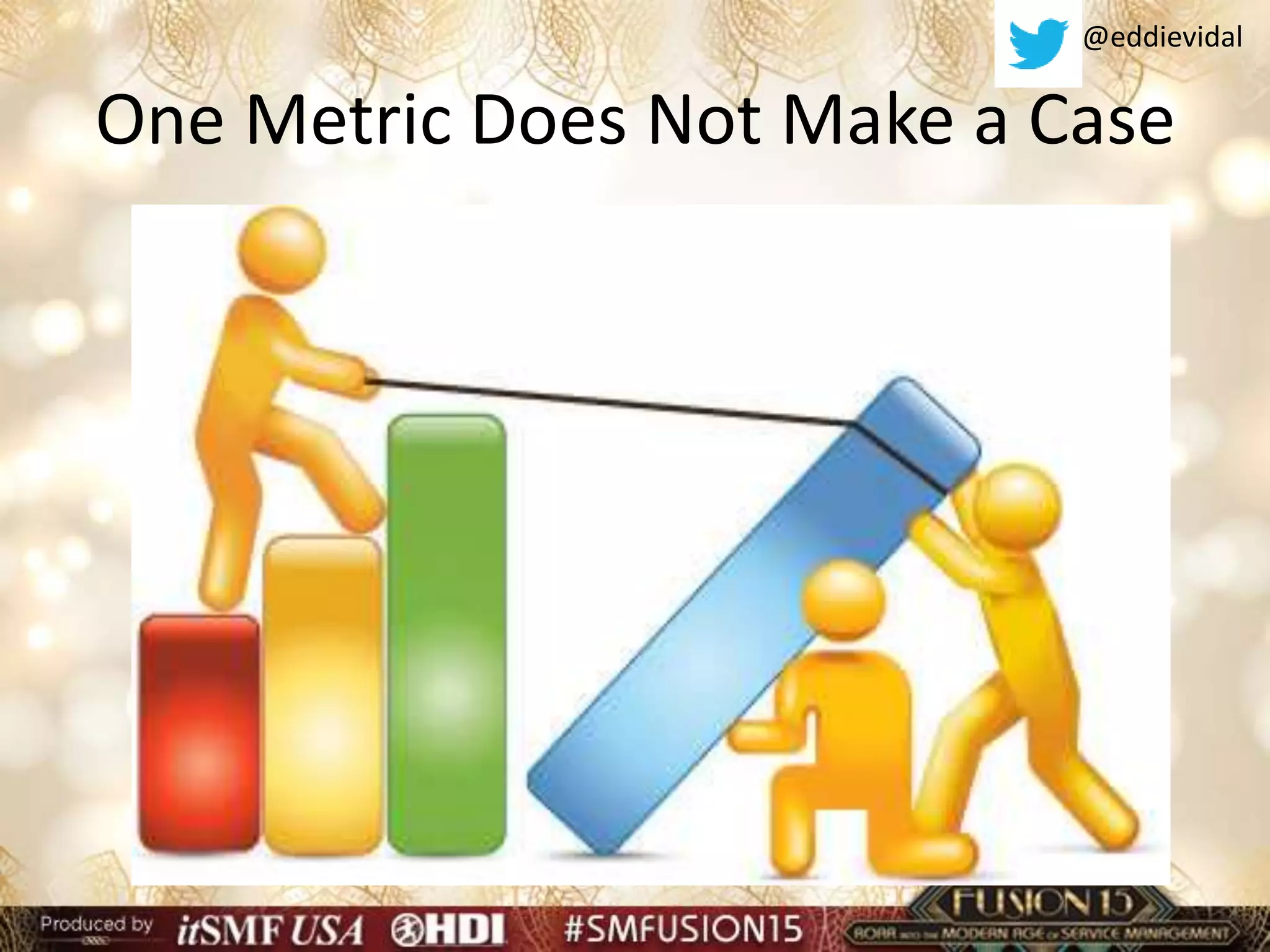
  • #15 One metric does not make a case.  Just as in crime scene investigations, one metric is part of the puzzle...it's a clue. ONE metric does not tell the entire story.  I use metrics to begin my investigation regarding why we aren’t or are performing well.  As I begin to investigate the clues, I often uncover more clues. I also use metrics to communicate positive results to the team. Many times team members think I make decisions based on one metric. Right now I’m keying in on one metric for our Service Desk called Not Ready Time. I have a goal of 2.5 hours or less per day. Every Monday for the last several weeks I send out a weekly report and highlight in green those that have met the goal. Those that miss it one day I don’t say anything to them because they are not robots and can have an off day. But if they miss it 3 or more days I bring them into my office and ask them why they haven’t met the goal? There may be some good reasons such as meetings or training or escalated calls or I ask them to share with me why they didn’t reach this goal. I remind them of the goal and it’s important to reach it. Sometimes when I address it with team members they become defensive and state there are many other things they do and do well. This is where I start educating and explaining to them why I feel this ONE metric is important right now. Low NOT READY time leads to the following: Average speed to answer improves Abandon rate lowers More calls are answered Service level increases Potentially customer SAT goes up ONE metric -> 5 potential outcomes for improvements
  • #16 Bonus/Extra Credit:  Give back, pay it forward.  It’s better to give than to receive.  I enjoy giving back and mentoring individuals.  I feel my career has gone to another level by sharing my experiences, knowledge and cultivating relationships.  It feels great when someone asks you for help and you have the ability to make a difference.  I’ve learned to say yes to volunteer opportunities and learned to go beyond my comfort zone.  It’s humbling to be asked to speak at conferences, write blogs and give back to the IT industry.  Paying it forward does not mean it’s all work related.  Share your time with family, your faith based practices and the things you love, in my case, sports.  Take the time to pay it forward. I mentioned before, it’s better to give then receive. It’s important to help those around you become better.
  • #17 Take education seriously.  It’s OK to play, but work and study hard. Don't take 20 years to finish college, like I did.  I graduated with a degree in MIS at the age of 40 and regret not applying myself sooner.  If I had worked harder at a younger age, a lot more opportunities would have been available during my career. I never took education seriously in my youth. I was moving along in my career. Making money an deciding to drop out of school Heck, the internet and technology was blowing up. Why bother with school. Cruising along moving from company to company every 5 years and then BOOM! What do you think happened? I was LAID OFF! Married with 3 kids, ages 8,7 and 5 years old. I started looking for work and talking with people and the one question I heard repeatedly…”Do you have a degree? Where is it? Why not? I didn’t have a good answer. Certifications, are you technical? Enough to do some damage. Even though that was a joke, at this time in my life it wasn’t time to joke around. What happens next? No interview of job offers for 6 months. I called everyone in my contact list. This was before Facebook, LinkedIn and social media What did I do during this time to make money and put food on the table? I delivered Yellow Pages and visited 84 Winn-Dixie Supermarkets working on a project for a friend. First interview and job offer was at FIU for 50% less than what I was making. FIU will hire you but with one stipulation….GET A DEGREE! ---------------------- During the presentation we now come full circle to the end….This same slide will go at the end and the following will be said If I lost my job today what would happened? Can anyone predict the future? No but you can place yourself in a better position if you take education seriously. Today I have a degree and certifications Today I volunteer and network with peers in my industry I do more speaking at conferences, webinars, podcast and presentations. I have started to write more too. There’s more…How do I take it to the next level? Master degree, why not? I work at the U Write more…how about a book or start with blogs Earn more certifications, ITIL Expert, ITSM certs This is how I feel I can take it to the next level and put myself in position to be ready when the next BOOM happens
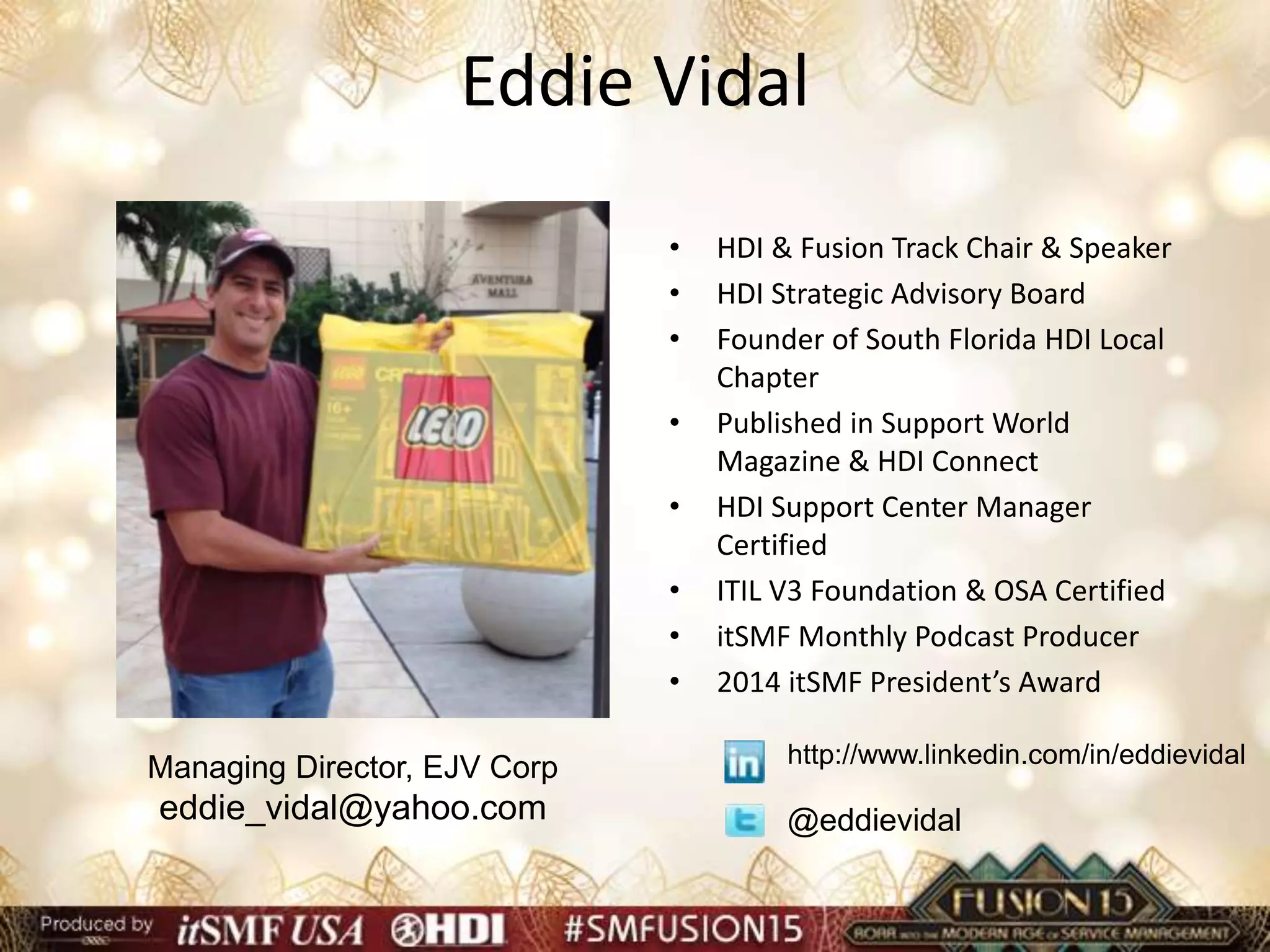
  • #18 Eddie Vidal Managing Director, EJV Corp Eddie Vidal has over twenty years’ experience in information technology, where he focuses primarily on service delivery and support for IT infrastructures. In his current position as the manager of enterprise support services for the information technology department at the University of Miami, Eddie supports over 35,000 faculty, staff, and students. In addition to higher education, Eddie’s experience includes the hospitality and travel industries. Eddie currently serves as the president of the HDI South Florida local chapter and a member of the HDI Desktop Support Advisory Board (DSAB). He has spoken at local, regional, and national events and has been published in HDI's SupportWorld magazine.