From Clever code to Better code
Dror Helper (@dhelper)
About.ME
Consultant & software architect @ Practical Software
Developing software since 2002
Clean Coder & Test-Driven Developer
Pluralsight author
Blogger: http://helpercode.com
Twitter: @dhelper
A long time ago,
in an office not that far from here . . . .
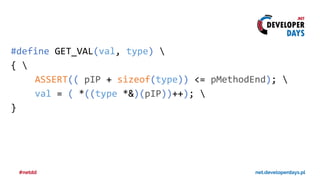
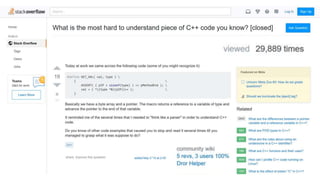
#define GET_VAL(val, type) 
{ 
ASSERT(( pIP + sizeof(type)) <= pMethodEnd); 
val = ( *((type *&)(pIP))++); 
}
What this code does now I understand, clever it is!
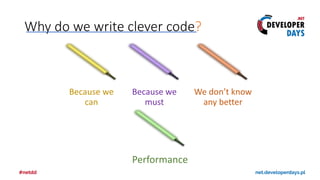
Why do we write clever code?
Because we
can
Because we
must
We don’t know
any better
Performance
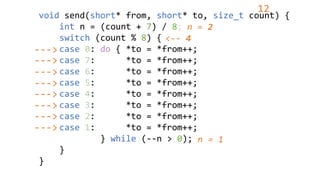
void send(short* from, short* to, size_t count) {
int n = (count + 7) / 8;
switch (count % 8) {
case 0: do { *to = *from++;
case 7: *to = *from++;
case 6: *to = *from++;
case 5: *to = *from++;
case 4: *to = *from++;
case 3: *to = *from++;
case 2: *to = *from++;
case 1: *to = *from++;
} while (--n > 0);
}
}
n = 2
12
<-- 4
--->
--->
--->
--->
n = 1
--->
--->
--->
--->
REALITY CHECK:
We write Clever Code because it makes us feel
good
/* Most programmers love to be clever */
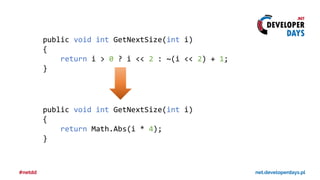
There is more than one
way to write
Clever Code
public void int GetNextSize(int i)
{
return i > 0 ? i << 2 : ~(i << 2) + 1;
}
public void int GetNextSize(int i)
{
return Math.Abs(i * 4);
}
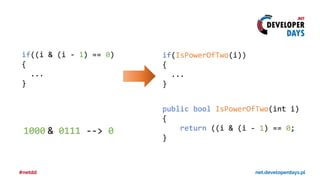
if((i & (i - 1) == 0)
{
...
}
if(IsPowerOfTwo(i))
{
...
}
public bool IsPowerOfTwo(int i)
{
return ((i & (i - 1) == 0;
}
1000 & 0111 --> 0
Low level programming
Avoid if you can
Refactor to show intent
Compressed code
a = y[0]>y[1] ? (b=1,0) : (b=0,1);
a = (y[0] > y[1] ?
(Func<int>)(() => { b = 1; return 0; }) :
() => { b = 0; return 1; })
.Invoke();
Compressed code
a = y[0]>y[1] ? (b=1,0) : (b=0,1);
if(y[0] > y[1]){
a = 0;
b = 1;
} else {
a = 1;
b = 0;
}
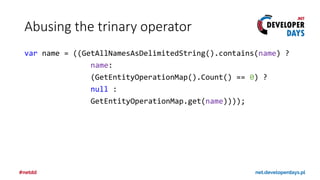
Abusing the trinary operator
var name = ((GetAllNamesAsDelimitedString().contains(name) ?
name:
(GetEntityOperationMap().Count() == 0) ?
null :
GetEntityOperationMap.get(name))));
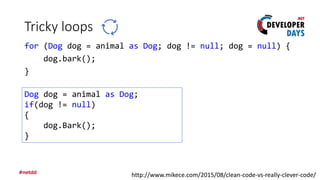
Tricky loops
for (Dog dog = animal as Dog; dog != null; dog = null) {
dog.bark();
}
http://www.mikece.com/2015/08/clean-code-vs-really-clever-code/
Dog dog = animal as Dog;
if(dog != null)
{
dog.Bark();
}
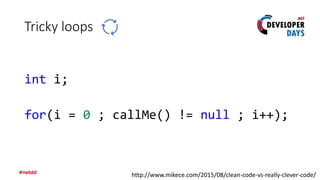
Tricky loops
int i;
for(i = 0 ; callMe() != null ; i++);
http://www.mikece.com/2015/08/clean-code-vs-really-clever-code/
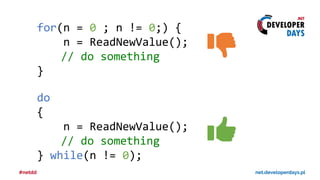
for(n = 0 ; n != 0;) {
n = ReadNewValue();
// do something
}
do
{
n = ReadNewValue();
// do something
} while(n != 0);
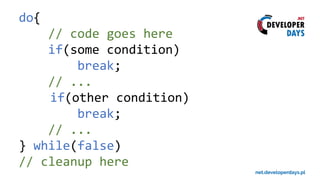
do{
// code goes here
if(some condition)
break;
// ...
if(other condition)
break;
// ...
} while(false)
// cleanup here
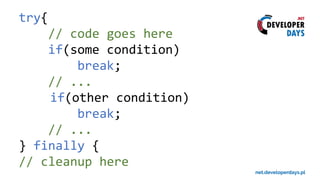
try{
// code goes here
if(some condition)
break;
// ...
if(other condition)
break;
// ...
} finally {
// cleanup here
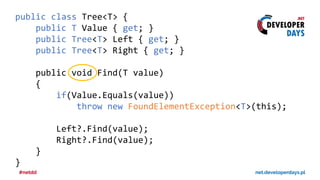
public class Tree<T> {
public T Value { get; }
public Tree<T> Left { get; }
public Tree<T> Right { get; }
public void Find(T value)
{
if(Value.Equals(value))
throw new FoundElementException<T>(this);
Left?.Find(value);
Right?.Find(value);
}
}
Creative (ab)use
Don’t surprise the reader!
Think of a better way to express yourself
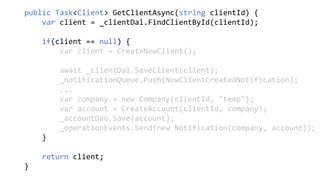
public Task<Client> GetClientAsync(string clientId) {
var client = _clientDal.FindClientById(clientId);
if(client == null) {
var client = CreateNewClient();
await _clientDal.SaveClient(client);
_notificationQueue.Push(NewClientCreatedNotification);
...
var company = new Company(clientId, "temp");
var account = CreateAccount(clientId, company);
_accountDao.Save(account);
_operationEvents.Send(new Notification(company, account));
}
return client;
}
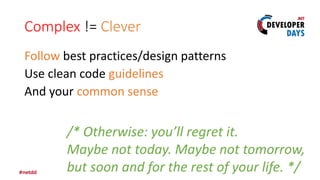
Complex != Clever
Follow best practices/design patterns
Use clean code guidelines
And your common sense
/* Otherwise: you’ll regret it.
Maybe not today. Maybe not tomorrow,
but soon and for the rest of your life. */
class O1
{
private string myPrivateField;
}
class O2
{
public string publicField;
}
[StructLayout(LayoutKind.Explicit)]
struct FastReflectionAdapter
{
[FieldOffset(0)]
internal object o1;
[FieldOffset(0)]
internal O2 o2;
}
var adapter = new FastReflectionAdapter { o1 = new O1("Foo") };
var privateValue = adapter.o2.publicField;
https://twitter.com/korifey_ad/status/1169210959426183168
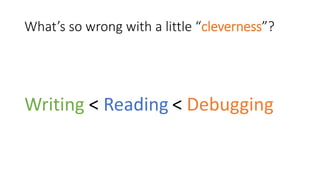
What’s so wrong with a little “cleverness”?
Writing < Reading < Debugging
“A clever person solves a problem.
A wise person avoids it.”
Albert Einstein
void calculate(struct salesinfo* sales)
{
jmp_buf buffer;
int i=setjmp(buffer);
if (!(i<sales->count))
RETURN_NOTHING;
addToSubtotal(sales->values[i]);
if (i<sales->count)
{
longjmp(buffer,i+1);
}
}
void calculate(struct salesinfo*sales)
{
for(int i = 0; i < sales->count; i++)
{
addToSubtotal(sales->values[i]);
}
}
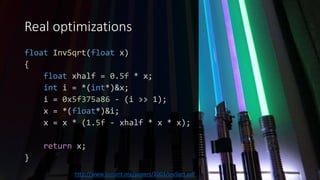
Real optimizations
float InvSqrt(float x)
{
float xhalf = 0.5f * x;
int i = *(int*)&x;
i = 0x5f375a86 - (i >> 1);
x = *(float*)&i;
x = x * (1.5f - xhalf * x * x);
return x;
}
http://www.lomont.org/papers/2003/InvSqrt.pdf
Is clever code
Good or Evil?
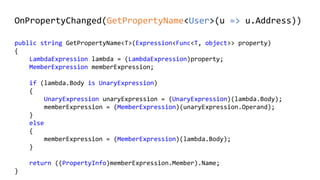
public string GetPropertyName<T>(Expression<Func<T, object>> property)
{
LambdaExpression lambda = (LambdaExpression)property;
MemberExpression memberExpression;
if (lambda.Body is UnaryExpression)
{
UnaryExpression unaryExpression = (UnaryExpression)(lambda.Body);
memberExpression = (MemberExpression)(unaryExpression.Operand);
}
else
{
memberExpression = (MemberExpression)(lambda.Body);
}
return ((PropertyInfo)memberExpression.Member).Name;
}
OnPropertyChanged(GetPropertyName<User>(u => u.Address))
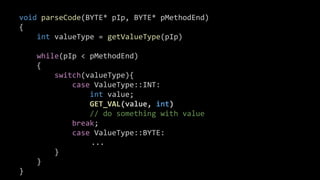
#define GET_VAL( val, type ) 
{ 
ASSERT( ( pIP + sizeof(type) ) <= pMethodEnd ); 
val = ( *((type *&)(pIP))++ ); 
}
void parseCode(BYTE* pIp, BYTE* pMethodEnd)
{
int valueType = getValueType(pIp)
while(pIp < pMethodEnd)
{
switch(valueType){
case ValueType::INT:
int value;
GET_VAL(value, int)
// do something with value
break;
case ValueType::BYTE:
...
}
}
}
Dror Helper | @ dhelper | http://helpercode.com
Thank you!
From clever code to better code

From clever code to better code

  • 1.
    From Clever codeto Better code Dror Helper (@dhelper)
  • 2.
    About.ME Consultant & softwarearchitect @ Practical Software Developing software since 2002 Clean Coder & Test-Driven Developer Pluralsight author Blogger: http://helpercode.com Twitter: @dhelper
  • 3.
    A long timeago, in an office not that far from here . . . .
  • 4.
    #define GET_VAL(val, type) { ASSERT(( pIP + sizeof(type)) <= pMethodEnd); val = ( *((type *&)(pIP))++); }
  • 5.
    What this codedoes now I understand, clever it is!
  • 7.
    Why do wewrite clever code? Because we can Because we must We don’t know any better Performance
  • 8.
    void send(short* from,short* to, size_t count) { int n = (count + 7) / 8; switch (count % 8) { case 0: do { *to = *from++; case 7: *to = *from++; case 6: *to = *from++; case 5: *to = *from++; case 4: *to = *from++; case 3: *to = *from++; case 2: *to = *from++; case 1: *to = *from++; } while (--n > 0); } } n = 2 12 <-- 4 ---> ---> ---> ---> n = 1 ---> ---> ---> --->
  • 9.
    REALITY CHECK: We writeClever Code because it makes us feel good /* Most programmers love to be clever */
  • 10.
    There is morethan one way to write Clever Code
  • 11.
    public void intGetNextSize(int i) { return i > 0 ? i << 2 : ~(i << 2) + 1; } public void int GetNextSize(int i) { return Math.Abs(i * 4); }
  • 12.
    if((i & (i- 1) == 0) { ... } if(IsPowerOfTwo(i)) { ... } public bool IsPowerOfTwo(int i) { return ((i & (i - 1) == 0; } 1000 & 0111 --> 0
  • 13.
    Low level programming Avoidif you can Refactor to show intent
  • 15.
    Compressed code a =y[0]>y[1] ? (b=1,0) : (b=0,1); a = (y[0] > y[1] ? (Func<int>)(() => { b = 1; return 0; }) : () => { b = 0; return 1; }) .Invoke();
  • 16.
    Compressed code a =y[0]>y[1] ? (b=1,0) : (b=0,1); if(y[0] > y[1]){ a = 0; b = 1; } else { a = 1; b = 0; }
  • 17.
    Abusing the trinaryoperator var name = ((GetAllNamesAsDelimitedString().contains(name) ? name: (GetEntityOperationMap().Count() == 0) ? null : GetEntityOperationMap.get(name))));
  • 19.
    Tricky loops for (Dogdog = animal as Dog; dog != null; dog = null) { dog.bark(); } http://www.mikece.com/2015/08/clean-code-vs-really-clever-code/ Dog dog = animal as Dog; if(dog != null) { dog.Bark(); }
  • 20.
    Tricky loops int i; for(i= 0 ; callMe() != null ; i++); http://www.mikece.com/2015/08/clean-code-vs-really-clever-code/
  • 21.
    for(n = 0; n != 0;) { n = ReadNewValue(); // do something } do { n = ReadNewValue(); // do something } while(n != 0);
  • 22.
    do{ // code goeshere if(some condition) break; // ... if(other condition) break; // ... } while(false) // cleanup here
  • 23.
    try{ // code goeshere if(some condition) break; // ... if(other condition) break; // ... } finally { // cleanup here
  • 24.
    public class Tree<T>{ public T Value { get; } public Tree<T> Left { get; } public Tree<T> Right { get; } public void Find(T value) { if(Value.Equals(value)) throw new FoundElementException<T>(this); Left?.Find(value); Right?.Find(value); } }
  • 25.
    Creative (ab)use Don’t surprisethe reader! Think of a better way to express yourself
  • 26.
    public Task<Client> GetClientAsync(stringclientId) { var client = _clientDal.FindClientById(clientId); if(client == null) { var client = CreateNewClient(); await _clientDal.SaveClient(client); _notificationQueue.Push(NewClientCreatedNotification); ... var company = new Company(clientId, "temp"); var account = CreateAccount(clientId, company); _accountDao.Save(account); _operationEvents.Send(new Notification(company, account)); } return client; }
  • 27.
    Complex != Clever Followbest practices/design patterns Use clean code guidelines And your common sense /* Otherwise: you’ll regret it. Maybe not today. Maybe not tomorrow, but soon and for the rest of your life. */
  • 28.
    class O1 { private stringmyPrivateField; } class O2 { public string publicField; } [StructLayout(LayoutKind.Explicit)] struct FastReflectionAdapter { [FieldOffset(0)] internal object o1; [FieldOffset(0)] internal O2 o2; } var adapter = new FastReflectionAdapter { o1 = new O1("Foo") }; var privateValue = adapter.o2.publicField; https://twitter.com/korifey_ad/status/1169210959426183168
  • 29.
    What’s so wrongwith a little “cleverness”? Writing < Reading < Debugging
  • 30.
    “A clever personsolves a problem. A wise person avoids it.” Albert Einstein
  • 32.
    void calculate(struct salesinfo*sales) { jmp_buf buffer; int i=setjmp(buffer); if (!(i<sales->count)) RETURN_NOTHING; addToSubtotal(sales->values[i]); if (i<sales->count) { longjmp(buffer,i+1); } } void calculate(struct salesinfo*sales) { for(int i = 0; i < sales->count; i++) { addToSubtotal(sales->values[i]); } }
  • 33.
    Real optimizations float InvSqrt(floatx) { float xhalf = 0.5f * x; int i = *(int*)&x; i = 0x5f375a86 - (i >> 1); x = *(float*)&i; x = x * (1.5f - xhalf * x * x); return x; } http://www.lomont.org/papers/2003/InvSqrt.pdf
  • 34.
  • 35.
    public string GetPropertyName<T>(Expression<Func<T,object>> property) { LambdaExpression lambda = (LambdaExpression)property; MemberExpression memberExpression; if (lambda.Body is UnaryExpression) { UnaryExpression unaryExpression = (UnaryExpression)(lambda.Body); memberExpression = (MemberExpression)(unaryExpression.Operand); } else { memberExpression = (MemberExpression)(lambda.Body); } return ((PropertyInfo)memberExpression.Member).Name; } OnPropertyChanged(GetPropertyName<User>(u => u.Address))
  • 36.
    #define GET_VAL( val,type ) { ASSERT( ( pIP + sizeof(type) ) <= pMethodEnd ); val = ( *((type *&)(pIP))++ ); } void parseCode(BYTE* pIp, BYTE* pMethodEnd) { int valueType = getValueType(pIp) while(pIp < pMethodEnd) { switch(valueType){ case ValueType::INT: int value; GET_VAL(value, int) // do something with value break; case ValueType::BYTE: ... } } }
  • 37.
    Dror Helper |@ dhelper | http://helpercode.com Thank you!

Editor's Notes

  • #9 Duff's device is a way of manually implementing loop unrolling by interleaving two syntactic constructs of C
  • #11 Clever code is not dumb code or bad code in itself, It’s a unique and cool implementation done in a way that you haven’t thought of before. But there are instances where the author of the clever code has gone too far – and I like to show you some of those cases
  • #30 Not bad code in itself But sometime over complex or trickery Hard to read Difficult to maintain Impossible to extend
  • #34 Clever code could be a must, but there’s a price to pay – it is impossible to maintain When you need to extend or update you have no choice but to completely re-write it
  • #37 If I had to write the code I’ve used I would have to write a lot of boilerplate code My conclusion is that Clever code is not always good or bad, but it does have a cost, Maintenance would be harder, extending you code will be difficult or even impossible so you need to make sure you’ve got a good reason to pay that price. In other words - don’t write write clever cod just for the sake of being clever write it only when you have to because there is no better way to solve a complex problem, create a user friendly API or Because real clever code is not about finding a dark corner of your programming language to show how smart you are but rather on making life simpler for whoever is going to us it – including your future self.