ProGuard
Optimizer and Obfuscator
in the Android SDK
Eric Lafortune
Developer of ProGuard
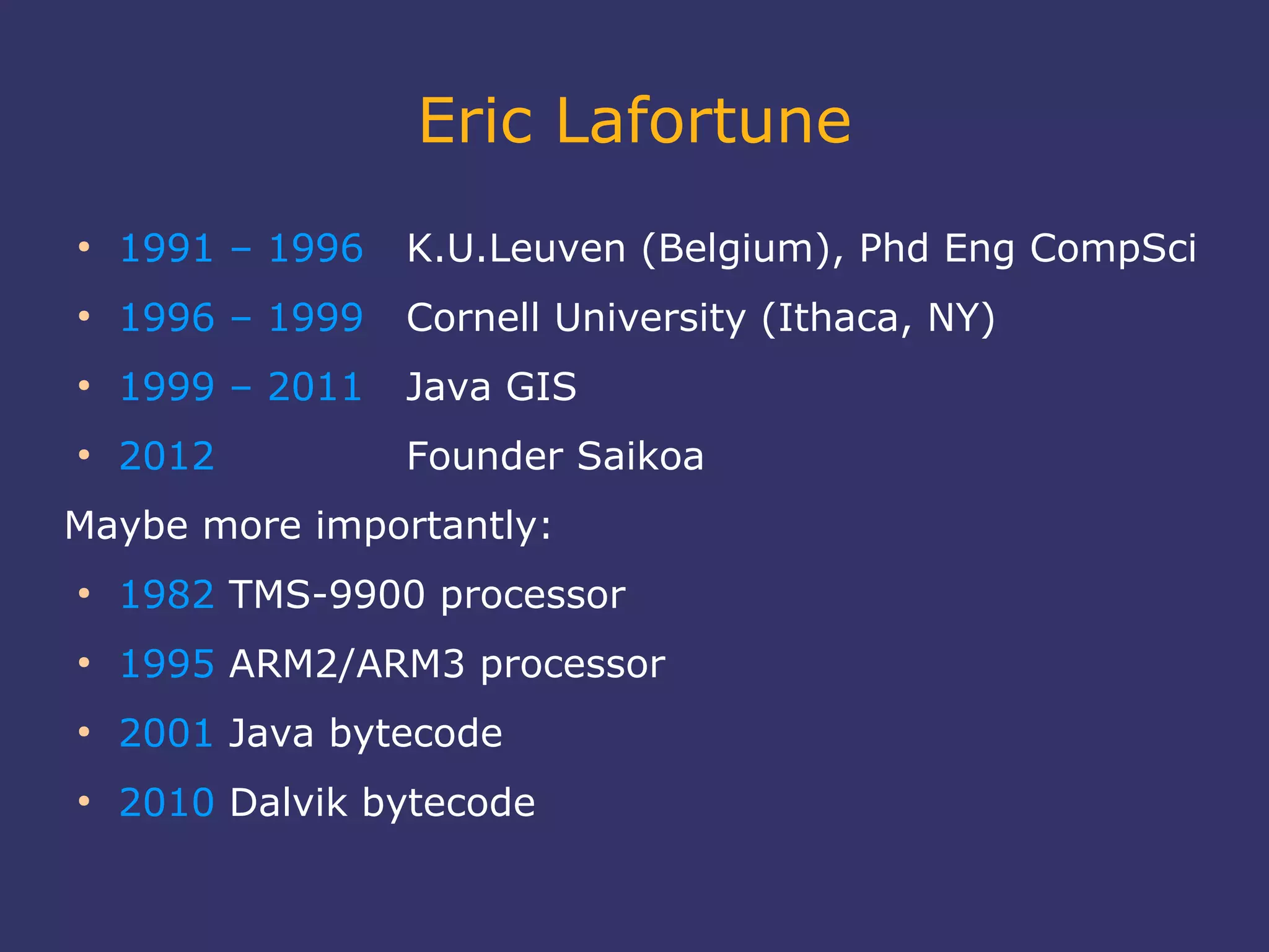
Eric Lafortune
●
1991 – 1996 K.U.Leuven (Belgium), Phd Eng CompSci
●
1996 – 1999 Cornell University (Ithaca, NY)
●
1999 – 2011 Java GIS
●
2012 Founder Saikoa
Maybe more importantly:
●
1982 TMS-9900 processor
●
1995 ARM2/ARM3 processor
●
2001 Java bytecode
●
2010 Dalvik bytecode
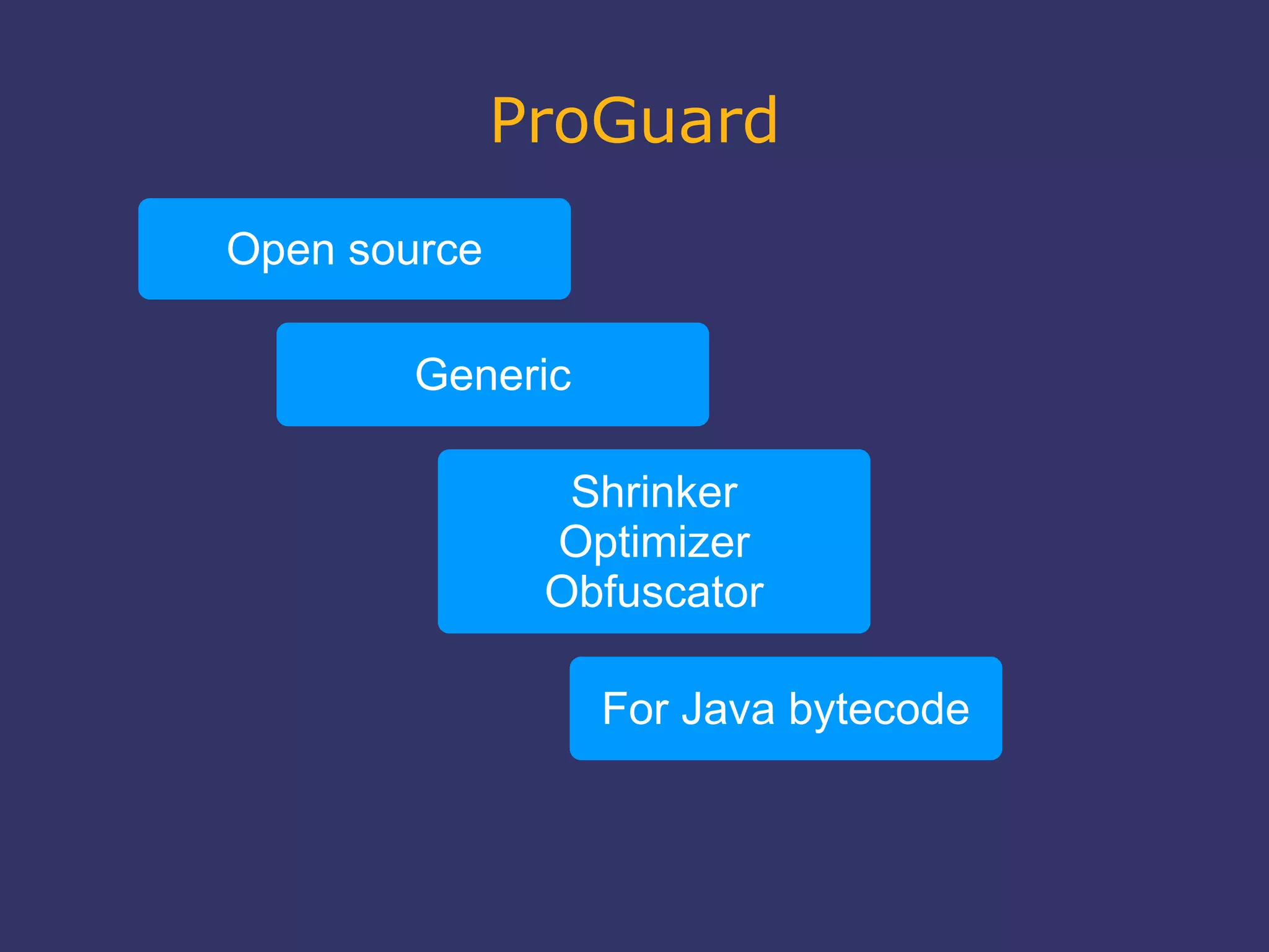
ProGuard
Open source
Generic
Shrinker
Optimizer
Obfuscator
For Java bytecode
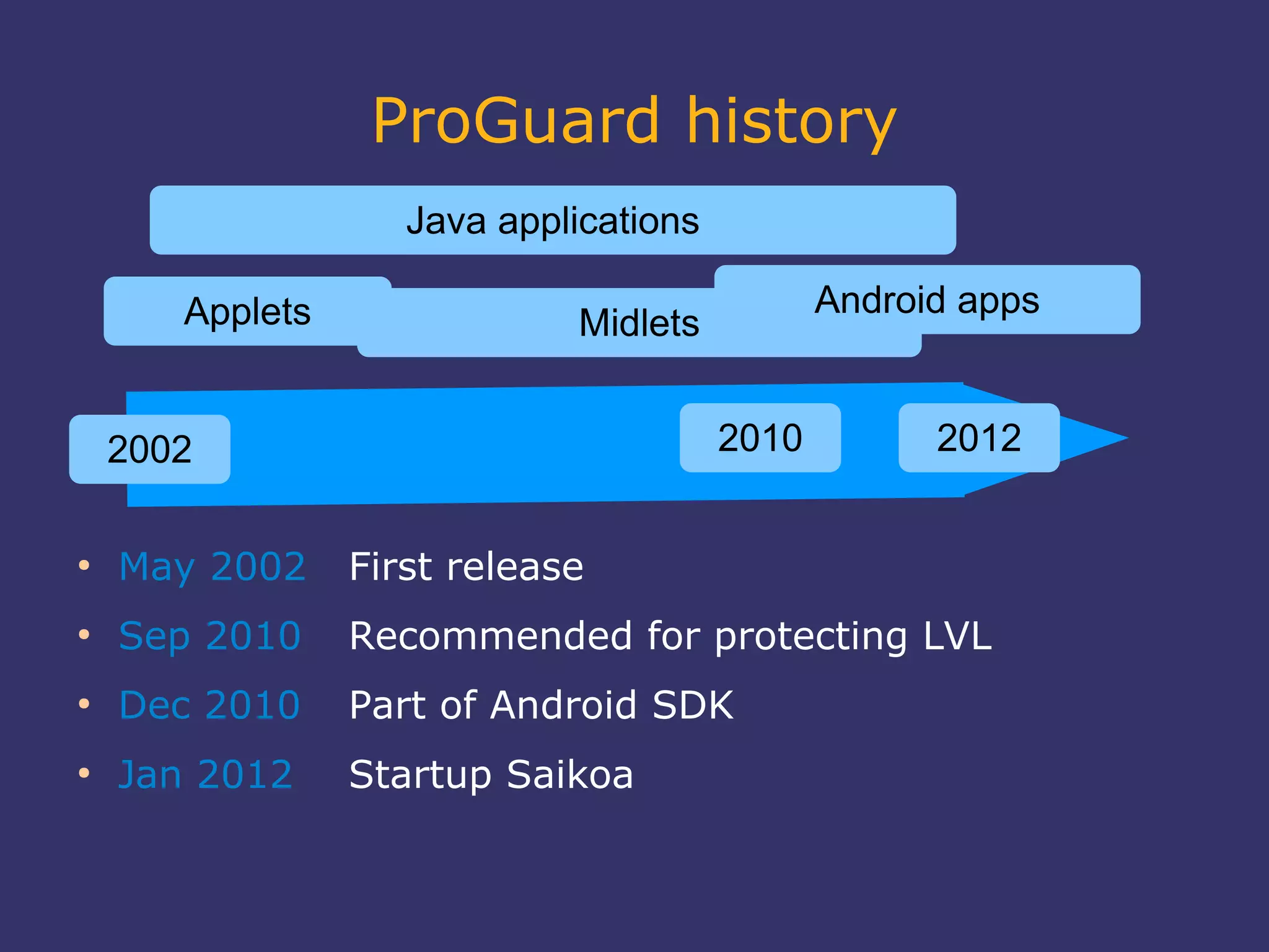
ProGuard history
Java applications
Applets
2002
Midlets
2010 2012
Android apps
●
May 2002 First release
●
Sep 2010 Recommended for protecting LVL
●
Dec 2010 Part of Android SDK
●
Jan 2012 Startup Saikoa
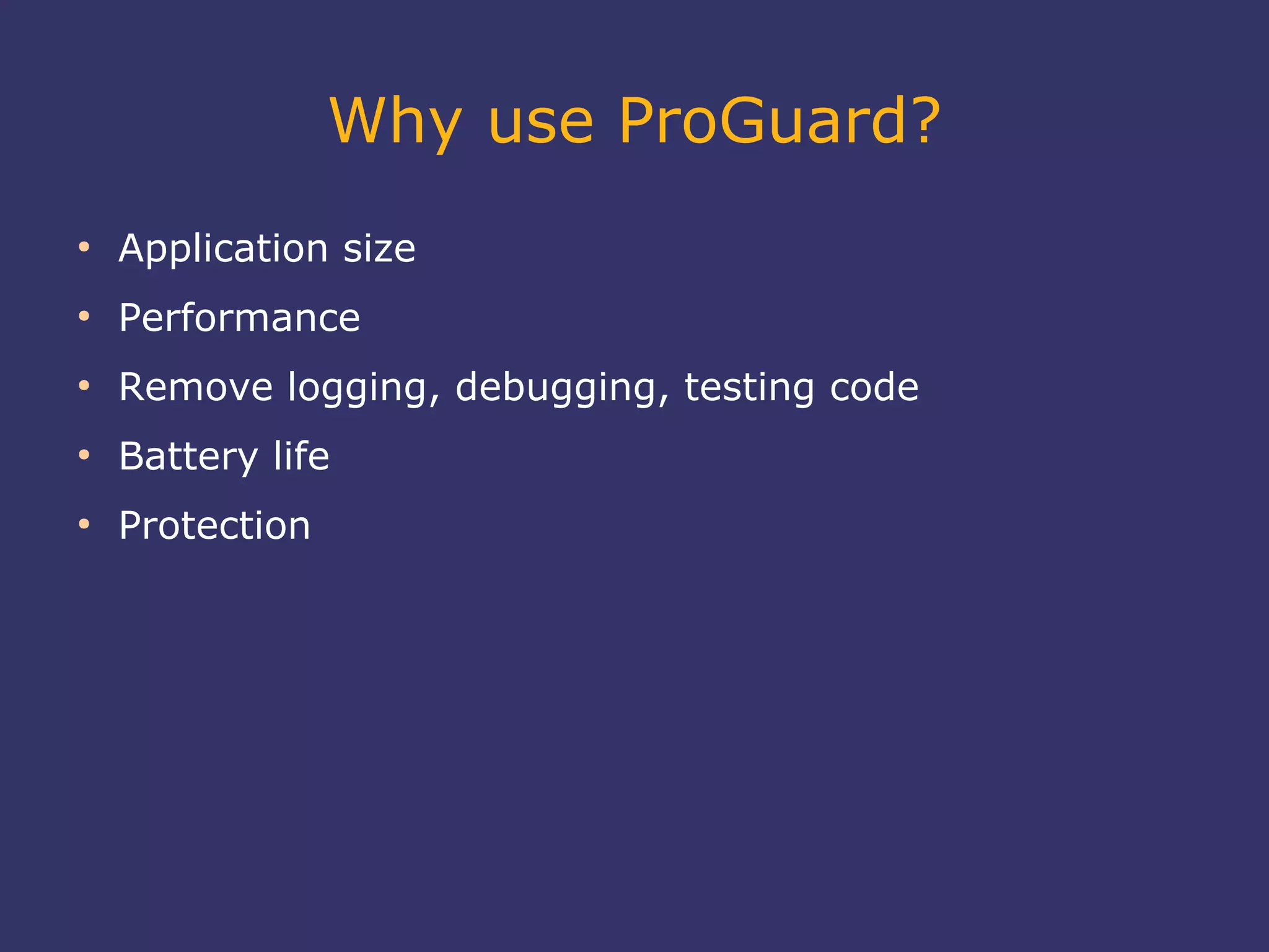
Why use ProGuard?
●
Application size
●
Performance
●
Remove logging, debugging, testing code
●
Battery life
●
Protection
Application size
classes.dex size .apk size
Without
ProGuard
With
ProGuard
Reduction
Without
ProGuard
With
ProGuard
Reduction
ApiDemos 716 K 482 K 33 % 2.6 M 2.5 M 4 %
GoogleIO
App
3.4 M 905 K 75 % 1.9 M 906 K 53 %
ApiDemos
in Scala*
~6 M 542 K ~90 % ~8 M 2.5 M ~70 %
* [Stéphane Micheloud, http://lampwww.epfl.ch/~michelou/android/library-code-shrinking.html]
Performance: CaffeineMark
Without ProGuard
Sieve score = 6833
Loop score = 14831
Logic score = 19038
String score = 7694
Float score = 6425
Method score = 4850
Overall score = 8794
With ProGuard
Sieve score = 6666
Loop score = 15473
Logic score = 47840
String score = 7717
Float score = 6488
Method score = 5229
Overall score = 10436
Improvement: 18%
[Acer Iconia Tab A500, nVidia Tegra 2, 1.0 GHz, Android 3.2.1]
Battery life
Extreme example:
“5 x better battery life,
by removing verbose logging code
in a background service”
(but don't count on it)
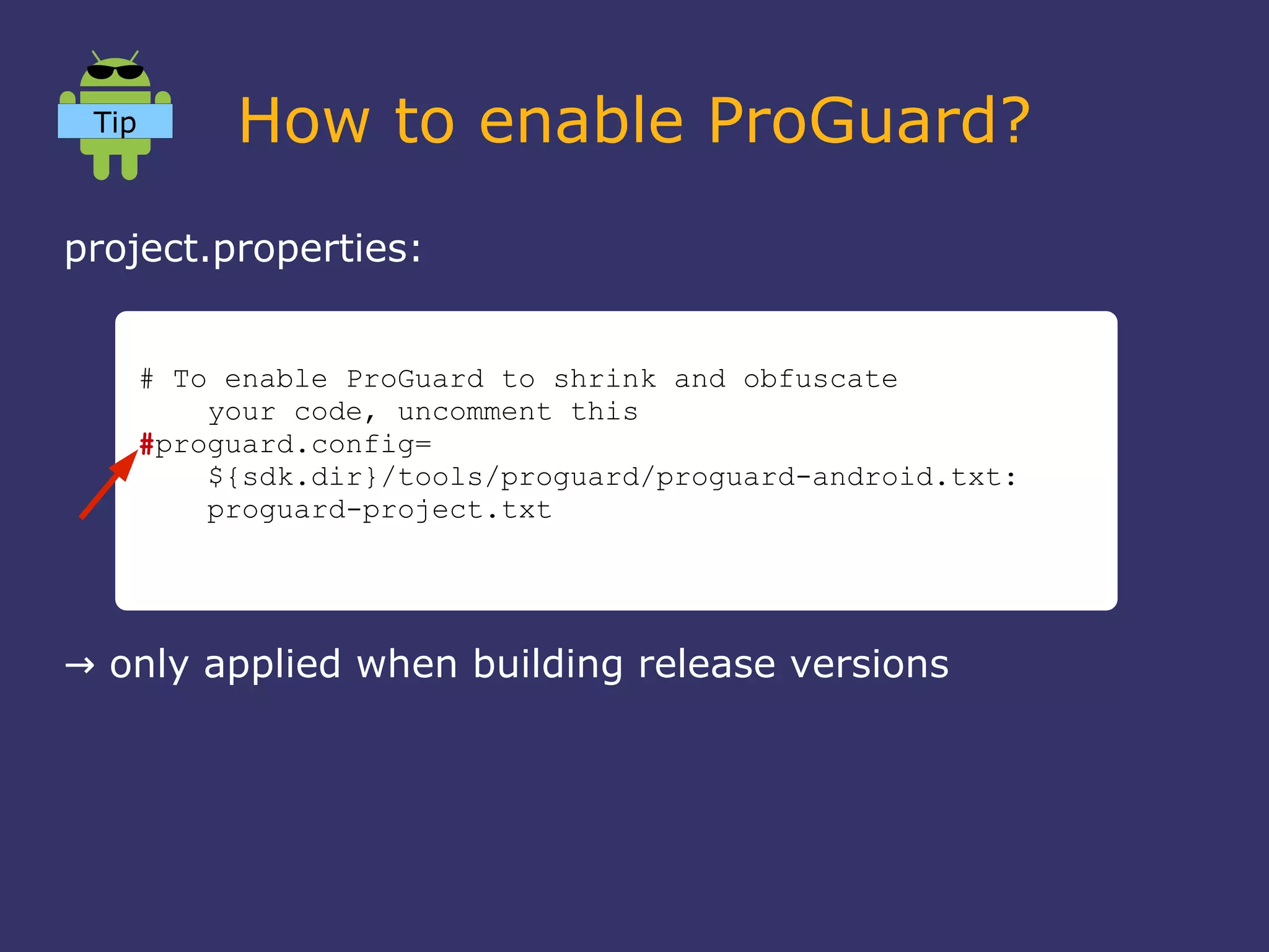
How to enable ProGuard?
project.properties:
→ only applied when building release versions
# To enable ProGuard to shrink and obfuscate
your code, uncomment this
#proguard.config=
${sdk.dir}/tools/proguard/proguard-android.txt:
proguard-project.txt
Tip
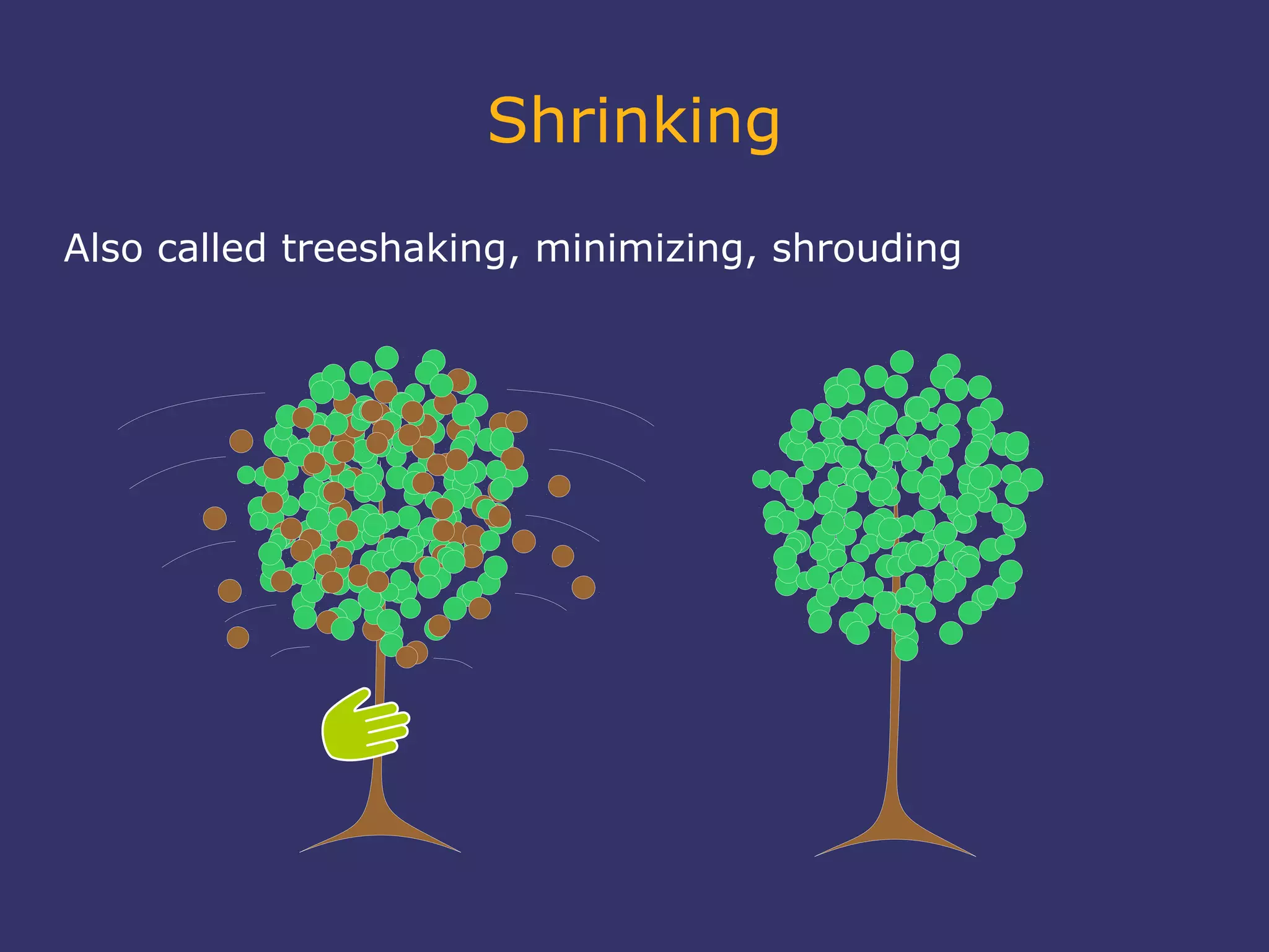
Shrinking
Also called treeshaking, minimizing, shrouding
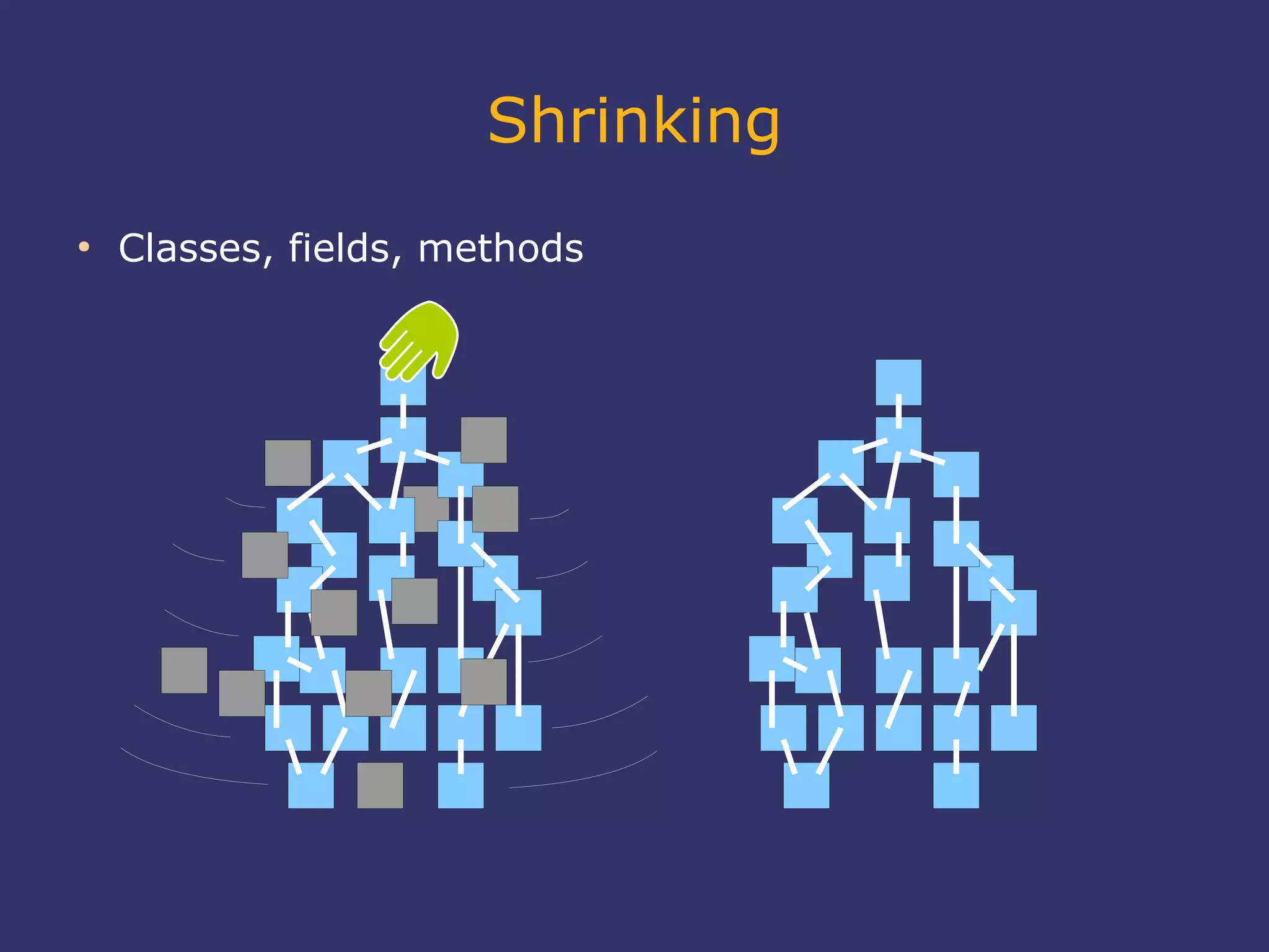
Shrinking
●
Classes, fields, methods
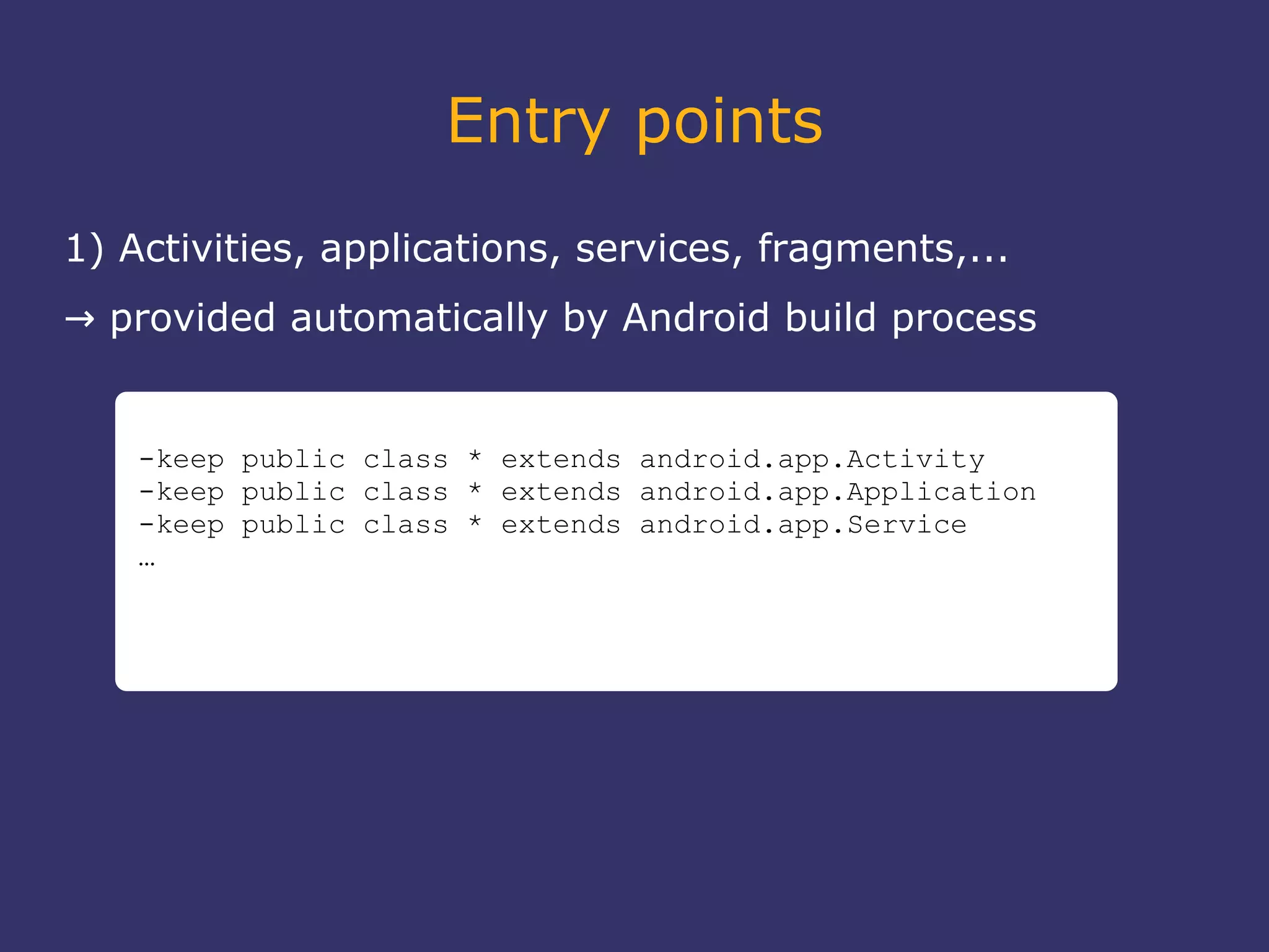
Entry points
1) Activities, applications, services, fragments,...
→ provided automatically by Android build process
-keep public class * extends android.app.Activity
-keep public class * extends android.app.Application
-keep public class * extends android.app.Service
…
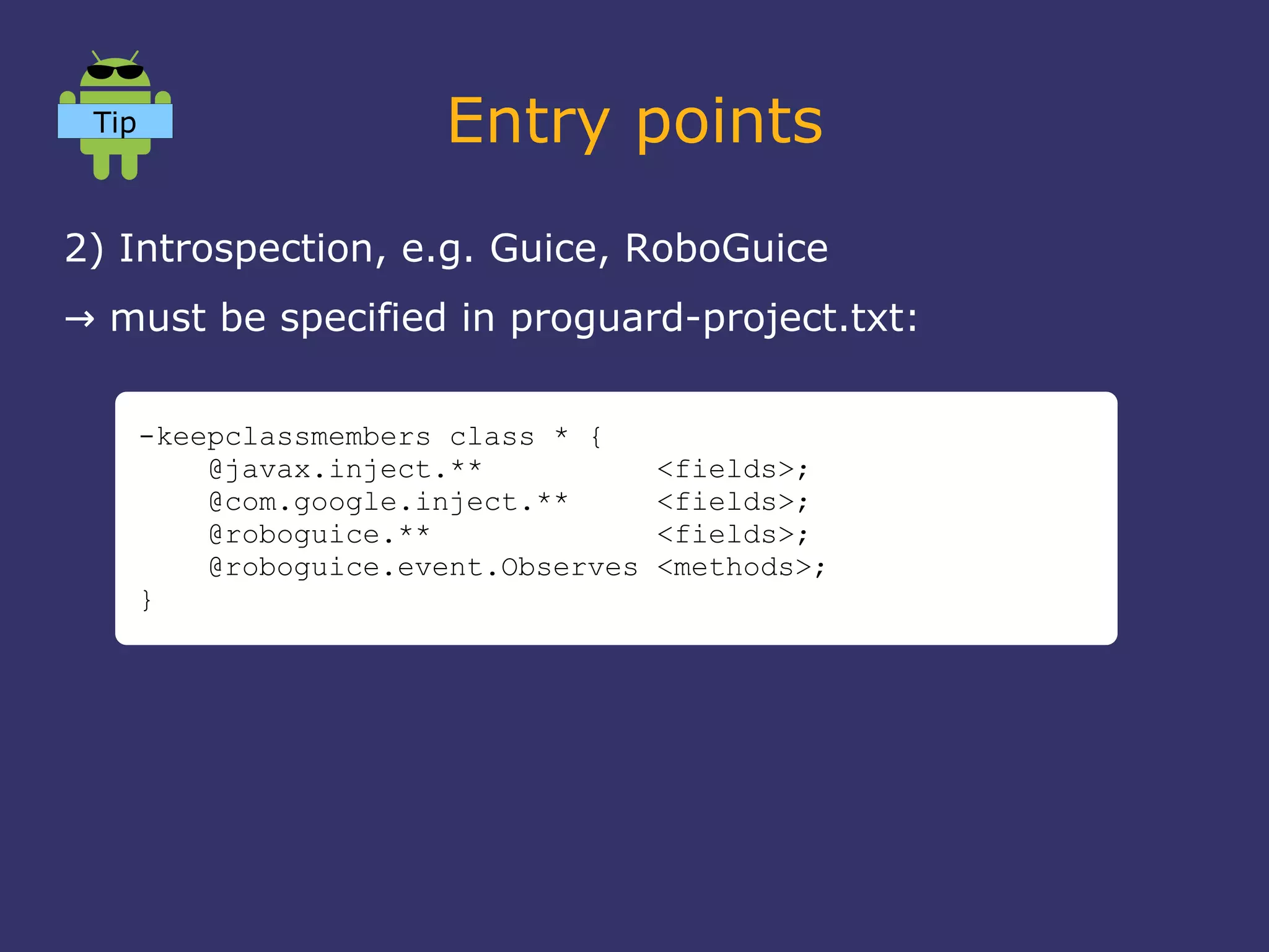
Entry points
2) Introspection, e.g. Guice, RoboGuice
→ must be specified in proguard-project.txt:
-keepclassmembers class * {
@javax.inject.** <fields>;
@com.google.inject.** <fields>;
@roboguice.** <fields>;
@roboguice.event.Observes <methods>;
}
Tip
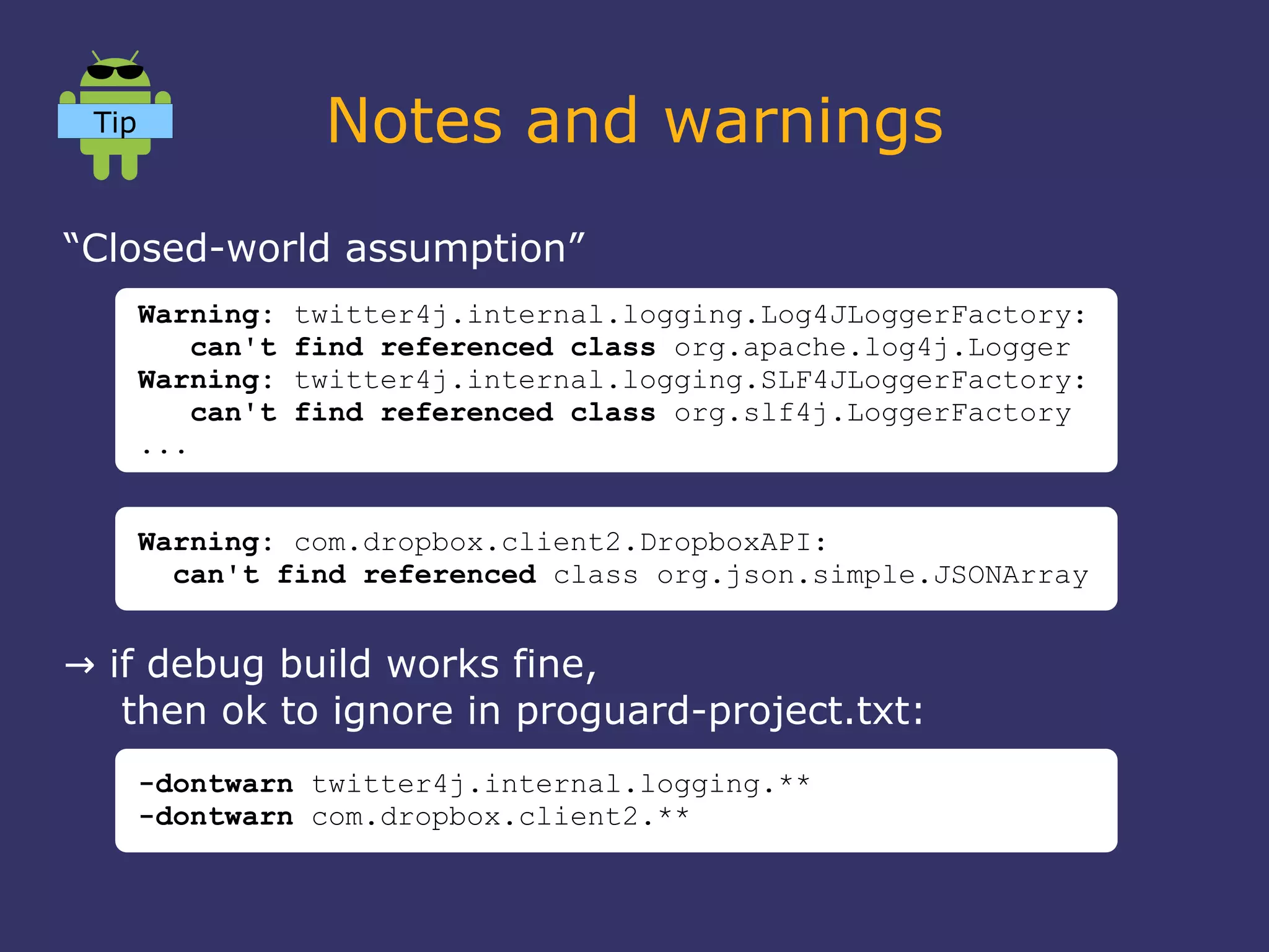
Notes and warnings
“Closed-world assumption”
→ if debug build works fine,
then ok to ignore in proguard-project.txt:
Warning: com.dropbox.client2.DropboxAPI:
can't find referenced class org.json.simple.JSONArray
-dontwarn twitter4j.internal.logging.**
-dontwarn com.dropbox.client2.**
Warning: twitter4j.internal.logging.Log4JLoggerFactory:
can't find referenced class org.apache.log4j.Logger
Warning: twitter4j.internal.logging.SLF4JLoggerFactory:
can't find referenced class org.slf4j.LoggerFactory
...
Tip
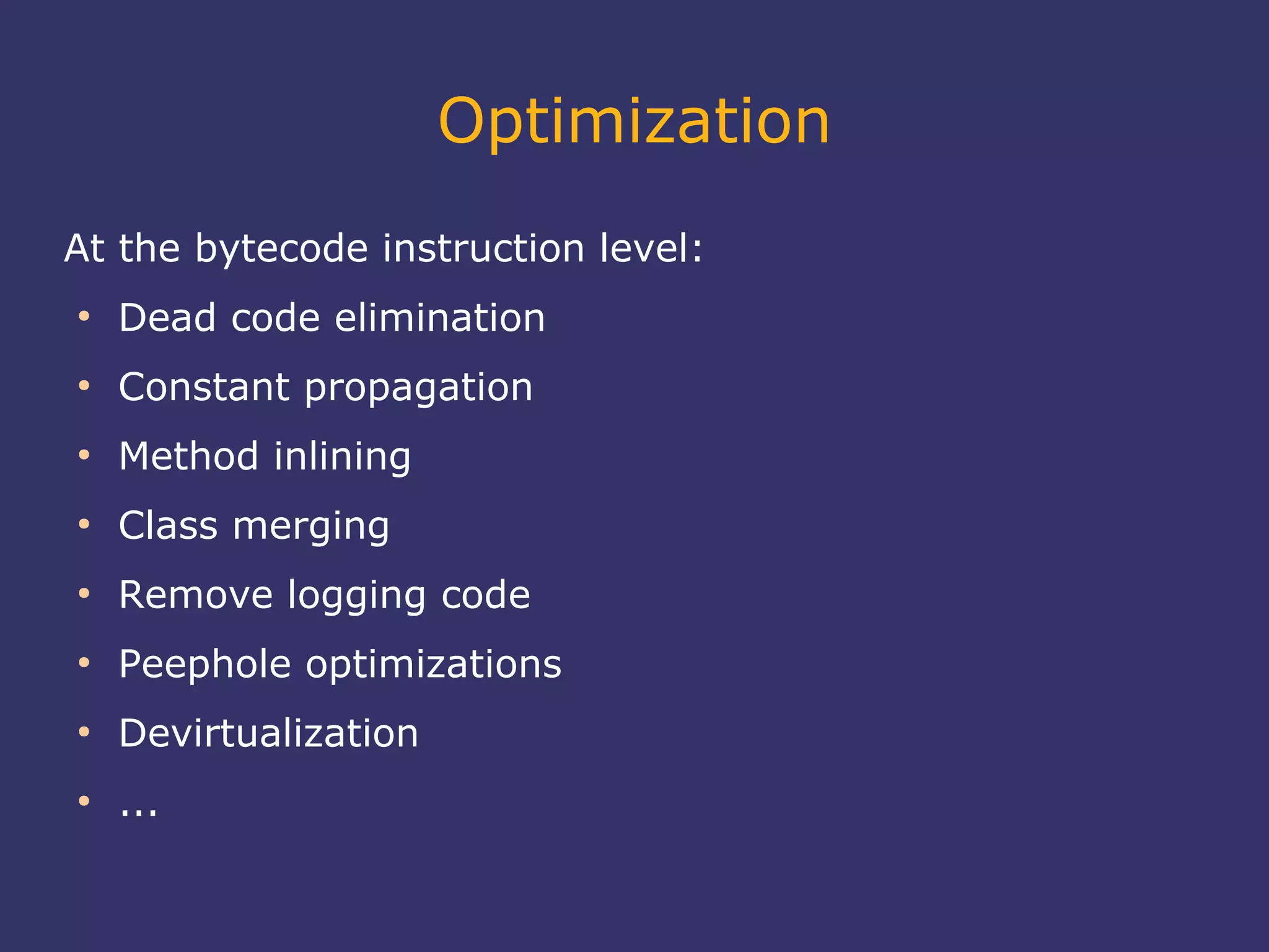
Optimization
At the bytecode instruction level:
●
Dead code elimination
●
Constant propagation
●
Method inlining
●
Class merging
●
Remove logging code
●
Peephole optimizations
●
Devirtualization
●
...
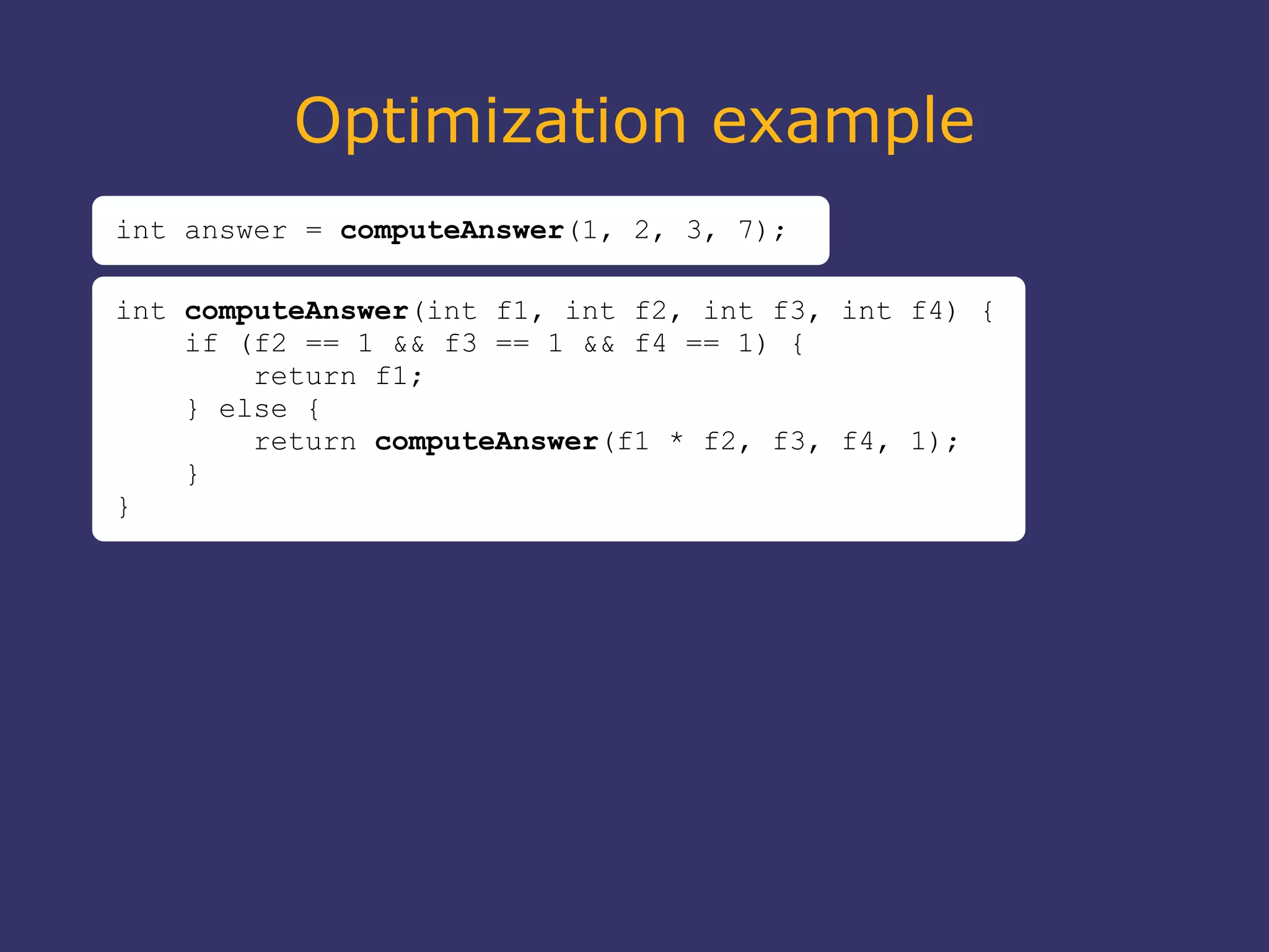
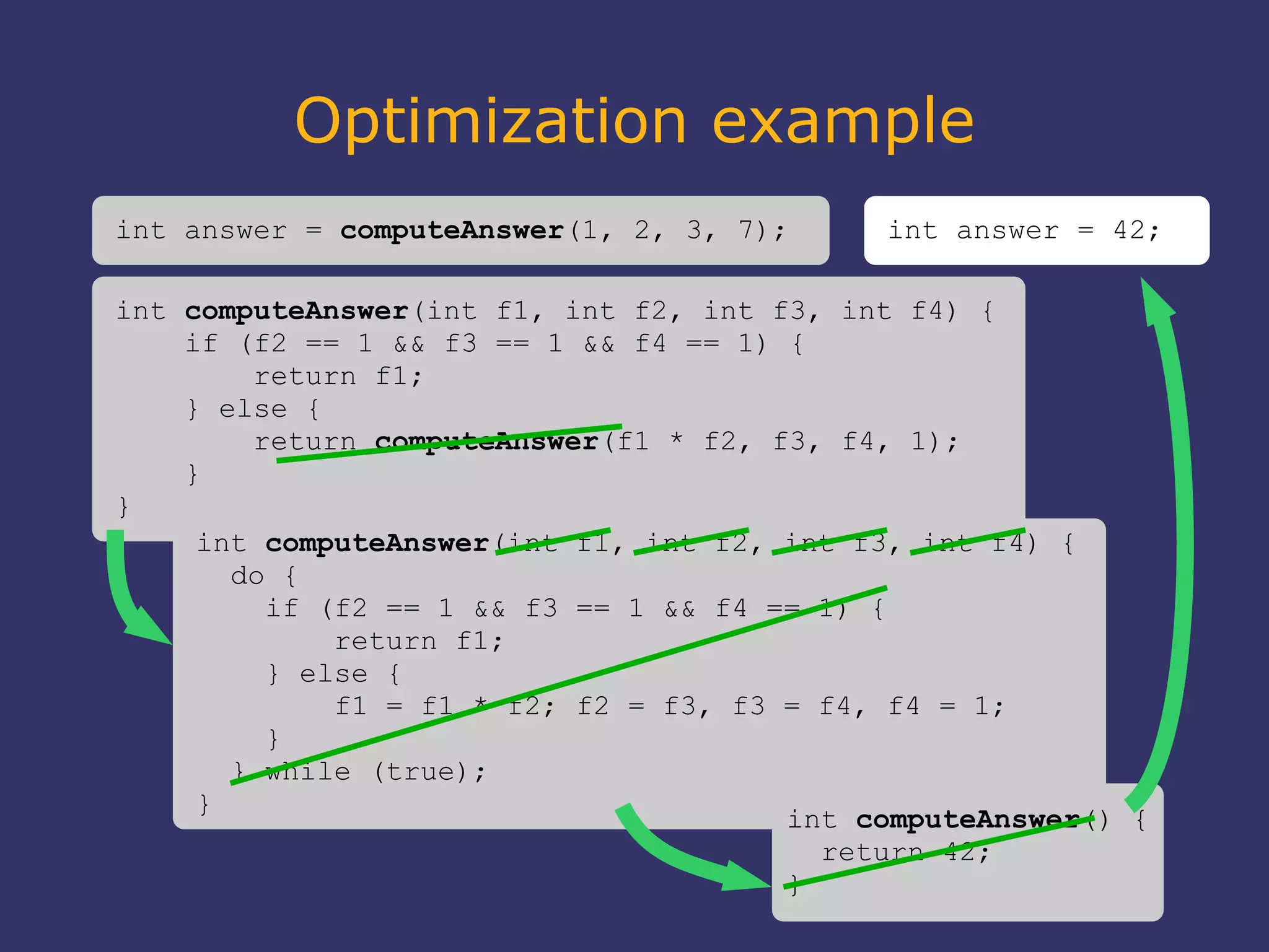
Optimization example
int answer = computeAnswer(1, 2, 3, 7);
int computeAnswer(int f1, int f2, int f3, int f4) {
if (f2 == 1 && f3 == 1 && f4 == 1) {
return f1;
} else {
return computeAnswer(f1 * f2, f3, f4, 1);
}
}
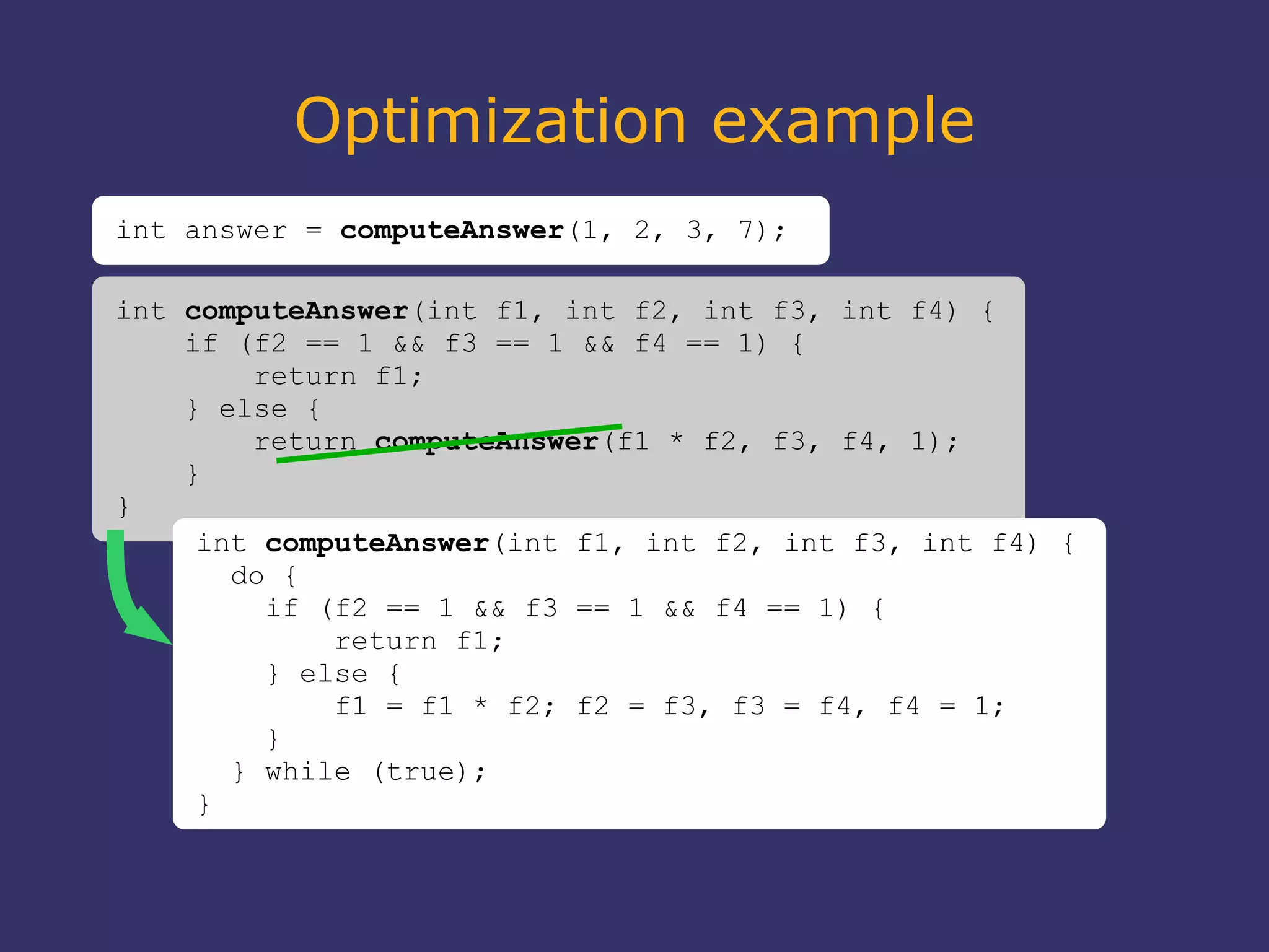
Optimization example
int answer = computeAnswer(1, 2, 3, 7);
int computeAnswer(int f1, int f2, int f3, int f4) {
if (f2 == 1 && f3 == 1 && f4 == 1) {
return f1;
} else {
return computeAnswer(f1 * f2, f3, f4, 1);
}
}
int computeAnswer(int f1, int f2, int f3, int f4) {
do {
if (f2 == 1 && f3 == 1 && f4 == 1) {
return f1;
} else {
f1 = f1 * f2; f2 = f3, f3 = f4, f4 = 1;
}
} while (true);
}
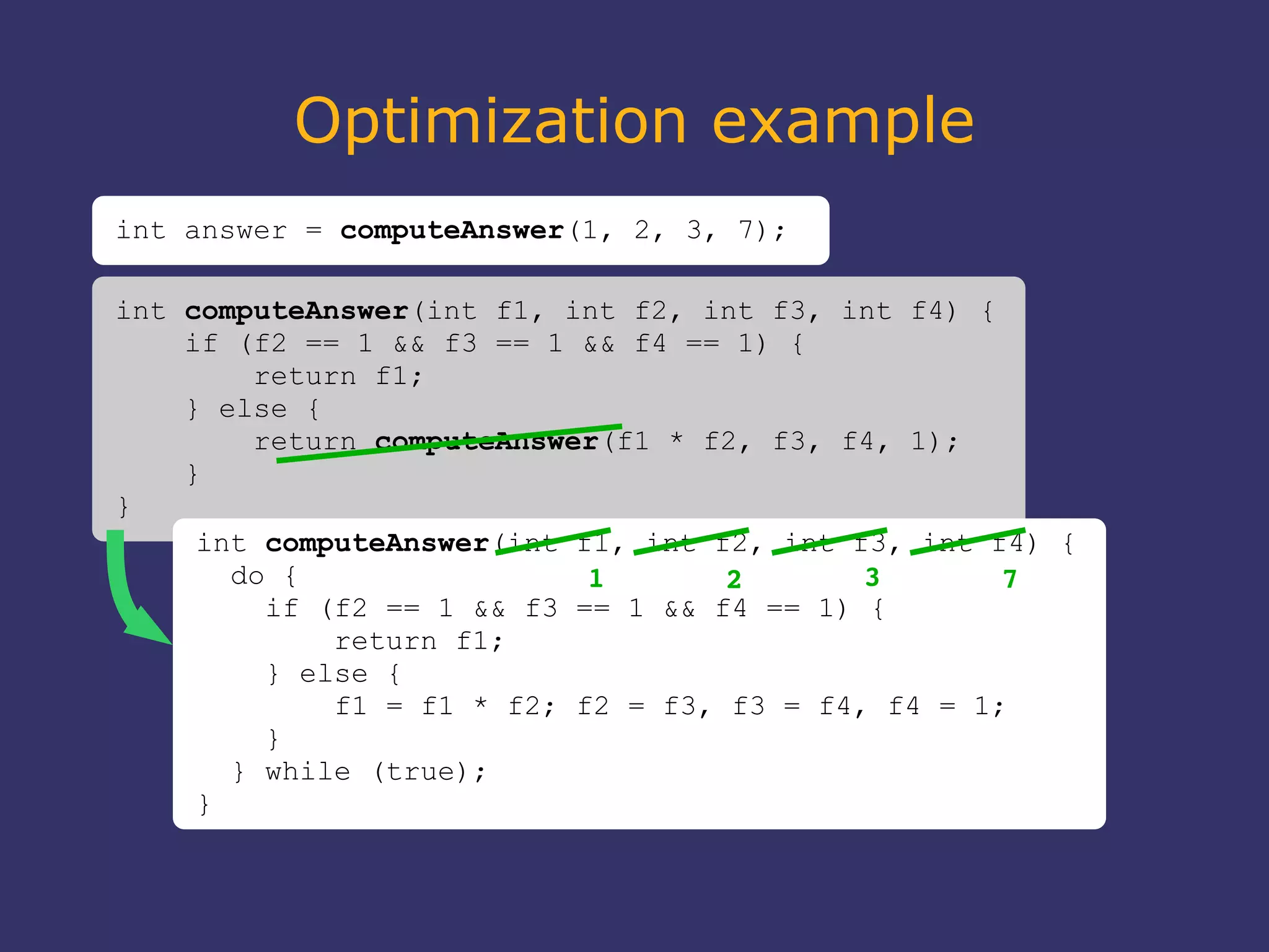
Optimization example
int answer = computeAnswer(1, 2, 3, 7);
int computeAnswer(int f1, int f2, int f3, int f4) {
if (f2 == 1 && f3 == 1 && f4 == 1) {
return f1;
} else {
return computeAnswer(f1 * f2, f3, f4, 1);
}
}
int computeAnswer(int f1, int f2, int f3, int f4) {
do {
if (f2 == 1 && f3 == 1 && f4 == 1) {
return f1;
} else {
f1 = f1 * f2; f2 = f3, f3 = f4, f4 = 1;
}
} while (true);
}
1 2 3 7
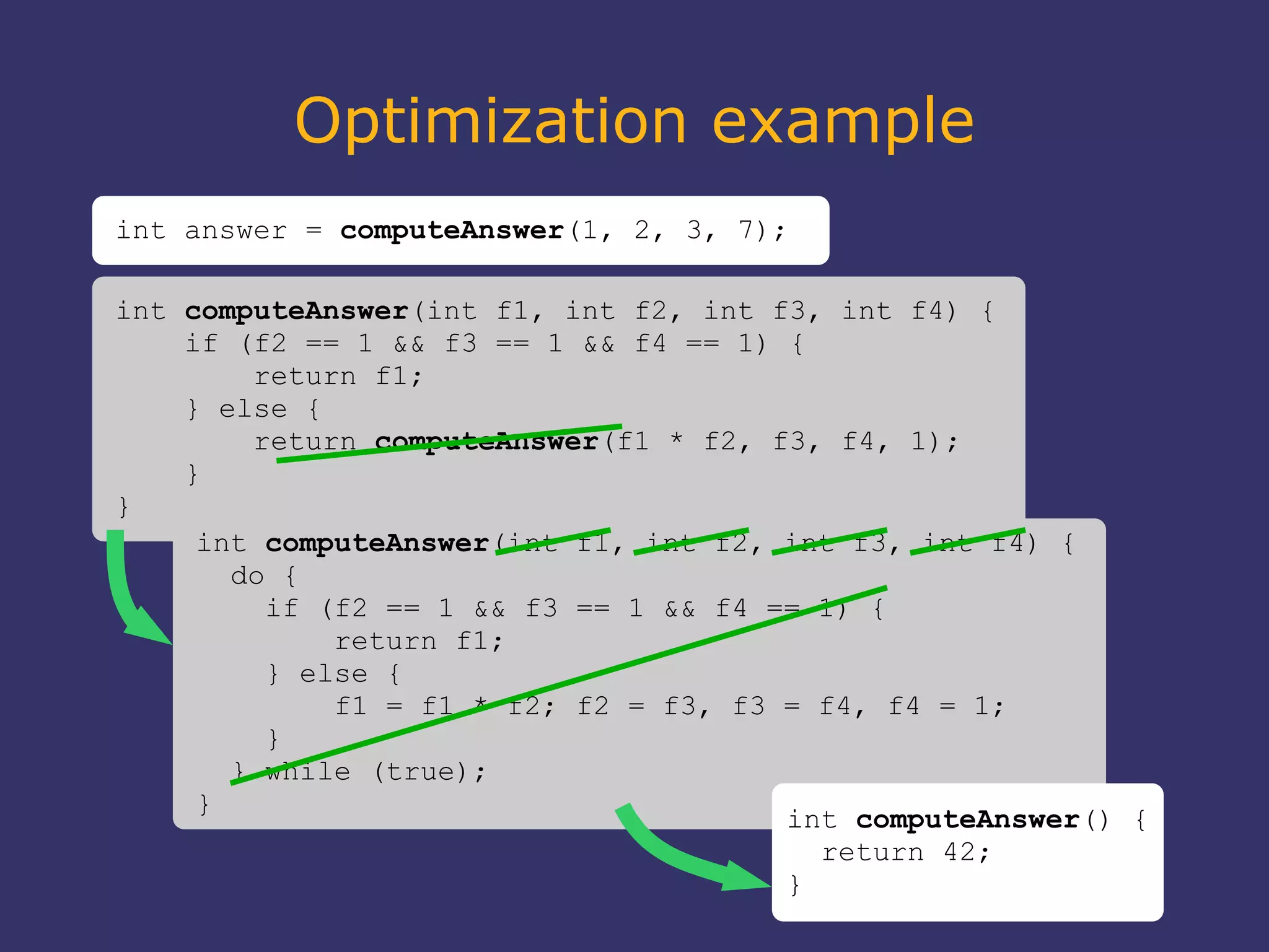
Optimization example
int answer = computeAnswer(1, 2, 3, 7);
int computeAnswer(int f1, int f2, int f3, int f4) {
if (f2 == 1 && f3 == 1 && f4 == 1) {
return f1;
} else {
return computeAnswer(f1 * f2, f3, f4, 1);
}
}
int computeAnswer(int f1, int f2, int f3, int f4) {
do {
if (f2 == 1 && f3 == 1 && f4 == 1) {
return f1;
} else {
f1 = f1 * f2; f2 = f3, f3 = f4, f4 = 1;
}
} while (true);
}
int computeAnswer() {
return 42;
}
Optimization example
int answer = computeAnswer(1, 2, 3, 7);
int computeAnswer(int f1, int f2, int f3, int f4) {
if (f2 == 1 && f3 == 1 && f4 == 1) {
return f1;
} else {
return computeAnswer(f1 * f2, f3, f4, 1);
}
}
int computeAnswer(int f1, int f2, int f3, int f4) {
do {
if (f2 == 1 && f3 == 1 && f4 == 1) {
return f1;
} else {
f1 = f1 * f2; f2 = f3, f3 = f4, f4 = 1;
}
} while (true);
}
int computeAnswer() {
return 42;
}
int answer = 42;
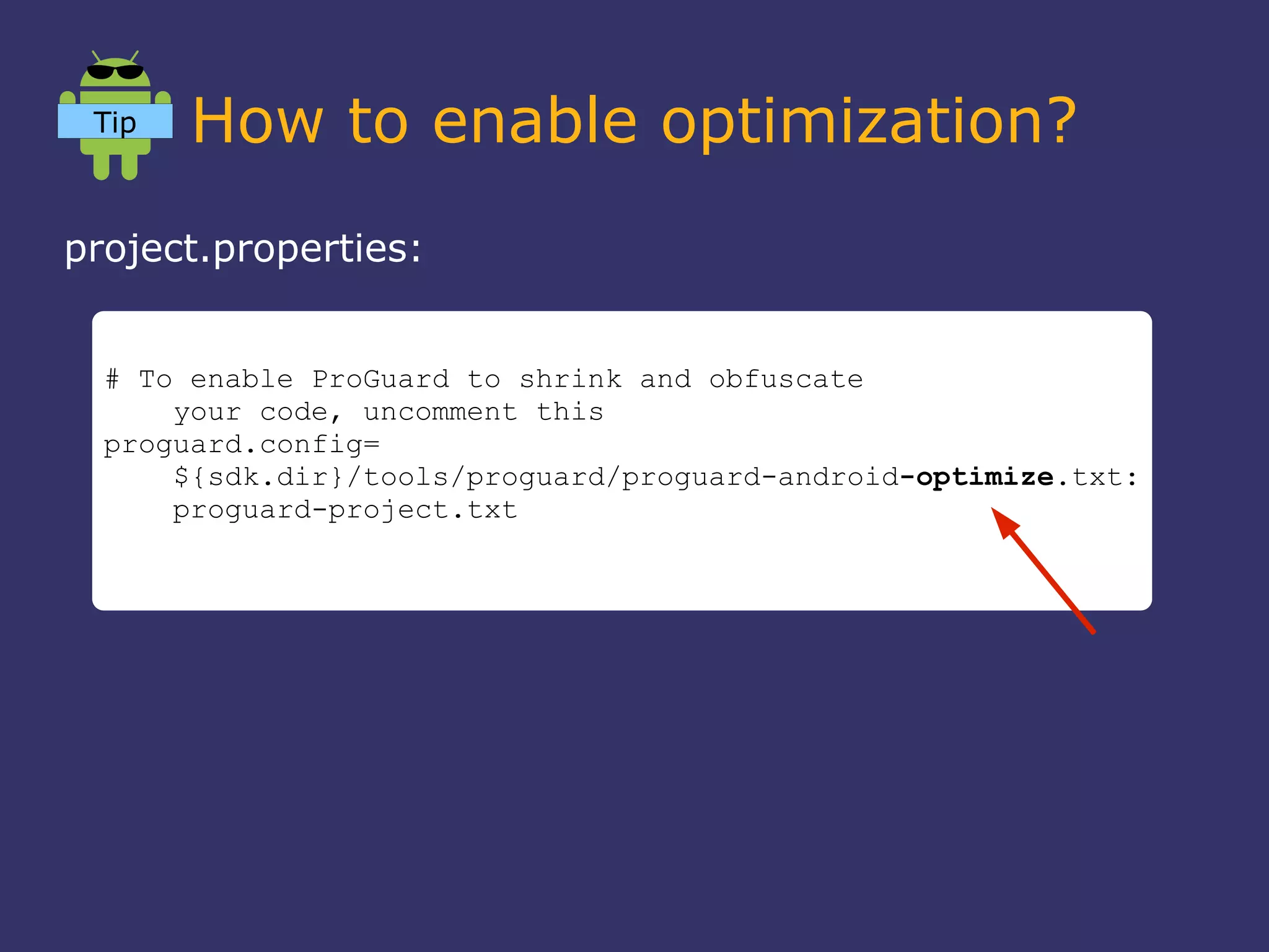
How to enable optimization?
project.properties:
# To enable ProGuard to shrink and obfuscate
your code, uncomment this
proguard.config=
${sdk.dir}/tools/proguard/proguard-android-optimize.txt:
proguard-project.txt
Tip
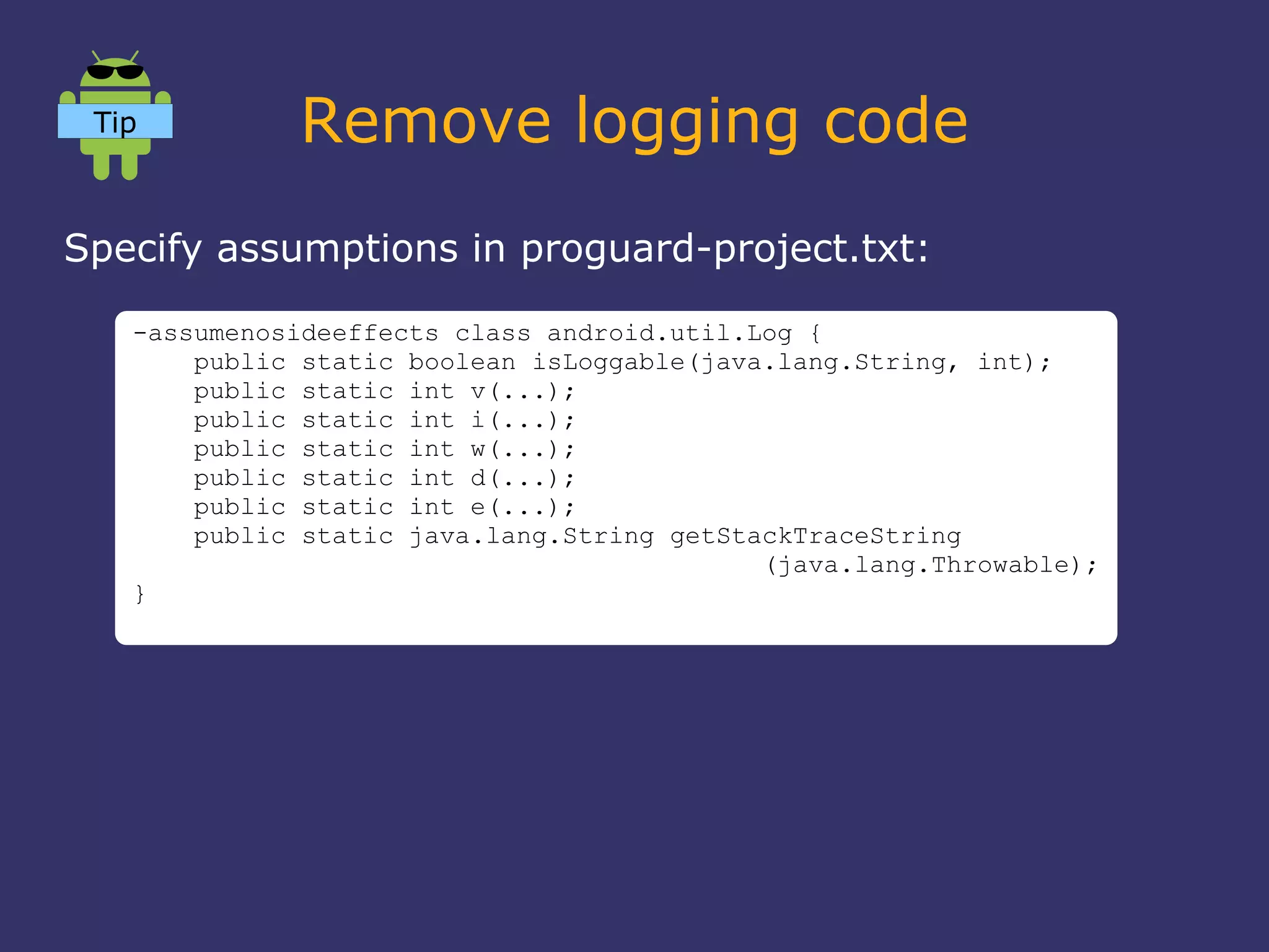
Remove logging code
Specify assumptions in proguard-project.txt:
-assumenosideeffects class android.util.Log {
public static boolean isLoggable(java.lang.String, int);
public static int v(...);
public static int i(...);
public static int w(...);
public static int d(...);
public static int e(...);
public static java.lang.String getStackTraceString
(java.lang.Throwable);
}
Tip
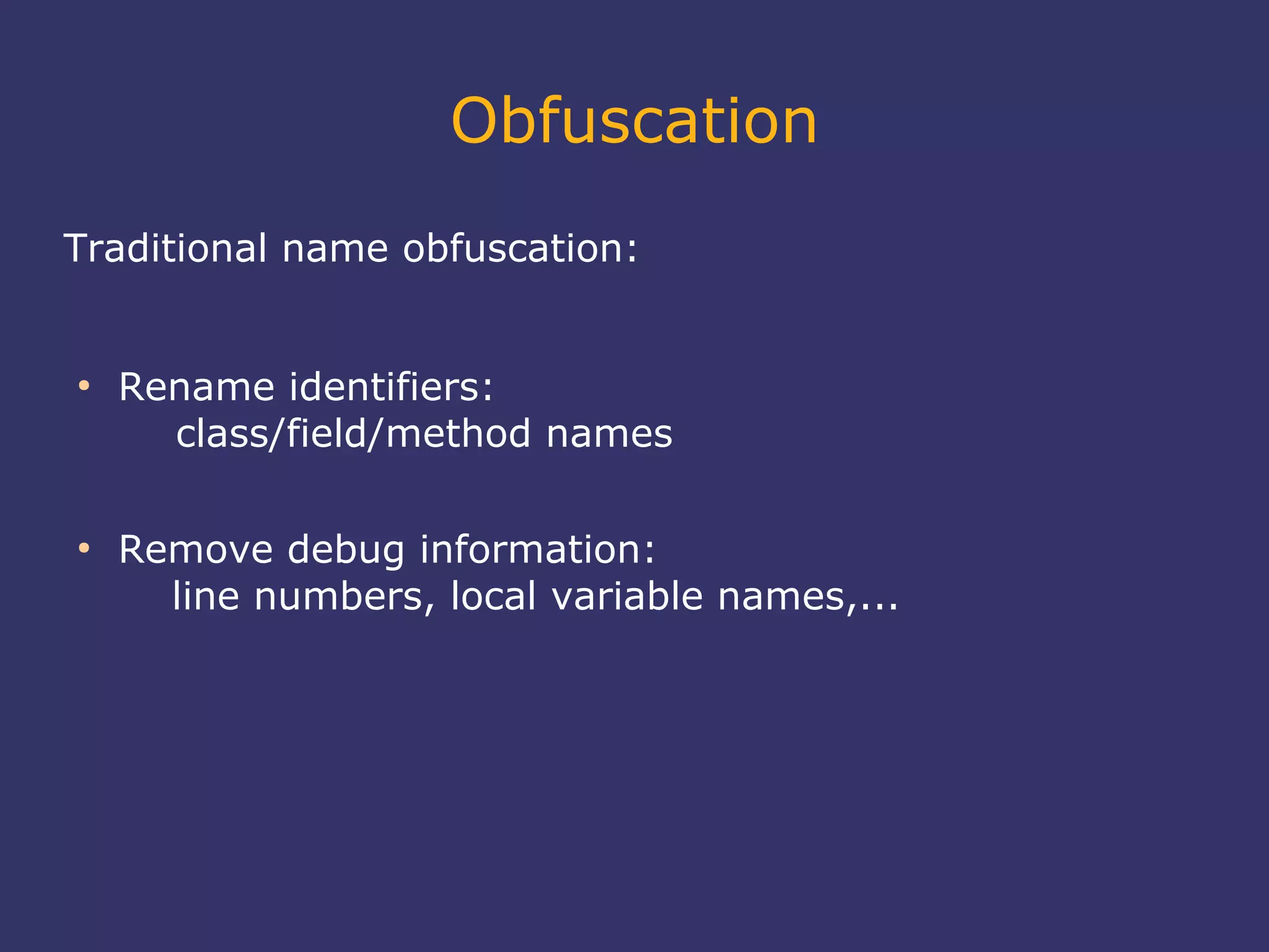
Obfuscation
Traditional name obfuscation:
●
Rename identifiers:
class/field/method names
●
Remove debug information:
line numbers, local variable names,...
Obfuscation
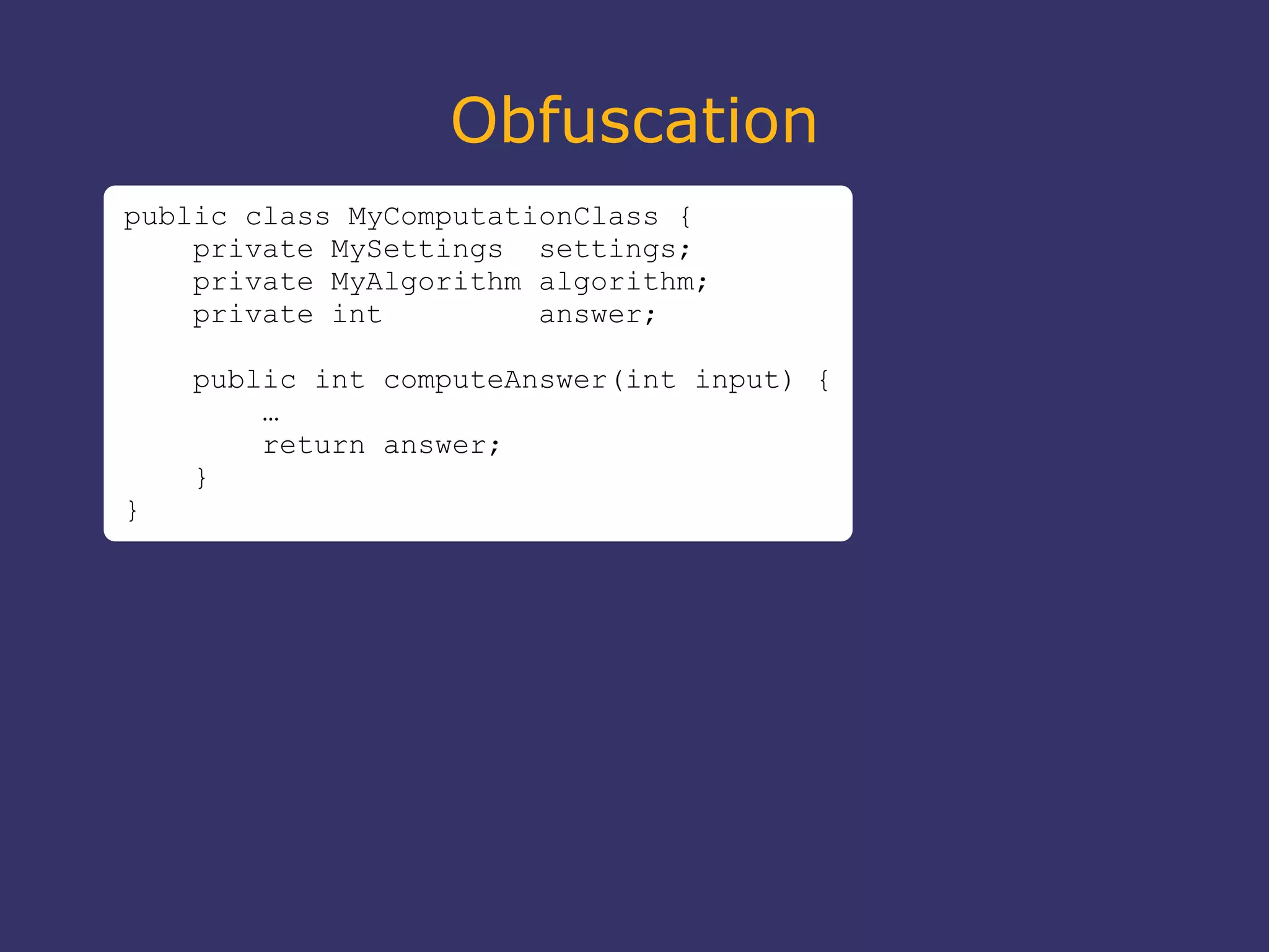
public class MyComputationClass {
private MySettings settings;
private MyAlgorithm algorithm;
private int answer;
public int computeAnswer(int input) {
…
return answer;
}
}
Obfuscation
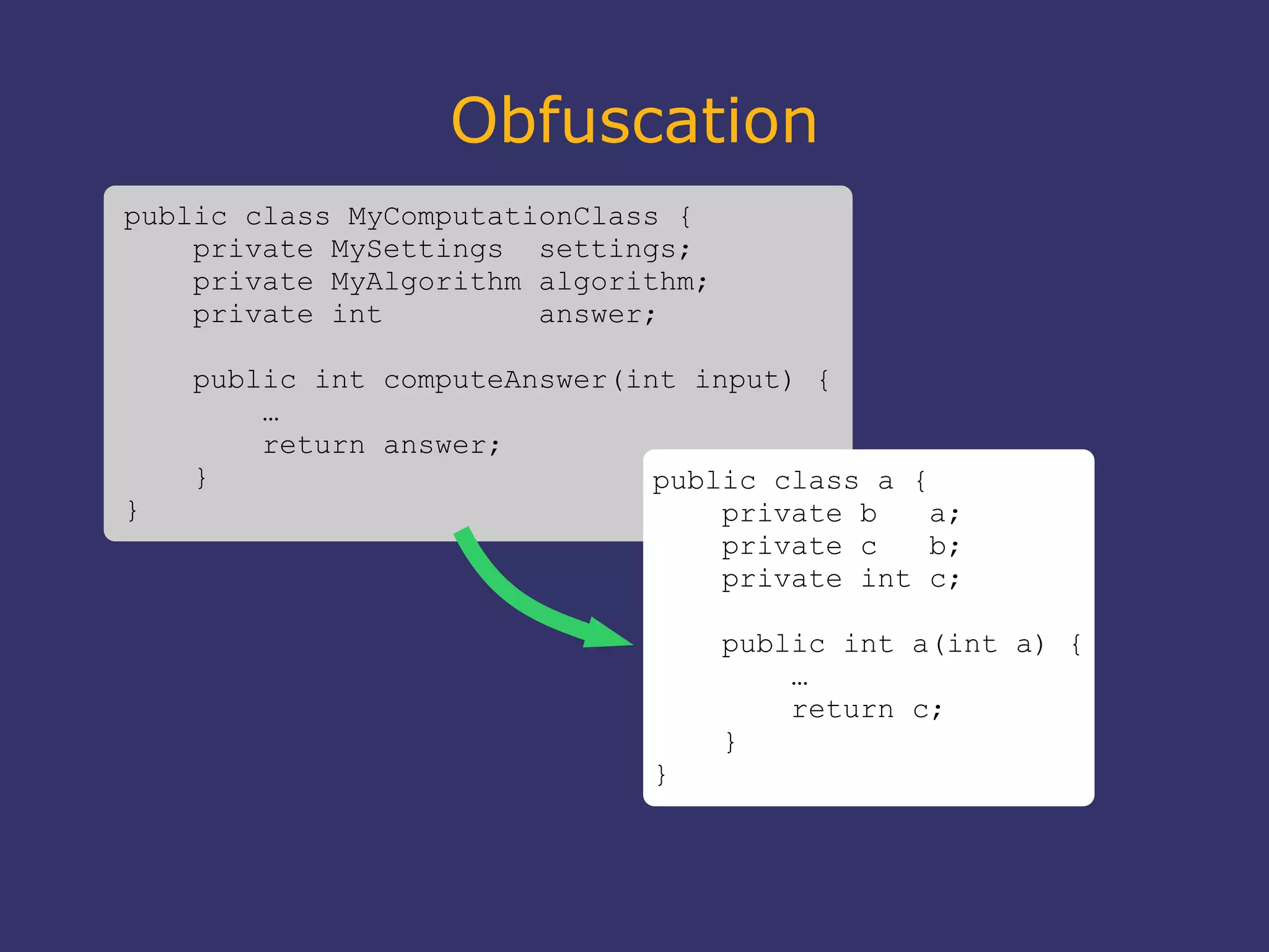
public class MyComputationClass {
private MySettings settings;
private MyAlgorithm algorithm;
private int answer;
public int computeAnswer(int input) {
…
return answer;
}
}
public class a {
private b a;
private c b;
private int c;
public int a(int a) {
…
return c;
}
}
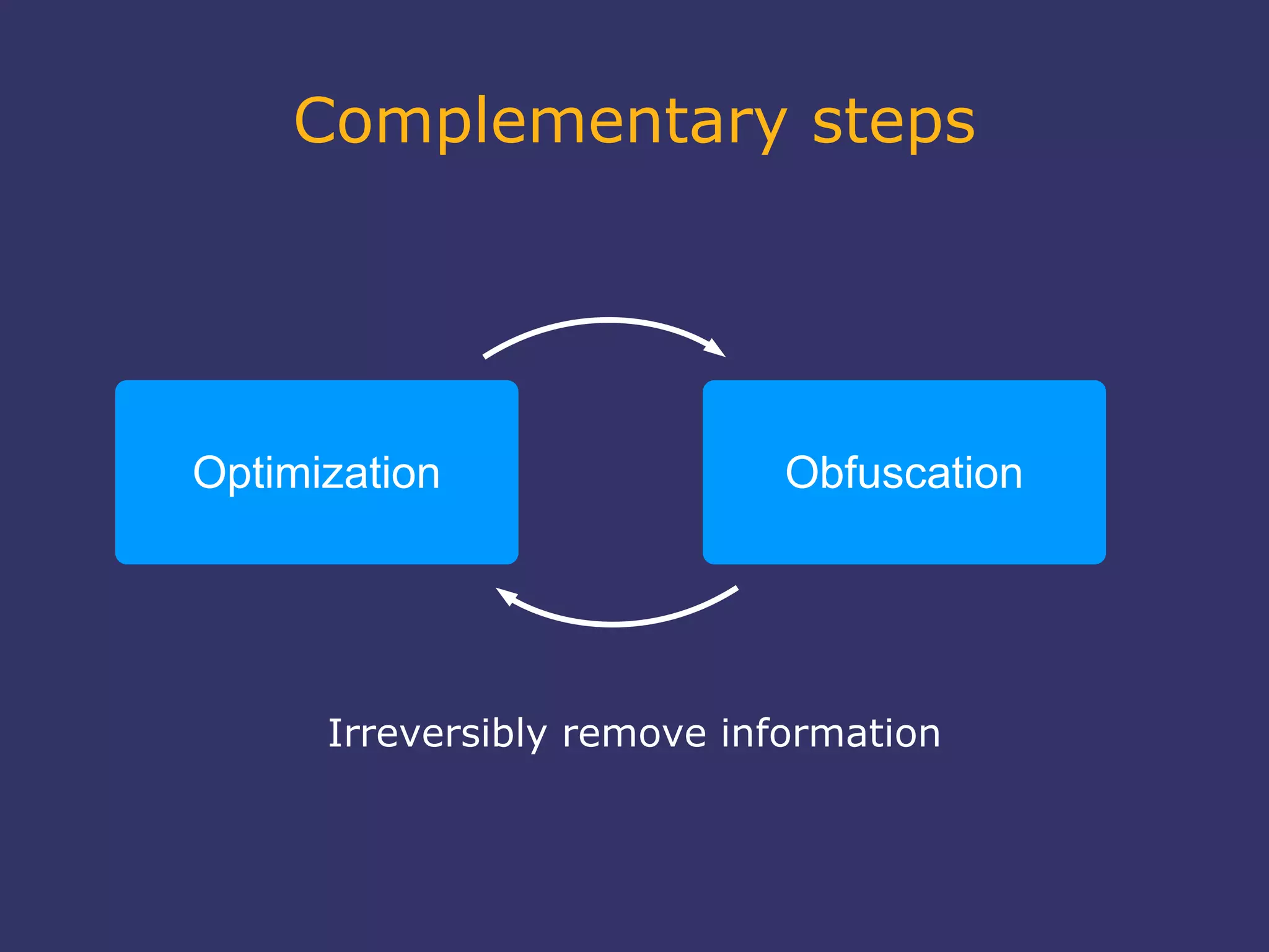
Complementary steps
Optimization Obfuscation
Irreversibly remove information
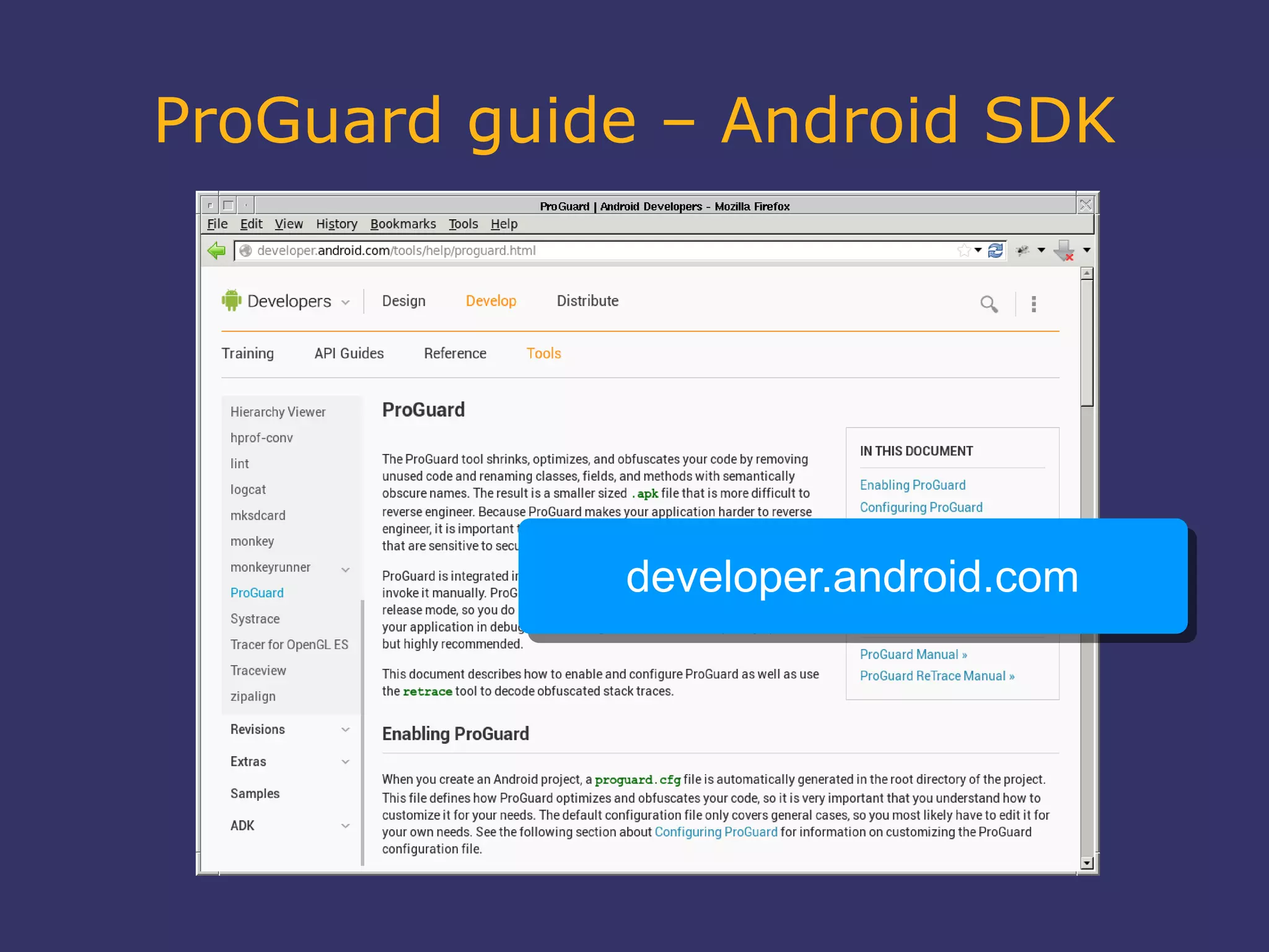
ProGuard guide – Android SDK
developer.android.comdeveloper.android.com
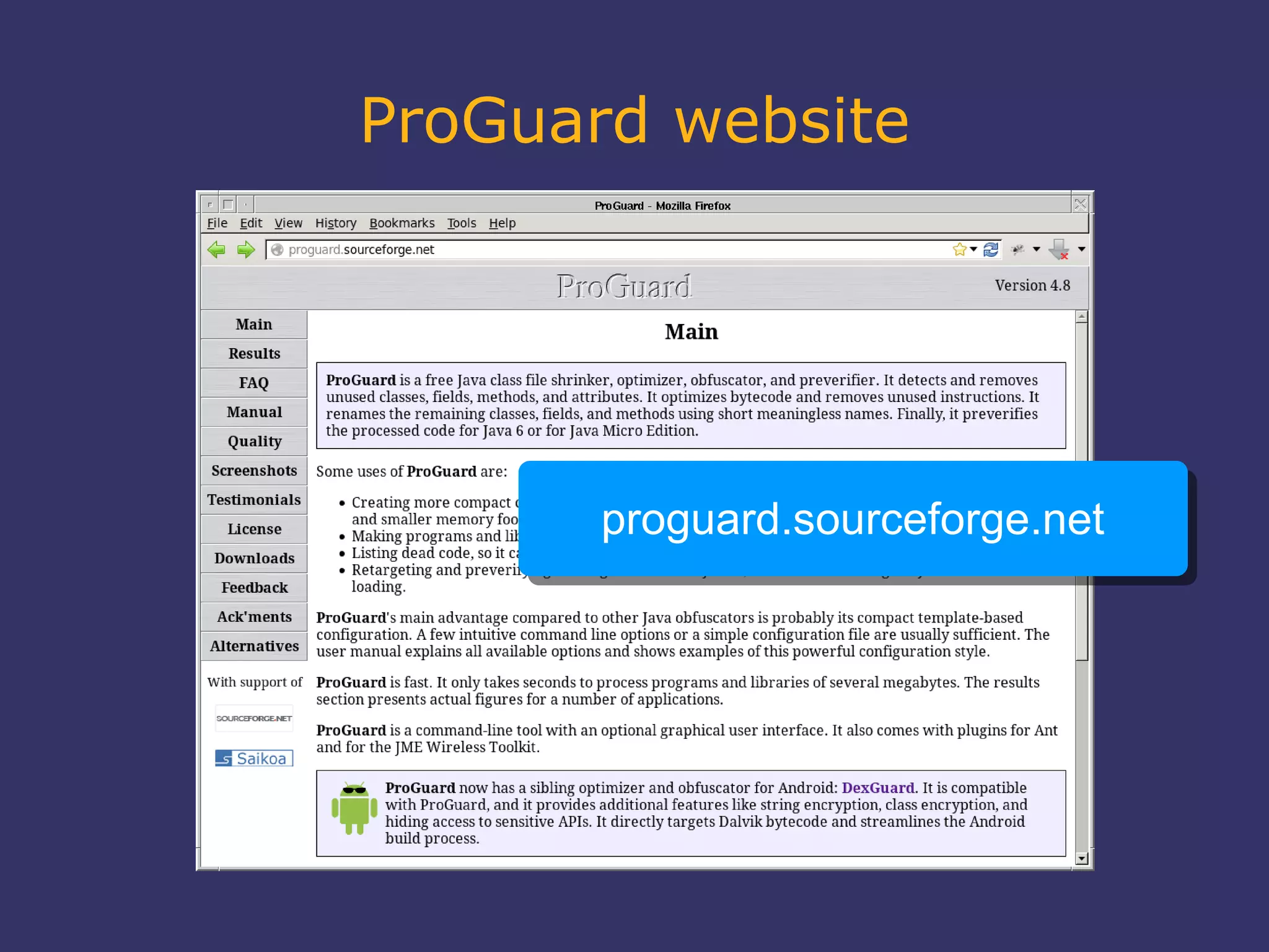
ProGuard website
proguard.sourceforge.netproguard.sourceforge.net
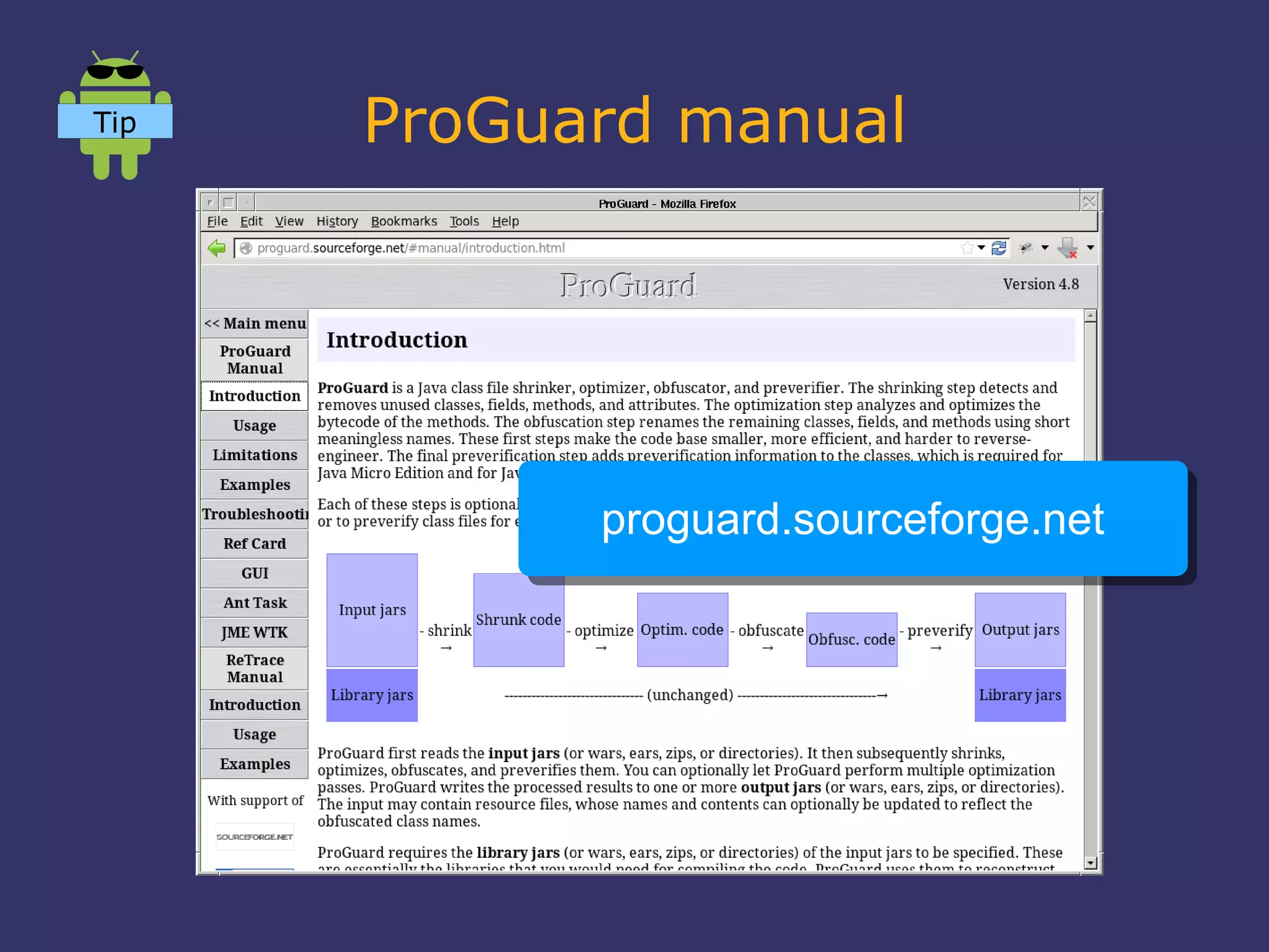
ProGuard manual
proguard.sourceforge.netproguard.sourceforge.net
Tip
Startup: Saikoa
ProGuard
ProGuard support
DexGuard
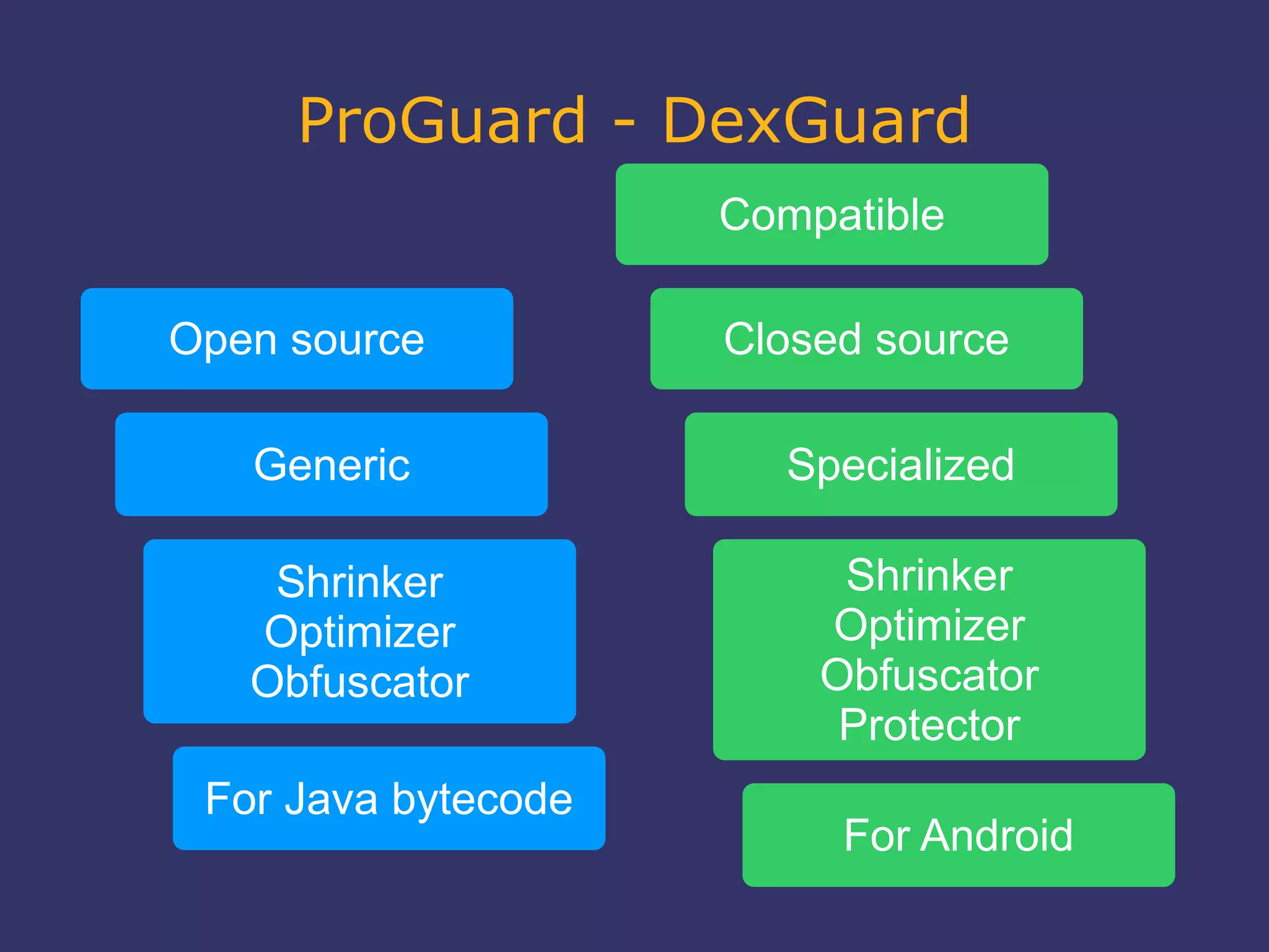
ProGuard - DexGuard
Open source
Generic
Shrinker
Optimizer
Obfuscator
For Java bytecode
Closed source
Specialized
Shrinker
Optimizer
Obfuscator
Protector
For Android
Compatible
Hacking and cracking
●
Anti-malware research
●
Reverse-engineering
protocols, formats,...
●
Fun
●
Translation
●
Game cheating
●
Software piracy
●
Remove ads
●
Different ads
●
Different market
●
Extract assets
●
Extract API keys
●
Insert malware
●
Extorsion
●
...
Solutions?
●
Ignore it
●
Different business model (open source, service)
●
Regular updates
●
Lock down device
●
Server
●
Remove motivations
●
Obfuscation, application protection
More application protection
Nothing is unbreakable, but you can raise the bar:
●
Reflection
●
String encryption
●
Class encryption
●
Resource obfuscation
●
Tamper detection
●
Debug detection
●
Emulator detection
●
…
→ Automatically applied by DexGuard
DexGuard strategy
●
Tight integration
●
Multiple layers
●
Unique protection for every application
●
Follow up
DexGuard reactions
“My app usually gets pirated after a few hours,
but now it hasn't been pirated after several weeks,
thanks to DexGuard!”
“Installation was simple.”
“The support is fantastic.”
“I'm enjoying DexGuard.”
“Support from Saikoa is awesome!”
“You're doing an awesome job!”
Saikoa website
www.saikoa.comwww.saikoa.com
Questions?
Open source
Shrinking
Optimization
Obfuscation
Java bytecode
ProGuard
Saikoa
DexGuard
Dalvik bytecode
Protection

Droidcon2013 pro guard, optimizer and obfuscator in the android sdk_eric lafortune_saikoa

  • 1.
    ProGuard Optimizer and Obfuscator inthe Android SDK Eric Lafortune Developer of ProGuard
  • 2.
    Eric Lafortune ● 1991 –1996 K.U.Leuven (Belgium), Phd Eng CompSci ● 1996 – 1999 Cornell University (Ithaca, NY) ● 1999 – 2011 Java GIS ● 2012 Founder Saikoa Maybe more importantly: ● 1982 TMS-9900 processor ● 1995 ARM2/ARM3 processor ● 2001 Java bytecode ● 2010 Dalvik bytecode
  • 3.
  • 4.
    ProGuard history Java applications Applets 2002 Midlets 20102012 Android apps ● May 2002 First release ● Sep 2010 Recommended for protecting LVL ● Dec 2010 Part of Android SDK ● Jan 2012 Startup Saikoa
  • 5.
    Why use ProGuard? ● Applicationsize ● Performance ● Remove logging, debugging, testing code ● Battery life ● Protection
  • 6.
    Application size classes.dex size.apk size Without ProGuard With ProGuard Reduction Without ProGuard With ProGuard Reduction ApiDemos 716 K 482 K 33 % 2.6 M 2.5 M 4 % GoogleIO App 3.4 M 905 K 75 % 1.9 M 906 K 53 % ApiDemos in Scala* ~6 M 542 K ~90 % ~8 M 2.5 M ~70 % * [Stéphane Micheloud, http://lampwww.epfl.ch/~michelou/android/library-code-shrinking.html]
  • 7.
    Performance: CaffeineMark Without ProGuard Sievescore = 6833 Loop score = 14831 Logic score = 19038 String score = 7694 Float score = 6425 Method score = 4850 Overall score = 8794 With ProGuard Sieve score = 6666 Loop score = 15473 Logic score = 47840 String score = 7717 Float score = 6488 Method score = 5229 Overall score = 10436 Improvement: 18% [Acer Iconia Tab A500, nVidia Tegra 2, 1.0 GHz, Android 3.2.1]
  • 8.
    Battery life Extreme example: “5x better battery life, by removing verbose logging code in a background service” (but don't count on it)
  • 9.
    How to enableProGuard? project.properties: → only applied when building release versions # To enable ProGuard to shrink and obfuscate your code, uncomment this #proguard.config= ${sdk.dir}/tools/proguard/proguard-android.txt: proguard-project.txt Tip
  • 10.
  • 11.
  • 12.
    Entry points 1) Activities,applications, services, fragments,... → provided automatically by Android build process -keep public class * extends android.app.Activity -keep public class * extends android.app.Application -keep public class * extends android.app.Service …
  • 13.
    Entry points 2) Introspection,e.g. Guice, RoboGuice → must be specified in proguard-project.txt: -keepclassmembers class * { @javax.inject.** <fields>; @com.google.inject.** <fields>; @roboguice.** <fields>; @roboguice.event.Observes <methods>; } Tip
  • 14.
    Notes and warnings “Closed-worldassumption” → if debug build works fine, then ok to ignore in proguard-project.txt: Warning: com.dropbox.client2.DropboxAPI: can't find referenced class org.json.simple.JSONArray -dontwarn twitter4j.internal.logging.** -dontwarn com.dropbox.client2.** Warning: twitter4j.internal.logging.Log4JLoggerFactory: can't find referenced class org.apache.log4j.Logger Warning: twitter4j.internal.logging.SLF4JLoggerFactory: can't find referenced class org.slf4j.LoggerFactory ... Tip
  • 15.
    Optimization At the bytecodeinstruction level: ● Dead code elimination ● Constant propagation ● Method inlining ● Class merging ● Remove logging code ● Peephole optimizations ● Devirtualization ● ...
  • 16.
    Optimization example int answer= computeAnswer(1, 2, 3, 7); int computeAnswer(int f1, int f2, int f3, int f4) { if (f2 == 1 && f3 == 1 && f4 == 1) { return f1; } else { return computeAnswer(f1 * f2, f3, f4, 1); } }
  • 17.
    Optimization example int answer= computeAnswer(1, 2, 3, 7); int computeAnswer(int f1, int f2, int f3, int f4) { if (f2 == 1 && f3 == 1 && f4 == 1) { return f1; } else { return computeAnswer(f1 * f2, f3, f4, 1); } } int computeAnswer(int f1, int f2, int f3, int f4) { do { if (f2 == 1 && f3 == 1 && f4 == 1) { return f1; } else { f1 = f1 * f2; f2 = f3, f3 = f4, f4 = 1; } } while (true); }
  • 18.
    Optimization example int answer= computeAnswer(1, 2, 3, 7); int computeAnswer(int f1, int f2, int f3, int f4) { if (f2 == 1 && f3 == 1 && f4 == 1) { return f1; } else { return computeAnswer(f1 * f2, f3, f4, 1); } } int computeAnswer(int f1, int f2, int f3, int f4) { do { if (f2 == 1 && f3 == 1 && f4 == 1) { return f1; } else { f1 = f1 * f2; f2 = f3, f3 = f4, f4 = 1; } } while (true); } 1 2 3 7
  • 19.
    Optimization example int answer= computeAnswer(1, 2, 3, 7); int computeAnswer(int f1, int f2, int f3, int f4) { if (f2 == 1 && f3 == 1 && f4 == 1) { return f1; } else { return computeAnswer(f1 * f2, f3, f4, 1); } } int computeAnswer(int f1, int f2, int f3, int f4) { do { if (f2 == 1 && f3 == 1 && f4 == 1) { return f1; } else { f1 = f1 * f2; f2 = f3, f3 = f4, f4 = 1; } } while (true); } int computeAnswer() { return 42; }
  • 20.
    Optimization example int answer= computeAnswer(1, 2, 3, 7); int computeAnswer(int f1, int f2, int f3, int f4) { if (f2 == 1 && f3 == 1 && f4 == 1) { return f1; } else { return computeAnswer(f1 * f2, f3, f4, 1); } } int computeAnswer(int f1, int f2, int f3, int f4) { do { if (f2 == 1 && f3 == 1 && f4 == 1) { return f1; } else { f1 = f1 * f2; f2 = f3, f3 = f4, f4 = 1; } } while (true); } int computeAnswer() { return 42; } int answer = 42;
  • 21.
    How to enableoptimization? project.properties: # To enable ProGuard to shrink and obfuscate your code, uncomment this proguard.config= ${sdk.dir}/tools/proguard/proguard-android-optimize.txt: proguard-project.txt Tip
  • 22.
    Remove logging code Specifyassumptions in proguard-project.txt: -assumenosideeffects class android.util.Log { public static boolean isLoggable(java.lang.String, int); public static int v(...); public static int i(...); public static int w(...); public static int d(...); public static int e(...); public static java.lang.String getStackTraceString (java.lang.Throwable); } Tip
  • 23.
    Obfuscation Traditional name obfuscation: ● Renameidentifiers: class/field/method names ● Remove debug information: line numbers, local variable names,...
  • 24.
    Obfuscation public class MyComputationClass{ private MySettings settings; private MyAlgorithm algorithm; private int answer; public int computeAnswer(int input) { … return answer; } }
  • 25.
    Obfuscation public class MyComputationClass{ private MySettings settings; private MyAlgorithm algorithm; private int answer; public int computeAnswer(int input) { … return answer; } } public class a { private b a; private c b; private int c; public int a(int a) { … return c; } }
  • 26.
  • 27.
    ProGuard guide –Android SDK developer.android.comdeveloper.android.com
  • 28.
  • 29.
  • 30.
  • 31.
    ProGuard - DexGuard Opensource Generic Shrinker Optimizer Obfuscator For Java bytecode Closed source Specialized Shrinker Optimizer Obfuscator Protector For Android Compatible
  • 32.
    Hacking and cracking ● Anti-malwareresearch ● Reverse-engineering protocols, formats,... ● Fun ● Translation ● Game cheating ● Software piracy ● Remove ads ● Different ads ● Different market ● Extract assets ● Extract API keys ● Insert malware ● Extorsion ● ...
  • 33.
    Solutions? ● Ignore it ● Different businessmodel (open source, service) ● Regular updates ● Lock down device ● Server ● Remove motivations ● Obfuscation, application protection
  • 34.
    More application protection Nothingis unbreakable, but you can raise the bar: ● Reflection ● String encryption ● Class encryption ● Resource obfuscation ● Tamper detection ● Debug detection ● Emulator detection ● … → Automatically applied by DexGuard
  • 35.
    DexGuard strategy ● Tight integration ● Multiplelayers ● Unique protection for every application ● Follow up
  • 36.
    DexGuard reactions “My appusually gets pirated after a few hours, but now it hasn't been pirated after several weeks, thanks to DexGuard!” “Installation was simple.” “The support is fantastic.” “I'm enjoying DexGuard.” “Support from Saikoa is awesome!” “You're doing an awesome job!”
  • 37.
  • 38.