From Chaos to Order:
Building a Business Architecture
Michael King
Halfaker and Associates
Chief Technology Officer
• Company founded in 2006 with the
vision of Continuing to Serve…
• Founded by West Point graduate
and Army Military Police Officer
Dawn Halfaker (Service-Disabled
Veteran-Owned, Woman-Owned,
8(a) Small Business)
• 150-employee company focused on
providing Advanced Analytics,
Software Engineering, IT
Infrastructure, and Cyber Security
solutions to Federal Government
customers
Halfaker and Associate Overview
Culture built on Military
Principles
 Lead from the Front
 Never Give Up
 Stay Positive
 Plan, Plan, Plan (Op Orders)
 Take Care of Your People
 Know the Job above you and
below you
 Demand Excellence
• Halfaker began to accelerate growth
in 2013, approaching 100 employees
spread across 20 projects
• As the Company grew, we struggled
to maintain consistency, ensure
quality, and manage risk across
increasing number of projects spread
across the country
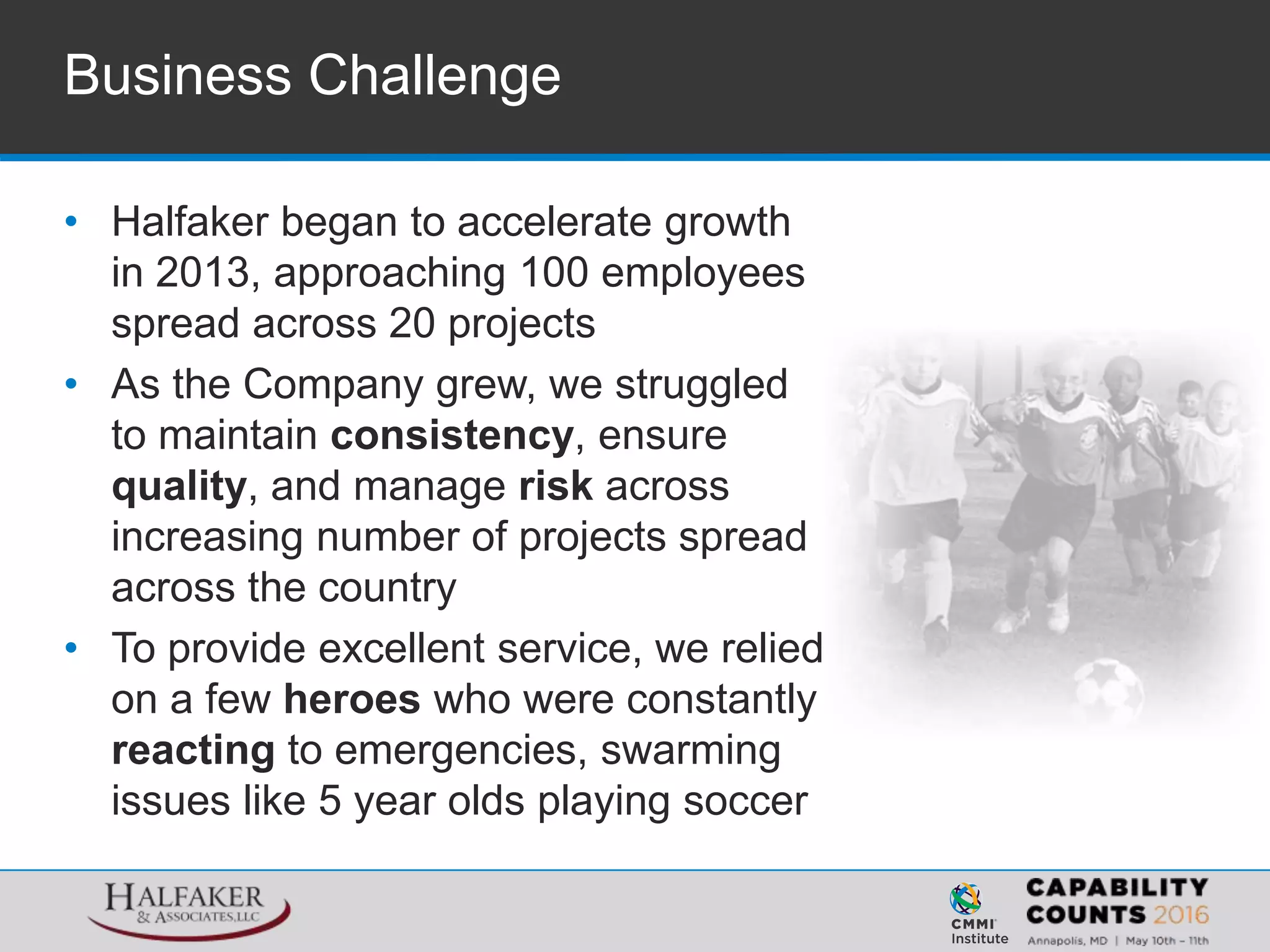
• To provide excellent service, we relied
on a few heroes who were constantly
reacting to emergencies, swarming
issues like 5 year olds playing soccer
Business Challenge
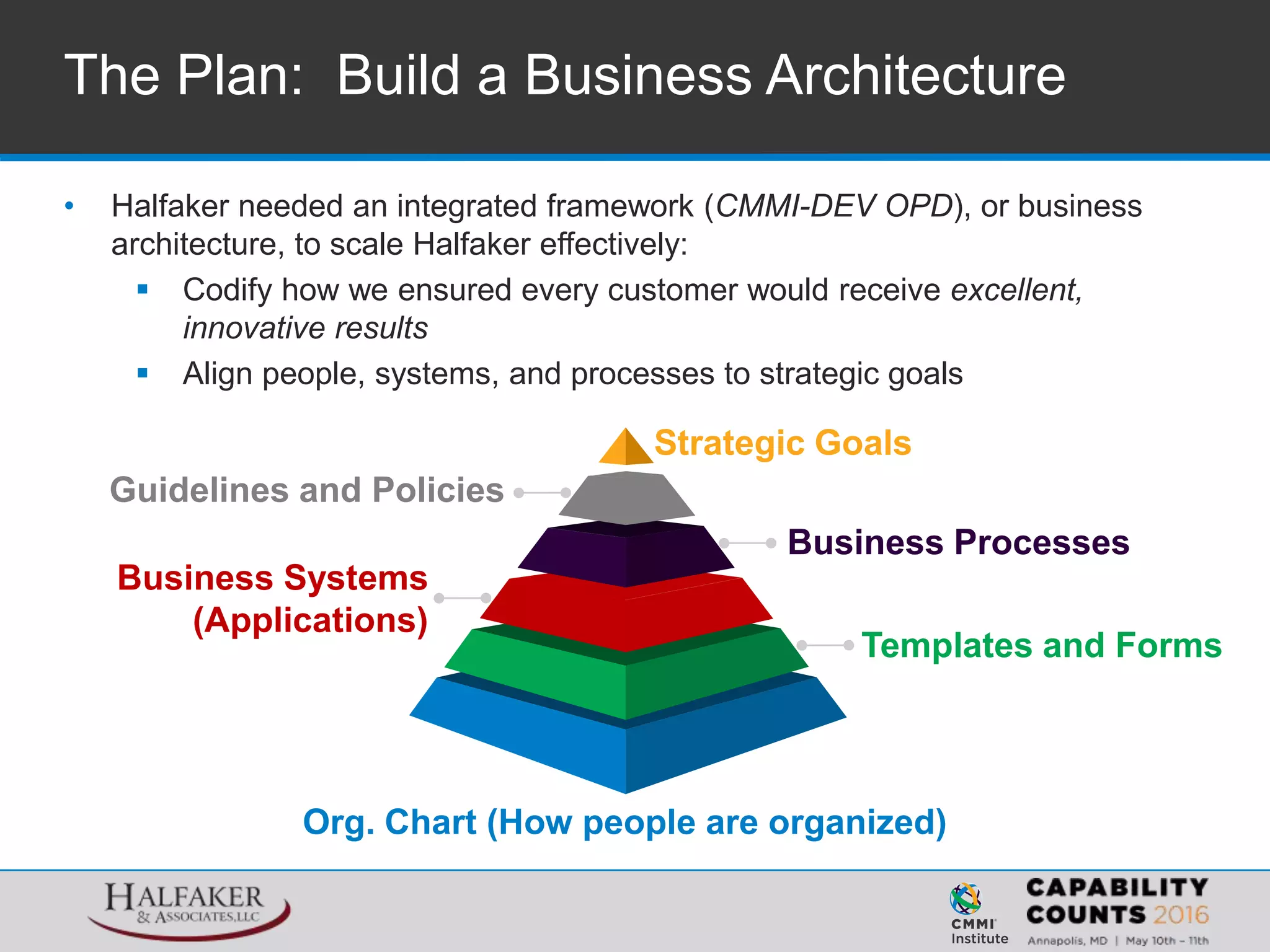
• Halfaker needed an integrated framework (CMMI-DEV OPD), or business
architecture, to scale Halfaker effectively:
 Codify how we ensured every customer would receive excellent,
innovative results
 Align people, systems, and processes to strategic goals
The Plan: Build a Business Architecture
Strategic Goals
Business Processes
Templates and Forms
Business Systems
(Applications)
Guidelines and Policies
Org. Chart (How people are organized)
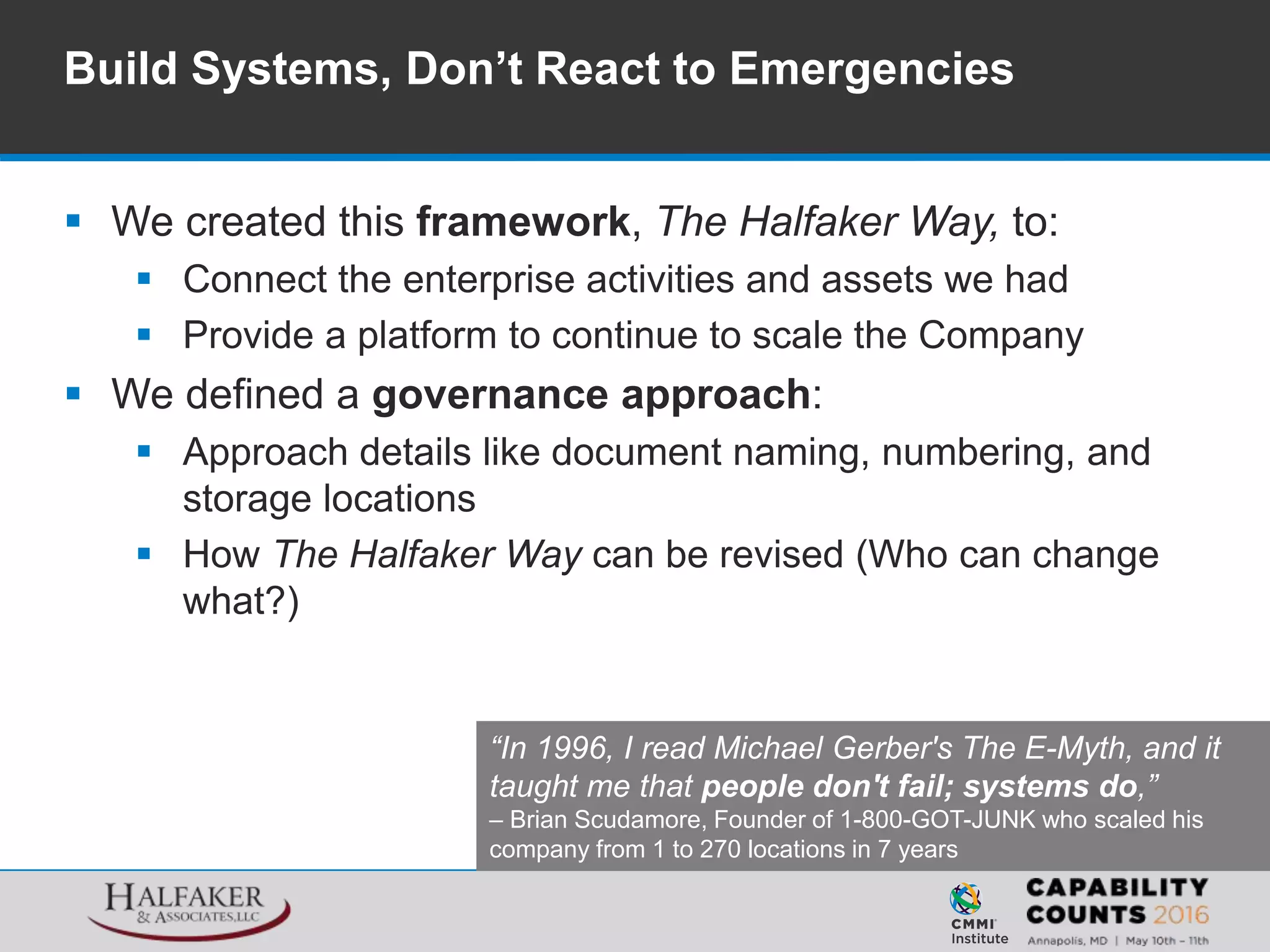
 We created this framework, The Halfaker Way, to:
 Connect the enterprise activities and assets we had
 Provide a platform to continue to scale the Company
 We defined a governance approach:
 Approach details like document naming, numbering, and
storage locations
 How The Halfaker Way can be revised (Who can change
what?)
Build Systems, Don’t React to Emergencies
“In 1996, I read Michael Gerber's The E-Myth, and it
taught me that people don't fail; systems do,”
– Brian Scudamore, Founder of 1-800-GOT-JUNK who scaled his
company from 1 to 270 locations in 7 years
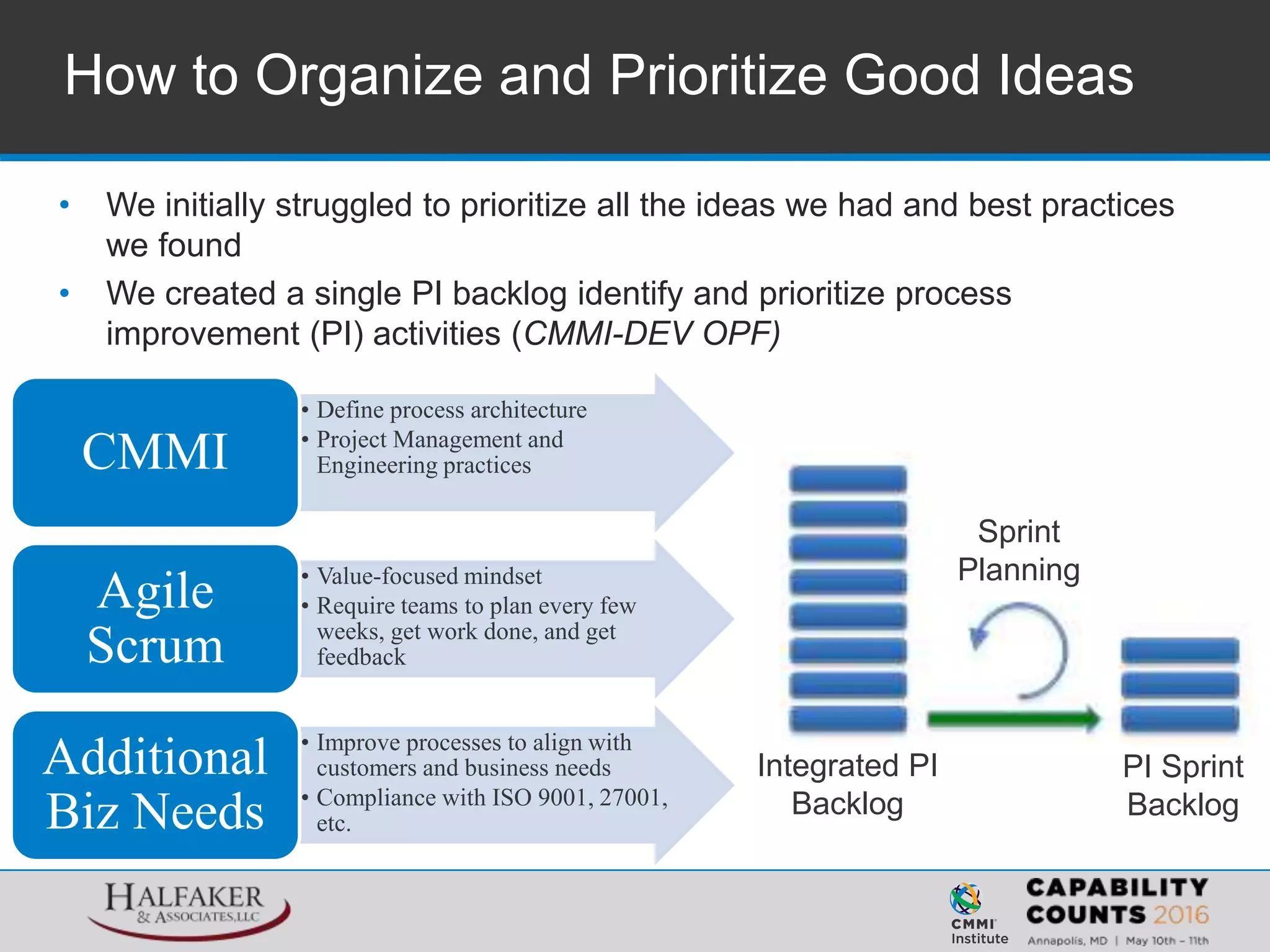
How to Organize and Prioritize Good Ideas
• We initially struggled to prioritize all the ideas we had and best practices
we found
• We created a single PI backlog identify and prioritize process
improvement (PI) activities (CMMI-DEV OPF)
Integrated PI
Backlog
Sprint
Planning
PI Sprint
Backlog
• Define process architecture
• Project Management and
Engineering practicesCMMI
• Value-focused mindset
• Require teams to plan every few
weeks, get work done, and get
feedback
Agile
Scrum
• Improve processes to align with
customers and business needs
• Compliance with ISO 9001, 27001,
etc.
Additional
Biz Needs
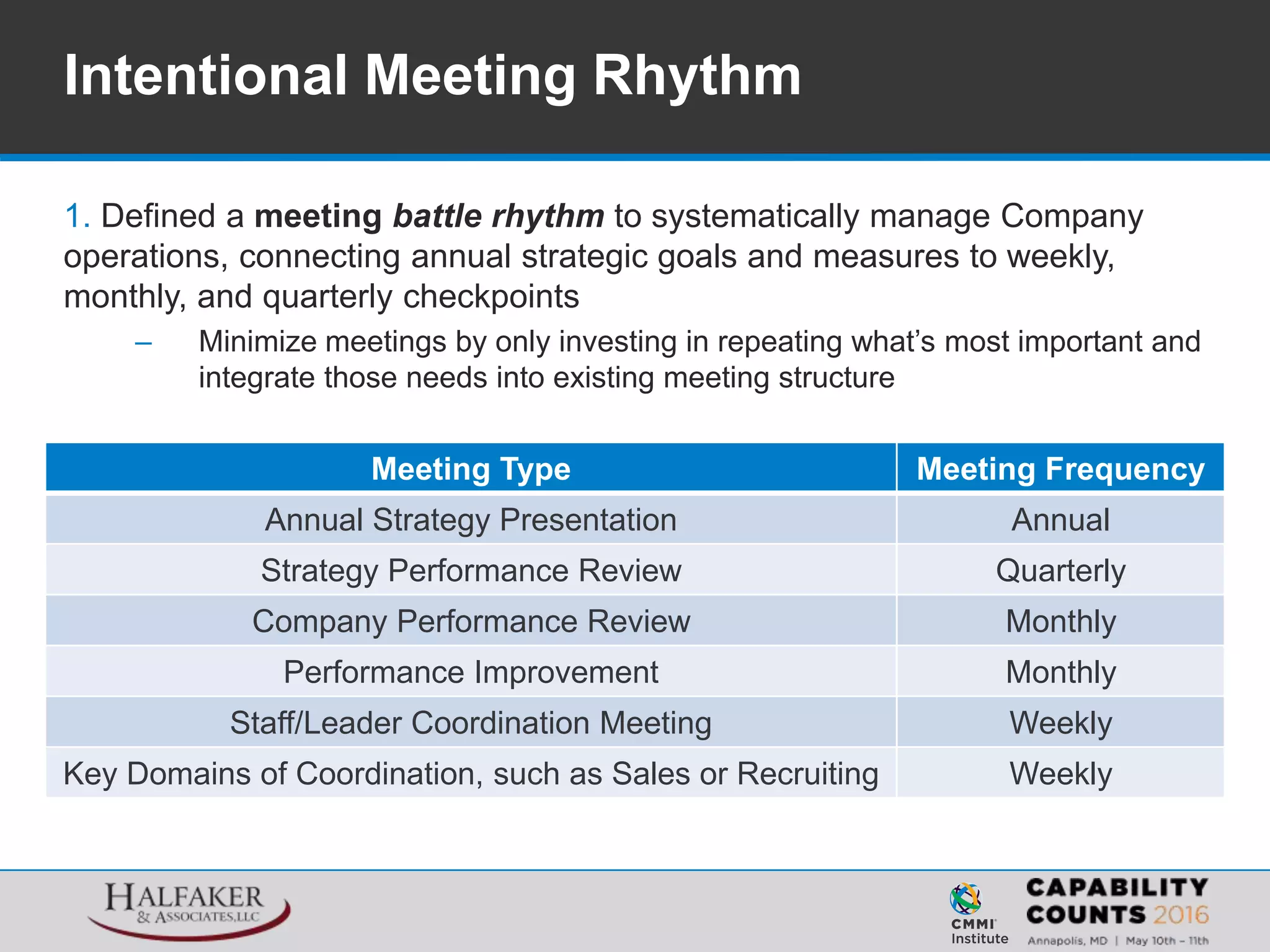
1. Defined a meeting battle rhythm to systematically manage Company
operations, connecting annual strategic goals and measures to weekly,
monthly, and quarterly checkpoints
– Minimize meetings by only investing in repeating what’s most important and
integrate those needs into existing meeting structure
Intentional Meeting Rhythm
Meeting Type Meeting Frequency
Annual Strategy Presentation Annual
Strategy Performance Review Quarterly
Company Performance Review Monthly
Performance Improvement Monthly
Staff/Leader Coordination Meeting Weekly
Key Domains of Coordination, such as Sales or Recruiting Weekly
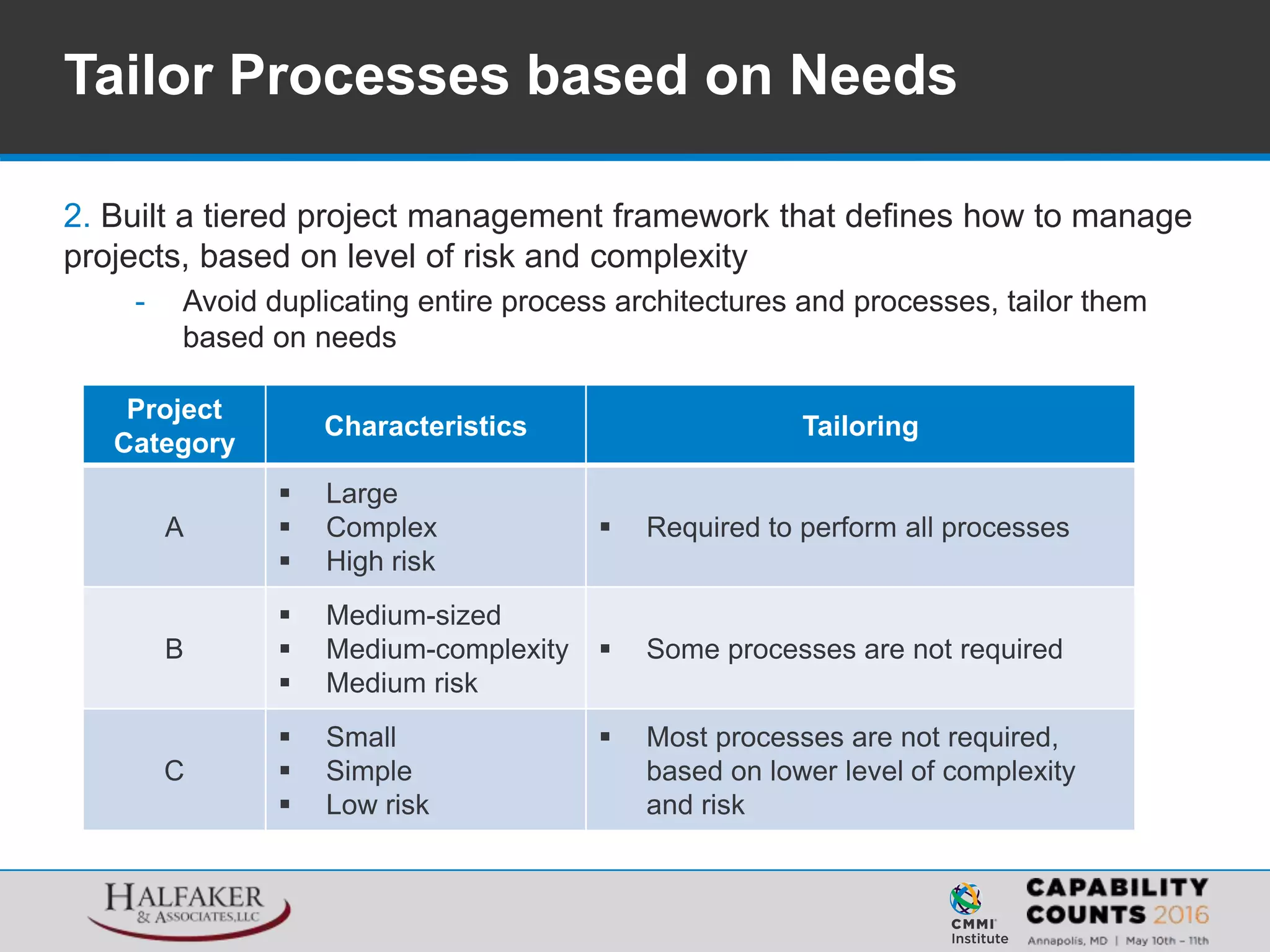
2. Built a tiered project management framework that defines how to manage
projects, based on level of risk and complexity
- Avoid duplicating entire process architectures and processes, tailor them
based on needs
Tailor Processes based on Needs
Project
Category
Characteristics Tailoring
A
 Large
 Complex
 High risk
 Required to perform all processes
B
 Medium-sized
 Medium-complexity
 Medium risk
 Some processes are not required
C
 Small
 Simple
 Low risk
 Most processes are not required,
based on lower level of complexity
and risk
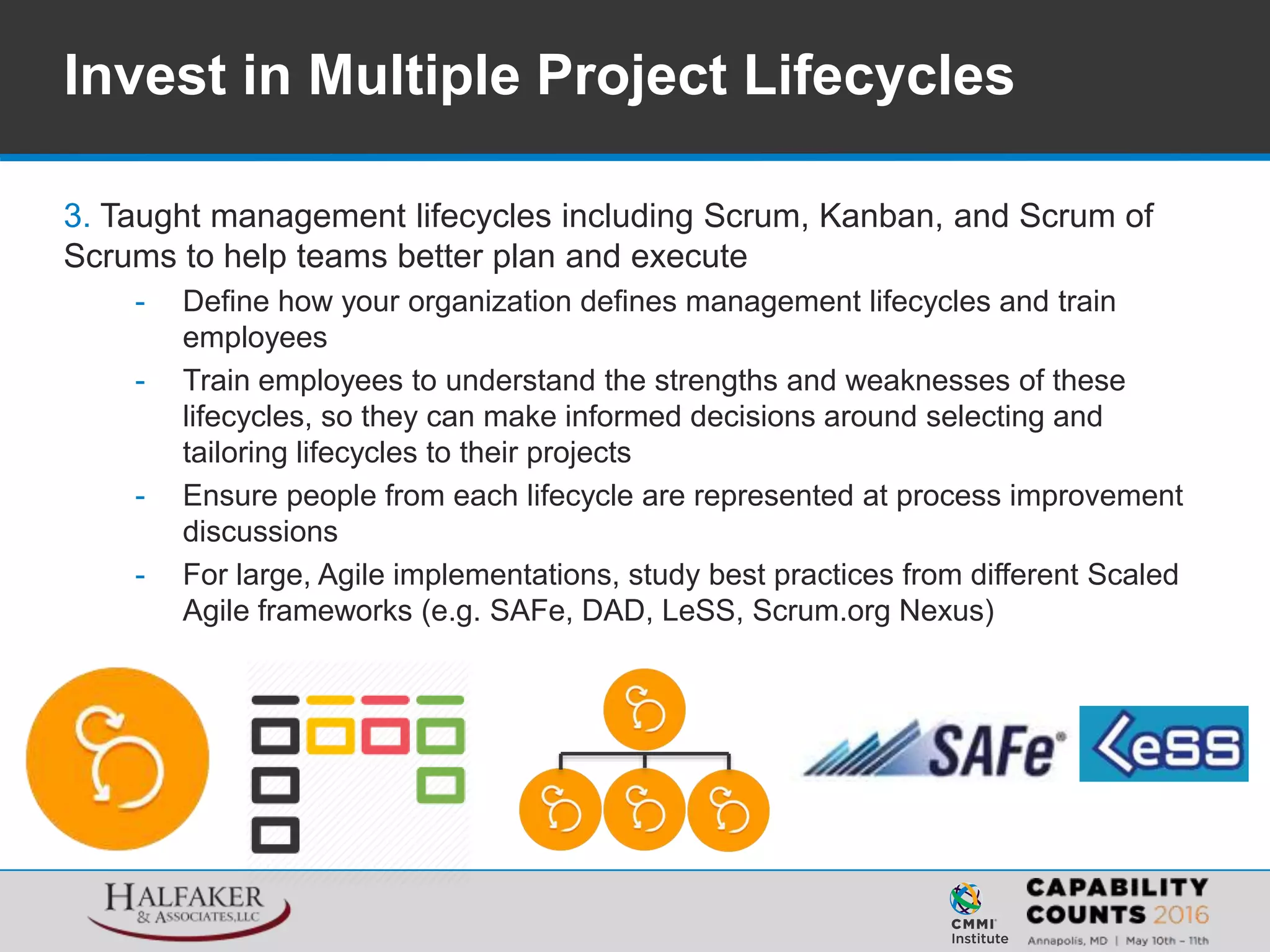
3. Taught management lifecycles including Scrum, Kanban, and Scrum of
Scrums to help teams better plan and execute
- Define how your organization defines management lifecycles and train
employees
- Train employees to understand the strengths and weaknesses of these
lifecycles, so they can make informed decisions around selecting and
tailoring lifecycles to their projects
- Ensure people from each lifecycle are represented at process improvement
discussions
- For large, Agile implementations, study best practices from different Scaled
Agile frameworks (e.g. SAFe, DAD, LeSS, Scrum.org Nexus)
Invest in Multiple Project Lifecycles
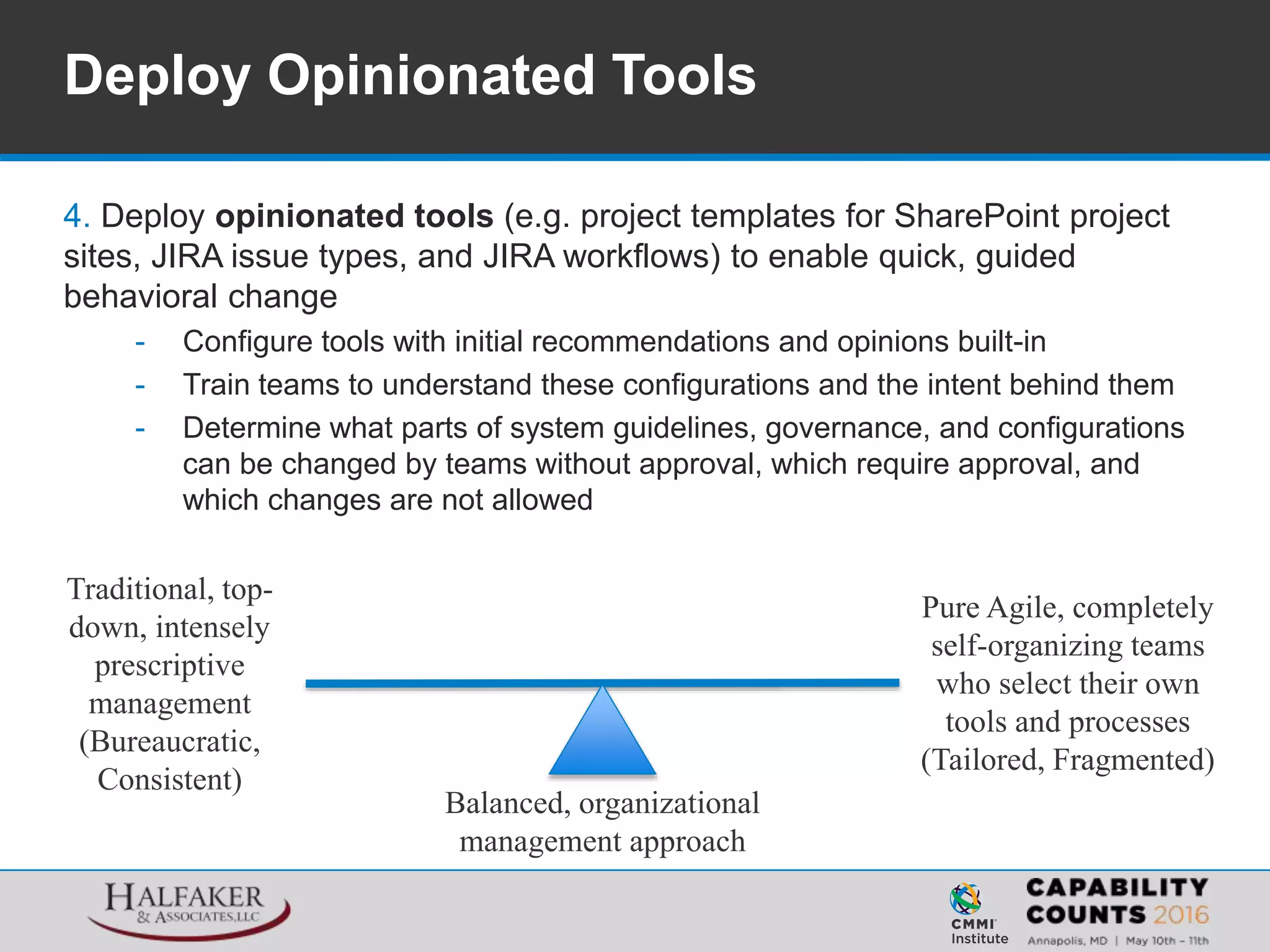
4. Deploy opinionated tools (e.g. project templates for SharePoint project
sites, JIRA issue types, and JIRA workflows) to enable quick, guided
behavioral change
- Configure tools with initial recommendations and opinions built-in
- Train teams to understand these configurations and the intent behind them
- Determine what parts of system guidelines, governance, and configurations
can be changed by teams without approval, which require approval, and
which changes are not allowed
Deploy Opinionated Tools
Traditional, top-
down, intensely
prescriptive
management
(Bureaucratic,
Consistent)
Pure Agile, completely
self-organizing teams
who select their own
tools and processes
(Tailored, Fragmented)
Balanced, organizational
management approach
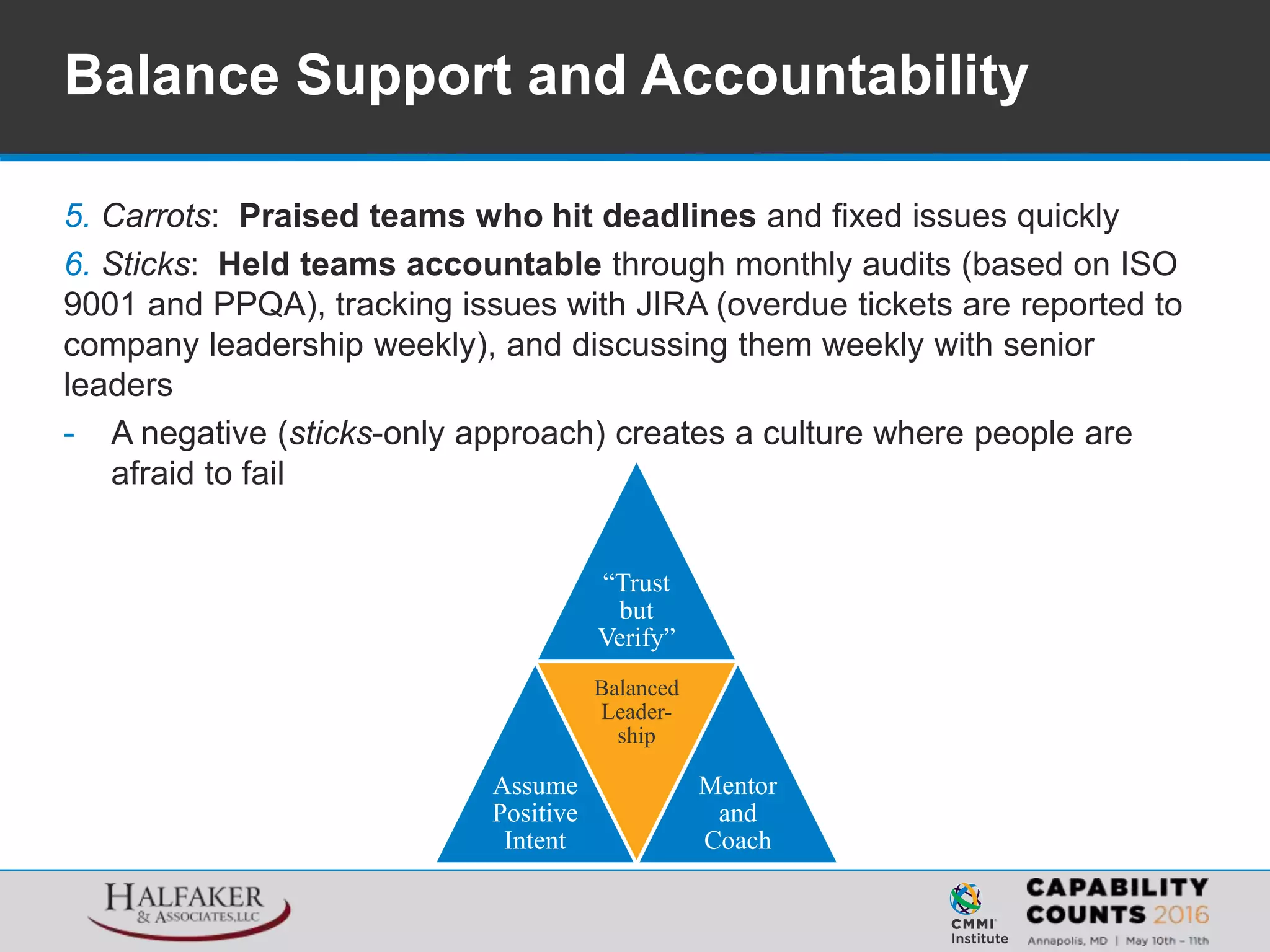
5. Carrots: Praised teams who hit deadlines and fixed issues quickly
6. Sticks: Held teams accountable through monthly audits (based on ISO
9001 and PPQA), tracking issues with JIRA (overdue tickets are reported to
company leadership weekly), and discussing them weekly with senior
leaders
- A negative (sticks-only approach) creates a culture where people are
afraid to fail
Balance Support and Accountability
“Trust
but
Verify”
Assume
Positive
Intent
Balanced
Leader-
ship
Mentor
and
Coach
The Results
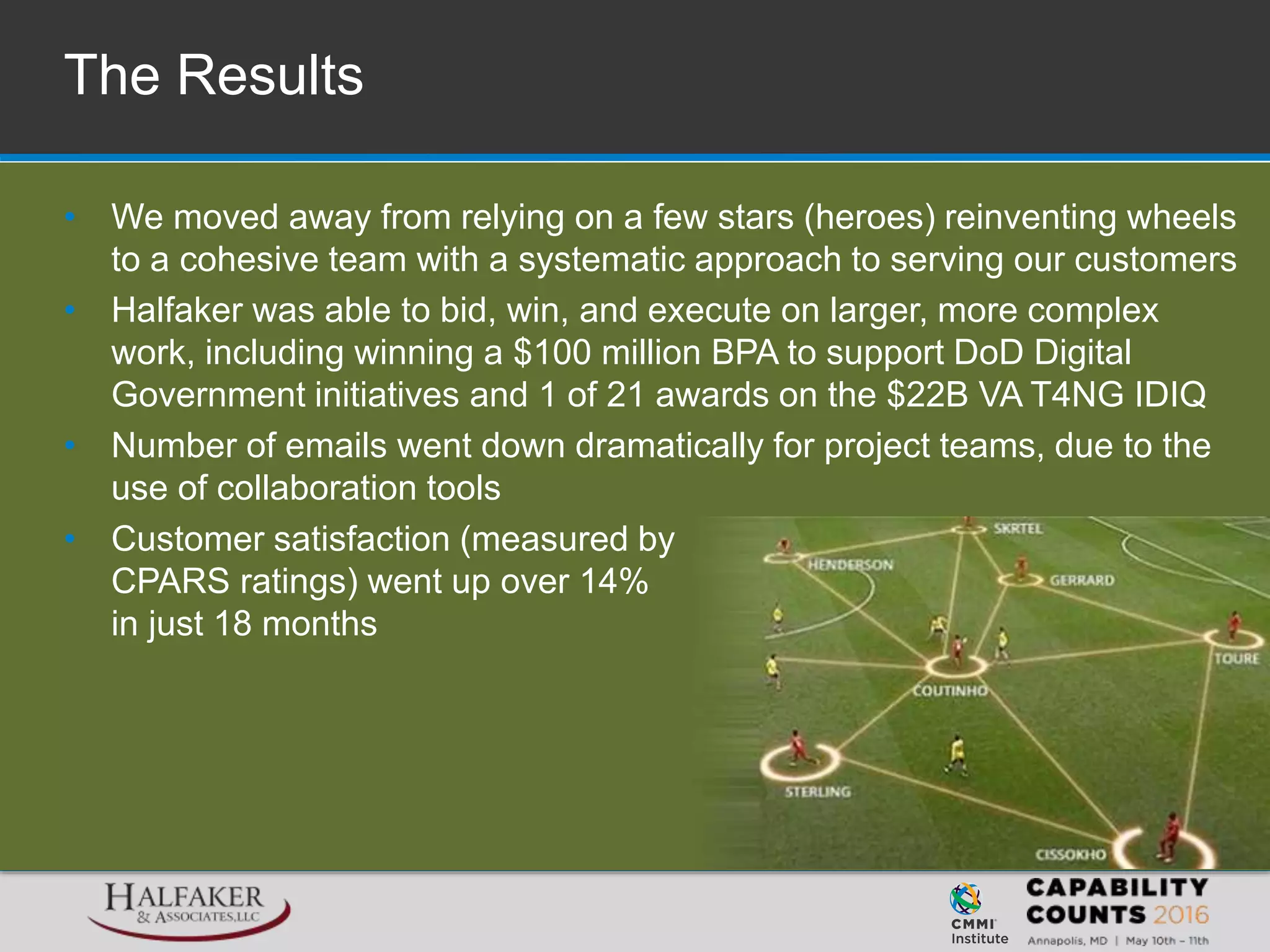
• We moved away from relying on a few stars (heroes) reinventing wheels
to a cohesive team with a systematic approach to serving our customers
• Halfaker was able to bid, win, and execute on larger, more complex
work, including winning a $100 million BPA to support DoD Digital
Government initiatives and 1 of 21 awards on the $22B VA T4NG IDIQ
• Number of emails went down dramatically for project teams, due to the
use of collaboration tools
• Customer satisfaction (measured by
CPARS ratings) went up over 14%
in just 18 months
Lessons Learned
1. Invest in training your process improvement leaders early on in
CMMI, Agile, tools (e.g. JIRA, and other relevant frameworks, tools,
and techniques
2. Don’t think that writing processes is the hard part of process
improvement – change management (people) is the hard part of
process improvement
3. Add feedback loops and verification points to existing meetings
when possible to reinforce new behaviors (and avoid adding more
meetings)
4. Use Agile sprints to manage all activities, not just software
development projects, or projects (use to manage back-office
departments and process improvement activities)
5. Always be thinking about building systems – define the process,
write it down, train people, and ensure someone has ownership to
run it, so you as the business and process improvement leader can
go create/improve the next things (See CMMI GP’s)
Questions
• Questions?
• Follow-up Questions? Want to Connect?
• michael.king@halfaker.com
• @mikehking (Twitter)
• https://www.linkedin.com/in/mikehking

From Chaos to Order: Building a Business Architecture

  • 1.
    From Chaos toOrder: Building a Business Architecture Michael King Halfaker and Associates Chief Technology Officer
  • 2.
    • Company foundedin 2006 with the vision of Continuing to Serve… • Founded by West Point graduate and Army Military Police Officer Dawn Halfaker (Service-Disabled Veteran-Owned, Woman-Owned, 8(a) Small Business) • 150-employee company focused on providing Advanced Analytics, Software Engineering, IT Infrastructure, and Cyber Security solutions to Federal Government customers Halfaker and Associate Overview Culture built on Military Principles  Lead from the Front  Never Give Up  Stay Positive  Plan, Plan, Plan (Op Orders)  Take Care of Your People  Know the Job above you and below you  Demand Excellence
  • 3.
    • Halfaker beganto accelerate growth in 2013, approaching 100 employees spread across 20 projects • As the Company grew, we struggled to maintain consistency, ensure quality, and manage risk across increasing number of projects spread across the country • To provide excellent service, we relied on a few heroes who were constantly reacting to emergencies, swarming issues like 5 year olds playing soccer Business Challenge
  • 4.
    • Halfaker neededan integrated framework (CMMI-DEV OPD), or business architecture, to scale Halfaker effectively:  Codify how we ensured every customer would receive excellent, innovative results  Align people, systems, and processes to strategic goals The Plan: Build a Business Architecture Strategic Goals Business Processes Templates and Forms Business Systems (Applications) Guidelines and Policies Org. Chart (How people are organized)
  • 5.
     We createdthis framework, The Halfaker Way, to:  Connect the enterprise activities and assets we had  Provide a platform to continue to scale the Company  We defined a governance approach:  Approach details like document naming, numbering, and storage locations  How The Halfaker Way can be revised (Who can change what?) Build Systems, Don’t React to Emergencies “In 1996, I read Michael Gerber's The E-Myth, and it taught me that people don't fail; systems do,” – Brian Scudamore, Founder of 1-800-GOT-JUNK who scaled his company from 1 to 270 locations in 7 years
  • 6.
    How to Organizeand Prioritize Good Ideas • We initially struggled to prioritize all the ideas we had and best practices we found • We created a single PI backlog identify and prioritize process improvement (PI) activities (CMMI-DEV OPF) Integrated PI Backlog Sprint Planning PI Sprint Backlog • Define process architecture • Project Management and Engineering practicesCMMI • Value-focused mindset • Require teams to plan every few weeks, get work done, and get feedback Agile Scrum • Improve processes to align with customers and business needs • Compliance with ISO 9001, 27001, etc. Additional Biz Needs
  • 7.
    1. Defined ameeting battle rhythm to systematically manage Company operations, connecting annual strategic goals and measures to weekly, monthly, and quarterly checkpoints – Minimize meetings by only investing in repeating what’s most important and integrate those needs into existing meeting structure Intentional Meeting Rhythm Meeting Type Meeting Frequency Annual Strategy Presentation Annual Strategy Performance Review Quarterly Company Performance Review Monthly Performance Improvement Monthly Staff/Leader Coordination Meeting Weekly Key Domains of Coordination, such as Sales or Recruiting Weekly
  • 8.
    2. Built atiered project management framework that defines how to manage projects, based on level of risk and complexity - Avoid duplicating entire process architectures and processes, tailor them based on needs Tailor Processes based on Needs Project Category Characteristics Tailoring A  Large  Complex  High risk  Required to perform all processes B  Medium-sized  Medium-complexity  Medium risk  Some processes are not required C  Small  Simple  Low risk  Most processes are not required, based on lower level of complexity and risk
  • 9.
    3. Taught managementlifecycles including Scrum, Kanban, and Scrum of Scrums to help teams better plan and execute - Define how your organization defines management lifecycles and train employees - Train employees to understand the strengths and weaknesses of these lifecycles, so they can make informed decisions around selecting and tailoring lifecycles to their projects - Ensure people from each lifecycle are represented at process improvement discussions - For large, Agile implementations, study best practices from different Scaled Agile frameworks (e.g. SAFe, DAD, LeSS, Scrum.org Nexus) Invest in Multiple Project Lifecycles
  • 10.
    4. Deploy opinionatedtools (e.g. project templates for SharePoint project sites, JIRA issue types, and JIRA workflows) to enable quick, guided behavioral change - Configure tools with initial recommendations and opinions built-in - Train teams to understand these configurations and the intent behind them - Determine what parts of system guidelines, governance, and configurations can be changed by teams without approval, which require approval, and which changes are not allowed Deploy Opinionated Tools Traditional, top- down, intensely prescriptive management (Bureaucratic, Consistent) Pure Agile, completely self-organizing teams who select their own tools and processes (Tailored, Fragmented) Balanced, organizational management approach
  • 11.
    5. Carrots: Praisedteams who hit deadlines and fixed issues quickly 6. Sticks: Held teams accountable through monthly audits (based on ISO 9001 and PPQA), tracking issues with JIRA (overdue tickets are reported to company leadership weekly), and discussing them weekly with senior leaders - A negative (sticks-only approach) creates a culture where people are afraid to fail Balance Support and Accountability “Trust but Verify” Assume Positive Intent Balanced Leader- ship Mentor and Coach
  • 12.
    The Results • Wemoved away from relying on a few stars (heroes) reinventing wheels to a cohesive team with a systematic approach to serving our customers • Halfaker was able to bid, win, and execute on larger, more complex work, including winning a $100 million BPA to support DoD Digital Government initiatives and 1 of 21 awards on the $22B VA T4NG IDIQ • Number of emails went down dramatically for project teams, due to the use of collaboration tools • Customer satisfaction (measured by CPARS ratings) went up over 14% in just 18 months
  • 13.
    Lessons Learned 1. Investin training your process improvement leaders early on in CMMI, Agile, tools (e.g. JIRA, and other relevant frameworks, tools, and techniques 2. Don’t think that writing processes is the hard part of process improvement – change management (people) is the hard part of process improvement 3. Add feedback loops and verification points to existing meetings when possible to reinforce new behaviors (and avoid adding more meetings) 4. Use Agile sprints to manage all activities, not just software development projects, or projects (use to manage back-office departments and process improvement activities) 5. Always be thinking about building systems – define the process, write it down, train people, and ensure someone has ownership to run it, so you as the business and process improvement leader can go create/improve the next things (See CMMI GP’s)
  • 14.
    Questions • Questions? • Follow-upQuestions? Want to Connect? • michael.king@halfaker.com • @mikehking (Twitter) • https://www.linkedin.com/in/mikehking