Life Cycle of a Frog
Write On
Grade 3 - 4
Learner Expectation
 Content Standard: 4.0 Heredity and Reproduction
 The student will understand the basic principles of
inheritance.
 Learning Expectations:
 4.1 Recognize that living things reproduce.
 4.2 Recognize that offspring tend to resemble their
parents.
 4.3 Recognize that the appearance of plants and
animals changes as they mature
In this activity you will:
 Learn about the life cycle of a frog.
 Learn about the changes that take place as
tadpoles change into frogs.
Life Cycle of a Frog: First Week
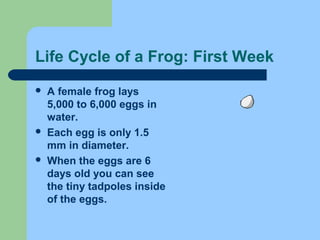
 A female frog lays
5,000 to 6,000 eggs in
water.
 Each egg is only 1.5
mm in diameter.
 When the eggs are 6
days old you can see
the tiny tadpoles inside
of the eggs.
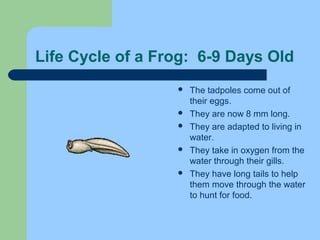
Life Cycle of a Frog: 6-9 Days Old
 The tadpoles come out of
their eggs.
 They are now 8 mm long.
 They are adapted to living in
water.
 They take in oxygen from the
water through their gills.
 They have long tails to help
them move through the water
to hunt for food.
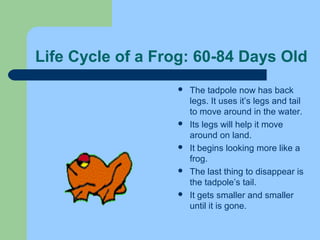
Life Cycle of a Frog: 60-84 Days Old
 The tadpole now has back
legs. It uses it’s legs and tail
to move around in the water.
 Its legs will help it move
around on land.
 It begins looking more like a
frog.
 The last thing to disappear is
the tadpole’s tail.
 It gets smaller and smaller
until it is gone.
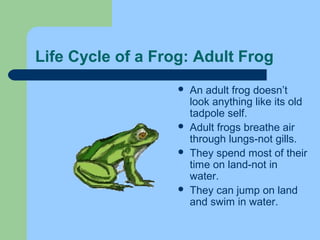
Life Cycle of a Frog: Adult Frog
 An adult frog doesn’t
look anything like its old
tadpole self.
 Adult frogs breathe air
through lungs-not gills.
 They spend most of their
time on land-not in
water.
 They can jump on land
and swim in water.
The Life Cycle of a Frog:
Writing Activity
 Create a Four Square writing paper.
 Write a topic sentence that is appropriate for the
lesson about what you have learned about the Life
Cycle of a Frog.
 Write one detail in each square.
 Self edit and then exchange with a friend for peer
editing.
 Take it to paper.
 Draw a picture of an egg, a tadpole, and an adult
frog.

Frog

  • 1.
    Life Cycle ofa Frog Write On Grade 3 - 4
  • 2.
    Learner Expectation  ContentStandard: 4.0 Heredity and Reproduction  The student will understand the basic principles of inheritance.  Learning Expectations:  4.1 Recognize that living things reproduce.  4.2 Recognize that offspring tend to resemble their parents.  4.3 Recognize that the appearance of plants and animals changes as they mature
  • 3.
    In this activityyou will:  Learn about the life cycle of a frog.  Learn about the changes that take place as tadpoles change into frogs.
  • 4.
    Life Cycle ofa Frog: First Week  A female frog lays 5,000 to 6,000 eggs in water.  Each egg is only 1.5 mm in diameter.  When the eggs are 6 days old you can see the tiny tadpoles inside of the eggs.
  • 5.
    Life Cycle ofa Frog: 6-9 Days Old  The tadpoles come out of their eggs.  They are now 8 mm long.  They are adapted to living in water.  They take in oxygen from the water through their gills.  They have long tails to help them move through the water to hunt for food.
  • 6.
    Life Cycle ofa Frog: 60-84 Days Old  The tadpole now has back legs. It uses it’s legs and tail to move around in the water.  Its legs will help it move around on land.  It begins looking more like a frog.  The last thing to disappear is the tadpole’s tail.  It gets smaller and smaller until it is gone.
  • 7.
    Life Cycle ofa Frog: Adult Frog  An adult frog doesn’t look anything like its old tadpole self.  Adult frogs breathe air through lungs-not gills.  They spend most of their time on land-not in water.  They can jump on land and swim in water.
  • 8.
    The Life Cycleof a Frog: Writing Activity  Create a Four Square writing paper.  Write a topic sentence that is appropriate for the lesson about what you have learned about the Life Cycle of a Frog.  Write one detail in each square.  Self edit and then exchange with a friend for peer editing.  Take it to paper.  Draw a picture of an egg, a tadpole, and an adult frog.