<agency name> Presentation
Friending the Statehouse
How the Open Data Movement and Social
Media are Changing Citizen Communication
With Government
Mark J. Headd
mheadd@voiceingov.org
voiceingov.org/blog
@mheadd / facebook.com/mheadd
Who am I?
• Maxwell Grad – MPA, 1994.
• 12 years in state government – NY & DE.
• Executive and Legislative branch experience.
• IT Policy advisor and IT agency manager.
• Past 7 years – private sector.
• Software developer with focus on phone / mobile technology.
• Open government enthusiast / speaker.
• Open source contributor.
• Blogger (voiceingov.org).
Agenda
• Show me the Data!
• eGov vs. Gov 2.0
• What’s different?
• The Rise of Social Media
• Towards a Government Platform – defining APIs.
• APIs in the wild.
• Open311: What is it, Why is it Important?
• Location, Location, Location!
• Getting Started with Open Data.
• Conclusions. What Comes Next?
Show me the Data!
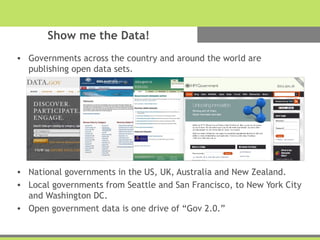
• Governments across the country and around the world are
publishing open data sets.
• National governments in the US, UK, Australia and New Zealand.
• Local governments from Seattle and San Francisco, to New York City
and Washington DC.
• Open government data is one drive of “Gov 2.0.”
What is Gov 2.0?
• Rebranding of eGov, begun more than a decade before.
• Take off of Web 2.0
• Real differences between eGov and Gov 2.0.
eGov:
• Government centric (portal).
• Blur the lines between agencies, branches of government.
• Push to put government services online.
Gov 2.0:
• Citizen centric (developer centric).
• Enhance the transparency of government operations.
• Push to put government data online in “raw” formats.
What’s Different?
• The idea of releasing government data to outsider users is not new.
• The Open Data movement that is part of Gov 2.0 is different from
past actions to release government data in at least 3 ways:
– Publishing open data is becoming a measure of government
transparency and performance.
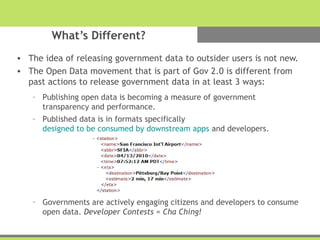
– Published data is in formats specifically
designed to be consumed by downstream apps and developers.
– Governments are actively engaging citizens and developers to consume
open data. Developer Contests = Cha Ching!
OMG, #OpenGov is BFD!
• Fundamental change in how we
communicate with each other.
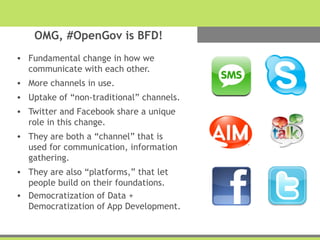
• More channels in use.
• Uptake of “non-traditional” channels.
• Twitter and Facebook share a unique
role in this change.
• They are both a “channel” that is
used for communication, information
gathering.
• They are also “platforms,” that let
people build on their foundations.
• Democratization of Data +
Democratization of App Development.
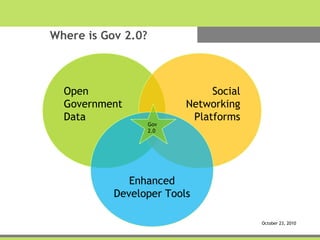
Where is Gov 2.0?
October 23, 2010
Open
Government
Data
Social
Networking
Platforms
Enhanced
Developer Tools
Gov
2.0
Towards a Government Platform
• What is an API?
• Application Programming Interface.
• A set of rules that govern how developers can use a platform or
service.
• Typically built on underlying web technologies.
• Documented list of “functions” that can be invoked in the service.
• What are the requirements to invoke a function?
• Guarantee of a response from the service.
– Success! I get what I asked for (list of all tweets within 1 mile of
Maxwell Hall, Syracuse NY).
– Failure. I won’t get what I asked for, with an details of failure.
• The format of the response will be fixed and consistent.
• A contract.
APIs in the Wild
• Trailblazing governments are moving beyond
static data sets.
• City of Seattle uses a open source API that sits
in front of it’s data, allowing developers to
programmatically query multiple data sets.
• MassDOT and BART publish real time transit
information feeds.
• NY State Senate has deployed an API for
searching their Legislative Information System.
• San Francisco and Washington DC have
deployed APIs for their 311 systems.
• Moving from static data to real-time feeds and
transaction-based APIs.
• From individual efforts to standard
implementations.
311 and Open311
• Abbreviated dialing designation set up for use by municipal governments in
both the U.S. and Canada.
• Non-emergency requests and questions.
• “Burning building? Call 911. Burning question? Call 311.”
• First: Baltimore (1996). Biggest: NYC (just passed 100 million calls).
• Pew Charitable Trust report on Philly 311.
• Most 311 operations include a web component with lists of FAQs and
information frequently requested by callers.
• Several 311 operations (including NYC and San Francisco) have worked to
incorporate Twitter and other social media tools into their services.
• San Francisco and Washington DC have deployed 311 APIs.
• Open311 Initiative. Effort to standardize 311 APIs across governments.
• Applications built for one municipality will work in others that support the
standard.
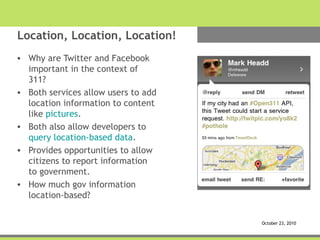
Location, Location, Location!
• Why are Twitter and Facebook
important in the context of
311?
• Both services allow users to add
location information to content
like pictures.
• Both also allow developers to
query location-based data.
• Provides opportunities to allow
citizens to report information
to government.
• How much gov information
location-based?
October 23, 2010
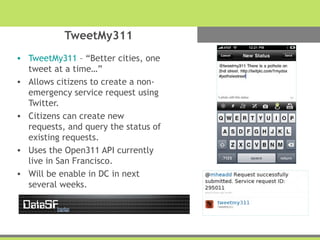
TweetMy311
• TweetMy311 – “Better cities, one
tweet at a time…”
• Allows citizens to create a non-
emergency service request using
Twitter.
• Citizens can create new
requests, and query the status of
existing requests.
• Uses the Open311 API currently
live in San Francisco.
• Will be enable in DC in next
several weeks.
Getting Started with Open Data
• Where can governments begin with open data?
• What are people asking for?
• Look at customer engagements (phone / e-mail / web) for
opportunities to release open data.
• Is there anything available already?
• Look at high value / high impact data.
– Crime location data
– Other types of location data (polling places, libraries, health facilities).
– Transit data (Delaware General Assembly: SB 242)
– Restaurant inspection data
– Licensure data
• Compact data lends itself most easily to multiple channels.
• Make a plan. Set a goal. Publish the goal. Measure progress.
What’s Next?
• More data! And more apps!
• Geekery as citizenship. Code for America (USA), Rewired State (UK).
• Less app building by governments – dramatic changes to existing
procurement processes.
• Governments become data stewards / data providers.
• Uneven distribution of connectivity (both traditional and mobile)
will continue as an issue governments must address.
• Citizen communication with government may first require a trip to
the app store. San Francisco App Showcase, DC App Store.
• More multitenant applications, and apps shared between different
governments. SeeClickFix.
• Mobile devices and cell phones become the primary instruments for
communicating with government.
La Fin
Questions?

Friending The Statehouse

  • 1.
    <agency name> Presentation Friendingthe Statehouse How the Open Data Movement and Social Media are Changing Citizen Communication With Government Mark J. Headd mheadd@voiceingov.org voiceingov.org/blog @mheadd / facebook.com/mheadd
  • 2.
    Who am I? •Maxwell Grad – MPA, 1994. • 12 years in state government – NY & DE. • Executive and Legislative branch experience. • IT Policy advisor and IT agency manager. • Past 7 years – private sector. • Software developer with focus on phone / mobile technology. • Open government enthusiast / speaker. • Open source contributor. • Blogger (voiceingov.org).
  • 3.
    Agenda • Show methe Data! • eGov vs. Gov 2.0 • What’s different? • The Rise of Social Media • Towards a Government Platform – defining APIs. • APIs in the wild. • Open311: What is it, Why is it Important? • Location, Location, Location! • Getting Started with Open Data. • Conclusions. What Comes Next?
  • 4.
    Show me theData! • Governments across the country and around the world are publishing open data sets. • National governments in the US, UK, Australia and New Zealand. • Local governments from Seattle and San Francisco, to New York City and Washington DC. • Open government data is one drive of “Gov 2.0.”
  • 5.
    What is Gov2.0? • Rebranding of eGov, begun more than a decade before. • Take off of Web 2.0 • Real differences between eGov and Gov 2.0. eGov: • Government centric (portal). • Blur the lines between agencies, branches of government. • Push to put government services online. Gov 2.0: • Citizen centric (developer centric). • Enhance the transparency of government operations. • Push to put government data online in “raw” formats.
  • 6.
    What’s Different? • Theidea of releasing government data to outsider users is not new. • The Open Data movement that is part of Gov 2.0 is different from past actions to release government data in at least 3 ways: – Publishing open data is becoming a measure of government transparency and performance. – Published data is in formats specifically designed to be consumed by downstream apps and developers. – Governments are actively engaging citizens and developers to consume open data. Developer Contests = Cha Ching!
  • 7.
    OMG, #OpenGov isBFD! • Fundamental change in how we communicate with each other. • More channels in use. • Uptake of “non-traditional” channels. • Twitter and Facebook share a unique role in this change. • They are both a “channel” that is used for communication, information gathering. • They are also “platforms,” that let people build on their foundations. • Democratization of Data + Democratization of App Development.
  • 8.
    Where is Gov2.0? October 23, 2010 Open Government Data Social Networking Platforms Enhanced Developer Tools Gov 2.0
  • 9.
    Towards a GovernmentPlatform • What is an API? • Application Programming Interface. • A set of rules that govern how developers can use a platform or service. • Typically built on underlying web technologies. • Documented list of “functions” that can be invoked in the service. • What are the requirements to invoke a function? • Guarantee of a response from the service. – Success! I get what I asked for (list of all tweets within 1 mile of Maxwell Hall, Syracuse NY). – Failure. I won’t get what I asked for, with an details of failure. • The format of the response will be fixed and consistent. • A contract.
  • 10.
    APIs in theWild • Trailblazing governments are moving beyond static data sets. • City of Seattle uses a open source API that sits in front of it’s data, allowing developers to programmatically query multiple data sets. • MassDOT and BART publish real time transit information feeds. • NY State Senate has deployed an API for searching their Legislative Information System. • San Francisco and Washington DC have deployed APIs for their 311 systems. • Moving from static data to real-time feeds and transaction-based APIs. • From individual efforts to standard implementations.
  • 11.
    311 and Open311 •Abbreviated dialing designation set up for use by municipal governments in both the U.S. and Canada. • Non-emergency requests and questions. • “Burning building? Call 911. Burning question? Call 311.” • First: Baltimore (1996). Biggest: NYC (just passed 100 million calls). • Pew Charitable Trust report on Philly 311. • Most 311 operations include a web component with lists of FAQs and information frequently requested by callers. • Several 311 operations (including NYC and San Francisco) have worked to incorporate Twitter and other social media tools into their services. • San Francisco and Washington DC have deployed 311 APIs. • Open311 Initiative. Effort to standardize 311 APIs across governments. • Applications built for one municipality will work in others that support the standard.
  • 12.
    Location, Location, Location! •Why are Twitter and Facebook important in the context of 311? • Both services allow users to add location information to content like pictures. • Both also allow developers to query location-based data. • Provides opportunities to allow citizens to report information to government. • How much gov information location-based? October 23, 2010
  • 13.
    TweetMy311 • TweetMy311 –“Better cities, one tweet at a time…” • Allows citizens to create a non- emergency service request using Twitter. • Citizens can create new requests, and query the status of existing requests. • Uses the Open311 API currently live in San Francisco. • Will be enable in DC in next several weeks.
  • 14.
    Getting Started withOpen Data • Where can governments begin with open data? • What are people asking for? • Look at customer engagements (phone / e-mail / web) for opportunities to release open data. • Is there anything available already? • Look at high value / high impact data. – Crime location data – Other types of location data (polling places, libraries, health facilities). – Transit data (Delaware General Assembly: SB 242) – Restaurant inspection data – Licensure data • Compact data lends itself most easily to multiple channels. • Make a plan. Set a goal. Publish the goal. Measure progress.
  • 15.
    What’s Next? • Moredata! And more apps! • Geekery as citizenship. Code for America (USA), Rewired State (UK). • Less app building by governments – dramatic changes to existing procurement processes. • Governments become data stewards / data providers. • Uneven distribution of connectivity (both traditional and mobile) will continue as an issue governments must address. • Citizen communication with government may first require a trip to the app store. San Francisco App Showcase, DC App Store. • More multitenant applications, and apps shared between different governments. SeeClickFix. • Mobile devices and cell phones become the primary instruments for communicating with government.
  • 16.