1
CLINICAL NOTES
ON LIBIDINAL TYPES
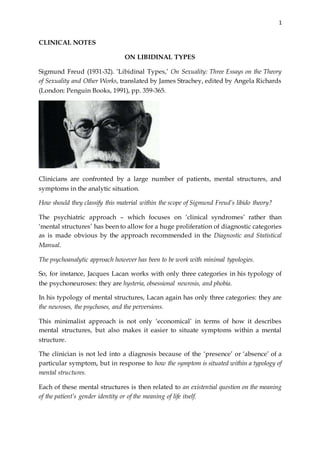
Sigmund Freud (1931-32). ‘Libidinal Types,’ On Sexuality: Three Essays on the Theory
of Sexuality and Other Works, translated by James Strachey, edited by Angela Richards
(London: Penguin Books, 1991), pp. 359-365.
Clinicians are confronted by a large number of patients, mental structures, and
symptoms in the analytic situation.
How should they classify this material within the scope of Sigmund Freud’s libido theory?
The psychiatric approach – which focuses on ‘clinical syndromes’ rather than
‘mental structures’ has been to allow for a huge proliferation of diagnostic categories
as is made obvious by the approach recommended in the Diagnostic and Statistical
Manual.
The psychoanalytic approach however has been to be work with minimal typologies.
So, for instance, Jacques Lacan works with only three categories in his typology of
the psychoneuroses: they are hysteria, obsessional neurosis, and phobia.
In his typology of mental structures, Lacan again has only three categories: they are
the neuroses, the psychoses, and the perversions.
This minimalist approach is not only ‘economical’ in terms of how it describes
mental structures, but also makes it easier to situate symptoms within a mental
structure.
The clinician is not led into a diagnosis because of the ‘presence’ or ‘absence’ of a
particular symptom, but in response to how the symptom is situated within a typology of
mental structures.
Each of these mental structures is then related to an existential question on the meaning
of the patient’s gender identity or of the meaning of life itself.
2
It also helps to orient the patient in terms of the great polarities of ‘male and female’
and ‘life and death.’
This approach in the Lacanian clinic is related to the approach that Freud himself
took in his clinic at Vienna.
Freud did not invoke more diagnostic categories and types than absolutely
necessary to describe his patients; their mental structures; the forms of the
transference and resistance in the analytic situation; and the clinical interventions
that would be appropriate therein.
This paper on ‘libidinal types’ by Freud is a good instance of working with a
minimalist typology in the attempt to clarify the huge amount of material that
emerges in the clinic.
Freud’s approach not only clarifies the situation, but also helps to position
psychoanalysis vis-à-vis the academic typologies that were already available in the
context of personality theory in psychology.
The main difference between these approaches and what Freud is doing is that he
‘subsumes’ many of these types in academic psychology in terms of their underlying
libidinal patterns.
Since the analytic clinic is based on the ‘sexual aetiology of the neuroses,’ what
matters for Freud is not an exhaustive list of personality types in itself, but to reduce
them to elementary forms that will help the clinician to make a diagnosis.
The Freudian typology of libidinal types then is not akin to what is being attempted
in theories of personality as such.
If we misunderstand why Freud is interested in such a typology in the first place, we
will not be able to appreciate the significance of this short paper.
The typology of libidinal types then is a means to an end.
3
That end is the need to make a timely diagnosis in the analytic clinic (preferably in
the preliminary interviews with the patient before he is put on the couch).
The attempt to diagnose on the part of the clinician should keep in mind not only the
sexual aetiology of the neuroses, but also the fact that the neurotic subject usually
finds himself stuck between a ‘libidinal’ economy and a ‘symbolic’ economy.
The libidinal types that Freud describes are related to the problem of ‘libidinal
allocation.’
What then are the different ways in which the subject can allocate his libido?
Freud’s answer is that there are three ways of allocating libido: they usually take the
form of the ‘erotic, the narcissistic, and the obsessional.’
Freud then goes on to describe what exactly he means by invoking this minimal
typology, and why clinicians must keep this typology in mind when they treat a
patient.
In other words, the fantasy structure and the pattern of symptom formation of the
patient are related to his libidinal economy.
That is because it is the symptom that constitutes the ‘sex life of the subject.’
The symptom however makes sense only within the context of the patient’s
‘fundamental fantasy,’ which has both conscious and unconscious components.
The first of these three libidinal types is the ‘erotic.’
This term, like the remaining two, can be used as both a noun and as an adjective.
The erotic subject is mainly preoccupied with fantasies of love; he would like to love
and be loved in his turn.
As Freud puts it, for the erotic type of subject, ‘loving, but above all being loved, is
the most important thing.’
Subjects of this type are propelled by the fear that they might lose out on the amount
of love that they feel is rightfully theirs.
They are most closely identified with the locus of the ‘id’ in Freud’s structural theory
of the psychical apparatus.
Everything else in their life is subordinate to the need for love.
These erotic subjects are trying to replicate in their adult life the love that they
originally experienced for the mother in early childhood.
4
They are however likely to discover that nothing they get by way of love in their
adult life is comparable to what it was like with their mother or some care giver.
Their entire life is an attempt to re-find the lost object in the locus of the mother.
The second libidinal type in the ‘obsessional.’
This type of subject is dominated not so much by the id as by the ‘superego.’
It is not that the obsessional does not care for love; he does, but not to the extent that
he will let his id take over his life since that implies a loss of control for the ego.
The main symptomatic trait for obsessionals is not a preoccupation with the
‘beloved,’ but with a fear of their own ‘conscience,’ which flagellates them endlessly
even for small mistakes.
They also have a fear of being dependant on anybody in the external world and are
mainly into self-reliance (even though they objectively realize the need to engage
with larger social entities like companies, teams, groups, and so on).
The third libidinal type is the ‘narcissistic’ personality.
Subjects belonging to this category like to be ‘larger-than-life’ and ‘impress others as
being personalities’ in their own right.
Unlike the obsessional, they do not experience endless internal conflict between their
ego and the superego.
These libidinal types however do not always present themselves for analysis in the
pure form described above.
The clinician is more likely to meet them in combinations.
So, for instance, it is common to meet a subject who is ‘erotic-obsessional,’ or ‘erotic-
narcissistic,’ or even ‘narcissistic-obsessional.’
It would however be incorrect to posit the existence of the ‘erotic-obsessional-
narcissistic’ type.
That is because that would not be a type in the technical sense, since it unites all
these three types into an ‘absolute norm’ or into an ‘ideal harmony’ that is rare to
find in the clinical situation.
Freud’s point is not that these types are always subject to a neurosis.
But, if they do become neurotic, then, being acquainted with this typology will make
it easier for the clinician to situate their mental structure, fantasies, and symptoms.
5
Freud does not take a position on whether the ‘pure’ types or the ‘mixed’ types are
more likely to fall ill because he considers that to be an empirical matter which he
cannot resolve within his theory of libidinal types.
In any case, it is not the allocation of libido within a particular type alone that
determines whether or not the subject will fall ill with a neurosis later on in life.
It is rather a question of whether the extent of primal repression was adequate or
excessive in the context of the oedipal fantasies of childhood.
However, if and when, these libidinal types do fall ill, it is much more likely that
(other things being equal) those who are erotic will come down with hysteria; those
who are obsessive by temperament will ‘develop obsessional neurosis’; and those
who are narcissistic will suffer from a ‘psychosis.’
Needless to say, this is only a preliminary typology.
But it is nonetheless extremely clarificatory since it cuts through reams of clinical
data, and gives clinicians something that they can work with when they analyse
their patients.
Freud concludes by pointing out that a lot more work has to be done on the
causative factors in the neuroses.
Freud points out that his theory of the sexual aetiology of the neuroses also includes
additional factors like frustration; internal conflicts within the psyche; the subject’s
bisexual disposition; and the diphasic onset of sexuality.
The purpose of these clinical notes is to demonstrate that Freud’s typology is as
useful as ever.
If we try to relate Freud’s theory of libido and libidinal types with the basic typology
of mental structures in the Lacanian clinic, we can put it to use as a diagnostic tool in
the Freudian field.
SHIVA KUMAR SRINIVASAN

Sigmund Freud on 'Libidinal Types'

  • 1.
    1 CLINICAL NOTES ON LIBIDINALTYPES Sigmund Freud (1931-32). ‘Libidinal Types,’ On Sexuality: Three Essays on the Theory of Sexuality and Other Works, translated by James Strachey, edited by Angela Richards (London: Penguin Books, 1991), pp. 359-365. Clinicians are confronted by a large number of patients, mental structures, and symptoms in the analytic situation. How should they classify this material within the scope of Sigmund Freud’s libido theory? The psychiatric approach – which focuses on ‘clinical syndromes’ rather than ‘mental structures’ has been to allow for a huge proliferation of diagnostic categories as is made obvious by the approach recommended in the Diagnostic and Statistical Manual. The psychoanalytic approach however has been to be work with minimal typologies. So, for instance, Jacques Lacan works with only three categories in his typology of the psychoneuroses: they are hysteria, obsessional neurosis, and phobia. In his typology of mental structures, Lacan again has only three categories: they are the neuroses, the psychoses, and the perversions. This minimalist approach is not only ‘economical’ in terms of how it describes mental structures, but also makes it easier to situate symptoms within a mental structure. The clinician is not led into a diagnosis because of the ‘presence’ or ‘absence’ of a particular symptom, but in response to how the symptom is situated within a typology of mental structures. Each of these mental structures is then related to an existential question on the meaning of the patient’s gender identity or of the meaning of life itself.
  • 2.
    2 It also helpsto orient the patient in terms of the great polarities of ‘male and female’ and ‘life and death.’ This approach in the Lacanian clinic is related to the approach that Freud himself took in his clinic at Vienna. Freud did not invoke more diagnostic categories and types than absolutely necessary to describe his patients; their mental structures; the forms of the transference and resistance in the analytic situation; and the clinical interventions that would be appropriate therein. This paper on ‘libidinal types’ by Freud is a good instance of working with a minimalist typology in the attempt to clarify the huge amount of material that emerges in the clinic. Freud’s approach not only clarifies the situation, but also helps to position psychoanalysis vis-à-vis the academic typologies that were already available in the context of personality theory in psychology. The main difference between these approaches and what Freud is doing is that he ‘subsumes’ many of these types in academic psychology in terms of their underlying libidinal patterns. Since the analytic clinic is based on the ‘sexual aetiology of the neuroses,’ what matters for Freud is not an exhaustive list of personality types in itself, but to reduce them to elementary forms that will help the clinician to make a diagnosis. The Freudian typology of libidinal types then is not akin to what is being attempted in theories of personality as such. If we misunderstand why Freud is interested in such a typology in the first place, we will not be able to appreciate the significance of this short paper. The typology of libidinal types then is a means to an end.
  • 3.
    3 That end isthe need to make a timely diagnosis in the analytic clinic (preferably in the preliminary interviews with the patient before he is put on the couch). The attempt to diagnose on the part of the clinician should keep in mind not only the sexual aetiology of the neuroses, but also the fact that the neurotic subject usually finds himself stuck between a ‘libidinal’ economy and a ‘symbolic’ economy. The libidinal types that Freud describes are related to the problem of ‘libidinal allocation.’ What then are the different ways in which the subject can allocate his libido? Freud’s answer is that there are three ways of allocating libido: they usually take the form of the ‘erotic, the narcissistic, and the obsessional.’ Freud then goes on to describe what exactly he means by invoking this minimal typology, and why clinicians must keep this typology in mind when they treat a patient. In other words, the fantasy structure and the pattern of symptom formation of the patient are related to his libidinal economy. That is because it is the symptom that constitutes the ‘sex life of the subject.’ The symptom however makes sense only within the context of the patient’s ‘fundamental fantasy,’ which has both conscious and unconscious components. The first of these three libidinal types is the ‘erotic.’ This term, like the remaining two, can be used as both a noun and as an adjective. The erotic subject is mainly preoccupied with fantasies of love; he would like to love and be loved in his turn. As Freud puts it, for the erotic type of subject, ‘loving, but above all being loved, is the most important thing.’ Subjects of this type are propelled by the fear that they might lose out on the amount of love that they feel is rightfully theirs. They are most closely identified with the locus of the ‘id’ in Freud’s structural theory of the psychical apparatus. Everything else in their life is subordinate to the need for love. These erotic subjects are trying to replicate in their adult life the love that they originally experienced for the mother in early childhood.
  • 4.
    4 They are howeverlikely to discover that nothing they get by way of love in their adult life is comparable to what it was like with their mother or some care giver. Their entire life is an attempt to re-find the lost object in the locus of the mother. The second libidinal type in the ‘obsessional.’ This type of subject is dominated not so much by the id as by the ‘superego.’ It is not that the obsessional does not care for love; he does, but not to the extent that he will let his id take over his life since that implies a loss of control for the ego. The main symptomatic trait for obsessionals is not a preoccupation with the ‘beloved,’ but with a fear of their own ‘conscience,’ which flagellates them endlessly even for small mistakes. They also have a fear of being dependant on anybody in the external world and are mainly into self-reliance (even though they objectively realize the need to engage with larger social entities like companies, teams, groups, and so on). The third libidinal type is the ‘narcissistic’ personality. Subjects belonging to this category like to be ‘larger-than-life’ and ‘impress others as being personalities’ in their own right. Unlike the obsessional, they do not experience endless internal conflict between their ego and the superego. These libidinal types however do not always present themselves for analysis in the pure form described above. The clinician is more likely to meet them in combinations. So, for instance, it is common to meet a subject who is ‘erotic-obsessional,’ or ‘erotic- narcissistic,’ or even ‘narcissistic-obsessional.’ It would however be incorrect to posit the existence of the ‘erotic-obsessional- narcissistic’ type. That is because that would not be a type in the technical sense, since it unites all these three types into an ‘absolute norm’ or into an ‘ideal harmony’ that is rare to find in the clinical situation. Freud’s point is not that these types are always subject to a neurosis. But, if they do become neurotic, then, being acquainted with this typology will make it easier for the clinician to situate their mental structure, fantasies, and symptoms.
  • 5.
    5 Freud does nottake a position on whether the ‘pure’ types or the ‘mixed’ types are more likely to fall ill because he considers that to be an empirical matter which he cannot resolve within his theory of libidinal types. In any case, it is not the allocation of libido within a particular type alone that determines whether or not the subject will fall ill with a neurosis later on in life. It is rather a question of whether the extent of primal repression was adequate or excessive in the context of the oedipal fantasies of childhood. However, if and when, these libidinal types do fall ill, it is much more likely that (other things being equal) those who are erotic will come down with hysteria; those who are obsessive by temperament will ‘develop obsessional neurosis’; and those who are narcissistic will suffer from a ‘psychosis.’ Needless to say, this is only a preliminary typology. But it is nonetheless extremely clarificatory since it cuts through reams of clinical data, and gives clinicians something that they can work with when they analyse their patients. Freud concludes by pointing out that a lot more work has to be done on the causative factors in the neuroses. Freud points out that his theory of the sexual aetiology of the neuroses also includes additional factors like frustration; internal conflicts within the psyche; the subject’s bisexual disposition; and the diphasic onset of sexuality. The purpose of these clinical notes is to demonstrate that Freud’s typology is as useful as ever. If we try to relate Freud’s theory of libido and libidinal types with the basic typology of mental structures in the Lacanian clinic, we can put it to use as a diagnostic tool in the Freudian field. SHIVA KUMAR SRINIVASAN